
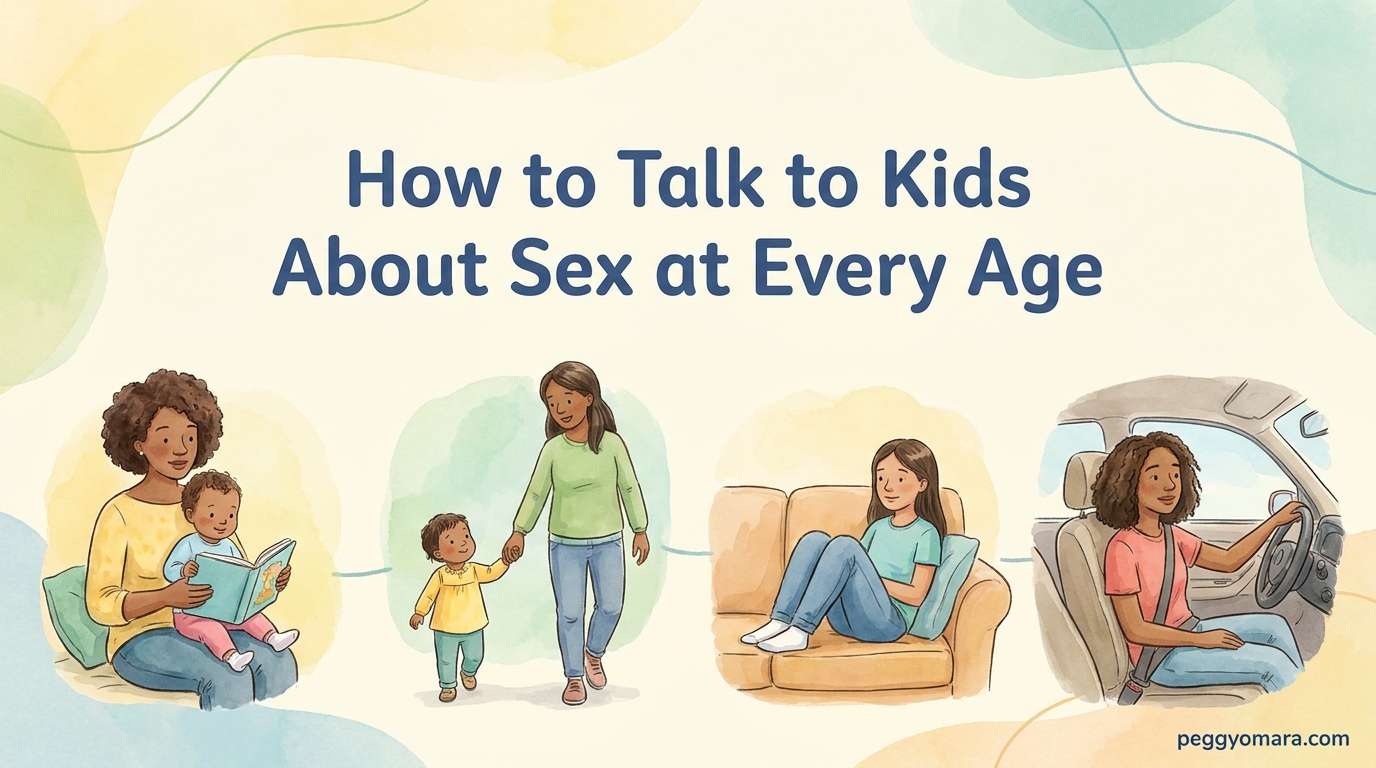
The question caught me off guard during bath time. My three-year-old pointed to her vulva and asked, “Mommy, why does it have a hole?” I froze for a moment. Then I remembered what the sex educator had told me: answer only what they asked, use correct terms, and stay calm. I took a breath and said, “That’s where pee comes out, and it’s also the opening where babies can come out when a grown-up is ready to have a baby.” She nodded, splashed her rubber duck, and moved on. That was it. No trauma. No awkwardness. Just a thirty-second exchange that built a bridge of trust we have crossed many times since.
Learning how to talk to kids about sex at every age does not require a degree in psychology or perfect comfort with every topic. It requires something much simpler: showing up early and often with honest, age-appropriate answers. Research consistently shows that children who receive early sex education from parents are significantly less likely to experience sexual abuse, more likely to delay sexual activity until they are older, and report higher satisfaction in their adult relationships. A 2023 meta-analysis in the Journal of Adolescent Health found that parent-child communication about sex was associated with a 47% reduction in risky sexual behaviors among teenagers.
Yet many parents tell me they feel paralyzed by fear. They worry about saying the wrong thing, giving too much information, or embarrassing their child. Some had parents who never discussed sex at all, leaving them without a model for these conversations. Others received shame-based messages that left them determined to do better but uncertain how. If any of this resonates with you, know that you are not alone. You can build a foundation of open communication that serves your child from toddlerhood through their teenage years and beyond.
Table of Contents
5 Core Principles That Work at Every Age (2026)
Before we dive into specific age groups, let me share the principles that guide every conversation I have had with my own children. These are not rules etched in stone but flexible guidelines that have helped me navigate hundreds of unexpected questions.
1. Use Anatomical Terms From Day One
Call a vulva a vulva, a penis a penis, and testicles testicles. Using cutesy nicknames sends an unconscious message that these body parts are shameful or different from elbows and noses. When you use correct terminology, you accomplish three things: you normalize these body parts, you give your child the vocabulary to communicate clearly if something inappropriate happens, and you establish yourself as a credible source of information. Children who know anatomical terms are better equipped to report sexual abuse because they can describe what happened with clarity.
2. Start Early and Make It Ongoing
There is no single “sex talk” that happens once. Sex education is an ongoing conversation that evolves as your child grows. Starting in the toddler years with simple body part names means you never have to have one big, overwhelming discussion. Instead, you add layers of information gradually. This approach feels more natural for both you and your child. It also signals that you are always available to answer questions, no matter the topic.
3. Answer Only What They Asked
Children usually ask for much less information than parents assume. When your four-year-old asks where babies come from, they typically want a simple explanation like “from a special place inside the mother’s body called the uterus.” They do not need a detailed explanation of sexual intercourse yet. Follow your child’s lead. Give a brief, honest answer and pause. If they want more, they will ask. This approach prevents overwhelming them while still being truthful.
4. Embrace a Shame-Free Tone
Your tone communicates as much as your words. Speak about bodies and reproduction with the same neutral, positive tone you use when explaining digestion or respiration. If you blush, whisper, or laugh nervously, your child learns that this topic is embarrassing. If you remain matter-of-fact, they absorb the message that sexuality is a normal, healthy part of human life. This shame-free foundation becomes crucial when they reach puberty and need to navigate intense physical and emotional changes.
5. Build the Consent Foundation Early
Consent education starts long before sex enters the conversation. When you respect your toddler’s choice to decline a hug from grandma, you teach them that their body belongs to them. When you ask before helping with the potty, you model that we seek permission before touching others. These small daily interactions build the framework for understanding sexual consent later. By the time they are teenagers, the idea that any sexual activity requires enthusiastic agreement will feel obvious, not foreign.
How to Talk to Kids About Sex: The Complete Age-by-Age Guide
The following guide breaks down what to say and how to approach conversations at each developmental stage. Remember that every child develops at their own pace. You know your child best, so adapt these suggestions to fit their specific maturity level and curiosity.
Ages 0-2: Building the Foundation with Body Part Names
Even babies benefit from hearing correct terminology during diaper changes. Narrate what you are doing: “I am wiping your vulva now.” “Let me clean around your penis and testicles.” This may feel strange at first, but you are laying neural pathways that make these words feel normal for both of you. During bath time, name body parts casually: “Here is your knee, your belly button, your vulva.”
Toddlers at this age are naturally curious about bodies. They touch themselves during diaper changes or bath time because it feels good, not because they understand sexuality. Your response shapes their relationship with their body. Simply say, “I see you are touching your penis. That is something we do in private, not at the playground.” This teaches two important concepts: that genital touch is normal, and that it belongs in private spaces.
This is also the age to begin teaching body safety rules. Keep it simple: “No one should touch your penis or vulva except for diaper changes or if the doctor needs to check and Mommy or Daddy is there.” You can also start the conversation about who they can talk to if someone makes them uncomfortable. Identify three to five trusted adults in their life and practice saying, “If anyone makes you feel weird, you tell Mommy, Daddy, Grandma, or your teacher.”
Ages 2-3: Introducing Consent and Body Boundaries
Two and three-year-olds are asserting independence everywhere, including their bodies. This makes it the perfect time to establish that they are in charge of their physical self. When Grandma visits and wants a hug, give your child an out: “You can give a hug, a high-five, or just say hello with words. Your body, your choice.” This might feel awkward with relatives, but it sends a powerful message to your child.
Private parts language becomes important now. Explain that certain parts are private because we keep them covered with clothes or diapers. You can say, “Your vulva and buttocks are private parts. We don’t show them to people unless a doctor or parent is helping with cleaning or a check-up.” Keep the explanation concrete rather than abstract.
Masturbation often begins or continues during this stage. Toddlers discover that touching their genitals feels pleasant and may do so frequently. This is developmentally normal and not a cause for concern. Respond calmly: “I know touching there feels good, but that is a private activity. If you want to do that, please go to your bedroom.” Never shame them or use punishment. Your goal is teaching appropriate context, not eliminating the behavior.
Also introduce the concept of “good touch, confusing touch, bad touch.” Good touches feel safe and comfortable, like hugs from people we trust. Bad touches hurt or feel scary. Confusing touches might feel good physically but make us feel weird inside, or they might involve someone asking us to keep secrets. Tell your child that confusing touches should always be reported to a trusted adult.
Ages 4-5: Where Babies Come From and Simple Reproduction
Preschoolers often ask where babies come from during pregnancy announcements, new sibling arrivals, or even while playing with dolls. This question typically means: where did the baby grow, and how did it get out? You can say: “When two grown-ups decide to make a baby together, the sperm from one parent meets an egg from the other parent. The baby grows in a special place inside the mother’s body called the uterus, and when it is ready, it comes out through the vagina or a doctor helps take it out through surgery.”
Notice what is included here and what is not. You mention sperm and egg meeting without explaining the mechanics of sexual intercourse. You introduce the uterus as the place where babies grow. You acknowledge both vaginal birth and cesarean sections. This satisfies most preschool curiosity without overwhelming them. If they ask how the sperm and egg meet, you can add: “The sperm comes out of the penis and travels to meet the egg inside the woman’s body.” Most four-year-olds will accept this and move on.
Children this age also benefit from understanding fertility and reproduction as natural processes. You might explain that not all people can make babies, and that is okay. Some families adopt, use IVF, or have children through surrogacy. Introducing this diversity early normalizes different paths to parenthood and sets the stage for understanding LGBTQ+ families later.
This is also a good age to reinforce body safety with more detail. Explain that secrets about touching are never okay. Teach them that if someone says, “This is our secret,” they should tell you immediately. Practice this so they know exactly what to do.
Ages 6-8: The Mechanics of Reproduction and Online Safety
School-age children are ready for more specific information about reproduction. By age six or seven, many children ask exactly how the sperm gets to the egg. You can explain sexual intercourse simply: “When two grown-ups decide to make a baby together, the penis goes into the vagina and releases sperm that can meet the egg.” Some parents prefer to describe this as “special cuddling” or being “very close together,” but I have found that direct, simple language reduces confusion.
Emphasize that this is something only adults do when they are ready to be parents or when they are expressing love in a committed relationship. You might say, “This is something grown-ups do when they have decided they want to make a baby or when they are sharing love in a very private, special way. It is not something children do because their bodies are not ready.” This frames sexual activity as an adult choice while acknowledging it also happens for reasons beyond reproduction.
Online safety becomes critical during these years. Many children encounter internet pornography accidentally around ages eight to eleven. Prepare them before this happens. Say, “Sometimes pictures or videos pop up on screens that show naked people or people doing sexual things. If you ever see something like that, turn off the screen and come tell me immediately. I will not be angry. It is important that we talk about it.” This removes shame and ensures they will come to you rather than hide what they saw.
Also discuss that pornography is not realistic. Explain that it is acting, like movies, and does not show what real love or healthy sex looks like. Real intimacy involves connection, communication, and consent that you cannot see in videos. This conversation protects them from developing distorted expectations about sex and relationships.
Puberty preparation should begin around age eight, especially for girls who may start menstruating as early as nine or ten. Explain that in the coming years, their body will start changing. Girls will develop breasts and begin having periods. Boys will notice their testicles and penis growing and will begin having wet dreams and erections more frequently. Normalize these changes as healthy and expected parts of growing up.
Ages 9-12: Puberty, Relationships, and Critical Thinking
The tween years bring rapid physical changes and new emotional complexity. Children this age need detailed information about puberty before it begins. For girls, explain menstruation thoroughly: what happens in the body, what periods look and feel like, and how to use pads, tampons, or period underwear. Show them where supplies are kept and teach them to track their cycle. For boys, explain wet dreams, spontaneous erections, voice changes, and growing facial hair. Normalize nocturnal emissions and erections as involuntary and nothing to be embarrassed about.
Boys and girls both need information about the opposite sex’s puberty experiences. This builds empathy and prevents confusion. Girls should understand that boys also experience emotional ups and downs due to hormones. Boys should understand menstruation and why girls might need accommodations during that time. Understanding how bodies work differently helps children develop body-positive attitudes.
Crushes and romantic feelings emerge during this period. Validate these emotions without dismissing them as “puppy love.” Say, “It is normal to have strong feelings for someone at your age. Those feelings are real, and they can be intense.” Discuss what healthy crushes look like: mutual respect, kindness, and boundaries. Also address unrequited feelings and how to handle rejection with dignity.
Media literacy becomes essential as tweens consume more content independently. Talk about how movies, television, and social media portray relationships and sex. Point out problematic patterns: pursuit after rejection shown as romantic, lack of communication before intimacy, or unrealistic body standards. Teach them to ask critical questions: “Does this look consensual? Are both people communicating? Does this seem realistic?”
Consent education deepens now. Move beyond “no means no” to “yes means yes.” Explain that enthusiastic, verbal agreement should be the standard for any physical intimacy. Discuss how alcohol and drugs impair judgment and the ability to consent. Talk about the importance of checking in with partners and respecting any hesitation or uncertainty.
Also address peer pressure and the social dynamics of middle school. Role-play scenarios where they might feel pressured to share sexual information, send photos, or engage in sexual talk they are not ready for. Give them scripts: “I am not comfortable talking about that,” or “My parents check my phone, so I cannot send that.”
Ages 13+: Ongoing Conversations About Healthy Sexuality
By the teenage years, your child likely knows the mechanics of sex. Now the focus shifts to context, values, and decision-making. Conversations about sex should expand to include healthy relationships, communication, and emotional readiness. Ask questions rather than lecture: “What do you think makes someone ready for sex?” “How do you know if you can trust someone?” Listen to their answers without immediate judgment.
Discuss contraception and STI prevention comprehensively. Explain birth control options, how they work, and their effectiveness rates. Discuss condoms for STI protection, not just pregnancy prevention. Make sure they know where to obtain contraception confidentially if needed. Remove judgment from these discussions: “I hope you will wait until you are older, but if you do choose to have sex, you must use protection every single time.”
Talk about emotional readiness for sex. Many teenagers focus on physical readiness while overlooking the emotional complexity. Discuss how sex changes relationships, the potential for regret, and the importance of having sex with someone who respects and cares for them. Address the difference between physical attraction and emotional intimacy.
Pornography discussions should continue and expand. Teenagers are likely encountering porn, whether intentionally or through peer sharing. Discuss how pornography distorts reality: the absence of communication, the unrealistic bodies, the lack of consent negotiation, and the often degrading treatment of women. Teach them that expecting real sex to look like pornography will lead to disappointment and potentially harmful behavior.
Include LGBTQ+ inclusivity explicitly. Acknowledge that some people are attracted to the same gender, both genders, or no gender at all. Normalize diverse sexual orientations and gender identities as healthy variations of human sexuality. If your teenager is questioning their own identity, create a safe space for exploration without pressure to label themselves.
Continue consent education with nuance. Discuss scenarios involving alcohol, pressure, and unclear communication. Teach that consent must be enthusiastic, ongoing, and can be withdrawn at any time. Make clear that your values around respect and communication apply regardless of gender or sexual orientation.
Scripts for 5 Awkward Moments Every Parent Faces
No matter how prepared you are, certain moments will catch you off guard. Here are specific scripts for common scenarios that trip up even the most dedicated parent.
1. When You Do Not Know the Answer
Your child asks something you have no idea how to answer. Script: “That is a great question, and I want to give you an accurate answer. Let me look that up and we can talk about it tomorrow.” Then actually follow through. This models that learning is ongoing and that accuracy matters more than having all the answers immediately.
2. When Your Child Says “That Is Gross”
You are explaining reproduction and your child wrinkles their nose and says, “Eww, that is disgusting.” Script: “It can sound strange when you first hear about it. Your body is designed to do amazing things, and this is just one of them. As you get older, it will feel less weird and more like a normal part of life.” Do not force them to feel comfortable immediately. Let them have their reaction while maintaining your calm, matter-of-fact tone.
3. When Your Child Shares Information at School
The teacher calls because your child explained menstruation in detail at the lunch table or told classmates how babies are made. Script to your child: “I am proud of you for knowing the correct information. Some parents want to be the ones to tell their own kids, so next time maybe check with me first before explaining to friends.” Script to the teacher: “We believe in providing accurate information at home. I am happy to share resources if other parents have questions about how to discuss these topics.”
4. When Your Child Walks In On You
You are having sex and your child walks into the bedroom. Script: “I am sorry we did not lock the door. You saw Mommy and Daddy having private time together. We were making love, which is something adults do to show love and closeness. I know that might look strange to you. Do you have any questions?” Address their immediate concern first. Wait until later to install a lock and establish rules about closed doors.
5. When Your Child Asks About Your Sexual History
Your teenager asks if you had sex before marriage, or how old you were when you first had sex. Script: “I want to be honest with you while also maintaining some privacy. I will tell you that I made some choices I am proud of and some I wish I had done differently. What I want you to know is that I hope you will wait until you are older and in a committed relationship. When you are ready, I want you to have accurate information and protection.” Share values without oversharing details that might create discomfort.
Recommended Books to Support Your Conversations
Books provide an excellent bridge for conversations that feel awkward. They give children accurate information, normalize their curiosity, and offer a reference they can return to privately. Here are my recommendations organized by age.
For Toddlers and Preschoolers (Ages 2-5)
“C is for Consent” by Finnie Coleman introduces body boundaries through simple scenarios. The diverse characters and clear message make it perfect for the youngest children learning about personal space.
“Who Has What? All About Girls’ and Boys’ Bodies” by Robie Harris teaches anatomical differences through a family at the beach. It normalizes body diversity without shame.
“The Amazing True Story of How Babies Are Made” by Fiona Katauskas covers conception through birth with accurate, cartoon-style illustrations that feel accessible rather than clinical.
For School-Age Children (Ages 6-9)
“Sex is a Funny Word” by Cory Silverberg focuses on communication, trust, and respect. The comic-style format and inclusive representation make it a modern classic.
“It’s Not the Stork! A Book About Girls, Boys, Babies, Bodies, Families and Friends” by Robie Harris answers common questions with scientific accuracy while maintaining a warm tone.
“I Am Jazz” by Jessica Herthel and Jazz Jennings introduces gender identity through the true story of a transgender child. Essential for building understanding of diverse experiences.
For Tweens (Ages 9-12)
“Celebrate Your Body (and Its Changes, Too): The Ultimate Puberty Book for Girls” by Sonya Renee Taylor covers menstruation, body changes, and emotional shifts with body-positive messaging.
“Guy Stuff: The Body Book for Boys” by Cara Natterson addresses boys’ specific puberty concerns including hygiene, emotional changes, and physical development.
“Wait, What? A Comic Book Guide to Relationships, Bodies, and Growing Up” by Heather Corinna and Isabella Rotman covers puberty, sex, and relationships through an inclusive, LGBTQ-friendly lens.
For Teens (Ages 13+)
“S.E.X.: The All-You-Need-To-Know Sexuality Guide to Get You Through Your Teens and Twenties” by Heather Corinna is comprehensive, inclusive, and judgment-free. It covers everything from anatomy to consent to relationships.
“Consent (for Kids!): Boundaries, Respect, and Being in Charge of You” by Rachel Brian though titled for kids, works well for teens needing a clear understanding of consent mechanics.
“You Know, Sex: Bodies, Gender, Puberty, and Other Things” by Cory Silverberg updates the classic sex education format with modern, inclusive language and focus on equity and justice.
For Parents
“It’s Perfectly Normal: Changing Bodies, Growing Up, Sex, and Sexual Health” by Robie Harris serves as both a reference for parents and a book to share with older children.
“The Planned Parenthood Guide to Talking to Kids About Sex” by Dr. M. Markovic offers research-backed strategies and conversation starters for every age.
“This Book Is Gay” by Juno Dawson helps parents understand LGBTQ+ experiences and support questioning or queer children.
Frequently Asked Questions
What is a good age to start talking to kids about sex?
The best age to start talking to kids about sex is from birth, using correct anatomical terms during diaper changes and bath time. By age two, you should be discussing body boundaries and consent. Detailed conversations about reproduction typically begin around ages four to six when children naturally ask where babies come from. There is no single ‘right’ age because sex education is an ongoing conversation that evolves as your child grows.
Will talking to kids about sex encourage them to have sex earlier?
No. Research consistently shows the opposite is true. Children who receive comprehensive sex education from parents are more likely to delay sexual activity and have fewer sexual partners than those who receive no information. A 2023 meta-analysis found that parent-child communication about sex was associated with a 47 percent reduction in risky sexual behaviors among teenagers. Knowledge empowers children to make informed decisions and resist peer pressure.
Is it normal for young children to touch themselves?
Yes, masturbation and genital touching are completely normal for toddlers and young children. Children discover that touching their genitals feels pleasant, just as they discover other pleasant physical sensations. This is not sexual in the adult sense. The appropriate response is to teach privacy: ‘I know that feels good, but that is something we do in private, not at the playground.’ Never shame a child for this normal behavior.
How do I explain sexual intercourse to my child?
For preschoolers, keep it simple: ‘When two grown-ups decide to make a baby, the sperm from one parent meets the egg from the other parent.’ For ages six to eight, add the mechanics: ‘The penis goes into the vagina and releases sperm that can meet the egg.’ Always emphasize that this is something only adults do when they are ready, and frame it as a loving, private act between committed partners.
What should I do if my child accidentally sees pornography?
Stay calm and thank them for telling you. Say: ‘I am glad you told me. What you saw is acting, like in movies, and it is not what real loving relationships look like. Those are adults doing things for a camera. Real intimacy involves connection, communication, and consent.’ Discuss pornography with children by age eight, before accidental exposure typically occurs. Set up parental controls, but emphasize that they should come to you immediately if they see anything confusing online.
Conclusion
Learning how to talk to kids about sex at every age is really about building a relationship of trust that lasts a lifetime. When you show up with honest answers, correct terminology, and a shame-free attitude, you become your child’s most reliable source of information about their body and their health. You cannot prevent every awkward moment or control every piece of information they encounter. But you can ensure that when questions arise, they come to you first.
Remember that perfection is not the goal. Some conversations will feel clumsy. You will occasionally give too much or too little information. What matters most is the overall pattern: your child knows they can ask you anything, and you will answer with respect and honesty. Start today, wherever you are. Your child’s future relationships, safety, and self-respect depend on the foundation you build now.