

A garage dehumidifier bought for winter work has one job no other appliance has: pull water out of cold air without icing itself solid. That takes a unit rated for low-temperature operation, a real auto-defrost cycle and continuous drainage, and the best dehumidifiers for garages in winter are exactly the models that publish all three. The category rule is simple, and everything below it follows from that rule.
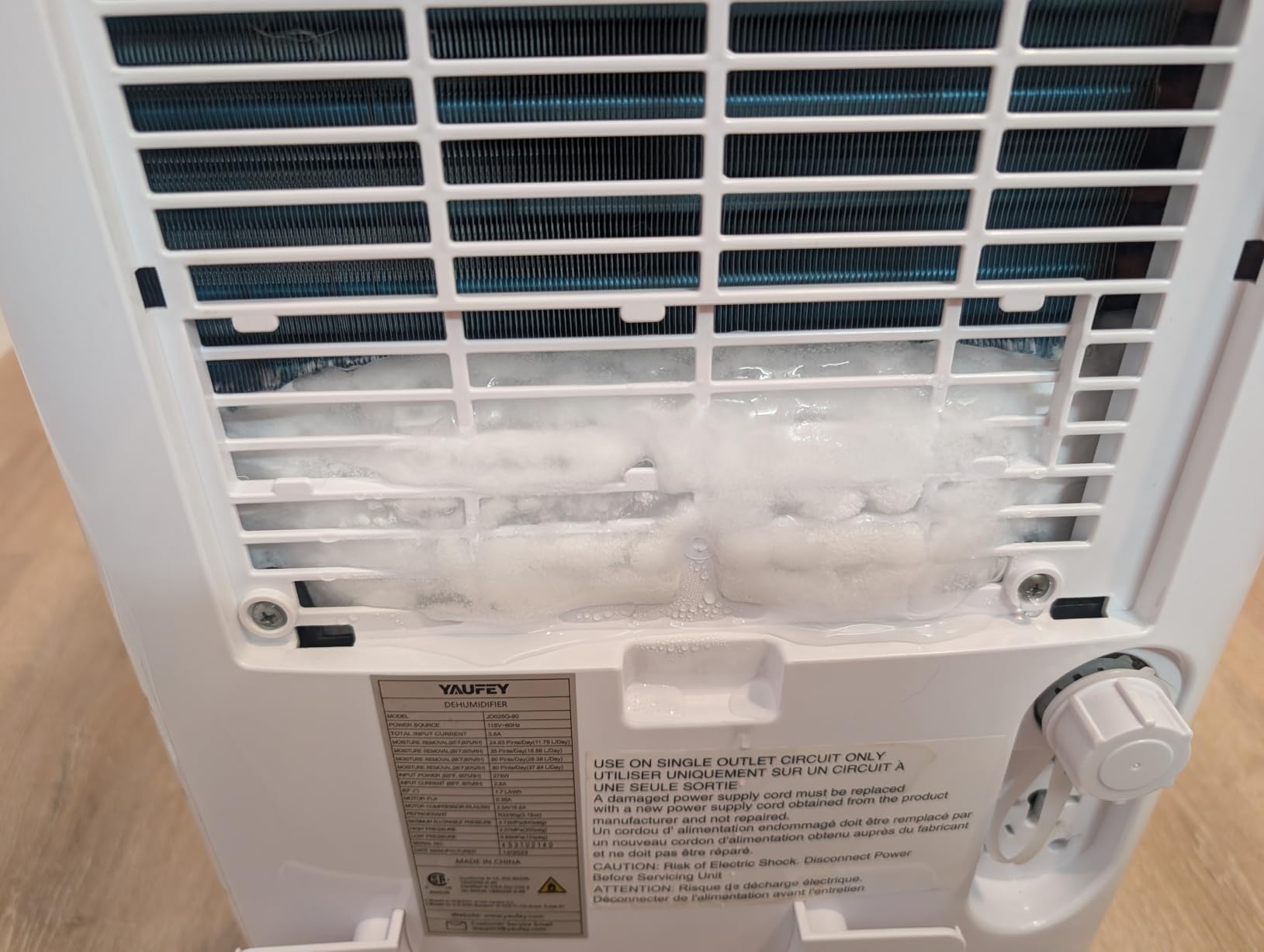
Get it wrong and you get the single most reported failure in cold-climate forums: a unit that looks fine when you carry it out to the garage, runs for an hour, grows a solid block of ice on its evaporator coil and collects nothing for the rest of the season. Nobody sees the frost. You just see the bucket never fills.
So this roundup is ordered by winter behaviour, not by headline pint rating. I read the coil, compressor, drainage, defrost, wattage and temperature specs for all ten models below, and I flagged the ones that publish real output figures at cool temperatures versus the ones that only quote a 95F laboratory number. Ten units, one winter-focused question each.
If you want the general buying framework first, our guide to the best dehumidifiers covers room models, and the commercial dehumidifier roundup covers the heavy metal housings. This page is the cold-garage slice.
Table of Contents
Top 3 Dehumidifier Picks for Winter Garages in 2026

All 10 Best Winter Garage Dehumidifiers Compared (September 2026)
| Product | Specifications | Action |
|---|---|---|
 Waykar 120 Pint Waykar 120 Pint |
|
Check Latest Price |
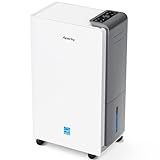 AEOCKY 80 Pint AEOCKY 80 Pint |
|
Check Latest Price |
| yaufey 150 Pint with Pump |
|
Check Latest Price |
 ALORAIR Sentinel HD55S ALORAIR Sentinel HD55S |
|
Check Latest Price |
 Waykar 125 Pint Crawl Space Waykar 125 Pint Crawl Space |
|
Check Latest Price |
 Moiswell 155 Pint Moiswell 155 Pint |
|
Check Latest Price |
 Gasbye 115 Pint Gasbye 115 Pint |
|
Check Latest Price |
 MIONJO 4500 Sq Ft MIONJO 4500 Sq Ft |
|
Check Latest Price |
 GoveeLife Smart Dehumidifier GoveeLife Smart Dehumidifier |
|
Check Latest Price |
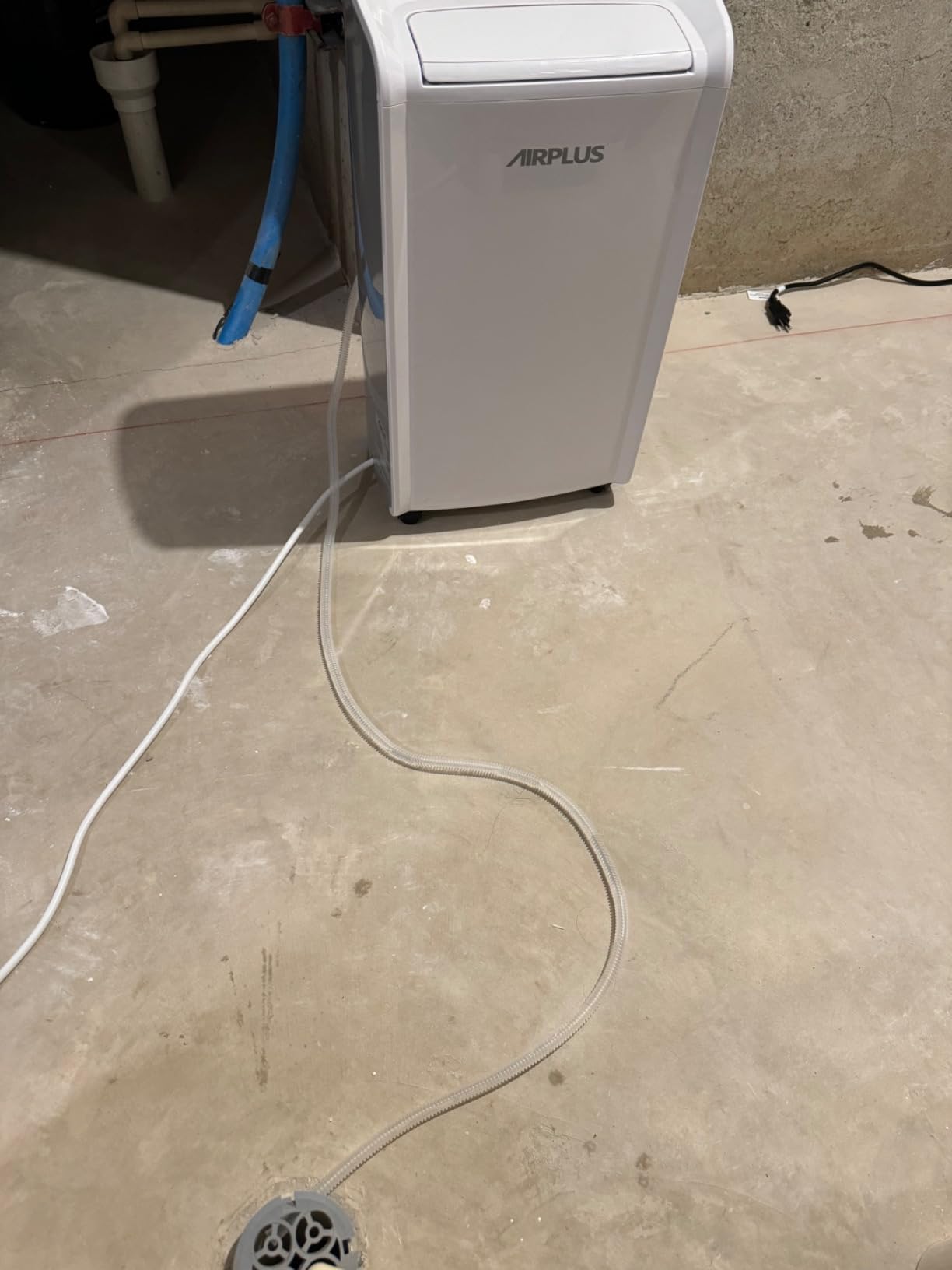
 AIRPLUS 70 Pint AIRPLUS 70 Pint |
|
Check Latest Price |
1. Waykar 120 Pint 6000 Sq Ft – Our Pick for Most Winter Garages
Waykar 120 Pints 6000 Sq. Ft 2025 Energy Star Dehumidifier for Basement
- Automatic defrost and overload protection for low-temperature spaces
- 120 pints per day suited to a large two-car garage or a damp basement
- 30%-80% humidity control with 90 degree auto swing
- ENERGY STAR certified and DOE compliant
- Quiet at 42 dB with a 24-hour timer
- Plastic housing rather than the metal used by commercial models
- Only a single fan speed setting
- A minority of owners report control board and auto shut-off failures
I keep coming back to this one because of the combination rather than any single number. 22,498 reviews at a 4.3 average is by far the deepest field history in this group, and depth matters more than a headline stat when you are asking whether a compressor survives five winters of freeze-thaw cycling.
Automatic defrost and overload protection are both listed as standard, and overload protection is the bit that matters in a cold garage because it is what shuts the machine down when the coil load gets unreasonable. The 30% to 80% humidity control range with a 90 degree swing louver means you can aim the discharge at a cold corner rather than blasting one wall.
At 350 watts it sits in the middle of the group, which makes it a reasonable unit to run on a timer through a season. Owners repeatedly point to the 42 dB figure being real rather than a marketing number, which matters if the garage sits next to a bedroom.
Capacity is quoted at 120 pints per day, and I would treat that as a warm-garage number. Published capacity ratings are measured at 95F, and a winter garage will never deliver it. That caveat applies to every unit in this roundup, including the ones that publish better data.
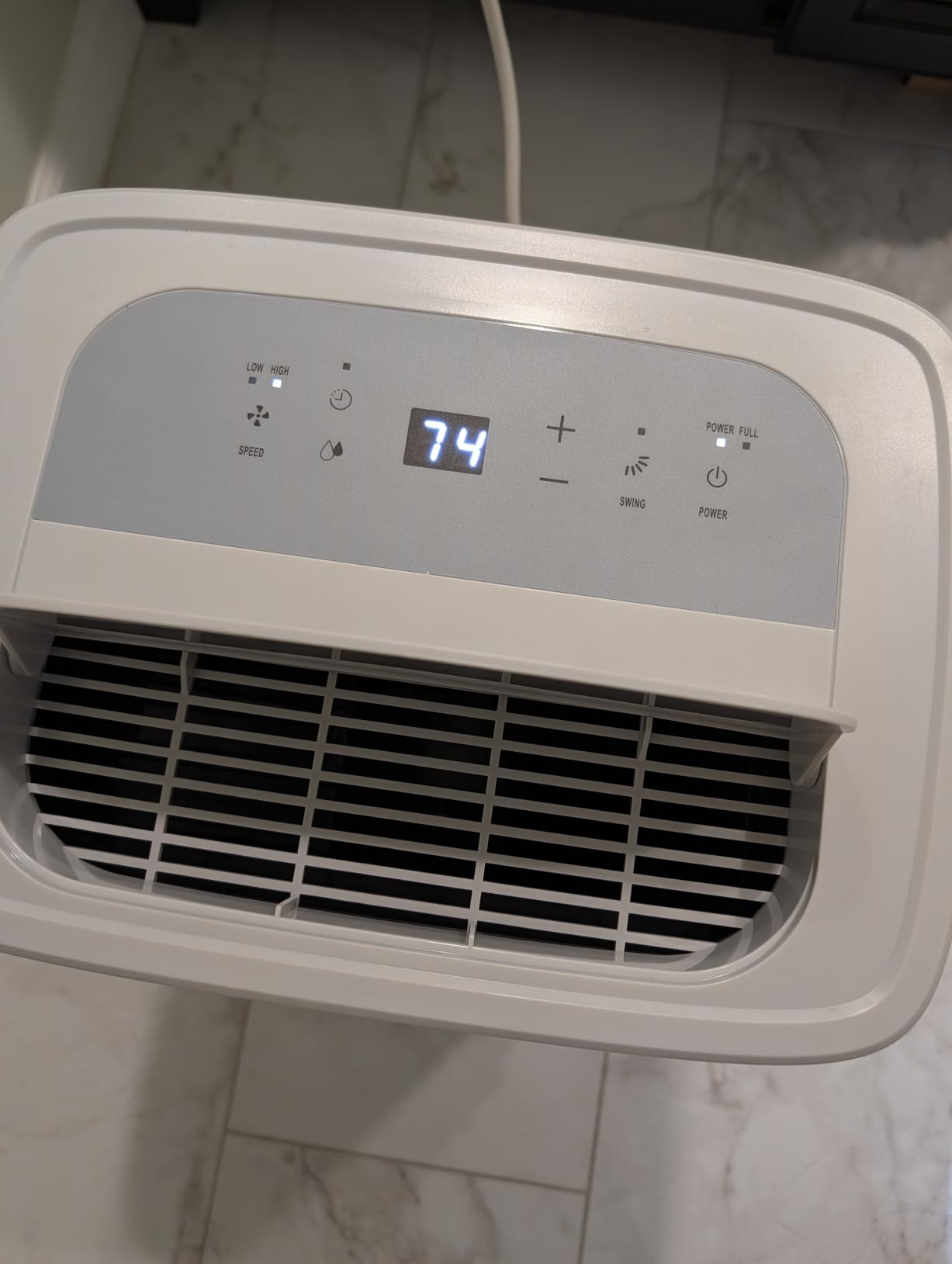
What to check before you buy it for a garage
Confirm your garage sits above roughly 60F on a typical winter night, or accept that this unit spends much of the season in its defrost cycle collecting less than the label says. The listing states automatic defrost but does not publish a numeric minimum operating temperature, and that missing number is the single thing I would want in writing before buying.
Plan on continuous drainage rather than tank emptying. The included 3.3 ft drain hose covers a short run to a floor drain, and the 1.14 gallon tank is small enough to overflow unnoticed in a space you walk through twice a week.
Where it falls short
Single fan speed is a real limitation in a garage. You often want low airflow to keep the compressor running longer and pull more water at a steady rate, and this unit does not give you that dial. The plastic housing also means it is a poor choice for a space with a rough, abrasive environment.
There is a meaningful share of owners describing auto shut-off and control board failures that ended in a replacement. The failure rate implied by a 9% one-star share on 22,000 reviews is still low, but it is not nothing, and you should weigh that against a five-year compressor warranty on some models here.
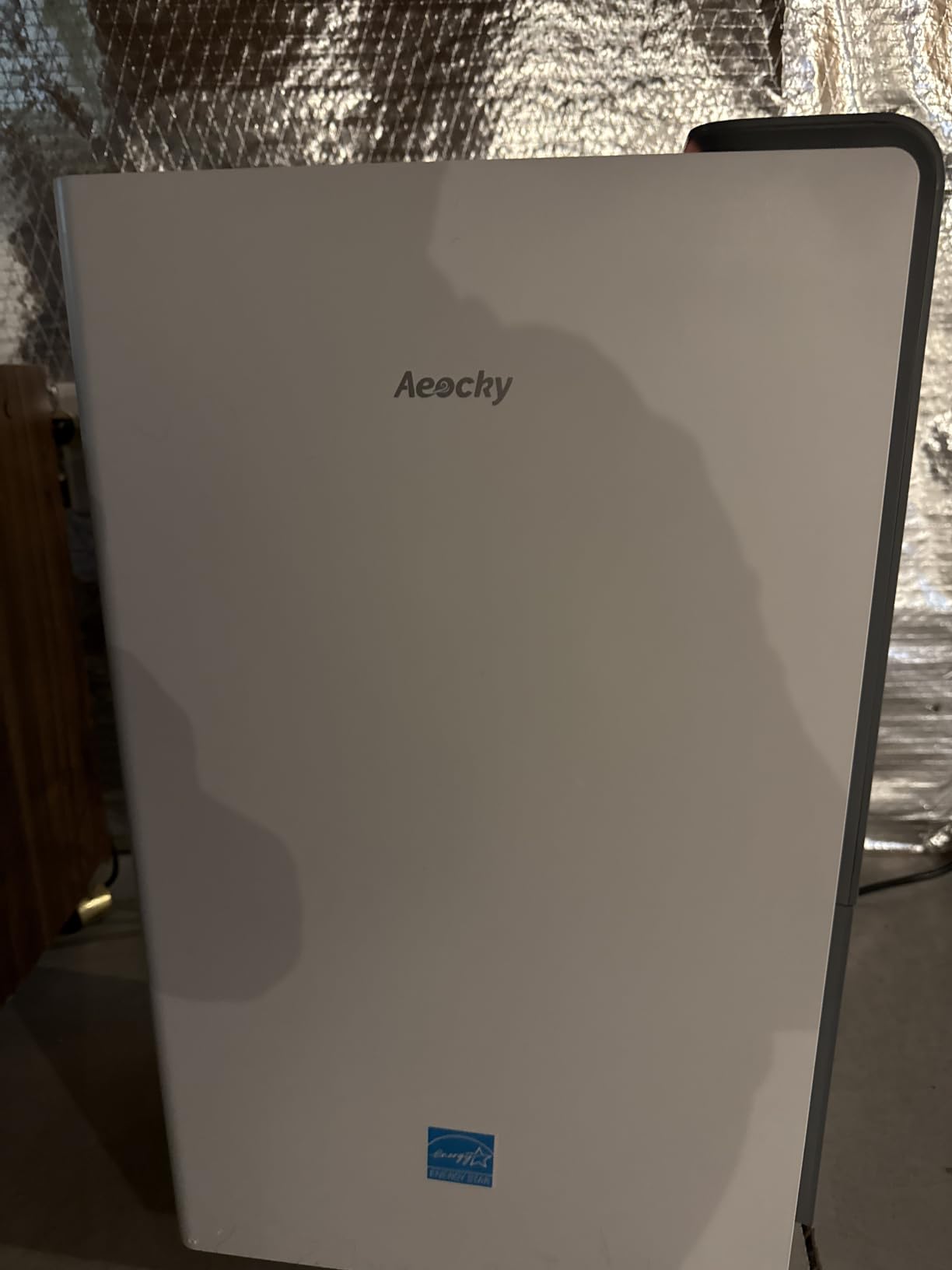
2. AEOCKY 5500 Sq Ft 80 Pint – Best Value and the Clearest Low-Temp Rating
AEOCKY 5500 Sq.Ft Energy Star Most Efficient 2025 Dehumidifier Max 80Pint/D
- The only unit here that publishes a working low-temperature figure
- Defrost sensors hold operation to about 65F where ordinary compressor models ice up
- ENERGY STAR Most Efficient 2025
- a tier about 2.6% of ENERGY STAR models reach
- Copper evaporator and condenser tubing with hydrophilic foil
- 44 dB at lowest fan speed with sleep mode
- Power-off memory resumes automatically after a power cut
- 80 pints per day is well below the 120-155 pint models
- Gravity drainage only so the unit must sit above the drain
- Energy savings and three-year design life claims come from the manufacturer
This is the unit I would tell a friend to buy if their garage actually gets cold. It is also the only model in the roundup that states a minimum operating temperature in the open, roughly 65F, which is a more useful number than any headline pint figure on the other nine.
It publishes two capacity points too: 80 pints per day at 95F and 95% RH, and 56 pints per day at 86F and 80% RH. That second number is the honest one, and having it published tells you the manufacturer expects you to think about actual conditions rather than a laboratory hot box.
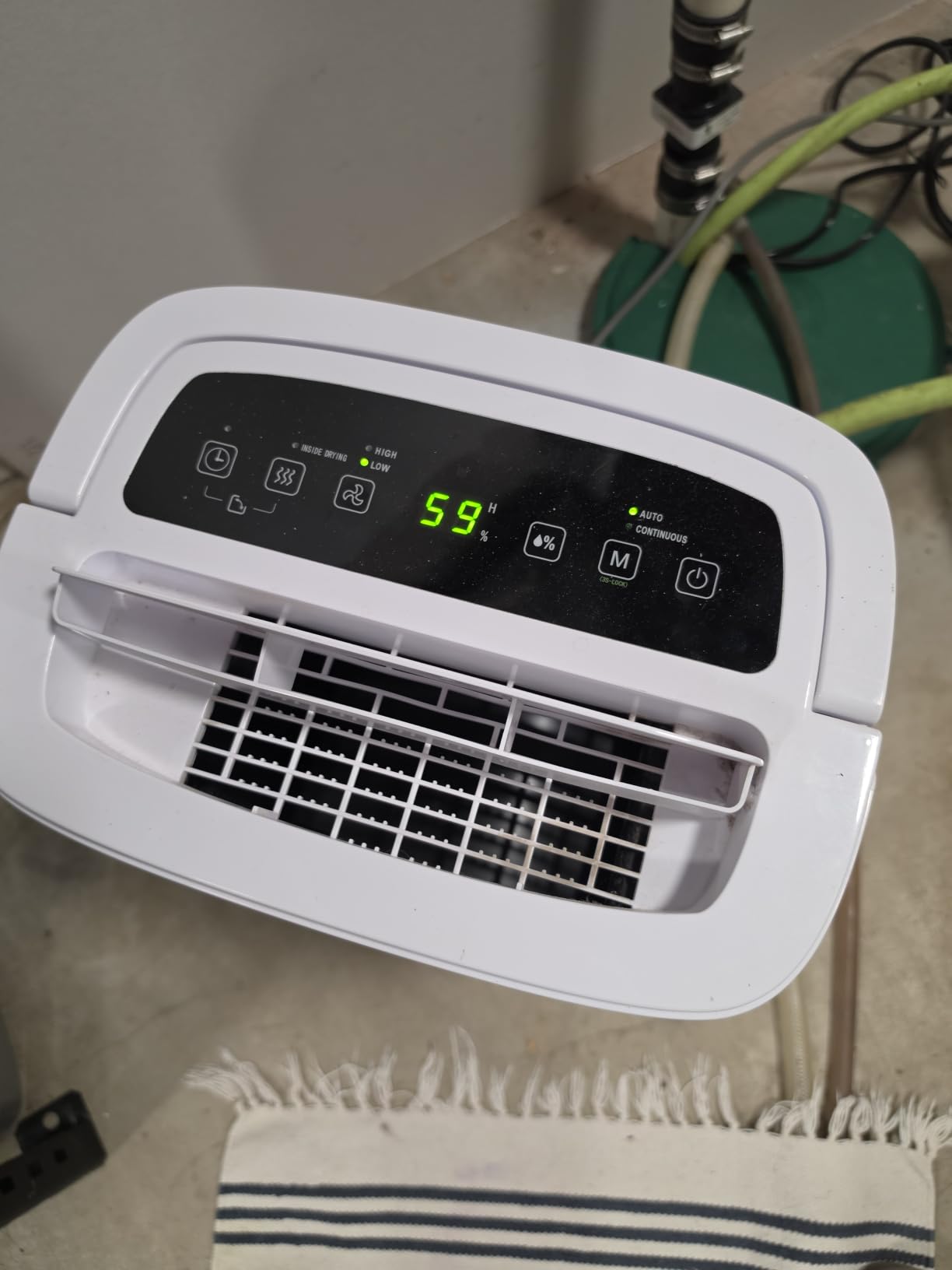
At 280 watts this is the lowest draw in the group, and ENERGY STAR Most Efficient 2025 certification is a genuinely narrow tier rather than a sticker. If you plan to run the thing continuously through a four-month winter, that efficiency rating does more for you than another 20 pints of headline capacity.
The 3-year coverage and ETL and RoHS certification are also better than most consumer plastic boxes in this lineup. Power-off memory means it resumes on its prior setting after a garage circuit trips, which owners in cold climates consider close to mandatory.
What to check before you buy it for a garage
Size honestly. 80 pints per day is fine for a one-car garage or a moderately damp two-car space, and thin for a workshop with a wet floor or a garage with a wood stove. Buy it for a space you can close the door on, not a space you plan to heat up.
Drainage is gravity only, so the unit has to sit above the floor drain or sump. There is no pump, which means an above-grade discharge line needs a fall you may not have. Measure before you order.
Where it falls short
The 80 pint ceiling is the honest limitation. In a large two-car garage that stays above 70F with a wet car in it, a larger model will bring the space down faster and hold it there.
Watch the marketing claims closely. The energy savings and three-year design life figures come from the manufacturer rather than independent testing, so treat them as directional. The copper coil and hydrophilic foil construction is a real design detail that should help cold-weather heat exchange, but it is not a substitute for a published minimum temperature.
3. yaufey 150 Pint with Pump – Best Drainage Setup for a Damp Two-Car Garage
Yaufey 150 Pint Dehumidifier with Pump for Basement 8500 Sq. Ft.
- Three drainage options including upward pump discharge
- 16.4 ft pump hose plus 3.28 ft gravity hose both included
- 1.85 gallon tank is larger than most consumer models here
- 30%-80% RH in 5% steps with three presets
- Three fan speeds and a 40-80 degree swing
- Owners report drops from 80% to 42% RH in about a day and a half
- 500W draw adds meaningful running cost for continuous use
- Listed upper temperature rating of 89.6F is lower than several rivals
- Plastic housing
- One owner reported a full-tank shut-off fault
The reason this unit sits near the top is drainage, not capacity. A built-in pump that discharges water upward means you can send it to a drain that is above the outlet, across the garage, or through a wall, which removes almost every routing constraint in an old garage with an awkward slab.
150 pints per day across three fan speeds and a 40 to 80 degree swing gives you real control over a large space. Owners report a specific, checkable result: a garage reading 80% RH brought down to 42% in roughly a day and a half.
Both hoses ship in the box, a 16.4 ft run for the pump and a 3.28 ft piece for gravity drainage, and both work with a standard garden hose. That means you do not have to plan a weekend around finding fittings.
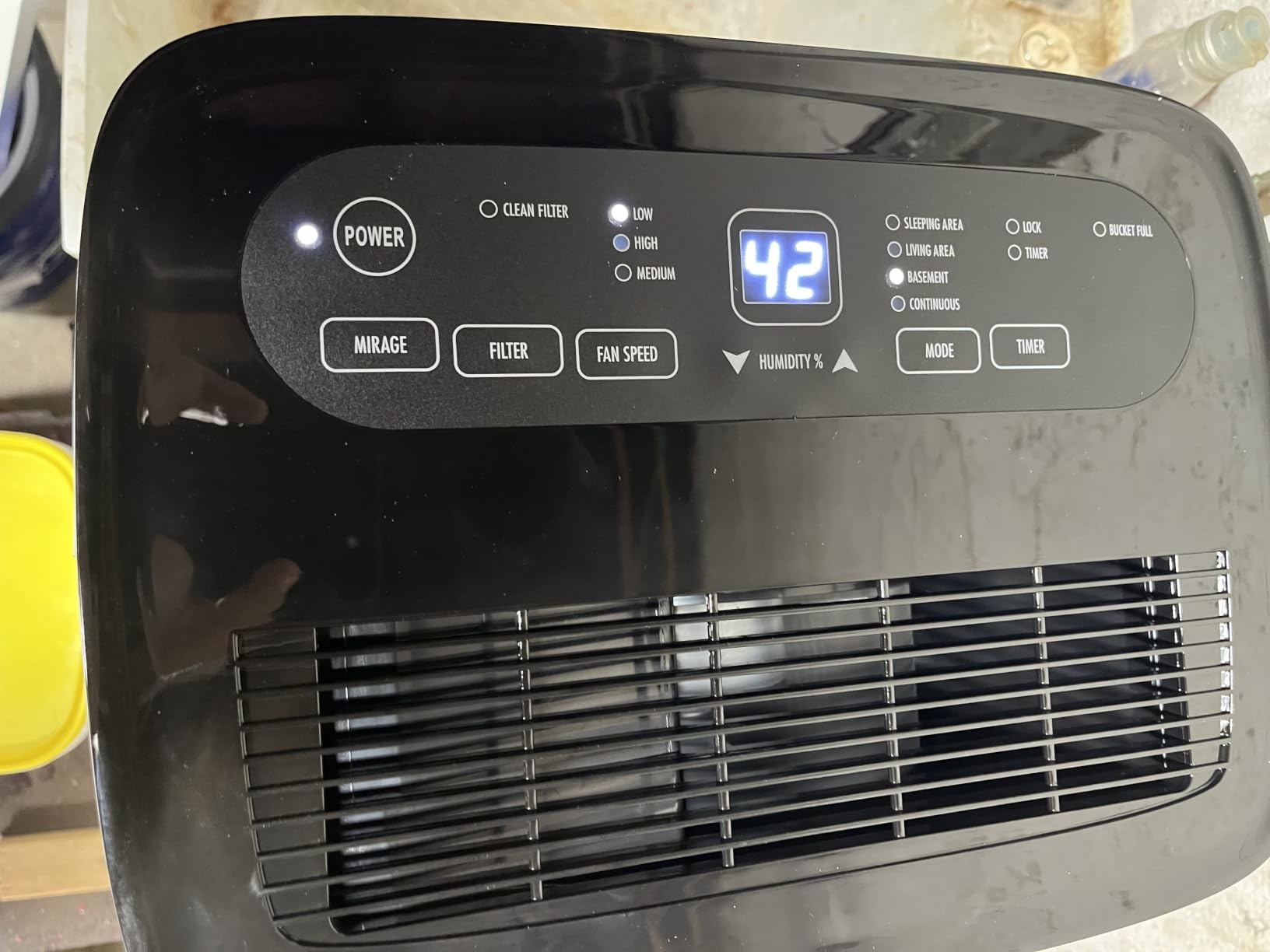
Auto defrost, power-off memory, timer, overload protection and a digital humidity display are all present, and the temperature and humidity sensor drives the 5% step adjustment. The 1.85 gallon tank is a genuine improvement over the half-gallon tanks common in this class.
What to check before you buy it for a garage
Confirm the 500 watt draw is acceptable on the circuit you plan to use. It is among the highest draws in this lineup, and on a 15-amp circuit shared with a welder or a space heater it is the first thing that will trip.
Look at the 89.6F upper temperature rating. It is lower than several rivals in this list, so this is not the unit for a garage in the southern United States that sits near 100F on a summer afternoon.
Where it falls short
500 watts run continuously is a meaningful operating cost, and in an unheated garage that added heat is not always welcome in a workshop you want to work in. Reviewers in cold climates note the added warmth as a genuine side effect rather than a selling point.
Plastic housing on a unit this heavy is a compromise, and 39.7 pounds is awkward to move across a threshold. If you are going to reposition it seasonally, budget for two people or a dolly.
4. ALORAIR Sentinel HD55S – Best Metal Build for Damp Crawl Spaces and Basements
ALORAIR 120 Pints Energy Star Crawlspace Dehumidifier, Sentinel HD55S
- Metal housing built for crawl spaces
- basements and utility areas
- Automatic defrost with sensors pauses the compressor while the fan clears frost
- Continuous drainage through a built-in drain outlet
- Compact 19.2 by 12.2 by 13.3 inch footprint fits between joists
- ETL listed with a 6-year limited warranty
- Users report an 80% RH crawl space held below 60%
- The priciest unit in the roundup
- Gravity drain only so it must be elevated above the sump
- 41.7 pounds is hard to move into a tight crawl space
- Humidity readings vary by plus or minus 5%
- Remote monitoring is a paid accessory
This is the one I would look at if the dampness is coming from under the floor rather than off the ceiling. The Sentinel HD55S is a metal commercial chassis with an automatic defrost system that pauses the compressor and lets the fan run to clear frost, which is exactly the behaviour you want below 60F.
Capacity is stated two ways, 120 pints at saturation and 55 pints at AHAM. The second figure is the one to plan around, and the fact that both appear on the spec sheet is a good sign about how the manufacturer handles capacity claims.
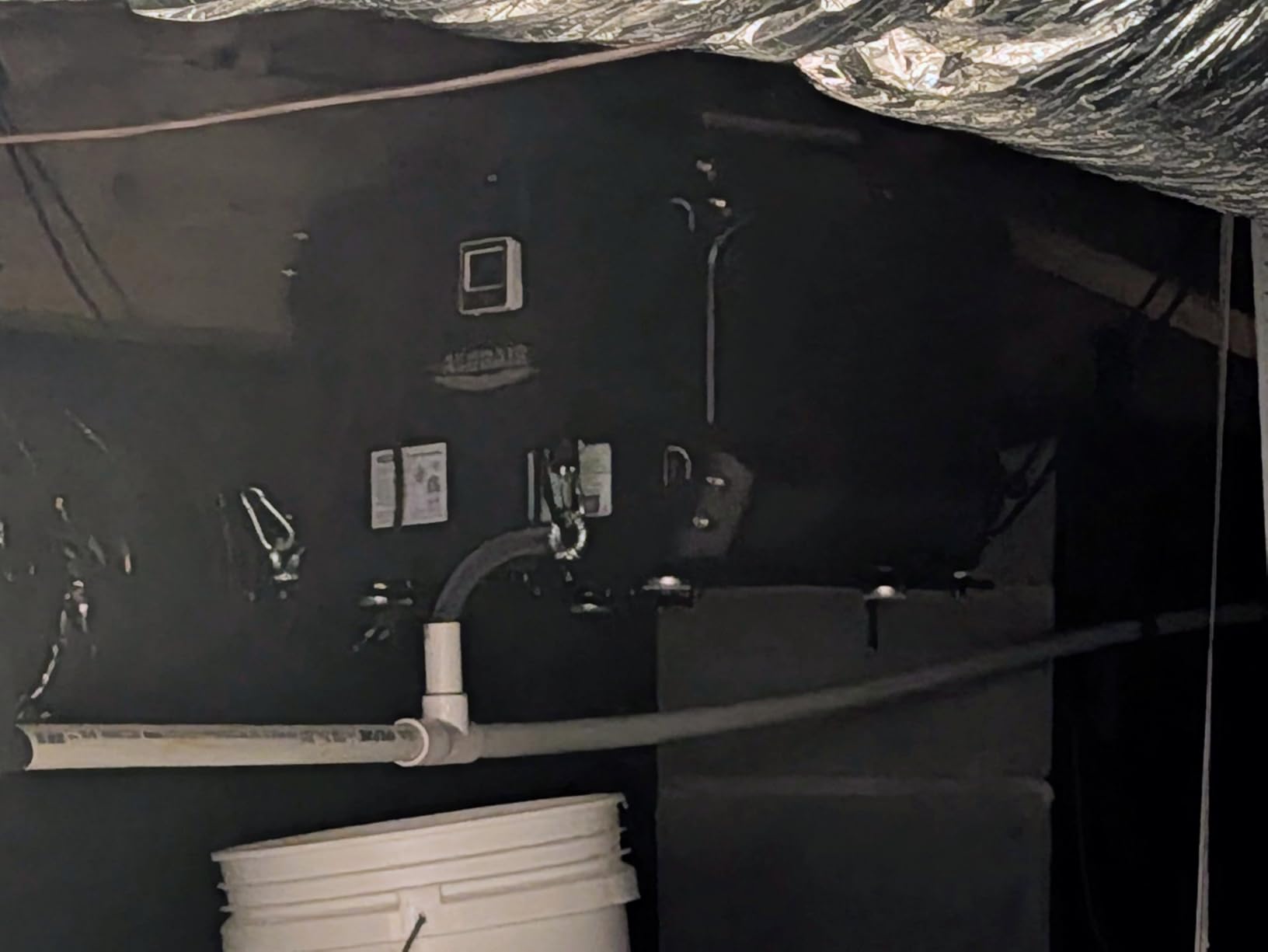
The continuous drain outlet means no tank to remember, and the MERV-1 filter keeps dust off the internal components in a space that is rarely cleaned. At 19.2 by 12.2 by 13.3 inches it slides between joists, which most consumer towers will not do.
Owners running long-term installations report a crawl space that started at 80% RH settling into readings below 60% and staying there. The warranty is the strongest here too, one year parts and labor, three years on the refrigeration system, five years parts.
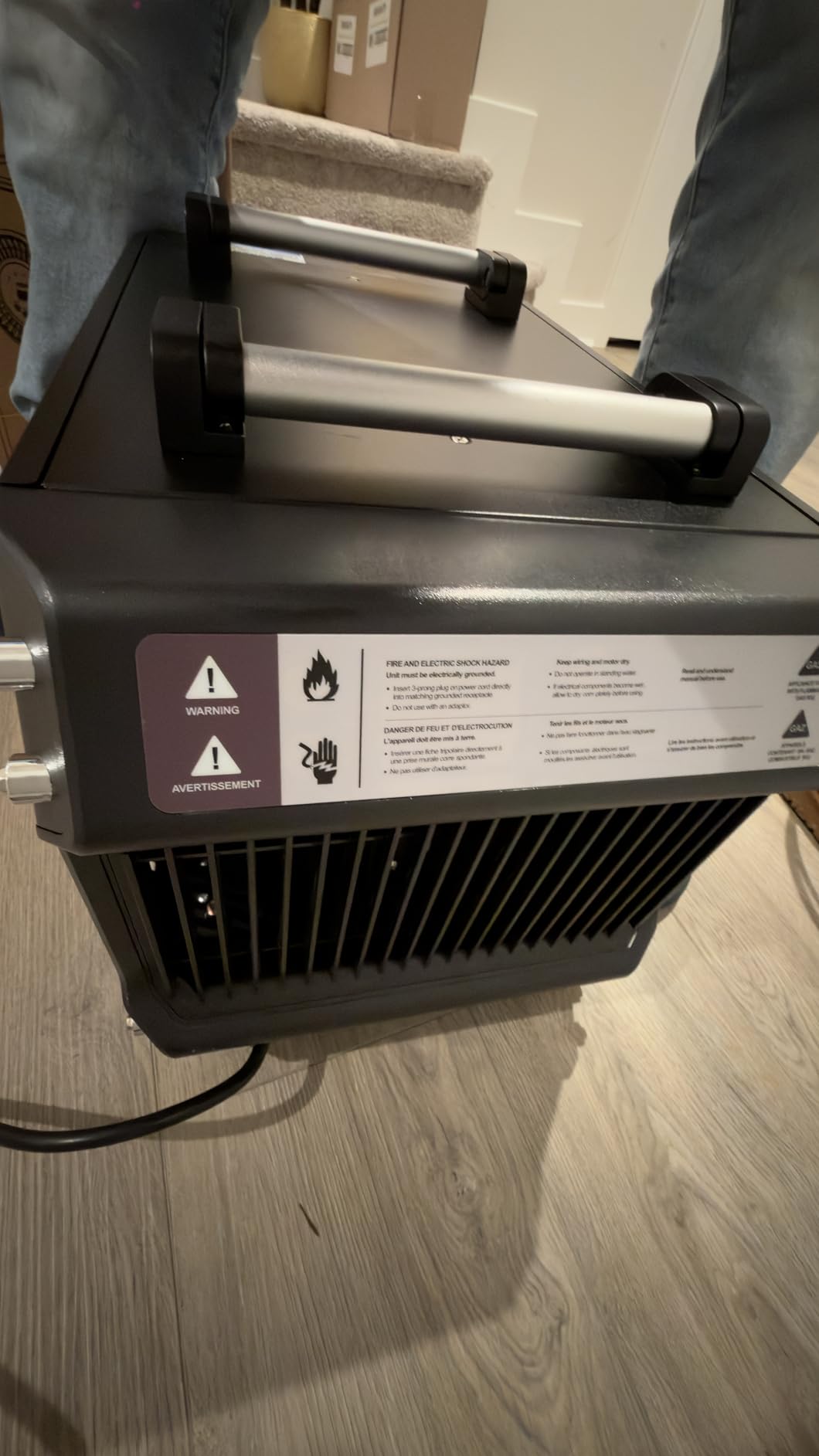
What to check before you buy it for a garage
Budget is the real constraint. This is the most expensive model in this lineup by a wide margin, and that premium buys metal, a defrost system engineered for cool spaces and a warranty rather than raw capacity.
Plan the elevation. Gravity drain only means the unit needs to sit above the sump or the drain line, and in a garage that usually means a stand or a platform, which you have to build.
Where it falls short
There is no built-in pump, and the pump wiring does not accept third-party auto shut-off pumps. If your only outlet is below the unit, this is the wrong chassis no matter how good the coil is.
At 41.7 pounds it is genuinely awkward to get into a crawl space, and the 12% one-star share centers on durability and warranty service friction rather than performance. A few owners report units that arrived defective or developed a refrigerant leak after several years of service.
5. Waykar 125 Pint Crawl Space – Best Pump and Zoning Setup
- Built-in pump drains water up and over obstacles with a 6.56 ft hose included
- 125 pints per day with a 10%-90% RH range
- the widest here
- High-strength metal casing with a 2+3 layer condenser
- Independent 5.9 inch duct outlet lets you dry a specific zone
- Auto defrost
- auto restart and continuous mode support unattended use
- Touchscreen panel with adjustable feet that cut vibration
- Loud at high output and described by owners as industrial
- Remote control sold separately
- A small number of units arrived with a failed internal pump or a leaking base
- Included gravity hose described as low quality by one owner
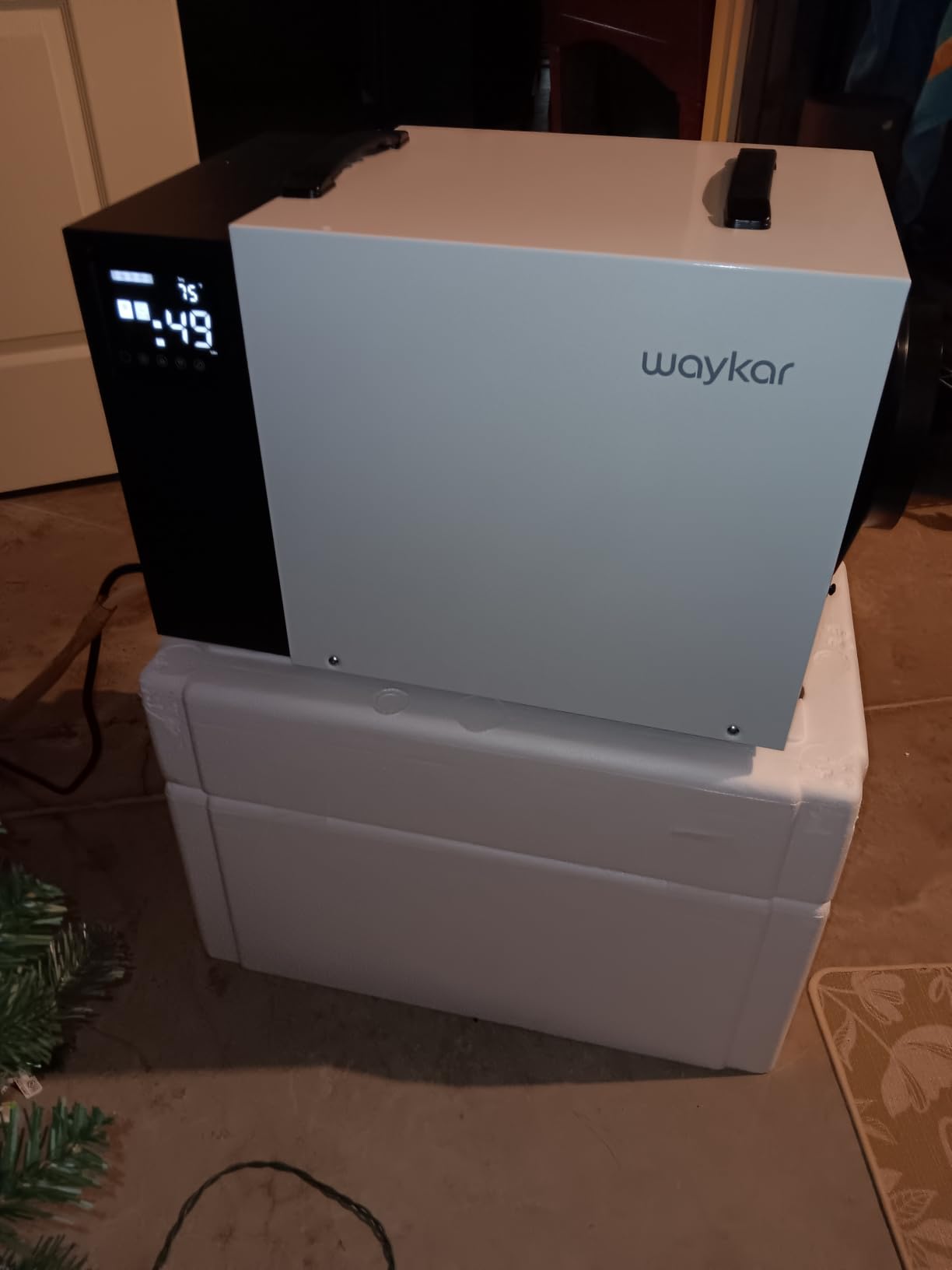
The independent 5.9 inch ducted output is the feature I would highlight. In a garage where one corner is damp and the rest is fine, you can run this unit into the corner instead of trying to condition the whole volume, which is far more efficient than a bigger machine pointed at an empty floor.
The 10% to 90% RH adjustment range is the widest in this lineup, which gives you a lot of latitude in a space where you are chasing a specific target rather than just drying.
Owners report a 750 square foot finished basement and a flooded crawl space both handled effectively, and the automatic restart after a power cycle is exactly what you want on a garage circuit that trips during a winter storm.
Warranty terms are good, two years on the unit, five years on the compressor, with lifetime technical support. That five-year compressor coverage matters most in a seasonal unit that will be cycled hard every winter.
What to check before you buy it for a garage
Noise. Owners describe this as industrial at high output, and a garage attached to a house makes that a nightly problem. If the space is next to where you sleep, put a decibel rating ahead of everything else on your list.
Set it on a level, drained surface. The gravity path has to fall away continuously, and a unit rocking or sitting on a cord is how a base ends up leaking.
Where it falls short
The 13% one-star share is among the highest in this roundup, and it clusters around units failing on arrival with a dead internal pump or a leaking base, plus slow support response. That is a quality control problem rather than a design problem, but it is a real cost in time.
Remote control is a separate purchase, so the app-based convenience everyone expects from a modern unit is not in the box. At 530 watts it also sits near the top of the power draw range here.
6. Moiswell 155 Pint Defender M145 – Best Raw Capacity for Water Damage
Moiswell 155 Pint Commercial Dehumidifier with Drain Hose for Crawl Spaces
- Highest capacity in this roundup at 155 pints per day
- Horizontal 22.5 by 14 by 14.7 inch design fits between joists or mounts overhead
- ENERGY STAR certified with 265 CFM airflow
- Alloy steel construction
- Auto drain
- auto defrost
- auto restart and a 24-hour timer
- 5-year warranty with 2 years whole-unit and 3 years parts
- Highest power draw here at 860 watts
- Heaviest model at 63 pounds
- Gravity drain only so it must sit above the drain point
- About 500 ratings gives less long-term field history than the rest
- Newer brand with less market history
After a flood or a persistent slab leak, raw capacity is the whole game, and this is the most powerful model here. 155 pints per day, 70 at AHAM, with 265 CFM of airflow pushing air across the coil fast enough to matter on a large wet floor.
The horizontal chassis is the reason it works in spaces a tower will not. At 22.5 by 14 by 14.7 inches it fits between floor joists or mounts overhead in a low-clearance crawl space.
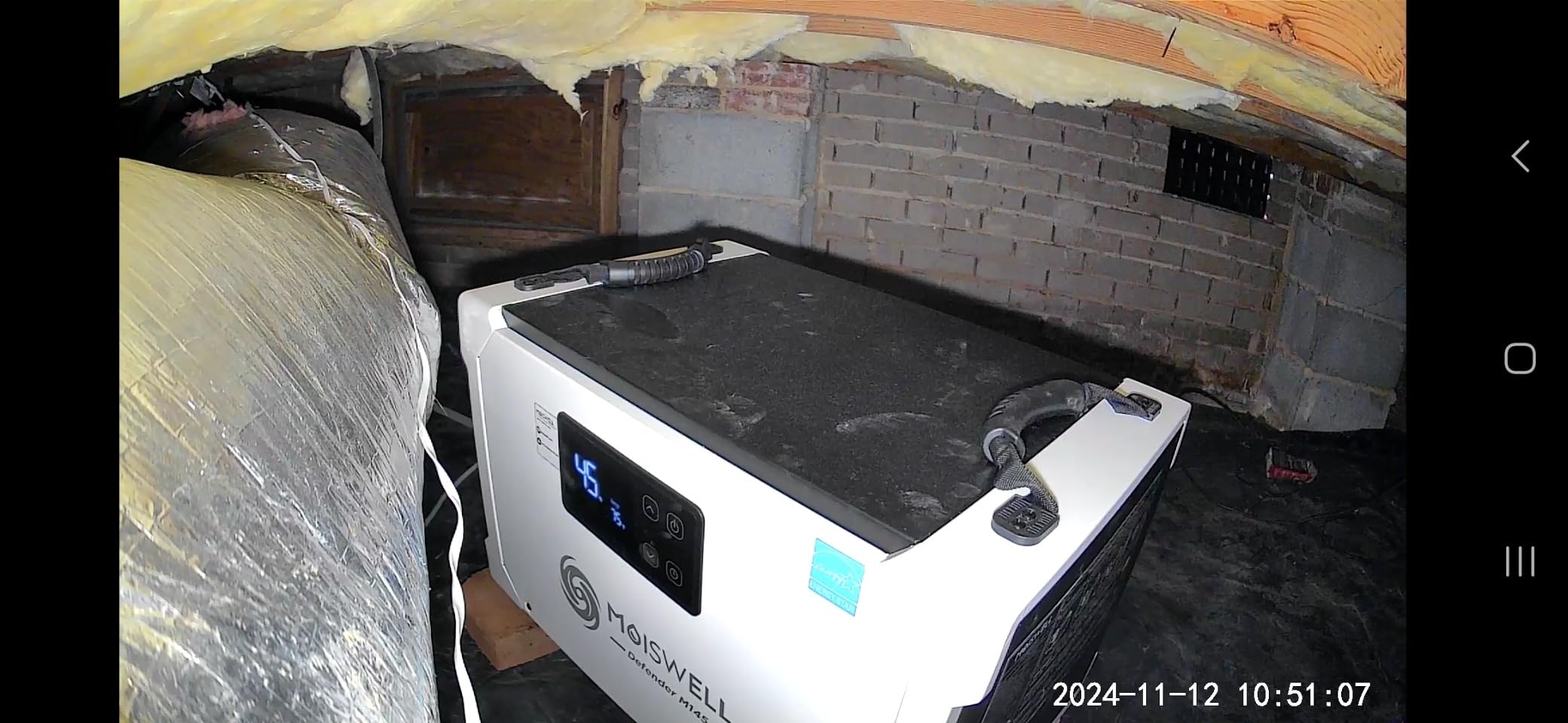
Auto defrost, auto drain and auto restart after a power outage mean it can run unattended through a recovery, which is when you are not standing in the garage watching it anyway. The 24-hour timer adds scheduled cycles on top of humidity cycling.
Alloy steel construction and a 5-year warranty with 2 years on the whole unit and 3 years on parts is a sturdier package than most of the plastic consumer models here.
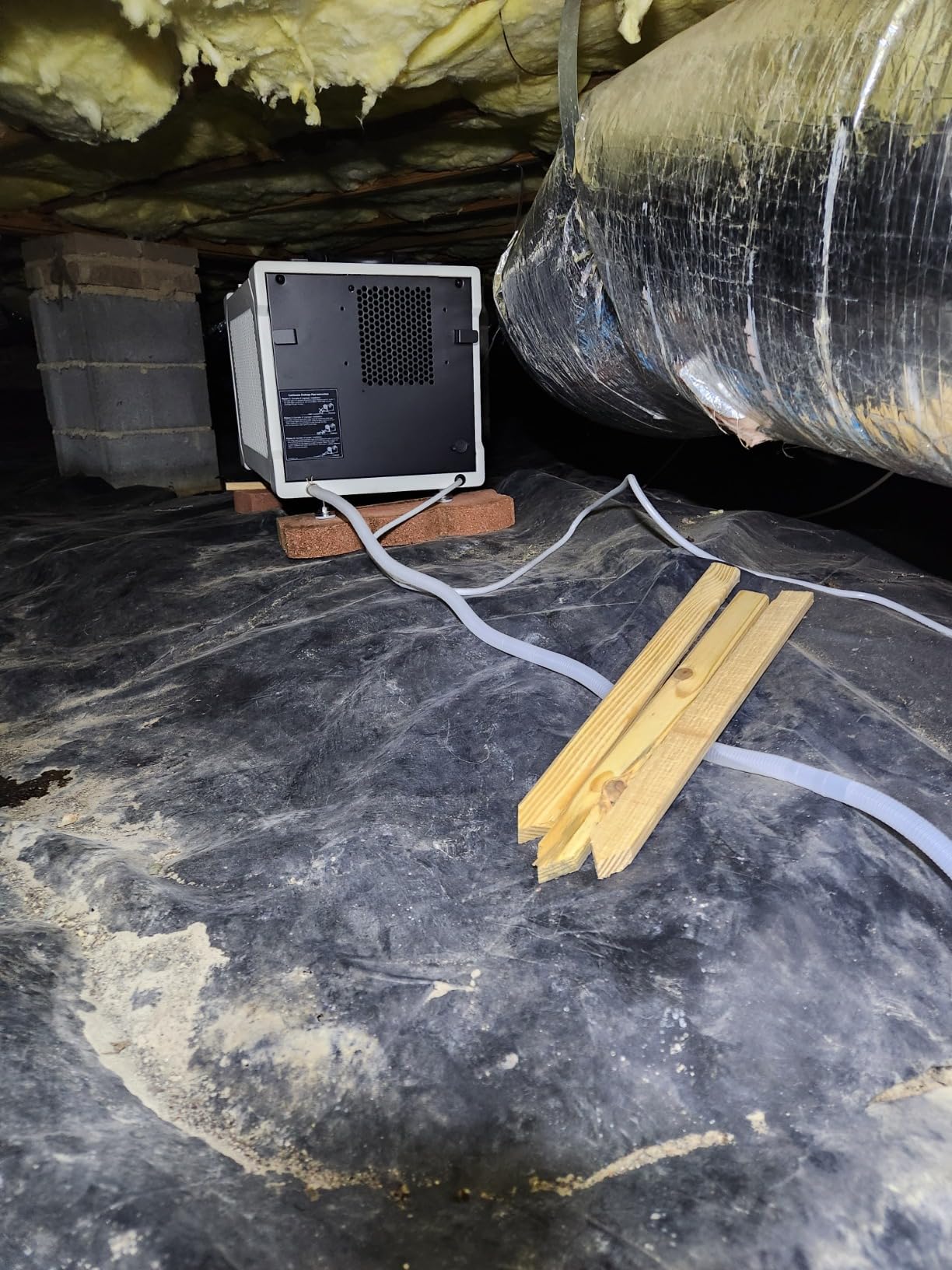
What to check before you buy it for a garage
860 watts is the highest draw in the roundup and it will show up on a bill if you run it continuously all winter. For a short flood recovery that is irrelevant, but for seasonal humidity control it is the number that should worry you.
It is 63 pounds. Plan how it gets through a garage door and onto a stand before it arrives, because that is a two-person job with an awkward shape.
Where it falls short
At around 500 ratings it has the smallest review base in the group, and a 78% five-star share on a small sample is less informative than a 69% share on 22,000 reviews. You are buying on spec sheet more than on field history.
Gravity drainage only means it must be set above the drain point, and the brand is newer and less established than Waykar or AlorAir. Neither is disqualifying, but both add a little risk to a purchase you hope lasts a decade.
7. Gasbye 115 Pint DryPrime – Most Honest Cold-Weather Capacity Figures
- Publishes output at three temperature points including 50 pints per day at 65F/60% RH
- ENERGY STAR 2026 certified with up to 30% better efficiency
- Highest average rating in the roundup at 4.6
- Reinforced copper tubing and a 5-tier copper coil
- Auto shut-off within a 3% band with restart and power outage memory
- Three drainage options
- 45 dB
- 2-year coverage
- 43 pounds is heavy to move around a garage
- Upper temperature rating listed at 86F
- The 50 pints per day figure at 65F shows real cold-weather output is far below the headline 115
- About 900 ratings
Gasbye does something none of the other nine do, which is publish output at the temperature you will actually use it. 115 pints per day at 86F and 80% RH, 73 at 80F and 60% RH, and 50 at 65F and 60% RH. That last figure is the one I would size a garage with.
It is also the highest-rated model in this lineup at 4.6, with 80% of ratings at five stars and only 4% at one star. That distribution is unusually clean for a brand in this category.
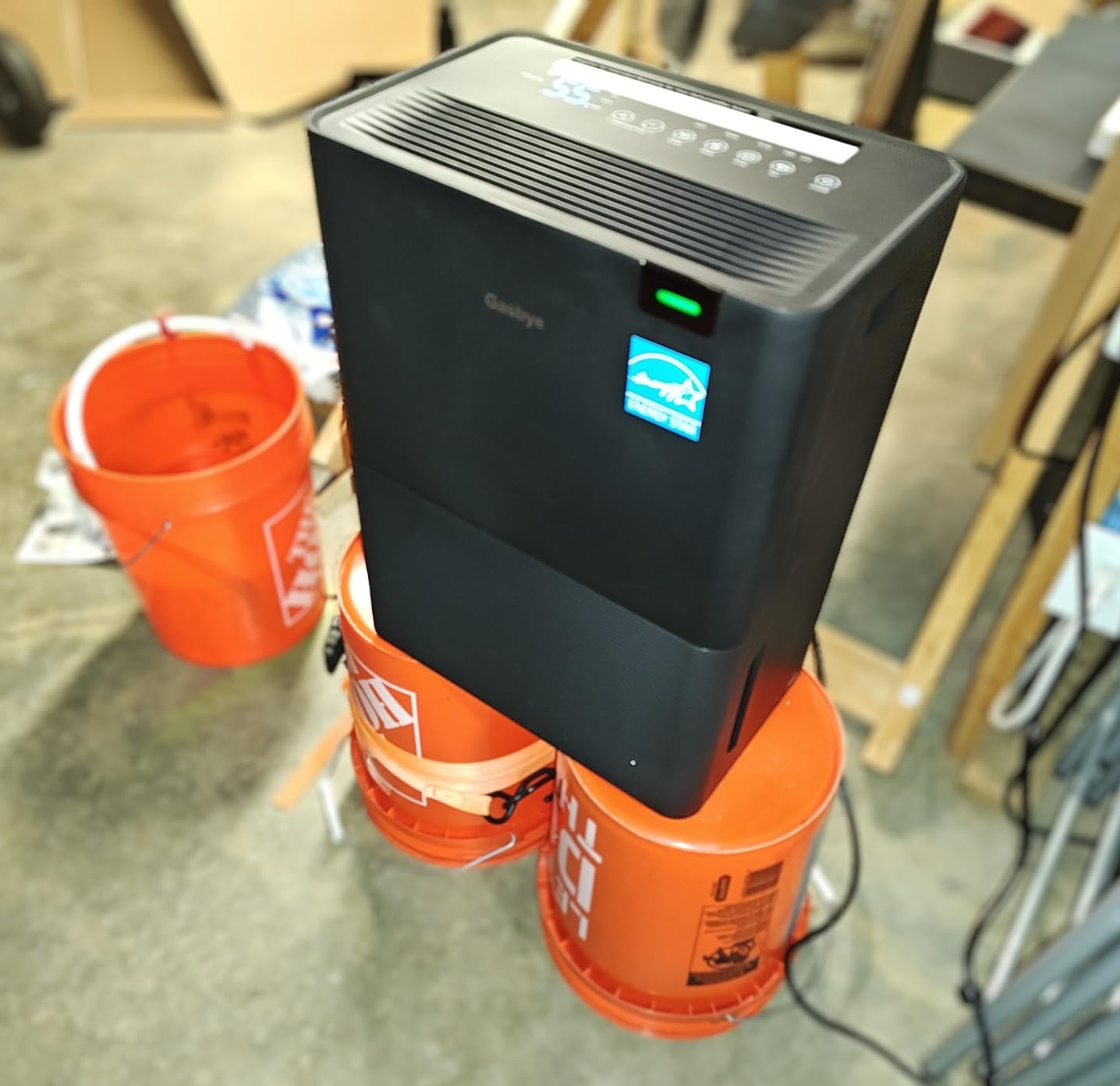
ENERGY STAR 2026 certification and 45 dB operation make it the quietest efficient option here. The auto shut-off inside a 3% band with restart and prior-setting memory is a genuinely useful detail, since most units coast well past the setpoint.
Three drainage paths are offered, a 1.72 gallon tank, an included 5 foot drain hose and a standard 3/4 inch garden hose. The 2-year coverage with a full return or replacement handled by a U.S. support team is straightforward.
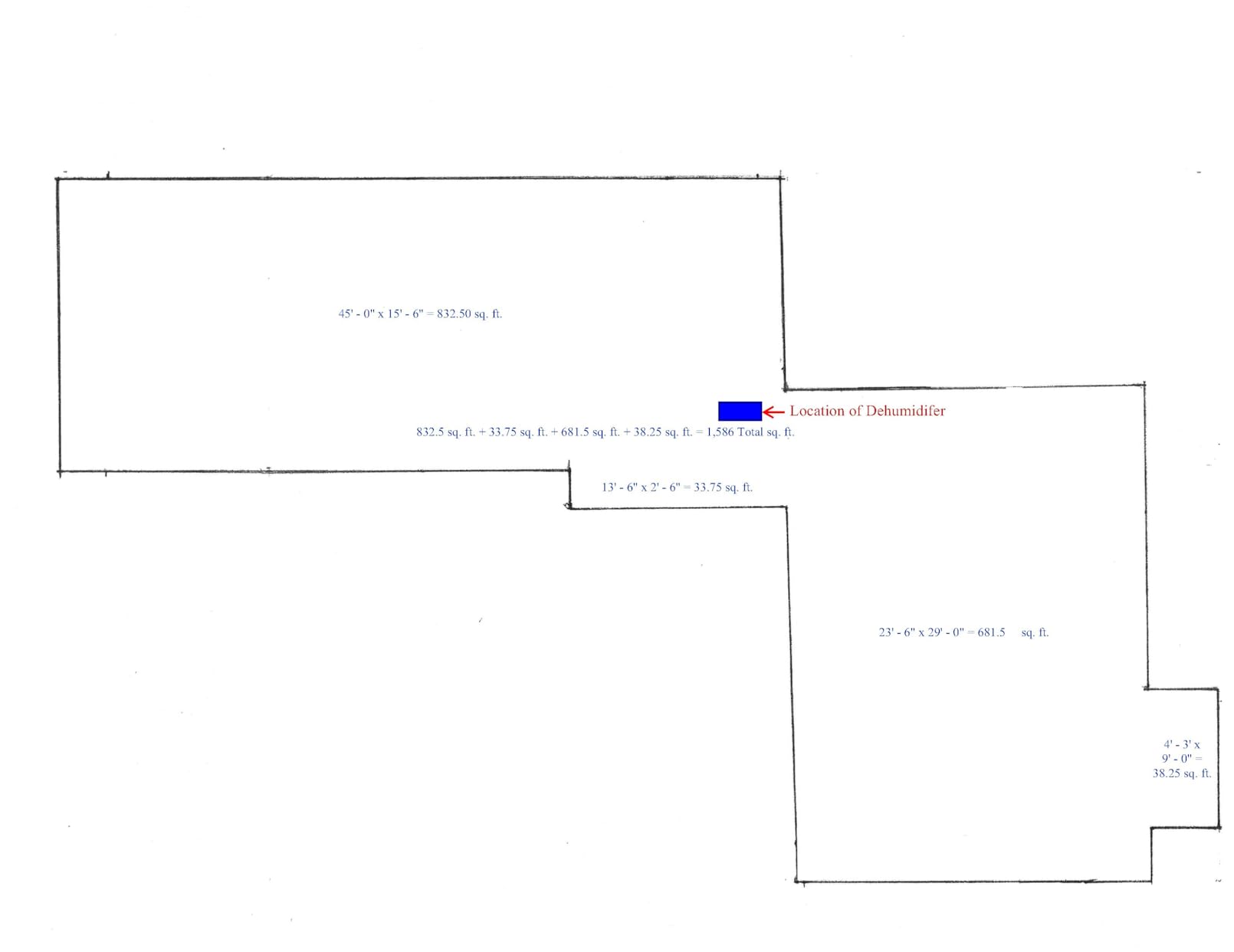
What to check before you buy it for a garage
Understand what the 50 pints per day figure means for your space. It is roughly the output of a mid-size consumer dehumidifier rated at 70. If your garage is large and genuinely wet, that is going to be the number that decides how many hours a day you run it.
The 86F upper temperature rating is the tightest in the roundup. In a southern or southwestern garage that climbs above that in summer, this is not a year-round unit.
Where it falls short
43 pounds is heavy for a plastic-bodied machine, and awkward to reposition when you want to move the dehumidification focus to a different area of the garage mid-season.
At around 900 ratings the rating is excellent but the sample is thin compared with the 22,000-review models here. The published figures were measured in a cool, damp garage, so treat the 50-pint number as the one to plan around rather than the 115-pint headline.
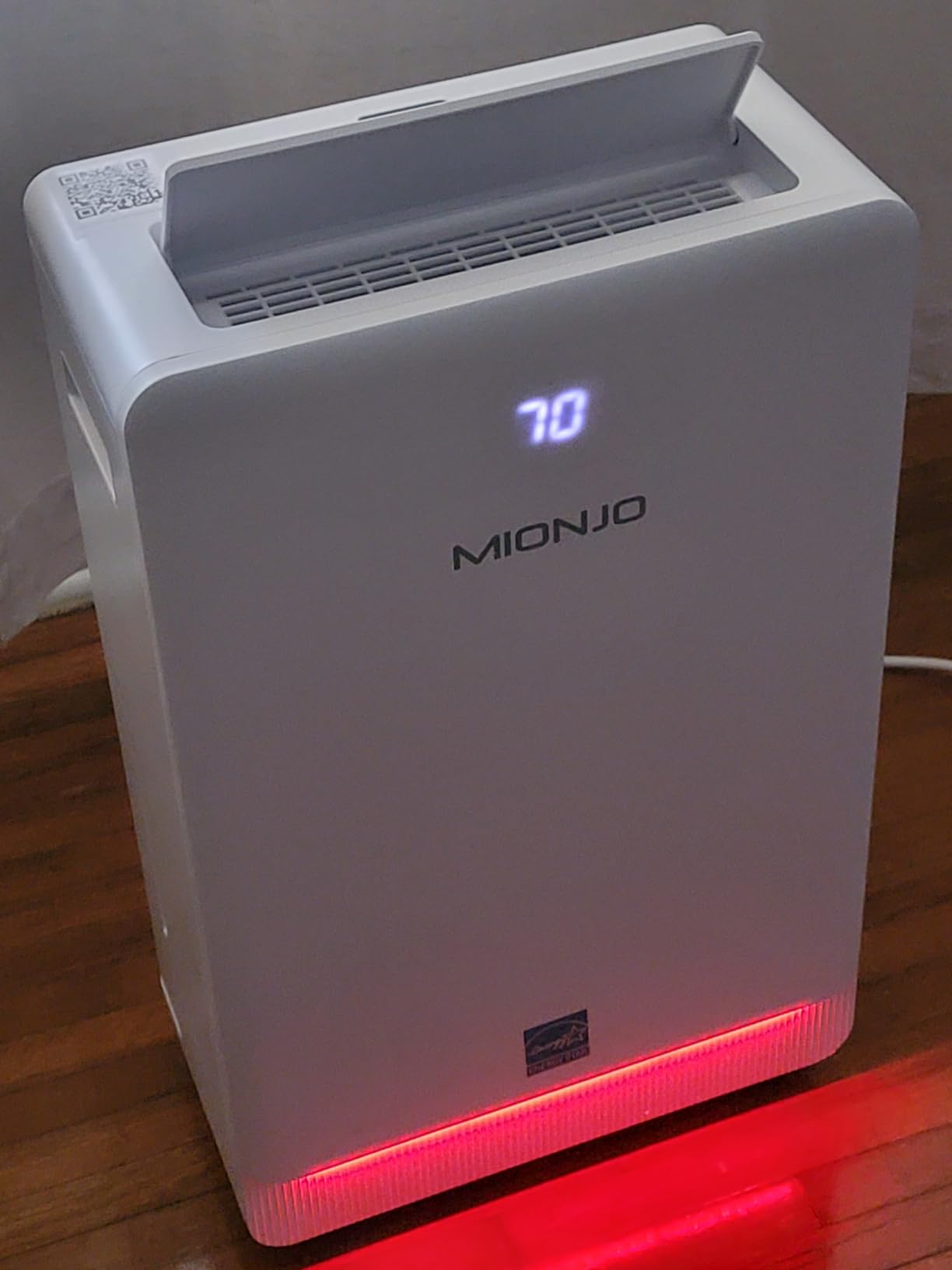
8. MIONJO 4500 Sq Ft 80 Pint – Lightest Model to Move Between Corners
- Lightest model here at 10 pounds on four 360 degree swivel wheels
- 45-80 pints per day with 30%-80% adjustable humidity
- 40 dB with sleep mode
- 90 degree adjustable outlet for targeted drying
- Energy Star certified
- Dual drainage with a 1.72 gallon self-shutoff tank or included continuous hose
- Spec sheet lists floor area as 1 while listing copy claims 4500 sq. ft
- Only a 10 pound listed weight suggests a lower-output design
- Plastic housing and a small brand presence
- About 430 ratings with a 10% one-star share
Where most of the machines in this roundup need two people or a dolly to reposition, this one moves on four 360 degree swivel wheels and weighs 10 pounds. For a garage where you are chasing a shifting damp patch, that is not a small thing.
It is also the quietest efficient model here at 40 dB, with a sleep mode for overnight running, and the 90 degree adjustable outlet lets you aim it at one wall or a stack of wet gear.
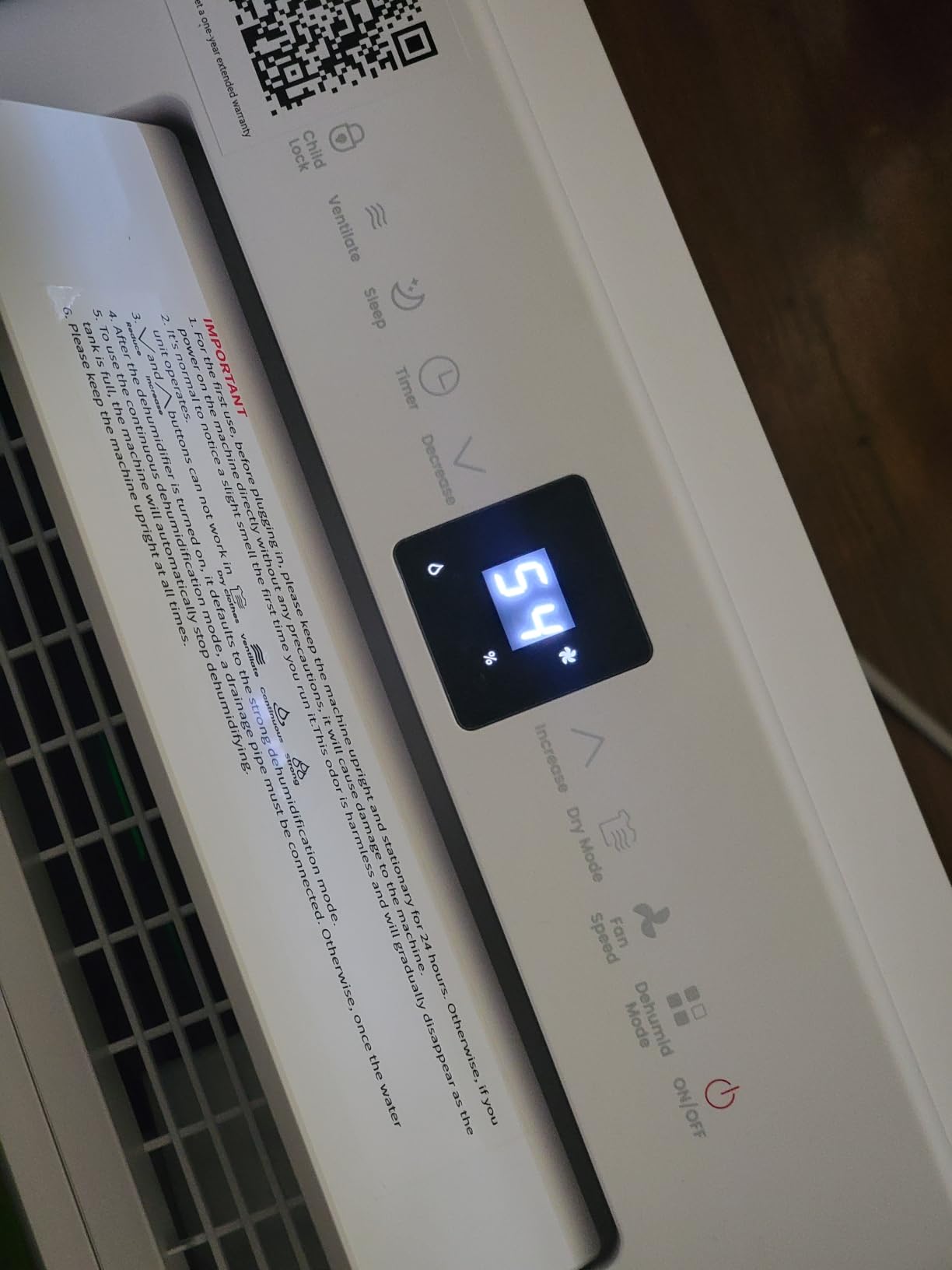
Smart sensors trigger automatic defrost and overload protection, and the dual drainage gives you a 1.72 gallon self-shutoff tank or continuous drainage through the included hose. The washable filter and hidden cord wrap are small touches that matter more in a dusty garage than in a bedroom.
Owners consistently describe it as quiet, easy to move and effective for home rooms, and 45 to 80 pints per day is a reasonable range for a single-car garage that stays above 60F.
What to check before you buy it for a garage
Ask the manufacturer for the real coverage figure, because the spec sheet lists a floor area of 1 while the listing copy claims 4,500 square feet. Those two numbers cannot both be right, and the gap tells you the coverage number is marketing.
Expect less extraction than the 120 to 155 pint machines. If your garage has a genuinely wet floor or active water ingress, this is a comfort unit, not a recovery unit.
Where it falls short
The 10% one-star share is worth checking against the average rather than ignoring, and a review base of around 430 makes that average less stable than it looks.
There is no numeric minimum operating temperature published, and for a winter garage that is the spec that would settle the question. Plastic housing and a modest brand presence add durability risk over a decade of freeze-thaw cycling.
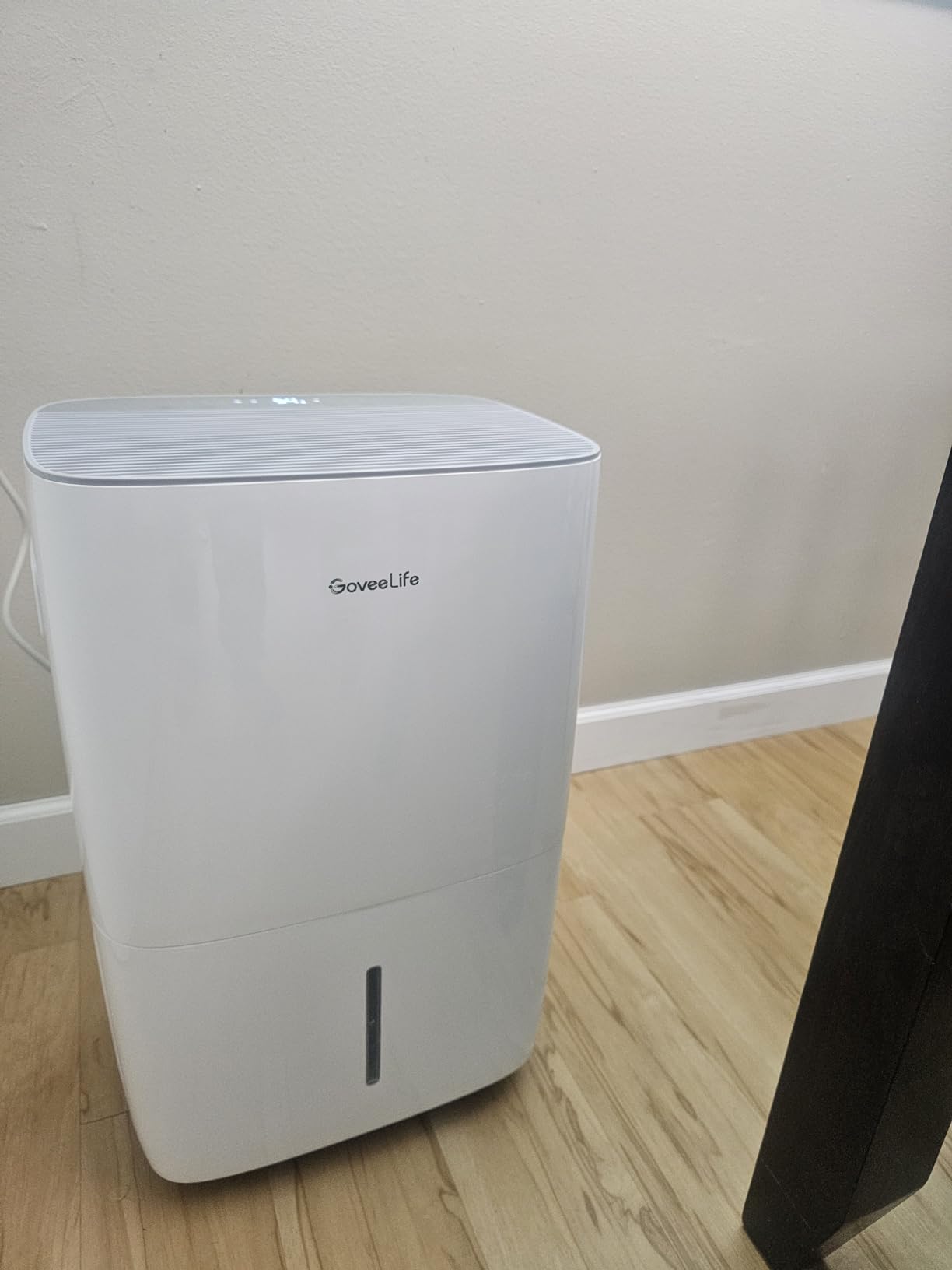
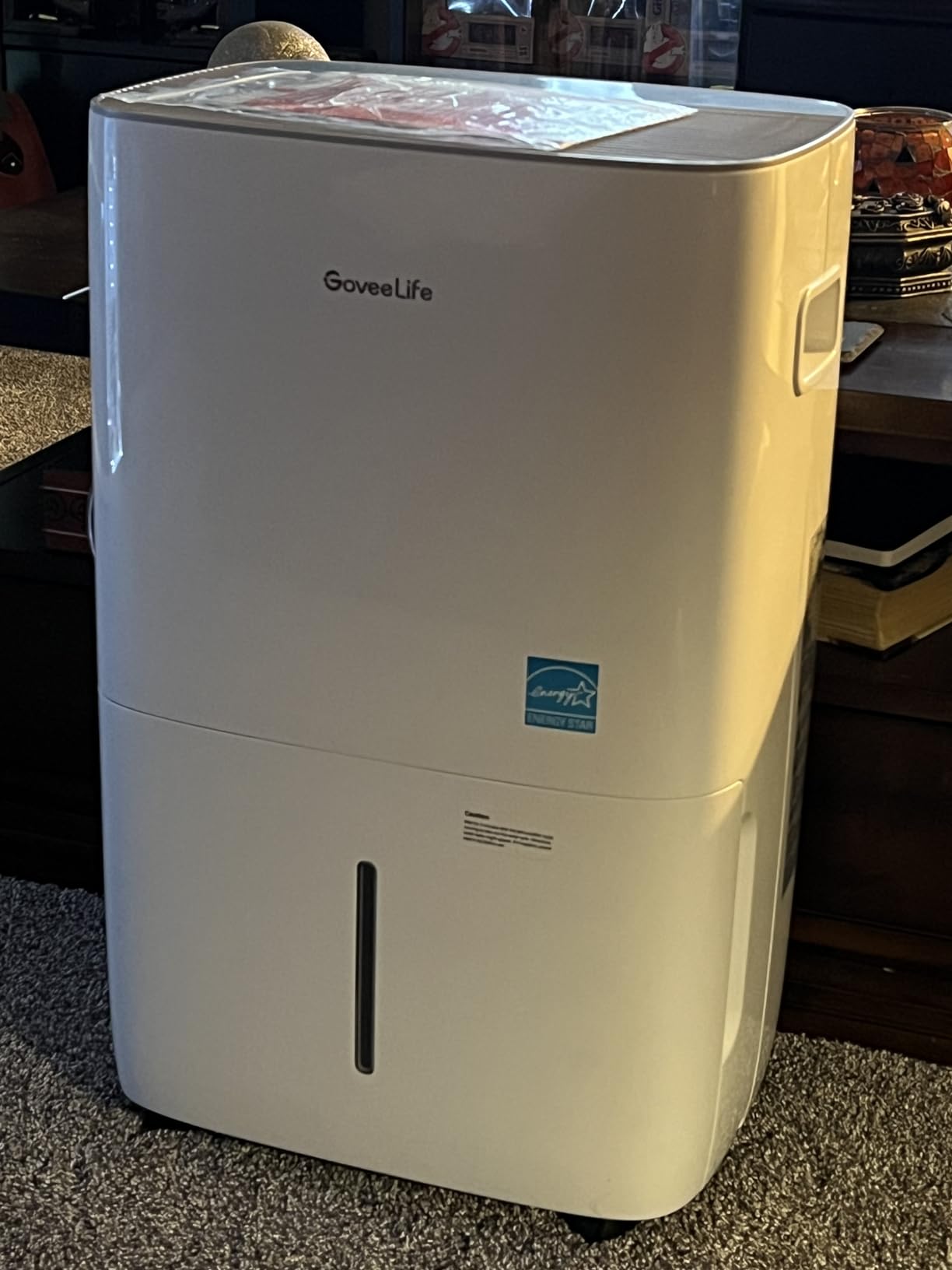
9. GoveeLife Smart Dehumidifier – Best App and Sensor Control
GoveeLife Dehumidifier for Home 4,500ft², 50 to 137 Pints, 2.0Gal Bucket
- The only model here with app
- voice and touch control over Alexa
- Google Assistant and IFTTT
- Variable output from 50 pints at cooler temperatures to 137 pints at 90F/90% RH
- Largest tank among the consumer units here at 2.0 gallons with a 3 ft hose and garden hose compatibility
- Can pair with a separate Govee hygrometer so a remote sensor drives the target
- Auto defrost and automatic restart
- Tied for the lowest rating in the roundup at 4.0 with a 15% one-star share
- Several reports of units that stopped dehumidifying after one or two seasons
- 850W draw with about 4 degrees of added heat
- No audible full-tank signal
- WiFi requires 2.4GHz
This is the only model here you can drive from your phone, and for a garage that is a feature with real weight. The app, voice and touch control work over 2.4 GHz WiFi and Bluetooth, and it pairs with a separate Govee hygrometer so a remote sensor can set the target humidity rather than the unit guessing.
Variable output from 50 pints at cooler temperatures to 137 pints at 90F and 90% RH is the widest declared range here, and the 2.0 gallon tank is the largest in the roundup.
Owners report holding roughly 45% RH in a Deep South home and cutting the air conditioning run time in a 1,700 square foot space, which is the use case the app was built for. ETL and FCC certified, also DOE and CEC.
Auto defrost and auto restart are both present, and the 3 ft corrugated drain hose plus 3/4 inch garden hose compatibility covers most permanent drainage routes.
What to check before you buy it for a garage
Read the one-star reviews first on this one. At 4.0 with a 15% one-star share, it is tied for the lowest-rated model here, and a recurring theme is units that ran for a season or two and then stopped removing moisture, including a pair that failed at the same time.
Heat output is the real winter issue. At 850 watts with about 4 degrees of added warmth, this adds a measurable load to a cold space. If you are trying to keep a garage cold, that works against you.
Where it falls short
There is no audible full-tank signal, so emptying depends on the app or on walking over to look, and the 2 gallon bucket is described as awkward to grip and prone to spilling when full.
WiFi needs 2.4 GHz and enabled phone location, and the unit is bulky at 39 pounds. For a garage with no reliable WiFi coverage, most of what makes this unit distinctive simply goes unused.
10. AIRPLUS 70 Pint – A Solid Fit for a Small One-Car Garage
AIRPLUS 70 Pint Dehumidifier with Drain Hose, 4500 Sq.Ft for Basement
- 300 watt draw keeps the running cost low over a full season
- Compact 28 pound build with an 8.7 by 12.6 by 22.2 inch footprint
- Four smart modes including a dry mode and a sleep mode
- Digital display shows temperature
- humidity
- timer and mode
- Auto defrost
- auto shut-off and restart
- 24-hour timer
- child lock
- 30-day free exchange or refund
- Smallest tank here at 0.7 gallons so a hose is effectively required
- Several reports of the evaporator coil freezing into a block of ice in a 73F room
- Reports of units that ran continuously without stopping at the setpoint
- Only 60% of ratings are five stars
- 70 pints per day is low for a large cold garage
For a single-car attached garage that stays above 60F, 300 watts and 70 pints per day is a sensible pairing, and that low draw is the number that decides operating cost over a season. Owners report indoor humidity dropping from around 70% into the mid-50s quickly.
The digital display showing temperature, humidity, timer and mode is better instrumentation than many units in this class, and the control set includes automatic defrost, auto shut-off and restart, a 24-hour timer, a child lock and a negative ion function.
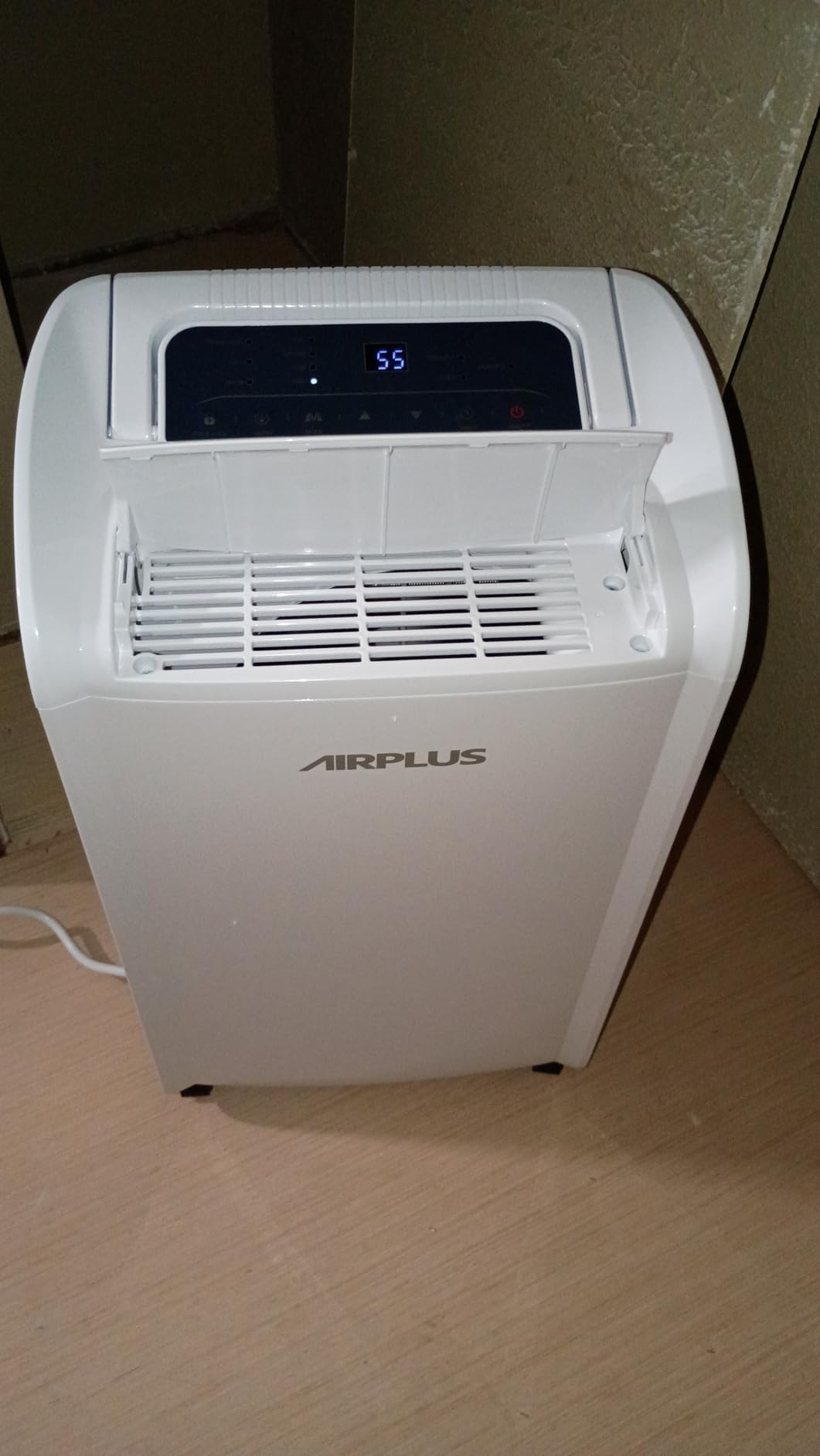
At 28 pounds and 8.7 by 12.6 by 22.2 inches it stores out of the way between seasons, and the 30-day free exchange or refund makes it a low-risk way to test whether a dehumidifier is the right answer for your space at all.
Four modes including a dedicated dry mode for delicate items and a sleep mode give it more flexibility than the mode count suggests.
What to check before you buy it for a garage
The tank is 0.7 gallon, the smallest here, so treat continuous drainage as mandatory rather than optional. A small tank in a space you enter twice a week is how water ends up on the floor of your garage.
Be realistic about capacity. 70 pints per day is modest for a large cold garage, and the model is 4.0 rated with only 60% of ratings at five stars, the weakest positive share in this roundup.
Where it falls short
Several owners describe the evaporator coil freezing into a solid block of ice even in a 73F room, which stops moisture removal until it thaws. In a genuinely cold garage that failure mode is much more likely, so this is not a unit I would run in a space that regularly drops toward 50F.
Others report the unit running continuously without stopping at the humidity setpoint, which wastes power and is a sign the control board is not reading the sensor correctly. The short instruction manual and one reported leak round out the complaints.
Why a Garage Gets Damp in Winter
Garages get damp in winter for four reasons, and none of them is a leak in the wall.
Cold slab condensation. Warm indoor air carries moisture, and when it touches a concrete slab that has been sitting at 40F all night, the water in that air condenses on the concrete. It looks like a leak. It is just physics, and no amount of dehumidification fixes the slab itself, only the air above it.
Wet cars shedding melt water. A car that came in with snow or road salt dripping indoors can put several gallons of water on a concrete floor overnight. In an unheated space that water does not evaporate, it sits.
No ventilation. An attached garage with the door to the house closed traps every gallon of moisture the cars bring in. Venting outdoors helps, but only when the outdoor air is actually drier than the indoor air, which on a typical December afternoon it is not.
Ground moisture wicking. Bare concrete wicks groundwater straight up through the slab by capillary action. You can seal it with a vapor barrier coating, and treating the slab before buying a machine is the higher-return fix available to a garage owner, because it removes the source instead of the symptom.
What that moisture does is quiet until it is expensive. Bare steel and unplated tool bodies flash-rust. Table saw tops and cast iron pitting. Electrical connectors and breaker panel corrosion. Mold on stored cardboard, drywall and fabric. A dehumidifier manages the symptom; sealing the slab removes the source.
Can a Dehumidifier Work in an Unheated Garage? Only With Auto-Defrost
Yes, but only a unit rated for low-temperature operation with a working auto-defrost cycle. A standard compressor dehumidifier dropped into a garage that falls to 45F will chill its coil below freezing, grow a block of frost, choke its own airflow and collect nothing, usually within the first hour. Cold-rated units detect the buildup, pause the compressor, run the fan to melt it, and resume.
That is the entire mechanism. A compressor dehumidifier works by cooling a coil below the air’s dew point so water condenses on the fins and drips into a pan. In a space above about 60F the coil never gets cold enough to frost, and the cycle is invisible to you.
Below that, the same physics turns against the machine. The colder the garage air, the lower its dew point, and the harder the coil has to be driven to get there. Ice forms on the fins faster than it melts, airflow drops, and the compressor works against a blocked coil drawing maximum current until something trips.
Auto-defrost fixes this with temperature sensors rather than a timer. When the coil approaches its freezing point the compressor stops and the fan runs alone, which moves room air across the frosted fins and melts them into the pan below. The cycle costs you a few minutes of collection several times a night, and it is the difference between a unit that works all winter and one that collects a puddle in October.
Every model in this roundup lists some form of automatic defrost. Only one publishes the temperature it holds down to, which is roughly 65F, and one other publishes real output at 65F and 60% RH. Treat a missing minimum operating temperature as a red flag rather than a missing feature, because it usually means nobody tested it below 60F.
What to Look For in a Garage Dehumidifier: 7 Criteria
1. Minimum operating temperature, stated as a number. This is the gate. Everything else is a preference. If a listing says only that it works in cool spaces, assume 60F and plan accordingly. Our roundup of the best dehumidifiers covers the same tradeoffs in rooms rather than garages.
2. A real defrost cycle, not a defrost button. Sensor-driven defrost that pauses the compressor and runs the fan beats anything you trigger yourself. Look for the words automatic defrost and for a description of what happens during the cycle.
3. Drainage that does not depend on your memory. A built-in pump that discharges upward gives you routing freedom, which in an old garage is worth more than extra capacity. Gravity drainage is fine if the outlet is above your drain, and a problem if it is not. The short hose in the box matters far less than the direction it can flow.
4. Output at cool temperatures, not just at 95F. Standard capacity ratings are measured at 95F and 95% RH, which is a summer number. When a manufacturer publishes a second figure at 80F or 65F, that is the one to size with. A unit rated 115 pints that delivers 50 pints at 65F is a 50-pint unit in your garage.
5. Capacity in a format you can trust. The DOE changed its test method in 2019, and the same hardware that used to be labelled 70 pints per day is now labelled 50. Any listing over a few years old may be showing pre-2019 numbers, so a model that looks bigger than it is. Look for a stated AHAM figure alongside the saturated figure, and use the lower one.
6. Noise, measured. A compressor dehumidifier is a compressor, and models here range from 40 dB to industrial. If the garage shares a wall with a bedroom, the decibel rating outranks every other spec. Sleep mode helps, but it slows collection.
7. Power-off memory and automatic restart. Garage circuits trip in winter, often more than once a season. A unit that forgets its settings and its target humidity on every power blip will drift, and you will only notice when the bucket is empty and the walls are damp again.
Skip the rest. Negative ion functions, decorative LED displays and voice assistants are fine, and none of them change whether the unit keeps collecting water in February.
How Big a Dehumidifier Your Garage Needs by Square Footage
Rule of thumb, assuming a two-car garage ceiling and a cold slab rather than a wet one.
Around 300 square feet, one car. 40 to 50 pints per day is plenty. Most of the airflow work here is done by the unit being present, not by it being powerful. Choose the quietest one you can find, because you will be in and out of this space daily.
400 to 600 square feet, two cars. 70 to 90 pints per day. This is the range where drainage and defrost start to matter more than raw capacity, and where a built-in pump earns its cost if your floor drain is not conveniently placed.
1,000 to 2,000 square feet, workshop or man cave. 100 to 130 pints per day, metal construction if you can justify it, and a unit you can duct or aim at a specific zone rather than flood the whole volume. Owners in forums consistently separate works when cold from works when powerful, and you need the first one here.
3,000 square feet and up, shop or pole barn. 130 to 155 pints per day, ENERGY STAR certified, and accept the power draw. At 500 to 860 watts, continuous operation is a line item, not an afterthought. For spaces this size, running two medium units on opposite walls often beats one large one, because you get redundancy and shorter duct runs.
Water damage at any size. Size for recovery, not for control. Flooded or actively wet areas need the 155-pint class for a few weeks, then you can step down to something efficient for maintenance. See the commercial dehumidifier roundup for the heavy chassis options.
If you are torn, size up one step and run it on a timer with a target humidity set in the mid-50s. Storage conditions for tools, cardboard and electronics want 40 to 60% RH, and you are better off holding a steady number than chasing a fast initial drop.
Winter Operating Strategy: When to Run It and When to Shut It Down
This is the part that decides whether the unit survives the season, and almost no roundup covers it.
Give it a slow start. When you bring it out of storage, let it stand at room temperature for a full day before plugging it in. Running a compressor while its oil and refrigerant are at 35F is how you shorten its life, and cold oil does not lubricate well. Set the target humidity in the low 50s for the first week so it works gently while the space stabilises.
Never leave standing water in the tank. The tank is the one piece of the machine that is designed to sit in a freezing garage full of water. Empty it before the first hard frost and, if the unit runs through a freeze, empty it again as soon as you get back to the space. An ice block in the tank will lift the float switch and stop the machine from collecting for the rest of the season.
Route the drain line so it cannot freeze. Two rules cover almost every case. Keep continuous fall from the unit to the drain for the whole run, and insulate any section that passes through an exterior wall or unheated space with foam sleeve. Never create a low point where water can pool, and never trap the hose in a loop that dips below the outlet. If a section is likely to sit below 32F, add a trace-heating cable or accept that you have to shut the unit off below a set temperature.
Know your shutdown temperature before you need it. Decide in advance the garage temperature at which you stop running the machine, write it on the unit with a marker, and check it on a cold morning. Below that number the defrost cycle is working harder than the collection cycle, and you are paying electricity and cycling the compressor for very little water. Most people in cold climates simply pull the unit out at first frost, and that is a perfectly reasonable choice for a seasonal machine.
Do not use it as a space heater. Every compressor dehumidifier puts out some heat, and owners with large tanks report about 4 degrees of added warmth. That is a benefit in a workshop you want to work in and a problem in a garage holding a stored vehicle. Know which one you have before you choose a high-wattage model.
Clean the filter and check the coil once a month. A dusty garage filter is a restricted filter, and a restricted coil is a cold coil. A ten-minute filter clean in November is worth more than any spec on the box.
Desiccant vs Compressor Units for a Freezing Garage
Every unit in this roundup is a compressor dehumidifier, and that is the right call for most garages. Compressor models are far cheaper per pint of water removed, quieter at low settings, and dramatically better at recovering quickly after a wet spell. They also have a hard floor below which they stop working entirely, which is the one limitation no amount of defrost can remove.
A desiccant unit uses a rotating chemical wheel instead of a cooling coil, and it has no coil to freeze. That makes it the right tool in two specific situations, and our desiccant dehumidifier roundup covers the class in depth.
First, when the space is genuinely below-freezing. A rotor unit keeps pulling water in a shed, a closed-off garage or a north-facing room that a compressor model will simply refuse to touch. Second, when you need a genuinely portable unit that survives being carried between a wet room and a cold basement without a warm-up period.
What you give up is money and noise. Desiccant machines cost considerably more for less output, run louder, and add far less heat to the space. In a garage that stays above 50F, a compressor model with defrost is the better buy by a wide margin. Below 32F, a desiccant unit is the only category that will work at all.
For a typical winter garage that sits between 40F and 60F, a low-temperature compressor unit from this list is the correct answer, and running it in short cycles on a humidistat is what gets you through the season.
Frequently Asked Questions
Is it worth putting a dehumidifier in the garage?
Usually yes, if you store a vehicle, power tools, motorcycles, electronics or cardboard in a space that drops below 60F. It is worth it when moisture is condensing on the slab, walls or roof deck, when tools are rusting, or when a wet car is dripping indoors. It is less worthwhile in a small one-car garage that stays above 60F with nothing moisture-sensitive stored. Seal the slab first, because a vapor barrier coating removes the source, and a dehumidifier only manages the symptom.
Can a dehumidifier work in an unheated garage?
Yes, but only a unit rated for low-temperature operation with a working auto-defrost cycle. A standard compressor dehumidifier in a garage that falls to 45F will chill its coil below freezing, grow a block of frost, choke its own airflow and collect nothing, usually within the first hour. Cold-rated units detect the buildup, pause the compressor, run the fan to clear the frost, and resume collecting.
How big of a dehumidifier do I need for a garage?
For a one-car garage of about 300 square feet, 40 to 50 pints per day is plenty. A 400 to 600 square foot two-car garage wants 70 to 90 pints per day. A 1,000 to 2,000 square foot workshop needs 100 to 130 pints per day, and 3,000 square feet or more needs 130 to 155 pints per day. Always check the output figure published at 60F to 70F rather than the 95F laboratory number.
What temperature can a garage dehumidifier work down to?
It depends entirely on the unit and its defrost cycle, which is why you should insist on a published number rather than a vague claim about cool spaces. Among the models we reviewed for 2026, one publishes operation down to about 65F with defrost sensors, and another publishes 50 pints per day at 65F and 60% RH. Several listed automatic defrost without giving any minimum operating temperature at all, which is a red flag.
Should I run a dehumidifier in my garage in winter?
Run it on a humidistat set in the low-to-mid 50s, not on continuous. Empty the water tank before the first hard frost and again after any freeze, because an ice block in the tank trips the float switch and stops collection. Route the drain hose with continuous fall and insulate any section passing through an unheated wall. Set a shutdown temperature in advance and check it on cold mornings rather than assuming the unit is coping.
What brand makes the most reliable dehumidifier?
Reliability in a winter garage comes down to field history, construction and warranty rather than brand loyalty. The Waykar 120 Pint in our roundup leads on review depth, with over 22,000 ratings, plus ENERGY STAR certification and automatic defrost. The ALORAIR Sentinel HD55S leads on construction and warranty, with a metal housing, auto defrost and a 6-year limited warranty. Be cautious with models that have a thin review base or a high one-star share, and check whether auto shut-off and control board failures appear in the reviews.
The Best Dehumidifiers for Garages in Winter
The Waykar 120 Pint is the pick we would buy for most winter garages, because automatic defrost, overload protection, a 42 dB running level and 22,000 ratings of field history together make it the lowest-risk seasonal machine here. For a garage that actually gets cold, the AEOCKY 80 Pint is the smarter buy, since it is the only model that states a low-temperature operating figure rather than asking you to take defrost on faith.
The yaufey 150 Pint with Pump takes the large two-car garage, where drainage routing decides whether installation is easy or a weekend project. For metal construction and a warranty you can set a compressor lifespan by, the ALORAIR Sentinel HD55S is the pick, and the Gasbye 115 Pint publishes the most honest cold-weather numbers in the group.
What we would not do is buy a small plastic unit that only lists capacity, or a 9-ounce mini unit, for an unheated garage. Owners in cold-climate forums treat the low-temperature rating as a gate before capacity ever enters the conversation, and they are right. Confirm that number in writing, plumb continuous drainage before the first cold morning, and set a shutdown temperature on the unit before you forget about it.
Whatever you choose, run it on a humidistat in the low 50s, seal the slab if you have not already, and check the tank after every freeze. That is how the best dehumidifiers for garages in winter keep working past 2026 and the one after it.