
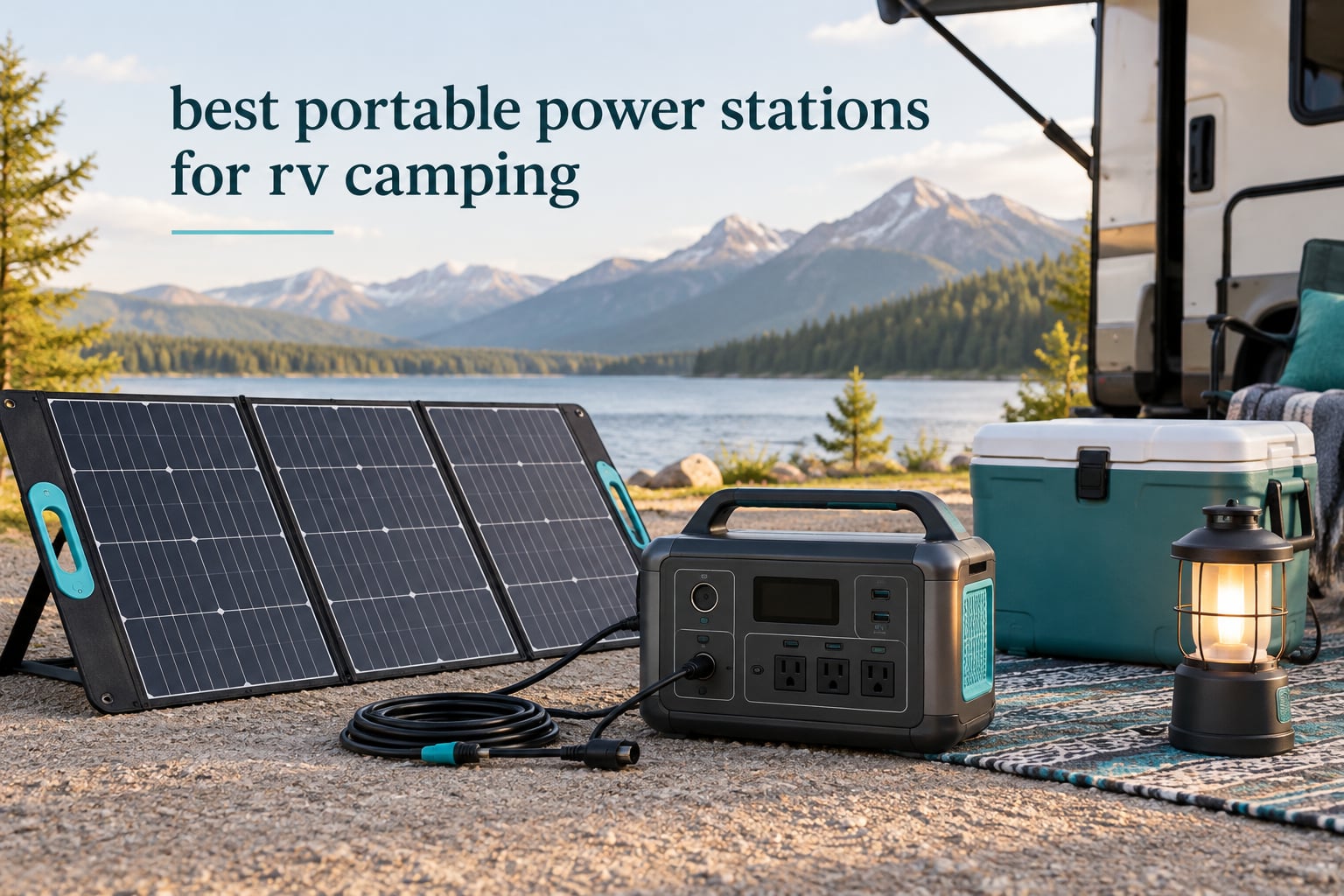
A portable power station is a rechargeable battery box with a built-in inverter, and picking the right one for an RV is less about headline wattage than most roundups suggest. The best portable power stations for camping cover tents and tailgates. An RV adds three hard requirements: a 12V fridge that runs all weekend, a rooftop AC unit that pulls a big surge on compressor startup, and enough stored energy to get through three cloudy days without a generator.
We spent weeks comparing 10 units on the numbers that actually decide an RV purchase: usable watt-hours, continuous AC output, weight, solar input ceiling, UPS cutover time, and idle draw. Every figure below comes from the manufacturer listing and the owner reviews on it, not from a spec sheet we wrote ourselves.
If you are starting from zero, read the sizing section further down before you shop. The main disappointments with portable power stations for RV camping come down to buying a beautiful 1kWh box for a rig that eats 1.4kWh a day. Our general power station roundup covers the camping side if your rig is smaller than a Class C.
At a glance, the best portable power stations for RV camping in 2026:
Best overall for RV camping: Jackery Explorer 1000 v2 — 1070Wh, 1500W continuous, 23.8 lb — full AC recharge in about an hour, seven outlets, and the most owner feedback in the 1kWh class.
Best for fast recharging between drives: Anker SOLIX C1000 Gen 2 — 1024Wh, 2000W continuous, 3000W peak — 49-minute wall recharge and a 600W solar input that refills it in 1.8 hours.
Best for rooftop solar: BLUETTI AC180 — 1152Wh, 1800W continuous, 2700W power lifting — 500W MPPT solar input and a one-hour full charge on AC.
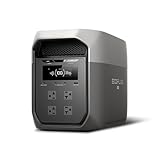
Best for high-draw loads: EcoFlow DELTA 3 Max — 2048Wh, 2400W rated, 3400W X-Boost — the most continuous output in this group and under 10ms UPS transfer.
Best for growing capacity later: OUPES Mega 1 — 1024Wh expandable to 5120Wh, 2000W continuous — modular add-on batteries without a second inverter.
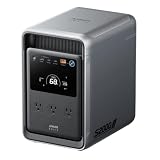
Best 2kWh battery lifespan: Anker SOLIX S2000 — 2010Wh on 314Ah LFP cells rated to 10,000 cycles, 1500W continuous, 6W idle draw.
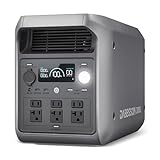
Best for a big family of AC devices: Dabbsson 2000L — 2048Wh semi-solid LFP, 2200W continuous, six AC outlets, UL94-V0 housing.
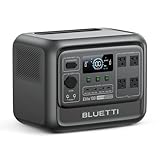
Best compact 1kWh build: BLUETTI Elite 100 V2 — 1024Wh, 1800W rated, 3600W surge, 25 lb, 30dB silent mode, 10ms UPS.
Best for CPAP and phones only: Jackery Explorer 300 — 292Wh, 300W continuous, 7.1 lb — the most-reviewed unit here, built for medical devices and small electronics.
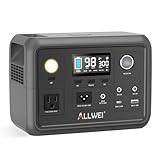
Best weight to carry: ALLWEI 300W — 256Wh, 300W continuous, 6.4 lb — pure sine wave output and a 60W USB-C port at the lightest carry weight in the roundup.
Table of Contents
Top 3 Picks for RV Camping (September 2026)

Jackery Explorer 1000 v2
- 1070Wh LiFePO4
- 1500W continuous
- 3000W surge
- 0-100% in 1 hour
- 23.8 lb


All 10 Best Portable Power Stations Compared in 2026
| Product | Specifications | Action |
|---|---|---|
| Jackery Explorer 1000 v2 |
|
Check Latest Price |
| Anker SOLIX C1000 Gen 2 |
|
Check Latest Price |
| BLUETTI AC180 |
|
Check Latest Price |
 EcoFlow DELTA 3 Max EcoFlow DELTA 3 Max |
|
Check Latest Price |
 OUPES Mega 1 OUPES Mega 1 |
|
Check Latest Price |
 Anker SOLIX S2000 Anker SOLIX S2000 |
|
Check Latest Price |
 Dabbsson 2000L Dabbsson 2000L |
|
Check Latest Price |
 BLUETTI Elite 100 V2 BLUETTI Elite 100 V2 |
|
Check Latest Price |
 Jackery Explorer 300 Jackery Explorer 300 |
|
Check Latest Price |
 ALLWEI 300W ALLWEI 300W |
|
Check Latest Price |
Two columns decide most RV purchases and both are in that table: continuous AC output and capacity. Everything else is preference.
1. Jackery Explorer 1000 v2 Review: The Best All-Rounder for RV Campers
- One-hour emergency recharge from the Jackery app
- 1070Wh with 1500W continuous
- 23.8 lb with a foldable handle
- 100W USB-C plus three pure sine wave AC ports
- App control works without cell service
- 23.8 lb is too heavy for hiking
- Large tools like a sliding miter saw trip the inverter
- No dedicated 12V barrel outputs
- Solar input limited to Jackery panels
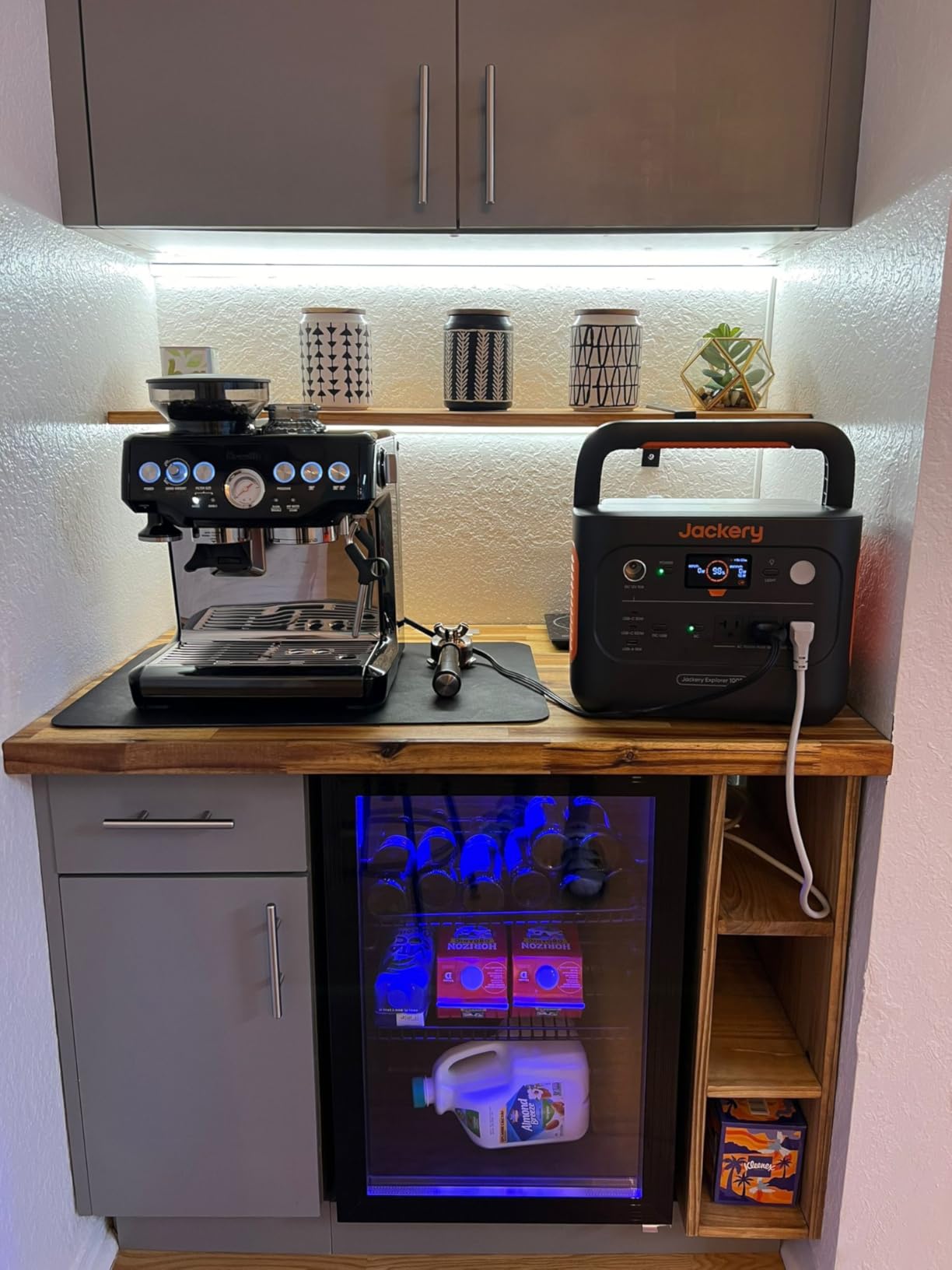
I keep the Explorer 1000 v2 in the cab of our trailer because it is the rare 1kWh box that does everything an RV weeknight needs without a gas can. Seven outlets, 1500W of continuous output and a 1070Wh battery cover a 12V fridge, Starlink, laptop charging and a CPAP machine in the same pass.
The charging speed is the standout. Owners report 0 to 100% in about an hour using the emergency charge mode in the app, and 1.7 hours on the default battery health setting. In practice that means you top it off over lunch at a truck stop and leave with a full battery, which is the single most useful thing a road power station can do.
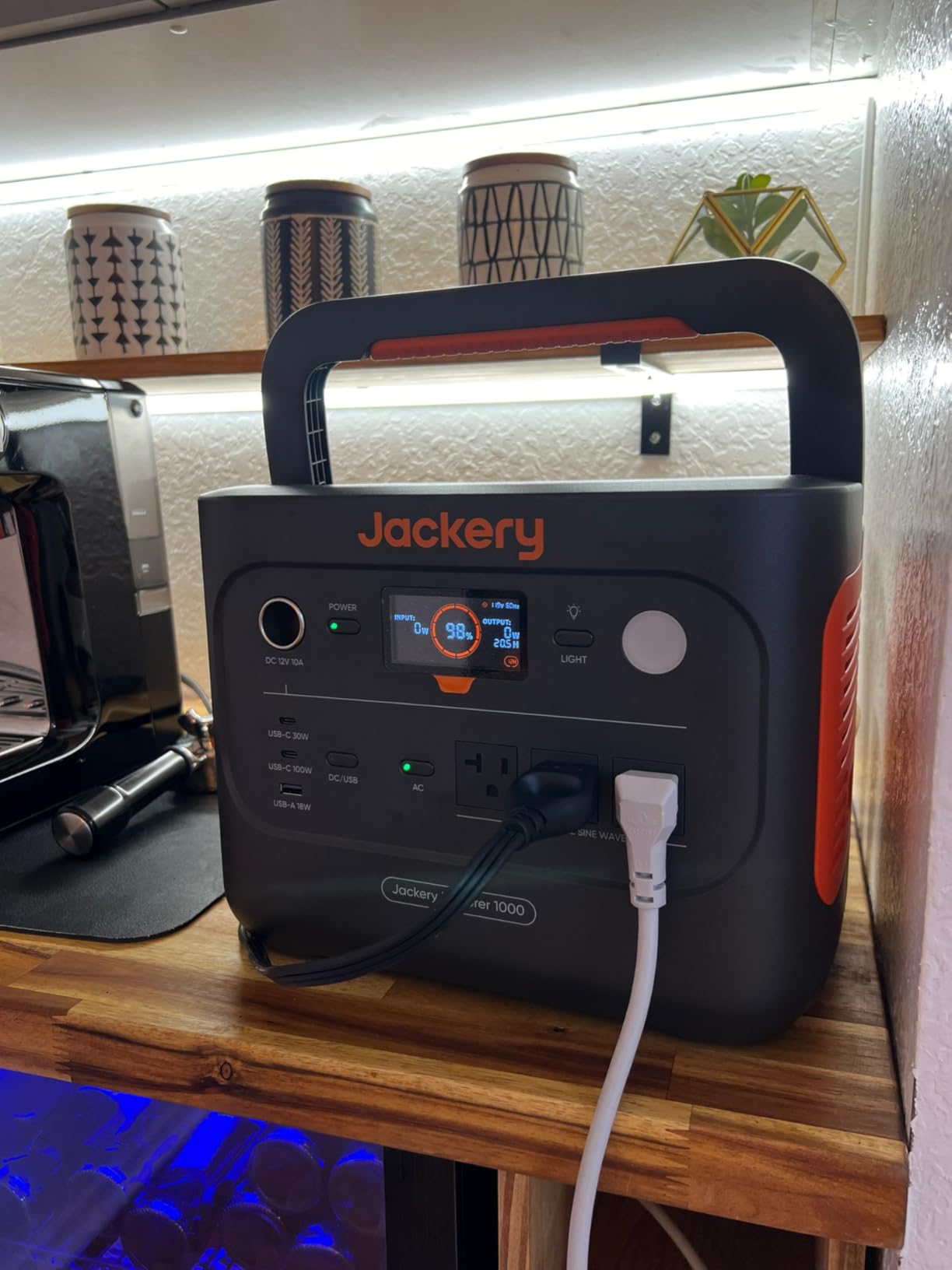
Cycle life is rated above 4,000 charges while still holding 70% of rated capacity, and the cell chemistry is LiFePO4 rather than NMC, which matters if you park a hot desert rig for a month with a full battery. The battery management system handles that without complaint.
Two real compromises showed up repeatedly in owner reviews. The USB-C port is 100W but there are no dedicated 12V DC barrel outputs, so running a 12V accessory means an adapter, and solar charging is limited to Jackery-branded panels even though the input is otherwise standard.
How it handles a 12V fridge and Starlink on one charge
A 12V compressor fridge drawing roughly 40 to 60 watts plus a Starlink dish around 50 watts is about 100 watts of continuous draw. On a 1070Wh battery with real-world usable capacity somewhere between 640 and 950Wh depending on how deep you discharge it, that is a comfortable overnight and most of the next day.
Sleeping next to it is not a problem. There is a 30 dB quiet mode in the app, and the built-in LED light can be switched on and off remotely, which matters when you are not wanting to crawl out of a sleeping bag in a dark trailer.
Where it falls short for a full-time RVer
At 23.8 lb it is a two-hand carry, and if your boondocking spot is 100 yards from the truck you will feel that every time. It also will not run a 12V rooftop air conditioner, because 1500W continuous simply cannot cover a compressor surge even with power lifting.
Reviewers also flag that heavy power tools trip the inverter, and a few units needed a factory reset after a software glitch stopped charging. The two-year manufacturer warranty is the shortest in this roundup, which is a real consideration for a box you may own for a decade.
2. Anker SOLIX C1000 Gen 2 Review: 49-Minute Full Recharge
- 49-minute full recharge at 1600W AC
- 2000W continuous from only 1024Wh
- Under 10ms UPS held a CPAP through a 10-day ice storm
- 10 output ports
- 14% smaller and 11% lighter than comparable models
- Gen 2 removed the expansion battery option
- About 25 lb is a one-person lift
- 15-20% harmonic distortion on microwave loads
- A 100W panel only pulls 60-80W in practice
The Anker SOLIX C1000 Gen 2 is the one I recommend to RVers who bounce between shore power and dry campsites constantly, because charging speed is the whole argument. A full recharge takes 49 minutes at 1600W through the HyperFlash setting in the Anker app.
Output is unusually strong for a 1kWh box. It puts out 2000W continuous with 3000W peak, which is double what the Explorer 1000 v2 delivers. That headroom is what makes it comfortable running a small microwave, an electric kettle or a portable AC unit on low, none of which the 1500W Jackery handles as confidently.
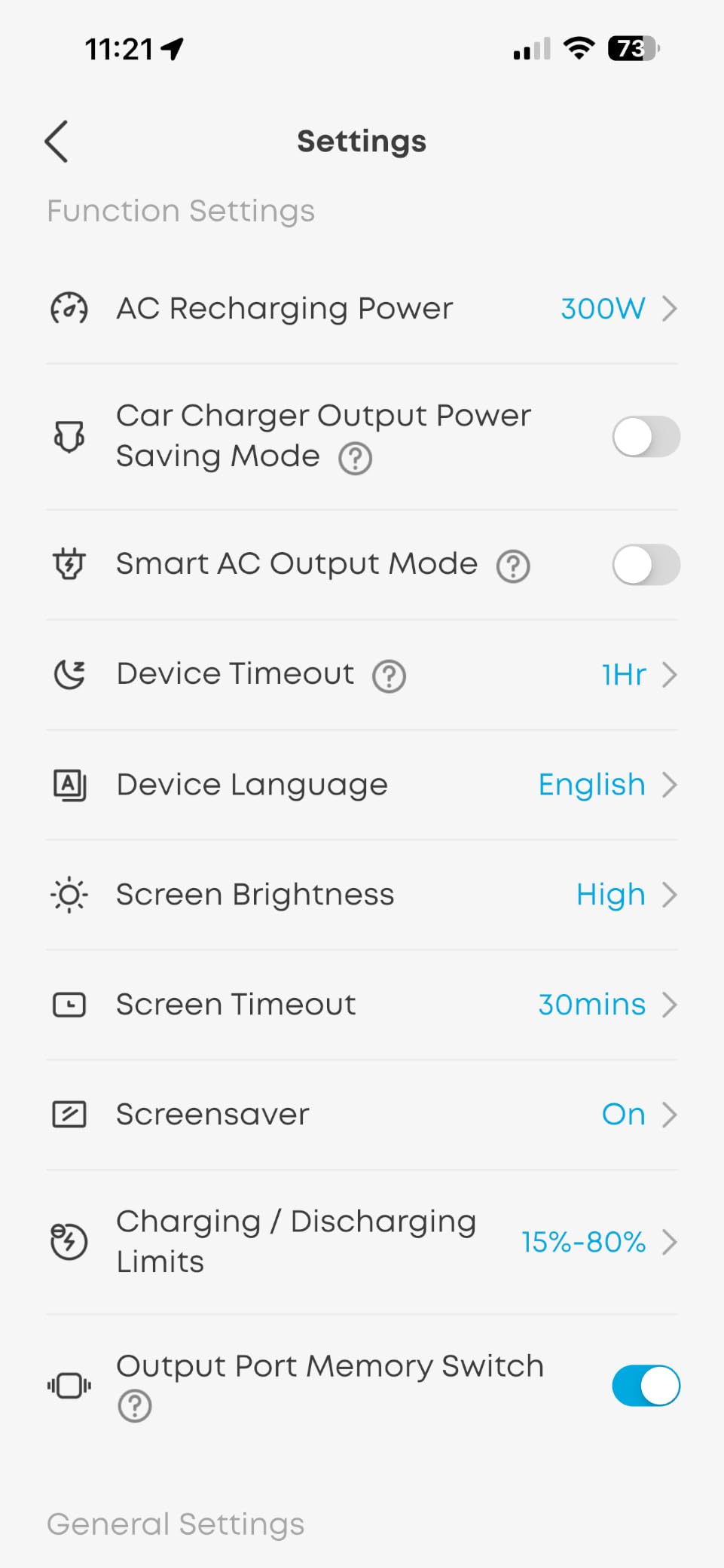
The battery is rated to keep at least 80% of capacity after 4,000 cycles, and the unit carries a five-year warranty. Owners across RV and van setups report running a mini fridge for two days and a CPAP for three nights on a single charge, and one reviewer kept a CPAP machine and their internet alive through a 10-day ice storm on the UPS function.
Ten output ports is a generous count, and the app includes time-of-use scheduling so you can charge cheaply at a campground before a long off-grid stretch.
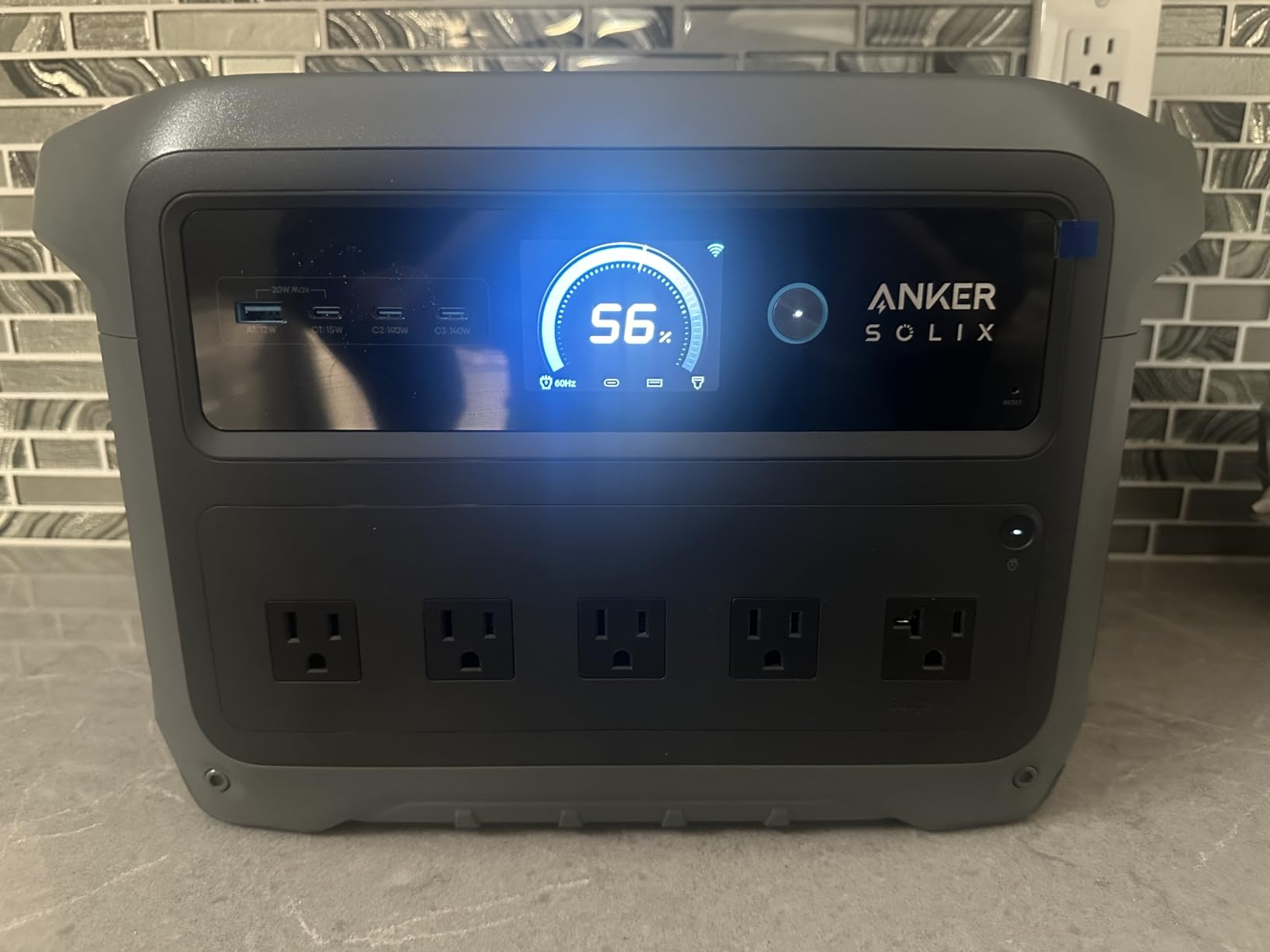
What the 10ms UPS cutover means in a sleeping RV
When the inverter switches to battery, the transfer takes under 10 milliseconds. Routers, laptops, Starlink terminals and CPAP machines do not notice the handoff, which means you can leave them plugged in overnight and stop thinking about switchovers entirely.
That matters more in an RV than at home, because shore power in a campground is far less reliable than a house connection. One owner on this listing described riding out a 10-day ice storm on battery backup with a medical device running the whole time.
Where the second-generation design costs you
The biggest change from the first generation is that the expansion battery option is gone. If your plan is to add capacity next year rather than buy a second unit, that is a meaningful loss for an RV build.
Engineering reviewers also note measurable harmonic distortion of 15 to 20% on microwave loads, and most RV solar setups will not keep up on a small panel: a 100W solar panel only pulls 60 to 80W in practice, so plan on the 600W input to do the work.
3. BLUETTI AC180 Review: 500W Solar Input for Roof Arrays
BLUETTI AC180 Portable Power Station 1152Wh 1800W LiFePO4 Solar Generator
- 500W MPPT solar input recharges in 2.8-3.3 hours
- Eight outlets plus USB ports
- 20ms UPS switchover
- One-hour full charge on 1440W AC
- Five-year warranty and strong support
- 37.4 lb is heavy for pack-downs
- Draws about 20W with the inverter on
- Wireless charging pad on top is unreliable
- Only about 90% of rated capacity is usable
If your RV roof carries panels, the BLUETTI AC180 is the strongest match in this roundup because its 500W MPPT solar input sits among the highest ceilings here. A 400W portable panel array can push into that input hard, and the station refills in roughly 2.8 to 3.3 hours on solar alone.
Capacity is 1152Wh with 1800W rated output, and BLUETTI’s app-enabled power lifting mode raises the usable ceiling to 2700W for resistive loads like a coffee maker or hair dryer. Full charge on a wall outlet takes about an hour at 1440W of AC input.
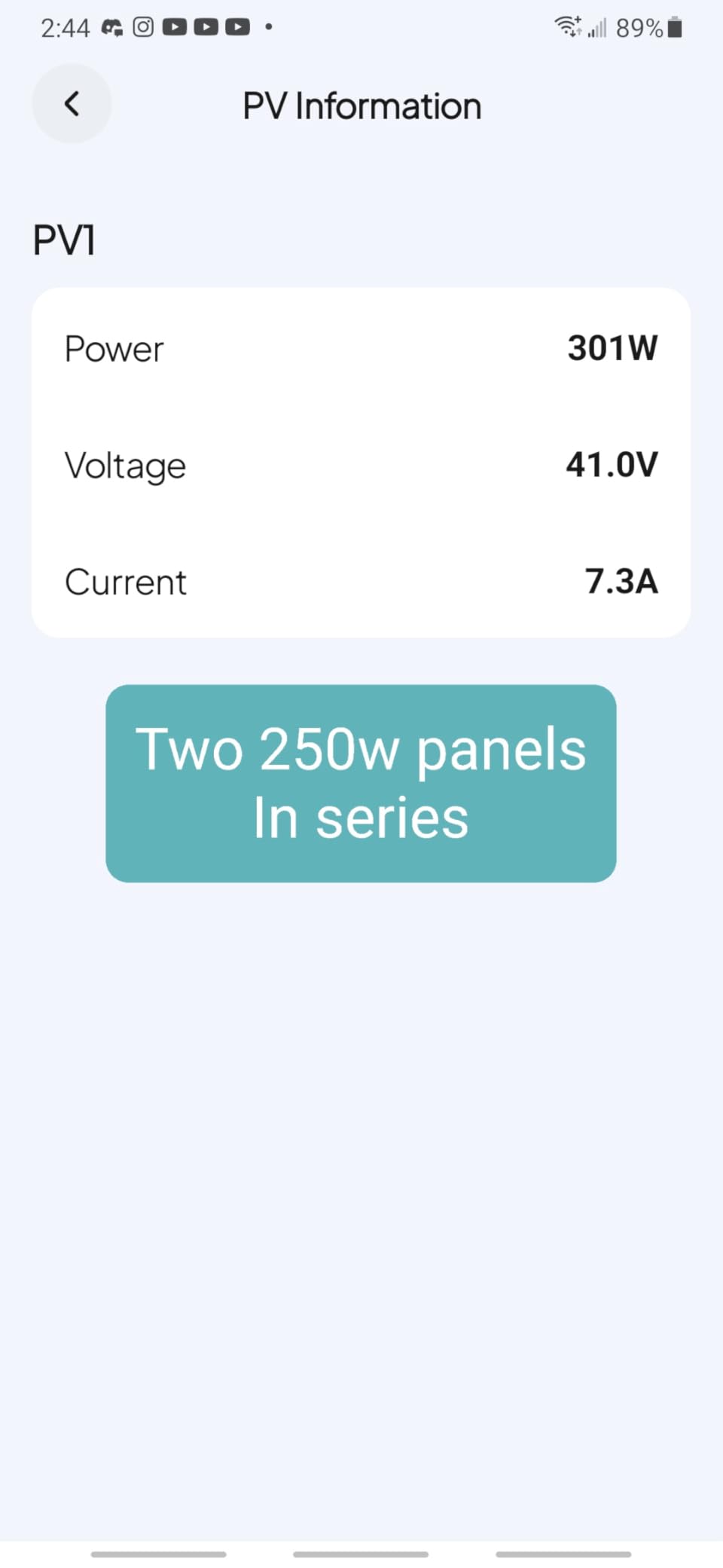
The port count works in your favor here. Eight outlets plus USB ports let a full camp load run at once, and the 20ms UPS switchover keeps routers, televisions and internet alive through campground power dropouts. The five-year warranty is tied for the longest in this group, and owners repeatedly single out customer support for actually resolving issues.
Campers report running a 12V car fridge and charging phones for a full five-day trip on one charge, and one owner uses it as a whole-room backup through a heavy-gauge extension cord in a house.
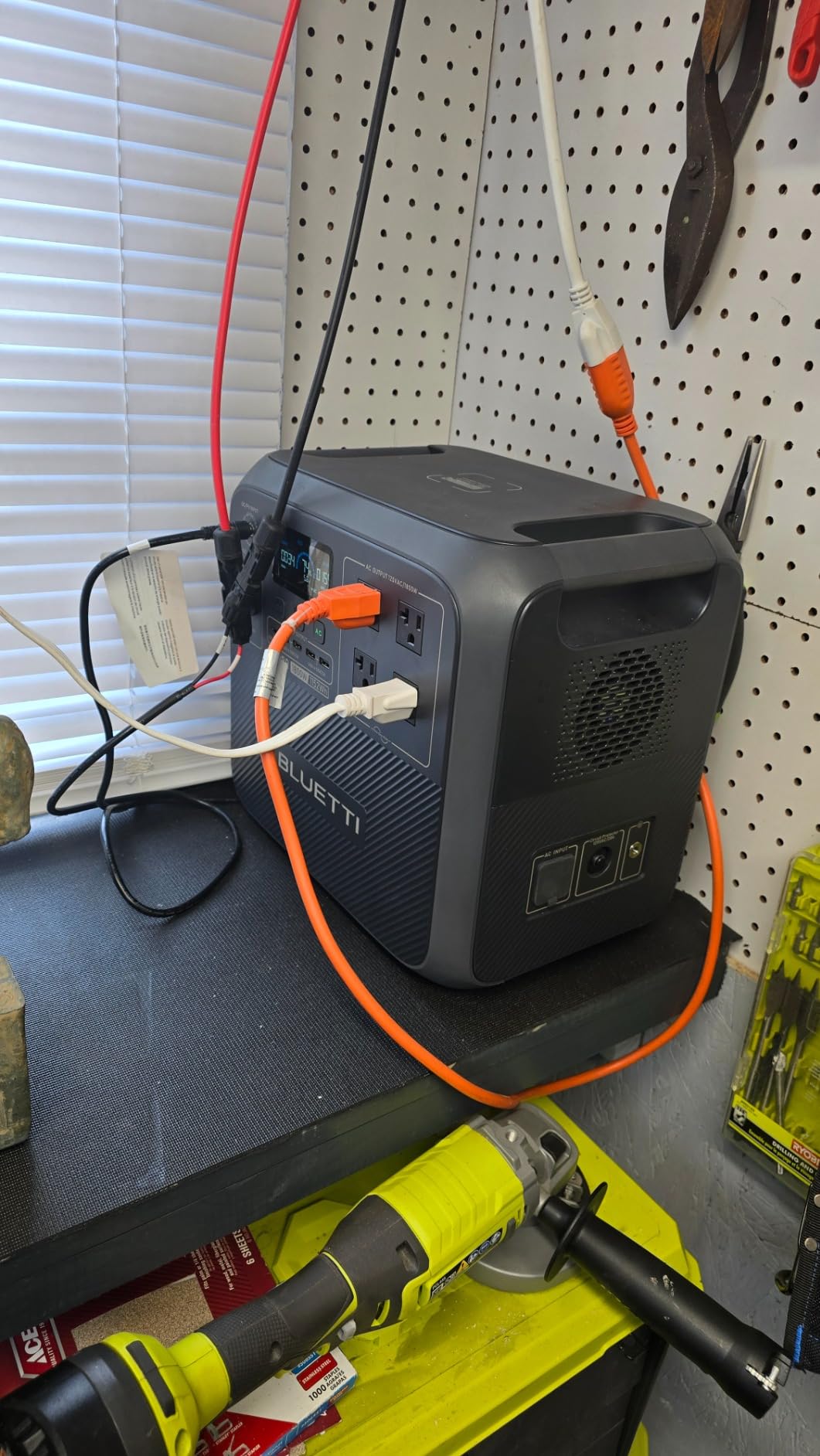
Sizing solar panels to the AC180 input
Plan on 300W to 500W of panels to keep pace with a typical overnight draw. Below 200W of panel, an RV in partial shade, a dusty roof panel or a light overcast will leave you recharging in real time rather than overnight, which is the disappointment RV solar buyers hit most often.
Boondockers report the same thing about panels as they do about stations, so a weak solar day is as often a panel problem as a station problem. The AC180 at least gives you the input headroom to fix it with better panels later.
The idle draw and capacity you do not get to use
Two honest caveats. The unit draws roughly 20W while the inverter is switched on, so an overnight run on a low-draw load quietly costs you more than the label suggests, and only about 90% of rated capacity is usable in practice.
At 37.4 lb it is the second-heaviest unit here, so it is a station for a permanent spot in a cargo bay rather than something you move between sites. The wireless charging pad on top is also the most commonly reported failure, dropping connection.
4. EcoFlow DELTA 3 Max Review: 2400W of Headroom for Big Loads
EF ECOFLOW DELTA 3 Max Portable Power Station, 2048Wh LFP Battery, 2400W
- Highest continuous output in the roundup at 2400W rated
- 0-80% recharge in about 1.13 hours
- Under 10ms transfer for medical devices
- Ultra-quiet operation for indoor and overnight use
- Five-year service coverage
- Tall 19.44 inch form factor needs vertical storage
- Only three outlets in the base configuration
- Solar panel sold separately
- Smaller review base than the established rivals
The DELTA 3 Max answers the question RV owners ask most often, which is whether a portable power station can handle a real appliance rather than a phone. At 2048Wh with 2400W of rated output and a 3400W X-Boost mode, it is the strongest inverter in this group.
That headroom is what separates it from the 1kWh models here. A microwave, an air fryer, an electric coffee maker and a small 12V AC unit on low all fall inside what it can start, which is the category of load that actually decides an RV weekend.
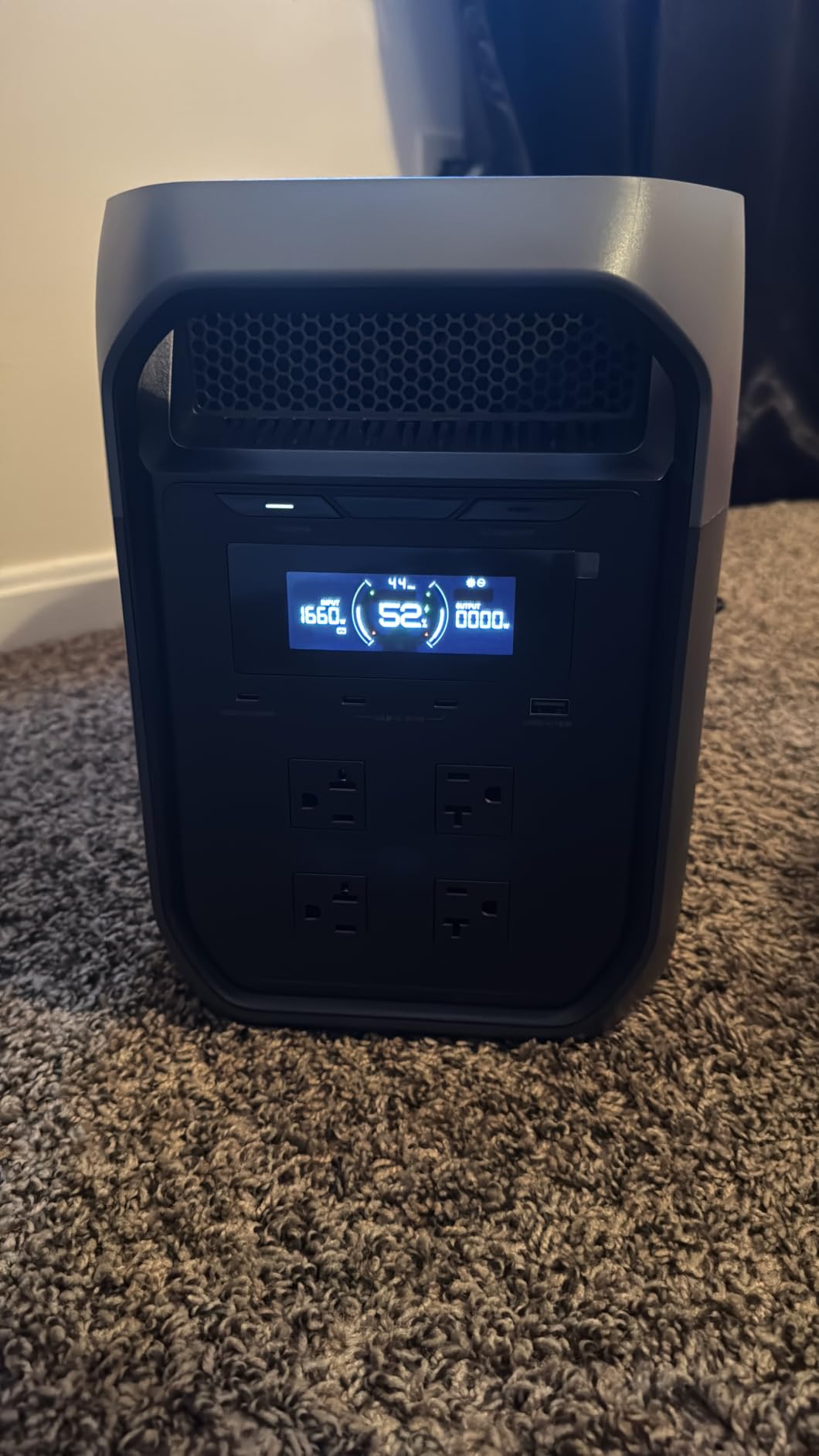
Recharge is equally quick. EcoFlow’s X-Stream technology takes the battery from 0 to 80% in about 1.13 hours, and transfer to battery happens in under 10ms so computers and medical devices do not blink. The cooling system is quiet enough for indoor backup and overnight campsite use, and the build is aluminum and plastic with five years of service coverage.
In r/RVLiving, owners pick larger EcoFlow units specifically to avoid waking up to a dead battery after a night of heavy use, which is exactly the failure mode this capacity addresses.
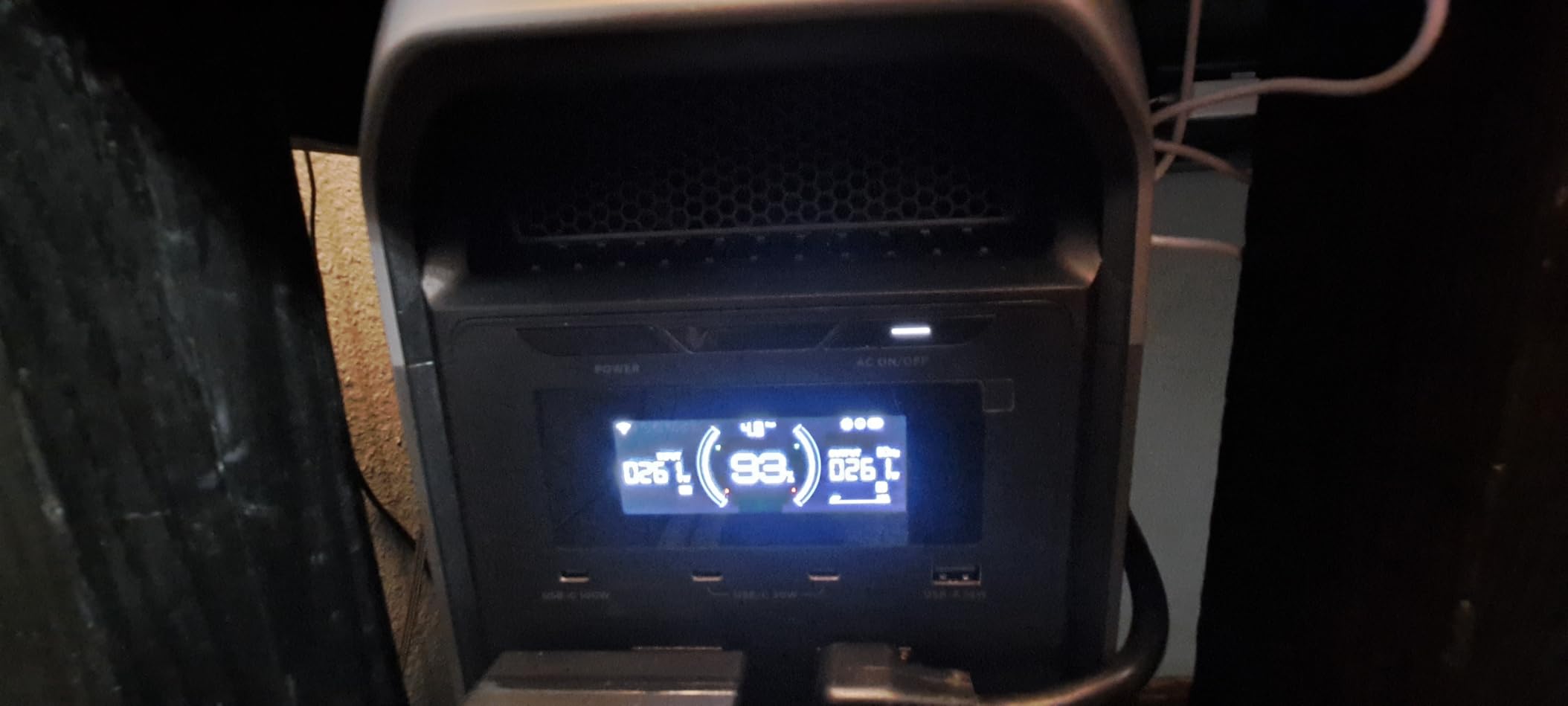
Will it run a rooftop 12V air conditioner?
Partly, and the honest version matters. A small 12V compressor unit rated around 1,200W can often be started and run, because 2400W rated leaves real surge headroom. A larger 12V AC unit, or one starting from a cold soak, still stretches the limits and depends on the unit having a soft start relay.
If a 12V AC unit is the reason you are shopping, this is the class of station to buy, and you should still carry a small gas generator as backup for the hottest nights rather than betting a hot-weather boondock on one battery.
What you give up for that power
The station stands 19.44 inches tall, so it needs real vertical clearance in a storage bay where the 1kWh models slide under a seat. The base configuration lists only three outlets, which is thin for a 2kWh box, and no solar panel is included.
It is also a newer listing with 583 reviews, so long-term durability data is still thin compared with the established 1kWh competitors.
5. OUPES Mega 1 Review: Strong Specs With Room to Grow
OUPES Mega 1 Portable Power Station 1024Wh 2000W (4500W Surge)
- Expands to 5120Wh with two B2 batteries and no extra inverter
- 0-80% in 36 minutes on AC
- 2000W continuous beats most 1kWh rivals
- Dual 100W USB-C plus four QC3.0 USB-A
- Under 20ms UPS transfer
- Real surge trips near 2050-2200W
- not the claimed 4500W
- Cooling fan gets loud under heavy load
- Wi-Fi in the app is unreliable
- Plastic housing with no weather resistance
The OUPES Mega 1 is the value pick in this roundup, and the reason is a feature almost nobody else at this capacity offers: modular expansion to 5120Wh using up to two B2 extra batteries, with no second inverter to buy.
For an RV owner who starts with a 1kWh box for weekends and later wants three cloudy days of off-grid time, that path is cheaper and simpler than replacing the whole station. Campers and overlanders report running a fridge, lights, Starlink and a coffee maker for days on a single charge.
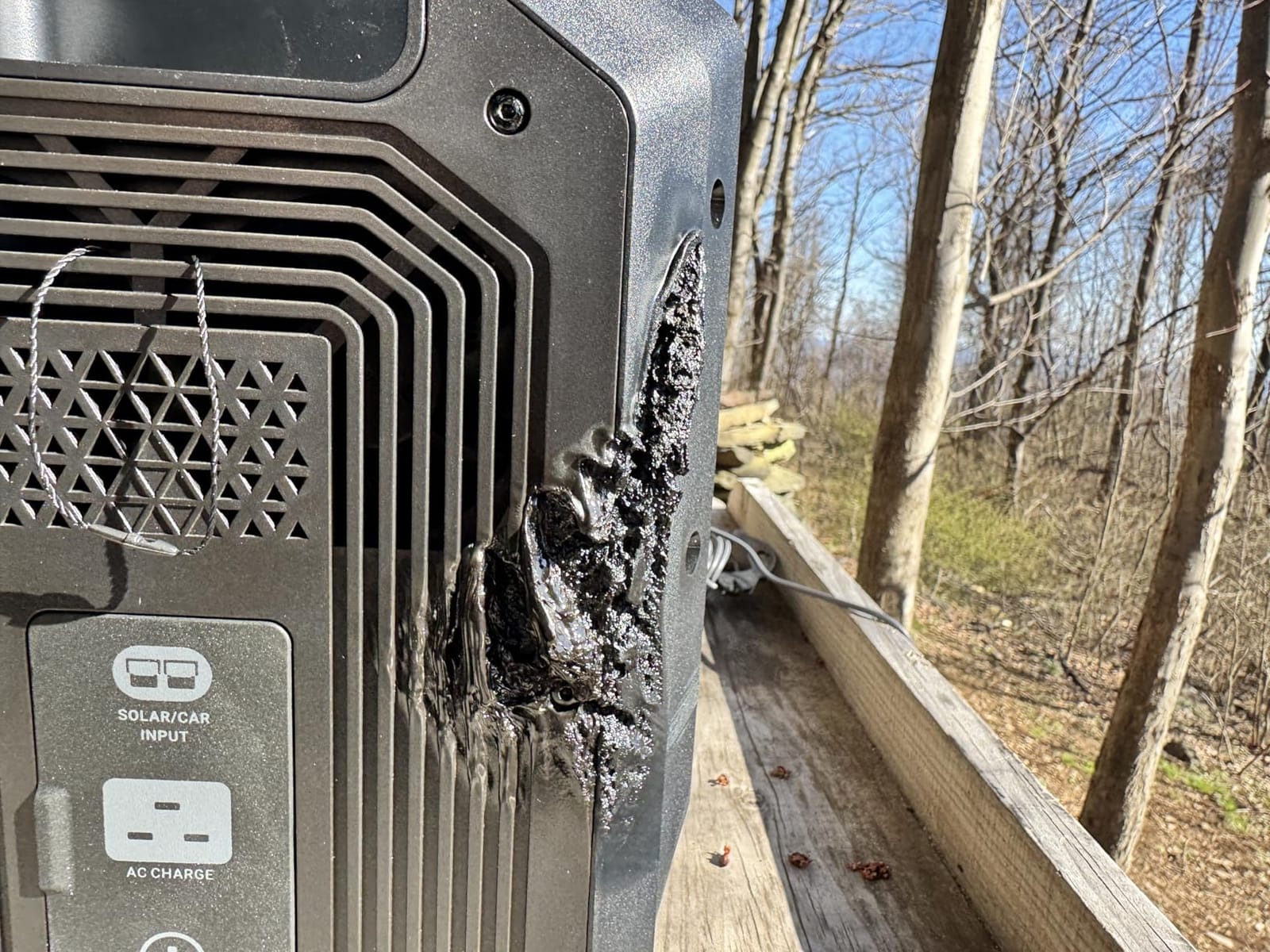
Recharge speed is genuinely fast: 0 to 80% in 36 minutes on AC, and 26 minutes when you combine wall power and solar. Output is 2000W continuous, which puts it ahead of most 1kWh units, and the port mix includes dual 100W USB-C PD, four QC3.0 USB-A and 12V DC outputs.
Multiple owners describe it as the best power-per-dollar option at this capacity, and OUPES support is praised for replacing defective units quickly, which offsets a thinner brand track record.
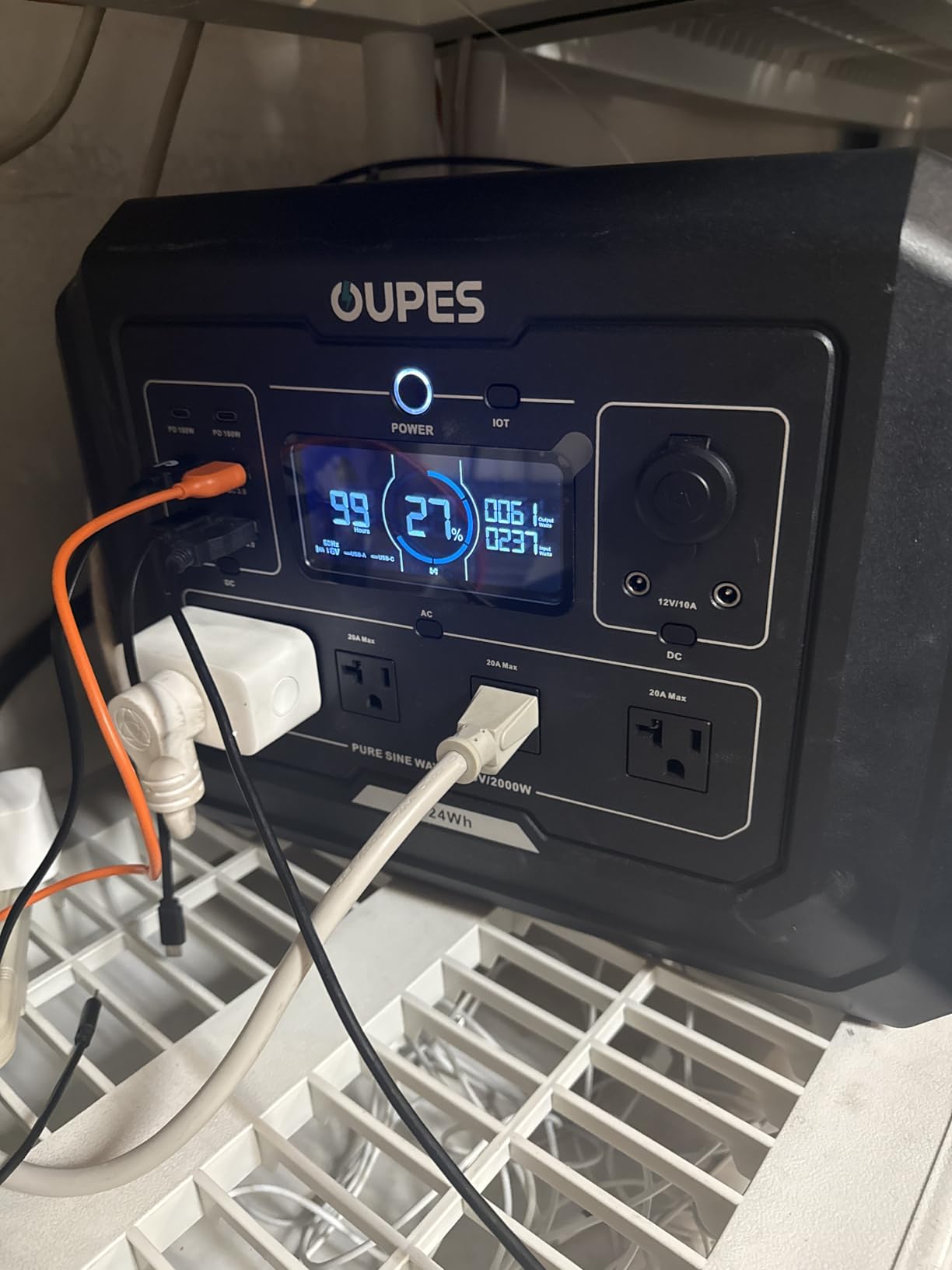
What expansion actually gets you
Two B2 batteries take the total from 1024Wh to 5120Wh, which is roughly four days of moderate RV use without touching shore power. The batteries chain into the existing inverter, so port layout and 2000W output stay the same, only runtime changes.
That is the honest advantage over fixed units: you pay for the capacity you need now, and the inverter you already own handles the rest. It is also a cleaner answer than a DIY build for anyone who does not want to wire a converter, a solar controller and a breaker panel.
Where the claims and the reality differ
The 4500W surge figure is the big one. Owners consistently report the inverter actually trips somewhere around 2050 to 2200W, so treat surge capacity as roughly equal to the continuous rating and plan compressor startups accordingly.
At 27.8 to 30 lb it is heavy for repeated carry-on setups, the cooling fan runs through most of the charge cycle and gets loud under load, and the housing is plastic with no weather resistance, which matters on a wet trailer floor or a dusty desert site.
6. Anker SOLIX S2000 Review: 314Ah Cells and a 6W Idle Draw
- 314Ah LFP cells rated to 10000 cycles
- 6W idle draw runs about 20% longer than similar 2kWh systems
- Compact footprint for a 2010Wh capacity
- Six recharge paths including alternator
- 35-hour rated fridge runtime
- 1500W continuous is modest for a 2010Wh unit
- No 12V DC port
- 35.7 lb is a heavy lift
- Small review base so far
The Anker SOLIX S2000 is built around 314Ah LFP cells, which is the number that matters for a ten-year RV ownership cycle. Those cells are rated to 10,000 cycles, a 15-year lifespan figure that no other unit in this roundup claims.
Its other distinguishing feature is efficiency. A 6W idle draw means it runs roughly 20% longer than comparable 2kWh systems, and Anker rates it at 35 hours of fridge runtime, which is a realistic multi-day number for a 12V compressor fridge rather than a headline LED-light figure.
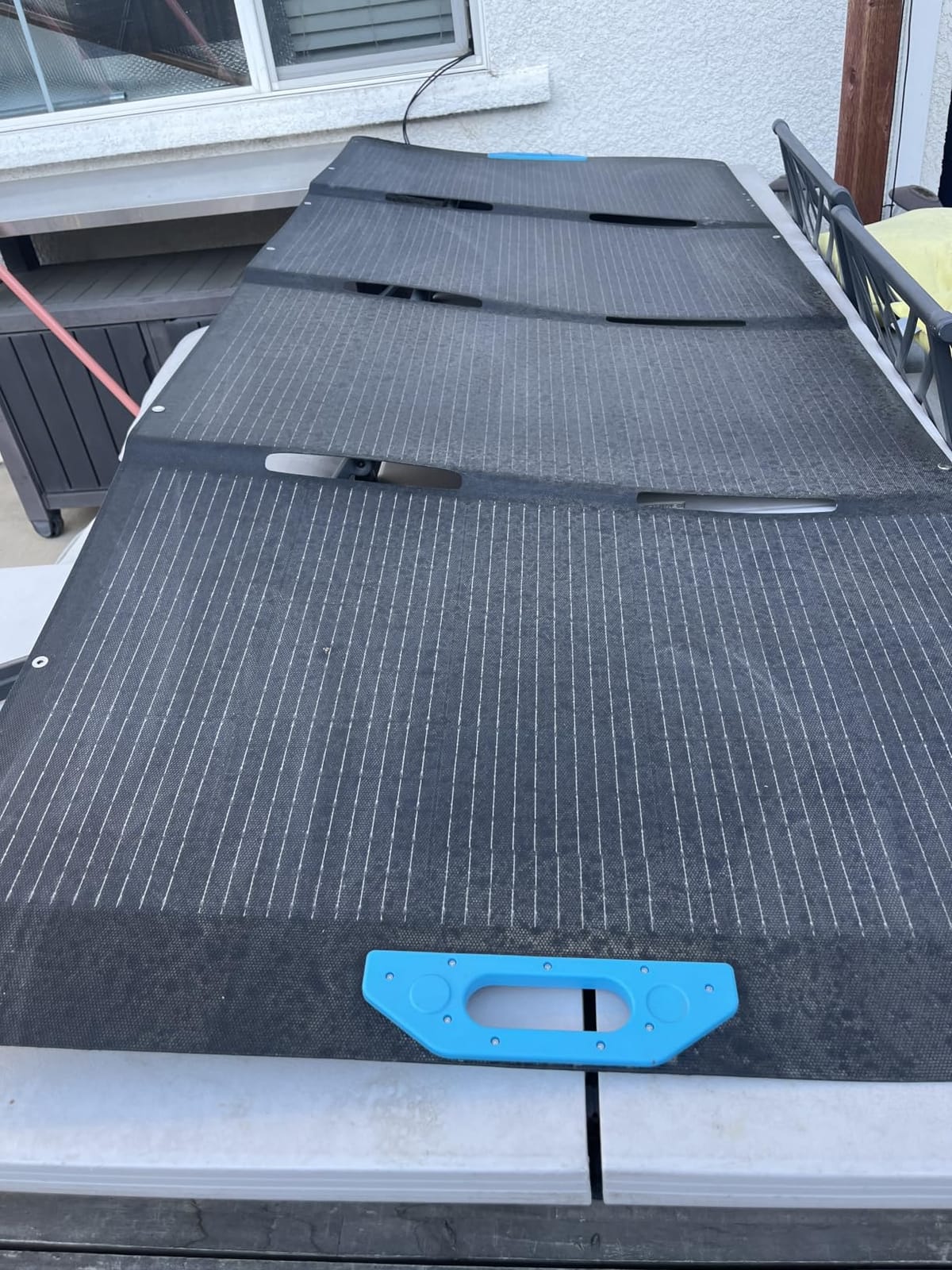
Charging flexibility is the sleeper feature for RV use. Six recharge paths are listed, covering AC, solar up to 400W, generator, alternator and car outlet, plus combined AC plus solar. The alternator path is what makes it practical for a tow-vehicle charging setup, since it is the fastest refill available while you drive.
In the r/AnkerSOLIXCommunity, owners praise the S2000 for being light enough to move around a campsite and for pairing well with a small generator as a top-up rather than a primary source. The dual-sided outlet layout keeps always-on appliances on the rear panel so you are not unplugging the fridge to charge a phone.
Why idle draw matters more than capacity
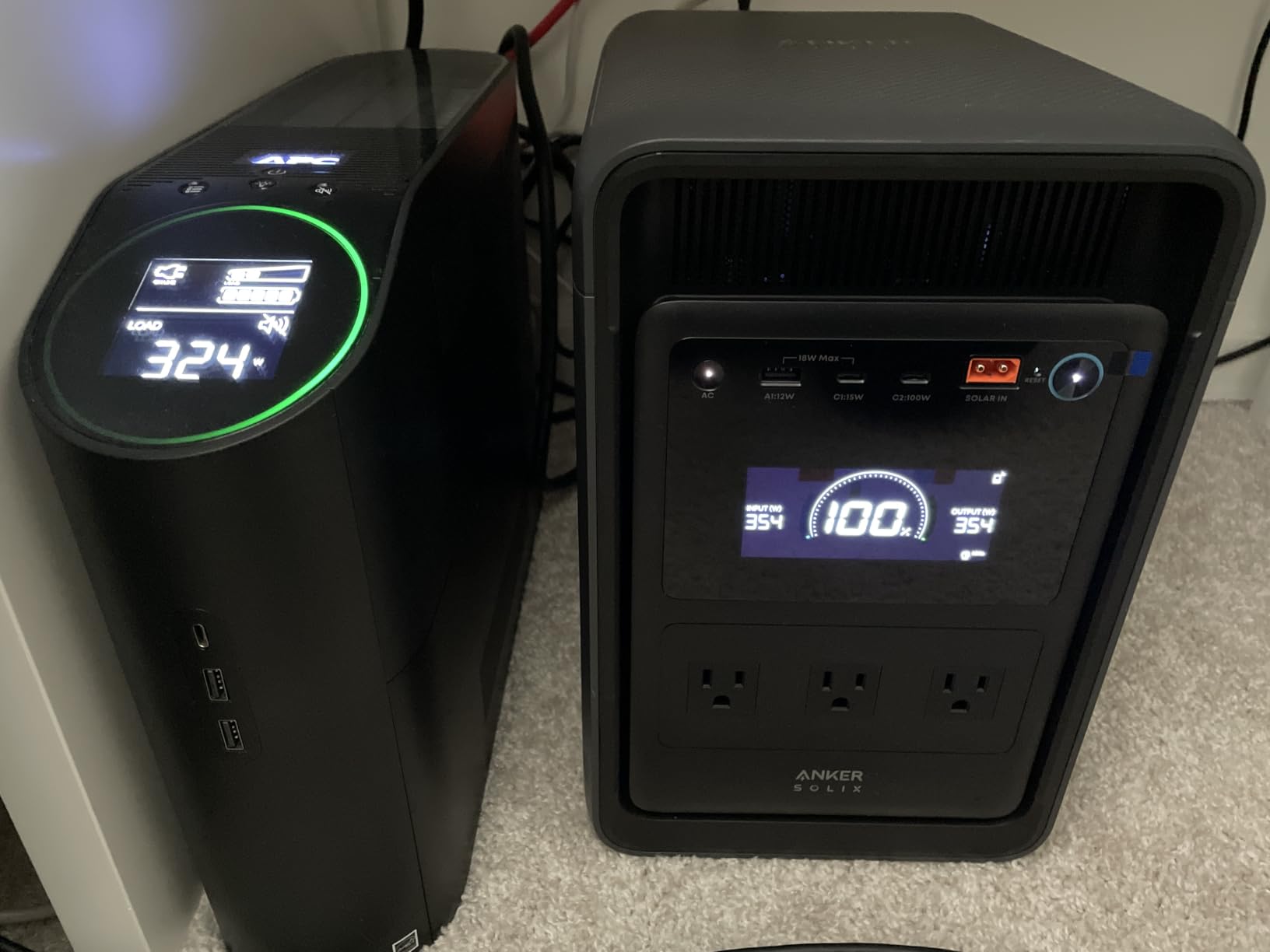
A power station spends most of its life doing almost nothing, running a fridge compressor in short cycles while everything else is off. A 6W idle draw sounds trivial until you multiply it across 300 days of a boondocking season, where it adds up to roughly 43Wh of pure overhead.
That is the quiet reason this unit covers more nights than a same-size competitor with a heavier electronics draw, and it is the spec we would look at first for a stationary RV install rather than a carried-along unit.
Where 1500W is a real limitation
A 2010Wh battery with only 1500W of continuous output is an unusual balance, and owners note it trips on some kettles and air fryers. It is a runtime-first design, not a power-first one, so it is the wrong choice if your plan centers on a microwave or a 12V AC unit.
There is no 12V DC port, so vehicle accessories need adapters, and 35.7 lb is a heavy lift into a high cargo bay. With only 303 reviews on this listing, the 10,000-cycle claim is a rating rather than something owners have yet verified over a decade.
7. Dabbsson 2000L Review: Six AC Outlets and Semi-Solid Cells
- Semi-solid LiFePO4 cells deliver about 1.3x runtime of standard LFP stations
- Six AC outlets plus a full port set
- Full AC recharge in about one hour with 800W MPPT solar
- UL94-V0 flame-retardant housing
- Five-year warranty
- 41 lb is still a heavy lift
- Cooling fan cycles on audibly even at zero load
- App charge-limit settings do not hold
- Constant relay clicking on AC pass-through
The Dabbsson 2000L uses semi-solid LiFePO4 cells, a denser pack chemistry that delivers about 1.3 times the runtime of standard LFP stations at the same 2048Wh rating. Experienced owners rate it among the best price-to-performance options in the 2kWh class.
The real-hardware draw here is outlet count. Six dedicated AC outlets is unusually generous at the 2kWh tier, and combined with USB, 12V DC and car port outputs, it is the easiest station to plug a whole household of RV devices into without daisy-chaining a hub.
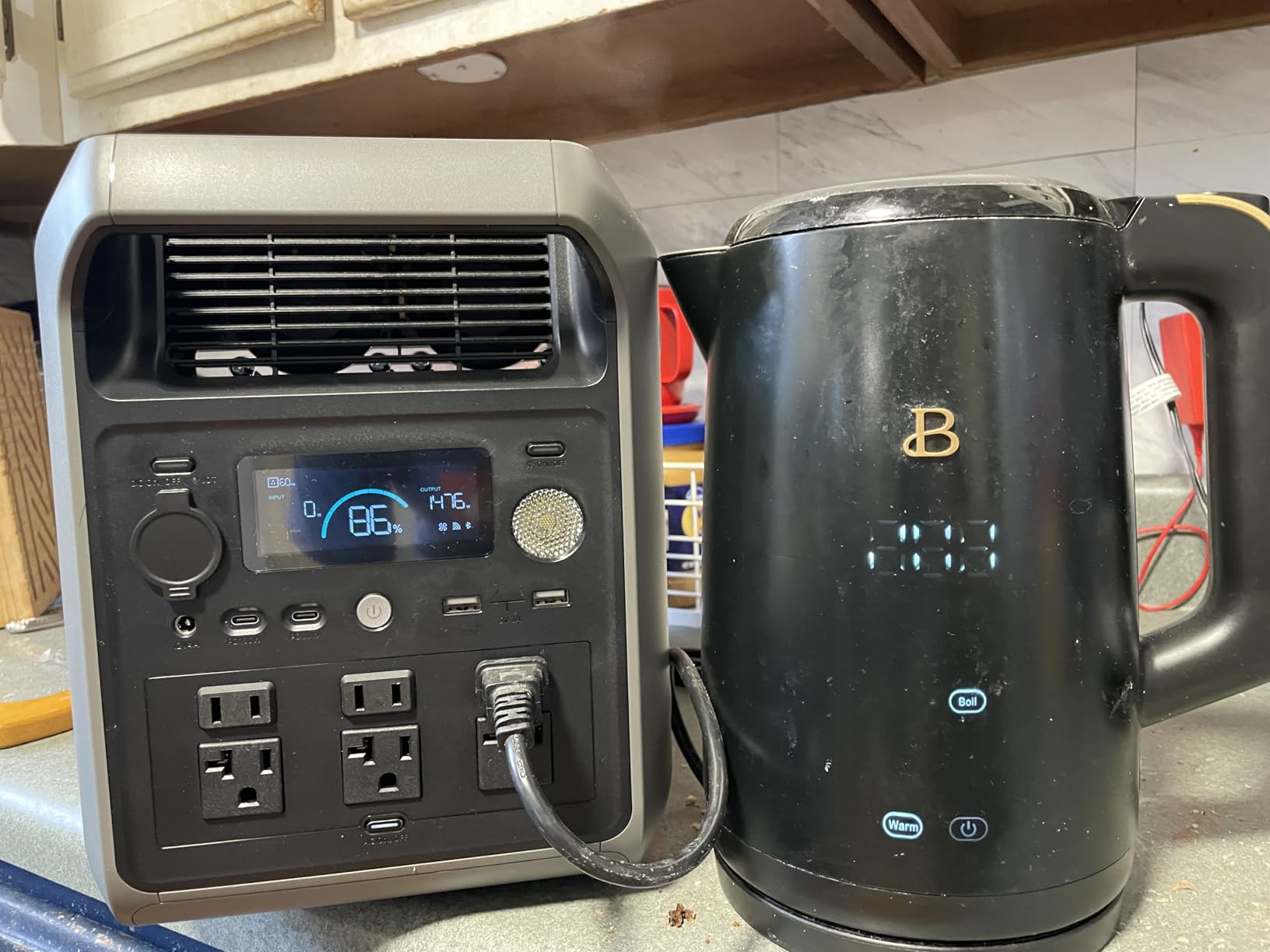
Charging is quick and flexible: a full AC recharge takes about an hour, and up to 800W of MPPT solar input is among the highest solar ceilings in this roundup. Under 15ms EPS switchover plus pass-through charging keep devices alive during a swap, and a three-mode built-in light covers the campground path.
One owner ran two freezers and two refrigerators for over seven hours, and another reported nearly 21 hours on a single fridge, which is the sort of real-world number RV buyers should be looking for instead of LED-light claims.
Sleeping next to it in a small trailer
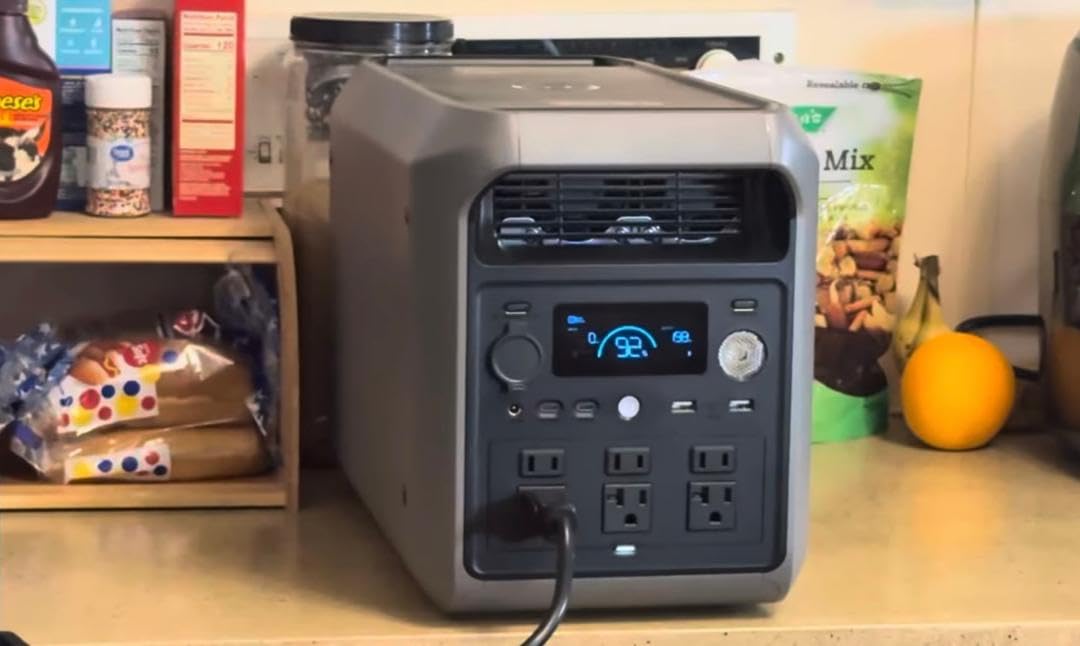
Two noise complaints are worth knowing. Owners report the cooling fan cycling on audibly even at zero load, noticeable from about 20 feet, and a constant relay clicking sound when running on AC pass-through. In a hard-sided trailer with a closed door, both are audible from the bed.
For a sleep-sensitive setup, test fan noise on your specific unit before committing. The safety side is better: the housing is UL94-V0 flame-retardant rated, and the battery is rated for 4,000 or more deep cycles to 80% capacity, with a five-year warranty covering three standard plus two extended years.
The app problems you will probably hit
Wi-Fi pairing in the Dabbsson app is reported as difficult even though Bluetooth works, and the battery charge-limit settings do not hold, so the unit stays at 100% by default. For RV use that second point matters, because a battery parked at full charge in summer heat ages faster than one held at a lower level.
You also cannot charge the unit from its two USB-C ports, and one owner reported it switching itself off unexpectedly while unattended on a light load. Plan to manage charge limits through the unit itself rather than the app.
8. BLUETTI Elite 100 V2 Review: Small Footprint With 3600W of Surge
BLUETTI Elite 100 V2 Portable Power Station for Camping 1024Wh 1800W
- Only 25 lb and 17L
- 35% smaller than similar units
- 3600W surge and 2700W power lifting
- 70-minute full recharge on 1200W AC
- 30dB silent mode with 10ms UPS
- 11 ports
- 4000+ cycles rated for a 10-year lifespan
- 1024Wh is low once the 10% reserve applies
- Only four AC outlets
- Priced well above comparable 1kWh units
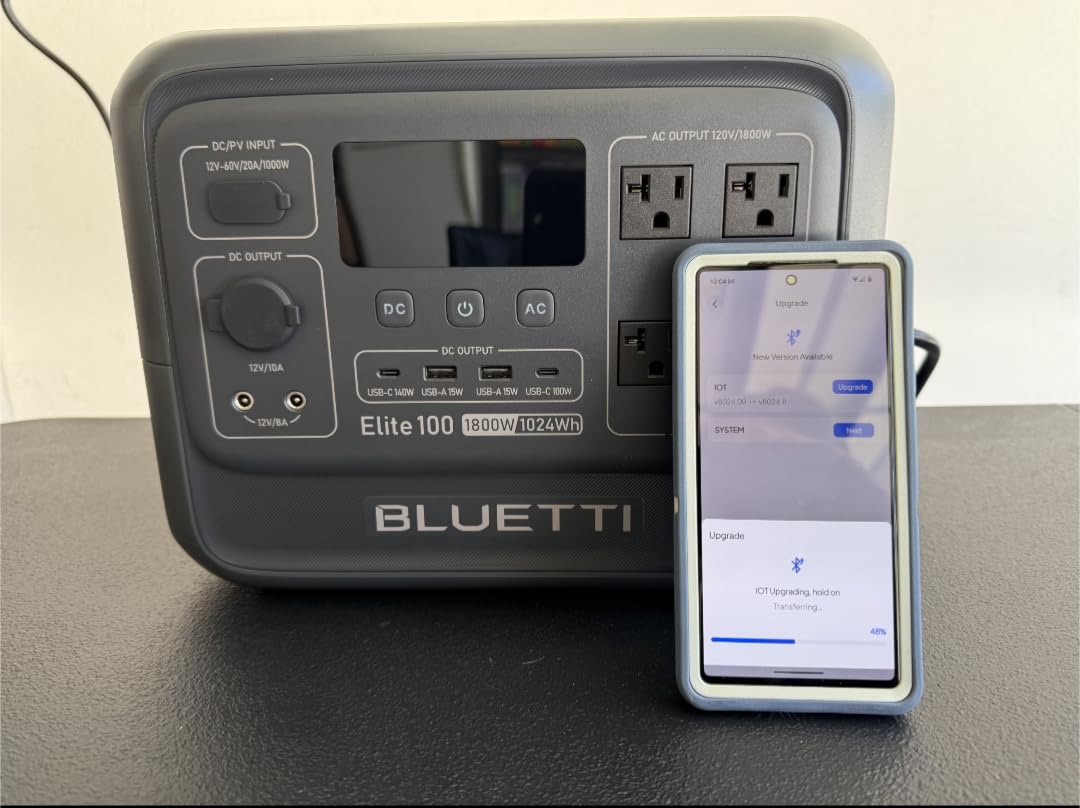
- Wi-Fi app connectivity is less reliable than Bluetooth
The Elite 100 V2 solves a problem the rest of this list creates. At 25 lb in a 17L footprint, it is 35% smaller and 30% lighter than similar 1kWh units, which is what makes it fit under a dinette bench or behind a seat in a Class B.
Power is not the compromise. It rates 1800W of AC output with 3600W of surge and 2700W of app-enabled power lifting, so it starts compressor loads that a 1500W unit refuses.
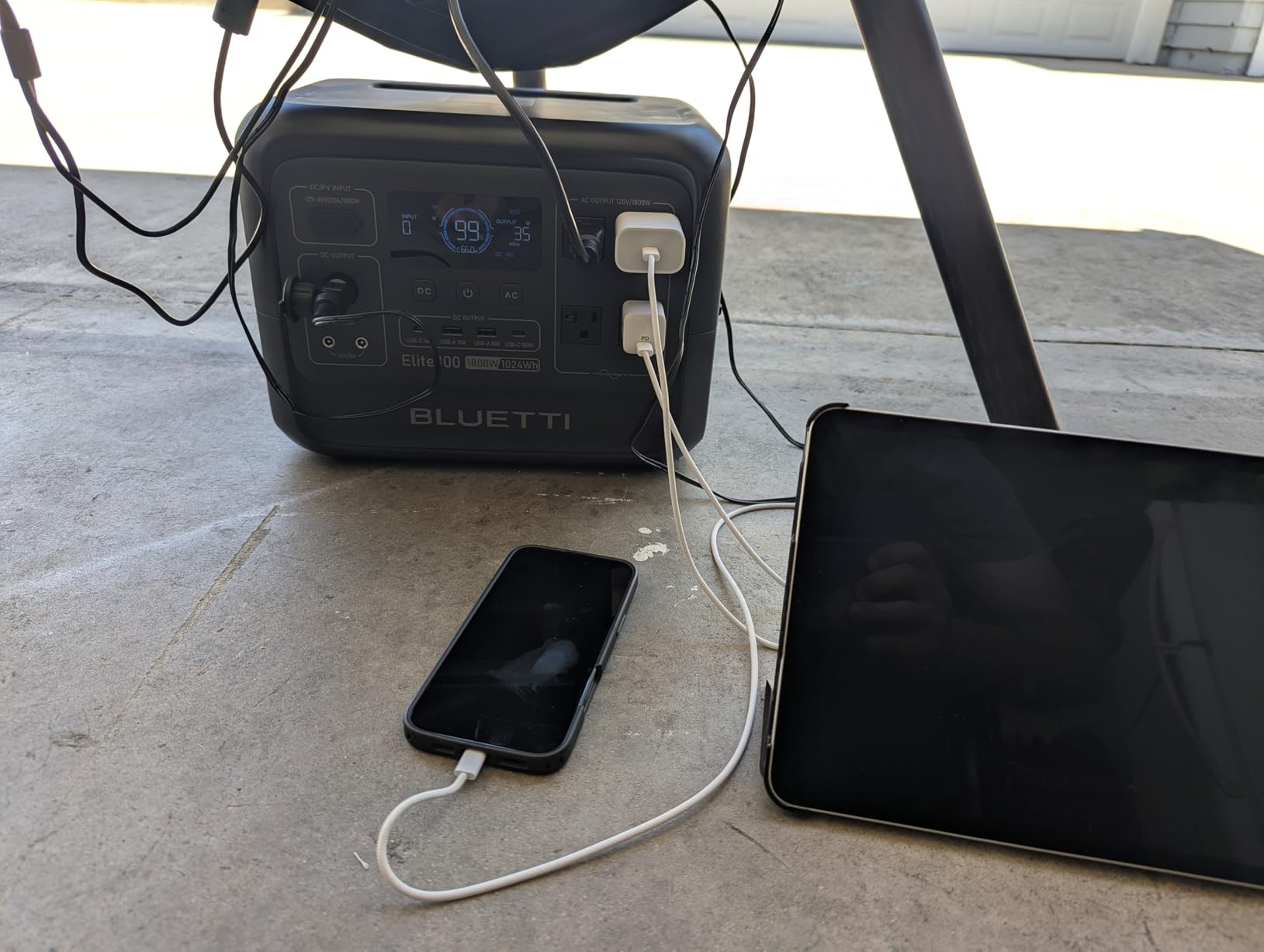
It also recharges faster than most of its class: a full charge takes 70 minutes on 1200W of AC input, and it accepts up to 1000W of solar. The 30dB silent mode plus a 10ms UPS switchover make it the pick for overnight CPAP and router duty in a small, enclosed camper.
Cell life is rated at 4,000 or more cycles to 80%, which is a 10-year lifespan figure, and the warranty runs 60 months. Eleven total ports let multiple devices charge at once even though only four are AC outlets.
Fitting a 1kWh station into a small RV
Footprint is the entire point of this unit. Where a 2kWh station needs a dedicated cargo bay, the Elite 100 V2 can sit in a pass-through, a garage or under a seat, and the hidden one-handed carry handle makes moving it a one-person job. That changes how often you are willing to use it.
The r/CampPower roundup consensus praises BLUETTI’s Elite series for packing serious capacity into a small footprint, which is the same problem this unit solves for Class B and van builds.
Where 1024Wh runs out
Apply the reserve rule before planning. Keeping about 10% in reserve for inverter stability and battery health means roughly 920Wh of working capacity, and against a 1152Wh AC180 that is a real difference on a two-day boondock with a fridge and Starlink.
Four AC outlets is among the tightest counts here, and several reviewers note it sits well above comparable 1kWh models from Jackery, Anker and OUPES. Wi-Fi connectivity in the app is also reported as less reliable than its Bluetooth link.
9. Jackery Explorer 300 Review: The Right Choice for Medical Devices Only
- Only 7.1 lb with an integrated handle
- Most owner feedback of any unit in this roundup
- MPPT controller reaches about 80% in 2.8 hours on a 100W panel
- Clean pure sine wave output
- Backlit LCD shows input and output wattage
- 292Wh is too small for fridges
- AC units or appliances
- USB-C is output only and cannot accept input
- Car port rated at only 10A
- Auto power-off below a 10W draw
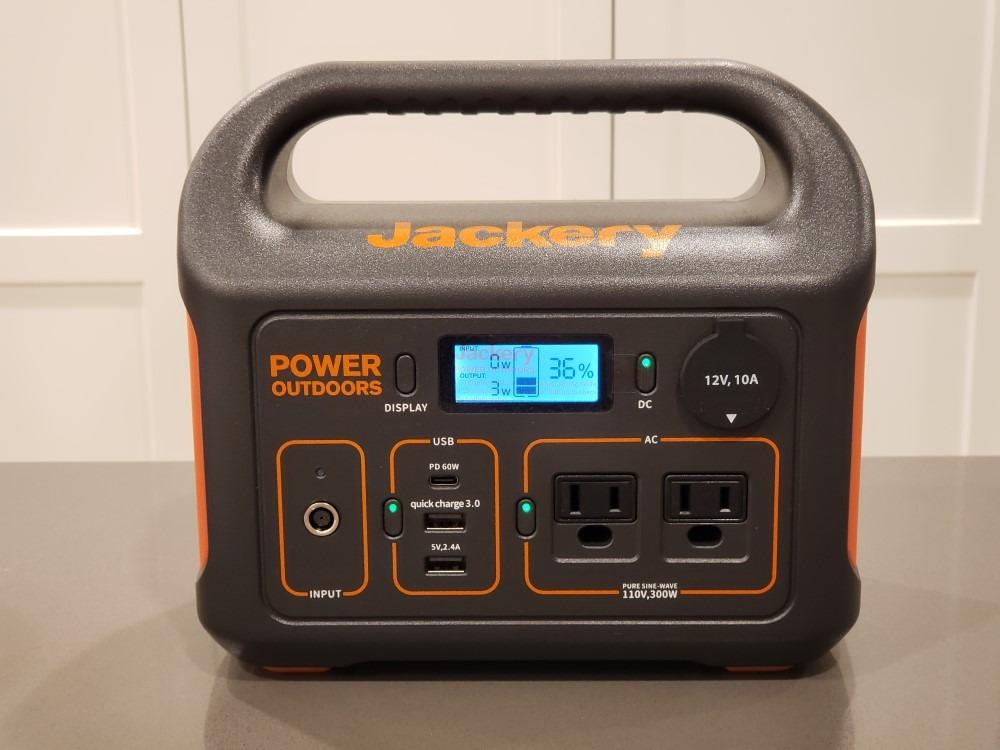
At 7.1 lb with an integrated handle, the Explorer 300 is the station we keep in the front seat for medical devices and electronics. It is not an RV power station in the sense the rest of this list means, and buying it expecting to run a fridge will end badly.
What it does well is small loads. It carries the most owner feedback of any unit here, with 11k+ reviews, and owners overwhelmingly use it for phones, laptops, lights, fans, cameras and CPAP machines. Multiple reviewers report two to four 7-hour nights of CPAP per charge.
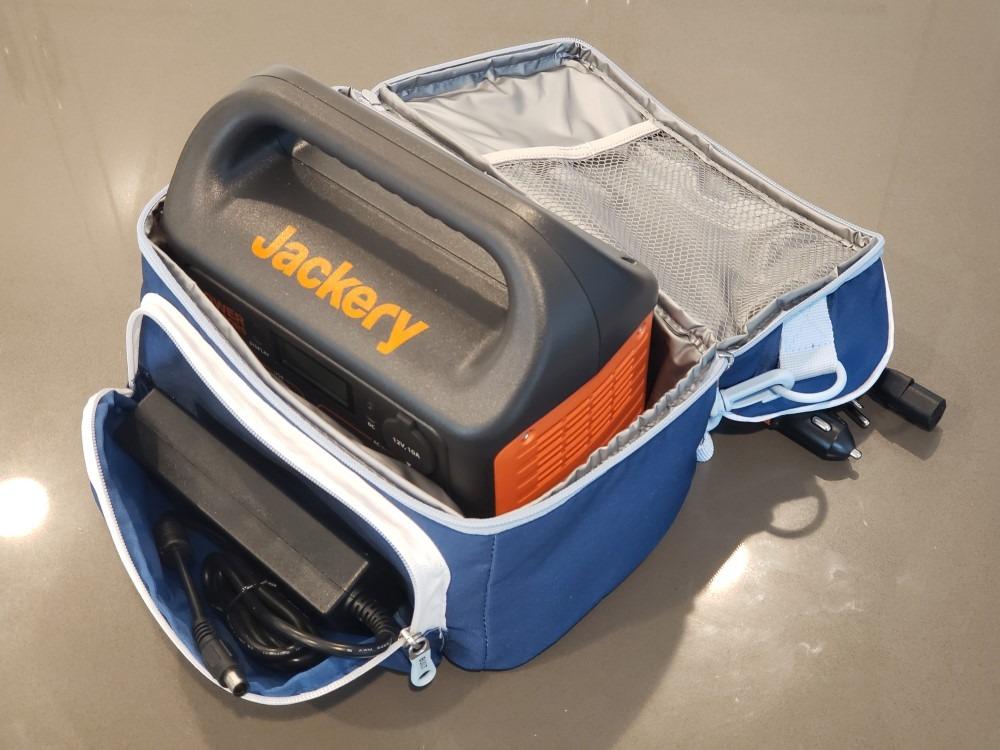
The inverter delivers clean pure sine wave output that owners trust with sensitive electronics, and the MPPT controller reaches roughly 80% charge in about 2.8 hours on a 100W panel. The backlit LCD shows battery percentage plus input and output wattage, which is more information than most units at twice the capacity show you.
Battery life is rated beyond 4,000 cycles before reaching 70% of capacity, which is a genuinely long life for something you can carry in one hand.
Using it as an overnight medical device bank
A CPAP machine is the single most common RV load for a small station, because it is low-wattage and high-stakes. Owners run it two to four nights per charge here, and the pure sine wave output means the machine sees clean power rather than stepped-up square wave.
Watch one setting though. The unit auto-powers-off below a 10W draw, which can interrupt low-draw monitoring equipment. If you are running a small medical device overnight, test it at your actual draw before you rely on it.
Why it will not run your RV appliances
292Wh with 300W of continuous output is phone-charging territory. There is no path to a 12V compressor fridge, no path to a microwave, and no path to a 12V air conditioner, so treat this as a companion device rather than a boondocking solution.
Two more limits: the USB-C port is output only and cannot be used to charge the unit, and the 12V car port is rated at 10A, which rules out the high-draw 12V compressors that RV owners ask about. The warranty is two years.
10. ALLWEI 300W Review: Lightest Box on the List
ALLWEI Portable Power Station 300W, 256Wh Solar Generator LiFePO4 Battery
- Lightest unit here at 6.4 lb and thin enough for tight RV storage
- Display shows watts in and out with an estimated runtime
- True 2.4A USB ports
- Three-level LED flashlight with SOS mode
- Pass-through charging and dual-input recharge in 2-2.5 hours
- Only 256Wh
- suited to phones
- lights and CPAP rather than appliances
- Single AC outlet
- No 24V output for 24V gear
- Some units lost charge holding ability after 8-12 months
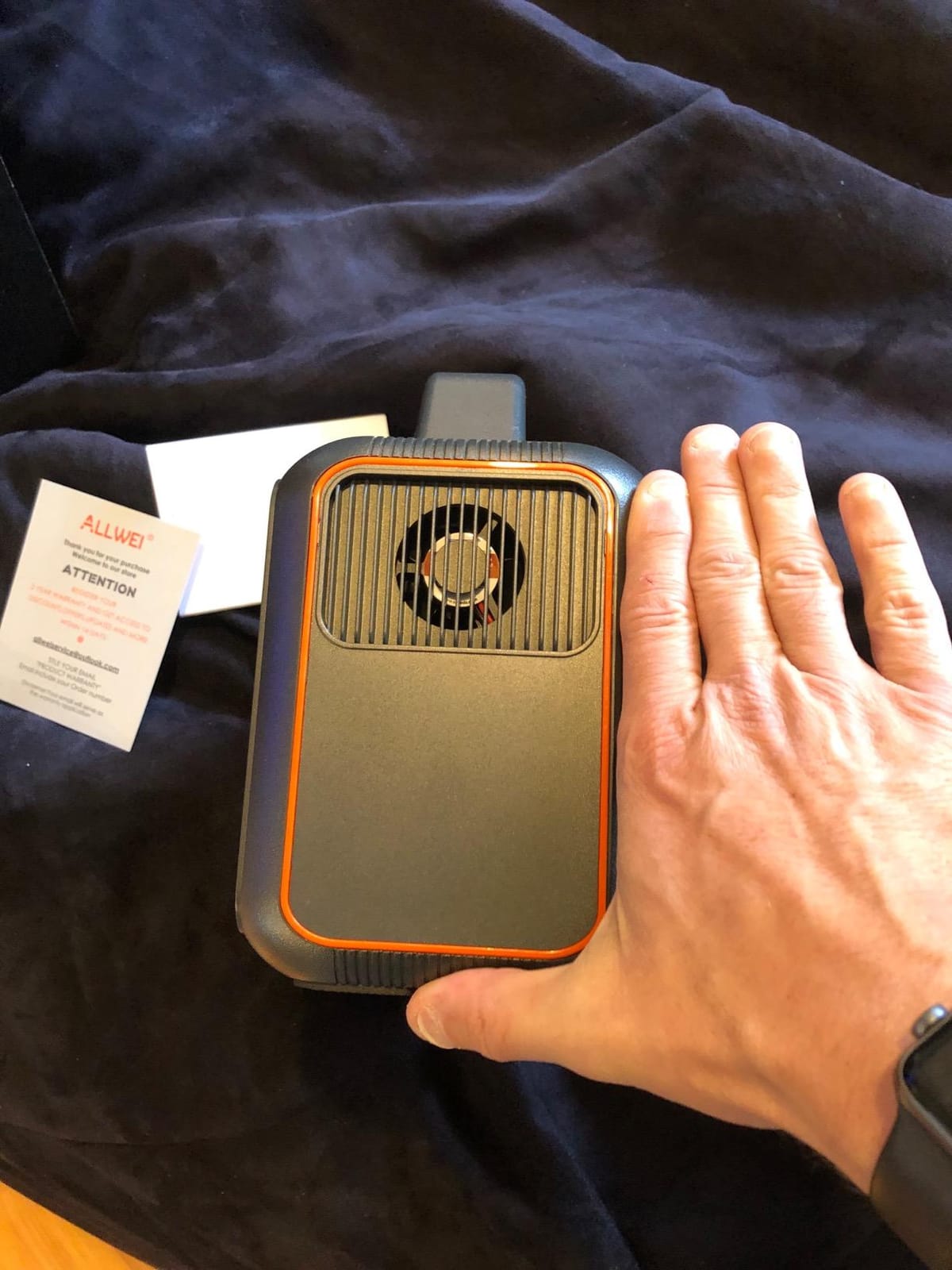
At 6.4 lb and thin enough to slide into a tight RV storage cubby, the ALLWEI 300W is the easiest unit here to carry from the truck to a picnic table. If your campsite is far from the parking spot, that weight difference is the feature that matters.
It is a 256Wh LiFePO4 pack rated at 300W continuous and 600W of pure sine wave surge, with 3,000 charge-discharge cycles rated to roughly a decade of use. The chemistry and cycle rating are better than the price tier suggests.
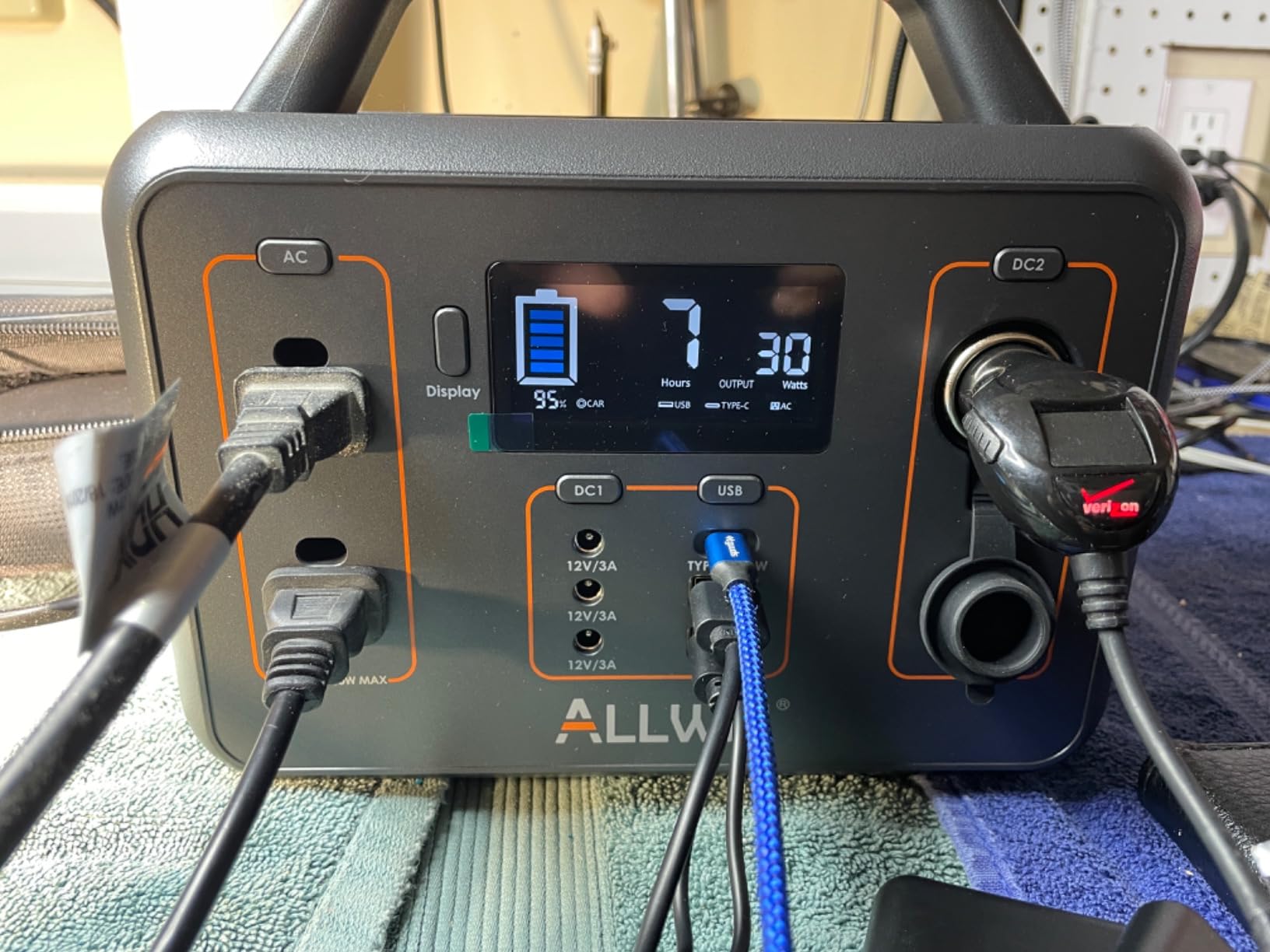
The display is unusually informative for a unit this small, showing watts in and out, an estimated remaining runtime and an exact percentage. Six output ports cover AC, two DC barrel outputs, a car port, an 18W USB-A and a 60W USB-C PD port that sustained about 21W across two USB devices in testing by owners.
Several buyers use it as a CPAP or power-recliner backup, getting roughly three nights per charge. The three-level LED flashlight with SOS mode sits where you can reach it while carrying, which is a small thing that gets used constantly.
Where it fits in an RV setup
This is a weekend and day-trip device. It fits in a glove box, a door pocket or a small console, and it handles phones, laptops, lights, fans and a CPAP machine for a few nights. It will not run a fridge or any AC appliance, and one AC outlet is the minimum for high-draw devices.
RV users with 24V gear should note the gap, since there is no 24V output on this model. Pass-through charging and dual AC plus solar input let it recharge in 2 to 2.5 hours from a wall outlet.
Long-term reliability is the open question
The one-star tail is specific and worth weighing. Owners report fan noise during CPAP use, frequent resets, and a minority of units losing the ability to hold a charge after 8 to 12 months, which is a real risk on a device you are trusting for medical power.
Customer support is also reported to require extensive data before engaging, and the warranty is two years. If you want the lightest option, this is it, but pair it with a second battery rather than making it your only power source.
How to Size a Portable Power Station for Your RV
Size the station in three steps: list your loads, multiply watts by hours, then match the recharge plan to how you travel. The formula is simple, and skipping it is how people end up with a beautiful box that dies on night two.
Step 1: list every load you actually run
Write down the running wattage of each device you plan to power away from shore power. A 12V compressor fridge is usually 40 to 60 watts, a CPAP machine with a heated hose runs 30 to 60, Starlink sits around 50 watts, LED string lights are 5 to 20, a router and laptop together are 25 to 45, and a diesel heater draws 600 to 900 watts in bursts rather than continuously.
Note which devices run all night and which run only when you use them. Overnight loads are the ones that determine whether you wake up with a charged battery.
Step 2: multiply watts by hours and add a reserve
Take each overnight load, multiply it by the hours you want it running, and add the results. A 50W fridge plus a 45W CPAP plus 15W of lights for eight hours is 880Wh, before you count daytime charging of phones and cameras.
Then add a reserve of roughly 30%. Inverter losses and the cutoff reserve mean you typically get 60 to 93% of the nameplate watt-hours in real use, which is the single most useful number the GearLab testing on this category established. A station advertised at 1000Wh is closer to 700 to 900Wh of usable energy, so a rig that needs 880Wh overnight wants a unit rated around 1300Wh or more.
Step 3: match the recharge plan to your travel pattern
A station is only as good as the energy you put back in. Wall charging is fastest, ranging from 36 minutes to about 1.7 hours for 0 to 100% across this group depending on the model. Solar input ceilings here run from 100W on the smallest model to 800W on the Dabbsson 2000L, and a 200W panel is the practical floor for any multi-day boondock.
Car socket charging is slow, typically 10A or less, and the 12V port on the smallest models is rated at 10A which can also limit how much you can pull back out. Alternator charging through a dedicated DC-DC charger is the fastest refill while driving, and only the Anker SOLIX S2000 lists alternator charging among its supported paths in this roundup.
What usable capacity really means
Usable capacity is the energy you can actually take out of the battery and use, after inverter conversion losses, heat, and the reserve manufacturers hold back to protect cell life. Treat any Wh number on a listing as the ceiling, and plan on the lower end of that range when you are sizing overnight loads.
Idle draw eats into the same budget. A 20W parasitic load on the BLUETTI AC180 costs roughly 480Wh across a full day of inverter-on time, which is more than most 12V fridges use in a week.
How a portable power station connects to your RV
There are three routes. Plug individual devices into the AC, USB and 12V ports, which is simplest and needs no installation. Feed the RV’s own DC panel from the station’s 12V output so the RV’s existing fuse panel and converter handle distribution, which is what most experienced RVers do. Or connect at the shore power inlet with a transfer switch, which lets the station back up the whole RV but requires proper installation and correct wattage sizing.
None of the ten units reviewed here includes a TT-30 RV outlet or a 30-amp connector, so connecting a station directly to an RV requires an adapter and you should check your RV’s amperage against the station’s continuous output first. Forums often describe the TT-30 plug as convenient but redundant when the RV’s own DC panel is the better integration path.
Portable Power Station vs a DIY 800Ah Lithium Build
Almost every buying guide skips the question RV owners argue about most, so here it is straight. A DIY build of roughly 800Ah of lithium iron phosphate plus a 3000W inverter, a converter and charger, a solar controller, a breaker panel and the wiring to connect them all is a real option, and it wins on raw capacity per dollar once you are past a certain size.
The portable power station wins on everything except capacity. There is nothing to install, nothing to wire, no breaker box to fit in a wall cavity, and no risk of a mis-sized cable. You carry it outside, plug in, and it works.
That trade is worth making up to roughly 2kWh, which is where most of these models sit. Past that, the DIY route wins on stored energy, and past roughly 3kWh the power station’s convenience starts costing real money per watt-hour. Full-time RVers living off-grid for months are the group that should seriously look at building.
Before you choose, look at your own site’s constraints. A shaded tree line, a dry campsite or a desert rig makes solar unreliable, and a station paired with a small gas generator is often the more honest answer than a large battery you cannot refill. Our general portable power station guide covers the recharge-side tradeoffs in more detail, and the camp seating picks are worth a look once the power question is settled.
Frequently Asked Questions
Can a portable power station run an RV?
Yes, for most RV loads, but not all of them. A 1kWh to 2kWh station rated at 1800W to 2400W can run a 12V fridge, Starlink, lights, a laptop and a CPAP machine for days. Running a 12V rooftop AC unit is possible on the 2000W and up models, and depends on the compressor having a soft start. A 30-amp RV shore power connection demands far more than any station in this roundup can deliver continuously.
Which portable power station is best for a motorhome?
For a motorhome that boondocks regularly, the EcoFlow DELTA 3 Max leads because its 2048Wh capacity and 2400W of rated output handle the widest range of RV loads, including small 12V AC units, and it recharges 0 to 80% in about 1.13 hours. If your rig is smaller or you need to move the station often, the Jackery Explorer 1000 v2 offers the best balance of weight, capacity and owner feedback.
Is Jackery or EcoFlow better?
Jackery wins on proven longevity, weight and app reliability, with the most owner feedback in this roundup and the smoothest solar pairing. EcoFlow wins on raw inverter power, charging speed and quiet operation, which is why it is the better match for higher-draw RV loads such as microwaves and small 12V AC units. For a Class B or van build, Jackery; for a full-time motorhome running appliances, EcoFlow.
What is the best portable battery station for camping?
For camping rather than RV use, the Anker SOLIX C1000 Gen 2 is the strongest all-rounder, delivering 2000W of continuous output from 1024Wh and a 49-minute full recharge, plus under 10ms UPS for medical devices. The BLUETTI AC180 is the better pick if your setup runs on solar, with 500W of MPPT input. For carry weight alone, the ALLWEI 300W at 6.4 lb is the lightest.
How big of a power station do I need for RV camping?
For a weekend of fridge, lights, charging and CPAP, roughly 1000Wh of nameplate capacity is enough. For three to four days boondocking with a 12V fridge, Starlink and a 12V AC unit, plan on 2000Wh or more, and check that continuous output covers your largest single appliance. Multiply each overnight load by its hours, add 30% reserve, and divide by the 60 to 93% of nameplate you can realistically use.
Final Verdict: The Best Portable Power Station for RV Camping in 2026
The Jackery Explorer 1000 v2 is our pick for the best portable power stations for RV camping, and it wins for a simple reason: it is the unit in this group that balances 1070Wh of capacity, 1500W of continuous output, a one-hour wall recharge and 23.8 lb of carry weight, with 3600+ owner reviews behind it.
Buy the EcoFlow DELTA 3 Max if you need to actually start appliances, the Anker SOLIX C1000 Gen 2 if you want the fastest turnaround between campsites, and the BLUETTI AC180 if your energy comes from the roof. Whatever you choose, run the sizing formula before you order, because the most common mistake in this category is a battery that is too small.
Check the current listing for each model, compare the usable watt-hours against your overnight load, and pick the station you will actually carry to the picnic table.