
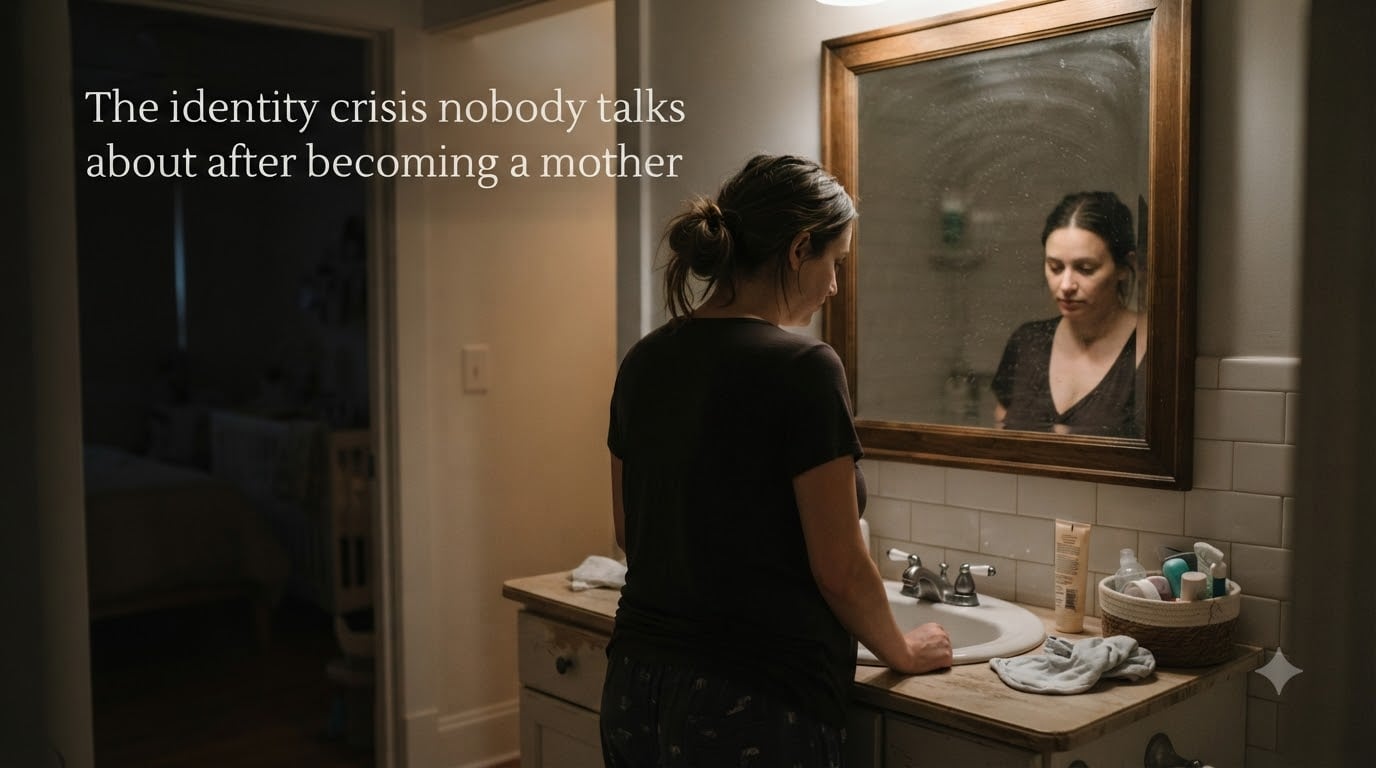
There is a moment, usually around 3 a.m., when the house is finally quiet and the baby is asleep. You look in the mirror and the woman staring back seems familiar yet completely foreign. You cannot quite place her. That woman used to have opinions about things beyond milk supply and sleep schedules. She used to have a name that was not “Mama.”
This disorienting experience is what we call an identity crisis after becoming a mother. It is one of the most profound yet least discussed transformations new mothers go through. We talk about postpartum depression, we talk about baby blues, but we rarely name this quiet unraveling of self that happens in the margins of new motherhood.
If you are standing in that 3 a.m. darkness wondering why you feel like a stranger in your own life, this guide is for you. You are not broken. You are not alone. And understanding what is happening to you is the first step toward finding your way back to yourself.
Table of Contents
Why Does Identity Crisis Happen After Becoming a Mother?
The identity crisis after becoming a mother is not just emotional. It is biological, neurological, and physical all at once. Your entire system is being rewired.
The Science of Matrescence
There is a term for what you are experiencing. It is called matrescence. Coined by anthropologist Dana Raphael in the 1970s, matrescence describes the transition a woman undergoes when she becomes a mother. It is a neurological transformation as significant as adolescence. During pregnancy and the postpartum period, your brain undergoes measurable changes. New neural pathways are formed to prepare you for caregiving. Your brain physically changes shape, strengthening the areas associated with empathy, threat detection, and emotional regulation.
Chelsea Conaboy explored these changes extensively in her book “Mother Brain.” She describes how the brain does not just respond to motherhood. It actively reorganizes itself around it. This reorganization is adaptive and necessary. It is also profoundly disorienting. The woman you were before pregnancy had different priorities, different neural pathways, and a different sense of self. That version of you did not disappear. She was temporarily overwritten by new programming that serves your baby’s survival.
This is why so many mothers describe feeling like they have been replaced by someone else entirely. The mental fog, the emotional intensity, the feeling that your brain no longer works the way it used to. It is not weakness. It is neuroscience.
The Perfect Storm of Changes
Beyond the neurological rewiring, new mothers face a simultaneous convergence of changes across every area of life. Your hormones are fluctuating dramatically. Cortisol, oxytocin, progesterone, and prolactin all surge and drop in patterns that affect your mood, energy, and emotional regulation. Your body has just performed an extraordinary physical feat and is now recovering while providing round-the-clock nutrition. Your social roles have shifted. Your relationship with your partner has shifted. Your career trajectory may have shifted. Your sleep schedule has certainly shifted.
All of this happens at the same time. There is no transition period where you get to adjust to one change before the next arrives. You are expected to figure out breastfeeding, recover from birth, maintain a household, nurture a newborn, and somehow also remember to eat and shower. It is not surprising that you feel lost. It would be more surprising if you felt completely like yourself.
What Mothers Actually Grieve Losing
The identity crisis nobody talks about after becoming a mother involves genuine grief. You are not just feeling a little different. You are mourning real losses. Understanding what you are grieving can help validate your experience.
The Nine Things You May Be Grieving
Research from Psychology Today identifies several key losses that new mothers commonly experience. These include the loss of your pre-baby body and how it felt to move through the world in that body. The loss of spontaneity and freedom to come and go as you please. The loss of your career identity and the professional goals you were working toward. The loss of your hobbies and the time you used to spend on activities that defined you. The loss of your social life and the relationships that used to nourish you. The loss of independence and the ability to do things alone. The loss of your pre-baby relationship with your partner, which has now been reshaped around a third person. And the loss of your imagined future, the life you thought you would be living right now.
Many mothers also report losing their sense of taste and preferences. Foods you used to love suddenly feel different. Activities you used to enjoy no longer bring the same satisfaction. One forum mother described it as feeling like she was walking through her own home blindfolded with all the furniture rearranged. Everything is the same, yet nothing is recognizable.
The mental load of maintaining a pumping schedule or breastfeeding routine is just one example of how identity gets submerged in caregiving tasks. Mothers frequently report feeling like they have become an extension of their baby rather than a person in their own right.
Feeling Like a Stranger to Yourself
Forum discussions reveal a consistent theme. Mothers describe looking in the mirror and not recognizing the woman looking back. They report feeling like an imposter in their own lives. “I used to be the person who had opinions about books and could finish a sentence without being interrupted,” one mother wrote. “Now I cannot remember the last book I read and my thoughts are constantly fragmented.”
This experience of depersonalization is unsettling but normal. The self you constructed over twenty or thirty years is being actively dismantled and rebuilt. The woman in the mirror is still you. She is just a different version, one still under construction.
You’re Not Alone: The Partner’s Experience
While this article focuses on maternal identity crisis, partners also experience significant identity shifts after becoming parents. Partners also experience identity shifts after becoming parents, though these are rarely discussed in the same way.
Partners may grieve the loss of their relationship as it was, the loss of attention and intimacy, and the sudden pressure to define themselves in a new role they have never practiced for. The transition to parenthood affects the entire family system. Acknowledging this does not diminish the mother’s experience. It expands the understanding of what families go through together.
How to Cope With Identity Loss After Motherhood
There are concrete strategies that help. These are not about “snapping back” or recovering who you were. They are about building a sustainable path forward that honors both who you were and who you are becoming.
Rebuilding Your Sense of Self
First, name what you are experiencing. Simply recognizing that you are going through matrescence, a normal developmental transition, reduces shame. You are not failing. You are transforming.
Second, create small moments of your old self. This does not mean escaping your baby for a full day or pretending nothing has changed. It means making space for one cup of coffee while reading a real book instead of scrolling your phone. It means keeping one hobby alive, even in modified form. It means talking to friends about things beyond parenting when you can.
Third, challenge the expectation that you should feel immediate and constant joy. It is possible to love your baby deeply and still grieve your old life. Both feelings can coexist. One mother described being the happiest and most exhausted she had ever been simultaneously. These contradictions are not problems to be solved.
Fourth, connect with other mothers who validate your experience. The isolation of new motherhood is profound. Finding your people, whether online or in person, reminds you that this struggle is collective rather than personal deficiency.
Fifth, consider professional support if your feelings persist beyond a few weeks or interfere with your ability to function. Proper nutrition supports your postpartum mental health, but some experiences require more than self-care strategies.
Sixth, document your experience. Journaling, photography, voice memos. These artifacts become evidence that you existed before this moment and that you will exist beyond it. They remind you that identity is continuous even when it feels fragmented.
Seventh, set micro-goals. The scope of “finding yourself” is overwhelming. A five-minute meditation or a five-minute conversation about something other than the baby is manageable. Small wins accumulate.
Practical Exercises for Identity Rebuilding
Beyond general strategies, there are specific exercises that help. One effective practice is the “Identity Inventory.” Spend fifteen minutes writing down everything you did before having a baby that brought you joy, meaning, or a sense of accomplishment. You do not have to do all of these things again. You are just reminding yourself they existed. Then choose one small thing from that list and do it this week, even for just thirty minutes.
Another exercise is the “Two Truths and a Wish” practice. Write down two things that are true about who you are now as a mother. These might be “I am more patient than I thought” or “I have discovered a capacity for love I did not know I had.” Then write one wish for who you want to become. This is not about who you should become. It is about who you desire to be.
A third practice is creating a “Future Self Letter.” Write a letter from your future self, five years from now, describing who you have become. What have you rebuilt? What have you let go of? What brings you joy in this future version of your life? This exercise creates a sense of trajectory and hope when the present feels stuck.
When You Have More Than One Child
Mothers with multiple children face an additional layer of identity complexity. Not only are you reconciling who you were with who you are now, but you are managing multiple caregiving identities simultaneously. The identity you built with your first child shifts when the second arrives. You may feel disconnected from your first child even as you bond with your second. Your sense of competence and confidence gets tested again when you realize you do not actually know what you are doing with a newborn and a toddler at the same time.
The grief compounds. You may grieve the relationship you had with your firstborn before the second arrived. You may grieve the intimacy of one-on-one time. You may grieve the version of motherhood you thought you would have. This complexity is not a sign that you should not have had more children. It is simply the truth of what it means to mother multiple people who each need different things from you.
When It Is More Than Identity Crisis
Sometimes the identity crisis after becoming a mother overlaps with postpartum depression or postpartum anxiety. Distinguishing between these is important because the treatment is different.
Identity crisis is a normal adjustment to an enormous life change. It involves feeling lost, grieving the old self, and gradually integrating the new identity over time. Postpartum depression involves persistent sadness, loss of interest in things you used to enjoy, changes in appetite and sleep beyond what caring for a newborn causes, feelings of worthlessness or guilt, difficulty bonding with your baby, and scary thoughts that worry you. These symptoms are medical and respond to treatment.
If you are experiencing thoughts of harming yourself or your baby, please reach out to a healthcare provider immediately. Postpartum Support International offers resources at 1-800-944-4773. You deserve support, not suffering in silence.
The distinction matters because many mothers dismiss their depression as just identity crisis or dismiss their identity crisis as not serious enough to warrant attention. Both deserve acknowledgment. Both warrant support.
Frequently Asked Questions
What is depleted mother syndrome?
Depleted mother syndrome describes a state of physical, emotional, and mental exhaustion where mothers feel completely drained of energy and a sense of self. It is characterized by feeling like you are running on empty constantly, struggling to remember who you were before children, and experiencing a profound lack of identity outside of your role as a mother. This is different from ordinary tiredness. It involves a deep depletion that affects your sense of self and your capacity to engage with the world beyond caregiving tasks.
What are the four stages of identity crisis?
While identity crisis is not formally staged, experts describe a general progression. First comes disorientation, where you feel lost and confused about who you are now. Then grief emerges as you mourn the loss of your pre-baby identity and everything that came with it. Next is exploration, where you actively seek to understand your new self through new activities, relationships, and ways of being. Finally comes integration, where you gradually weave together your old and new identities into a coherent whole. This process is not linear and the duration varies significantly for each person.
Is it normal to miss your old life after having a baby?
Yes, it is completely normal. Research shows 62 percent of new mothers experience some form of identity loss after having a baby. Missing your old life does not mean you do not love your child. It simply means you are human and are mourning the loss of who you were before this profound transformation. This grief is a valid part of becoming a mother, not evidence that you are doing something wrong or that you should feel differently.
Is it normal to not enjoy being a mother?
Many mothers struggle with enjoyment in the early stages while still deeply loving their baby. The physical exhaustion, hormonal changes, and identity disruption can make motherhood feel like a chore rather than a joy. This is common but should be distinguished from postpartum depression. If feelings persist beyond a few weeks, interfere with daily functioning, or include symptoms like persistent sadness or scary thoughts, speak with a healthcare provider.
The identity crisis nobody talks about after becoming a mother is one of the most profound transformations you will ever experience. It is not a problem to be solved. It is a passage to be honored. The woman you were before had value. The mother you are becoming has value. And eventually, these two versions will merge into someone new who carries both histories within her.
You do not have to choose between finding yourself and being present for your child. Both can coexist. The work of rebuilding identity after motherhood is not about returning to who you were. It is about discovering who you are becoming.