
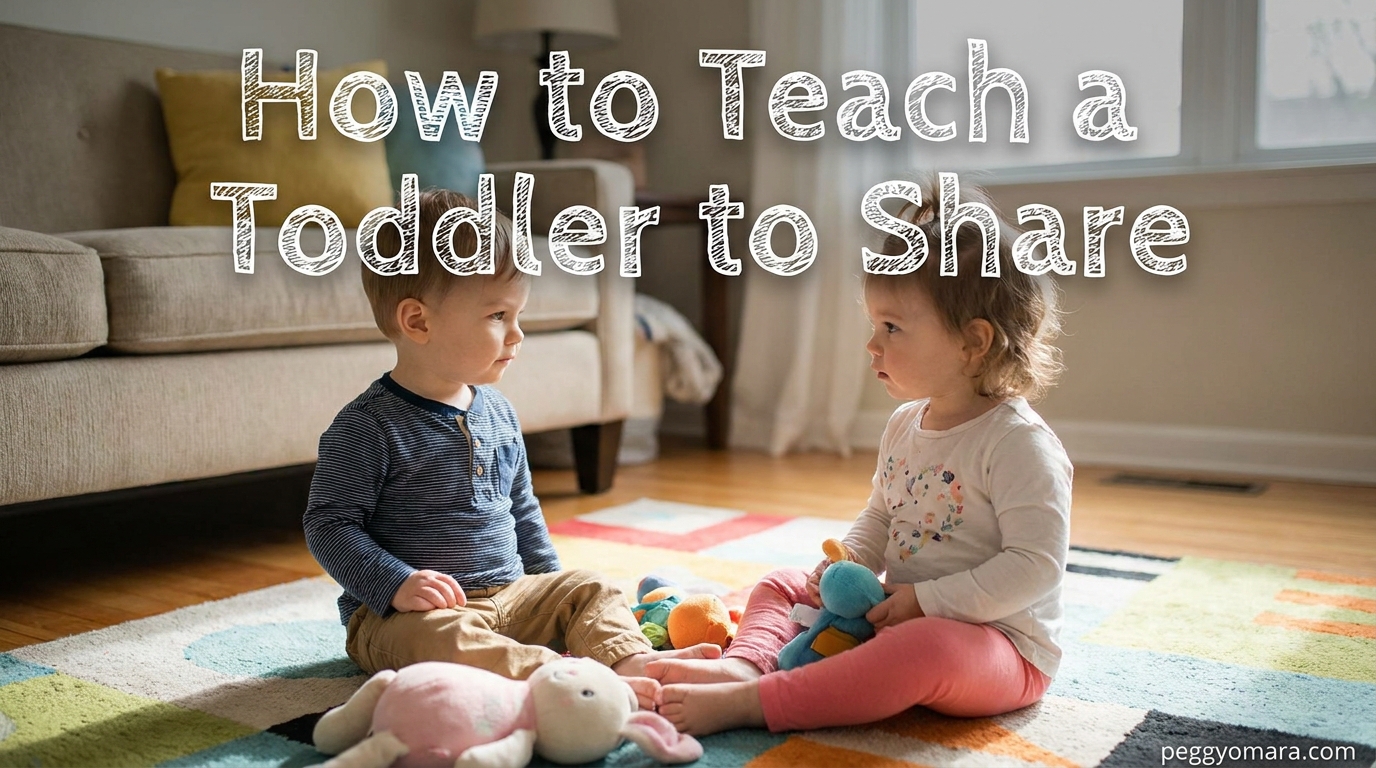
You are at a playdate. Your two-year-old clutches their favorite fire truck while another child reaches for it. The other parent is watching. You gently ask your child to share, and they respond by throwing the truck across the room and screaming “Mine!”
If this scenario makes you cringe with recognition, you are not alone. Learning how to teach a toddler to share is one of the most common challenges parents face, and it can feel deeply personal when your child refuses to cooperate in public. The good news is that sharing is a learned skill that develops over time, and there are specific strategies that make the process smoother for everyone.
In this guide, I will share what research tells us about toddler brain development, realistic expectations for each age, and ten practical techniques you can start using today. These methods come from child development experts and real parents who have been exactly where you are right now.
Table of Contents
Why Is Sharing So Hard for Toddlers?
First, let us look at why sharing feels nearly impossible for young children. The answer lies in brain development, not stubbornness or bad parenting. Your toddler’s brain is literally not wired for sharing yet.
The prefrontal cortex, which controls impulse control and perspective-taking, does not fully develop until adulthood. In toddlers, this part of the brain is just beginning to form the connections needed for sharing behavior. According to research from Zero to Three, impulse control typically begins developing between ages three and four, which explains why true sharing is so difficult for younger children.
Additionally, toddlers operate from a place of complete self-centeredness, which is developmentally normal, not a character flaw. Before age three, most children lack what psychologists call “theory of mind” – the understanding that other people have thoughts and feelings different from their own. To a toddler, the universe revolves entirely around them, and anyone wanting their toy is simply an obstacle to their happiness.
Their emotional regulation skills are also minimal. When a toddler feels a strong emotion like possessiveness, their brain floods with feelings they cannot yet manage. Expecting a two-year-old to calmly hand over a beloved toy is like expecting someone to do calculus while running a marathon – the necessary systems are not ready yet.
At What Age Do Toddlers Start Sharing?
Understanding the developmental timeline helps set realistic expectations. Here is what typical sharing development looks like by age.
Ages 1-2: True sharing is not expected. Children this age engage in parallel play, meaning they play beside each other but not with each other. They have no concept of ownership beyond “I see it, therefore it is mine.” Do not force sharing at this stage.
Ages 2-3: Turn-taking can begin with guidance. A two-year-old can start learning that they will get a toy back after someone else has a turn. This is the perfect time to introduce visual timers and simple turn-taking language.
Ages 3-4: Intentional sharing starts developing. With impulse control beginning to emerge, three-year-olds can understand sharing concepts and may share willingly, especially with encouragement. They still need plenty of support and should not be expected to share everything.
Ages 4-5: Consistent sharing becomes more possible. Four-year-olds can typically share with guidance and understand the social benefits of cooperation. They may still struggle with special toys or when tired.
Ages 5-6: True empathy-based sharing develops. By this age, children can genuinely understand that sharing makes others feel good and strengthens friendships. This is when sharing becomes more consistent and less forced.
Here is a surprising fact: a national survey by Zero to Three found that 43% of parents mistakenly believe children under age two should be able to share. If you have been expecting your toddler to share easily, you are among many well-meaning parents who were simply given the wrong timeline. Sharing is a complex social skill that takes years to develop, not weeks.
10 Practical Ways to Teach Your Toddler to Share
Now let us get to the strategies that actually work. These ten methods progress from foundational approaches to specific techniques you can use in the moment.
1. Model Sharing Behavior Daily
Children learn more from what we do than what we say. Make sharing visible in your daily life by narrating your own sharing moments. Say things like, “I am sharing my snack with Daddy” or “Can we share this blanket while we read?”
Share with your toddler directly too. Ask, “Would you like to share some of my popcorn?” or “Come sit with me. We can share the chair.” When you model generosity without pressure, your child absorbs the message that sharing is a normal, positive part of relationships.
I have found that sharing with my partner in front of my children is particularly powerful. When they see me offering the last piece of pie to my husband or letting him choose the movie, they witness sharing as an act of love between people who care about each other.
2. Teach Turn-Taking First
For toddlers, turn-taking is much easier to grasp than simultaneous sharing. The concept of “your turn, then my turn” is concrete and fair. Start with activities rather than objects since activities feel less threatening to give up.
Use simple, consistent language: “Your turn,” then “My turn,” then “Your turn again.” The predictability helps toddlers feel secure that they will get what they want back. Practice this during daily routines like brushing teeth, pushing buttons on toys, or stirring cookie dough.
Once your child understands turn-taking with activities, apply the same language to toys. “It is Sarah’s turn with the truck. You will get a turn when the timer dings.” This framing respects that the child is waiting for their possession to return, not giving it up forever.
3. Use a Visual Timer
A visual timer transforms abstract waiting time into something concrete a toddler can see. When a child watches sand fall through a timer or numbers count down on a visual display, they understand that their turn is coming.
Set the timer for short periods – two to three minutes for younger toddlers, up to five minutes for older ones. Keep the intervals brief enough that waiting does not feel like punishment. When the timer dings, enforce the turn switch consistently so children learn to trust the system.
Many parents tell me the visual timer was a game-changer for their family. One mom shared that her three-year-old went from screaming when asked to share to calmly saying, “I see the red is getting smaller” while watching a time timer count down.
4. Validate Their Feelings
Before you can teach sharing, you need to acknowledge that sharing is genuinely hard. Validate your child’s feelings with phrases like, “It is hard to wait for your turn” or “You really love that truck. It is tough to let someone else use it.”
Validating feelings does not mean giving in to demands. You can empathize while holding boundaries. “I know you want the doll right now. Sarah is using it. You will get a turn soon.” This approach builds emotional intelligence while maintaining the sharing expectation.
When we dismiss our children’s feelings with phrases like “You have plenty of toys” or “Do not be silly,” we teach them that their emotions are wrong. A child who feels heard is more likely to cooperate than a child who feels dismissed.
5. Distinguish Special Toys from Shared Toys
Not everything needs to be shared. Let your child choose special toys that are just theirs – the ones they sleep with, carry everywhere, or are deeply attached to. These special toys stay in a safe place during playdates.
Having this distinction teaches children that sharing applies to community toys, not personal possessions. It also respects their developing sense of ownership and autonomy. A child who knows their most precious items are safe will feel more secure sharing other things.
Before playdates, involve your child in choosing which toys to share and which to put away. This gives them control over the situation. Say, “Let us pick three toys to share today and put your special bunny in your room.”
6. Prepare Before Playdates
Preparation prevents many sharing conflicts. Before a playdate, talk through what will happen. “Your friend is coming over. She might want to play with your toys. Remember, we take turns and share so everyone has fun.”
Pack special toys separately or put them away before guests arrive. Have your child help choose which toys will be for sharing. This proactive approach prevents the emotional intensity of having to give up a toy in the heat of the moment.
If you are visiting someone else’s home, bring a few of your child’s toys to share. This gives your child something they are comfortable offering while also ensuring they have familiar items if they need comfort.
7. Narrate Sharing Situations
Think of yourself as a sports commentator describing the action. Narrating what is happening helps toddlers understand social dynamics and gives them language for their experiences.
Try phrases like, “Tommy is using the truck now. You are waiting so nicely.” or “Look, Sarah is sharing her blocks with you. That makes playing more fun for everyone.” Narration provides information without pressure and highlights positive behavior when you see it.
When conflicts arise, narration keeps you calm and focused. “You both want the red car. This is tricky. How can we solve this?” By describing rather than judging, you model problem-solving language your child will eventually use themselves.
8. Offer Choices and Trade-Ins
Giving choices helps toddlers feel in control during sharing situations. Instead of demanding they hand over a toy, try, “Do you want to give your friend the truck now, or in two minutes when the timer dings?”
Trading is another powerful tool. Encourage your child to offer a different toy in exchange for the one they want. “Can you trade the fire truck for this ball?” Many sharing conflicts resolve when children learn that exchanging toys means everyone gets something new to play with.
Problem-solving questions also work well. “You both want to play with the kitchen set. What can we do so you both have fun?” Older toddlers can sometimes suggest solutions like, “I cook, she serves” that you would never have thought of.
9. Give Specific Praise
Generic praise like “good job” does not teach children what they did right. Instead, give specific feedback about the sharing behavior you want to encourage. “Thank you for letting Maya have a turn with the doll. That was kind.”
Praise effort as much as outcome. If your child struggled but eventually shared, acknowledge the difficulty. “I know that was hard for you to wait. You did it anyway. I am proud of you.” This builds resilience and shows that managing difficult feelings is what matters most.
Focus on the positive impact of sharing too. “Look how happy Sarah looks when you shared your stickers with her.” Connecting sharing to others’ feelings builds the empathy that makes genuine sharing possible.
10. Practice with Books and Play
Make sharing practice low-pressure by using books and pretend play. When reading stories, point out when characters share and discuss how it makes others feel. Ask questions like, “Why do you think the bunny shared his carrots?”
Role-play sharing with stuffed animals or dolls. Have one “refuse” to share and talk through how that makes the other feel. Then have them share and notice the difference. This practice lets children experiment with sharing concepts without real-world consequences.
Games that require turn-taking, like rolling a ball back and forth or simple board games designed for toddlers, build sharing skills in a fun context. Check out our guide to outdoor activities for toddlers for more ideas on cooperative play.
Fun Sharing Activities and Games
Beyond the strategies above, here are concrete activities that make sharing practice enjoyable for toddlers.
Roll and Catch: Sit facing your child and roll a ball back and forth. Say “Your turn!” and “My turn!” with each roll. This simple game builds the turn-taking foundation that sharing requires.
Pass the Toy: Sit in a circle with family members and pass a toy around while music plays. When the music stops, whoever has the toy gets to do a silly dance before passing it on. This creates positive associations with giving toys to others.
Build Together: Work on the same block tower or puzzle together, taking turns adding pieces. Emphasize that you are creating something together that neither of you could make alone.
Snack Sharing: Practice sharing with something desirable by giving your child a small bowl of snacks and asking them to share with you or a stuffed animal. Food sharing is often easier than toy sharing because it is consumable and not permanent.
Instrument Parade: If you have simple instruments like drums or shakers, take turns being the “conductor” who leads the music. Everyone else follows the conductor’s lead until it is someone else’s turn to lead.
What NOT to Do When Teaching Sharing?
Just as important as what to do is what to avoid. These common mistakes can backfire and make sharing harder to learn.
Do not force arbitrary sharing. Making a child give up a toy just because another child wants it teaches that might makes right. The bigger or more demanding child gets what they want, and your child learns their feelings do not matter.
Avoid shaming language. Phrases like “You are being selfish,” “You are a bad friend,” or “You are embarrassing me” damage self-esteem and create negative associations with sharing. A child who feels ashamed becomes defensive, not generous.
Do not make it a power struggle. When sharing becomes about who is boss – you or your child – everyone loses. The goal is teaching social skills, not winning a battle of wills.
Never take toys away as punishment. This creates fear and possessiveness rather than generosity. A child whose toys are taken away learns to guard possessions more carefully, not less.
Do not compare to other children. “Why can you not share like Emma does?” makes sharing feel like a competition and implies something is wrong with your child. Every child develops at their own pace.
Avoid embarrassment-based correction. Correcting your child harshly in front of other parents teaches them that your approval is conditional on their performance. This undermines the secure attachment that actually promotes sharing behavior.
Frequently Asked Questions
Is it normal for a 2 year old not to share?
Yes, it is completely normal and developmentally appropriate. According to Zero to Three, 43% of parents mistakenly believe children under age two should be able to share. True sharing requires impulse control and perspective-taking skills that typically begin developing between ages three and four. A two-year-old who refuses to share is demonstrating healthy self-awareness and attachment to their belongings.
What is the 3 3 3 rule for toddlers?
The 3 3 3 rule refers to communication guidelines for getting a toddler’s attention: use 3 words or less, speak within 3 seconds of the behavior you want to address, and be within 3 feet of your child. While not specifically about sharing, this rule helps ensure your guidance is heard and understood when teaching any new skill, including sharing and turn-taking.
How to deal with a toddler who will not share?
First, validate their feelings by acknowledging that waiting is hard. Use a visual timer to make turns concrete. Offer choices like trading toys rather than forcing immediate sharing. Distinguish between special toys that do not need to be shared and community toys. Model sharing behavior yourself. Never shame or force sharing arbitrarily. Focus on turn-taking before expecting true simultaneous sharing.
What is the 7 7 7 rule for parenting?
The 7 7 7 rule asks you to consider how a decision will matter in 7 minutes, 7 months, and 7 years. When applied to sharing struggles, most conflicts that feel urgent in the moment will not matter in 7 months or years. This perspective helps parents stay calm and avoid power struggles over sharing, keeping the focus on long-term social skill development rather than immediate compliance.
What is the 10-10-10 rule for kids?
The 10-10-10 rule, popularized by Suzy Welch, involves asking how a decision will feel in 10 minutes, 10 months, and 10 years. For parenting sharing struggles, this means recognizing that a playground conflict over a toy will not matter in 10 years, even if it feels stressful right now. This helps parents maintain perspective and avoid overreacting to normal developmental behavior.
Patience Is Key When Teaching Toddlers to Share
Learning how to teach a toddler to share is a journey, not a destination. Your child will not become a generous sharer overnight, and there will be setbacks even after progress is made. This is completely normal and expected.
Remember that sharing is one of the most complex social skills we teach young children. It requires impulse control, emotional regulation, empathy, and the ability to delay gratification – all skills that take years to develop. Your job is not to force immediate sharing but to scaffold these skills gradually through modeling, practice, and patience.
Celebrate small wins along the way. The first time your child hands over a toy without prompting, acknowledge the growth. The first time they calmly wait for a turn, praise their self-control. These moments are building blocks for the generous, cooperative person your child is becoming.
You are doing better than you think you are. Every time you model sharing, validate feelings, or help your child navigate a difficult social moment, you are teaching them skills that will serve them throughout their entire life. That fire truck struggle at the playdate will be a distant memory before you know it.