
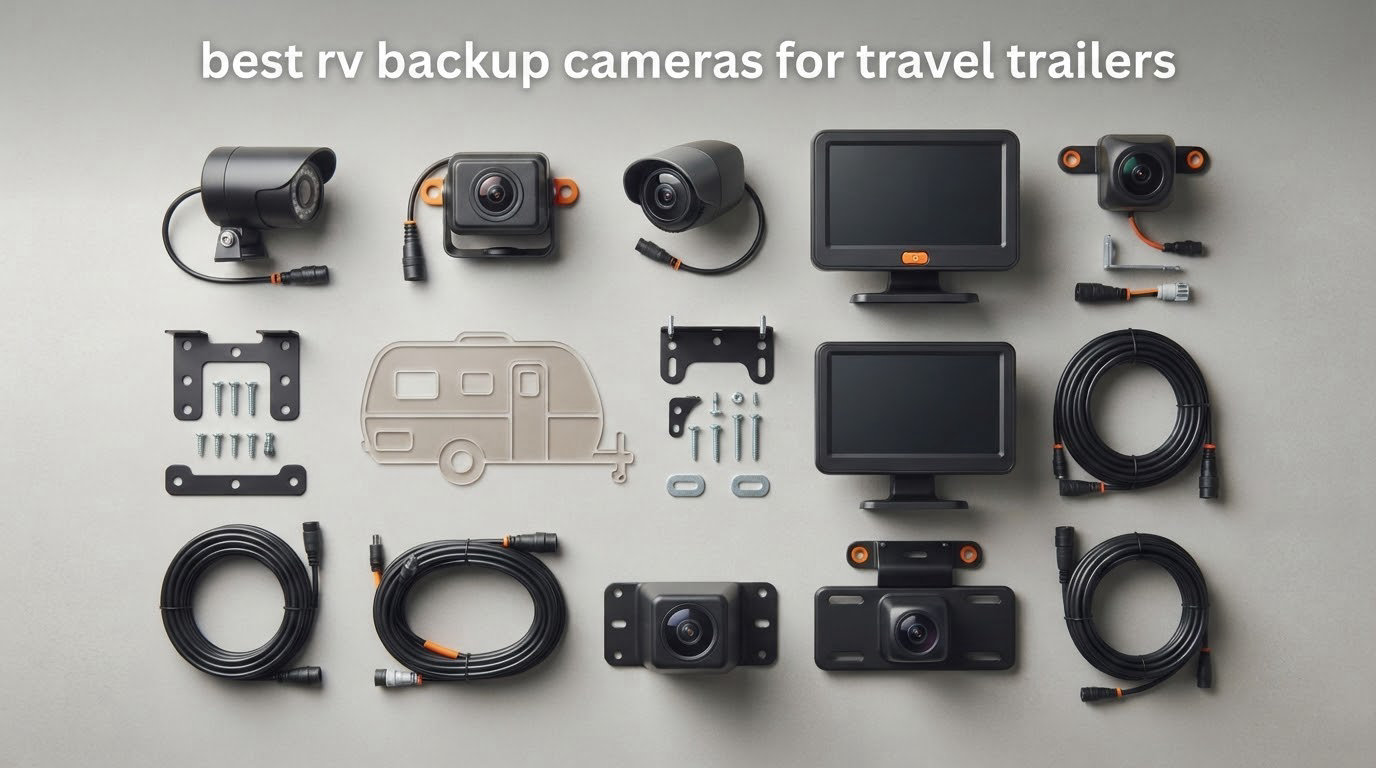
A 30 ft travel trailer has a rear blind zone that no camera in the truck can fix. The factory camera on your tow vehicle looks at the trailer, not past it, so a child, a hookup post, or a truck in the next lane stays invisible until it is too late.
We spent weeks going through owner reports, spec sheets, and forum threads on these systems, and put the eight best RV backup cameras for travel trailers side by side. The short version: if your trailer is Furrion pre-wired, a pre-wired kit is a ten-minute install, and everything else is a wire-fishing job.
The brands that keep coming up in trailer groups are Furrion, Haloview, AUTO-VOX, and AMTIFO, with Rear View Safety holding the wired camp steady. Most people asking for the best RV backup cameras for travel trailers already own a pre-wired rig, which makes compatibility the first question and image quality the second.
We also tracked the failure modes owners actually hit, and the one that surprises people most is not picture quality. It is signal. Understanding why a digital wireless feed cuts to a blank screen while an analog one goes fuzzy changes which system you should buy, so we covered that in detail further down.
If you are still building out the rest of your rig, our picks for the best backup cameras overall and the best wireless backup cameras cover the non-trailing side of the market too.
Table of Contents
Is Your Trailer Furrion Pre-Wired? Check This Before You Buy
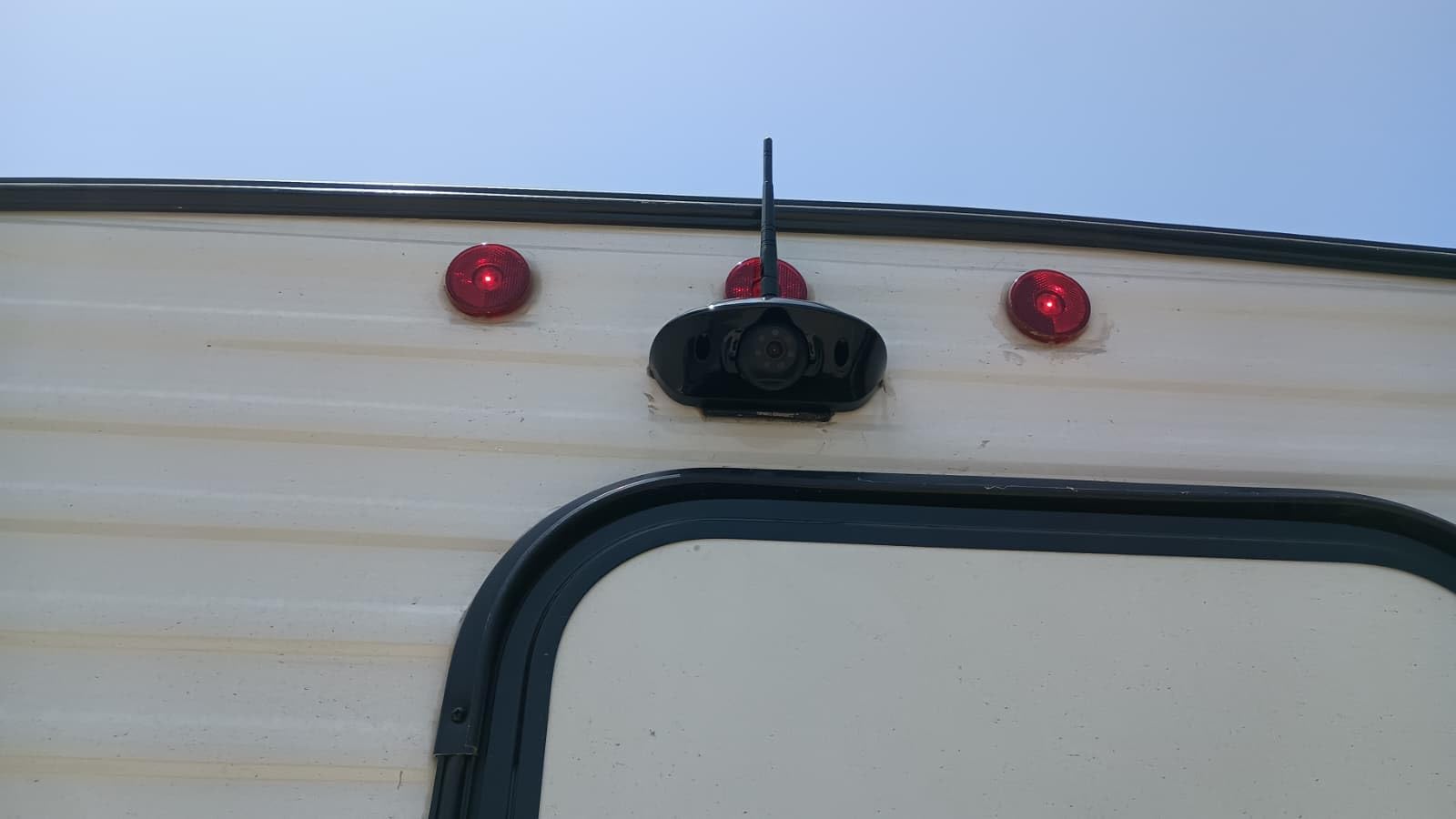
Most travel trailers built since roughly 2019 from Grand Design, Jayco, Keystone, Forest River, and Coleman arrive with a Furrion prep plate already at the top rear of the trailer, and sometimes a second plate near the side marker lights. That plate is a weatherproof housing with a short power pigtail waiting for a camera.
Here is the four-step check. Look at the top center rear of the trailer at roof height for a rectangular plastic housing roughly the size of a license plate. Open it or look underneath for a short pigtail connector with a two-pin or three-pin plug. Check the side marker lights at the rear corners for a second, smaller housing with the same style of pigtail. Finally, confirm with the manufacturer or dealer that the trailer was built with the Furrion package, since some units are retrofitted at the factory line.
If you find those plates, your install is a bracket swap rather than a wiring job. Any kit advertised as Furrion pre-wired, or Furrion compatible, will drop into that housing.
If you do not find them, assume you are running power from the trailer yourself, usually off the running lights or marker light circuit. That is where the wired picks start to look more attractive, because a cable run to the trailer frame is a weekend project but a permanent one.
Top 3 Picks for Travel Trailer Backup Cameras in 2026
Our three standouts below cover the three most common trailer situations: a permanent wired install, a pre-wired trailer swap, and a no-install magnetic setup you can carry between rigs.
Yakry Wired 7 inch Kit
- Wired signal with no dropouts
- 66ft shielded cable
- IP69K camera
- True IR night vision

Yakry Furrion Wireless Kit
- Plugs into the Furrion prep plate
- Dual antennas
- 825ft open range
- Expandable to 4 channels

Pemacom Magnetic 1080P Kit
- One-minute magnetic install
- 15000mAh battery with solar
- 170 degree view
- IP69 waterproof
Best RV Backup Cameras for Travel Trailers at a Glance (October 2026)
Every system below ships with one camera unless the title says otherwise, and the field of view number tells you more about side awareness than the resolution does.
| Product | Specifications | Action |
|---|---|---|
| Yakry Wired Plug and Play 7 inch Kit |
|
Check Latest Price |
| Yakry Furrion Pre-Wired Wireless |
|
Check Latest Price |
| Pemacom 1080P Magnetic Wireless |
|
Check Latest Price |
 DOUXURY IP69 170 Degree System DOUXURY IP69 170 Degree System |
|
Check Latest Price |
 DVKNM Magnetic Solar 1080P DVKNM Magnetic Solar 1080P |
|
Check Latest Price |
 AUTO-VOX Solar Magnetic 7.2 inch AUTO-VOX Solar Magnetic 7.2 inch |
|
Check Latest Price |
 Fookoo Furrion Pre-Wired 7 inch Fookoo Furrion Pre-Wired 7 inch |
|
Check Latest Price |
 DoHonest R50 Solar Magnetic 5 inch DoHonest R50 Solar Magnetic 5 inch |
|
Check Latest Price |
1. Yakry RV Backup Camera Plug and Play – Best Wired System for a 30 ft Travel Trailer
Yakry RV Backup Camera Plug and Play – No Delays 7″ HD 1080P Reverse Camera
- Signal never drops or lags
- Single 12V feed simplifies install about 8 minutes
- True IR night vision in low light
- 7 inch IPS screen with anti-glare sunshade
- Dual V1 and V2 inputs accept a second camera
- Connectors are finicky and jostling can cut the image
- Image is softer and less colorful than listing photos suggest
- 150 degree view turns close vehicles into an unreadable blob
- Parking guide lines cannot be switched off
Pick this one if your trailer has no Furrion prep plate and you want a connection that never fails. The whole point of a wired kit is that there is no radio link to lose, and with 6657 reviews averaging 4.5 stars, owners back that up in large numbers.
The install is the part that surprises people most. Instead of fishing a cable through the trailer, this kit runs on a single 12V feed and reviewers report roughly eight minutes from box to working image on a bumper-pull trailer. That speed is what makes it our top pick: it is the system you will actually finish installing.
It ships with a 66ft cable in a PVC jacket with dual-layer shielding and pure copper connectors, which is the hardware that makes the no-dropout claim hold up over a long rig. The 7 inch IPS monitor includes an anti-glare sunshade, which matters more than it sounds when you are trying to read the screen at a bright midday site.
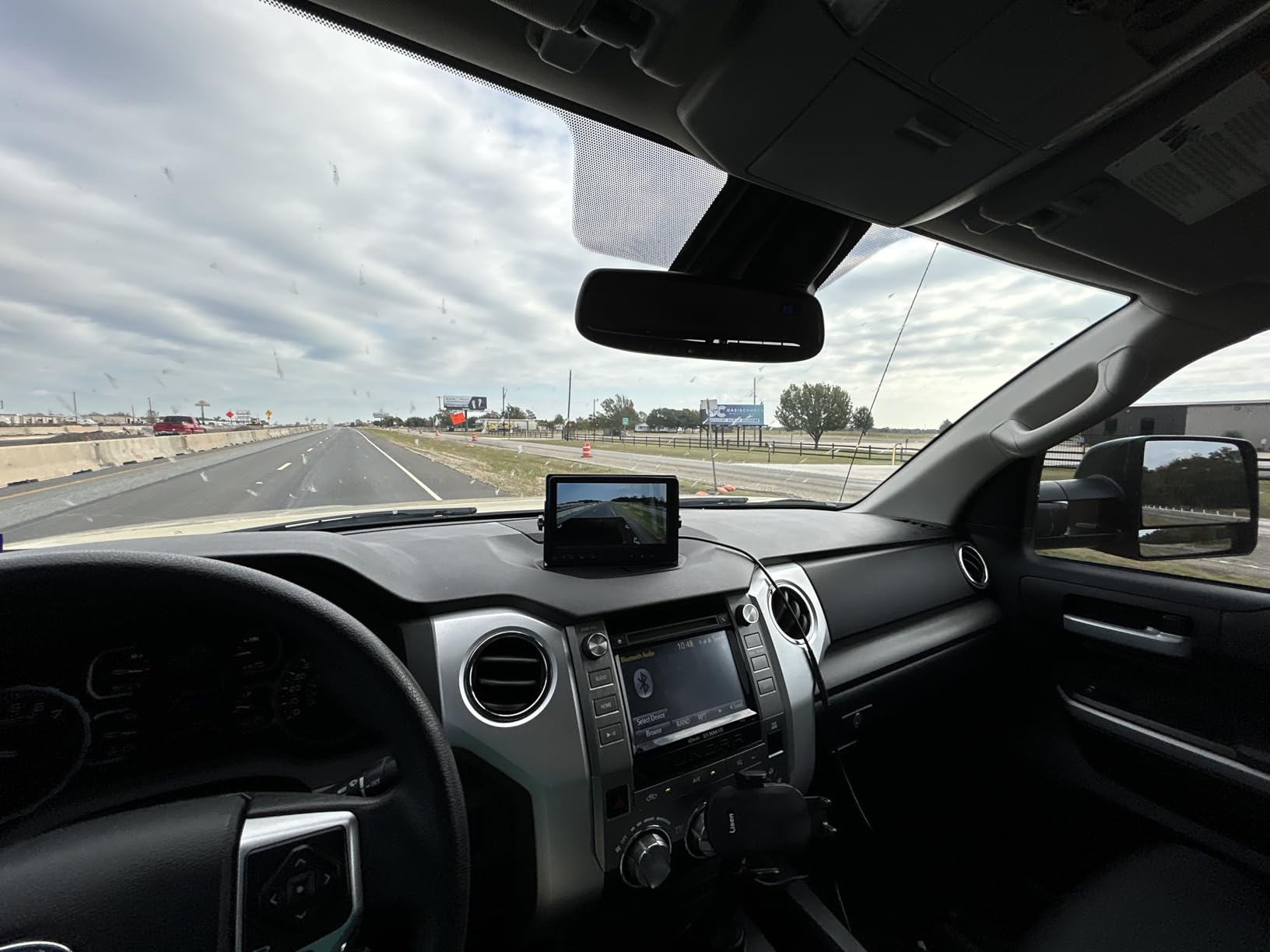
Night performance is genuinely good. Reviewers repeatedly describe a clear image in minimal ambient light, which is the situation you hit most often arriving at a campground after dark. The camera is rated IP69K for waterproofing, so rain, road spray, and washdowns are not a concern.
The honest weakness is field of view. At 150 degrees, a vehicle passing close to the trailer becomes a soft unreadable shape, and owners note this makes lane-change decisions harder than it should be. The 7 inch screen is also on the larger side, so plan the mounting position before you buy.
Two video inputs are labeled V1 and V2, which means a second camera can be added later for a bumper-down and traffic-facing dual rear setup. That is the pattern several 30 ft trailer owners in our research use, and having the input already on the monitor saves a second purchase.
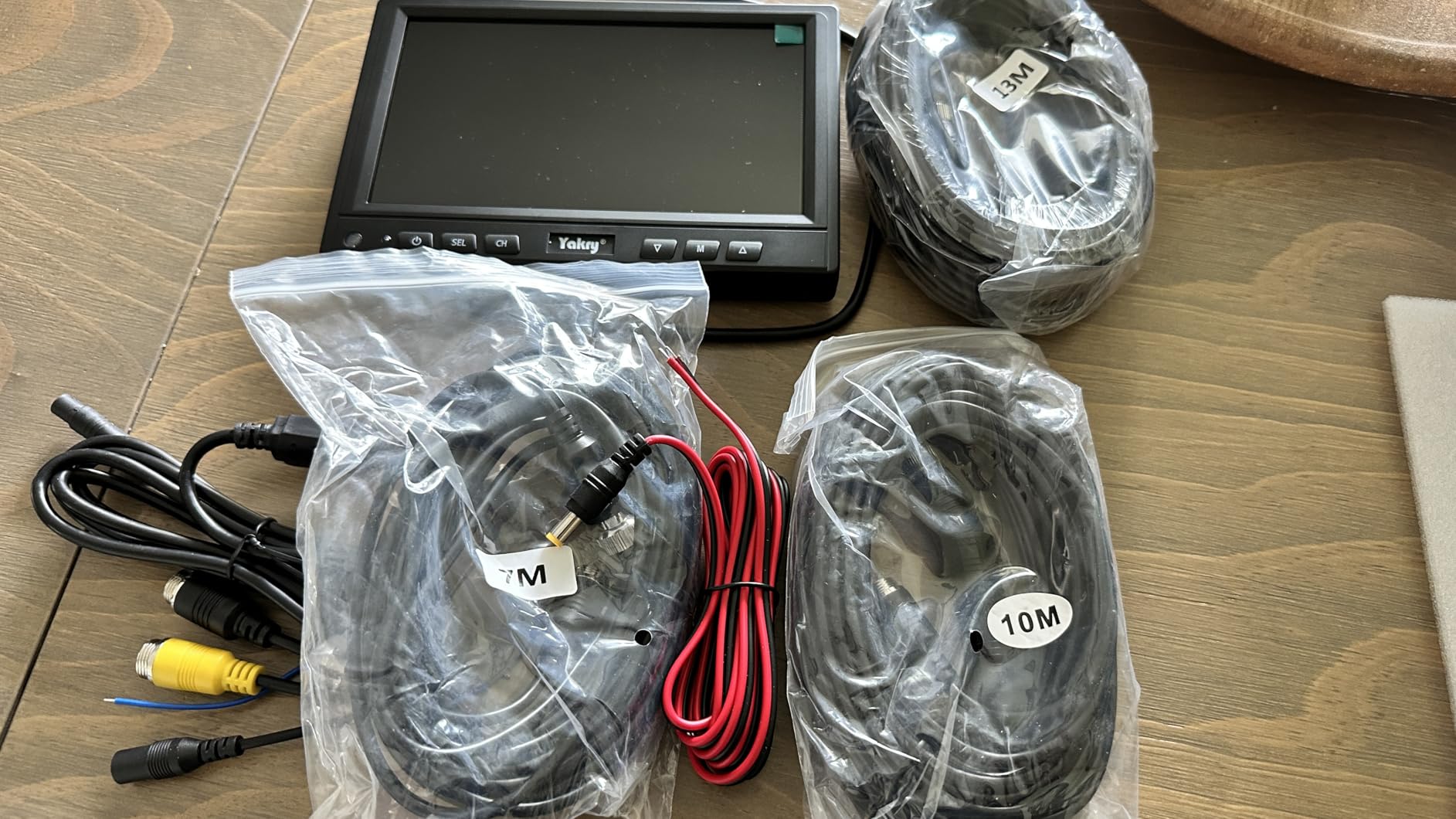
Is the 66 ft cable long enough for your trailer?
For most bumper-pull trailers in the 25 to 35 ft range, yes. The 66 ft run gives you room to route behind the rear axle, up the side rail, and forward to the tongue box without stretching. If your trailer is a 40 ft fifth wheel or a gooseneck, measure first.
Route the cable along an existing frame member and away from the exhaust and the tongue jack area. Conduit along a frame rail protects the jacket from road debris, which is the most common cause of a physical fault after a year of towing.
Who should skip the wired kit entirely
If you unhitch and hitch up often, or you want one camera to move between a truck and two trailers, a wired kit anchors the system to the trailer. A magnetic unit with its own battery is the better fit for that pattern, and the ones further down cover it.
Also skip it if you have no safe 12V source near the rear of the trailer. Most people tap the running light or marker light circuit, and that means the camera is only live when those lights are on, which surprises first-time installers.
2. Yakry RV Backup Camera Wireless Plug and Play – Budget Pick for a Furrion Pre-Wired Trailer
RV Backup Camera Wireless Plug and Play: Pre-Wired for Furrion Easy Install
- Dual-antenna design holds signal at highway speed
- Plugs straight into the factory Furrion bracket with no drilling
- Owners report about 25 to 30 minutes to install
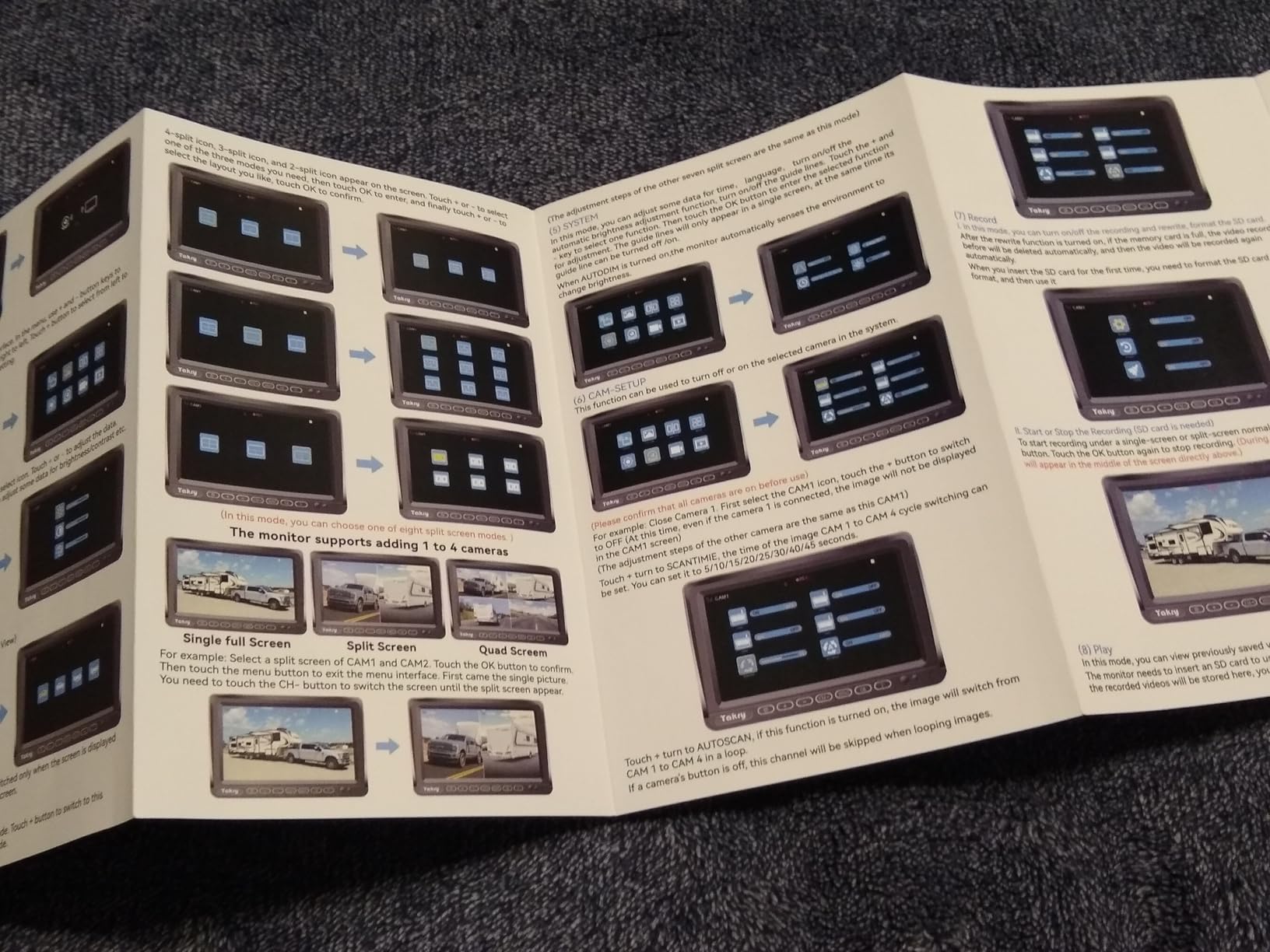
- Expands to 4 channels with split screen
- SD card loop recording for incident proof
- 7 inch monitor is bulky in a smaller truck cab
- Third-party bracket is not weather sealed like the factory part
- Playback shows pixelation on some clips
- Camera only powers when trailer running lights are on
For a trailer that already has Furrion prep plates, this is the value answer. The bracket and pigtail wire are in the box, so the install is a swap rather than a project, and the wireless link means no cable through the trailer wall at all.
The dual-antenna design is the reason for the confidence here. Yakry rates it at up to 825 ft in open areas and 320 ft through a vehicle, and owners towing long rigs report the feed holding up at highway speed. The 50 percent higher refresh rate over a single-antenna design also cuts the lag you feel when the image stutters during a turn.
Multiple owners report finishing the install in roughly 25 to 30 minutes, with no drilling into aluminum or fiberglass. Once it is in, the system expands to four channels with split-screen switching, so you can add side marker cameras later without buying a new monitor.
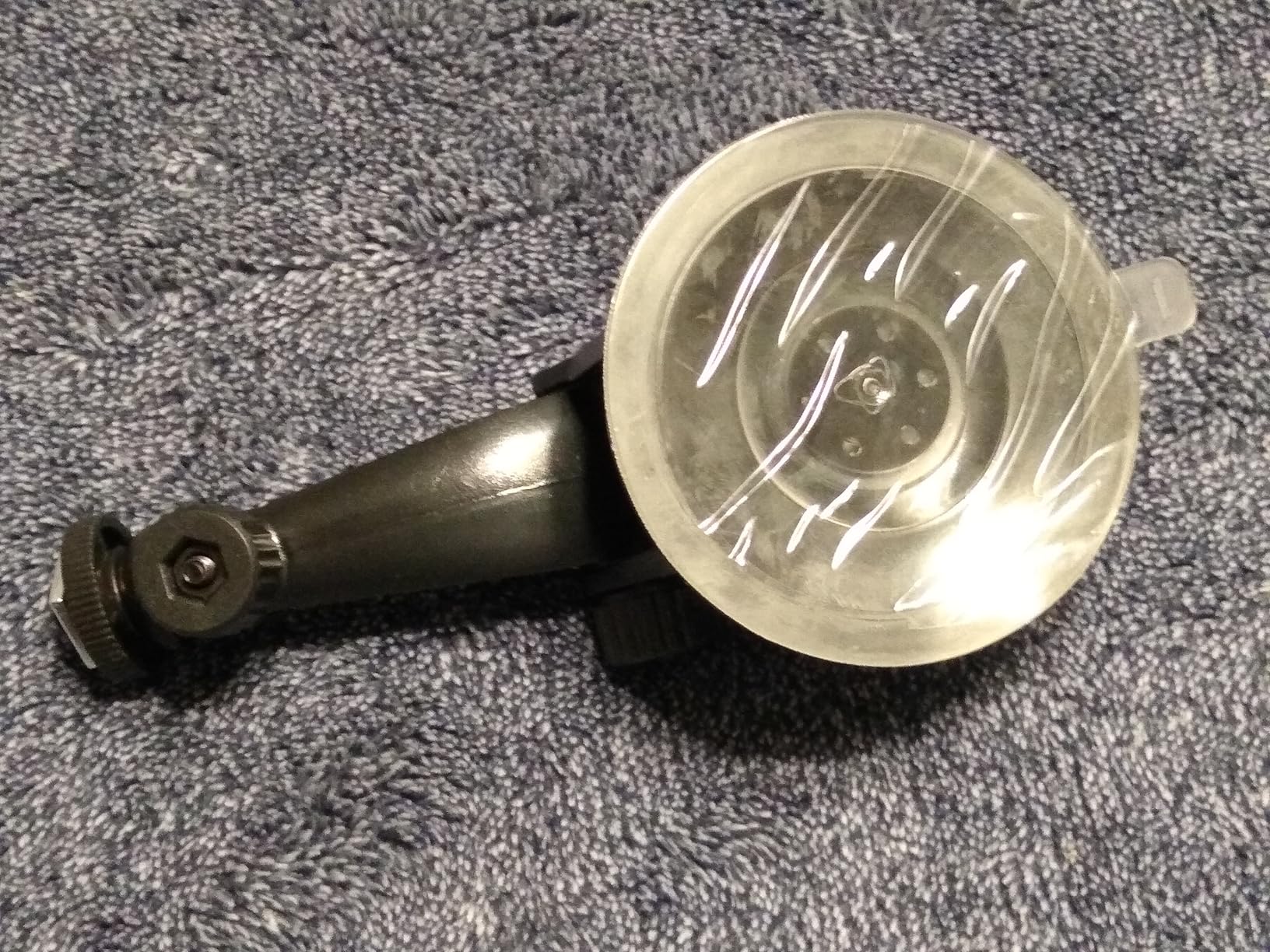
There is an SD card loop recording mode, which turns the system into a rear-facing dash cam while you tow. That is the feature owners cite for insurance and incident documentation, and it is not universal in kits at this level.
The 7 inch monitor is the main practical drawback. In a compact truck cab it needs a custom bracket to sit somewhere sensible, and it will not sit unnoticed. Playback on recorded clips shows some pixelation, and the included bracket is not weather sealed to the same standard as the factory Furrion housing.
One more thing to know before you buy: the camera draws power from the trailer running lights, so nothing displays until those lights are switched on. That is normal for this class of kit but catches out a lot of first-time owners.
Will it actually plug into my Furrion plate
On most pre-wired trailers built since roughly 2019, yes, and the pigtail matches the factory connector. The bracket sits in the same upper rear position, so the camera ends up at the same height and angle as the unit it replaces.
Check the connector shape before ordering if your trailer is older or a retrofit. A handful of pre-wired trailers use a different pigtail pinout, and no third-party kit will bridge that without an adapter.
Is 320 ft of on-vehicle range enough for a 35 ft trailer
For a bumper-pull trailer, comfortably. A 35 ft trailer plus a truck puts the rear camera roughly 50 to 60 ft from the cab monitor, so 320 ft of rated vehicle range leaves a large margin for walls, a fifth-wheel slide, and metal-framed construction absorbing signal.
Short of a full-height aluminum fifth wheel at highway speed with several obstructions in the path, we did not find consistent reports of failure at these distances. If your rig is metal-framed and 40 ft or longer, take the next section on range seriously before committing.
3. Pemacom 1080P HD Wireless Magnetic Backup Camera – Best No-Install Pick
1080P HD Wireless Backup Camera – 1 Minute Magnetic Easy Install No Wiring
- One-minute magnetic install with no drilling
- Rubber-coated base protects trailer paint
- Large battery with solar panel for long travel days
- 170 degree view covers most rear blind spots
- Top-ranked listing in the vehicle backup camera category
- 33ft transmission range is short for a travel trailer
- Brightness and saturation need manual adjustment in some conditions
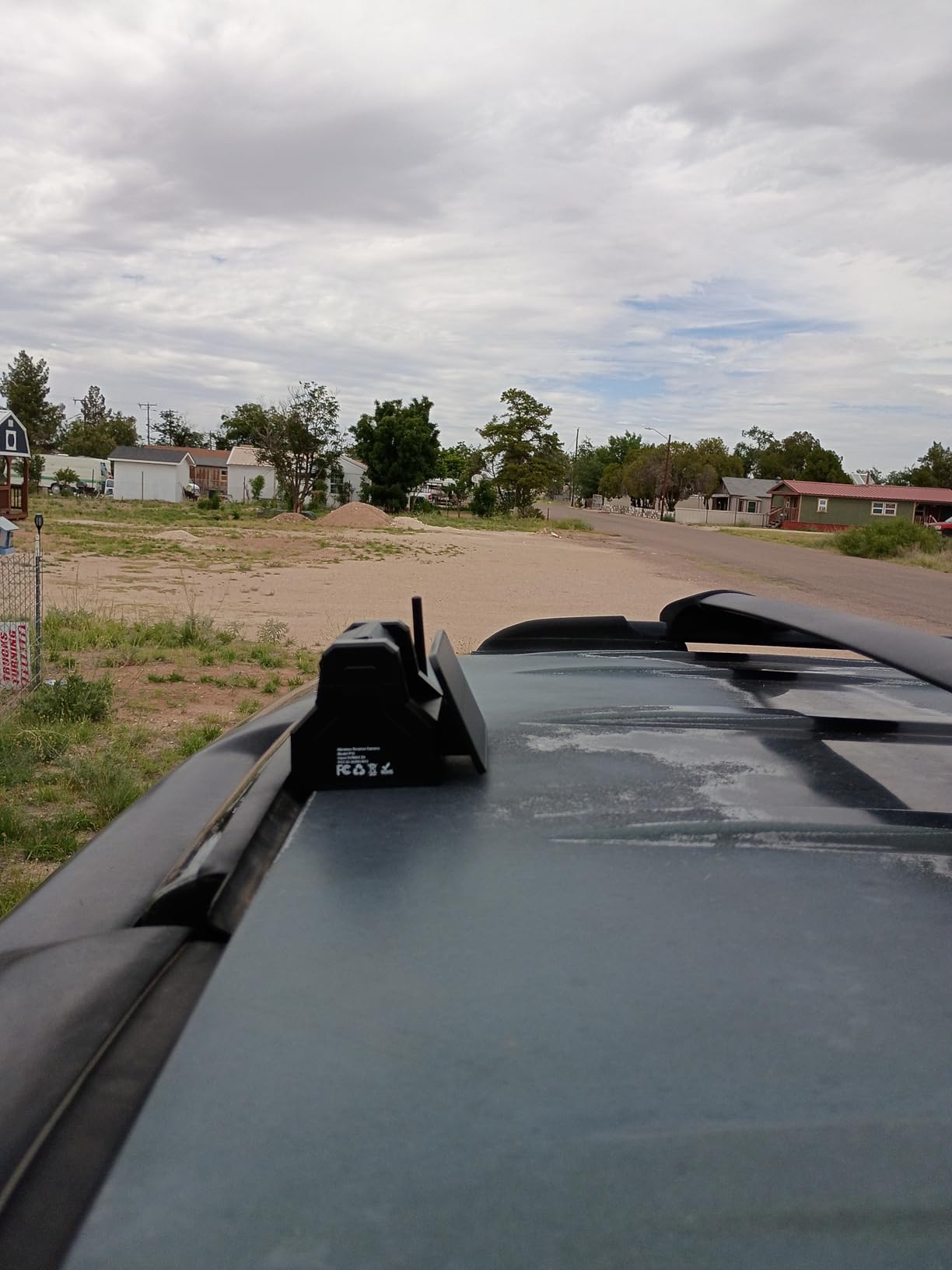
This is the pick when you rent sites, borrow trailers, or simply do not want to drill a hole in a fiberglass shell. The magnetic base uses six third-generation rare-earth magnets in a soft rubber coating that grips a metal surface without marking the paint, and the install takes about a minute.
At 170 degrees, this is one of the widest views in the group, and the 7 inch HD LCD uses an F1.2 aperture with a six-piece spherical glass lens. The picture is bright and clean in daylight, and owners consistently call out the wide view as the reason the rear blind zone shrinks noticeably.
Power is the standout feature. A 15000mAh rechargeable battery with a 5W solar panel and a Type-C charger gives up to 24 hours of use from a full five-hour charge, so a multi-day trip without hookups is not a problem.
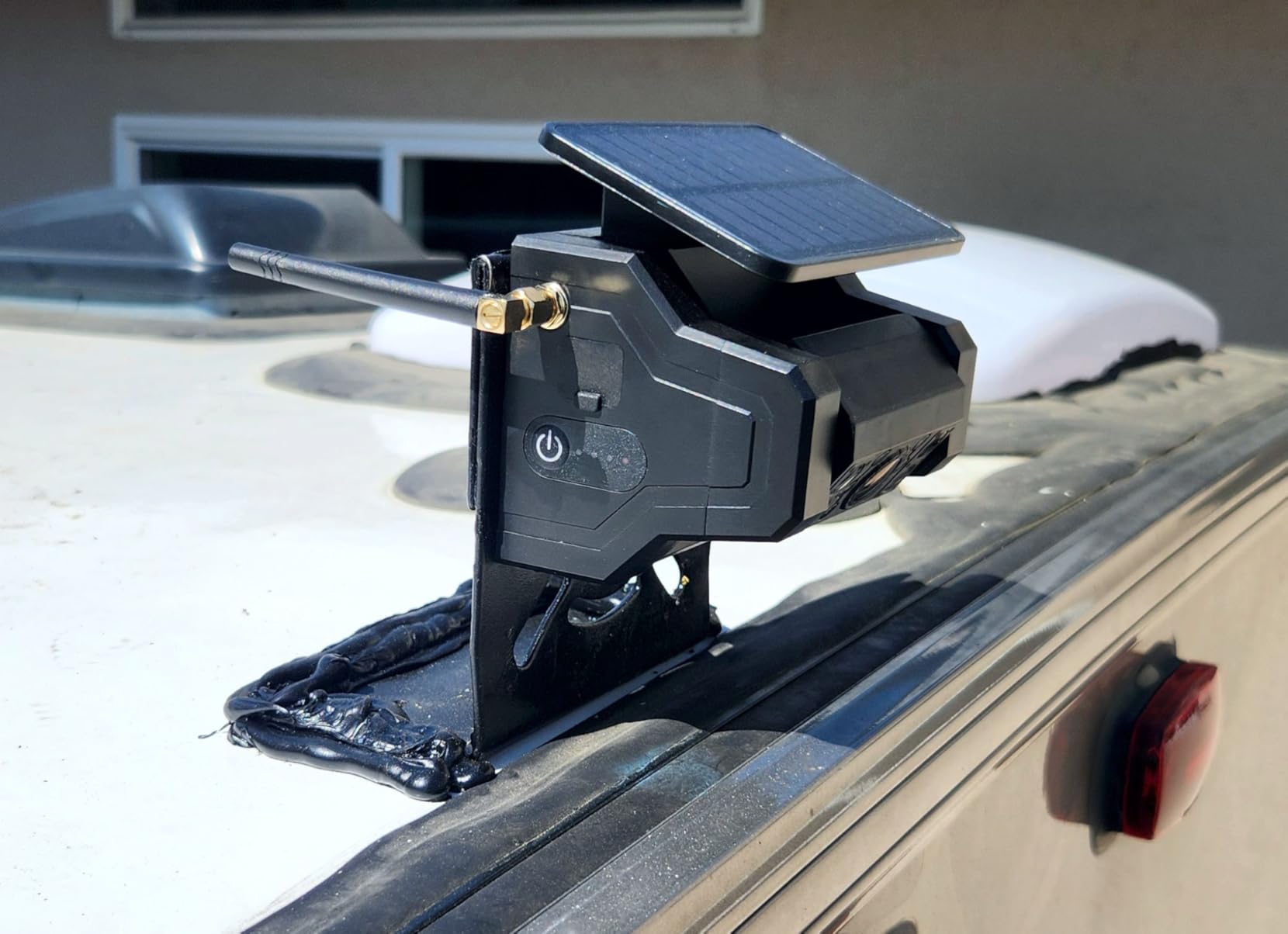
Waterproofing is IP69 and the operating range runs from -22°F to 176°F, which covers winter parkups as well as summer heat. Dual video channels and built-in parking assist lines are included, and the camera can also serve as a portable observation cam while stopped.
The range is the honest limit. At 33 ft rated transmission distance, this is a magnetic hitch camera rather than a trailer-mounted system, and it suits short trailers, hitched setups, and campsite maneuvering more than highway observation on a 35 ft rig.
Owners also note that brightness, contrast, and saturation need manual adjustment in changing light. It is a small thing, but it is one more thing to fiddle with while backing.
Will a magnet hold up at highway speed
On a properly seated metal surface, yes. The rubber-coated base grips hard and reviewers towing rough roads report the camera staying put. On an aluminum or wood-skinned trailer, the surface itself is the problem rather than the magnet.
If the trailer skin is not ferrous metal, plan to secure the camera with a secondary strap or zip-tie before highway speeds. That habit matters for any magnetic unit in this roundup, not just this one.
Is it worth buying over a pre-wired kit
If you back into campsites often and rarely use continuous highway observation, the no-install approach wins on convenience. You can move the same camera between your truck, your trailer, and a borrowed rig in under a minute.
You give up the ability to see traffic continuously while towing, because the 33 ft range is built for close-quarters maneuvering. If continuous rear observation is the goal, look at the wired pick or the longer-range wireless kits below.
4. DOUXURY IP69 170 Degree Wireless System – Best for 4-Channel Side Visibility
- Signal holds through metal trailer bodies and walls
- 4 split screen supports up to 4 cameras
- No wiring between trailer camera and cab monitor
- Quick disconnect lets the monitor move between vehicles
- Monitor mount releases the trailer entirely when you unhitch
- DVR recording stops at random intervals and saves mirrored 720p footage
- Live frame rate of about 15 to 20 fps looks jerky
- Windshield monitor mount is too weak for the weight over bumps
- One owner reported lens fogging after rain
The reason this system is on the list is the four-channel monitor. A 4 split screen supports up to three additional cameras, which makes it the natural choice for owners who plan to add side marker cameras and still want a fourth channel for a front or hitch view.
Owners of long aluminum trailers report that it outperformed their factory wired camera on clarity, night performance, and signal reliability. The 1080P CCD image chip handles day and night, and the dual-antenna design with digital signal processing is rated at 320 ft in open areas and 180 ft through a vehicle.
Nothing runs between the trailer and the cab except power, and the quick-disconnect mount releases the trailer entirely when you unhitch. Universal 12-24V DC compatibility means it works on trailers and box trucks alike.
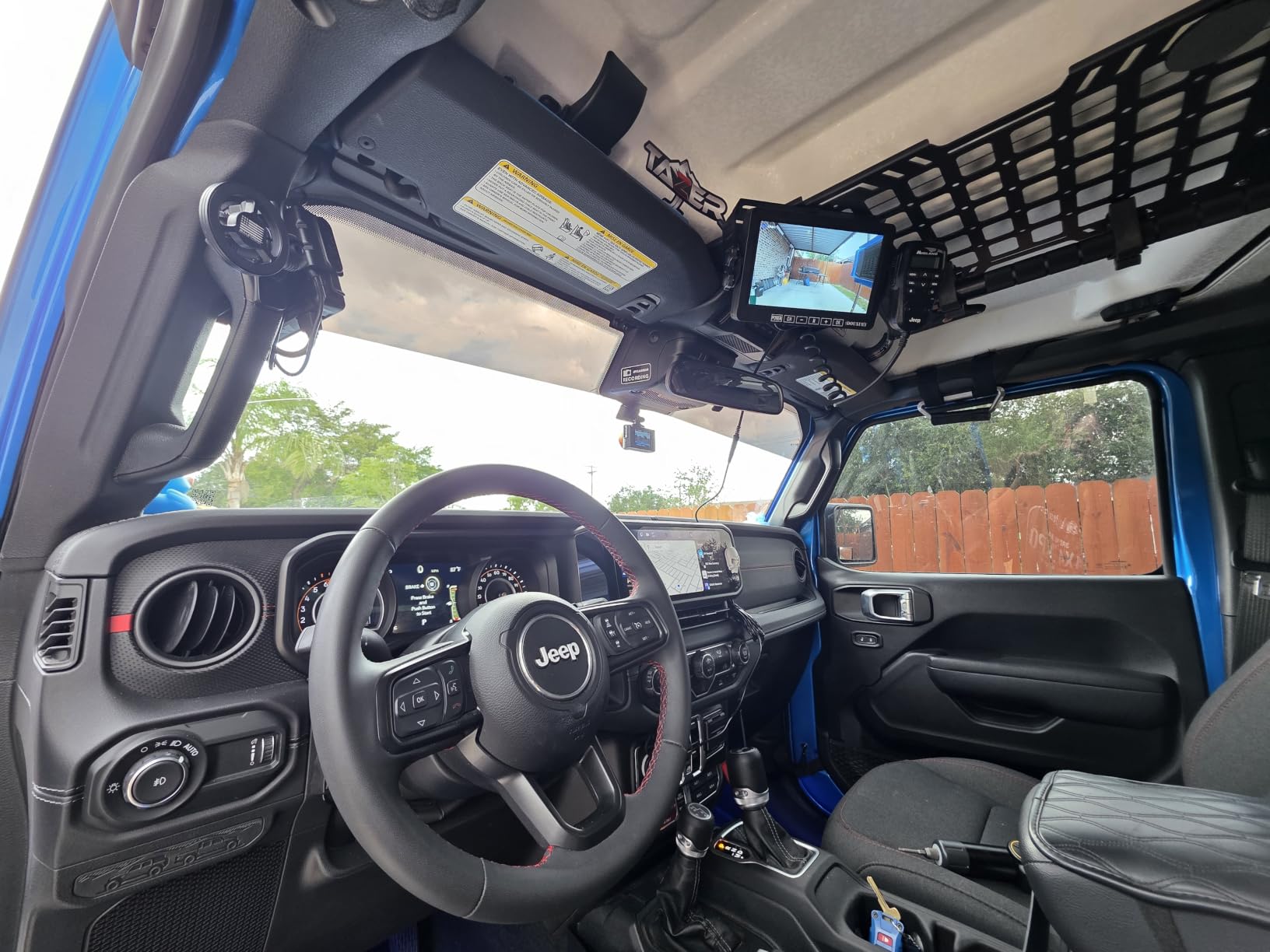
Automatic loop recording writes to an SD card up to 128GB, so a multi-camera rig can document all angles at once. Built-in reversing guideline lines and parking assist are handled by the monitor.
Two limitations stand out. The DVR recording stops at unpredictable intervals and the saved files come out mirrored at 1280×720, which is poor evidence quality if you are counting on footage for an insurance claim. The live frame rate of roughly 15 to 20 fps also looks slightly jerky in motion.
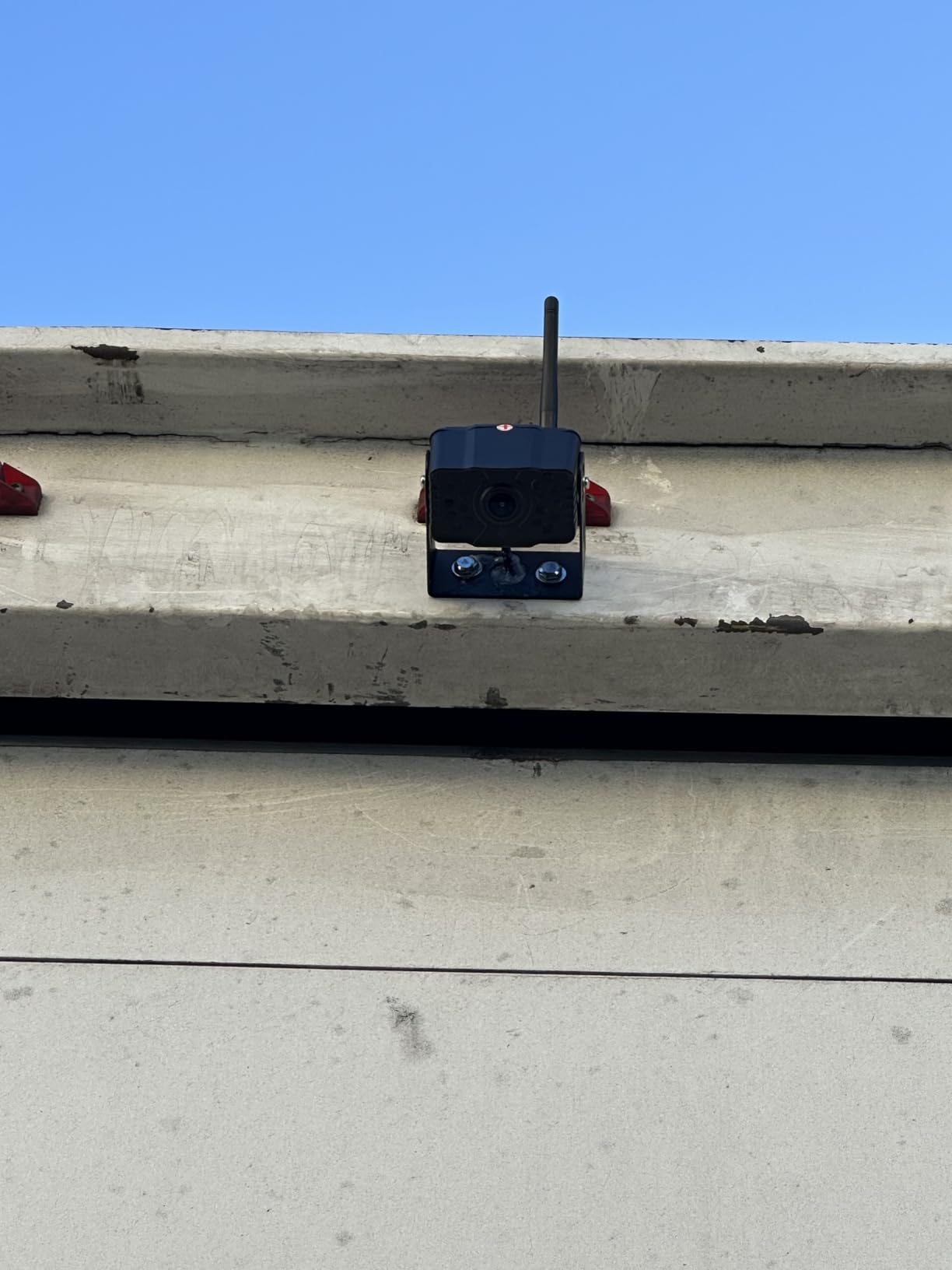
Several owners replaced the included windshield mount after bumps loosened it, and one reported moisture fogging the lens after heavy rain. Install the camera with a deliberate downward angle and check the seal after the first season.
Is four channels overkill for a 25 ft trailer
For a short trailer with an open site, two channels do the job. The extra capacity pays off once you are past about 30 ft, where the side blind zones start hiding hookup posts and adjacent traffic, or if you want a camera angled down at the bumper for distance judging.
Adding cameras later means adding them one at a time, and each extra camera is a separate purchase. Budget for that before committing to a four-channel plan.
Why does the picture look jerky
The live feed runs at roughly 15 to 20 fps, which is below what a modern phone display refreshes at. It is most noticeable while manoeuvring slowly rather than at highway speed, and it does not affect parking accuracy in any meaningful way.
If smooth motion matters to you for observation while driving, a kit with a higher refresh rate is the better match. For campsite backing, the field of view matters far more than frame rate.
5. DVKNM Magnetic Solar Wireless Backup Camera – Best for Boondocking and Off-Grid Sites
- Three-minute install with no drilling or wiring
- Solar and Type-C dual charging on a 9600mAh battery
- 9 IR LEDs give visibility in complete darkness
- Signal booster and long antennas reach about 328 ft
- DVR loop recording protects impact footage automatically
- 140 degree field of view is narrower than most competing kits
- Monitor is bulkier than 5 inch alternatives
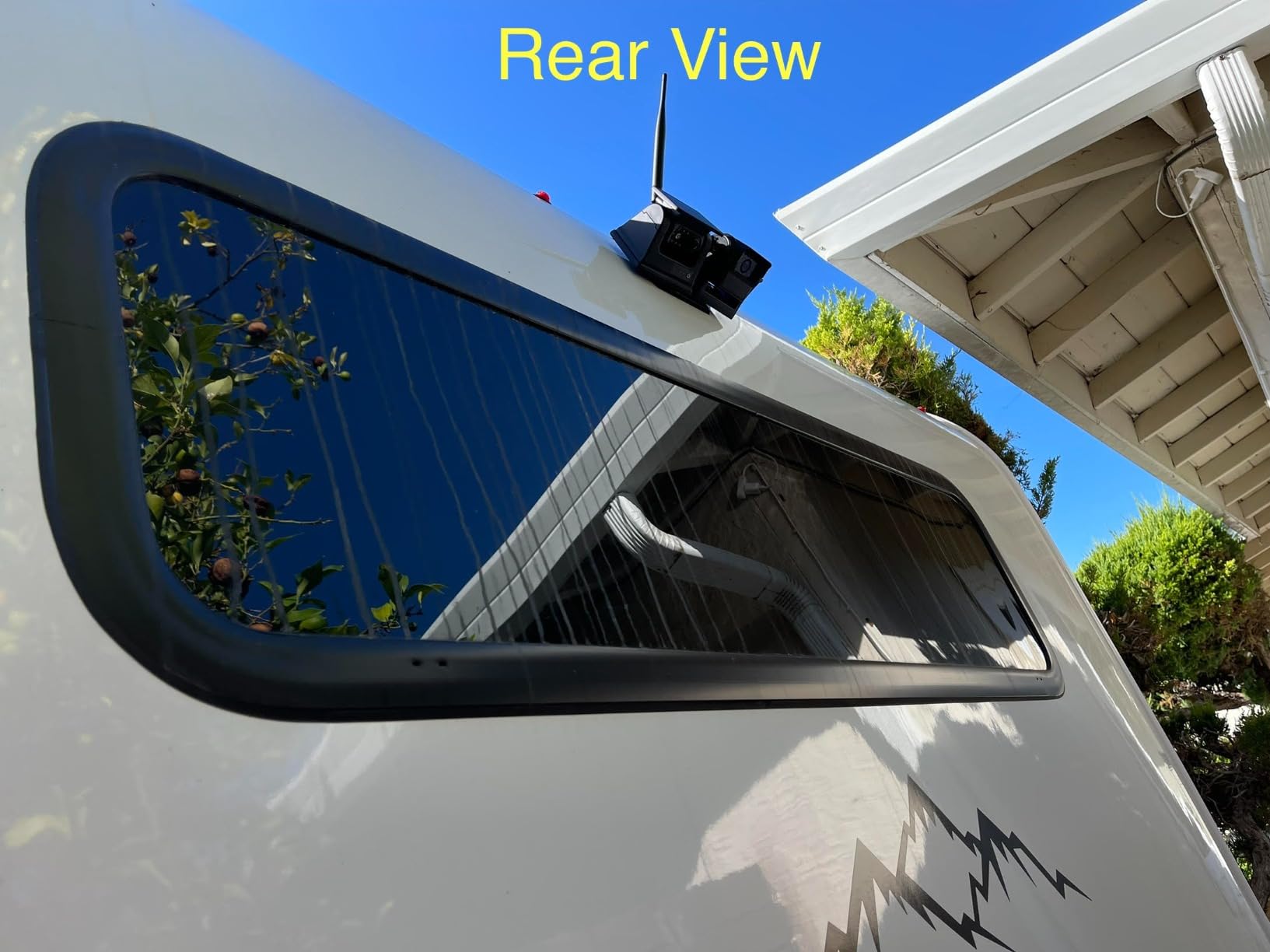
If you camp off-grid, the power story matters more than the picture. This camera carries a 9600mAh rechargeable battery with both solar and Type-C charging, so it does not sit draining the trailer house battery all weekend waiting for someone to look at a screen.
The 1080P HD color CMOS sensor pairs with nine infrared night vision LEDs for visibility in total darkness, and the unique potting process gives it IP69 commercial-grade waterproofing. For a camera that lives outside on a trailer all year, that rating is the right one to see.
Range is handled better here than with most magnetic kits. A built-in signal booster plus the long antennas included in the box push unobstructed transmission to about 328 ft, which is far more than the sticker figure on competing magnetic units.
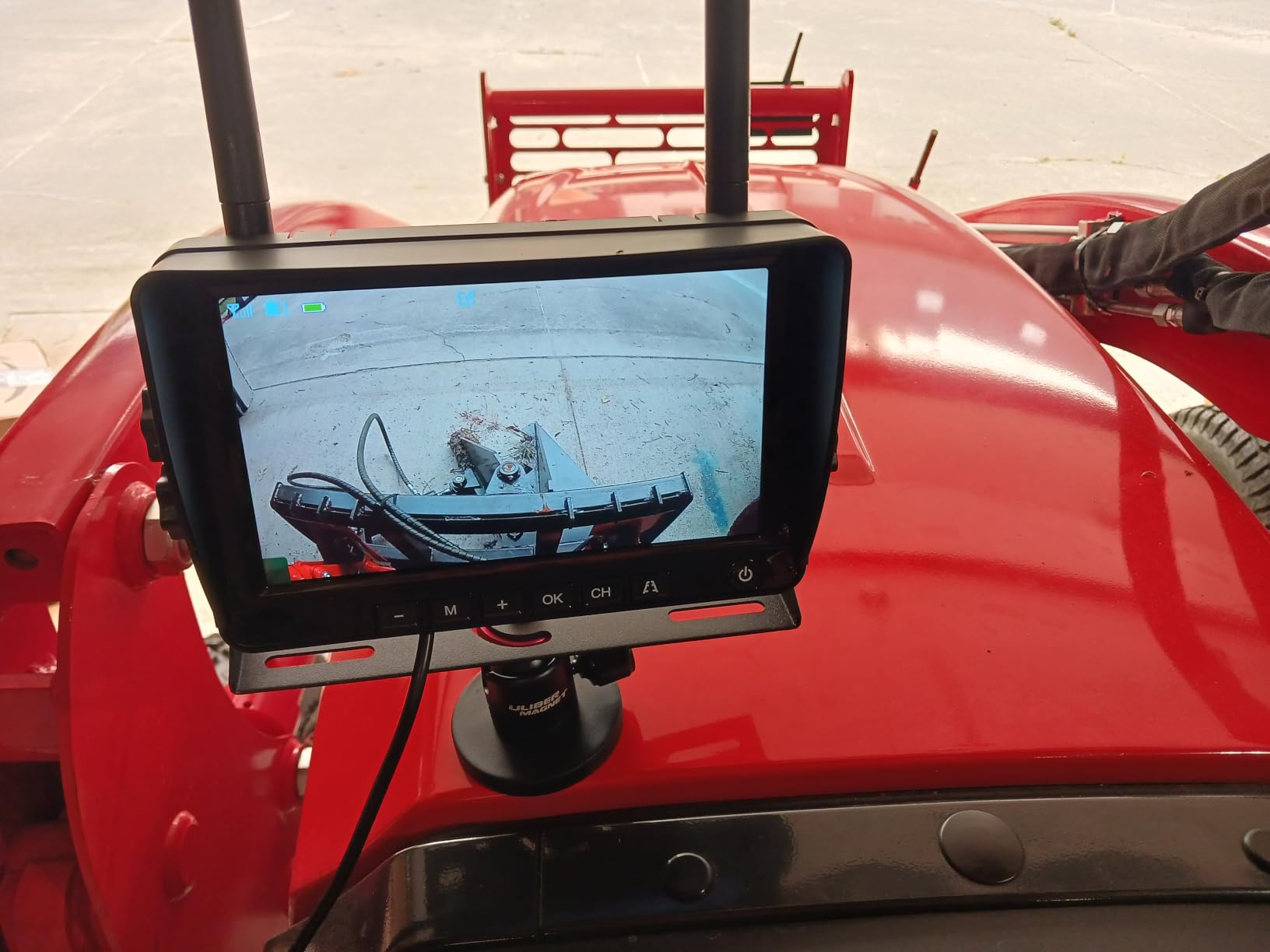
DVR loop recording automatically protects the segment captured during an impact, so a collision does not overwrite itself in the next loop. A 3-year warranty and 24-hour support back the system, and a sunshade is included for the windshield mount.
The trade-off is field of view at 140 degrees, which is narrower than the 170 degree kits in this roundup. Seeing vehicles in the adjacent lane takes deliberate camera aiming rather than automatic coverage, and for lane awareness on a busy road that is a real limitation.
The 7 inch FHD monitor is bulkier than the 5 inch alternatives. Plan for a suction cup position with a clear view rather than a low dash corner.
Does solar charging actually keep up while driving
It contributes, but it is a top-up rather than the primary supply. The Type-C charger is what refills the battery properly, and a full charge covers a long day of use on its own.
For boondocking specifically, the win is that the camera runs entirely from its own battery, so there is no draw on the trailer house battery and nothing to reconnect when you arrive at a site in the dark.
Is 140 degrees narrow for a 35 ft trailer
It is workable at the rear and limited to the sides. A rear camera at 140 degrees still covers the full trailer width when mounted high at the top rear, which is what matters most for backing.
For the side lanes, you are back to adding cameras, and the DVKNM kit here ships as a single-camera unit with two-camera variants available. Budget for that if lane awareness is the priority.
6. AUTO-VOX Solar Magnetic Backup Camera – Best Dual-Split Screen on 7.2 Inches
AUTO VOX Wireless Backup Camera Solar Magnetic, 7.2″ DVR 1080P Monitor
- Dual-split screen shows two cameras at once
- Included metal plate mounts on aluminum and wood trailers
- 524ft dual-antenna range with no dropouts on long trips
- Solar plus battery gives about 20 hours of continuous use
- Service replaced a failed camera within days
- Magnetic base can release at highway speed and the camera was lost
- Screen is hard to read in bright daylight
- Some units failed to power on after months of disuse
- Low blind spot remains behind the trailer at high mounting heights
The 7.2 inch 16:9 dual-split screen is the feature that sets this kit apart. Showing rear and side views side by side on one screen is the single most useful arrangement on a trailer, and no other kit in this roundup does it on a panel this size.
The magnetic mount is the second differentiator. A metal plate is included for aluminum and wood trailer skins that will not hold a magnet on their own, which is exactly the surface a lot of modern travel trailers have.
Signal strength is the strongest in the group at a rated 524 ft on the dual-antenna design, with owners reporting no dropouts on long trips. The solar panel and high-capacity battery give up to 20 hours of continuous use, and an auto sleep mode offers 120 second, 240 second, or never timeouts.
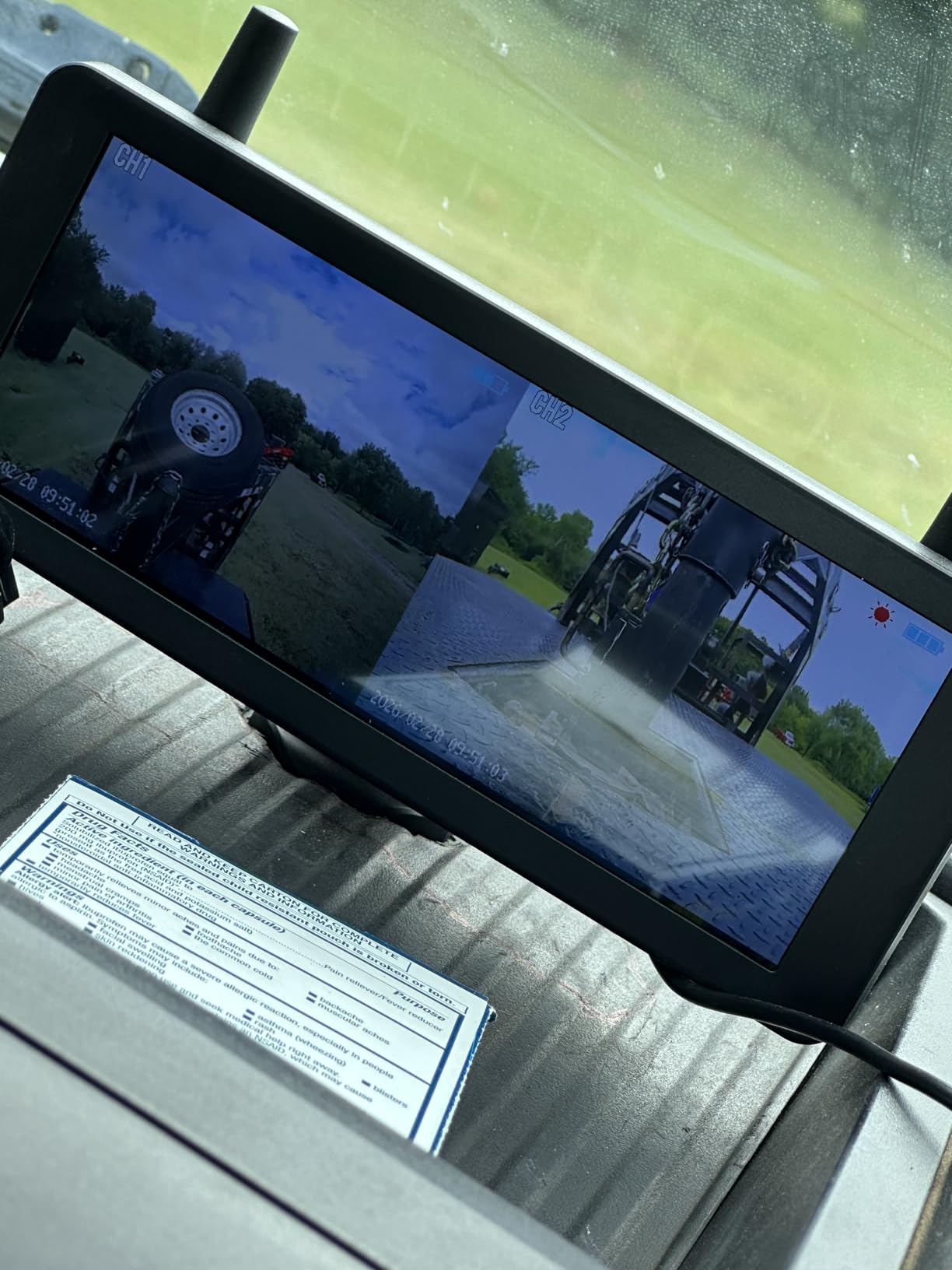
At 4.1 stars across 1034 reviews, this is the lowest-rated kit here, and the reason is consistent: magnet security and battery durability. Multiple owners add a zip-tie or strap after a camera has gone missing at highway speed, and a few report units failing to power on after months of disuse despite charging.
The screen is also reported as hard to read in bright daylight, and because the camera must sit high for rear traffic coverage, a blind spot remains low behind the trailer. The included USB-C cable is short enough that it may not seat properly in the camera port, so bring your own.
There is a 170 degree field of view on the camera and IP69K waterproofing rated from -4°F to 149°F. A carrying case is included for storage between trips.
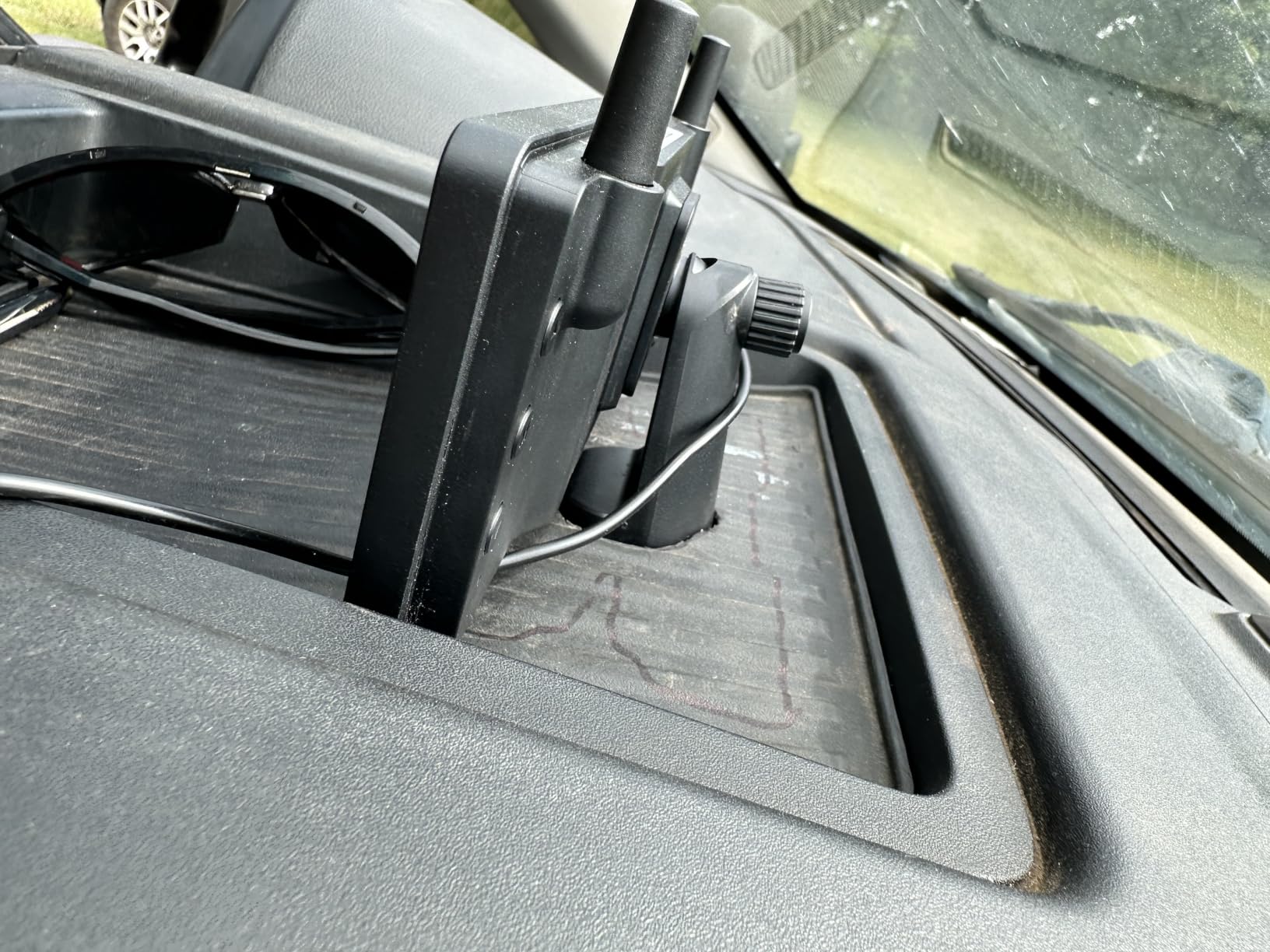
Is the magnet safe enough for highway towing
Not on its own. Owners report the base letting go of a rail at highway speed and losing the camera, which is the most serious complaint in this review set. Add a secondary strap before you tow.
On a campsite surface or a short move around a site, the magnet is completely dependable. Treat it as a maneuvering camera and treat the strap as mandatory on the road.
What does the dual split actually show
Two camera feeds side by side, which in practice means rear plus one side, or rear plus bumper-down for distance judging. That pairing solves the two blind spots a single rear camera cannot, and it is why a 7.2 inch panel makes more sense here than on a single-feed kit.
Two-camera and single-camera variants are both offered, so you can start with one and add the second later without replacing the monitor.
7. Fookoo HD 1080P 7 Inch Wireless System – Best Auto-Dimming Night Display for Pre-Wired Trailers
Fookoo HD 1080P 7″ Wireless Backup Camera System for Furrion Pre-Wired RV
- Drops into a standard Furrion pre-wired mount with no drilling
- Auto-dimming keeps the night display readable
- Responsive 7 inch IPS touch panel with parking lines
- Dual-antenna 2.4GHz link runs with no lag
- 24-month replacement service with lifetime after-sales support
- 120 degree field of view is the narrowest in this roundup
- Not a true drop-in for a genuine Furrion system
- Chevrolet
- GMC and some Ford trucks need a 7-way adapter or PWM filter
The auto-dimming screen is the feature that separates this kit. Most monitors need manual brightness changes between a dark forest road and a sunlit campsite, and owners consistently single out the dimming as the reason the display stays readable at night without adjustment.
It fits a standard Furrion pre-wired mount without extensive drilling, which makes it the second strong option here for a pre-wired trailer after the Yakry wireless kit. Variants are offered as 1-camera, 3-camera, and 4-camera sets, so buying the coverage you want up front is straightforward.
Signal is handled by dual antennas on the 2.4GHz band, rated at up to 200 ft in open range and reported to work at highway speeds with no delay. SD card loop recording is included, and the monitor supports windshield or table mounting.
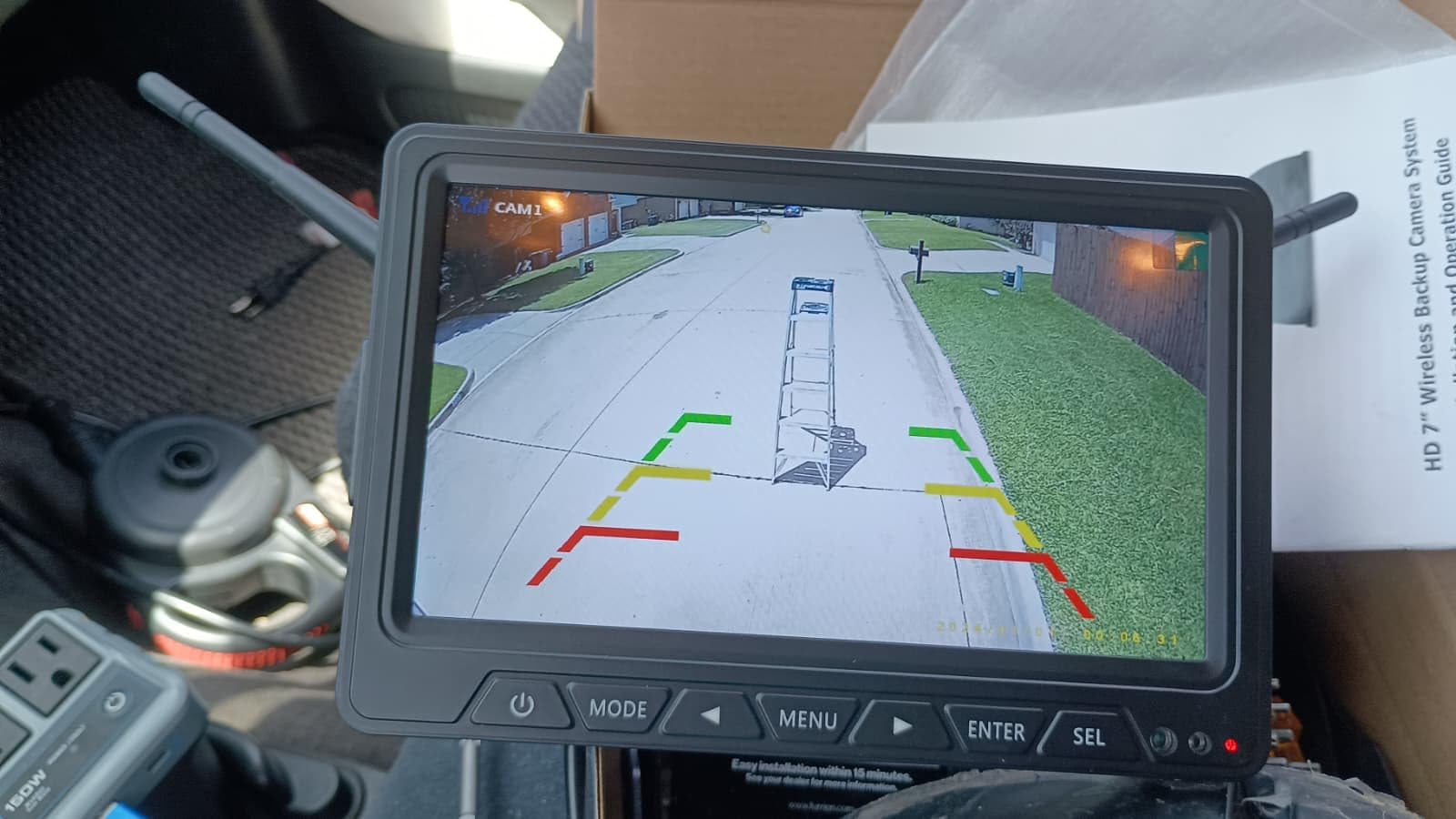
Night vision uses six infrared lights with a photoreceptor for automatic switching, and the camera is IP69 waterproof. It runs on 12-24V DC, covering travel trailers, campers, buses, vans, pickups, and farm machinery.
The 120 degree field of view is the narrowest in this roundup, and owners note it limits side visibility. An important caveat is that this is Furrion-compatible, not a true Furrion system, so the technologies differ even when the bracket fits.
If your tow vehicle is a Chevrolet, GMC, or a newer Ford using PWM signals, you may see flicker and need a Furrion 7-way power adapter or a PWM filter to bypass it. Check your truck before ordering.
Is a 120 degree view too narrow for backing
For the rear view at the top of the trailer, no. At that height the lens still covers the full trailer width and the ground behind the bumper.
Where it falls short is lane awareness beside a long trailer, and that is where the four-channel and dual-split kits earn their place. If your backing sites are tight, field of view matters more than screen features.
Will it cause flicker in my truck
Possibly, and it depends on the vehicle. Chevrolet, GMC, and some Ford tow vehicles use PWM switching on certain circuits, which shows up as a flickering or dimmed image. A 7-way power adapter or a PWM filter resolves it in most cases.
Owners of other trucks report a clean image with no adapter. It is worth confirming your make and model before the install rather than after.
8. DoHonest R50 Solar Magnetic Camera – Best Compact 5 Inch Setup You Can Move Between Rigs
- Tool-free magnetic mount moves between truck
- RV
- and trailer
- Reviewers measured about 11 hours of continuous use in warm weather
- Strong neodymium magnet held up over rough roads
- Real-world range exceeded the stated 36 ft in testing
- 5 inch IPS monitor with adjustable brightness and saturation
- Camera body is large and heavy in a compact cab
- 5 inch screen is the smallest here so less of the trailer is visible
- Side-by-side dual view squeezes both images
- Occasional dropouts return within a few seconds
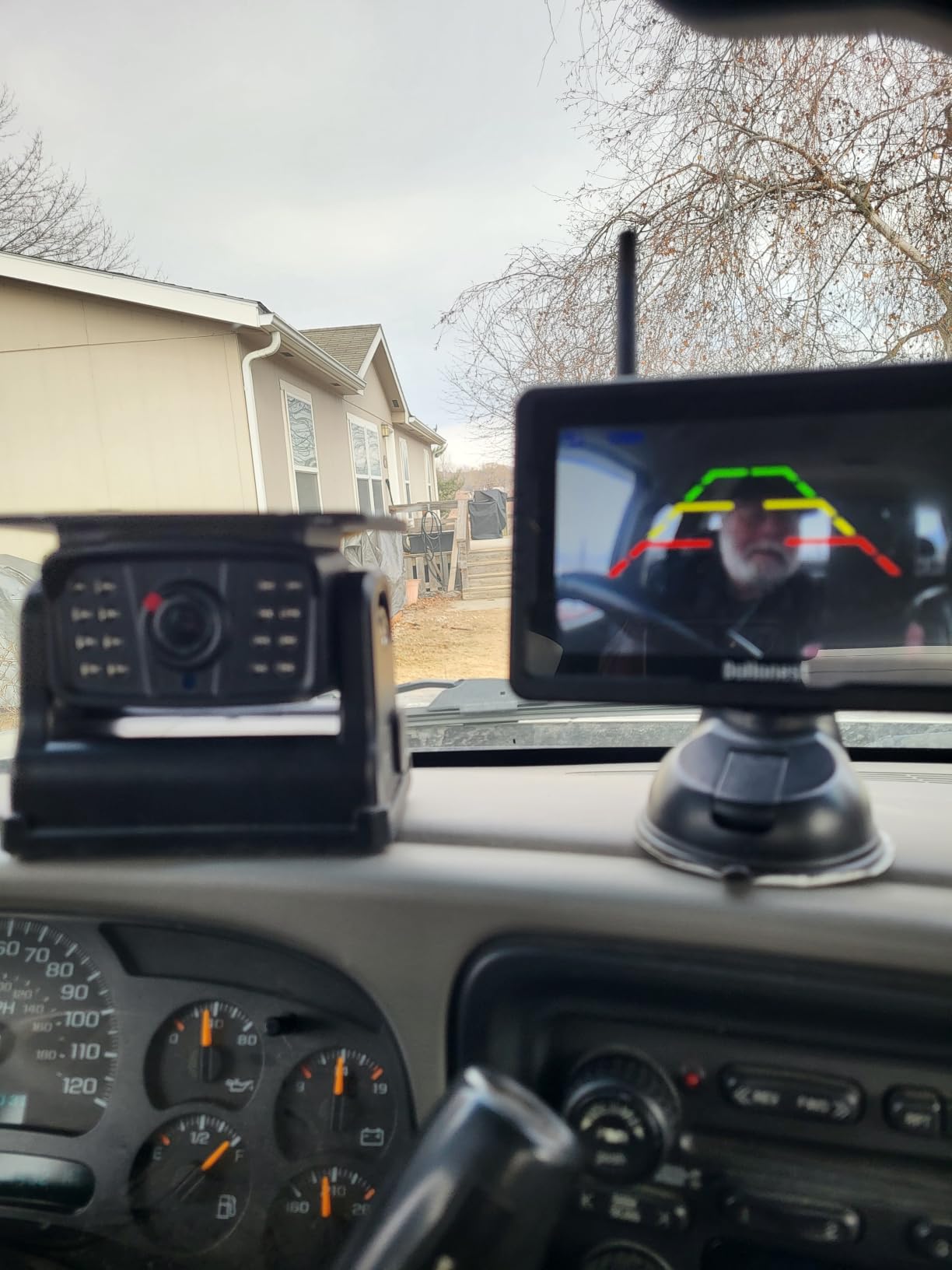
This is the smallest monitor in the roundup at 5 inches, and that is the whole argument. If you tow a smaller trailer, drive a compact cab, or split time between a truck and a trailer, a smaller screen takes up less space and stops being an obstruction.
Power comes from a 9600mAh rechargeable battery with solar charging, rated at up to 24 hours per charge. In real conditions, reviewers measured roughly 11 hours of continuous use in 75 to 80°F weather on a long haul, which lines up with a working day of towing.
The tool-free neodymium magnetic mount protects paint and leaves no marks, and one owner reported the camera survived a fall onto pavement at highway speed and kept working. Range is listed at 36 ft, but testers report staying connected well past 100 ft in practice.
Night vision uses 16 infrared LEDs with automatic light sensing, and the lens is IP69K waterproof with a scratch-resistant surface. Integrated parking assist with distance lines and a 5 inch IPS monitor with adjustable brightness, contrast, and saturation round out the package.
Trade-offs are real: the camera body is chunky and heavy, the 5 inch screen shows less of the trailer at once, and when two cameras are shown side by side both images are squeezed. Occasional connection dropouts do occur, though the feed returns within a few seconds.
A one-year warranty with lifetime technical support is included, which is thinner on paper than the 24-month and 3-year coverage on the kits above.
Is 36 ft of rated range enough for a travel trailer
Not for a 30 ft trailer in theory, and yes in practice based on owner tests. The stated figure is a conservative line-of-sight number, and reviewers report a stable connection past 100 ft.
Longer rigs with metal frames and several obstructions in the path are the case where conservative ratings matter. If you are past 30 ft, treat the tested experience as encouraging rather than a guarantee.
Is 5 inches too small to read at a campsite
It is small, and sunlight is the limiting factor rather than the image itself. A windshield mount in shade, with brightness turned up, works for most sites.
If you regularly arrive at open sites in full sun, a 7 inch panel with an included sunshade is the safer choice, and there are three in this roundup that include one.
What Wireless Range Does Your Travel Trailer Actually Need?
Match the rated range to about twice your trailer length, and treat the open-area figure as marketing and the through-vehicle figure as reality. Every wireless kit here lists both.
Under 25 ft, a short-range magnetic system with roughly 33 to 100 ft of rated range is sufficient for campsite maneuvering. The 33 ft figure looks thin next to the others, but for aligning a ball on a small trailer the distance between camera and monitor is short.
Between 25 and 30 ft, target at least 200 ft of rated range. The Fookoo system at 200 ft open range sits right at this line, and anything higher gives you margin for walls and gates.
Between 30 and 35 ft, look for 320 ft or more of through-vehicle capability. The Yakry wireless kit at 320 ft on vehicle and the DOUXURY at 180 ft through vehicle both cover this band, with the Yakry holding more margin.
At 35 ft and beyond, or for a metal-framed fifth wheel, we would stop relying on wireless entirely. A wired kit has no radio link to fail, and the peace of mind is worth the cable run. If wireless is a requirement, the AUTO-VOX at 524 ft and the Yakry at 825 ft open-area are the two with real headroom.
Range is only half the story. Signal quality also depends on how many obstructions sit between camera and monitor, and how many other devices share the 2.4GHz band.
Field of View, Night Vision, Monitor Size, and Waterproofing Compared
Field of view is the spec that decides how much of the campsite you can actually see. The sweet spot for a trailer sits between 120 and 150 degrees. Below that, side awareness suffers. Above 160, close objects smear into unreadable shapes at the frame edges, which is the complaint owners raise most often against the widest kits.
Our at-a-glance spread runs from 120 degrees on the Fookoo to 170 degrees on the Pemacom, DOUXURY, and AUTO-VOX. A 150 degree lens like the Yakry and DoHonest units is the balanced middle.
Night vision depends on infrared LEDs and the sensor lux rating. Kits here run from 6 IR lights to 16, and lower lux ratings like 0.1 lux indicate the sensor can work in darker conditions. The practical test is a campsite arrival with no light other than your own headlights, which is when owners judge a system most harshly.
Monitor size decides readability. A 7 inch panel with an included sunshade is the safe choice for daylight sites, and only one kit here uses a 5 inch screen. Touch panels and auto-dimming are worth more than raw size once you are driving at night.
Waterproofing is where IP65 and IP69 ratings matter. IP69 and IP69K units tolerate high-pressure hot-water washdowns, and every system in this roundup meets at least IP69. For a camera living outside on a trailer year round, that is the correct bar.
Wired vs Wireless vs Magnetic: Which Power Method Fits How You Camp
A wired kit draws power from the trailer and sends video down a physical cable, so there is no signal to lose. It is the right answer for a long or metal-framed trailer and the wrong answer for anyone who unhooks often.
A wireless kit still needs 12V power at the camera, usually tapped from the running lights or marker light circuit. That means the feed is only live when those lights are on, which is the single most common source of confusion for new owners.
A magnetic unit carries its own battery, often with solar charging, so nothing is connected to the trailer at all. It is the only clean answer for boondocking, since there is no draw on the trailer house battery at all.
One more note for newer trucks. If a wireless image flickers or dims, your tow vehicle may be using PWM switching on a specific circuit. A 7-way power adapter or a PWM filter usually clears it.
Why Does a Trailer Camera Lose Signal While Driving? Fixes to Try in Order
Signal loss while driving is the most repeated complaint in trailer owner forums, and it appears repeatedly in threads on r/RVLiving, iRV2, and the Keystone forums. Work through these in order rather than swapping hardware first.
First, confirm power at the camera pigtail with the trailer running lights switched on. A camera with no power presents as a dead monitor, and this is the most common cause of a no-signal screen on a fresh install.
Second, re-seat every connector. Pigtail plugs, the monitor power lead, and any antenna connection work loose from road vibration, and a half-seated plug can read as a total failure.
Third, power cycle the 12V. Disconnect the trailer power, wait a full minute, and reconnect before the monitor finishes booting. This clears most pairing and frozen-frame states.
Fourth, re-pair the monitor to the camera. Hold the pairing button on the monitor until the indicator flashes, then power the camera. Owners on r/GoRVing describe this as the fix for units that will not pair or show a blue screen out of the box.
Fifth, reposition the antennas. The monitor antenna and the camera antenna both matter, and the factory antenna is usually routed in whatever path was convenient at the factory. Moving the monitor antenna up toward a window and away from the metal frame frequently restores a stable link.
Sixth, look for 2.4GHz congestion. Wi-Fi hotspots, Bluetooth devices, toll transponders, and some power inverters share the same band. Turning off a portable hotspot is a fast test that costs nothing.
Finally, if your trailer is pre-wired, confirm you bought a system matching the generation in the housing. Furrion Vision S, Vision S+, and S Pro are not cross-compatible, and a mismatched unit will never pair no matter how many times you reset it.
Frequently Asked Questions
Who makes the best RV backup camera?
For a travel trailer built since roughly 2019, the answer depends on one fact: whether it is Furrion pre-wired. A pre-wired trailer gets a drop-in Furrion or Furrion-compatible camera in minutes. For a non-pre-wired trailer, a wired kit with a 66 ft cable gives the most reliable image. Haloview and AUTO-VOX cover the multi-camera and side-visibility slots, and AMTIFO and Yakry cover the value end.
Which backup camera is better, Furrion or Haloview?
For a Furrion pre-wired travel trailer, the Furrion system installs with no adapters, while the Haloview BT7 delivers 1080P on a larger 7 inch DVR monitor for a similar outlay. Furrion wins on guaranteed native fit and the option to add Furrion side cameras later. Haloview wins on resolution per dollar, longer rated range, and built-in recording.
What wireless range do I need for a 30 ft travel trailer?
Aim for at least 200 ft of rated range, and ideally 320 ft of through-vehicle capability. A rule of thumb that works well is twice your trailer length. Treat open-area figures as generous and through-vehicle figures as realistic, since walls, gates, and metal trailer frames all reduce the usable signal.
Do wireless backup cameras really work on travel trailers?
Yes, for bumper-pull trailers up to about 35 ft, provided the range is matched to the rig. One thing to know in advance: a digital wireless feed goes completely blank when the link fails, rather than degrading into a fuzzy image the way an analog system does. Many owners find that total blackout more unsettling than a slightly grainy picture.
Do I have to have the trailer running lights on for the camera to work?
On most wireless kits, yes. The camera draws 12V power from the trailer running lights or marker light circuit, so nothing displays until those lights are switched on. This is normal for the category and catches out many first-time installers. Wired kits that tap the same circuit behave the same way.
Are RV backup cameras worth it for travel trailers?
For most owners backing into campsites, solo hitching, or navigating tight campground lanes, yes. The rear blind zone of a 25 to 35 ft trailer is wide enough to hide a child or a post entirely. The fair counter-argument comes from experienced owners who have towed for decades using mirrors alone and find a screen more distracting than helpful at highway speed.
Which Travel Trailer Backup Camera Should You Buy?
Start with the pre-wire check. If your trailer has Furrion plates, the Yakry wireless kit at number two is the strongest balance of install speed, signal, and expandability. If it has no plates, the wired Yakry at number one gives you a feed that never fails, and it is the one we would own.
For side visibility on a longer trailer, the DOUXURY four-channel kit or the AUTO-VOX dual-split screen cover what a single rear camera cannot. For boondocking or a camera that moves between rigs, the DVKNM and Pemacom magnetic units carry their own batteries and need nothing from the trailer.
Whichever you pick, run the power, connector, and pairing checks before your first solo back-in, not during it. And if you are still planning the rest of the rig, our best truck GPS navigators for RV travel guide covers the navigation side of a long tow. For families traveling with small children, the best baby monitors with cameras for travel roundup covers the same problem inside the trailer.