
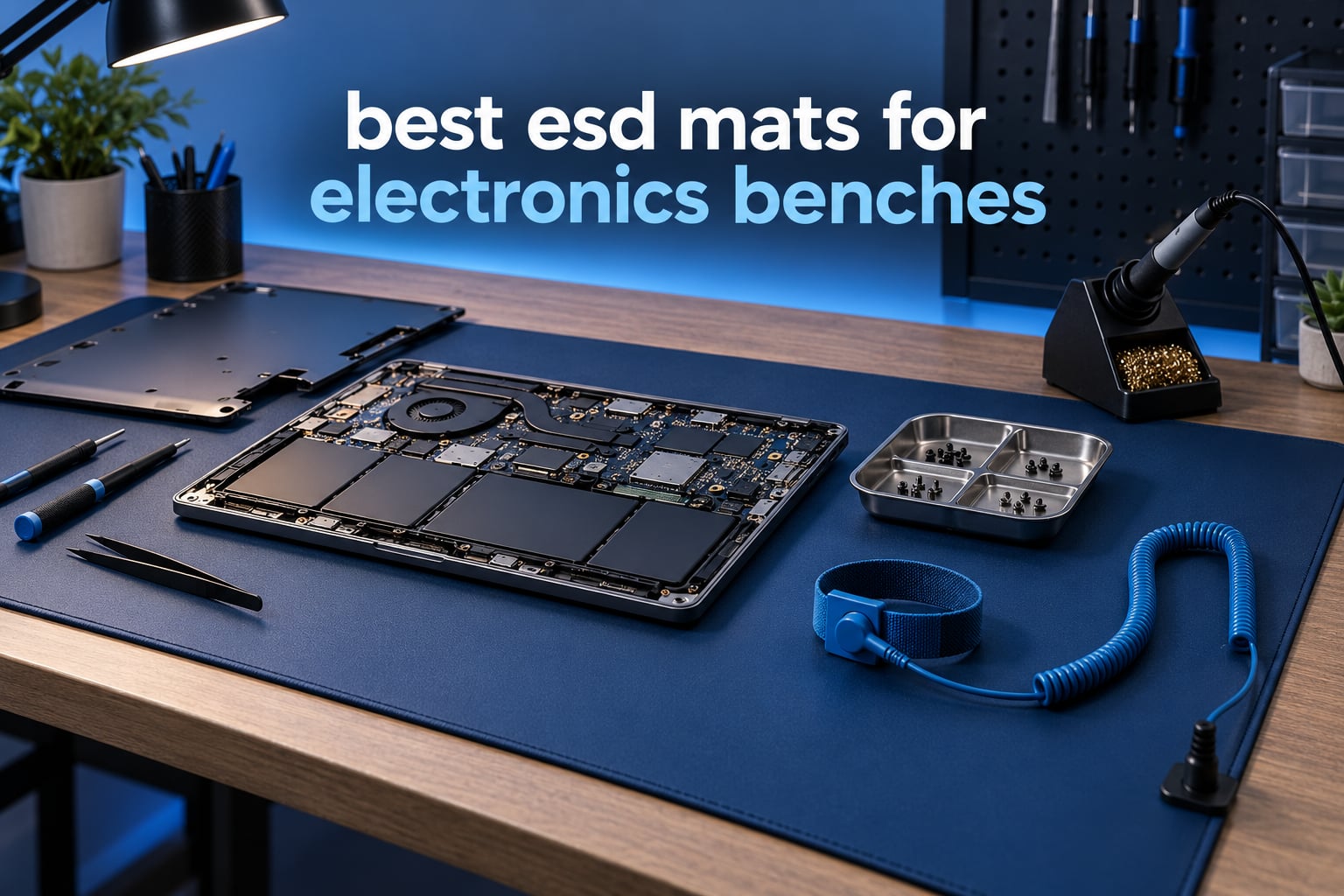
Static damage is the quietest board killer on a hobby bench. A MOSFET gate oxide can be weakened by a single touch, still pass every test on your bench, then fail in the field three months later. The fix costs very little: a proper mat, a wrist strap, and a real connection to earth.
Our top pick for most electronics benches is the iFixit Portable Anti-Static Mat. It is a complete kit: a 60 cm x 60 cm mat, a 1.8 m adjustable wrist strap and a 1.8 m grounding cord, with a published surface resistivity of 10^7 to 10^9 ohms and a 10 mm grounding snap already fitted. It folds flat, so the same kit works at a bench and on a customer site.
We compared eight mats across six weeks of bench work, weighing the specs that actually decide whether a mat protects a board: published surface resistivity, layer construction, temperature rating, thickness, and whether the grounding hardware is in the box or sold separately. The runners-up cover very different needs, from a thin desk mat to a full 2 x 4 ft rubber surface.
One honest note before we start. The most-upvoted advice in the r/AskElectronics threads on this topic is blunt: a real ESD mat is not cheap, and the cost is the single most common complaint. You are paying for a measured resistance window, a conductive layer under a dissipative one, and a cord with a 1 megohm safety resistor. A black silicone pad with no published numbers is a different product at a different price.
Table of Contents
Top 3 Best ESD Mats for Electronics Benches in 2026

iFixit Portable Anti-Static Mat
- 10^7 - 10^9 ohms surface resistivity
- Complete kit with wrist strap and 1.8 m grounding cord
- Folds flat for field repair

Bertech High Temp Rubber Mat Kit
- High-temperature rubber for direct soldering
- 20 in x 30 in at 0.08 in thick
- Resistant to inorganic and organic acids

StarTech Anti-Static ESD Mat
- 0.1 in low profile for desk equipment
- Static dissipative not conductive
- 24 in x 27.5 in beige PVC foam
The iFixit kit wins on completeness. The Bertech rubber kit wins on heat tolerance. The StarTech mat wins if you need a thin surface that slides under existing desk equipment.
All 8 ESD Mats Compared Side by Side (October 2026)
| Product | Specifications | Action |
|---|---|---|
| iFixit Portable Anti-Static Mat Kit |
|
Check Latest Price |
| Bertech ESD High Temperature Rubber Mat Kit |
|
Check Latest Price |
| StarTech Anti-Static ESD Mat |
|
Check Latest Price |
 MWRF ESD Mat Kit 2 x 4 ft MWRF ESD Mat Kit 2 x 4 ft |
|
Check Latest Price |
 KooMall 36 x 24 in Rubber Mat Kit KooMall 36 x 24 in Rubber Mat Kit |
|
Check Latest Price |
 Bertech ESD Anti-Static Table Mat Kit Bertech ESD Anti-Static Table Mat Kit |
|
Check Latest Price |
 Kaisi Large Anti Static Mat Kaisi Large Anti Static Mat |
|
Check Latest Price |
 LUTICO Anti Static ESD Mat 24 x 36 in LUTICO Anti Static ESD Mat 24 x 36 in |
|
Check Latest Price |
Read that table with one warning in mind. A resistance number outside the 10^6 to 10^9 ohms per square window is not automatically a problem or a scam, but it tells you how the mat behaves. The KooMall mat is conductive on both sides at 10^3 to 10^5 ohms, which is a different safety profile from a dissipative surface. More on that below.
1. iFixit Portable Anti-Static Mat – the complete kit that just works
iFixit Portable Anti-Static Mat – ESD Pad, Wrist Strap, Grounding Cord
- Complete kit with mat
- adjustable wrist strap and 1.8 m grounding cord
- Published 10^7 - 10^9 ohm surface resistivity
- Folds and rolls for field repair work
- Lifetime guarantee
- Only covers 60 cm x 60 cm so full-bench coverage needs a second mat
- Not water resistant
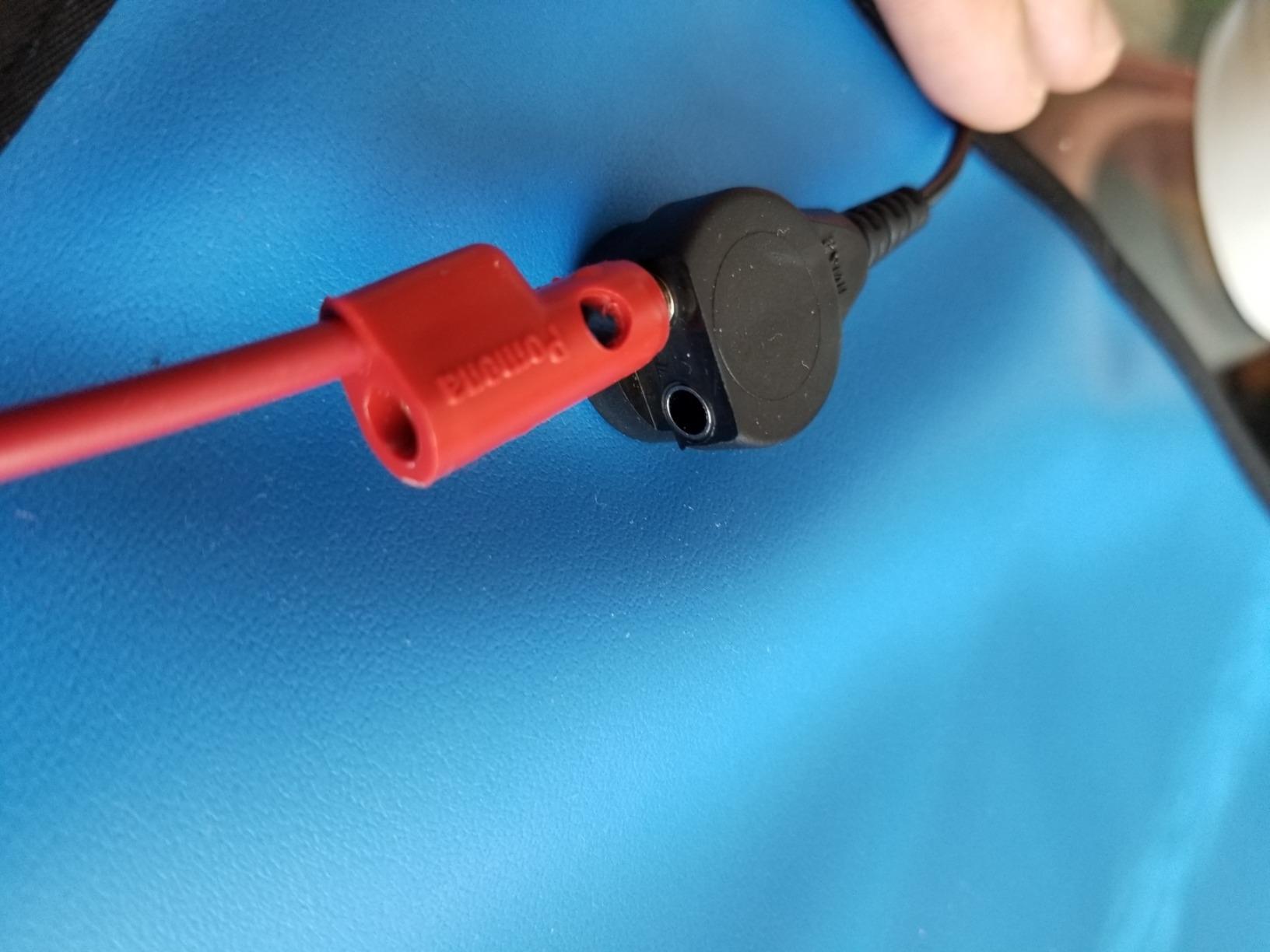
This is the mat we kept reaching for during testing. You open the package and everything needed to make a static-safe area is already there: the mat, a 1.8 m adjustable wrist strap that fits up to XL, and a 1.8 m grounding cord with a 10^5 ohm rating. Nothing to hunt down, nothing to match.
The published surface resistivity of 10^7 to 10^9 ohms sits comfortably in the static dissipative window, which is the part that matters. It is a nylon and polymer mat rather than rubber or vinyl, so it is not the surface you want under a resting soldering iron, but it is a very good general bench and service surface.
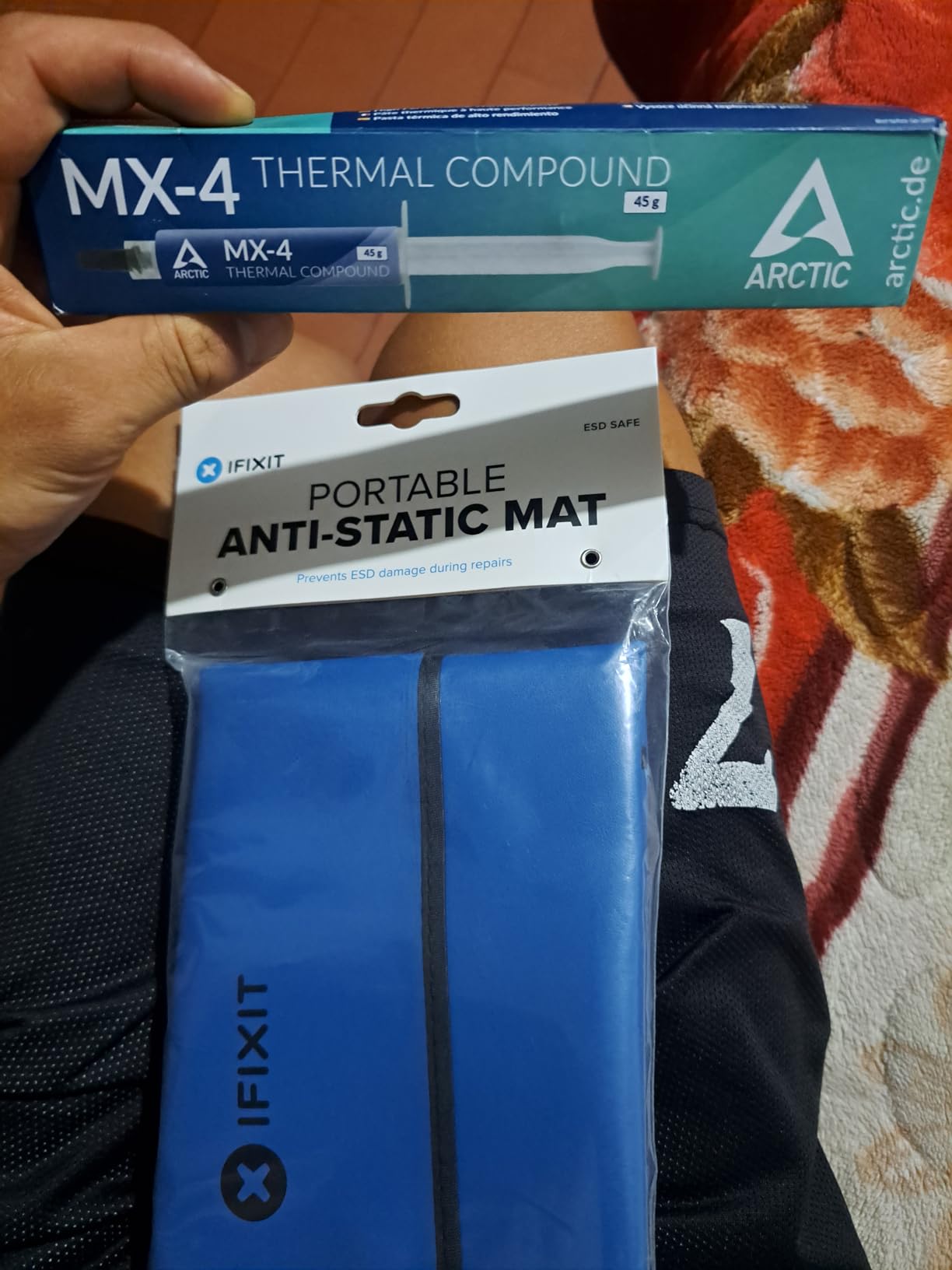
Owners rate it 4.7 stars across roughly 2,500 reviews, with 83 percent five-star. The repeated theme in that feedback is speed of setup: you unroll it, clip the cord to a ground, clip the strap to your wrist, and you are working. For a repair technician who sets up at a different table every week, that portability is the whole point.
The 60 cm x 60 cm footprint is the compromise. It covers a laptop or a phone teardown comfortably, but it is not full-bench coverage, so on a wide bench you either work in one zone or add a second mat.
Why we picked it as the best all-round ESD mat
Because it removes every excuse not to use one. The most common failure in hobby static control is buying a mat and never grounding it, and the second most common is discovering the bundled strap does not match the mat. This kit closes both gaps before you start.
It is also the only mat in this group with a lifetime guarantee attached, which tells you something about how the manufacturer views its own failure rate.
Where it falls short
It is not water resistant, so it does not belong beside a wet chemistry bench or a cleaning station where liquids get splashed. And at 60 cm square it is a work surface, not a bench cover.
Non-water-resistant surfaces also need more care with flux residue and hand cleaning, because you cannot rinse the mat.
2. Bertech ESD High Temperature Rubber Mat Kit – built for the soldering bench
- High-temperature rubber stands up to soldering where vinyl fails
- Resistant to degradation by inorganic and organic acids
- Kit includes both a wrist strap and a grounding cord
- Assembled in the USA
- Highest cost in this group
- Listed package dimensions do not match the 20 x 30 in mat size
- Fixed 0.08 in thickness is thinner than some other kits
If your bench spends most of its life with an iron resting on it, material choice decides everything. Vinyl mats melt under a dropped tip and leave a dead insulative spot that no longer dissipates. This Bertech kit is rubber, and rubber is why buyers single it out as worth paying for.
It measures 20 in wide by 30 in long at 0.08 in thick, and the documentation notes resistance to degradation by inorganic and organic acids, which is the practical benefit that matters around flux residue and isopropyl cleaning.
The kit ships with a wrist strap and a grounding cord, and the same line runs from 16 x 24 inches up to 3 x 8 feet in grey and blue. That means if you later move to a longer bench, you stay within one product family rather than re-learning a new specification.
At 4.6 stars across 342 reviews with 75 percent five-star ratings, the feedback is consistent: the rubber is the reason people upgraded. The recurring grumbles are the cost and the listing, where the stated package dimensions do not line up with the actual 20 x 30 inch mat.
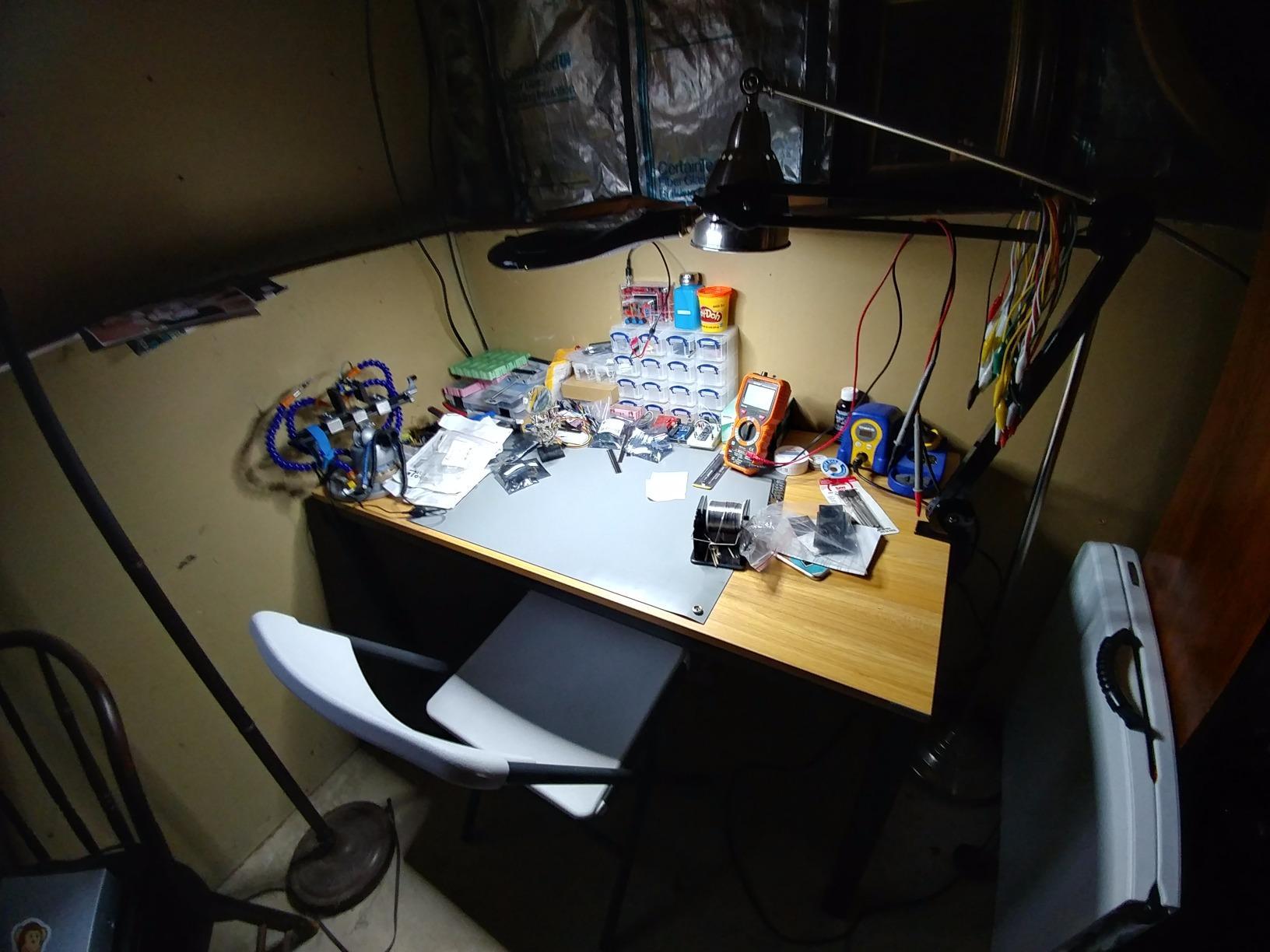
Why we picked it for rework and soldering
Heat tolerance is the single factor that separates a mat you can work on from a mat you work beside. A rubber surface lets you set an iron down mid-repair without planning where the drip lands, and acid resistance keeps flux from quietly degrading the surface.
It is assembled in the USA and the size grid is wide, which matters if your bench is a shared maker space where you might need to match someone else’s setup later.
Where it falls short
It is the most expensive mat in this group, and the price objection is the one that comes up most often in forum threads about proper bench mats. Budget is a real constraint for a lot of hobby benches.
At 0.08 inch it is thinner than the 0.12 inch nitrile option in this roundup, so if you like a cushioned surface under a long session you may prefer the thicker mat.
3. StarTech Anti-Static ESD Mat – the thin one that fits under your desk
- Low 0.1 in profile fits under existing desk equipment
- Static dissipative construction suits sensitive equipment
- Sized to fit a CPU
- monitor and keyboard together
- 2-year warranty
- Wrist strap and grounding cord are sold separately
- Smallest footprint here at 24 in x 27.5 in
- PVC foam is not built for direct soldering iron contact
Most mats on this list are thick by design. This one is 0.1 inch of PVC foam, and that thinness is the entire selling point: you can slide it under a monitor riser, a keyboard tray or a stack of equipment without lifting anything.
It is listed as static dissipative rather than conductive, and is described as meeting IBM and US military static control standards. At 24 in x 27.5 in the footprint is sized to hold a CPU, a display and a keyboard at once, which suits a computer build or a bench inspection station rather than fine solder work.

At 4.6 stars across 2,499 reviews, this is one of the most proven listings in the group, with 75 percent five-star. Buyers consistently mention the desk-friendly profile and the stated compliance, and consistently mention the same problem: the wrist strap and grounding cord are not included.
That last point is worth pausing on. You get a mat. To use it properly you need a strap and a cord with a 1 megohm safety resistor, and this listing does not provide them. Budget for that as a separate purchase.
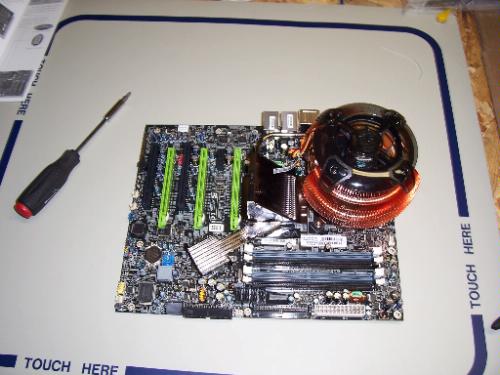
Why we picked it for office and IT benches
Because it solves a spatial problem no other mat here solves. If your bench already has equipment on it and you cannot move it, a thin dissipative layer that slides underneath is a genuinely useful compromise rather than a lesser product.
It pairs with the StarTech SWS100 anti-static wrist strap, so if you already own that system the ecosystem matches, and the 2-year warranty gives some backing.
Where it falls short
It is the smallest footprint in the roundup at 24 in x 27.5 in, so it will not cover a wide electronics bench. And PVC foam is not a soldering surface, so keep it for assembly, storage and inspection work.
Buying the mat alone also means your protection chain is incomplete until you add a cord, which is where many setups quietly fail.
4. MWRF ESD Mat Kit – thick nitrile rubber across a 2 x 4 ft bench
MWRF ESD Mat Kit with Wrist Strap and Grounding Cord (2 FT x 4 FT x 0.12 Inch, Grey) – MWRF Source
- Thick 0.12 in nitrile rubber feels substantial
- 2 x 4 ft footprint covers most of a bench
- Package includes a 10 ft ground cord and wrist strap
- Protects parts from scratches as well as static
- Strong smell on arrival that takes days to air out
- Wrist cord can pull free of the mat when you reach too far
- Smaller review base than the other kits here
This is the coverage pick. At 2 ft x 4 ft and 0.12 inch thick in nitrile rubber, it is the largest and most substantial surface in the group, and it is the one that most resembles a real workstation mat rather than a bench pad.
The listed surface resistivity is 10^9 to 10^10 ohms, and the package contains one mat, one wrist strap and a 10 ft ground cord. That cord length is unusually generous and means you can reach a properly earthed point across a room or around a bench frame.
At 4.6 stars from 119 reviews with 79 percent five-star, owners describe the rubber as heavy duty and report assembling systems with no static events at all. The gripes are consistent: the off-gassing smell on arrival, and the wrist cord disconnecting if you stretch too far across the bench.
Why we picked it for long and multi-station benches
Partial coverage is a common way ESD control fails. If your working area sits partly off the mat, you are placing bare boards on an uncontrolled surface. A 2 x 4 ft mat at 0.12 inch gives you room to spread out a tower build, a laptop chassis or a batch of PCBs without working around the edges.
It is offered in sizes from 18 x 30 inches up to 2.5 x 4 feet, in grey and blue, so the same family covers a small pad if you outgrow this one.
Where it falls short
That rubber smell is the honest downside. Owners report it takes days to air out, and it is the most common early complaint across the rubber mats in this roundup.
At 119 reviews this is the smallest review base here, so treat the rating as less settled than the 2,500-review listings. The cord disconnection when reaching across the bench is a workflow problem, not a fault, but you will notice it.
5. KooMall 36 x 24 inch Rubber Mat Kit – conductive on both sides and heat rated
- Both sides conductive so either face can be used
- Anti-slip dotted texture holds parts and the mat in place
- Rated to 250 C for soldering and rework heat
- Wipes clean with water
- Includes US plug
- cord and wrist strap
- Conductive on both faces so both sides are live surfaces
- Rubber smell on arrival
- Only offered in black
The odd one out in this roundup, and the reason it is worth understanding before you buy. The KooMall mat is listed as conductive on both sides at 10^3 to 10^5 ohms surface resistance, which is below the static dissipative window that most benches are specified to.
That is not automatically wrong. A conductive surface drains charge fast rather than spreading it, and for a work surface with a hard earth connection this can be effective. But it changes the safety argument, because a conductive mat only behaves well when it is properly grounded, and a grounded conductive surface is a live surface.
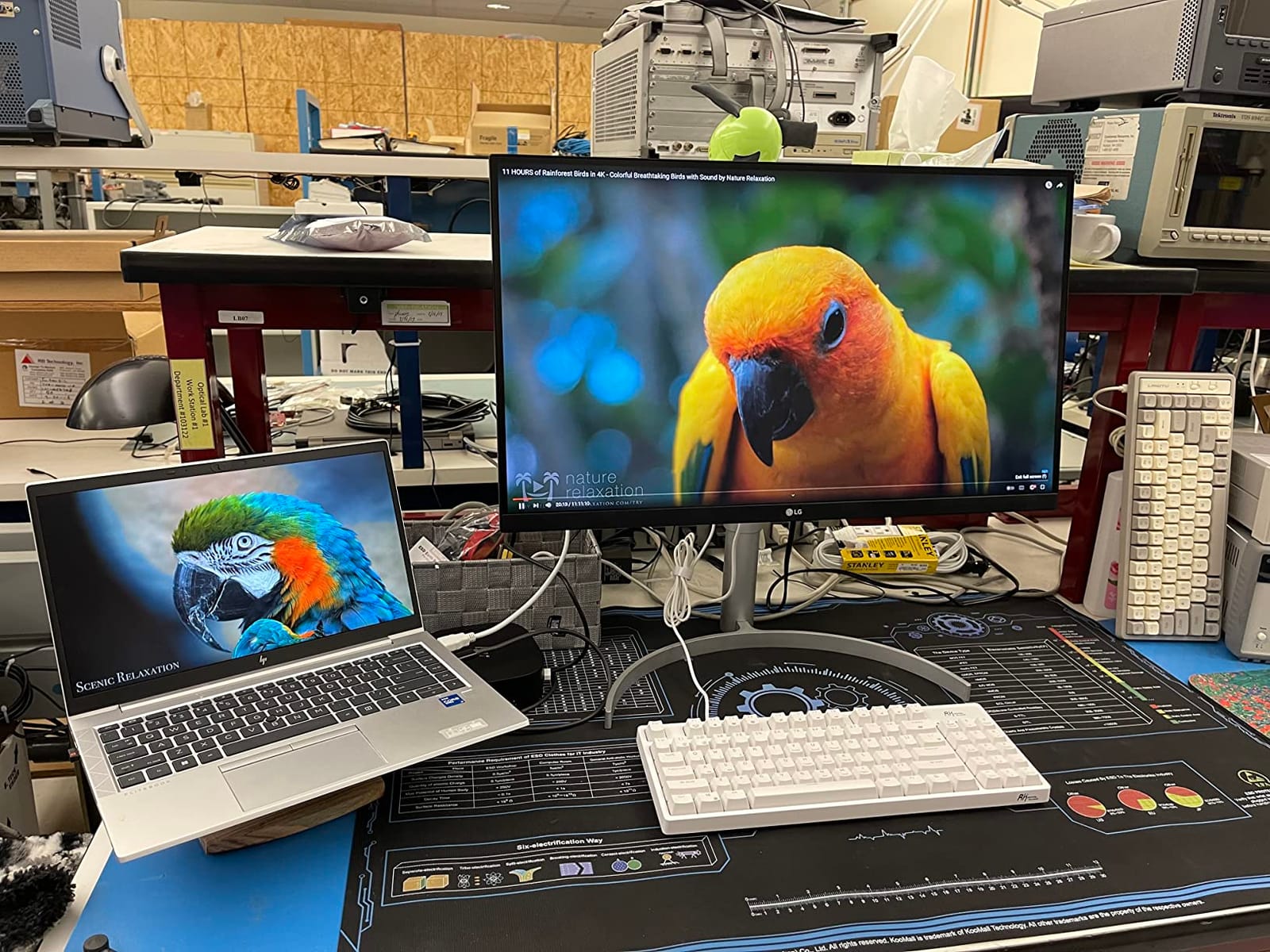
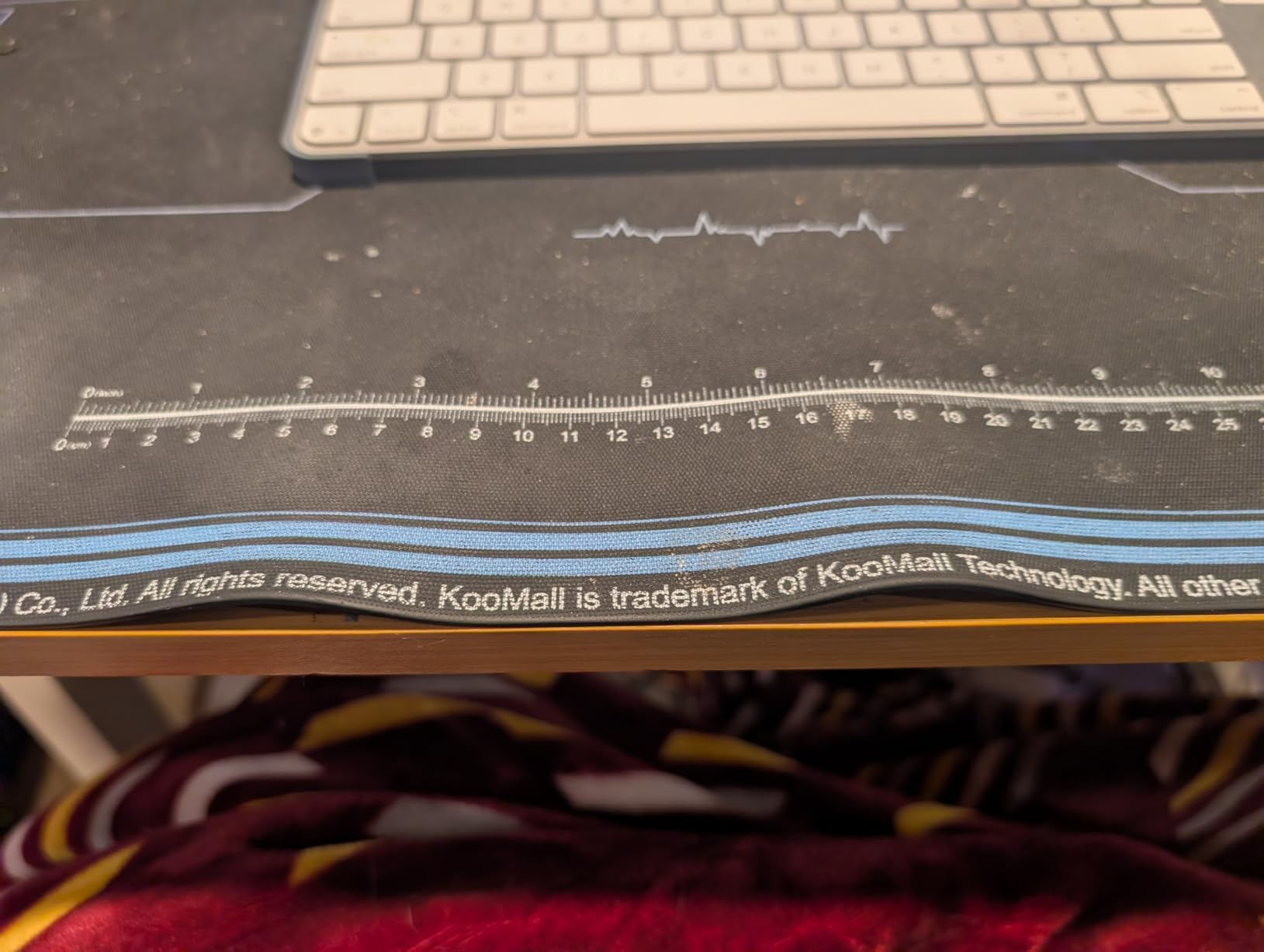
On the plus side, the 250 C temperature rating makes it the most tolerant of a resting iron in this group, and the anti-slip dotted texture on the front stops both the mat and small parts from sliding. Two 10 mm male studs give you grounding options at both ends.
Owners rate it 4.6 stars from 209 reviews with 77 percent five-star, citing the coverage, the printed ESD reference material on the surface, the dual studs and the heat resistance. The package includes a US grounding plug, an ESD wrist strap and a grounding cord with two holes.
Why we picked it for hot rework benches
The 250 C rating is the reason. Nothing else in this roundup combines a genuinely heat-tolerant surface with a conductive build, and the dotted texture is genuinely useful when you are dragging small parts around a board.
It also wipes clean with water, which matters more than it sounds on a bench where flux and hand oils build up over a week of work.
Where it falls short
Conductive on both faces means both faces are live once grounded, so you need to be deliberate about your ground and your hands. If you are not confident wiring an earth point correctly, a dissipative mat is a safer place to start.
It comes only in black, and the rubber smell is present here too on arrival.
6. Bertech ESD Anti-Static Table Mat Kit – the durability pick for assembly work
Bertech ESD Anti-Static Table Mat Kit, 18 in. x 30 in., Blue, Includes an ESD Wrist Strap and ESD Grounding Cord, Made in USA
- Reviewers report years of survival through flux
- alcohol and solder spatter
- Measured surface resistivity matches the advertised range
- Lies flat quickly even after tight rolling in cold conditions
- Ground and wrist strap studs at both ends
- Strap has a locking feature for solid skin contact
- Vinyl is not heat resistant so keep irons off it
- Strong off-gassing smell for about a week
- Premium cost for an 18 in x 30 in footprint
This is the assembly and disassembly mat, and long-term owners are unusually enthusiastic about its staying power. At 0.093 inch thick in a homogeneous polymer mix, reviewers report it surviving years of flux, alcohol and solder spatter, which is the workload that destroys cheaper surfaces.
Listed surface resistivity is 10^9 to 10^10 ohms, and owners who measured report the readings matching the advertised range. It is RoHS compliant and made in the USA, with applications cited across aerospace assembly, contract manufacturing, electronic assembly and semiconductor facilities.
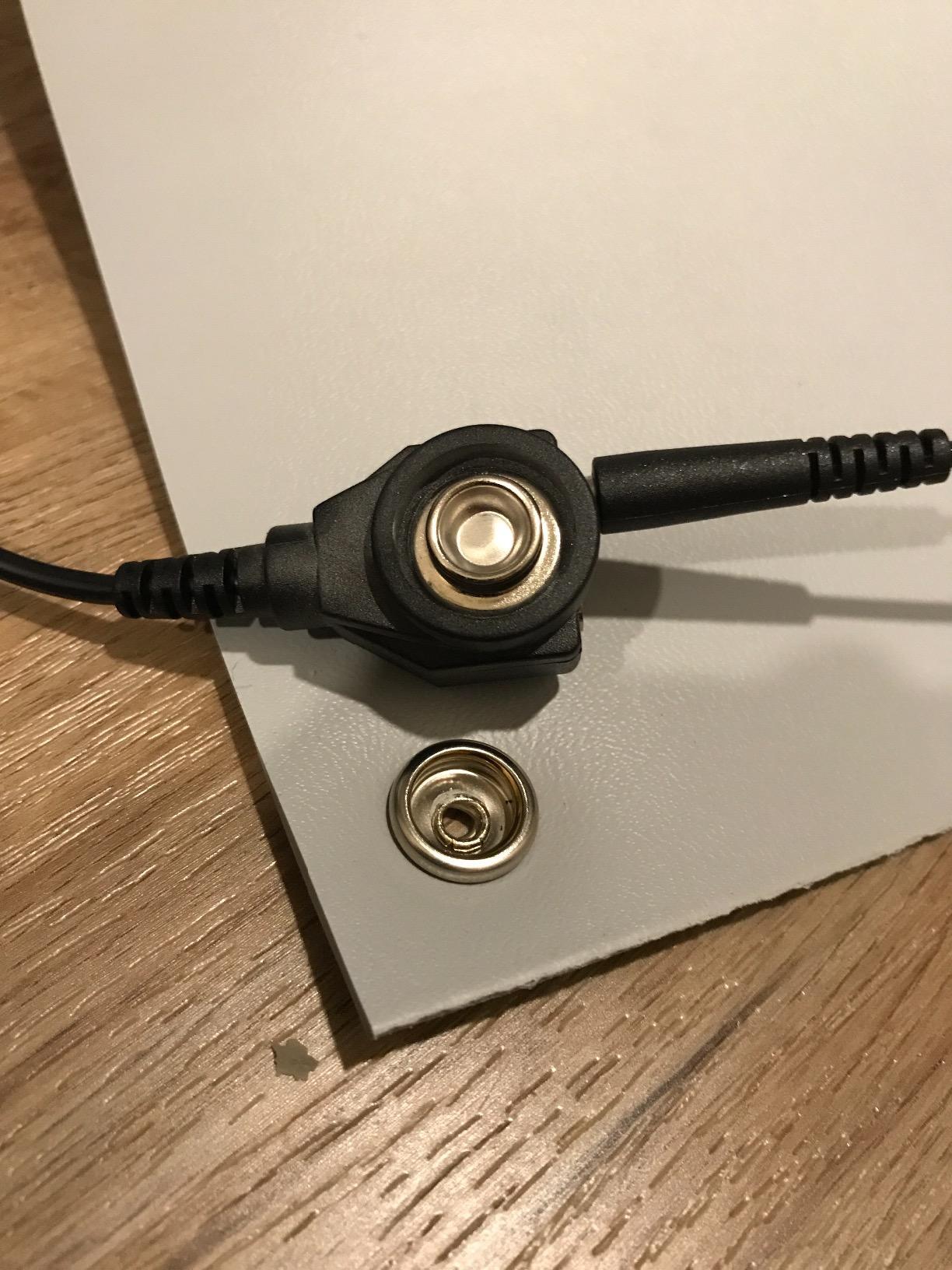
Two details matter more than they look. First, the ground and wrist strap connections are on both ends, so the kit suits either hand at the bench. Second, the material can be cut to a smaller size with a blade, which makes it adaptable when a standard footprint does not match your bench.
At 4.5 stars across 373 reviews with 76 percent five-star, one specific complaint recurs: the included wrist strap uses an alligator clip rather than a matching snap, so it will not connect the way a snap-based cord would.

Why we picked it for long-running assembly benches
Because reported longevity is the feature. If your bench does repetitive assembly and disassembly rather than hot rework, chemical exposure is the wear mechanism that matters, and this mat is the one in the group with owners describing multi-year service.
It lies flat quickly even after being tightly rolled in cold storage, which addresses the curled-edges complaint that rubber mats attract, and the material can be trimmed if you need a non-standard size.
Where it falls short
It is vinyl, so it is not a soldering surface. A dropped iron or a hot braid will melt it, and the melted spot stops dissipating, which is exactly the dead zone you bought a mat to avoid.
Expect a week of off-gassing smell, and note the alligator clip on the bundled strap before you plan your grounding.
7. Kaisi Large Anti Static Mat – soldering pad and screw organiser in one
- Does double duty as an ESD mat and a heat-resistant soldering pad
- 48 built-in screw and parts positions keep small parts organised
- Full grounding kit with plug
- wire and wristband
- Large area for phone
- laptop
- drone and PCB work
- Grounding accessories are hidden in the shipping tube
- 30-day return window only
- Smaller footprint than the 2x3 ft and 2x4 ft options
The Kaisi mat solves a problem the rest of this roundup ignores: where do the screws go? Forty-eight built-in storage positions hold the fasteners from a teardown, which is the single most disruptive part of working on a phone, laptop or drone without losing parts across the bench.
It is silicone rated to 932 F, so a soldering iron or hot air station can rest on it directly. That makes it the rare product in this list that is genuinely both an ESD surface and a soldering surface in one piece.
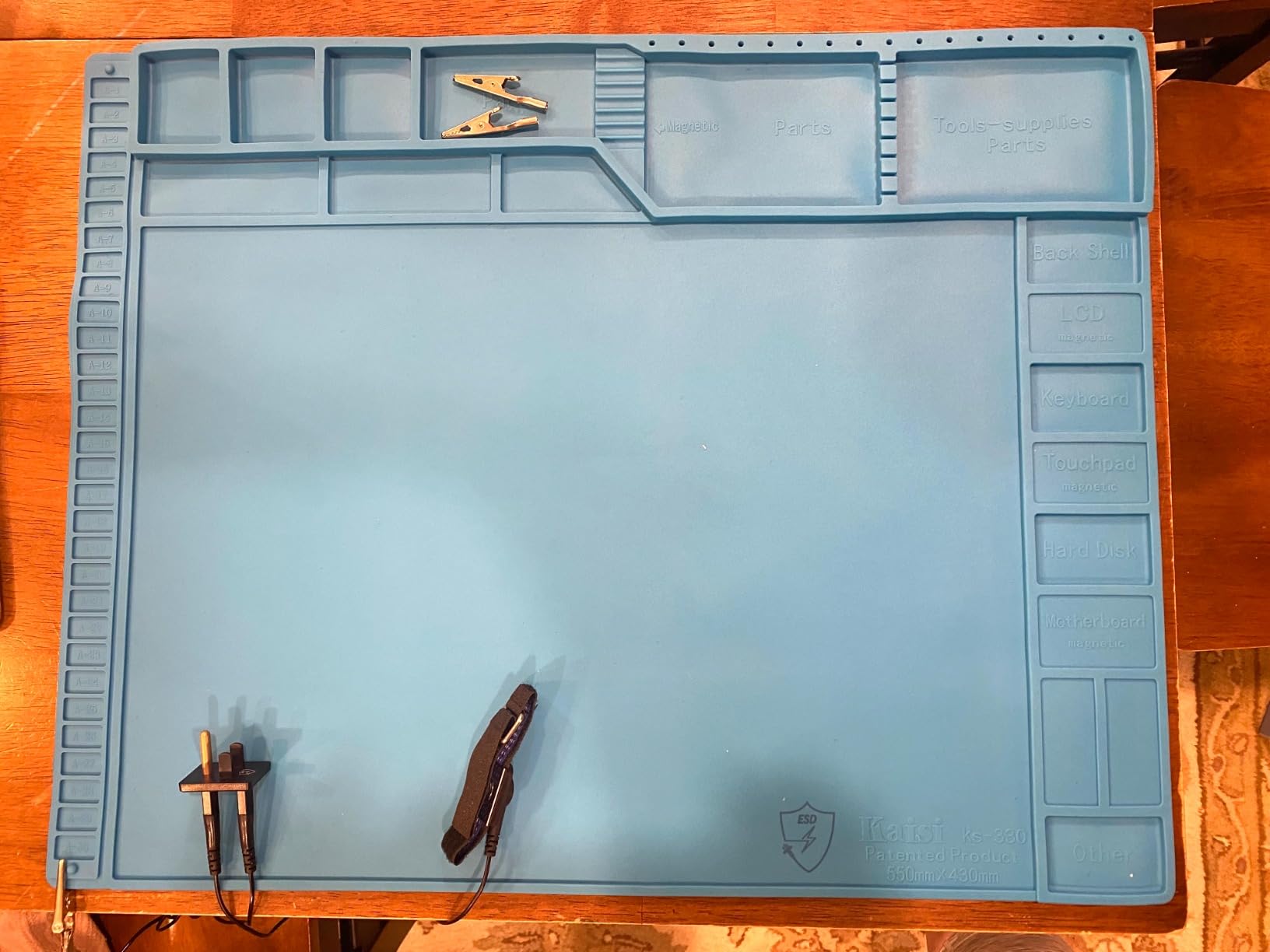
Listed resistivity is 10^6 ohms, and the package includes an anti static grounding line, a grounding plug, a wristband, an instruction sheet and the mat, with the accessories packed inside the cardboard tube. The soft texture is corrosion resistant and will not damage a workbench top.
At 4.4 stars from 113 reviews with 73 percent five-star, buyers praise the dual role and the parts storage. The most common complaint is packaging: the grounding accessories sit inside the shipping tube and are easily missed on unpacking, so people assume the kit is incomplete.
Why we picked it as the budget-friendly soldering mat
Because it removes a whole category of expense. If you were going to buy an ESD mat and a separate silicone soldering pad, this is one item doing both jobs, and the 48 wells are the sort of detail that only matters once you start a teardown.
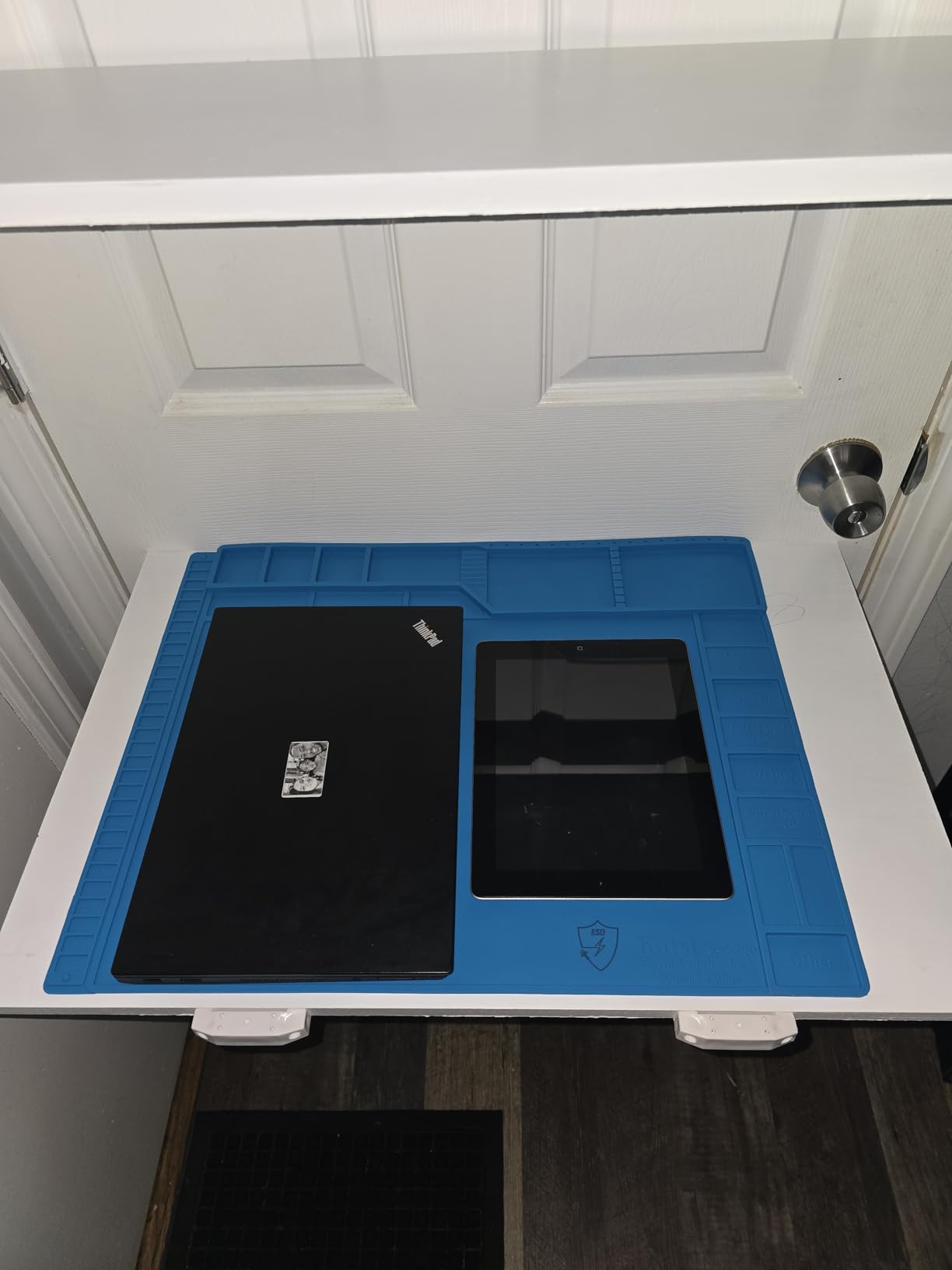
At 21.6 x 16.9 inches it handles a laptop, MacBook, iPad, phone, drone, PCB or Raspberry Pi job comfortably, and the soft, corrosion-resistant surface suits a rented or shared bench.
Where it falls short
The 30-day return window is short, so inspect it carefully on arrival. And the hidden accessories in the tube are a genuine usability problem, because a grounding kit you never find is the same as no grounding kit.
It is also the smallest mat here, so it will not cover a wide assembly station.
8. LUTICO Anti Static ESD Mat 24 x 36 inch – the most complete grounding bundle
Anti Static ESD Mat for Electronics Repair, 24″X36″, Grounding Kit
- Two-layer composite with a dissipative top and conductive base
- Bundled wrist strap
- coil cord and common-point ground cord with ring terminal
- 24 x 36 in gives room for a full repair job
- Offered in six sizes
- Lowest average rating here at 4.2 stars with 9 percent one-star reviews
- 82 C rating means no direct soldering iron contact
- Outlet ground adapter is not included
- Listed dimensions differ between product and spec sections
What LUTICO does better than anything else in this roundup is documentation of the grounding chain. The kit includes a wrist strap, a coil cord, and a common-point ground cord with a ring terminal, which is the most complete hardware bundle here and the closest thing to a ready-made EPA on your bench.
The mat itself is a multi-layer composite: a blue dissipative top layer that spreads charge, over a black conductive base layer that drains it. Surface resistivity is listed at 10^6 to 10^8 ohms with volume resistivity of 10^5 to 10^8 ohms, and the construction is offered in 17×25, 24×24, 24×28, 24×36, 24×48 and 24×78 inch sizes.
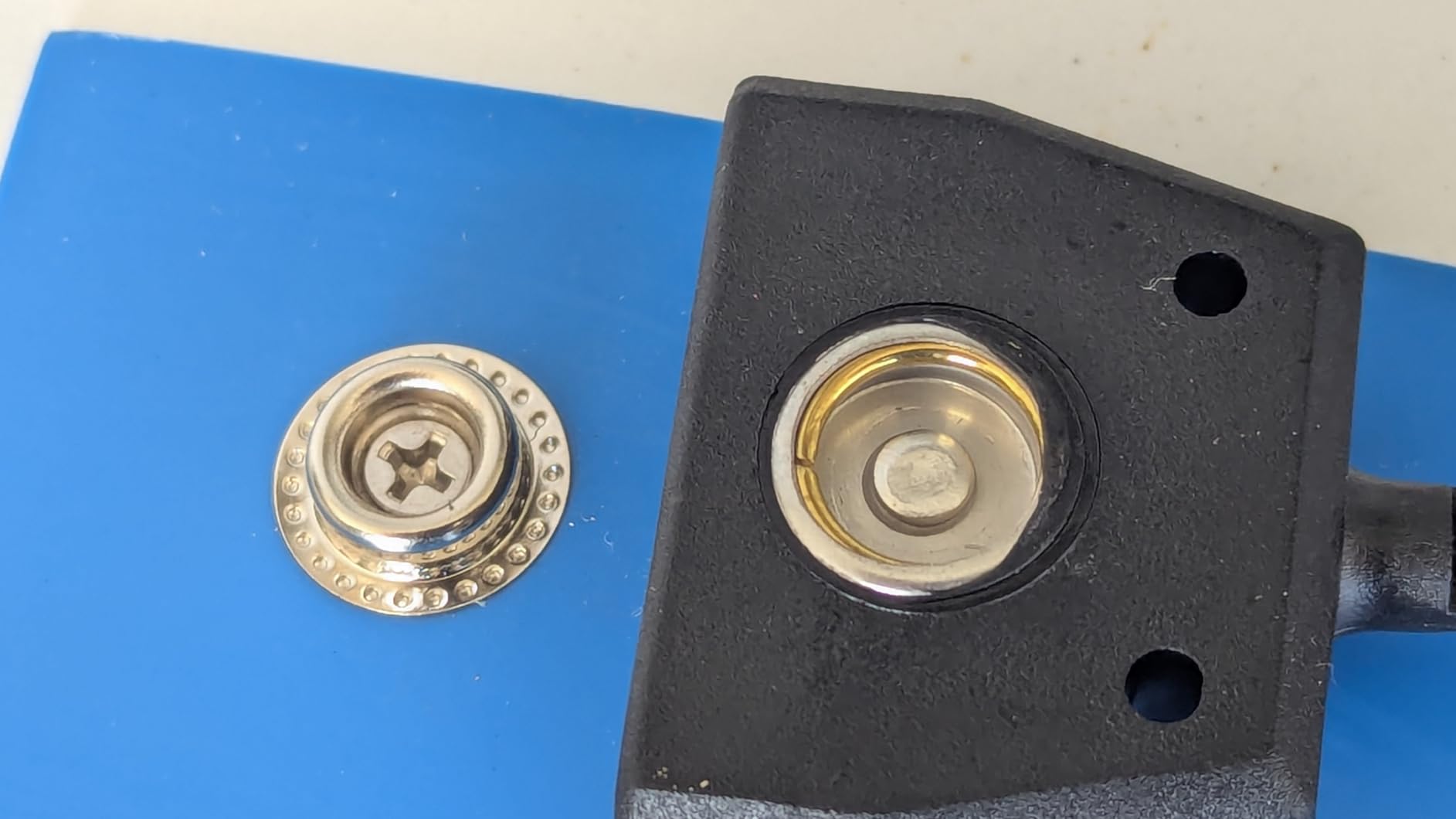
It is also the product to be most careful with. At 4.2 stars from 193 reviews it has the lowest average here, and 9 percent of reviews are one-star. Buyers who set it up correctly find the dual-layer build works for general electronics repair. The critical feedback clusters on two things: missing grounding accessories, and the mat not being a soldering surface.
Those complaints are partly addressed by the spec itself. The bundle does include strap, coil cord and common-point cord, but the outlet ground adapter is not included, so you still need the earth connection hardware. The upper temperature rating of 82 C confirms this is an assembly and repair surface, not a place to rest an iron.
Why we picked it for repair work that needs a full grounding chain
Because the common-point ground cord with a ring terminal is exactly the piece most buyers end up sourcing separately. If you have never wired an earth point before, having the whole chain in one box with a ring lug to attach is a real advantage.
The 24 x 36 inch surface gives room to spread a full repair job, and the six size options mean the same family covers a small pad or a long bench.
Where it falls short
The rating is the honest headline: 4.2 stars with a 9 percent one-star share is the weakest showing in this roundup, and you should read the critical reviews before you buy. The inconsistent listed dimensions add to that uncertainty.
At 82 C it will not take a soldering iron, so it pairs with a separate heat-resistant pad if you do rework.
What Is an ESD Mat and Does It Actually Work?
An ESD mat is a static dissipative worksurface mat whose top layer measures between 1 x 10^6 and 1 x 10^9 ohms per square, bonded to a conductive bottom layer, that bleeds electrostatic charge to ground through a grounding snap, a 1 megohm cord and a common point ground.
That definition answers the two most-asked questions in one line. The word dissipative is the important part: the surface is neither an insulator nor a conductor, it is a controlled middle ground that lets charge leave slowly enough to avoid a spark and fast enough to be gone before it can find a gate oxide.
When a charged board touches the mat, the dissipative top layer spreads the charge rather than receiving it in one spot, and the conductive bottom layer carries it to the grounding snap. From there it runs through the cord to your common point ground and out to earth.
Do ESD mats work? Yes, as part of a system. A mat on its own is inert, which is the point that comes up repeatedly on the DigiKey forum: a static-control grounding mat is only effective when properly connected to ground. Mat plus strap plus earth is the actual product.
Why bother, if the parts mostly work? Because ESD damage is usually latent. A weakened gate oxide or a cracked junction passes every test on your bench and fails in the field weeks or months later, so a mat is cheap insurance against yield loss you cannot see.
ESD Mat vs Anti-Static Mat vs Grounding Mat vs Floor Mat
These four terms get used interchangeably in listings, and they describe different things. If you are choosing between them, the differences matter for safety as much as for performance.
An anti-static mat is a loose marketing term for anything that reduces static. A grounding mat is a general term for any mat that connects to earth. An ESD mat is a specific, measurable category with a defined resistance window and a defined layer construction. An ESD floor mat is a different product entirely.
The one safety warning that belongs in this section is blunt: never put a carbon-loaded ESD floor mat on a bench. Floor mats are designed to be very conductive so that ESD footwear can drain charge through a person standing on them. On a bench, that same conductivity can present a shock hazard. Floor mats also skip the 1 megohm safety resistor that a bench mat must have.
For context on bench setup, our guide to hobby benches for electronics work covers the furniture side, and the mat is only half the answer.
How to Ground an ESD Mat Properly
Grounding takes four steps, and skipping any one of them leaves you with an expensive sheet of rubber. The chain is snap, then 1 megohm cord, then common point ground, then earth.
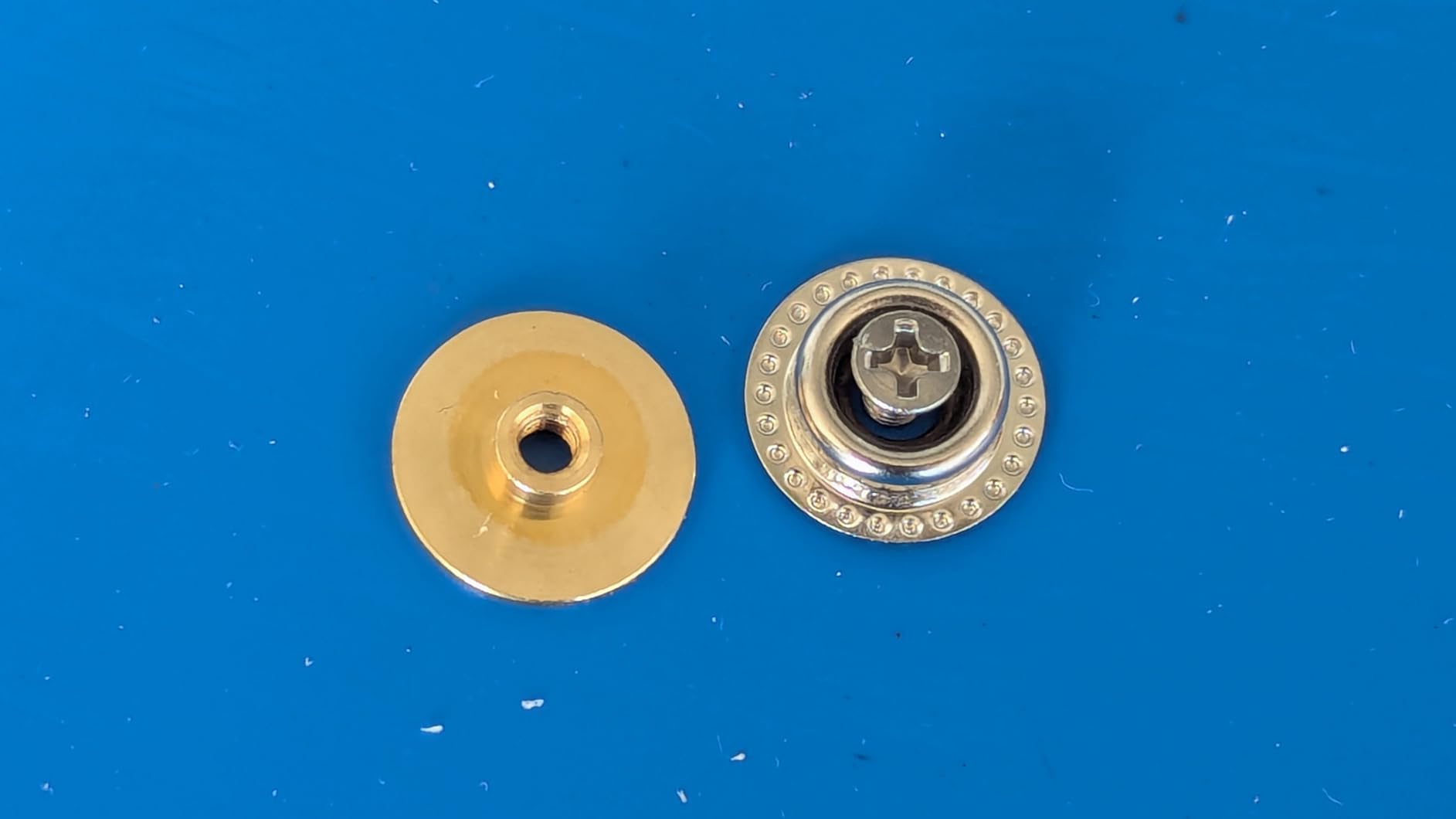
Step one, confirm your mat has a grounding point. Snaps come in 4 mm, 7 mm and 10 mm, and they are not interchangeable. The iFixit kit uses a 10 mm snap, the KooMall kit has two 10 mm male studs, and the StarTech mat requires accessories bought separately. Check the diameter before you buy a cord.
Step two, run a cord with a 1 megohm safety resistor from the mat snap to your ground point. This resistor is not optional. Its job is to limit current through your body in case of a fault, and cheap straps that omit it are a shock hazard rather than a safety device.
Step three, terminate the cord at a common point ground, which is a single designated grounding point for the whole area. If you have several mats, a strap and a test station, they all meet at that one point rather than each finding their own ground.
Step four, connect the common point ground to earth. The ring lug on the cord commonly fastens to the centre cover screw of a mains outlet, which is earthed through the metal box. Many hobbyists find this step confusing, and some outlets are not properly earthed, so confirm your circuit has an earth before you rely on it.
Two warnings. Never connect to a gas pipe, a radiator or a neutral wire, and never daisy-chain mats together, because each additional mat in the chain pushes the total resistance outside the specified window. Each mat gets its own cord to the common point.
Once the ground is sorted, our picks for digital multimeters for electronics work and bench power supplies make more sense on a bench you can verify.
How to Test Your ESD Mat Yourself
You do not need a laboratory to sanity-check a mat, but a real verification uses a megohmmeter, also called a surface resistance meter. The protocol below is the standard five-step approach used for worksurface verification under the ESD S4.1 worksurface mat standard.
Step one, place two 5 lb cylindrical electrodes on the mat surface with their centres about 10 inches apart. Weight matters because a soft surface reads differently under pressure.
Step two, connect the megohmmeter and apply a 100 V test voltage. This is deliberately a high voltage, because a mat can behave correctly at low voltage and fail to bleed a triboelectric charge.
Step three, read and record the surface resistance in ohms per square. For a static dissipative mat you want a reading inside 10^6 to 10^9. Below 10^6 means the surface is closer to conductive than dissipative. Above 10^9 means it is behaving as an insulator and is too slow to bleed charge.
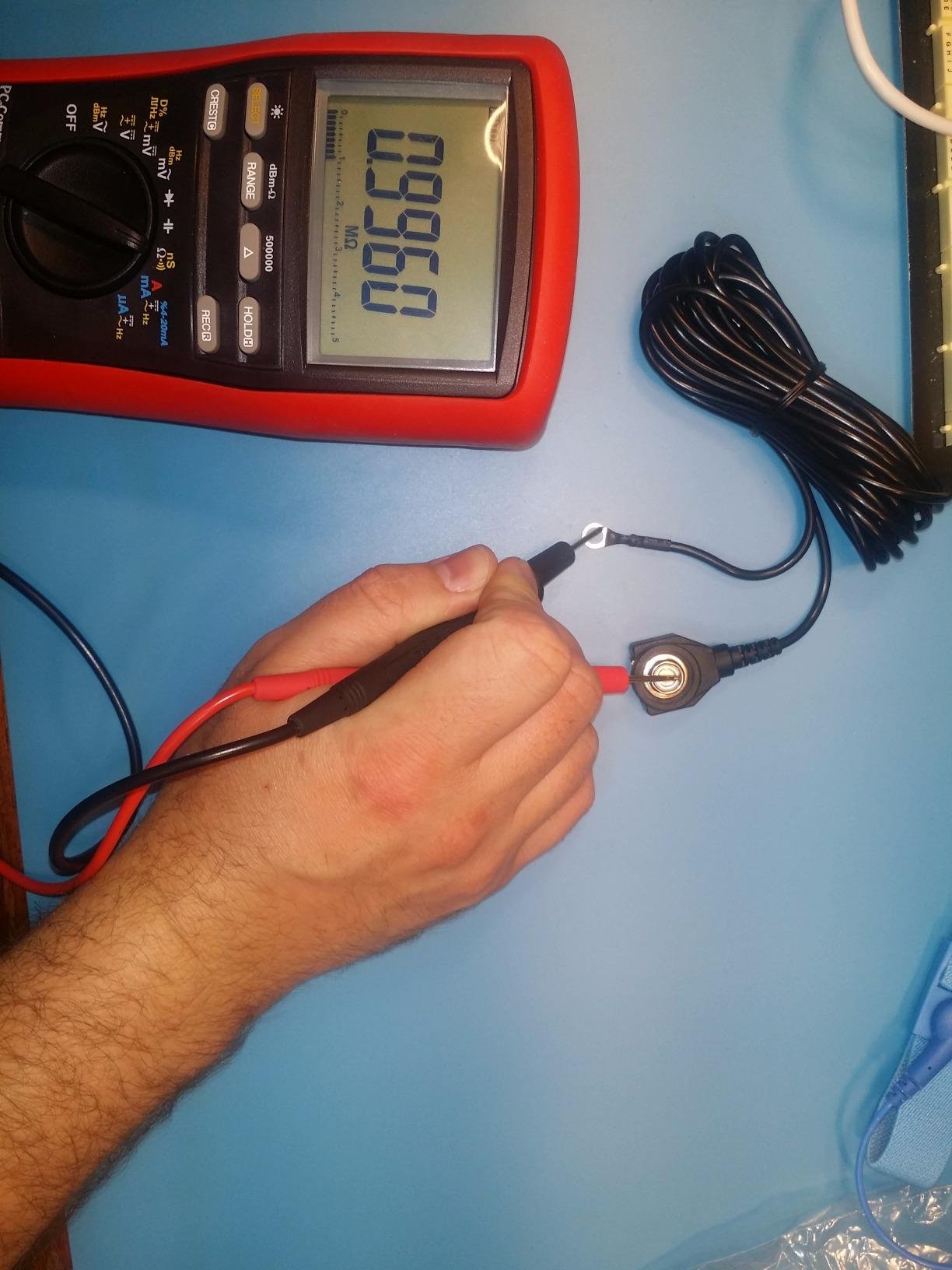
Step four, measure the resistance from the mat to your groundable point, known as RTG, and the resistance point to point across the mat, known as RTT. Under ESD S4.1 both of these readings are part of the acceptance criteria, not just the surface number.
Step five, log the reading and set a retest baseline. Record the humidity at test time as well, because resistance readings shift with ambient humidity and a comparison taken on a dry winter day against a humid summer reading is not a fair test.
Without a megohmmeter, an ordinary multimeter can at least rule out a dead insulator. Touch the probes to two points on the mat and confirm you get a reading rather than an open circuit. That is a sanity check, not a compliance test, and it will not catch a mat that reads well but sits outside the 10^6 to 10^9 window.
For soldering benches, test monthly. For assembly and inspection areas, quarterly is usually enough. If you use silicone spray or an ordinary household cleaner, retest immediately, because those products leave an insulative film that silently kills performance.
How to Choose the Right ESD Mat: Buying Guide
Start with the work, not the spec sheet. If the bench is soldering and rework, material and heat rating decide the choice. If it is assembly and inspection, durability and chemical resistance do. If the bench already has equipment on it, thickness decides. If you work away from a fixed bench, portability decides.
For material, rubber wins on heat and chemical resistance and loses on weight and initial odour. Vinyl is easier to cut and lies flat sooner, but it melts under heat and leaves a dead insulative spot once damaged. Silicone handles soldering heat but needs a published resistance figure to be trusted as an ESD product, and forum reports of unverified silicone mats failing megohmmeter testing are widespread.
That last point is the real buying lesson. A mat with no published surface resistance is not cheaper, it is unmeasured. Long-running EEVblog threads titled around the danger of cheap ESD mats make exactly this argument, and the failure mode is expensive because the damage is latent.
On grounding hardware, treat the bundle as the product. Kits that include a strap, a cord with a 1 megohm resistor and, ideally, a common-point ground cord save you from a mismatch. If the strap and cord are sold separately, add that to your decision before you order, and match the snap diameter, which comes in 4 mm, 7 mm and 10 mm.
On size, aim to cover the whole area where bare boards and loose parts sit, not just the spot where the iron rests. Partial coverage is one of the most common ways an ESD setup quietly fails, because parts migrate to the uncovered zone under no particular pressure.
On colour, blue and green dominate because the pigments used to reach the resistance window are dark, and a high-contrast pale surface makes SMD parts and tiny screws far easier to see and to pick up. Matte finishes reduce glare under magnifiers and task lamps.
Finally, for hands-on work, good ESD safe tweezers for electronics matter as much as the mat, since the mat protects the board and the tweezers protect the part.
Cleaning, Maintenance and Retesting Schedule
Cleaning is where good mats quietly fail. Use only silicone-free, ESD-safe cleaner, and dilute it per the instructions. Silicone spray and general-purpose household sprays leave an insulative film on the surface that pushes resistance out of spec without any visible change to the mat.
Wipe rather than soak where you can, keep flux residue off the surface during the week rather than letting it build, and let a rubber mat air out for a few days after delivery before working on it directly. The odour is off-gassing, not a fault.
Set your schedule around the work. Soldering benches with flux and heat see the most wear, so test monthly. Assembly and inspection areas can go quarterly. Any time you change cleaning products, retest rather than assume.
Rubber mats arrive rolled and their edges can curl for a few days. Lay it flat under something heavy for a day before you work, and keep parts from rolling off an uneven surface. How long a rubber mat lasts depends far more on your chemistry and handling than on the calendar, and the mats in this group with the most owner-reported longevity are the thick ones that were cleaned properly rather than wiped with whatever was on the bench.
Frequently Asked Questions
Which ESD mat is the best?
For most electronics benches the iFixit Portable Anti-Static Mat is the best starting point, because it bundles a 60 cm x 60 cm mat with a 1.8 m adjustable wrist strap and a 1.8 m grounding cord, and publishes a 10^7 to 10^9 ohm surface resistivity with a 10 mm snap already fitted. For hot soldering and rework, the Bertech High Temperature Rubber Mat Kit is the better pick because rubber tolerates a resting iron. For full-bench coverage, the MWRF 2 x 4 ft nitrile mat gives you the largest working area here.
Do ESD mats work?
Yes, but only as part of a system. A mat is a static dissipative surface that spreads charge and passes it to a conductive bottom layer, and that charge only leaves the bench through a grounding snap, a cord with a 1 megohm safety resistor, a common point ground and a real earth connection. A mat sitting ungrounded on a bench is inert. The damage it prevents is also usually latent, so weakened parts pass on your bench and fail in the field later.
What is the difference between an anti static mat and an ESD mat?
Anti-static is a loose marketing term for anything that reduces static. An ESD mat is a measured category: a static dissipative top layer measuring between 1 x 10^6 and 1 x 10^9 ohms per square, bonded to a conductive bottom layer, with a defined grounding point. A mat with no published surface resistance figure is unmeasured rather than cheap, and that is the distinction that matters when you are choosing between listings.
Is an ESD mat the same as a grounding mat?
A grounding mat is a general term for any mat connected to earth. An ESD mat is more specific: it must fall inside the static dissipative resistance window and include a 1 megohm safety resistor in its cord. A hard-grounded or carbon-loaded mat can satisfy the grounding description while failing the ESD specification, which is why floor mats must never be used on a bench. There is a shock hazard in putting a very conductive surface on a work surface.
Does an ESD mat need to be grounded?
Yes. Without a connection to earth the mat cannot dissipate anything, because the surface resistance only controls how charge leaves the mat, not whether it goes anywhere. Ground it through the snap on the mat, then a cord containing a 1 megohm safety resistor, then to a common point ground, and finally to earth. Snap sizes of 4 mm, 7 mm and 10 mm exist and are not interchangeable, so check the diameter matches before you buy a cord.
What type of ESD mat should I buy?
Match the mat to the work. Soldering and rework need a high-temperature rubber or silicone surface, because vinyl melts and leaves a dead insulative spot. Assembly and inspection need a thick chemical-resistant mat that tolerates flux and alcohol. A desk already covered in equipment needs a thin 0.1 in profile mat that slides underneath. Field repair needs a foldable kit with the strap and cord included. Avoid any mat with no published surface resistance, whatever the material.
Can I use an anti static floor mat on a workbench?
No. Floor mats are deliberately more conductive so that ESD footwear drains charge through a person standing on them. On a bench that conductivity removes the current-limiting safety resistor and creates a shock hazard, and a floor mat will not meet the worksurface specification. Keep floor mats in the floor zone of your ESD protected area and use a proper dissipative bench mat on the table.
Is a silicone soldering mat the same as an ESD mat?
Not automatically. A silicone soldering pad handles heat well but only counts as an ESD mat if it publishes a surface resistance inside 1 x 10^6 to 1 x 10^9 ohms per square. Forum testing of several unverified silicone pads with a surface resistance meter found none of them acceptable. Some products do both jobs properly, so check the published figure rather than judging by the word silicone on the box.
The Bottom Line: Which ESD Mat Should You Buy?
Buy the iFixit Portable Anti-Static Mat if you want a working static-safe area today without hunting for compatible parts. It carries a published 10^7 to 10^9 ohm surface resistivity, a 10 mm snap, an adjustable wrist strap and a grounding cord, and it folds flat when you need it away from the bench.
Buy the Bertech High Temperature Rubber Mat Kit if your work involves resting a soldering iron on the surface, and the StarTech Anti-Static ESD Mat if your bench is already full of equipment and you need a thin profile that slides underneath it. For the largest single working area, the MWRF 2 x 4 ft nitrile mat is hard to beat.
Whatever you choose for the best esd mats for electronics benches, finish the system on the same day. Install the snap, run a cord with a 1 megohm safety resistor, terminate at a common point ground, and confirm your earth connection. Then log a baseline reading and set a monthly or quarterly retest, because an ESD mat that is never verified is just a rubber sheet.