
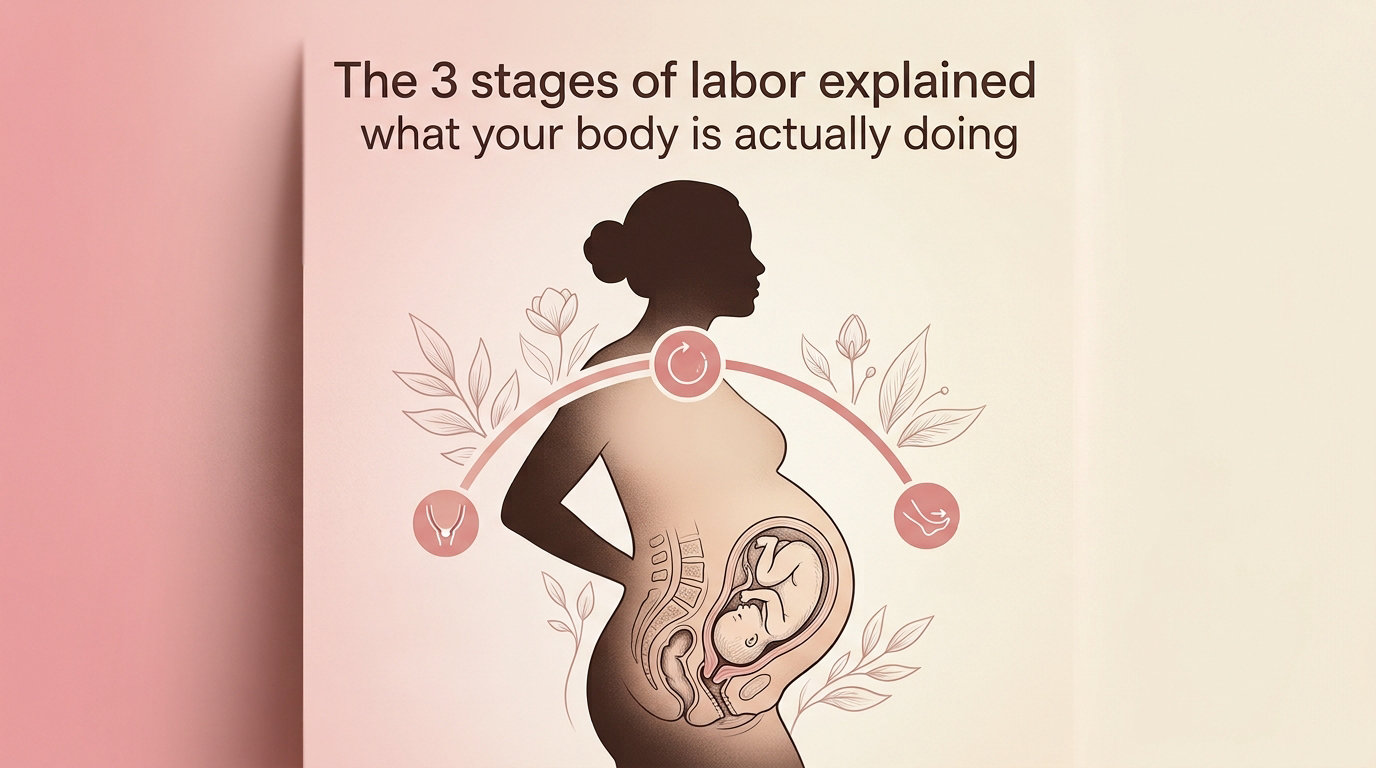
Understanding the 3 stages of labor transforms anxiety into confidence as you approach childbirth. Your body performs an intricate biological dance during labor—coordinating hormones, muscles, and physical changes to bring your baby into the world. Knowing what your body is actually doing at each stage helps you recognize normal progress, make informed decisions, and feel more connected to the miraculous process unfolding within you.
Labor occurs in three distinct stages, each with a specific physiological purpose. The first stage involves cervical dilation and effacement through increasingly strong uterine contractions. The second stage begins when you’re fully dilated and ends with your baby’s birth. The third stage completes the process with delivery of the placenta. While every labor journey is unique, understanding these universal stages gives you a roadmap for what lies ahead.
In this guide, we’ll explore not just what happens during each stage, but what your body is actually doing at the cellular and hormonal level. We’ll include duration estimates, signs to watch for, and practical guidance based on real experiences from mothers who’ve walked this path before you.
Table of Contents
Stage 1: Labor – Opening and Thinning
The first stage of labor is typically the longest, encompassing all the work your body does to prepare the birth canal for your baby’s arrival. During this stage, your cervix undergoes two critical changes: effacement (thinning and shortening) and dilation (opening). These changes happen through three distinct phases—early labor, active labor, and transitional labor—each with different characteristics, duration, and physical sensations.
Your uterus is a remarkable muscle composed of smooth muscle fibers arranged in complex layers. During Stage 1, these muscle cells coordinate in waves that start at the top of your uterus (the fundus) and sweep downward toward your cervix. Each contraction pulls the cervix open while simultaneously pushing your baby downward. This dual action is what your body is actually doing throughout this entire stage.
Early Labor (Latent Phase): The Quiet Beginning
Early labor, also called the latent phase, marks the gentle beginning of your childbirth journey. Your cervix dilates from 0 to 3 centimeters during this phase. Contractions are typically mild, lasting 30-45 seconds and occurring every 5-30 minutes. You might experience some discomfort, but many women continue normal activities during this time.
What your body is actually doing during early labor involves a fascinating biochemical process. Your body releases prostaglandins—hormone-like substances that soften and thin your cervix. These prostaglandins break down the collagen fibers in your cervical tissue, transforming it from a firm, closed barrier into a soft, yielding gateway. Meanwhile, oxytocin levels begin rising, triggering those first rhythmic uterine contractions.
You may notice several signs that early labor has begun. Your mucus plug—a protective barrier in your cervix—may dislodge, appearing as thick, jelly-like discharge that might be clear, pink, or slightly bloody (this is called the “bloody show”). Some women experience their water breaking, though this happens before labor in only about 15% of cases. Others notice mild cramping, backache, or an upset stomach as your body clears itself in preparation for birth.
Duration varies significantly during early labor. First-time mothers typically experience 8-12 hours in this phase, though it can extend to 20 hours or more. If you’ve given birth before, early labor often moves faster—sometimes lasting just 3-5 hours. The wide range reflects individual differences in anatomy, baby position, and how your body responds to hormonal signals.
During this phase, rest is your priority. Many women find that early labor contractions start at night, allowing you to sleep through the initial hours. Eat light, easily digestible foods to maintain your energy. Stay hydrated with water or clear liquids. Taking a warm bath or shower can help you relax and conserve strength for the more intense phases ahead. This is also an excellent time to time your contractions and prepare mentally for the journey ahead.
Active Labor: The Work Intensifies
Active labor represents a significant shift in intensity and progress. Your cervix dilates from 3 to 7 centimeters during this phase. Contractions become stronger, lasting 45-60 seconds and occurring every 3-5 minutes. You’ll need to actively focus through each contraction, using breathing techniques and position changes to manage the intensity.
What your body is actually doing during active labor involves an exponential increase in oxytocin production. This hormone creates a positive feedback loop—as contractions strengthen, more oxytocin releases, causing even stronger contractions. Your uterine muscle cells work in remarkable coordination, with action potentials sweeping across the myometrium (the muscular layer of your uterus) in precisely timed waves. Each wave pulls your cervix further open while simultaneously nudging your baby deeper into your pelvis.
During active labor, your body also releases increasing amounts of endorphins—your natural pain-relieving hormones. These chemicals help you enter a trance-like state many women describe as “labor land.” You might become less aware of your surroundings and more focused inward. This physiological response helps you cope with intensifying sensations while conserving energy.
Your baby plays an active role during this phase too. As your pelvis opens, your baby descends into the birth canal, tucking their chin to their chest and rotating to navigate through your pelvis. This fetal descent creates additional pressure sensations—many women report increased back pain or pelvic pressure as their baby’s head presses against the sacrum and pelvic floor.
Active labor typically lasts 3-5 hours for first-time mothers and 2-3 hours for subsequent births. This is when most women head to their birth location. The 5-1-1 rule offers helpful guidance: when contractions are 5 minutes apart, lasting 1 minute, and this pattern has continued for 1 hour, it’s time to go to the hospital or birthing center. However, trust your instincts—if you feel strongly that you need to go earlier, listen to your body.
Pain management becomes a focus during active labor. Movement helps—walking, swaying on a birth ball, or changing positions regularly. Warm compresses on your lower back can relieve pressure. Hydrotherapy in a shower or tub provides significant relief for many women. If you’re planning medication, this is typically when epidural anesthesia is administered, as it requires you to remain relatively still during placement.
Transitional Labor: The Final Push Before Pushing
Transitional labor represents the most intense but shortest phase of Stage 1. Your cervix completes its dilation journey from 7 to 10 centimeters (fully dilated). Contractions reach peak intensity, lasting 60-90 seconds and occurring every 2-3 minutes with minimal rest between them. This phase demands everything you have—but it also means you’re almost ready to begin pushing.
What your body is actually doing during transition involves maximum hormonal output and muscular coordination. Oxytocin levels surge to their highest point during labor. Your uterine contractions generate tremendous force—each wave pulls your cervix the final distance to complete dilation. Simultaneously, your baby’s head presses firmly against pelvic structures, triggering intense pressure sensations and the beginning of the fetal ejection reflex.
Many women experience characteristic signs during transition that signal full dilation is approaching. You might feel shaky or trembling as adrenaline joins the hormonal mix. Some women feel nauseous or even vomit—a sign that your body is transitioning to the pushing phase. A strong urge to push often begins during late transition, though your care provider will want to confirm you’re fully dilated before actively bearing down.
Despite being the most challenging phase, transition is typically brief—lasting 15 minutes to 1 hour for most women. First-time mothers often need the full hour, while experienced mothers might transition in 15-30 minutes. The intensity can feel overwhelming, but remembering that this phase is short and signifies imminent progress helps many women push through.
Support becomes crucial during transition. You may feel irritable or request things you immediately reject—this is normal and temporary. Let your support person know you need their presence, even if you can’t communicate clearly. Simple, continuous support—eye contact, hand-squeezing, verbal encouragement—provides grounding during this intense phase. Focus on one contraction at a time, knowing that each brings you closer to meeting your baby.
Stage 2: Pushing and Birth – Meeting Your Baby
Stage 2 begins when your cervix reaches 10 centimeters dilation and ends with your baby’s birth. This stage represents the culmination of all your body’s preparation—your baby descends through the birth canal and emerges into the world. For many women, Stage 2 brings a sense of relief despite intense physical effort, as you finally have an active role to play in moving your baby outward.
What your body is actually doing during Stage 2 involves coordinated efforts between your uterus and your voluntary muscles. Your uterus continues its powerful contractions, but now you add conscious pushing efforts using your abdominal muscles, diaphragm, and pelvic floor. This dual propulsion system—involuntary uterine contractions plus voluntary bearing down—creates the force necessary to move your baby through the birth canal and out into the world.
The Urge to Push: Your Body Takes Over
The urge to push is one of labor’s most powerful sensations. As your baby’s head presses against pelvic floor muscles and the perineum, it triggers the Ferguson reflex—an involuntary response that creates an overwhelming, often uncontrollable urge to bear down. This reflex demonstrates how your body instinctively knows what to do during birth, often overriding conscious thought.
When you push effectively, you engage multiple muscle groups in coordinated action. You take a deep breath and hold it (closed glottis pushing), simultaneously tightening your abdominal muscles while relaxing your pelvic floor. This creates a pressure wave that moves downward, adding to the force of your uterine contraction. Many women describe the sensation as similar to the most intense bowel movement of their life—but with an undeniable momentum that feels unstoppable.
Some women experience “laboring down”—a period after full dilation where they rest and allow the baby to descend naturally without active pushing. This approach conserves energy and takes advantage of the body’s natural expulsive forces. Whether you push immediately or labor down depends on your body’s signals, your care provider’s guidance, and any medical considerations.
Positioning and Progress: Working With Gravity
Your position during pushing significantly affects progress and comfort. Upright positions—squatting, kneeling, or using a birth stool—work with gravity and can widen your pelvic outlet by 10-15%. These positions also align your body naturally, following the curves of your birth canal. Side-lying positions offer rest between pushes while still maintaining some gravitational advantage.
What your body is actually doing during fetal descent involves remarkable biomechanics. Your baby performs the “cardinal movements”—a sequence of position changes that navigate through your pelvis. They flex their chin to their chest, rotate to align with your pelvic dimensions, extend their head under the pubic bone, and finally externally rotate (turn) to allow shoulders to emerge one at a time. These movements happen partly through uterine force and partly through your baby’s own reflexes.
Many women experience back labor during Stage 2—intense pain in their lower back caused by their baby’s occiput (back of head) pressing against the sacrum. If this happens, positions that rotate your baby forward (hands and knees, lunging) often provide relief. Counter-pressure from a support person pressing firmly on your sacrum can also help manage this sensation.
Crowning and Birth: The Moment of Arrival
Crowning occurs when your baby’s head remains visible at your vaginal opening between contractions rather than slipping back inside. This signals that birth is imminent—usually just minutes away. During crowning, you’ll likely feel intense stretching and burning sensations as your perineum (the tissue between your vagina and anus) expands to accommodate your baby’s head.
What your body is actually doing during crowning involves maximum tissue expansion. Your perineal tissues contain remarkable elasticity thanks to hormonal changes during pregnancy. Relaxin hormone, combined with the pressure of your baby’s descending head, allows these tissues to stretch significantly. Many women naturally slow their pushing during crowning—either instinctively or guided by their care provider—to allow gradual stretching and minimize tearing.
Once your baby’s head emerges, their body typically follows quickly with the next contraction or two. You might feel a rush of fluid and a slippery sensation as your baby slides out. Immediately after birth, your baby begins their transition to life outside the womb—taking their first breath, changing circulation patterns, and adjusting to the dramatic shift from womb to world.
Stage 2 duration varies based on several factors. First-time mothers typically push for 30 minutes to 3 hours, with 1-2 hours being most common. Women who’ve given birth before often push for 15-30 minutes. Epidural anesthesia can extend pushing time slightly, as you may have less sensation to guide your efforts. Your baby’s position, your pelvic shape, and your pushing technique all influence duration.
Stage 3: Delivering the Placenta – The Final Chapter
Stage 3 begins after your baby’s birth and ends with delivery of the placenta—the organ that has nourished and protected your baby throughout pregnancy. While this stage receives less attention than the others, it’s a crucial biological process that must complete for your safety. Understanding what your body is actually doing during placental delivery helps you know what to expect during this final phase.
The third stage typically lasts 5-30 minutes, though it can occasionally take up to an hour. There are two approaches: active management (using medication to speed delivery and prevent bleeding) or physiological management (allowing natural separation and delivery). Your care provider will discuss which approach aligns with your birth plan and any medical considerations.
How the Placenta Detaches: A Biological Process
What your body is actually doing during placental delivery involves coordinated uterine action and hormonal shifts. Immediately after your baby emerges, your uterus continues contracting—but now these contractions serve a different purpose. They cause the placenta to shear away from your uterine wall at the spongy layer, where the interface between placental tissue and uterine lining is designed to separate cleanly.
Oxytocin plays the starring role in this process. Levels that surged during labor drop slightly after birth, then rise again with breastfeeding or nipple stimulation. This oxytocin triggers continued uterine contractions that both shrink the uterus and expel the placenta. Simultaneously, your uterus contracts down from a large, expanded organ to a grapefruit-sized ball of muscle—this dramatic size reduction helps shear the placenta loose.
As the placenta separates, blood from the interface flows into the space behind it, adding weight that helps it slide downward. You might feel a trickle of blood or mild cramping as this happens. When enough separation occurs, the weight of the placenta itself triggers the urge to push it out—often feeling like a soft, easy sensation compared to birthing your baby.
What to Expect During Placental Delivery
During the third stage, you’ll likely be holding your baby, which naturally stimulates oxytocin release through skin-to-skin contact and the instinct to touch and gaze at your newborn. This hormonal response supports both placental delivery and the beginning of breastfeeding. Many women are so absorbed in meeting their baby that they barely notice the placental delivery occurring.
If you’re following active management, your care provider might give you an injection of oxytocin or other uterotonic medication shortly after birth. They may also apply gentle traction to the umbilical cord to guide the placenta out. With physiological management, you’ll wait for natural separation signs—usually a small gush of blood, lengthening of the visible cord, or your body’s urge to push.
Once delivered, your care provider examines the placenta to ensure it’s complete. A retained placenta—when fragments remain inside—can cause bleeding and requires removal. After confirmation of complete delivery, attention shifts to your recovery. Your uterus receives firm massage (fundal massage) to encourage strong contraction and prevent excessive bleeding. You might feel cramping, often stronger with subsequent births, as your uterus works to clamp down blood vessels at the placental site.
Many birth plans now include delayed cord clamping—waiting 1-3 minutes (or until the cord stops pulsing) before cutting. This practice allows blood from the placenta to transfer to your baby, providing approximately 30% more blood volume and important stem cells. Delayed clamping is supported by major medical organizations including ACOG and the WHO.
What Your Body Is Actually Doing: The Biological Symphony
Throughout all three stages of labor, your body performs a coordinated biological symphony involving hormones, muscles, and structural changes that have been preparing for months. Understanding these mechanisms demystifies the process and highlights how remarkably designed the female body is for childbirth. This is what your body is actually doing—down to the cellular level—during each stage of labor.
The Hormonal Orchestra: Chemical Messengers in Action
Oxytocin serves as labor’s master conductor. Produced by your hypothalamus and released from your posterior pituitary gland, this hormone creates a positive feedback loop during labor. Each uterine contraction stimulates more oxytocin release, which creates stronger contractions, which stimulates even more oxytocin. This elegant system allows labor to build naturally in intensity without external control.
What your body is actually doing with oxytocin involves binding to receptors on uterine muscle cells. During pregnancy, your body increases the number of these receptors dramatically—by up to 300% in the third trimester. This preparation explains why preterm labor risks decrease as pregnancy progresses and why your uterus becomes increasingly responsive to oxytocin signals as you approach your due date.
Prostaglandins work alongside oxytocin, particularly during early labor. These hormone-like substances soften your cervix by breaking down collagen cross-links and increasing water content in cervical tissue. This process—called cervical ripening—transforms your cervix from a firm, closed structure into a soft, stretchable opening. Synthetic prostaglandins are used in medical inductions to mimic this natural process.
Endorphins serve as your body’s natural pain management system during labor. As contractions intensify, your pituitary gland releases beta-endorphins—chemicals structurally similar to morphine. These natural opioids bind to the same receptors in your brain, providing significant pain relief and creating the trance-like state many women experience during active labor. High endorphin levels also help you bond with your baby immediately after birth.
Adrenaline and noradrenaline play complex roles. In early labor, elevated stress hormones can actually slow progress—part of why creating a calm environment matters. However, during transition and pushing, an adrenaline surge provides the energy burst needed for the final efforts. This hormonal shift explains why many women report a “second wind” or surge of power as pushing begins.
Your Uterus: The Powerhouse Muscle
Your uterus is one of the most powerful muscles in the human body. During labor, its smooth muscle cells coordinate through a remarkable mechanism. Each cell contains ion channels that, when triggered by oxytocin, create action potentials—electrical signals that cause the cell to contract. These signals spread from cell to cell through gap junctions, creating the coordinated waves you experience as contractions.
What your body is actually doing at the cellular level involves calcium ions flooding into muscle cells, causing proteins called actin and myosin to slide past each other and shorten the cell. This shortening pulls your cervix open while the upper uterus remains fixed. After each contraction, the muscle doesn’t fully relax to its original length—a phenomenon called retraction. This progressive shortening explains why labor becomes more efficient as it progresses, with each contraction building on the last.
The fundus (top of your uterus) and cervix have different muscle compositions that serve distinct purposes. Your fundus contains thick, powerful muscle layers that generate contractions. Your cervix contains softer tissue that must yield and open. During pregnancy, these areas maintain their distinct characteristics. During labor, hormonal signals help transform the cervix while maintaining the fundus’s contractile power—an elegant division of labor within the organ itself.
The Cervix: From Barrier to Gateway
Your cervix undergoes the most dramatic transformation during Stage 1 labor. Before pregnancy, your cervix is a firm, cylindrical structure composed primarily of collagen arranged in tight, cross-linked fibers. This structure serves an essential protective function—keeping your uterus sealed against the outside world throughout pregnancy.
What your body is actually doing to transform your cervix involves biochemical and structural changes. Prostaglandins and other enzymes break down collagen cross-links, allowing fibers to slide past each other. Water content increases, softening the tissue. These changes allow your cervix to first thin (effacement) and then open (dilation). By full dilation, your cervix has essentially disappeared as a distinct structure—becoming part of the lower uterine segment that forms the birth canal.
The process of effacement typically precedes or accompanies early dilation. Imagine your cervix as a thick turtleneck sweater—effacement pulls the fabric upward, thinning it, while dilation creates the opening. Your care provider tracks both changes during cervical exams, often describing effacement as a percentage (0-100%) and dilation in centimeters (0-10). Both must occur for vaginal birth, though the sequence varies between women.
The 3 Stages of Labor: Key Questions Answered
What are the three stages of labor?
The three stages of labor are: Stage 1 (dilation and effacement of the cervix through contractions), Stage 2 (pushing and birth of the baby), and Stage 3 (delivery of the placenta). Stage 1 is typically longest, while Stage 3 is usually shortest at 5-30 minutes.
What are the 3 P’s of labor?
The 3 P’s of labor refer to Power (strength of uterine contractions), Passage (size and shape of the maternal pelvis), and Passenger (size and position of the baby). These three factors work together to determine labor progress and duration.
What is the 5-1-1 rule for labor?
The 5-1-1 rule suggests going to the hospital when contractions are 5 minutes apart, lasting 1 minute each, and this pattern has continued for 1 hour. However, this is a guideline—if you feel strongly you need to go sooner, or if your water breaks, contact your care provider immediately.
Is 3 contractions in 10 minutes good?
Three contractions in 10 minutes indicates active labor—this is more frequent than the typical 5-minute spacing. If you haven’t yet gone to your birth location, this pattern suggests heading there soon. Contact your care provider for guidance based on your specific situation.
What is the hardest phase of labor?
Most women find transitional labor (7-10 cm dilation) the hardest phase. Contractions are at their strongest and closest together with minimal rest between them. However, transition is also the shortest phase—typically lasting 15 minutes to 1 hour—and signals that pushing and birth are approaching.
How painful is childbirth on a scale from 1 to 10?
Pain is highly individual, but many women rate active labor contractions 6-8 and transition 8-10 on the pain scale. The intensity varies by phase, baby’s position, individual pain tolerance, and coping strategies. Remember that your body produces endorphins—natural pain relievers—and numerous pain management options exist.
How long does each stage of labor last?
For first-time mothers: Stage 1 typically lasts 12-19 hours (early labor 8-12 hours, active labor 3-5 hours, transition 30-60 minutes). Stage 2 averages 30 minutes to 3 hours. Stage 3 lasts 5-30 minutes. Subsequent births are usually faster in all stages.
Embracing the Journey
Understanding the 3 stages of labor and what your body is actually doing during each phase transforms the unknown into knowledge you can work with. Your body performs a biological masterpiece during childbirth—coordinating hormones, muscles, and structural changes that have been preparing throughout pregnancy. From the quiet beginnings of early labor through the intense work of transition, the powerful pushing of Stage 2, and the final delivery of the placenta, each stage serves an essential purpose.
Remember that labor, while challenging, is a normal physiological process your body is designed to handle. The hormonal cascades, uterine contractions, and cervical changes all work together to bring your baby into your arms. Trust your body’s wisdom, prepare with knowledge, and surround yourself with supportive care. Whether your labor follows textbook patterns or takes unexpected turns, understanding these stages helps you navigate with confidence and strength.
As you approach your birthing day, revisit this guide to remind yourself of the incredible work your body will do. Each contraction brings you closer. Each stage completes an essential task. And at the end of this journey—after all three stages of labor—you’ll meet the little one you’ve been waiting for.