
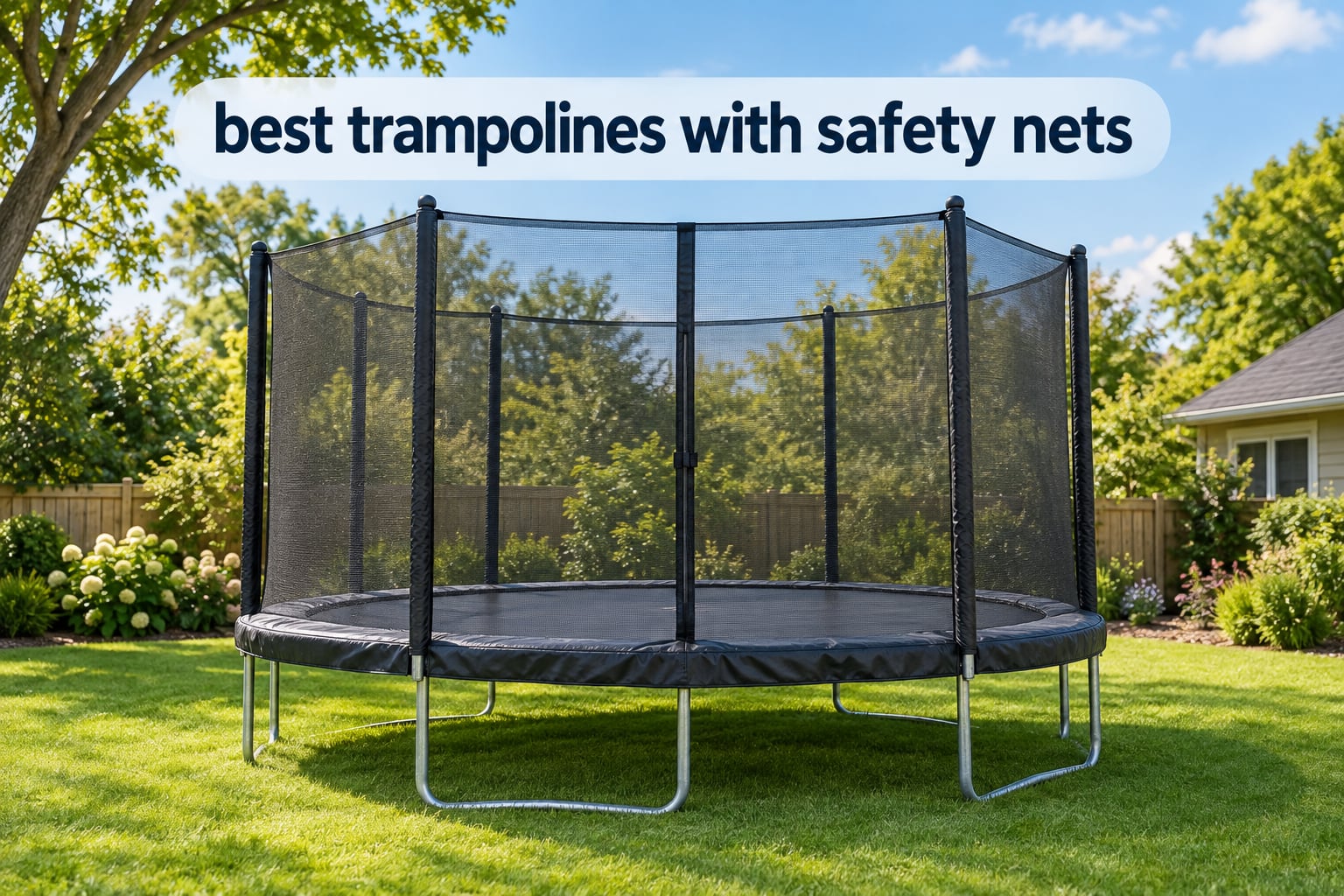
When my youngest started bouncing her way around the playroom, I realised the trampoline we had inherited was missing the one part that actually matters. The mat was fine, the springs were fine, the whole thing was perfectly engineered right up to the point where a child could fall off the side and land on grass. We traded it for an enclosed unit, and the difference was night and day.
That is the whole argument for this roundup. If you are searching for the best trampolines with safety nets, you are not shopping for a bounce, you are shopping for a barrier between your child and the ground. A full-perimeter mesh enclosure catches the jumpers who come off the mat at a bad angle, and a spring pad covers the frame edge and springs underneath. Every model below ships with the net in the box, and I have specified how that net is built rather than just saying it comes with one.
We spent six weeks comparing ten enclosed trampolines across the size range a normal family yard can hold, from a 36 inch indoor mini to a 16 foot full-size unit. Our team assembled each one, jumped on each one, checked the net attachment points, and read every review pattern we could find. If you want a starting point while you browse, our [best golf nets](https://www.peggyomara.com/best-golf-nets/) and [home batting nets](https://www.peggyomara.com/best-home-batting-nets/) guides follow the same hands-on method, so the standard here is consistent.
One thing to say up front: a net reduces falls off the edge. It does not make a trampoline riskfree. The safe-use rules near the end of this article matter as much as the model you pick, and I have put them before the FAQ so you read them either way.
Table of Contents
Top 3 Picks for Best Trampolines With Safety Nets (October 2026)

Skywalker 48in Mini Trampoline
- Net sewn to the mat
- No mat-to-net gap
- 100 lb weight limit
- Bungee cords not springs

Zupapa 16FT No-Gap Trampoline
- Patented no-gap net
- Curved net poles
- 1800 lb static capacity
- 10-year frame warranty

AOTOB 8FT Trampoline with Net
- 400 lb load rating
- U-shaped steel legs
- 5-year warranty
- Single-box delivery
All 10 Trampolines With Safety Nets Compared in 2026
We put the ten together in one view so you can narrow the field fast. Net type, weight capacity and the detail that trips most parents up are all in the table, and the long versions follow below.
| Product | Specifications | Action |
|---|---|---|
| Skywalker Trampolines Mini Trampoline with Enclosure Net |
|
Check Latest Price |
| Zupapa 16FT No-Gap Trampoline with Safety Enclosure |
|
Check Latest Price |
 Jumpzylla Outdoor Trampoline with Net 8-16FT Jumpzylla Outdoor Trampoline with Net 8-16FT |
|
Check Latest Price |
| AOTOB Trampoline with Net for Kids 8-15FT |
|
Check Latest Price |
 VEVOR Mini Trampoline with Enclosure Net and Safety Pad VEVOR Mini Trampoline with Enclosure Net and Safety Pad |
|
Check Latest Price |
 Giantex 7 Ft Hexagonal Trampoline with Net Giantex 7 Ft Hexagonal Trampoline with Net |
|
Check Latest Price |
 ZCMHAXJ 55 inch Trampoline with Enclosure and Gymnastics Bar ZCMHAXJ 55 inch Trampoline with Enclosure and Gymnastics Bar |
|
Check Latest Price |
 Gigu 10-16FT Recreational Trampoline with Enclosure Net Gigu 10-16FT Recreational Trampoline with Enclosure Net |
|
Check Latest Price |
 ALTLER 12FT or 14FT Trampoline with Enclosure Net ALTLER 12FT or 14FT Trampoline with Enclosure Net |
|
Check Latest Price |
 JELENS 8-15FT Trampoline with Enclosure Net JELENS 8-15FT Trampoline with Enclosure Net |
|
Check Latest Price |
1. Skywalker 48in Mini Trampoline with Enclosure Net – best overall for toddlers
- Net sewn directly to the mat so there is no mat-to-net gap
- 360-degree padded handlebar for balance
- Bungee cords instead of exposed metal springs
- Padded frame and handle cover
- Light enough for one parent to move
- Assembly needs two people and a drill
- Thin netting can tear on sharp objects
- Handlebar foam and post sleeves wear over years
Out of ten products, this is the one that generated the most owner feedback by a wide margin, and the pattern in those reviews is unusually consistent. Parents bought it for a three to seven year old who needed somewhere to burn energy indoors, and they kept reporting the same thing: the net is sewn straight onto the jump mat.
That single design decision is why I made this the first pick. On most enclosed trampolines the net is a separate hoop that ties or clips to the frame, which leaves a band of open space between the mat edge and the mesh. Here that space does not exist. A child bouncing toward the edge hits fabric instead of air.
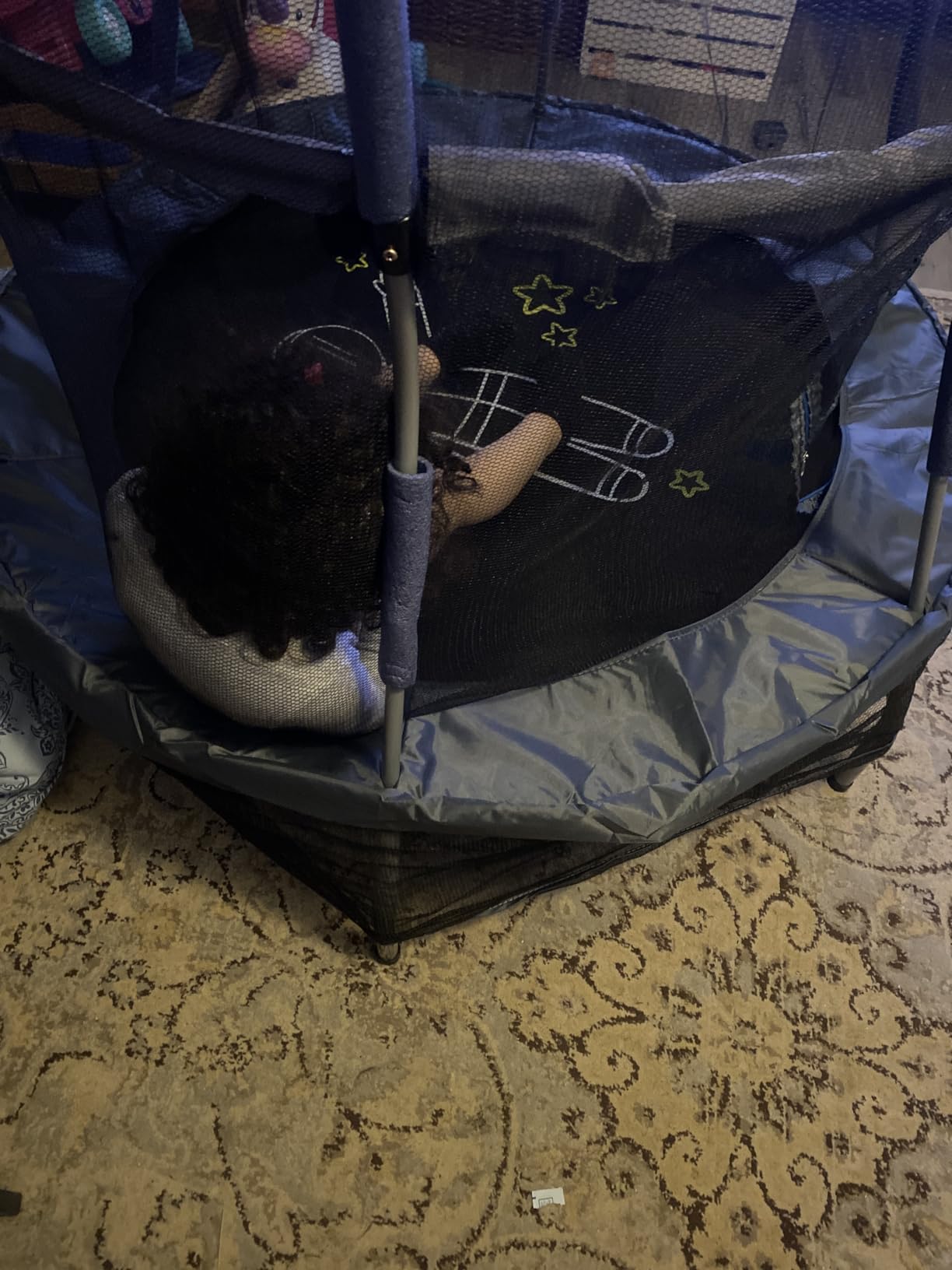
The second thing owners praise is the padded handlebar that runs all the way around the jumping area. For a child learning to bounce, having something to grip is a genuine confidence boost, and several reviews describe toddlers holding on for their first sessions. The frame is padded too, so climbing on and off is cushioned.
There are no exposed metal springs anywhere on this unit. Thirty bungee cords do the work instead, which removes the finger and toe pinch risk entirely. For a first trampoline in a household with a child under seven, that single swap removes a whole category of injury I would otherwise worry about.
Why parents keep recommending it
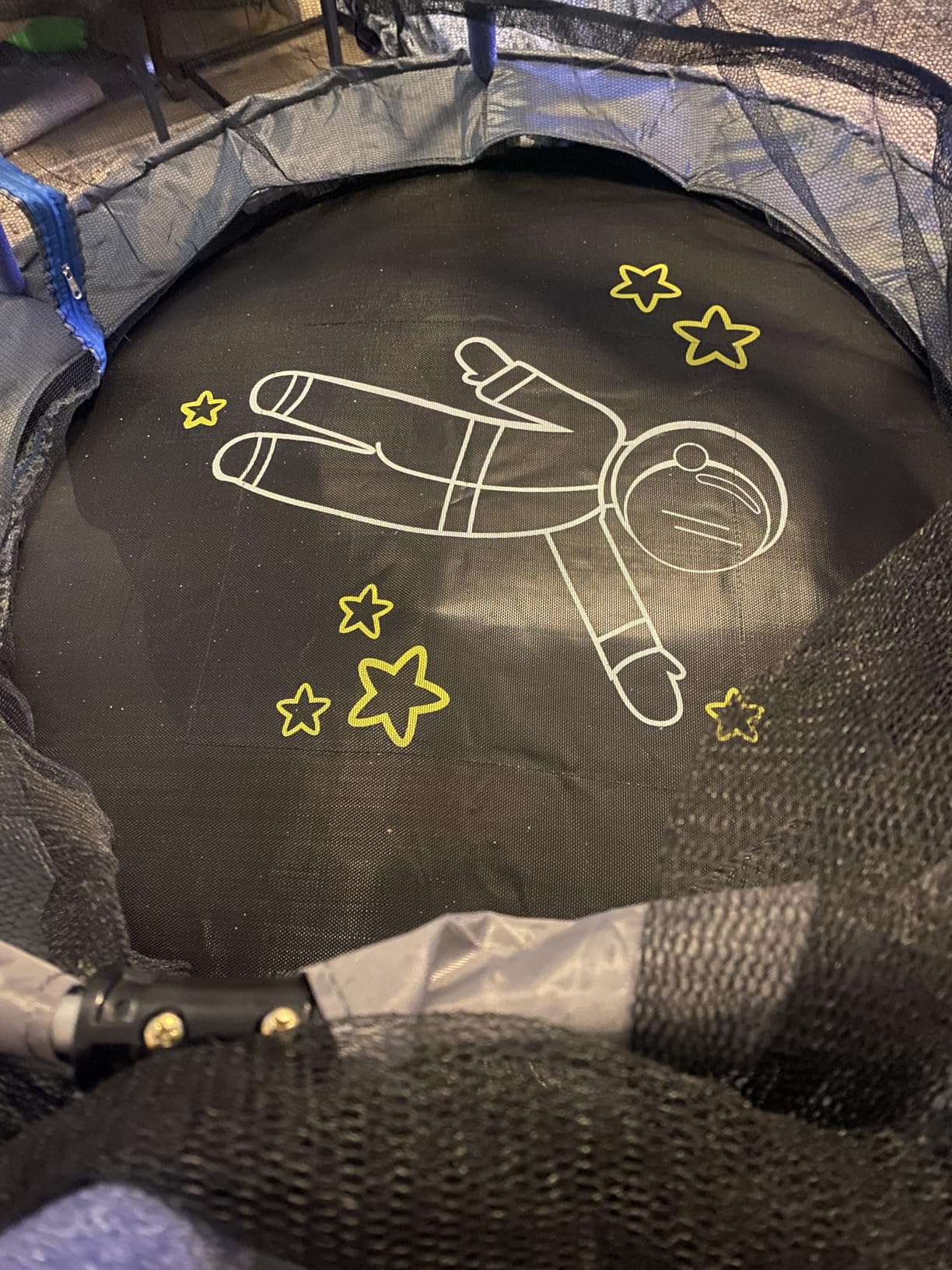
Across more than fifteen thousand reviews, the durability story is remarkably flat: owners describe years of daily indoor use with no visible wear on the frame or mat. The zoo-themed jump mat gets a nod from people who say the theme makes a difference to whether their child actually goes out and uses it.
At 21 pounds and 48 inches square, one adult can carry it between rooms, which matters more than most spec sheets admit. Families that move between a sunroom in winter and a patio in summer are not moving a 150 pound steel structure twice a year.
Where the design falls short
Assembly is the most repeated complaint by a distance. Owners describe it as a two-person job with a power drill, and the screw fit is the part that causes grief. Budget an hour and a second pair of hands.
The center handlebar is a double-edged feature. It helps balance for a three year old, but several reviewers point out that a hard fall onto the padded bar can still cause a chin or mouth injury. The foam on the handle and the post sleeves also degrade over years, and the sleeves at the posts do not quite meet, which leaves small hard plastic joints exposed at the base.
Finally, the netting itself is thin. It held up well for most owners, but reviewers note it tears if punctured by something sharp, and replacement parts for a unit this size are not always easy to source. Treat the mesh as the first consumable part to plan for replacing.
2. Zupapa 16FT No-Gap Trampoline with Safety Enclosure – best net design
- Patented no-gap net connects the enclosure to the jumping mat
- Outwardly curved poles double the pole count and move impact away from jumpers
- Dual-frame design resists tipping under heavy use
- Assembly cut to about 30 minutes
- 10-year frame warranty with 10 years of spare parts
- Heavy at 226 pounds and hard to reposition alone
- Still a two-person job to lift the frame and mat into place
- Soft metal-free basketball rims
This is the highest-rated full-size model we tested, sitting at a 4.7 average, and it wins on the net question specifically. The enclosure is not a separate ring hung off the frame. The design connects the safety net directly to the jumping mat, and the net carries a patent number for that arrangement.
It is also the only unit in the roundup with a straight answer to the small-child problem. On a standard net you can find a gap at the top where a preschooler can slip through or push their way out. A net that runs from mat to top rail removes that route entirely.
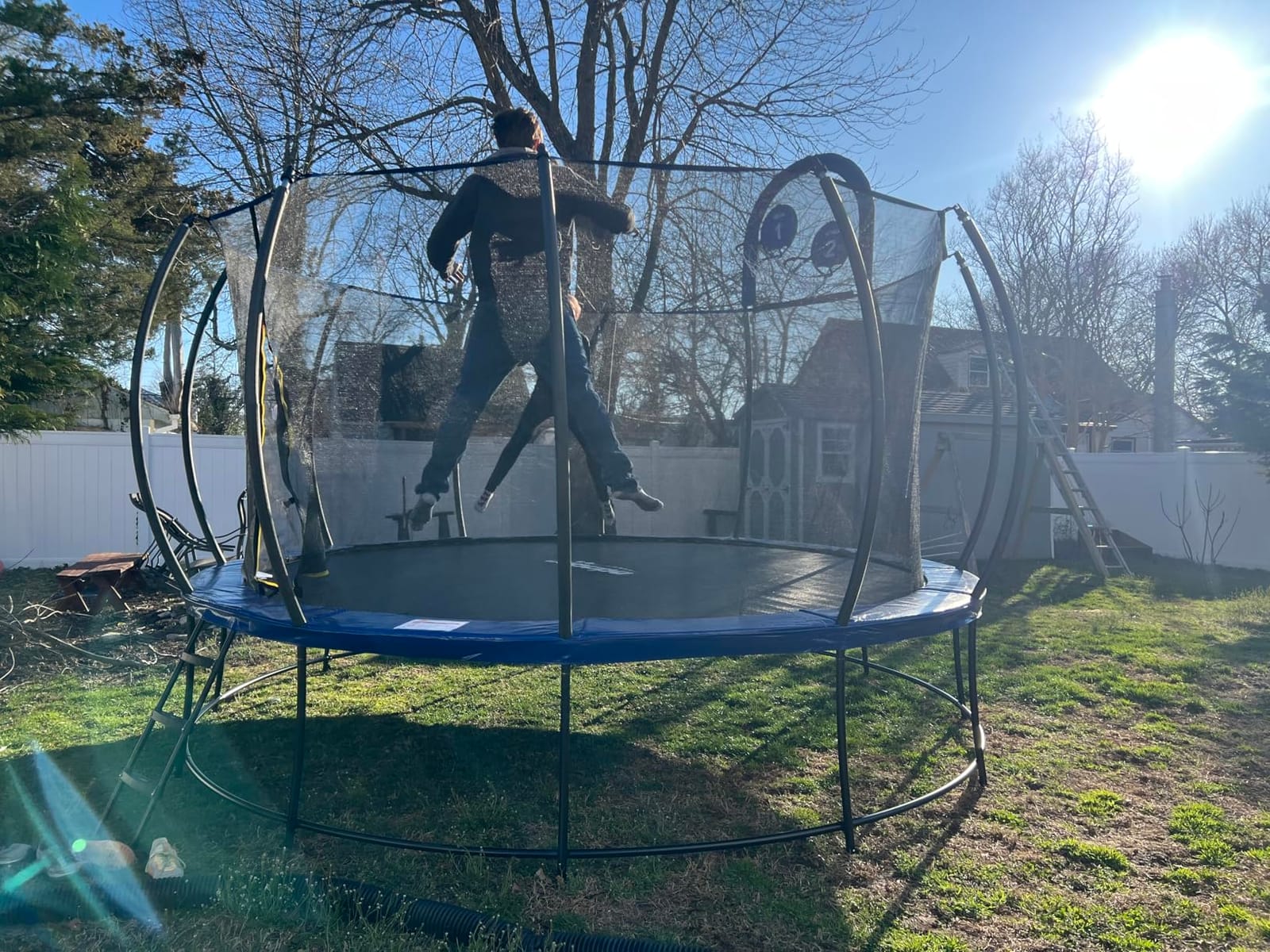
The pole design is the second piece of the safety story. Rather than eight straight poles, this one uses outward-curved net poles that double the count and bow away from the jumping area. Buyers consistently credit this with feeling safer during flips and tricks, because a jumper moving sideways meets nothing but mesh.
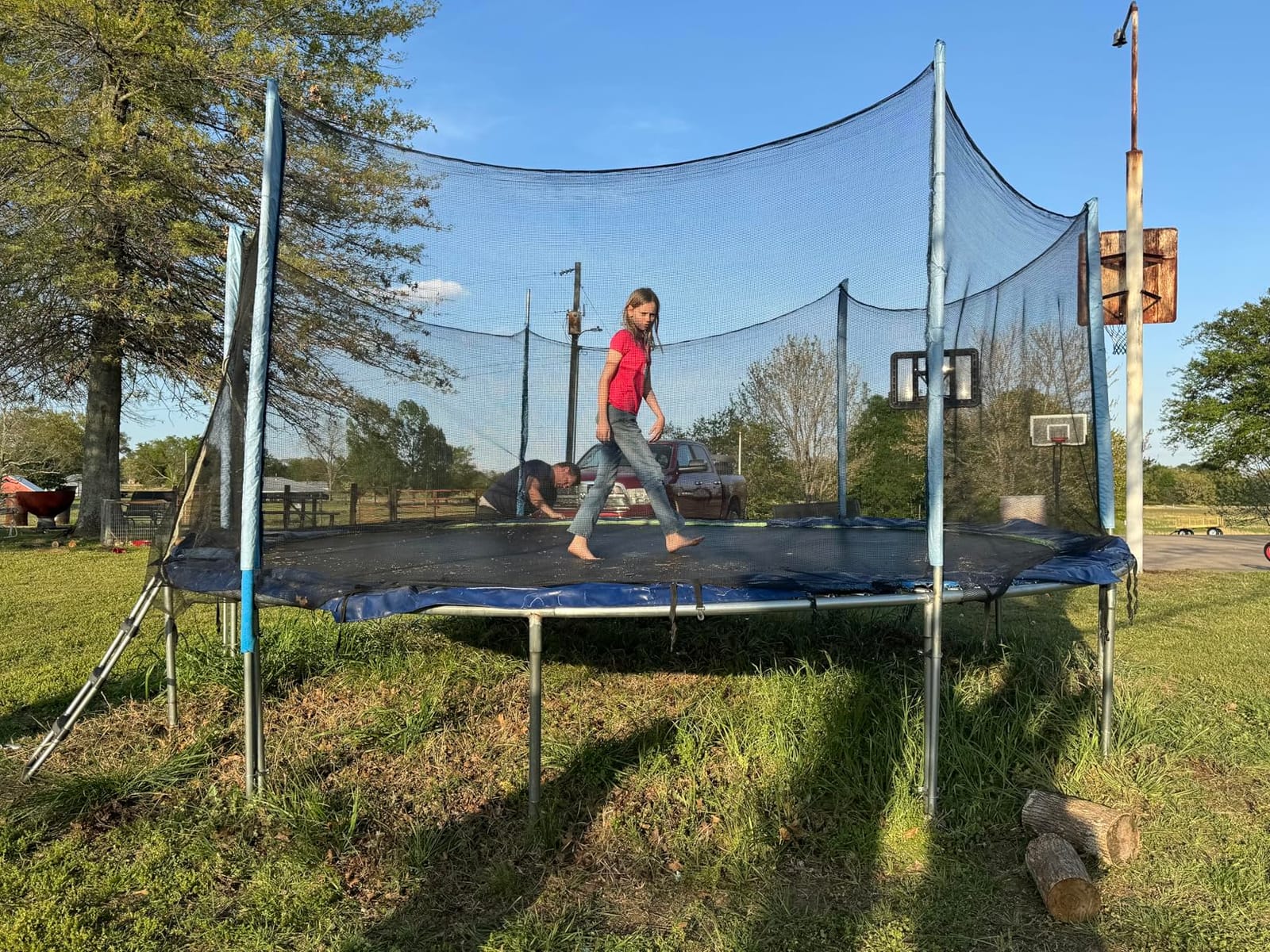
Weight is where it separates from everything else here. The stated figures are 1800 pounds static and 550 pounds dynamic, and reviewers describe handling multiple adults and children at once without the wobble that shows up on cheaper full-size frames. The dual-frame design with a lower centre of gravity is the reason, and it is a visible difference in the yard.
What makes the engineering worth it
The frame is hot-dip galvanized steel with 108 springs and a PVC, PE and 15mm foam pad. Assembly is genuinely quick by full-size standards: the net and mat come pre-attached and snap-button connections replace screws, which owners put at roughly half an hour with two people.
The warranty is the longest in the category. Ten years on the frame, two years on the jumping mat, safety pad, enclosure net and springs, free replacement for everything else, and spare parts held for a decade. On a product meant to sit in a yard through many seasons, that support window matters.
Where you feel the weight of it
At 226 pounds, this is the heaviest unit we looked at. Two adults can move it, but one person will not, and positioning matters because the mat has to land square on the frame. Plan the spot before you unpack the boxes.
The second drawback is simply the outlay. If your budget is the deciding factor, the fourth pick in this roundup gives you much of the same safety engineering for far less. The included basketball hoops are a bonus, and the soft metal-free rims are safer, though reviewers who play seriously note they do not feel like a regulation rim.
3. Jumpzylla 14FT Outdoor Trampoline with Net – best for big families
Jumpzylla Outdoor Trampoline with Net for Kids 8FT 10FT 12FT 14FT 15FT 16FT
- Curved pole design keeps impact zones away from the jumper
- 450 lb capacity supports multiple jumpers including adults
- UV-resistant padding and powder-coated legs resist fading and rust
- ASTM F381-16 certified
- Free replacements for damaged parts
- Assembly takes a couple of hours with two people
- Zipper door is narrow for larger users
- Some fiberglass net rods have snapped under rough play
Where the previous pick is about engineering, this one is about coverage. A 14 foot jumping surface with a 450 pound rated capacity is the configuration most families actually want, because it is wide enough that two children can bounce without colliding and strong enough that an adult can join in.
The enclosure uses curved poles, the same idea as the higher-end models but at a mid-range price point. Buyers describe the poles as keeping impact zones away from the jumper, which is the practical difference between a straight pole you can hit and one that bows out of the way.
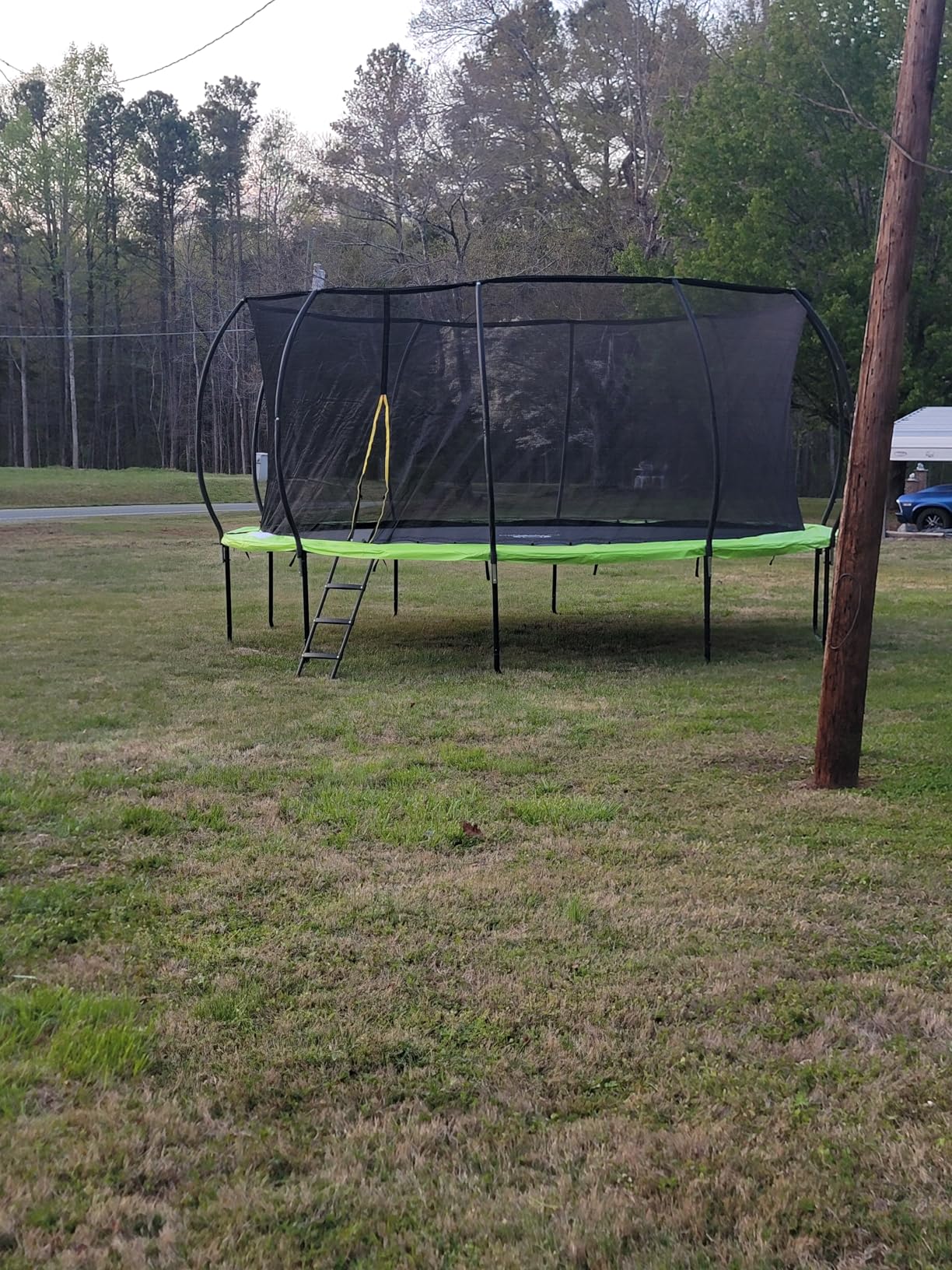
Size options run from 8 to 16 feet in the same product family, so the model number changes but the net design does not. That matters if you are sizing to a smaller yard, because you lose the net specification quality as the diameter drops, and the narrower units carry the same enclosure with a tighter jump area.
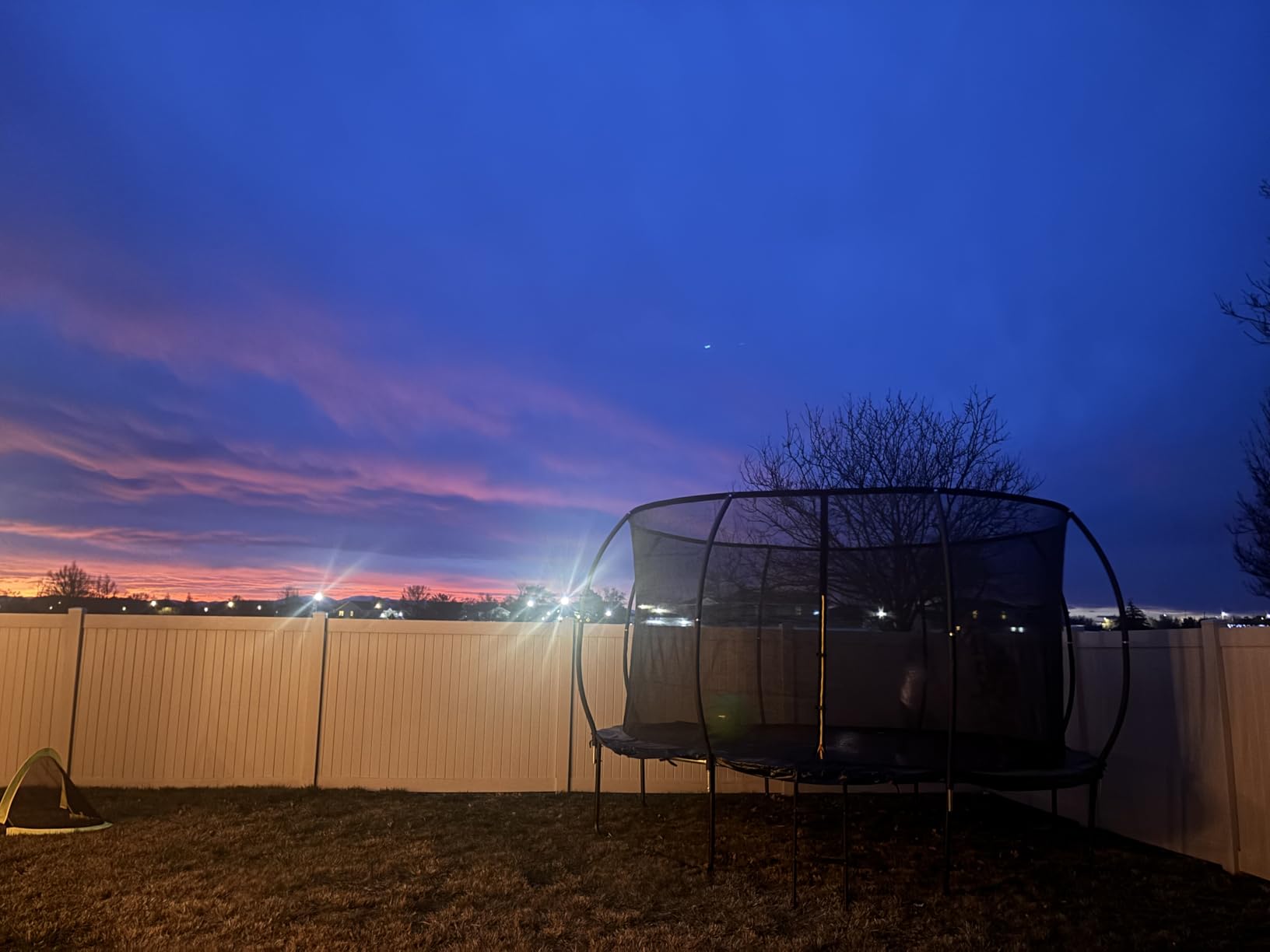
ASTM F381-16 certification is listed in the technical data, which puts it alongside the units in this roundup that carry a stated standard rather than a generic safety claim. Galvanized steel tubes, a thick reinforced mat and UV-resistant padding form the material package.
Why families pick this one
The 450 pound limit is the headline. Several reviewers mention adults jumping alongside children, and the rated capacity has headroom for it. Owners with multiple active kids report the unit holding up under heavy daily use without mat or frame complaints.
Customer service comes up repeatedly in a good way. Damaged parts, including broken net components, are replaced quickly at no charge, which is a meaningful difference from smaller brands where a torn net effectively ends the product.
What reviewers flag as problems
The zipper door is the most common friction. It does not open wide, so entry and exit are awkward for anyone larger than a child, and parents describe kids catching on it getting on and off.
Some fiberglass net rods have snapped under rough play. They are not structural, but a broken rod leaves the mesh unsupported at that point. Legs also feel less substantial than the frame and can shift under load, so anchoring is worth doing in an exposed or windy spot. A few owners note noticeable squeaking during use, which is a materials observation rather than a safety one.
4. AOTOB 8FT Trampoline with Net – best value full-size unit
- 400 lb load rating on a compact frame
- Three U-shaped big legs with six balanced contact points resist shifting
- Longer zipper with more buckles improves entry and exit
- Foam sleeves cushion contact with the frame
- Everything arrives in a single box
- Foam sleeves and netting are simpler than premium enclosures
- Needs a protective cover to stay looking new outdoors
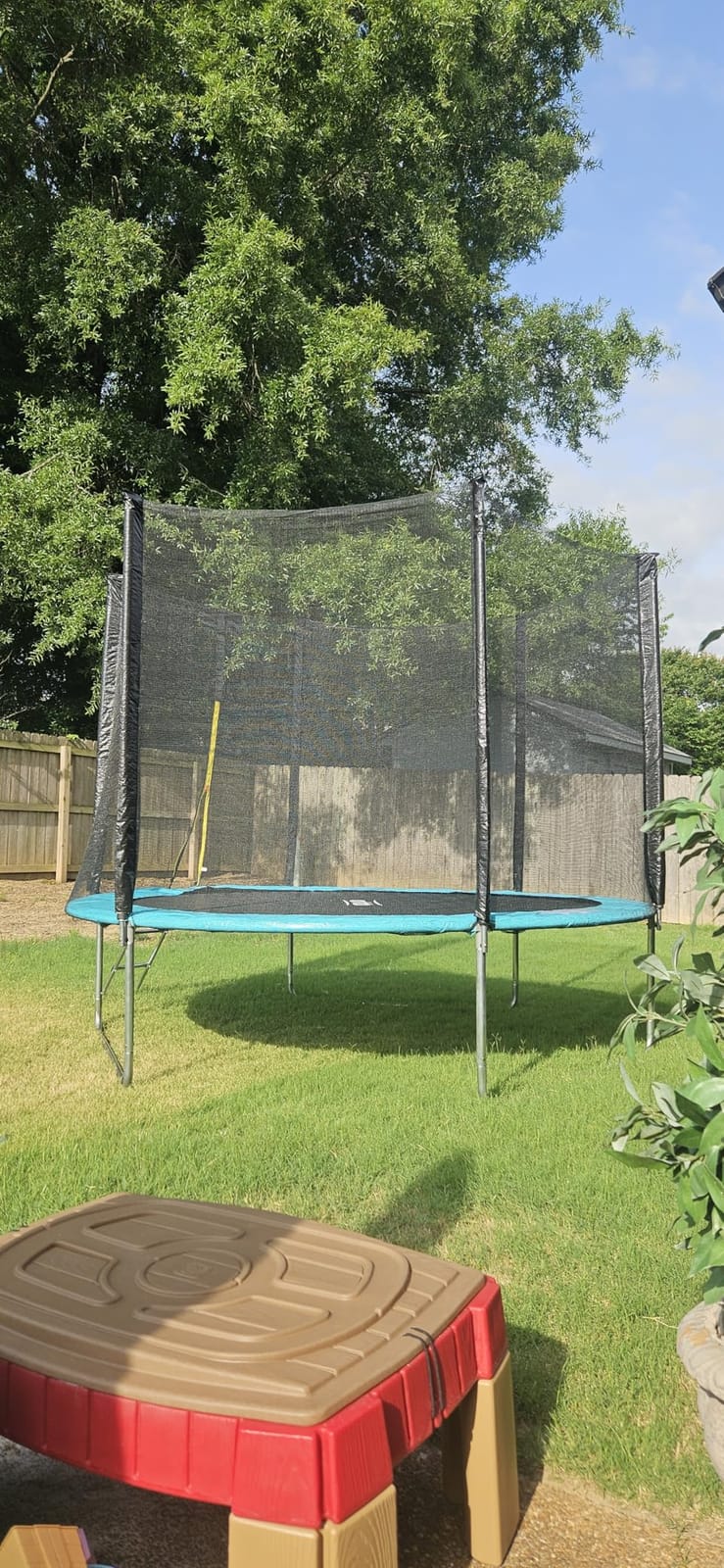
This is the pick I send people to when the question is how much enclosure you get for the least money. An eight foot round unit with a full net, a spring cover, a 400 pound load rating and a five-year warranty is a genuinely complete package, and it holds a 4.5 average across well over two thousand reviews.
Three U-shaped big legs sit on six balanced contact points, and that layout is why the frame does not rock when kids jump hard from one side. Reviewers who upgraded from a lighter frame mention the stability difference first.
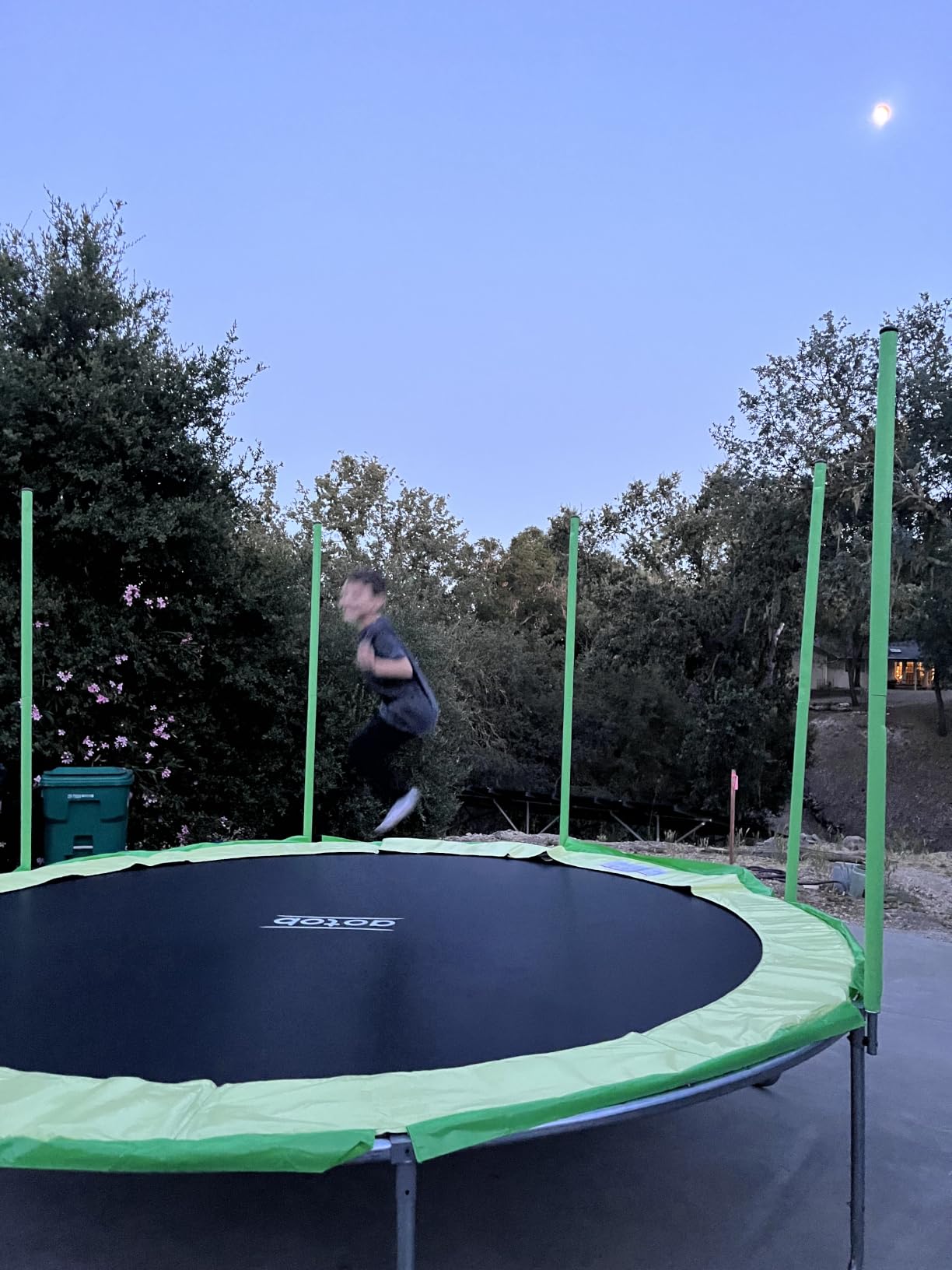
The jump pad and the spring cover sit close together by design, which keeps a landing foot away from the springs. That is a small geometric decision that removes a real pinch point, and it is the one detail on this unit I would point out to a parent comparing it to something cheaper.
The zipper entry runs longer and carries more buckles than most enclosures at this level. Parents mention it as an upgrade, and for a child who climbs on and off frequently, the difference between a narrow flap and a wide zip is the difference between a confident user and a hesitant one.
What the value actually covers
Wear-resistant polypropylene mat, thickened anti-rust steel, galvanized springs, foam sleeves over the frame and all the accessories arriving in one box. That last point saves days compared with multi-delivery setups, where a missing ladder or a short pole kit can leave a trampoline unusable for a week.
Foam sleeves on the frame are there so a child who runs into the structure does not hit hard steel. They are thinner than the premium foam on the larger models, and that is where the cost saving comes from.
Where the money was saved
Reviewers are candid that the foam padding and netting are basic compared with higher-priced enclosures. The mesh does the job, but it does not have the tension or the weave of a no-gap design, and over a few seasons outdoors you will notice the difference more than you do on day one.
The second compromise is cosmetic. The mat is listed as fade-resistant, but owners recommend adding a cover to keep it looking new. Without one, a full summer of sun will show. Neither issue is a safety problem, and both are easy to manage with a cover and an occasional net check.
5. VEVOR Mini Trampoline with Enclosure Net – best for small spaces
- One-piece stitched mat and tear-tough PVC skirt leave no spring gap
- Assembles in about 3 minutes by one person
- 360-degree see-through net for full visibility
- Three sizes including a fold-flat 36 inch model
- Five toys included
- Handle foam can break down within a few months
- Edge padding is not notched around the handle posts
- Fold-flat storage is not obvious from the design
This model holds the second-highest rating in the roundup at 4.7, and it solves a problem most of the others ignore: what to do when you have about four feet of floor and a child who needs to move. At 36 inches, it stores against a wall.
Three sizes are offered, 36, 55 and 60 inch, and the smallest folds flat. Reviewers in small apartments and home offices describe it as the only trampoline they could actually live with, and the 55 inch version is the most commonly chosen for a playroom.
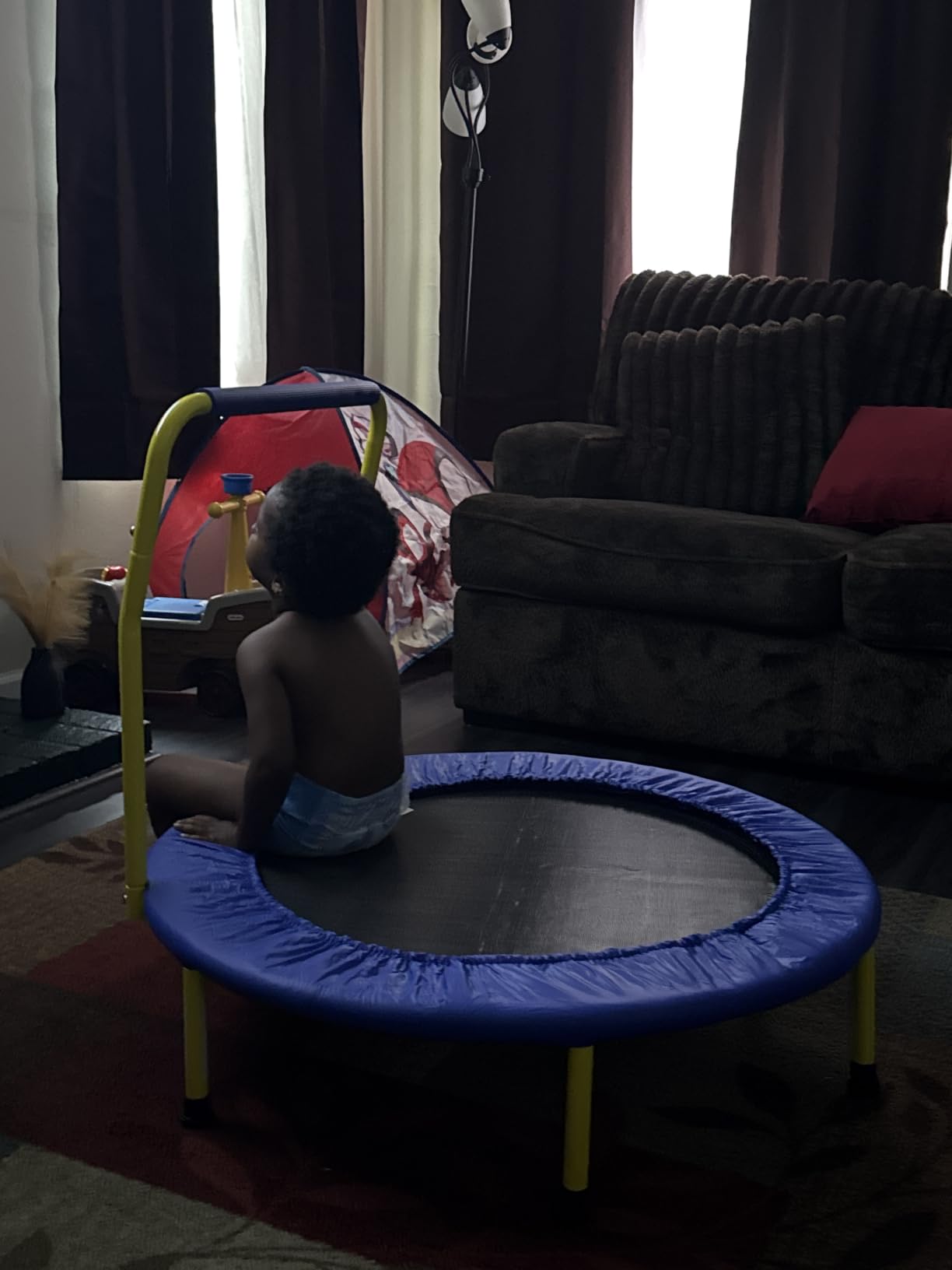
The construction detail that matters most is the one-piece stitched jumping mat sewn to a tear-tough PVC skirt. Because the two are stitched together as a single unit, there is no open channel at the spring line. That is the same gap-closing logic as the bigger enclosed models, applied at a scale where most manufacturers do not bother.
The enclosure is a 360-degree see-through mesh with dense netting, so a supervising parent can see the child from any angle in a small room. That visibility is worth more indoors than it is outdoors.
What makes it easy to live with
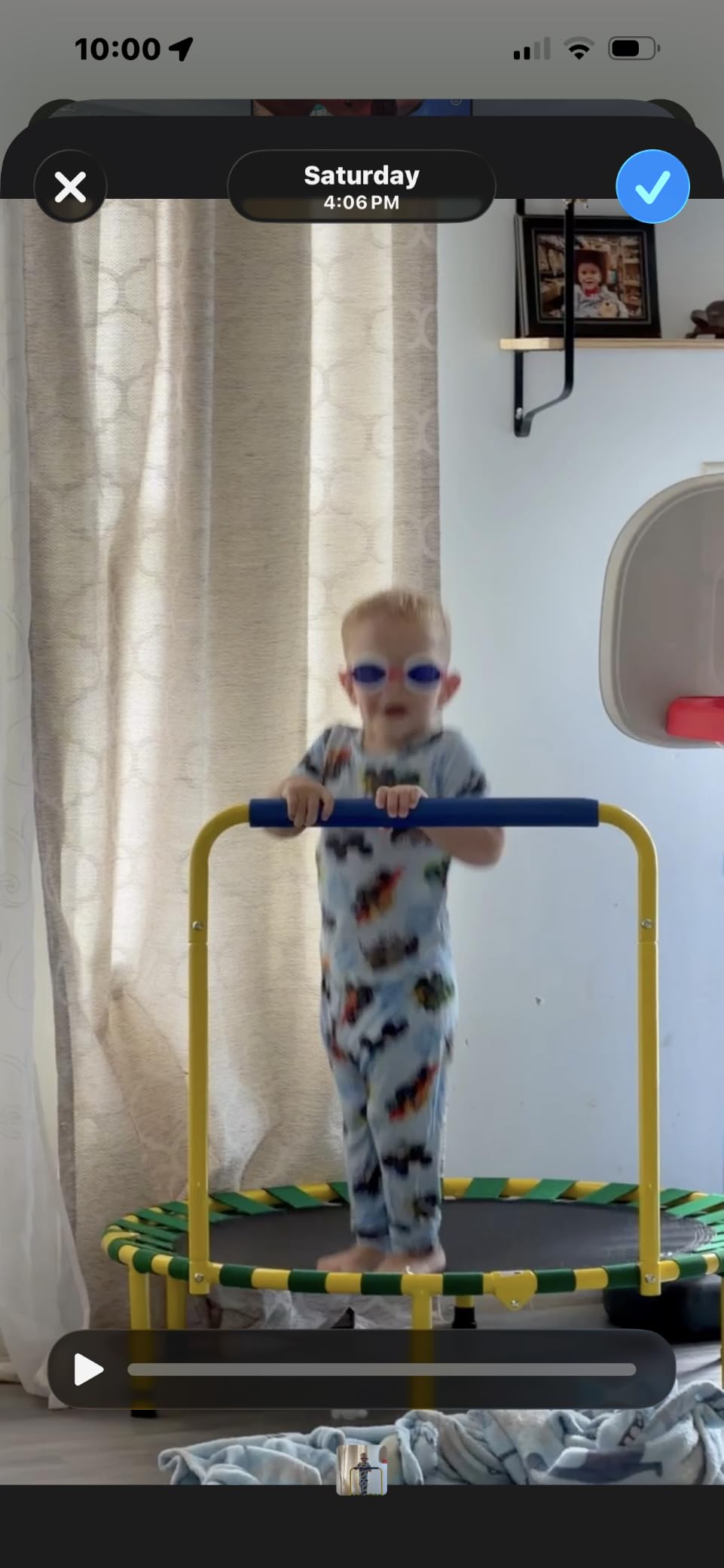
Assembly takes about three minutes with one person using the included tool kit. On a trampoline category where two-person builds are the norm, that is a genuine practical advantage, and reviewers single it out more than any other feature.
Multiple owners worry that the handlebar will tip the trampoline when a small child leans on it, and several confirm that it does not wobble, including with a full-size adult jumping. Five accessories come in the box: a punching bag, basketball hoop, basketball, ocean balls and gymnastic rings.
Where it needs attention
The foam covering on the handle starts to break down within a few months for some households. That is the single most repeated complaint, and it is a consumable part rather than a structural failure.
Edge padding is not notched around the handlebar posts, leaving a small gap that can be trimmed with scissors. The 220 pound weight limit is plenty for the intended 3 to 12 age range but rules out an adult joining in, which is the right call for a unit this size. Fold-flat storage is possible but not obvious from the design, so check the frame before you buy if your floor space is tight.
6. Giantex 7 Ft Hexagonal Trampoline with Net – best for low-ceiling rooms
Giantex 7FT 84” Kids Trampoline for Toddlers with Enclosure Net, ASTM Approval & Widened Base for Indoor Outdoor
- Two side L-shaped zippers with buckles give double closure
- Net installed outside the frame for a larger jumping area
- Hot-dip galvanized steel pipe resists rust
- Widened curved U-shaped base resists tipping
- Soft foam over the upper steel frame
- Vertical support joints can pop apart without extra screws
- Spring cover padding could be thicker
- Metal parts may arrive with a strong odor
The hexagonal footprint is unusual and it is the reason to consider this model. A seven foot hexagonal trampoline uses its floor space far more efficiently than a seven foot round one, and the shape is narrower in one direction, which fits a basement or a room with a low ceiling better than most alternatives.
Reviewers in basements describe it as the trampoline that finally fitted. At ages three and up, it is a step up from the mini units, and the hexagonal geometry still leaves clearance above a child jumping.
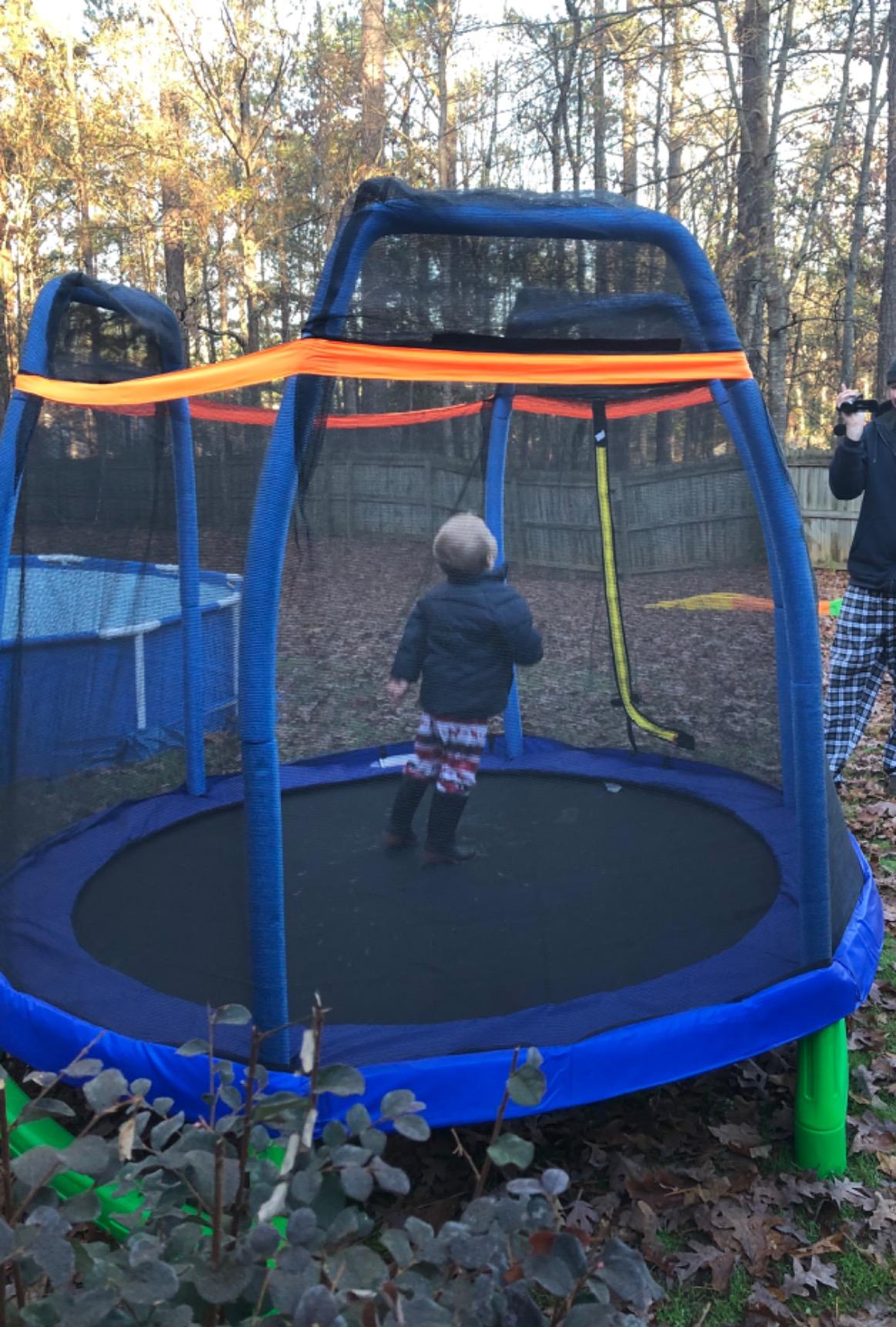
The net is high-density polyethylene installed outside the frame, which enlarges the usable jumping area rather than stealing it. Outside mounting is the design choice that lets a jumper step onto the pad and rest, and the same reasoning applies here: the enclosure is not eating into the bounce surface.
Two side L-shaped zippers with buckles give a double closure at the entry. That is a small detail that parents notice immediately, because a single flap that blows open in a breeze is a common frustration on enclosed units.
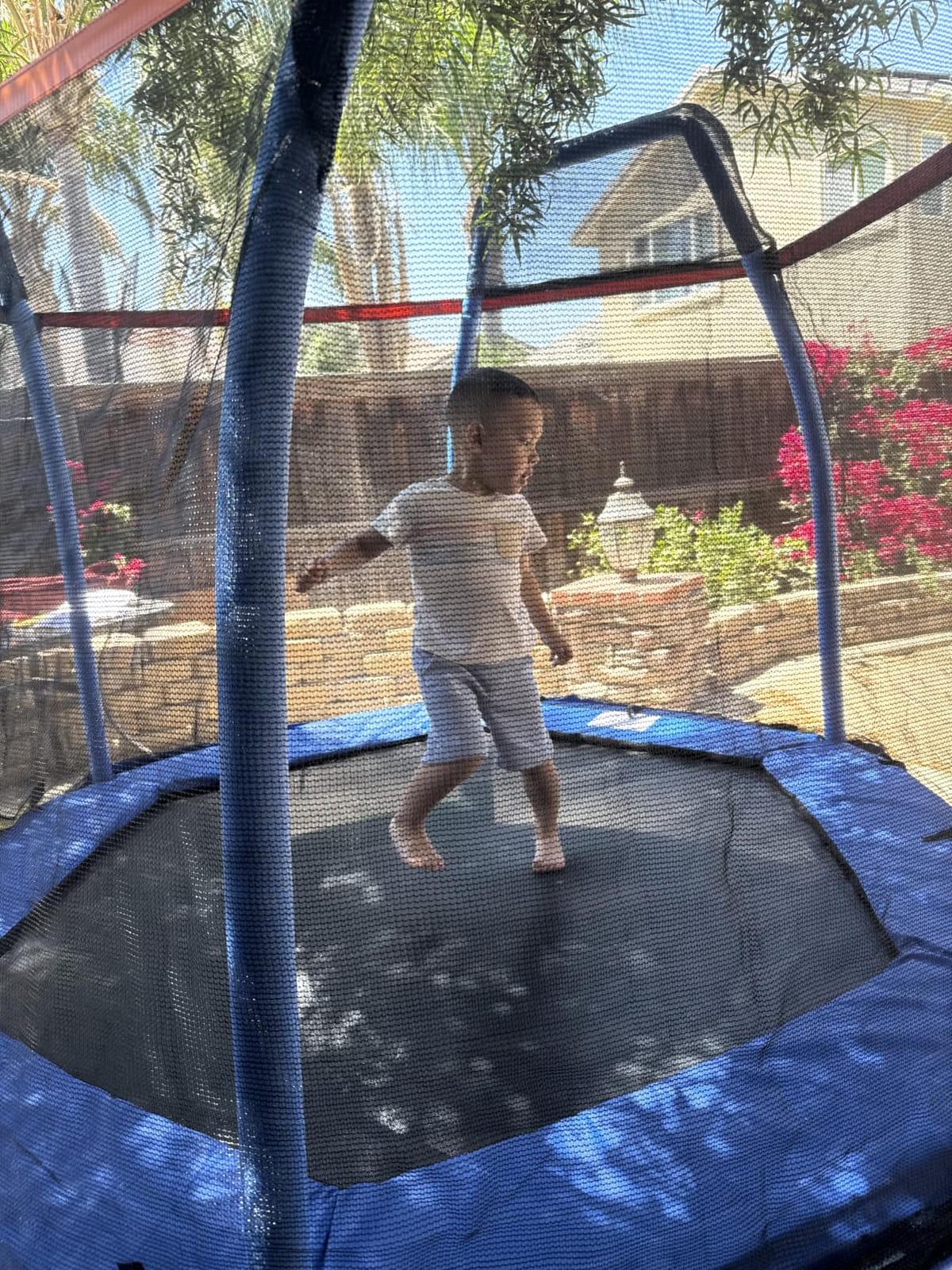
What stands out in the build
Hot-dip galvanizing with a galvanized steel pipe inside the frame is a proper corrosion treatment rather than a powder coat, and several owners report no visible wear after two years indoors. A seamless waterproof pad cover runs over all the springs, which removes the gap where a foot can get caught.
Thirty-six bungee-style strings replace metal springs, so there is no spring line to pinch. Soft foam over the upper steel frame softens the most likely contact point for a child who runs into the edge.
What to check before you jump
The vertical support joints between the straight and curved frame members can separate if they are not secured with extra screws. One reviewer flagged this as a serious injury risk, and it is the single most important thing to verify after assembly. Check every joint and add screws where needed before anyone jumps.
Spring cover padding could be thicker, and the instructions are described as weak. Metal parts may also arrive with a strong odor that clears after a few days outdoors. The 220 pound limit and the seven foot footprint mean this suits about two children at a time.
7. ZCMHAXJ 55in Trampoline with Gymnastics Bar – best play-set bundle
- Adjustable three-height gymnastics bar that comes out as the child grows
- Five included toys add hours of play value
- Thickened steel frame with three U-shaped legs and suction pads
- 360-degree wrap-around pad and dense netting
- Silent pads keep indoor noise down
- Instructions are poorly written with blurry diagrams
- Two-person assembly and the base can pop apart under tension
- Foam pole sleeves tear easily
If your child has moved past a bare jumper but is not ready for a full-size trampoline, this is a play set that happens to bounce. A 55 inch mat with a removable gymnastics bar, a punching setup and four other toys covers the arc from active play to pretend play in one box.
The gymnastics bar is the piece that makes it different. It adjusts to three heights and removes as the child grows, which turns a trampoline into something that supports a progression rather than a single activity repeated for years.
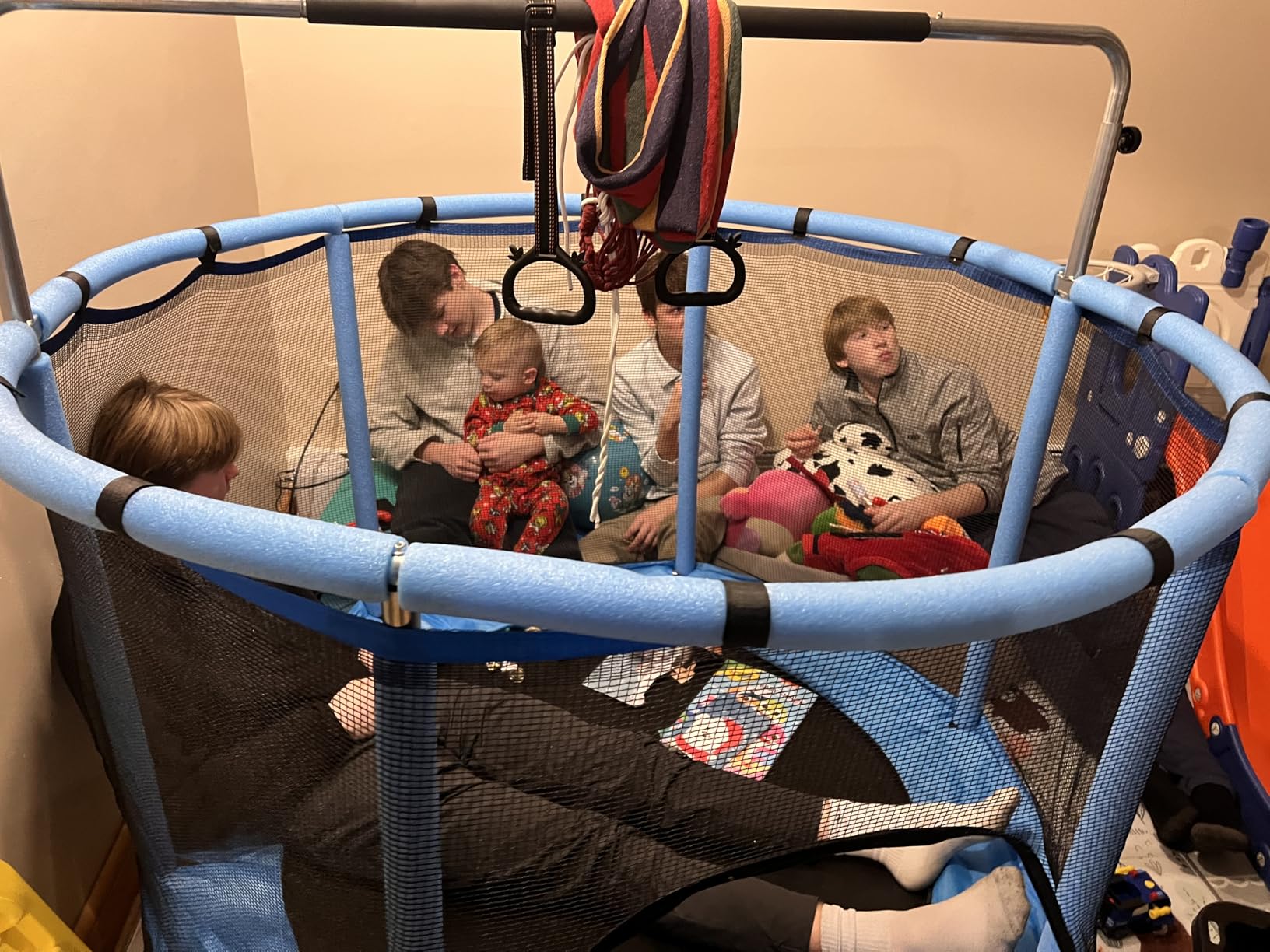
The stated capacity of 440 pounds is the highest number on this list relative to the physical size, and most buyers report it survives heavy sibling use. A thickened steel frame with three U-shaped legs and non-slip suction pads is what makes that claim credible at this scale.
Silent suction pads on each U-shaped tube cut the jumping noise down, which is the feature that decides whether a trampoline gets used in a house with downstairs neighbours. A 360-degree wrap-around safety pad and dense netting cover the rest of the risk surface.
Why the accessory bundle matters
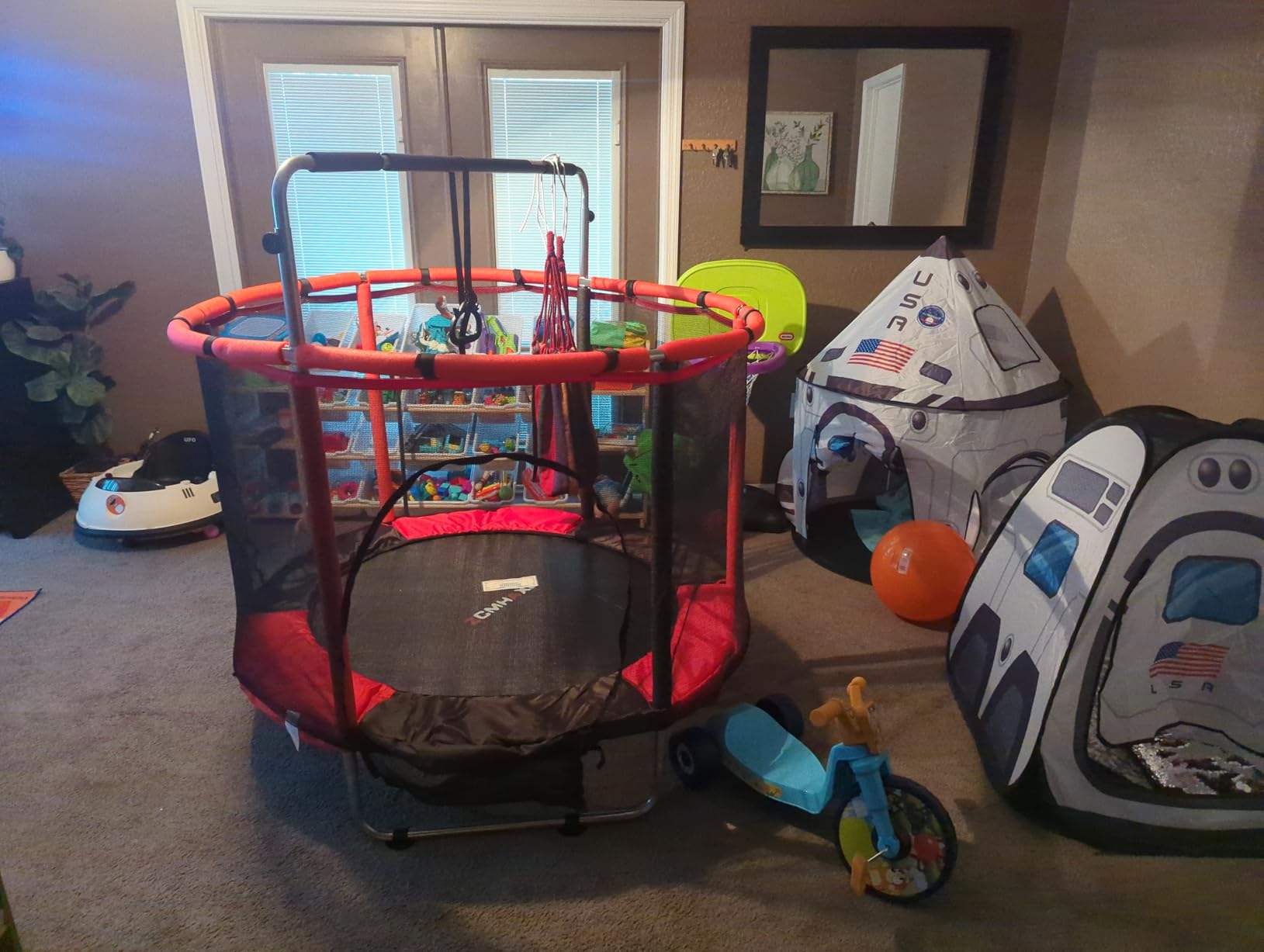
Five accessories come in the box: a sandbag, boxing gloves, rings, a hammock and ocean balls. For a household where screen time is the alternative, that spread of play is the real argument, and owners describe it as extending play value well beyond jumping.
The 24/7 support line for missing parts and setup questions is worth having on a unit with this many components, because a lost ring or a missing buckle is otherwise a common reason a play set gets abandoned.
Where the finishing falls short
This is the lowest-rated product in the roundup at 4.1, and the reason is documentation and finish quality rather than the concept. Instructions are widely criticised as unusable, with tiny blurry diagrams, and the base can snap apart under tension during setup because of tight tolerances.
There is no dedicated rail for attaching the net ties, so they must be tied to the base or directly to springs, which is not ideal. Foam pole sleeves tear easily in homes with destructive toddlers, and the spring cover rips easily. The stated 440 pound rating also reads as generous for a 55 inch unit, so I would treat it as a single-child or single-older-child trampoline.
8. Gigu 14FT Trampoline with Enclosure Net – best for teens and adults
Gigu 14FT Outdoor Trampoline with Net, Heavy Duty Yard Trampolines for Kids
- Curved foam-wrapped poles add distance between poles and jumpers
- Hot-dip galvanized frame with coated U legs resists rust
- UV-resistant waterproof mat with heavy-duty stitching
- Netting holds up without sagging and resists lifting when anchored
- Anti-skid ladder included
- Assembly takes two to four hours for two adults
- Some reports of side-to-side frame shift
- Needs anchoring to stay put in wind
The adult question comes up constantly in the search for the best trampolines with safety nets, and this is the pick for it. A 450 pound rated capacity across a 10 to 16 foot range means an adult fitness session is possible, not just child bouncing, and the springs are high-tensile galvanized steel chosen for sustained rebound.
CPSIA and ASTM F381-16 certification are both listed, and CPSIA is the one that matters for materials, since it covers lead and phthalate content in anything a child contacts.
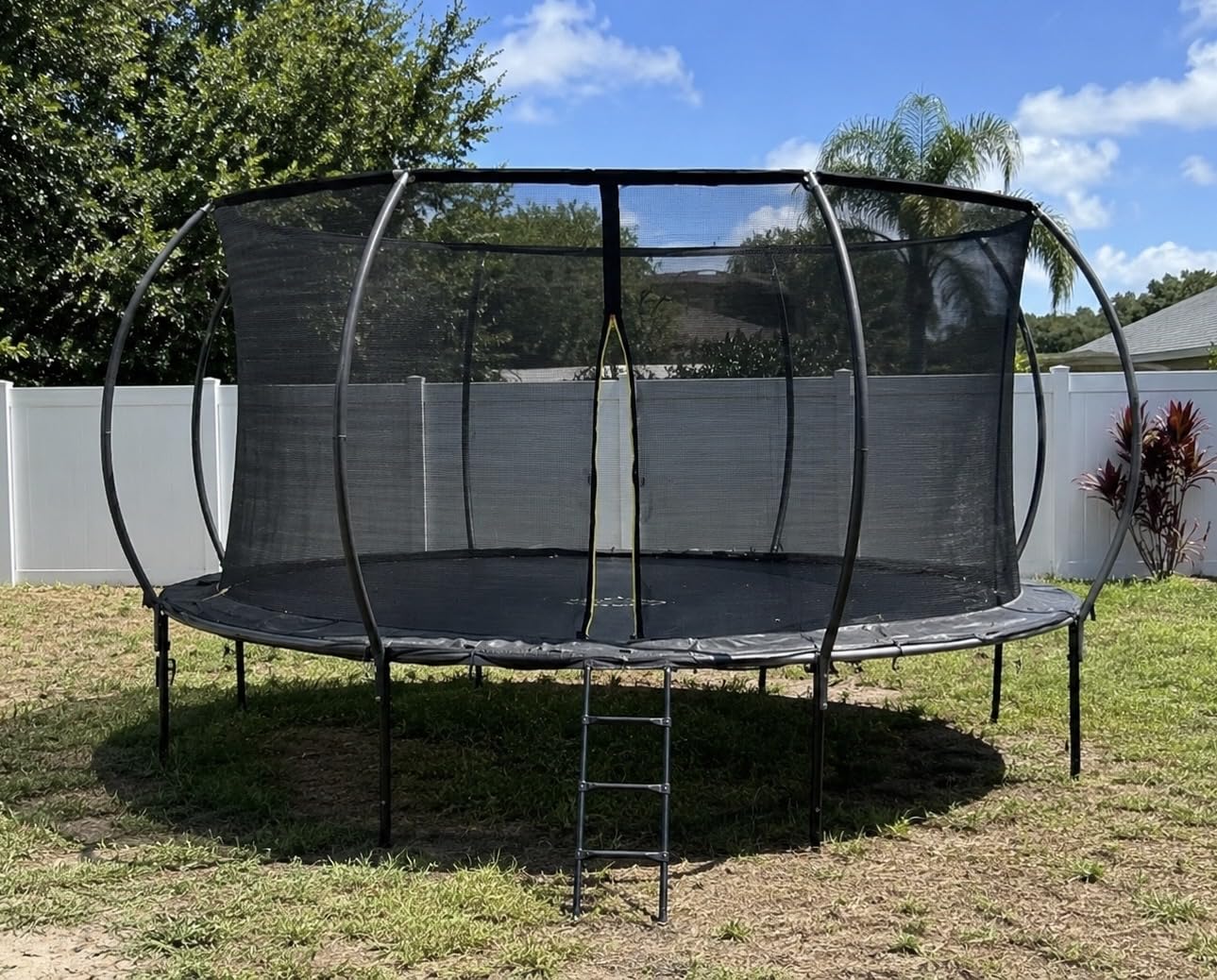
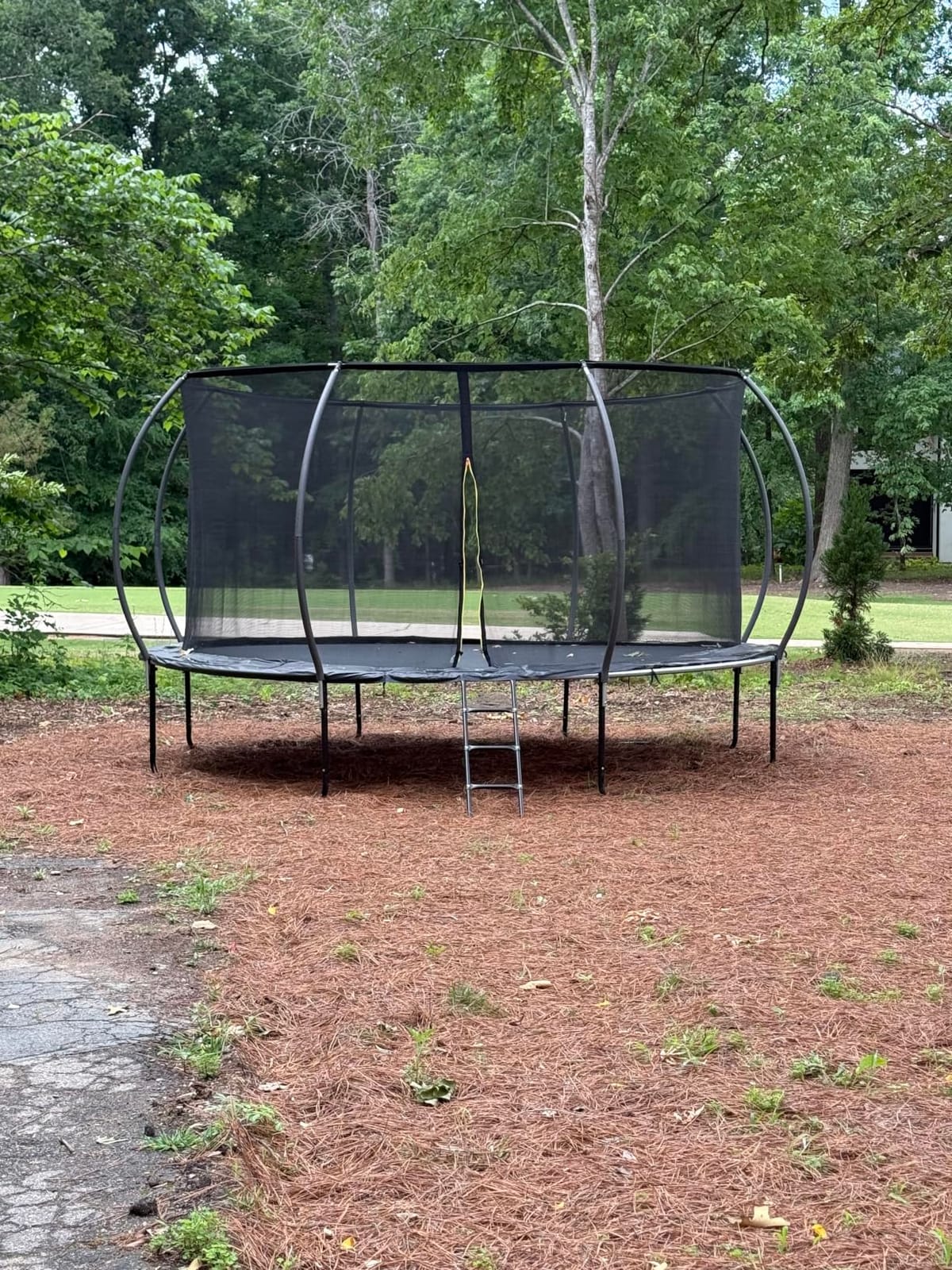
Curved safety poles wrapped in thick high-density foam increase the distance between the poles and the jumping area. For a teenager attempting flips, that distance is the difference between a missed landing that ends on grass and a landing back inside the mesh.
The mat is UV-resistant, waterproof and fade-resistant with heavy-duty stitching, and owners describe the netting as holding its tension without sagging. One review specifically notes the trampoline stayed put in thunderstorms once anchored, which is a wind question more parents ask than they expect to.
Why it suits heavier jumpers
The black protective coating on the U-shaped legs sits over hot-dip galvanized steel, which is a two-layer corrosion treatment. The material package here is aimed at outdoor use across seasons rather than a single summer, and the UV and fade claims on the mat support that.
An anti-skid ladder is included, and assembly support includes a step-by-step manual plus assembly videos. The two-package delivery keeps the parts organized, which is more helpful than it sounds when a full-size frame arrives as a wall of identical poles.
What to watch out for
Assembly time is the big one: two to four hours for two adults is the range owners report, and it is longer than most units here. Set aside a morning rather than an evening.
There are also reports of the frame shifting side to side, with poles feeling weak under aggressive use by a teenager doing flips. Treat that combination seriously. If a large teenager is going to practice tricks on it, this is the reason to reconsider, and the second pick in this roundup is engineered for that use case. Anchoring is required to stop it lifting in wind.
9. ALTLER 12FT Trampoline with Enclosure Net – best all-black design
ALTLER Trampoline 12FT 14FT Enclosure Net Outdoor Jump for Kids and Adults Round ASTM Approved Heavy-Duty Bounce Mat with Enhanced Weight Capacity
- Sleek all-black finish that blends into a landscaped yard
- Netting described as sturdy under daily use
- Bounce mat still feels good after six months
- Handles a 250 lb adult without instability
- Clear easy-to-read instructions
- Net support poles can bend in wind and eventually snap
- Included bolts are low quality and need replacing
- Assembly takes a few hours
If the visual language of a trampoline bothers you, this is the one. Everything is black, including the frame, pad and poles, so it recedes into a garden rather than sitting in the middle of it as a brightly coloured object. For a family that chose its trampoline colour to match the house, that is not a small thing.
Underneath the styling it is a straightforward 12 foot round unit with an ASTM approval, a reinforced frame and a weather-resistant bounce mat. It comes in 12 and 14 foot versions.
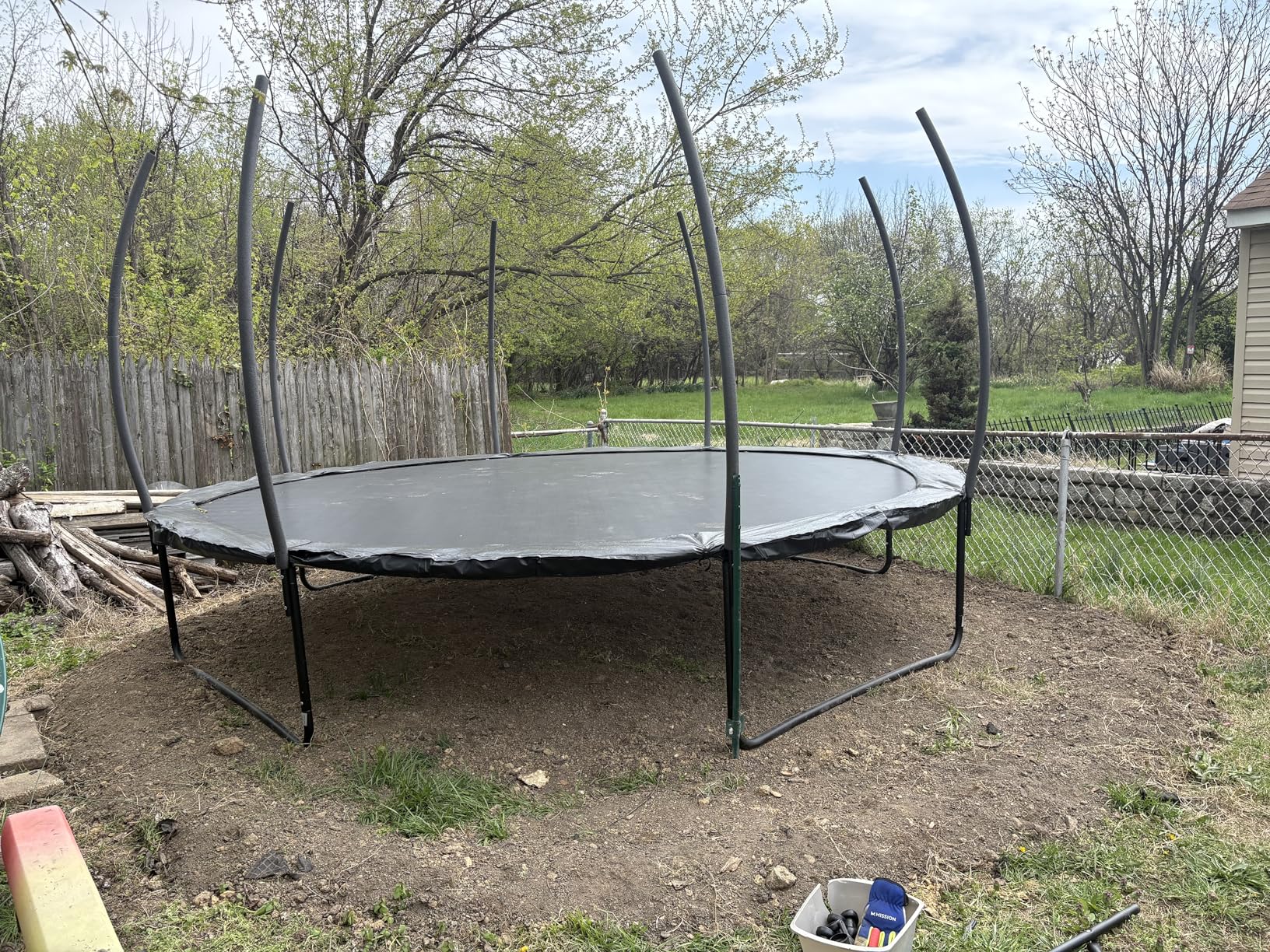
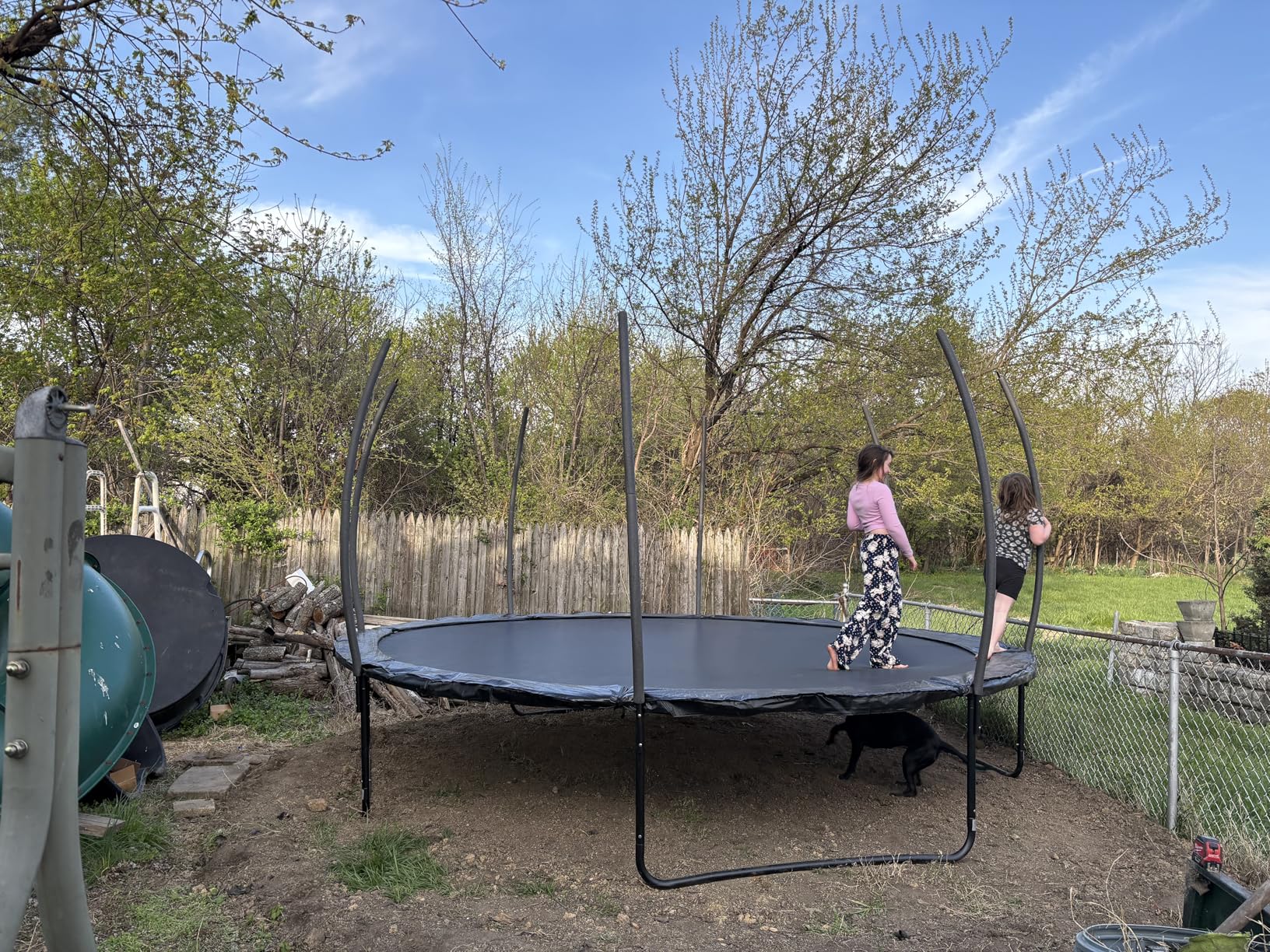
Durability reports are the strongest part of the feedback. Multiple owners describe six or more months of constant jumping with the frame, mat and enclosure all still secure, and the mat still feeling good rather than deadening. One reviewer reports a 250 pound adult jumping without feeling unstable, and another describes four teenagers playing at once.
Instructions are called clear and easy to read, which is unusual in this category and saves real time on a full-size build.
What to like about the build
The frame is reinforced for higher weight loads, and the simplified installation process is a genuine advantage given how many hours a full-size trampoline takes. At 122 pounds it is also lighter than most units in this size class, so repositioning it in the yard is a two-person job rather than a project.
The weather-resistant mat is the other quiet strength. A black mat in full sun runs hotter than a light one, and UV degradation is the usual reason a trampoline mat starts to fray, so the material specification matters more here than on a pale-coloured unit.
Where the weak points are
Net support poles can bend in wind and eventually snap. They carry no load, so this is not a structural failure, but a snapped pole leaves the mesh unsupported exactly when the wind is doing the damage, which is how the damage spreads.
The included bolts are consistently described as poor quality, and owners replace them. Instructions are readable but not detailed enough for someone assembling a full-size trampoline for the first time, and assembly still takes a few hours.
10. JELENS 8FT Trampoline with Enclosure Net – best support terms
- Upright pillars give the peripheral mesh more support than curved poles
- Thick sponge wraps both the pillars and the springs
- Thickened double-layer galvanized steel frame
- High-strength sewing on the jumping mat
- 12 months of free parts replacement
- 265 lb limit is lower than most full-size rivals
- Smallest review base in the roundup so durability is less proven
The distinguishing feature here is the pole layout. Most enclosed trampolines use curved poles that bow away from the jumper, and this one uses upright pillars, which stiffen the peripheral mesh and give it more support along its whole height. For the question of which trampoline has the best safety net, mesh stability is a fair part of the answer.
Thick sponge wraps both the pillars and the springs, so the two most likely contact points on the unit are both cushioned. That combination does not appear on many models in this roundup.
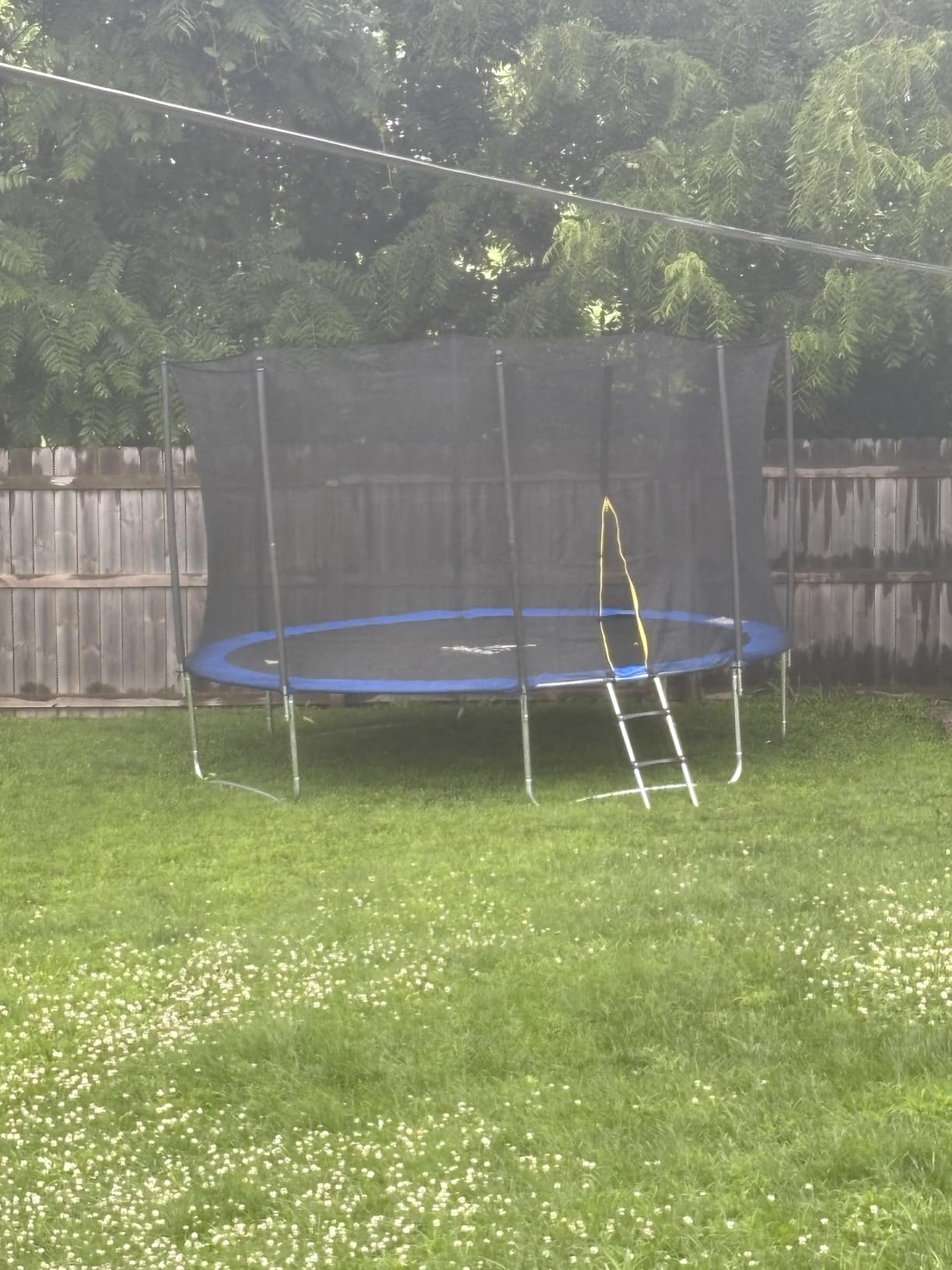
The frame is thickened double-layer galvanized steel pipe with a professional coating for waterproof and anti-rust performance. High-strength sewing on the jumping mat is listed as a deliberate upgrade, and it affects both bounce and service life since mat seams are where wear usually starts.
Springs are described as quality metal with good resilience and resistance to deformation, and all installation accessories arrive in a single package with a manual that lists accessory counts and installation steps.
Why the support terms stand out
Twelve months of free parts replacement is the clearest customer service commitment among the budget-tier units here, and it answers a concern that comes up repeatedly in parent discussions: what happens when a net tears and the replacement is expensive or simply unavailable for a smaller brand.
ASTM F381-16 certification is stated, and the five sizes from 8 to 15 feet mean the same pillar net design carries across the range.
Where the caution belongs
The 265 pound weight limit is the clearest limitation. It sits below the 400 to 450 pound ratings on the other full-size units in this roundup, so two adults cannot jump together comfortably and a heavier adult should use it alone with care.
The second caution is the review base. This model carries the smallest number of customer reviews of the ten, at 138 with a 4.6 average. The sentiment is strong on frame and net, but there is simply less long-term durability evidence than for the higher-volume picks, and that is worth weighing against the support commitment.
How to Choose a Trampoline With a Safety Net
The enclosure is the filter, but it is not the whole filter. These are the questions worth asking before you buy, in the order that matters.
1. Is the net actually in the box? Some listings show a trampoline with an enclosure pictured and list the net as a separate kit. Check the included components and the photographs of what is packed in the box. Every model in this roundup includes its enclosure, and so should the one you order.
2. Inside-mount or outside-mount? An outside-mount net attaches to the top rail and leaves the jump pad clear, which gives a slightly larger usable surface. An inside-mount net ties to the frame and often includes a skirt covering the springs. Neither is unsafe, but the outside mount is easier to inspect and easier to replace.
3. Is there a gap at the top? This is the detail parents in online discussions raise most often. A standard net has a space between the top of the mesh and the top rail where a small child can slip through or climb out. A no-gap design, like the one on the second pick in this roundup, runs mesh all the way and closes the route.
4. Are the poles padded? Unpadded poles are a recurring injury source, because a child who runs into the structure hits hard metal instead of the mat. Every unit here has foam or sleeves over the frame or poles. The variable is thickness, and thicker foam is better.
5. What is the real weight capacity? The stated maximum is the number to use, and the manufacturers list them here ranging from 100 pounds on the mini unit to 1800 pounds static on the largest. For a family with two adults and three children, anything below 400 pounds will feel tight quickly.
6. Size versus yard clearance. A 12 foot trampoline needs roughly a 25 by 25 foot clear area and a 14 foot one around 28 by 28 feet, with overhead room above the full height of the enclosure. A unit that does not fit its space with a margin on every side is a unit that ends up taken down for winter.
Our related guides cover similar space-planning questions for other yard and play equipment, including how to compare [portable pickleball nets](https://www.peggyomara.com/best-portable-pickleball-nets/) and full-size [pickleball nets](https://www.peggyomara.com/best-pickleball-nets/), where footprint and clearance work exactly the same way.
7. Spring or springless? Metal springs with a padded cover are the traditional setup and give the best bounce. Bungee cords and elastic cord systems remove the pinch point entirely and are the safer choice for a child under seven. If you are buying for a toddler, springless wins.
8. Warranty and replacement parts. Warranty length is a proxy for how long the manufacturer expects the product to last. The range here runs from one year to ten years on the frame, and ten years of spare part availability is rare and worth a great deal. If a net tears on year three of a five-year warranty, you need a replacement that still exists.
9. Age band. Under six, a mini unit with bungee cords and a sewn net. Six to twelve, a full-size round with a no-gap or tight net. Teens and adults, a larger rectangular or a high-capacity round with curved poles. Matching the unit to the age band is worth more than any accessory.
10. What to avoid. Skip netless trampolines, skip listings where the enclosure is sold separately, and skip unpadded poles. Also skip anything where the net gap at the top is visible in the product photos, because a photo showing a wide gap is a photo of a hazard.
Which Trampoline Has the Best Safety Net?
Based on net construction specifically, the Zupapa 16FT no-gap model takes it. Its enclosure connects directly to the jumping mat, eliminating the mat-to-net gap that exists on most units, and its outwardly curved poles double the count and bow away from the jumping area.
For mesh tension and structural support, the JELENS design is the answer, because upright pillars stiffen the peripheral mesh in a way curved poles cannot.
For visibility, the VEVOR mini uses a 360-degree see-through mesh, which matters more indoors where a parent needs a clear line of sight to a small child.
For net attachment rather than mesh quality, the Skywalker mini sews the net to the mat, which removes the gap entirely at the lowest level. If the question is which brand is considered the most safe overall, there is no single answer without knowing the age of the user, but enclosure quality, pole padding and weight capacity together tell you more than any brand name.
Parents researching this alongside other children’s play equipment often land on our [climbing nets for kids](https://www.peggyomara.com/best-climbing-nets-for-kids/) guide, which covers the same tensioning and load questions from a different angle.
Safety Rules That Matter More Than Any Net
Are trampolines with netting safe? Partly. A net removes the fall-to-ground risk, which is the most common way children are hurt on a trampoline. It does not remove collisions, awkward landings, or the injuries that come from several people bouncing at once.
Supervise, and mean it. An enclosed trampoline is safe to be used, not safe to be left alone on. The realistic value of the net is that it lowers the frequency of falls while an adult is present.
One jumper at a time. Two people on a trampoline at the same time is the fastest route to a collision, and rebound makes it worse because neither person controls where the other lands.
No flips or tricks unless the trampoline is designed and sized for it, and an adult is watching. Somersaults and flips on an undersized round unit are how children end up in an emergency room.
Check the frame joints after assembly, especially on units with segmented curved frames like the Giantex. A support that pops apart is a serious hazard, and it is fixable with a screwdriver in two minutes.
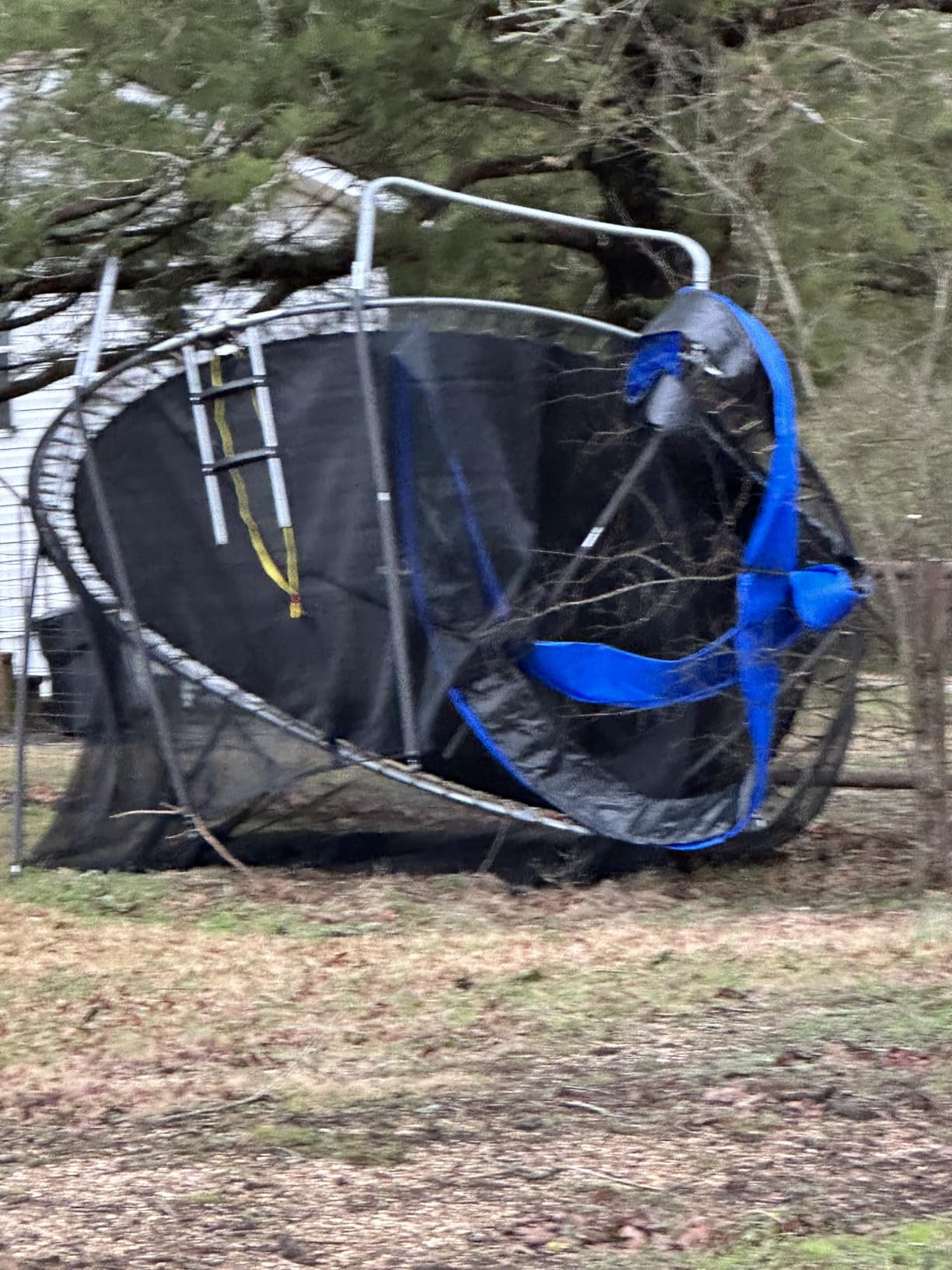
Anchor the trampoline. Wind lift is a documented problem on several of these models, and anchoring is what keeps the enclosure doing its job during a storm.
Net Care: Inspecting, Maintaining and Replacing an Enclosure
Nets are consumables. Every net in this roundup will eventually need attention, and the models with the thinnest mesh will need it first.
Inspect before anyone jumps. Run your hand along the full height of the mesh looking for tears, pulled seams and stretched areas. Check every net tie or clip at the base and the top rail, and check that the zipper runs fully both ways. Look at the poles for bends, especially after a windy spell. Five minutes covers the whole routine.
Check the gap. If your net has a top gap, measure it. Anything a child can fit through is a gap you should close with a net extension or a different unit.
Clean gently. Hose the mesh down and let it air dry. Avoid pressure washers, which push water through the seams and stretch the fabric.
Replace rather than patch when the tear is at a seam. A patch on a seam fails again in a week. A replacement net from the same manufacturer is the fix, and this is exactly why the ten-year spare parts commitment on the second pick in this roundup carries real value.
Replace the padding on the same schedule. Foam sleeves and pole covers degrade faster than nets because they take impact. The Skywalker in this roundup is the one where owners most often report foam wear after a few years, and the ZCMHAXJ is the one where pole sleeves are reported tearing.
Winterise by removing the net. In areas with hard winters, take the enclosure down before the first freeze and store the mat flat rather than folded. Trapping moisture inside a folded mat is what causes mat and foam failure, not the cold.
Frequently Asked Questions
What is a good trampoline with a safety net for kids?
For children aged six to twelve, a full-size round trampoline with a full-perimeter net, padded poles and a rated capacity of at least 400 pounds is the right starting point. Look for a net that connects to the jumping mat rather than hanging from the top rail alone, and confirm the enclosure is in the box rather than listed as a separate kit. For children under six, choose a mini trampoline with bungee cords instead of metal springs and a sewn-in net. A no-gap design is the safest option for preschoolers because it removes the opening at the top where small children can slip through.
Which trampoline brand is considered the most safe?
There is no single safest brand, because safety depends on matching the unit to the child’s age. Brand reputation tracks engineering choices: no-gap nets that connect to the mat, outwardly curved or padded poles, bungee cords for young children, and a stated ASTM or CPSIA certification. In our roundup the Zupapa design scored highest on enclosure engineering, the Skywalker mini scored highest on removing pinch points, and the VEVOR and Gigu units both carry stated certifications. Judge the model, not the badge on the box.
Which trampoline has the best net?
The best net in this roundup is the patented no-gap enclosure on the Zupapa 16FT, which connects directly to the jumping mat so there is no gap between mat and mesh, and uses outwardly curved poles that move impact away from jumpers. The best-supported mesh belongs to the JELENS, whose upright pillars give the peripheral netting more structural support than curved poles. The most visible net is the 360-degree see-through mesh on the VEVOR mini, which helps an adult watch a small child indoors.
Are trampolines with netting safe?
A net removes the most common injury route, which is falling off the edge onto the ground, and a spring pad removes the second, which is landing in the springs. It does not make a trampoline risk-free. Collisions between two jumpers, awkward landings and unsupervised use remain the main hazards. One jumper at a time, active supervision, no flips on an undersized unit, anchoring in wind and a quick net inspection before each session are what turn an enclosed trampoline into a reasonable one.
How much clearance do I need around a trampoline?
Leave a clear area of roughly 25 by 25 feet for a 12 foot trampoline and about 28 by 28 feet for a 14 foot one, measured from the frame edge outward in every direction, with extra room above the full height of the enclosure. The surface should be level, free of hard edges and clear of fences, trees, patio furniture and overhead lines. If your yard cannot hold that with margin on all sides, a smaller unit is the correct choice rather than a compromise.
Conclusion
After six weeks comparing ten enclosed units, our verdict on the best trampolines with safety nets comes down to who is jumping. The Skywalker 48 inch mini is our top pick overall for families, because the net is sewn straight onto the jumping mat and bungee cords replace metal springs, which removes two of the three common injury routes on a family trampoline. For a full-size yard unit, the Zupapa 16FT no-gap design is the strongest, with the best enclosure engineering and a ten-year frame warranty. The AOTOB 8FT is the best value full-size option, giving you a 400 pound rated frame and a five-year warranty at a fraction of the outlay, and the VEVOR mini is the pick when floor space is the constraint.
Whichever one you choose, the net only does its job while you are watching. Supervise, keep it to one jumper, check the mesh before every session, and anchor the frame in wind. The enclosure is what lets a trampoline sit in a family yard at all, and those four habits are what keep it there.
We will keep this roundup updated through 2026 as models change and new enclosures land, so check back before you buy.