
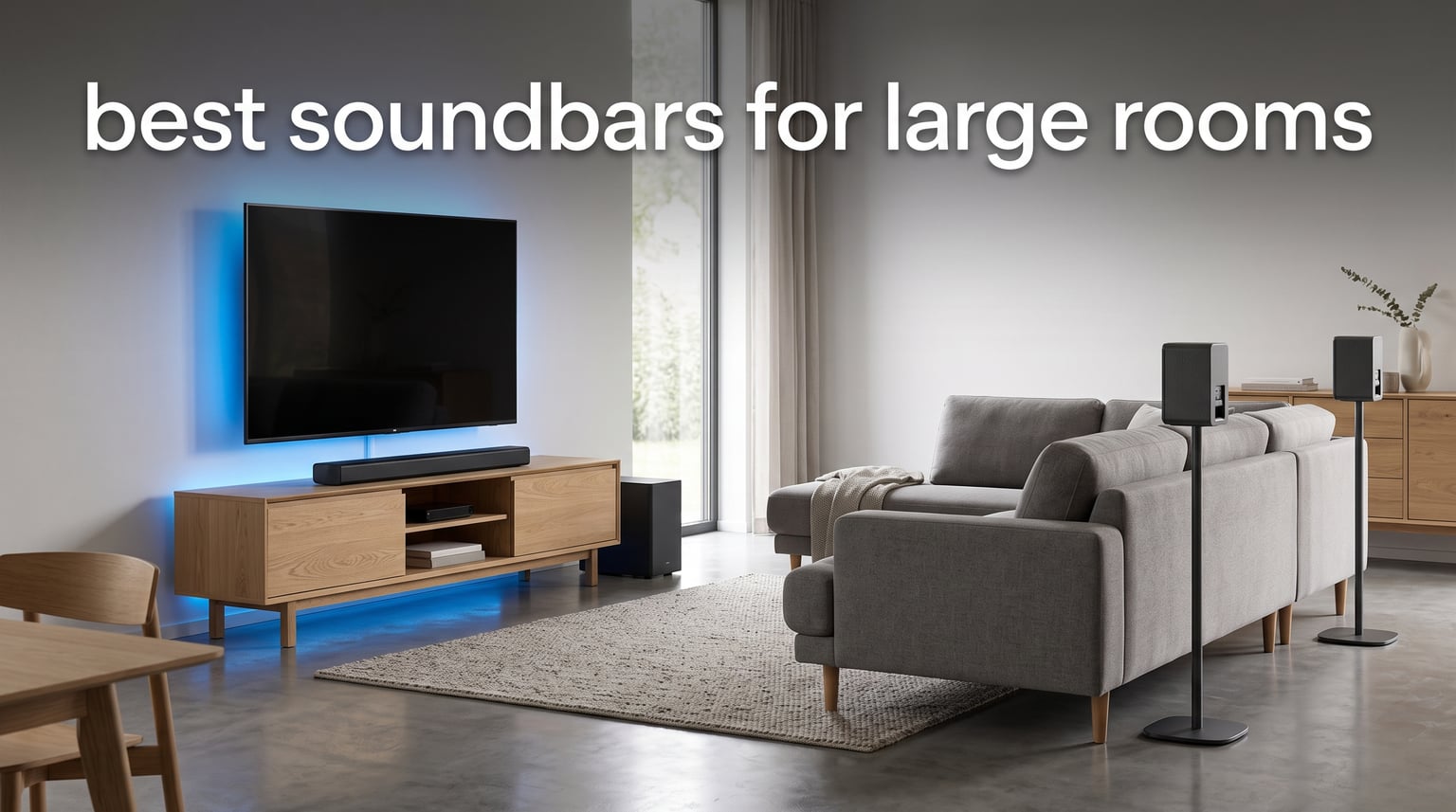
The best soundbars for large rooms need more than a loud center channel. In a living room of roughly 500 square feet or more, an open concept area, or a space with a vaulted ceiling, sound spreads out quickly; bass can lose impact and voices can seem distant from the main seat.
I narrowed this list to eight soundbar systems whose published specifications address that problem with higher channel counts, a separate subwoofer, rear speakers, room calibration, or a combination of those features. The right choice depends less on the TV alone than on the room boundaries, seating distance, ceiling height, and whether you want actual rear speakers behind the couch.
For a direct answer, a 5.1 setup with a subwoofer can serve a contained large living room, while 7.1.4 through 11.1.4 systems make more sense when you want a fuller surround sound system and Dolby Atmos overhead effects. I also call out the practical details that forum discussions keep raising: bass that gets lost in open floor plans, rear-speaker placement, and the limits that tall ceilings place on reflected height audio.
Table of Contents
The top 3 picks for large-room sound are complete surround systems 2026
The Samsung Q990F is my first look for the most extensive listed channel layout, the ULTIMEA Skywave X70 is the power-focused option with 7.1.4 channels and a 10 inch subwoofer, and the JBL Bar 1000MK2 suits people who need rear speakers that can detach from the bar. Each includes a subwoofer, but their rear-speaker approach and room setup are different.
A published channel count is not a promise that every room will sound the same. Still, these three give a large living room more physical speaker positions than a single-bar design, which is the more convincing starting point for movie effects that need to travel past the television wall.


The best soundbars for large rooms in 2026 cover eight distinct setups
The comparison below puts the listed layouts and key hardware side by side. A larger channel number is useful when the room and speaker placement can support it, but a clean center channel, an appropriately placed subwoofer, and calibration can matter just as much in a real family room.
| Product | Specifications | Action |
|---|---|---|
 Samsung Q800F Samsung Q800F |
|
Check Latest Price |
 JBL Bar 500MK2 JBL Bar 500MK2 |
|
Check Latest Price |
 ULTIMEA Skywave X70 ULTIMEA Skywave X70 |
|
Check Latest Price |
 Sonos Arc Ultra Sonos Arc Ultra |
|
Check Latest Price |
 Sony BRAVIA Theater System 6 Sony BRAVIA Theater System 6 |
|
Check Latest Price |
| Samsung Q990F |
|
Check Latest Price |
 TCL Q65H TCL Q65H |
|
Check Latest Price |
| JBL Bar 1000MK2 |
|
Check Latest Price |
1. Samsung Q800F is a focused 5.1.2 system for a contained large living room
- Q-Symphony
- Wireless Dolby Atmos
- Includes subwoofer
- 400W output
- Game Mode Pro
- 5.1.2 channel layout
- No rear speakers listed
The Samsung Q800F makes the most sense when the television wall is the clear focal point and you want a soundbar-plus-subwoofer setup instead of speakers spread around the room. Its listed 5.1.2 channel configuration and 400W maximum output give it a more substantial foundation than a basic TV soundbar, while the included subwoofer handles the low end.
I would put this one in a large but enclosed room rather than a wide-open great room. The product listing does not identify separate rear speakers, so the strongest effects begin at the front of the room and rely on the bar’s channels rather than speakers placed behind the listener.
Samsung lists Wireless Dolby Atmos, Q-Symphony, built-in Wi-Fi, Bluetooth, and Game Mode Pro. Q-Symphony is especially relevant to a compatible Samsung TV because the listed feature is designed to use TV and soundbar speakers together; buyers without that TV should treat it as an extra, not the reason to choose the system.
The 8 inch woofer and supplied subwoofer give this package a direct answer to the common large-room complaint that TV sound has no weight. The available rating is 4.9 from 24 reviews, a small review base compared with several systems here, so I would view that score alongside the published configuration rather than by itself.
The Q800F works best when the seating stays in front of the TV wall
This is a sensible fit for a primary couch facing the screen, with nearby sidewalls that can help contain the front sound field. A 5.1.2 bar can still present Atmos material, but it is not the same physical layout as a package with discrete rear channels.
Place the subwoofer along the front half of the room first, leaving it some breathing room from corners if bass becomes boomy. Then use the bar’s supplied controls and TV connection to set dialogue at your normal seat before judging its output.
The Q800F needs a compatible Samsung TV for its signature pairing feature
Q-Symphony is listed as a benefit, and that benefit has its clearest use with a Samsung TV. The unit also lists Wi-Fi, Bluetooth, and smartphone or laptop compatibility, which broadens music-streaming use after the TV setup is complete.
The 27.1 pound listed weight and 47 by 16 by 12 dimensions are worth checking against the furniture or wall-mount plan. Keep the upward-facing area clear if you want the Dolby Atmos channels to reflect from the ceiling rather than into a cabinet shelf.
2. JBL Bar 500MK2 is a 750W option with a 10 inch wireless subwoofer
- 750W output
- 10 inch wireless subwoofer
- Dolby Atmos
- MultiBeam 3.0
- PureVoice 2.0
- 5.1 channel layout
- No rear speakers listed
The JBL Bar 500MK2 brings a stated 750W maximum output and 10 inch wireless subwoofer to a 5.1-channel package. That combination is appealing for a soundbar for a big room where fuller bass and a broad front presentation matter more than placing speakers behind the couch.
Its 20Hz listed frequency response gives bass-focused shoppers a useful specification to check, and the wireless subwoofer makes front-of-room placement less restricted by a signal cable. The listed system is still 5.1, so buyers seeking the most distinct surround placement should compare it with the 7.1.4 packages later in this guide.
JBL includes Dolby Atmos, MultiBeam 3.0, PureVoice 2.0, SmartDetails, and easy sound calibration in the product details. PureVoice 2.0 is a particularly practical feature for large rooms because dialogue has to stay intelligible when people sit farther from the screen or when the room has harder surfaces.
The connectivity list is unusually broad: Bluetooth, HDMI, optical, USB, and Wi-Fi, plus HDMI eARC with 4K Dolby Vision passthrough. It also supports AirPlay, Google Cast, Spotify Connect, Tidal Connect, and Roon Ready, so this can work as more than a TV-only speaker.
The Bar 500MK2 suits wide front seating and music streaming
MultiBeam 3.0 is designed for a wide soundstage, which makes this JBL a logical fit if the couch stretches across the room but all listeners remain in front of the bar. I would use the system’s calibration before making a final call on subwoofer level, especially in an open plan where there is no rear wall nearby.
Its 37 inch soundbar width can fit comfortably below many television sizes, including a soundbar for a 65 inch TV, without needing to match the TV’s full width. What matters is leaving the drivers unobstructed and keeping the bar centered with the screen and principal seating.
The Bar 500MK2 leaves rear-channel placement to future priorities
No separate rear speakers appear in the listed package features, so the system is easier to keep visually simple than a complete rear-speaker setup. The tradeoff is that a large room will not get the same behind-the-listener speaker positions offered by JBL’s detachable-rear model.
The 24.3 pound weight and 4.1 by 37 by 2 inch dimensions help with a low-profile shelf or wall plan. Check that the HDMI eARC input on the television is accessible before mounting, since that connection is the listed route for its 4K Dolby Vision passthrough capability.
3. ULTIMEA Skywave X70 is the power-forward 7.1.4 system
- 7.1.4 surround
- 980W output
- 20Hz bass
- Wireless speakers
- 10-band EQ
- 48.5 pound system
- Large-system placement needed
The ULTIMEA Skywave X70 is the most power-forward choice in this group on its published 980W maximum output specification. It pairs that figure with a 7.1.4 channel layout, a 10 inch wireless subwoofer, and a stated 20Hz low-frequency point, all useful ingredients for a large-room home theater soundbar.
The listing also identifies wireless surround speakers and dual 5GHz wireless transmission. That matters in rooms where running speaker cable around doors, rugs, or open traffic paths would be impractical, though every speaker still needs a sensible physical position and power plan.
Its audio processing details are unusually specific: a GaN amplifier with 98% listed efficiency, NEURACORE triple-core DSP, and 24-bit/192kHz processing. Those specifications do not remove the need for setup, but they give owners a real tuning path through the app’s 10-band EQ and 121 sound presets.
For video sources, it lists HDMI eARC, optical, Bluetooth, USB, 4K HDR pass-through, and CEC sync support. That makes it suitable for a projector or gaming console as well as a television, provided the rest of the signal chain supports the chosen video format.
The Skywave X70 is strongest for rooms that need physical surround placement
A 7.1.4 layout offers more speaker channels than a 5.1 system, and the wireless surround speakers give the layout room to work in a deeper seating area. I would consider it first for a dedicated media zone or a larger room with a couch that has space behind it.
The 10 inch subwoofer and 20Hz listed bass capability are relevant when forum users describe low frequencies disappearing into a large open space. Start with the sub in the front third of the room, then move it incrementally rather than raising its level immediately when a seat sounds thin.
The Skywave X70 needs room for its complete system and calibration time
The listed 48.5 pound system weight signals that this is not a one-piece bar to casually shift after everything is connected. Measure the soundbar’s 43.31 by 3.94 by 2.76 dimensions, identify outlet locations for the wireless components, and leave time for calibration and EQ adjustment.
A vaulted ceiling can soften the apparent location of reflected height sound from any upward-firing system. In that situation, the X70’s surround-speaker placement and adjustable EQ are more dependable setup tools than assuming the height channels alone will solve the room.
4. Sonos Arc Ultra is a 9.1.4 bar for an expandable large-room system
- 9.1.4 spatial audio
- Speech Enhancement
- Trueplay tuning
- Voice control
- Expandable system
- Subwoofer not included
- Rear speakers not included
The Sonos Arc Ultra takes a different route from the bundled surround packages. It is listed as a 9.1.4 Dolby Atmos soundbar with Sound Motion acoustic architecture, but its larger-room promise is based on the bar first and an option to expand with a Sonos Sub and Era 300 rear speakers.
That makes it attractive for someone who wants to start cleanly with one 46.18 inch bar and build a bigger system later. The listing does not include a subwoofer or rear speakers in the product title, so a buyer should decide whether the standalone bar meets the immediate room need or whether expansion is part of the plan.
Speech Enhancement powered by AI, Trueplay room tuning, and a single HDMI eARC connection address three everyday setup concerns: dialogue clarity, room response, and cable simplicity. For a large room with reflective floors or uneven furniture, tuning is more helpful than copying a setting from another house.
The Arc Ultra supports Wi-Fi, Bluetooth, Apple AirPlay 2, Spotify Connect, the Sonos app, touch controls, Sonos Voice Control, and Amazon Alexa. Its listed 12.7 pound weight and 4.35 by 46.18 by 3.13 dimensions also make it substantially lighter than a multi-component package, even though the soundbar itself is quite wide.
The Arc Ultra works best for a phased Sonos home-theater plan
I would choose this bar when clean installation and multi-room streaming are central priorities, then add the listed Sonos Sub and Era 300 rear speakers if the room needs more bass and physical surround coverage. That progression is more flexible than buying every component at once, but it also means planning for the complete system from the beginning.
Trueplay room tuning is an important listed feature for a large living room because seating often is not centered perfectly on the TV. Run the tuning after the furniture is in its regular position, not during an empty-room setup, so it reflects the room you actually use.
The Arc Ultra needs expansion for the strongest low bass and rear effects
The soundbar supports 9.1.4 spatial audio on its own, yet the published expansion path clearly identifies separate subwoofer and rear speakers. A large open plan that already loses bass will usually benefit more from planning that expansion than from expecting a single bar to create the same physical impact as a bundled subwoofer system.
Keep the bar’s upward-facing drivers out from under a low cabinet and use the HDMI eARC connection listed by Sonos for TV audio. For a high ceiling, do not assume any reflected Atmos effect will be as defined as it would be in a standard-height room.
5. Sony BRAVIA Theater System 6 is a complete 5.1 package with rear speakers
- 1000W output
- Dedicated center channel
- Rear speakers included
- Dolby Atmos and DTS:X
- Voice Zoom 3
- Wired subwoofer
- Wired rear speakers
The Sony BRAVIA Theater System 6 answers the rear-speaker question directly: the listed package includes a soundbar, wired subwoofer, and rear speakers. Its 5.1-channel layout, 1000W total power output, Dolby Atmos and DTS:X compatibility, and dedicated center channel create a practical full-system choice for a large living room.
Discrete rear speakers are often more meaningful in a big space than trying to make a front bar sound like effects are behind the couch. This Sony system gives you actual rear locations, provided the room can accommodate the wiring required by its listed wired subwoofer and rear components.
The center channel and Voice Zoom 3 compatibility with a BRAVIA TV point toward a dialogue-first setup. People who struggle with soft voices in television shows should value that dedicated center speaker alongside the normal volume controls, rather than pushing every channel louder.
Sony also lists Multi Stereo for room-filling sound, Bluetooth 5.3 streaming, DSEE, and BRAVIA Connect App control. The soundbar itself is 35.7 inches wide and 3.6 by 35.7 by 2.6 inches, making it shorter than several bars here while the full system does more of the work around the room.
The BRAVIA Theater System 6 fits rooms that can accept speaker wiring
This package is a strong match when a couch has a rear wall or clear side positions for the included rear speakers. I would map cable routes before opening the boxes, especially in rooms with walkways, since the listing specifies wired subwoofer connectivity and a wired rear-speaker system.
Once installed, place the rear speakers around or slightly behind the primary seats, rather than beside the television. That position gives a 5.1 soundtrack a clearer surround role than a bar-only system can create from the front wall.
The BRAVIA Theater System 6 favors dialogue and TV integration
The dedicated center speaker is the defining specification here for viewers who want speech to remain clear at a distance. Voice Zoom 3 is specified for compatible BRAVIA TVs, so that particular feature should be treated as a compatibility bonus for Sony-TV owners.
The system’s listed 20Hz frequency response and 1000W total output give it the published numbers many big-room buyers seek. Placement remains important: a wired subwoofer pushed fully into a corner may produce more bass, but it can also make the response less even across a long couch.
6. Samsung Q990F is the 11.1.4 pick for the fullest listed channel layout
- 11.1.4 channels
- Wireless rear speakers
- Wireless Dolby Atmos
- Q-Symphony
- Adaptive Sound
- 41.89 pound system
- Q-Symphony needs Samsung TV
The Samsung Q990F is the clearest answer for a buyer who wants the highest listed channel configuration in this roundup. It combines 11.1.4 channels, a wireless subwoofer, wireless rear speakers, Wireless Dolby Atmos, and 756W maximum output in a system designed around full-room surround placement.
For the best soundbars for large rooms, physical rear speakers can be the difference between a broad front wall of sound and effects that occupy the seating area. The Q990F includes those rear speakers in its stated configuration, which makes it a more natural match for a deep room, a dedicated viewing area, or a couch away from the television.
Samsung lists Adaptive Sound with built-in sensors that calibrate to the room, along with Q-Symphony, Game Mode Pro, Alexa built-in, Google Cast, and AirPlay 2. Automatic room calibration cannot change an unusually difficult floor plan, but it is useful when the left side of the room opens into another area or one wall is much farther away.
The available product data lists an 8 inch audio driver size, an 8 inch subwoofer diameter, 20Hz frequency response, and a 41.89 pound system weight. That is a substantial package, so the strongest setup starts with deciding where the subwoofer and wireless rears will live rather than treating them as accessories to add later.
The Q990F is best when rear speakers can sit behind the main couch
Place the wireless rear speakers around the listening position and leave a reasonably open path from their drivers to the seats. The more the rear channels are hidden by furniture or placed far ahead of the couch, the less the 11.1.4 layout can show its purpose.
I would use the automatic calibration after the rear speakers and subwoofer have permanent locations. In an open floor plan, a modest change in subwoofer position can do more for bass consistency than simply increasing the level in the remote menu.
The Q990F benefits most from a compatible Samsung television
Q-Symphony is one of the system’s headline capabilities, and the listing states it works with Samsung TV and soundbar speakers together. Owners of another TV can still use the listed Bluetooth and HDMI connectivity, but should not base the choice on that Samsung-specific integration.
The listed wall-mount type may suit a clean front wall, while the 48.5 inch system width requires careful centering beneath the TV. A high ceiling remains a challenge for reflected height effects, but the included rear speakers give the overall surround field a physical foundation that does not depend solely on ceiling reflection.
7. TCL Q65H is a calibrated 5.1 system with a wireless subwoofer
- 5.1 surround
- 580W output
- Wireless subwoofer
- AI Sonic calibration
- Dolby Atmos and DTS:X
- No dedicated rear speakers
- Side-firing drivers
The TCL Q65H puts 5.1 surround sound, a wireless subwoofer, Dolby Atmos, DTS:X, and AI Sonic optimization into a straightforward large-room package. Its product features list 580W power output, while its side-firing drivers are intended to create a broader sound field without separate rear speakers.
That design is useful for a room where placing speakers behind the seating is impossible or visually unwanted. It is not the same as the discrete rear-speaker arrangement in the Sony, Samsung Q990F, ULTIMEA, or JBL Bar 1000MK2, so I would select it for simplicity rather than for the most literal rear-channel placement.
AI Sonic optimization through the TCL app is the standout practical feature because it is described as room and seating calibration. In a large room, calibration should be done from the main seats and repeated after major furniture moves, since a new rug or an open doorway can change what listeners hear.
The unit lists HDMI, optical, Bluetooth, USB, and auxiliary connectivity, as well as remote and touch control. At 41.5 inches wide and 9.3 pounds, it is also a relatively manageable bar to position below a wider television or on furniture with a solid top surface.
The Q65H is right for large rooms without a rear-speaker route
Choose this TCL if a complete speaker layout behind the couch is a nonstarter but you still want a separate wireless subwoofer. The side-firing approach can make the front sound feel wider, while the wireless sub gives you flexibility to test more than one front-half location.
For a 500 square foot room that is closed on most sides, the listed 5.1 architecture can be a reasonable starting point. For a much larger open concept space, a package with separate rears and higher channel count has a clearer physical advantage.
The Q65H depends on calibration and careful side clearance
Do not wedge the bar tightly between cabinet walls, because its listed side-firing drivers need clear space to interact with the room. Use AI Sonic after the final bar placement, and keep the television stand from blocking the front or side output.
The product data identifies a floor-standing mount type, which deserves a closer look before a wall-mount installation is assumed. Its wireless subwoofer addresses signal-cable flexibility, but it still needs a power outlet and a spot that does not obstruct everyday traffic.
8. JBL Bar 1000MK2 is the flexible 7.1.4 system with detachable rear speakers
- Detachable rear speakers
- 7.1.4 channels
- 10 inch wireless subwoofer
- MultiBeam 3.0
- PureVoice 2.0
- Rear speakers need charging
- 32.1 pound system
The JBL Bar 1000MK2 is the right kind of unusual for a large room that cannot keep permanent rear speakers in place. Its stated 7.1.4-channel setup includes detachable wireless surround speakers, a 10 inch wireless subwoofer, Dolby Atmos, DTS:X, MultiBeam 3.0, and PureVoice 2.0.
You can separate the rechargeable rear speakers from the bar for a movie session, then return them when the room needs to look less like a theater. That flexibility directly addresses a common real-world problem: many open living rooms have a couch in the middle of the space, but no convenient permanent rear-speaker wiring route.
JBL lists 480W RMS output and 960W maximum output, plus 20Hz frequency response, easy sound calibration, night listening mode, and HDMI eARC with 4K Dolby Vision passthrough. The 10 inch wireless subwoofer is a serious addition for large room audio, especially when the main seat is far from the television wall.
Wi-Fi, Ethernet, HDMI, optical, USB, app, remote, touch, and voice control are all listed, giving it a broad connection and control set. The detachable speakers use rechargeable batteries with a 6600mAh listed capacity, which is useful freedom but adds a charging step to the ownership routine.
The Bar 1000MK2 is best for flexible real rear-speaker placement
I would choose this JBL for a multi-use living room where speakers can sit behind the couch during films but cannot remain there all week. Detached and placed near the listening area, they create actual surround locations instead of asking the front bar to simulate them.
Use the system’s calibration after moving the detachable speakers into their viewing positions. Keep their placement consistent from session to session if you want the calibrated balance to remain meaningful.
The Bar 1000MK2 asks owners to manage rechargeable rear speakers
The rear speakers’ battery-powered design is the tradeoff for their flexibility. Plan a charging routine before a long movie night, since the system’s full 7.1.4 layout depends on those detachable speakers being ready to use.
The soundbar measures 47.4 inches wide and the system weighs 32.1 pounds, so measure the TV stand and allow space for the 10 inch subwoofer. With no raw speaker wires crossing the room, this is one of the cleaner complete surround options for an open floor plan.
A large-room soundbar should match room volume, seating, and speaker placement
For soundbar shopping, call a room large at about 500 square feet or more, or treat it as large when it has an open connection to a kitchen, dining space, stairwell, or tall ceiling. The problem is room volume as much as floor area: a 500 square foot room with a vaulted ceiling holds more air and gives reflected sound farther to travel than a room with a standard ceiling.
Start by drawing the television wall, primary seats, power outlets, and any route behind the couch. That simple exercise usually tells you whether a single bar, a bar-and-subwoofer package, or a full system with rears is realistic before channel-count marketing enters the conversation.
A 5.1.2 layout suits contained rooms, while 7.1.4 and 11.1.4 serve deeper rooms
The first number describes the main and surround channels, the second identifies the subwoofer channel, and the final number refers to height channels. A 5.1.2 soundbar can be satisfying in a contained large room, while 7.1.4 and 11.1.4 systems add more surround and height positions for a deeper home theater layout.
Channel count alone does not make a room-filling sound system. A 5.1 package with rear speakers correctly positioned behind the couch can feel more involving than a higher-numbered bar that has no clear path to the listener or ceiling.
A separate subwoofer is the direct fix for bass that disappears in a big room
Large rooms and open floor plans are difficult because low frequencies spread widely and can collect unevenly near walls and corners. A separate subwoofer gives you the freedom to test placement without moving the television, which is why every bundled system in this list includes one.
Begin with the subwoofer in the front third of the room, then listen at the main seat and move it in small increments. Turning up the bass may help one chair but can make another chair muddy, so placement comes before aggressive level changes.
Rear speakers are the clearest way to fill the area behind the listener
Forum discussions repeatedly point to rear speakers when a standard bar feels too small for an open living room. The Sony BRAVIA Theater System 6, Samsung Q990F, ULTIMEA Skywave X70, and JBL Bar 1000MK2 provide rear-speaker solutions in the listed product data.
Put rear speakers slightly behind or alongside the principal seats, at a position where furniture does not block them. If the couch is against the back wall, side placement may be more practical, but it will create a different surround effect than speakers behind the listener.
A high ceiling makes reflected Dolby Atmos less predictable
Upward-firing drivers use ceiling reflection to suggest height, so a standard flat ceiling is usually simpler than a vaulted, angled, or very high one. This does not make a Dolby Atmos soundbar unusable in a tall room; it means the perceived height effect can be less exact and should not be the only reason for a purchase.
For a vaulted ceiling living room, prioritize a system with a capable subwoofer, clear dialogue handling, and actual rear speakers if the room allows them. Physical surround placement remains helpful even when ceiling reflection is less consistent.
An open floor plan needs boundaries and calibration more than extra volume alone
In an open floor plan, aim the main seating toward the bar, keep the bar centered under the television, and place the subwoofer where it can be adjusted without blocking a walkway. Room-calibration features listed on the JBL models, Sonos Arc Ultra, Samsung Q990F, and TCL Q65H are useful starting points once furniture is in its normal place.
Do not expect a soundbar to serve a kitchen, dining area, and lounge with identical balance from one listening setting. Choose the primary listening zone first, calibrate for it, and use music or multi-room capabilities as a separate consideration from movie surround sound.
A soundbar for a 65 inch TV should fit the furniture and not block the screen
A soundbar does not need to be as wide as a 65 inch TV, but it should look proportionate, fit securely on the stand, and leave the television’s lower edge and IR receiver unobstructed. The listed bars range from the Sony at 35.7 inches to the Samsung Q990F at 48.5 inches, with several others between those widths.
Wall mounting can free shelf space, while a stand installation can simplify cable access and future adjustments. In either case, keep an upward-firing Atmos bar out from under an enclosed shelf and verify HDMI eARC access before making mounting holes.
HDMI eARC is the preferred TV connection when the setup supports it
HDMI eARC is listed on several products here, including the JBL Bar 500MK2, ULTIMEA Skywave X70, Sonos Arc Ultra, TCL Q65H, and JBL Bar 1000MK2. It is the connection to prioritize when a compatible TV is available because it keeps the system tied to the TV audio path and listed advanced audio features.
Before choosing a model, check the television’s ports, its audio settings, and the source devices you will use for gaming or streaming. A system may offer Bluetooth or optical as well, but the connection plan should be settled before you decide where every component will sit.
The answers to common large-room soundbar questions are practical
What is considered a large room for a soundbar?
A large room for a soundbar is roughly 500 square feet or more, but an open floor plan, vaulted ceiling, or connection to other rooms can make a smaller area act larger. Look for a separate subwoofer, room calibration, and preferably rear speakers when the primary seating is far from the television.
How big of a soundbar do I need for a 65 inch TV?
A soundbar does not have to match the width of a 65 inch TV. Choose one that fits the furniture, stays centered below the screen, does not block the display or IR receiver, and has room around upward-firing drivers; the system configuration matters more than matching the TV width.
What is the number one rated soundbar?
Among the eight products reviewed here, the Samsung Q800F has the highest listed rating at 4.9 from 24 reviews. For the most extensive listed surround configuration, the Samsung Q990F has 11.1.4 channels with a wireless subwoofer and wireless rear speakers, so the better fit depends on whether rating or room-filling system layout is the priority.
How to improve TV sound in a large room?
Use HDMI eARC when the TV and soundbar support it, place the bar centered and unobstructed, and add a separate subwoofer for bass placement flexibility. For a deep room, place rear speakers around or behind the main couch, run room calibration after furniture is settled, and do not rely on volume alone to solve dialogue or open-floor-plan problems.
The right large-room soundbar is the one that fits the room around it
For the broadest listed surround system, I would start with the Samsung Q990F and its 11.1.4 layout, wireless subwoofer, and wireless rear speakers. The ULTIMEA Skywave X70 is compelling for its published 7.1.4 system, 980W output, 10 inch subwoofer, and deep-bass specification, while the JBL Bar 1000MK2 offers the most flexible rear-speaker placement.
The best soundbars for large rooms in 2026 are not necessarily the widest bars or the ones turned up the loudest. Pick the channel layout you can actually place, reserve a proper spot for the subwoofer, use calibration after the furniture is settled, and check the current listing details before deciding.