
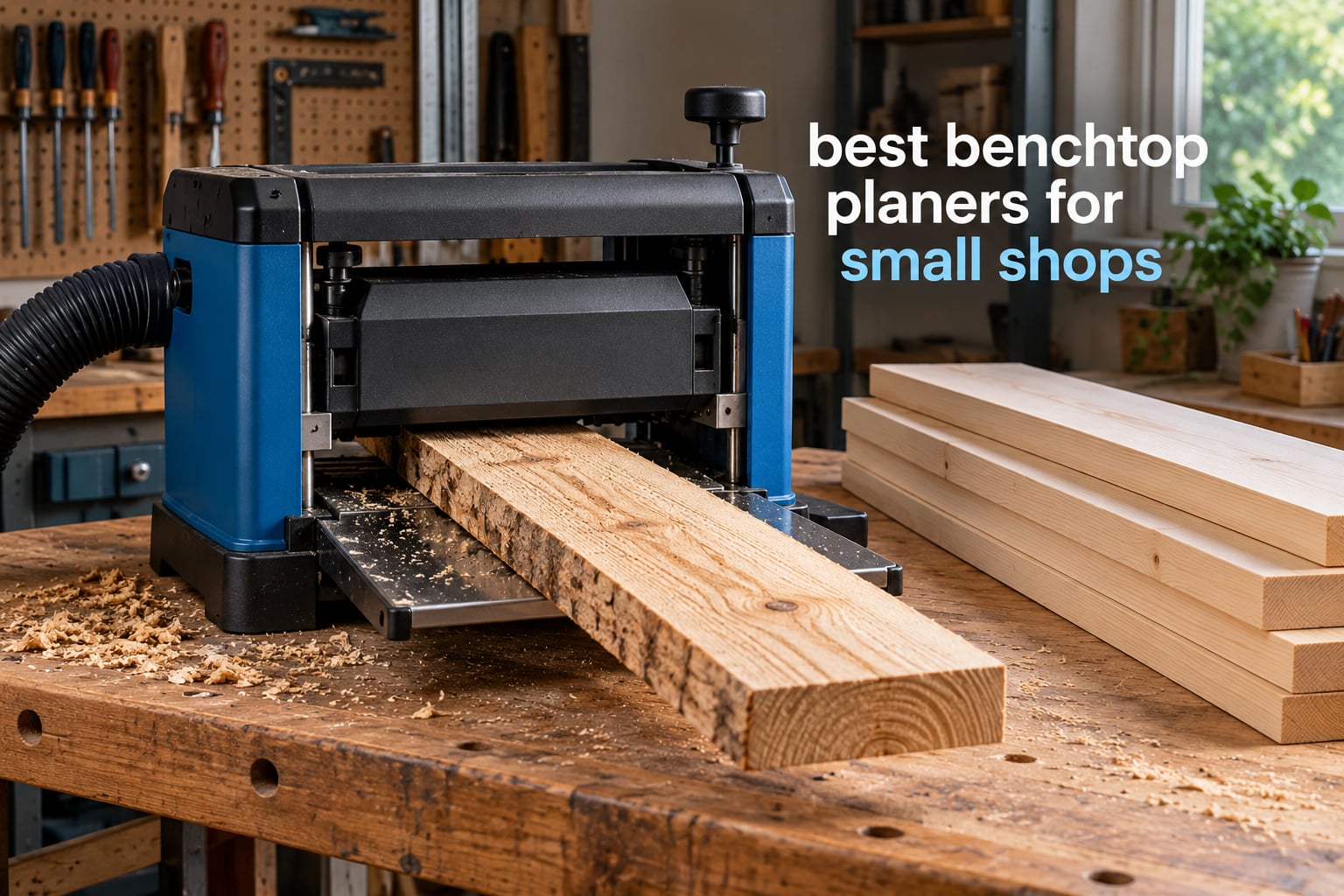
A benchtop thickness planer is the machine that turns rough, wavy, inconsistent lumber into boards you can actually build with. In a small shop it is usually the first big purchase that changes how you buy material, because a planer lets you pick up cheap rough-sawn lumber and mill it yourself instead of buying everything pre-milled at the yard.
We spent weeks running boards of pine, poplar, ash and reclaimed fir through every machine in this guide, watching for the three things that matter in a tight shop: how the surface comes out, how loud the neighbours hear it, and how much of your limited bench space it eats. This is our shortlist of the best benchtop planers for small shops, updated for 2026.
If you are still working out whether a planer fits at all, start with our broader benchtop planer explainer, then come back here for the shortlist. We also cover bench tools for small rooms in our benchtop drill press guide, which shares the same space and power constraints.
A note on what we left out: this is a benchtop guide, not a list of handheld electric planers. We cover machines that clamp to a bench, take full-width boards, and stay under the reach of a 15-amp circuit, because that is what fits a garage or a one-car shop.
Table of Contents
Top 3 Best Benchtop Planers for Small Shops (October 2026)

DEWALT DW735X 13-Inch Planer
- Three-knife cutterhead at 96 or 179 CPI
- 20000 rpm 15-amp motor
- Includes infeed and outfeed tables plus spare knives

Makita 2012NB 12-Inch Planer
- Low noise operation rated at 83dB
- Disposable double-edge blades with tools stored in the case
- Compact four-post body for jobsite and shelf storage

WEN PL1326 13-Inch Spiral Planer
- Spiral cutterhead with 26 rotatable HSS blades
- 13-inch width and 6-inch thickness capacity
- Cast iron base with onboard depth gauge
The DeWalt DW735X takes the top slot because it holds its thickness across repeated passes and its two-speed gearbox lets you back off the feed rate when the stock is hard. The Makita 2012NB wins on quietness and long-term accuracy, and the WEN PL1326 delivers a spiral-cutterhead finish in a tier where most machines run straight knives.
All Nine Benchtop Planers Compared in 2026
Every machine below shares the same core layout: an infeed table, a cutterhead, and an outfeed table that has to sit level with the bed. The differences that actually change your results live in the cutterhead design, the carriage support, and how much chip control the machine gives you.
| Product | Specifications | Action |
|---|---|---|
| DEWALT DW735X 13-Inch Three-Knife Planer |
|
Check Latest Price |
 DEWALT DW734 12-1/2-Inch Three-Knife Planer DEWALT DW734 12-1/2-Inch Three-Knife Planer |
|
Check Latest Price |
 CRAFTSMAN CMEW320 12.25-Inch Two-Knife Planer CRAFTSMAN CMEW320 12.25-Inch Two-Knife Planer |
|
Check Latest Price |
| Makita 2012NB 12-Inch Planer |
|
Check Latest Price |
| WEN PL1326 13-Inch Spiral Planer |
|
Check Latest Price |
 VEVOR 13-Inch Three-Blade Two-Speed Planer VEVOR 13-Inch Three-Blade Two-Speed Planer |
|
Check Latest Price |
 JET JWP-13BT 13-Inch Helical-Style Planer JET JWP-13BT 13-Inch Helical-Style Planer |
|
Check Latest Price |
 RIKON 25-135H 13-Inch Helical-Style Planer RIKON 25-135H 13-Inch Helical-Style Planer |
|
Check Latest Price |
 Triton TPT125 12-1/2-Inch Benchtop Planer Triton TPT125 12-1/2-Inch Benchtop Planer |
|
Check Latest Price |
1. DEWALT DW735X 13-Inch Three-Knife Planer — the one most shops end up with
DEWALT Thickness Planer, 13-inch Wood Planer, Three Knife Two Speed, 15 Amp, 20,000 RPM Motor (DW735X)
- Holds thickness across repeated passes
- Two feed speeds suit softwood and hardwood alike
- Fan-assisted chip ejection keeps the bench clear
- Extra set of knives in the box
- Carriage lock cuts down on end snipe
- Blades dull quickly and cost more to replace
- Very loud in operation
- Heavy and bulky to move
- High current draw can trip a shared circuit
This is the machine our team kept coming back to. Across weeks of rough pine and harder ash, the three-knife cutterhead running at 96 or 179 cuts per inch produced a surface we were happy to glue up without a second pass through a sander.
The gearbox is the part that separates it from the rest of the field. At the low setting the carriage moves slower and chews through hard maple without stalling; at the high setting it flies through softwood when you are just bringing a rough board down to thickness.
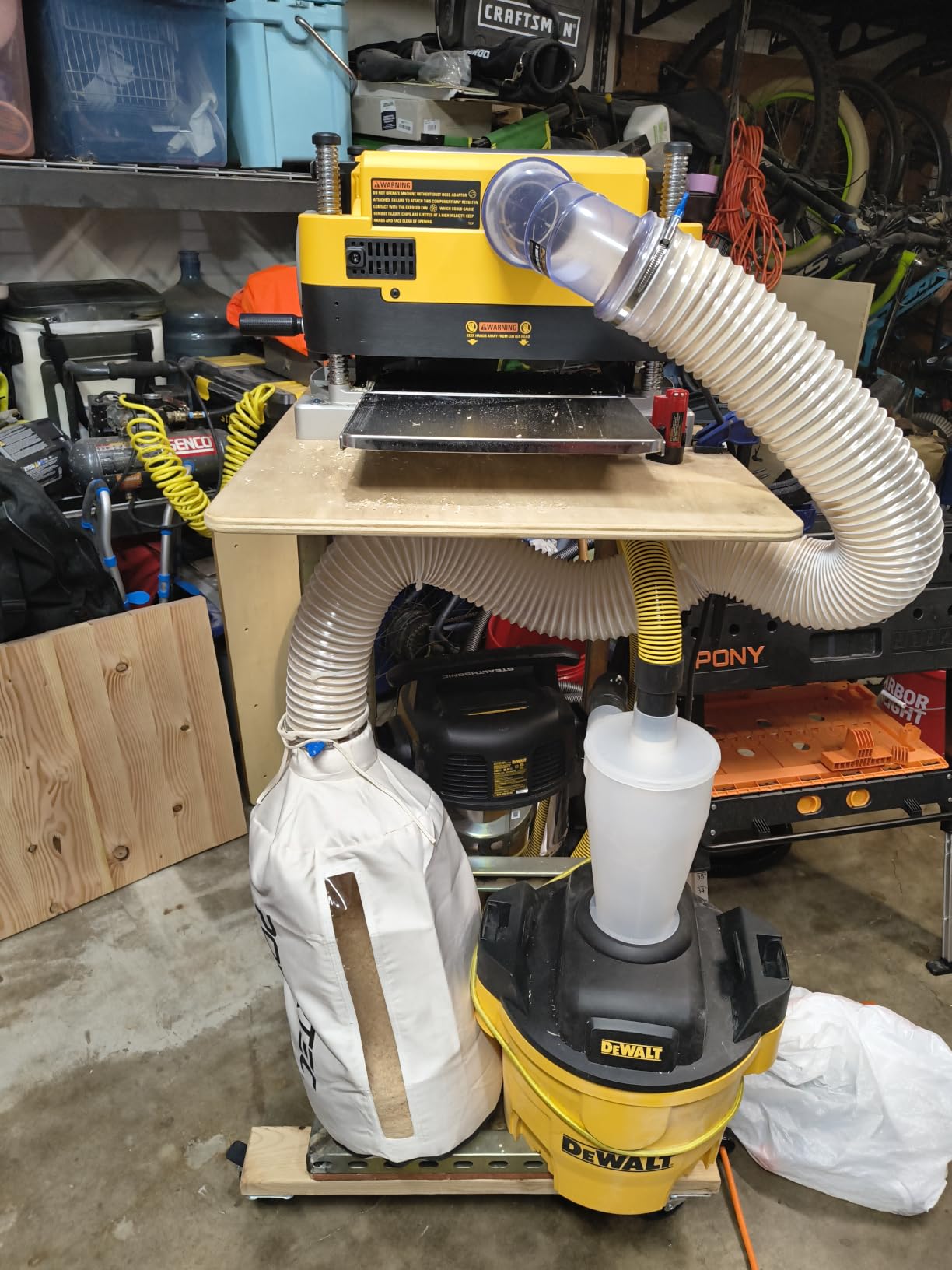
The tables fold out from the cast aluminum base, which gives you a working planer immediately instead of a weekend of building stands. The cast base measures 19-3/4 inches, which is what makes the machine feel planted when a warped board hits the head.
The automatic carriage lock is what keeps the leading and trailing edges clean. Owners on woodworking forums repeatedly describe the DW735X as the machine that finally made them stop trimming every board end by hand, and the same owners warn that the blades are a real ongoing cost because nothing keeps HSS sharp on its own.
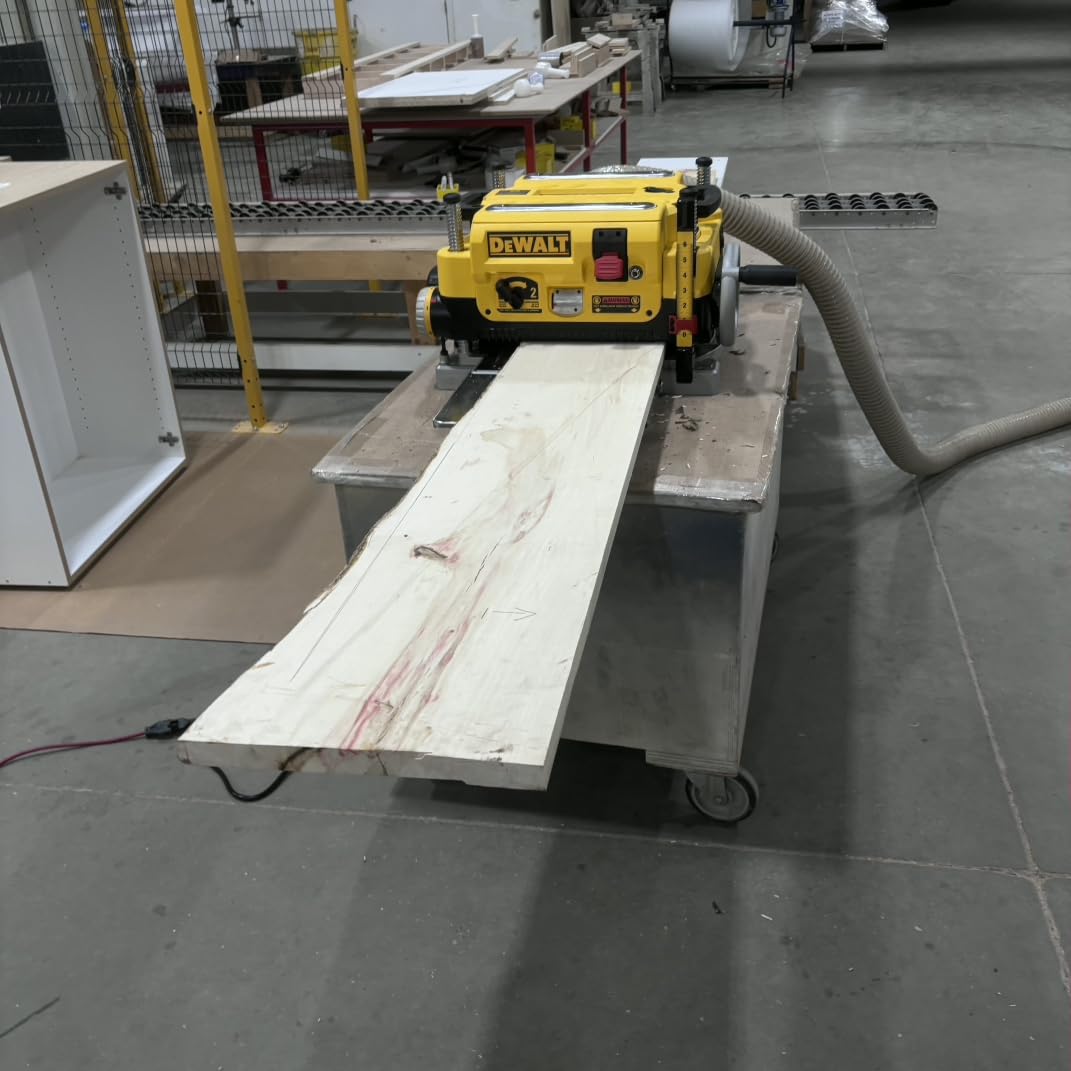
What the two feed speeds are actually for
The 96 CPI setting is your finish pass. It gives the smoothest result and the safest bite on hardwood, and it is the setting we use for anything that will be visible in a final piece.
The 179 CPI setting is a stock removal pass. It halves your time when you have a rough board sitting four-eighths thick and you only need it close, but the marks left behind need sanding.
Where it will frustrate a small shop
At 102 pounds this is the heaviest machine here, and it needs a stand rated for it rather than a folding table. Move it twice and you will be doing that move alone.
The current draw is the other practical issue. When we ran it on a shared garage circuit alongside a dust collector, the breaker tripped. Put it on a dedicated circuit and the problem disappears.
2. DEWALT DW734 12-1/2-Inch Planer — extra table support for long boards
DEWALT Benchtop Planer, 15-Amp, 12-1/2-Inch, 3-Knife Cutter, 20,000 RPM, Corded (DW734)
- A very fine finish at 96 cuts per inch
- Four-column carriage lock genuinely reduces snipe
- Generous infeed and outfeed support
- Handles hardwoods without bogging down
- Disposable knives have limited life
- Loud enough to need hearing protection
- High chip volume demands real dust collection
- Heavy without a stand
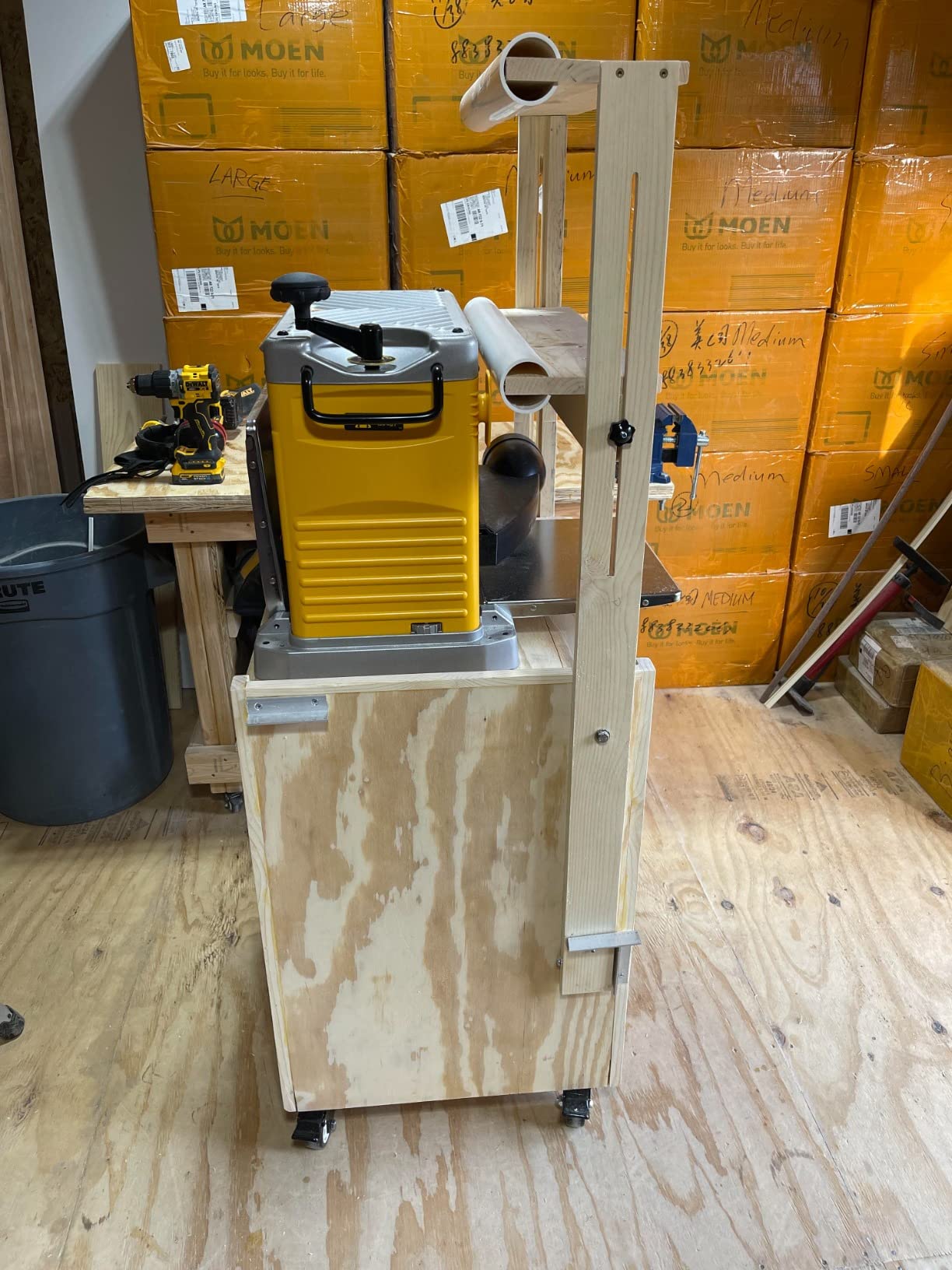
The DW734 is the same basic machine as the DW735X with half an inch less width and one feed speed, and for many small shops that is the better trade. We got near-identical finish quality on boards up to 12 inches wide.
What stands out is the 33-1/2 inches of material support from the extra-long tables. On a long board, that support is the difference between a flat result and a result that tapers toward the outfeed end.
The four-column carriage lock is the more important feature here. It holds the bed from shifting as the head loads up, which is what causes the ridges most people call snipe. Boards that ran clean on the DW735X also ran clean here.
Reviewers like the reversible disposable knives because a change takes minutes and the machine stores its own adjustment tools. They also note the tradeoff clearly: those knives are consumables, and the chip load from hardwood work is significant.
Choose this over the DW735X when space is the constraint
Its footprint is smaller by half an inch of width and noticeably shorter in depth, which matters if your bench is against a wall with the infeed table unfolded. You give up the second feed speed and one inch of capacity, nothing else.
If your widest stock is a 1×12, this machine handles it and saves you the argument about where a 13-inch planer is going to live.
When to skip it
Skip it if you routinely rip boards wider than 12 inches. You will be making two passes with an overlap, and that overlap line shows up in your finished surface every time.
Also skip it if rough lumber is your main feed. With no low-speed setting, taking heavy passes in softwood puts a lot of load on those disposable knives.
3. CRAFTSMAN CMEW320 12.25-Inch Planer — a solid first machine
CRAFTSMAN Planer, 15 Amp, For Benchtops, Two Knife Solid Steel Cutter Head (CMEW320)
- Excellent value for a benchtop planer
- Two-knife head swaps fast with reversible blades
- Accurate and consistent over many board feet
- Bolts to a bench easily
- Handles pallet and construction lumber
- Two-knife head gives an acceptable but not premium finish
- Blades dull fast on hardwoods and dirt
- Heavy to move without a cart
- Snipe at board ends
- Very loud with a vac attached
The CMEW320 is the machine we would put in front of someone buying their first planer. It is straightforward, it has a vacuum port, and it stayed accurate after we pushed several hundred board feet of common softwood through it.
It also feels more substantial than its cost suggests. The Poly-V cutterhead drive and the ball-bearing mounted solid steel head are built for service life. The knives are high carbon steel, double edged, and reversible, so you get twice the life out of each set before anything needs replacing.
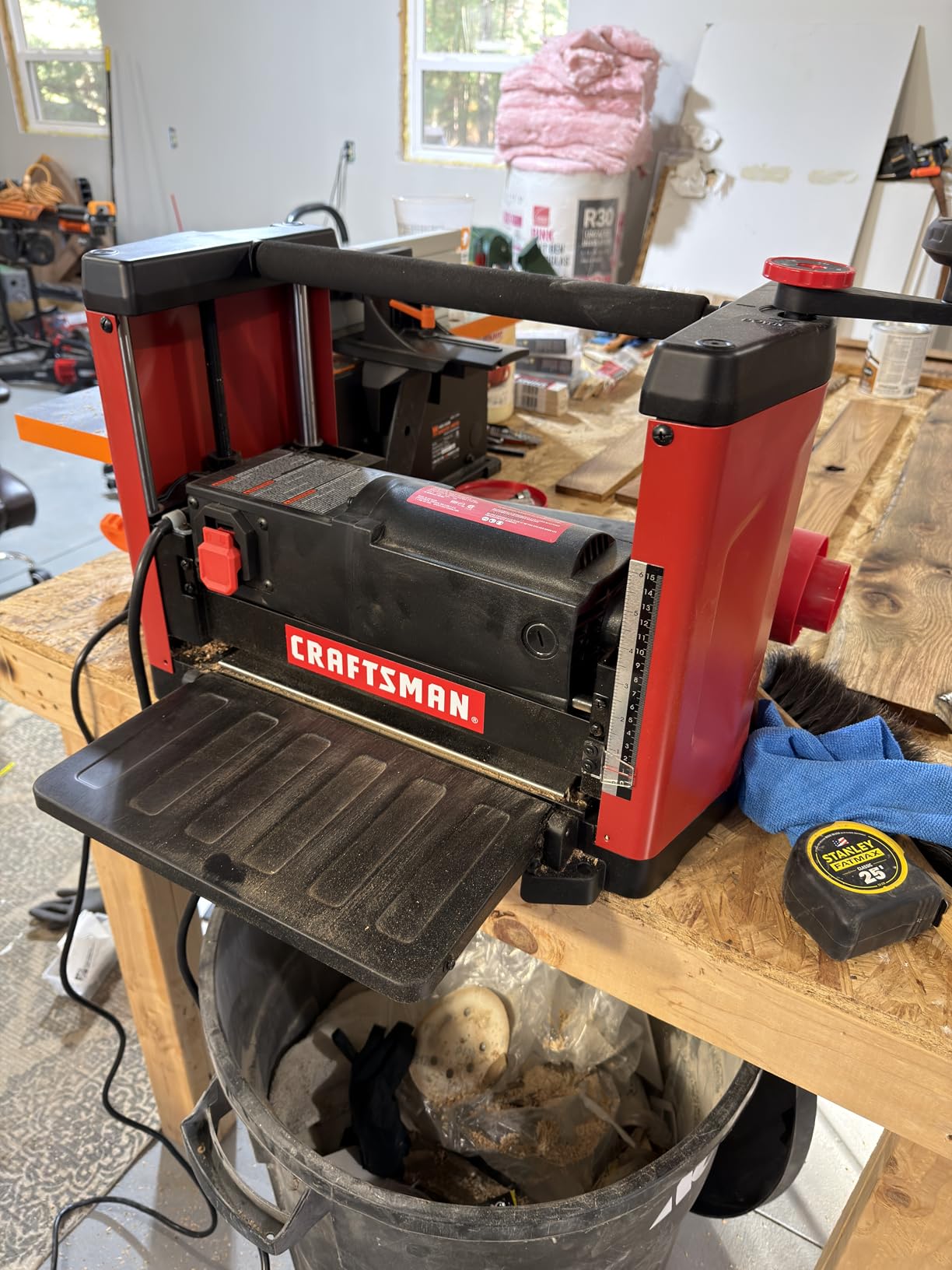
The honest limitation is the knife count. Two blades at 16,000 cuts per minute will get a board to thickness, but they leave a surface that is one sanding pass away from finished rather than ready to glue. Users with hardwood projects notice the blades dulling fast when they hit dirt or a stray nail head.
Shop vac performance is better than we expected, and the port pulls chips out of the carriage properly rather than letting them pile under the head. Owners also note that bolting the base to the bench makes a visible difference, because the machine walks under load otherwise.
What a beginner should know before the first pass
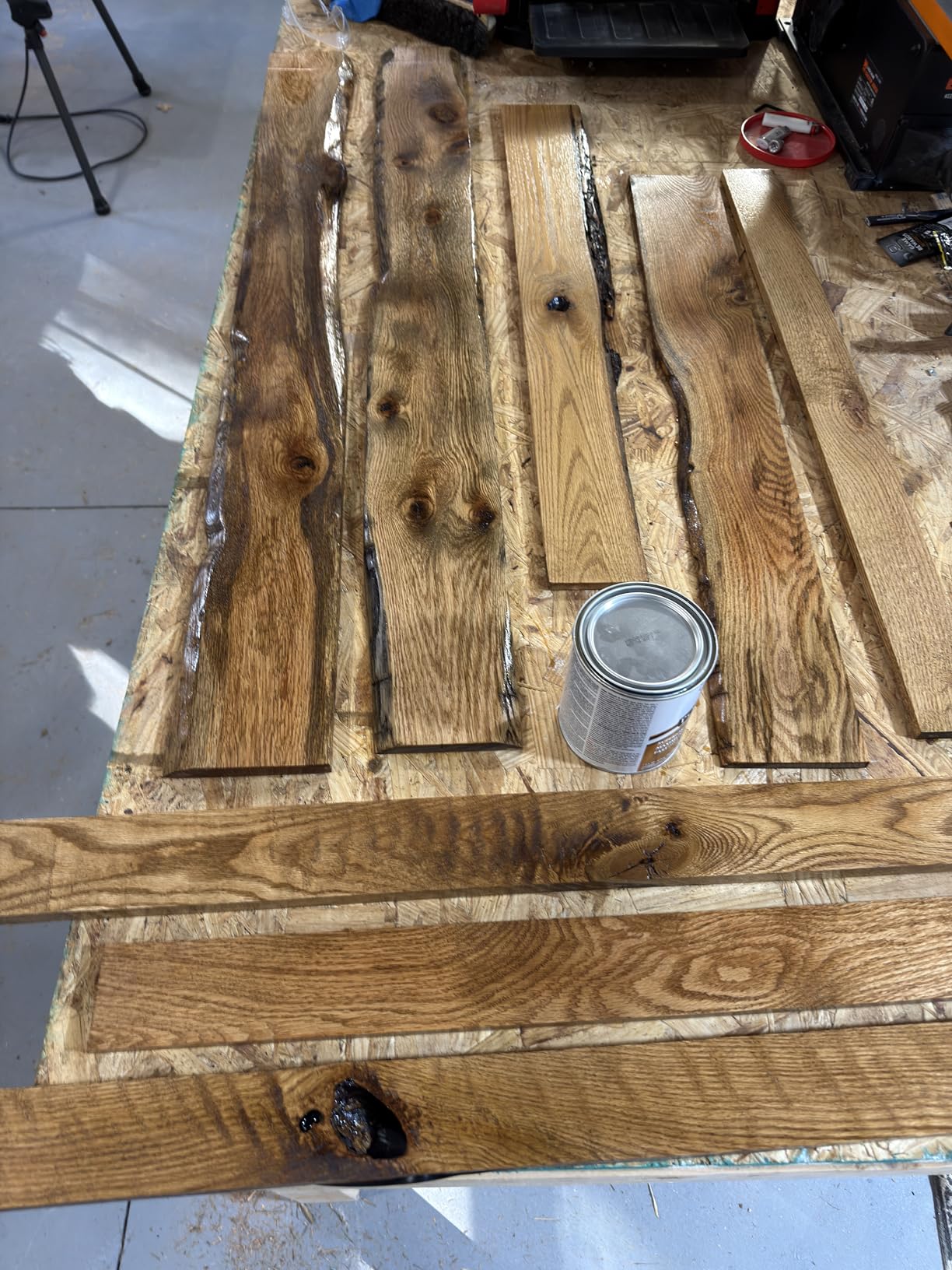
Set your depth of cut conservatively. Take two light passes rather than one aggressive one, and let the machine do the work rather than leaning into it. The chip load stays manageable and the finish comes out closer to final.
Check the gauge with a caliper before you trust it. A light calibration on the first day saves you from discovering a sixteenth-inch error after a full stack of cabinet parts is already cut.
When it is the wrong choice
This is not the machine for a shop that sells finished hardwood panels. The gap between a two-knife finish and a three-knife or spiral finish is obvious under finish and visible to customers.
It is also not ideal for reclaimed wood with embedded nails and fasteners. Sharp blades matter more there, and these will not stay sharp as long as the disposable sets on the DeWalt machines.
4. Makita 2012NB 12-Inch Planer — quiet enough for an attached shop
- Exceptionally accurate and stays accurate over decades
- Low noise operation rated at 83dB
- Very little snipe with proper infeed support
- Blade changes are fast with tools stored inside
- Compact enough for shelf storage and jobsite work
- Dust hood and port sold separately
- Blades need replacing every few months in heavy hardwood use
- Heavy for a 12-inch machine
- Plastic safety key for the on/off paddle is easy to lose
If your shop is a converted garage with a bedroom on the other side, the 83dB rating is the number that matters. Owners rate it as the quietest machine in its class, and you will hear the difference at seven in the morning.
The four-post body with diagonal cross supports is the second reason to like it. That bracing keeps the cutterhead from flexing under load, and the result is a thickness that stays put from one end of a long board to the other.
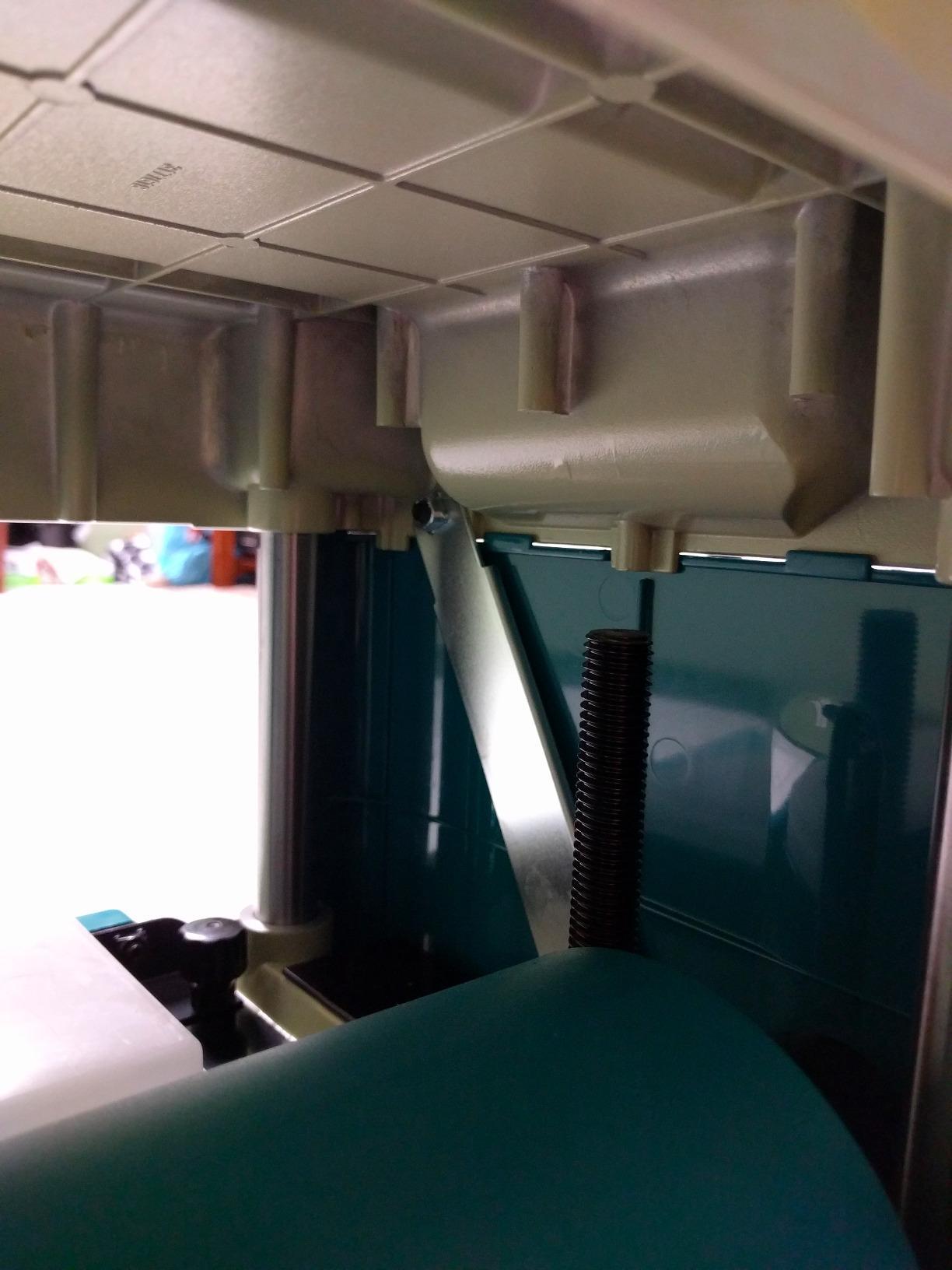
Owners with two-decade old machines report they have never been re-tarped or rebuilt, which tells you what class of hardware this is. The surface quality is the cleanest we got from a two-knife head in this group, and snipe stayed minimal as long as the table extensions were properly supported.
The blade system is genuinely the fastest here. Disposable double-edge blades mean no sharpening, and the adjustment tools live in a compartment inside the machine so nothing gets lost. The catch is that the dust hood and port are a separate purchase, so budget for that before the first run.
What 83dB actually changes in a shop
Roughly, it is the difference between a machine you can run while someone sleeps in the next room and one you cannot. If your neighbours are close or your shop hours are early, this buys you real flexibility on when you can work.
The other benefit is personal. A less noisy machine means longer sessions without the ear fatigue that cuts your workday short.
Where the premium does not pay off
If your shop is a detached building or you work on weekends, you are paying for quiet you cannot use. The DW734 gives a comparable finish and is worth a look in that case.
Long-term hardwood volume is also worth thinking about. Reviewers do replace the blades on a schedule when running a lot of oak or walnut, so a shop that planes hardwood daily will spend more on consumables here than on the machines with replaceable knives.
5. WEN PL1326 13-Inch Spiral Planer — a finish that outruns its tier
- Finish quality rivals machines at a much higher tier
- 26 staggered HSS blades rotate before replacement
- Very little snipe once tables are set correctly
- Cast iron base feels solid and stable
- Large curly chips extract easily
- Brush motor is as loud as a knife-head machine
- Dust collector works better than a shop vac
- Single feed speed on this variant
- Depth indicator is a small pin not a full scale
- 120V design only
The WEN PL1326 is the standout value here. A spiral cutterhead with 26 staggered, rotatable HSS blades produces a finish we would not expect from a machine in this tier, and reviewers describe it the same way once they own one.
Because the blades are staggered in a spiral rather than sitting in a straight line, each blade enters the cut at a slightly different point. That keeps the finish smooth, and it is why the surface quality outpaces what a two-knife head at a similar cost can do.
The rotatable inserts are the practical win. When an edge dulls or picks up a nick, you index it to a fresh edge rather than replacing the whole set, which stretches the consumable cost considerably.
Capacity is generous for the class at 13 inches wide and 6 inches thick, and the cast iron base keeps the machine planted. Large curly chips come off the head and travel well into a dust collector, which is the right partner for a spiral head.
Why snipe mostly disappears here
Two things combine. The 26 blades mean any one nick is spread across a tiny fraction of the cut, and the cast iron bed holds its height better under load than lighter castings. Set the support tables level with the bed and boards come out clean at both ends.
The failure mode here is skipping that step. Support tables that are not set to bed height will still produce dips, and that gets blamed on the planer rather than the setup.
What you give up compared with the DeWalt
This variant runs at a single feed speed. The DW735X lets you slow down for hardwood, and that difference shows when you are working dense stock.
The brush motor noise is also worth planning for. It measured as loud as a straight-knife machine to our ears despite the helical cutting, so this is not the quiet-shop answer. The depth indicator is a small pin rather than a readable scale, which means checking thickness with a caliper is part of the routine.
6. VEVOR 13-Inch Three-Blade Two-Speed Planer — a capable budget machine
VEVOR Power Benchtop Planer Three-Blade Two Speed 13″ Thickness Planer
- Capable on rough softwood
- Three-knife head and two feed speeds
- Strong dust collection with a shop vac
- Quiet relative to machines in a similar tier
- Cast iron bed and metal bevel gears
- Built-in tool storage and quick height adjustment
- Factory knives have arrived blunt on some units
- Outboard support trays are hard to level perfectly
- Included wrench can slip during blade changes
- Rear table extension does not lock when folded
- Vacuum hood can clog and dimple the workpiece
- Poor manual and limited parts support
The VEVOR has the longest table package in this group at 35 inches of total length, and the two feed speeds let you choose between fast material removal and a slower finish pass. On paper it offers a lot of machine for the money.
In practice, most of the capability is there. The precision machined cast iron bed and steel cover keep boards flat, and the three-knife head hardened to HRC55-60 is a spec you rarely see at this level.
The main issue is assembly quality on the support trays. Those trays are what prevent snipe, and reviewers repeatedly describe them as hard to level perfectly, which caps the flatness you can get out of rough boards.
There is also a pattern of factory knives arriving blunt, which means checking and possibly dressing your blades before the first board. The manual is difficult to follow, and owners report limited luck getting replacement parts or support.
Who this machine suits
A first shop that mostly handles construction lumber and pallet wood will find this genuinely useful. It has a vacuum port, two speeds, and enough table length to support a full sheet of thin stock without improvising.
It also suits anyone who wants two feed speeds and full 13-inch capacity on a tighter budget than the machines above it.
Where it falls short
Support and parts availability is the real risk. If a gear or a depth crank fails, you may wait a long time for a replacement, and that risk grows if you depend on the machine for paid work.
The rear table extension not locking in the folded position is a small thing, but in a small shop it means one more thing to knock over while moving boards around.
7. JET JWP-13BT 13-Inch Helical-Style Planer — the one that folds away
- Helical-style cutting is smooth and quiet
- Cast iron bed and four-post design limit snipe
- Two feed speeds for speed or finish
- Folding tables free up bench space when stored
- Adjustable depth stop for repetitive work
- HSS inserts dull in hardwoods and need rotation
- Heavy at 75 pounds
- Sits in a higher tier than most benchtop models
- 120V single phase only
The folding adjustable infeed and outfeed tables are the feature that makes this a small-shop machine. When you are not planing, the machine folds down and the bench is a bench again, which is not true of most competitors.
The helical-style cutterhead runs 26 individual quick-change HSS inserts arranged in six rows, so a worn or nicked insert is a swap rather than a full head teardown. Owners consistently comment on how smooth and comparatively quiet the cutting feels.
The four-post design gives the head real support, and combined with the cast iron bed that shows up as boards that hold their thickness. Two feed rates at 18 and 26 feet per minute give you the same choice the DW735X does, and the adjustable depth stop helps when you are cutting a stack of identical parts.
The 5-year warranty is the longest in this group. The catch is the warranty drops to 2 years if the machine is used commercially, which is worth knowing if your shop does paid work.
Why folding tables matter more than they sound
A benchtop planer with fixed extended tables permanently occupies several feet of bench frontage. In a one-car shop, that is often the difference between having a workbench and not having one.
Folding tables also mean you can move the whole machine against a wall between jobs and reclaim the floor space in about a minute.
What to weigh before choosing it
It sits at 75 pounds, so you need a stand rated for it rather than a light table, and the folding tables need something solid to sit on once they are down.
Review volume is thin for this machine, so long-term reports are limited. Ask yourself whether you are comfortable buying on spec and on the warranty rather than on a decade of owner feedback.
8. RIKON 25-135H 13-Inch Helical-Style Planer — threaded posts for repeat work
RIKON 25-135H 13-Inch Portable Planer with Helical-Style Cutterhead
- Rotatable two-edge inserts make maintenance simple
- Threaded four-post support holds consistent thickness
- Two feed speeds for removal or finish
- Dust hood and adapter included
- Stays under 70 pounds for a machine this wide
- HSS inserts are consumables that need rotation or replacement
- Costs more than generic spiral-head alternatives
- Small review base limits long-term data
The threaded four-post head support is the detail that sets this machine apart. Rather than sliding posts that can creep under load, the posts are threaded, which is why owners describe its thickness repeatability as excellent on batch work.
Capacity is a full 13 inches wide and 6 inches thick with a depth of cut up to 1/8 inch, and the dust hood with a 4 inch to 2-1/2 inch adapter is included, so you can connect to a shop vac or a collector out of the box.
When repeatability matters more than volume of reviews
If you are cutting a run of identical parts, the setup holds between passes. That is the number one source of frustration in batch work, and a threaded post solves it more directly than a higher horsepower figure does.
The two-edge inserts also mean each insert gives you two usable edges before it leaves the head, which stretches consumable cost in a small shop.
Buy it with clear eyes
The review base here is small, so there is less long-term evidence about durability than with the other machines in this guide. Treat the specification sheet as the reason to buy and accept that you are buying earlier in a machine’s life cycle.
It also costs more than generic spiral-head alternatives for the same insert count. If that gap matters to you, the WEN PL1326 gives you a similar cutterhead approach with more owner feedback behind it.
9. Triton TPT125 12-1/2-Inch Planer — for occasional, light work
Triton TPT125 High Performance Benchtop Planer with 12-1/2″ Cutting Width
- A low entry point for a benchtop planer
- Tables arrive nearly set and need minor adjustment
- Dust chute mounts on either side and extracts well
- Blades are easy to remove and sharpen
- Compact for casual and light shop work
- Snipe at board ends needs adjustment or trimming
- Inconsistent thickness across the width on some boards
- Height crank can vibrate out of position
- Thickness scale is hard to read
- Struggles with rough aged softwood at depth
- Very loud
The TPT125 makes sense if you plane a few boards a month and you would rather not give up shop space to a larger machine. The infeed and outfeed tables arrive close to set, so you are not levelling before your first cut.
At 17,500 cuts per minute it is fine for softwood and for boards that are already close to thickness. The depth of cut sets in 1/16 inch increments and the integrated circuit breaker adds a layer of electrical safety in a shared shop.
Where it holds up
The dust chute that mounts on either side is genuinely useful. Most machines force you to choose a side based on where the outlet is, and a planer that can flip is easier to fit against a wall.
Blades that remove easily and sharpen simply matter more on a low-use machine, because you will be doing them by hand rather than paying a shop to do it.
Where it holds you back
Rough, textured, aged softwood is the problem case. Owners report the machine straining at depth on old lumber, which is exactly the material reclaimed-wood shops want to run through.
Thickness consistency across the width also varies on some boards, and the height scale is hard to read. Check with a caliper on every setup and you can work around it, but you are always measuring.
How to Choose a Benchtop Planer for a Small Shop?
Match the cutting width to your widest boards
Most dimensional lumber tops out at 12 inches, so a 12-inch machine handles nearly everything you will buy. If you work with plywood, full sheets or wide reclaimed boards, you need 13 inches.
For anything wider than your cutterhead, a planer sled is the answer. A flat piece of plywood riding on the infeed table lets you support a wide panel and feed it through at a constant height. It takes an afternoon to build and turns a 12-inch planer into a wide-board tool.
Straight knife, spiral, or helical cutterhead
A straight-knife head is simple and cheap to maintain. Blades are easy to remove and sharpen, and the finish is good when the blades are sharp.
A spiral or helical head uses many small staggered blades. The result is a smoother surface, less noise, and far more tolerance for a nick or a dirty blade. The trade is consumable cost and the fact that spiral inserts dull rather than sharpen.
For a shop that runs hardwood or reclaimed material, the spiral approach pays back quickly. For occasional softwood work, straight knives are hard to argue against.
Snipe control beats raw horsepower
Snipe is the stepped dip at the ends of a board caused by the carriage moving as the cutterhead loads up. It is the most common complaint on woodworking forums, and it is a support and stability problem more than a power problem.
Look for machines with a carriage lock or a four-post design. Then set your outfeed support to bed height, which is the step people skip. A feed speed in the low range also reduces the dip noticeably.
Plan the circuit before you buy
Almost every machine here runs a 15-amp motor, and a 15-amp circuit already carries a 15-amp breaker. Add a dust collector, a radio, or a shop light on the same circuit and you have a tripped breaker in your future.
Woodworkers on forums treat a dedicated 20-amp circuit for the planer as close to non-negotiable. We agree after watching a breaker trip the first week we had the DW735X running. Budget for the electrician if your panel does not have a spare circuit.
Planer vs jointer: do you need both?
A planer makes a board a consistent thickness. It does not flatten a cupped or twisted board, because it cannot correct a bow running along the length of the stock.
A jointer flattens one face and one edge. That is a different job. If your material is rough-sawn and warped, a jointer or a planer sled comes first, and the planer second.
For most small shops doing furniture and cabinetry, running a board through a jointer first and then the planer gives the best result. If you only buy one machine and your stock is already flat, buy the planer.
Fit it into the space you actually have
Measure the machine plus its unfolded tables before you buy, and measure with the infeed and outfeed at the height of your bench. Most small shops are constrained by bench frontage rather than floor space.
Folding tables, as on the JET, let the machine collapse when it is not in use. A rolling mobile base solves the same problem for the heavier machines. Both are worth more to a small shop than an extra inch of cutting width.
On dust collection, a spiral head that throws large curly chips pairs best with a proper collector. Straight-knife heads make small chips and shavings that saturate a shop vac filter quickly, so plan on emptying it often.
Frequently Asked Questions
What is a bench top planer?
A benchtop planer, also called a thickness planer, is a power tool that feeds a board between an infeed and outfeed table while a rotating cutterhead shaves off a set amount of material. It makes rough lumber a consistent thickness and smooth on one or both faces. It is a bench-mounted machine, so it bolts to a stand or a heavy bench rather than being carried by hand.
Is a planer worth it for a small shop?
For most small shops, yes. A planer lets you buy rough-sawn lumber well below the cost of pre-milled boards and still get boards at the exact thickness your project needs. It also makes reclaimed and pallet wood usable. The value drops if you only work with pre-milled boards or if you have very limited room for a machine and its tables.
How big do benchtop planers get?
Most benchtop planers handle stock 12 to 13 inches wide and up to about 6 inches thick. With the infeed and outfeed tables extended, expect a working footprint of roughly three feet long. Machine weights in this class run from about 60 to just over 100 pounds, so a stand rated for the machine is needed.
What is the difference between a hand planer and a thickness planer?
A hand planer is pushed by hand across a board to shave and flatten its surface, and it gives you control over the cut. A thickness planer is a powered machine that sets a fixed depth of cut and feeds the board through at a consistent rate. Hand planers suit fitting and finishing; thickness planers suit making boards a uniform thickness quickly.
What is the best benchtop planer for beginners?
For a first machine, the CRAFTSMAN CMEW320 is the most straightforward: a two-knife head that swaps fast, a vacuum port for chips, and accuracy that holds up over many board feet. If your budget stretches further, the DEWALT DW734 gives a finer finish at 96 cuts per inch and a four-column carriage lock that reduces snipe.
Is the Harbor Freight planer any good?
We did not include a Harbor Freight planer in this roundup, so we cannot give you a first-hand verdict. What we can say is that in this class the deciding factors are the cutterhead design, the carriage support, and whether support is available for replacement parts. Check those three things against the models above rather than relying on price alone.
Is a benchtop jointer worth it?
A jointer is worth adding if your material is rough-sawn, cupped, or twisted. A planer makes thickness consistent but cannot fix a board that bows along its length, so a jointing pass first gives you flat reference faces. If your stock is already flat and dimensioned, a planer alone will carry a small shop for most furniture and cabinetry work.
Should I buy a new planer or a used one?
A used planer is a reasonable option when you can test it. Check the cutterhead for nicks and pitting, look for play in the carriage by running a board through several times, and confirm the depth gauge reads accurately against a caliper. A machine with a helical or spiral head is usually easier to service than one with disposable knife cartridges.
Final Verdict: Which Benchtop Planer Should a Small Shop Buy?
The DEWALT DW735X is the pick for most small shops. It holds thickness, it has two feed speeds, and it comes with the feed tables and a spare set of knives so you are not building anything on day one. Budget for a dedicated circuit and a stand, and it will serve a growing shop for years.
Buy the Makita 2012NB if noise is the constraint. At 83dB it changes what hours you can work, and owners report two-decade reliability. Buy the WEN PL1326 if finish quality per dollar matters most, since its 26-blade spiral head delivers a surface that punches above its class.
For the rest: the DW734 for long-board support, the CMEW320 as a solid first machine, the JET when bench space is the problem, and the Triton for occasional light work. Whichever you choose, give it a dedicated circuit, set the support tables to bed height, and check your gauge with a caliper before the first cut. Those three habits fix most of the complaints people post about benchtop planers in 2026.