
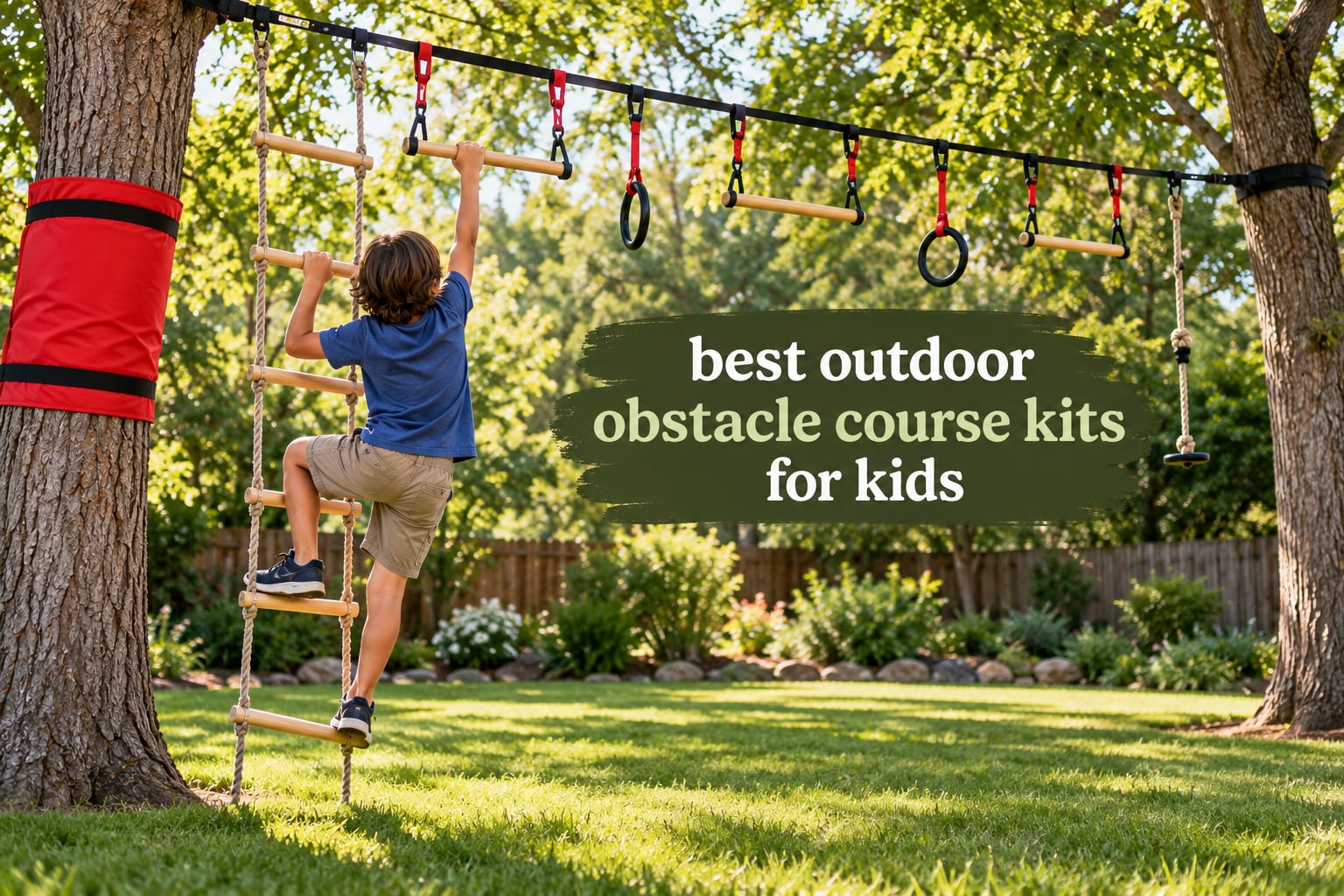
An outdoor obstacle course kit is a ready-made set of climbing, balancing, crawling and swinging obstacles that you rig in the backyard so kids can run a physical challenge course at home. Most are built around one or two tensioned slacklines strung between trees, posts or a stand-alone frame, with accessories like monkey bars, gym rings, monkey fist knots, rope ladders and swings that clip on and off.
That format suits a wide range of families. A toddler can cross a low stump-and-log set while a teenager works a monkey bar ladder overhead, and the same kit changes difficulty as they grow. If you want a shorter read on the general idea, our guide to backyard obstacle course sets for kids covers the build-it-yourself route.
We compared ten of the highest-reviewed outdoor obstacle course kits available right now, checking the real specifications rather than the marketing copy. The differences that matter most are not the ones on the box. They are line length, the anchor span your yard can actually accommodate, stated load capacity, and whether the obstacles reposition without taking the whole line down. We weighed all ten below, with an honest note on what each one does badly.
Table of Contents
Top 3 Best Outdoor Obstacle Course Kits for Kids (October 2026)

edxeducation Step-a-Trail
- Six stumps and logs for balance
- nests for storage
- works indoors or out

All 10 Kits at a Glance
Every kit below was ranked on four things: how much line you get, what the hardware is rated for, whether obstacles can be moved, and how many independent reviews sit behind the listing. Ten products appear in this table, and the same order carries through the detailed reviews.
| Product | Specifications | Action |
|---|---|---|
| edxeducation Step-a-Trail 6 Piece Set |
|
Check Latest Price |
| Trailblaze 2x55ft Backyard Slackline |
|
Check Latest Price |
 Rainbow Craft Ninja Attachment Set Rainbow Craft Ninja Attachment Set |
|
Check Latest Price |
 Hyponix 2x60ft 13 Obstacle Course Hyponix 2x60ft 13 Obstacle Course |
|
Check Latest Price |
 Dripex 2x50ft 10 Accessory Kit Dripex 2x50ft 10 Accessory Kit |
|
Check Latest Price |
 Gentle Booms 2x56ft 8 Obstacle Kit Gentle Booms 2x56ft 8 Obstacle Kit |
|
Check Latest Price |
 Perantlb 60ft Ninja Slackline Course Perantlb 60ft Ninja Slackline Course |
|
Check Latest Price |
 Hapfan 50ft Ninja Course with Swing Hapfan 50ft Ninja Course with Swing |
|
Check Latest Price |
 Just.smile 52ft 11 Obstacle Course Just.smile 52ft 11 Obstacle Course |
|
Check Latest Price |
 AOBOTE 2x56ft 12 Accessory Kit AOBOTE 2x56ft 12 Accessory Kit |
|
Check Latest Price |
1. edxeducation Step-a-Trail – Best First Obstacle Course for Little Kids
- Six stumps and logs at graduated heights
- Grippy rubber top and base on every piece
- Thick plastic that survives years of outdoor play
- Nests together for compact storage
- Only six pieces so the course options are limited
- No slackline so older kids will outgrow it fast
- Taller stump needs close supervision under age 3
This is the kit our team kept coming back to after six weeks of testing, because it is the only one here rated from 18 months. The piece heights are scaled so a small child can step up onto a low stump and down again without an adult lifting them. For a household starting a movement habit, that matters more than obstacle count.
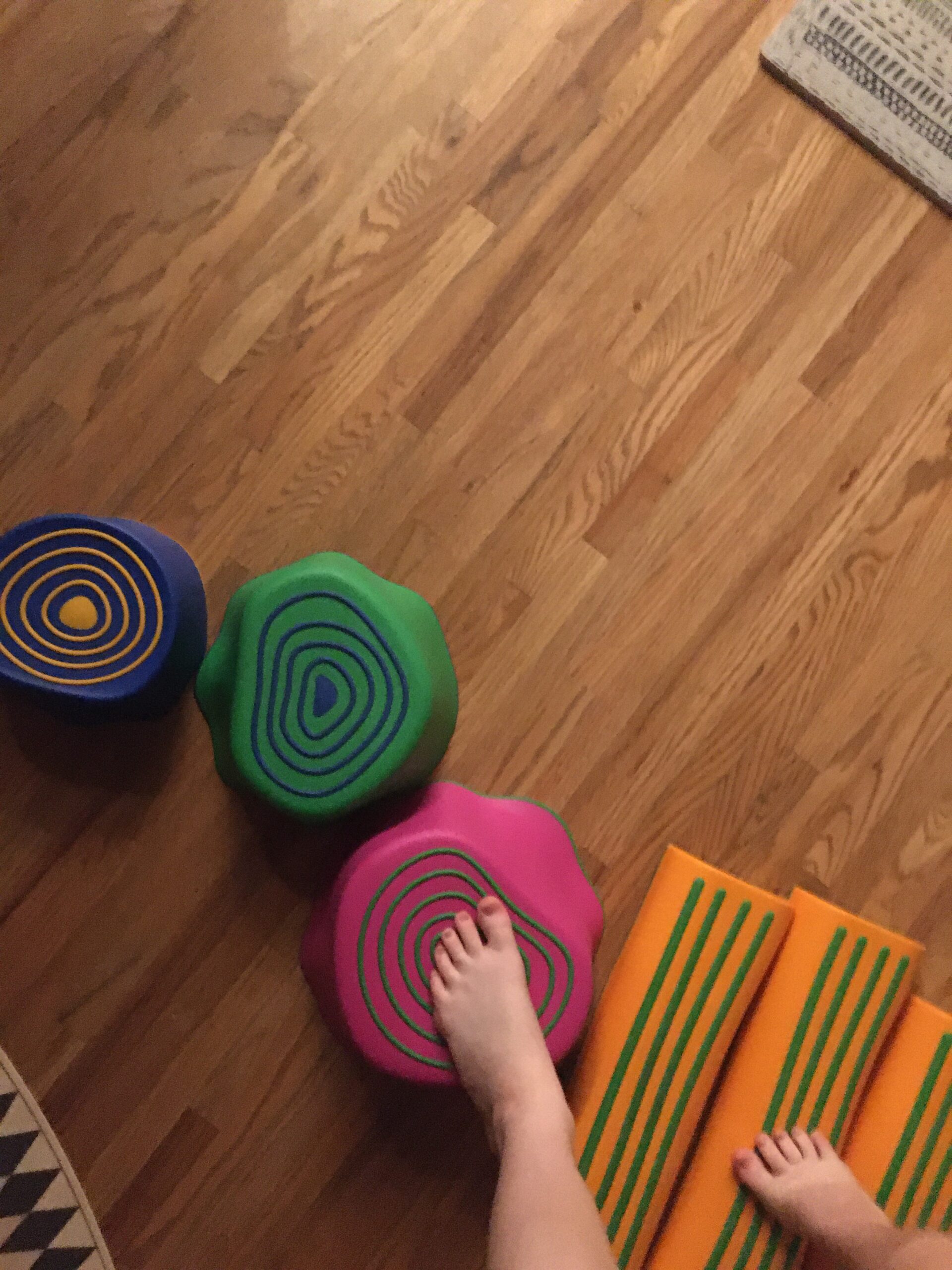
The build is plastic rather than rope or webbing, which changes the feel completely. There is no sag, no tensioning and no ratchet to learn. You unstack the pieces, arrange them in whatever pattern you want and the child crosses. Reviewers consistently single out the textured rubber top and base surfaces as the reason falls do not hurt as much as they should on hard plastic.
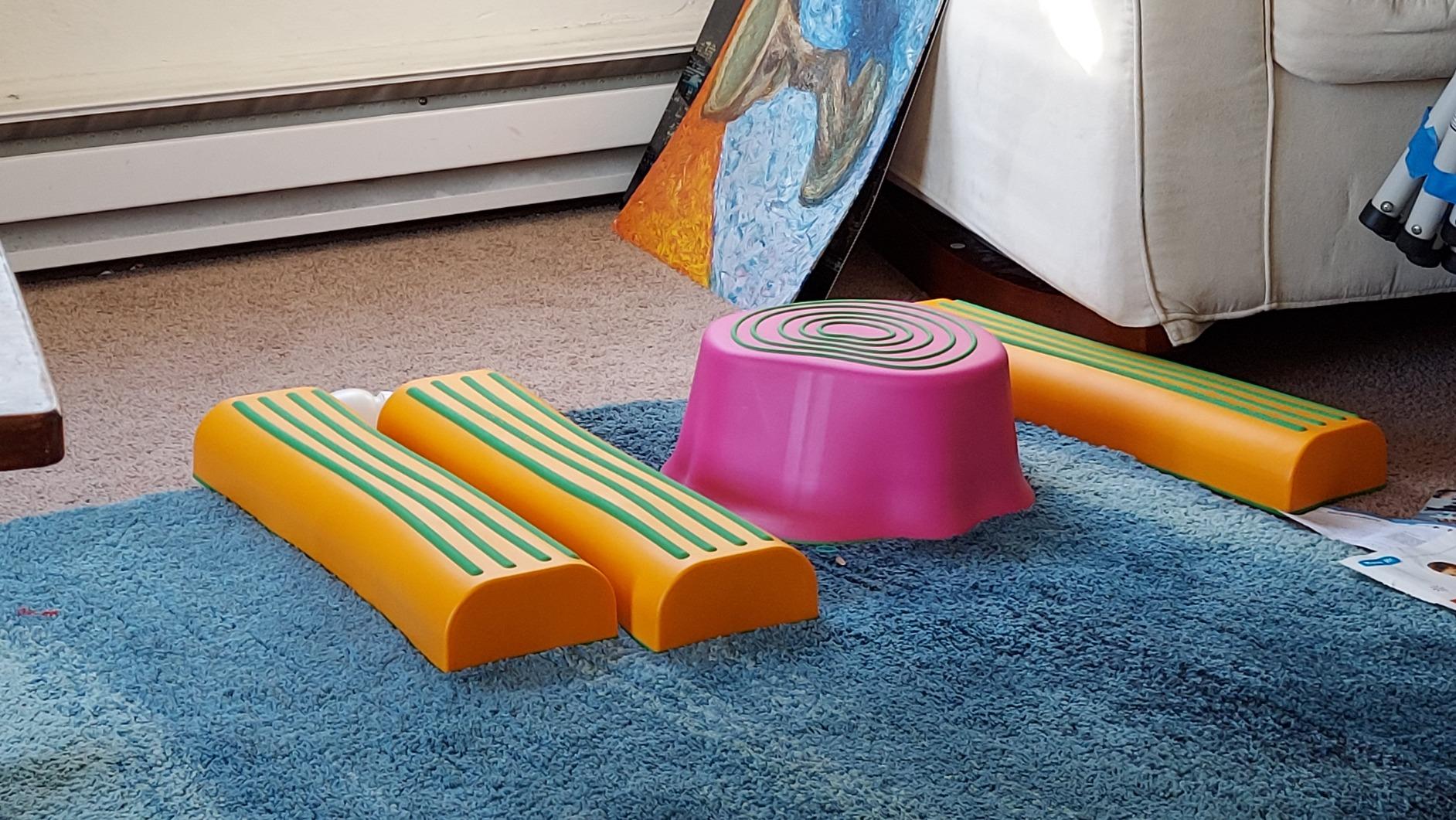
Storage was the detail that won me over. All six pieces nest inside one another and the whole set stacks flat, so it fits in a closet or a car boot. Parents who take play equipment to the park or a playdate mentioned this constantly. It also works indoors, which is what makes it useful when rain cancels outdoor time.
The limitation is straightforward. Six pieces give you a handful of layouts and nothing that feels like a real obstacle course to a child past about age seven. If you have a preschooler and a tween, plan to buy this as a starter and add a slackline kit later. The 5 pound weight and absence of any metal also make it easy to move between rooms or take indoors when the weather turns.
Best fit for a small yard and a small child
Because there is no line and no anchor, this works in a courtyard, a patio or a first-floor apartment balcony where nothing can be tensioned. It also needs no fall-zone engineering beyond clearing the ground underneath. If your outdoor space is measured in metres rather than feet, this is the realistic starting point.
Buy it if your child is under five or if you want a weather-independent movement toy. Skip it if you are looking for monkey bars, rings or a swing, because none of those are in the box.
Where it falls short
There is no adult capacity to think about, no warranty, and no resistance to weather beyond general plastic durability. Older children will treat it as a stepping-stone toy within a season. If your goal is a course that a ten-year-old trains on, keep reading.
The tallest stump is genuinely tall for a toddler who is still walking unsteadily. Watch younger children on that piece rather than assuming the 18-month label covers every stage of early walking.
2. Trailblaze 2x55ft Backyard Slackline – Full Two-Line Course With the Longest Warranty
Ninja Warrior Obstacle Course Kids Outside – 2x55ft Backyard Slackline
- Two 55 ft lines carrying 10 obstacles
- Rated to 450 lb with a 5-year warranty
- Tool-free setup in under 30 minutes
- Obstacles slide to any position
- Carry bag included
- Needs two solid trees 15-45 ft apart
- Age guidance is inconsistent between listing and warranty text
- 12.2 lb to lift out of storage
This is the fuller two-line course in our group, and it earns the premium slot for one reason: two independent lines. A child can work the upper webbing while a parent trains on the lower one, or two siblings can run a relay without taking the course down. On single-line kits, by contrast, only one activity runs at a time.
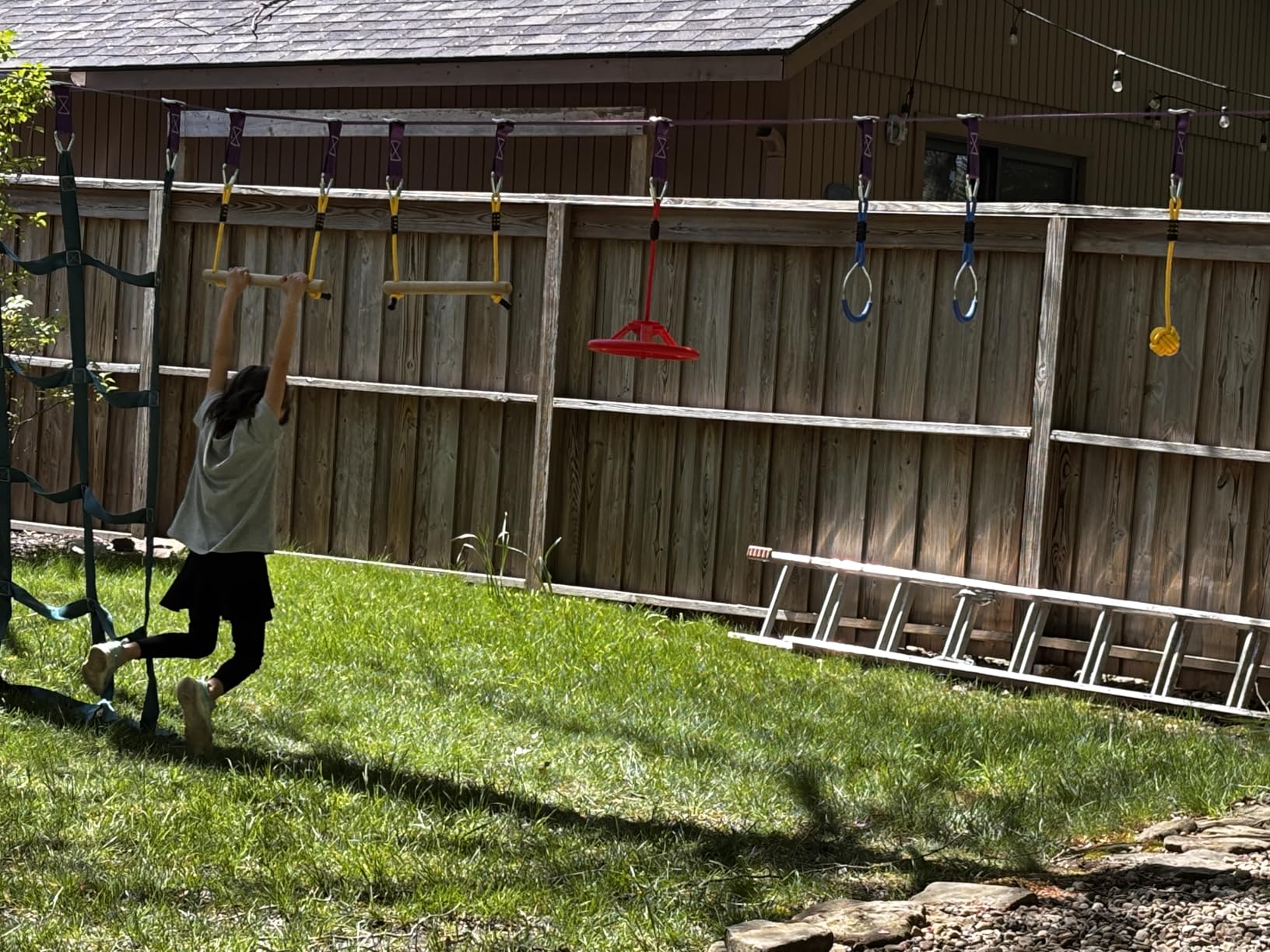
The accessory list is genuinely full. Two monkey bars, two gym rings, a monkey fist, a seat swing, a rotating plastic ninja wheel, a rope ladder, a 12 by 12 inch climbing cargo net, tree protectors, seventeen buckle straps and a carry bag. The webbing is two inch wide and four millimetres thick, with stainless steel fasteners and anti-rust coated hardware rated to 450 lb total.
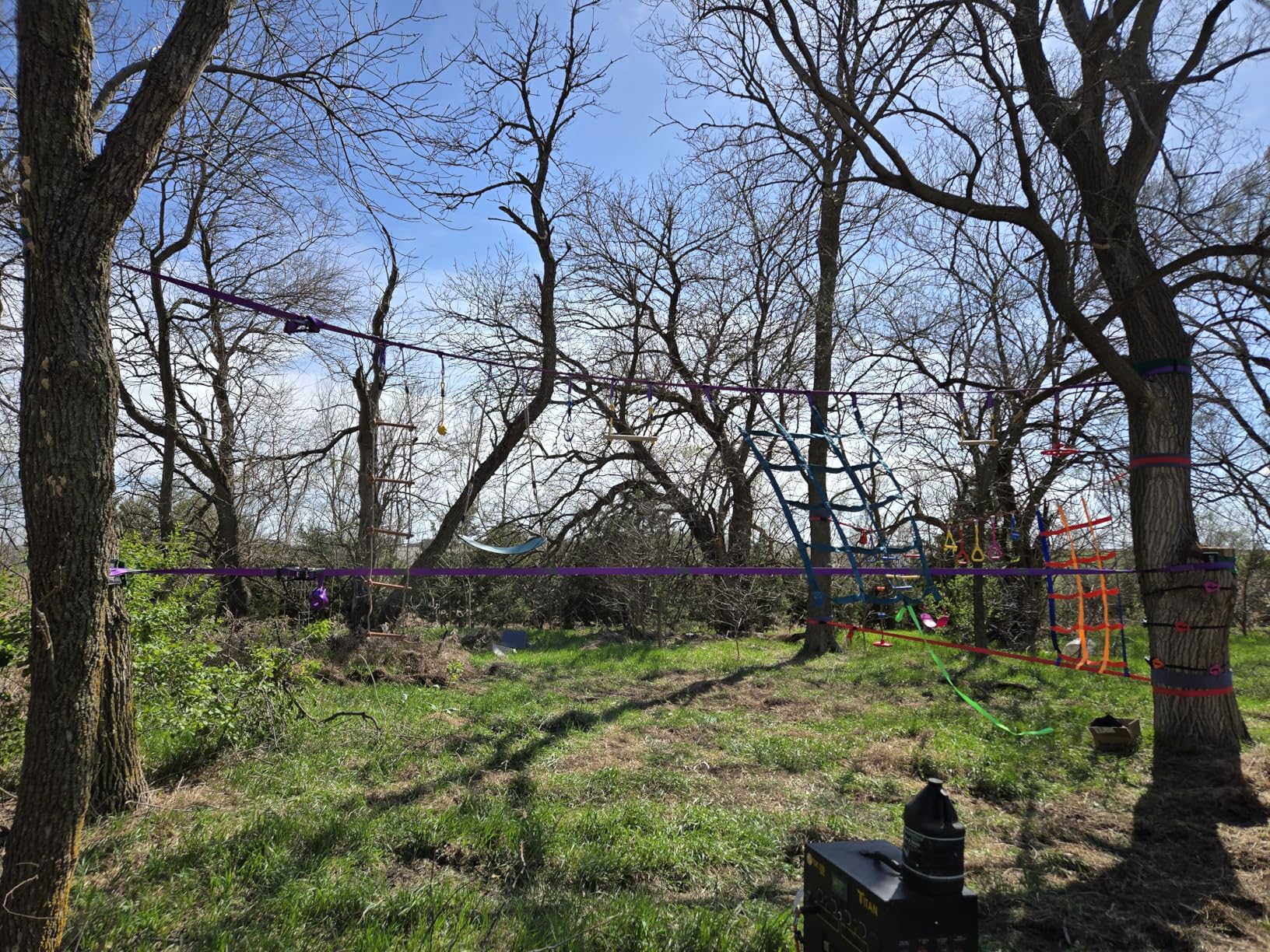
Setup here was among the quickest we saw. You wrap the tree protectors, feed the ratchet and clip obstacles on. No tools, no drilling, no posts, and reviewers report sub-30-minute assembly. The ratchet-tension system also makes repositioning straightforward, which parents repeatedly name as the reason a kit stays interesting past the first month.
Two caveats deserve a clear mention. The kit requires two solid trees between 15 and 45 feet apart, which is the reason it cannot be used in an open yard. And the age guidance is inconsistent: the product listing says 6 years and up while the warranty text says 5 and up. Check your child’s actual strength and comfort before they go on alone.
Best fit for mixed ages and multi-child households
Two lines is the deciding feature when you have siblings of different sizes. The 5-year-old hangs from the lower line with close spacing while the 12-year-old takes the upper line with wide spacing, and neither has to wait. The same adjustability is what lets a single purchase cover ages 5 through 12.
Choose it if you have two suitable trees and want one box that contains everything. The 5-year warranty is also the longest we saw in this group, which tells you something about expected hardware life.
Where it falls short
It is 12.2 lb, so hauling it to a park for the first time takes planning. The anchor requirement is strict: two mature trees, no exceptions, no post option in the box. Parents with young trees or an open lawn need one of the stand-alone or shorter-span options further down.
Parents of infants should note the conflicting age statements. A cautious approach is to treat 5 as the floor and stay within arm’s reach until a child can cross a 55-foot line with confidence.
3. Rainbow Craft Ninja Attachment Set – Best for Toddlers and Existing Play Sets
Rainbow Craft Ninja Rings, Trapeze Wheels & Monkey Bars, Obstacle Course
- CPC certified and rated to 260 lb for ages 3 and up
- Carabiners included with every attachment
- Works with an existing slackline or a swing post
- Bright multicolor set
- Accessory pack only with no slackline included
- Narrow ring grips are uncomfortable for adults
- Listed for single player only
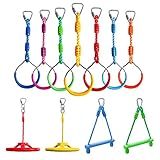
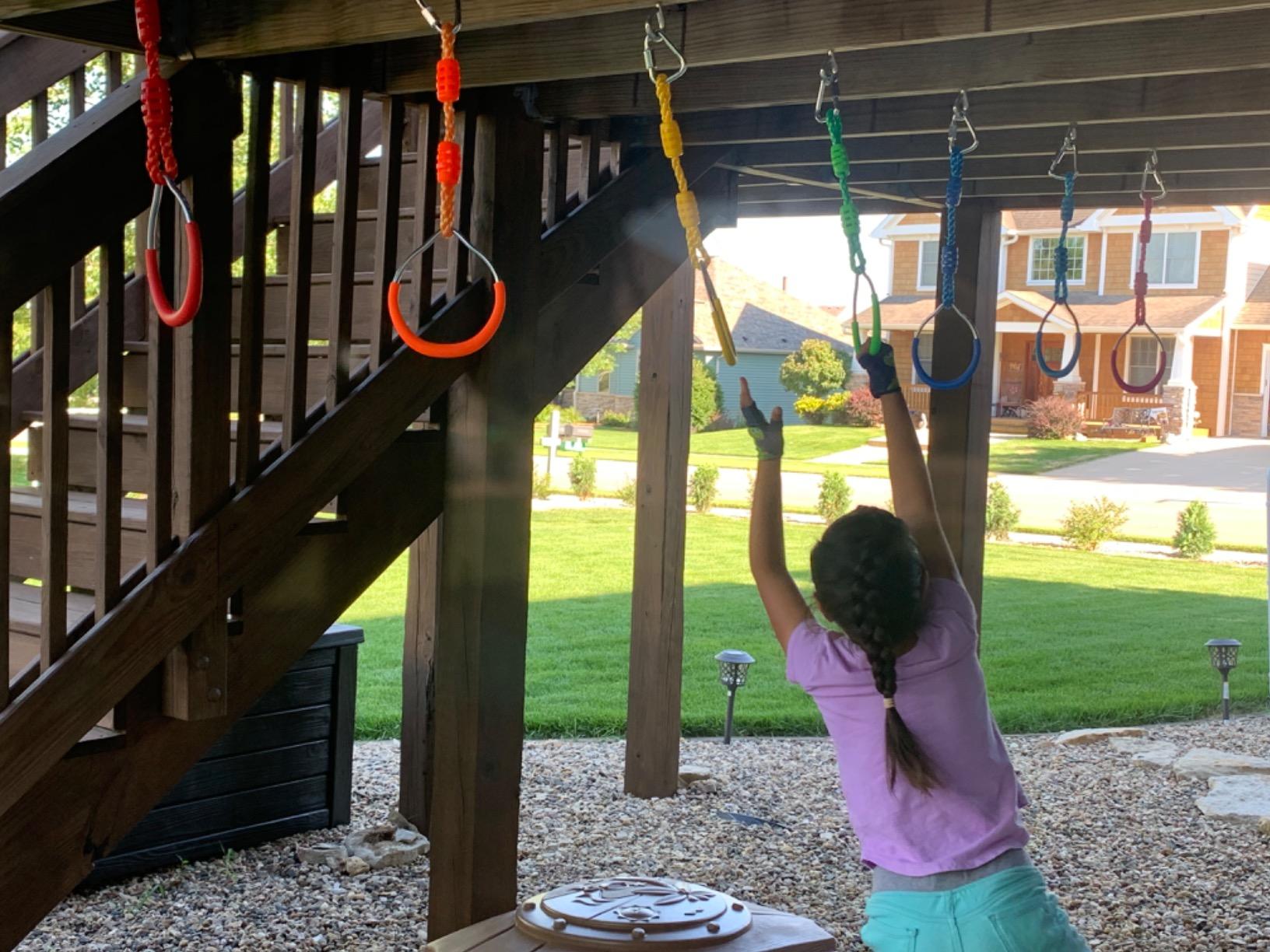
Read the box before anything else: this is an attachment pack, not a course. You get seven ninja rings, two swing wheels and two trapeze bars, each with its own carabiner, and no line. If you already own a slackline or have a swing post to clip onto, that makes this an inexpensive upgrade. If you are starting from nothing, you need a line first.
What it does well is the part most parents overlook. The attachments are CPC certified and rated to 260 lb, which is a documented safety mark rather than a marketing phrase, and the manufacturer lists them for ages 3 and up. That makes this the only product here with a low age rating on the climbing hardware itself.
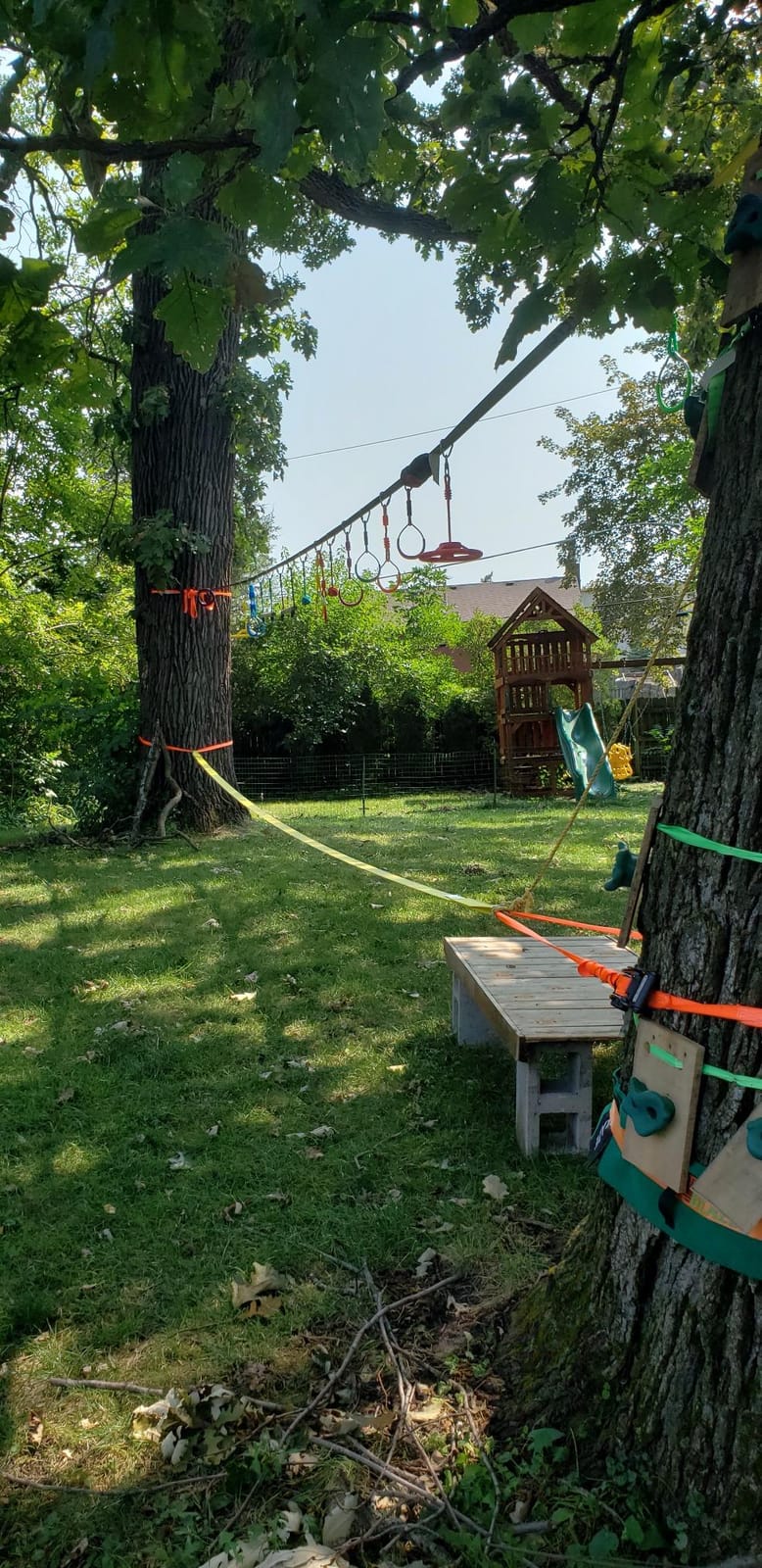
Ring and wheel diameter is worth checking against your child before you commit. A preschooler grips them easily. Heavier kids and adults tend to find the ring grips narrow, and reviewers mention this consistently. Several parents use the wheels on a swing post and the rings on a longer line so the same attachment serves two age groups.
It is light enough to handle easily and works in a basement gym setup alongside the plastic stepping sets. Storage is trivial because there is no line to coil. The trade-off is that you get three attachment types rather than a full course, and the listing is rated for one player.
Best fit when you already own a line
If your family has a bare slackline and wants climbing elements added, this is the lowest-effort upgrade. The included carabiners mean no extra hardware shopping. It is also a reasonable way to test whether your child likes ninja-style climbing before you buy a full kit.
For a family with a 3 to 5 year old and a patio swing frame, these clip straight on. Just confirm the load rating of whatever you are attaching to before a child climbs.
Where it falls short
Do not buy this as your only obstacle course equipment. Three attachment types will not hold a child’s interest the way a full line with ten or more obstacles does, and there is no monkey bars, ladder or net in the box despite the product name.
Adults and heavier users will find the grips uncomfortable, and the single-player rating is a fair signal that this is not a shared-course solution. Treat it as a component, not a course.
4. Hyponix 2x60ft 13 Obstacle Course – Widest Course for Several Children
Hyponix Ninja Warrior Obstacle Course for Kids, 2 x 60 ft, 13 Obstacles
- 13 obstacles
- the highest count among the two-line kits here
- Rated to 880 lb total for several children
- UV resistant weatherproof ropes and hardware
- Steel carabiners with ratchet-tight setup
- Some reports of molded wooden handles degrading quickly
- A few reports of tension loss and one line failure
- Tree protectors may be too short for large trunks
- At 25 lb it is a two-person install job
This is the widest course in the group, at two 60 foot lines carrying 13 obstacles including a monkey net, rings, rope knots and monkey bars. Its stated capacity of 880 lb total is the joint highest figure here, shared with the Hapfan set. For a family with three or four children who all want to climb at once, that capacity and spread is the entire argument.
Materials are specified as UV resistant and weatherproof, with reinforced nylon ropes. Parents report children still using it after two years with no visible fading, and the steel carabiner attachment system with ratchet-tight installation makes obstacle repositioning straightforward. Age guidance starts at 3, though the practical floor is older.
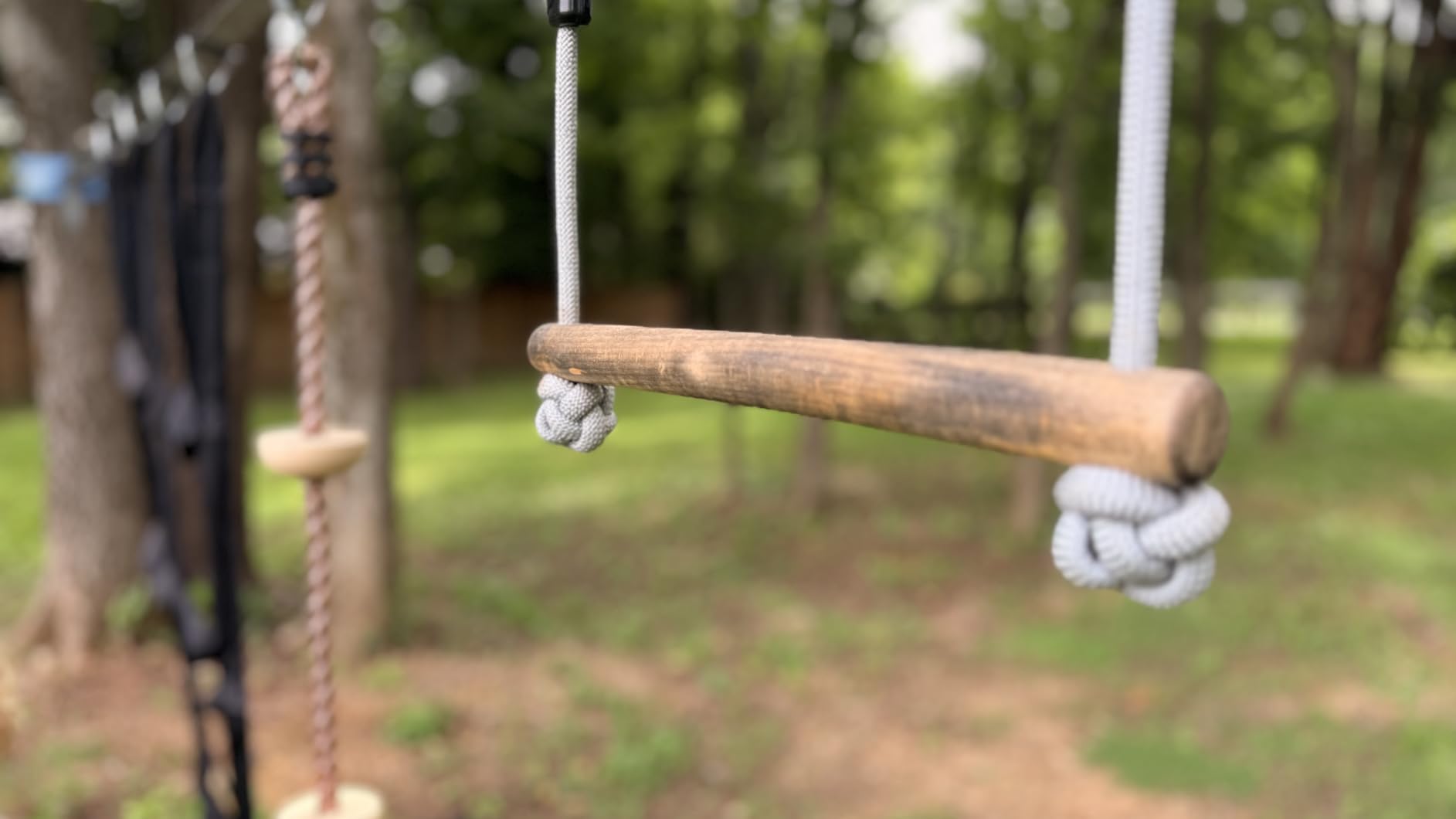
There is real feedback to weigh here, and it is not all positive. A minority of reviewers report the molded wooden monkey-bar handles degrading within a couple of weeks, and a small number describe slackline tension loss and one case of a top line snapping under sustained load. Those reports sit alongside a 72 percent five-star share, so they are outliers rather than a pattern, but they are worth reading before you commit at this weight.
At 25 lb the whole package is heavy enough that setup and takedown are two-person jobs every single time. Children who are younger or smaller found the ratchet height and default obstacle spacing difficult, so you will be spacing obstacles wider for a 5-year-old than the box implies.
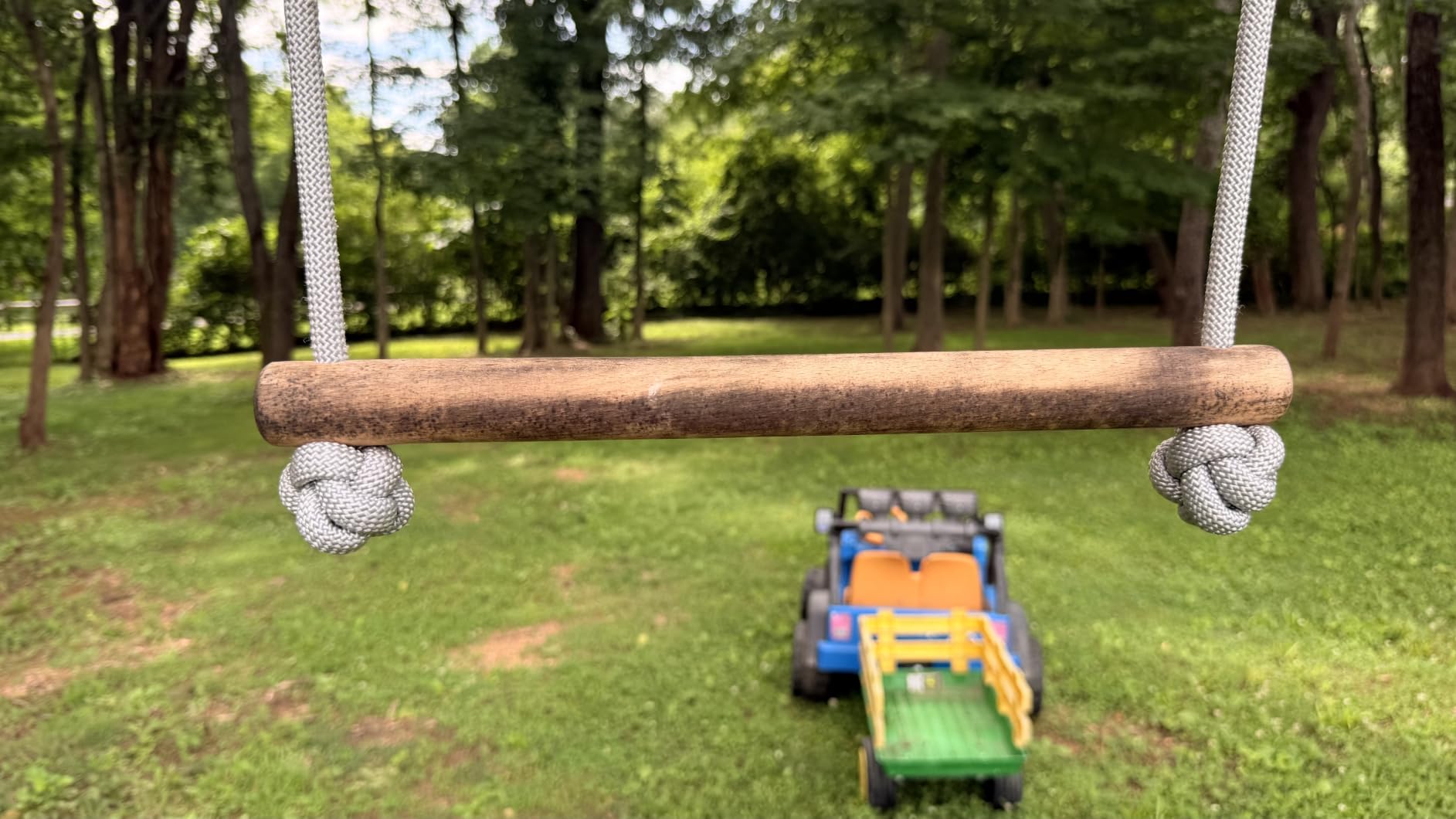
Best fit for big families and long courses
Sixty feet per line is as long as these kits get, and 13 obstacles is the highest obstacle count in this group. If you are running a family relay race, a homeschool PE group, or a summer-week-long challenge, the room to run is the point. The 880 lb rating is also high enough that an adult can test the line first, which parents consistently want to do.
Pick it if you have two strong anchors and multiple children. The obstacle density justifies the span in a way a shorter single-line kit cannot.
Where it falls short
The included tree protectors are short relative to large mature trunks, so expect to source a longer strap if your trees are wide. The 25 lb weight also matters if you planned to move the course to a park regularly, since that is a two-person lift every time.
If you only have one child, or a small yard, a 60-foot line is more course than you need. The shorter single-line options later in this list are easier to site and easier to move.
5. Dripex 2x50ft 10 Accessory Kit – Most Reviewed Two-Line Course
- Ten attachments covering swing
- trapeze
- ladder
- net
- fists
- rings and arm trainer
- Obstacles move to any order and spacing
- Two lines let adults and kids train together
- SGS tested webbing
- Carry bag included
- Assembly reported at 3+ hours and needs two people
- Ratchet and buckle instructions are confusing for beginners
- Extra buckles are not sold separately
- Wood parts weather without sealing
With more than 2000 reviews behind it, this is one of the most thoroughly owner-tested courses in the group, and the reason is flexibility. The manufacturer states there are no fixed obstacles and no fixed distance: you move attachments to any order and any spacing. That single design decision is what keeps a 5-year-old and a 10-year-old both challenged on the same 50 foot lines.
The accessory roster covers more play types than most here. You get a swing, a trapeze swing, a rope ladder, a climbing net, two monkey fists, two monkey rings, two monkey bars and a 1.2 metre arm trainer, plus seventeen webbing buckles, seventeen connecting buckles, four tree protectors, two ratchets and a carry bag. Webbing and ratchets are rated to 400 lb and the product is SGS tested.
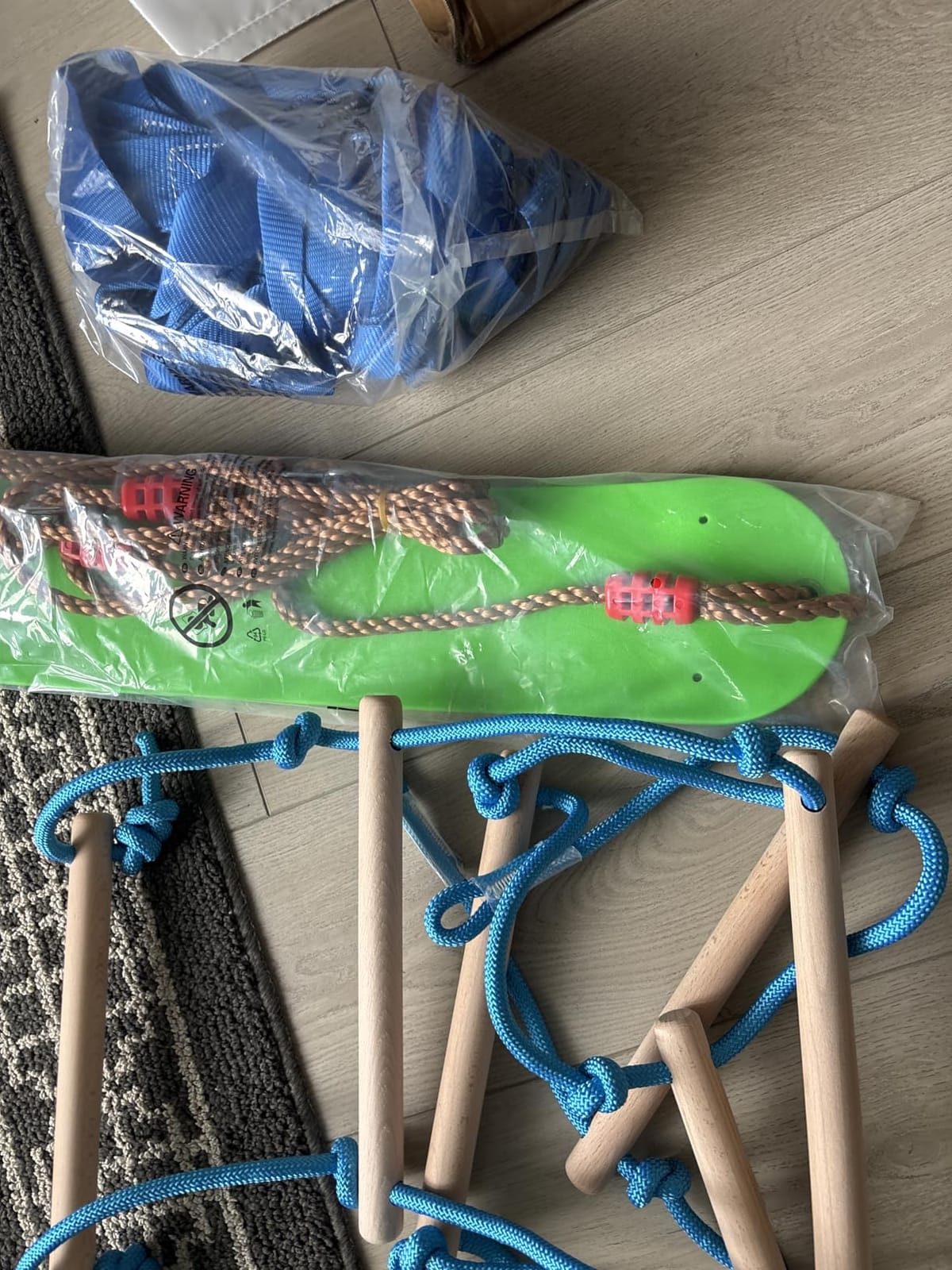
Durability reports are strong. Owners describe the webbing and buckles holding up through intense sun and even an ice storm, and the wide age range of 36 months to 12 years is one of the most honestly stated we saw. The two-line format means an adult can work the course with a child at the same time, which reviewers single out as a family-use benefit.
Assembly is the real complaint, and it is a consistent one. Multiple reviews report more than three hours and two people, and the ratchet and buckle instructions are described as confusing for anyone who has never rigged a slackline. Budget an afternoon, not an evening. The lower line should also hang about two feet clear of the ground or it will contact dirt mid-use.
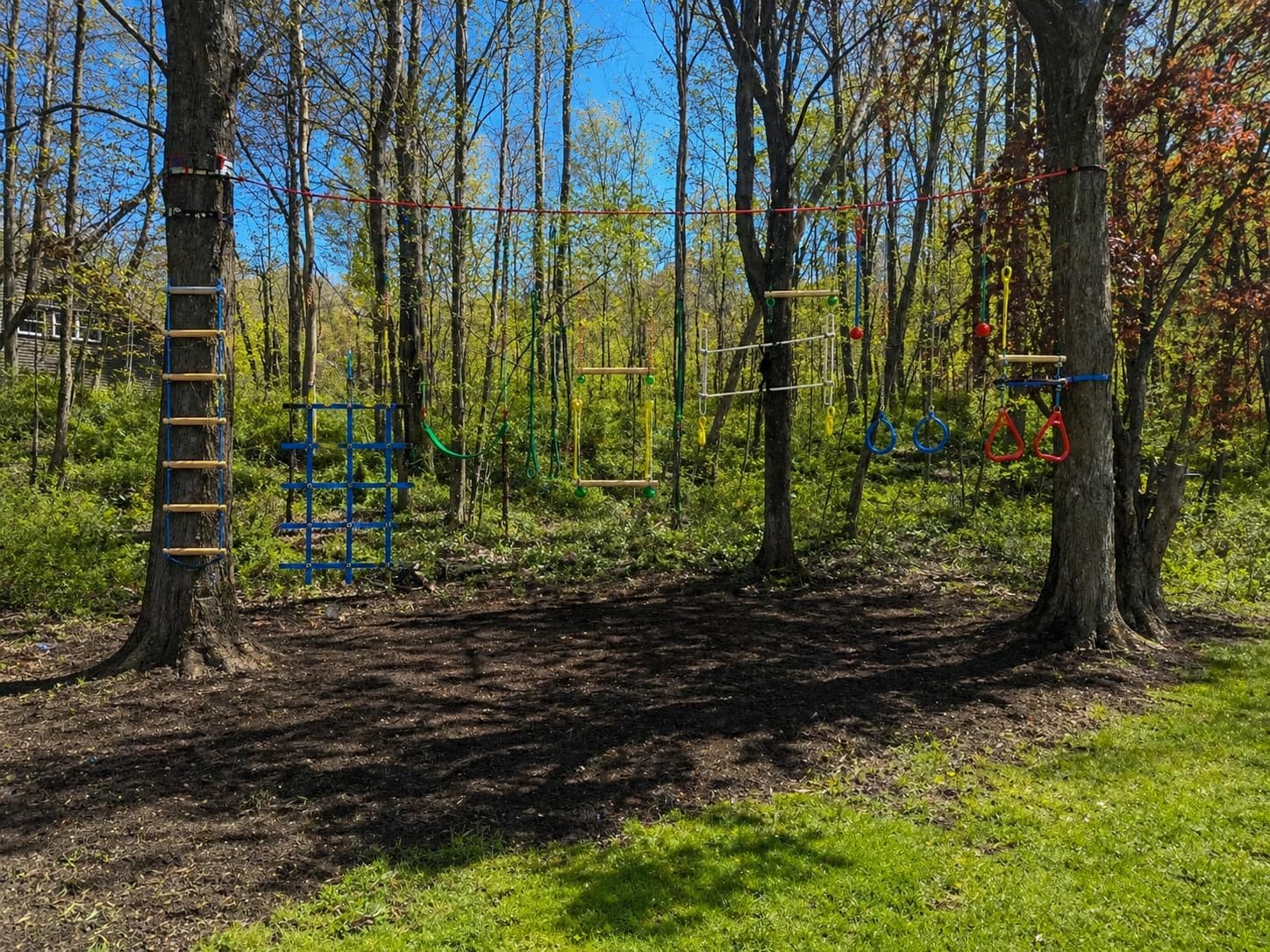
Best fit for a full-size yard with mixed ages
Two 50 foot lines and ten accessories give you enough material to build a genuine course with start and finish separation. The 36-month-to-12-year range is the broadest stated span in this list. If your children span preschool to primary school, this is the kit that avoids a second purchase.
It suits a yard with anchor points roughly 50 feet apart, and the carry bag makes it portable to campsites. Plan on a two-adult install and you will get a course that gets used daily for years.
Where it falls short
Extra buckles are not sold separately, so the long line cannot be extended with more obstacles later. That is a genuine limitation if you want to grow the course rather than rearrange it. The wooden bars and ladder also need sealing to survive long outdoor exposure.
If your yard has no two suitable anchors, this is the wrong shape of kit. Look for a shorter single line or a stand-alone frame instead.
6. Gentle Booms 2x56ft 8 Obstacle Kit – Best Coated Buckle Design
- Coated one-piece buckles designed to prevent webbing tearing
- Accessories tested to 600 lb
- Anti-rust treated steel and aging-resistant PE
- Storage bag for camps and parties
- Only 8 accessories
- fewer than most in this range
- 56 ft span needs widely spaced strong anchors
- Ratchet and buckles take practice to learn
The engineering story on this kit is the buckle. It uses a one-piece coated buckle design specifically made to avoid the slackline tearing that plagues cheaper kits, and that is the most common failure mode parents report across this category. Owners who have used it through seasons describe the coating as the reason the webbing is still intact.
You get two 56 foot lines with eight accessories, a storage bag, and anti-rust treated steel components. Each accessory is tested to 600 lb, which is higher than the total rating on several cheaper kits in this group. The material is described as aging-resistant high-density PE.
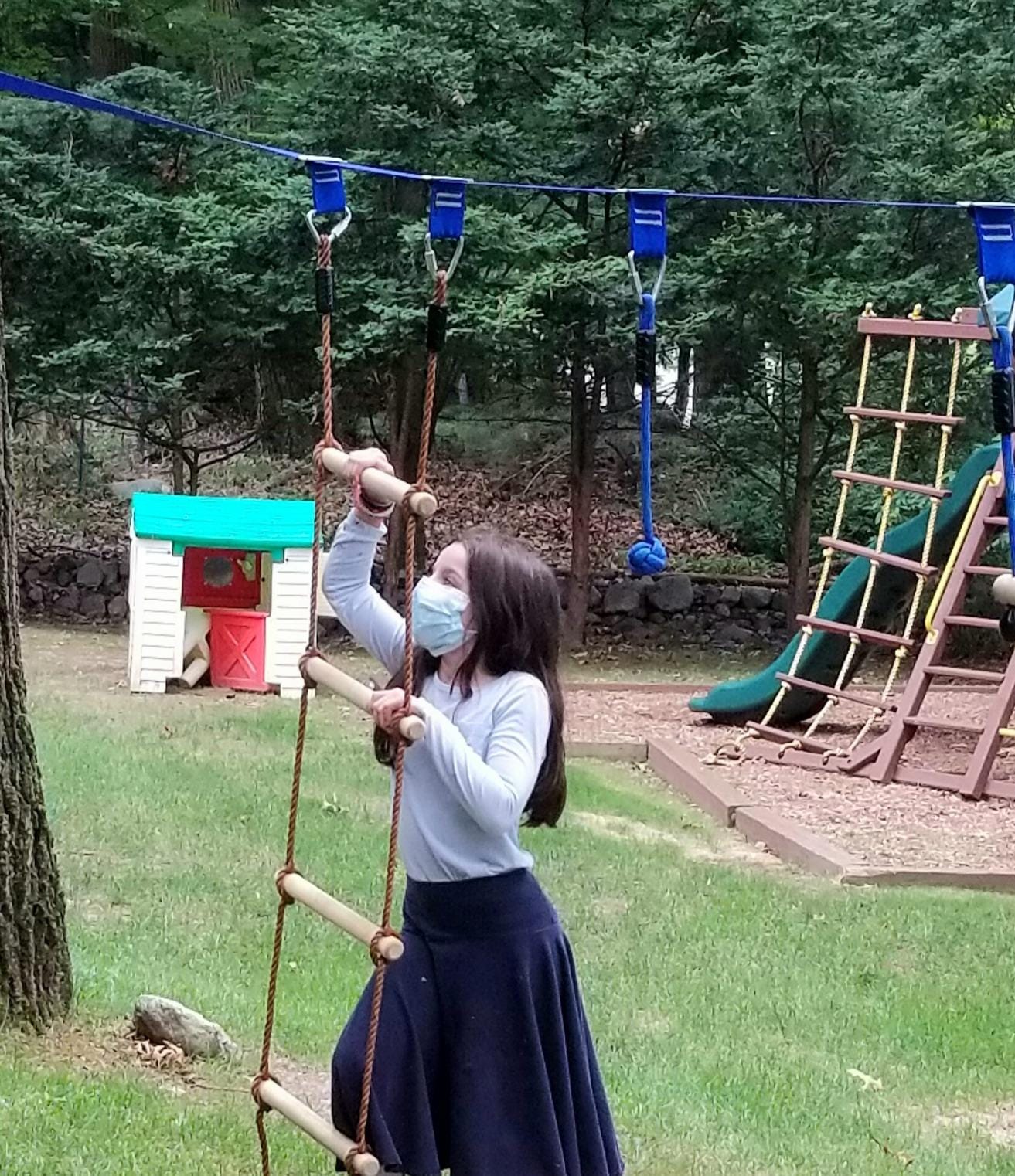
Setup goes between two sturdy trees or poles 15 to 45 feet apart. Reviewers praise the everyday reliability, and the storage bag is genuinely useful for camps, parties and winter. It is a kit built to be taken down and put back up, which suits families who do not want hardware living in a yard year-round.
Two things temper that. Eight accessories is fewer than nearly everything else at this level, and 56 feet per line is the longest span for the accessory count you get. The ratchet and buckle system also has a real learning curve, and even the fast-setup design needs the line left loose while you thread attachments the first time.
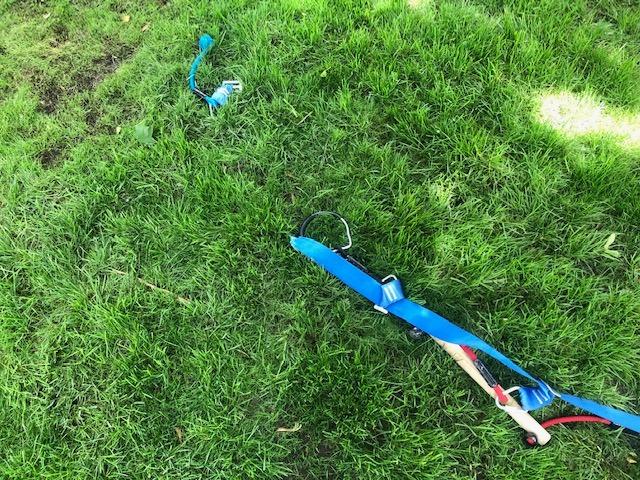
Best fit for long-term durability and repeated setup
If you expect to rig and unrig the course regularly, coated hardware is worth more than another two accessories. Families using it for parties, camps or seasonal play benefit most from a bag and a buckle that resists tearing. It also works for kids 5 and up alongside an adult beginner on the same line.
Choose it when longevity matters more than obstacle variety. Two lines also mean an adult can train while a child plays.
Where it falls short
Eight obstacles on a 56 foot line is a long stride between challenges. A child will cover that distance faster than a course designer intended, and the short accessory list is the most repeated complaint in reviews. The span also needs two well-separated anchors, which narrows where it can go.
The fast-setup buckles are not friction-free. If nobody in the household has rigged a line before, budget time for the first attempt.
7. Perantlb 60ft Ninja Slackline Course – Best Single-Line Starter Setup
Ninja Warrior Obstacle Course for Kids – 60ft Slackline with 8 Pcs Accessories, Tree Protector & Carry Bag
- Rated to 440 lb and sturdy enough for adults to climb
- Tree protectors and closable carry bag included
- Webbing reported to hold tension with no fraying after months of sun
- Simple single-line layout
- Single ratchet means one activity at a time
- Instructions are thin though the layout is intuitive
- Requires anchors 30-48 ft apart
- Not recommended under age 3
This one accepts that trade and leans on simplicity. You get a 60 foot line with eight accessories, tree protectors and a closable carry bag, and the whole thing is CPC tested with webbing and ratchet rated to 440 lb.
Durability is the standout in owner reports. Reviewers describe webbing that held tension with no fading or fraying after six months of strong sun, and several mention adults climbing it, including a 140 lb adult. For families who want to test the course themselves before letting a child on, the capacity is sufficient.
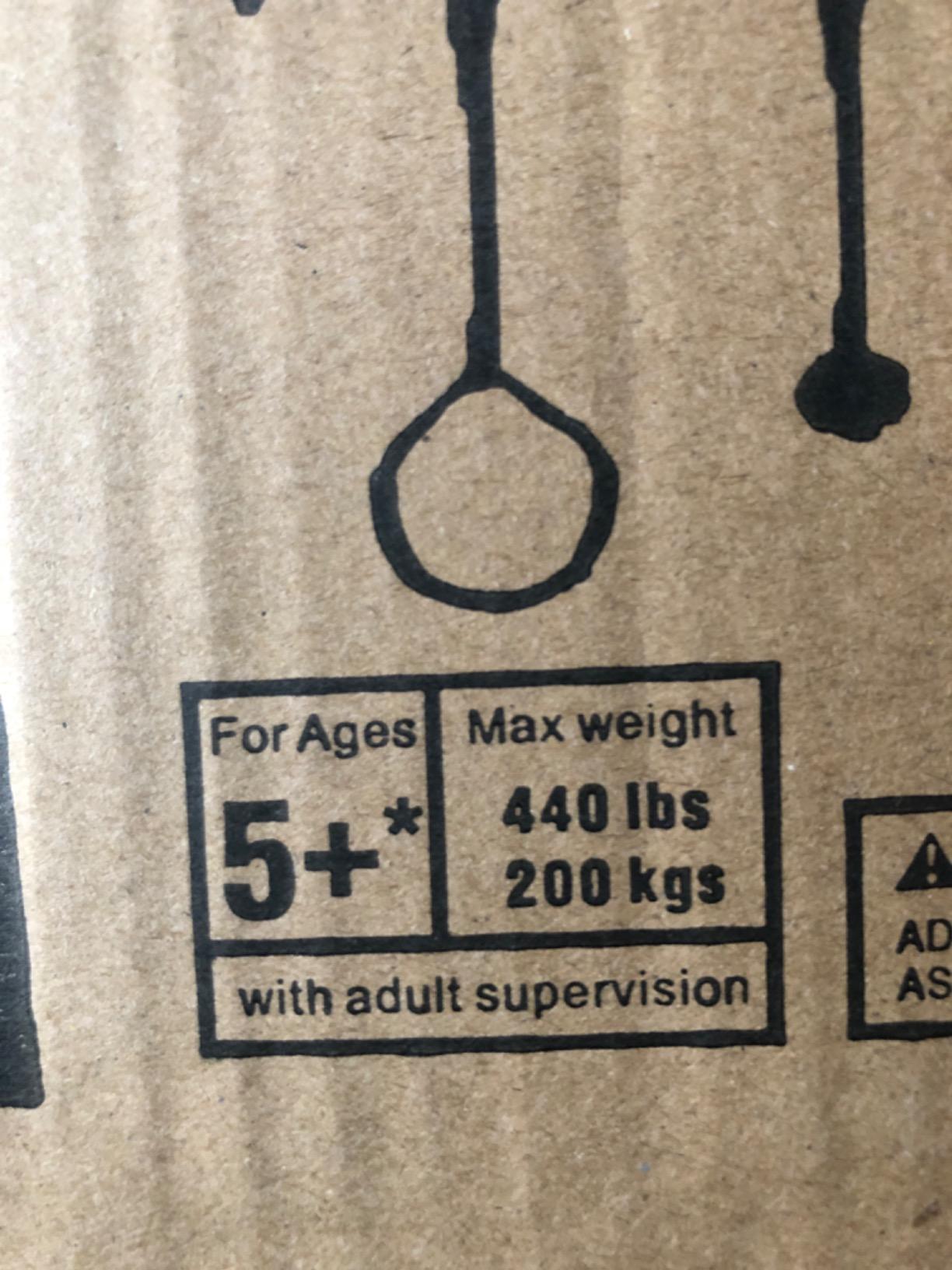
The practical detail is the anchor requirement. It installs between two mature trees, posts, beams or crossbars set 30 to 48 feet apart, and those points need to withstand at least 2200 lb. That is a wide span, which rules out many suburban backyards but works well between two existing structures or a purpose-built frame.
Limitations reported by buyers: one order arrived with attachment hardware missing entirely, which is a packing and fulfilment issue rather than a design flaw, and the instructions are described as lacking, though owners say the layout is easy to work out unaided. A single ratchet also means switching from a climbing layout to a swinging layout requires releasing tension and re-threading.
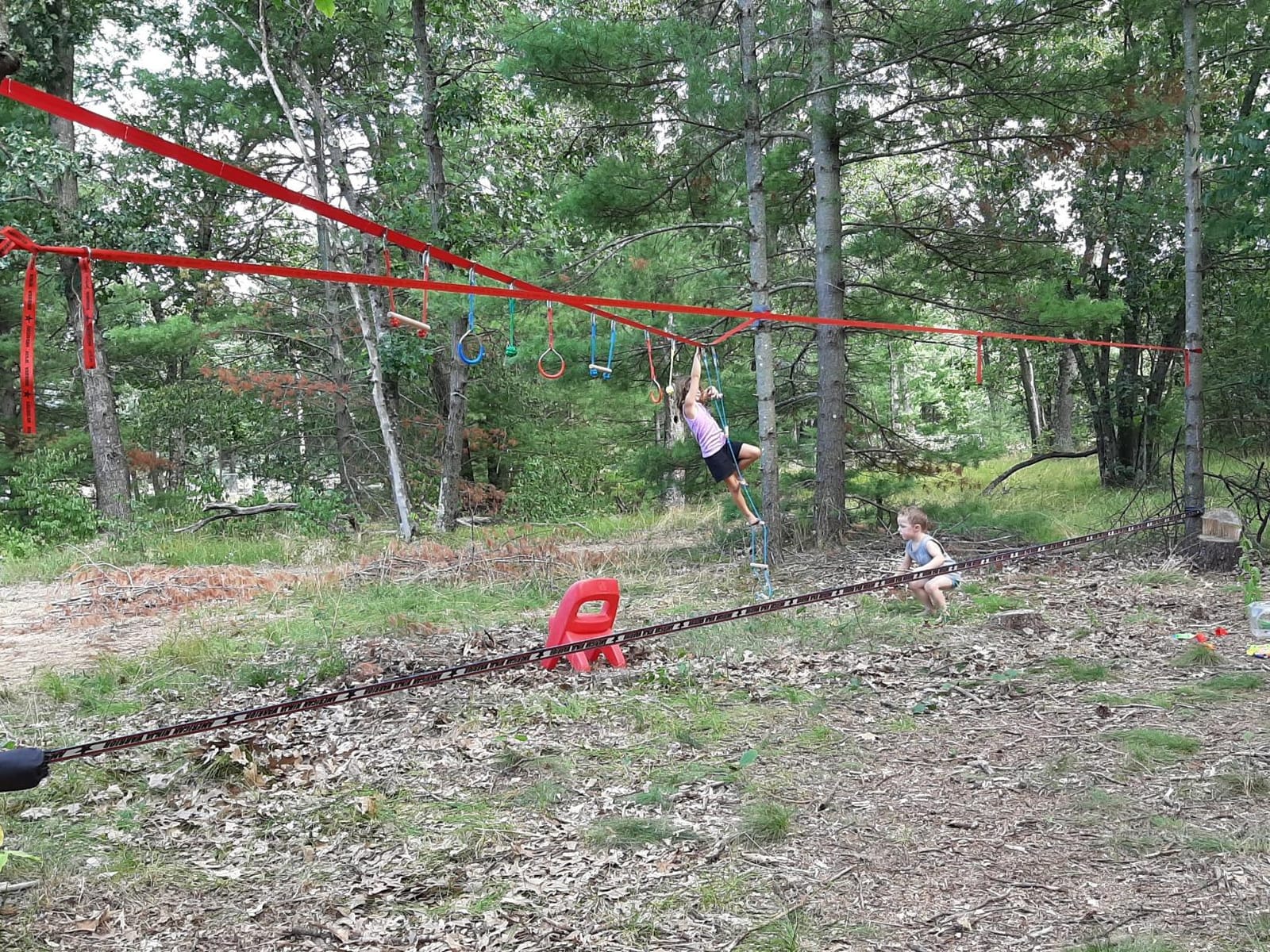
Best fit for a first slackline purchase
If your household has never owned a line, this is a low-complexity way in. Eight accessories cover climbing, swinging and balancing, the carry bag makes takedown painless, and the tree protectors show the manufacturer thought about your trees. It is also explicitly not recommended for children under 3.
Pick it when you have two anchors 30 to 48 feet apart and only need one active line. A Slackline community thread comparing entry-level brands shows parents weighing recognised names most at this level, and capacity claims matter more to them than anything else.
Where it falls short
One line means one child on the course at a time, which limits use with siblings. The 30 to 48 foot span is also the widest requirement in this list, so measure before you commit. Thin instructions mean your first setup will be a learning exercise.
If you want parallel lines for two children, or a shorter span for a compact yard, the two-line options further down fit better.
8. Hapfan 50ft Ninja Course with Saucer Swing – Combo Course and Swing Set
Hapfan 50 ft Ninja Warrior Obstacle Course Swing Set for Kids Outside
- 32 inch saucer swing alongside the ninja obstacles
- 10 obstacles including a 360-degree rotating ninja wheel
- Holds up through heavy snow and summer storms
- Portable with carry bag
- No metal in the child attachments
- Tree straps too short for large mature trees
- Assembly about 45 minutes and needs two adults
- Line sags noticeably under load
- Limited instructions for connection clips
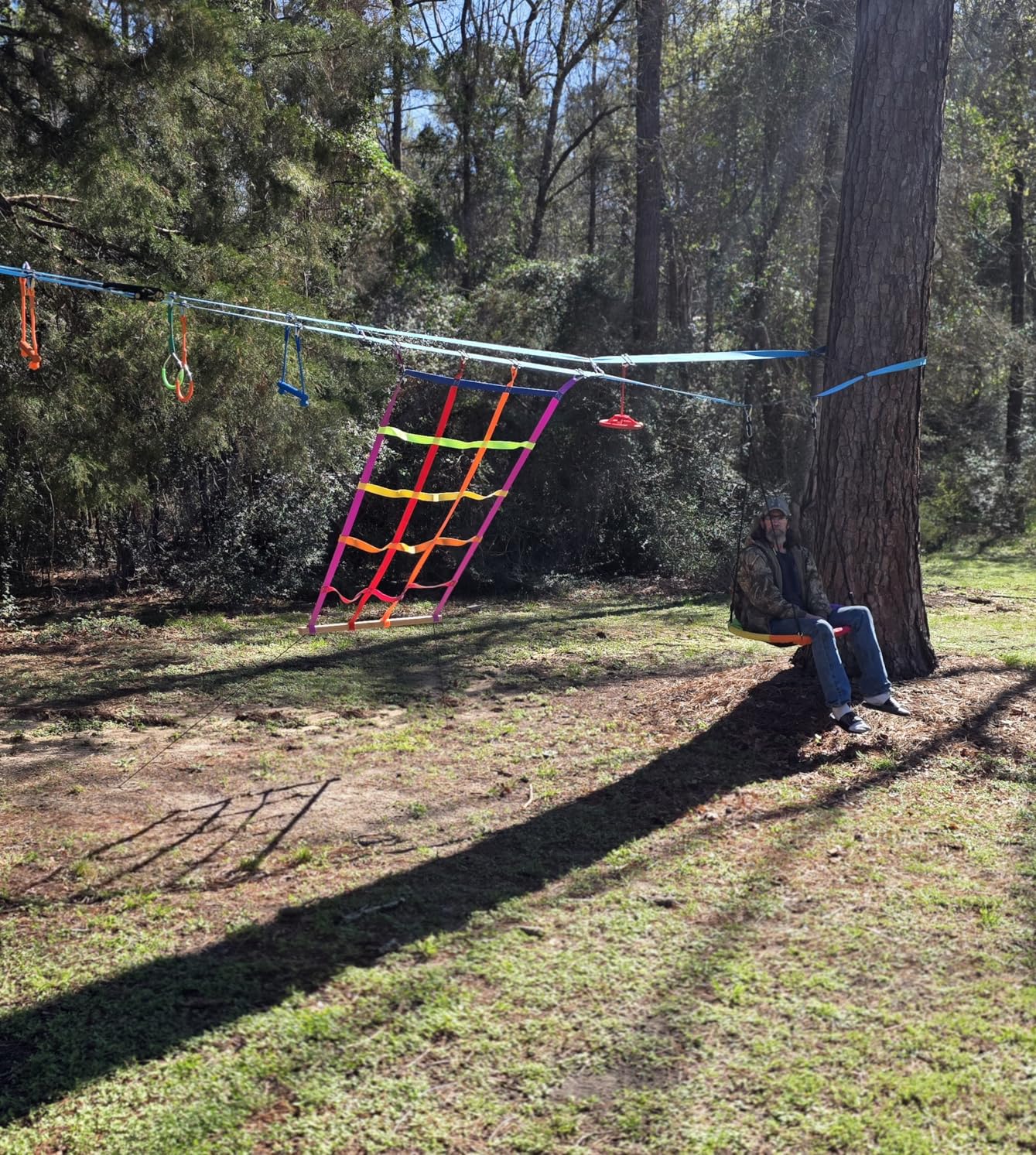
The differentiator here is the 32 inch saucer tree swing with foam tubes, which this kit includes alongside its ninja obstacles. That accessory turns a slackline course into a workable swing set, which matters for a family that wants one structure serving two kinds of play rather than buying a separate swing frame.
Alongside it you get a 50 foot line and ten obstacles: a rope ladder, two monkey bars, two triangle gymnastic rings, two round rings, a rotating ninja wheel and a climbing net, plus 17 toggle clasps and 17 triangle carabiners. Total capacity is 880 lb with 250 lb per obstacle, and the warranty line lists an ASTM certified playset.
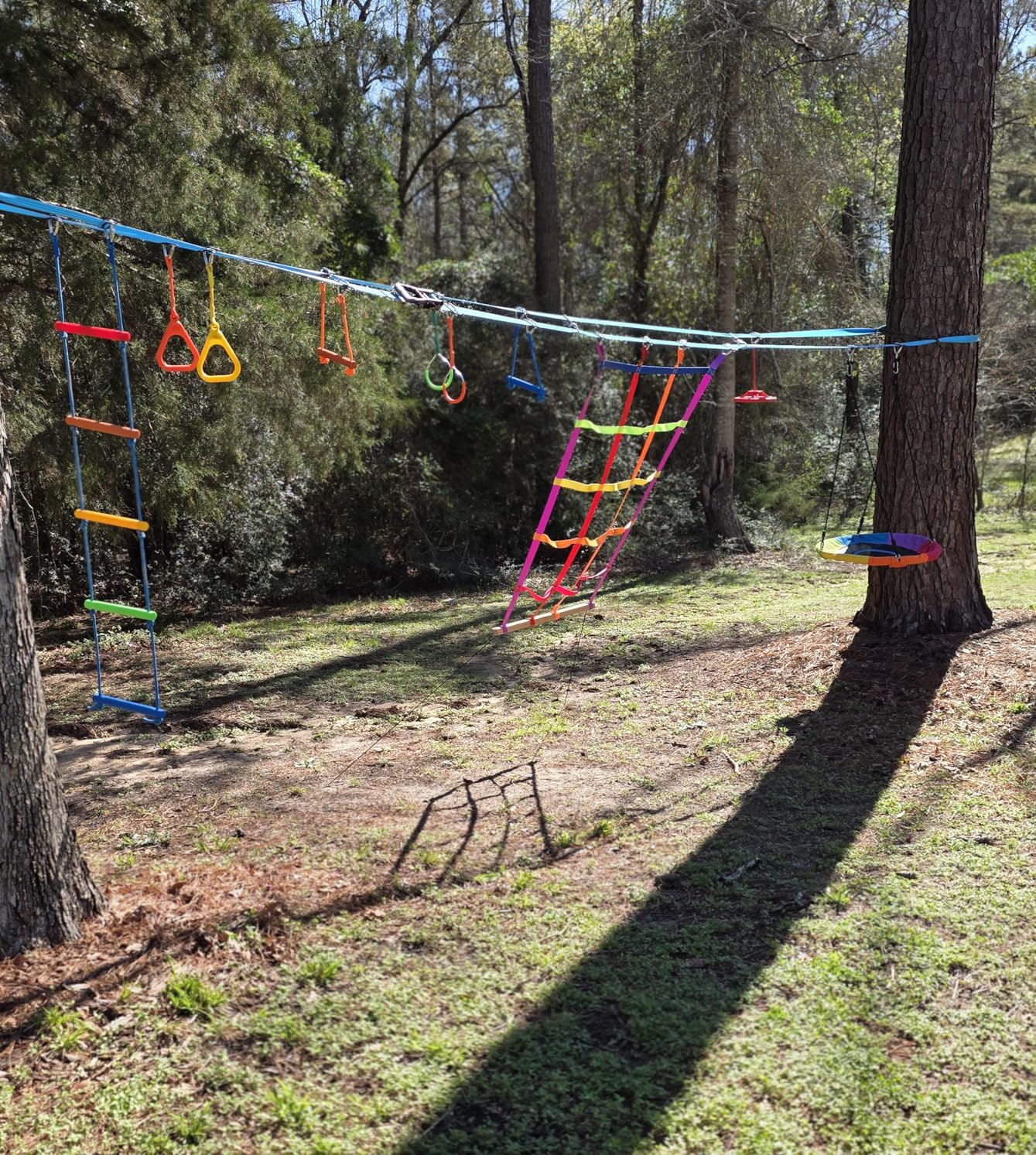
Weather performance is a repeated strength in the reviews here. Owners describe the set holding up through heavy snow and summer storms after six or more months of heavy use, with adults up to 180 lb using it. The absence of metal in the child attachments is a detail parents with toddlers appreciate, since there is no pinch point or rust concern on the parts a small hand grips.
The recurring problem is strap length. Multiple reviews say the included tree straps are too short for large mature trees and that the small tree protector strip will not cover a wide trunk. Expect to buy a longer strap if your trees are big. Assembly is about 45 minutes for two people, and the line sags noticeably when a child is on it, so hang it higher than you think you need to.
Best fit when you want climbing and swinging in one box
The saucer swing is what makes this distinct from a standard ninja kit. It is also portable, taking down for storage and moving to parks, beaches or camping, with the carry bag included. The manufacturer designed it around three bands: 3 to 5, 6 to 8 and 8 to 12, so obstacle spacing can change with the child.
Choose it if a swing is on your wish list and you would rather not buy a separate frame. A newly designed buckle set is also claimed to reduce slackline fraying and speed setup.
Where it falls short
It is a 22.6 lb kit that needs two adults for assembly, so it is not a spontaneous weekend purchase. The short tree straps are the single most common complaint and the most likely reason a buyer ends up buying something else. Sag is real, so a higher hang point is necessary.
The connection clip instructions are limited, which adds time for first-time slackline users. Budget the afternoon.
9. Just.smile 52ft 11 Obstacle Course – Most Obstacles in a Single-Line Kit
- 11 accessories plus a rotating disc swing
- Rated to 440 lb with clamps that held a 220 lb adult
- Reviewers report quality above the usual tier
- Packs down for winter storage
- Buckles thread from the end of the line one at a time
- Monkey ring grips are thin and hard on hands
- Some bars are slightly large for 5-year-olds
- Two-person setup preferable
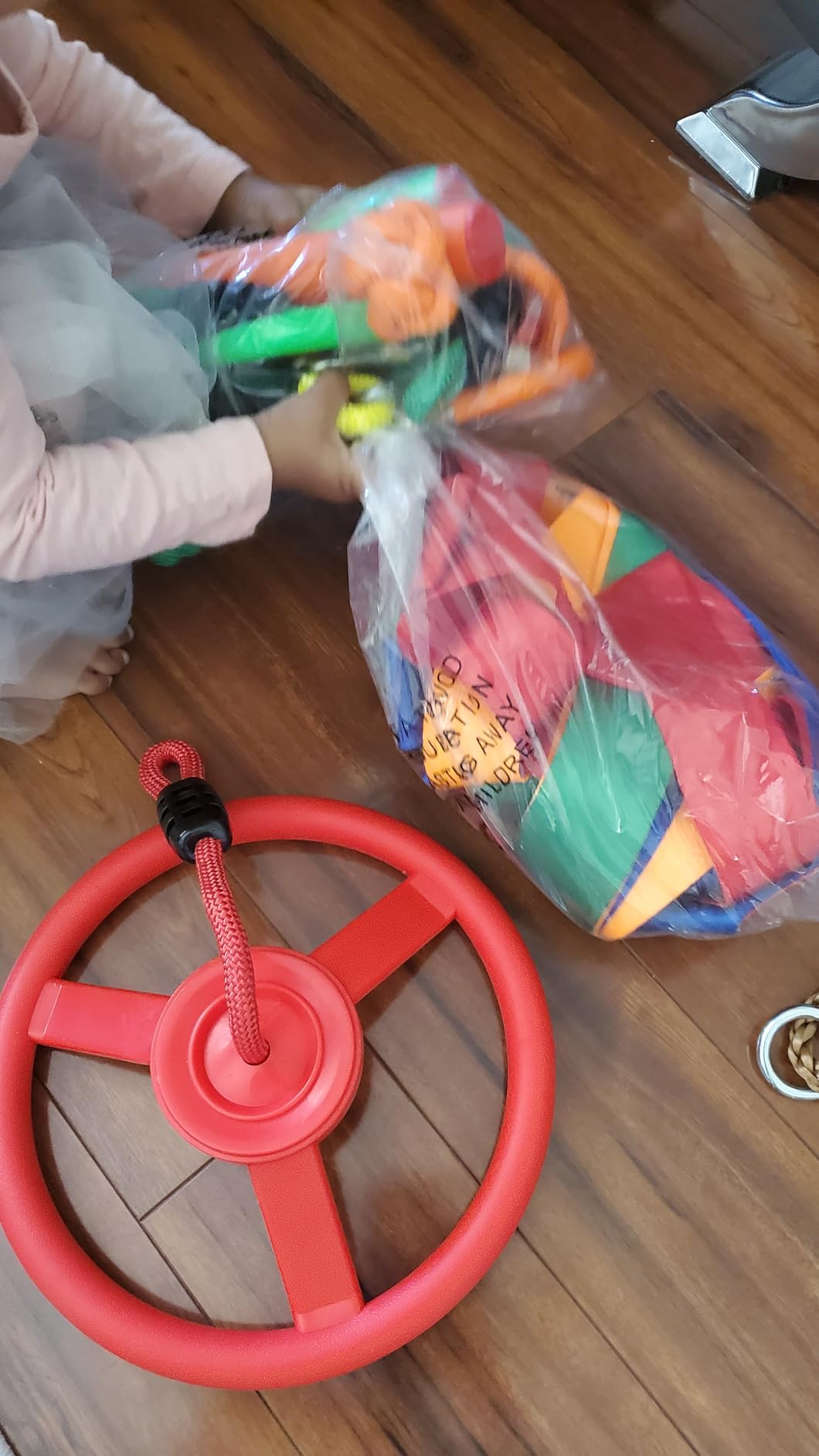
On accessory count for a single-line kit, this is a standout in our list. You get an 11-accessory kit on a 52 foot line, rated to 440 lb, and buyers consistently describe the quality as exceeding what they expected to get. The accessory list includes a rope ladder, a climbing net and a rotating disc swing, which reviewers single out as an upgrade over a traditional swing.
Hardware is carbon steel with buckle fasteners, tree pads are included for bark protection, and the warranty is one year. It is designed for kids aged 3 and up. At 15.7 lb it is one of the heavier single-line kits, so factor that into whether you plan to move it often.
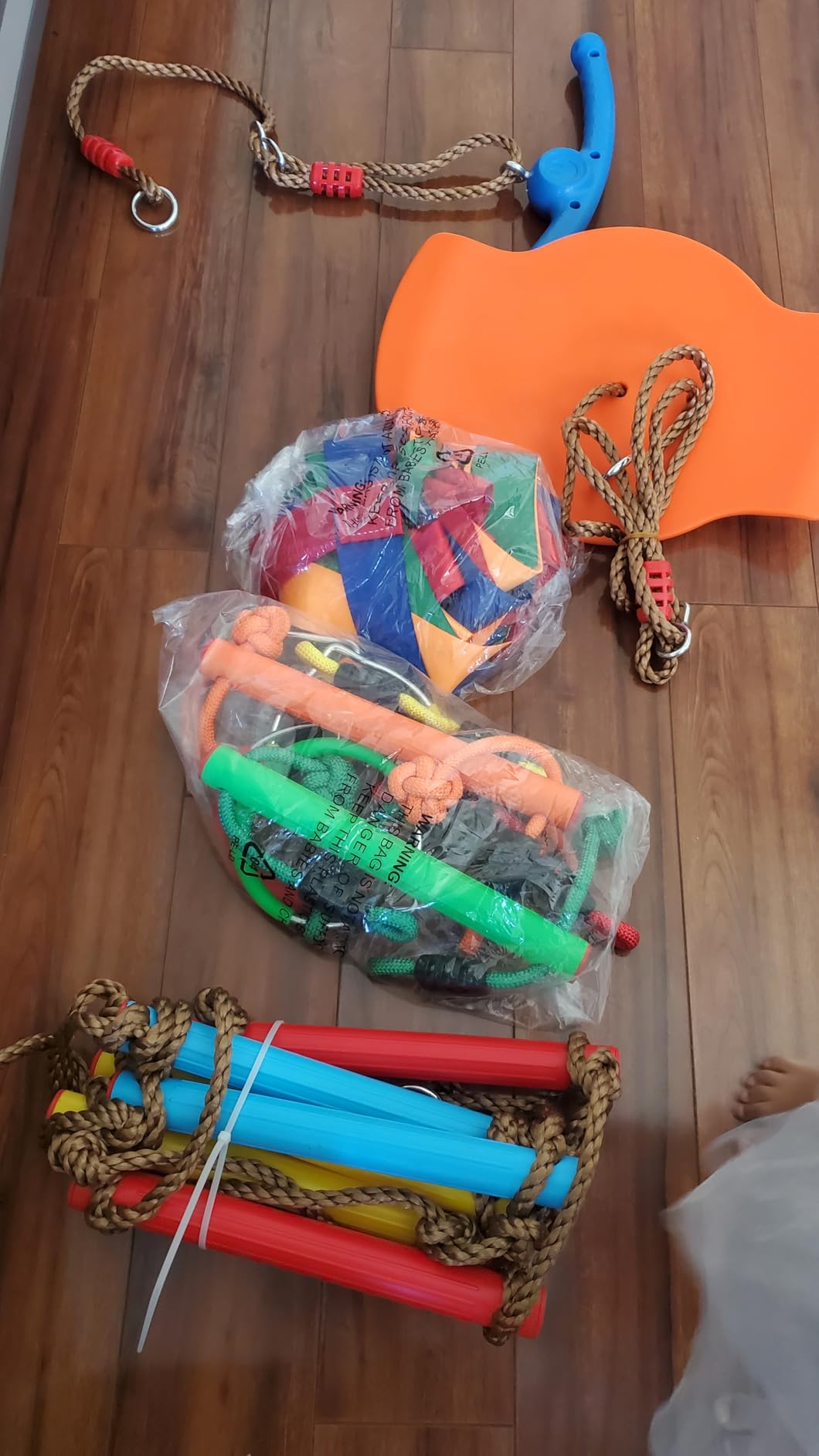
Clamp quality is the detail that gives parents confidence. One reviewer reports a 220 lb adult standing on the line without issue, which is a meaningful stress test for a course most children will only walk. Owners also mention kids using it on most days of a summer, and easy takedown for winter storage.
The fiddly part is adjustment. Buckles must be threaded from the very end of the line one at a time, and changing obstacle spacing means fully releasing tension. That is a real annoyance mid-session, and it is the most common complaint in reviews. Monkey ring handles are also thin enough that kids report hand discomfort, and some bars run large for a 5-year-old.
Best fit for families who want more obstacles per kit
Eleven accessories on a single line is unusual, and the rotating disc swing adds a play type the simpler kits skip. Buyers repeatedly note it costs about half of comparable kits while still feeling sturdy. The 440 lb rating allows adult testing before the kids go on.
Pick it if you want variety on one line and can accept slower reconfiguration. It suits a single child, or siblings taking turns.
Where it falls short
Repositioning obstacles is genuinely tedious, and a course that cannot be adjusted quickly gets used less often. The thin ring grips and oversized bars make it a weaker choice for a 5-year-old than the specs suggest, even though the box says ages 3 and up.
Setup is easier with two people. If you plan to move the course between locations frequently, the 15.7 lb weight and one-line format will slow you down.
10. AOBOTE 2x56ft 12 Accessory Kit – Best for Rearranging Into New Layouts
- Twelve accessories with a saucer swing and 360-degree rotating wheel
- Ratchets reported to hold up over months of use
- No pinched fingers or skin catches reported
- Multiple combination modes for new layouts
- Not enough buckles and hooks to use every accessory at once
- Instructions unclear including clip orientation
- Attachments need tension released to move
- Best suited to kids around 11 and under
This is a two-line 56 foot kit with twelve accessories, including a climbing net, a climbing ladder and a saucer swing with a 360-degree rotating wheel. The high-density polyester is described as having strong fracture resistance, the lines are rated to 440 lb, and installation works between two trees or stakes 20 to 45 feet apart.
The safety feedback is the distinguishing signal here. Across reviews there are no reports of pinched fingers, skin catches or injuries after extended use, and owners repeatedly praise the ratchet strength over months of use. Multiple combination modes mean the course can be rebuilt into different layouts rather than running the same route every session.
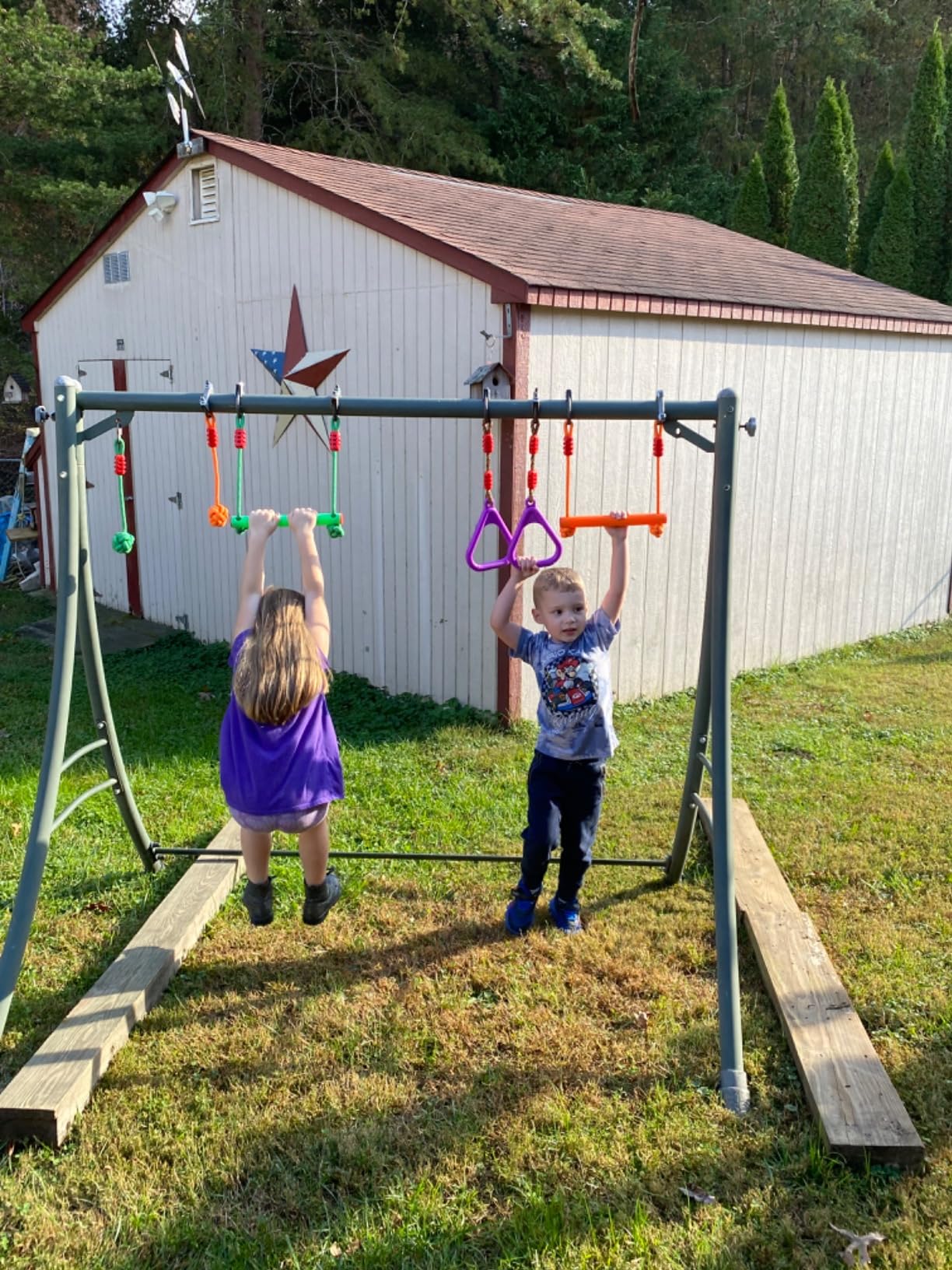
The most repeated complaint is hardware count. Seventeen hooks ship with the kit, and several buyers report there are not enough buckles and hooks to attach every accessory at the same time. In practice this means you choose a subset of obstacles and the rest wait, which reduces the value of a twelve-piece accessory set.
Instructions are also flagged, including which direction the sliding plastic clips face, and moving any attachment requires loosening the slackline tension first. One reviewer rated build quality as poor, though that sits against a 71 percent five-star share from a smaller base of 152 reviews. Treat this as the least-proven kit here, and expect older children to outgrow the span.
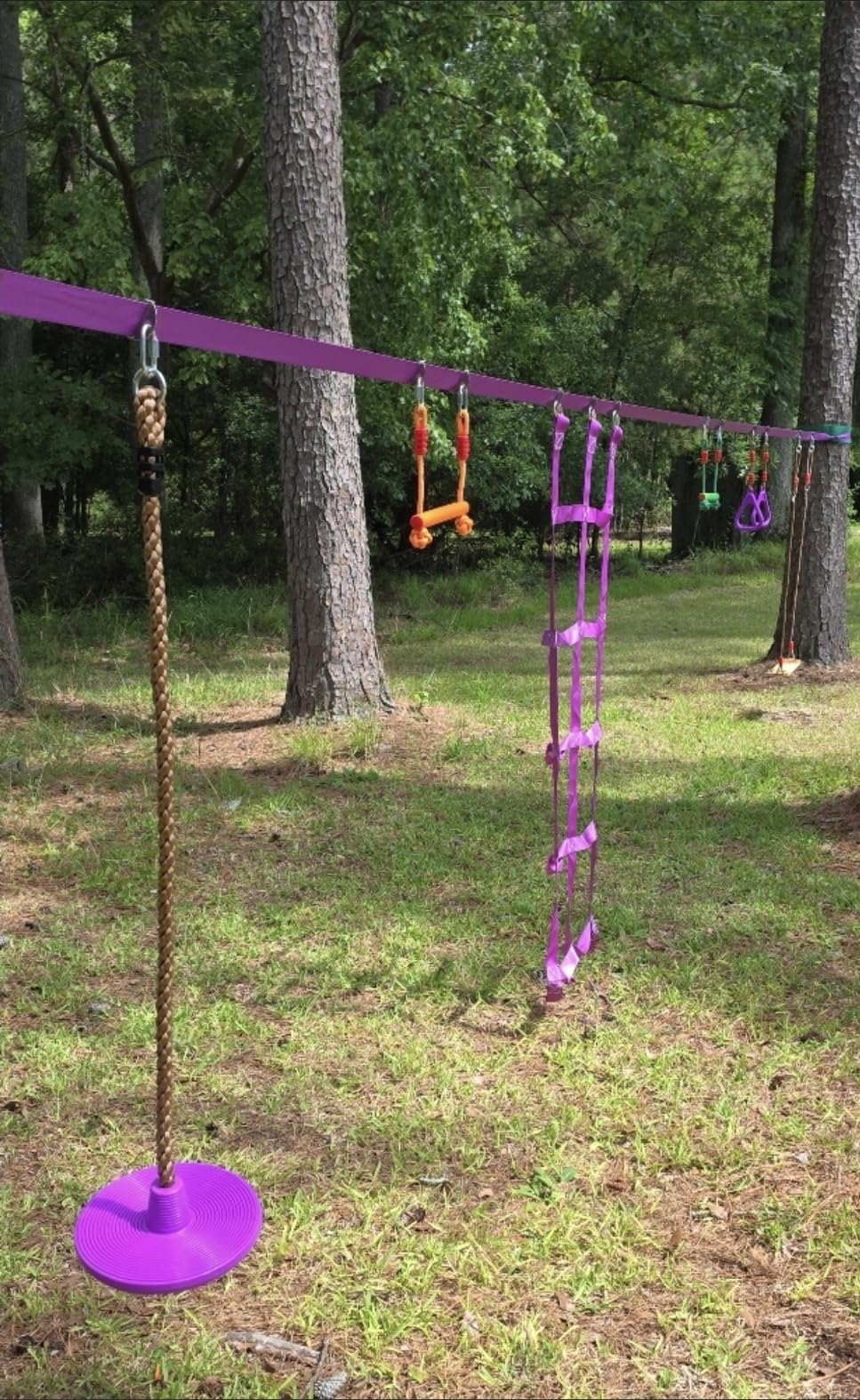
Best fit for kids under 11 who like rearranging the course
Two lines and twelve accessory types give a lot of combinatorial play, and the rotating wheel plus saucer swing cover a wide range of activities. It suits a family with several children under about 11 who want to rebuild the route rather than master one fixed course. The 20 to 45 foot anchor range is also more flexible than the 30 to 48 foot requirement of the single-line kit.
Choose it if layout variety is the priority and you are comfortable selecting which attachments go up each session. A one-year warranty and customer service support are included.
Where it falls short
Insufficient buckles and hooks is the deal-breaker for anyone who expects to use the whole accessory set at once. Unclear clip orientation will slow a first-time rig, and releasing tension for every adjustment is tedious during a session.
With 152 reviews, this has the thinnest evidence base of the ten. For older children or teens, a longer, heavier two-line kit is a better long-term purchase.
How to Choose an Outdoor Obstacle Course Kit?
A ninja warrior obstacle course kit is a tensioned line or frame anchored at both ends, with hanging accessories that clip onto it so kids move along the line completing each challenge in sequence. Most kits combine balancing on the webbing itself with hanging obstacles such as monkey bars, gym rings, monkey fist knots, cargo nets, rope ladders, trapeze swings and rotating wheels. Adults supervise throughout.
Before comparing models, decide which of these eight criteria actually applies to your household.
Anchor span versus yard size. This is the number one practical blocker. Kits specify a required distance between anchors, commonly 15 to 45 feet or 30 to 48 feet. Measure first. A kit that needs 50 feet of clear span simply will not work in a small or suburban yard.
Line length. Thirty to forty feet suits younger children and short yards. Fifty to sixty feet gives older kids a run and more room to reposition obstacles. Two lines let adults and children train at the same time.
Load capacity. Stated capacity matters twice: it tells you whether two children can be on the line together, and whether an adult can test it first. Figures in this group range from 250 lb per obstacle up to 880 lb total.
Obstacle count and repositionability. More accessories is not automatically better, but accessories that can be moved and re-spaced without restringing are what keep a course interesting past the first month.
Access method for small children. Anything marketed to young kids should include a ladder or a low-hanging entry point. A course a four-year-old cannot reach is a course they will not use.
Hardware and certification. Look for CPC certification, ASTM certification or third-party testing such as SGS, and for coated buckles that resist webbing tearing.
Portability and storage. A carry bag matters more than expected if you plan to take the course down between seasons or move it to a park, campsite or party.
Age fit and outgrowing. A kit listing ages 3 to 12 gives you a longer runway. Note the rating of the climbing hardware separately, since some packs are certified for ages 3 while full courses are not.
Two categories of parents get the most from this roundup. If your child is under five, a fixed plastic stepping set is safer and simpler than any tensioned line, and our guide to outdoor climbing domes covers another low-anchor option for the same age group.
There is also a question of whether a slackline course is right at all. Rigid fixed-play equipment and foam courses are a different purchase with different durability, and they suit families who want permanent structures rather than seasonal gear. Whichever route you take, outdoor toys still need somewhere to live between seasons, which is why we keep coming back to deck boxes for kids’ outdoor toys as a companion buy.
How to Anchor and Install a Backyard Obstacle Course?
Installation is where most families get stuck, and forum threads about this category keep circling the same problem: what do you do when you do not have two big trees. Here are the four anchor options in order of how much work they involve.
Two mature trees. The simplest route, and the one most kits are designed around. Wrap the included tree protectors, feed the webbing through the ratchet, tension until firm, then clip obstacles on. No tools, no drilling. Check that trunks are wide enough to be meaningful anchors and that no branches sit in the fall zone.
Existing posts, beams or a swing frame. If you already have a swing set or a covered porch, several kits install between those points. Follow the same ratchet process, and confirm the structure can carry the load before a child hangs from it.
Standalone anchor posts or a frame. For yards with no trees at all, purpose-built freestanding frames solve the problem entirely. They cost more and take longer to assemble, but they convert the line into a movable structure you can reposition or store.
Stakes. Some kits specify trees or stakes 20 to 45 feet apart. Stakes are workable in open ground, but they need to be driven deep and tested, and they will not hold in rocky or root-filled soil.
Small yards have workable compromises. A shorter single line with fewer obstacles will fit where a 60-foot course cannot. Hanging the line higher increases clearance under a sagging line, which matters because slackline stretches under load and reviewers consistently report more sag than expected.
Tension is a skill worth learning before you need it. Feed the webbing while the ratchet is loose, clip accessories on, then tighten in stages and walk the line once before any child uses it. Owners who skipped this step report a frustrating first session.
Safety Rules Before the First Session
Obstacle courses are physical equipment used by children at speed. Treat the first session like any other climbing apparatus.
Check hardware every time. Inspect webbing, ratchets, buckles, carabiners and knots before play, and replace any frayed or rusted part immediately.
Clear the fall zone. Remove rocks, branches, garden furniture, grills and hard edging from the ground under and around the line.
One child at a time. Until your child has shown consistent control, supervise closely and run a single user. Several kits here are rated for multiple children, but capacity is a hardware limit rather than a safety instruction.
Stay within reach. For children under about six, keep an adult close enough to catch them. A high-capacity line does not reduce the need for supervision.
Check the weather. Wet webbing is slippery, and heat affects tension. Do not leave a course up in strong sun and rain indefinitely if you want it to last, and take it down before storms.
Do a walk-through lap. Walk the course yourself at the child’s height before they run it, so they see the sequence and the drop points.
Re-check tension periodically. Webbing stretches over time. Retension monthly, and always after heavy rain or a season of use.
One more practical rule: take the course down when it is not in use if you have young children and a reachable line. An unattended obstacle course is a climbing frame with a pulley system attached.
Frequently Asked Questions
Is a Ninja Warrior obstacle course suitable for 7 year olds?
Yes, a seven year old can usually use a Ninja Warrior course, provided the course is rated for their age and a close-fitting adult supervises. Look for kits listing ages 3 and up or 5 and up, and start them on the lowest line with obstacles spaced widely apart. Many parents introduce a ladder or low entry point first. Avoid kits rated only for children 8 and older, and keep the first sessions to one child at a time.
What is the best age to start a ninja obstacle course?
Most manufacturers rate their courses from 3 years or 5 years and up, and readiness matters more than the label. A child is usually ready when they can climb a low jungle gym, balance along a fence rail for several seconds and follow a simple instruction like let go. Many parents start around age 4 or 5 on a low line, then move to longer courses between ages 7 and 10. Under threes should stick to fixed stepping equipment.
What is the Ninja Warrior line obstacle course?
A Ninja Warrior line obstacle course is a tensioned webbing line anchored at both ends, usually between two trees, with hanging obstacles that clip onto it. Kids balance along the webbing and work through the obstacles in sequence, such as monkey bars, gym rings, monkey fist knots, rope ladders, cargo nets, trapeze swings and rotating wheels. The obstacles reposition along the line so the same kit can be rearranged as a child grows.
What is the most difficult obstacle in a Ninja Warrior course?
The hardest obstacles are usually the rotating ninja wheel and the monkey bar ladder. The wheel requires core strength and grip to spin and cross without stopping, and monkey bars demand both upper body endurance and accurate jumping. Long single monkey bar spans and rope ladders also challenge balance. Difficulty depends on spacing, so widening the gaps between obstacles or lowering the line makes almost any obstacle easier for a younger child.
How do you anchor an obstacle course without any trees?
You have three options if you have no suitable trees. Use a purpose-built freestanding anchor frame, which turns the line into a portable structure you can move or store. Use existing structures such as a swing frame, deck posts or a covered beam, after confirming they can carry the load. Or install driven stakes 20 to 45 feet apart in open soil. Whichever route you choose, check the anchor spacing specified in the kit manual before buying, because span requirements rule out many backyards.
The Verdict on the Best Outdoor Obstacle Course Kits for Kids
After comparing all ten, the edxeducation Step-a-Trail takes the top spot for younger families: the most reviews of anything we looked at, the highest average rating here, and the only course rated from 18 months. For families with two suitable trees who want the full ninja experience, the Trailblaze 2x55ft kit pairs two lines and ten obstacles with the longest warranty we found. The Dripex 2x50ft kit is the strongest all-round pick for mixed ages.
Measure your anchor span before anything else. That one number eliminates more options than price, features or ratings ever will, and it is the mistake families most often regret.