
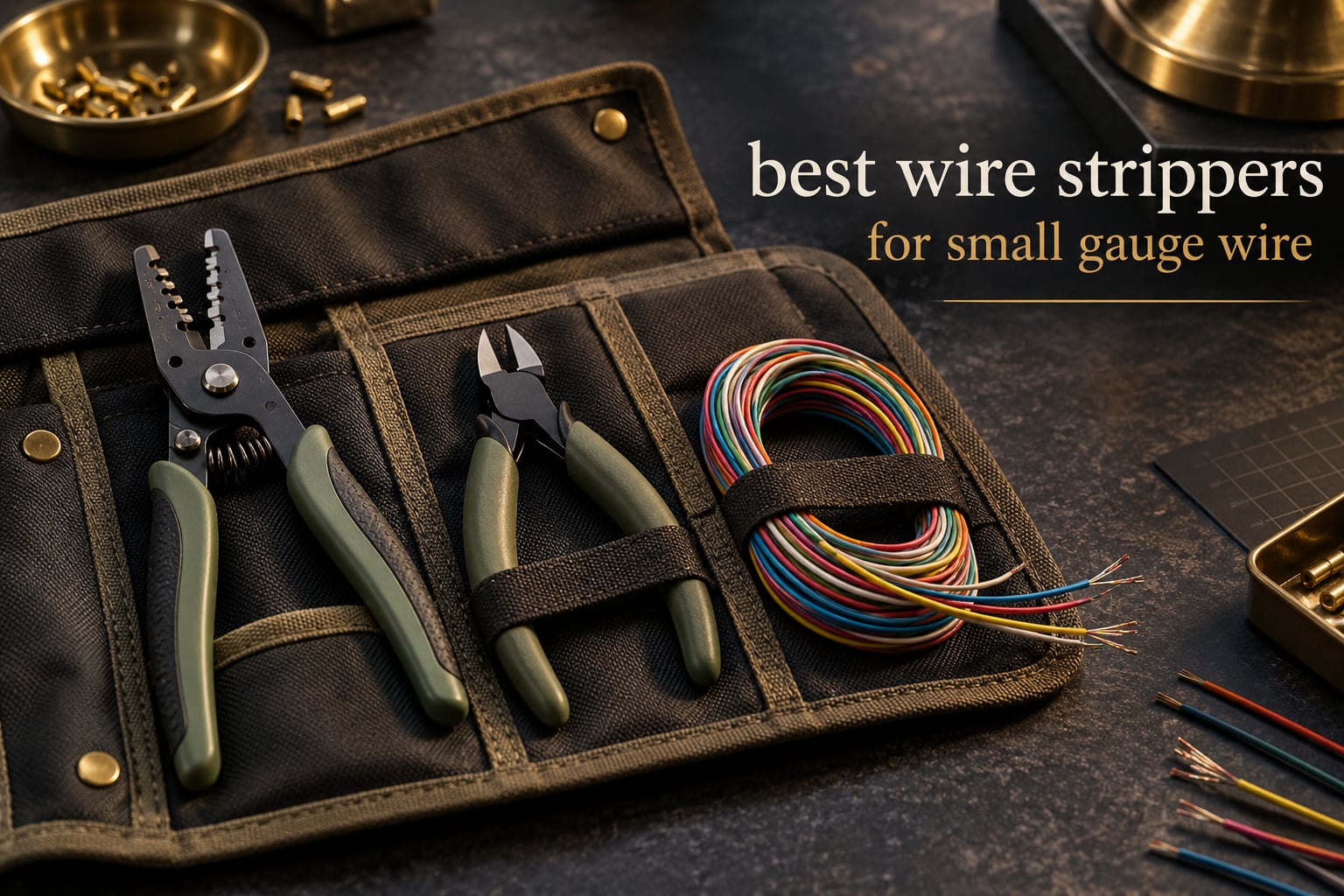
Small gauge wire means thin wire in the American Wire Gauge system, roughly 20 to 30 AWG, where a higher number is a smaller conductor. That is the wire in electronics, RC and drone builds, speaker and low-voltage cable, breadboards and PCB jumpers. It is not the 10-18 AWG solid wire used for household outlets and light switches, and a tool sized for one is usually wrong for the other.
Our best overall pick is the Klein Tools 11057, a precision-hole stripper rated for 20-30 AWG solid and 22-32 AWG stranded wire. For the thinnest conductors, the ENGINEER PA-06 is the precision pick, covering solid 28-16 AWG and stranded 30-18 AWG without nicking copper.
Below is a 12-tool comparison of the best wire strippers for small gauge wire, plus a technique section that matters more than the tool itself. On fine wire, a nick is not a cosmetic mark. It is a fatigue break point that can snap months later at exactly the spot you stripped.
Table of Contents
Top 3 Picks for Small Gauge Wire (October 2026)

Klein Tools 11057
- 20-30 AWG solid and 22-32 AWG stranded
- Precision-ground stripping holes
- Alloy steel
- Made in USA

DOWELL 22-30 AWG
- 22-30 AWG stripping range
- Integrated copper cutter
- Stainless steel with TPE grips

ENGINEER PA-06
- Solid 28-16 AWG and stranded 30-18 AWG
- High carbon steel jaws
- Spring-loaded with latching handles
All three of those top picks work on 20-30 AWG hookup wire, which is where most small-gauge work actually happens. The Klein is the broadest and most proven of the set with over 2300 reviews. The DOWELL is the cheapest route to a clean strip on 22-30 AWG. The ENGINEER PA-06 is the pick when the wire gets thinner than 22 AWG or the conductor absolutely cannot be nicked.
Best Wire Strippers for Small Gauge Wire in 2026
Every tool below states a real AWG range from its manufacturer or spec sheet. Where a range is quoted for solid and stranded separately, both numbers are shown, because they almost never match.
| Product | Specifications | Action |
|---|---|---|
| Klein Tools 11057 |
|
Check Latest Price |
| DOWELL 22-30 AWG Stripper |
|
Check Latest Price |
 Klein Tools 11046 Klein Tools 11046 |
|
Check Latest Price |
 Hakko CSP-30-1 Hakko CSP-30-1 |
|
Check Latest Price |
| ENGINEER PA-06 |
|
Check Latest Price |
 ENGINEER PA-14 ENGINEER PA-14 |
|
Check Latest Price |
 Jonard Tools WS-5 Jonard Tools WS-5 |
|
Check Latest Price |
 Jokari Micro-Precision Jokari Micro-Precision |
|
Check Latest Price |
 KATA 7 Inch Precision KATA 7 Inch Precision |
|
Check Latest Price |
 Jonard Tools JIC-2030 Jonard Tools JIC-2030 |
|
Check Latest Price |
 Gardner Bender GS-361 Gardner Bender GS-361 |
|
Check Latest Price |
 Paladin Tools PA1123 Bundle Paladin Tools PA1123 Bundle |
|
Check Latest Price |
1. Klein Tools 11057 – Best Overall for 20-32 AWG
Klein Tools 11057 Wire Cutter/Stripper, Made in USA, Heavy Duty Cutter for 20-30 AWG Solid and 22-32 AWG Stranded Wire
- Strips 24
- 28 and 30 gauge cleanly with no nicked strands
- Heavy alloy steel build with tight joints
- Self-opening coil spring action
- Serrated nose doubles as a loop and pull tool
- Made in USA
- Integrated cutter is adequate rather than excellent on heavier stranded
- You must visually confirm the correct gauge hole is seated
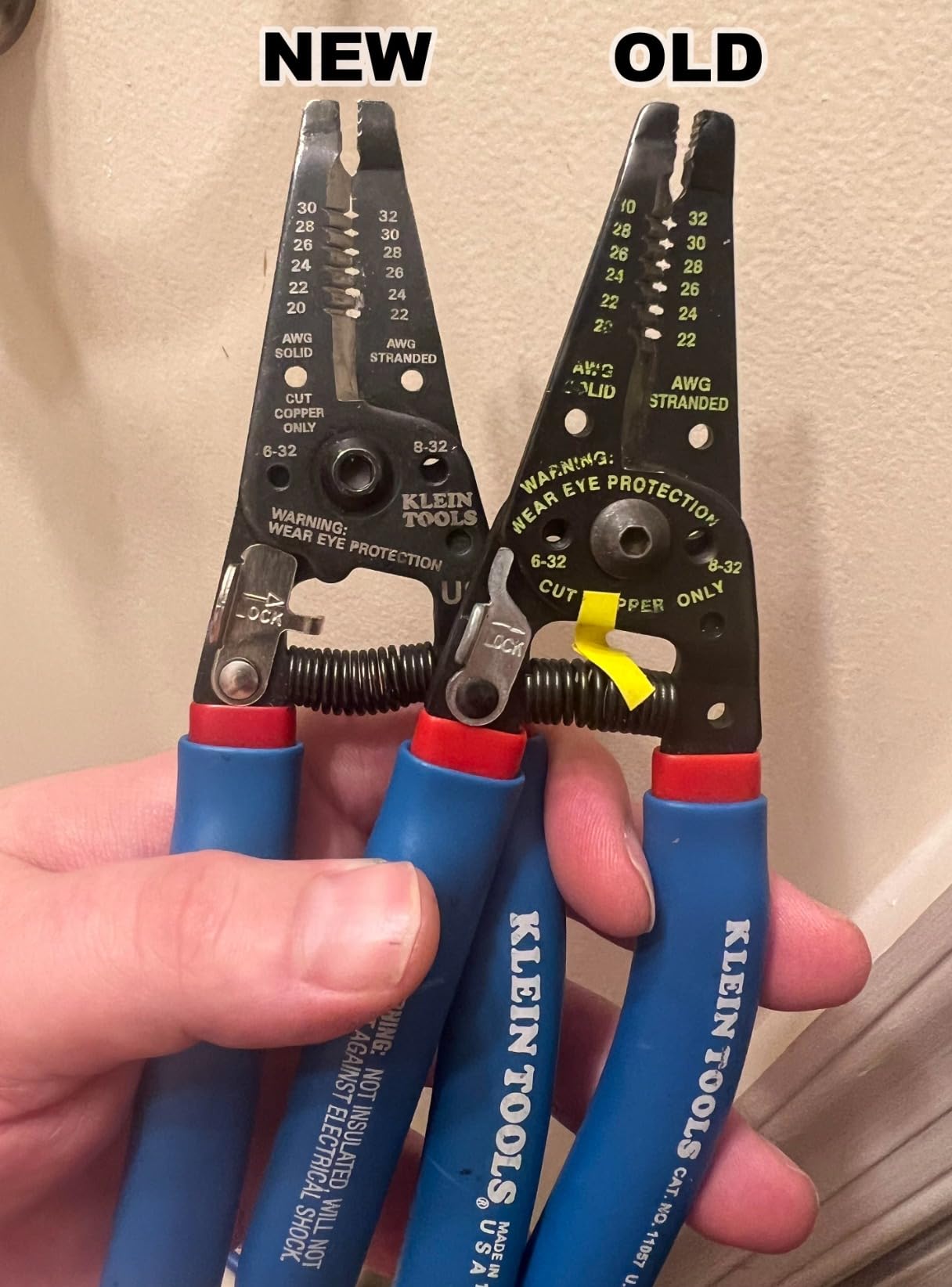
When a single tool has to cover almost every small-gauge job, this is the one I reach for. The Klein 11057 strips 20-30 AWG solid and 22-32 AWG stranded, which is the full span of hookup wire, RC servo leads, fan and LED wiring, telephone wire and most bench electronics.
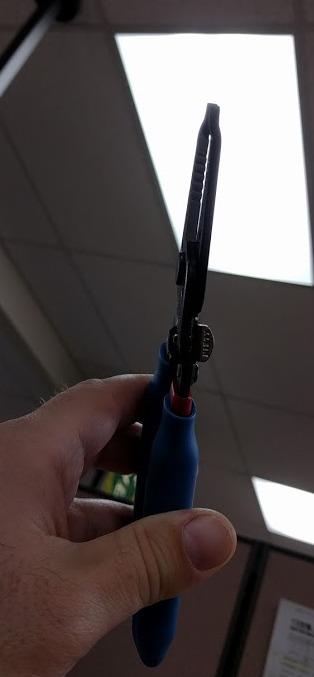
What sets it apart is the hole sizing. Each stripping hole is precision ground to a specific AWG, so the blades meet the insulation and stop. On r/Tools, owners repeatedly single out this model as the trusted home-brand answer for 20-30 gauge work, and that reputation lines up with what the tool does on the bench.
The 12-inch alloy steel body is heavier than the plastic-handled alternatives, and that weight is the point. There is no flex in the jaws, so a 30 AWG solid wire does not get pushed aside by the tool as you close it. Reviewers describe the joints as tight with no play after long service.
Two practical notes. The integrated cutter is serviceable but not the strongest part of the tool, and on heavier stranded wire some owners report it takes more than one cut. And the gauge holes are small, so glance into the jaw before you commit rather than assuming the wire seated.
What you should check before buying
Confirm the wire is in the 20-30 AWG solid or 22-32 AWG stranded band. This tool does not reach 16 or 18 AWG, so if you also do household-scale wiring you will need a second tool. Our write-up of the cable strippers worth owning covers the outer-jacket side of the job if your runs are multi-conductor.
Who should pass on it
Pass if you work at 32 AWG or finer regularly, where the hole walls are too thick relative to the conductor. Pass if you want a one-hand automatic action, because this is a squeeze-and-pull precision tool. It is also a manual squeeze, not a ratcheting one, so expect to use both hands for comfort on longer sessions.
2. DOWELL 22-30 AWG Stripper – Best Value
- Clean precise strips with no coating residue and no cut strands
- Smooth spring action with good recoil
- Gauge sizes printed on the cutting area
- Stainless steel body with TPE grips
- The safety lock has no real catch and pops open on its own
- Copper and fine iron wire only
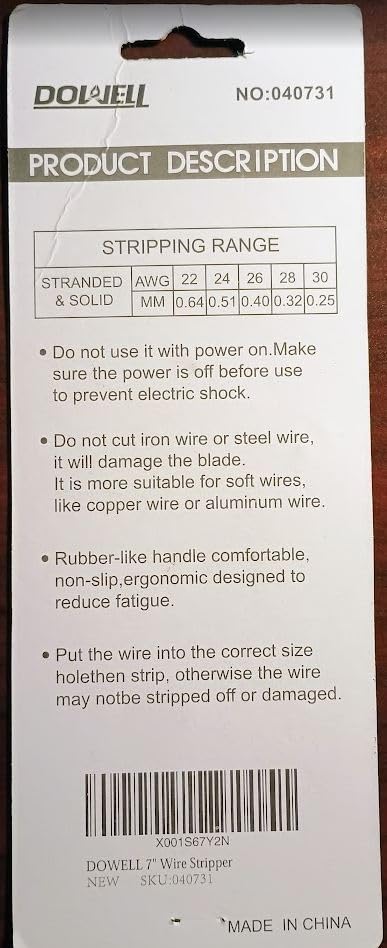
This is the cheapest tool here that still produces a genuinely clean strip, which is a low bar that plenty of tools fail. It handles 22-30 AWG and cuts copper and fine iron wire. For bench work on telephone wire, ethernet cable and 22-24 AWG hookup, it does the job in one pass.
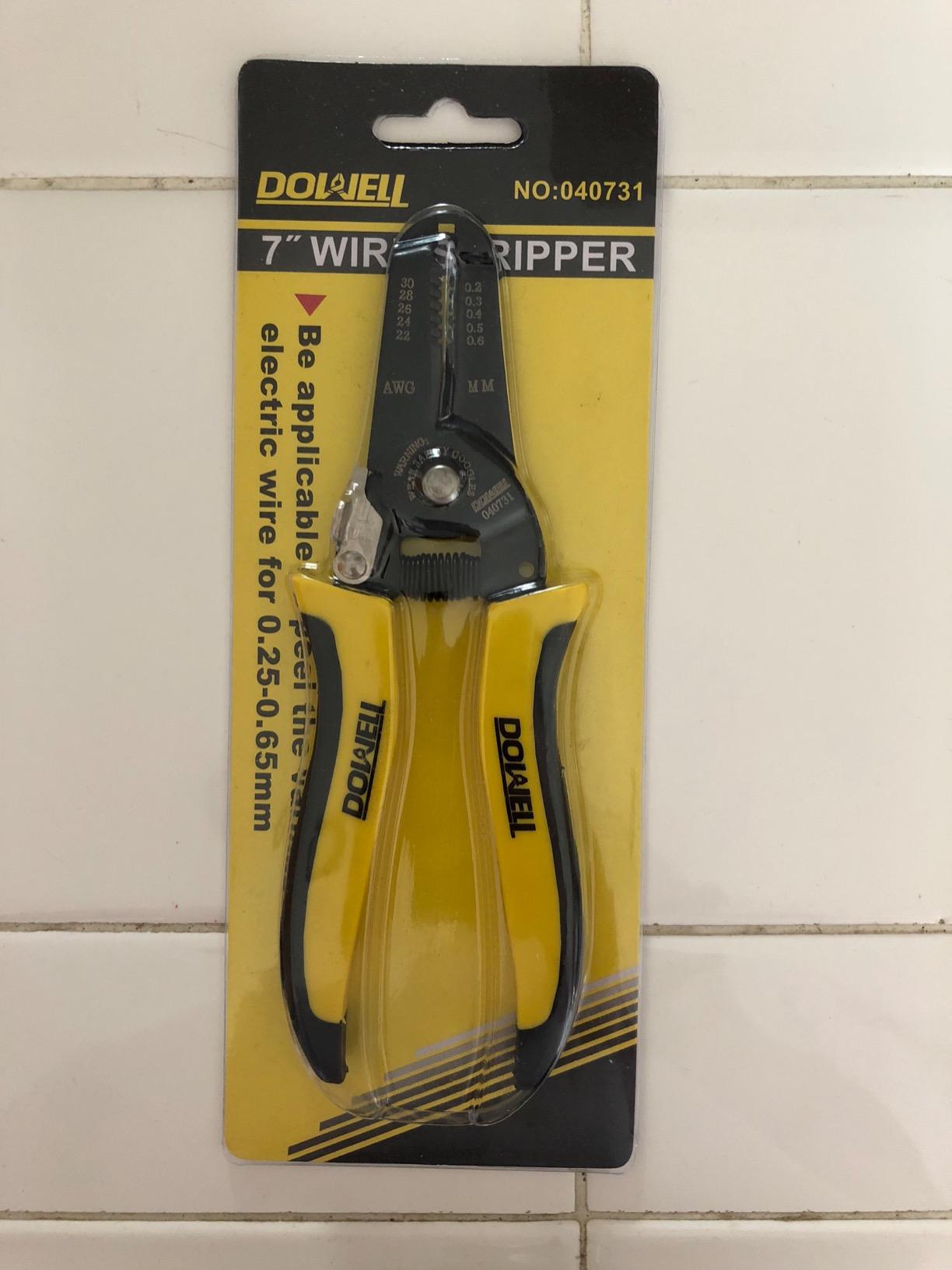
Owners often compare it favorably to costlier precision strippers, and the reviews back that up: clean strips on 22-24 AWG with no nicks, smooth spring recoil, and a grip that stays put. The gauge sizes printed on the cutting area are a genuinely useful touch when you are switching wire types mid-task.
The 7-inch body is short and light at 127 g, so it lives comfortably in a small parts tray or a field kit. The stainless steel body resists the corrosion that shows up on cheap plated steel after a few damp months.
The safety lock is the weak point. Reviewers consistently report that it has no real catch and pops open on its own, so treat it as a loose-handle tool rather than something to hang off a belt loop. There is also no replaceable blade and no looping hole, so crimping and coil work is out of scope.
What you should check before buying
Check the smallest wire you actually plan to strip. A 22-30 AWG window is narrower at the bottom than the Klein 11057 and the Jonard WS-5. If your work includes 20-21 AWG runs, this tool will not reach them.
Who should pass on it
Pass if you need solid core 20 AWG or heavier, or if you work below 30 AWG. Pass if you strip a lot of PTFE- or silicone-jacketed wire, where the stiffness of the jacket demands a sharper, more precise jaw. This is a first tool and a spare, not a last tool.
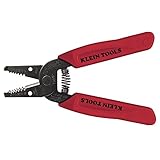
3. Klein Tools 11046 – Best for Confined Panel Work
- Narrow nose reaches tight panels and control boxes
- Strips and cuts without nicking conductors
- Rubber grip works with gloves or large hands
- Holds its edge and spring tension over years
- Stamped gauge markings are hard to read
- Closed tool is bulky in a crowded pouch
- Handles feel thick to some users
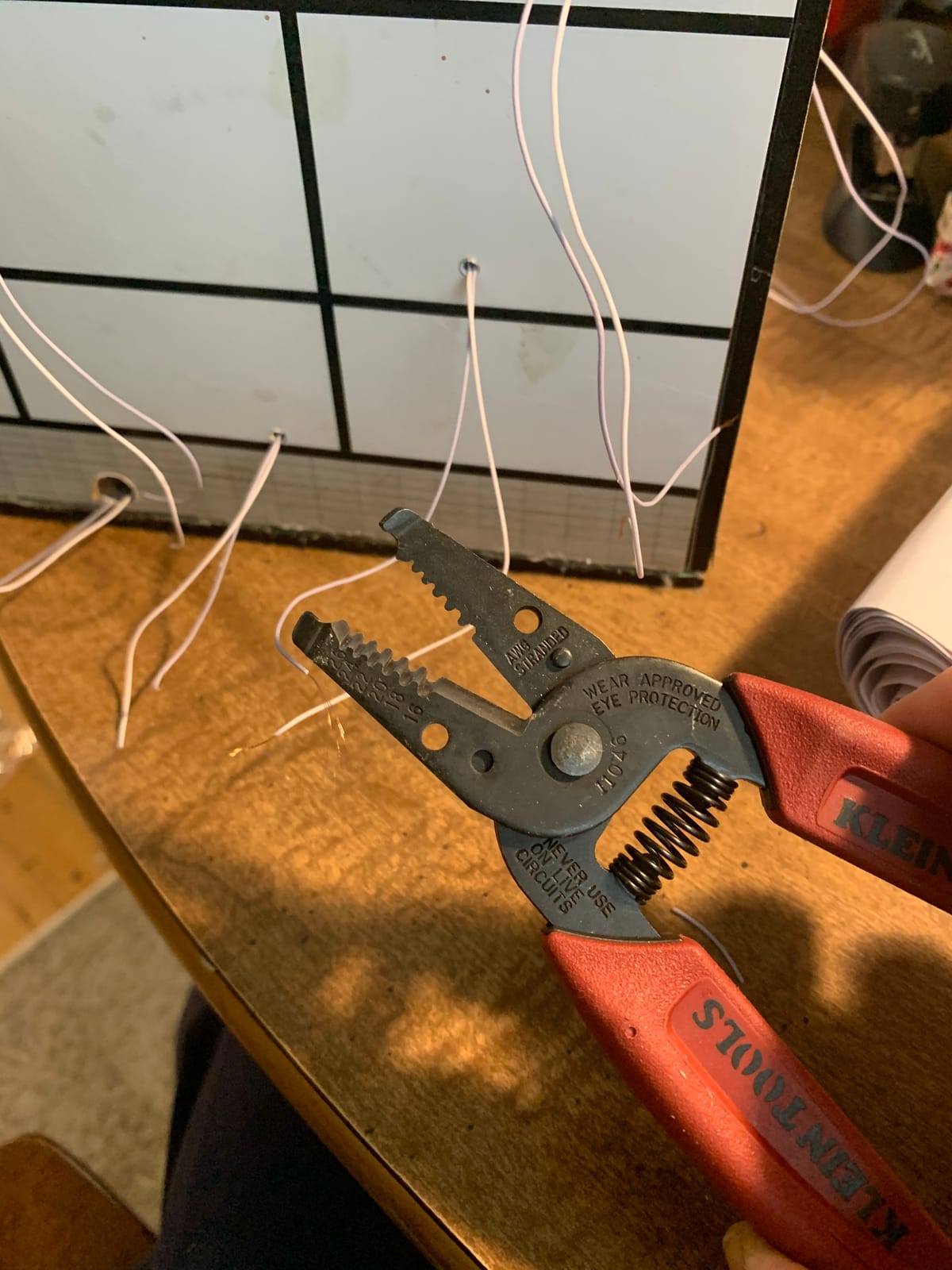
Where the 11057 is the generalist, the Klein 11046 is the one with a short nose. At 6.25 inches and 4.3 ounces, it fits into a control cabinet, an amplifier chassis or a dense terminal block where a full-size stripper physically cannot go.
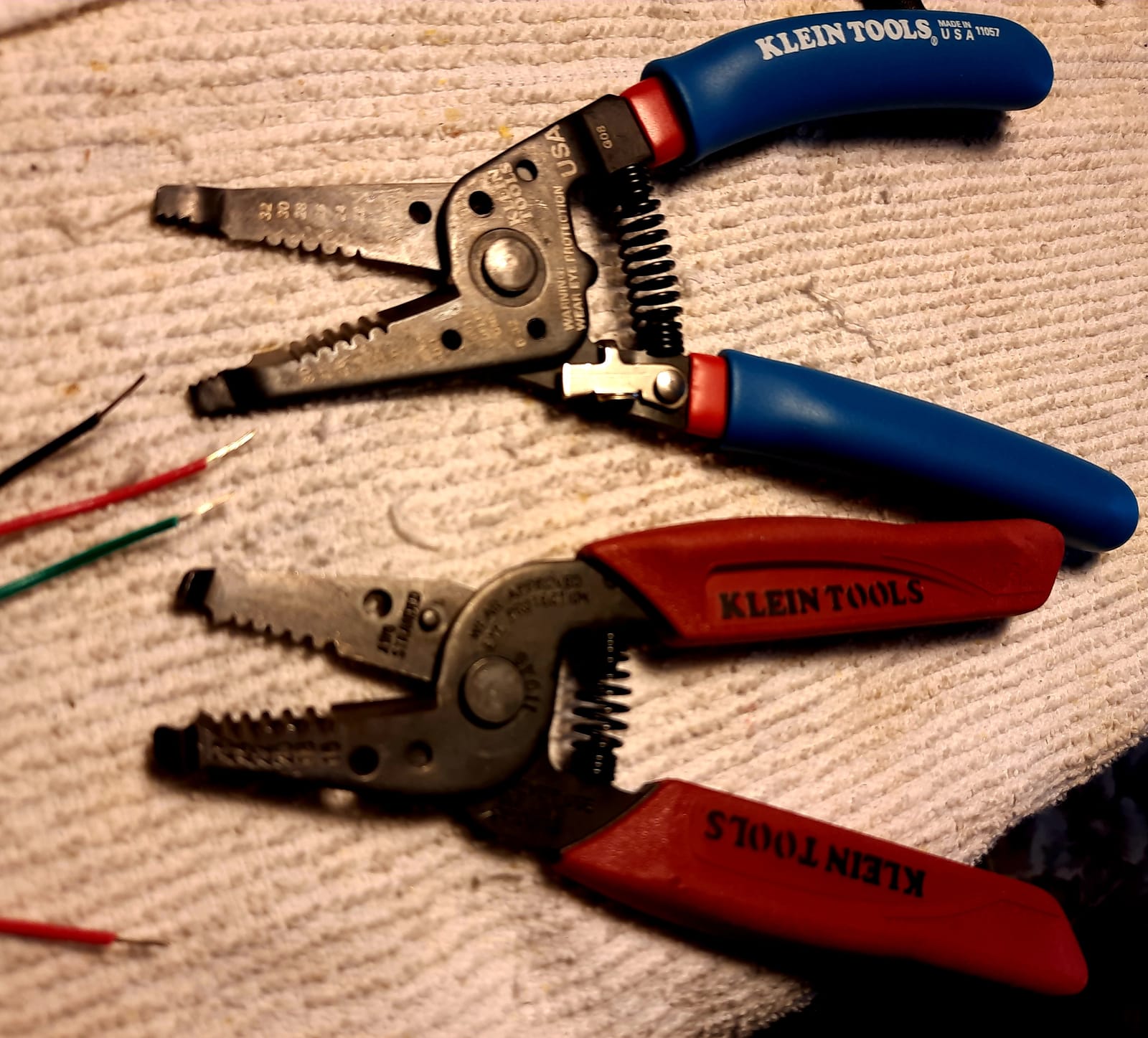
The stated range is 16-26 AWG stranded. That is worth flagging plainly: the manufacturer specifies stranded here, and the long-term owners we see describing this tool most often talk about low-voltage and audio cable work down to 22 AWG. If your project is solid core in the 24-26 AWG range, the ENGINEER PA-06 covers that case properly.
Build quality is the story. Long-term owners describe the tool holding its edge and spring tension through years of copper work, and the rubber grip works with gloves or with hands larger than the handles were clearly drawn for. The self-opening spring means one hand can feed wire while the other stays free.
The stamped AWG markings on both sides are the most repeated complaint, and they are genuinely hard to read without enhancement. If you switch gauges constantly, mark them yourself with a paint pen on day one.
What you should check before buying
Check the diameter of what you can reach. The narrow nose is the entire reason to own this, and it only helps if the space you are working in is genuinely tight. If you have open bench access, the longer 11057 is more capable for the same money class.
Who should pass on it
Pass if you need anything finer than 26 AWG stranded, which means passing on all PCB jumper work. Pass if you strip solid 20 AWG or heavier. And pass if you keep a slim tool pouch, because closed up this one is not slim.
4. Hakko CSP-30-1 – Best All-Round Electronics Stripper
Hakko CHP CSP-30-1 Wire Stripper, 30-20 Gauge Maximum Cutting Capacity
- Strips 20-30 AWG without marring core strands
- Adjustable metal stop holds jaws part-open
- Gauge labels on both sides of the jaws
- Smooth well-damped action with no flex
- Crimps and cuts as well as strips
- Embossed gauge numbers are hard to read without touch-up paint
- Not intended for household power wiring
The Hakko CSP-30-1 is the tool we see cited most often for guitar pickup builds and general electronics work, and the reason is the 30-20 AWG window combined with a very light, well-damped action. It weighs 1.28 ounces, so it disappears in the hand during long sessions.
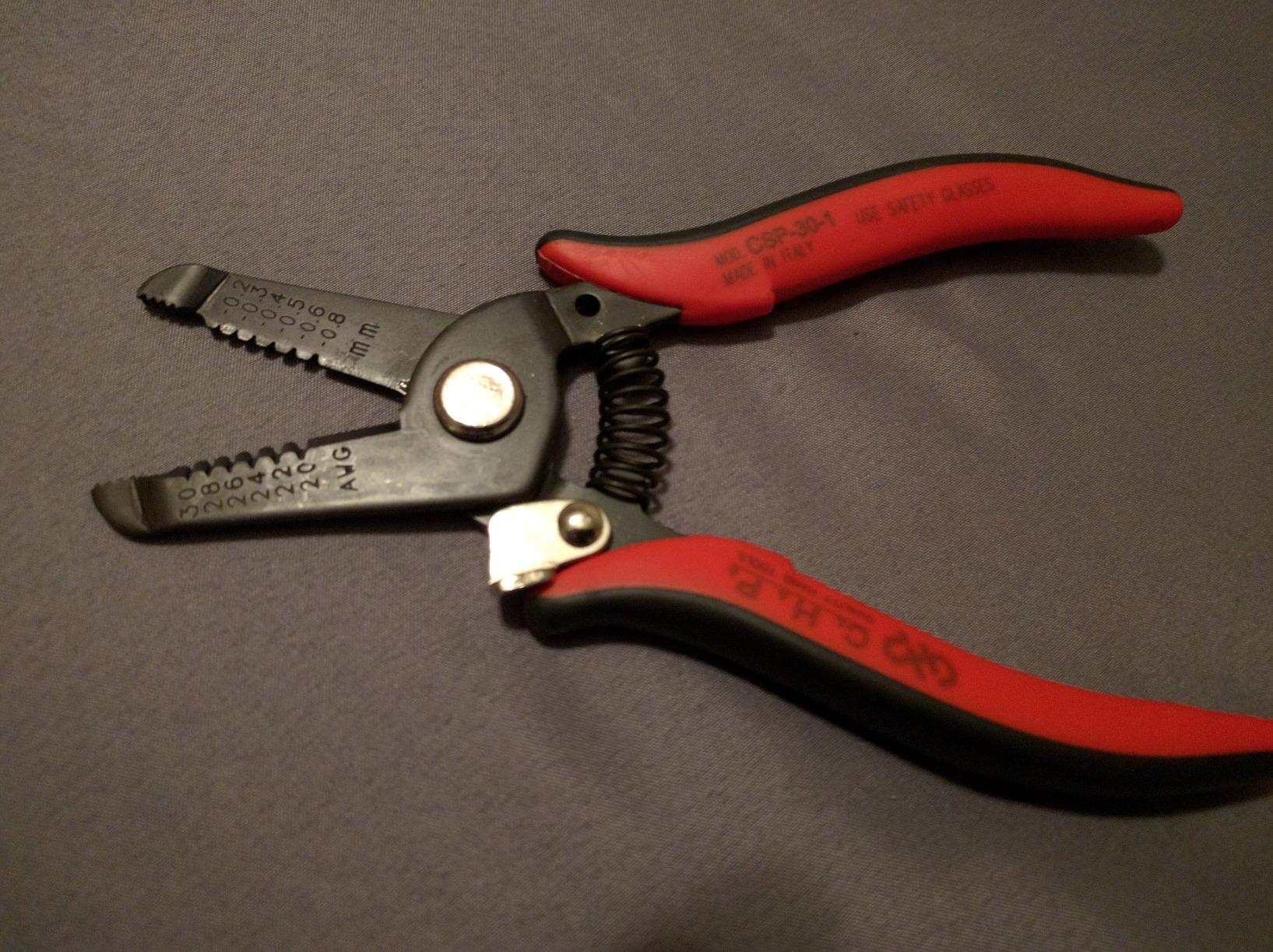
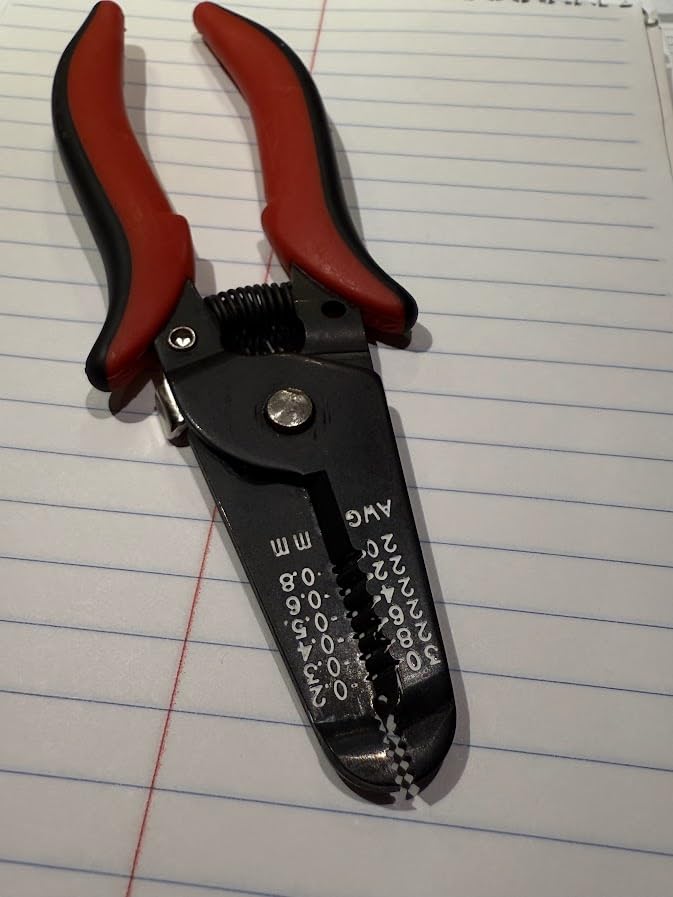
Three details set it apart. The adjustable metal stop lets you hold the jaws part-open, which matters on the thinnest wire because a fully closed jaw on 30 AWG tends to cut the conductor instead of stripping it. The gauge labels sit on both sides of the jaws. And the serrated plier nose doubles as a gripping and bending tool.
It is also a combination tool: strip, shear and crimp in one body. That saves a second tool for the crimp, though for JST and Molex work we would still reach for a dedicated ratcheting crimper to get a repeatable pin depth.
The stamped gauge numbers are embossed rather than etched, so they wear visually fast in a pocket. Reviewers commonly fix this with correction fluid or a paint pen. Reviewers are also clear that this is not a household power wiring tool and should not be treated as one.
What you should check before buying
Check whether you want a stripper or a stripper-and-crimp. If your workload is JST, Molex or DuPont terminations, the crimping side here is a convenience, not a replacement for a proper ratcheting crimper. If you only strip, this is an efficient single tool.
Who should pass on it
Pass if you strip stranded wire below 30 AWG, and pass if you do any 10-18 AWG household work, which this tool is not built for. It is also not the answer for PTFE-insulated wire so thin that you need the 34 AWG end of the scale.
5. ENGINEER PA-06 – Best for Precision Electronics Work
- Strips 28-30 AWG and PTFE wire with no broken strands
- Very light spring action tuned for repetitive work
- Cuts cleanly at the rear without fraying stranded wire
- Slim nose reaches tight spots
- Oil-resistant TPR grips
- Size markings are small and hard to read at a glance
- Markings mix stranded and metric diameters which confuses new users
- No protective case included
The PA-06 is the benchmark in this list for anyone whose work lives at 24 AWG and below. It strips solid wire from 28 down to 16 AWG and stranded wire from 30 down to 18 AWG, which spans both fine hookup and larger circuits in one tool.
Audiophiles, model builders and 3D-printer hobbyists treat it as a reference tool, and reviewers repeatedly compare it favorably to Klein, Knipex and Hakko alternatives. The dominant praise is for zero nicking on fine conductors, including PTFE-insulated wire, and for a spring action light enough for long repetitive work. The rear cutter is reported clean on stranded wire, with no fraying.
Two honest caveats. The size markings are small and hard to read at a glance, and they mix stranded wire AWG with metric hole diameters, which genuinely confuses people new to the tool. No protective case is included, so a small pouch is worth adding.
What you should check before buying
Check that you will use the fine end. The 28 AWG solid capability is the reason to own this rather than a cheaper 20-30 AWG tool. If your work never goes below 24 AWG, the Hakko CSP-30-1 covers the range at a lower price point with similar core protection.
Who should pass on it
Pass if you need stranded wire at 32 AWG or finer, which is the PA-14 territory. If you want a wider toolkit, our roundup of the best electric wire strippers covers the heavier gauges.
6. ENGINEER PA-14 – Best for Micro-Thin Wire
ENGINEER PA-14 Precision Wire Stripper for Micro-Thin Wire Made in Japan
- Strips 32-34 AWG with no visible nicks under magnification
- Grips stay secure through long sessions
- Suited to tonearm rewire and fine network cable
- Spring pressure well tuned for delicate wire
- A minority report the smallest slots close with no gap and cut the wire
- Needs a separate ring to hang on a hook
- Less forgiving than the PA-06 and demands technique
This is the most specialized tool in the roundup. The PA-14 strips stranded copper from 34 down to 22 AWG and solid wire from 32 down to 20 AWG, which puts it in territory where almost nothing else on this list works. Tonearm rewire, fine network cable and SMD LED work are the use cases owners cite.
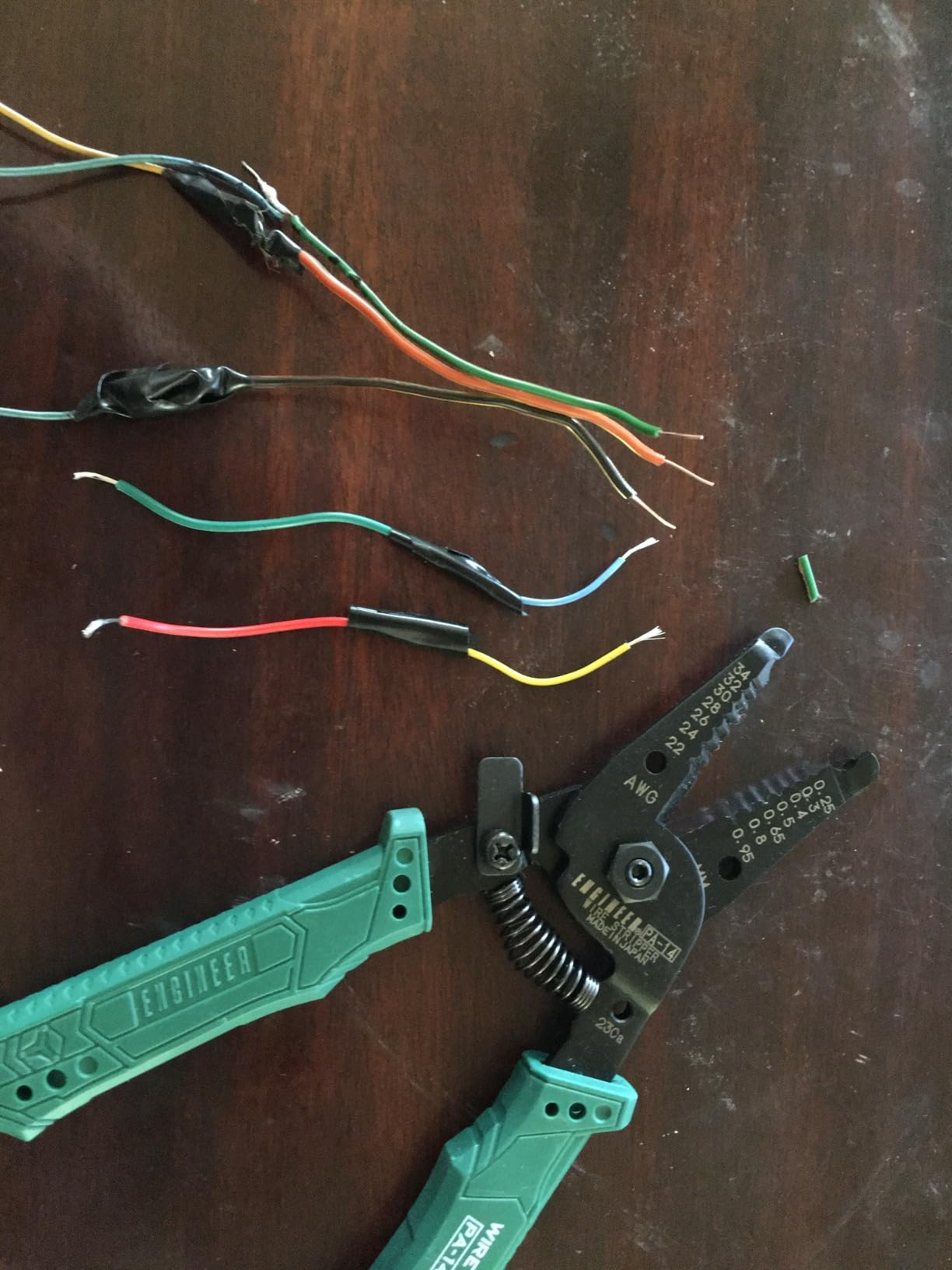
The jaws are high carbon steel with a round finishing edge, and the round edge is the engineering point: it shears insulation without scoring the copper. Owners report stripping 32-34 AWG with no visible nicks even under magnification, which is the standard that matters at this gauge.
Its 4.5 average reflects one recurring complaint, and it is worth taking seriously. A minority of reviewers report that the smallest slots can close with essentially no gap, so the tool cuts the wire rather than stripping it. That is a fit or clearance issue on the very thinnest gauges, and it argues for a magnifier check on your first few strips.
Two more notes. The hanger opening is narrow, so it needs a separate ring to hang on a hook. And it is less forgiving than the PA-06, so expect a short learning curve before your strips are consistent.
What you should check before buying
Check whether your thinnest wire is 32 AWG or below. If the answer is yes, this is the only sensible choice in the list. If the answer is no, the PA-06 gives you a wider usable range with a friendlier learning curve for a similar spend.
Who should pass on it
Pass if you are new to stripping and want a forgiving first tool. Pass if your work is 22-28 AWG, where the PA-06 or Hakko will be quicker and cheaper. And pass if you expect a self-adjusting action, because this is a fixed-hole precision tool with no tension screw to tune.
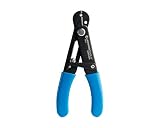
7. Jonard Tools WS-5 – Best for Pocket Carry
Jonard Tools WS-5 Adjustable Wrench Stripper, Cutter, 10-30 AWG
- V-notch blade adjusts across 10-30 AWG and strips cleanly once tuned
- Extremely compact at 5 inches
- Sharp cutter
- Owners keep several in different tool bags
- Adjustment set screw is fiddly to tighten precisely and can slip
- Only handles one gauge setting at a time so the screw resets between sizes
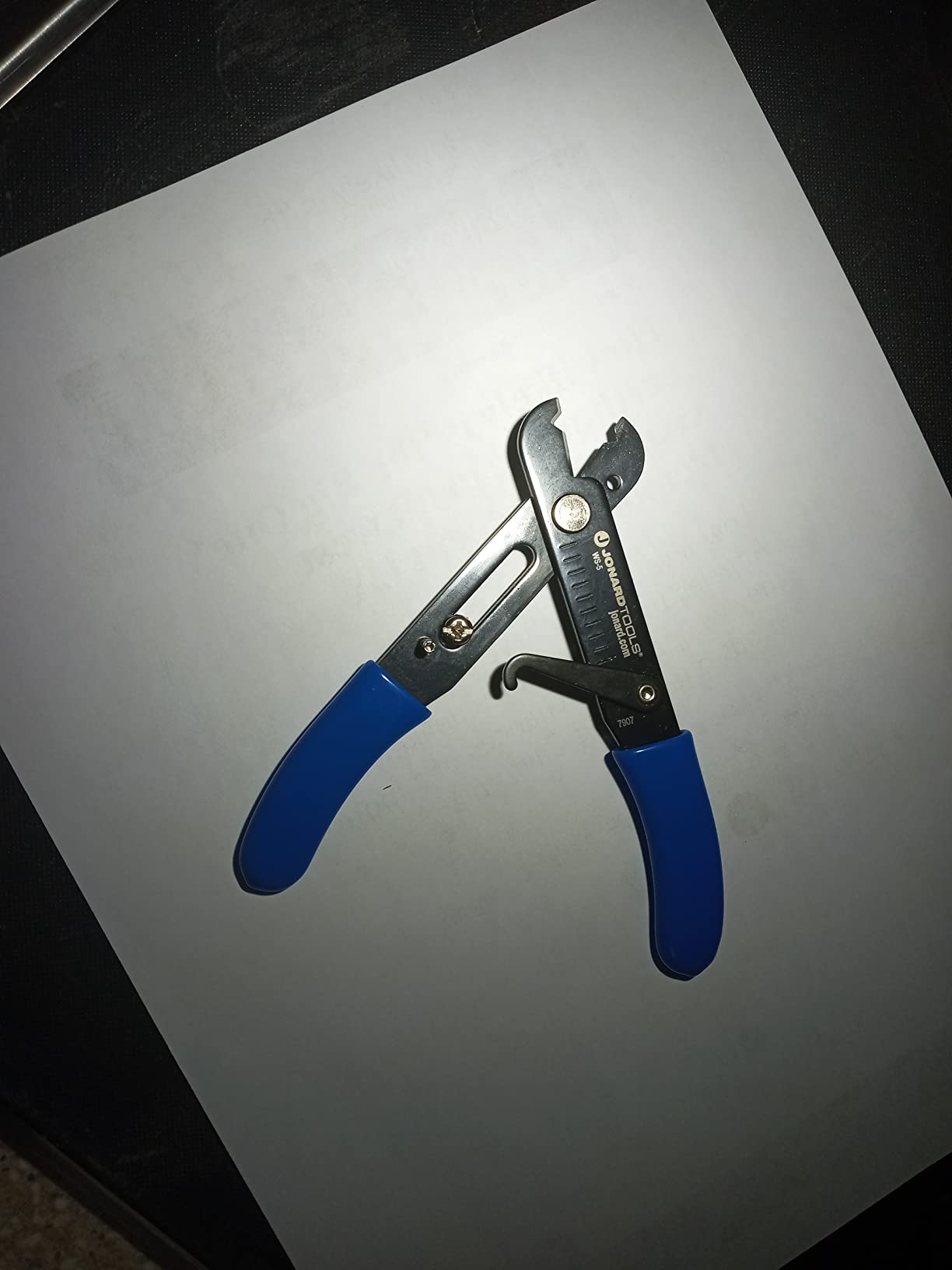
The WS-5 is the odd one out in this roundup: a single adjustable V-notch blade rather than a row of fixed holes. It covers 10-30 AWG solid and stranded, so it spans household-scale and electronics-scale wire in one setting tool.
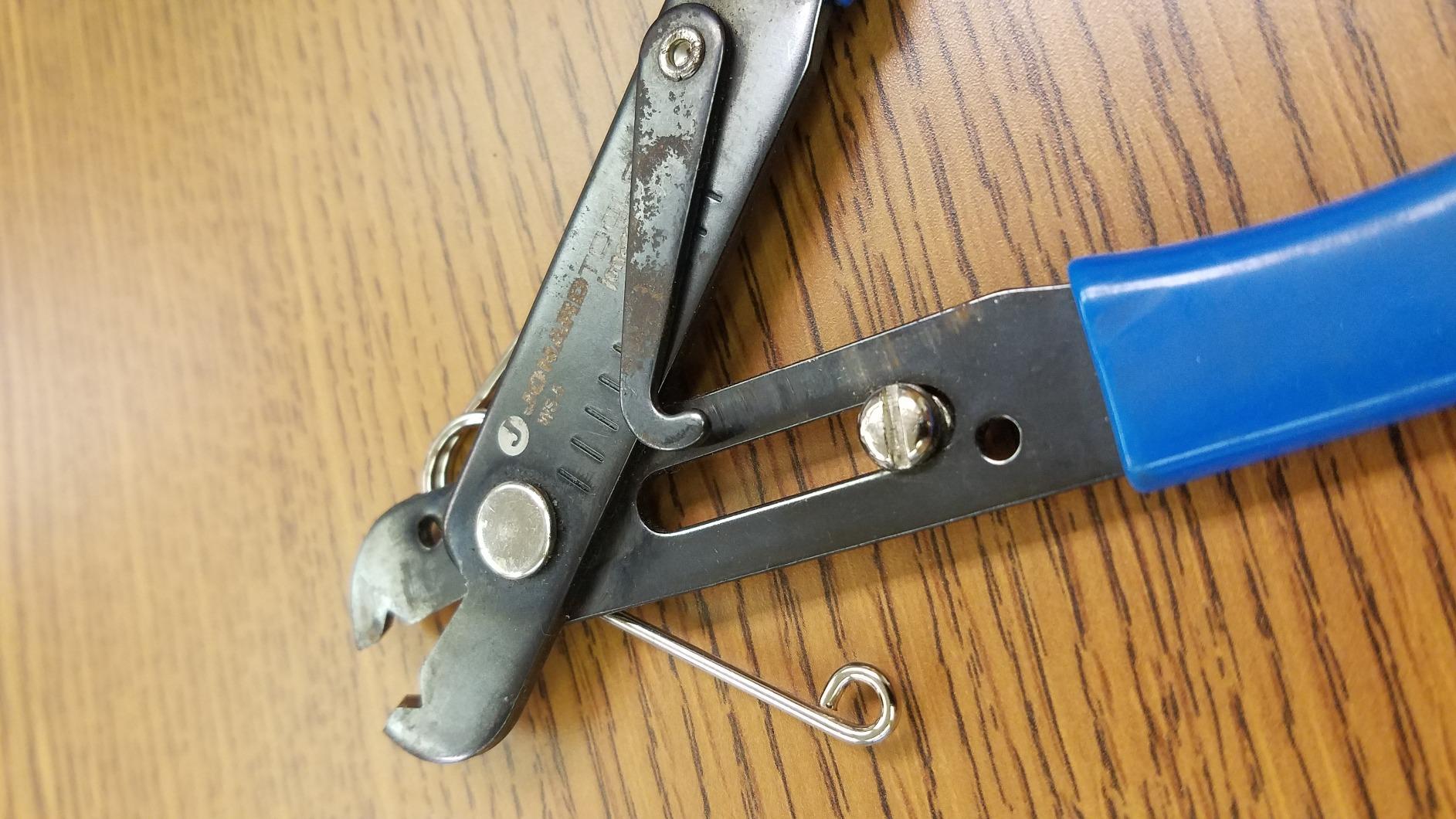
At 5 inches and 2.56 ounces it is genuinely pocketable, and technicians like it for that reason. Several owners report replacing costlier adjustable strippers with it, and the black oxide high carbon steel holds up to daily use. The scored size reference marks on the body let you return to a setting without guessing.
The tradeoff is the tuning. The adjustable blade stop is set with a small screw, and that screw is fiddly to tighten precisely. Once dialled in, the V-notch strips without nicking. Off by a hair, it either leaves insulation behind or takes strands with it. Forum users describe exactly this failure mode: hole too big gives a poor strip, hole too small cuts the inner strands.
Because it handles one gauge at a time, you reset the screw every time you change wire. That is fine for a technician moving between gauges occasionally and annoying for a production run on one consistent wire.
What you should check before buying
Check how often you will switch gauges. If you work on one wire size day in and day out, the adjust-and-lock approach pays off. If you hop between 22 and 28 AWG constantly, a fixed-hole tool is faster and more reliable.
Who should pass on it
Pass if you need a repeatable, identical strip length on every conductor, because there is no stop for that. Pass if your work is at 30 AWG or finer where a V-notch has too little material to grip. And pass if you dislike tuning tools, since this one asks for patience before it asks for money.
8. Jokari Micro-Precision – Best for Repeat Work With a Set Strip Length
- Very short precise strips without cutting strands of fine litz wire
- Adjustable strip length makes repeat work fast and consistent
- Resistant plastic body with smooth lever action
- Handles wire-wrap wire and small house wiring in one tool
- Higher cost than conventional strippers
- Requires a specific insert-then-pull technique rather than a simple squeeze
Strip-length consistency is the criterion no roundup on this topic ever addresses properly, and the Jokari Micro-Precision is the tool that solves it. Its stop cursor sets the exposed conductor length, so fifty identical strips come out identical. That matters for anyone building harnesses in batches.
The range is 20-30 AWG for both solid and stranded, and the lever operation plus base trimming cutter give it a self-contained workflow. Reviewers who work with very fine or multi-strand wire especially value that it produces very short, precise strips without cutting individual strands, which matters on litz-type conductors.
It is also compact at 4 inches and 1.65 inches wide, so it fits the same tight spaces the Klein 11046 does. The plastic body resists the oils and solder flux that destroy bare steel handles, which is a real advantage on an electronics bench.
The honest reservations are cost and technique. It is the priciest tool in this roundup, and it does not work like a normal stripper. You insert the wire to the stop and pull as you lever, rather than squeezing and drawing back. Once that motion is in your hands it is fast, but it takes practice.
What you should check before buying
Check whether you build in quantity. If you terminate forty identical leads, the adjustable stop alone justifies this. If you strip a handful of wires a week, any precision-hole tool gives you a clean result without the premium.
Who should pass on it
Pass if you want a simple squeeze-and-pull stripper you can hand to anyone. Pass if you work above 20 AWG or below 30 AWG, since both ends are outside its range. And pass if you need a crimping function, which this tool does not have.
9. KATA 7 Inch Precision Stripper – Best for Learners and STEM Kits
KATA 7 Inch Precision Wire Stripper, 20-32 AWG Tool for Electronics DIY
- Strips 24-30 AWG cleanly for dollhouse and electronics projects
- Feels solid in the hand and sharper than cheap big-box strippers
- Sharp edge makes quick work of fine insulation
- Comfortable grip including for arthritic hands
- One reviewer reports misaligned blades that deflect stranded wire
- Intended strictly for low-voltage work and not mains wiring
The KATA is aimed squarely at makers, students and STEM classrooms, and it hits that brief well. It strips 20-30 AWG solid and 22-32 AWG stranded with 50# heat-treated carbon steel, and the reviews describe it as sharper and more solid-feeling than the strippers typically found in school electronics kits.
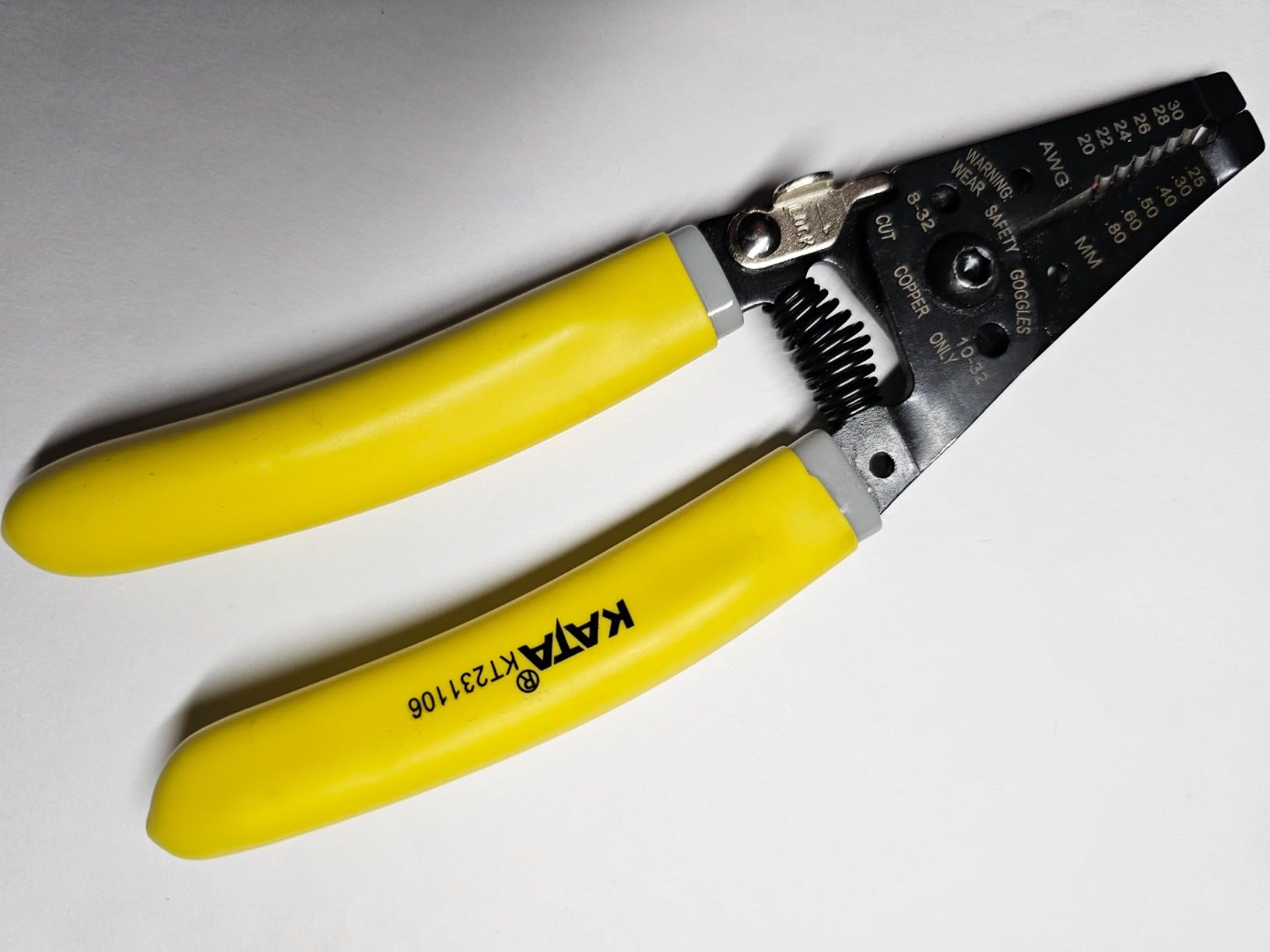
Beyond stripping, it also cuts, clamps and crimps insulation terminals. That makes it a single-tool answer for classroom wiring kits where a student needs to strip, cut and terminate without a full bench of tools. The 7-inch frame and 179 g weight sit well in a smaller hand, and one reviewer specifically calls out the grip for users with arthritic hands.
The caution here is about quality control rather than design. One well-publicized negative review reports misaligned blades that deflect stranded wire before stripping it. That is a single reported unit rather than a pattern, but it is worth checking on your first strip.
It is also explicitly a low-voltage tool. Nothing in the construction or the spec sheet suggests it is meant for household mains wiring, and we would not put it near a 14 AWG Romex run.
What you should check before buying
Check the crimp feature against your actual terminals. It handles insulation terminals, not the ratcheting JST or Molex style, so buy it for stripping and basic terminations rather than for connector production.
Who should pass on it
Pass if you work at 32 AWG or finer, and pass if your projects need a repeatable strip length on large batches. Pass if you are buying for shared shop use where a single misaligned unit matters, and pass for any household electrical wiring task.
10. Jonard Tools JIC-2030 – Best for Connector Work
Jonard Tools JIC-2030 20-30 AWG Wire Stripper and Cutter, 6-3/4″ Length
- Strips 28-30 AWG without nicking conductors
- Useful for JST and model-train wiring
- Sharp blades remove the need to peel by hand
- Consistent strip length
- Coil spring can walk out of the handle when opened wide
- Some users report it will not strip certain 30 AWG kynar wire
- Lowest rated tool in this roundup
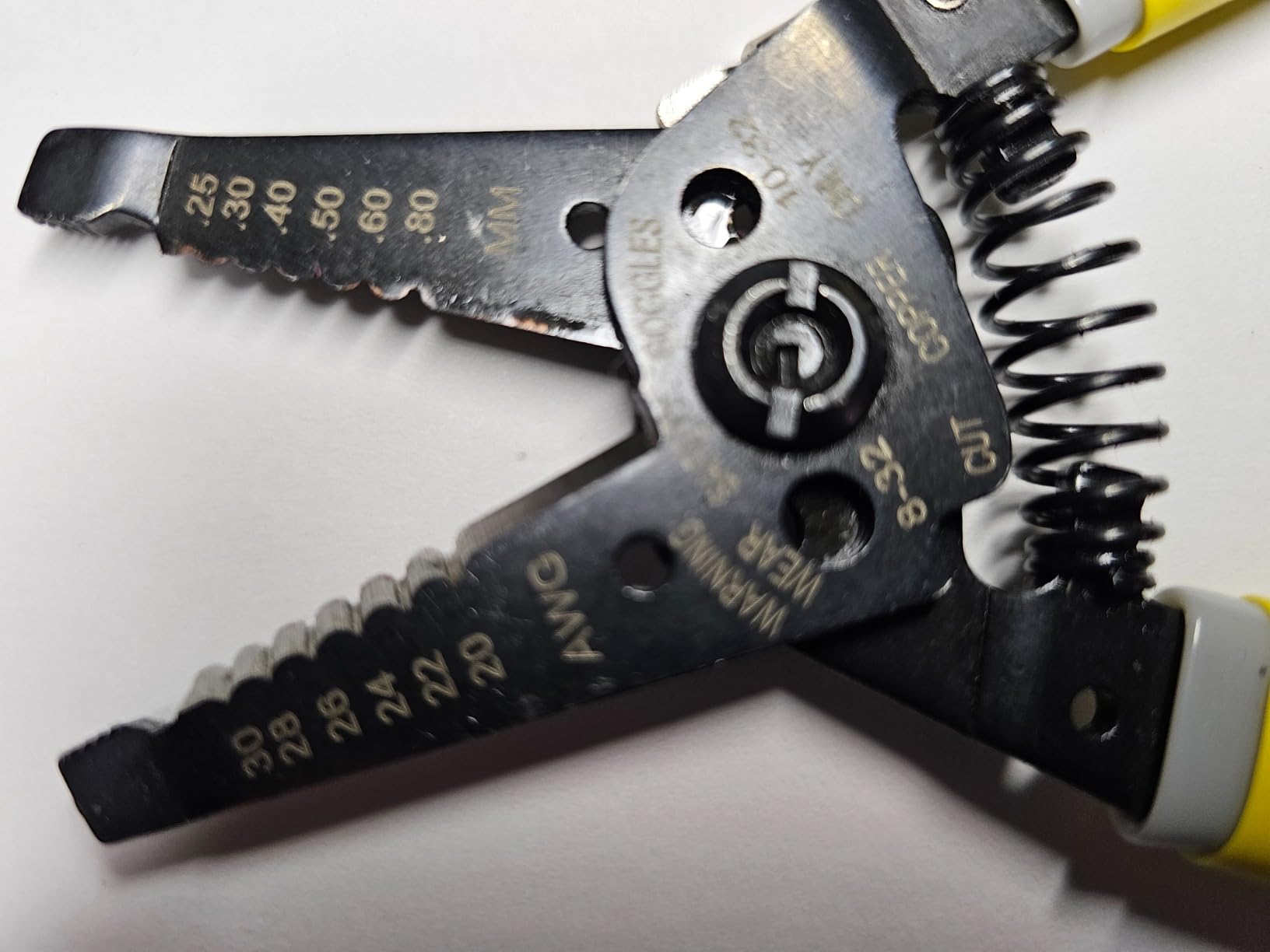
The JIC-2030 covers 20-30 AWG in both single and stranded wire with hardened, tempered and ground cutting edges and a 50 HRC black oxide finish. It is a straightforward, uncomplicated tool for JST and similar connector work where the conductor is thin and the strip has to be short.
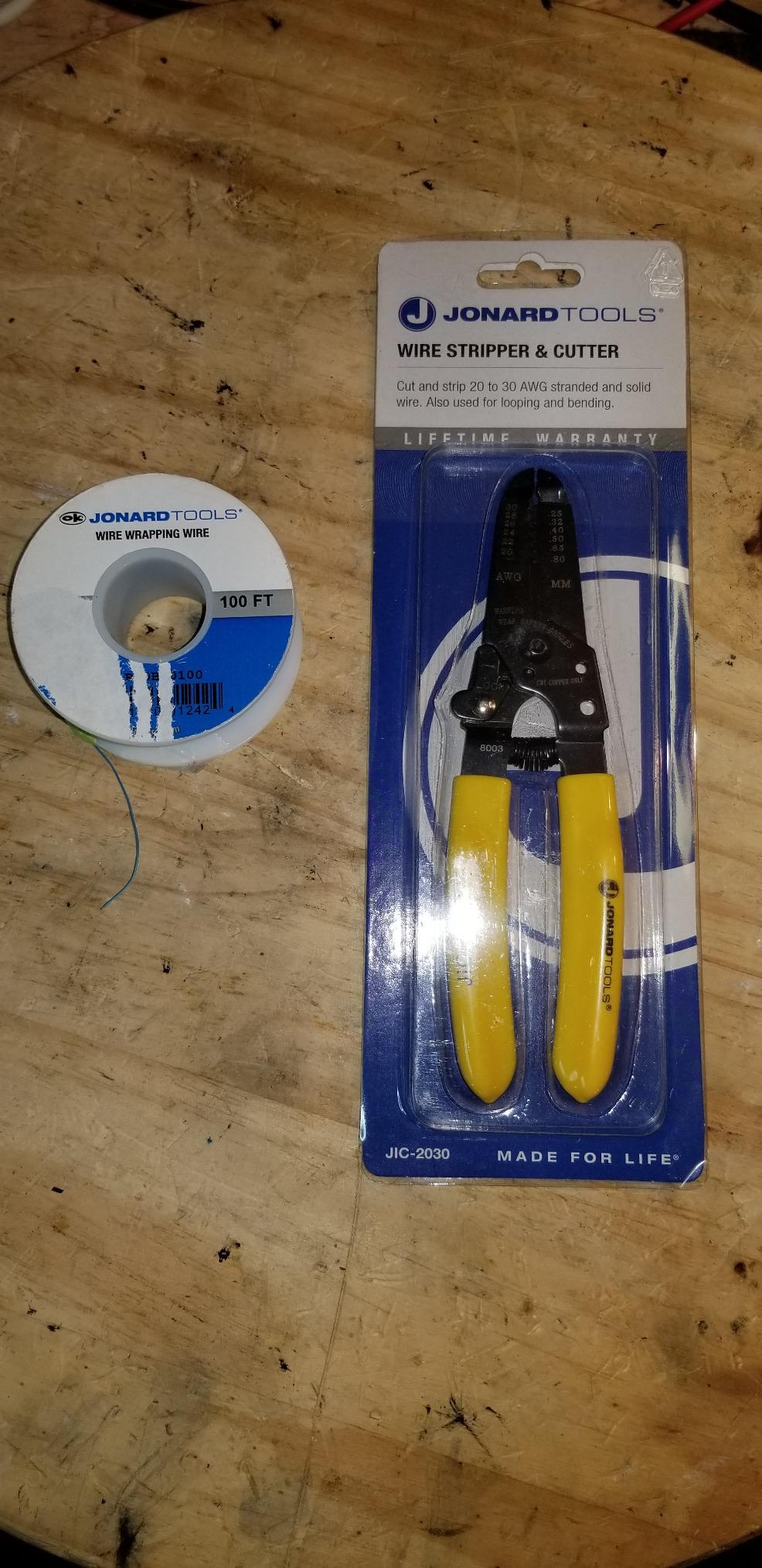
It does that job. Most buyers are satisfied with the cutting quality and report stripping 28-30 AWG without nicking conductors, plus consistent strip length across the batch, which is the thing that matters when a crimp cavity has a fixed strip length.
This is the lowest-rated tool in the roundup at 4.3, and the reasons are concrete. The coil spring can walk out of the handle when the tool is unlocked and opened wide, which is annoying rather than dangerous. More substantively, a minority of users report it will not strip certain 30 AWG kynar wire, so if your work is specifically 30 AWG PTFE-coated kynar for PCB jumpers, look elsewhere.
What you should check before buying
Check the actual wire in your hand, not the label. Because the 30 AWG claim is optimistic on some units and some wire types, we would buy this for 22-28 AWG work and treat 30 AWG as a test-before-you-trust-it gauge.
Who should pass on it
Pass if your project is thin kynar jumper work, and pass if a spring that can escape the handle would bother you in a shared tool bag. If you want a higher-confidence tool in the same gauge band, the Jonard WS-5 or the Klein 11057 are the safer picks.
11. Gardner Bender GS-361 – Best for Model Railroad and AV Wiring
- Handles tiny hookup wire without cutting the conductor
- Consistent clean 28 AWG and finer results
- Laser-etched markings stay legible
- High-leverage cushioned handles reduce hand fatigue
- No keep-closed lock clip so an elastic band is often used
- Lowest rated but one in the lineup
The GS-361 sits at the intersection of fine wire and heavy wire: 16-30 AWG solid and 18-32 AWG stranded. That range makes it a natural fit for model railroad DCC wiring, cat5e work and general microelectronics, where the wire in the same bundle spans a wide range of gauges.
Model railroad, cat5e and microelectronics users report that it solves fine-wire stripping where ordinary strippers fail, and the results at 28 AWG and finer are described as consistent and clean. The laser-etched color-coded industry standard markings are a real advantage over stamped numbers, and they stay legible over time on a tool that lives in a bag.
The curved high-leverage handles with power spring return are the ergonomic story here. They cut the hand fatigue that builds up when you are doing several hundred terminations, and the plier nose with a curved cutting blade handles pulling and cutting in the same tool.
Two drawbacks. There is no keep-closed lock clip, so many owners improvise with an elastic band. And at 4.4 it is one of the lower-rated entries, which in this case reflects a modest volume of feedback rather than a specific defect.
What you should check before buying
Check that your thinnest wire is at least 30 AWG stranded. Below that, the jaws have nothing to register on and the strip becomes inconsistent. Above 16 AWG solid you are into household-scale territory where a more robust tool is a better answer.
Who should pass on it
Pass if your work is 32 AWG or finer, and pass if you want a stripper that closes and stays closed in a pouch. Pass if you need an automatic self-adjusting action. For pure 20-32 AWG bench work, the Klein 11057 is a more proven choice with a much larger review base.
12. Paladin Tools PA1123 – Best Two-Tool Bundle
Paladin Tools PA1123 Wire Stripper Bundle, 22-10 AWG and 30-20 AWG (Formerly Greenlee Communications) (Color may vary)
- Bundle covers 22-10 AWG and 30-20 AWG in one purchase
- 22 degree offset head keeps the wrist neutral
- Non-scoring precision-ground areas leave conductors undamaged
- Comfortable rubber grips for long sessions
- Two separate tools mean two sets of gauges to learn
- Bundle cost is higher than buying a single stripper
- Color may vary from the listing
The PA1123 bundle, sold under the Paladin Tools name from the former Greenlee Communications line, contains two strippers: a 22-10 AWG model and a 30-20 AWG model. That pairing is the argument. One purchase covers fine electronics wire and the heavier 10-18 AWG runs that a precision stripper cannot touch.
The engineering detail that stands out is the 22 degree offset head, designed so your wrist does not bend awkwardly. On long sessions that is a genuine comfort difference, and the rubber grips back it up. The stripping areas are precision ground and non-scoring, which is the term manufacturers use for a blade edge that leaves the conductor undamaged.
There is also a screw cutter and wire loops embedded in the frames, so the tools double as screw cutters and coil formers. Spring-loaded open action keeps one hand free for feeding wire.
Honestly assessed, some buyers consider this more tool than they needed. You are paying for two gauges sets you may never use, and two sets of holes to learn instead of one. If you do both kinds of work, that is a fair trade. If you only strip 24 AWG, it is money spent on an unused tool.
What you should check before buying
Check whether you genuinely need both ranges. A single-tool buyer is better served by one precision stripper chosen for their thinnest and thickest wire. Bundle buyers are people whose work crosses the 20-22 AWG line into household-scale conductors.
Who should pass on it
Pass if your work is entirely one gauge band. Pass if your thinnest wire is finer than 30 AWG, since neither tool in the bundle reaches it. And pass if you want a single tool with a strip-length stop, because neither of these has one.
Precision vs Automatic vs Plier-Style Strippers
Most confusion in this category comes from mixing up tool families. There are three main mechanisms, plus one specialist type, and they behave very differently on fine wire.
Precision hole strippers
A precision stripper has a row of holes, one per gauge, machined to a specific diameter. You put the wire in the hole that matches it and squeeze. The blade edges meet the insulation and stop before reaching the conductor. This is the family that dominates our roundup because it is the most predictable on small gauges. The Klein 11057, 11046, Hakko CSP-30-1, ENGINEER PA-06 and PA-14, and the KATA are all precision tools.
Automatic self-adjusting strippers
An automatic stripper has no fixed holes. It grips the wire, adjusts to the conductor diameter, cuts the insulation and pulls it off in one continuous motion. That continuous pull is why these nick the conductor less on solid core wire, and it is also why they are the answer for thick insulation and heavier gauges. The downside is bulk: these tools are typically longer and heavier than a precision pair, and at the very smallest gauges the gripping mechanism can be too aggressive.
Plier-style and curve-handle strippers
Plier-style strippers use a scissor or curved-blade action between curved handles, usually with a thumbscrew that sets the depth. The Klein-Kurve shape is the most recognized example. They are fast, they handle a wide range of gauges in one tool, and they are what most electricians carry. The cost of that speed is less control: the blade depth is set by a screw rather than by the hole, so a mistuned screw gives you either a sloppy strip or a nicked conductor. The Jonard WS-5 in this roundup is an adjustable example of the same idea in a compact body.
Thermal strippers
A thermal stripper melts insulation with a hot blade and pulls the clean conductor out, with no mechanical contact at all. Because no blade touches the copper, this is genuinely the right answer for very thin, heat-sensitive or very finely stranded wire where mechanical stripping keeps damaging the conductor. It is also slower, and it leaves the conductor slightly warm and sometimes slightly discolored. For 30 AWG and finer on delicate work it is worth considering, and for ordinary 20-24 AWG hookup it is overkill.
How to Strip Small Gauge Wire Without Damaging It
On small gauge wire, technique matters at least as much as tool choice. A good stripper in the wrong hands will still nick a 30 AWG solid conductor, and the damage does not show up until the wire flexes.
Cut and pull in one motion
This is the single most repeated piece of advice from experienced users, and it comes directly from a rocketryforum practitioner writing about solid core: cut the insulation and pull at the same time. If you cut, release the pressure, and then pull the insulation off, you drag a stationary blade edge along the conductor and put a nick in it. On solid core that nick becomes a fatigue break point, and the wire snaps there later when it is bent. Make the squeeze and the withdrawal one continuous movement and the blade never dwells against the copper.
Set the tool one gauge larger, not smaller
The second technique rule comes from the same forum thread, and the wording there is precise: use the setting one gauge below your wire, so the tool just nicks the insulation, then peel the last of it off with your fingernails. The intent is that the tool does the hard cut at the jacket and your fingers take the final, gentle peel. A slightly generous setting plus a fingernail beats a tight setting and a damaged conductor every time.
Inspect for nicks every time
Before a stripped conductor goes into a crimp, roll it between your fingers and look at it. On stranded wire you are looking for flattened or broken strands. On solid core you are looking for a bright flat spot or a shallow groove. A jeweller’s loupe or a phone camera macro lens makes this trivial, and at 28 AWG and below it is the difference between a working harness and a mystery failure six months later.
The mistakes that cost conductors
Four mistakes account for most of the damage. First, using a hole one gauge too tight, which turns a strip into a sever. Second, cutting and pulling in separate motions. Third, using a knife and stripping with the wire on a flat surface, which scores the conductor directly. Fourth, ignoring insulation stiffness. Silicone and PTFE jackets are much harder than PVC and will deflect a thin wire out of a straight-down strip, so slow the stroke and brace the wire.
How to Match a Wire Stripper to Your Gauge
Buying decisions come down to five variables, and only the first one is the number printed on the box.
1. Know your actual AWG band
Small gauge is roughly 20-30 AWG. Between 16 and 18 AWG you are at the boundary where home electrical tools take over, and above 14 AWG you are into heavy building wire that needs a ratcheting or compound-action tool entirely. For 22 AWG specifically, any tool in this roundup rated to 20-30 AWG will do the job well. For 28 AWG, you need the fine end of a precision tool. For 30 AWG and below, you need a dedicated micro tool and a magnifier.
2. Decide solid versus stranded, because they are not the same job
Solid core is the harder case and the one most people get wrong. A nick in solid wire is a permanent mechanical defect, while a nick in stranded wire is a damaged strand that shows up later as a fraying or a failed crimp. A tool rated for stranded wire is not automatically fine for solid at the same gauge, which is why we flag the 11046 as a stranded-rated tool. This is the point behind the automatic-stripper advantage too, because the continuous pull is gentler on solid than a fixed blade.
3. Check the insulation, not just the conductor
PVC insulation is soft and forgiving. Silicone and thermoplastic elastomer jackets are springy and tend to push the wire out of a straight strip. PTFE is thin, tough and slippery, and it will mark easily, so a rounded finishing edge on the jaw matters more. This is the main practical reason to favor a tool with a round-edged jaw when you work on PTFE-insulated wire.
4. Count the strands if it is litz or fine multi-strand
Very fine multi-strand and litz-type conductors get cut rather than stripped by most tools, because the strands are individually tiny. Reviewers of the Jokari and the ENGINEER PA-14 both single out fine multi-strand as the case where the tool earns its price. If your wire is that type, do not stretch a 20-30 AWG stripper to it.
5. Decide whether strip length consistency matters to you
If you are building batches of identical terminations, a tool with an adjustable strip-length stop is worth more than a tool with a slightly better cut. The Jokari Micro-Precision is the clearest example in this roundup, and it is also the only one here with a real stop. If every strip is a one-off, skip this criterion entirely.
What to watch for in knockoff tools
Generic precision strippers advertised at 20-30 AWG are frequently not what they claim. In a long raspi.tv comment discussion, owners comparing listings described identical-looking tools that performed very differently, with the cheapest units being the worst for copper damage. The practical defense is unglamorous: test on a scrap length of the same wire, then inspect the result under magnification. If the holes are inconsistent between sections of the jaw, or the wire does not slide in freely without force, send it back.
When stripping is the wrong approach
If the cable arrives with factory-terminated ends, or the harness is a molded assembly, there is nothing to strip. Buy pre-stripped cable or a cable that is cut to length with the conductors already exposed. No tool, at any price, improves a wire that should not have been cut.
Frequently Asked Questions
How to strip very small gauge wire?
Use a precision hole stripper with holes for the thinnest gauges you can find, insert the wire to match the gauge exactly, and squeeze while pulling in one continuous motion. Never cut first and pull second, because a stationary blade edge against solid core leaves a nick that becomes a fatigue break point. Peel the last of the insulation with your fingernails rather than forcing the tool.
What tool should I use to strip 22 gauge wire?
Almost any precision stripper rated to 20-30 AWG will handle 22 AWG well. The Klein Tools 11057 covers 20-30 AWG solid and 22-32 AWG stranded and is the broadest choice here. The Hakko CSP-30-1 and the DOWELL 22-30 AWG stripper are lighter and cheaper if 22 AWG is close to the top of your range. Match the tool to the thinnest wire you use, not the thickest.
How to strip 28 AWG wire?
Use a precision stripper with a dedicated hole for 28 AWG rather than a self-adjusting tool, which can grip a conductor that thin hard enough to flatten it. The ENGINEER PA-06 strips solid 28-16 AWG and stranded 30-18 AWG and is our precision pick for this range. The Gardner Bender GS-361 also handles 18-32 AWG stranded. Check the stripped end under a loupe before crimping.
What are common wire stripping mistakes?
The four most common are using a hole one gauge too tight, cutting and pulling in separate motions, stripping with a knife against a flat surface, and not inspecting the result. The tight hole turns a strip into a sever. The separate cut-then-pull drags a blade edge along solid core. A knife scores the conductor directly. And skipping inspection is how nicks reach a crimp and fail later.
What is the best cable stripper?
A cable stripper removes the outer jacket from multi-conductor cable, which is a different job from removing insulation from a single conductor. This roundup covers conductor insulation only. For jacket work on coax, ethernet or multi-conductor runs, use a dedicated cable stripper scored to the jacket diameter, since a wire stripper blade is sized to individual conductors and will score the jacket rather than part it cleanly.
Conclusion
For most people landing on this topic, the Klein Tools 11057 is the answer. It covers 20-30 AWG solid and 22-32 AWG stranded, holds its precision-ground holes for years, and has the largest body of real-world use behind it of any tool in this roundup.
Below 24 AWG, step up to the ENGINEER PA-06 for solid 28-16 AWG and stranded 30-18 AWG, or the PA-14 if you go to 32 AWG solid and 34 AWG stranded. On a budget and staying at 22-30 AWG, the DOWELL stripper does a clean job for very little. And if you strip the same wire dozens of times, the Jokari Micro-Precision is the one with a strip-length stop.
Whichever tool you pick, cut and pull in one motion, set the opening one gauge generous, and look at every conductor under a loupe before it goes into a crimp. That habit matters more than the model number.
Our picks for wider toolkits are collected in our electric wire stripper roundup and our hobby electronics guide, both updated for 2026.