
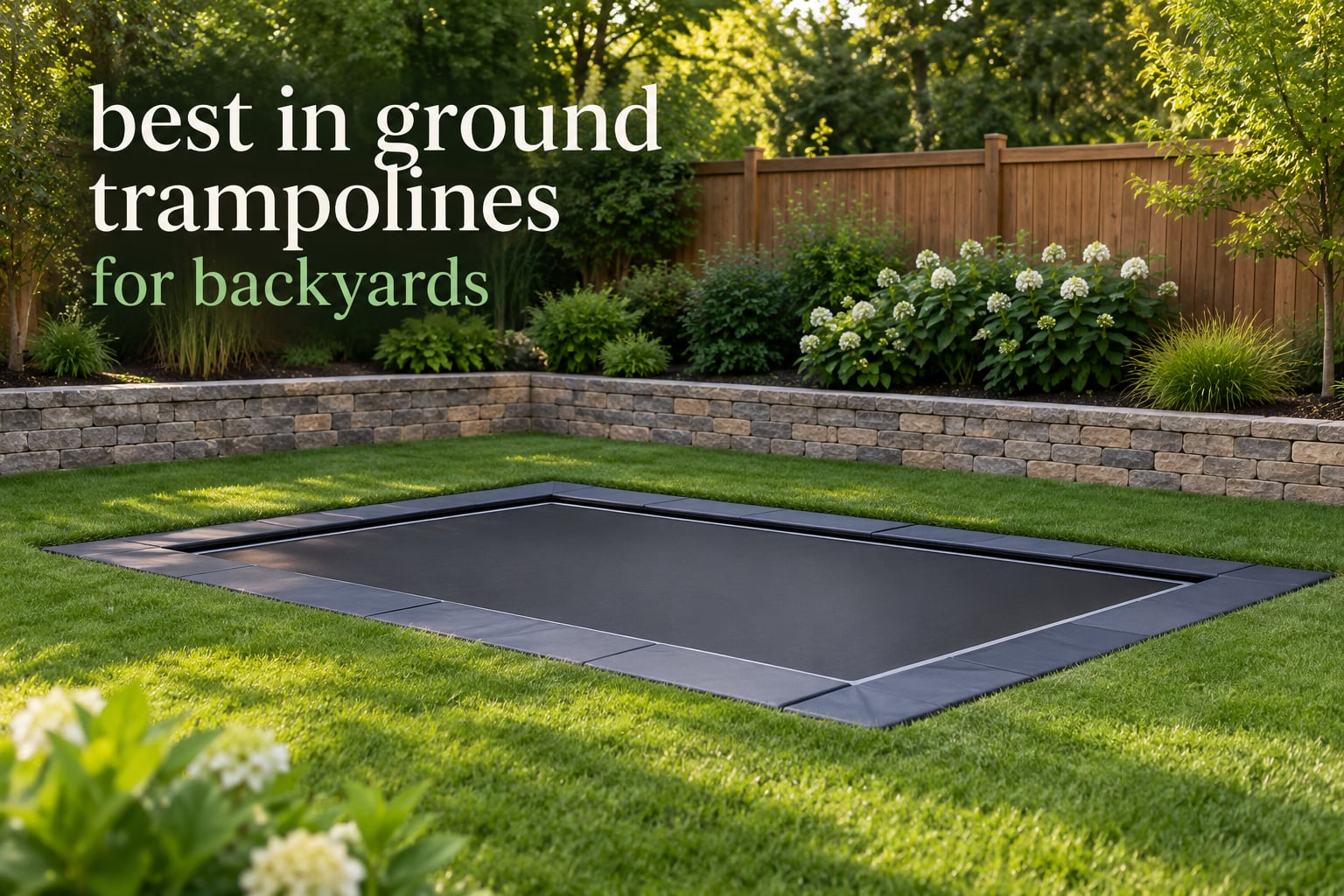
An in-ground trampoline changes the shape of a backyard in a way an above-ground frame never can. Instead of standing on legs like a piece of play equipment, the mat sits flush with the grass, so the whole yard stays walkable, mowable and usable. For the best in ground trampolines for backyards, that flat profile matters most in two places: a family with a four-year-old who can step straight onto the mat without a ladder, and anyone who lost a third of their usable lawn to a nine-foot frame with a ladder sticking out of it.
The catch is that an in-ground unit is not a weekend box build. It is a small yard renovation project with a trampoline in the middle of it. The unit still needs a pit excavated to the manufacturer’s depth, a retaining wall built around the edge, a drainage plan, and enough clear air beneath the mat for the bounce to stay alive. Get any of those wrong and the same product that reads as premium online feels dead underfoot after a rainy month.
I have picked apart six genuine in-ground options across every shape and size range, and below you will see what the owners actually report after living with them. We weighed the frame gauge, the airflow under the mat, whether the retaining wall structure is actually in the box, the real weight limit, and how long the warranty runs on each part. We also costed the install honestly, because that is where most of the surprise lives.
Table of Contents
Top 3 Best In-Ground Trampolines for Backyards in 2026
Avyna Premium In-Ground
- Flush-to-ground frame
- No ladder needed
- Vented jump mat
- Heavy-gauge steel
BERG Champion InGround 14ft
- 20cm step-on threshold
- Air Flow mat
- Net enclosure included
- TwinSpring gold springs

Rectangular In-Ground Kit
- Rectangular even tension
- Galvanized steel frame
- Full hardware kit
- Flush install
Which In-Ground Trampoline Brand Comes Out Ahead?
Among the in-ground brands worth your time right now, Avyna packages the fullest set: the frame, the vented mat, the enclosure and the layered padding all arrive together under one lifetime frame warranty. BERG wins on the step-on threshold and the Air Flow mat, and it is the pick if adults and older kids will share the pit. The ANYTHING SPORTS kits cost far less than the premium tier and still get the shape and the frame right, which is why they keep scoring well in owner reviews.
Springfree, Akrobat and Trampolines Down Under come up constantly in forum threads, and they are genuinely good trampolines, but they are not in this set because we could not verify owner feedback on the specific in-ground listings. Judge any of them on the same three things we judged these: frame gauge, mat ventilation, and parts availability in the states.
Best In-Ground Trampolines for Backyards at a Glance (October 2026)
| Product | Specifications | Action |
|---|---|---|
| Avyna Premium In-Ground Trampoline |
|
Check Latest Price |
| BERG Champion InGround 14ft |
|
Check Latest Price |
| Rectangular In-Ground Trampoline Kit |
|
Check Latest Price |
 Round In-Ground Trampoline Kit Round In-Ground Trampoline Kit |
|
Check Latest Price |
 Capital Play Inground Kit 11×8 Capital Play Inground Kit 11×8 |
|
Check Latest Price |
 ExacMe No-Gap In-Ground Trampoline ExacMe No-Gap In-Ground Trampoline |
|
Check Latest Price |
1. Avyna Premium In-Ground Trampoline: Best Overall Pick
- Truly flush frame with no ladder or fall height
- Listed load capacity up to 1750 pounds
- Air X-TREAM vented mat improves airflow
- Enclosure and thick UV pad included
- 90 percent of reviews are five star
- Very heavy frame needs several strong adults to move
- Installation ran about five days for one solo owner
- Pad replacement not always covered in practice
- Wide size range can overwhelm a small yard
Of everything we looked at, this is the one that does the most for you before anyone turns a spade. The frame is 11-gauge high-tensile hot-dip galvanized steel, and the listed load capacity is 1,750 pounds, which is far above what anyone in a family backyard will put through it. Ninety percent of the 14 owner reviews are five star, and the recurring word in those reviews is access: kids get on without climbing, adults step straight down, and nobody needs a ladder bracket bolted to the side.
The bounce comes from the Air X-TREAM vented mat, which the manufacturer rates at up to 70 percent more airflow than a standard mat. That number only means something if air can actually move in the pit, which is exactly why the vented perimeter pads and a properly sized pit matter so much. Owners also call out the finished look, which matters more than most spec sheets admit when the frame is going to be visible for the next decade.
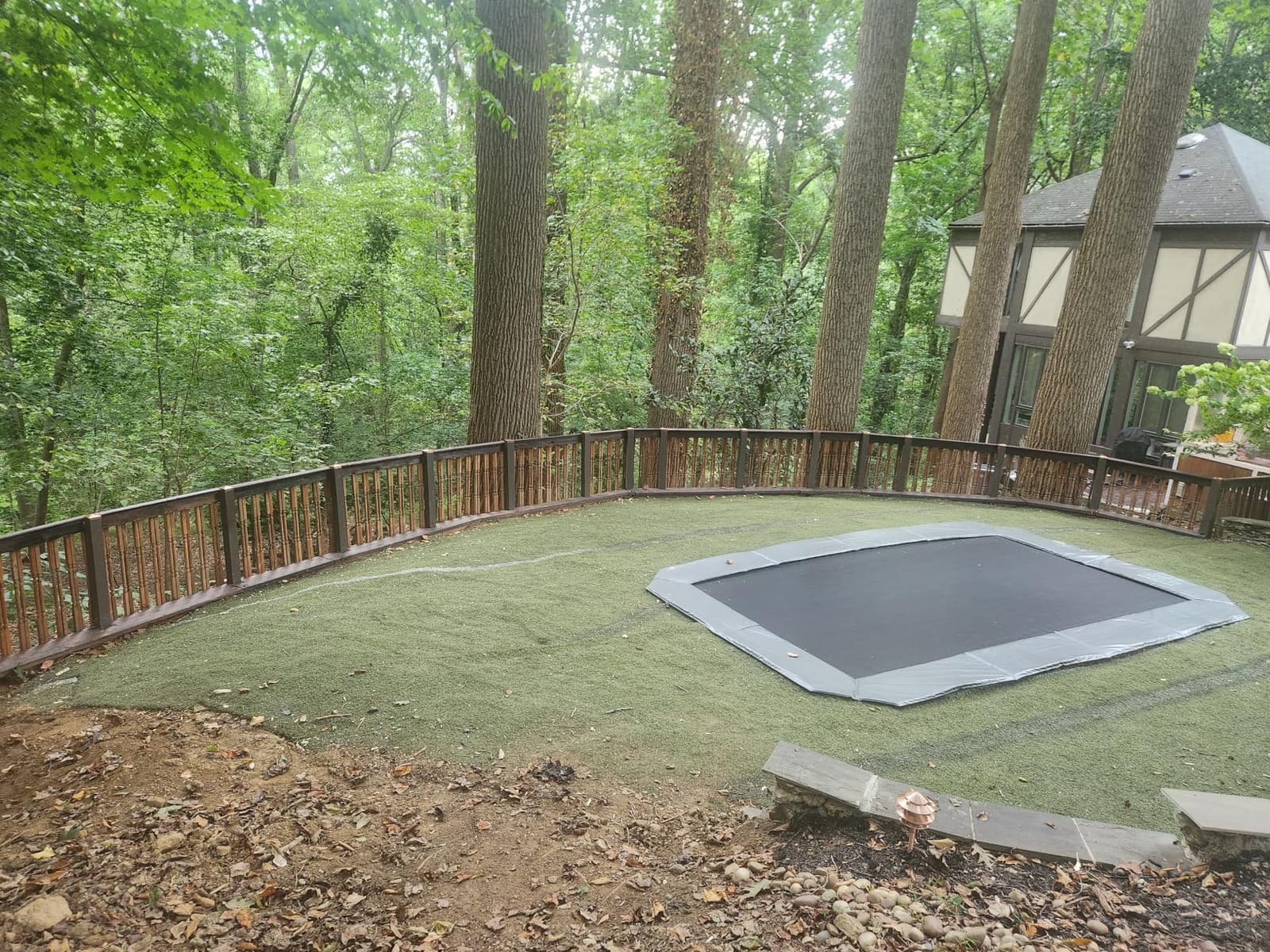
The real drawback is labour. One owner spent roughly five full days assembling this solo, and that was without counting the excavation. The frame is heavy enough that several strong adults are needed just to carry it to the pit edge. One buyer also had a worn pad dispute with the manufacturer, so treat the pad coverage as the weakest link in an otherwise strong warranty package.
Even so, this is the one we keep coming back to. If your household plans to stay in the home and wants the install done once, lifetime frame coverage plus ten years on springs plus the fullest safety package here is the best balance of cost and longevity.
What you should know before you buy this one
The listed dimensions run 165 inches by 120 inches by 165 inches, and the product comes in four size variants from a 14 foot round up to a 12 by 18. Measure your clear zone twice, because the widest configuration will eat a lawn that looked generous on paper. Add the clearance recommended for the enclosure on whichever side faces the house.
Assemble the frame ring at ground level before it goes anywhere near the pit. Once that circle is under the grass, a twisted joint is a miserable afternoon with a shovel. Several owners recommend calling in the manufacturer installer network rather than fighting the ring assembly underground.
Who this one suits and who it does not
It suits families with young children who want free mat access without a ladder, and anyone building a yard they intend to enjoy for years. Its listed load capacity covers parents and grandparents jumping alongside the kids.
It does not suit a renter, a very small yard, or anyone hoping for an afternoon build. If your clear space is tight, the round kit further down gives you the same flush concept in a much smaller footprint.
2. BERG Champion InGround 14ft: Best for Step-On Access and Bounce
- Low 20cm threshold for step-on access
- Air Flow mat reduces drag on jumps
- Net enclosure arrives in the box
- Shallow install needs less excavation
- Replacement nets and mats hard to source for older models
- Support response on parts has been slow for some buyers
- Round shape suits less athletic training
- Freight arrival needs scheduling
The BERG’s defining feature is that 20cm threshold, the closest any of these comes to a true flush edge. Adults can step on and off without a ladder, which removes the most common injury pattern on above-ground frames. Owners describe the install as unusually shallow for an in-ground, meaning less soil comes out of the hole than you would expect.
Performance is the other argument. The Air Flow jumping mat is rated at 50 percent more breathability than a standard mat, and the TwinSpring gold springs are paired with 96 springs across the 14 foot bed. Combined with the included net enclosure, safety is covered end to end without a second purchase.
Here is the honest problem. At 3.9 stars across 15 reviews, this is the most debated product in the set, and the complaints are not about build quality. Multiple buyers describe being unable to obtain a replacement safety net or jump mat for earlier models years after purchase, and they describe the support response as slow. That is a genuine long-term risk for a product that sits in your yard permanently and whose mat will eventually fade.
What to check before the truck arrives
Delivery comes by freight carrier and has to be scheduled, so plan the pit around a delivery window rather than the other way round. Manufacturer part number 35.44.81.00 is the reference to quote if you ever need a match on the frame or springs.
Owners also note that the oval and round shapes give less even spring tension than a rectangle, which matters if anyone plans to flip or train. Confirm that the net, the mat and the springs are all covered under the same warranty path before you finalize, and register the product at purchase.
Who should skip it and who should buy it
Buy it if adults will be jumping alongside kids, if the lowest possible lip matters to you, and if you can source spares through a local dealer rather than relying on a single channel.
Skip it if you want a rectangular training surface, or if you have already heard that spare parts for your region are hard to get. The quality is fine; the support network is the risk.
3. ANYTHING SPORTS Rectangular In-Ground Kit: Best Value for Athletic Use
- Even spring tension across a rectangle
- Consistent owner ratings with no one-star reviews
- Complete kit includes frame springs pads and anchors
- Flush install blends into the lawn
- Only a 1-year no-questions-asked warranty
- Frame and enclosure inclusion varies by variant
- No installation labour included
- 10 ft size limits the number of jumpers
A rectangle is the right shape when more than one person wants to jump at the same time or when anyone is working on flips, because the spring tension stays even corner to corner instead of pulling everyone toward the centre. This kit gives you that geometry at a much lower outlay than the premium brands, and its 4.4 rating across 13 reviews comes with 68 percent five star and not a single one-star rating.
Everything needed for the hardware side of the install is in the box: support frame, springs, safety padding and ground anchors. That last item matters, because an in-ground frame that is not anchored into the surrounding soil can shift after a season of freeze and thaw. Dimensions list 120 by 84 by 20 inches at 50 kg, so plan a pit around roughly a 10 foot rectangle.
The warranty is the compromise. A one-year, no-questions-asked coverage is short for something permanently buried, and the listing offers the galvanized frame and enclosure as variant-dependent, so confirm which version you are actually ordering before you start digging.
What to verify before you dig
Confirm whether your variant includes the galvanized frame or the enclosure, because the 10×17 and 7×10 configurations are built differently. If you want the enclosure, order it deliberately rather than assuming it is in the kit.
Also budget for the soil work, since there is no installation labour included here. The excavation, the retaining wall and the drainage bed are entirely your project or your contractor’s, and that work costs the same at every price tier.
Who this kit works for and who it does not
It suits older kids and adults who want to practise sport on a mat, and it suits anyone whose budget stops the premium tier from being a conversation. Multi-jumper family sessions are also easier to manage on a rectangle.
It does not suit a household wanting a large family bounce surface, or anyone who wants a decade-long warranty story. Treat this one as a well-made component set, not a lifetime asset.
4. ANYTHING SPORTS Round In-Ground Kit: Best for Small Yards
ANYTHING SPORTS Premium Round In-Ground Trampoline, 12FT and 14FT Diameters (14 FT Without Enclosure)
- Circular shape centres jumpers for a safer bounce
- Flush mount with no ladder
- Owners call the frame stable and rust resistant
- Quiet operation thanks to the spring cover
- Factory springs can feel soft until replaced
- No perimeter shield on the variant reviewed
- Only a 1-year warranty for a fixed install
- Round shape will not serve trick practice
When the yard is the constraint, a circular bed keeps the excavated area compact. Owners consistently mention three things: kids step on without help, the frame does not sway, and the circular geometry gently pushes jumpers back toward the middle instead of letting them drift into the frame edge. That is a genuine safety argument, not just marketing.
The flush mount is the other repeated theme. A round in-ground with a low lip effectively replaces the lawn rather than occupying it, which is why owners with tight yards single it out. Build quality reads well: a galvanized steel frame, reinforced springs, a UV-resistant mat and thick protective edge padding, with 71 percent of reviews at five stars and no one-star ratings.
Two criticisms do come up. One owner found the supplied springs made the mat feel squishy until they were replaced, which is worth planning for in your first-year budget. The variant reviewed also lacked a perimeter safety shield, so some buyers rated it for teens and adults only. The one-year no-questions-asked warranty remains the weakest part of the package.
What matters for a small yard
The listed frame size is 10 feet, with dimensions of 100 by 100 by 100 inches, and 12 foot and 14 foot variants exist as well. Map the excavation plus the surrounding clear zone before choosing, because the pit edge needs enough room that nobody lands on soil.
Leave room for the retaining wall footprint outside the frame line itself. A block or mortared wall eats several inches on every side, and on a small lawn that is the difference between a workable plan and a plan you have to abandon.
Who should pick this one
Pick it for a compact backyard, a first trampoline for a family with younger children, and anyone who prefers a controlled, centred bounce over an athletic rectangle. It suits an adult-and-teen use case particularly well.
Pass on it if you want trampoline gymnastics, or if you plan to keep the pit for twenty years and want frame coverage to match. Everything about this one is designed around the present, not the next decade.
5. Capital Play Inground Trampoline Kit 11×8: Best Compact Double-Frame Kit
- Only double frame system in the group
- Retaining wall structure included in the kit
- TDU vented pads aid airflow
- 10-year frame warranty
- Listed maximum user weight is 220 pounds
- Enclosure sold separately
- Very few verified buyer reviews
- One reviewer felt materials were light for the tier
The Capital Play kit is one of the few here where the retaining wall structure is a listed included component, alongside the trampoline, jump mat, springs and safety pads. That single fact changes the install maths more than most other features on this page. Buyers are not sourcing wall material separately, which is where most DIY pits get expensive.
The frame is the other differentiator: a double frame system in 2mm thick double-dip galvanized steel, described in the listing as commercial grade, with an 11 foot by 8 foot rectangular bed and 80 springs. TDU vented safety pads are notably thicker than the foam pads on the other kits, and the design is explicitly flush, with no ladder and no zipper step at all, which also removes the forgotten-closure risk that comes with a zipped net.
Two things temper that. The listed maximum weight recommendation is 220 pounds, the lowest figure in the group, so it is not a model for several adults jumping together. And with only 4 reviews on this listing, the independent feedback is thin, including one detailed review that felt the kit supplied roughly half the materials expected for the tier.
How to approach this kit
Plan the enclosure as a separate purchase decision and order it deliberately. A flush kit without a net is fine for older jumpers and a poor fit for a five-year-old.
The manufacturer states the design minimizes soil disposal, which reduces excavation effort, and provides downloadable instructions plus phone support during assembly. Use both. With a wall and frame this rigid, an assembly mistake underground is far more expensive than a careful read beforehand.
Who fits this kit and who does not
It suits a compact yard where a smaller rectangular bed is the only workable geometry, and it suits buyers who want the retaining wall solved by the purchase rather than by their own masonry skills.
It does not suit large-family use or heavy adult jumping, given that 220 pound figure. Check your own weight against it before you commit, because in a shared-family pit that limit gets tested every weekend.
6. ExacMe No-Gap In-Ground Trampoline: Best Safety-Feature Design
ExacMe No-Gap In-Ground Trampoline for Kids, 14 12 10 8FT with Safety Enclosure Net, Round Outdoor Heavy-Duty Round Backyard Trampoline for Family Fun (10FT)
- No-gap design reduces pinched feet and trapped toes
- Zipperless self-closing overlap entry
- Reinforced vertical struts resist frame warping
- ASTM and US CPC certified
- Five-year frame warranty
- No owner reviews on this listing to judge real performance
- A ladder is listed among the included components
- User limit is 250 pounds
- Flush in-ground configuration needs confirming
On paper, this design takes safety seriously in a way few of the others here do, starting with two problems specific to in-ground pits. The no-gap system closes the space between the mat and the frame, which is where feet get pinched and toes get caught on an above-ground unit. The zipperless self-closing overlap entry means there is no zipper left open after someone runs inside, a small detail that removes a genuinely common failure.
Underneath that, the 360-degree multi-point support structure with reinforced vertical struts spreads load evenly and resists warping, which matters more in a pit where the frame is fully supported by soil contact rather than standing on legs. The high-strength fiberglass net is rated to stay taut, and the whole package carries ASTM and US CPC certification with a five-year manufacturer warranty on the frame.
What we cannot tell you is how it feels after a season, because this listing has no owner reviews at all. There is also an oddity worth resolving before purchase: a ladder appears in the list of included components, which does not match a flush in-ground configuration and may reflect shared listing copy across the brand’s range. Confirm which configuration you actually receive.
Sizes run 8, 10, 12 and 14 feet, so a small yard is genuinely possible here, and the 250 pound user limit is the second-lowest figure in this group. That limits adult shared use but is comfortable for kids.
What to verify before committing
Ask the seller directly whether this specific model is the flush in-ground configuration, and what the included components list means once the ladder is removed from the equation. Buying a listing that is partly an above-ground product is the failure mode here.
With no reviews, treat the specifications as unverified in practice. Once it is installed, check frame levelness early, because the multi-point support structure only distributes load evenly if the ring itself is true.
Who should consider it
Consider it for a family with young children, where the no-gap pad and self-closing entry genuinely reduce the two most common at-home injuries, and where a smaller yard makes an 8 or 10 foot bed the right call.
Skip it if you want to read owner experiences before buying, if several adults will share the pit, or if you need a decade of warranty coverage. The five-year frame warranty is respectable, just not class-leading.
In-Ground vs Above-Ground: The Honest Tradeoff
The upside of going in-ground is real and consistent. The yard stays flat, mowing equipment crosses without a workaround, and children can reach the mat without an adult carrying them. It also disappears into the garden beds and lawn, which is why families with small backyards keep calling it the deciding factor.
The downside is equally consistent and rarely stated plainly: you are buying a yard renovation, not a trampoline purchase. Owners report excavation depths that surprise people, retaining wall builds that turn into several days of work, and pits that hold water if drainage was skipped. Sellers typically deliver hardware only, so the pit build is entirely on you or on a contractor you hire separately.
Above-ground frames stay ahead on cost per unit of bounce, on how quickly they go up, and on how easy they are to move. If you rent, plan to move within a few years, or want a trampoline this month, the above-ground route is the honest one. The 15 foot trampoline guide covers that category properly if you go that way.
Installation Reality Check: Pit Depth, Retaining Wall and Drainage
You cannot simply bury a standard above-ground trampoline in the ground. Soil corrodes the legs and frame, the frame cannot be supported the way the design assumes, and the enclosure hardware is wrong for a flush profile. In-ground frames are purpose-built, and that is why they cost what they cost.
Plan the job in this order, because the order matters. Get utility lines marked and check your HOA rules and any permit requirements before a shovel touches grass, then excavate to the depth the manufacturer specifies for your size rather than a generic guess.
Build the retaining wall next, using cinder block, mortared brick or stone, pressure-treated timber, or a steel plate depending on your soil and your willingness to do masonry. Lay the drainage before the frame goes in.
Drainage is where owners most often cut corners and then pay for it. A gravel bed that sits above native soil gives water somewhere to go. Where the ground drains slowly, a French drain routed away from the pit or a small sump pump handles the wettest months. Nobody pre-installs this, so it belongs in your scope of work from day one.
Air has to escape beneath the mat or the bounce stiffens into something dead, and that stale-air complaint comes up repeatedly in owner discussions. Vented perimeter pads plus adequate pit clearance are the fix. Our companion in-ground trampoline roundup makes the same point: bounce quality is set by pit ventilation more than by spring count.
Safety: The Half-On, Half-Off Problem and Why Nets Matter
An in-ground model removes the fall height from the frame, which is a genuine improvement. They do not remove the foot hazard that troubles safety specialists: a jumper who lands with one foot on the mat and one on the surrounding ground can twist an ankle or knee. The pit edge is now grass instead of a raised frame, but the two-surface problem is identical.
So a net still matters. A low threshold makes the mat easy to reach, which also makes it easy to reach before you are ready. The best designs here handle it with closed-entry systems: a zipperless self-closing overlap, or a flush kit with no zipper step at all. Check weight limits too, and supervise younger children the same way you would on any trampoline.
One more practical note for anyone with animals or curious small children. An unsealed pit is a hole in the ground in every other sense, and wildlife complaints come up regularly in owner threads. Fit the mat on permanently and keep the pit lined and covered when it is not in use.
How to Choose the Right Size for Your Backyard
Size by jumper count, not by what fits. A round 10 to 12 foot mat handles one or two children comfortably, and a 14 foot round unit adds room for a parent joining in.
A rectangular bed of roughly 10 by 17 gives you even tension and enough space for two jumpers plus a spotter. It is the only shape that makes sense for flips or sport practice.
Then measure the whole zone, not the trampoline. You need the pit footprint plus the retaining wall thickness on every side, plus a clear landing zone that is free of hard surfaces, fencing and grills. On a small yard, our small yard trampoline guide covers how much clearance actually matters.
Finally, be honest about your soil. Heavy clay holds water and needs a real drainage plan. Sandy ground drains freely and forgives a lot of mistakes. Sloped yards are doable but expensive, since you are effectively building a level pad inside a grade change.
Frequently Asked Questions
Which brand of inground trampoline is considered the best?
Among the models we could verify owner feedback for, Avyna offers the most complete package: a flush 11-gauge galvanized frame rated to 1,750 pounds, a vented jump mat, an enclosure with a lockable entrance and a lifetime frame warranty. BERG leads on step-on access with a 20cm threshold and an included enclosure. The best value comes from the galvanized rectangular and round kits, which include the frame, springs, pads and ground anchors.
Are in-ground trampolines a good idea?
They are a good idea for homeowners with small or landscaped backyards, families with young children who need easy mat access, and anyone renovating a yard they will stay in for years. You gain back the lawn and lose the ladder and fall height. You also take on excavation, a retaining wall build, drainage planning and ongoing pit maintenance, so they are less suitable for renters or anyone wanting a same-day install.
Are inground trampolines safer than above ground?
They remove the fall height of the frame and make the mat reachable without a ladder, which lowers injury risk for young children. They do not eliminate the half-on, half-off hazard, where one foot lands on the mat and one on the ground and twists an ankle or knee. An enclosure net, or a closed-entry design, remains the best answer, alongside adult supervision and respecting the stated weight limit.
Are Berg trampolines worth it?
Worth it for the physics of the design. The Air Flow mat is rated at 50 percent more breathability than a standard mat, the 20cm threshold is a notably low lip, and the enclosure is included in the box. The caution is after-sales support: owners of earlier models report difficulty obtaining a replacement safety net or jump mat, so confirm parts availability in your region before you commit.
Can you bury a regular trampoline in the ground?
No. A standard above-ground frame is not engineered for burial. Soil contacts and corrodes the legs and frame, the frame is not supported the way the design assumes, and the enclosure hardware and ladder are wrong for a flush profile. In-ground trampolines use a purpose-built frame and mat because the pit, the retaining wall and the ventilation underneath all have to work together.
Conclusion: Our Pick for 2026
For most households searching for the best in ground trampolines for backyards, the Avyna Premium is the safest long-term decision: flush access, a listed load capacity of 1,750 pounds, a vented mat and a lifetime frame warranty. Pick the BERG Champion instead if the lowest possible step-on height and an included enclosure net matter more to you, and accept the weaker spare-parts story.
If budget is the deciding factor, the galvanized rectangular kit gives you even spring tension and a complete hardware set well below the premium tier, while the round kit is the better answer for a genuinely small lawn. Whichever you choose, budget the pit, the wall and the drainage separately. That work is what makes an in-ground trampoline worth having rather than merely disappointing. For a low-commitment alternative, our above ground pool guide covers another way to use the same yard.