
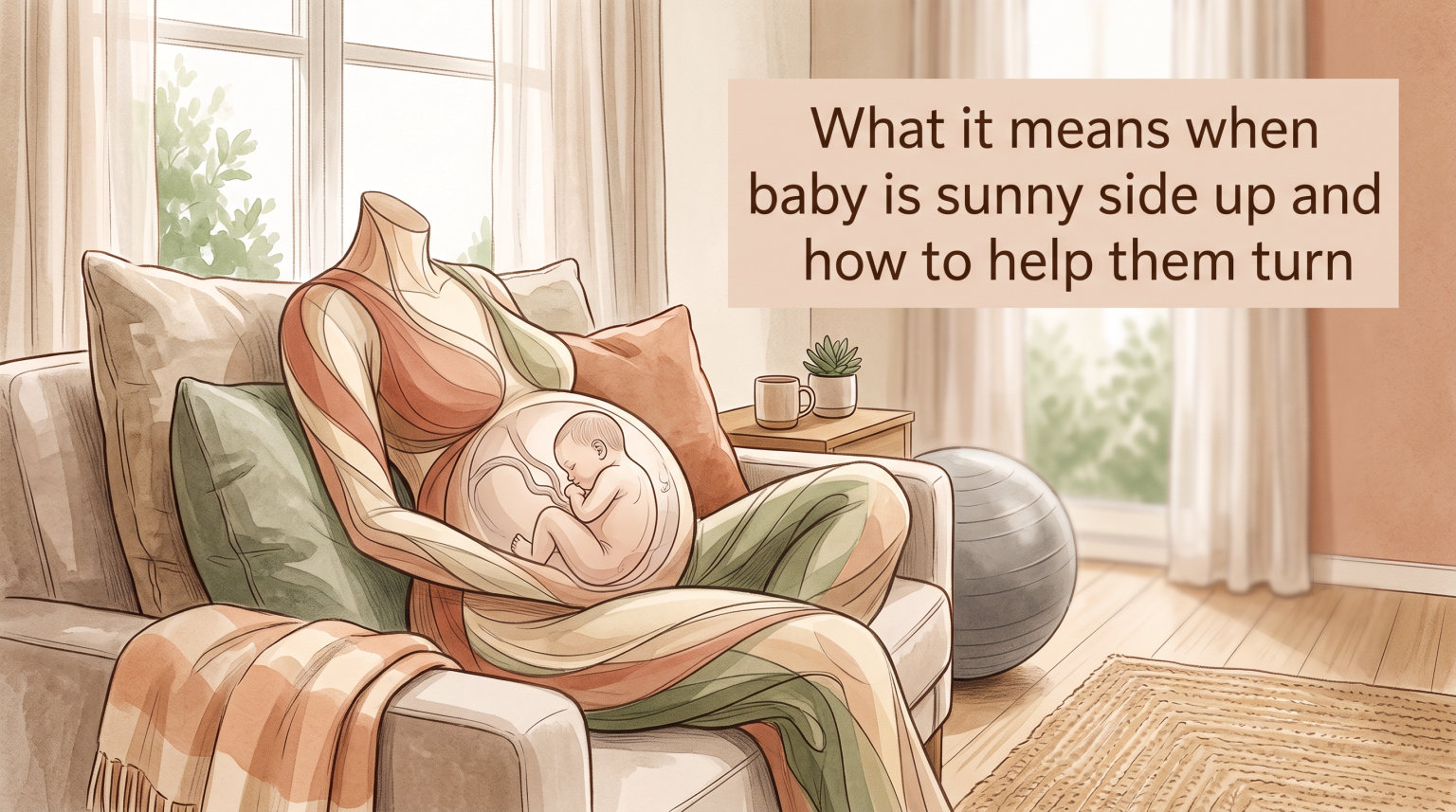
Finding out your baby is “sunny side up” can stir up immediate worry. I remember the moment my midwife mentioned my daughter was in the posterior position during a late pregnancy checkup. My mind raced with questions about pain, complications, and whether I would need a C-section.
A sunny side up baby, medically known as the occiput posterior or OP position, is one where the baby is head-down but facing toward your belly rather than your spine. This means the baby’s face looks up toward the ceiling, and the back of their head presses against your tailbone. About 5 to 8 percent of babies are in this position at birth, though up to 34 percent start labor this way before rotating naturally.
The good news I wish I had known then? Most babies turn on their own, either before labor begins or during the process itself. And even if they do not turn, many sunny side up babies are born vaginally without major complications. Understanding what this position means and having practical tools to help your baby turn can make a significant difference in your confidence and your birth experience.
Table of Contents
What Does Sunny Side Up Baby Mean?
A sunny side up baby refers to a fetal position called occiput posterior, or OP for short. In this position, your baby is head-down and ready for birth, but their face is oriented toward your abdomen instead of your spine. The term comes from the image of an egg cooked with the yolk facing upward.
Medically speaking, the occiput is the back portion of the baby’s skull. When a baby is occiput posterior, this bony part of the head presses against your sacrum and tailbone. This differs from the optimal occiput anterior position, where the baby faces your spine with the back of their head toward your belly.
Between 10 and 20 percent of babies are in the posterior position at the start of labor. However, only about 5 to 8 percent remain this way at delivery because most rotate naturally as labor progresses. The position is more common in first-time mothers and those with certain pelvic shapes or risk factors.
Understanding the Occiput Posterior Position
To understand why the sunny side up position matters, it helps to visualize how a baby moves through the birth canal. The human pelvis is not a straight tube. It has curves and angles that babies must navigate by tucking their chin and rotating their head.
When a baby is in the occiput anterior position, the smallest part of their head leads the way. The back of the skull is smooth and rounded, making it easier to mold and move through the pelvis. The baby’s face presses against your spine, allowing the back of the head to slip under your pubic bone smoothly.
What Is the Optimal Position?
The ideal fetal position for vaginal birth is called occiput anterior, or OA. In this position, your baby faces your spine with their chin tucked to their chest. This alignment allows the narrowest part of the baby’s head to enter the pelvis first.
Babies naturally seek this position because it requires the least amount of space and offers the path of least resistance. Most babies settle into the occiput anterior position by the final weeks of pregnancy. However, some factors can prevent this natural settling or encourage the baby to favor the posterior position.
How Common Is a Sunny Side Up Baby?
Research shows that approximately 15 to 20 percent of babies are in the occiput posterior position when labor begins. By the time of delivery, this number drops to roughly 5 to 8 percent. Many babies rotate into the anterior position during the early or active phases of labor.
The position is more common in first pregnancies. Studies suggest that around 13 percent of first-time mothers have babies in the persistent OP position at birth, compared to about 7 percent of women who have given birth before. This difference likely relates to the tone and flexibility of pelvic ligaments and muscles.
Why Some Babies End Up Sunny Side Up
Understanding why babies end up in the posterior position can help you identify risk factors and take preventive steps. While not all causes are within your control, knowing what contributes to this positioning empowers you to make informed choices.
Risk Factors for Posterior Position
Several factors increase the likelihood of having a sunny side up baby. Being a first-time mother is one of the most significant risk factors, as your uterine and abdominal muscles may be tighter, limiting the baby’s movement. The position of your placenta also plays a role.
An anterior placenta, which attaches to the front wall of your uterus, may encourage your baby to face away from it toward your spine. However, this is not always the case. Other risk factors include having a previous posterior birth, carrying multiples, or having uterine fibroids that limit space.
Your daily posture and movement patterns during pregnancy may also influence fetal position. Sitting in positions that tuck your pelvis under, like slouching on a couch or leaning back in car seats, may encourage the baby’s back to settle toward your spine. Being on bed rest or having reduced mobility can have a similar effect.
Pelvic Shape and Structure
The shape of your pelvis can influence how easily your baby can rotate into the optimal position. A gynecoid pelvis, which is the classic rounded female pelvis shape, generally provides the most room for rotation. An android pelvis, which is more heart-shaped and resembles a male pelvis structure, may make rotation more challenging.
However, pelvis shape is rarely a definitive predictor of birth outcomes. Most women have a mix of pelvic characteristics rather than a pure type. Even with a less ideal pelvic structure, babies often find their way through with patience and supportive positioning during labor.
What to Expect During Labor with a Sunny Side Up Baby
The occiput posterior position can affect labor in several ways. Understanding these potential impacts helps you prepare mentally and practically for what might lie ahead. Remember that every labor is unique, and many women have straightforward births with posterior babies.
Back Labor Explained
Perhaps the most talked-about aspect of having a sunny side up baby is back labor. This term describes intense pain in the lower back during contractions, caused by the baby’s occiput pressing against your sacrum and tailbone. Instead of feeling contractions primarily in your abdomen or uterus, the sensation concentrates in your back.
Back labor can feel unrelenting because the pressure continues between contractions. The hard bone of the baby’s skull against your spine creates a sharp, grinding sensation that can be exhausting. However, not every woman with a posterior baby experiences significant back labor, and pain levels vary widely.
Positions that take pressure off your back can provide relief. Many women find that hands-and-knees positions, leaning forward over a birth ball, or counter-pressure applied by a partner or doula makes back labor more manageable. Movement and changing positions frequently often help more than staying still.
Labor Duration and Progression
Research indicates that the occiput posterior position is associated with longer labors. The baby’s head may not engage as deeply in the pelvis, or it may engage in a way that creates less effective pressure on the cervix. This can result in slower dilation and a prolonged early or active labor phase.
Some studies show that first-stage labor with a persistent OP position averages about an hour longer than with an OA position. The pushing phase may also take longer because the baby’s head presents a wider diameter to the birth outlet. However, these are averages, and many women labor efficiently with posterior babies.
A sunny side up position does increase the likelihood of needing labor augmentation. You may be more likely to receive Pitocin to strengthen contractions if progress stalls. The key is working with your provider to balance patience with intervention, giving your baby time to rotate while monitoring safety.
Delivery Considerations
When it comes time to push, the occiput posterior position presents some additional challenges. The baby’s head exits the birth canal at a wider diameter than in the anterior position. This can make the pushing stage longer and more tiring.
Posterior babies have a higher association with assisted vaginal delivery, meaning forceps or vacuum extraction may be used more frequently. The rate of episiotomy and significant perineal tearing is also somewhat higher. These outcomes relate to the mechanics of delivering a wider head diameter and the longer pushing effort.
However, a sunny side up baby does not mean you need a cesarean section. Most posterior babies can be born vaginally, and planned C-sections for position alone are rare. Your provider’s skill, your pushing efforts, and your baby’s size and flexibility all factor into the outcome.
How to Help Your Baby Turn Before and During Labor
If you learn your baby is sunny side up before labor begins, several techniques may encourage rotation. Some of these can be practiced during pregnancy, while others are used during labor itself. Success varies, but many women find these methods helpful.
Spinning Babies Techniques
Spinning Babies is an approach developed by Gail Tully that focuses on optimal fetal positioning through maternal positioning. The techniques are based on the principle that creating balance in your uterine and pelvic muscles gives your baby room to move into the best position.
One foundational Spinning Babies technique is the Forward Leaning Inversion. This involves kneeling on a couch or bed edge and carefully lowering your hands to the floor, allowing your head to hang below your hips for 30 seconds. The position uses gravity to create space in the pelvis and encourage the baby to shift.
The Side-Lying Release is another technique that involves lying on your side with your top leg supported while a partner applies gentle pressure to your hip. This helps release tension in the pelvic ligaments. Many women practice these techniques daily from 32 weeks onward if their baby is posterior.
Other Spinning Babies recommendations include spending time on hands and knees, doing pelvic tilts, and avoiding reclined positions that encourage the baby to settle back-to-spine. The website offers detailed videos and instructions for these techniques.
Using a Peanut Ball
The peanut ball, an exercise ball shaped like a peanut, has become a popular tool in labor rooms for helping posterior babies rotate. When placed between your legs while side-lying, it opens your pelvis and creates asymmetry that encourages the baby to turn.
To use a peanut ball for a sunny side up baby, lie on your side with the ball between your thighs or knees. Your top leg should rest on the ball while your bottom leg stays straight or slightly bent. This position opens the upper side of your pelvis and may give the baby room to rotate away from your spine.
Research suggests that using a peanut ball during labor reduces the length of the pushing stage and may decrease the likelihood of cesarean delivery. Many hospitals now provide peanut balls, or you can bring your own. Even without a peanut ball, placing pillows between your legs in a side-lying position may help.
Labor Positions That Help
Movement and position changes during labor can encourage a posterior baby to rotate. Gravity-friendly positions that tilt your pelvis forward tend to be most effective. These include standing and swaying, walking, or leaning forward over a birth ball or counter.
Hands-and-knees positions are particularly valuable for back labor and posterior babies. This position takes pressure off your spine and allows your baby more freedom to rotate. Rocking your hips while on hands and knees, called the pelvic tilt or cat-cow motion, may encourage rotation.
Lunging is another effective technique. Stand with one foot on a stool or low step and l gently side to side. This creates asymmetry in your pelvis that may help the baby navigate through. Alternating sides every few contractions prevents fatigue and keeps your pelvis mobile.
Sitting on a birth ball and doing figure-eight hip motions can also encourage rotation. The key is avoiding positions where you are flat on your back, which works against gravity and may slow progress. Your nurse or doula can suggest specific positions based on how your labor is unfolding.
Manual Rotation
In some cases, your provider may offer manual rotation, also called digital rotation. This is a procedure performed during a vaginal exam where the care provider uses their hand to physically turn the baby into the anterior position. It is typically done when you are fully dilated and the baby’s head is low in the pelvis.
Manual rotation can be uncomfortable, but it is usually quick. Some women request an epidural top-off before the procedure. Research shows that successful manual rotation reduces the length of the pushing stage and the need for operative vaginal delivery or cesarean.
Not all providers are trained in or comfortable with manual rotation, and it is not appropriate in every situation. If this is something you are interested in, discuss it with your obstetrician or midwife before labor begins. They can explain their approach and when they might recommend it.
What Real Moms Want You to Know
Reading medical information is helpful, but hearing from women who have been through it brings a different kind of reassurance. From pregnancy forums and community discussions, several themes emerge that you will not find in clinical textbooks.
Many mothers emphasize that finding out late in pregnancy caused the most anxiety. Women who learned their baby was posterior at 36 weeks often spent the next weeks trying every technique and worrying constantly. In contrast, those whose babies turned spontaneously during labor sometimes did not even know the position had been an issue.
The peanut ball comes up repeatedly as a game-changer. One mother described how her posterior baby turned within an hour of using the ball in a side-lying position. Another mentioned that her labor nurse positioned her with the ball without mentioning the technical reason, which helped her stay relaxed.
Perhaps the most important message from experienced mothers is about letting go of guilt. Several women shared feelings of failure when their babies did not turn, as if they had not done enough exercises or positioned correctly enough. The reality is that some babies simply settle into the posterior position due to factors completely outside your control.
Success stories abound, but so do stories of acceptance. Women who delivered sunny side up babies vaginally report that while it was harder than expected, it was absolutely doable. Those who ended with cesareans after failed rotation often express relief that they tried while accepting that the outcome was right for their situation.
Frequently Asked Questions
Do sunny side up babies usually turn?
Yes, most sunny side up babies turn either before labor begins or during the labor process. About 15-20% of babies start labor in the posterior position, but only 5-8% are still in that position at birth. Many babies rotate naturally as labor progresses, especially with movement and position changes.
Is sunny side up birth more painful?
Sunny side up births can involve more back labor, which many women describe as intense pressure and pain in the lower back. However, pain levels vary widely between individuals. Some women experience manageable discomfort, while others find back labor exhausting. Position changes, counter-pressure, and hands-and-knees positions can help reduce back pain significantly.
Is it harder to push out a sunny side up baby?
The pushing stage may be longer with a sunny side up baby because the baby’s head presents a wider diameter to the birth outlet. This can make delivery more physically demanding. However, most posterior babies can still be born vaginally. Working with your body, using effective pushing positions, and having supportive care can make a significant difference.
How to prevent sunny side up baby?
While not all cases are preventable, maintaining good posture during pregnancy may help. Avoid sitting in positions that tuck your pelvis under for long periods. Spend time on hands and knees, use a birth ball for sitting, and practice forward-leaning positions. Regular movement, swimming, and prenatal yoga that emphasizes pelvic balance may also encourage optimal positioning.
How rare is a sunny side up baby?
A sunny side up baby is not particularly rare. About 5-8% of babies are born in the occiput posterior position, though up to 34% may be in this position at some point during labor. The position is more common in first-time mothers and those with certain risk factors like an anterior placenta or specific pelvic shapes.
Finding Peace with Your Baby’s Position
Learning that your baby is sunny side up can feel overwhelming, but knowledge transforms fear into preparation. Understanding what the occiput posterior position means, why it happens, and what options you have empowers you to navigate your birth experience with confidence.
Remember that statistics favor a positive outcome. Most babies turn on their own, and most of those who do not still arrive safely through vaginal birth. The techniques we have discussed, from Spinning Babies exercises to the peanut ball to labor positioning, give you practical tools to encourage optimal positioning.
Your baby’s position is just one factor in your birth story. The support of your care team, your preparation, your flexibility, and your trust in the process matter just as much. Whether your baby turns or arrives sunny side up, you are capable of having a positive birth experience. Trust your body, stay informed, and approach your labor with both hope and openness to whatever path your unique journey takes.