
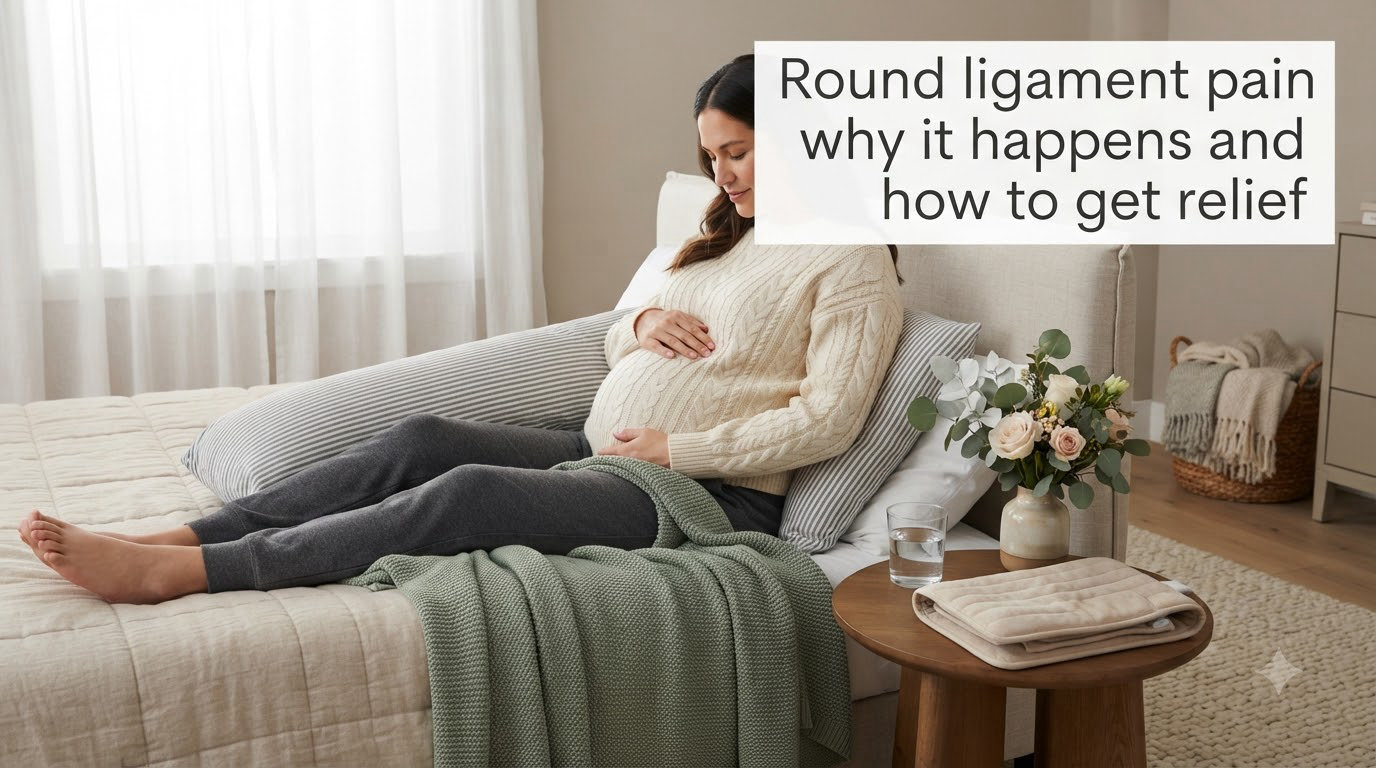
If you have ever felt a sharp, stabbing sensation shoot through your lower belly when you stood up too quickly or sneezed during pregnancy, you are likely experiencing round ligament pain. This sudden, jabbing discomfort catches many pregnant women off guard, often leaving them wondering if something is wrong with their baby or their body. I want to reassure you right away: round ligament pain is completely normal, extremely common, and generally harmless to both you and your baby.
Throughout my years of working with expecting mothers, I have heard countless stories about this particular pregnancy discomfort. Some women describe it as a brief lightning bolt of pain. Others feel a persistent dull ache in their groin or hip area. However it manifests for you, understanding why it happens and knowing how to find relief can make your pregnancy journey significantly more comfortable.
In this guide, I will walk you through everything you need to know about round ligament pain. You will learn what causes those sharp twinges, how to distinguish normal discomfort from warning signs that need medical attention, and most importantly, proven relief techniques that have helped thousands of women find comfort. Whether you are in your first trimester wondering what is ahead, or currently wincing through your second trimester, this information will help you navigate this common pregnancy experience with confidence.
Table of Contents
What Is Round Ligament Pain?
Round ligament pain is a sharp, stabbing, or pulling sensation felt in the lower abdomen, groin, or hips during pregnancy, caused by the stretching of ligaments that support your growing uterus. These brief but intense spasms typically last only seconds, though some women experience a lingering dull ache that persists for minutes or even hours.
To understand this discomfort, picture your uterus as a growing balloon. Two thick, rope-like ligaments called the round ligaments attach to either side of your uterus and anchor into your groin area. These ligaments act like supportive suspension cables, holding your uterus in place as it expands. During pregnancy, these ligaments must stretch and thicken considerably, eventually growing from their pre-pregnancy thickness of about 3-5 millimeters to nearly a centimeter or more.
The round ligaments contain muscle fibers that contract when stretched suddenly. This involuntary contraction creates that characteristic sharp pain you feel. Think of it like a rubber band snapping when pulled too quickly, though much less dramatic and completely harmless to your pregnancy. Your uterus and baby remain perfectly safe throughout these episodes.
Most women first encounter round ligament pain during their second trimester, typically between weeks 14 and 27, though it can begin earlier or persist later. The pain occurs most frequently on the right side of the body, simply because the uterus naturally tilts slightly to the right as it grows. However, many women experience bilateral pain or discomfort that shifts from side to side.
Why Does Round Ligament Pain Happen?
The primary cause of round ligament pain lies in the remarkable transformation your body undergoes to accommodate your growing baby. As your uterus expands from its pre-pregnancy size of about 70 grams to more than a kilogram by full term, the round ligaments must stretch, thicken, and work significantly harder to provide support.
Hormonal changes play a major role in this process. During pregnancy, your body produces increased levels of a hormone called relaxin, along with elevated progesterone. These hormones loosen your ligaments and joints throughout your body, preparing your pelvis for childbirth. While essential for delivery, this hormonal softening makes your round ligaments more susceptible to strain and sudden discomfort.
The mechanics are straightforward. When you make sudden movements, the round ligaments stretch rapidly and then contract. This quick stretching motion triggers pain receptors in the ligament tissue, sending that sharp signal to your brain. The pain serves as a gentle reminder from your body to slow down and move more mindfully during this physically demanding time.
Several factors can increase your likelihood of experiencing round ligament pain. Women carrying multiples often report more frequent discomfort due to the faster and larger uterine expansion. Your pre-pregnancy fitness level and core strength also influence ligament strain, as weaker abdominal muscles require your ligaments to work harder. Previous pregnancies can sometimes increase round ligament pain, as tissues have been stretched before, though this varies widely among women.
One mother shared with our community: “I noticed the pain happened if I moved too quickly, like getting out of bed or standing from sitting, or started sneezing. That was the worst!” Her experience perfectly illustrates how normal daily activities can trigger these ligament spasms when your body is working hard to support new life.
What Does Round Ligament Pain Feel Like?
Women describe round ligament pain using remarkably consistent language across forums, support groups, and medical consultations. The most common descriptor is a sharp, stabbing, or jabbing sensation that strikes suddenly and intensely. Imagine a quick pinch or the feeling of a rubber band snapping inside your lower belly.
The location typically centers in your lower abdomen, starting from the sides of your uterus and radiating into your groin area or hip creases. Some women feel the pain shoot downward into their inner thighs. While most commonly felt on the right side, it can occur on either side or both simultaneously.
Duration varies significantly between episodes and individuals. The classic round ligament spasm lasts mere seconds, perhaps ten to thirty, before fading completely. However, some women experience a lingering pulling sensation or dull ache that persists for several minutes after the initial sharp pain subsides. In certain cases, particularly after prolonged activity or an awkward movement, the discomfort can hover in the background for hours.
The intensity ranges from mildly annoying to surprisingly painful. Some women barely pause at the twinge, while others find themselves catching their breath or stopping mid-step. One expectant mother told us: “Some days it is severe, I almost cry, and on others I just feel minor discomfort.” This variability is completely normal and does not indicate any problem with your pregnancy.
Unlike menstrual cramps or labor contractions, round ligament pain does not follow a rhythmic pattern. It will not come in waves every few minutes. Instead, it strikes in direct response to specific movements or positions, giving you the opportunity to identify and modify triggers.
Common Triggers That Set Off Round Ligament Pain
Understanding what sets off your round ligament pain empowers you to anticipate and often prevent episodes. The common thread among all triggers is sudden stretching or tension on the ligaments supporting your uterus.
Sudden movements top the list of culprits. Standing up quickly from a seated position, getting out of bed too fast, or rising from a deep squat can all trigger that sharp sensation. Your ligaments, already working overtime to support your expanding uterus, contract defensively when asked to stretch rapidly.
Sneezing, coughing, and even laughing hard can provoke round ligament pain. These actions cause your abdominal muscles to contract suddenly, which pulls on the ligaments. Many women learn to brace themselves by bending slightly forward and supporting their belly with their hands before a sneeze, significantly reducing the jolt of pain.
Rolling over in bed represents one of the most frequently reported triggers. The motion of shifting your weight from side to side while lying down creates a shearing force across your ligaments. This explains why so many women experience pain upon waking or during nighttime bathroom trips.
Physical exercise, particularly activities involving quick direction changes or core engagement, can aggravate round ligament pain. Running, high-impact aerobics, and certain yoga poses that require deep twisting may trigger discomfort. However, this does not mean you should abandon exercise. Many women find that modifying their routine actually reduces overall pain by strengthening supporting muscles.
Standing for extended periods or maintaining any single position too long can also cause discomfort. When you stand still, your ligaments bear the full weight of your uterus without the dynamic support that movement provides. Similarly, sitting with poor posture or crossing your legs can compress the area and increase strain.
When Does Round Ligament Pain Occur During Pregnancy?
Round ligament pain most commonly emerges during the second trimester, typically beginning around week 14 and potentially continuing through week 27. This timing aligns with the period when your uterus undergoes its most dramatic growth spurt, transitioning from a pelvic organ to an abdominal one that rises above your pubic bone.
However, the timeline varies considerably among women. Some expectant mothers report experiencing round ligament pain as early as the first trimester, particularly those carrying twins or multiples where uterine expansion happens faster. Others sail through their second trimester without significant discomfort only to encounter pain in their third trimester as their belly reaches maximum size.
One mother at 36 weeks shared her experience: “I have had round ligament pain for about a month. It was only at certain times in the beginning and now it is any time I move.” Her story illustrates how pain patterns can evolve throughout pregnancy, becoming more frequent or intense as your body accommodates your growing baby.
For most women, round ligament pain represents a temporary discomfort that resolves completely after childbirth. Once your uterus returns to its pre-pregnancy size and your hormone levels normalize, the excessive strain on your ligaments disappears. Some women notice immediate relief after delivery, while others find the lingering effects of relaxin keep joints and ligaments loose for several weeks postpartum.
How to Get Relief from Round Ligament Pain
Finding relief from round ligament pain involves a combination of immediate techniques to stop an episode in progress and longer-term strategies to reduce frequency and severity. I have organized these methods from the simplest immediate fixes to comprehensive approaches that can transform your comfort level throughout pregnancy.
Immediate Relief Techniques
When pain strikes, your first response should be to stop moving and find a comfortable position. Lying down on your side, preferably the left side to optimize blood flow, often provides the fastest relief. Place a pillow between your knees to align your hips and reduce ligament tension.
Gentle position changes can also help. If you are standing, slowly lower yourself to sit or lie down. If you are lying down, try slowly rolling to your other side or adjusting your leg position. The key word is slowly. Rapid movements will likely intensify the spasm.
Many women find that applying gentle counter-pressure helps. Place your hand firmly but gently on the painful area and apply steady pressure. This supports the ligament and can reduce the spasming sensation. Some women prefer to cup their lower belly with both hands when they feel a sneeze or cough coming.
Heat Therapy for Soothing Relief
Heat therapy ranks among the most effective non-invasive relief methods for round ligament pain. A warm bath provides comprehensive relief, allowing the heat to penetrate deeply into your ligaments while the buoyancy of water supports your body weight, removing strain entirely.
For targeted relief, use a heating pad or warm compress on the affected area. Keep the temperature warm but not hot, and limit applications to 15-20 minutes at a time. Never fall asleep with a heating pad on, and avoid placing heat directly on your abdomen during the first trimester when your baby is most vulnerable to temperature changes.
Some women alternate heat and cold therapy, though most find heat more effective for ligament pain. If you try cold, use a wrapped ice pack for no more than 10 minutes and monitor how your body responds.
Gentle Stretches and Targeted Exercises
Regular stretching can significantly reduce round ligament pain frequency and intensity by keeping your ligaments supple and your supporting muscles engaged. The key is gentle, consistent movement rather than aggressive stretching.
The cat-cow stretch, performed on your hands and knees, gently mobilizes your pelvis and stretches your lower back and abdominal muscles. Arch your back upward like a cat, then slowly release and let your belly drop toward the floor. Repeat this flow five to ten times, moving with your breath.
Pelvic tilts, whether standing against a wall or lying on your back (if still comfortable), strengthen your core and reduce ligament strain. Gently rock your pelvis forward and back, engaging your abdominal muscles without straining.
Hip flexor and adductor stretches target the areas connected to your round ligaments. A gentle butterfly stretch, where you sit with your feet together and knees apart, can open your hips and reduce groin tension. Remember to breathe deeply and never force a stretch.
A community member from our forums recommends: “Practice prenatal yoga and regular stretching. Get rest. Use techniques such as those in natural pain relief approaches.” Her advice aligns with what many physical therapists and prenatal fitness instructors emphasize.
Support and Strategic Positioning
Proper support during sleep can prevent nighttime round ligament pain episodes and help you rest more soundly. Sleeping on your side with a pillow between your knees aligns your hips and reduces ligament tension. Many women benefit from placing a small pillow or rolled towel under their belly for additional support.
When changing positions in bed, use the log roll technique. Keep your knees bent and your shoulders and hips moving as one unit rather than twisting at your waist. This minimizes the shearing force across your ligaments that occurs when you roll normally.
During the day, maternity support belts or belly bands can redistribute your uterus weight and reduce the load on your round ligaments. These supportive garments work particularly well if you spend significant time standing or walking. Look for adjustable options that grow with your belly.
Massage Techniques for Pain Relief
Massage offers dual benefits: immediate relief from muscle tension and the stress-reducing effects of therapeutic touch. You can perform self-massage on accessible areas or enlist your partner for more comprehensive relief.
For self-massage, use gentle circular motions on your lower abdomen, staying above your pubic bone and working outward from the center. Light effleurage strokes, where you use flat hands to stroke gently toward your heart, can improve circulation and reduce tension.
Partner massage can target the areas you cannot easily reach. Have your partner use their palm or the heel of their hand to apply gentle pressure along your lower back, hips, and the sides of your abdomen. Always communicate about pressure levels, as pregnancy makes tissues more sensitive.
Professional prenatal massage from a certified therapist offers the most comprehensive relief. These specialists understand pregnancy anatomy and can safely work on areas of tension while avoiding pressure points that could stimulate contractions.
Movement Modifications That Prevent Pain
Simple adjustments to how you move throughout your day can dramatically reduce round ligament pain episodes. The golden rule is to slow down and support your belly during transitions.
Before standing from a seated position, scoot to the edge of your chair, separate your knees slightly, and use your arms to push yourself up slowly while engaging your core muscles. When getting out of bed, roll to your side first, then push yourself up using your arms while swinging your legs over the edge together.
Brace your belly before coughing, sneezing, or laughing by bending slightly forward and supporting your abdomen with your hands. This counter-pressure significantly reduces the jolt of pain these actions can trigger.
Avoid sudden twisting motions. When you need to turn, move your entire body as one unit rather than twisting at your waist. This protects not only your round ligaments but also your spine and pelvis.
Safe Pain Relief Options
When natural relief methods need backup, acetaminophen (Tylenol) provides a pregnancy-safe option for managing pain. Current medical consensus considers acetaminophen safe during all trimesters when used as directed. Always follow dosage instructions and consult your healthcare provider before taking any medication during pregnancy.
Avoid nonsteroidal anti-inflammatory drugs (NSAIDs) like ibuprofen and naproxen during pregnancy unless specifically prescribed by your doctor. These medications carry risks, particularly in the third trimester, and are generally not recommended for routine pregnancy discomfort.
Topical treatments like menthol rubs may provide some relief for associated muscle tension, though they do not address the ligament pain directly. Always check with your provider before using any topical products, as skin absorption varies.
Natural and Holistic Approaches to Managing Round Ligament Pain
Aligning with the natural parenting philosophy that Peggy O’Mara has championed for decades, many women find that holistic approaches address not just the physical discomfort of round ligament pain but also the emotional and spiritual aspects of pregnancy wellness.
Mindfulness and body awareness practices transform how you experience pregnancy discomfort. By tuning into your body’s signals, you learn to recognize the precursors to pain episodes and can often prevent them. Simple body scans, where you mentally check in with each part of your body, increase your awareness of tension patterns before they trigger pain.
Breathing techniques offer immediate relief during pain episodes. Slow, deep abdominal breathing activates your parasympathetic nervous system, reducing muscle tension and pain perception. Try inhaling for four counts, holding for four, and exhaling for six. This extended exhale naturally promotes relaxation.
Prenatal yoga combines stretching, strengthening, and breathwork into a comprehensive practice. Unlike standard yoga, prenatal classes focus on poses that support pregnancy, avoid dangerous positions, and build the specific muscle groups that reduce ligament strain. Many women find that regular practice reduces their round ligament pain frequency by half or more.
Swimming and water exercise provide nearly magical relief for pregnancy discomfort. The buoyancy of water supports your body weight, removing the strain on your ligaments entirely. Meanwhile, the gentle resistance of water strengthens your muscles without impact. Many women report feeling completely pain-free during water activities.
Interestingly, the skills you develop managing round ligament pain translate directly to labor preparation. Learning to breathe through discomfort, move mindfully, and trust your body’s wisdom creates a foundation for coping with labor contractions. Viewing your round ligament pain as preparation rather than just a nuisance can shift your entire pregnancy experience.
When to Call Your Doctor or Seek Emergency Care
While round ligament pain is almost always benign, knowing when to seek medical attention provides essential peace of mind. Certain symptoms indicate conditions that require prompt evaluation.
Contact your healthcare provider immediately if you experience any vaginal bleeding along with abdominal pain. Bleeding at any point in pregnancy warrants investigation, and when combined with pain, it requires urgent assessment.
Fever accompanying abdominal pain suggests infection and needs medical evaluation. Your immune system changes during pregnancy, making it important to treat infections promptly to protect both you and your baby.
Pain that persists longer than a few hours without relief, or pain so severe that you cannot walk, speak, or find any comfortable position, requires immediate attention. While round ligament pain can be intense, it should be brief and responsive to rest and position changes.
Rhythmic pain that comes in regular intervals, especially if accompanied by lower back pressure or pelvic pressure, could indicate preterm labor rather than round ligament pain. True contractions follow a pattern and increase in intensity, unlike the random, movement-triggered nature of ligament pain.
Go to the emergency room if you experience severe pain with chills, vomiting, dizziness, or fainting. These symptoms could indicate serious conditions like appendicitis, ovarian torsion, or placental problems that require immediate intervention.
Differentiating round ligament pain from other conditions helps you make informed decisions. Round ligament pain is typically brief, triggered by movement, and located in specific areas of your lower abdomen or groin. Pain that spreads across your entire abdomen, radiates to your shoulder, or changes your mental status always warrants immediate medical evaluation.
Prevention Tips: Reducing Round Ligament Pain Episodes
Prevention often proves easier than treatment when managing round ligament pain. By incorporating these strategies into your daily routine, you can significantly reduce both the frequency and severity of pain episodes.
Establish a daily stretching routine that targets your hips, pelvis, and lower back. Five to ten minutes each morning and evening keeps your ligaments supple and your supporting muscles engaged. Focus on gentle movements rather than deep stretches, and always warm up before stretching.
Maintain awareness of your posture throughout the day. When standing, keep your weight evenly distributed on both feet and avoid locking your knees. When sitting, choose chairs with good back support and keep both feet flat on the floor. Avoid crossing your legs, which can compress blood vessels and increase pelvic tension.
Master the art of position changes in bed using the log roll technique. Keep your shoulders and hips moving as one unit when turning, and use your arms to assist rather than relying on abdominal strength. This becomes especially important as your belly grows and twisting becomes more difficult.
Avoid heavy lifting whenever possible. If you must lift something, bend at your knees rather than your waist, keep the object close to your body, and avoid twisting while holding weight. Better yet, ask for help with lifting tasks during your pregnancy.
Practice movement mindfulness. Before you stand, cough, or change position, take a moment to engage your core muscles and prepare your body. This brief pause allows your ligaments to adjust gradually rather than reacting to sudden strain.
Stay hydrated and maintain regular bowel habits. Constipation and dehydration can increase abdominal pressure and discomfort, potentially aggravating round ligament pain. A diet rich in fiber, plenty of water, and regular gentle movement support digestive health.
Consider your work environment if you have a physically demanding job or spend long hours sitting. Request accommodations like a supportive chair, opportunities to change positions frequently, or reduced lifting requirements. Most employers are legally required to provide reasonable pregnancy accommodations.
Frequently Asked Questions About Round Ligament Pain
Can round ligament pain happen in the first trimester?
Yes, though less common, round ligament pain can occur in the first trimester. Women carrying multiples or those who have been pregnant before may experience it earlier as their bodies recognize the hormonal signals and begin stretching sooner.
How long does round ligament pain last?
Individual episodes typically last seconds to minutes, though some women experience lingering aches for hours. As a pregnancy condition, it often peaks in the second trimester and may continue into the third, but usually resolves completely after childbirth.
Is round ligament pain dangerous for my baby?
No, round ligament pain poses no danger to your baby. The pain originates in your ligaments and does not affect your uterus, placenta, or baby. It is a normal physiological response to pregnancy changes.
Does round ligament pain go away after birth?
Yes, round ligament pain typically resolves completely after delivery. Once your uterus returns to pre-pregnancy size and your hormone levels normalize, the excessive strain on your ligaments disappears. Some women experience immediate relief, while others find it takes a few weeks postpartum.
What is the best sleeping position for round ligament pain?
Sleep on your side, preferably the left, with a pillow between your knees and another supporting your belly. This alignment reduces ligament tension and improves blood flow. Use the log roll technique when changing positions to minimize ligament strain.
Can I exercise with round ligament pain?
Yes, most women can continue exercising with modifications. Avoid high-impact activities and sudden direction changes. Prenatal yoga, swimming, and walking often reduce overall pain by strengthening supporting muscles. Stop if exercise triggers pain and consult your provider for personalized guidance.
How can my partner help with round ligament pain?
Partners can provide massage, assist with position changes, help with household tasks that involve lifting or bending, and offer emotional support. Learning to recognize when you need to slow down and reminding you to move mindfully makes a significant difference.
Is round ligament pain worse with each pregnancy?
Not necessarily. Some women find subsequent pregnancies involve less round ligament pain as their bodies remember the stretching process. Others experience more discomfort as tissues have been stretched before. Each pregnancy is unique, and previous experience does not predict future pain levels.
Round ligament pain represents one of the most common yet least discussed discomforts of pregnancy. By understanding why it happens, recognizing your personal triggers, and building a toolkit of relief techniques, you can navigate this temporary challenge with confidence and grace. Your body is doing remarkable work growing new life, and these stretching sensations are simply part of that miraculous process.
Remember that every pregnancy journey is unique. What works for one woman may not work for another, and your experience with round ligament pain may differ from your friends or even your own previous pregnancies. Trust your instincts about when discomfort crosses into concerning territory, and never hesitate to contact your healthcare provider when something feels wrong.
The techniques you learn managing round ligament pain, breathing through discomfort, moving with intention, and listening to your body’s wisdom, serve you well beyond pregnancy. They become part of your maternal intuition, a deep knowing of what you need that will support you through labor, childbirth, and the beautiful, demanding years of motherhood ahead.