
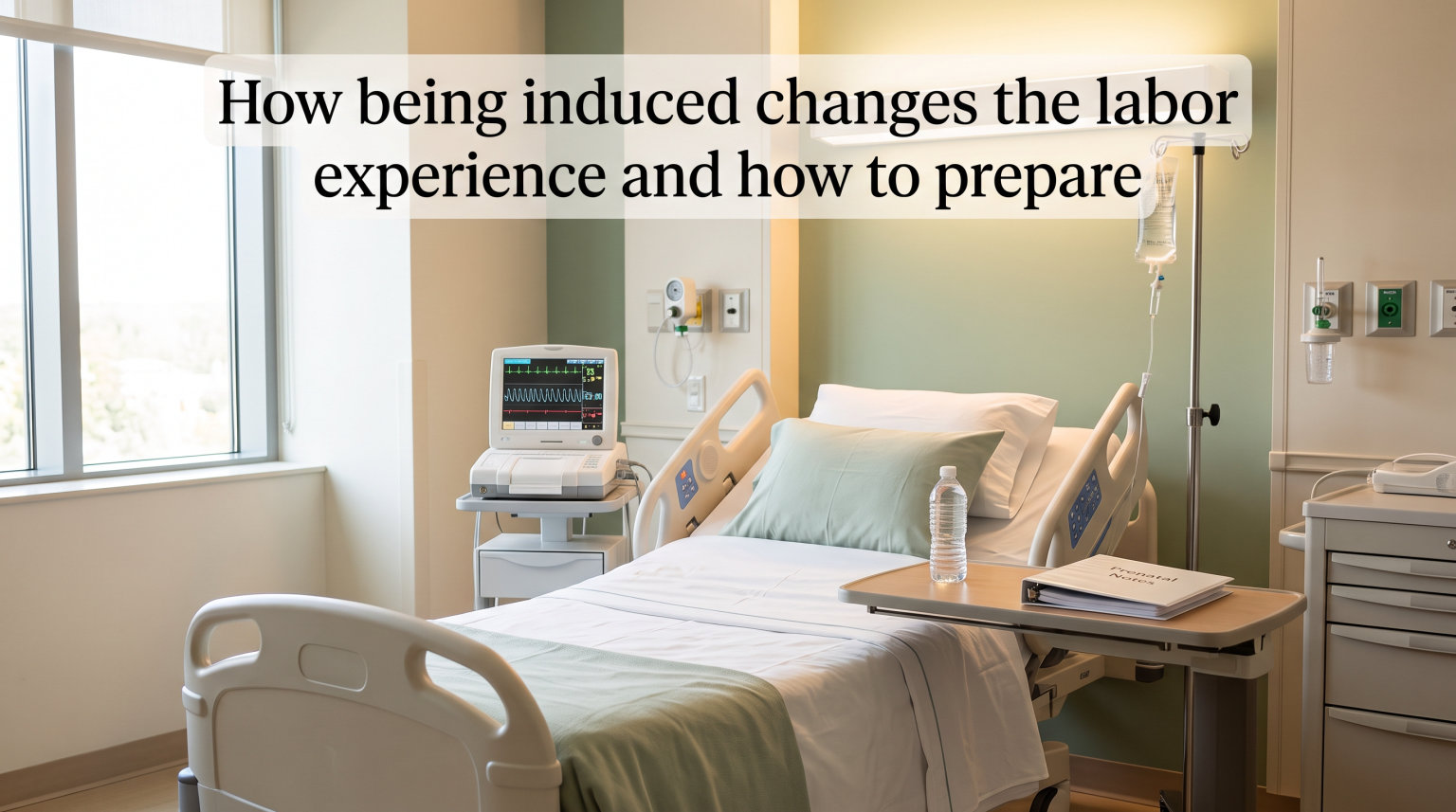
Understanding how being induced changes the labor experience helps you walk into that hospital room with confidence instead of anxiety. Induction artificially starts labor before it begins naturally, and this process creates a distinctly different journey than spontaneous labor.
I have worked with hundreds of expectant parents preparing for induction, and the ones who feel most satisfied with their experience share one trait: they understood what made their labor different and prepared accordingly.
This guide explains exactly how induced labor differs from spontaneous labor, what you can expect during each phase, and how to prepare physically and mentally for the experience ahead.
Table of Contents
What Is Labor Induction?
Labor induction is a medical procedure that stimulates uterine contractions before they begin naturally. Your healthcare provider uses medications like synthetic oxytocin (Pitocin) or mechanical methods like Foley bulb catheters to initiate and progress labor.
Doctors recommend induction when continuing the pregnancy poses risks to you or your baby. Common medical reasons include preeclampsia, gestational diabetes, post-term pregnancy beyond 42 weeks, decreased amniotic fluid (oligohydramnios), or intrauterine growth restriction.
Some inductions happen for non-medical reasons, often called elective or social inductions. These typically occur after 39 weeks when the baby is fully developed and the mother prefers a scheduled delivery date. About 25-30% of pregnancies in the United States involve induction, making it one of the most common labor interventions.
How Being Induced Changes the Labor Experience
The question at the heart of this article deserves a clear, direct answer: induction changes your labor experience in three fundamental ways. Your contractions behave differently, your timeline shifts significantly, and your emotional journey through birth takes on a unique character.
Let me break down each difference so you know exactly what to expect when comparing induced vs spontaneous labor.
Contraction Patterns: The Pitocin Difference
Natural labor contractions build gradually. Your body releases oxytocin in waves, allowing your uterus to warm up slowly and giving you time to adapt to increasing intensity. This gradual progression helps many people cope without intervention until later in active labor.
Induced labor works differently. Pitocin, the synthetic oxytocin used in most inductions, creates contractions that are often stronger, closer together, and more uniform than natural ones. Many women describe them as more intense from the start, without the gentle buildup that characterizes spontaneous labor.
Forum discussions reveal this experience repeatedly: women who have experienced both types of labor often say induced contractions feel more artificial or mechanical. They come on stronger and faster, which can make pain management decisions more urgent.
This does not mean induced labor is unbearable. It means your pain management strategy needs to account for this faster ramp-up. Many women successfully use epidurals, nitrous oxide, or other comfort measures to manage Pitocin-induced contractions.
Timeline Expectations: Scheduled Start, Uncertain Duration
One of the biggest surprises for first-time moms facing induction is the timeline. You might arrive at the hospital knowing exactly when your induction starts, but you cannot know when your baby will arrive.
Spontaneous labor might begin at home in the evening, progress overnight, and result in morning delivery. Induction often stretches across multiple days, especially for first-time mothers with an unripe cervix.
Here is what a typical induction timeline looks like:
- Cervical ripening phase: 12-24 hours (sometimes longer)
- Active labor induction with Pitocin: 6-12 hours on average
- Second stage (pushing): 1-3 hours for first-time moms, less for experienced moms
Many inductions take 24 to 48 hours from start to finish. The women who report the most positive experiences are those who expected this timeline and prepared accordingly.
Movement and Monitoring Restrictions
During spontaneous labor, many women spend early labor at home, moving freely, showering, walking, and changing positions as comfort dictates. They arrive at the hospital already in active labor.
Induction starts in the hospital, and from the beginning, you face monitoring requirements. Continuous fetal heart rate monitoring is standard during induction, which means external monitors strapped to your abdomen.
These monitors limit your movement. You can usually still shift positions in bed, use a birth ball, or walk short distances with the monitors, but you cannot move as freely as you might at home in early labor.
This restriction frustrates many women, especially during the long cervical ripening phase when they feel fine but must stay on or near the monitoring equipment. Planning for this reality helps set appropriate expectations.
The Emotional Experience: Processing Different Feelings
Spontaneous labor brings a sense of your body working naturally toward birth. Many women feel powerful and primal as their labor unfolds according to their body’s timing.
Induction can trigger different emotions. Some women feel disappointment about not going into labor naturally. Others feel anxiety about the medical intervention. The scheduled nature creates anticipation that can become stress if the process takes longer than expected.
However, many women report positive emotional aspects of induction. Knowing the date provides mental preparation time. Having the medical team present from the start offers reassurance. The gradual nature of cervical ripening allows time to adjust to the reality of labor.
The key difference is this: spontaneous labor often feels like something happening to you naturally, while induced labor feels like a process you are moving through with medical support. Both can result in positive, empowering birth experiences when you understand what to expect.
Understanding Induction Methods
Your induction experience depends partly on which methods your provider uses. Understanding each method helps you anticipate what will happen and participate in decisions about your care.
Cervical Ripening: Preparing the Pathway
Before stimulating contractions, your cervix must be ready. This readiness is measured by the Bishop score, which evaluates dilation, effacement, consistency, position, and fetal station. A score below 6 usually means you need cervical ripening before Pitocin can work effectively.
Cervidil (dinoprostone) is a prostaglandin medication inserted near the cervix as a thin vaginal insert. It stays in place for 12 hours, softening the cervix gradually. You can usually walk, shower, and move around with Cervidil in place.
Cytotec (misoprostol) is another prostaglandin option, given as a small pill placed near the cervix. It works faster than Cervidil and can be repeated every few hours. Some providers prefer it for cost and effectiveness reasons.
The Foley bulb catheter provides mechanical ripening. A small balloon is inserted through the cervix and inflated with saline. The balloon puts pressure on the cervix, encouraging it to open. It typically falls out once you reach 3-4 centimeters dilation. Women describe Foley bulb insertion as uncomfortable but manageable, similar to a cervical check.
Amniotomy: Breaking the Water
Once your cervix is sufficiently dilated, your provider might break your amniotic sac artificially. This procedure, called amniotomy, releases the fluid and often stimulates stronger contractions naturally.
Amniotomy typically happens when you are already 3-4 centimeters dilated. The procedure takes just a moment and feels like a warm gush of fluid. After your water breaks, contractions usually intensify, and the clock starts ticking more urgently because the risk of infection increases once the barrier between baby and outside world is gone.
Pitocin: Driving Active Labor
Pitocin (synthetic oxytocin) is the workhorse of labor induction. Given through an IV drip, it stimulates uterine contractions in a controlled, measurable way. Your nurse adjusts the dosage based on how your uterus responds, aiming for regular contractions every 2-3 minutes.
Pitocin induction starts with a low dose that increases gradually. This titration process can take several hours as the medical team finds the right level for your body. Too little Pitocin produces ineffective contractions. Too much creates contractions that are too strong, too close together, or lasting too long, which can stress the baby.
The protocol involves continuous monitoring of both your contractions and the baby’s heart rate. This safety measure is non-negotiable but does limit your movement during this phase.
How to Prepare for Labor Induction
Preparation makes the difference between a stressful, exhausting induction and a manageable, positive birth experience. Here is how to set yourself up for success.
Step 1: Ask the Right Questions
Before your induction date, schedule a conversation with your provider. Ask these essential questions:
- What is my Bishop score, and what does it mean for my induction plan?
- Which ripening method do you recommend for me, and why?
- What is your approach to Pitocin dosing?
- Under what circumstances would you recommend a C-section if induction does not progress?
- What pain management options do you recommend for induced labor specifically?
- Can I eat before coming in, and what are the guidelines?
These questions help you understand your provider’s approach and allow you to align your expectations with their practices. They also signal that you want to be an active participant in your care.
Step 2: Pack for a Marathon, Not a Sprint
The most common regret I hear from women after induction is this: I did not pack enough entertainment and comfort items for the waiting periods.
Pack these essentials specifically for induction:
- Multiple chargers for phones and devices (outlets may be far from the bed)
- Books, magazines, downloaded movies, or tablet with entertainment
- Comfortable pillow from home (hospital pillows are notoriously thin)
- Snacks for your support person (they will be there for the long haul too)
- Eye mask and earplugs for resting during bright, noisy hospital nights
- Multiple outfit changes (you may be in the hospital for 3+ days)
- Comfortable walking shoes and socks with grip for pacing hallways
Step 3: Prepare Mentally and Emotionally
Induction requires mental stamina. The waiting periods test your patience. The intensity changes challenge your coping skills. Preparing your mind is as important as packing your bag.
Set realistic expectations. Understand that induction often takes 24-48 hours. Remind yourself that slow progress is still progress. The cervical ripening phase feels boring because it is supposed to happen quietly in the background.
Practice relaxation techniques before your induction date. Breathing exercises, visualization, and meditation help you stay calm during the long hours. Consider hiring a doula specifically experienced with induced labors.
Process any feelings of disappointment about not going into labor naturally. Grief about missing the spontaneous labor experience is valid. Acknowledge it, then focus on the reality that a positive birth experience can happen through any pathway.
Step 4: Prepare Your Support Person
Your partner or support person needs preparation too. They will be with you through long, boring waiting periods followed by intense active labor. Their stamina matters for your experience.
Make sure they understand the induction timeline. They should pack their own entertainment, plan for meals (hospital cafeteria food gets old fast), and arrange for backup support if they need breaks.
Discuss your preferences for pain management, intervention decisions, and communication style before you arrive at the hospital. In the moment, you may not want to explain what you need. Clear pre-planning helps them advocate for you effectively.
Dos and Don’ts Before Being Induced
Your actions in the days and hours before induction affect your experience. Follow these practical guidelines.
What to Do Before Your Induction
- Do eat a good meal before arriving if your provider allows it. Hospital food is limited, and you need energy for the long process ahead.
- Do get as much sleep as possible the night before. You might not sleep well in the hospital during early induction phases.
- Do confirm your hospital arrival time and any pre-induction instructions with your provider’s office.
- Do install your car seat and have your home ready for baby’s arrival before induction day.
- Do charge all devices and download entertainment that works offline.
- Do confirm who will be your support person and communicate your expectations to them.
What Not to Do Before Your Induction
- Don’t eat a huge heavy meal if your provider restricts food intake. Follow their specific guidelines.
- Don’t expect to have the baby within a few hours. First-time mom inductions typically take 24+ hours.
- Don’t schedule visitors immediately. The timeline is unpredictable, and you need rest.
- Don’t neglect pain management planning. Induced contractions intensify quickly for many women.
- Don’t assume your birth plan is irrelevant. While flexibility matters, your preferences still guide your care.
What to Expect: The Induction Timeline
Understanding the typical timeline helps you recognize normal progress and avoid unnecessary anxiety.
Arrival and Assessment (1-2 Hours)
When you arrive at the hospital, your care team confirms your induction order, checks your vital signs, and performs a cervical exam to assess your Bishop score. They place an IV line for fluids and potential medication administration. They also attach continuous fetal monitoring.
This initial phase feels administrative and slow. You are hooked up to monitors, paperwork gets completed, and you settle into your room. Many women feel a mix of excitement and nervousness during this time.
Cervical Ripening Phase (12-24+ Hours)
If your cervix needs ripening, this phase begins next. You might receive Cervidil, Cytotec, or a Foley bulb catheter. During this phase, you typically feel little to no discomfort from the medications or devices themselves.
The challenge during cervical ripening is boredom and restlessness. You cannot leave the hospital, but you are not in active labor yet. Smart women use this time to rest, watch movies, walk the halls, or nap. Do not exhaust yourself trying to force labor to start faster.
Your nurse checks progress periodically. If using Cervidil, it stays in for 12 hours. Cytotec gets checked every few hours. The Foley bulb falls out on its own once you dilate sufficiently.
Active Labor Induction (6-12 Hours)
Once your cervix is ready, Pitocin administration begins. The nurse starts at a low dose and increases it gradually based on your contraction pattern. The goal is regular contractions every 2-3 minutes that are strong enough to dilate your cervix.
This phase transitions from manageable to intense. Early on, you might chat between contractions and feel optimistic. As the Pitocin increases, contractions become stronger and closer together. This is when most women request epidurals or other pain relief.
The active labor phase ends when you reach full dilation (10 centimeters). For first-time moms, this phase averages 8-12 hours with Pitocin. Women who have given birth before often progress faster.
Pushing and Delivery (1-3 Hours)
Once fully dilated, you enter the second stage of labor. Your provider guides you through pushing, which can take 1-3 hours for first-time moms. The pushing phase is similar whether your labor was induced or spontaneous.
After delivery, your baby is placed on your chest (if circumstances allow), and you deliver the placenta. The third stage of labor is typically brief and uncomplicated.
When Induction Does Not Work
Not every induction results in vaginal delivery. Sometimes the cervix does not respond to ripening methods, or contractions do not progress dilation despite Pitocin. This is called a failed induction.
Your provider might try different methods, break your water if it has not happened yet, or recommend a cesarean section if progress stalls completely. The decision depends on how you and your baby are tolerating the process.
Understanding that C-section is a possibility before you start helps you process the decision if it becomes necessary. It does not represent a failure on your part. Sometimes induction reveals that vaginal delivery is not safe or possible, and the surgical route protects both you and your baby.
Risks and Considerations
Every medical intervention carries benefits and risks. Understanding both sides helps you make an informed decision and participate actively in your care.
Benefits of Induction
Induction prevents complications when continuing pregnancy poses risks. For women with preeclampsia, delivering reduces the danger of seizures and organ damage. For post-term pregnancies, induction prevents the risks associated with aging placentas and decreasing amniotic fluid.
Even elective induction at 39 weeks offers benefits. The ARRIVE trial showed that elective induction at 39 weeks reduces the risk of cesarean delivery compared to waiting for spontaneous labor. It also reduces the risk of perinatal death and maternal hypertension.
Potential Risks and Complications
Failed induction leading to C-section is the most common complication. When induction does not progress, you might endure hours or days of intervention only to need surgery anyway. This possibility makes realistic timeline expectations even more important.
Uterine rupture is a rare but serious risk, particularly for women attempting vaginal birth after cesarean (VBAC) with Pitocin. The risk is less than 1% for most women but higher for those with previous uterine surgery.
Fetal heart rate abnormalities sometimes occur with Pitocin, especially at higher doses. Continuous monitoring helps detect these issues early. If the baby’s heart rate shows concerning patterns, your provider might adjust the Pitocin, give you oxygen, or recommend delivery assistance or C-section.
Infection risk increases after your water breaks, especially if labor is prolonged. Chorioamnionitis is an infection of the amniotic fluid and membranes that requires antibiotics and sometimes prompts expedited delivery.
Making Your Decision
Ultimately, the decision to induce involves balancing your medical situation, personal preferences, and your provider’s recommendations. For medically indicated inductions, the benefits usually outweigh the risks. For elective induction, personal preference plays a larger role.
Trust your provider’s guidance while advocating for your preferences. Ask questions until you feel confident in your decision. Remember that you can always revisit the decision if circumstances change before your scheduled induction.
Frequently Asked Questions
How do you prepare for induced labor?
Prepare for induced labor by asking your provider about the specific plan, packing entertainment for long waiting periods, eating before arrival if allowed, getting sleep the night before, and preparing mentally for a 24-48 hour process. Bring comfortable items from home and prepare your support person for the extended timeline.
How long after being induced do you usually deliver?
Most inductions take 24-48 hours from start to delivery for first-time moms. The process includes cervical ripening (12-24 hours), active labor induction (6-12 hours), and pushing (1-3 hours). Women who have given birth before often progress faster. Some inductions complete within 12 hours, while others extend beyond 48 hours.
Is being induced more painful than natural labor?
Induced labor often feels more intense because Pitocin creates stronger, closer contractions without the gradual buildup of natural labor. However, effective pain management including epidurals makes induced labor manageable for most women. The key difference is the faster ramp-up of intensity rather than inherently more pain overall.
How to improve induction experience?
Improve your induction experience by setting realistic timeline expectations (24-48 hours), packing entertainment and comfort items, using pain management before contractions become overwhelming, walking and changing positions when possible, resting during early phases, and maintaining open communication with your care team about your preferences.
What is the 5-1-1 rule for labor?
The 5-1-1 rule helps determine when to go to the hospital during spontaneous labor: contractions are 5 minutes apart, lasting 1 minute each, and this pattern continues for 1 hour. For inductions, this rule does not apply since you are already in the hospital. However, understanding this rule helps you recognize active labor patterns if contractions start naturally before your induction date.
Why do most inductions fail?
Induction failure usually means the cervix did not respond to ripening methods or contractions did not lead to sufficient dilation. This happens more often with first-time mothers, those with an unripe cervix (low Bishop score), or when the baby’s position makes descent difficult. Failed induction does not reflect on you; it simply means vaginal delivery was not achievable through this method.
Can you eat before being induced?
Eating guidelines before induction vary by provider. Many allow a light meal before arriving, while others restrict food intake due to anesthesia safety concerns. Ask your provider specifically about their policy. If food is restricted, you will receive IV fluids to keep you hydrated during the long process.
Conclusion
Understanding how being induced changes the labor experience empowers you to prepare effectively and navigate the process with confidence. Induction creates a different journey than spontaneous labor, with stronger contractions, longer timelines, and unique emotional considerations.
The key to a positive induction experience lies in preparation. Ask your provider detailed questions about their approach. Pack for a 48-hour stay with plenty of entertainment and comfort items. Prepare your mind for waiting periods and faster pain progression. Equip your support person with realistic expectations and a clear role.
Remember that millions of women have healthy, positive births through induction every year. Your body is capable of bringing your baby into the world through this pathway. Trust your medical team, advocate for your preferences, and stay flexible as your unique birth story unfolds.
Schedule that conversation with your provider today. The more you understand about how being induced changes your labor experience, the more prepared you will feel when induction day arrives.