
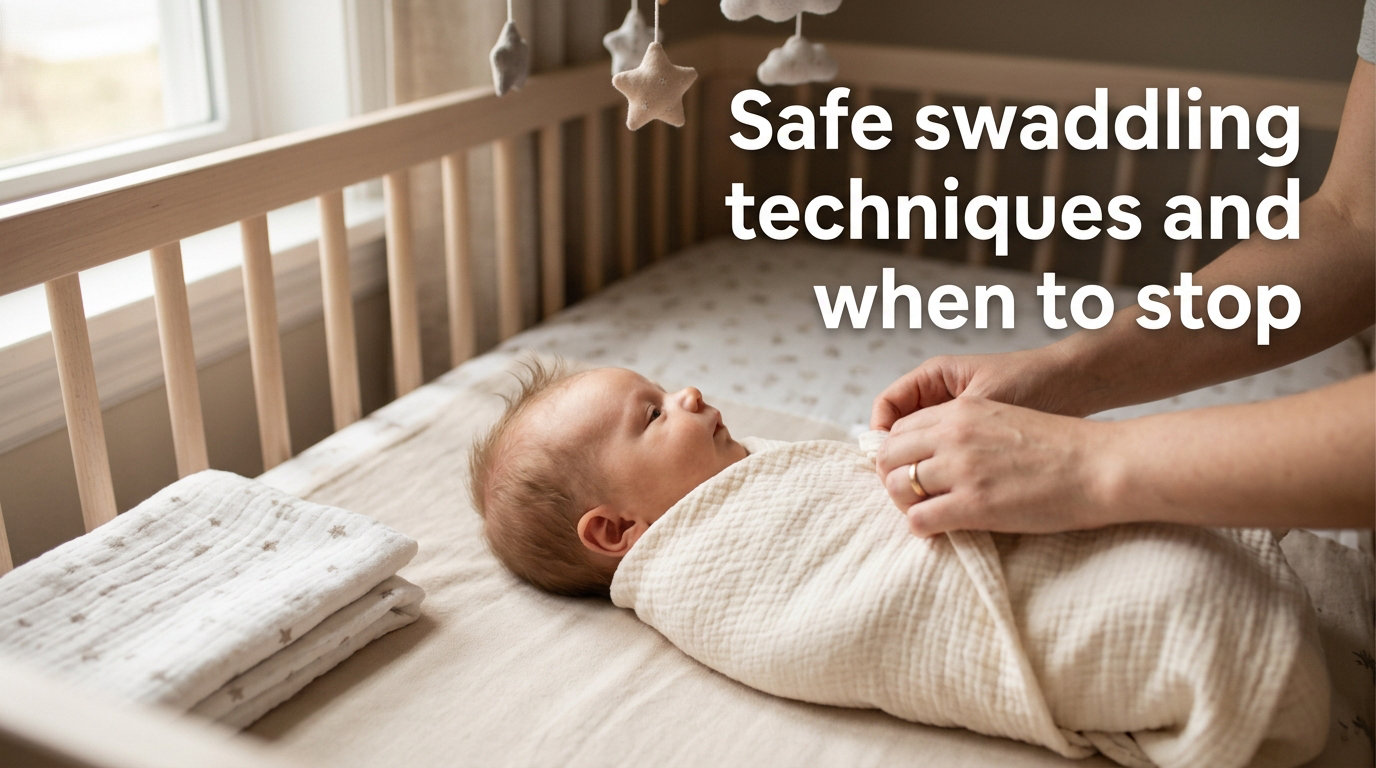
Learning safe swaddling techniques and when to stop can feel overwhelming when you’re already running on three hours of sleep. One parent on Reddit shared what many of us feel: “AAP says 2 months but my baby sleeps so well swaddled – what should I actually do?”
The confusion is real. Medical guidelines say one thing. Your baby’s sleep patterns say another. And every parenting forum seems to have a different answer.
After diving deep into American Academy of Pediatrics guidance, medical research, and real parent experiences from 2026, I will walk you through exactly how to swaddle safely and the precise moment to stop. You will learn the two-finger rule, how to tell newborn curl from actual rolling, and three proven transition methods that real parents have used successfully.
Table of Contents
Why Swaddling Helps Newborns Sleep Better
Newborns enter the world with a startle reflex (called the Moro reflex) that jolts their arms outward when they feel like they’re falling. This reflex wakes babies constantly during the first few months of life.
Swaddling applies gentle, even pressure around your baby’s body. This containment mimics the womb environment where your baby spent nine months tucked securely. The result: less startling, longer sleep stretches, and a calmer baby.
Research consistently shows that proper swaddling can reduce crying and improve sleep quality for babies under four months. But the key word is proper. Done incorrectly, swaddling carries real risks.
How to Swaddle a Baby Safely: Step-by-Step
Safe swaddling technique starts with the right materials and ends with the two-finger rule. Follow these steps every time you wrap your baby.
Step 1: Prepare Your Materials
Use a thin, breathable blanket or muslin swaddle approximately 40-44 inches square. Avoid thick quilts or weighted blankets. The fabric should feel lightweight against your skin.
Lay the blanket flat in a diamond shape on a safe, firm surface. Fold the top corner down about 6 inches to create a straight edge. This folded section will support your baby’s neck.
Step 2: Position Your Baby
Place your baby on their back with their neck resting on the folded edge. Their shoulders should be just below the fold line. Keep their hips and legs positioned naturally – hips bent and flexed outward, not forced straight down.
This hip-flexed position is critical for preventing hip dysplasia. Your baby’s legs should fall into a frog-like position naturally, not be forced together.
Step 3: Secure the First Arm
Take the left corner of the blanket and bring it across your baby’s chest. Tuck it securely under their right arm and behind their back. Your baby’s left arm should now be held gently against their side.
The wrap should be snug but not tight. You should be able to slide your hand between the blanket and your baby’s chest.
Step 4: Fold the Bottom Up
Take the bottom corner of the blanket and fold it up over your baby’s feet. Tuck the excess fabric into the top of the first wrap, near the chest area. This creates a pouch for your baby’s legs to move freely.
Leave plenty of room for leg movement. Your baby should be able to bend their hips and knees up toward their belly.
Step 5: Secure the Second Arm
Take the right corner of the blanket and wrap it across your baby’s chest. Bring it all the way around and tuck it behind their back on the left side. Both arms are now securely but comfortably contained.
The Two-Finger Rule: Checking Tightness
After swaddling, perform the two-finger test. Slide two fingers between the swaddle and your baby’s chest at the top of the wrap.
If you can insert two fingers comfortably, the swaddle is appropriately tight. If you can fit more than two fingers, tighten the wrap. If you cannot fit two fingers, loosen immediately.
Swaddling DO’s and DON’Ts
Use this quick reference to keep your swaddling safe:
DO:
- Place baby on their back to sleep
- Use a thin, breathable blanket
- Leave hips loose and flexed
- Check the two-finger rule every time
- Stop swaddling at first signs of rolling
- Dress baby in light clothing underneath
DON’T:
- Never place a swaddled baby on their stomach or side
- Don’t swaddle with legs straight and together
- Don’t use weighted blankets or swaddles
- Don’t swaddle above the shoulders or cover the face
- Don’t swaddle too tightly (violating two-finger rule)
- Don’t continue swaddling after signs of rolling appear
Safe Swaddling Techniques and When to Stop
Stop swaddling when your baby shows signs of rolling over. This typically happens between 2-4 months of age, with most babies ready around 3-4 months. Some babies show early rolling signs at 8 weeks.
The American Academy of Pediatrics recommends stopping swaddling by 2 months OR at the first signs of rolling – whichever comes first. This guidance confuses many parents, so let me clarify.
Understanding the 2 Month vs 3-4 Month Guidance
The AAP says “stop by 2 months” because some babies roll early. But most babies don’t roll until 3-4 months. This creates conflicting advice that leaves parents anxious.
Here is the practical interpretation pediatricians give: Watch for signs of rolling starting at 8 weeks. If no signs appear, you can typically continue until 3-4 months when rolling commonly begins. But the moment you see any rolling attempt, stop immediately regardless of age.
The safest approach: Begin monitoring for rolling signs at 8 weeks. Plan to transition by 3-4 months even if rolling hasn’t started. And stop immediately if any rolling behavior appears.
Developmental Milestones That Signal It’s Time
Beyond rolling, other developmental changes suggest your baby is ready to transition out of the swaddle:
- Breaking out of the swaddle regularly (not just occasionally)
- Increased arm movement during sleep
- Trying to lift the head and chest during tummy time
- Rocking from side to side while on their back
- Bringing knees to chest and rocking
Not all of these mean rolling is imminent. But they indicate your baby is developing the strength and coordination needed to roll soon.
Signs of Rolling vs Newborn Curl: How to Tell
The most common confusion parents face: Is my baby rolling, or is this just the newborn curl? Knowing the difference could prevent a dangerous situation.
What Is the Newborn Curl?
Newborns have a natural reflex called the newborn curl (or tonic neck reflex). When placed on their back, they automatically turn their head to one side. The arm and leg on that side extend while the opposite arm and leg curl inward.
This creates a C-shaped or fencer’s pose that looks like your baby is rolling toward their side. It is completely involuntary and disappears around 5-7 months.
Physical Signs of Actual Rolling
True rolling is intentional movement your baby controls. Here is how to tell the difference:
Newborn Curl (Normal Reflex):
- Happens automatically when baby turns their head
- Same pattern every time: head turns, limbs follow reflexively
- Baby cannot maintain the side position
- Starts from a calm, still position
- Disappears when you gently reposition baby
True Rolling (Time to Stop Swaddling):
- Baby purposefully lifts and turns their head
- Uses arm or leg to push against the floor
- Can maintain a side-lying position
- May rock back and forth building momentum
- Happens during active play, not just when startled
If you see your baby lifting their head, arching their back, and trying to use their arms to propel themselves, stop swaddling that day.
How to Transition Out of the Swaddle
There are three proven methods to transition your baby out of swaddling. Each works for different baby temperaments and parent comfort levels.
Method 1: Cold Turkey
The cold turkey approach means stopping the swaddle completely and switching directly to a sleep sack or wearable blanket.
How to do it: Put your baby to sleep in their regular pajamas or a sleep sack with both arms completely free. Do not use any transitional products.
Best for: Babies who have already started breaking out of the swaddle regularly. Parents who want a clean, definitive transition.
What to expect: The first 2-3 nights may be rough. Your baby may startle more and wake frequently. Most babies adjust by night 4-5. Some parents report their baby actually sleeps better once they can self-soothe with their hands.
Method 2: One Arm Out (Gradual Transition)
This gradual approach gives your baby time to adjust to increased freedom while maintaining some swaddle security.
How to do it: Start by leaving one arm out of the swaddle for 2-3 nights. Keep the swaddle wrapped around the torso and one arm free. After 2-3 nights, switch to both arms out while keeping the torso wrapped.
Best for: Babies who seem particularly dependent on the swaddle for sleep. Parents who prefer gradual changes.
What to expect: Each stage may take 2-4 nights for adjustment. The entire transition typically spans 1-2 weeks. Some babies resist the one-arm stage because the asymmetry feels strange.
Method 3: Partial Night Transition
This method lets your baby get their longest sleep stretch swaddled while practicing unswaddled sleep during shorter periods.
How to do it: Swaddle your baby at bedtime. When they wake for their first nighttime feeding, remove the swaddle completely. Put them back to sleep without swaddling for the remainder of the night. Gradually reduce the swaddled portion over time.
Best for: Babies with a predictable feeding schedule. Parents who want to preserve some sleep during the initial transition.
What to expect: The unswaddled portion of the night may involve more wake-ups initially. Most families can fully transition within 1-2 weeks using this method.
Transition Method Comparison
Use this table to choose your approach:
| Method | Timeline | Difficulty | Best For |
|---|---|---|---|
| Cold Turkey | 3-5 nights | High initially, then done | Babies already breaking out; parents wanting quick resolution |
| One Arm Out | 1-2 weeks | Moderate, spread out | Swaddle-dependent babies; gradual transition preference |
| Partial Night | 1-2 weeks | Moderate | Predictable sleepers; preserving long sleep stretch |
Sleep Sacks and Wearable Blankets
Once you stop swaddling, transition to a sleep sack (also called a wearable blanket). Sleep sacks provide warmth without the risks of loose blankets in the crib.
Choose a sleeveless sleep sack that fits snugly around the neck and armholes. The bottom should be roomy enough for leg movement. Look for TOG ratings that match your room temperature: 0.5 TOG for warm rooms, 1.0 TOG for standard rooms, 2.5 TOG for cooler rooms.
Some babies adjust better with arms-up swaddle transition products. These allow arm movement while maintaining some chest compression. Use these only as a brief transition step, not long-term.
Safety Risks Every Parent Must Understand
Safe swaddling isn’t just about technique. Understanding why these rules exist helps you make better decisions when situations aren’t straightforward.
SIDS Risk and Swaddling
Sudden Infant Death Syndrome (SIDS) risk increases when swaddled babies are placed on their stomachs or sides. A swaddled baby who rolls onto their stomach cannot use their arms to push up and reposition. They may bury their face in the mattress and suffocate.
This is why the back-to-sleep rule is non-negotiable for swaddled babies. Once rolling begins, the swaddle must stop immediately. Even a baby who has never rolled before might surprise you with their first attempt.
The risk is real: Studies show that swaddling roughly doubles the SIDS risk for babies placed on their stomachs or sides. For back-sleeping babies under 6 months, swaddling appears to have neutral or slightly protective effects – but only when stopped at the appropriate time.
Hip Dysplasia and Hip-Healthy Swaddling
Developmental dysplasia of the hip (DDH) occurs when a baby’s hip socket doesn’t form properly. Tight swaddling that forces legs straight and together can contribute to or worsen this condition.
The International Hip Dysplasia Institute recommends hip-healthy swaddling: legs should be able to bend up and out at the hips. The swaddle should secure the arms while leaving the lower body loose and flexible.
Babies with known hip dysplasia or risk factors (breech position, family history) should not be swaddled with straight legs. Consult your pediatrician or orthopedist for specific guidance.
Overheating Prevention
Swaddled babies cannot kick off extra layers when they get warm. Overheating is a known SIDS risk factor and can cause your baby significant discomfort.
Keep the room temperature between 68-72 degrees Fahrenheit. Dress your baby in one layer more than you would wear to be comfortable. Use thin, breathable swaddle materials only.
Check for overheating by feeling your baby’s neck or chest (not hands or feet, which naturally run cool). They should feel warm but not sweaty. Sweaty, flushed skin, rapid breathing, or heat rash are signs to remove layers immediately.
Frequently Asked Questions
What is the 3 6 9 rule for babies?
The 3 6 9 rule is a sleep training guideline suggesting 3 hours of wake time before the first nap, 6 hours before the second nap, and 9 hours before bedtime. This schedule applies to older babies around 6-9 months, not newborns. It is not specifically related to swaddling.
What is a good age to stop swaddling?
Stop swaddling when your baby shows signs of rolling over, typically between 2-4 months of age with an average around 3-4 months. Some babies may show signs as early as 8 weeks. The AAP recommends stopping by 2 months OR at first signs of rolling, whichever comes first. Watch for signs starting at 8 weeks and plan to transition by 3-4 months even if rolling has not started.
Should you swaddle a baby with hip dysplasia?
Babies with hip dysplasia or at risk for it should not be swaddled with legs straight and together. If swaddling is used, it must be hip-healthy swaddling that allows legs to bend up and out at the hips freely. Consult your pediatrician or orthopedist for specific guidance. Many babies with hip dysplasia should avoid swaddling entirely.
What is the 5 3 3 rule for babies?
The 5-3-3 rule is a sleep schedule guideline for older babies suggesting 5 hours of wake time before the first nap, 3 hours before the second nap, and 3 hours before bedtime. This applies to babies around 7-9 months old, not newborns. It is unrelated to swaddling decisions.
My baby breaks out of the swaddle – does this mean I should stop?
Not necessarily. Breaking out of the swaddle can mean several things: your baby is strong enough to start rolling soon, the swaddle is not tight enough, your baby prefers arms-up sleeping, or your baby is going through an active sleep phase. If breaking out is accompanied by other rolling signs like rocking or lifting the head, stop swaddling. If your baby breaks out but shows no rolling signs, try a different swaddle type or check your wrapping technique.
Is 8 weeks too early to stop swaddling?
No, 8 weeks is not too early to stop swaddling if your baby shows signs of rolling. While the average baby stops around 3-4 months, early rollers may need to transition sooner. If your 8-week-old shows no rolling signs and sleeps well swaddled, you can continue while monitoring closely. But if any rolling behavior appears at any age, stop immediately.
Can you swaddle a baby too tightly?
Yes, swaddling too tightly can cause serious problems. A too-tight swaddle restricts breathing, increases overheating risk, and can contribute to hip dysplasia if hips are forced straight. Always use the two-finger rule: you should be able to slide two fingers between the swaddle and your baby’s chest. The swaddle should be snug on the arms but loose around hips and legs.
Conclusion
Safe swaddling techniques and knowing when to stop come down to a few simple principles: wrap snugly but not tight using the two-finger rule, always place baby on their back, and stop at the first sign of rolling. Most babies transition between 2-4 months, with 3-4 months being the typical window.
The transition out of swaddling may disrupt sleep temporarily. Choose the method that fits your baby’s temperament: cold turkey for quick resolution, one arm out for gradual adjustment, or partial night for preserving longer sleep stretches. Within a week, most babies have adjusted to their new freedom.
Trust your observations. The newborn curl is normal reflex activity, but purposeful rolling attempts require immediate action. When in doubt, consult your pediatrician. Your baby’s safety always comes before sleep convenience.