
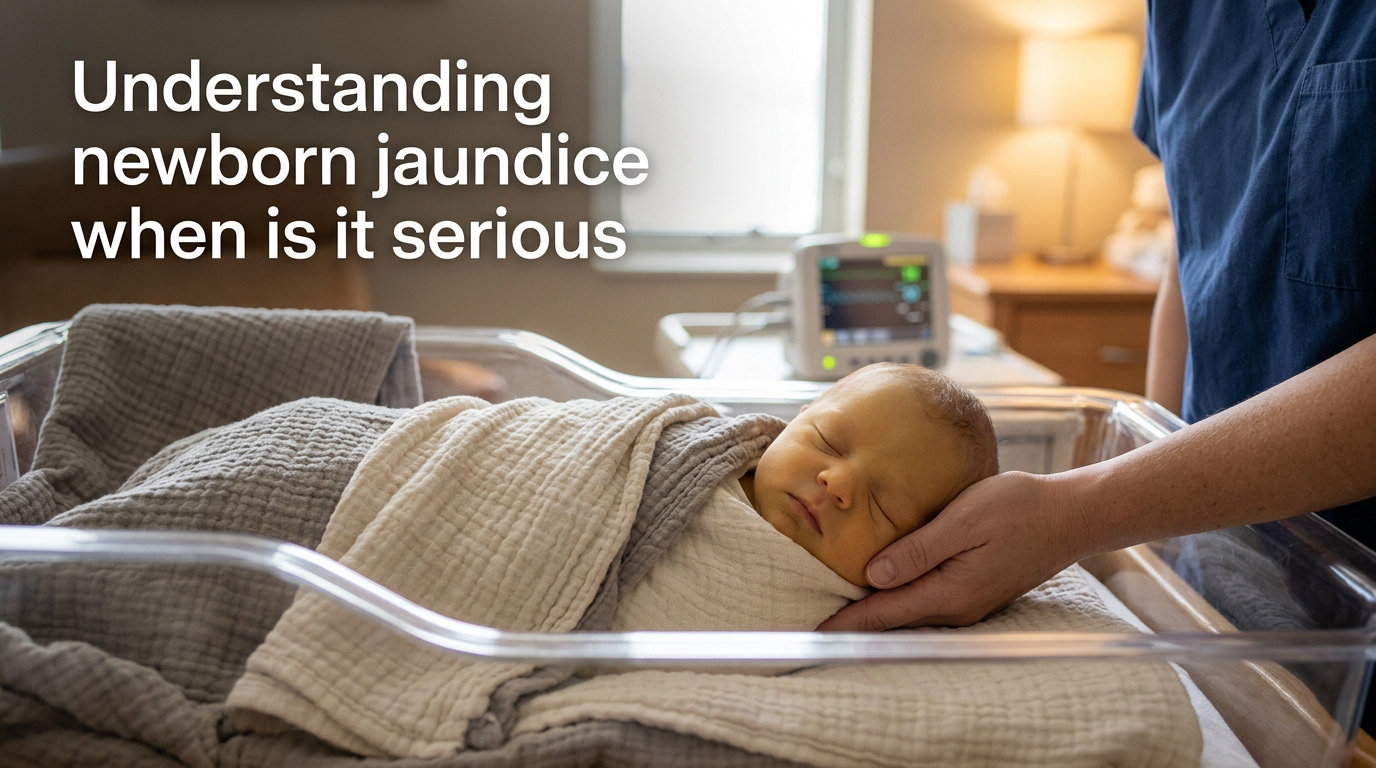
I remember watching the afternoon light stream across my baby’s cheek on day three of his life, noticing a yellowish tint that hadn’t been there the day before. My heart immediately raced. Was something seriously wrong? Was my baby in danger?
If you’re noticing that golden hue on your newborn’s skin right now, I want you to know: you’re not alone, and you’re not overreacting by seeking information. Understanding newborn jaundice and when it becomes serious is one of the most common concerns new parents face. The truth is, approximately 60 to 80 percent of newborns develop some degree of jaundice. For the vast majority, it’s a temporary, harmless condition that resolves without any lasting effects.
But here’s what I learned through my own experience and years of talking with other parents: knowing when jaundice is normal versus when it requires urgent attention can make all the difference. This guide will walk you through everything you need to know, from the science behind that yellow coloring to the specific warning signs that mean you should call your pediatrician immediately. Most importantly, I’ll share what I wish someone had told me during those anxious early days—how to care for yourself while caring for your baby, and how to trust your instincts as a parent.
Table of Contents
What Is Newborn Jaundice?
Newborn jaundice is the yellow discoloration of a baby’s skin and the whites of their eyes, caused by a buildup of bilirubin in the blood. Bilirubin is a yellow pigment that forms when red blood cells break down, which happens naturally as your baby’s body transitions from fetal circulation to breathing air.
During pregnancy, your baby relied on your placenta to clear bilirubin from their system. After birth, their liver must take over this job—but newborn livers are still developing and may not process bilirubin as quickly as the body produces it. This temporary imbalance causes the yellowing we call jaundice, medically known as hyperbilirubinemia.
The process begins when your baby starts breaking down excess fetal red blood cells they no longer need. These cells have a shorter lifespan than adult red blood cells, creating more bilirubin than your baby’s immature liver can handle at first. As the liver matures over the first week of life, it becomes more efficient at processing bilirubin, and the yellow color gradually fades.
What is bilirubin? Think of bilirubin as a waste product from recycling blood cells. In healthy amounts, it’s completely normal and harmless. Your body (and your baby’s developing body) is designed to eliminate it through the liver and intestines. Problems only arise when bilirubin levels become too high and cross into the brain, which is why monitoring matters.
Types of Newborn Jaundice
Not all jaundice is the same, and understanding the different types will help you know what to expect. Medical professionals classify newborn jaundice into several categories based on cause and timing.
Physiological jaundice is the most common type, affecting about 75 percent of newborns. It typically appears between day two and four of life, peaks around day three to five, and resolves by the end of the first week in formula-fed babies or by two weeks in breastfed babies. This is considered a normal part of newborn development—your baby’s body simply working through the transition to life outside the womb.
Pathological jaundice is less common but more concerning. It appears within the first 24 hours after birth, rises very quickly, or persists beyond normal timeframes. This type often signals an underlying medical condition such as blood type incompatibility, infection, or liver problems that require specific treatment.
The breastfeeding relationship creates two additional categories that often confuse parents. Breastfeeding jaundice happens when a baby isn’t getting enough milk in the first few days, causing bilirubin to build up due to infrequent elimination. This type usually appears in the first week and improves with increased feeding frequency.
Breast milk jaundice is different—it appears after the first week and may last several weeks. Some substance in certain mothers’ milk appears to increase bilirubin absorption in the baby’s gut. Despite the name, this doesn’t mean you should stop breastfeeding. The jaundice resolves on its own, and the benefits of continued nursing far outweigh the temporary yellow color.
Physiological vs. Pathological Jaundice Comparison:
Physiological jaundice appears at 2-4 days after birth, progresses gradually, reaches moderate bilirubin levels, and resolves within 1-2 weeks. It is the normal, expected type affecting most newborns.
Pathological jaundice appears within 24 hours of birth, rises rapidly, may reach high bilirubin levels, and requires immediate investigation. This type signals a potential underlying condition needing treatment.
Symptoms Parents Can Recognize
The yellowing typically follows a predictable pattern, starting at the head and moving downward as bilirubin levels rise. On day two or three, you might notice a faint yellow tinge on your baby’s face, particularly across the nose and forehead. Press gently on your baby’s forehead or nose with your fingertip, then release. If the skin looks yellow where you pressed, that’s jaundice.
As bilirubin increases, the yellow color spreads to the chest, belly, and eventually the arms and legs. The whites of the eyes (the sclera) may also turn yellow—this is called scleral icterus and is often one of the earliest signs parents notice.
The best way to check for jaundice at home is in natural daylight or under fluorescent lighting, never under warm incandescent bulbs which can mask the yellow tone. Undress your baby completely and examine their skin in good light. Look at the face, chest, and the whites of the eyes. Take photos in natural light to track whether the yellowing is spreading or fading over time.
For babies with darker skin tones, jaundice can be harder to detect visually. Pay special attention to the whites of the eyes, the gums, the palms of the hands, and the soles of the feet. These areas often show yellowing before it becomes visible elsewhere. When in doubt, request a bilirubin test—your baby’s skin tone should never be a barrier to appropriate screening and care.
Understanding Newborn Jaundice: When Is It Serious?
Jaundice is generally not dangerous in healthy full-term babies, but contact your baby’s doctor immediately if any of the following occur:
First, jaundice appearing within the first 24 hours after birth requires urgent evaluation. Yellowing this early almost always indicates pathological jaundice with an underlying cause that needs immediate treatment.
Second, if the yellow color spreads to your baby’s legs, arms, or belly, this suggests rising bilirubin levels that have moved beyond the face and chest. The further down the body the yellowing extends, the higher the bilirubin level likely is.
Third, behavioral changes are critical warning signs. If your baby becomes very sleepy, hard to wake, or stops feeding well, these are red flags. A high-pitched cry, unusual irritability, or arching of the back and neck also signal potential bilirubin toxicity affecting the brain.
Fourth, fever combined with jaundice can indicate infection, which requires immediate medical attention. Similarly, if your baby appears limp, floppy, or has decreased muscle tone, call your doctor right away.
Fifth, dark urine or pale, chalky stools suggest a different type of jaundice involving the liver or bile ducts, which needs prompt investigation to rule out conditions like biliary atresia.
Sixth, if the yellow color becomes brighter or more intense rather than fading, or if jaundice persists beyond two weeks in a full-term baby (or three weeks in a premature baby), contact your pediatrician.
Finally, any parental instinct that something is wrong deserves attention. You know your baby best. If you’re worried, make the call.
The Seven Danger Signs in a Newborn Baby
Pediatricians look for these seven danger signs that require immediate evaluation when combined with jaundice:
1. Lethargy or difficulty waking your baby
2. Poor feeding or refusal to eat
3. High-pitched, inconsolable crying
4. Arching of the back or neck (opisthotonus)
5. Fever (temperature above 100.4°F or 38°C)
6. Decreased urine output (fewer than 6 wet diapers per day after day 5)
7. Pale or white stools, indicating possible liver or bile duct problems
These signs suggest possible bilirubin encephalopathy or kernicterus, a rare but serious complication where excess bilirubin crosses into the brain and causes damage. The good news is that kernicterus is entirely preventable with appropriate monitoring and treatment.
Dangerous Bilirubin Levels: What the Numbers Mean
While you don’t need to memorize charts, understanding what doctors look for can help you advocate for your baby. Bilirubin is measured in milligrams per deciliter (mg/dL).
For a full-term baby at day three, levels under 12-15 mg/dL are generally considered safe and don’t require treatment. Levels above 20 mg/dL carry risk of kernicterus in full-term babies, though treatment typically begins well before reaching this threshold.
Premature babies require much lower thresholds because their brains are more vulnerable. A 35-week premature baby might need treatment at 10-12 mg/dL, while a 28-week baby might need intervention at 6-8 mg/dL.
What matters most is the trend, not a single number. A bilirubin level of 10 mg/dL at 24 hours old is very different from 10 mg/dL at day five. Rapidly rising levels concern doctors more than stable, moderate levels. Ask your pediatrician: What was the level? How quickly is it rising? What is the treatment threshold for my baby’s age and risk factors?
Risk Factors for Severe Jaundice
Certain factors increase the likelihood that jaundice will become serious. Knowing whether these apply to your baby helps you understand your doctor’s recommendations.
Premature birth is the most significant risk factor. Babies born before 37 weeks gestation have less mature livers and are more vulnerable to bilirubin effects on the brain. Their treatment thresholds are lower, and they require closer monitoring.
Blood type incompatibility between mother and baby can cause rapid hemolysis (breakdown of red blood cells). This includes Rh incompatibility (Rh-negative mother, Rh-positive baby) and ABO incompatibility (mother with O blood type, baby with A or B). These situations often require immediate phototherapy and sometimes IVIG treatment.
G6PD deficiency, a genetic condition more common in males and certain ethnic groups (including Mediterranean, African, and Asian populations), causes red blood cells to break down more easily when exposed to certain triggers. Testing may be recommended if jaundice appears early or becomes severe.
Significant bruising from birth, cephalohematoma (bleeding under the scalp), or birth trauma creates more red blood cells to break down, increasing bilirubin production. Babies with these conditions need closer monitoring.
Other risk factors include: a previous sibling who required phototherapy, East Asian or Mediterranean ancestry, exclusive breastfeeding with poor weight gain, maternal diabetes, and male sex. Having risk factors doesn’t mean jaundice will become serious—it simply means vigilance is especially important.
Diagnosis and Testing: What to Expect
Your pediatrician will evaluate jaundice through a combination of visual examination and testing. Understanding this process helps reduce anxiety about what comes next.
The first step is always visual assessment. Your doctor will examine your baby in good light, checking the progression of yellowing from head to toe. They’ll look at the sclera, press gently on the skin, and ask about feeding patterns and diaper output.
Many practices now use a transcutaneous bilirubin meter, a handheld device that measures bilirubin through the skin without any pain. The nurse places the device on your baby’s forehead or sternum, and it gives an instant reading. This screening tool helps determine whether a blood test is needed.
If levels are elevated or borderline, or if your baby has risk factors, a blood test measures total serum bilirubin directly. This involves a small heel prick to collect a few drops of blood. The results provide the most accurate measurement and guide treatment decisions.
Additional tests may include a Coombs test (checks for antibodies attacking baby’s red blood cells), blood type testing, complete blood count, and tests for infection if indicated. For prolonged jaundice, doctors may test for liver function or check for urinary tract infections.
Don’t hesitate to ask for the exact numbers and what they mean. I learned that knowing my baby’s bilirubin was 12.5 mg/dL at day four, rising from 9.0 at day three, helped me understand why phototherapy was recommended. Ask: What is my baby’s current level? What was it before? How does this compare to treatment thresholds? When should we recheck?
Treatment Options Explained
Most cases of newborn jaundice require no treatment beyond monitoring and time. When treatment is needed, phototherapy is the first-line approach, safe and highly effective.
Phototherapy works through a simple principle: specific wavelengths of blue light change the shape of bilirubin molecules, making them water-soluble so they can be eliminated through urine without needing liver processing. Your baby lies under special lights wearing only a diaper and protective eye shields.
Hospital phototherapy typically uses overhead bili lights, while home phototherapy may use a bili blanket—a flexible pad that wraps around your baby and can be used while you hold and feed them. Many parents find home phototherapy far less stressful than NICU separation, though high bilirubin levels or other risk factors may require hospital-based treatment.
During phototherapy, your baby can be taken out briefly for feeding and bonding. Frequent feeding is actually part of the treatment—it provides the fluids needed to flush out the light-altered bilirubin through urine and stool. Your baby may have loose, greenish stools during treatment, which is expected and actually good—it means bilirubin is being eliminated.
In rare, severe cases where bilirubin rises despite phototherapy or reaches dangerous levels quickly, exchange transfusion may be necessary. This procedure replaces the baby’s blood with donor blood to rapidly lower bilirubin. It sounds frightening, and it is serious, but it is life-saving when needed. Fortunately, with modern monitoring and early phototherapy, exchange transfusions have become extremely rare.
For babies with blood type incompatibility causing rapid red blood cell breakdown, intravenous immunoglobulin (IVIG) may be given. This medication blocks the antibodies attacking the baby’s red blood cells, slowing hemolysis and reducing bilirubin production.
What Parents Can Do at Home
While medical treatment addresses high bilirubin levels, parents play a crucial role in managing and preventing complications. These steps support your baby’s recovery.
Feed frequently. This is the most important thing you can do. Aim for 8 to 12 feedings per 24 hours, or even more if your baby is jaundiced. Frequent feeding provides the hydration needed to flush bilirubin through urine and stimulates bowel movements that eliminate bilirubin through stool. Don’t let your baby sleep through feeds in the first weeks—wake them every 2-3 hours during the day and every 3-4 hours at night.
Monitor diapers. By day five, your baby should have at least 6 wet diapers and 3-4 yellow, seedy stools per day. Dark urine suggests dehydration and concentrated bilirubin. Pale, white, or gray stools indicate a problem with bile flow and require immediate medical attention.
Use natural light for assessment. Each morning, undress your baby and examine their skin in natural daylight near a window. Photograph their face, chest, and the whites of their eyes. Compare daily photos to track whether yellowing is spreading or fading. If you see progression downward toward the legs, or if the yellow becomes more intense rather than paler, call your pediatrician.
Consider carefully controlled sunlight. Natural sunlight helps break down bilirubin, but direct exposure carries risks of sunburn and overheating. If your doctor agrees, place your baby in indirect sunlight near a window for 10-15 minutes, 2-3 times per day, with only a diaper on. Never place your baby in direct sunlight, and never use this as a substitute for medical treatment when bilirubin levels are high.
Track the trend. Keep a simple log of feeding times, wet and dirty diapers, and your observations about the yellow color. This information helps your pediatrician assess whether jaundice is improving and supports any decisions about testing or treatment.
Emotional Support for Worried Parents
If you’re feeling anxious about your baby’s jaundice, I want you to know: that worry is completely normal, valid, and actually a sign of your love and attachment. Every parent I’ve spoken with who went through this experience felt the same fear. You are not overreacting, and you are not failing as a parent because you’re worried.
The early days with a newborn are already an emotional rollercoaster—hormonal changes, sleep deprivation, learning to feed, and recovering from birth. Adding a medical concern like jaundice can feel overwhelming. Many parents describe feeling helpless, especially if their baby needs to be under phototherapy lights for hours at a time.
If your baby requires NICU phototherapy or extended hospital treatment, the separation can be heartbreaking even when you know it’s necessary. You’re allowed to grieve the early days you imagined—holding your baby skin-to-skin, nursing peacefully, bringing them home. These feelings don’t conflict with being grateful for medical care that keeps your baby safe. Both can be true.
Conflicting advice from different providers—perhaps your lactation consultant suggests one approach while your pediatrician recommends another—can compound stress. When this happens, ask your pediatrician directly: What are my options? What are the risks and benefits of each approach? What would you do if this were your baby?
Trust your instincts while respecting medical guidance. You know your baby best. If something feels wrong, speak up. At the same time, remember that doctors see hundreds of jaundiced babies and know what safe levels look like. Finding the balance between advocacy and trust takes practice.
Take care of yourself during this stressful time. Accept help with meals, laundry, or caring for older children. Rest when your baby rests. Connect with other parents who’ve been through this—their stories of babies who are now thriving can provide real comfort. And remember: the vast majority of jaundiced babies recover completely with no lasting effects. Your baby will likely be one of them.
What to Expect: The Typical Timeline
Understanding the normal progression of jaundice helps you know what to expect and when to seek help. For most healthy, full-term babies, jaundice follows a predictable pattern.
Days one to two after birth: Jaundice is typically not visible yet. Your baby’s bilirubin levels are still low as they transition from placental clearance to liver processing. If yellowing appears this early, it requires immediate evaluation.
Days two to four: This is when physiological jaundice typically appears. You might notice yellowing first on the face and in the whites of the eyes. Bilirubin levels begin rising as fetal red blood cells break down faster than the liver can process them.
Days three to five: For full-term babies, this is usually when bilirubin peaks. The yellow color may extend to the chest and upper belly. If you’re still in the hospital, routine bilirubin screening happens during this window. If you’ve gone home, your pediatrician will likely schedule a check.
Days five to seven: Premature babies often peak later, around day five to seven. Treatment decisions are made based on bilirubin level, rate of rise, and risk factors.
Week one to two: For formula-fed babies, jaundice typically resolves by the end of the first week. Breastfed babies often maintain some yellowing longer, which is normal as long as levels are safe and decreasing.
Week two to three: Mild jaundice in breastfed babies may persist, but should be gradually fading. If jaundice is worsening or not improving by this point, contact your pediatrician to rule out breast milk jaundice or other causes.
Beyond three weeks: Any jaundice lasting longer than three weeks in a breastfed baby, or two weeks in a formula-fed baby, requires evaluation. While often still benign (breast milk jaundice can last 8-12 weeks), prolonged jaundice should be assessed to rule out liver or metabolic conditions.
Prevention Strategies
While physiological jaundice cannot be prevented—it’s a normal developmental process—certain strategies can reduce severity and prevent complications.
Early and frequent feeding is the most powerful prevention tool. Colostrum and breast milk have a mild laxative effect that helps eliminate bilirubin through stool. The more your baby feeds, the more bilirubin they eliminate. Aim to feed within the first hour after birth and at least 8-12 times daily thereafter.
Skin-to-skin contact supports feeding initiation and helps regulate your baby’s systems. Keep your baby close, respond to early feeding cues before they cry, and avoid unnecessary supplementation that might interfere with establishing breastfeeding.
Prenatal blood type screening helps identify mothers at risk for blood type incompatibility. If you’re Rh-negative, you’ll receive RhoGAM during pregnancy to prevent antibody formation. Knowing about potential incompatibility allows for immediate bilirubin monitoring after birth.
For babies with identified risk factors—prematurity, significant bruising, previous sibling with severe jaundice—proactive monitoring makes the difference. Request early bilirubin testing and frequent follow-up visits in the first week.
Remember, you cannot prevent all jaundice through any action or inaction. If your baby develops jaundice despite your best efforts, it is not your fault. Physiological jaundice is a normal newborn process, not a parenting failure.
Frequently Asked Questions
When should I worry about jaundice in newborns?
Contact your pediatrician immediately if jaundice appears within the first 24 hours after birth, spreads to your baby’s legs or belly, your baby becomes very sleepy or hard to wake, develops a high-pitched cry, arches their back, has a fever, shows pale or white stools, or if the yellowing becomes brighter rather than fading. Trust your instincts—if something feels wrong, make the call.
What are the 7 danger signs in a newborn baby with jaundice?
The seven danger signs are: 1) Lethargy or difficulty waking, 2) Poor feeding or refusal to eat, 3) High-pitched inconsolable crying, 4) Arching of the back or neck, 5) Fever above 100.4°F, 6) Decreased urine output with fewer than 6 wet diapers per day after day 5, and 7) Pale or white stools indicating possible bile duct problems.
When is it too late to treat jaundice in newborns?
It is rarely too late to treat jaundice, but permanent brain damage from kernicterus becomes a risk when very high bilirubin levels are left untreated for extended periods. With modern monitoring, this is almost always preventable. If your baby shows any signs of bilirubin encephalopathy—extreme lethargy, high-pitched crying, arching, or fever—seek emergency care immediately. Early treatment always leads to better outcomes.
What color is bilirubin poop in newborns?
Healthy bilirubin elimination produces yellow, seedy, or mustard-colored stools in breastfed babies, and tan or yellow stools in formula-fed babies. Dark urine and yellow stools indicate normal bilirubin processing. However, pale, white, gray, or chalky stools combined with dark urine suggest a blockage in bile flow and require immediate medical evaluation.
Does pooping help lower bilirubin in newborns?
Yes, bowel movements are one of the primary ways bilirubin leaves the body. Bilirubin is eliminated through bile into the intestines, then excreted in stool. Frequent feeding stimulates the gastrocolic reflex and promotes stooling, which is why feeding 8-12 times daily helps reduce jaundice. The more your baby poops, the faster bilirubin levels drop.
What is the fastest way to cure jaundice in newborns?
Phototherapy is the fastest medical treatment, typically lowering bilirubin levels within 24-48 hours. Frequent feeding (8-12 times daily) supports this process by providing fluids to flush bilirubin through urine and stimulating bowel movements. In severe cases, exchange transfusion works immediately but is rarely needed with modern care. There is no instant cure—treatment takes time to work safely.
Will milk reduce bilirubin in newborns?
Milk itself doesn’t directly reduce bilirubin, but frequent feeding helps eliminate it. Breast milk and formula provide hydration needed to excrete bilirubin through urine. The act of feeding stimulates digestion and bowel movements, which remove bilirubin from the body. For breast milk jaundice, some breast milk components temporarily increase bilirubin absorption, but this resolves naturally and breastfeeding should continue.
How long does it take to flush out jaundice in a newborn?
For healthy full-term babies, jaundice typically resolves within 1-2 weeks, with formula-fed babies often clearing faster than breastfed babies. Breastfed babies may maintain mild yellowing for 3-4 weeks, which is normal as long as bilirubin levels are safe and trending down. The process cannot be rushed—your baby’s liver needs time to mature and efficiently process bilirubin.
Conclusion
Understanding newborn jaundice and when it becomes serious empowers you to care for your baby with confidence rather than fear. Remember the essential truths: jaundice affects most newborns, the vast majority cases resolve completely without complications, and modern medicine offers safe, effective treatments when needed.
You now know the warning signs that require immediate attention—jaundice within the first 24 hours, rapidly spreading yellowing, behavioral changes like lethargy or poor feeding, fever, and pale stools. You understand the importance of frequent feeding, how to monitor at home, and what questions to ask your pediatrician. Most importantly, you know that your worry is normal, your instincts matter, and you are exactly the parent your baby needs.
If you’re holding your baby right now, examining their skin for any hint of yellow, wondering if you should call the doctor—trust yourself. The fact that you’re reading this, learning, and paying attention means you’re already doing a wonderful job. Call your pediatrician with any concerns. No question is too small when it comes to your baby’s health.
Your baby will grow out of this phase. The yellow will fade, the numbers will drop, and you’ll move on to the next beautiful, challenging, miraculous stage of parenthood. Take a breath. You’ve got this.