
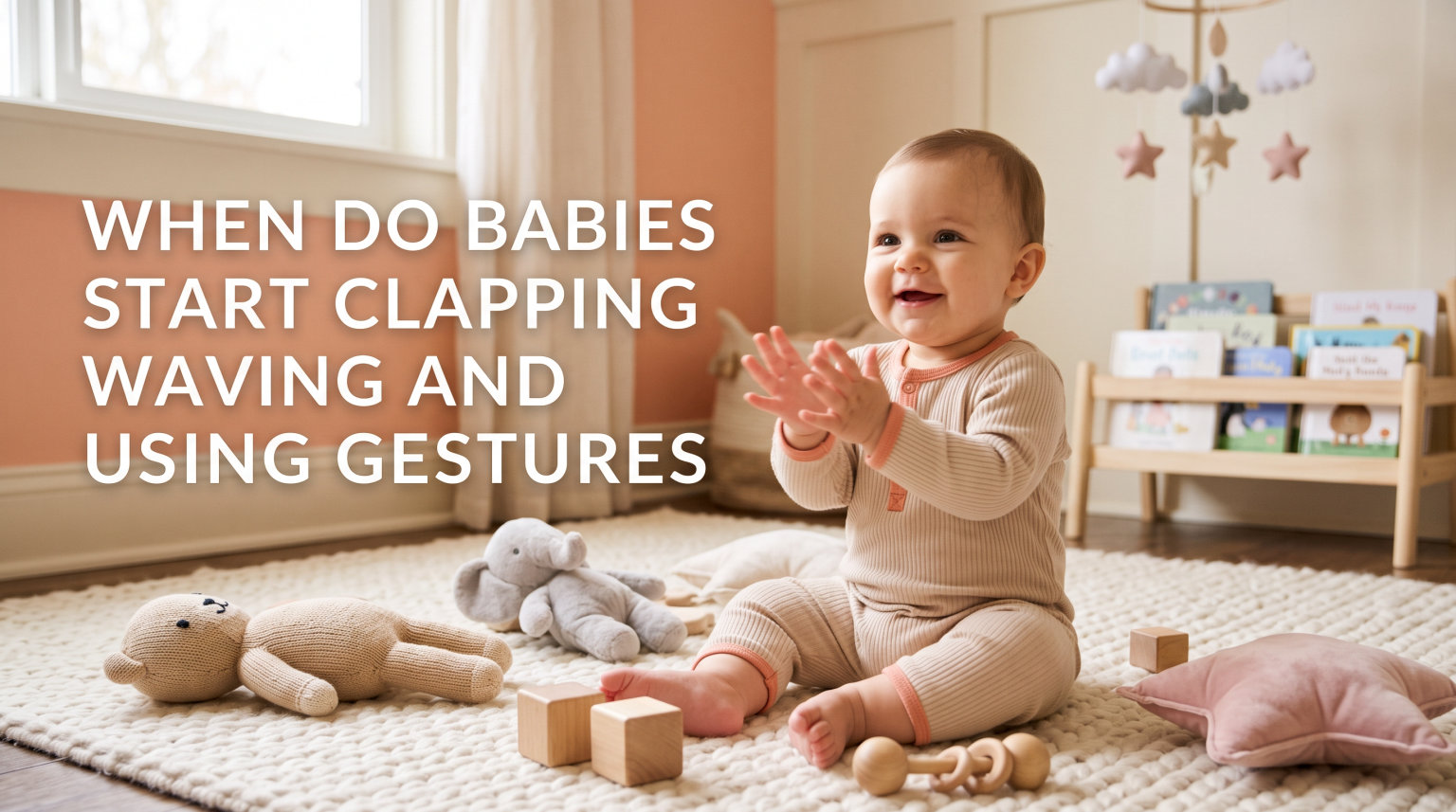
Most babies start clapping, waving, and using gestures between 9 and 12 months of age. These simple hand movements mark a major shift in how your little one connects with the world around them. I remember watching my daughter’s face light up the first time she clapped along to a song. It was more than just cute. It was her first real step into social communication.
In this guide, I will walk you through exactly when to expect these gestures. You will learn why they matter for language development, how to encourage them through everyday play, and when to check in with your pediatrician. Whether your baby is 6 months or 15 months, this timeline will help you understand what is typical and what comes next.
Table of Contents
When Do Babies Start Clapping Waving and Using Gestures: The Complete Timeline
Every baby develops at their own pace, but most follow a similar pattern for gesture development. Here is what you can typically expect during those exciting months between 9 and 15 months.
Clapping: 9 to 12 Months
Babies usually start clapping between 9 and 12 months. Many begin by banging toys together around 9 months, then discover they can do the same thing with their own hands. The first claps are often accidental, happening when your baby brings their hands together while excited.
By 10 to 11 months, most babies clap purposefully when happy or excited. They might clap during songs, when you cheer, or when they accomplish something like stacking blocks. This shows they are connecting the gesture to positive emotions and social situations.
Some babies clap earlier, around 7 or 8 months, while others wait until closer to their first birthday. Both are within the normal range. My son did not clap consistently until 13 months, yet his pediatrician was not concerned because he was meeting other social milestones.
Waving: 9 to 12 Months
Waving typically emerges between 9 and 12 months, often appearing around the same time as clapping. The first waves might look more like random hand flapping. Your baby may not connect the motion to saying hello or goodbye initially.
True communicative waving, where your baby waves in response to someone leaving or arriving, usually develops closer to 12 months. Before that, you might see imitation waving when you wave first. This is still an important step in learning the gesture.
Many parents in online forums report their babies waved bye-bye between 10 and 11 months. Some babies wave earlier at strangers but take longer to wave at familiar people. Others wave enthusiastically at the door long after grandma has left. These variations are all perfectly normal.
Pointing: 10 to 15 Months
Pointing with the index finger typically develops between 10 and 15 months. This gesture is especially important because it shows your baby wants to share attention with you. When they point at a dog and look back at you, they are engaging in what experts call joint attention.
Early pointing might involve the whole hand rather than just the index finger. Some babies start by reaching toward objects they want. Between 12 and 15 months, most babies refine this into clear pointing to show interest, request items, or share experiences.
Research consistently shows that babies who point more frequently tend to develop larger vocabularies later. This gesture acts as a bridge between nonverbal and verbal communication. It is one of the strongest predictors of future language skills.
Other Early Gestures to Watch For
Beyond clapping, waving, and pointing, babies develop many other gestures during this same window. Reaching for objects to be picked up usually starts around 6 to 9 months. Showing objects by holding them up for you to see typically emerges around 10 to 12 months.
Shaking the head no often appears between 9 and 12 months, sometimes before babies can say the word. Raising arms to be picked up is another early gesture that develops around 9 months. Blowing kisses and giving high fives usually come closer to 12 to 14 months.
The 16 gestures by 16 months framework, supported by speech-language pathologists, suggests babies should use at least 16 different gestures by the time they are 16 months old. These include giving objects, pushing away to reject, and nodding yes.
Why Gestures Matter for Your Baby’s Development
These simple hand movements are far more important than they might appear. Gestures represent your baby’s first intentional communication with the world. They are the foundation for social skills, language development, and cognitive growth.
The Connection to Language Development
Babies who use more gestures early tend to have larger vocabularies by age 2 and 3. Gestures give babies a way to communicate before they can speak. When your baby points at a cup and you hand it to them, they learn that communication works.
This back-and-forth exchange builds the neural pathways needed for conversation. Your baby learns that they can influence their world through communication. They practice the turn-taking pattern essential for later dialogue.
Studies from the University of Chicago found that the number of gestures babies use at 14 months predicts their vocabulary size at 42 months. Early gesture use is one of the strongest predictors of later language success.
Social Skills and Joint Attention
When your baby shows you a toy or points at a bird, they are engaging in joint attention. This means they are sharing their interest with you and checking to see if you notice the same thing. Joint attention is fundamental to social development.
Babies who develop strong joint attention skills tend to be more socially connected and better at reading social cues later. They learn that other people have different perspectives and interests. This awareness is crucial for empathy and friendship.
Imitation, which drives gesture learning, also strengthens the parent-child bond. When you clap and your baby tries to copy you, you are having your first real back-and-forth interaction. These moments build trust and connection.
Cognitive Development and Problem-Solving
Using gestures requires fine motor skills, hand-eye coordination, and cognitive planning. Your baby must think about what they want, figure out how to move their hands, and execute the motion. This is complex problem-solving.
Pointing specifically shows your baby understands symbolic communication. The finger is not the object itself but represents the object. This grasp of symbolism is the same cognitive leap needed for language, where words stand for things.
Research suggests that gesture use reflects overall cognitive development. Babies who use diverse gestures demonstrate more advanced thinking skills. They are practicing categorization, cause-and-effect, and intentional action.
How to Teach and Encourage Baby Gestures
You do not need special training to help your baby learn gestures. Everyday interactions provide plenty of opportunities. Here are practical strategies that work.
Step 1: Model Gestures Consistently
Babies learn through imitation. Use gestures yourself throughout the day. Wave goodbye every time you leave a room, even if your baby seems too young to understand. Clap when they accomplish something small, like finishing a meal.
Make the gestures big and exaggerated at first. Use your whole hand to wave. Clap loudly and smile. The more noticeable the gesture, the easier it is for your baby to copy. Repetition is key. Your baby needs to see the gesture many times before attempting it.
Step 2: Use Playful Games
Patty-cake is a classic for a reason. The rhythmic hand movements help babies practice bringing their hands together. The song makes it fun and engaging. Play peekaboo and wave your hands when you reappear. This connects waving with joy and surprise.
Sing songs with hand motions like “If You Are Happy and You Know It” or “Wheels on the Bus.” These create natural opportunities to practice clapping and other gestures. The music and repetition help reinforce the movements.
Try bubble play where you clap when bubbles pop. Point at bubbles floating by. These games make gestures part of play rather than formal teaching. Your baby learns without feeling pressured.
Step 3: Create Opportunities for Pointing
Place interesting objects just out of reach during playtime. When your baby wants the toy, they may naturally reach or point. Immediately respond by handing over the object and saying the word. This reinforces that pointing works.
Take walks and point at things you see. Dogs, birds, flowers, cars. Name the object and look back at your baby. This models the joint attention pattern. Eventually your baby will start pointing back at things that interest them.
Use picture books with clear images. Point at pictures and name them. Ask your baby to point at specific pictures. This game builds both pointing and receptive language skills.
Step 4: Respond to Early Attempts
When your baby makes any gesture-like movement, respond enthusiastically. If they flap their hands when grandma leaves, treat it as waving. Say “Yes, wave bye-bye to grandma.” This helps them connect the motion to meaning.
Even imperfect gestures deserve recognition. A clumsy reach toward a toy is communication. Hand it over and say “You want the ball.” This positive reinforcement encourages more communication attempts.
Be patient. Some babies need weeks of watching before they try a gesture themselves. Keep modeling without pressure. Your baby will develop at their own pace.
Step 5: Limit Screen Time
Many parents in online forums mention concerns about screen time delaying gestures. Research supports this connection. Babies learn gestures best through live human interaction, not screens.
Video chat with grandparents is different from passive screen time. Your baby can interact with a real person on video, waving back when grandma waves. This may actually support gesture learning. But background TV and solo tablet use do not provide the same benefit.
Focus on face-to-face play as much as possible. Put down your phone during playtime. Your attention is the best teaching tool you have.
Baby Communication Milestones by Age
Understanding the broader picture of development helps put gestures in context. Here is what typical communication development looks like from birth through age 3.
| Age | Receptive Language | Expressive Communication | Gestures |
|---|---|---|---|
| 0-3 months | Startles to loud sounds, quiets to familiar voices | Cries, coos, makes pleasure sounds | Reflexive arm movements |
| 4-6 months | Follows objects with eyes, notices music | Babbles with consonant sounds, laughs | Reaching, early arm waves |
| 7-9 months | Responds to name, understands “no” | Strings sounds together, shouts for attention | Reaches to be picked up, bangs toys |
| 10-12 months | Follows simple commands, recognizes common words | First words emerging, jargon babbling | Clapping, waving, showing objects |
| 13-16 months | Points to body parts when asked, follows 2-step commands | 3-10 words consistently, imitates sounds | Pointing, head shaking, 16+ gestures |
| 17-24 months | Understands 200+ words, follows complex directions | 50+ words, 2-word phrases | Nodding yes, symbolic gestures |
| 25-36 months | Understands most of what is said, follows 3-step commands | 200+ words, 3-word sentences | Complex gestures, pointing to describe |
Remember that these ages are guidelines. Some babies reach these milestones earlier, others later. Premature babies should be evaluated based on their adjusted age until around age 2. If your baby was born 2 months early, expect milestones 2 months later than the typical timeline.
The 16 Gestures by 16 Months Framework
Speech-language pathologists emphasize that babies should use at least 16 different gestures by 16 months. This framework helps identify babies who may need extra support. The gestures include:
- Reaching to be picked up (9 months)
- Waving bye-bye (9-12 months)
- Shaking head no (9-12 months)
- Nodding yes (12-18 months)
- Clapping hands (9-12 months)
- Showing objects (10-12 months)
- Giving objects (10-12 months)
- Pointing with index finger (10-15 months)
- Open hand request (10-12 months)
- Pushing away to reject (9-12 months)
- Rubbing eyes for tired (12-16 months)
- Blowing a kiss (12-16 months)
- Thumbs up (14-18 months)
- Raising arms for up (9-12 months)
- Tapping for more (12-16 months)
- Shrugging (14-18 months)
If your baby is approaching 16 months and uses fewer than 16 gestures, mention this to your pediatrician. Early intervention can make a significant difference if there are any developmental concerns.
When to Worry and Talk to Your Doctor
Most babies develop gestures on their own timeline, and variation is normal. However, certain patterns warrant a conversation with your pediatrician. Trust your instincts as a parent. You know your baby best.
Red Flags to Watch For
By 12 months, most babies use at least a few gestures consistently. If your baby is not clapping, waving, or pointing by their first birthday, bring this up at their 12-month checkup. It does not necessarily mean there is a problem, but it is worth monitoring.
More concerning signs include no back-and-forth sharing of sounds or expressions by 9 months, no consistent response to their name by 12 months, and no pointing to show interest by 18 months. Limited eye contact and minimal social smiling are also worth discussing.
If your baby was pointing or waving and suddenly stops using these gestures, mention this to your doctor. Regression can indicate a need for evaluation, though it is sometimes just a temporary pause in development during illness or stress.
Adjusted Age for Premature Babies
If your baby was born prematurely, use their adjusted age when evaluating milestones. A baby born 8 weeks early who is 10 months old has an adjusted age of 8 months. Expect milestones based on the adjusted age, not the chronological age.
Most pediatricians use adjusted age until around 24 months for babies born more than 3 weeks early. After age 2, premature babies are typically expected to meet the same milestones as full-term babies. Ask your doctor when to stop adjusting.
Parents of preemies in online forums consistently report that using adjusted age reduced their anxiety. One mother shared her 14-month-old preemie was not waving, but at his adjusted age of 12 months, he was right on track.
Early Intervention Makes a Difference
If your pediatrician has concerns, they may refer you to early intervention services. These programs are free or low-cost in most areas. They provide speech therapy, occupational therapy, and developmental support for babies who qualify.
Early intervention is highly effective. The brain is most plastic during the first three years. Skills developed during this window create lifelong benefits. Many parents report their children caught up completely with a few months of support.
Some parents worry that seeking evaluation will label their child. The opposite is usually true. Early support often prevents the need for more intensive services later. It gives your baby tools to communicate while their brain is most receptive to learning.
What Comes Next After These Milestones
Once your baby masters clapping, waving, and pointing, you can expect exciting new developments. These early gestures are just the beginning of your child’s communication journey.
First Words and Symbolic Communication
Most babies say their first true word between 12 and 15 months. First words often emerge right alongside or shortly after pointing develops. This is not a coincidence. Both require understanding that symbols stand for things.
Early words typically include names like mama and dada, important objects like ball or bottle, and social words like bye-bye and hi. By 18 months, most babies say at least 10 words consistently. Some have vocabularies of 50 words or more.
Continue encouraging gestures even as words emerge. Gestures and words develop together. Babies often pair pointing with vocalizations before they can say full words. The gesture gives context to the sound.
More Complex Gestures and Pretend Play
Between 15 and 24 months, gestures become more sophisticated. Your toddler might pretend to drink from a cup, talk on a toy phone, or put a doll to bed. These symbolic gestures show advanced thinking.
Two-word phrases usually emerge between 18 and 24 months. Your child might say more milk or bye-bye doggy. They combine gestures with these phrases for emphasis. Pointing while saying that ball makes their message crystal clear.
Pretend play explodes during this period. Your toddler uses objects to represent other things. A block becomes a phone. A banana becomes a phone. Everything becomes a phone. This symbolic thinking is the foundation for language, reading, and creativity.
Walking and Physical Confidence
Physical milestones often accelerate alongside communication skills. Most babies take their first independent steps between 12 and 15 months. Walking frees up their hands for more complex gestures.
Once mobile, toddlers point while walking to show you distant objects. They bring objects to you from across the room. Their world expands dramatically, and their communication expands with it.
Continue supporting all areas of development. The connection between physical confidence and communication is strong. A child who feels secure in their body communicates more freely.
Frequently Asked Questions
Is clapping and waving a milestone?
Yes, clapping and waving are important developmental milestones. They typically emerge between 9 and 12 months and represent your baby’s first intentional forms of social communication. These gestures show that your baby is developing fine motor skills, social awareness, and the ability to imitate others.
What is the 3 6 9 rule for babies?
The 3 6 9 rule refers to social smile by 3 months, sitting by 6 months, and standing by 9 months. While not an official medical guideline, it helps parents remember key gross motor milestones. For gestures specifically, the 9-month mark is significant as many babies begin waving and clapping around this age.
When should babies start using gestures?
Babies typically start using gestures between 9 and 12 months of age. Early gestures like reaching to be picked up may appear around 6 to 9 months. True communicative gestures like waving bye-bye, clapping, and pointing usually emerge between 9 and 15 months. By 16 months, most babies use at least 16 different gestures.
Is clapping a milestone for babies?
Yes, clapping is considered a developmental milestone. It demonstrates fine motor control, hand-eye coordination, and social engagement. Most babies clap between 9 and 12 months. The ability to bring hands together intentionally shows advancing motor skills and cognitive development.
What age should a baby start clapping and waving?
Most babies start clapping and waving between 9 and 12 months. Some begin as early as 7 to 8 months, while others wait until closer to 14 or 15 months. Both ends of this range are typically normal. By 12 months, most babies have attempted these gestures at least occasionally.
Is it normal for a 10 month old to not wave or clap?
Yes, it is normal for a 10-month-old to not wave or clap yet. While many babies start these gestures around 9 months, the typical range extends to 12 months or even slightly later. If your baby is socially engaged, responds to their name, and uses other forms of communication, delayed clapping or waving alone is usually not concerning.
Why is clapping hands a developmental milestone?
Clapping hands is a milestone because it requires multiple developing skills working together. It demonstrates bilateral coordination (using both sides of the body), fine motor control, hand-eye coordination, and the cognitive ability to imitate. Clapping also shows social awareness, as babies typically clap in response to positive events or social cues.
Conclusion
Watching your baby discover gestures is one of the joys of early parenthood. When do babies start clapping waving and using gestures? Most begin between 9 and 12 months, though the full range of normal extends from about 7 to 15 months for most gestures.
Remember that development is not a race. Your baby will clap, wave, and point when they are ready. Your job is to provide plenty of opportunities through play, respond enthusiastically to their attempts, and seek support if you have concerns.
The best thing you can do is enjoy these moments. That first wobbly wave goodbye or enthusiastic clap is more than just adorable. It is your baby telling you they see you, they hear you, and they want to connect with you. Treasure every gesture. They grow up fast.