
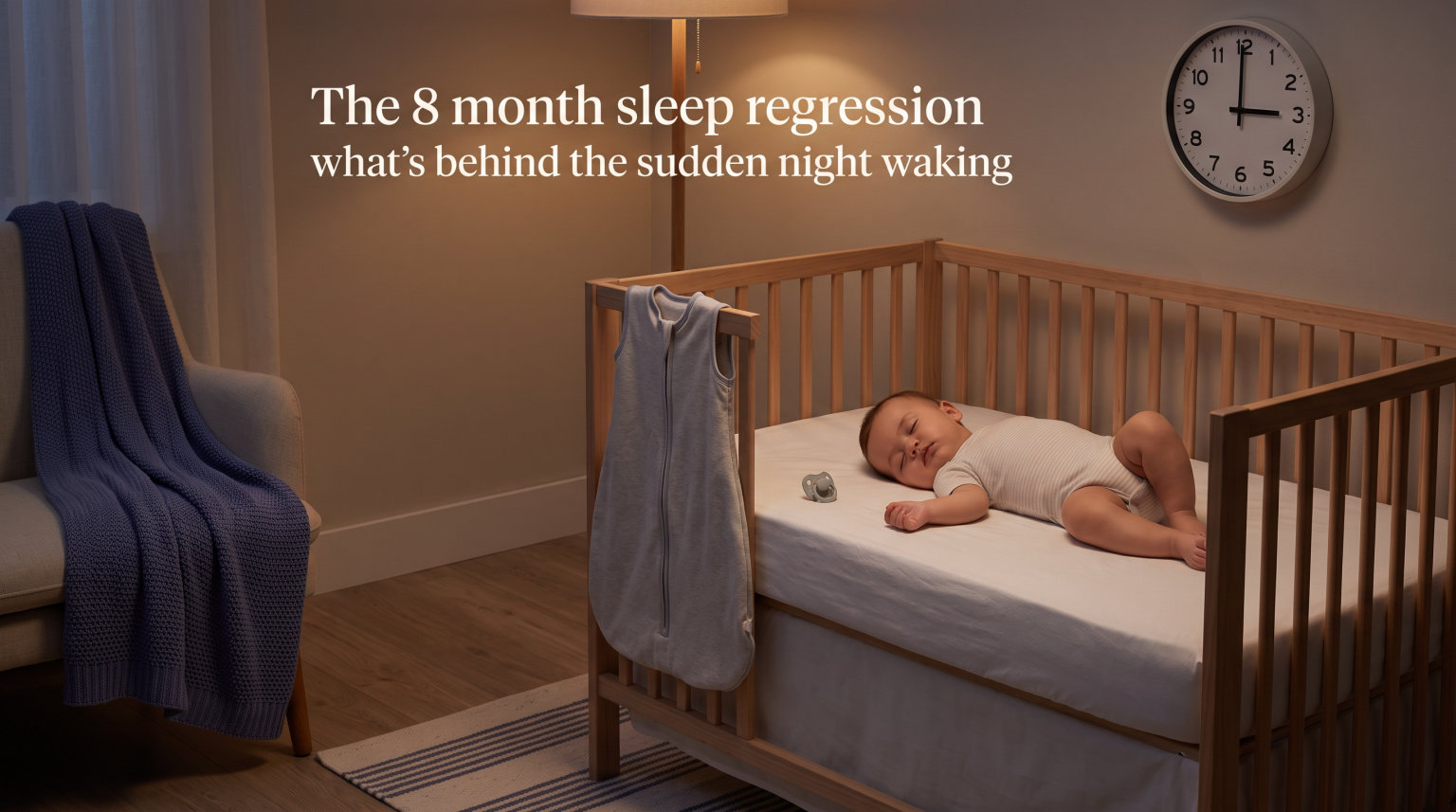
It is 2 a.m. and your baby, who has been sleeping peacefully through the night for months, is suddenly wide awake and crying. Again. This is the third time tonight, and you are wondering what on earth happened to your good little sleeper. Welcome to the 8 month sleep regression, a phase that catches many parents off guard and leaves them exhausted, confused, and searching for answers.
After working with parents for over two decades and raising four children of my own, I have seen this pattern countless times. The 8 month sleep regression is one of the most intense developmental sleep disruptions, but here is what you need to know right now: this is completely normal, it is temporary, and you will get through it.
In this guide, I will walk you through exactly what is behind the sudden night waking at 8 months. We will explore the 5 primary causes of this sleep regression, how to recognize the signs, how long you can expect it to last, and practical strategies that actually work for helping your baby (and you) get the rest you need.
Table of Contents
What Is the 8-Month Sleep Regression?
A sleep regression is a period when a baby who has been sleeping well suddenly starts waking more frequently at night, taking shorter naps, or resisting bedtime altogether. These regressions typically coincide with major developmental leaps.
The 8 month sleep regression is particularly challenging because it hits during one of the most rapid periods of brain development in your baby’s entire life. Between 7 and 10 months, your baby is mastering new physical skills, developing emotional awareness, and experiencing cognitive leaps that fundamentally change how they experience the world.
Unlike the 4 month sleep regression, which is tied to permanent changes in sleep cycles, the 8 month regression is more closely linked to developmental milestones and behavioral changes. This means that while it feels overwhelming in the moment, it is usually temporary and your baby can return to healthy sleep patterns with the right support.
What is a sleep regression? A temporary period of disrupted sleep that occurs when a baby’s brain is processing significant developmental changes. These disruptions typically last 2-6 weeks and resolve once the new skills or awareness are integrated.
The 5 Primary Causes of 8-Month Sleep Regression
Understanding why your 8 month old is suddenly waking at night helps you respond with patience and appropriate strategies. Here are the five main factors behind this sleep regression:
1. Growing Out of 3-Nap Wake Windows
By 8 months, most babies are ready to transition from three naps to two. Their wake windows, the amount of time they can comfortably stay awake between sleeps, have lengthened significantly. If you are still trying to squeeze in that third nap, you may be putting your baby down when they are not actually tired.
This creates a cascade of sleep problems. Short or skipped naps lead to overtiredness, which makes it harder for your baby to fall asleep and stay asleep. Overtired babies actually wake more frequently at night because their bodies produce stress hormones like cortisol that interfere with restful sleep.
At 8 months, most babies do best with wake windows of 2.5 to 3.5 hours. If your baby is fighting that third nap or taking a very short late afternoon nap, it is probably time to make the switch to a 2-nap schedule.
2. Separation Anxiety and Object Permanence
Right around 8 months, babies develop object permanence, the understanding that things continue to exist even when they cannot see them. This cognitive leap is exciting, but it also means your baby now understands that you still exist when you leave the room. And that can be unsettling.
What is object permanence? The developmental milestone, typically emerging around 8 months, when a baby realizes that people and objects continue to exist even when out of sight. This cognitive leap triggers separation anxiety because babies now understand their parents can leave.
Separation anxiety typically peaks between 8 and 10 months. Your baby may cry when you leave the room, cling to you more during the day, and wake up at night looking for reassurance that you are still there. Night waking becomes a way to check that you have not disappeared.
This is not manipulation or bad habits forming. It is a normal, healthy sign of attachment and cognitive development. Your baby is learning about relationships and permanence, and they need your reassurance as they process these big feelings.
3. Greater Mobility (Crawling and Pulling Up)
If your baby has started crawling, pulling up to stand, or cruising along furniture, their brain is buzzing with excitement about these new skills. Many babies practice these movements in their crib at night, leading to night waking and difficulty settling back to sleep.
Physical milestones disrupt sleep in two ways. First, your baby’s brain is processing these new motor patterns during sleep, which can cause partial awakenings. Second, babies often want to practice their new skills, even when they should be sleeping. You might find your baby standing in their crib crying because they do not know how to get back down.
The excitement of newfound mobility can also lead to bumped heads, frustration when stuck in sitting or standing positions, and a general restlessness that makes settling to sleep more challenging.
4. Sleep Associations and Independent Sleep Skills
How does your baby fall asleep at bedtime? If they rely on external help, such as being rocked, fed, or held to sleep, they may need that same help every time they wake during the night. And at 8 months, with all the developmental changes happening, they are waking more often.
What are sleep associations? The conditions or actions a baby relies on to fall asleep. Positive sleep associations include a dark room, white noise, or a lovey. Negative sleep associations require parent intervention, like rocking or feeding to sleep, which can become unsustainable when night waking increases.
This does not mean you need to stop comforting your baby. But if you are nursing, rocking, or holding your baby until they are completely asleep, they may not have developed the independent sleep skills needed to connect sleep cycles on their own during this regression.
5. Teething Discomfort
Many babies are cutting teeth around 8 months, and this physical discomfort can compound sleep regression symptoms. The pressure and inflammation in the gums tends to be more noticeable when babies are lying down, which explains why teething often seems worse at night.
It can be tricky to determine whether your baby’s night waking is due to teething or the sleep regression. Teething pain typically comes with other signs like drooling, gum rubbing, and sometimes a low-grade fever. Sleep regression waking is more about developmental leaps and behavioral changes.
The good news is that teething-related sleep disruption is usually temporary, lasting only a few days around the time a tooth actually breaks through the gum. Sleep regression, on the other hand, tends to last several weeks.
Signs Your Baby Is Going Through the Regression
If your previously good sleeper has suddenly changed their sleep patterns, you may be wondering whether this is the 8 month sleep regression or something else. Here are the most common signs:
Sudden Night Waking
The hallmark of this regression is sudden, frequent night waking. A baby who was sleeping 6-8 hour stretches might start waking every 1-2 hours. These wakings often involve crying that seems more intense or persistent than before. Some parents describe their baby waking screaming at night, which can be alarming but is often just a sign of frustration, confusion, or needing comfort during this developmental period.
Night waking during the 8 month regression is different from the waking of younger babies. Your 8 month old is more alert, more aware, and more likely to stay awake for longer periods if not settled back to sleep quickly. Some parents report their baby waking for an hour or more, seemingly ready to play, which is often called “party time” wakings.
Nap Resistance and Short Naps
Naps often fall apart during this regression. Your baby may fight going down for naps, take much shorter naps than usual, or skip naps entirely. This nap resistance is frequently tied to the wake window issue. If your baby is undertired from a late third nap or overtired from too-long wake stretches, naps become a battleground.
Short naps of 20-30 minutes are common during this phase. Your baby wakes after one sleep cycle and cannot transition into the next one. This leaves them still tired but unable to fall back asleep, creating a cycle of crankiness and overtiredness.
Bedtime Battles and Fussiness
Bedtime might suddenly become a struggle. Your baby may cry when you start the bedtime routine, fight being put in the crib, or pop up crying repeatedly after you leave the room. This fussy at bedtime behavior is often tied to overtiredness or separation anxiety.
Some babies also start showing more intense separation anxiety specifically at bedtime, clinging to parents and crying when the sleep sack goes on or the lights dim. This is their way of saying, “I know you are leaving, and I do not like it.”
Early Morning Waking
Some babies start waking earlier than usual during this regression, sometimes as early as 4 or 5 a.m. and being unable to fall back asleep. This early morning waking is often the last symptom to resolve because sleep pressure is naturally lowest at the end of the night.
Teething vs. Sleep Regression: How to Tell
It can be challenging to distinguish between teething pain and sleep regression. Here is a quick comparison:
Teething signs: Excessive drooling, swollen or red gums, trying to chew on everything, possible low-grade fever (under 100.4F), fussiness during the day, relief when given something cold to chew. Sleep disruption is usually temporary and coincides with visible gum changes.
Sleep regression signs: Sudden change in sleep patterns around 8 months, baby practicing new skills during the day, increased clinginess and separation anxiety, fighting naps or taking short naps, waking crying intensely but settling with comfort. Disruption lasts 2-6 weeks.
If your baby is showing both signs, you may be dealing with a double challenge. Focus on comfort for teething while maintaining consistent sleep routines for the regression.
How Long Does the 8-Month Sleep Regression Last?
The 8 month sleep regression typically lasts between 2 and 6 weeks. Most families see significant improvement by week 3 or 4, with sleep patterns returning to baseline or even improving as the baby adjusts to new developmental milestones.
Several factors influence how long the regression lasts for your family:
Developmental pace: Babies who master new skills quickly may move through the regression faster. Once your baby feels confident in their crawling, pulling up, or other new abilities, the urge to practice at night often diminishes.
Consistency: Maintaining consistent sleep routines and responses helps babies feel secure and can shorten the regression period. Frequent changes to approach can extend the disruption.
Nap transition timing: If your baby is fighting the 3-to-2 nap transition, extending the regression by continuing to offer that third nap when they are ready to drop it. Making the transition decisively often helps sleep improve more quickly.
Underlying issues: Sometimes what looks like a regression is actually illness, ear infection, or another issue. If sleep disruption lasts longer than 6-8 weeks, it is worth checking with your pediatrician.
From the forums and communities I follow, most parents report the 8 month regression as lasting 3-4 weeks, with gradual improvement starting around the 2-week mark. Some babies breeze through in just a week or two, while others take the full 6 weeks. Every baby is different.
Practical Strategies for Managing Night Waking
While you cannot speed up your baby’s development, you can use strategies to help everyone get more rest during this challenging phase. Here is what has worked for the families I have worked with:
Strategy 1: Adjust Wake Windows and Transition to 2 Naps
If your baby is fighting that third nap or taking a catnap that pushes bedtime too late, it is time to make the transition to two naps. This typically means wake windows of 2.5-3 hours before the first nap, 3-3.5 hours before the second nap, and 3-3.5 hours before bedtime.
A typical 2-nap schedule for an 8 month old might look like this: wake at 7 a.m., first nap 9:30-11 a.m., second nap 2-3:30 p.m., bedtime 7 p.m. Adjust these times based on your baby’s unique sleep needs.
The transition period can be messy for a week or two as your baby adjusts. Some days they may need a micro-nap in the late afternoon to make it to bedtime without becoming overtired. This is temporary while they build the stamina for longer wake windows.
Strategy 2: Practice New Skills During the Day
Give your baby plenty of opportunities to practice crawling, pulling up, and cruising during awake hours. The more they can satisfy their brain’s urge to practice these skills during the day, the less they may feel compelled to practice at 2 a.m.
Practice getting down from standing too. Many babies get stuck standing in their crib and cry because they do not know how to lower themselves. During playtime, help them practice bending their knees and sitting down from standing.
Floor time and safe exploration space are crucial during this period. A baby who has had ample time to move and explore during the day often sleeps more soundly at night.
Strategy 3: Maintain a Consistent Bedtime Routine
Your bedtime routine is a signal to your baby that sleep is coming. Keep it predictable, calming, and consistent. A typical routine might include bath, pajamas, feeding, book, song, bed.
The routine should take 20-30 minutes and happen in the same order each night. This predictability is especially comforting during a time when so much feels uncertain to your baby.
Consider adding extra connection time during the bedtime routine during this regression. A few extra minutes of cuddling or singing can help fill your baby’s emotional cup and ease separation anxiety.
Strategy 4: Respond to Separation Anxiety with Connection
When your baby wakes crying for you, they are not being manipulative. They are experiencing genuine distress and need your reassurance. Respond with warmth and consistency.
During the day, practice brief separations with games like peekaboo. This helps your baby learn that you always come back. Keep goodbyes brief and cheerful, and reunions warm and enthusiastic.
At night, if your baby is crying, go to them. Comfort them. You cannot spoil a baby with responsiveness during a developmental regression. Your reassurance helps them feel safe enough to eventually settle back to sleep.
Strategy 5: Optimize the Sleep Environment
A sleep-friendly environment can help minimize wakings. Keep the room dark, ideally using blackout curtains. Use white noise to mask household sounds and create a consistent audio backdrop. Maintain a comfortable temperature between 68-72 degrees.
Make sure the crib is clear of toys and distractions. During this regression, a simple sleep environment helps signal that crib time is sleep time, not play time.
Strategy 6: Consider Gentle Sleep Approaches
If you are interested in helping your baby develop more independent sleep skills, the regression period can actually be a good time to start, since you are already experiencing frequent wakings. However, I recommend gentle, responsive approaches rather than cry-it-out during this already stressful developmental period.
The chair method, where you sit by the crib offering verbal reassurance and occasional touch while your baby learns to fall asleep, can be effective. Gradually move your chair farther from the crib over several nights.
Alternatively, the pick-up-put-down method involves picking your baby up when they cry, calming them until they are drowsy but awake, then putting them back down. Repeat as needed.
These methods take more time than extinction-based approaches, but they preserve the trust and connection that is so important during this phase of heightened separation anxiety.
Strategy 7: Prioritize Parent Self-Care
You cannot pour from an empty cup. Sleep deprivation is real and it affects your mood, patience, and ability to respond to your baby. This section matters because you matter.
If you have a partner, share the night wakings when possible. Even if you are breastfeeding, your partner can handle some wakings with a bottle of expressed milk or by bringing the baby to you and handling the settling afterward.
Take turns sleeping in on weekends. If you are up multiple times during the week, negotiate with your partner so each of you gets one morning to sleep in.
Lower your standards in other areas. Let the laundry pile up. Order takeout. Simplify everything that is not essential so you can focus on getting through this phase.
Connect with other parents who understand. The forums I follow show that just knowing you are not alone helps immensely. Millions of parents are going through this exact experience right now.
Sample 8-Month Sleep Schedule
Here is a sample 2-nap schedule that works well for many 8 month olds. Remember that every baby is different, and your little one may need slightly different timing.
Wake up: 7:00 a.m.
First nap: 9:30 a.m. – 11:00 a.m. (1.5 hours)
Second nap: 2:30 p.m. – 4:00 p.m. (1.5 hours)
Bedtime: 7:30 p.m.
This schedule uses wake windows of approximately 2.5 hours, 3.5 hours, and 3.5 hours. Total daytime sleep is 3 hours, with 11 hours overnight (acknowledging that night waking is likely during the regression).
Some babies do better with longer naps and shorter night sleep, while others need shorter naps to sleep well overnight. Watch your baby’s cues and adjust accordingly.
If your baby is still taking three naps, a typical schedule might look like this:
Wake up: 7:00 a.m.
First nap: 9:00 a.m. – 10:30 a.m.
Second nap: 12:30 p.m. – 2:00 p.m.
Third nap: 4:30 p.m. – 5:00 p.m. (catnap)
Bedtime: 8:00 p.m.
If your baby starts fighting that third nap or it begins to interfere with bedtime, it is time to transition.
When to Talk to Your Pediatrician
While the 8 month sleep regression is normal and temporary, there are times when night waking may signal something that requires medical attention. Contact your pediatrician if:
Sleep disruption lasts more than 6-8 weeks. While regressions can last up to 6 weeks, ongoing sleep issues beyond that warrant investigation. There could be underlying issues like sleep apnea, reflux, or other conditions.
Your baby seems in pain and is inconsolable. Intense crying that does not respond to comfort, especially if accompanied by fever, ear pulling, or other signs of illness, needs evaluation.
There are signs of CMPA or other allergies. Cows’ milk protein allergy can affect sleep due to discomfort. Signs include excessive fussiness, diarrhea, mucus in stool, eczema, or vomiting. If you suspect CMPA, consult your pediatrician before making dietary changes.
Your baby is not gaining weight appropriately. If sleep disruption is affecting feeding or your baby is losing weight or not gaining as expected, medical guidance is important.
You are concerned. Trust your instincts. If something feels wrong to you, it is always worth checking with your doctor. Parental intuition is powerful and valid.
Frequently Asked Questions
Why is my 8 month old waking up at night all of a sudden?
Sudden night waking at 8 months is typically caused by the 8 month sleep regression. This developmental phase involves separation anxiety, object permanence awareness, new mobility skills like crawling, the transition from 3 to 2 naps, and sometimes teething. Your baby is experiencing rapid brain development that temporarily disrupts established sleep patterns. This is normal and usually lasts 2-6 weeks.
How long does 8 month sleep regression usually last?
The 8 month sleep regression typically lasts between 2 and 6 weeks. Most families see improvement around the 3-4 week mark. Factors affecting duration include how quickly your baby masters new skills, consistency with sleep routines, timing of nap transitions, and whether there are any underlying issues like illness or teething.
How to handle night wakings during sleep regression?
Handle night wakings by responding with comfort and consistency. Adjust your baby’s wake windows and transition to 2 naps if needed. Practice new skills during the day to reduce nighttime practice. Maintain a calming bedtime routine. Respond to separation anxiety with connection and reassurance. Optimize the sleep environment with darkness and white noise. Consider gentle sleep training approaches. Most importantly, prioritize parent self-care and share night duties with your partner when possible.
Can CMPA affect sleep?
Yes, Cows’ Milk Protein Allergy (CMPA) can affect sleep because the discomfort from digestive symptoms may cause fussiness and night waking. Signs of CMPA include excessive crying, diarrhea, mucus in stool, eczema, vomiting, or blood in stool. If you suspect CMPA, consult your pediatrician before making dietary changes. Your doctor can help determine if allergy testing or an elimination diet is appropriate.
Is it the 8 month sleep regression or teething?
Both can cause night waking, but there are differences. Teething typically involves visible signs like drooling, swollen gums, chewing on objects, and possibly a low-grade fever. Sleep disruption from teething is usually brief, lasting a few days around when a tooth erupts. The 8 month sleep regression involves developmental leaps like separation anxiety, new mobility skills, and nap transitions, typically lasting 2-6 weeks. If your baby shows both signs, address comfort for teething while maintaining consistent sleep routines.
Can you sleep train during 8 month regression?
You can work on sleep skills during the 8 month regression, but gentle approaches are recommended over cry-it-out methods. The chair method or pick-up-put-down technique allows you to support your baby while they learn independent sleep skills. Avoid extinction-based training during this phase of heightened separation anxiety. Focus on preserving trust and connection. Remember that consistency matters more than the specific method you choose.
Conclusion
The 8 month sleep regression is challenging, exhausting, and sometimes feels like it will never end. But it will. Behind the sudden night waking is a baby whose brain is growing at an astonishing pace, mastering new physical skills, developing emotional awareness, and learning about the world in whole new ways.
You are not doing anything wrong. Your baby is not broken. This is a normal, temporary phase of development that millions of families navigate every year. By understanding the 5 primary causes, recognizing the signs, and applying practical strategies, you can help your baby (and yourself) get through this regression with connection and care intact.
Trust your instincts. Respond with love. Ask for help when you need it. And know that better sleep is on the other side of this developmental leap. You have got this.