
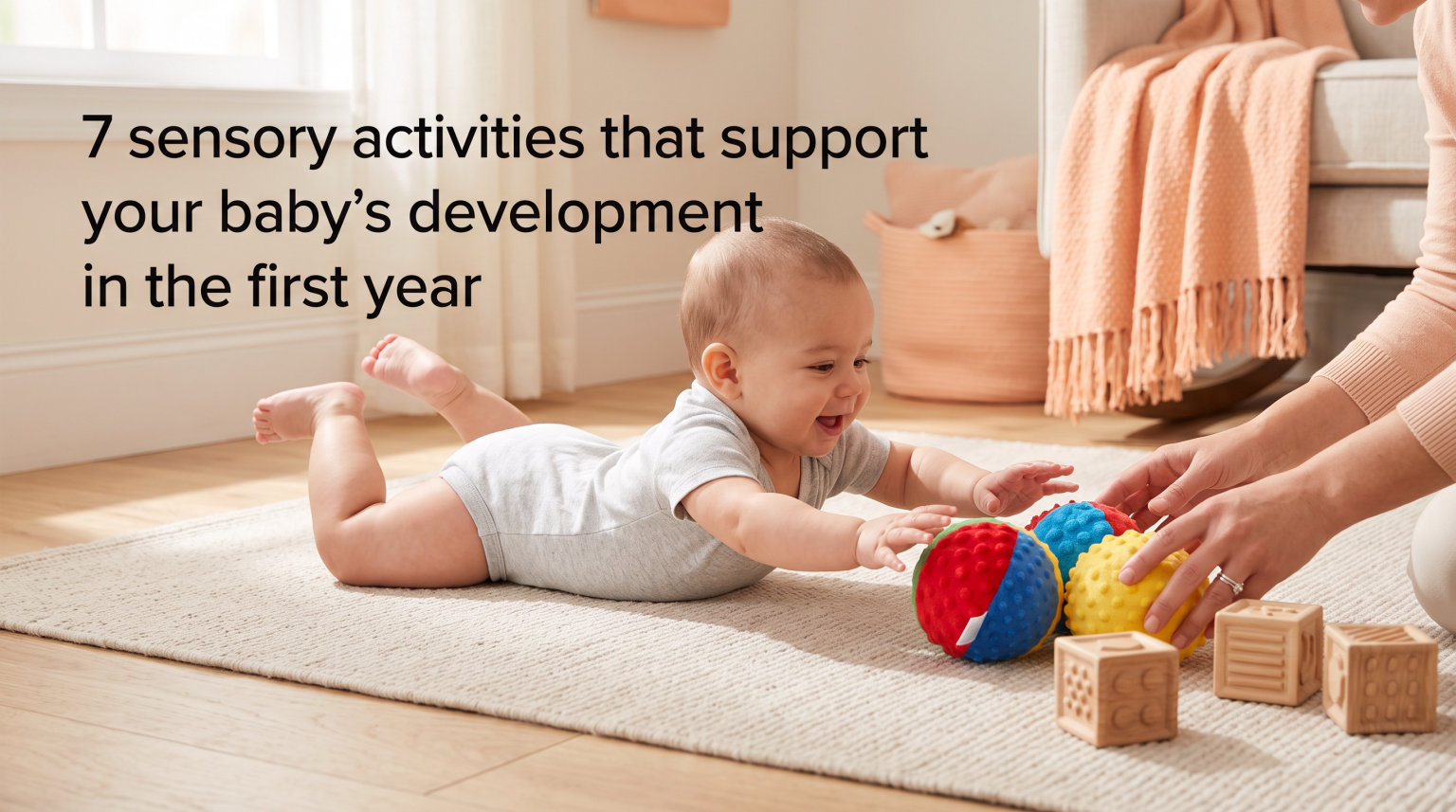
Sensory activities are play experiences that engage your baby’s five senses to support brain development, motor skills, and cognitive growth during their first year. Every touch, sound, sight, and texture your baby encounters helps build neural pathways that form the foundation for future learning. When I started researching infant development for my own children, I was amazed to learn that 90% of brain growth happens before age five, with the most explosive period occurring in those first 12 months.
The good news is that sensory play does not require expensive toys or elaborate Pinterest setups. Your baby learns just as much from feeling a wooden spoon and listening to rice shake in a container as they do from store-bought activity centers. In this guide, I will share seven sensory activities that support your baby’s development in the first year, organized by age and designed to use items you likely already have at home.
Each activity includes clear instructions, materials needed, and the specific developmental benefits your baby will gain. Whether you are a first-time parent feeling overwhelmed or a seasoned caregiver looking for fresh ideas, these simple activities will help you support your baby’s growth while creating meaningful moments together.
Table of Contents
Why Sensory Activities Matter for Your Baby’s Development
Sensory play is not just about keeping your baby entertained. It is a critical component of healthy brain development that directly impacts how your child will learn, communicate, and interact with the world throughout their life. When babies engage their senses, they are literally building their brains.
Research from the Center on the Developing Child at Harvard University shows that neural connections form at an astonishing pace during the first few years of life. Every sensory experience, whether it is feeling water splash during bath time or watching leaves move in the wind, strengthens synaptic connections. These connections form the architecture of your baby’s developing brain.
The Science Behind Sensory Development
Your baby is born with nearly all the neurons they will ever have, about 100 billion of them. What develops after birth are the connections between these neurons, called synapses. Sensory experiences trigger electrical impulses that travel along neural pathways, and repeated experiences strengthen these pathways through a process called myelination.
Each of the five senses contributes uniquely to development. Touch helps babies understand where their bodies end and the world begins, a concept called proprioception. Visual stimulation supports the development of focus and attention span. Sounds build the foundation for language acquisition. Smell creates powerful memory associations. Taste exploration helps babies learn about safe foods and textures.
Key Developmental Benefits
Sensory activities support multiple areas of development simultaneously. When your baby reaches for a textured ball during tummy time, they are strengthening gross motor skills, developing hand-eye coordination, learning cause and effect, and building cognitive connections about shape and texture all at once.
Fine motor skills develop when babies grasp, pinch, and manipulate small objects. These movements lay the groundwork for later skills like holding a crayon, buttoning clothes, and writing. Gross motor skills, including rolling, sitting, and crawling, are supported through activities that encourage movement and balance.
Cognitive development flourishes through sensory exploration. Babies learn object permanence, the understanding that things exist even when out of sight, through peekaboo games and hidden treasure activities. Problem-solving skills emerge as babies figure out how to reach toys or open containers.
Language development connects closely to sensory experiences. When you narrate what your baby is touching or seeing, you are building their vocabulary and helping them make connections between words and experiences. Research shows that babies who engage in rich sensory environments with descriptive language support develop larger vocabularies by age three.
0-3 Months: First Sensory Experiences
The newborn stage is all about gentle introduction to the world. Your baby’s senses are still developing, and their vision is limited to about 8-12 inches. Activities at this age focus on bonding, basic visual tracking, and gentle tactile experiences that build trust and security.
Activity 1: Skin-to-Skin Texture Exploration
Best for: Newborns through 3 months
This activity builds on the natural skin-to-skin contact that newborns crave while introducing gentle texture variations. Your touch is your baby’s first and most important sensory experience.
Materials Needed:
Soft baby blanket or swaddle
Different fabric textures (silk scarf, cotton burp cloth, fleece)
Your bare hands and arms
A quiet, warm space
How to Do It:
Hold your baby skin-to-skin against your chest for at least a few minutes to establish comfort and bonding. Once your baby is calm and alert, gently introduce different textures. Lightly stroke your baby’s arm with a soft silk scarf, then switch to the cotton burp cloth. Use your bare hand to create gentle pressure, letting your fingers trace slow patterns on their skin.
Watch your baby’s cues carefully. Some newborns love gentle tickling motions, while others prefer firm, steady pressure. My first child would calm instantly with gentle circular motions on her back, while my second preferred light stroking on his arms and legs. Every baby is different, and this activity helps you learn your baby’s unique sensory preferences.
Developmental Benefits:
Skin-to-skin contact regulates your baby’s heart rate, temperature, and stress hormones. The texture exploration stimulates tactile receptors in the skin, building neural connections that will later support fine motor skills. This activity also strengthens the parent-child bond through oxytocin release in both you and your baby.
Pro Tip: Do this activity after bath time when your baby is already undressed and relaxed. The combination of warm water followed by texture exploration creates a powerful sensory memory and often leads to better sleep.
Activity 2: High-Contrast Visual Tracking
Best for: Newborns through 3 months
Newborns can only see high-contrast patterns clearly. Black and white images provide the visual stimulation their developing eyes need without overwhelming their limited visual processing abilities.
Materials Needed:
Black and white contrast cards or images
A simple black and white mobile or hanging toy
Good natural lighting
Flat surface for tummy time
How to Do It:
Place your baby on their back or tummy on a comfortable surface. Hold a high-contrast card about 8-12 inches from their face, within their clear vision range. Slowly move the card from side to side, watching to see if your baby’s eyes track the movement. Many newborns will naturally follow high-contrast patterns with their eyes and may even turn their heads to keep watching.
For tummy time enhancement, prop up black and white images at eye level. This gives your baby something visually interesting to focus on while they work on head control. The combination of physical effort and visual stimulation makes tummy time more engaging and helps babies tolerate longer sessions.
Developmental Benefits:
Visual tracking strengthens the eye muscles and improves coordination between both eyes. High-contrast patterns stimulate the optic nerve and support the development of the visual cortex in the brain. This activity also builds attention span as babies learn to focus on and follow objects.
When to Stop: If your baby turns their head away, closes their eyes, or becomes fussy, they are telling you they need a break. Newborns tire quickly from visual stimulation, so keep sessions short, about 2-3 minutes at a time.
4-6 Months: Growing Curiosity
By four months, your baby’s vision has improved dramatically, and they are beginning to reach for objects intentionally. They can hold their head steady during tummy time and may be rolling over. This is the perfect time to introduce more active sensory exploration.
Activity 3: Tummy Time Texture Mat
Best for: 4-6 months (once baby has good head control)
This activity transforms tummy time from a chore into an adventure. By creating a multi-textured surface for exploration, you give your baby a reason to stay on their tummy longer while building the muscles needed for crawling.
Materials Needed:
Play mat or clean blanket as a base
Different textured fabrics (towel, faux fur, bubble wrap with bubbles facing down, silk)
Safe household items (wooden spoon, silicone spatula, soft brush)
BPA-free silicone teethers or textured toys
Mirror (unbreakable baby mirror)
How to Do It:
Lay out different textured fabrics in sections across your play mat. Place interesting items at various points, encouraging your baby to reach and explore. Put the unbreakable mirror at one end so your baby can see their own reflection, which often motivates them to lift their head higher and push up on their arms.
Get down on the mat with your baby. Touch the different textures yourself, narrating what you feel. Say things like, “This towel feels bumpy” or “The silk is smooth and slippery.” Your narration builds language skills while your engagement keeps your baby interested in tummy time longer.
Rotate the items every few days to maintain novelty. Simple changes, like swapping the wooden spoon for a metal one, create entirely new sensory experiences without requiring new purchases.
Developmental Benefits:
This activity strengthens neck, back, and shoulder muscles essential for crawling and sitting. The variety of textures stimulates tactile receptors and builds sensory discrimination skills, the ability to distinguish between different textures. Reaching for and grasping items develops hand-eye coordination and fine motor control.
Safety Note: Ensure all items are larger than your baby’s fist to prevent choking. Avoid small items that could fit through a toilet paper roll. Always supervise closely during this activity.
6-9 Months: Active Exploration
By six months, most babies can sit with support and are eager to explore everything with their hands and mouths. They are developing the pincer grasp and showing interest in cause-and-effect relationships. Sensory activities at this stage can become more complex and interactive.
Activity 4: Taste-Safe Sensory Bin
Best for: 6-9 months (sitting independently or with minimal support)
This activity introduces the concept of sensory bins using completely edible materials, perfect for babies who explore everything by putting it in their mouths. I discovered this approach after my daughter tried to eat rice from a sensory bin at a playgroup.
Materials Needed:
Large shallow container (baking dish or storage bin)
Taste-safe base material: cooked pasta (cooled), oats, or rice cereal
Large kitchen utensils for scooping (measuring cups, wooden spoon)
BPA-free containers with lids for filling and emptying
Sheet or drop cloth for easy cleanup
How to Do It:
Place your sheet or drop cloth under the container to catch spills. Fill the shallow container with your taste-safe base material about 2-3 inches deep. Sit your baby next to the container and demonstrate scooping and pouring. Let them explore the texture with their hands, showing them how to dig, pour, and transfer between containers.
Cooked pasta offers a squishy, slippery texture that babies find fascinating. Oats provide a grainy, pourable experience similar to sand but completely safe if tasted. Rice cereal creates a powdery texture that babies love to run their fingers through.
Developmental Benefits:
Scooping and pouring develop fine motor skills and hand-eye coordination. The tactile exploration builds sensory tolerance and discrimination. Understanding cause and effect, such as seeing oats pour from a cup, supports cognitive development. This activity also introduces early math concepts like full and empty, more and less.
Cleanup Tip: Place a large towel under the play area. When finished, gather the corners of the towel and shake the materials into the trash or compost. Most of the mess will be contained.
Activity 5: Water Play Station
Best for: 6-9 months (sitting with support)
Water provides one of the richest sensory experiences available, engaging touch, sight, and sound simultaneously. This activity brings the joy of water play to a safe, contained environment.
Materials Needed:
Shallow plastic bin or baking dish
Warm water (test on your wrist first)
Towels nearby
Water-safe items: plastic cups, silicone molds, bath toys
Optional: a few drops of food coloring for visual interest
How to Do It:
Fill the container with 1-2 inches of warm water. Sit your baby on the floor with the container in front of them, or place them in a high chair pulled up to a table. Show them how to splash, pour water between cups, and feel the water run through their fingers. Add the optional food coloring to one section to create visual interest and watch it swirl.
Demonstrate cause and effect by showing how pouring water makes splashing sounds. Help them feel the difference between wet and dry by touching a wet hand to a dry towel. Narrate their experience with words like splash, pour, wet, and drip.
Developmental Benefits:
Water play builds sensory integration as multiple senses process information simultaneously. The resistance of water provides gentle strength training for hands and arms. Pouring and transferring water develops fine motor control and hand-eye coordination. Water play also has a naturally calming effect that can help regulate an overstimulated baby.
Important: Never leave your baby unattended with water, even small amounts. A baby can drown in as little as one inch of water.
9-12 Months: Little Scientists
By nine months, your baby is likely crawling, pulling to stand, and showing intense curiosity about how things work. They understand object permanence and enjoy problem-solving activities. Sensory play at this stage can involve more complex cause-and-effect relationships and independent exploration.
Activity 6: Kitchen Treasure Basket
Best for: 9-12 months (crawling and exploring)
The treasure basket concept comes from Montessori philosophy and offers babies a collection of interesting objects to explore independently. The kitchen provides a wealth of safe, interesting items that babies rarely get to handle.
Materials Needed:
Low basket or box (easy for baby to reach into)
Wooden spoon and spatula
Silicone whisk or pastry brush
Clean spice jars with lids that twist or pop
Measuring cups that nest together
Small metal bowl (creates interesting sounds)
Clean, empty cardboard boxes of various sizes
How to Do It:
Collect 8-10 interesting kitchen items and arrange them in the basket. Place the basket on the floor where your baby can easily access it. Let your baby explore independently, resisting the urge to demonstrate or interfere unless they ask for help. Sit nearby and observe, offering language support by naming items and describing what they are doing.
Rotate the items every few days to maintain interest. A whisk might fascinate them for a week, then a nested set of measuring cups becomes the new favorite. The variety keeps the activity fresh without requiring constant new purchases.
Developmental Benefits:
Independent exploration builds confidence and decision-making skills. Manipulating different lids and containers develops problem-solving abilities and fine motor control. The variety of materials, weights, and textures supports sensory discrimination. This activity also encourages longer periods of independent play, giving caregivers brief moments of hands-free time.
Safety Check: Inspect each item carefully. Remove any small parts, ensure no sharp edges, and verify that containers are clean and free from food residue. Avoid items with batteries or small buttons.
Activity 7: Messy Play with Edible Materials
Best for: 9-12 months (can sit independently and shows interest in self-feeding)
Messy play gets a bad reputation, but it is one of the most valuable sensory experiences for babies. This activity embraces the mess while keeping materials completely taste-safe and easy to clean.
Materials Needed:
High chair or easel with tray
Large bib or old t-shirt
Edible “paint”: yogurt mixed with natural food coloring, or mashed avocado and banana
Large sheet or drop cloth under the high chair
Shallow tray or plate for the edible materials
Plastic utensils for spreading and marking
How to Do It:
Strip your baby down to a diaper or use a large bib you do not mind staining. Spread your protective sheet under the high chair. Place a small amount of edible “paint” on the tray and let your baby explore. They will likely start with finger exploration, then progress to whole-hand smearing, and eventually may use the utensils to make marks.
Yogurt mixed with a drop of natural food coloring creates a smooth, paint-like texture. Mashed avocado provides a thick, green medium. Banana creates a sticky, sweet texture that many babies find fascinating. Offer one material at a time to avoid overwhelming your baby.
Developmental Benefits:
Messy play supports sensory tolerance and reduces tactile defensiveness, a common issue where children resist certain textures. The freedom to create without rules fosters creativity and self-expression. Using tools to spread and mark builds fine motor skills and prepares hands for writing. This activity also strengthens the connection between sensory exploration and artistic expression.
Mess Management: Do this activity before bath time so you can transition directly to cleanup. Use a large drop cloth that can be shaken out and washed. Keep a damp cloth nearby for quick hand wiping if your baby shows signs of being done.
Safety Guidelines and Best Practices
Sensory play is generally safe when supervised properly, but there are important guidelines every parent should follow. These simple precautions ensure your baby can explore freely while staying protected.
Supervision Is Non-Negotiable
Never leave your baby unattended during sensory activities. Even taste-safe materials can pose choking hazards if large mouthfuls are taken. Water play requires constant attention, as babies can drown in very small amounts of water. Stay within arm’s reach and maintain visual contact at all times.
Taste-Safe Does Not Mean Edible
Many parents confuse taste-safe with edible. Taste-safe means the material will not harm your baby if a small amount is tasted, but it is not food. Oats, rice cereal, and cooked pasta are taste-safe but should not be consumed in large quantities. True edible materials like yogurt, banana, and avocado are appropriate for actual eating.
For babies under 12 months, stick to completely edible materials. After age one, you can introduce small amounts of non-edible taste-safe materials like flour or cornstarch mixed with water, with close supervision.
Choking Hazard Awareness
Any item small enough to fit through a toilet paper roll tube is a choking hazard for babies under three. Check all items before offering them. Balloons, small balls, coins, batteries, and magnets are particularly dangerous and should be kept far away from sensory play areas.
Recognizing Overstimulation
Babies will tell you when they have had enough sensory input. Signs of overstimulation include turning the head away, closing eyes, arching the back, becoming fussy or crying, hiccups, and avoiding eye contact. When you see these signs, calmly remove your baby from the activity and provide a quiet, low-stimulation environment.
Some babies are more sensitive to sensory input than others. If your baby consistently shows signs of overstimulation, offer shorter sessions with simpler materials. Build up tolerance gradually.
Making Sensory Play Part of Your Daily Routine
One of the most liberating realizations I had as a parent was that normal daily activities already provide rich sensory experiences. You do not need to carve out special “sensory play time” if you approach everyday moments with intention.
Bath Time as Sensory Play
Bath time offers built-in water play, temperature variation, and tactile exploration. Add cups for pouring, washcloths with different textures, and bubbles for visual interest. Let your baby splash freely and explore the properties of water. Narrate what is happening: “The water splashes when you kick” or “The washcloth is soft and squishy.”
Mealtime Sensory Exploration
Allow your baby to touch and explore food textures during meals, even if it creates mess. Let them feel the difference between smooth applesauce and chunky mashed potatoes. Offer safe finger foods in various textures. The high chair becomes a sensory exploration station three times a day.
Outdoor Sensory Walks
A simple walk outside provides visual stimulation from changing light and colors, auditory input from birds and traffic, tactile experience from grass and wind, and olfactory stimulation from flowers and fresh air. Let your baby touch safe plants, feel grass on their feet, and watch leaves move.
Kitchen Helper Activities
Babies love being where the action is. Set up a safe spot in the kitchen where your baby can watch and participate. Give them a wooden spoon and a pot to drum while you cook. Let them explore safe ingredients like flour or oats in a small container while you prepare meals. These moments build connection while providing sensory input.
FAQs
What are good sensory activities for a 1-year-old?
Good sensory activities for a 1-year-old include water play with cups and containers, kitchen treasure baskets with wooden spoons and measuring cups, messy play with edible materials like yogurt or mashed banana, texture exploration with fabric swatches, and outdoor nature walks to touch grass and leaves. Focus on taste-safe materials since 1-year-olds explore everything with their mouths. Activities should encourage pouring, scooping, and independent exploration while supporting their developing fine motor skills and hand-eye coordination.
What is the 3 6 9 rule for babies?
The 3 6 9 rule refers to infant sleep patterns and wake windows. At 3 months, babies typically stay awake for about 1.5 hours between sleeps. At 6 months, wake windows extend to 2-3 hours. At 9 months, babies can handle 3-4 hours of awake time. This rule helps parents understand appropriate sleep schedules and prevents overtiredness. However, every baby is different, and these are general guidelines rather than strict rules. Watch your baby’s individual sleepy cues rather than strictly following any timing formula.
What is the sensory development of a 1-year-old?
By age 1, babies have developed nearly mature vision and can see colors clearly and track moving objects smoothly. Their hearing is fully developed, and they respond to their name and simple instructions. Touch receptors are highly sensitive, making texture exploration especially engaging. Most 1-year-olds are developing sensory integration, the ability to process multiple sensory inputs simultaneously. They show preferences for certain textures, sounds, and visual patterns while actively seeking new sensory experiences through mouthing, touching, and manipulating objects.
How do babies say I love you?
Babies communicate love through non-verbal cues before they can speak. They make prolonged eye contact, smile and coo when they see you, reach up to be held, snuggle into your body, and calm down when you enter the room. Physical touch is their primary love language, seeking skin-to-skin contact and preferring your arms over anyone else’s. Around 9-12 months, they may start giving kisses, patting your face gently, or offering you their favorite toy as a gift. These gestures are your baby’s way of expressing deep attachment and affection.
When should I start sensory activities with my baby?
You can start sensory activities from birth. Newborns benefit from skin-to-skin contact, gentle touch, and high-contrast visual stimulation. As your baby grows, activities should evolve to match their developmental stage. The key is keeping activities age-appropriate and safe. For newborns, focus on bonding and gentle experiences. Around 4 months, introduce tummy time with textures. By 6 months, add taste-safe sensory bins. From 9 months onward, offer more complex exploration with household items. Every normal interaction, from bath time to diaper changes, already provides sensory input.
Are sensory bins safe for babies?
Sensory bins are safe for babies when properly prepared and supervised. For babies under 12 months, use only edible materials like cooked pasta, oats, rice cereal, or flour mixed with water. Avoid small items that could be choking hazards. Always supervise closely and never leave a baby unattended with sensory materials. Ensure all items are larger than your baby’s fist. Keep sessions short to prevent overstimulation. If your baby puts materials in their mouth, which is normal exploration, ensure the materials are truly taste-safe and redirect gently without making them feel shamed for exploring.
What household items work best for sensory play?
The best household items for baby sensory play include wooden spoons, metal measuring cups, silicone spatulas, clean spice jars with interesting lids, fabric swatches with different textures, nesting containers, cardboard boxes, soft brushes, and unbreakable mirrors. Kitchen items are particularly engaging because babies see adults using them daily. Choose items with varied weights, textures, and sounds. Avoid anything with small parts, sharp edges, batteries, or toxic materials. The beauty of household items is that they are free, readily available, and often more interesting to babies than commercial toys because they are objects from the real world.
Conclusion: Embracing the Messy, Beautiful Journey
These seven sensory activities that support your baby’s development in the first year are just the beginning of a lifelong journey of exploration and learning. The activities we have covered, from newborn skin-to-skin contact to one-year-old messy play, provide the foundation your baby needs for healthy brain development, motor skills, and cognitive growth.
Remember that the goal is not perfection. Your baby does not need the most elaborate sensory bin or the prettiest setup. What they need is you, present and engaged, offering safe opportunities to explore the world through their senses. Some days you will have time for a full messy play session. Other days, simply narrating bath time or letting your baby explore a wooden spoon while you cook dinner is enough.
Trust your instincts as a parent. You know your baby better than any expert or blog article. Watch their cues, follow their interests, and adjust activities to match their unique temperament and developmental pace. The sensory activities outlined here are frameworks, not rigid rules. Adapt them to fit your life, your home, and your baby’s needs.
Most importantly, enjoy this time. The first year passes quickly, and soon your baby will be moving beyond these early sensory explorations into more complex play. By providing rich sensory experiences now, you are giving them the gift of curiosity, confidence, and a love of learning that will last a lifetime.