
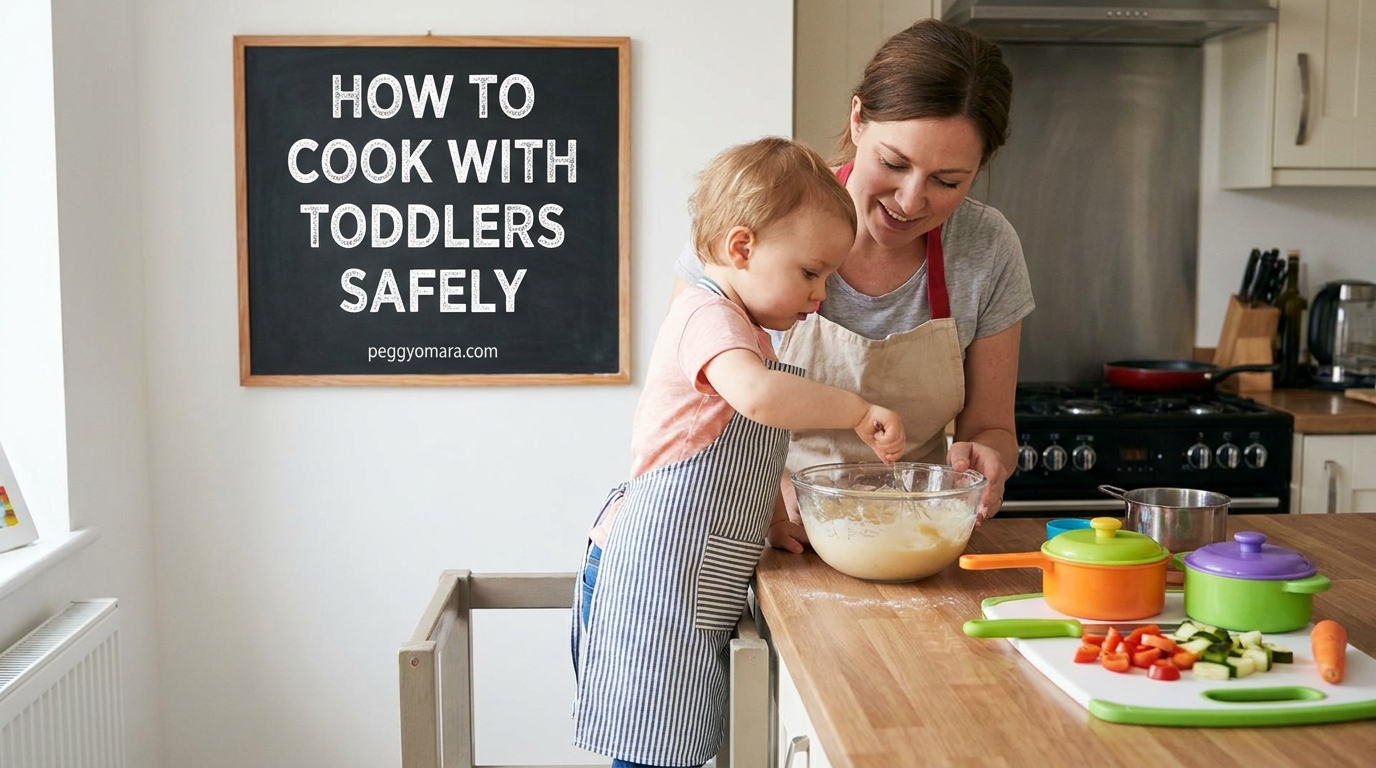
Cooking with toddlers safely involves starting around 18 to 24 months with simple tasks like washing vegetables, stirring ingredients, and tearing lettuce while using kid-safe tools and maintaining constant supervision. You might worry about the mess, the time it will add, or whether your kitchen is safe enough. I felt the same way before I started cooking with my own toddler, and now I can not imagine our routine without it.
This guide will show you exactly how to cook with toddlers safely and why you should start now. The developmental window for building these skills and food curiosity is surprisingly narrow, and the benefits reach far beyond learning how to crack an egg.
Table of Contents
Why You Should Start Cooking with Toddlers Now?
The best time to start cooking with your toddler is right now. Research consistently shows that children who participate in meal preparation develop healthier eating habits, stronger motor skills, and greater confidence in the kitchen. These benefits compound quickly, and the earlier you start, the more natural cooking becomes for your child.
Sensory and Fine Motor Development
Cooking is one of the richest sensory experiences you can offer a toddler. The textures of flour, the squish of dough between fingers, the sound of sizzling, and the smells of herbs all engage multiple senses simultaneously. These experiences are not just fun. They are building neural pathways that support cognitive development.
Fine motor skills develop rapidly when toddlers tear lettuce, stir batter, or sprinkle cheese. These actions require hand-eye coordination and finger control that worksheets simply cannot replicate. Every time your child pours water or mashes a banana, they are strengthening the same muscles they will need for writing.
Math and Science Skills in Real Context
Cooking turns abstract concepts into tangible experiences. Measuring one cup of flour versus half a cup teaches fractions better than any flashcard. Watching bread rise demonstrates biology and chemistry in action. Toddlers absorb these lessons without realizing they are learning.
The kitchen becomes a living laboratory where cause and effect are immediate and visible. When you mix baking soda and vinegar, something exciting happens. When you heat butter, it changes from solid to liquid. These observations build scientific thinking skills that will serve your child for life.
Language Development and Following Instructions
Cooking naturally expands vocabulary in ways that everyday conversation often misses. Words like whisk, dice, simmer, and zest become part of your toddler’s working language. Following a recipe step by step teaches sequencing skills that directly translate to classroom success.
I talk through everything when cooking with my toddler. We name each ingredient, describe what we are doing, and predict what will happen next. This constant narration builds language skills and helps children understand that communication has purpose.
Building Confidence and Independence
There is something powerful about a two-year-old who can spread their own peanut butter or pour their own milk. These small victories build self-esteem in concrete ways. When a toddler successfully cracks an egg or flips a pancake, they learn that they are capable.
This confidence extends beyond the kitchen. Children who cook develop a sense of agency and competence that affects how they approach other challenges. They learn that mistakes are fixable and that effort leads to results.
Quality Family Time That Is Productive
Modern parenting often feels like a constant juggling act between entertaining your child and getting things done. Cooking with toddlers solves both problems at once. You are spending focused time together while also preparing a meal your family needs.
These shared experiences create the kind of memories that last. Years from now, your child might not remember specific playdates or outings, but they will remember standing on a stool next to you, covered in flour, proudly showing off cookies you made together.
Developing Healthy Food Relationships
Children who cook are more likely to try new foods and make healthier choices. There is something magical about the pride of eating something you helped create. This connection often overcomes picky eating tendencies that frustrate so many parents.
The kitchen also provides no-pressure food exposure. A toddler who washes broccoli or tears kale may eventually taste it simply because the barrier of unfamiliarity has been broken. Cooking demystifies food and builds curiosity about where meals come from.
Creating Lasting Memories and Traditions
Family recipes become part of your legacy. Teaching your grandmother’s cookie recipe to your toddler connects generations in meaningful ways. These traditions provide children with a sense of belonging and identity.
Our team has heard from countless parents who treasure these cooking moments as some of their most cherished memories. The kitchen becomes a place of laughter, learning, and love that shapes your family’s story.
When to Start: Age Readiness Guide
Most children are ready to begin simple kitchen tasks between 18 and 24 months. This is the sweet spot when they have developed enough coordination to hold a spoon and enough understanding to follow basic directions. However, readiness depends more on individual development than calendar age.
Signs your toddler is ready include showing interest in what you are doing in the kitchen, being able to stand steadily for several minutes, and following simple one-step instructions like “put this in the bowl.” If your child is not quite there, start by having them watch from a safe distance and narrate what you are doing.
Do not wait too long. By age three, many children have already developed strong food preferences and may resist participation if cooking feels foreign. Starting between 18 and 24 months lets cooking become a normal, expected part of life before resistance sets in.
Essential Safety Guidelines
Safety is the foundation of successful toddler cooking. These guidelines are non-negotiable and should be followed every single time you cook together. The good news is that with proper precautions, cooking with toddlers is genuinely safe.
Hand Washing First, Every Time
Make hand washing the ritual that signals cooking time has begun. Use a step stool at the sink so your toddler can reach the water independently. Sing a hand-washing song to make sure they scrub long enough. This habit teaches hygiene and creates a consistent routine.
Wash your own hands alongside your toddler to model the behavior. Explain why we wash hands before touching food. Even young children understand the connection between clean hands and staying healthy.
Constant Supervision Is Non-Negotiable
You must have eyes on your toddler at all times when cooking. Never step away to answer the phone or check another room. If you need to leave, your toddler leaves with you. This rule prevents accidents before they happen.
Position yourself between your child and any hazards. If you are chopping, your toddler should be on your opposite side from the knife. If you are at the stove, they should not be able to reach hot surfaces even by stretching.
Safe Positioning at Counter Height
Your toddler needs to be at counter height to participate safely and effectively. A learning tower or kitchen helper provides a stable, enclosed platform that prevents falls. These tools are worth the investment if you plan to cook together regularly.
Step stools can work too, but they are less stable and your child can step off easily. Always supervise extra carefully with step stools. Never let a toddler stand on a dining chair at the counter. Chairs tip, and the risk is not worth it.
Teaching Hot vs. Cold
From the very first cooking session, teach your toddler that the stove and oven are hot and never to be touched. Use consistent language. We say “hot, only mommy touches” in our house. Repetition is how young children learn safety boundaries.
Let your toddler feel safe warmth from a distance to understand the concept. Hold their hand near, not touching, a warm dish and say “this is warm, see?” Then show them the stove from a safe distance and say “this is hot, we do not touch.” Concrete examples help them understand.
Using Age-Appropriate Tools
Kid-safe knives, nylon knives, and plastic vegetable cutters allow toddlers to practice cutting skills without real danger. Look for tools specifically designed for young children with blunt edges and ergonomic handles.
Provide real tools, not just toy versions. Toddlers know the difference and want to do real work. A nylon knife cuts soft foods like bananas and cooked pasta but will not cut skin. This lets children build genuine skills safely.
What to Do When Safety Rules Are Broken
Toddlers will test boundaries. If your child reaches toward a hot stove or touches a knife, respond immediately and consistently. Remove them from the situation, get down to eye level, and clearly restate the rule. “The stove is hot. We do not touch. Cooking time is over now.”
Follow through by ending the cooking session if necessary. This teaches that safety rules have real consequences. After a break, you can try again with a fresh start and renewed attention to the rules.
Age-Appropriate Kitchen Tasks by Development Stage
The key to success is matching tasks to your toddler’s developmental abilities. Expecting too much leads to frustration. Expecting too little misses opportunities for growth. Here is what works at each stage.
Ages 18 Months to 2 Years: Exploring and Observing
At this stage, focus on sensory exploration and simple actions. Toddlers this age can wash vegetables in a colander, tear lettuce or herbs into pieces, dump pre-measured ingredients into bowls, and stir mixtures with a large spoon. These tasks build foundational skills without requiring precision.
Vegetable washing is often a favorite activity at this age. Place a colander in the sink and let your toddler rinse vegetables under gentle running water. The sensory experience of water combined with the satisfaction of “helping” creates pure joy.
Tearing greens into bite-sized pieces develops fine motor control. The irregular tearing motion strengthens different hand muscles than coloring or stacking blocks. Plus, most toddlers genuinely enjoy the satisfying rip of lettuce leaves.
Ages 2 to 3 Years: Helping with Simple Tasks
Two-year-olds can handle more complex tasks with supervision. They can spread butter or jam on bread using a child-safe knife, crack eggs into a separate bowl (for shell removal), pour pre-measured liquids, and sprinkle cheese or toppings. These activities build confidence through visible results.
Cracking eggs is a particular favorite. Teach your toddler to tap the egg on the counter, then use both thumbs to pull the shell apart over a separate bowl. This way any shell pieces can be removed before adding to the main mixture. The sense of accomplishment is enormous.
Spreading activities let toddlers prepare their own breakfast or snacks. Slicing a banana with a nylon knife, then spreading peanut butter on toast, creates independence at an age when children desperately want to do things themselves.
Ages 3 to 4 Years: Building Skills and Independence
Three-year-olds can begin working with more precision. They can measure dry ingredients using measuring cups, whisk eggs or batters vigorously, cut soft foods with nylon knives, mash bananas or potatoes, and set the table for family meals. These tasks prepare them for more advanced cooking in the preschool years.
Pizza making works beautifully at this age because it combines multiple skills. Your child can spread sauce, sprinkle cheese, and add toppings to their own section. The customization aspect keeps them engaged, and the quick baking time provides satisfying results.
By age four, many children can help with simple recipes from start to finish with minimal assistance. Banana bread is a classic choice because mashing bananas, measuring ingredients, and pouring batter offer varied tasks that maintain interest throughout the process.
Getting Started: Practical Tips for Success
The difference between a frustrating experience and a joyful one often comes down to preparation. These practical tips will help you start strong and build sustainable cooking habits with your toddler.
Start with Simple, Quick Recipes
Choose recipes with few ingredients and straightforward steps. Banana bread, scrambled eggs, and homemade pizza are perfect starters. Avoid anything that requires precise timing or complex techniques while you are both learning.
Recipes that allow tasting along the way are especially engaging. Smoothies, fruit salads, and trail mix let your toddler sample ingredients throughout the process. This sensory exploration keeps them interested and builds positive food associations.
Set Up a Safe Workspace
Before inviting your toddler to cook, clear the counter of anything dangerous or breakable. Remove knives, glass containers, and small appliances from reach. Set out only the ingredients and tools you will need.
Consider placing a towel or silicone mat under your toddler’s workspace. This provides a visual boundary for their work area and makes cleanup easier. Having a damp cloth nearby lets you wipe hands quickly when needed.
Plan Ahead and Manage Expectations
Everything takes longer with a toddler helper. Plan for cooking to take at least twice as long as usual. Do not attempt toddler cooking when you are rushed or hungry. Choose times when you can be patient and present.
Prep some ingredients in advance if needed. Measure dry ingredients into small bowls that your toddler can dump. This maintains their participation while moving the process along. As they get older and more skilled, they can do more of the measuring themselves.
Keep Sessions Short and Sweet
Toddlers have short attention spans. Fifteen to twenty minutes of focused cooking is plenty for young children. Plan recipes that can be broken into stages, or choose tasks that can be completed relatively quickly.
It is perfectly fine if your toddler only participates for part of the recipe. Let them help with the fun parts like mixing and decorating, then continue the cooking yourself if they lose interest. Forcing participation leads to resistance.
Use Real Tools, Not Just Toys
Toddlers want to do real work with real tools. Invest in one or two quality kid-safe kitchen tools rather than toy versions. A nylon knife, a small whisk, and a sturdy mixing bowl will get more use than any play kitchen set.
Child-sized tools fit small hands better and allow for more success. Look for short-handled whisks, small mixing bowls, and lightweight measuring cups. The right tools make tasks easier and more enjoyable.
Talk Through Everything
Narrate each step as you go. “Now I am cutting the banana. Can you put the pieces in the bowl?” This builds vocabulary and helps your toddler understand the process. Ask questions like “What color is this pepper?” or “What do you think will happen when we mix these?”
Reading the recipe together, even if your child cannot read yet, teaches that instructions have value and order. Point to the words and pictures. This builds early literacy skills in a meaningful context.
Managing Common Challenges (2026)
Every parent who cooks with toddlers faces challenges. The mess, the spills, the shortened attention spans, and the occasional refusal to participate are all normal. Here is how to handle the most common issues.
Embracing the Mess
Mess is inevitable when cooking with toddlers. Flour will spill, eggs will drip, and ingredients will miss the bowl. This is not failure. It is part of the learning process. Your reaction to mess teaches your child more than the mess itself.
I learned to keep a damp cloth nearby for quick cleanup and to choose my battles. A little flour on the counter is fine. Eggs on the floor get wiped up together as part of the process. Stay calm, and your child will learn that mistakes are manageable.
Handling Short Attention Spans
It is completely normal for toddlers to lose interest mid-recipe. Plan for this by choosing recipes where your participation can continue without them if needed. If you are making cookies and they wander off after helping mix, simply continue baking.
Allow your toddler to leave and return. Set clear expectations. “You can go play and come back when you are ready.” Some children actually participate better when they know leaving is an option rather than a battle.
Addressing Picky Eating Through Cooking
One of the biggest benefits of cooking with toddlers is reducing picky eating. The no-pressure exposure that happens in the kitchen often leads to food acceptance without any direct prompting. When a toddler washes broccoli or tears kale, they become familiar with that food.
Never force tasting. Simply expose and allow natural curiosity to develop. Many parents report that their picky eaters tried new foods for the first time after helping prepare them. The pride of creation often overcomes resistance.
Sensory-Sensitive Adaptations
Not all toddlers enjoy getting messy. If your child is sensitive to textures, start with dry ingredients or tools rather than hands-on mixing. Measuring flour, pouring dry oats, or using a whisk might feel safer than squishing dough.
Offer utensils as a barrier between hands and food. A spoon for stirring, tongs for moving ingredients, or a brush for spreading sauce lets sensitive children participate while managing their comfort level. Respect their boundaries while gently encouraging expansion.
When Toddlers Want to Quit Mid-Recipe
Sometimes your toddler will start enthusiastic and then want to stop. This is okay. Thank them for their help, let them know they can come back if they want, and finish the recipe yourself. Making participation optional prevents power struggles.
Save a task for the end if your child likes completion. Decorating finished cookies or adding toppings to a pizza gives a sense of closure. Even if they skipped the middle steps, they participated in the final product.
First Recipes to Try with Your Toddler
These five recipes are proven favorites that work well for beginners. Each offers multiple toddler-friendly tasks and produces results your child will be proud to share.
Banana bread tops the list for good reason. Toddlers can mash the bananas, measure dry ingredients, stir the batter, and pour into the pan. The mashing is particularly satisfying, and the end result is universally loved.
Homemade pizza lets everyone customize their own portion. Spread sauce, sprinkle cheese, and add toppings. The individual portions mean each family member gets exactly what they want, and the quick bake time keeps engagement high.
Simple green salads are perfect for the youngest toddlers. Washing vegetables, tearing lettuce, and adding toppings are all safe, accessible tasks. The immediate result means dinner is ready when cooking time ends.
Scrambled eggs teach basic stovetop skills with quick results. Cracking eggs, whisking them, and watching them transform in the pan demonstrates cooking science. The short cooking time matches toddler attention spans.
Fruit parfaits or yogurt bowls require no cooking at all. Layering yogurt, fruit, and granola builds fine motor skills and allows for creative expression. These make excellent breakfast preparations that toddlers can largely complete independently.
Frequently Asked Questions
What age to start cooking with a toddler?
Can you cook with a 2 year old?
What age can a toddler be in the kitchen cooking with you?
What are good questions to ask about cooking?
What are the 5 P’s of cooking?
What is the 80 20 rule for toddlers?
Conclusion: Start Your Cooking Journey Today
Learning how to cook with toddlers safely opens up a world of benefits for your child and your family. The developmental advantages, the strengthened bonds, and the practical life skills your toddler gains make every spilled ingredient worth it. The question is not whether you should start, but when.
The answer is now. Your toddler is at the perfect age to begin building a healthy relationship with food and developing skills that will serve them for life. Start small, stay safe, and embrace the mess. Years from now, you will look back on these kitchen moments as some of your most treasured memories.
Pick one simple recipe from this guide, set up a safe workspace, and invite your toddler to join you. You do not need fancy equipment or advanced cooking skills. You just need willingness and patience. The rest will come naturally, one recipe at a time.