
I remember the exact moment I knew co-parenting with my ex was impossible. My phone buzzed with another aggressive text message, my heart rate spiked, and my seven-year-old daughter looked up from her homework to ask why Mommy was crying again. That was the day I learned about parallel parenting, and it changed everything.
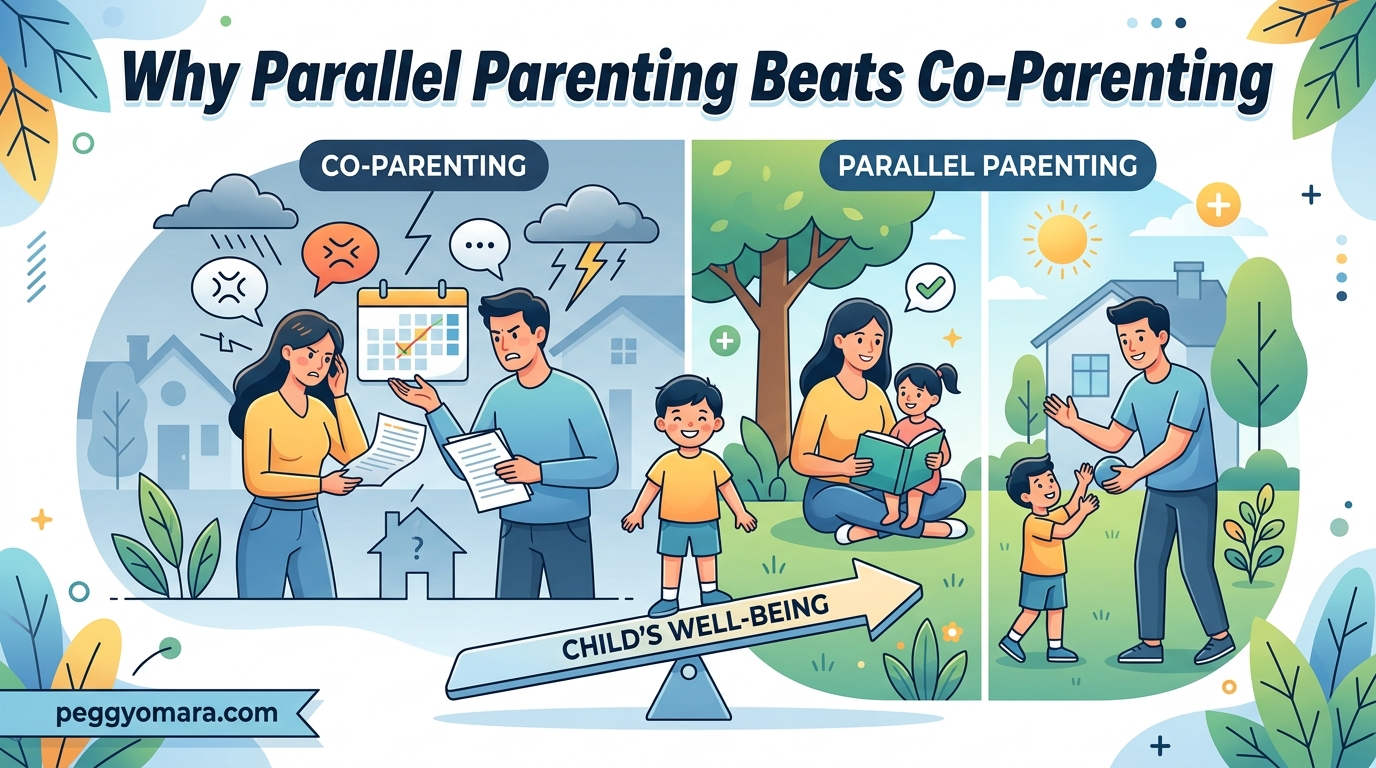
Parallel parenting works better than co-parenting for high conflict exes because it prioritizes what actually matters: your children’s wellbeing. When parents are locked in chronic conflict, research consistently shows that the style of parenting matters far less than shielding kids from that conflict. Parallel parenting creates a structured “firewall” between hostile exes while allowing both parents to remain fully engaged in their children’s lives.
This approach isn’t failure. It isn’t giving up. It’s a research-backed strategy that courts, therapists, and child development experts increasingly recommend for high-conflict situations. In this guide, I’ll explain exactly why parallel parenting outperforms traditional co-parenting when dealing with a difficult ex, and how to implement it successfully.
Table of Contents
What Is the Difference Between Co-Parenting and Parallel Parenting?
Co-parenting and parallel parenting represent two fundamentally different approaches to raising children after separation or divorce. Understanding these differences is crucial because choosing the wrong approach for your situation can cause unnecessary stress and harm to everyone involved.
Co-parenting requires ongoing collaboration, shared decision-making, and frequent communication between both parents. Think joint birthday parties, coordinating bedtimes across households, and discussing school choices together. This approach works beautifully when both parents can communicate respectfully and prioritize their children’s needs over their own conflicts.
Parallel parenting, by contrast, minimizes direct contact and separates decision-making as much as possible. Each parent manages their own household independently, with detailed written agreements about schedules, rules, and boundaries. The goal isn’t collaboration—it’s disengagement that protects children from witnessing parental conflict.
Co-Parenting vs Parallel Parenting: Key Differences
| Aspect | Co-Parenting | Parallel Parenting |
|---|---|---|
| Communication | Frequent, flexible contact (calls, texts, in-person) | Limited to written only (email, apps), business-like tone |
| Decision-making | Joint decisions on major and minor issues | Each parent decides independently during their time |
| Schedule flexibility | Accommodating changes through discussion | Strict adherence to court-ordered or agreed schedule |
| Rules between households | Attempt to maintain consistency | Different rules acceptable at each house |
| School events | Both parents attend together | Parents attend separately or alternate |
| Conflict level required | Works with low to moderate conflict | Designed for high-conflict situations |
The choice between these approaches depends entirely on your specific situation. Co-parenting is ideal when you and your ex can communicate without hostility. Parallel parenting becomes necessary when every interaction escalates into argument, when there is a history of emotional abuse, or when your ex has a high-conflict personality that makes collaboration impossible.
When Co-Parenting Actually Works
Co-parenting succeeds when both parents share similar values, can discuss differences respectfully, and genuinely want what’s best for their children despite their personal grievances. My sister and her ex-husband make co-parenting look effortless. They have dinner together for their daughter’s birthday, coordinate Christmas gifts so there are no duplicates, and can call each other when their teenager is struggling.
This level of cooperation is wonderful when possible, but it’s not realistic for every separated couple. Research from the Institute for Family Studies shows that approximately 30% of divorcing couples experience high conflict that makes traditional co-parenting unworkable. For these families, continuing to attempt co-parenting can actually harm children’s adjustment more than parallel parenting would.
Why Parallel Parenting Works Better Than Co-Parenting for High-Conflict Exes
The fundamental reason parallel parenting outperforms co-parenting in high-conflict situations is simple: it removes the source of harm. Decades of research consistently demonstrate that exposure to ongoing parental conflict damages children’s emotional development, academic performance, and future relationships more than any other factor in divorce.
A landmark NIH study on parallel parenting found that children in high-conflict parallel parenting arrangements showed significantly better adjustment outcomes than children whose parents continued attempting traditional co-parenting. The reason? Parallel parenting shields children from witnessing ongoing hostility while preserving their relationships with both parents.
The Research Is Clear: Conflict Matters More Than Parenting Style
Dr. Edward Kruk, a leading researcher in shared parenting, has published extensively on this topic. His findings consistently show that what harms children isn’t having two households with different rules or limited contact between parents. What harms children is exposure to chronic parental conflict, criticism of the other parent, and being caught in the middle of adult disputes.
When parents fight frequently—whether in person, over the phone, or through hostile emails—children experience elevated stress hormones, anxiety, and depression. They often blame themselves for the conflict or feel forced to choose sides. Parallel parenting eliminates this exposure by creating strict boundaries that keep parental conflict away from children.
The “Firewall” Concept: Protecting Children While Preserving Relationships
Family law professionals often describe parallel parenting as creating a “firewall” between hostile parents. Just like a firewall in computing prevents harmful spread between systems, parallel parenting prevents conflict from spreading between households and affecting children.
This firewall works through several key mechanisms. First, it establishes minimal contact protocols that reduce opportunities for conflict. Second, it uses written communication exclusively, removing the emotional volatility of phone calls or in-person exchanges. Third, it creates detailed agreements that reduce the need for ongoing negotiation. Finally, it accepts that different households can have different rules without either being “wrong.”
Reduced Stress for Everyone Involved
Parents who switch from failed co-parenting attempts to structured parallel parenting consistently report dramatic stress reduction. One parent on a Reddit co-parenting forum described it as “finally being able to breathe again.” Another noted that her anxiety medication dosage decreased significantly after implementing parallel parenting protocols.
This stress reduction isn’t just about parental comfort. Stressed parents make poorer decisions, have less patience with their children, and model unhealthy emotional regulation. When parallel parenting reduces parental stress, children benefit directly through calmer, more present caregiving.
Why Collaboration Fails with High-Conflict Personalities
Here’s a truth that took me years to accept: some ex-partners will never change. High-conflict personalities, including those with narcissistic traits, are neurologically and psychologically incapable of the empathy and compromise required for successful co-parenting. Continuing to attempt collaboration with these individuals creates a cycle of hope, disappointment, and escalating conflict.
Parallel parenting acknowledges this reality rather than fighting it. Instead of trying to change someone who won’t change, it creates structures that work around the conflict. This isn’t defeat—it’s strategic wisdom that protects your children and preserves your own mental health.
Signs You Need Parallel Parenting Instead of Co-Parenting
Recognizing when you’ve crossed the threshold from “difficult co-parenting situation” to “parallel parenting necessity” can be challenging. Many parents spend months or years attempting collaboration before accepting that a different approach is needed. Here are the clear indicators that parallel parenting will serve your family better than continued attempts at traditional co-parenting.
The High-Conflict Checklist: When Parallel Parenting Becomes Essential
If you recognize multiple items from this list in your co-parenting relationship, parallel parenting isn’t just an option—it’s probably necessary for your children’s wellbeing:
- Every conversation with your ex escalates into argument, regardless of how neutrally you begin
- You experience genuine anxiety when you see your ex’s name appear on your phone or in your inbox
- Your ex uses communication as an opportunity to criticize your parenting, your character, or your choices
- Attempts to discuss schedules or decisions consistently result in hostility or stonewalling
- Your ex speaks negatively about you to your children or attempts to use them as messengers
- There is a history of emotional abuse, domestic violence, or controlling behavior in the relationship
- Your ex refuses to follow agreements but expects you to accommodate their last-minute changes
- Your children have witnessed arguments, have expressed anxiety about exchanges, or have asked you to stop fighting
- Communication contains personal attacks, gaslighting, or attempts to rehash the relationship/marriage
- Your ex exhibits narcissistic traits: inability to acknowledge fault, constant victimhood, manipulation, or grandiosity
Experiencing one or two of these occasionally suggests you need better boundaries within co-parenting. Experiencing most of them consistently indicates that parallel parenting is the healthier choice for everyone involved.
The Narcissistic Co-Parent Dynamic
Parallel parenting with a narcissist presents unique challenges that traditional co-parenting cannot address. Narcissistic individuals view their children as extensions of themselves rather than separate individuals with their own needs. They also cannot tolerate any perceived criticism or loss of control, making collaborative parenting structurally impossible.
If your ex displays narcissistic traits—chronic blame-shifting, inability to apologize, using the children to punish you, or creating drama around every interaction—parallel parenting becomes your primary protective strategy. The structured, minimal-contact approach of parallel parenting removes the narcissist’s opportunities for manipulation and control while preserving your relationship with your children.
When There Is a History of Emotional Abuse or Domestic Violence
Following separation from an abusive relationship, traditional co-parenting can retraumatize victims and continue patterns of control. Abusers often use co-parenting requirements as opportunities for ongoing harassment, monitoring, and manipulation. Courts increasingly recognize that parallel parenting—or even supervised exchanges—may be necessary in these situations.
If there is any history of domestic violence, emotional abuse, or coercive control in your relationship, consult with a family law attorney before attempting any parenting arrangement. Many jurisdictions have specific provisions for high-conflict and domestic violence cases that prioritize safety and structured boundaries over collaborative co-parenting ideals.
Communication Strategies That Actually Work in Parallel Parenting
The communication protocols in parallel parenting are fundamentally different from those in co-parenting. Where co-parenting emphasizes flexibility and collaboration, parallel parenting prioritizes structure, documentation, and emotional neutrality. These strategies transform hostile exchanges into manageable transactions.
Email-Only Communication Protocol
The most effective parallel parenting arrangements use written communication exclusively. Email or specialized co-parenting apps create automatic documentation, remove emotional tone, and provide time to compose thoughtful responses rather than reacting in the moment.
Phone calls and in-person conversations are too volatile for high-conflict situations. They allow interruptions, tone escalation, and immediate emotional reactions. Written communication gives you time to breathe, consult your parenting plan, and respond strategically rather than reactively.
One parent on a co-parenting forum described the relief of email-only communication this way: “I no longer dread seeing his name on my phone. I check emails once daily, compose my response when I’m calm, and send it without engaging in hours of back-and-forth. My blood pressure literally decreased.”
The BIFF Method for High-Conflict Communication
Bill Eddy, a therapist and lawyer specializing in high-conflict personalities, developed the BIFF method for communicating with difficult exes. BIFF stands for Brief, Informative, Friendly, and Firm. This framework structures every communication to minimize conflict while maintaining necessary information exchange.
Brief means keeping messages short—ideally five sentences or fewer. Informative means sticking to facts without emotional commentary, opinions, or accusations. Friendly means using a neutral, respectful tone even when you don’t feel friendly. Firm means being clear about your boundaries and what you will or won’t do without being aggressive.
Communication Examples: What Works vs What Doesn’t
Here are specific examples of how to transform typical high-conflict communications using BIFF principles:
Instead of: “You were 20 minutes late again and Emma was crying. You never respect my time and you clearly don’t care about her feelings. This is typical of your selfish behavior.”
Use: “Emma will be ready at 6:00 PM on Friday. Per our agreement, please arrive on time to minimize her stress. Thank you.”
Instead of: “I can’t believe you’re taking her to that stupid concert instead of prioritizing her homework. You always put your wants before her needs.”
Use: “I’ve confirmed Emma’s school project is due Monday. During my parenting time, she’ll complete it Saturday morning. During your parenting time, her homework completion is your decision.”
Instead of: “Stop texting me at 2 AM about nonsense. You’re harassing me and I’ll tell my lawyer.”
Use: “I respond to parenting-related emails during business hours (9 AM-5 PM). Messages outside these times will be addressed the next business day.”
Co-Parenting Apps: Tools for High-Conflict Situations
Several apps are specifically designed for high-conflict co-parenting situations. These tools provide structured communication environments, documentation features, and sometimes even content monitoring that flags hostile language.
OurFamilyWizard is the most established co-parenting app and is court-recommended in many jurisdictions. Features include secure messaging, shared calendars, expense tracking, and an “info bank” for medical records and emergency contacts. The app includes a “ToneMeter” that alerts users when their message may be inflammatory.
TalkingParents offers similar features with an emphasis on documentation. All communications are recorded and can be exported for court proceedings if needed. This accountability often reduces hostile messaging because users know their words may be reviewed by judges or attorneys.
Custody X Change focuses heavily on scheduling and parenting plan management. It’s particularly useful for complex custody arrangements and helps visualize parenting time percentages, which can reduce disputes about schedule compliance.
2houses offers a more collaborative approach with features for sharing children’s moments and updates. While less focused on conflict management than OurFamilyWizard, it works well for parallel parents who want to share information without direct communication.
Business-Like Communication: Treating It Like a Transaction
The most successful parallel parents describe their communication approach as “business-like” or “transactional.” You wouldn’t send an angry, emotional email to a colleague about a work project. You’d send a brief, factual message addressing only the matter at hand.
Apply this same standard to co-parenting communication. Your ex is now your “business partner” in raising your children, but this is strictly a business relationship. Personal feelings, past grievances, and relationship history have no place in these communications.
One forum user put it perfectly: “I pretend I’m writing to the most annoying colleague at work. I keep it polite, factual, and brief. Then I hit send and don’t think about it again. This mindset shift changed everything for me.”
Neutral Exchange Locations
Where and how you exchange children can significantly impact conflict levels. Many parallel parents use “curbside drop-offs” where the receiving parent stays in their car and the child walks between vehicles. This eliminates face-to-face contact entirely.
Public locations also reduce conflict. School is often the ideal exchange location because transitions happen naturally without parents interacting. Libraries, police station parking lots, and supervised exchange centers provide additional neutral options when needed.
Some high-conflict situations require supervised exchanges through professional services. While this adds cost and complexity, it provides complete protection from hostile interactions and creates documentation of any problems.
How to Create a Detailed Parallel Parenting Plan
A parallel parenting plan differs from a standard parenting plan in its level of detail and specificity. Where co-parenting plans can be flexible because parents will communicate and adjust, parallel parenting plans must anticipate every possible scenario and establish clear protocols in advance.
Essential Components of a Parallel Parenting Plan
Your parallel parenting plan should address these key areas with specific details, not general intentions:
Residential Schedule: Define exact pickup and drop-off times, locations, and protocols. Specify who provides transportation under what circumstances. Include detailed holiday schedules several years in advance. Address summer vacation, school breaks, and special occasions like Mother’s Day and Father’s Day.
Decision-Making Authority: Clearly designate which parent makes decisions in specific categories. Medical decisions, educational choices, religious upbringing, and extracurricular activities should each have designated decision-makers or specific protocols for joint decisions.
Communication Protocols: Specify exactly how parents will communicate (email only, specific app, etc.), response timeframes, and what constitutes an emergency requiring immediate contact. Establish rules about communication through children (prohibited) and third parties.
Dispute Resolution: Include a clear process for resolving disagreements without direct conflict between parents. Many plans designate a parenting coordinator or specify that disputes go to mediation rather than court when possible.
Rules and Expectations: While each household can have different rules, some provisions may be appropriate for consistency (bedtimes for young children, homework requirements, screen time limits). Be specific about what is required versus what is each parent’s discretion.
Handling Different Rules at Each House
One of the most liberating aspects of parallel parenting is accepting that different households can have different rules without harming children. Research consistently shows that children adapt well to different expectations in different environments—just as they adapt to different rules at school versus home, or at Grandma’s house.
In my parallel parenting arrangement, my ex allows unlimited video games during his weekends. I maintain strict screen-time limits. Initially, I worried this inconsistency would confuse my children. Instead, they’ve learned that expectations differ by location—a valuable life skill. They know the rules at Mom’s house and the rules at Dad’s house, just as they know school rules differ from home rules.
The key is reframing different rules from “wrong vs right” to simply “different.” Unless a rule genuinely endangers your child (in which case legal intervention may be necessary), let go of controlling the other parent’s household. Your children benefit more from having two calm, disengaged parents than from having consistent rules enforced by hostile, fighting parents.
Managing School Events and Activities
School events present unique challenges for parallel parents. Both parents typically want to attend graduations, performances, and parent-teacher conferences, but shared attendance can create conflict that ruins the event for children.
Several strategies work well for school events:
Alternating Events: Parents take turns attending major events. One parent attends the winter concert, the other attends the spring play. Both can attend if they can commit to neutral, separate seating.
Separate Conferences: Most schools accommodate separate parent-teacher conferences for high-conflict families. Request individual conference times and inform the school of your parallel parenting arrangement.
Separate Seating: When both parents attend the same event, sit in different areas and avoid interaction. One parent might sit near the front, the other near the back. Establish in advance who will take photos, who will bring flowers, etc., to avoid competitive behavior.
Communication with School: Inform teachers and administrators about your parallel parenting situation. Provide both parents’ contact information and specify that information should be sent to both households. Request that school personnel not act as messengers between parents.
When to Involve a Parenting Coordinator
A parenting coordinator is a neutral professional—often a lawyer or mental health professional—appointed by the court to help high-conflict parents implement their parenting plan. This professional can make binding decisions about day-to-day disputes, reducing the need for parents to interact directly.
Parenting coordinators are particularly valuable when parents cannot agree on interpretation of their parenting plan, when frequent minor disputes would otherwise require court intervention, or when one parent consistently violates agreements. They provide faster resolution than court proceedings and reduce legal costs over time.
Not all jurisdictions offer parenting coordinators, and they add ongoing cost to your arrangement. However, for truly high-conflict situations, the investment often pays for itself in reduced stress, fewer court filings, and better outcomes for children.
Parallel Parenting with a Narcissistic or High-Conflict Ex
Parallel parenting with a narcissist requires additional strategies beyond standard parallel parenting protocols. Narcissistic individuals cannot tolerate perceived criticism, must always “win,” and view their children primarily as extensions of themselves rather than separate people. These traits make traditional parallel parenting challenging and sometimes require court intervention.
Understanding Narcissistic Co-Parenting Dynamics
Narcissistic co-parents create conflict through several predictable patterns. They rewrite history to cast themselves as victims. They use the children to punish you or maintain control. They create chaos around every transition or decision point. They cannot acknowledge any parenting choice you make as valid. They triangulate by involving new partners, lawyers, or even the children in conflicts that should stay between adults.
Recognizing these patterns as symptoms of narcissism rather than personal attacks helps you respond strategically rather than emotionally. When your ex sends a cruel email, they’re not actually communicating about the issue at hand—they’re seeking narcissistic supply through your emotional reaction.
The Gray Rock Method
The Gray Rock method—becoming as uninteresting and unresponsive as a gray rock—is essential when parallel parenting with a narcissist. This means providing absolutely no emotional reaction to provocation. Narcissists thrive on drama and emotional responses; depriving them of this “supply” often reduces their attacks over time.
Gray Rock communication is brief, boring, and transactional. You respond only to logistical content, never to emotional bait. If your ex sends a three-paragraph email attacking your character before asking about a schedule change, you respond only to the schedule question with a single sentence.
One parent on a high-conflict forum described Gray Rock this way: “I respond like I’m an automated system. ‘Request acknowledged. Child will be ready at 6 PM Friday.’ No emotions, no defense, no engagement with the attacks. Eventually, he stopped sending the attacks because I wasn’t giving him what he wanted.”
Dealing with Boundary Violations
High-conflict and narcissistic co-parents frequently violate boundaries—showing up unannounced, calling repeatedly outside agreed times, sending hostile messages, or attempting to control your household through the children. Document every violation meticulously. Screenshot texts, save emails, and keep a detailed log with dates and times.
Respond to violations using the BIFF method and your established parenting plan. Reference specific plan provisions and state the expected behavior without emotional commentary. If violations continue, consult your attorney about enforcement options. Some violations may warrant police involvement (trespassing, harassment) or court action (contempt proceedings).
Protect your children from boundary violations by not discussing them with your kids. If your ex sends inappropriate messages through your child, address it directly with your ex via the established communication channel without involving the child further. Let your children know they are not responsible for delivering adult messages.
Can Parallel Parenting Transition to Co-Parenting?
Many parents wonder if parallel parenting is permanent or if it can eventually evolve into more collaborative co-parenting. The answer depends entirely on your specific situation, your ex’s personality and behavior, and whether genuine healing occurs over time.
Timeline Expectations: How Long Before Reassessment?
Forum discussions and professional guidance suggest that parallel parenting typically requires at least one to two years before any meaningful reassessment. The first year post-divorce is often the most volatile as emotions remain high and new patterns are being established. Attempting to increase contact or collaboration too early usually backfires.
Some parents report that it took three to five years before any genuine improvement in the co-parenting relationship occurred. Others note that their parallel parenting arrangement remained essentially unchanged for a decade or more. The timeline depends heavily on whether your ex has a high-conflict personality (relatively unchangeable) versus situational conflict that may resolve with time and healing.
Signs That Improvement May Be Possible
Certain positive indicators suggest that gradual increases in collaboration might succeed:
- Your ex consistently follows the parenting plan without violations for six months or longer
- Communication has become genuinely neutral and business-like without hostility
- Both parents have established new relationships or life stability that reduces resentment
- Your ex acknowledges their role in past conflicts (rare with narcissists, but possible with situational conflict)
- Children report positive experiences with both parents and no anxiety about transitions
- Both parents independently express interest in more flexible arrangements
Even with these positive signs, increase collaboration gradually. Start with small changes—a single joint attendance at a school event, or flexibility on one schedule adjustment. Monitor carefully for regression. If increased contact triggers renewed hostility, return to stricter parallel parenting immediately.
Realistic Expectations for High-Conflict Situations
Here’s a difficult truth that took me years to accept: some ex-partners will never become cooperative co-parents regardless of how much time passes or how hard you try. High-conflict personalities, including those with narcissistic traits, do not fundamentally change. Parallel parenting may be the best possible arrangement for the entire childhood.
This isn’t pessimism—it’s acceptance that liberates you from the exhausting cycle of hope and disappointment. Parallel parenting that provides children with stable, conflict-free relationships with both parents is a success, not a failure. You don’t need to graduate to co-parenting to prove you’ve done divorce “right.”
Focus on the quality of your individual relationship with your children rather than the quality of your relationship with your ex. Your children don’t need parents who are friends. They need parents who don’t fight, who show up consistently, and who provide stable, loving homes—even if those homes operate on entirely different systems.
Frequently Asked Questions
Is co-parenting or parallel parenting better?
For low-conflict divorced parents, co-parenting offers better flexibility and collaborative decision-making. For high-conflict situations involving hostile exes, emotional abuse, or narcissistic dynamics, parallel parenting is significantly better because it protects children from ongoing parental conflict. Research from the NIH shows that shielding children from conflict matters more than parenting style. The ‘better’ approach depends entirely on your specific situation and the level of conflict between parents.
What are the downsides of parallel parenting?
The main downsides include less flexibility for schedule changes, potentially different rules between households that require children to adapt, limited ability to coordinate on major decisions, and the possibility of remaining stuck in conflict patterns if both parents don’t commit to the structure. Some parents also worry that minimal contact prevents healing. However, for high-conflict situations, these downsides are typically outweighed by the benefits of reduced stress and protected children.
Is parallel parenting healthy for children?
Yes, research consistently shows parallel parenting is healthy for children when the alternative is ongoing parental conflict. The NIH found that children in high-conflict parallel parenting arrangements showed better adjustment outcomes than children whose parents continued attempting traditional co-parenting. What harms children isn’t different rules at each house or limited parent contact—it’s exposure to chronic conflict, criticism of the other parent, and being caught in the middle. Parallel parenting protects children from these harms.
What is the 7 7 7 rule for parents?
The 7-7-7 rule suggests that parents should consider whether a concern will matter 7 minutes from now, 7 hours from now, or 7 days from now. If it won’t matter in any of those timeframes, let it go. This rule helps parallel parents avoid unnecessary conflict by distinguishing genuine issues requiring communication from minor differences in parenting style that don’t actually impact children’s wellbeing. It encourages focusing on truly important matters while accepting differences in day-to-day household management.
What is the 30% rule in parenting?
The 30% rule suggests that children need at least 30% of their time with each parent to maintain meaningful relationships after divorce or separation. This concept, supported by research from the Institute for Family Studies, indicates that parenting time below this threshold makes it difficult for children to bond with and feel connected to the non-custodial parent. Both parallel parenting and co-parenting can achieve this threshold; the structure matters less than ensuring adequate time with both parents.
How do you handle school events with parallel parenting?
Parallel parents handle school events through several strategies: alternating attendance at major events, arranging separate parent-teacher conferences, sitting in different areas when both attend the same event, or using separate events when possible (one parent attends the concert, the other attends the play). The key is advance planning and neutral behavior during events. Inform schools about your parallel parenting arrangement so they can accommodate separate communications and conferences without putting you in uncomfortable situations.
What co-parenting apps work best for high-conflict situations?
OurFamilyWizard is the most court-recommended app for high-conflict situations, featuring secure messaging, ToneMeter that flags inflammatory language, and extensive documentation. TalkingParents offers similar features with emphasis on record-keeping for legal proceedings. Custody X Change excels at complex scheduling and parenting plan visualization. 2houses provides a more collaborative environment for sharing moments. The best choice depends on your specific needs, budget, and whether your court has preferences. All these apps provide structure that reduces opportunities for hostile communication.
Can parallel parenting work long-term?
Yes, parallel parenting can work long-term and often does for high-conflict situations. Many parents maintain parallel parenting arrangements throughout their children’s minor years, gradually adjusting only as children mature and gain more autonomy. Some families eventually transition to more collaborative co-parenting if conflict genuinely resolves, but this typically takes 2-5 years minimum. Long-term parallel parenting is a valid, healthy arrangement when it provides children with stable, conflict-free relationships with both parents. The goal is children’s wellbeing, not a specific co-parenting structure.
Conclusion: Parallel Parenting Is a Valid Choice, Not a Failure
Parallel parenting works better than co-parenting for high conflict exes because it recognizes a fundamental truth: protecting children from ongoing parental conflict matters more than any idealized version of post-divorce collaboration. The research is clear. The real-world experiences of thousands of parents confirm it. When hostility between exes is chronic and unresolvable, parallel parenting isn’t second-best—it’s the healthiest choice available.
If you’re struggling with a high-conflict co-parenting situation, know that choosing parallel parenting doesn’t mean you’ve failed at divorce or that you’re giving up on your children’s wellbeing. It means you’re making a strategic, research-backed decision to prioritize what actually matters: their emotional safety and your own capacity to parent effectively without constant stress and anxiety.
Your children don’t need parents who are friends. They need parents who don’t fight in front of them, who show up consistently, and who provide stable, loving homes. Parallel parenting makes this possible even when the adults involved cannot peacefully coexist. That’s not failure. That’s wisdom—and your children will benefit from it for years to come.