
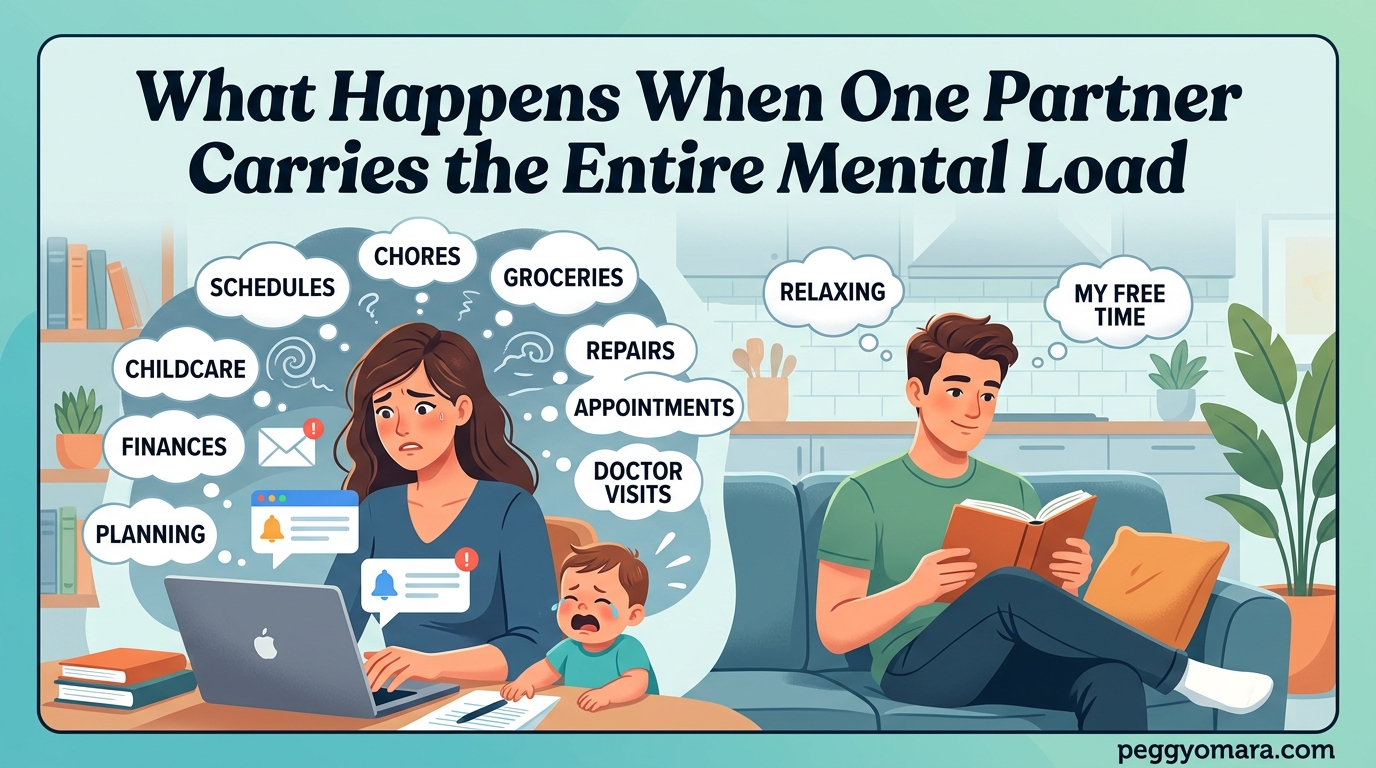
It is 11 PM and you are finally sitting down after a day that started at 6 AM. Your partner is beside you, scrolling through their phone, relaxed and ready for bed. You, however, are running through tomorrow’s logistics in your head. You need to remember that permission slip, schedule the dentist appointment, buy groceries for the weekend, and check if your mother-in-law’s birthday gift arrived. Your partner asks why you seem stressed. You say you are fine. But you are not fine. You are carrying the entire mental load, and it is slowly eroding your marriage from the inside out.
The mental load in marriage is not about who washes the dishes or folds the laundry. It is about who notices that the dishes need washing and plans when it will happen. It is about the invisible, exhausting work of managing a household and family – the constant planning, organizing, remembering, and anticipating that keeps daily life running smoothly. When this load falls disproportionately on one partner, the effects can be devastating.
In this article, I will explain what the mental load truly means, the warning signs that you are carrying too much, and exactly what happens to a marriage when this imbalance persists. I will also share concrete strategies for rebalancing the load, drawn from both research and real experiences shared by couples who have walked this path. Whether you are feeling exhausted and unseen or trying to understand why your partner seems distant, this guide will help you recognize the patterns and take steps toward a more balanced partnership.
Table of Contents
What Is the Mental Load in Marriage?
The mental load is the invisible, ongoing cognitive work of managing a household and relationship. It is the mental labor of planning meals, remembering appointments, anticipating needs, and coordinating logistics. Research published in the Journal of Business and Psychology confirms that women consistently report higher levels of mental load than men, even in dual-income households where physical chores appear to be shared equally.
Think of the mental load as being the project manager of your household while your partner is a team member who only completes assigned tasks. The project manager knows every deadline, anticipates every problem, and coordinates every moving part. The team member simply shows up and does what they are told. This dynamic might seem efficient on the surface, but it creates a profound inequality in emotional labor and psychological burden.
The Three Types of Mental Load
Understanding the mental load requires recognizing that it actually consists of three distinct but interconnected components. Each type drains energy in different ways, and together they create the exhaustion that so many partners describe.
The Managerial Load involves planning, organizing, and delegating household tasks. This is the work of creating the grocery list, scheduling the plumber, deciding what to cook for dinner, and determining who will pick up the children from school. It is the executive function of running a home – the constant decision-making that keeps everything functioning.
The Cognitive Load is the remembering and tracking. It is knowing that you are almost out of milk, that the car needs an oil change in two weeks, that your child’s favorite shirt is in the dryer, and that you promised to call your aunt back. This load never turns off. Even during supposed downtime, your brain is running background processes, monitoring the household systems like a server that never sleeps.
The Emotional Load encompasses the relationship maintenance and emotional support work. It is noticing when your partner seems stressed and asking what is wrong. It is remembering to buy a birthday card for your mother-in-law because you know it matters to your spouse. It is managing your children’s emotional needs, helping them process their feelings, and maintaining family harmony. This labor is perhaps the most invisible because it looks like natural nurturing, but it requires significant psychological resources.
Signs You’re Carrying the Entire Mental Load
Recognizing that you are carrying an unfair share of the mental load is the first step toward change. Many people normalize their exhaustion, believing that this is simply what motherhood or marriage requires. But the following signs indicate an imbalance that needs attention.
1. You cannot switch off, even during downtime. Vacations do not feel relaxing because you are still managing the logistics. Weekends are not restorative because you are coordinating schedules and anticipating needs. Your brain never gets to rest.
2. You feel like the project manager of your household. You are the one who knows what needs to happen, when it needs to happen, and who needs to do it. If you stopped reminding and coordinating, things would fall apart.
3. Your partner assumes tasks are simply taken care of. They never wonder who bought the birthday gift, scheduled the appointment, or remembered the permission slip. These things just happen, magically, without any visible labor.
4. You are the one who always has to ask for help. Your partner rarely anticipates what needs doing. Instead, they wait for you to identify the problem and request assistance. This puts the burden of management on you, even when they are willing to help.
5. You feel unseen and unappreciated for invisible labor. When you mention being tired or overwhelmed, your partner points to the physical tasks they completed. They do not see the mental juggling that happens behind the scenes.
6. Resentment is building, even if you have not named it yet. You find yourself feeling irritable with your partner. Small things they do bother you disproportionately. You may not realize it, but this is likely accumulated resentment from months or years of carrying the invisible load.
What Happens to a Marriage When One Partner Carries the Mental Load
When one partner carries the entire mental load, the effects on a marriage are not immediate. Instead, they unfold in stages over months and years, gradually transforming a loving partnership into something strained and distant. Understanding this timeline helps couples recognize where they are and what is at stake if nothing changes.
Stage 1: The Slow Build of Resentment
In the beginning, the imbalance feels like small irritations. You notice that you are always the one who remembers to buy toilet paper. You feel a flash of annoyance when your partner asks what is for dinner, as if meal planning is not also work. These moments seem minor, so you dismiss them.
But the resentment accumulates. Each time your partner enjoys leisure time while you are mentally running through to-do lists, a small weight adds to your emotional burden. You start keeping a mental scorecard, noting all the invisible work you do that goes unacknowledged. According to forum discussions, many partners report feeling dismissed when they try to express their exhaustion. Their partner counters that they do just as much, pointing to visible tasks while ignoring the invisible management behind them.
By the end of this stage, which typically lasts one to two years, you feel fundamentally unseen. The person who is supposed to know you best does not recognize the weight you carry. This is the beginning of emotional distance.
Stage 2: Emotional Distance and Intimacy Decline
As resentment deepens, intimacy suffers. You may find yourself avoiding physical closeness because you feel emotionally disconnected from your partner. They start to feel like a roommate rather than a romantic partner – someone who shares space and splits bills but does not truly share the emotional labor of life.
Communication patterns shift. Conversations become transactional – about logistics and schedules rather than dreams and feelings. You may stop sharing your inner world because it feels like your partner does not understand the reality you navigate daily. Meanwhile, they sense your withdrawal but cannot name what is wrong.
This stage, typically occurring in years two to five of the imbalance, is where many couples seek counseling. The distance has become painful, but the root cause remains invisible. Partners often describe feeling like they are drifting apart without understanding why.
Stage 3: Burnout and Relationship Crisis
Without intervention, the chronic stress of carrying the entire mental load leads to burnout. You may experience physical symptoms – headaches, digestive issues, insomnia, or frequent illness. Emotionally, you feel numb or irritable. The exhaustion is no longer situational; it has become your baseline state.
At this stage, which can emerge five or more years into the imbalance, the marriage enters crisis. You may seriously consider separation or divorce. The thought of continuing to manage everything alone for decades feels impossible. You may fantasize about living alone, not because you do not love your partner, but because the idea of managing one less person’s needs sounds like relief.
Research on marriage and divorce consistently identifies resentment and emotional distance as key predictors of relationship dissolution. When the mental load creates these conditions, it becomes a direct threat to the marriage’s survival.
The Long-Term Impact on Children
For parents, the mental load imbalance carries an additional consequence. Children are always watching and learning about relationships from their parents. When they observe one parent constantly stressed and managing everything while the other relaxes and responds to requests, they internalize these patterns.
Daughters may learn to become the project managers of their future households, replicating the cycle. Sons may learn to expect that a partner will handle the invisible labor for them. Neither outcome serves the next generation’s ability to build equitable partnerships.
Some parents realize the imbalance is a problem precisely because they see their children starting to replicate it. A mother notices her son assuming his sister will organize group activities. A father sees his daughter taking charge of all household planning. These observations can become powerful motivation for change.
The Parenting Mental Load: Why It Feels Different
For parents, the mental load takes on additional dimensions that make it particularly exhausting. It is not just about household management; it is about the emotional and developmental well-being of your children. This layer adds complexity and stakes that amplify the burden.
The parenting mental load includes knowing each child’s developmental needs, tracking their emotional states, and anticipating challenges before they arise. It is remembering which child is struggling with friendship issues at school, who needs extra support before a test, and which one has been showing signs of anxiety. This emotional attunement requires constant mental bandwidth.
There is also the administrative load of modern parenting. School forms, activity registrations, doctor appointments, dentist visits, teacher conferences, and birthday party logistics. One parent often becomes the default administrator, managing the family calendar and ensuring nothing falls through the cracks.
For breastfeeding mothers, the mental load intertwines with physical demands in ways that are impossible to separate. Night feedings, pumping schedules, and concerns about supply create a 24-hour cognitive load that cannot be fully shared. Even the most supportive partner cannot take on the mental burden of wondering if the baby is getting enough milk.
Many mothers describe the parenting mental load as feeling like they have a browser with fifty tabs open in their brain at all times. Each tab represents a child, a task, a worry, or a reminder. Closing one tab just reveals another. This constant cognitive load is why many parents feel they cannot think clearly or remember things – their mental RAM is fully occupied.
How to Rebalance the Mental Load in Your Marriage
The good news is that mental load imbalance can be corrected. It requires honest conversation, systemic changes to how your household operates, and patience as new patterns establish themselves. Here are concrete strategies that have worked for couples who successfully rebalanced their partnership.
Start the Conversation Without Blame
Many attempts to address mental load fail because partners become defensive. The partner carrying less load may feel attacked and respond by listing all the physical tasks they do. To avoid this, frame the conversation around your experience rather than their failures.
Try saying something like: “I have been feeling overwhelmed lately, and I realized it is not just the tasks I do. It is that I am constantly thinking about what needs to happen next. My brain never gets to rest. I would like us to figure out how to share that mental work, not just the physical chores.” This invites collaboration rather than triggering defensiveness.
Choose a neutral moment when neither of you is stressed or tired. Avoid bringing this up in the middle of a conflict about chores. You want your partner to be able to hear and process what you are saying, not feel ambushed.
Make the Invisible Visible
One of the biggest barriers to change is that the mental load is invisible by definition. Your partner cannot see what you are tracking in your mind. To address this, you need to externalize the work.
Try keeping a shared list for one week where you write down every single thing you think about, plan, remember, or coordinate related to your household and family. Include everything from “remembered to buy toilet paper” to “scheduled the pediatrician appointment” to “noticed partner seemed stressed and asked about it.” At the end of the week, review the list together. Most partners are genuinely shocked by the volume of invisible labor.
Implement shared planning systems that make the mental load visible and distributed. A shared family calendar where both partners are responsible for adding their commitments. A weekly check-in meeting to review the week ahead and divide responsibilities. A shared task management app where you both see what needs to happen.
These systems serve two purposes. They distribute the cognitive load so one person is not the sole rememberer. They also make the work visible so both partners can see and appreciate what is being managed.
Redefine What Ownership Means
The goal is not just to delegate tasks but to transfer full ownership of domains. When your partner truly owns an area, they do not just execute – they manage. They notice what needs doing, plan when it will happen, and ensure it gets done without your involvement.
Start by assigning your partner complete ownership of specific domains. For example, they might take full responsibility for all meal planning and grocery shopping. This means they decide what to cook, create the list, buy the food, and ensure ingredients are available. They do not ask you what is for dinner or what to buy. They own the entire domain.
Other domains might include managing the children’s activities, handling car maintenance, or planning social engagements. The key is that these are not tasks you delegate one at a time. They are areas your partner fully manages, freeing up those mental tabs in your brain.
Be patient during the transition. Your partner will make mistakes and miss things at first. Resist the urge to take back control. If they forget to buy an ingredient, let them figure out an alternative. This is how they learn to anticipate and plan. Taking over when things go wrong teaches them to rely on you rather than developing their own systems.
When to Seek Professional Help
Sometimes couples cannot rebalance the mental load on their own. The resentment has become too deep, communication patterns are too entrenched, or one partner is unwilling to acknowledge the problem. These are signs that professional support may be needed.
Consider couples therapy if you have tried to discuss the mental load multiple times but your partner becomes defensive or dismissive. A therapist can help facilitate the conversation in a way that both partners feel heard. They can also help uncover deeper issues that may be contributing to the imbalance.
Individual therapy can also be valuable, particularly if you are experiencing burnout. A therapist can help you process resentment, set boundaries, and develop strategies for self-care even within an unequal partnership. Sometimes one partner working on themselves creates shifts in the relationship dynamic.
Support groups for mothers or parents can provide validation that you are not alone in this experience. Hearing from others who have faced similar imbalances – and successfully addressed them – can provide both comfort and practical strategies. Many forums and community groups exist both online and in person.
Remember that seeking help is a sign of strength, not failure. The most successful marriages are those where partners recognize when they need outside perspective and are willing to invest in their relationship’s health.
Frequently Asked Questions
Conclusion
What happens to a marriage when one partner carries the entire mental load? Over time, the invisible work of managing a household transforms from a source of stress into a relationship threat. Resentment builds, intimacy fades, and partners who once felt like lovers become roommates. For parents, the stakes are even higher – children learn from what they observe, potentially replicating unequal patterns in their own future relationships.
But this outcome is not inevitable. The couples who successfully navigate mental load imbalance share common traits: they name the problem honestly, they create systems to distribute the cognitive work, and they commit to change even when it feels uncomfortable. The partner who has carried the load must learn to let go of control. The partner who has carried less must learn to anticipate and own rather than simply help.
If you recognize yourself in this article, know that change is possible. Whether you are at the beginning stages of imbalance or deep into years of resentment, the strategies outlined here can help you rebuild a partnership based on true equity. Your marriage deserves the effort. Your well-being demands it. And your family’s future health may depend on it.
Start today. Have the conversation. Make the invisible visible. Reclaim your partnership from the burden of unequal mental load.