
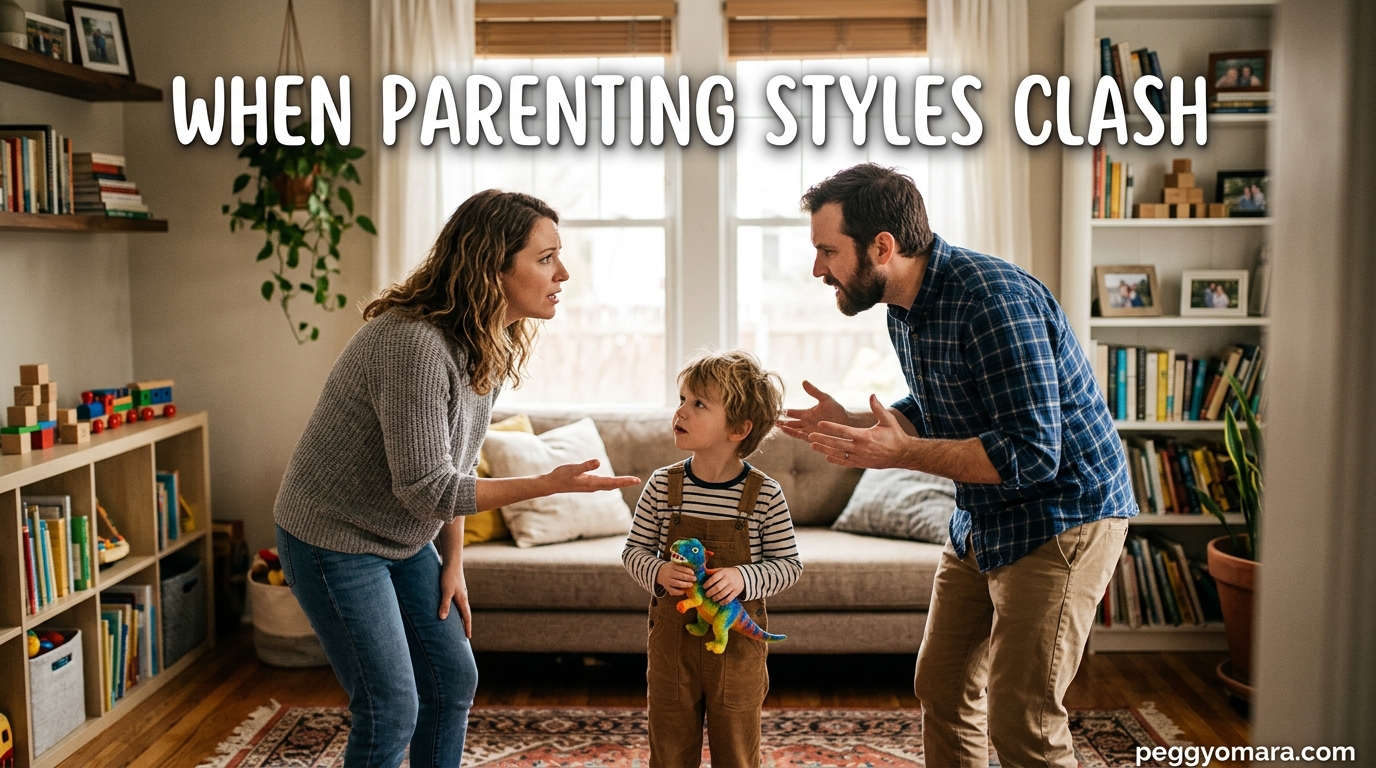
Your partner just gave the kids extra screen time after you explicitly said no. Again. You feel the familiar heat rising in your chest, the mental tally mark scratching in your head. When parenting styles clash, finding common ground without keeping score can feel like trying to choreograph a dance when you are both listening to different songs.
I have worked with dozens of families navigating this exact struggle. The research tells us that about two-thirds of couples experience significant parenting disagreements, yet most articles miss the deeper issue. It is not just about different styles—it is about the resentment that builds when parents start tracking who wins and who loses.
This guide will walk you through practical strategies to bridge your parenting differences while protecting your relationship from the score-keeping trap.
Table of Contents
Why Parenting Alignment Matters for Your Child and Relationship
Children are emotional sponges. Even when you think you are hiding your disagreements, your kids pick up on the tension, the eye rolls, the sighs, and the subtle undermining that happens in the moment.
Research from the University of Michigan shows that inconsistent parenting styles create confusion and anxiety in children. When one parent is highly structured while the other is permissive, children struggle to understand expectations. This inconsistency can lead to behavioral issues, increased testing of boundaries, and even attachment challenges.
The impact goes beyond the kids. Every unresolved parenting disagreement leaves a small mark on your relationship. Over time, these marks accumulate into real resentment. You start keeping a mental ledger of who gets their way, who carries the discipline burden, and whose approach the kids prefer. That resentment erodes the partnership that brought you into parenting together in the first place.
Understanding Where Your Parenting Differences Come From
The Unconscious Programming of Your Upbringing
We parent largely based on how we were parented. These patterns run deep, often operating below conscious awareness. When your partner does something that triggers you, it is often because it clashes with your internal programming about what good parenting looks like.
Developmental psychologist Diana Baumrind identified four main parenting styles that help explain these differences. Authoritative parents combine warmth with clear boundaries. Authoritarian parents focus on obedience and rules with less warmth. Permissive parents are highly nurturing but provide few limits. Uninvolved parents offer neither warmth nor structure.
Most parents naturally gravitate toward the style they experienced as children, or they swing hard in the opposite direction to avoid repeating their own upbringing. Understanding this helps depersonalize the conflict. Your partner is not wrong—they are just working from a different blueprint.
The Keeping Score Trap
Keeping score happens when parents track parenting decisions as wins and losses. You let the kids have dessert before dinner, so your partner decides tomorrow’s screen time rules without consulting you. You enforce a strict bedtime, so your partner extends it to score points with the kids.
This tit-for-tat approach turns parenting into a competition. It models unhealthy conflict resolution for your children and destroys the trust between you and your partner. The scoreboard never balances. Instead, it becomes a wall between you.
Stopping the score-keeping requires a fundamental shift from competition to collaboration. It means both parents must be willing to find solutions where neither fully wins or loses, but the family as a whole benefits.
8 Strategies for Finding Common Ground Without Keeping Score
1. Create a Signal Word for Real-Time Pauses
When your partner undermines you in front of the kids, you need a way to pause without escalating the conflict. Choose a neutral word or phrase together—something like pineapple or let’s revisit this—that signals you need to table the discussion for later.
This signal word works because it interrupts the reactive cycle. Instead of defending your position or shooting eye daggers across the room, you have a pre-agreed exit strategy. The kids see unity, not division. You buy time to address the issue privately.
Practice using the signal word when things are calm first. Role-play a scenario where you disagree. Make sure both partners feel comfortable using it and responding to it without defensiveness.
2. Keep All Parenting Disagreements Private
Never contradict or challenge your partner’s parenting in front of the children. This rule sounds simple, but it requires tremendous discipline in heated moments. When you override your partner in real-time, you teach your kids that one parent’s authority is negotiable.
If your partner makes a decision you disagree with, support it in the moment. Tell your child, Your father and I will discuss this together and get back to you. Then have that conversation later, away from little ears.
This approach maintains the united front that children need for security. It also shows your kids that you respect each other, even when you disagree. That modeling is worth more than winning any single parenting battle.
3. Identify Your Shared Values Beneath the Differences
Most parenting conflicts happen at the surface level—bedtimes, snacks, screen time. Underneath these daily battles, parents usually share core values. Both of you want your children to be safe, kind, resilient, and loved.
Sit down together and list your non-negotiable values. What kind of adults do you hope to raise? What qualities matter most? When you anchor your parenting discussions in shared values, the surface conflicts become solvable.
For example, if you both value independence but disagree on bedtime rules, you can design an approach that builds independence within age-appropriate boundaries. The values stay constant even as the methods evolve.
4. Create Third Way Solutions
Third way solutions honor both parents’ approaches without fully adopting either. Instead of your way or my way, you create our way. These solutions require creativity and genuine compromise from both partners.
If one parent wants strict homework time immediately after school and the other prefers free play first, try this. Set a timer for 30 minutes of outdoor play, then transition to homework. Neither parent gets exactly what they wanted, but both values—physical activity and academic focus—get honored.
Third way solutions work best when framed as experiments. Try the compromise for two weeks. Check in and adjust. This keeps the solution flexible rather than creating new rigid rules to battle over.
5. Divide and Conquer by Playing to Strengths
Stop trying to parent identically. You and your partner have different strengths, backgrounds, and temperaments. Instead of forcing uniformity, divide parenting domains based on who handles what best.
If your partner has infinite patience for bedtime stories but you excel at morning routines, own those spaces. If one of you connects better with the teenager about social drama while the other handles homework support, respect those natural affinities.
This division prevents the score-keeping that comes from comparing who does parenting better. You are both contributing fully, just in different arenas. Regular check-ins keep this balanced over time so one parent does not end up carrying all the emotional labor.
6. Use the 48-Hour Rule for Big Decisions
Major parenting decisions need a cooling-off period. New rules about phones, discipline approaches, school choices, or family policies should sit for 48 hours before implementation. This prevents reactive decision-making in the heat of conflict.
The 48-hour rule gives both parents time to research, reflect, and consider perspectives they might have dismissed initially. It also naturally reduces the keeping score dynamic because neither parent wins a snap decision.
During the waiting period, each parent should prepare a one-paragraph case for their position. What value does your approach serve? What concerns do you have about the alternative? Present these calmly when you reconvene.
7. Schedule Regular Parenting Check-Ins
Waiting until you are angry to discuss parenting is a recipe for conflict. Instead, schedule weekly or bi-weekly parenting meetings. Keep them short—20 minutes max. Start each meeting by sharing one thing the other parent did well that week.
Use this time to review what is working and what needs adjustment. Address small irritations before they become resentments. Celebrate the third way solutions that are succeeding.
Make these meetings non-negotiable. Put them on the calendar like any other important appointment. Consistency here models for your children that your partnership deserves protected time and attention.
8. Have an Emergency Reset Plan for In-the-Moment Undermining
Despite your best intentions, undermining will happen. Your partner will cave on a boundary you set. You will contradict their discipline in front of the kids. When this happens, you need a repair protocol.
First, take a breath and let the moment pass. Do not try to correct it in real-time with children present. Second, when you are alone, lead with vulnerability. I realized I undermined you earlier, and I am sorry. That sets a collaborative tone instead of a defensive one.
Third, create a shared narrative for the kids if needed. We talked about the screen time rule, and we realized we need to clarify it together. You will hear our decision at dinner. This shows children that mistakes happen and can be repaired through communication.
Special Considerations for Blended Families
Blended families face amplified parenting style challenges. When a step-parent enters with different approaches, children may feel confused about authority and loyalty. Biological parents may feel protective of their bond with children, resisting any approach that feels like an outsider’s influence.
The key in blended families is respecting the biological parent’s primary authority while gradually building the step-parent’s role. Early in the blending process, the biological parent should handle discipline while the step-parent focuses on relationship-building. Over time, as trust develops, the step-parent can take on more parenting responsibilities.
Consistency across households adds another layer of complexity. If you are co-parenting with an ex who has radically different rules, focus on what you can control in your own home. Create stability within your four walls rather than battling rules you cannot change elsewhere. Your children will adapt to different expectations in different spaces—it is not ideal, but it is manageable.
When to Seek Professional Support
Some parenting conflicts require outside help. Consider working with a parent coach, family therapist, or couples counselor if you recognize these red flags. Parenting disagreements have become the primary source of conflict in your relationship. You find yourself dreading your partner coming home because of how they will handle the kids. Your children are showing signs of anxiety, behavioral regression, or manipulation between parents.
One parent refuses to discuss or compromise on any parenting decisions. You have tried multiple strategies for months with no improvement. The resentment has built to a point where you question the relationship itself.
Professional support does not mean you have failed. It means you are committed enough to your family to get expert guidance. A neutral third party can help you see patterns you are too close to recognize and teach communication skills specific to parenting conflicts.
Parent coaching specifically focuses on helping couples develop shared approaches. Unlike therapy, which often explores past issues, coaching is forward-focused and practical. Many coaches offer virtual sessions, making support accessible regardless of location.
Frequently Asked Questions
What to do when parenting styles clash?
Start by having private conversations away from your children. Identify the shared values beneath your differences. Create third way solutions that honor both approaches rather than having one parent win. Use a signal word when you need to pause a discussion for later. Schedule regular check-ins to prevent small issues from becoming major conflicts. Consider professional support if disagreements are affecting your relationship or your child’s well-being.
What are inconsistent parenting styles?
Inconsistent parenting styles occur when two parents use dramatically different approaches to discipline, boundaries, and daily rules. For example, one parent may enforce strict bedtimes and limited screen time while the other allows flexibility with few consequences. Research shows this inconsistency can create confusion, anxiety, and behavioral issues in children because they cannot predict expectations or understand which rules are real.
How do I stop keeping score in parenting?
Keeping score happens when parents track parenting decisions as wins and losses. To stop, shift from a competitive mindset to a collaborative one. Celebrate when your partner handles something well instead of tallying who does more. Focus on the family as a team where everyone contributes differently. Use regular check-ins to address imbalances before they become resentments. Remind yourself that your partner’s different approach does not invalidate your own.
What should I do when my partner undermines me in front of the kids?
Have a pre-agreed signal word that pauses the conflict without escalating it. Support your partner’s decision in the moment, then discuss privately later. When you talk, lead with vulnerability rather than blame. Create a repair plan for when undermining happens, including apologizing to each other and presenting a united explanation to the children. If undermining becomes a pattern, consider professional support to address the deeper dynamics.
When Your Parenting Styles Clash, Finding Common Ground Without Keeping Score Is Possible
Parenting differences do not have to divide you. They can become opportunities to model for your children how two people with different perspectives can collaborate, compromise, and grow together. The goal is not perfect alignment—it is respectful partnership.
Start with just one strategy from this guide. Pick the one that feels most doable in your current situation. Maybe it is the signal word for pausing conflicts. Maybe it is the weekly check-in. Small changes build momentum and trust over time.
Remember that both you and your partner want what is best for your children. You are on the same team, even when it feels like you are playing by different rulebooks. Drop the scorecard. Pick up collaboration. Your relationship—and your children—will be better for it.