
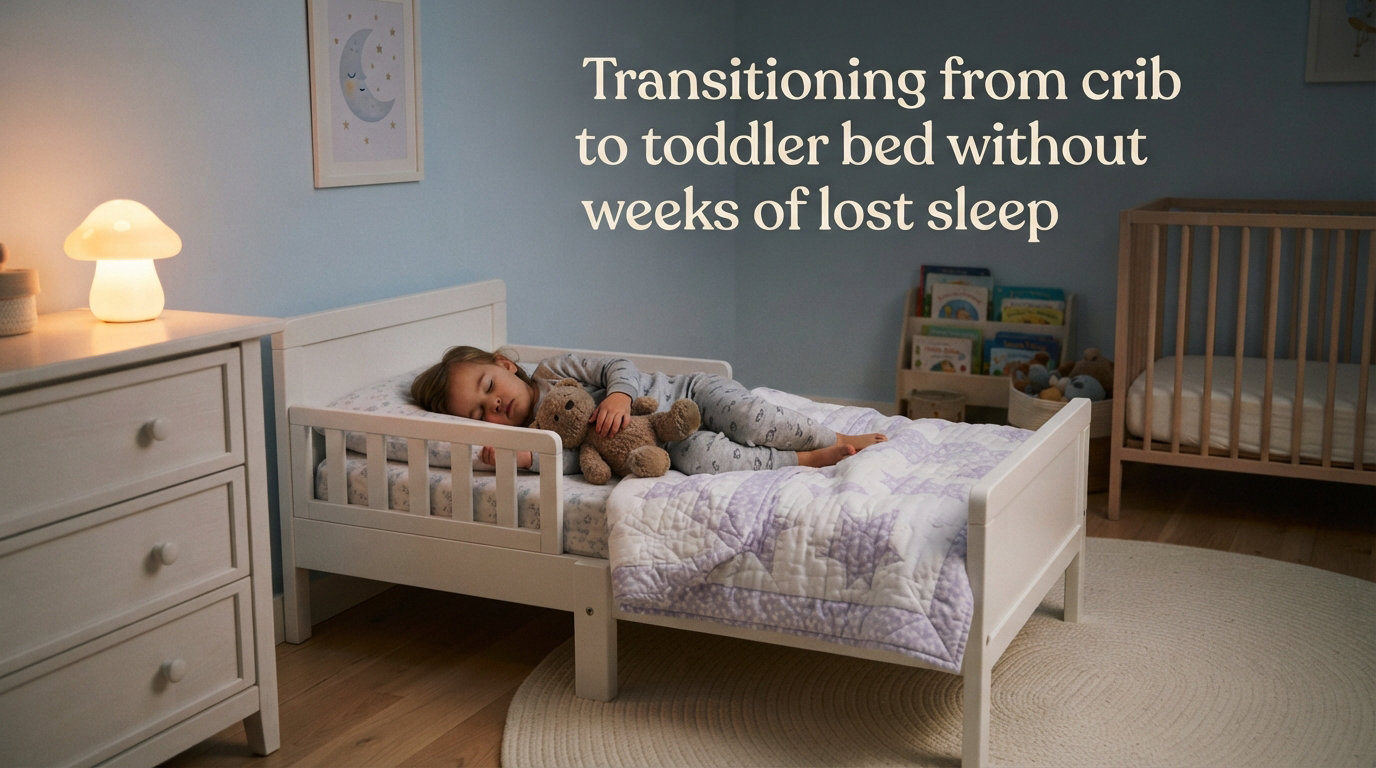
Moving your toddler from a crib to a big kid bed is one of those parenting milestones that sounds simple until you are actually doing it. I have been through this transition three times with my own children, and I have learned that timing and preparation make the difference between a smooth two-week adjustment and months of bedtime battles.
The good news? Transitioning from crib to toddler bed does not have to mean weeks of lost sleep. When you wait until your child is developmentally ready and follow a structured plan, most families see consistent sleep return within 2 to 3 weeks.
Research published in the journal Sleep Medicine shows that children who transition closer to age 3 experience fewer night wakings and bedtime struggles compared to those who move earlier. This guide combines that research with practical strategies I have used and recommendations from pediatric sleep consultants to help you navigate this transition successfully.
Table of Contents
When to Transition: What the Research Says About Timing
Most parents wonder about the right age to make the move. The data might surprise you.
According to a comprehensive study published in Sleep Medicine, the average age for transitioning from crib to toddler bed falls between 18 months and 3 years. However, the research reveals a clear pattern: children who transition at older ages tend to have better sleep outcomes.
Waiting until closer to 3 years old is backed by science. At this age, children have developed better impulse control and can understand and follow bedtime boundaries. Younger toddlers, particularly those under 2.5 years, often lack the self-regulation needed to stay in bed when they have the freedom to get out.
Dr. Haviva Veler, Director of the Sleep Center at Connecticut Children’s, recommends keeping children in cribs as long as possible for this exact reason. The physical boundaries of a crib provide security that supports healthy sleep habits during early developmental stages.
Signs Your Toddler Is Ready for a Big Kid Bed
Age matters, but individual readiness signs matter more. Here are the key indicators that your child is prepared for this transition.
Consistent crib climbing is the most common trigger for parents. If your toddler can climb out of the crib safely and does so regularly, the crib is no longer serving its safety purpose. Before you transition, try using a sleep sack to limit leg mobility. Many parents in online forums report this delaying the climbing phase by several months.
Expressing interest in a big bed is another positive sign. When your child starts asking about a sibling’s bed or shows excitement about the idea of a new sleeping space, they are emotionally ready for the change.
Physical outgrowing of the crib matters too. If your child is approaching 35 inches tall or their chest reaches the top rail when standing, it is time to transition for safety reasons.
Demonstrated impulse control in other areas of life is perhaps the most important sign. Does your child follow simple instructions? Do they stay in a designated play area? Can they wait for a reward? These behaviors indicate they have the self-regulation skills needed for an open bed.
Signs Your Toddler Is NOT Ready to Transition
Recognizing when to wait is just as important as knowing when to start. Moving too early is the number one reason transitions fail.
Recent major life changes are a red flag. If your family has moved, welcomed a new baby, started daycare, or gone through any significant transition in the past 2 months, wait. Children need stability to handle the crib to bed transition well.
Poor impulse control shows up as constant boundary testing throughout the day. If your toddler cannot resist touching the stove after being told no, or runs into the street despite warnings, they likely cannot resist leaving bed at night either.
Current sleep struggles mean you should delay. If your child is already waking frequently at night, fighting bedtime, or waking too early, adding a bed transition will make these problems worse. Fix the sleep issues first, then transition.
Potty training in progress is another reason to wait. Learning to use the toilet and transitioning to a bed simultaneously overwhelms most children. Complete potty training first, or wait until after the bed transition is settled before starting toilet learning.
Under 24 months is generally too young for most children. While some toddlers do successfully transition at 18 months, the majority lack the developmental capacity needed until closer to age 3.
Room Preparation and Safety Checklist
Before you remove the crib, your toddler’s room needs to be completely safe for a mobile child with unsupervised access. A child who can get out of bed can also explore the room while you sleep.
Anchor all furniture to walls. Bookshelves, dressers, and wardrobes must be secured with wall straps or brackets. Every year, children are injured by tipping furniture. This step is non-negotiable.
Install outlet covers on all accessible electrical outlets. Even if your toddler never showed interest in outlets before, unsupervised nighttime exploration changes the equation.
Manage cords carefully. Secure curtain and blind cords out of reach to prevent strangulation hazards. Consider cordless window coverings if possible.
Remove or secure hazards. Small objects that could be choking hazards, medications, cleaning supplies, and sharp objects must be moved to a closet with a childproof lock or out of the room entirely.
Consider door securing options. Many parents feel conflicted about this, but securing the bedroom door is about safety. Options include a baby gate at the door, a Door Monkey or similar latch that allows the door to open slightly but prevents full exit, or a childproof doorknob cover. The goal is preventing nighttime wandering through the house, which creates safety risks.
Install bed rails if your toddler bed does not have built-in rails. Falls are common in the first weeks as children adjust to sleeping without crib boundaries.
Choose night lights carefully. A soft, warm light helps with fear of the dark but should not be so bright that it disrupts melatonin production. Avoid blue-toned lights which suppress sleep hormones.
The 2-Week Transition Plan for Success
This structured approach helps most families complete the transition within 2 to 3 weeks without the months of sleep disruption many parents fear. The key is preparation followed by consistent execution.
Week 1: Preparation and Introduction
Days 1-3: Set up the bed. Bring the new bed into your toddler’s room while keeping the crib in place. Let your child explore the bed during awake time. Read books on it, play pretend sleep, and make it a fun space. Involve your toddler in small decisions like pillow placement or choosing a special stuffed animal for the new bed.
Days 4-5: Practice daytime play. Encourage your toddler to rest or read books on the new bed during quiet time. Do not pressure them to sleep there yet. The goal is building positive associations with the bed.
Days 6-7: Introduce sleep rules. Create 2-3 simple, clear rules for the new bed. Examples: “Stay in bed until the light turns green,” “Stay in your room until Mommy or Daddy comes to get you,” and “No playing with toys during sleep time.” Explain these rules daily and role-play them with stuffed animals.
Introduce an OK-to-wake clock during this week. Show your child how it works. When the light is red, it is sleep time. When it turns green, they can get up. These clocks typically take 1 to 2 weeks for children to fully understand, so starting before the transition helps.
Week 2: The Active Transition
Days 8-9: Start with naps. Begin having your toddler sleep in the new bed for daytime naps while keeping bedtime in the crib. Naps are lower-stakes practice since you are awake and can monitor. Most children find daytime sleep in a new bed easier than nighttime.
Days 10-11: Begin bedtime in the new bed. Once naps are going reasonably well for 2 days, move bedtime to the new bed too. Keep your exact same bedtime routine. The only change is where your child settles to sleep.
Days 12-14: Full transition with consistency. Remove the crib from the room if possible. Having both options available often leads to children requesting the crib when the new bed feels challenging. Complete the move by taking the crib out entirely.
Expect boundary testing during this period. Your toddler will likely get out of bed multiple times. This is normal. Respond using the silent return method.
Handling the First Night and Beyond
The first night in the new bed often brings mixed emotions for parents and children. Your toddler has had the crib their entire life. Change feels big.
Expect testing of boundaries. Most children get out of bed 5 to 15 times on the first night. Some play in their room. Others come looking for parents. This is developmentally normal behavior.
Maintain your normal bedtime routine exactly as it was in the crib. Consistency in the routine provides security even as the sleep location changes.
Use a video monitor if you have one. Watching without intervening helps you determine if your child is truly distressed or just testing boundaries. Many parents rush in at the first sound when waiting 5 to 10 minutes would allow the child to self-settle.
The Silent Return Method
When your toddler gets out of bed, use the silent return method. Without speaking, without eye contact, and without emotion, take your child back to bed. Lay them down, pat or hug briefly if needed, then leave.
Repeat this process as many times as necessary. The first night might require 50 silent returns. Night two might need 30. By night five, most children testing this boundary give up because the behavior does not produce results. Every time you engage in conversation, negotiation, or show frustration, you reinforce the getting-out-of-bed behavior.
Troubleshooting Common Challenges
Even with the best preparation, challenges arise. Here is how to handle the most common issues parents face.
What to Do When They Keep Getting Out of Bed
The most frequent complaint from parents is a toddler who gets out of bed constantly. We already covered the silent return method, but consistency is worth emphasizing again.
If your child comes out of their room after bedtime, walk them back silently every single time. If they cry, provide brief comfort in the bed, then leave. Do not lie down with them or bring them to your bed. These responses create sleep associations that are hard to break later.
Some parents find success with the “100 walks” approach. Commit mentally to walking your child back 100 times if needed. Knowing you will outlast them helps you stay calm through the process.
The Room Party Phase
Many toddlers go through a phase where they play in their room for hours instead of sleeping. Books come off shelves, stuffed animals become party guests, and your child explores every corner.
This phase typically lasts 1 to 2 weeks. Give your child time to self-settle. Using a video monitor helps you resist the urge to intervene immediately. Most children eventually get bored and fall asleep.
Remove tempting toys before bedtime if the play becomes excessive. Keep books and quiet comfort items only. Some parents use a sleep sack with feet holes to limit mobility while still allowing walking if needed for potty trips.
Early Morning Wake-Ups
The transition often triggers early morning wake-ups, sometimes as early as 5:00 AM. Your toddler discovers they can get out of bed and may not understand they should return to sleep.
An OK-to-wake clock is your best tool here. Set it for an acceptable wake time, even if that is initially 6:00 AM. Teach your child that they must stay in bed until the light turns green.
Leave safe snacks in the room for morning hunger. A small container of dry cereal or crackers on a low dresser can prevent the “I am hungry” wake-up calls at 5:30 AM.
Do not rush in immediately when you hear your child wake. Many toddlers play quietly for 20 to 30 minutes before truly needing attention. Rushing in trains them to expect immediate company upon waking.
When to Pause or Reverse the Transition
Sometimes the transition happens too early, and that is okay. You have permission to reverse course.
Signs the transition was too early include: your child getting out of bed 20 or more times per night for more than a week, complete refusal to stay in the new bed, increased night terrors or severe anxiety, and significant sleep loss affecting daytime behavior.
If you see these patterns after 10 to 14 days of consistent effort, put the crib back up. Tell your child, “We will try the big bed again when you are a little bigger.” Wait 1 to 2 months, then try again. There is no shame in waiting. Your child’s sleep matters more than meeting an arbitrary milestone.
Timeline Expectations: What to Expect Week by Week
Understanding the typical progression helps you maintain realistic expectations and avoid unnecessary worry.
Week 1: This is the most challenging period. Expect frequent night wakings, bedtime resistance, and early mornings. Your child is testing boundaries and adjusting to newfound freedom. Consistency is essential this week.
Week 2: Most children show significant improvement if parents remained consistent during week one. Night wakings decrease, and bedtime becomes smoother. Some children enter a “honeymoon phase” where sleep seems perfect. Do not be fooled. This phase often ends with renewed boundary testing.
Week 3: By week three, the majority of children have settled into the new routine. Sleep patterns return to pre-transition levels. If your child is still struggling significantly at this point, consider whether the transition happened too early.
Week 4 and beyond: Full adjustment for most toddlers. The new bed feels normal. Bedtime routines flow smoothly. Your child understands and accepts the boundaries around staying in bed.
Research and parent reports consistently show this 2 to 3 week timeline when the transition happens at the right developmental stage. If you are facing months of struggles, the transition was likely attempted too early.
Frequently Asked Questions About the Crib to Bed Transition
How long does it take to transition from crib to toddler bed?
The crib to toddler bed transition typically takes 2 to 3 weeks when parents remain consistent with their approach. Research shows that children closer to 3 years old adapt more quickly than younger toddlers. During this period, expect some testing of boundaries as your child adjusts to their new freedom. Most families see sleep patterns return to normal by the end of week three.
Is it okay for a 3 year old to still sleep in a crib?
Yes, it is completely okay for a 3-year-old to sleep in a crib. In fact, research published in Sleep Medicine shows waiting until closer to age 3 results in fewer bedtime struggles and night wakings. There is no developmental requirement to transition by a specific age. If your 3-year-old is comfortable and safe in their crib, there is no rush to move them.
What is the average age to transition to a toddler bed?
Most children transition from crib to toddler bed between 18 months and 3 years old. Approximately one-third transition between 18 months and 2 years, another third between 2 and 2.5 years, and the final third after age 2.5. While the average falls around age 2, research indicates children who transition closer to 3 experience smoother transitions with fewer sleep disruptions.
How do I keep my toddler in bed when transitioning from crib?
To keep your toddler in bed, establish clear sleep rules before the transition and use an OK-to-wake clock as a visual cue. When they get out of bed, use the silent return method: walk them back without talking, eye contact, or emotion. Repeat as many times as needed. Consistency across multiple nights teaches your child that staying in bed is non-negotiable. Consider securing the bedroom door for safety while they learn these new boundaries.
Should I transition to toddler bed before potty training?
No, experts recommend completing one major transition before starting another. If your child is showing readiness for potty training, complete that process first, then transition to the bed. If you are planning the bed transition, wait until your child has been sleeping consistently in the new bed for at least a month before starting potty training. Attempting both simultaneously overwhelms most toddlers and leads to setbacks in both areas.
Can I put my toddler back in the crib if the transition is not going well?
Absolutely. If after 10 to 14 days of consistent effort your child is still getting out of bed 20 or more times per night, showing severe anxiety, or experiencing significant sleep loss, it is okay to reverse the transition. Tell your child they will try the big bed again when they are bigger. Wait 1 to 2 months and attempt the transition again. Many parents who reversed early transitions report much smoother experiences when they tried again at a slightly older age.
What if my toddler keeps climbing out of the crib?
Try a sleep sack first. Many parents in online forums report that sleep sacks successfully delay crib climbing for months because they limit leg mobility. If climbing persists and creates safety concerns, you may need to transition even if your child is on the younger side. In this case, take extra time with the preparation phase and be prepared for a more intensive boundary-teaching period. Securing the bedroom door becomes especially important for young climbers transitioning early.
How do I handle the room party phase?
The room party phase, where toddlers play in their room instead of sleeping, typically lasts 1 to 2 weeks. Give your child time to self-settle using a video monitor to resist the urge to intervene immediately. Remove tempting toys before bedtime, keeping only books and quiet comfort items. Some parents use a sleep sack with feet holes to limit mobility. Most children eventually get bored and fall asleep on their own if parents remain consistent about not engaging during these parties.
Transitioning from Crib to Toddler Bed: Final Thoughts
You came to this guide looking for a way to transition your toddler without weeks of lost sleep. The research and real-world experience consistently point to the same conclusion: waiting until closer to age 3 and following a structured 2-week plan gives you the best chance of success.
Remember that every child is different. Some will breeze through this transition in 5 days. Others need the full 3 weeks or more. A few will need you to reverse course and try again later. All of these outcomes are normal.
The parents I have spoken with who struggled most are those who felt pressured to transition early, either by well-meaning family members, arbitrary age expectations, or the arrival of a new baby. Give yourself permission to wait if your child shows signs they are not ready.
Your child’s sleep matters. Your sleep matters. And with the right timing, preparation, and consistency, transitioning from crib to toddler bed can be a milestone you navigate smoothly without the months of bedtime battles many parents fear.