
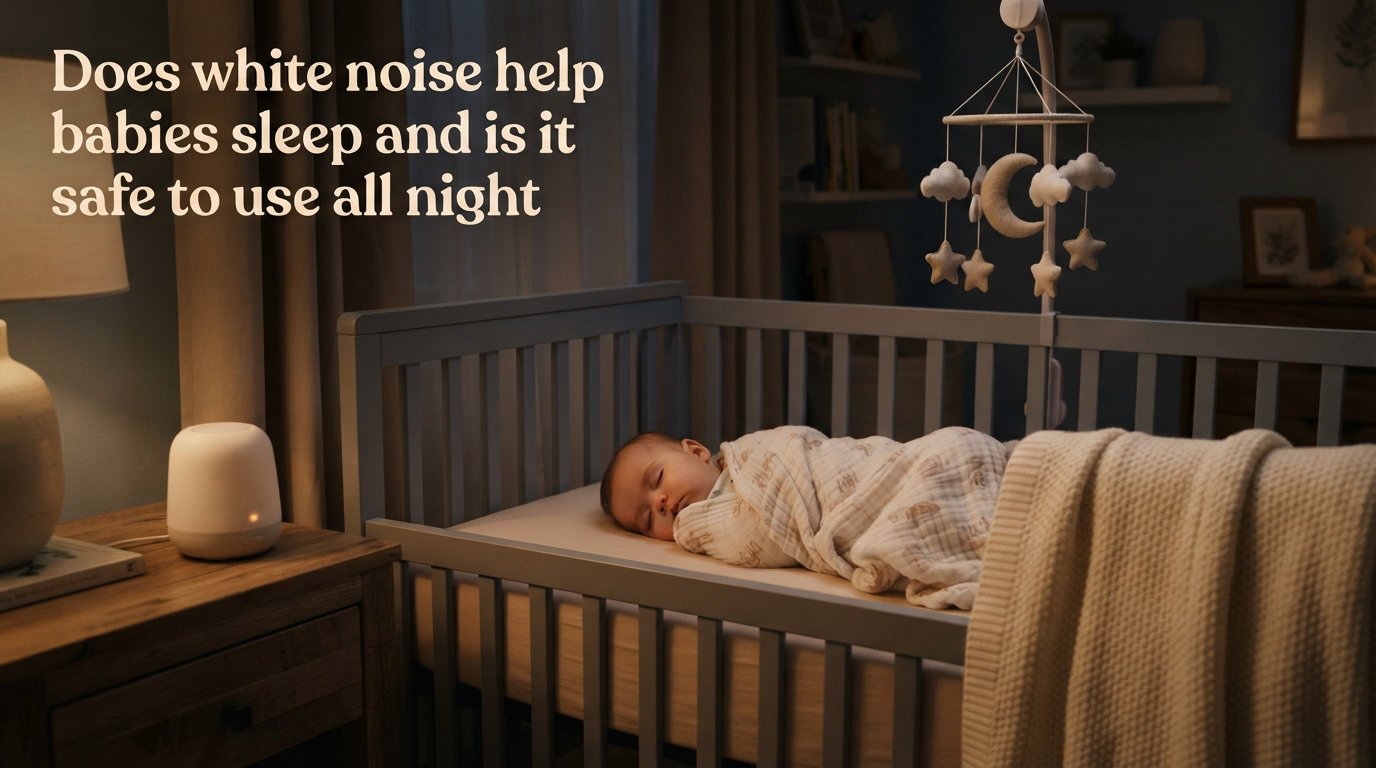
If you are a new parent staring at your phone at 2 AM searching for ways to help your baby sleep, you are not alone. I have been there, and I know how exhausting those sleepless nights can feel. One question that comes up constantly in parenting forums and pediatrician offices is whether white noise actually helps babies sleep and if it is safe to keep running all night long.
Does white noise help babies sleep and is it safe to use all night? This is exactly what we are going to explore together in this guide. I have spent hours researching the latest studies, AAP guidelines, and real parent experiences to give you clear, trustworthy answers.
By the end of this article, you will know exactly how white noise works, what the American Academy of Pediatrics recommends, and how to use it safely if you decide to try it with your little one.
Table of Contents
Quick Answer
Yes, white noise does help babies fall asleep faster and sleep more soundly. Research shows it can reduce the time it takes babies to drift off by masking disruptive household sounds and creating a comforting sleep association. When used correctly following AAP guidelines, it is absolutely safe to use all night.
The key is understanding how to use it properly: keeping volume at 50 decibels or lower, placing the machine at least 7 feet from your baby’s sleep space, and using the lowest effective volume that helps your baby sleep. In 2026, current research from the American Academy of Pediatrics and recent scoping reviews confirm that continuous white noise is safe for infants when these guidelines are followed.
What Is White Noise?
White noise is a consistent sound that contains all audible frequencies at equal intensity, creating that familiar static-like sound you might associate with an old television or radio between stations. Technically speaking, it spans the entire frequency spectrum that humans can hear, typically from 20 Hz to 20,000 Hz, with equal energy distributed across all frequencies.
What makes white noise particularly interesting for baby sleep is its connection to the womb environment. During pregnancy, babies are constantly exposed to a symphony of sounds: the mother’s heartbeat, blood flowing through the placenta, digestive sounds, and the muffled versions of external noises. These sounds create a continuous low-level noise environment that researchers estimate reaches 75-90 decibels inside the womb, which is actually quite loud.
When babies are born, they transition from this noisy, enclosed environment to our relatively quiet world. For many infants, this sudden silence can feel unsettling. White noise helps bridge this gap by recreating the continuous auditory stimulation they experienced before birth. The consistent sound provides a sense of familiarity and security that can help newborns feel more comfortable in their new environment.
It is worth noting that white noise is different from the other “colored” noises you might have heard about. Pink noise emphasizes lower frequencies, creating a deeper, softer sound similar to steady rainfall or wind. Brown noise goes even lower on the frequency spectrum, producing a rumbling sound like distant thunder or ocean waves. Green noise falls somewhere between white and pink noise, focusing on frequencies that match natural outdoor sounds. We will explore these differences in detail later, as each type has unique characteristics that might work better for different babies.
How White Noise Helps Babies Sleep
Understanding why white noise works can help you use it more effectively with your baby. The benefits go beyond simple sound masking, touching on developmental psychology, sleep science, and infant physiology. Here is what the research and real-world experience tell us about how white noise helps babies sleep better.
Creating a Positive Sleep Association
One of the most powerful ways white noise helps babies is by creating a sleep association or sleep cue. When you consistently play white noise as part of your baby’s bedtime routine, their brain begins to link that sound with sleep time. This association becomes a powerful signal that helps your baby understand it is time to wind down and rest.
Sleep consultants often call this a “sleep signifier” because the sound itself becomes a cue that sleep is coming. Just like a consistent bedtime routine signals to adults that it is time to relax, white noise signals to babies that the sleep environment has been activated. Over time, hearing the white noise can actually trigger physiological changes that prepare the body for sleep, such as lowering heart rate and reducing alertness.
Mimicking the Womb Environment
As I mentioned earlier, the womb is not a quiet place. The constant whooshing sound of blood flow through the placenta creates a noise level equivalent to having a vacuum cleaner running near your ear. Babies spend nine months in this environment, and it becomes their baseline for comfort and safety.
White noise helps recreate this familiar auditory landscape. The continuous, unobtrusive sound provides a sense of continuity between the womb and the outside world. Many parents report that their newborns seem to settle almost instantly when white noise is introduced, and this womb-mimicking effect is likely a major reason why. The sound helps babies feel like they are still in their safe, familiar environment.
Masking Environmental Disruptions
Household noises are one of the biggest culprits behind frequent baby wake-ups. Doorbells, older siblings playing, dishes clattering, neighbors talking, phones ringing, and even the creak of floorboards can startle a sleeping baby awake. Unlike adults who have learned to tune out these sounds, babies lack the neurological development to filter background noise effectively.
White noise acts as an acoustic blanket that masks these disruptive sounds. By providing a consistent baseline of sound, it makes sudden noises less jarring. The slam of a door or the ring of a phone becomes just another sound within the white noise spectrum rather than a distinct disruption that triggers the startle reflex. This environmental masking is particularly valuable during light sleep phases when babies are most susceptible to waking.
Research supports this benefit. The landmark 1990 study by Spencer et al. published in Archives of Disease in Childhood found that 80% of babies fell asleep within five minutes when exposed to white noise, compared to only 25% who fell asleep without it. The study concluded that white noise significantly reduces sleep latency, the time it takes to fall asleep.
Reducing the Fight or Flight Response
There is a common misconception that white noise puts babies in a fight or flight state. Actually, the opposite is true. Sudden environmental noises, not continuous white noise, trigger the sympathetic nervous system and the fight or flight response. White noise helps prevent this response by eliminating the sudden changes in sound that startle babies awake.
Think about how you feel when you are drifting off to sleep and a sudden loud noise jolts you awake. Your heart races, your muscles tense, and your alertness spikes. Babies experience this same reaction but with much more frequency because they have not yet developed the ability to distinguish between threatening and non-threatening sounds. White noise provides a protective buffer that keeps the sympathetic nervous system calm.
Is It Safe to Use All Night
The question of overnight safety is where many parents feel uncertain. You want to help your baby sleep, but not at the expense of their health or development. The good news is that current research and pediatric guidelines provide clear answers about all-night use.
What the Research Says About Continuous Use
The most recent and comprehensive review comes from a 2024 scoping review by De Jong et al. published in Sleep Medicine Reviews. This review examined all available research on continuous white noise exposure during sleep in children. The researchers concluded that when used at appropriate volumes, continuous white noise during sleep shows no evidence of harmful effects on hearing, speech development, or cognitive function.
Earlier research from the American Academy of Pediatrics in 2014 raised some concerns about sound machines producing hazardous noise levels, but the key word is “hazardous.” The AAP study found that some machines could produce sound levels above 50 decibels when placed too close to the baby’s ears, which is why proper placement and volume control are essential.
When used correctly, white noise is not only safe for overnight use but actually beneficial for sleep continuity. Turning white noise off during the night creates a change in the sleep environment that can cause partial awakenings. Keeping it on continuously helps maintain consistent sleep conditions throughout the night.
Benefits of All-Night Use
Using white noise all night rather than just at bedtime offers several advantages. Sleep cycles for babies are shorter than adult cycles, typically lasting 45-60 minutes. Between cycles, babies often experience brief partial awakenings where they check their environment before settling back to sleep. If the white noise has turned off, this environmental change can signal to the baby that something is different, potentially leading to a full wake-up.
Continuous white noise also helps during those inevitable nighttime disruptions. When your baby wakes for a feeding or diaper change in the middle of the night, the consistent background sound helps them settle back to sleep more easily. The white noise becomes a constant in their sleep environment that remains unchanged even when other factors, like darkness or swaddling, might shift.
Many sleep consultants recommend using the continuous setting on sound machines rather than timer settings for exactly this reason. The goal is to create a sleep environment that remains stable from bedtime through morning wake-up.
AAP Safety Guidelines You Need to Know
The American Academy of Pediatrics provides specific recommendations for using white noise safely with babies. Following these guidelines eliminates virtually all risks associated with white noise use. Here are the three key rules every parent should know.
Keep Volume at 50 Decibels or Lower
The AAP recommends keeping white noise at a maximum of 50 decibels, which is roughly equivalent to a quiet conversation at home or a gentle rainfall. To put this in perspective, normal conversation is typically 60 decibels, a dishwasher runs at about 60-70 decibels, and city traffic from inside a car reaches 85 decibels.
The 50 decibel limit is based on occupational noise exposure standards and has a significant safety margin built in. For context, the CDC recommends limiting infant exposure to sounds above 60 decibels, so the AAP guideline of 50 decibels provides an extra buffer of safety. Some sleep consultants, including experts from Taking Cara Babies, recommend the “lowest effective volume” principle: use the quietest setting that still helps your baby sleep.
Place the Machine at Least 7 Feet Away
Distance from the sound source dramatically affects the volume that reaches your baby’s ears. Sound intensity decreases with distance, following the inverse square law. This means that placing a sound machine just 3 feet from your baby versus 7 feet can result in significantly higher decibel levels at their ears.
The AAP specifically recommends placing sound machines at least 200 centimeters (approximately 7 feet) away from your baby’s sleep space. This distance, combined with proper volume settings, ensures that the sound reaching your baby stays well within safe levels. Some experts recommend placing the machine even farther away, across the room or outside the door, as long as the volume remains audible.
Use the Lowest Effective Volume
Perhaps the most practical guideline is to use the lowest volume setting that actually helps your baby sleep. There is no benefit to using white noise louder than necessary, and keeping it quieter provides additional safety margin. Start with a low volume and only increase it if your baby does not respond.
Practical volume testing methods include using a smartphone decibel meter app placed where your baby’s head rests, comparing the volume to a running shower (about 50 decibels), or simply ensuring the sound is quieter than normal conversation. If you need to raise your voice to be heard over the white noise, it is too loud.
Turn Off During Awake Time
An additional safety consideration is to turn off white noise when your baby is awake and alert. During awake time, babies need to hear language, environmental sounds, and the voices of caregivers to support normal speech and language development. White noise should be reserved for sleep periods only, not used as background sound throughout the day.
White Noise vs Pink, Brown, and Green Noise
Not all background sounds are created equal. While white noise is the most commonly discussed option, several variations exist that some babies might prefer. Understanding the differences can help you find the best sound for your little one’s sleep.
White noise contains equal energy across all frequencies, creating that crisp static sound. Pink noise emphasizes lower frequencies, producing a softer, deeper sound that many people find more soothing than pure white noise. Brown noise takes this even further, focusing heavily on the lowest frequencies to create a deep rumbling similar to distant thunder or ocean waves. Green noise falls between white and pink, emphasizing frequencies similar to natural outdoor environments like rustling leaves or gentle streams.
| Noise Type | Frequency Focus | Sound Description | Best For |
|---|---|---|---|
| White Noise | Equal across all frequencies | TV static, fan sound | Babies who respond well to consistent masking |
| Pink Noise | Lower frequencies emphasized | Steady rainfall, wind | Babies who need softer, more natural sound |
| Brown Noise | Heavily low-frequency focused | Distant thunder, ocean waves | Babies who need deep, rumbling comfort |
| Green Noise | Mid-range frequencies | Rustling leaves, gentle stream | Babies who prefer nature-like sounds |
Research on which type works best is still emerging. The 1990 Spencer study used white noise specifically, so that variety has the most research support for infant sleep induction. However, many parents and sleep consultants report that pink or brown noise feels more natural and soothing to babies. The BBC’s Tiny Happy People resource specifically recommends pink noise as potentially more soothing for infants than white noise.
The best approach is to experiment with different sounds to see what your baby prefers. Some sound machines offer multiple options, allowing you to test white, pink, and brown noise to find your baby’s favorite. There is no wrong choice as long as you follow the same volume and placement guidelines regardless of which noise type you use.
How to Set Up White Noise Safely Step by Step
Setting up white noise correctly takes just a few minutes but makes a significant difference in both effectiveness and safety. Here is a simple step-by-step guide to get you started.
Step 1: Choose Your Sound Source
You have several options for creating white noise. Dedicated sound machines are specifically designed for this purpose and often include multiple sound options, volume controls, and continuous play settings. Smartphone apps offer convenience and portability, with many free and paid options available. Household items like fans or humidifiers can also create white noise, though they offer less control over volume and sound quality.
If you choose a sound machine, look for one with a continuous play option rather than just timers. Many parents find that machines with physical volume knobs work better than digital controls because you can easily see and adjust the setting.
Step 2: Find the Right Location
Place the sound machine at least 7 feet from your baby’s crib or bassinet. Ideal locations include a dresser across the room, a shelf on the opposite wall, or just outside the bedroom door with the door slightly ajar. The goal is to have the sound audible throughout the room without the machine being right next to your baby’s ears.
Avoid placing the machine inside the crib, on the crib rail, or on a nightstand right next to the bed. These placements put the sound source too close and can result in unsafe decibel levels at your baby’s ears.
Step 3: Set the Volume Correctly
Start with the volume low, around the level of a quiet conversation or gentle shower. Use a decibel meter app on your smartphone placed at crib level to check the actual sound level reaching your baby’s position. Aim for 50 decibels or less. If you do not have an app, use the shower comparison: the white noise should be no louder than a bathroom with a shower running.
If your baby does not seem to respond to the sound at this low volume, increase it gradually until you find the lowest effective level. Remember that louder is not better and provides no additional sleep benefit.
Step 4: Test and Adjust
Give your setup a trial run during a nap or bedtime. Observe how your baby responds. Some babies settle immediately when the white noise starts, while others might take a few days to associate the sound with sleep. If your baby seems agitated or overstimulated by the sound, try a different noise type (switching from white to pink or brown) or lower the volume further.
Check the volume periodically, especially if you move the machine or your baby transitions to a different sleep space. What works in a bassinet might need adjustment when you move to a larger crib or different room.
Step 5: Use Consistently
For white noise to work as a sleep cue, you need to use it consistently. Turn it on as part of your bedtime routine and keep it running continuously through the night. Use it for both naps and nighttime sleep so your baby develops a strong association between the sound and sleeping.
Addressing Common Concerns and Misconceptions
Whenever I discuss white noise with parents, the same concerns come up repeatedly. Many of these worries stem from misinformation or studies that have been taken out of context. Let me address the most common concerns with what the research actually shows.
Concern: White Noise Causes Hearing Loss
This is perhaps the most common fear parents have, and it comes from a misunderstanding of the 2014 AAP study on infant sleep machines. That study found that some machines could produce sound levels above 50 decibels when placed close to a baby’s ears and set to maximum volume. The key phrase is “when placed close” and “maximum volume.” The study was not saying white noise is inherently dangerous; it was saying improper use could be hazardous.
When you follow the AAP guidelines, keeping volume at 50 decibels or lower and placing the machine at least 7 feet away, there is no evidence of hearing damage risk. Occupational noise standards, which are much stricter than typical environmental standards, allow exposure to 50 decibels for extended periods without any hearing protection required.
Concern: White Noise Causes Speech Delays
Another common worry is that white noise might interfere with language development or cause speech delays. This concern comes from research on environmental noise exposure, such as living near airports or busy highways, where constant loud background noise can make it harder for children to distinguish speech sounds during awake, learning time.
However, white noise during sleep is fundamentally different from environmental noise during awake time. When babies are sleeping, they are not actively learning language. White noise used only during sleep periods does not interfere with the crucial awake-time exposure to language, conversation, and environmental sounds that support normal speech development. The key is following the guideline to turn off white noise during awake time.
Concern: The Rat Study Proves White Noise Is Harmful
You might have seen references to a study where rats exposed to white noise showed developmental differences. This study by Mzia et al. in 2020 is frequently misinterpreted. The crucial detail that gets left out is that the rats were exposed to white noise 24 hours a day, 7 days a week, for extended periods.
Babies do not use white noise 24/7. They use it only during sleep, which typically accounts for 14-17 hours per day for newborns and gradually decreases as they get older. This is fundamentally different from constant, never-ending exposure. Additionally, rat auditory systems differ significantly from human infant auditory systems, making direct comparisons problematic.
The 2024 De Jong scoping review specifically examined this concern and found no evidence of developmental harm when white noise is used only during sleep at appropriate volumes. The rat study does not apply to normal white noise use for babies.
Concern: My Baby Will Become Dependent on White Noise
This concern comes in two forms: worry that your baby will never be able to sleep without white noise, and worry about what happens when you travel or the machine breaks. Let me address both.
First, dependency is not necessarily a bad thing in this context. We all use sleep associations as adults. You probably prefer a certain pillow, a specific room temperature, or darkness to sleep well. White noise is just another environmental factor that supports good sleep. There is nothing wrong with your baby having preferences for their sleep environment.
Second, white noise is portable and widely available. If you are concerned about travel, portable sound machines, smartphone apps, and even simple fans can create white noise anywhere. Most babies who sleep with white noise at home adapt easily to white noise in hotels, at grandparents’ houses, or during car rides with a portable machine.
If you eventually want to wean off white noise, it is entirely possible. I will cover weaning strategies in the next section.
Concern: White Noise Puts Babies in Fight or Flight Mode
Some parents worry that the constant sound keeps babies in an alert, stressed state rather than helping them relax. This misconception confuses continuous, predictable sound with unpredictable, startling noise.
Fight or flight responses are triggered by sudden changes, unexpected stimuli, and perceived threats. A consistent, predictable sound like white noise actually prevents fight or flight responses by blocking the sudden environmental noises that would otherwise startle your baby awake. Think of white noise as a protective shield rather than a stressor. The AAP’s 2023 noise exposure policy confirms that consistent background noise at safe levels does not trigger stress responses in infants.
When to Stop Using White Noise
A question I hear frequently is when parents should stop using white noise with their children. Parents worry about creating a crutch or wonder if there is an age where white noise becomes inappropriate.
There Is No Required Age to Stop
The short answer is that you never have to stop using white noise if it continues to help your child sleep. Many adults use white noise machines, fans, or apps to sleep better. It is not something children need to outgrow or a habit they need to break. If white noise helps your two-year-old, three-year-old, or even older child sleep better, there is no developmental or health reason to eliminate it.
The BBC’s sleep consultant Andrea Grace confirms this, stating that it is perfectly safe to use white noise every night if it becomes an integral part of your child’s bedtime routine and sleep signifier. As long as you continue following the volume and placement guidelines, white noise remains safe indefinitely.
Natural Transition Points
While you do not have to stop, there are natural transition points where some families choose to wean off white noise. The most common is the transition from crib to toddler bed. This major sleep environment change provides a natural opportunity to make other changes if desired. Some parents keep the white noise through this transition for consistency, while others use the opportunity to phase it out.
Another common transition point is when a child starts preschool or daycare and begins napping in a noisier environment. Some children adapt easily to sleeping with environmental noise at school while still using white noise at home. Others might naturally outgrow the need as they develop better sleep skills and environmental filtering abilities.
How to Wean Off White Noise If Desired
If you decide to stop using white noise, you have two main approaches. The gradual method involves slowly lowering the volume over one to two weeks until it is barely audible, then turning it off completely. This approach minimizes disruption to your child’s sleep because the change happens slowly.
The cold turkey method involves simply turning it off one night and letting your child adjust. Some children barely notice, while others might take a few nights to adjust to the new sleep environment. If you choose this approach, be prepared for potentially disrupted sleep for a few days while your child adapts.
Remember that weaning is optional. Many children continue using white noise into elementary school and beyond with no negative effects.
Frequently Asked Questions
Is it okay for babies to sleep with white noise all night?
Yes, it is safe for babies to sleep with white noise all night when used correctly. The American Academy of Pediatrics confirms that continuous white noise is safe when kept at 50 decibels or lower and placed at least 7 feet from the baby’s sleep space. Keeping white noise on all night actually helps maintain sleep continuity and prevents environmental disruptions from waking your baby between sleep cycles.
What are the risks of white noise for babies?
The main risks only occur when white noise is used incorrectly. These include potential hearing damage if volume exceeds 50 decibels or if the machine is placed too close to baby’s ears, speech delays if white noise is used during awake time when baby should hear language, and sleep dependency that could make travel challenging. Following AAP guidelines of 50 decibels maximum, 7 feet distance, and using the lowest effective volume eliminates these risks entirely.
What is the 3 6 9 rule for babies?
The 3-6-9 rule refers to wake windows for babies, not white noise usage. It suggests approximately 3 hours of awake time for 3-month-olds, 6 hours total daytime sleep for 6-month-olds, and aiming for 9 hours of uninterrupted nighttime sleep. This is a general guideline for baby sleep schedules that parents often search alongside white noise questions, but it is unrelated to white noise safety or usage.
How long can I use white noise for my baby?
You can use white noise for as long as it benefits your child’s sleep. There is no age limit or developmental requirement to stop using white noise. Many adults use white noise for sleep, and it remains safe throughout childhood when following volume and placement guidelines. If you choose to stop, you can wean gradually by lowering volume over time or stop cold turkey during a natural transition like moving to a toddler bed.
Conclusion
Does white noise help babies sleep and is it safe to use all night? After reviewing the research, AAP guidelines, and real parent experiences, the answer is clear: yes, white noise helps babies fall asleep faster and sleep more soundly, and it is safe to use all night when following simple safety guidelines.
The key to safe, effective white noise use comes down to three simple rules: keep volume at 50 decibels or lower, place the machine at least 7 feet from your baby’s sleep space, and use the lowest effective volume that helps your baby sleep. When these guidelines are followed, you can feel confident that you are providing your baby with a helpful sleep tool without any risk to their hearing or development.
If you are struggling with your baby’s sleep, white noise is worth trying. Start tonight with a safe setup, be consistent with your use, and give your baby time to develop that positive sleep association. Better sleep for your baby means better sleep for you, and that is something every new parent deserves.