
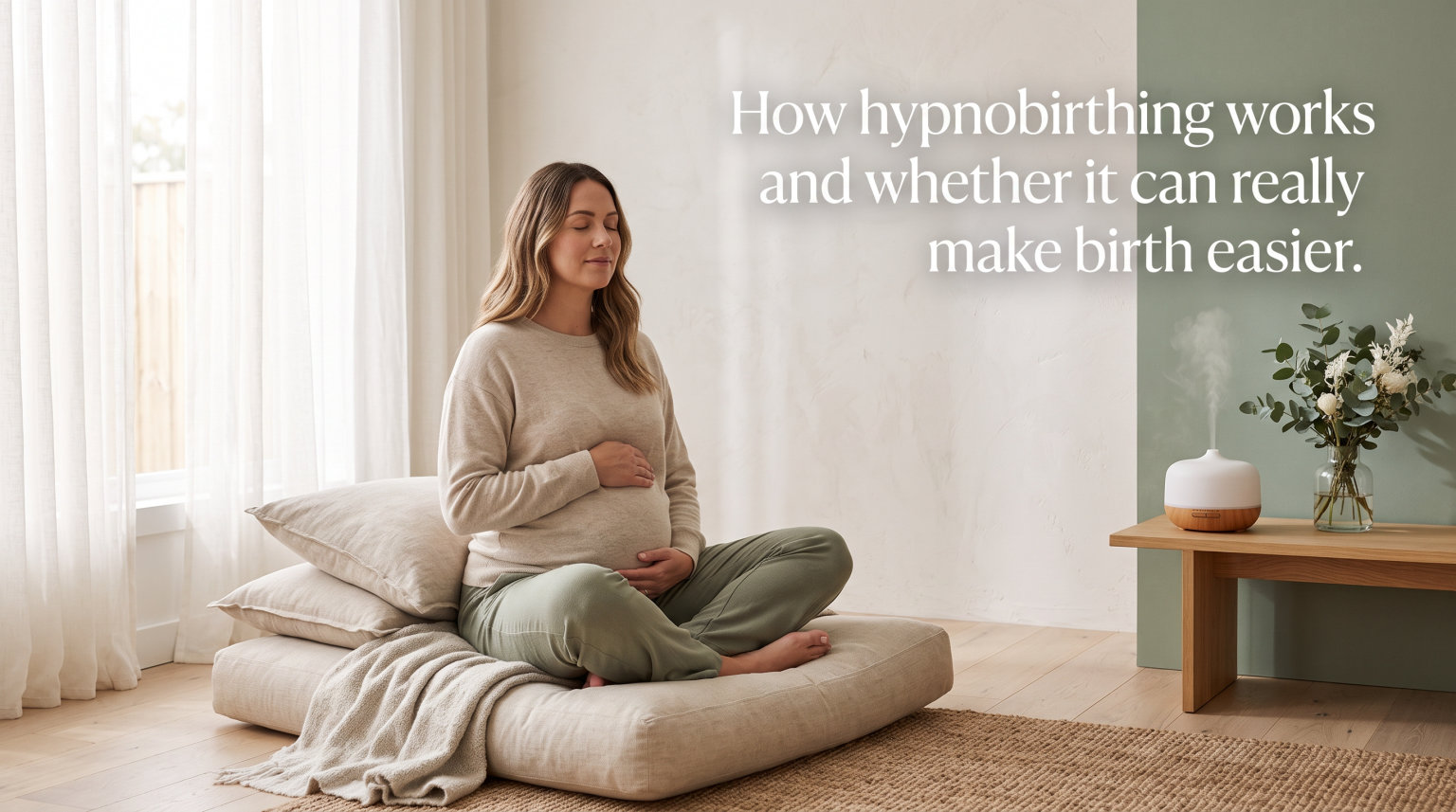
If you are pregnant and dreading the pain of childbirth, you have probably heard the buzz about hypnobirthing. Maybe a friend swears it gave her a calm, almost pain-free birth. Or perhaps you saw that Kate Middleton used it for all three royal babies. You might be wondering: Is this too good to be true? Or could self-hypnosis really change how you experience labor?
I have spent months researching hypnobirthing, talking to mothers who have used it, and reviewing the scientific evidence. In this guide, I will explain exactly how hypnobirthing works, what techniques are involved, and whether it can truly make birth easier. By the end, you will know if this approach is right for you and how to get started.
Table of Contents
What Is Hypnobirthing?
Hypnobirthing is a childbirth preparation method that uses self-hypnosis, deep breathing, visualization, and relaxation techniques to reduce fear and pain during labor. The goal is not an unconscious or zombie-like state, but rather a deep state of focused relaxation where you remain fully aware and in control.
The method was developed by Marie Mongan, a hypnotherapist and college counselor, who introduced the HypnoBirthing program in 1989. Mongan based her approach on the work of early 20th-century obstetrician Dr. Grantly Dick-Read, who proposed that fear creates tension, and tension creates pain in childbirth. Her program, formally called the Mongan Method, remains the most recognized hypnobirthing approach today.
The Philosophy Behind the Method
Hypnobirthing rests on a simple but powerful belief: Your body knows how to birth your baby. The method teaches that when fear is removed and relaxation is achieved, birth can happen more smoothly and with less discomfort. This is not about rejecting medical care or pretending birth is not intense. It is about approaching labor with confidence rather than dread.
The program also emphasizes specific language changes. Contractions become surges. Pain becomes pressure or intensity. These might sound like mere word games, but proponents argue that language shapes perception. When you expect pressure that you can breathe through instead of pain you must endure, your entire mindset shifts.
HypnoBirthing vs. Hypnobabies
Many people use these terms interchangeably, but they are actually different programs. HypnoBirthing is Marie Mongan’s original trademarked program. Hypnobabies is a separate method created by Kerry Tuschhoff that uses medical-grade hypnosis techniques and includes specific tracks for different stages of labor.
Both programs work toward the same goal but with slightly different approaches. HypnoBirthing tends to emphasize the philosophical and educational aspects more heavily. Hypnobabies focuses intensely on hypnotic anesthesia techniques. Some mothers try one, some try both, and some blend elements from each.
How Hypnobirthing Works: The Science Behind Calm Birth
Hypnobirthing works by interrupting what practitioners call the fear-tension-pain cycle. This concept, first described by Dr. Grantly Dick-Read, explains how fear triggers a cascade of physical responses that make birth more difficult and painful than it needs to be.
Breaking the Fear-Tension-Pain Cycle
When you feel afraid during labor, your body releases stress hormones called catecholamines, including adrenaline and cortisol. These hormones trigger your fight-or-flight response. Blood rushes away from your uterus to your arms and legs. Your muscles tense. Your heart races. For running from a predator, this response is helpful. For giving birth, it works against you.
A tense uterus cannot contract effectively. Labor slows down. Pain increases. You become more afraid, releasing more stress hormones, creating more tension and pain. This is the cycle hypnobirthing aims to break.
Activating the Relaxation Response
Hypnobirthing techniques trigger your parasympathetic nervous system, often called the rest-and-digest system. When this system is dominant, your heart rate slows. Your muscles relax. Blood flows freely to your uterus and other vital organs. Most importantly, your body releases endorphins, natural pain-relieving chemicals that are actually stronger than morphine.
Research shows that deep relaxation and hypnosis can increase endorphin levels significantly. In one study published in the Journal of Alternative and Complementary Medicine, women using hypnosis during labor reported substantially lower pain scores and less anxiety compared to control groups.
The Mind-Body Connection in Childbirth
Your thoughts directly influence your physical state. If you expect agony and panic, your body prepares for exactly that. If you expect manageable intensity that you can work with, your body responds accordingly. This is not wishful thinking. It is the documented physiology of how your nervous system interprets and responds to mental cues.
Hypnobirthing uses guided imagery to harness this connection. When you visualize your cervix opening like a flower blooming, or your breath flowing down to relax your pelvic floor, you are sending direct signals to those body parts. The relaxation is not just mental. It becomes physical.
Understanding Self-Hypnosis
The word hypnosis often conjures images of stage performers making people cluck like chickens. Clinical hypnosis, the type used in hypnobirthing, is nothing like that. It is simply a state of focused attention where your mind becomes more open to helpful suggestions.
In this state, you are not unconscious or out of control. You are actually hyper-aware of your body and your baby. You can respond to questions, change position, and make decisions. Many women describe it as being in a deep daydream or meditation. Time may feel distorted. Hours might pass feeling like minutes. You remain fully capable but deeply relaxed.
Core Hypnobirthing Techniques You Can Practice
Hypnobirthing programs teach several core techniques that work together to create a calm birth experience. These skills require practice before labor begins. Most instructors recommend starting between 20 and 30 weeks of pregnancy to build your comfort level with the methods.
Breathing Techniques
Breathing is the foundation of hypnobirthing. The method teaches specific patterns for different stages of labor. Up-breathing is used during surges (contractions). You breathe in deeply through your nose to the count of four, then out through your nose to the count of eight. This long exhale activates your relaxation response.
As labor progresses and you feel the urge to push, you switch to J-breathing or birth breathing. You take a deep breath in, then as you exhale, you visualize your breath traveling down through your body and gently pushing your baby out. No bearing down. No holding your breath. Just breathing your baby down.
Guided Visualization and Imagery
Visualization exercises guide you to imagine your birth unfolding peacefully. Common imagery includes picturing your cervix as a flower blossoming open, waves of the ocean rising and falling with your surges, or a golden thread of relaxation flowing through your body.
Some women create their own imagery that feels personally meaningful. One mother I spoke with visualized climbing a mountain she had actually hiked, using each surge as a step upward toward the summit where she would meet her baby. The key is finding images that feel calming and empowering to you.
Positive Affirmations
Affirmations are short, positive statements that you repeat to yourself to build confidence and override fearful thoughts. Hypnobirthing programs provide specific affirmations, but you can also create your own. Examples include: My body knows how to birth my baby. Each surge brings me closer to meeting my child. I am calm, relaxed, and in control.
The repetition of affirmations during pregnancy helps rewire your subconscious expectations about birth. Instead of anticipating pain and fear, you begin to expect strength and peace. Many women record themselves reading affirmations so they can listen during labor.
Language Reframing
Words shape experience. Hypnobirthing teaches specific vocabulary shifts designed to reduce fear associations. Contractions become surges. Pain becomes pressure, intensity, or sensation. Delivery becomes birthing. Complications becomes special circumstances.
This might seem like mere semantics, but research in cognitive linguistics shows that language profoundly affects perception. When you call something a surge, you expect energy and movement. When you call it a contraction, you expect tightness and restriction. The experience follows the expectation.
Deep Relaxation and Fear Release
Hypnobirthing includes scripts and exercises for releasing fears about birth. Many women carry subconscious fears passed down from family stories or media portrayals of screaming women in labor. The fear release exercise guides you to acknowledge these fears and let them go, replacing them with confidence.
Deep relaxation scripts, usually recorded, talk you through progressive muscle relaxation and hypnotic induction. With regular practice, you learn to enter a deeply relaxed state quickly. During labor, a few words from your partner or a few seconds of your recorded track can return you to that state instantly.
Does Hypnobirthing Actually Work? What the Evidence Says
This is the question every skeptical pregnant woman asks. Can breathing and positive thinking really change the physical reality of pushing a baby out? The answer is nuanced. Hypnobirthing does not guarantee a pain-free birth. The evidence does suggest it can significantly improve the birth experience for many women.
What the Research Shows
A 2016 Cochrane review examined the effects of hypnosis for pain management during labor. The review included nine trials with nearly 3,000 women. The findings were promising but not dramatic. Women using hypnosis used less pharmacological pain relief, including epidurals, compared to control groups. They also reported lower pain intensity scores in several studies.
Another study published in the British Journal of Obstetrics and Gynaecology found that women who used hypnobirthing techniques had shorter first and second stages of labor. The average reduction was about two hours for first-time mothers. Shorter labors generally mean less exhaustion and fewer medical interventions.
However, not all studies have found significant benefits. Some research has shown no difference in pain scores between women using hypnosis and those using standard childbirth education. The quality of studies varies, and many have small sample sizes or methodological limitations.
Realistic Expectations
The most honest answer is that hypnobirthing works well for some women and less well for others. Factors that influence success include how consistently you practice before birth, how well you enter the hypnotic state, the support of your birth team, and whether unexpected complications arise.
Some women achieve deep hypnotic anesthesia and feel only pressure. Others find the techniques take the edge off but do not eliminate pain. A small percentage find it does not help them at all. Going in with realistic expectations, rather than expecting guaranteed pain-free birth, leads to better satisfaction with the experience.
Real Parent Experiences
Mother experiences vary widely, which is why forum discussions show such mixed feedback. One mother reported: I was so calm through my labor, I had no pain relief not even gas and air. I can honestly say I did enjoy it. Another had a different experience: My husband and doula thought I was totally fine just by looking at me. I was not fine. I was in so much pain. It did nothing for the pain.
A more typical response falls in the middle: I definitely would not describe it as pain free, but it was also a manageable level of intense-ness, not a sharp, I am dying sort of pain. Many women report that even when pain was present, they felt more in control and less frightened than they expected.
The Honest Verdict
Hypnobirthing will not magically eliminate the physical reality of birth. What it can do is change how you respond to that reality. By reducing fear and increasing relaxation, it often reduces the intensity of pain you perceive. It gives you tools to work with your body rather than against it. For many women, that makes birth feel easier even if it is not painless.
Benefits of Hypnobirthing: What Mothers Actually Experience
Beyond pain management, hypnobirthing offers several documented and anecdotal benefits that make it appealing to expectant mothers. These advantages extend to birth partners and even the babies themselves.
Pain Management Without Medication
The most obvious benefit is natural pain relief. Women who use hypnobirthing techniques often report lower pain scores and are less likely to request epidurals or other pharmacological interventions. This matters if you specifically want an unmedicated birth or if you are birthing somewhere without immediate access to anesthesia.
Even for women who do choose medication eventually, hypnobirthing often helps them labor longer before requesting it. This can be valuable if you want to delay an epidural to keep labor progressing or avoid the side effects of early medication.
Shorter Labor Duration
Multiple studies have found that women using hypnosis or deep relaxation techniques experience shorter labors. The theory is that relaxation allows the uterus to work more efficiently without fighting against tense muscles. A shorter labor means less physical exhaustion and often a faster recovery.
One study from the HypnoBirthing Institute tracked over 1,000 mothers and found average first-stage labor was 6.75 hours for hypnobirthing mothers compared to the national average of over 12 hours for first-time mothers. While this data comes from the organization promoting the method, independent research also supports reduced labor duration.
Fewer Medical Interventions
Research consistently shows that women using hypnobirthing have lower rates of interventions including cesarean sections, forceps deliveries, and episiotomies. This may be partly because they are less likely to request epidurals, which can slow labor and lead to augmentation with Pitocin.
Hypnobirthing mothers also report fewer requests for labor augmentation and less need for synthetic oxytocin. When the body is relaxed and endorphins are flowing, labor often progresses naturally without artificial assistance.
Increased Sense of Empowerment
Perhaps the most significant benefit is psychological. Women who use hypnobirthing consistently report feeling more empowered and in control during birth. They describe the experience as something they actively did, rather than something that happened to them.
This sense of empowerment carries into the postpartum period. Mothers who feel positive about their birth experience often report greater confidence in early parenting. They proved to themselves that they could meet an intense physical challenge with calm and strength.
Partner Involvement and Connection
Hypnobirthing classes involve birth partners extensively. Partners learn how to guide relaxation, provide physical comfort, and advocate for the mother’s preferences. This creates a strong sense of teamwork during birth.
Many partners report feeling less helpless and more useful when they have specific techniques to support the laboring mother. One father shared: Instead of just standing there holding her hand, I had a script to read and breathing cues to give. I felt like I was actually helping.
Application to C-Sections and Complicated Births
Hypnobirthing is not just for unmedicated vaginal births. The relaxation techniques work beautifully during cesarean sections, helping mothers stay calm during surgery. The breathing techniques help with recovery. The positive mindset helps mothers feel empowered even when their birth plan changes.
Women with high-risk pregnancies or those planning inductions can also benefit. The techniques help manage anxiety and discomfort regardless of how birth unfolds.
Drawbacks and Considerations: The Honest Truth
Hypnobirthing is not perfect for everyone. Understanding the limitations and potential drawbacks helps you make an informed decision and prepares you for realistic outcomes.
Time Commitment Required
Hypnobirthing is not a quick fix. Most programs involve five to six weekly classes, each lasting two to three hours. You also need daily practice at home, typically 20 to 30 minutes of listening to relaxation tracks and practicing breathing techniques.
For working mothers with other children or demanding schedules, finding this time can be challenging. Some women start late and feel they did not master the techniques fully before labor began.
Financial Cost
Official HypnoBirthing classes typically cost between 200 and 550 dollars depending on your location and instructor. This is rarely covered by insurance. Books and online courses are less expensive, usually 30 to 100 dollars, but you miss the personalized instruction and support.
For families on tight budgets, this cost can be a barrier. Some instructors offer sliding scales or payment plans. There are also free resources online, though quality varies significantly.
No Guarantee of Pain-Free Birth
The biggest source of disappointment comes from the pain-free birth promise that some practitioners emphasize. When birth turns out to be intensely painful despite using techniques, mothers can feel like failures.
Honest instructors emphasize that hypnobirthing makes birth easier and more manageable, not necessarily painless. But marketing materials and success stories sometimes create unrealistic expectations.
Hospital Integration Challenges
Some women find that hospital staff are unfamiliar with hypnobirthing or skeptical of it. You might be offered interventions repeatedly despite your birth plan. Staff might talk loudly during your relaxation, breaking your focus.
One mother described being sent home from the hospital because she was so calm that the nurses did not believe she was in active labor. She was fully dilated but appeared too relaxed to be in serious labor. This illustrates both the effectiveness of the technique and the communication challenges with staff expecting visible distress.
When Birth Does Not Go as Planned
The most difficult situations occur when women have done everything right, practiced diligently, and still end up with emergency interventions or traumatic experiences. In these cases, the emphasis on positive thinking can feel like blame. If birth was difficult, did you not relax enough?
Good hypnobirthing instruction emphasizes that techniques help you cope with whatever happens, not that they guarantee any specific outcome. Birth is unpredictable. Sometimes even the most prepared mother needs emergency intervention.
How to Get Started with Hypnobirthing
If you are intrigued by hypnobirthing, getting started is straightforward. You have options ranging from formal classes to self-study using books and online resources.
Classes vs. Self-Study
Formal HypnoBirthing classes with a certified instructor offer structure, accountability, and personalized feedback. You meet weekly with other expectant couples, which creates community and support. Instructors can adjust techniques to your specific needs and answer questions in real time.
Self-study works well for self-motivated learners with limited budgets or scheduling constraints. The HypnoBirthing book by Marie Mongan provides the complete method. Many online courses offer video instruction. The key is consistency. You must practice daily to develop the skills.
When to Start
The ideal time to begin hypnobirthing classes is between 20 and 30 weeks of pregnancy. This gives you several weeks to practice before birth. However, it is never truly too late. Women who start at 35 weeks or even later still report benefits.
If you are 35 weeks or beyond, focus on learning the breathing techniques and recording your affirmations. You may not master deep hypnosis in a few weeks, but you can still significantly impact your birth experience.
What to Expect from Classes
A typical HypnoBirthing course runs five weeks, covering philosophy, anatomy, breathing techniques, visualization, fear release, and birth plan preparation. Classes include guided relaxation practice, videos of calm births, and partner coaching exercises.
Most instructors provide materials including the official book, relaxation audio tracks, and handouts. Classes are usually small, intimate groups where you can ask questions and share concerns.
Cost Breakdown
Expect to pay 300 to 500 dollars for in-person group classes. Private instruction ranges from 500 to 800 dollars. Online courses typically cost 100 to 300 dollars. Books alone cost 15 to 30 dollars.
Some doulas include hypnobirthing techniques in their services. Some hospitals offer classes as part of their childbirth education programs at lower cost. Check with your birth place to see what is available.
Recommended Resources
The foundational text is HypnoBirthing: The Mongan Method by Marie Mongan. This book explains the philosophy and teaches all core techniques. For Hypnobabies, the complete home study course is available online.
Several apps offer hypnobirthing tracks and timers, including GentleBirth and Hypnobirthing Baby. YouTube has free relaxation tracks and birth videos. Look for official channels or certified instructors to ensure quality content.
Free resources include the Positive Birth Company digital pack samples, NHS hypnobirthing audio tracks, and various birth preparation podcasts. While paid programs offer more structure, you can absolutely learn the basics using free materials if budget is tight.
Frequently Asked Questions About Hypnobirthing
What is the 5-1-1 rule for labor?
The 5-1-1 rule is a common guideline for when to go to the hospital: contractions are 5 minutes apart, lasting 1 minute each, for at least 1 hour. However, hypnobirthing mothers may progress differently. Because relaxation can make labor appear less intense on the outside, some women are fully dilated while still seeming calm. Follow your body’s cues and communicate with your care provider rather than relying solely on timing rules.
Can you do hypnobirthing with a C-section?
Yes, hypnobirthing works excellently for cesarean births. The deep breathing and relaxation techniques help you stay calm during surgery. The positive affirmations keep you focused on welcoming your baby rather than anxiety about the procedure. Many women report feeling empowered and peaceful during their C-sections after practicing hypnobirthing. The recovery breathing techniques also help with post-surgery healing.
Did Kate Middleton use hypnobirthing?
Yes, Catherine, Princess of Wales, reportedly used hypnobirthing techniques for all three of her pregnancies. She has spoken publicly about using hypnobirthing and finding it tremendously helpful. This celebrity endorsement has raised awareness of the method and made it more mainstream. Other celebrities who have used hypnobirthing include Jessica Alba and Angelina Jolie.
Is 35 weeks too late for hypnobirthing?
No, 35 weeks is not too late to start hypnobirthing. While the ideal window is 20 to 30 weeks to allow time for extensive practice, women who begin at 35 weeks or even later still report significant benefits. Focus on mastering the breathing techniques and recording affirmations you can use during labor. Even a few weeks of practice can change how you experience birth.
Is hypnobirthing pain free?
Hypnobirthing does not guarantee a pain-free birth. Some women experience deep hypnosis and feel only pressure or mild sensation. Others experience pain but find it more manageable. The goal is not eliminating sensation but changing your relationship with it. Hypnobirthing helps you stay calm and work with your body rather than against it. Most women describe the experience as intense but manageable, not painless.
Can I learn hypnobirthing on my own?
Yes, many women successfully learn hypnobirthing through self-study using books, online courses, and audio tracks. The HypnoBirthing book by Marie Mongan contains all the techniques. However, classes offer accountability, personalized feedback, and community support that self-study lacks. If you are self-motivated and disciplined about daily practice, self-study can work well. If you prefer structure and guidance, classes are worth the investment.
Can you use hypnobirthing with an epidural?
Yes, hypnobirthing and epidurals can absolutely be used together. Hypnobirthing helps you labor calmly until you decide you want pain medication. The breathing and relaxation techniques are useful even with an epidural to manage anxiety and stay present. Many women use hypnobirthing techniques through early labor, then get an epidural for transition and pushing. The methods complement each other rather than conflict.
What is the difference between HypnoBirthing and Hypnobabies?
HypnoBirthing is Marie Mongan’s original program, emphasizing philosophy, education, and gentle techniques. Hypnobabies is Kerry Tuschhoff’s program, using more medical-grade hypnosis techniques and specific tracks for different labor stages. HypnoBirthing uses the term surge instead of contraction. Hypnobabies uses pressure waves. Both aim for the same outcome but with different approaches. Some women try one, some try both.
How much does hypnobirthing cost?
Official HypnoBirthing classes typically cost 200 to 550 dollars depending on location and instructor format. Group classes are less expensive than private instruction. Books cost 15 to 30 dollars. Online courses range from 100 to 300 dollars. Some insurance plans cover childbirth education classes. Free resources are available through apps, YouTube channels, and NHS programs, though quality varies.
What is the 5-5-5 rule for childbirth?
The 5-5-5 rule suggests spending the first 5 days in bed, the next 5 days on the bed, and the following 5 days near the bed after giving birth. This traditional postpartum recovery guideline emphasizes rest and bonding. While not strictly about hypnobirthing, many hypnobirthing practitioners emphasize the importance of the postpartum period and using relaxation techniques for recovery and breastfeeding success.
Final Thoughts: Is Hypnobirthing Right for You?
So can hypnobirthing really make birth easier? The evidence suggests it can help significantly, though it does not guarantee any specific outcome. By interrupting the fear-tension-pain cycle, hypnobirthing allows your body to work more efficiently. Many women experience shorter labors, fewer interventions, and more positive memories of their birth experience.
Hypnobirthing works best for women who are open to practicing daily, who want an active role in their birth experience, and who approach the method with realistic expectations. It is not about achieving a pain-free birth at all costs. It is about feeling calm, capable, and empowered whatever unfolds.
If you are curious, I recommend starting with Marie Mongan’s book to understand the philosophy. If it resonates, consider a class or online course to learn the techniques properly. Even a few weeks of practice can change how you approach one of the most transformative experiences of your life. Your body knows how to birth. Hypnobirthing simply helps you get out of your own way and let it happen.