
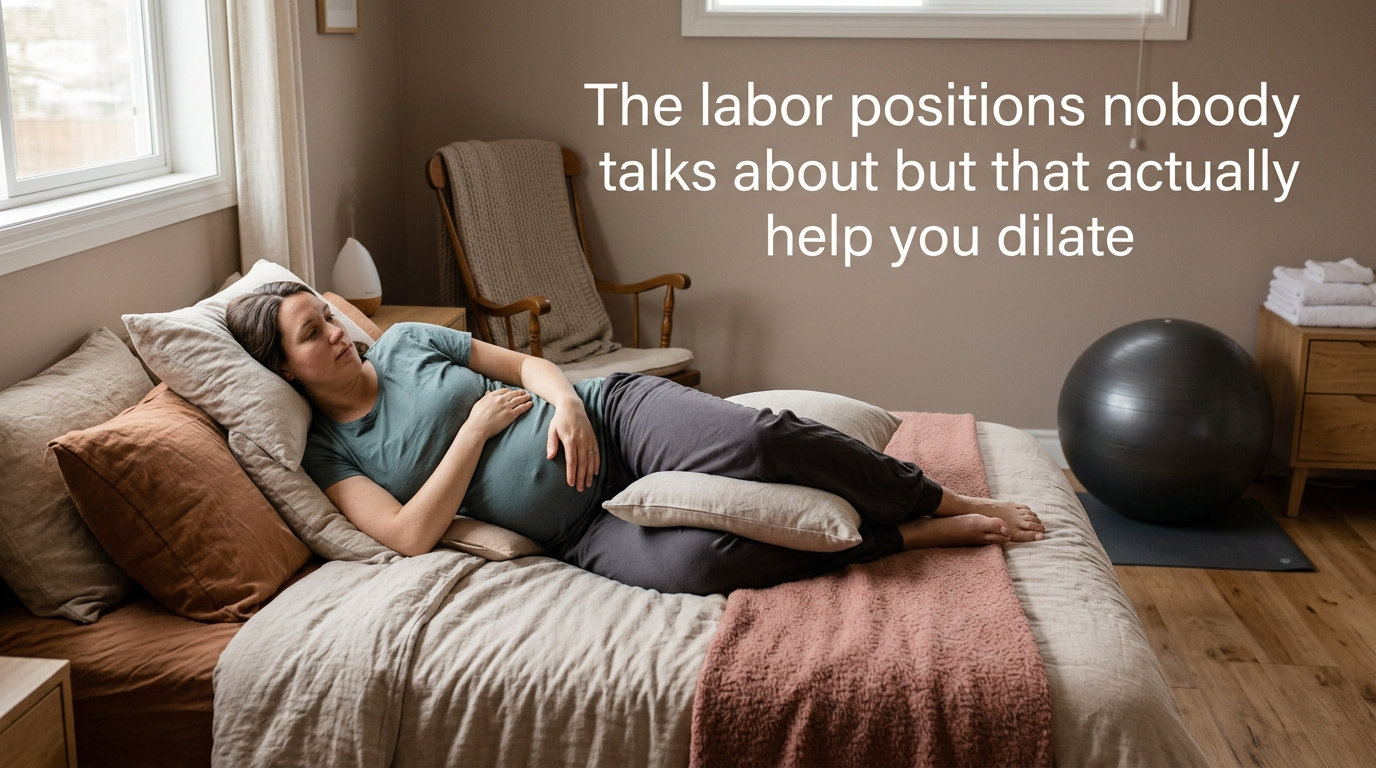
When I was 38 weeks pregnant with my first baby, I spent hours searching for ways to help my body prepare for labor. I found the same advice everywhere: walk, bounce on a ball, do squats. But after talking to midwives, doulas, and moms who had been through it, I discovered something surprising. There are labor positions that actually help you dilate faster that barely anyone talks about.
Most articles repeat the same handful of positions. They tell you to get on hands and knees or sit on a birth ball. Those are great, but they are just the beginning. Labor positions to dilate work by opening your pelvis wider, using gravity to bring baby down, and creating more room for your cervix to open. The right position at the right time can mean the difference between a stalled labor and steady progress.
In this guide, I am sharing the lesser-known labor positions that helped me and hundreds of other mothers I have spoken with over the past decade. These are the techniques doulas pull out when labor slows down. These are the positions that got me from 4 centimeters to fully dilated in under three hours. Whether you are planning a hospital birth, home birth, or birth center delivery, these positions can help your labor progress naturally.
Table of Contents
How Labor Positions Help You Dilate
Your cervix opens through a combination of uterine contractions and pressure from your baby’s head. When baby presses against the cervix during contractions, it signals your body to release hormones that soften and open the cervical tissue. This process is called cervical dilation, and it is measured in centimeters from 0 to 10.
Gravity-assisted positions work with your body instead of against it. When you stand, walk, or squat, gravity pulls baby downward. This adds gentle pressure to your cervix with each contraction. More pressure means stronger signals to your body, which often means faster dilation.
Pelvic opening is another key factor. The human pelvis is not fixed in one position. Certain movements can increase your pelvic diameter by several centimeters. That extra space allows baby to descend more easily and gives your cervix more room to open fully. Hands and knees positions widen the back of your pelvis. Squatting opens the outlet. Asymmetric positions like lunges open one side at a time.
Blood flow matters too. Lying flat on your back can compress major blood vessels and reduce circulation to your uterus. This can make contractions less effective and slow down labor progression. Upright and side-lying positions keep blood flowing freely, helping your muscles work efficiently.
The Labor Positions Nobody Talks About
These are the positions that make doulas and experienced moms nod with recognition. They are not secrets, but they are often buried in conversation threads and mentioned briefly in passing. Let me walk you through each one and explain exactly how to do them.
Hands and Knees with Hip Circles
The basic hands and knees position gets plenty of attention, but adding hip circles transforms it into a powerful dilation tool. Start on all fours with your knees spread wide and your hands directly under your shoulders. Instead of staying still, begin making large circles with your hips.
Move clockwise for ten circles, then reverse direction. The circular motion helps your pelvis open in all directions, not just front to back. It also encourages baby to rotate into the optimal position if they are not already there. Many women feel immediate relief from back labor when they start circling.
Have your partner place their hands on your hips and apply gentle counter-pressure as you circle. This creates a massage effect that reduces tension in your lower back and pelvis. Do this during contractions or between them whenever you need relief.
Deep Supported Squats
Regular squats are good. Deep supported squats are better. The key difference is depth and support. In a deep squat, your hips drop below your knees. This position opens your pelvic outlet by up to 28 percent compared to lying on your back.
Most women cannot hold a deep squat for long during labor, which is why support matters. Face a bed, counter, or your partner and hold on for balance. Lower yourself as far as comfortable, keeping your heels flat on the floor if possible. Hold for 30 to 60 seconds during contractions, then stand and rest between them.
If your heels lift off the ground, place a folded towel or yoga mat under them. This small adjustment takes pressure off your calves and lets you sink deeper into the squat. The deeper you can comfortably go, the more your pelvis opens.
I spent twenty minutes in supported squats during my second labor, and my dilation went from 6 to 9 centimeters during that time. The pressure was intense but productive. My midwife later told me that the squatting probably shaved an hour off my labor.
Asymmetric Positions and Curb Walking
This is the position that really surprised me. Asymmetric positions open one side of your pelvis more than the other. They are particularly helpful when baby is slightly off-center or when labor has stalled at a certain dilation.
Curb walking is exactly what it sounds like. Find a curb or step. Place one foot on the elevated surface and one on the ground. Walk forward with this uneven stance for ten to twenty steps, then switch sides. The uneven height tilts your pelvis and opens the joints on one side.
Do this during early labor to encourage baby to descend. I walked curbs in my neighborhood for thirty minutes at 3 centimeters dilated. By the time I reached the hospital, I was at 5 centimeters and contracting regularly. Several nurses commented on how quickly I had progressed.
Inside, you can create the same effect by placing one foot on a stool, book, or yoga block while standing. Switch sides every few contractions. This keeps your pelvis moving and prevents stiffness that can slow labor progression.
Side-Lying with Top Leg Supported
Side-lying positions are mentioned often, but the specific technique matters. Simply lying on your side is restful but not particularly helpful for dilation. The supported variation changes everything.
Lie on your side with a pillow between your knees. Have your partner or doula place a birth ball, rolled towel, or peanut ball between your legs near the knee. Your top leg should rest on this support, creating an angle that opens your pelvis.
The key is the height of the support. Your top thigh should be roughly parallel to the bed or floor. This position uses gravity to press baby’s head against your cervix while you rest. It is one of the few rest positions that actually helps you dilate rather than just pausing labor.
Switch sides every twenty to thirty minutes. This prevents pressure sores and encourages baby to shift position if needed. Many hospitals now provide peanut balls specifically for this position because studies show it can reduce labor time significantly.
Forward-Leaning Inversion
This position comes from traditional birth practices and is making a comeback in modern doula work. It involves briefly inverting your body to encourage baby to shift out of the pelvis slightly, then settle back in a better position.
Kneel on the edge of a couch or bed. Slowly lower yourself to rest your head and forearms on the floor or a stack of pillows. Your bottom should be higher than your head. Hold for thirty seconds to one minute, breathing normally.
The brief inversion creates space in your pelvis. When you return to an upright position, baby often settles back down with their head better aligned with your cervix. This can trigger stronger, more effective contractions.
Only do this if you are comfortable and have support nearby. It is not recommended if you have high blood pressure, certain heart conditions, or after your water has broken in specific situations. Check with your provider first.
A doula friend of mine calls this the “reset button” for stalled labors. She has seen it help women progress from 5 centimeters to transition within an hour when nothing else was working.
Toilet Sitting
The bathroom toilet is one of the most underappreciated labor tools in existence. Sitting on the toilet naturally puts you in a semi-squat position with your pelvis relaxed. It also triggers a psychological response that helps you release tension in your pelvic floor.
Our bodies associate the toilet with letting go. That mental association can help you relax your pelvic muscles during labor, which paradoxically helps dilation progress. A tense pelvic floor resists opening. A relaxed one can open more easily.
Sit facing forward normally, or straddle the toilet facing the tank for a more open position. Rest your arms on the tank and let your body sink down. Many women find they have some of their strongest contractions while sitting on the toilet.
If you are in a hospital room, ask to use the bathroom regularly even if you do not feel the urge. Fifteen minutes of toilet sitting every hour or two can make a noticeable difference in labor progression. Just be sure to have someone nearby for support and safety.
Lunges and Stair Climbing Sideways
Walking stairs is a classic labor recommendation, but walking them sideways is far more effective for dilation. The sideways motion opens your pelvis asymmetrically with each step, creating more space for baby to descend.
Find a staircase with a handrail. Turn sideways and hold the rail for support. Step up with the foot closest to the rail, then bring the other foot to meet it. Take five to ten steps up, then turn around and lead with the other foot on the way down.
Lunges work on the same principle without needing stairs. Take a wide step forward and sink into the lunge, keeping your back straight. Hold for a few seconds, then step back. Alternate legs every few repetitions.
Both movements open the front of your pelvis wider than regular walking. They are especially helpful when baby is high and not yet pressing firmly on the cervix. The combination of gravity and asymmetric movement can bring baby down quickly.
Exercise Ball Figure-Eights
Sitting and bouncing on a birth ball is common advice. Drawing figure-eights with your hips while seated is much less common and much more effective. The figure-eight motion moves your pelvis through its full range of motion.
Sit on a firm exercise ball with your feet flat on the floor. Your hips should be slightly higher than your knees. Begin moving your hips in a figure-eight pattern, tipping forward and back, side to side, in one continuous motion.
This movement helps loosen the ligaments around your pelvis and encourages baby to settle into the birth canal. Do it during early labor to prepare your body, then return to it whenever you need a break from standing positions.
Lean forward onto a bed or table while sitting on the ball for a variation that combines gravity assistance with pelvic movement. This forward-leaning position is particularly helpful for back labor.
Positions for Every Stage of Labor
Not every position works at every stage. Early labor, active labor, transition, and pushing each have positions that work best. Understanding when to use each position can help you plan your labor strategy.
During early labor, when contractions are mild and irregular, focus on positions that encourage baby to descend. Curb walking, regular walking, and stair climbing are excellent choices. Stay upright and mobile as much as possible. This is the time to prepare your body and help baby get into position before contractions intensify.
Active labor requires a different approach. When contractions are strong and regular, alternate between active positions and rest positions. Use deep supported squats, hands and knees with hip circles, and toilet sitting during contractions. Switch to side-lying with leg support between contractions to conserve energy.
Transition is the most intense phase. Many women naturally want to stand or kneel during transition contractions. Follow that instinct. Standing with forward leaning, kneeling while leaning on a birth ball, or hands and knees work well here. These positions give you a sense of control while keeping your pelvis open.
During pushing, listen to your body and your care provider. Squatting, hands and knees, or side-lying are common pushing positions. Some women prefer a supported semi-squat with a bar or their partner behind them. The best pushing position is one that feels powerful and effective to you.
Using Positions with an Epidural
An epidural limits mobility, but it does not eliminate the benefits of position changes. You will need assistance and modifications, but changing positions remains important for labor progression.
The peanut ball becomes your best friend with an epidural. This peanut-shaped exercise ball is placed between your legs while side-lying to keep your pelvis open. Research shows that using a peanut ball can reduce labor time by up to an hour for women with epidurals.
Side-lying with the top leg elevated on pillows or a peanut ball is the primary position for epidural births. Switch sides every twenty to thirty minutes. Have your nurse or partner help you rotate using a sheet under your hips for easier movement.
Semi-sitting positions can also work if your epidural allows some leg strength. Prop yourself at a 45-degree angle with pillows behind your back. This uses gravity more than lying flat while still letting you rest.
Even with an epidural, avoid lying flat on your back for extended periods. Ask your care team to help you change positions regularly. Your body still needs movement and position changes to help baby descend and your cervix open fully.
Common Mistakes to Avoid
After supporting dozens of women through labor, I have seen the same mistakes repeat. Avoiding these can make your labor positions more effective.
Staying in one position too long is the most common error. Even the best position becomes less effective after thirty to sixty minutes. Your body adapts, muscles fatigue, and baby may stop making progress. Set a timer or ask your partner to remind you to switch positions regularly.
Lying flat on your back without medical necessity is another mistake. This position closes your pelvis, compresses blood vessels, and works against gravity. Only use back-lying if your provider specifically recommends it for monitoring or medical reasons.
Holding tension in your shoulders and jaw prevents your pelvis from opening fully. When you feel yourself tensing, consciously drop your shoulders, unclench your jaw, and let your hands go limp. Tension in your upper body translates to tension in your pelvic floor.
Forgetting to empty your bladder regularly is surprisingly common. A full bladder sits right behind your uterus and can block baby’s descent. It also makes contractions more painful. Use the toilet or a bedpan every hour, even if you do not feel the urge.
Frequently Asked Questions
What positions help dilate your cervix faster?
The fastest positions for cervical dilation include deep supported squats, which can open your pelvis by up to 28 percent; hands and knees with hip circles to encourage baby rotation and descent; and asymmetric positions like curb walking that open one side of your pelvis at a time. Toilet sitting and forward-leaning inversions are also highly effective but less commonly known.
What is the 4-1-1 rule in labor?
The 4-1-1 rule is a guideline for when to go to the hospital or birth center. It means contractions are 4 minutes apart, lasting 1 minute each, and this pattern has continued for 1 hour. Some providers use a 3-1-1 or 5-1-1 variation. This rule indicates you are likely in active labor and should contact your care provider.
How do you force the cervix to dilate?
You cannot actually force your cervix to dilate, and trying to rush the process can cause complications. However, you can encourage natural dilation through gravity-assisted positions like squatting and walking, nipple stimulation to release oxytocin, and staying relaxed to allow your body to work efficiently. Medical interventions like Pitocin or cervical ripening agents can induce dilation when necessary, but these should only be used under provider supervision.
Does sitting butterfly help dilate?
The butterfly or tailor sitting position helps prepare your pelvis for labor but is not a strong dilation position by itself. It opens your hips gently and can help stretch your inner thighs. During active labor, more upright or forward-leaning positions are typically more effective for encouraging dilation than sitting butterfly.
Conclusion
Your body knows how to give birth. These labor positions to dilate are tools to help that natural process happen more smoothly and quickly. The hands and knees with hip circles, deep supported squats, asymmetric positions like curb walking, and the other techniques in this guide have helped countless women progress through labor with less intervention and more confidence.
Remember that every labor is different. What worked for me might work differently for you. The key is having options and being willing to move, adjust, and try new positions as your labor unfolds. Trust your instincts, follow your body’s lead, and use these positions to support the incredible work your body is already doing.
Print this guide, save it on your phone, or share it with your birth partner. Having these labor positions nobody talks about at your fingertips can make all the difference when you need them most. You have got this, and your body was made for this journey.