
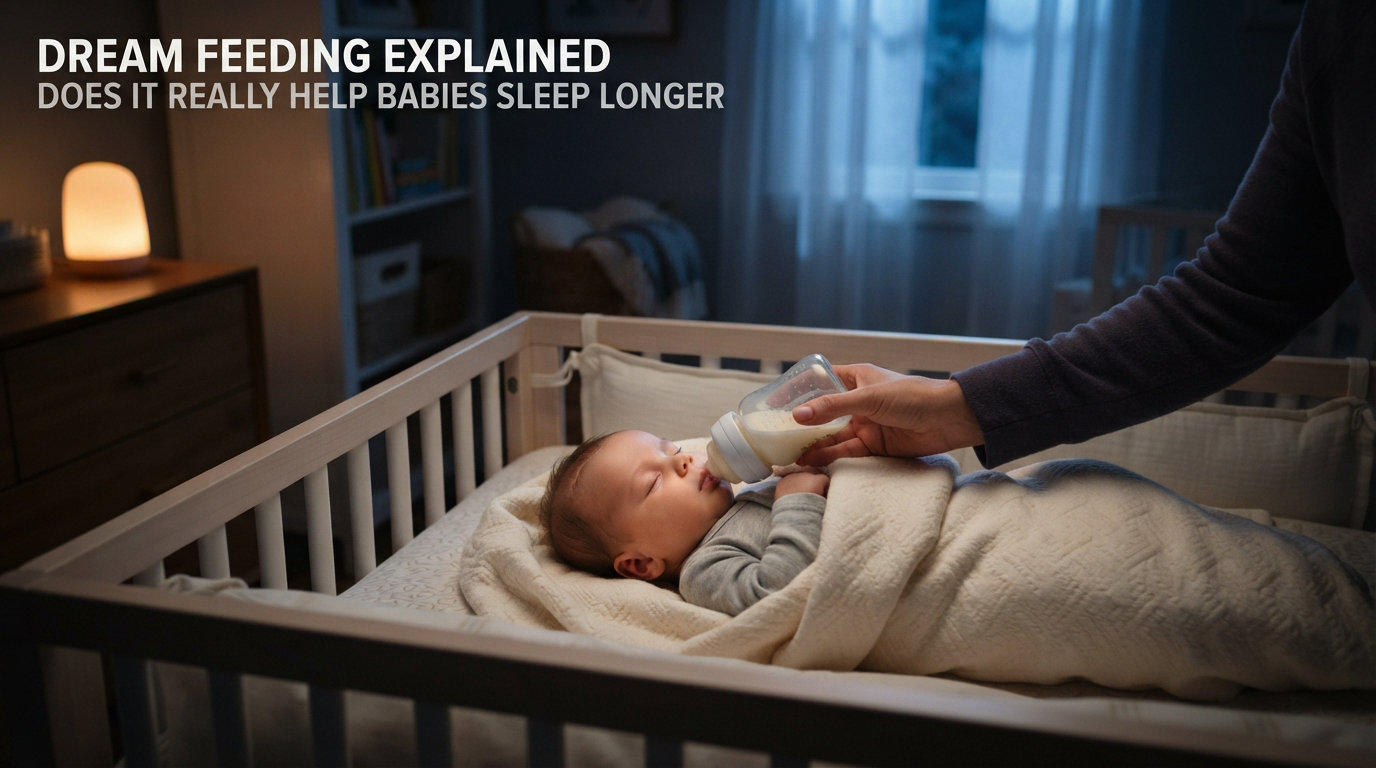
Dream feeding is one of those parenting techniques that sounds almost too good to be true. The promise is simple: feed your baby while they sleep, and everyone gets more rest. But does dream feeding actually help babies sleep longer, or is it just another sleep myth that leaves parents more exhausted?
I remember those early weeks with my first baby, staring at the clock at 2 AM wondering if I would ever sleep through the night again. A friend mentioned dream feeding as her secret weapon for getting five consecutive hours of sleep. It worked for her, but when I tried it, my baby woke fully and refused to go back down. That is the reality of dream feeding: it helps some families tremendously and makes things worse for others.
In this guide, I will explain exactly what dream feeding is, how to do it safely, and whether it actually helps babies sleep longer. You will learn when to start, when to stop, and how to troubleshoot common problems. By the end, you will have the facts you need to decide if dream feeding is right for your family.
Table of Contents
What Is Dream Feeding?
Dream feeding is a technique where parents gently rouse their sleeping baby for a feeding, typically between 9 and 11 PM, right before the parent goes to bed. The goal is to “top off” baby’s belly so they sleep longer during the hours when the parent is also trying to sleep. This practice is also called twilight feeding or a sleepy feed.
Unlike a regular night feeding, which happens in response to a baby crying and waking, a dream feed is proactive. You wake the baby before they would naturally wake on their own. The theory is that by filling their stomach before your bedtime, you can shift their longest sleep stretch to align with your own sleep schedule.
How Dream Feeding Differs From Night Feeding
Dream feeding and night feeding serve different purposes and happen at different times. Understanding the distinction matters for deciding which approach fits your situation.
Dream feeds happen 2 to 3 hours after your baby first falls asleep, typically between 9 PM and 11 PM. You initiate the feeding while baby is still mostly asleep. Night feeds happen when your baby naturally wakes from hunger, usually between midnight and 5 AM, after they have already slept a stretch.
The key difference is timing and intent. With dream feeding, you are trying to prevent a waking before it happens. With night feeding, you are responding to a waking that has already occurred.
How to Dream Feed Your Baby
The technique for dream feeding matters more than you might think. Done correctly, your baby barely stirs and settles back to sleep quickly. Done incorrectly, you end up with a wide-awake baby at 10 PM who thinks it is playtime.
Step 1: Choose the Right Timing
Pick up your baby approximately 2 to 3 hours after their bedtime feeding. If your baby goes down at 7 PM, aim for a dream feed between 9:30 and 10:30 PM. This timing allows them to have completed one full sleep cycle but ensures they are still in a deep enough sleep to feed drowsily.
Do not wait until your baby starts stirring or making noises. The goal is to catch them in deep sleep before natural waking begins.
Step 2: Minimize Stimulation
Keep the lights dim. Use a red night light if you need any illumination at all. Red light does not suppress melatonin the way blue or white light does, so it helps maintain your baby’s sleepy state.
Avoid talking to your baby or making eye contact. Eye contact is stimulating for babies and can signal that it is time to wake up fully. Keep your movements slow and gentle.
Step 3: Decide About the Swaddle and Diaper
Keep your baby swaddled if they use one. The swaddle provides comfort and signals that it is still sleep time. If your baby is in a sleep sack, leave it on.
Most parents do not change diapers during dream feeds unless absolutely necessary. A diaper change fully wakes most babies and defeats the purpose of the dream feed. If the diaper is only wet, leave it. If it is soiled, change it quickly with minimal light and interaction.
Step 4: Feed Efficiently
Offer the breast or bottle immediately. For breastfed babies, you may need to stroke their cheek or gently rouse them enough to latch. Once latched, most babies will nurse reflexively even while mostly asleep.
For bottle-fed babies, gently touch the bottle nipple to their lips. They should begin sucking without fully opening their eyes. Hold the bottle at a comfortable angle to prevent air intake.
Step 5: Aim for a Full Feeding
Encourage your baby to take a full feeding. This means nursing from both sides if breastfeeding, or finishing most of the bottle if formula feeding. A dream feed only works if baby gets enough calories to extend their sleep.
Watch for swallowing sounds or rhythmic sucking. If your baby is comfort nursing without swallowing, they may need gentle encouragement to keep eating.
Step 6: Burp and Return to Bed
Burp your baby gently. Some parents skip burping during dream feeds to avoid stimulation, but others find their baby wakes later with gas if not burped. I found that a gentle pat for 30 seconds was enough without fully rousing my baby.
Immediately place baby back in their sleep space. Do not rock, sing, or engage. The less interaction, the easier the transition back to sleep.
Does Dream Feeding Actually Help Babies Sleep Longer
Dream feeding does not actually lengthen your baby’s total sleep time or the duration between feedings. Instead, it shifts when the longest sleep stretch occurs. While your baby may not sleep longer overall, dream feeding can help parents get more consecutive sleep by aligning baby’s longest stretch with their own bedtime.
This distinction matters because many parents try dream feeding expecting their baby to suddenly start sleeping 8 hours straight. That is not how it works. If your baby naturally sleeps a 5-hour stretch from 7 PM to midnight, dream feeding might shift that stretch to 10 PM to 3 AM, giving you more sleep when you actually want to be sleeping.
What the Research Says
Scientific evidence on dream feeding is limited but suggestive. A study published in the journal Pediatrics found that feeding infants between 10 PM and midnight was associated with longer sleep duration in the early night hours. However, this does not mean dream feeding creates new sleep capacity that did not exist before.
The American Academy of Pediatrics does not specifically endorse or discourage dream feeding. Their guidance focuses on responsive feeding and ensuring babies receive adequate nutrition. Dream feeding aligns with responsive feeding principles as long as it is done safely and baby is gaining weight appropriately.
Real Parent Experiences
Forum discussions reveal a clear split in outcomes. Some parents swear by dream feeding as their sanity-saver. One mother reported that starting dream feeds at 8 weeks helped her baby sleep from 10:30 PM to 4 AM, giving her the first six-hour stretch she had experienced since pregnancy.
Other parents found dream feeding made sleep worse. A common complaint in parenting forums is that the dream feed disrupted baby’s natural rhythm. As one parent shared, “It did not change his sleep at all. He still woke between 1 and 3 AM and then 5 AM to eat. If anything, the dream feed made it worse because he now expected food at 10 PM too.”
When Dream Feeding Works Best
Dream feeding tends to work best for babies who are good sleepers already but wake from hunger at inconvenient times. If your baby consistently sleeps a 4-hour stretch but starts it at 7 PM, dream feeding can shift that stretch later.
It also works well for breastfeeding mothers who want to protect their milk supply while reducing night wakings. The extra feeding helps maintain production while potentially consolidating sleep.
Dream feeding is less effective for babies with sleep associations, reflux issues, or those already waking frequently from non-hunger reasons. In these cases, adding a dream feed often creates one more waking without solving the underlying sleep problem.
When to Start Dream Feeding
Most experts recommend waiting until your baby is at least 6 to 8 weeks old before starting dream feeds. Newborns need to eat every 2 to 3 hours around the clock and should not be woken for extra feedings unless medically directed. Their stomachs are small and their calorie needs are high.
The ideal window for dream feeding is typically from 6 weeks to 10 months of age. After 10 months, most babies can sleep through the night without feeding and may develop sleep associations that make dropping the dream feed difficult.
Dream Feeding by Age
6 to 8 Weeks: This is the earliest recommended age. Your baby should have regained their birth weight and established a consistent feeding pattern. Start with one dream feed between 10 and 11 PM.
3 Months: Many babies are ready for more consolidated sleep at this age. Dream feeding can help extend the first sleep stretch to 5 or 6 hours. Some babies may naturally drop the dream feed around this age.
4 Months: The 4-month sleep regression often hits during this period. Dream feeding may provide stability during disrupted sleep, but it can also become a crutch that is hard to break after the regression passes.
6 Months: At this age, many babies can sleep 8 to 10 hours without feeding. If you are still dream feeding, consider whether it is still necessary or has become a habit.
Signs Your Baby Is Ready for Dream Feeding
Your baby may be ready to try dream feeding if they consistently sleep a 3 to 4 hour stretch at the beginning of the night but wake hungry around midnight. Other readiness signs include steady weight gain, ability to feed efficiently, and the ability to fall back asleep independently after night wakings.
Dream Feeding Pros and Cons
| Pros | Cons |
|---|---|
| Aligns baby’s longest sleep stretch with parent’s bedtime | Does not actually extend total sleep time |
| May help breastfeeding mothers maintain milk supply | Can create a sleep association that is hard to break |
| Potentially reduces night wakings during parent sleep hours | Risk of fully waking baby and disrupting sleep |
| Provides extra calories for growing babies | May cause early morning wakings in some babies |
| Can help establish predictable sleep patterns | Not effective for babies with reflux or sleep issues |
| Allows both parents to get more consecutive sleep | Requires parent to stay awake until dream feed time |
The decision to dream feed depends on your baby’s temperament, your sleep goals, and your family’s schedule. For working parents who need to wake early, dream feeding can be a lifesaver. For parents whose babies wake frequently regardless of feeding, it may add complexity without benefit.
When to Stop Dream Feeding
Most babies are ready to drop the dream feed between 6 and 10 months of age. By this point, they can typically consume enough calories during the day to sustain them through the night. Continuing dream feeds beyond this age can create a sleep association that makes independent sleep more difficult.
Signs It Is Time to Stop
Your baby may be ready to drop the dream feed if they consistently sleep through it without waking or eating much, if they start waking more frequently after the dream feed, or if they can go 8 to 10 hours without feeding during the day. Another sign is early morning waking, which can indicate the dream feed is disrupting their natural sleep rhythm.
How to Wean Off Dream Feeding
There are two main approaches to dropping the dream feed: gradual weaning and cold turkey.
Gradual weaning involves slowly reducing the amount of milk offered or the time spent feeding over the course of a week. For breastfed babies, nurse for shorter periods each night. For bottle-fed babies, reduce the ounces by 1 to 2 ounces every few days. This method is gentler but takes longer.
Cold turkey means simply stopping the dream feed one night and letting your baby sleep through. Most babies will naturally redistribute their calories to daytime feedings within a few days. This approach works well for older babies who are clearly ready to drop the feed.
Either way, expect some adjustment for 3 to 5 nights. Your baby may wake earlier for their first night feeding, or they may surprise you by sleeping straight through.
Troubleshooting Common Dream Feeding Problems
Even with the best technique, dream feeding does not work for every baby. Here is how to handle common issues based on real parent experiences from parenting forums.
Problem: Baby Wakes Fully and Will Not Settle
If your baby consistently wakes fully during dream feeds, the timing may be off. Try moving the feed 30 minutes earlier when baby is in deeper sleep. Ensure you are not changing the diaper unless absolutely necessary. Check that the room is dark enough and that you are avoiding eye contact.
If your baby still wakes fully after adjusting technique, dream feeding may not be right for your baby. Some babies are light sleepers and cannot feed drowsily. In this case, responding to natural hunger cues may work better.
Problem: Early Morning Wakings
Some parents find that dream feeding leads to earlier morning waking, often between 4 and 5 AM. This happens because the dream feed shifts the entire sleep schedule earlier. Your baby is essentially taking their longest stretch from dream feed time rather than midnight.
If early wakings become a problem, try moving the dream feed 30 minutes later or gradually dropping it. Alternatively, accept that your baby is a natural early riser and adjust your own bedtime earlier to compensate.
Problem: No Improvement After One Week
Dream feeding takes time to show results. However, if you have tried it consistently for 7 to 10 nights with no improvement in your sleep, it is probably not going to work for your baby.
Some babies are not hungry at the dream feed time. Others have underlying sleep issues unrelated to hunger. If your baby wakes frequently from sleep associations, gas, reflux, or habit, adding calories will not help.
Problem: Baby Poops During Dream Feed
This is a frustrating reality for some parents. You successfully dream feed, change the diaper because it is soiled, and now you have a wide-awake baby at 10:30 PM. If this happens frequently, some parents choose to skip the dream feed entirely or accept that a diaper change means a longer settling period.
One workaround is to dream feed earlier, before the digestive system kicks into high gear. Another option is to use a highly absorbent nighttime diaper and skip changes for wet diapers only.
Problem: Reflux or Spit-Up
Babies with reflux need to remain upright after feeding. This conflicts with the dream feed goal of immediate return to sleep. If your baby has reflux, consult your pediatrician about whether dream feeding is appropriate.
Some parents of reflux babies keep them upright for 15 to 20 minutes after the dream feed, treating it more like a regular night feeding. This reduces the benefit but may still help consolidate sleep.
Frequently Asked Questions About Dream Feeding
Do dream feeds make my baby sleep longer?
Dream feeds do not actually lengthen your baby’s total sleep time. Instead, they shift when the longest sleep stretch occurs. For example, if your baby naturally sleeps 5 hours from 7 PM to midnight, a dream feed at 10 PM might shift that stretch to 10 PM to 3 AM. This gives parents more consecutive sleep during their own bedtime hours, even though baby’s total sleep duration remains the same.
What is the 3 6 9 rule for babies?
The 3 6 9 rule refers to a flexible sleep and feeding schedule for babies. It suggests feedings approximately every 3 hours during the day, with awake windows of 3 hours or less for young babies, and aiming for 6 to 9 hours of night sleep depending on age. This is a general guideline, not a strict rule, and individual babies vary significantly in their needs.
Do pediatricians recommend dream feeding?
The American Academy of Pediatrics does not specifically endorse or discourage dream feeding. Most pediatricians consider it safe for healthy babies who are gaining weight appropriately. However, individual pediatricians vary in their recommendations. Some suggest responsive feeding based on baby’s cues rather than scheduled dream feeds. Always consult your pediatrician if you have concerns about your baby’s feeding or sleep patterns.
What is the 5 3 3 rule for baby sleep?
The 5 3 3 rule is a sleep training method where baby sleeps for 5 hours, then is fed, then sleeps for 3 hours, is fed again, then sleeps for 3 more hours. This creates a predictable pattern of longer stretches followed by shorter ones. It is often used for babies around 3 to 4 months old who are developmentally ready for longer sleep stretches but still need night feedings.
Does dream feeding affect baby sleep?
Dream feeding can affect baby sleep in several ways. Positively, it may align baby’s longest sleep stretch with parental sleep hours and provide extra calories for growth. Negatively, it can create sleep associations, cause early morning wakings, or disrupt natural sleep rhythms in some babies. The effect varies by individual baby. Some babies benefit greatly, while others show no improvement or sleep worse.
Does dream feeding count as sleep time?
Yes, dream feeding counts as sleep time for your baby. Although they are briefly roused for feeding, baby remains in a sleepy state throughout and typically returns to sleep immediately afterward. The feeding time is minimal compared to a full waking. For sleep tracking purposes, most parents count the dream feed period as continuous night sleep since baby does not fully wake or cry.
Conclusion
Dream feeding explained does it really help babies sleep longer? The honest answer is nuanced. Dream feeding does not magically create longer sleep in your baby. What it can do is shift when that sleep happens, potentially giving you more rest during the hours when you need it most.
The technique works beautifully for some families and fails completely for others. Success depends on your baby’s temperament, age, feeding efficiency, and underlying sleep patterns. If your baby is already a decent sleeper who just wakes at inconvenient times, dream feeding may help. If your baby struggles with sleep associations or frequent wakings, dream feeding probably will not solve the problem.
The key is managing expectations and being willing to experiment. Try dream feeding consistently for 7 to 10 nights. If it helps, wonderful. If it makes sleep worse or shows no improvement, abandon it without guilt. Every baby is different, and there is no single sleep solution that works for everyone. Trust your instincts, consult your pediatrician when needed, and remember that this challenging phase will pass. Eventually, every baby sleeps through the night.