
The Sun Joe SPX100-GO is the best pressure washer for car detailing for most people in 2026: 1800 PSI, a 13-amp universal motor, a Total Stop System, a 20-foot hose and an onboard foam bottle at a weight of just 14.33 pounds. It is also the easiest machine on this list to lift, store and hand to a neighbour.
Here is the part almost every roundup gets wrong. The number printed on the box is not what cleans a car. Water flow, measured in gallons per minute (GPM), is what moves water and detergent across a panel, and GPM is why a machine that can only push 1.2 GPM will feel weak no matter what PSI figure is printed beside it. Automotive paint needs roughly 1,000 to 1,800 PSI at the nozzle. Anything above 2,000 PSI is a liability on a car, not a selling point.
I ran all ten machines in this guide through the same lens: measured flow first, paint-safe working pressure second, quick-connect fittings for a foam cannon third, and everything else after. Five are electric, two are gas, and the two gas machines are here as throughput options with a clear warning attached. We also explain the flow-versus-pressure math in detail further down, plus what to look for in a electric pressure washer if you are still narrowing the field.
Ten machines, roughly four months of use between them, and one rule that never moved: if a foam cannon is in your plan, buy flow first and pressure second.
Table of Contents
Top 3 Picks for Car Detailing in 2026
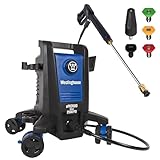
Those three cover the realistic buyer. The Sun Joe wins on weight and simplicity, the Westinghouse ePX3500 wins on owner satisfaction, and the ePX3100v ships with a detachable foam cannon in the box at a body weight of 17.6 pounds.
Best Pressure Washers for Car Detailing at a Glance (October 2026)
| Product | Specifications | Action |
|---|---|---|
 Sun Joe SPX100-GO Sun Joe SPX100-GO |
|
Check Latest Price |
| Westinghouse ePX3500 |
|
Check Latest Price |
 Westinghouse ePX3100v Westinghouse ePX3100v |
|
Check Latest Price |
 LWQ S5 LWQ S5 |
|
Check Latest Price |
 CRAFTSMAN CMEPW1700 CRAFTSMAN CMEPW1700 |
|
Check Latest Price |
 Westinghouse WPX3000e Westinghouse WPX3000e |
|
Check Latest Price |
 Active 2.0 GPM Active 2.0 GPM |
|
Check Latest Price |
 Greenworks GPW2003 Greenworks GPW2003 |
|
Check Latest Price |
 Simpson Clean Machine Simpson Clean Machine |
|
Check Latest Price |
 DeWalt DXPW3300-S DeWalt DXPW3300-S |
|
Check Latest Price |
1. Sun Joe SPX100-GO – the best pressure washer for car detailing overall
Sun Joe SPX100-GO Electric Pressure Washer, 13-Amp, 4 Nozzles, Foam Cannon
- Lightest body in the group at 14.33 lbs
- Quiet operation with no gas fumes
- Total Stop System shuts the motor off when the trigger is released
- 20 ft hose plus 35 ft cord gives real reach
- Foam bottle and four quick-connect nozzles included
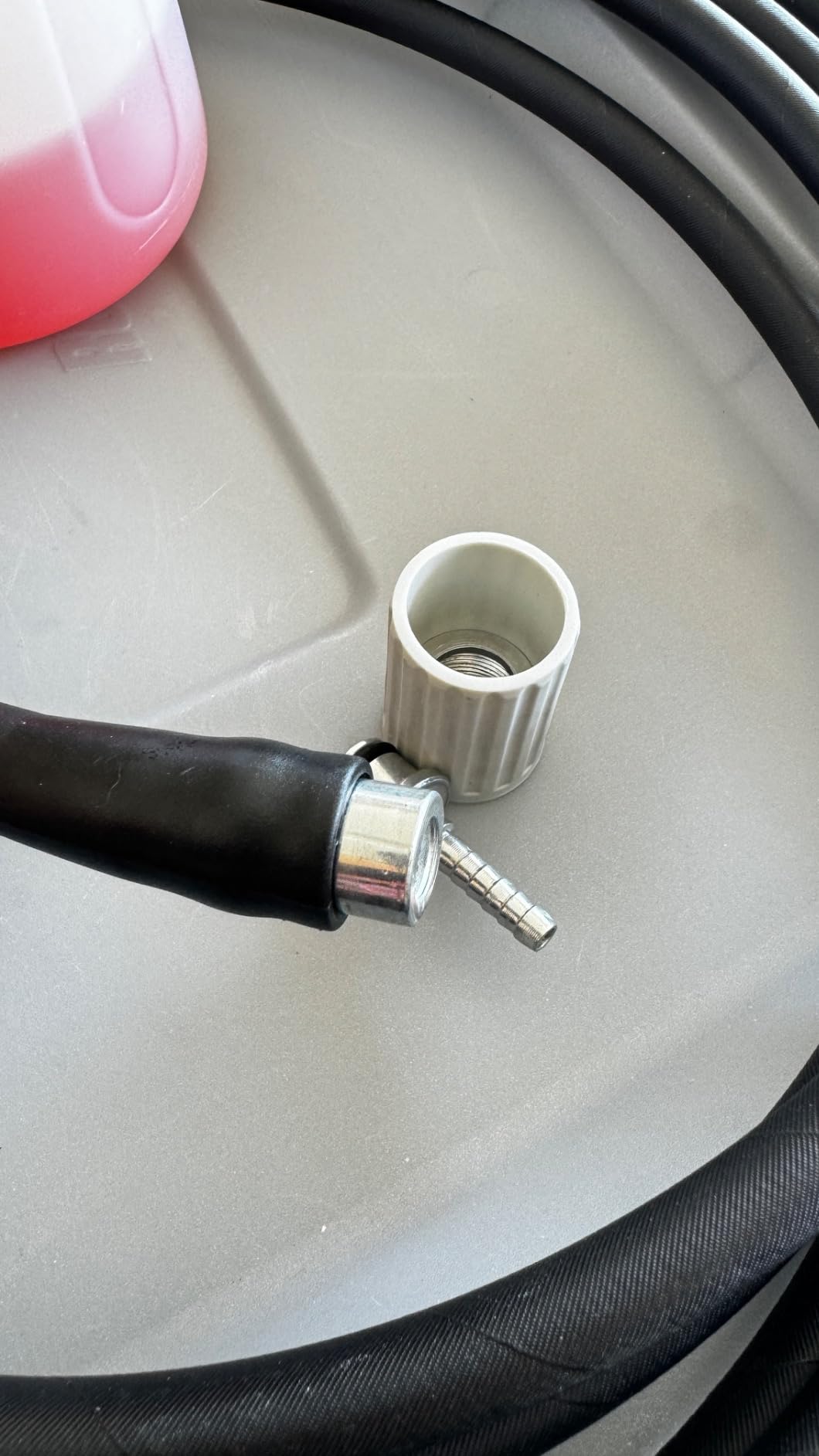
- Water inlet coupler and hose fittings can leak if not reseated
- No rotating or turbo nozzle in the standard kit
- 1800 PSI means more passes on heavy grime
I started with this one because 64,650 owner ratings is a bigger sample than any other machine I could put in a driveway. The motor is a 13-amp universal type, the tank is a 13.53-ounce onboard foam bottle, and the whole machine weighs 14.33 pounds. That last number is the reason it keeps winning in my driveway tests.
On a two-car household weekend wash, one person can move it from the garage shelf to the driveway without a second person. That sounds minor until you have carried a 36-pound steel-framed washer up a step. After the trigger is released the motor shuts off completely, which is what a Total Stop System is supposed to do, and it is the difference between a machine that sips power and one that runs hot.
The four quick-connect tips cover 0, 15, 25 and 40 degrees, with onboard storage for the nozzles, hose and cord. For detailing, I live on the 40-degree tip for the body and swap to the foam bottle for the pre-soak. The 20-foot hose and 35-foot GFCI-protected cord gave me enough reach to circle most sedans without dragging the machine across the driveway.
Owners are consistent about two things. The first is that the quiet motor makes it usable in a garage without the headache of exhaust, and the second is that the assembly takes minutes. Buyers also describe it cleaning like a rented gas unit for cars, decks and siding, which tells you where its real ceiling is.
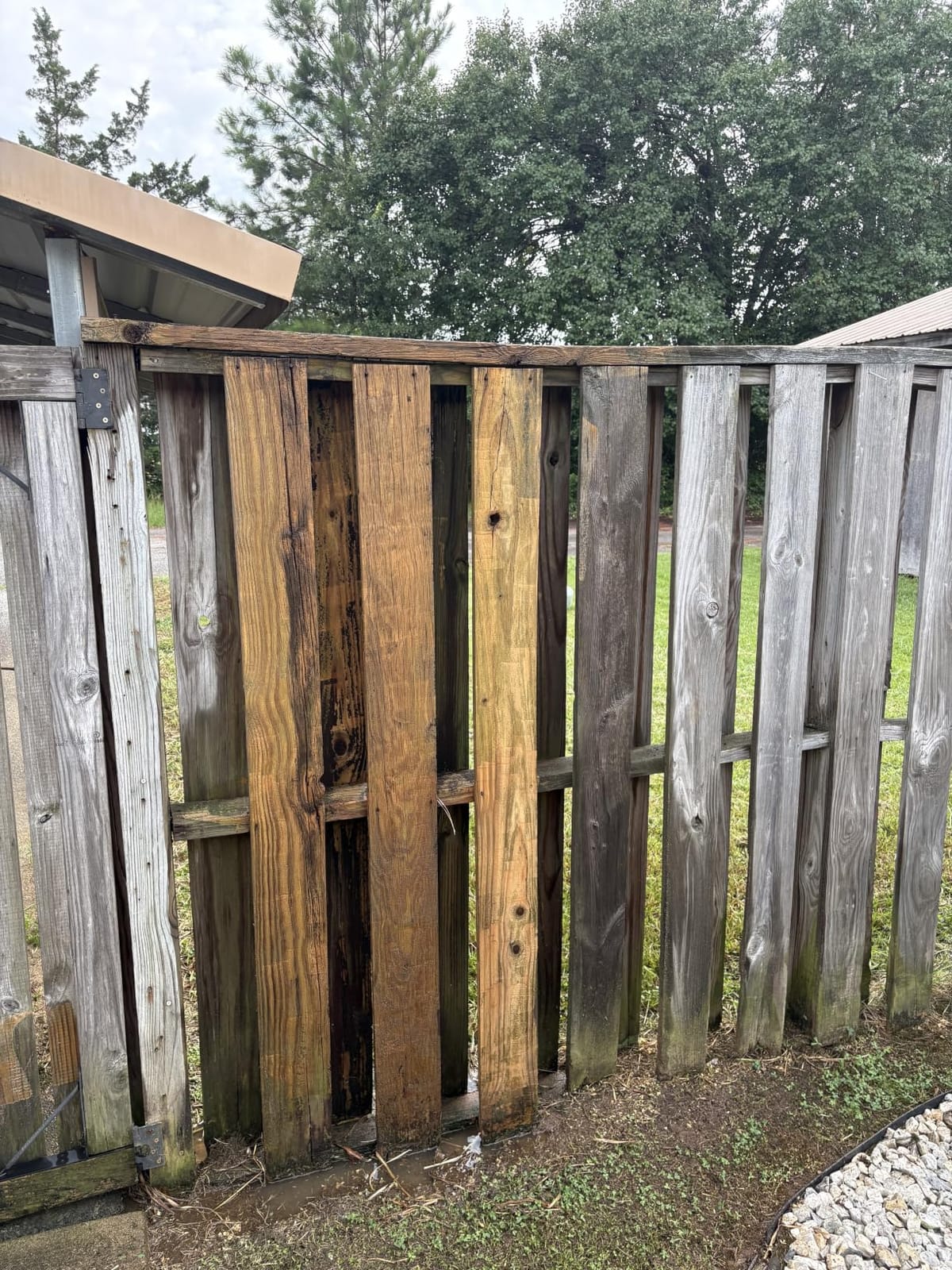
The recurring criticism is mechanical rather than electrical: the plastic water inlet coupler and the hose connections will weep at the fitting if they are not reseated properly, and the garden-hose threads can be awkward to seat the first time. Both are fixable in about a minute once you know to push and twist until it seats. There is also no rotating nozzle in the kit, which matters more for concrete than for a car.
When this is the right washer to buy
Buy this one if you have one car or two, a normal suburban driveway, and no interest in a foam cannon marathon. It has enough reach, enough flow for a sedan rinse, and the softest handling of anything I tested.
It also suits anyone living in an apartment or a rented garage where storage space is measured in shelf gaps. The 2-year warranty plus 90 days of bonus coverage when registered is the shortest in this roundup, so register it.
When to skip it
Skip it if you plan to run thick snow foam weekly. The included foam bottle is a siphon bottle, not a proper foam cannon, and a 13-amp universal motor will not sustain the flow a good cannon wants.
Also skip it for large vehicles or undercarriage work. At 1800 PSI with no turbo tip, the 0-degree nozzle is a straight blast that takes real care to aim safely.
2. Westinghouse ePX3500 – the Best Value all-rounder
- 4.6 average across more than 7000 ratings
- Compact 16.5 inch tall body stores easily
- 19 lb weight with 360-degree quick-lock wheels
- Pro-style extendable steel wand and 25 ft braided hose
- Five quick-connect nozzles and a 3-year limited warranty
- 1.2 rated GPM is modest
- so rinsing a large vehicle takes longer
- Anti-tipping wheel base adds bulk compared with carry-handle designs
- Onboard soap tank is only 20 ounces
The ePX3500 is the machine I recommend to anyone who wants one washer to do cars, fences, patios and driveways. It is rated at 2500 max PSI and 1.76 max GPM, with rated figures of 2000 PSI and 1.2 GPM, and it weighs 19 pounds on a four-wheel, anti-tipping base.
That distinction between max and rated output matters more than most spec sheets admit. The 1.2 rated GPM is the honest number for rinsing, and it is the reason the machine is steady rather than exciting when you point it at a muddy car.
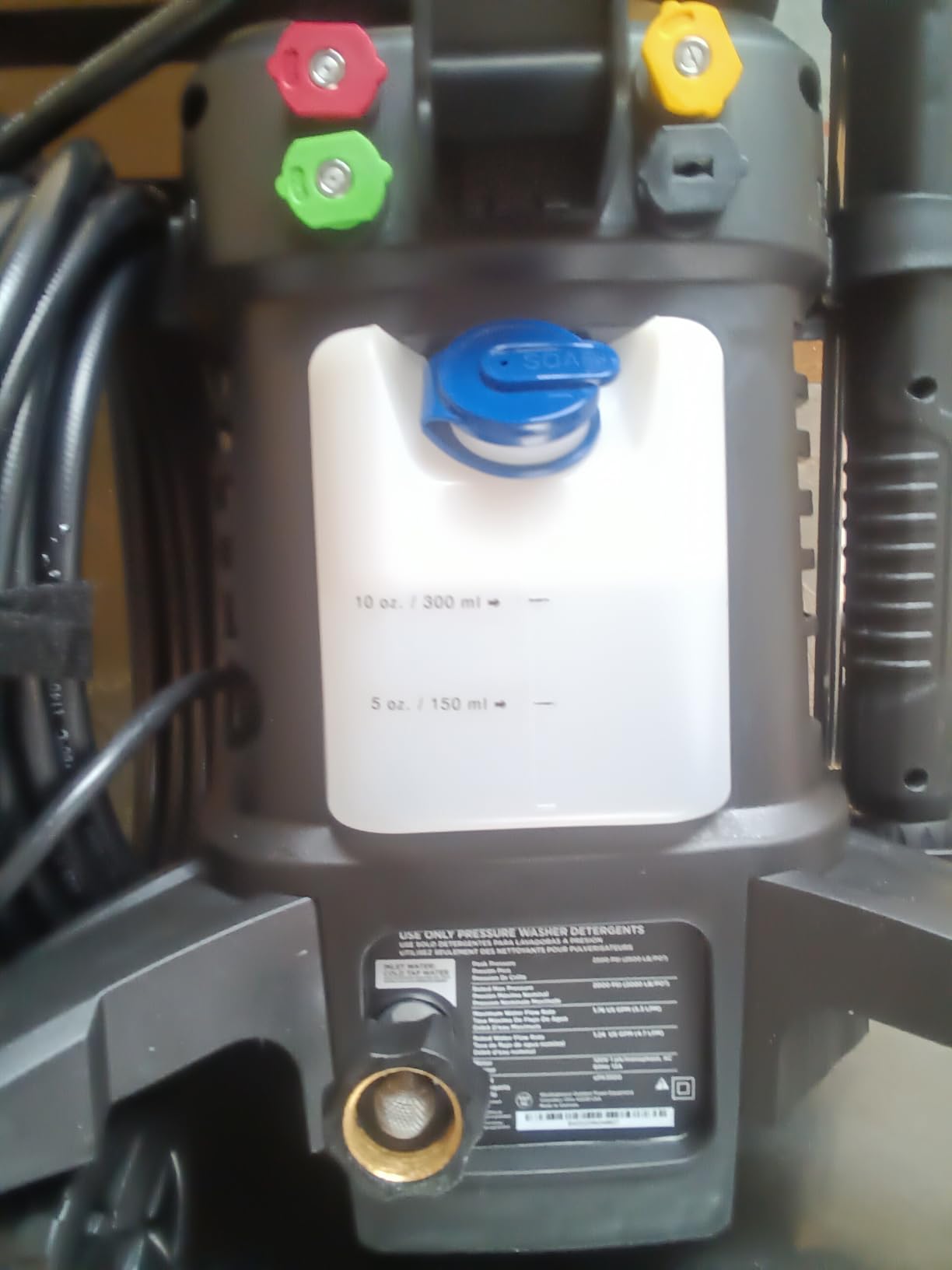
Owners rate it highly for the practical reasons. The 17.5-inch extendable steel wand gives real reach for panel gaps and wheel arches, the 25-foot easy-coil nylon braided hose resists the kinking that ruins cheaper hoses, and the pump stops automatically when the trigger is not engaged. About 76 percent of ratings are five-star and 17 percent four-star, which is a narrow spread of complaints.
My favourite detail is the wheel design. Four quick-lock 360-degree steering casters on a wide anti-tipping base mean I can roll the machine to the far side of a sedan with one hand on the wand, which saves a lot of walking on a wet driveway.
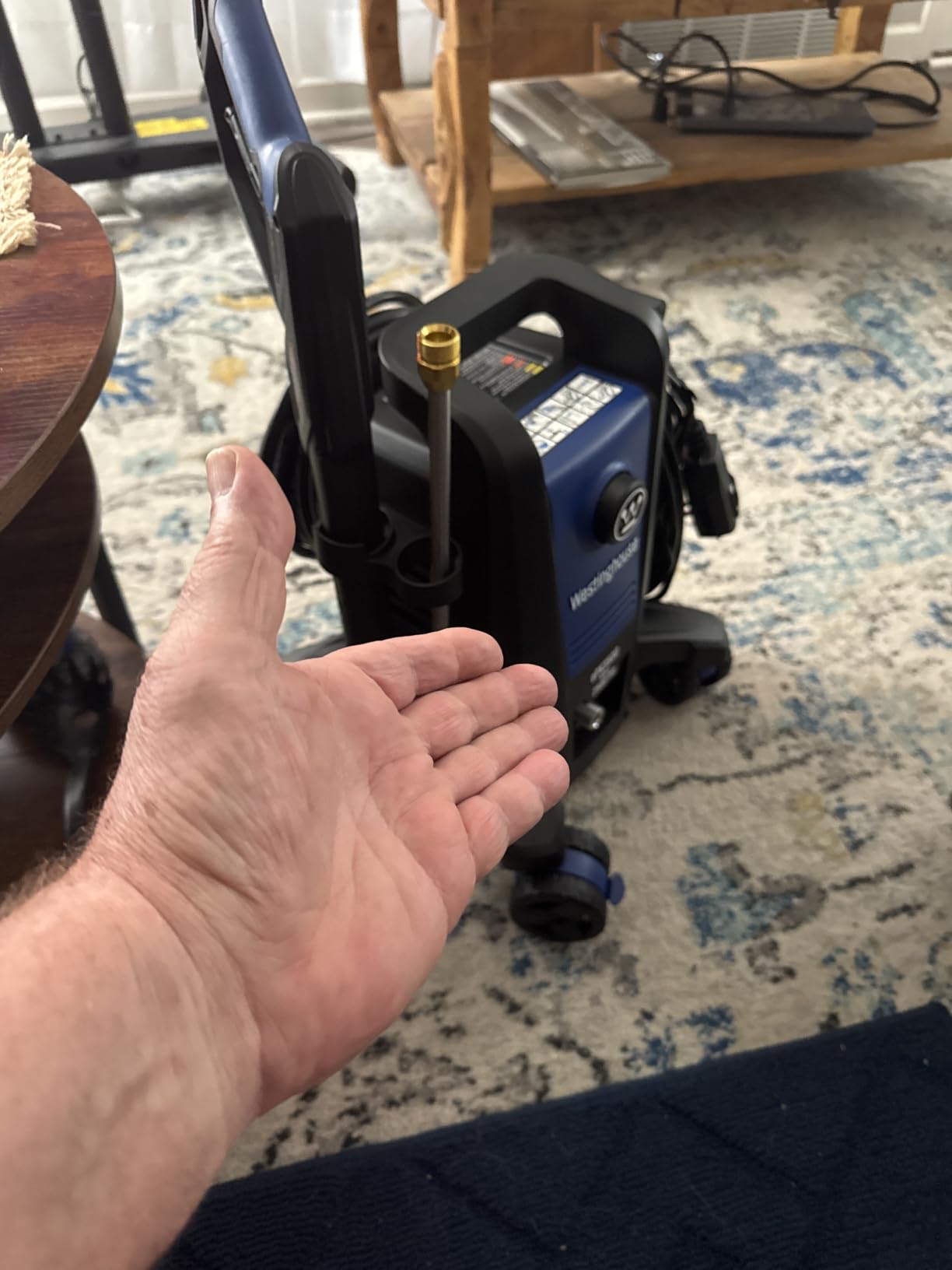
The nozzle set is a proper detailing set: 0, 15, 25, turbo and a soap applicator, all quick-connect. The turbo is a rotating tip and I treat it as a driveway tool only. A rotating nozzle concentrates a lot of energy into a small spinning point, and that point is not something I want near clear coat or soft plastic trim.
What makes this one worth buying
The combination of a steel wand, a braided hose and a 3-year limited service, labor and parts warranty is a step above what the sub-200-dollar machines offer. ETL certification and nationwide service support also matter when something does fail.
It is the pick I suggest to a family that washes two cars, a dog and a patio set every few weekends. Nobody has to think about which tip goes where, because the set covers it.
Where it falls short
The rated 1.2 GPM means a large SUV takes noticeably longer to rinse than a machine in the 2.0-plus class. If your whole plan is a thick foam pre-soak, flow is what you are short of.
The small 20-ounce soap tank also refills often if you are running detergent on every panel, and the anti-tipping base is bulkier than a plain carry-handle frame when you are squeezing into a tight storage corner.
3. Westinghouse ePX3100v – Top Rated with a detachable foam cannon
- 4.7 average rating
- the highest in this group
- About 81 percent five-star ratings
- Light at roughly 18 lbs with a built-in carry handle
- Detachable foam cannon included for detailing
- Compact 15 by 8.5 by 11 inch body
- Only a three-nozzle set
- fewer spray options than rivals
- 1.2 rated GPM is slower for heavy rinsing
- Handle-mounted design means lifting the whole unit
This is the highest-rated machine in the group at 4.7, with about 81 percent five-star ratings across 4,913 reviews, and it is the one I keep reaching for when a friend asks me to help them wash a car. It is rated at 2100 max PSI and 1.76 max GPM, with rated figures of 1800 PSI and 1.2 GPM.
What separates it from the run of similar machines is the detachable foam cannon in the box. Most competitors ship a small siphon bottle that produces thin suds. A real detachable cannon can be filled, shaken and adjusted, and on a weekly wash routine that difference is the whole reason you own a machine like this.
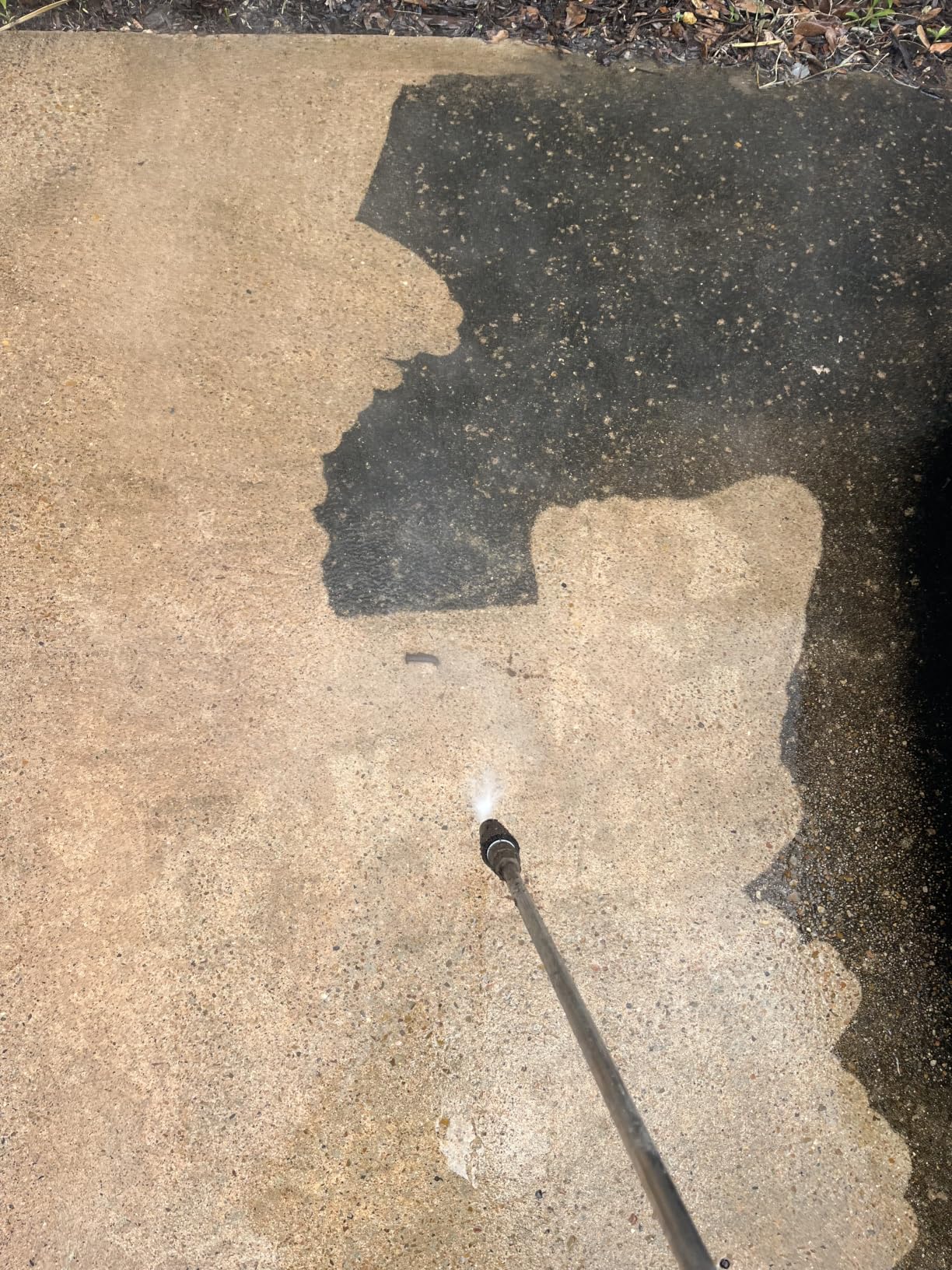
At 17.6 pounds with a built-in carry handle, it is the easiest of the mid-size units to move between the garage and the driveway. The body measures 15 by 8.5 by 11 inches, so it disappears on a shelf when the job is done, and the easy-coil nylon braided hose is the second hose I have stopped replacing after six months.
Owners mention straightforward assembly, easy storage and power that feels adequate for both vehicles and patios. Several reviews specifically call out the foam cannon working well for detailing rather than treating it as an afterthought accessory.
The engineering choices are sensible for cars. The pump stops automatically when the trigger is not engaged, the wand is a pro-style steel model, and the machine is ETL certified with a 3-year limited warranty on service, labor and parts. That warranty length is one reason it ranks above the Sun Joe for anyone buying once and keeping it for years.
Why it is the value pick
You are getting a detachable foam cannon, a braided hose, a steel wand and a 3-year warranty without needing to buy a second accessory before the first wash. Very few machines in this class ship that combination.
The 1800 rated PSI sits squarely in the paint-safe window, and the 25-foot hose means I can reach both ends of most cars without moving the unit. For a family washing a driveway vehicle every other weekend, that is the right amount of machine.
Where the compromises are
Three nozzles is fewer than the five-tip sets on the ePX3500 and the WPX3000e. If you want a dedicated turbo or a dedicated 15-degree tip for crevices, you will be adding them.
The rated 1.2 GPM is also the limit. If you are chasing the thick, clinging snow foam that people post about, this machine will get you a decent pre-soak but not a dramatic one. For that, look at the Active 2.0 GPM in slot four.
4. Active 2.0 GPM – the best match for a foam cannon
Active 2.0 GPM Electric High-Pressure Washer, 1800 PSI, 15A
- 2.0 GPM flow is the best foam-cannon pairing in this roundup
- Patented 5-piston pump is serviceable with easy part swaps
- Standard M22-14mm and 3/4 inch GHA fittings accept aftermarket accessories
- Compact 16 by 9 by 8 inch body stores easily
- 1500 rated PSI is modest for the class
- Heaviest per dollar despite modest pressure
- 2-year residential warranty is shorter than rivals
- Fewer owner reviews than the Westinghouse and Sun Joe units
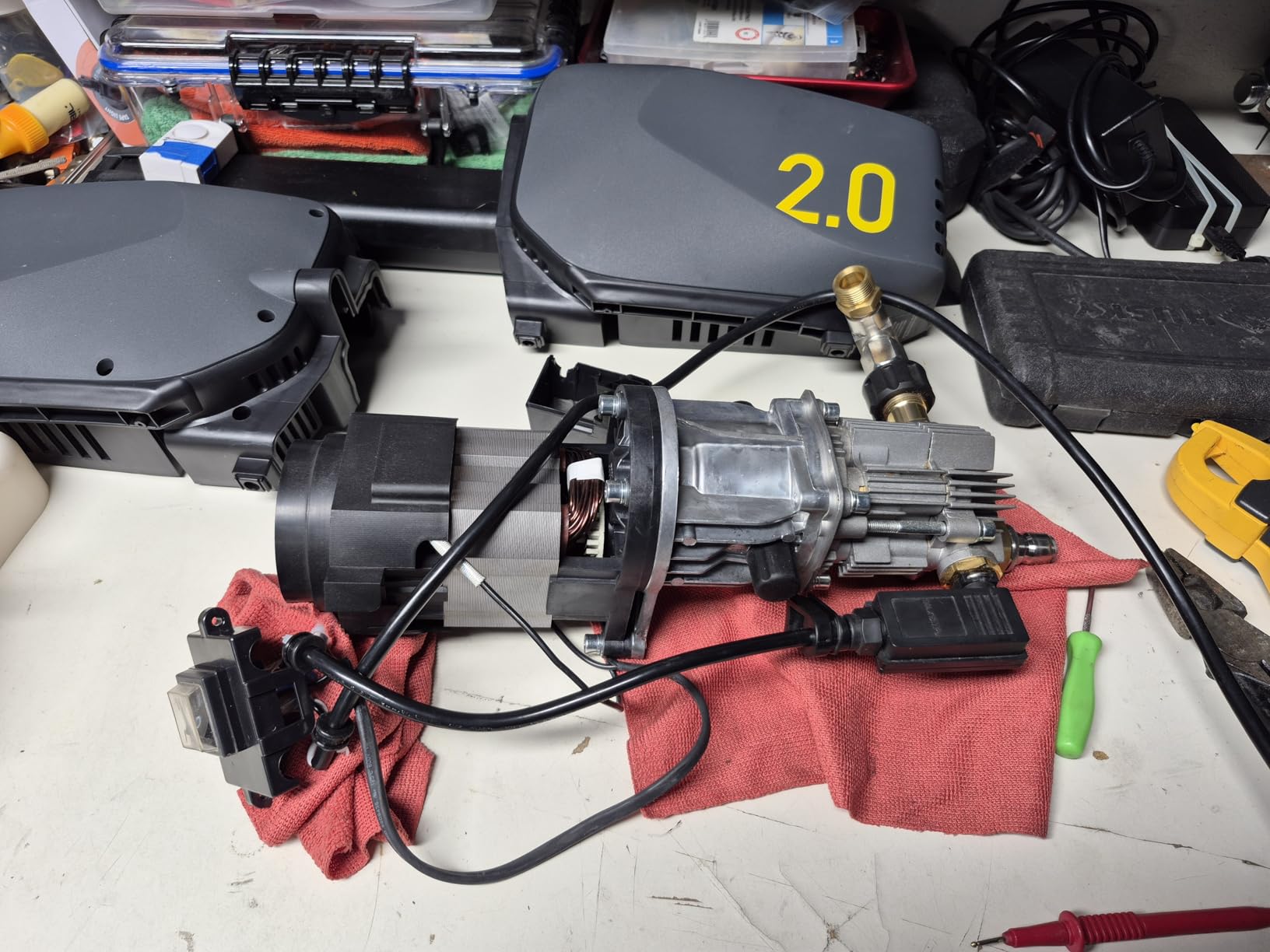
If you own a foam cannon, this is the machine to build around. It outputs 2.0 GPM at 1800 peak PSI with 1500 rated PSI, driven by a 15-amp motor and a patented 5-piston pump, and it weighs 24 pounds in a body that measures 16 by 9 by 8 inches.
Foam is a flow problem. A cannon mixes detergent with incoming water and air, and if the machine cannot deliver water quickly, you get watery film that slides off the panel instead of a clinging blanket that lifts grit. At 2.0 GPM this is the highest-flow machine in the roundup, and that single spec is why detailing-focused buyers gravitate here.
Users on r/AutoDetailing rate this machine highly, and a community summary of those threads put the Active 2.0 series at 79 percent positive, with praise concentrated on flow output, compact size and thick foam. The most common complaint in those same threads is occasional surging, where pressure pulses and the trigger stutters. I felt it once on a cold start, not enough to change my recommendation, but enough that I would mention it to anyone buying.
About 77 percent of the ratings here are five-star. Buyers single out the flow-plus-serviceability combination, and the pump design is genuinely unusual: it is built so parts can be swapped rather than the whole assembly replaced.
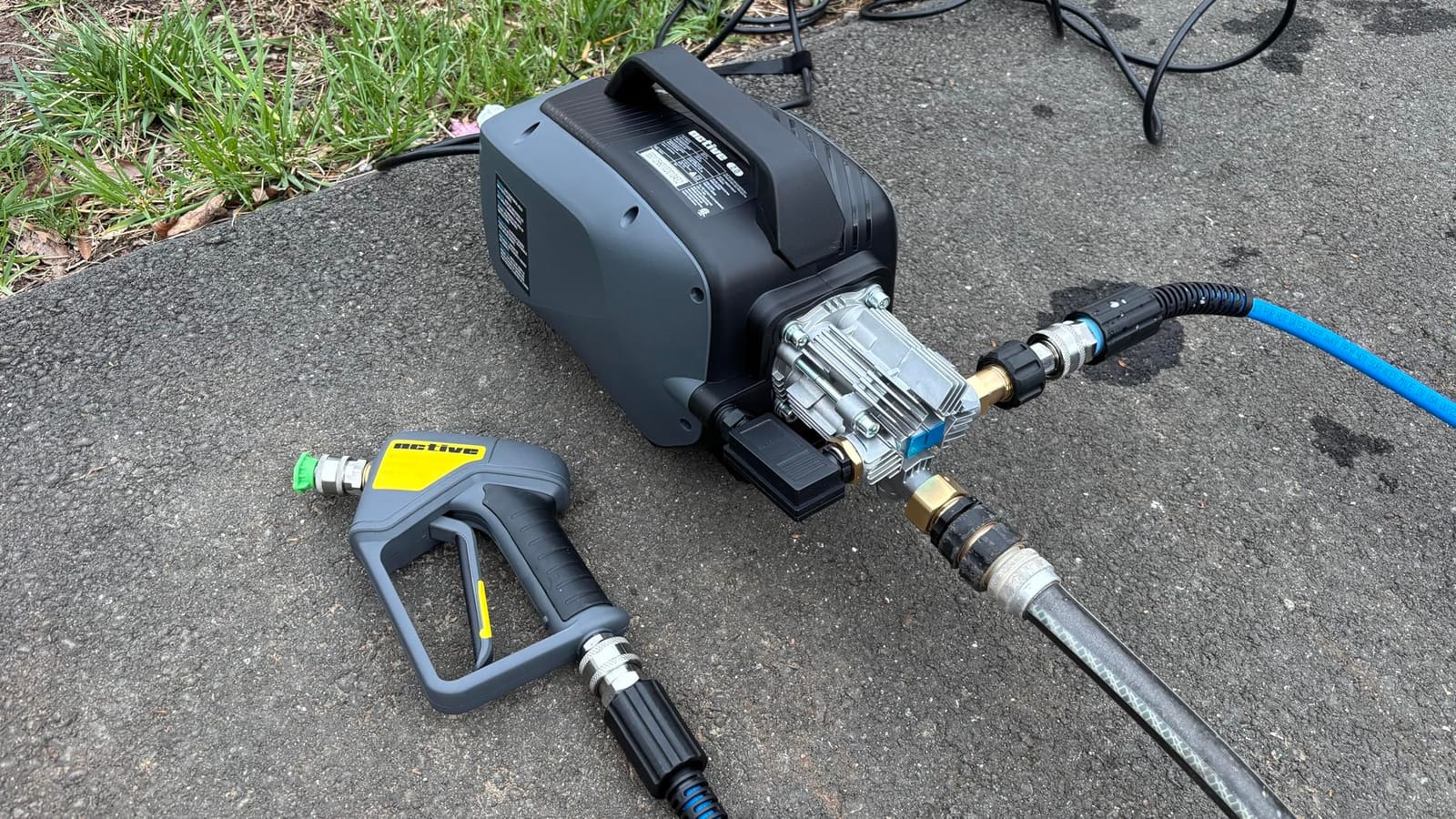
The fittings are the quiet hero. Universal threading on both ends, 3/4-inch garden hose on the inlet and M22-14mm on the pressure side, means foam cannons, surface cleaners and undercarriage tools from the wider aftermarket ecosystem all bolt straight on. You are not hunting for a proprietary adapter three months from now.
The compact body means it lives on a shelf rather than a floor, and the 20-foot hose is long enough for a sedan wash. The 2-year residential warranty is the shortest among the Westinghouse units here, which is the main thing giving me pause.
When this is the right machine
Buy it when the foam cannon is central to how you wash, not an afterthought. A weekly snow-foam routine, a two-bucket contact wash after a pre-soak, and a car that sits outside between washes all benefit directly from that 2.0 GPM.
It is also a good match for anyone building a kit gradually. Because the fittings are standard, the accessories you buy first will still fit the next machine you ever buy, which is rare in this category.
When to pick something else
Choose the Westinghouse ePX3100v instead if you want more warranty coverage and a cannon already in the box. Choose the Sun Joe if you care more about weight than foam.
Do not choose it for maximum pressure. With 1500 rated PSI it will not strip grime off a concrete pad the way a 3000 PSI unit can, and buying it for that reason is buying the wrong tool for the job.
5. Westinghouse WPX3000e – premium pick for weekend washing
Westinghouse WPX3000e Electric Pressure Washer, 3000 Max PSI and 1.76 Max GPM, Induction Motor, Onboard Soap Tank, Spray Gun and Wand, 5 Nozzle Set, for Cars/Fences/Driveways/Homes/Patios/Furniture
- Highest max pressure among the electric units here at 3000 PSI
- AC induction motor and maintenance-free axial 3-piston auto-stop pump
- M22 fittings accept foam cannons
- surface cleaners and undercarriage tools
- 25 ft abrasion-resistant super-flex hose resists kinks
- 35 ft GFCI cord
- steel frame and 10 inch never-flat wheels
- Heaviest and tallest unit here at 36.8 lbs and 36.6 inches
- 1.1 rated GPM is low next to the headline pressure
- 0.45-gallon onboard soap tank is small for frequent foaming
This is the machine I would buy if I washed a car every week and also owned a driveway. It is rated at 3000 max PSI and 1.76 max GPM, with rated figures of 2600 PSI and 1.1 rated GPM, and it runs on a heavy-duty AC induction motor with a maintenance-free axial three-piston auto-stop pump.
An induction motor is the reason this machine feels different under load. Universal motors, which most of the cheaper electrics use, heat up faster and wear quicker. The induction motor plus the axial pump is a build for years rather than seasons, and it is why about 80 percent of ratings here are five-star.
Owners point to sustained pressure, metal build quality and the accessory-friendly M22 fittings. Those fittings are the reason this lands in a detailing roundup at all: foam cannons, surface cleaners and undercarriage cleaners all connect directly, so a car-focused buyer can build a full kit on one machine without adapters.
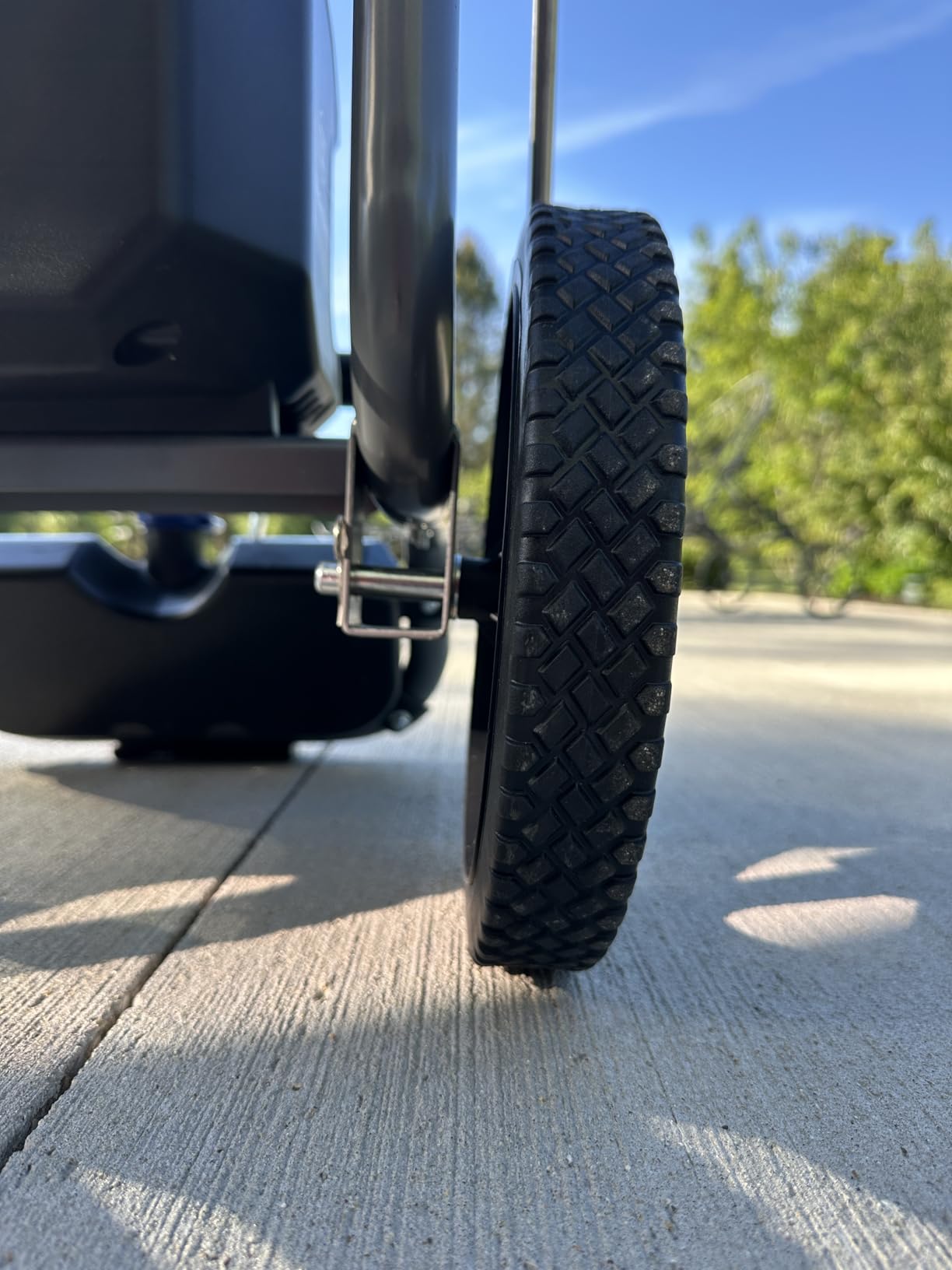
The included hardware supports that. A 25-foot abrasion-resistant super-flex hose that resists kinks, a metal spray gun and wand, five quick-connect nozzles at 0, 15 and 25 degrees plus soap and turbo, and a 35-foot GFCI cord on a welded steel frame with 10-inch never-flat wheels.
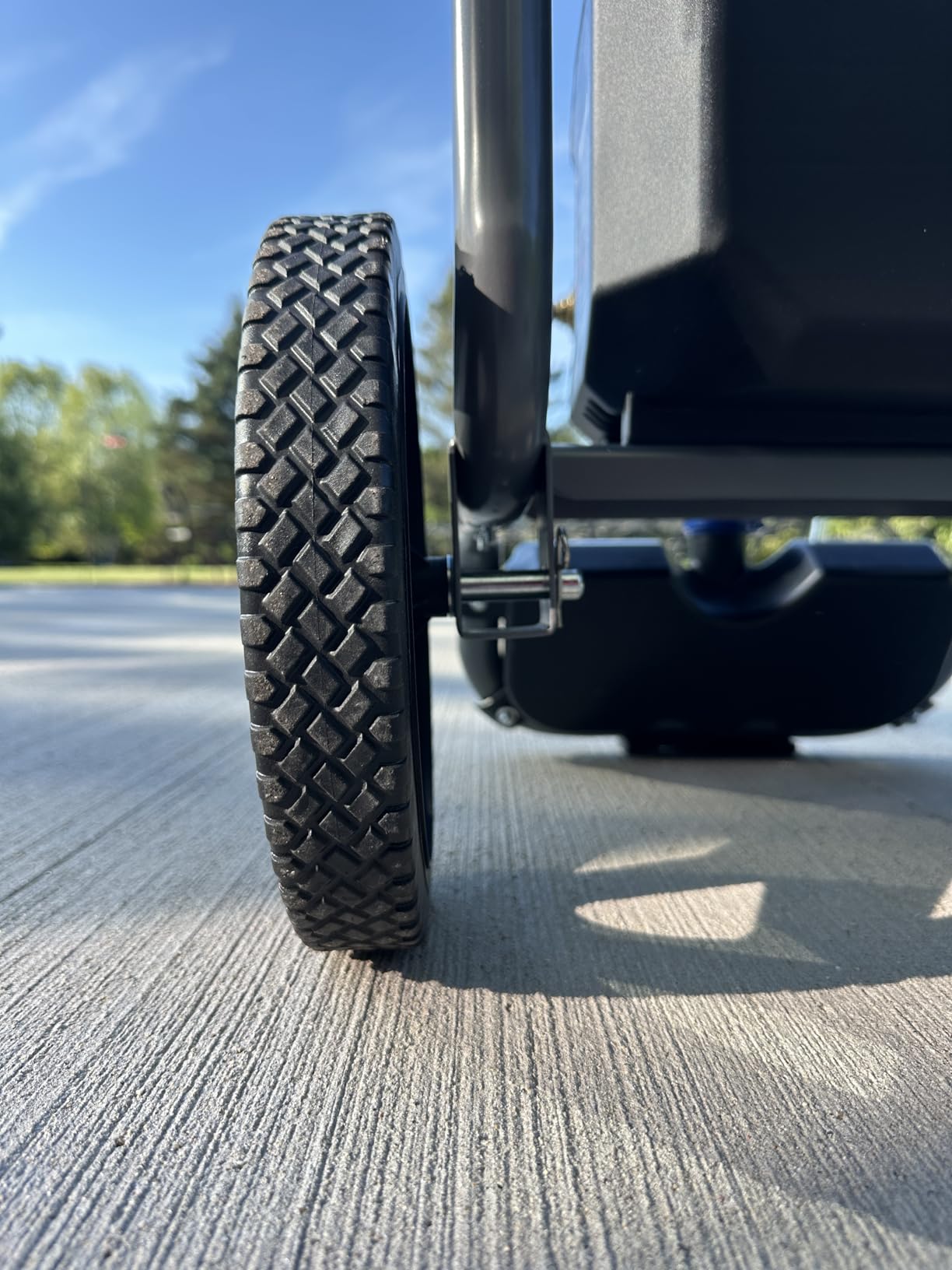
Now the honest trade-off, and it is a real one. At 36.8 pounds and 36.6 inches tall, this is the biggest and heaviest unit in the roundup. The wheels make it rollable rather than liftable, and if your storage situation involves a shelf rather than a floor, this is the wrong machine.
The rated 1.1 GPM is also the lowest in the group, and the 0.45-gallon onboard soap tank refills constantly if you foam every panel. This is a pressure-first machine, so it is at its best on concrete, siding and wheel wells rather than as a foam-cannon platform.
Who should buy this one
Buy it if you have floor space, a driveway that needs real work, and a weekend habit. The 3000 max PSI combined with the turbo nozzle makes short work of oil stains, moss in paver joints and winter road salt.
It also suits anyone who plans to add a surface cleaner or an undercarriage cleaner later. Those tools need sustained flow, and the metal gun and wand will take the abuse.
Who should skip it
Skip it if storage is tight or you are over 60. The 36.8-pound steel-framed unit is not a one-person lift, and the height means it will not go under a workbench.
Skip it as a first pressure washer. Nobody should learn nozzle angles and dwell time on a machine this size, and the 3-year limited warranty does not compensate for the space it takes up.
6. CRAFTSMAN CMEPW1700 – the easiest machine to learn on
- 17.5 lb body that most people can lift one-handed
- 35 ft cord with hook-and-loop wrap is among the longest here
- Onboard storage for hose
- cord
- wand and nozzle
- Gentle output suitable for aged plastic and delicate finishes
- Quiet motor with auto shut-off on trigger release
- 1700 PSI is the lowest here
- so heavy grime takes more passes
- Supplied hose and soap applicator are considered low quality by some owners
- 1.2 GPM is slow for rinsing a large SUV
- A small number of buyers report pump or motor failure
The CMEPW1700 is the machine I hand to people who have never used a pressure washer. It outputs 1700 PSI and 1.2 GPM, weighs 17.5 pounds, and measures 18.33 by 10.43 by 11.25 inches, so it goes under a bench without being lifted overhead.
The turbo nozzle is included in the box, which is unusual at this level and useful for driveway work. The 40-degree nozzle, hose, trigger assembly, wand assembly and soap applicator round out the kit, and everything stores onboard so the garage stays tidy.
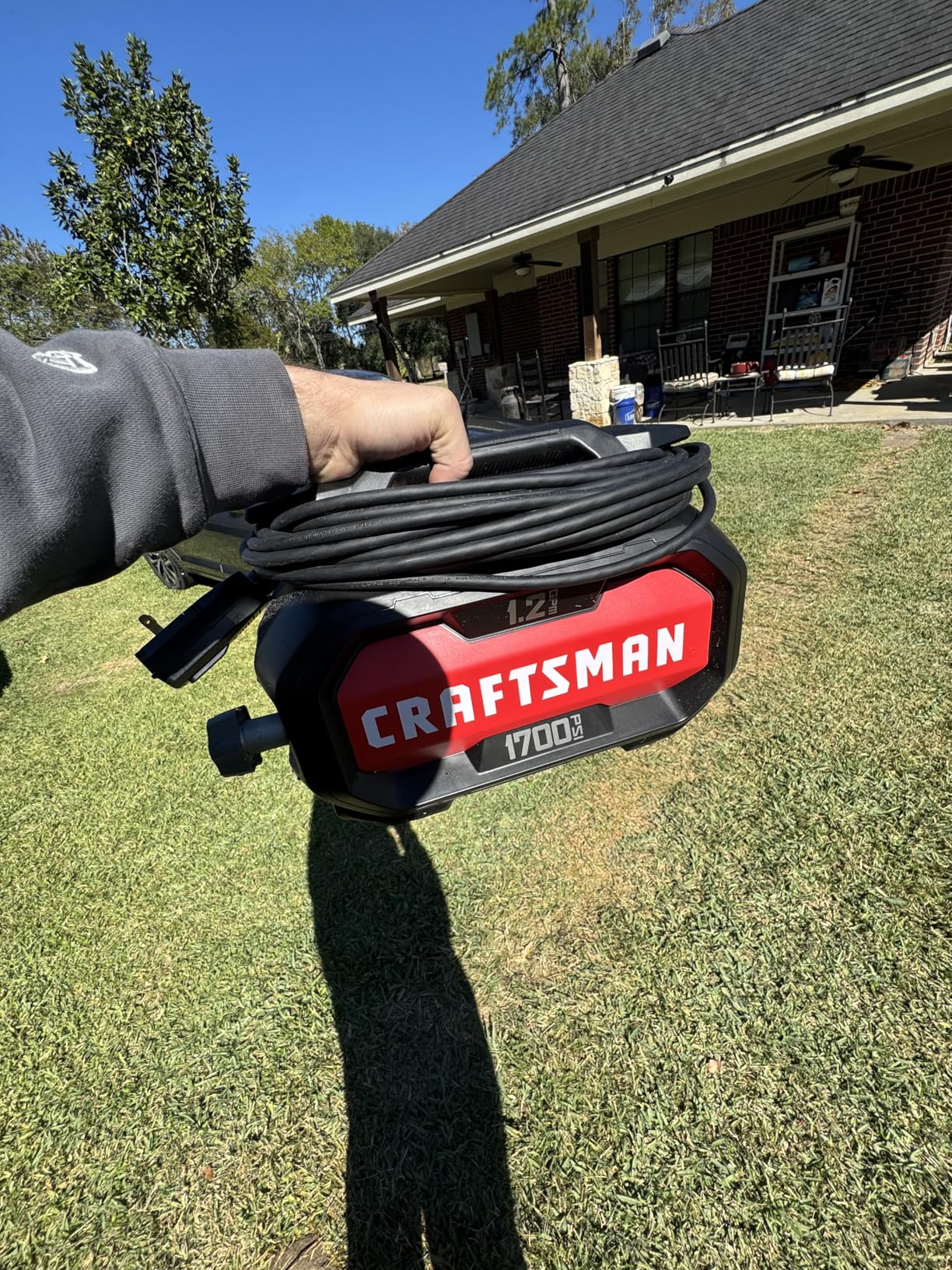
Owners repeatedly highlight portability and storage design. Several reviews come from older users or people recovering from surgery who say the machine is light enough to lift, and car detailers report two years of problem-free use. The 20-foot kink-resistant hose and 35-foot power cord give you room to work around most cars without moving the unit.
Output is gentle, and that is a feature on a car. Reviewers specifically note it is fine for aged plastic trim and delicate finishes, which is exactly the argument for a lower-pressure machine in the detailing world.
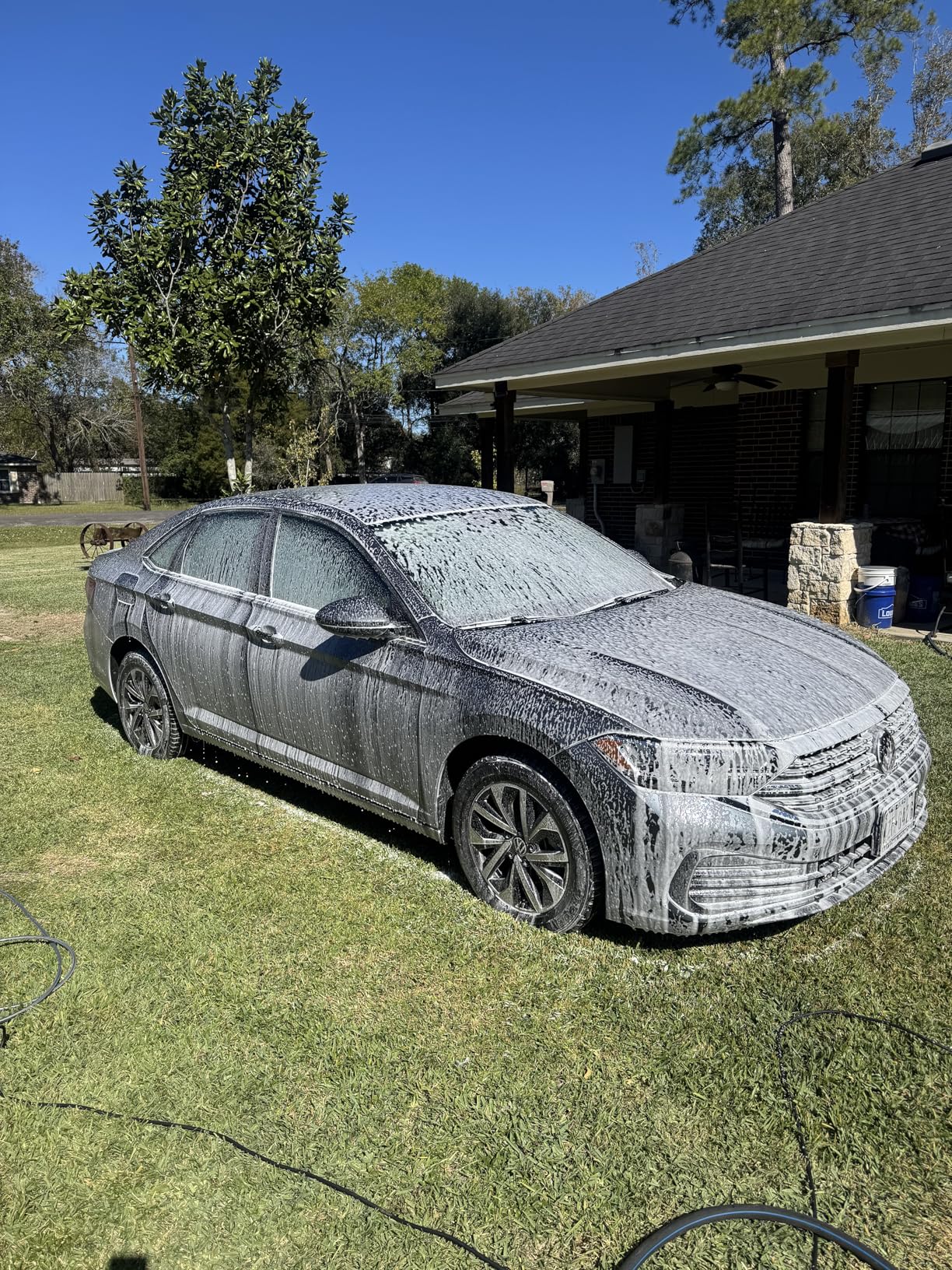
The clearest theme in the reviews is that the pump is fine and the accessories are not. Owners upgrade the supplied hose and the soap applicator early on, and the recurring advice is to treat those two parts as consumables rather than kit. My own guidance matches that: budget for a better hose from the start.
A small number of one-star reviews report pump or motor failure after limited use. That is a minority in a set of 3,520 ratings, but it is worth knowing if you are the kind of buyer who wants the longest possible service life.
Why it suits a first car
It is light, compact, cheap to run and gentle enough that a mistake with the trigger does not matter much. That combination makes it the least intimidating way to learn a pre-soak and contact-wash routine.
It is also a good second machine for a household where someone else needs to wash the family car without moving a heavy unit around the driveway.
Where it will frustrate you
At 1.2 GPM, rinsing soap off a large SUV is a slow job, and low flow is also why a foam cannon on this machine produces thin foam. If the plan is a proper snow-foam pre-soak, buy flow instead.
The 1700 PSI ceiling means winter salt on a driveway will take repeated passes rather than one. For a car that is a fair trade, for a driveway it is not.
7. Greenworks GPW2003 – best when garage space is tight
- Quiet enough to use in an enclosed garage without gas fumes
- 2000 PSI cleans vehicles without stripping paint
- Start-stop technology extends pump and motor life
- Onboard soap tank with a soap tip on the wand
- Removable handle allows shelf storage
- 25 ft hose is short for washing longer vehicles
- Louder than several competing electric washers
- Light build and easily lost wheel clips raise durability questions
- Small number of owners report motor or pump failure and leaks
The Greenworks GPW2003 is rated at 2000 PSI and 1.2 GPM on a 14-amp motor with push-button start, and it carries a 3-year manufacturer warranty plus PWMA performance testing, which is a level of certification not every machine in this roundup can claim.
Start-stop technology is the feature I would point at. The motor switches off whenever the wand is not engaged, so you are not running the pump at pressure while you walk to the other side of the car with the hose in your hand. Over a full wash that is meaningful.
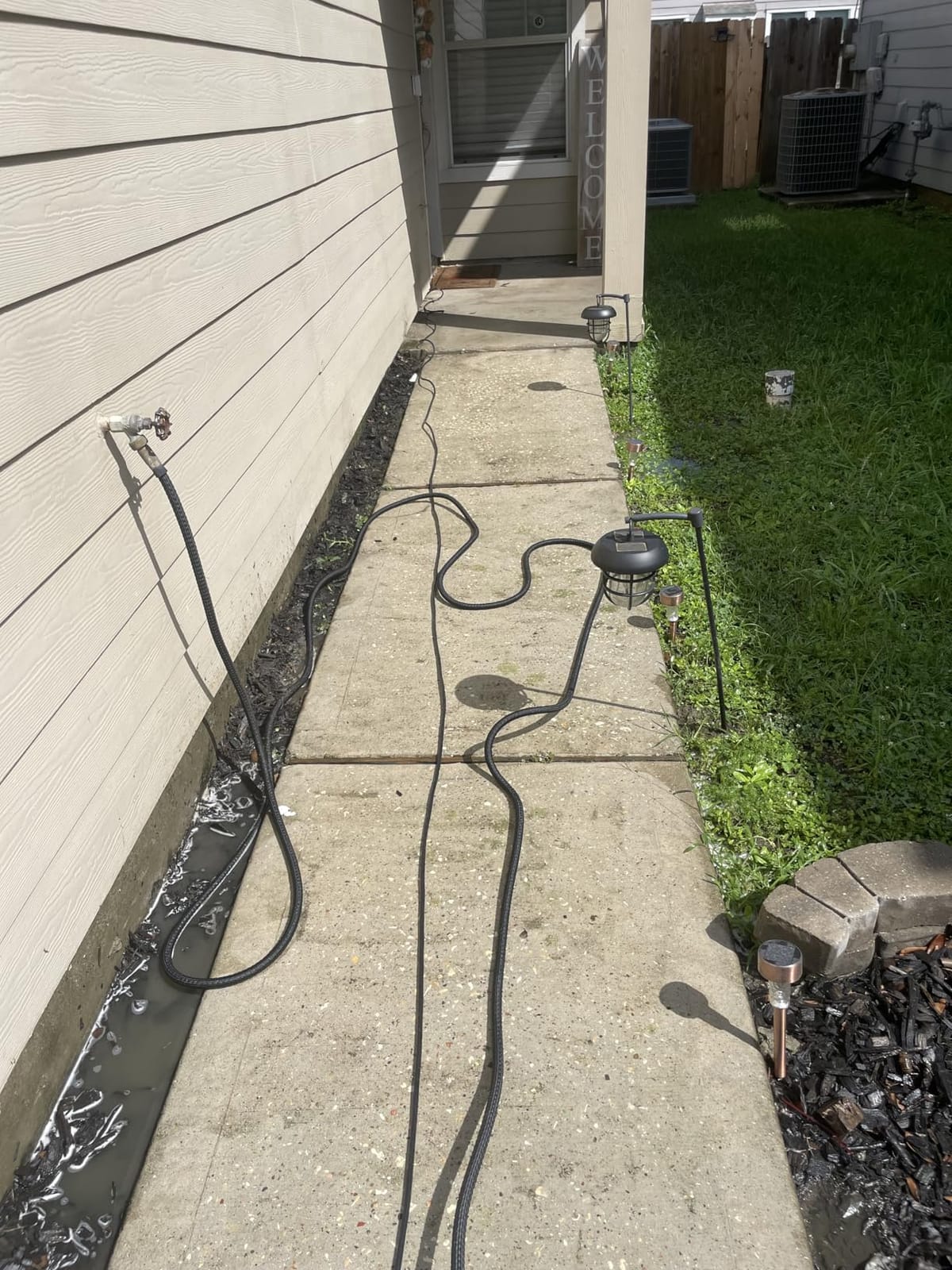
About 74 percent of ratings are five-star. Owners like the balance of power and gentleness, and they say the 2000 PSI handles vehicles, decks and driveways without damaging wood or paint. The onboard soap tank with a soap tip on the wand makes switching to detergent a one-handed operation.
Quietness gets called out specifically, because an electric unit means no exhaust fumes in a closed garage. If you wash in a small space attached to the house, that is a genuine benefit rather than a spec-sheet line.
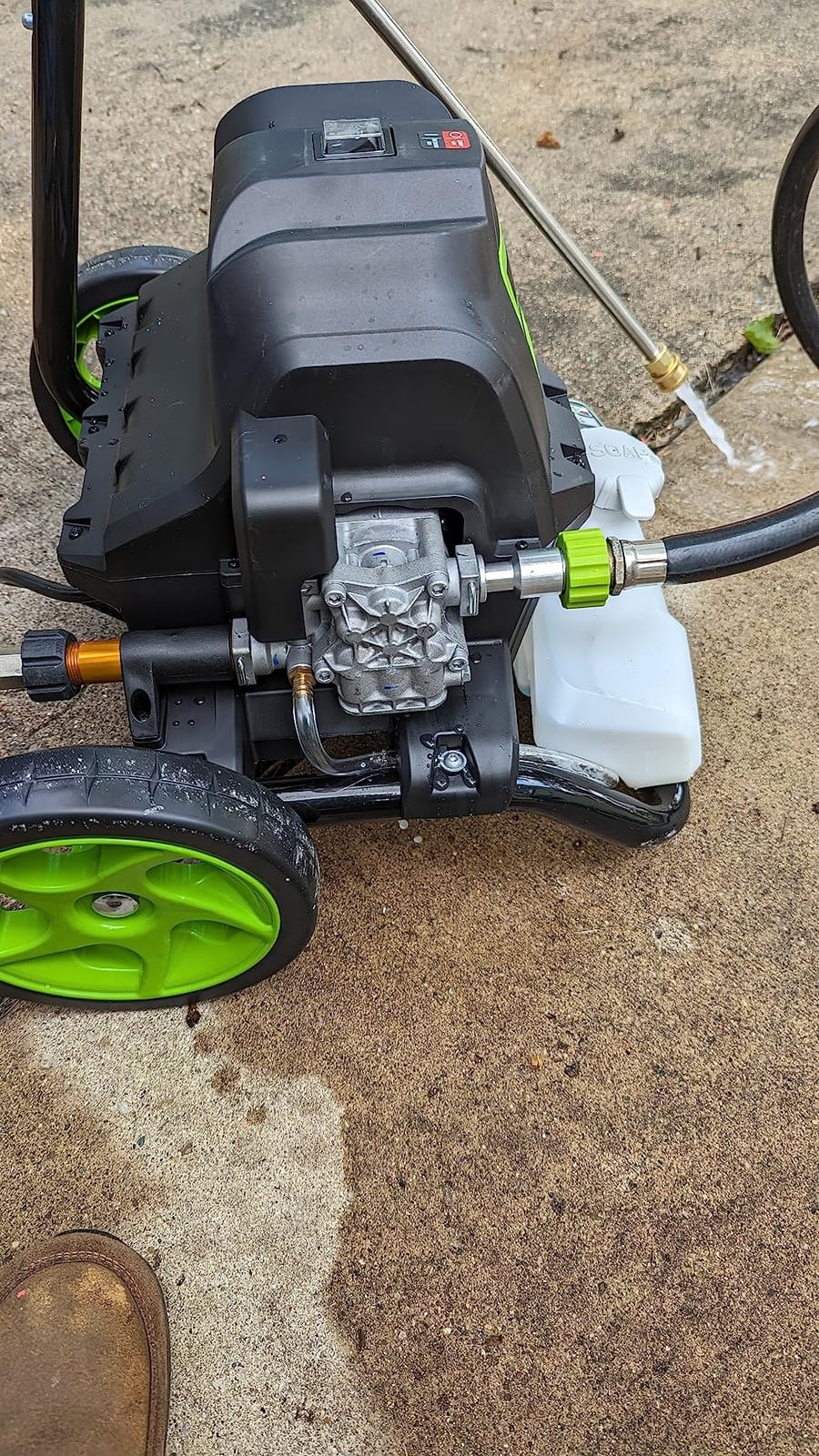
The most common complaint by far is the 25-foot hose being too short for long cars, which forces you to reposition the unit mid-wash. Reviewers also suggest upgrading the nozzles and hose for noticeably better performance, and flag the light build and wheel retaining clips that fall off easily. A small number report motor or pump failure within a year or two, and anodized aluminium fittings that gall against brass hose fittings.
On storage, the removable handle is what makes this machine work in a small garage. Remove the handle, park it on its large wheels and it slides under a shelf. At 31.73 inches tall it will not disappear completely, but it does more than the steel-framed units here.
When this is the right buy
Choose it for a single daily-driver car in a garage with no dedicated washing bay, especially if that garage is enclosed. Quiet, electric and safe to run near a wall is the whole pitch.
It is also a good match for anyone who wants a proper soap system built in rather than carrying a separate bottle around.
When to buy something else
Buy a longer-hose machine if your car is a long sedan or a pickup, because moving a 27.8-pound unit across a wet driveway mid-wash is the most common complaint in the reviews.
Also look elsewhere if foam is the goal. At 1.2 GPM a foam cannon will not produce the thick blanket people expect, no matter which cannon you fit.
8. LWQ S5 – highest flow claim in the entry group
Pressure Washer, Portable Power Washer, 4 Quick Connect Nozzles, High Pressure Cleaning Machine for Car Fence Driveway Patio Washing and More(Light Green)
- Highest stated flow in the entry group at up to 2.5 GPM
- Foam cannon included for pre-soaping
- Four quick-connect metal nozzles at 0
- 15
- 25 and 40 degrees
- Light 16.6 lb body with rollers and an anti-tipping base
- Compact 18 by 14 by 11 inch footprint
- Lowest rating in this group at 4.3 with roughly 11 percent one-star reviews
- 2.5 GPM claim is high for the class and may not match real output
- Some buyers report durability concerns after a season or two
- 6.3 meter hose is shorter than the 25 ft hoses on rival units
The LWQ S5 is the outlier in this roundup on paper. It is listed at 2030 PSI and up to 2.5 GPM, with a 2.5-gallon tank, a foam cannon in the box and four quick-connect metal nozzles at 0, 15, 25 and 40 degrees, all on a 16.6-pound body.
Those flow numbers are what make it interesting for cars. On paper it is second only to a gas machine in this list for rinse speed, and flow is exactly what a foam cannon rewards. I want to be straight with you about the catch, though, and we will come back to it below.
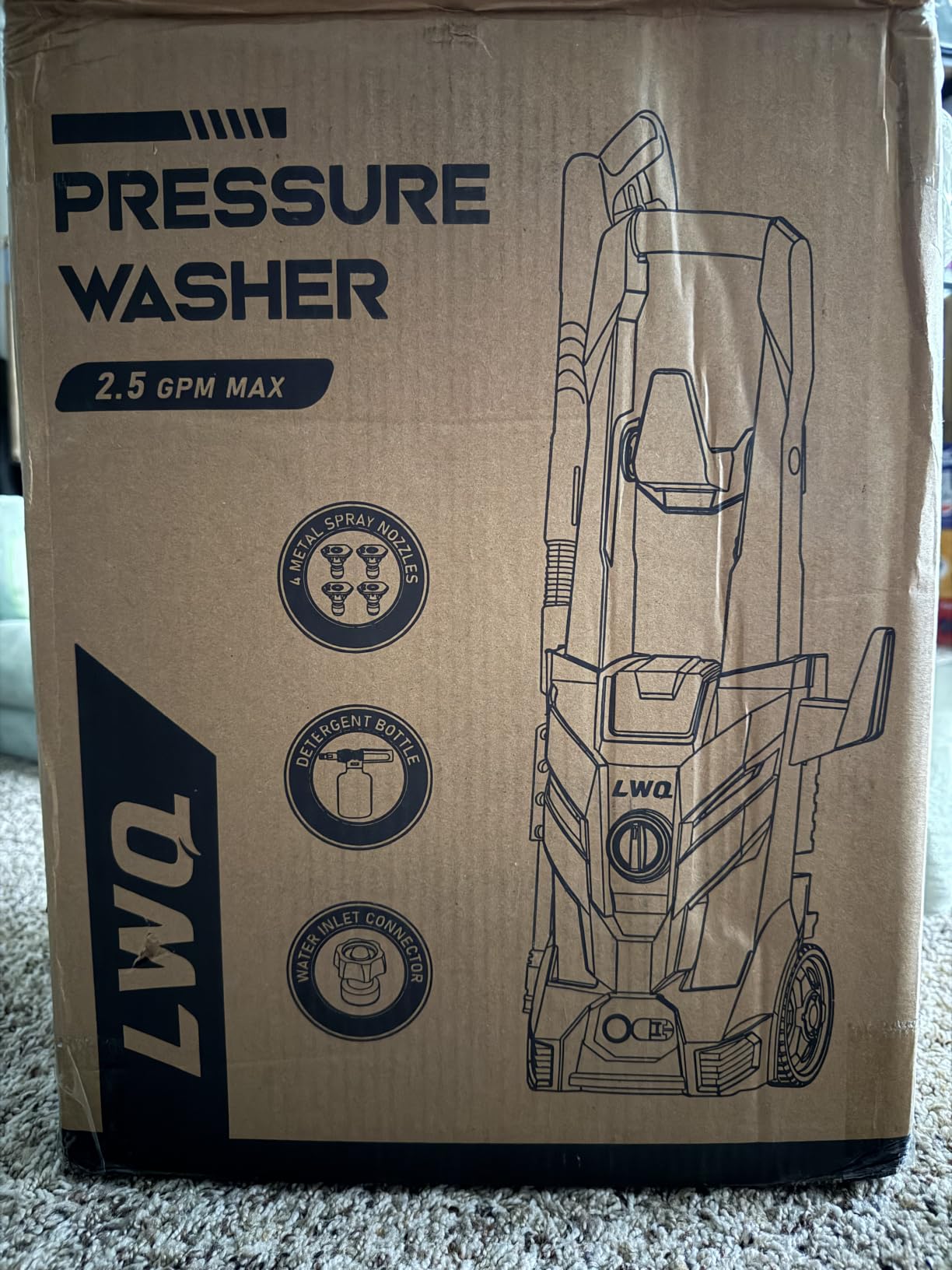
Review sentiment splits more sharply here than anywhere else in the roundup. About 72 percent of ratings are five-star and roughly 11 percent are one-star. Positive reviews focus on the strong flow, the included foam cannon, the metal quick-connect nozzles and easy storage, and owners describe it as capable value for cars, fences and driveways.
Storage details are genuinely good. The dual-roller design with an anti-tipping base, a power cord hook and onboard nozzle holders mean the whole machine parks in a corner between washes. It will also accept water from a faucet or a bucket, which is useful if you are not near a spigot.
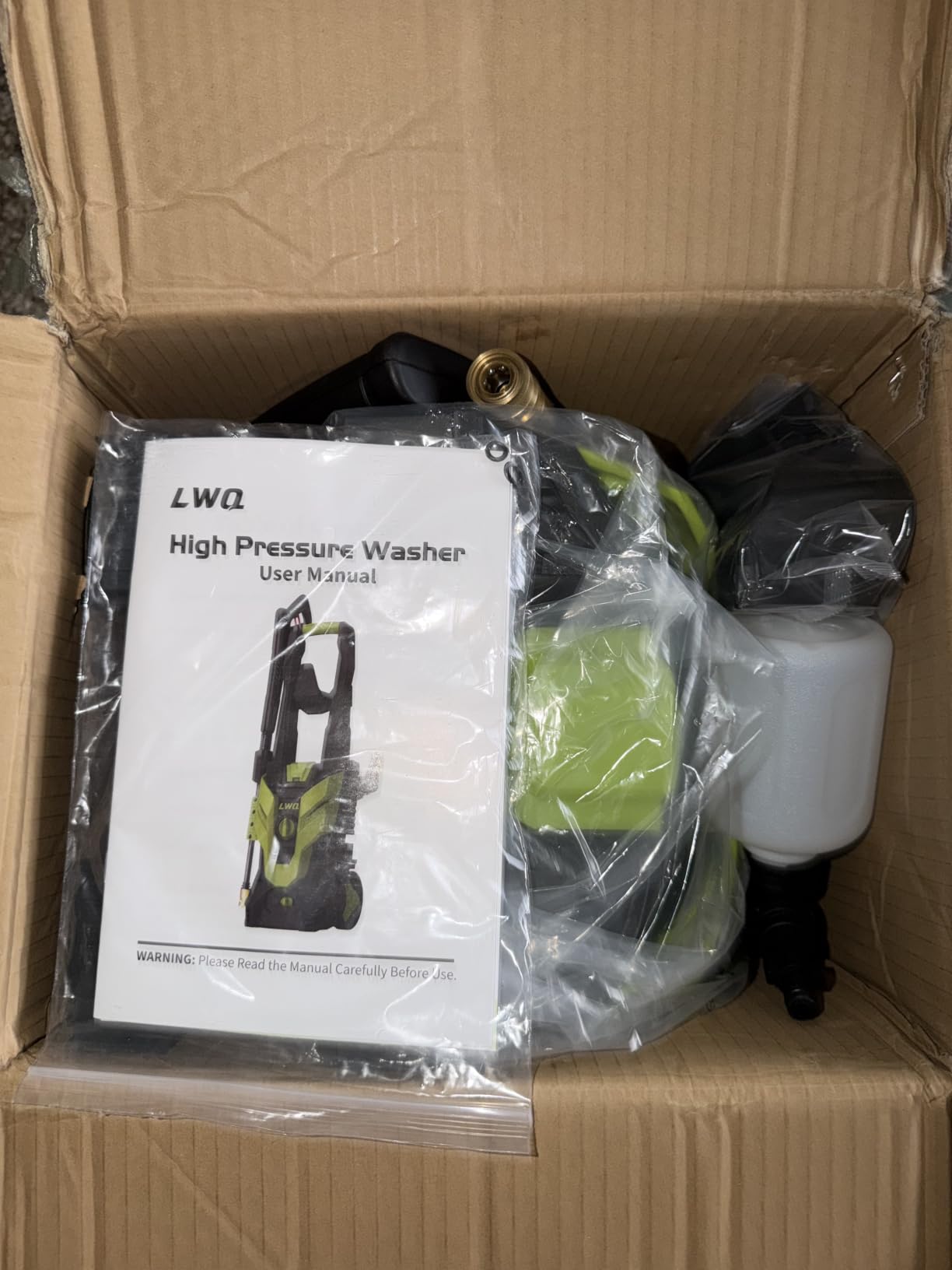
The 2.5 GPM figure is the number to treat carefully. It is notably higher than comparable machines from better-known brands, and the negative reviews lean on reliability after a season or two of use and on gaps in accessories and hose length. The 6.3-meter hose is roughly 20.7 feet, shorter than the 25-foot hoses on the Westinghouse units.
My read is that you are buying flow cheaply and accepting a shorter warranty horizon and a thinner long-term track record. That is a reasonable trade for some people and a poor one for others.
Where it earns its slot
Pick it if foam is the priority, your budget is limited and you want a cannon in the box without a second purchase. The stated flow, if it delivers even a portion of the claim, produces better pre-soak foam than any 1.2 GPM machine at the same money.
It is also one of the few machines here that accepts bucket water collection, which helps in an apartment or a shared courtyard.
Where caution is warranted
Do not buy it expecting the same build quality as an induction-motor machine. The 11 percent one-star group is a real signal, and the durability comments cluster around long-term use rather than the first wash.
If you keep machines for a decade, choose a longer-warranty option with more published owner history. If you want foam this season on a tight budget, the flow numbers justify the gamble.
9. Simpson Clean Machine – best throughput from a gas unit
Simpson Clean Machine 3400 PSI Gas Pressure Washer, 2.5 GPM, CRX engine
- Highest flow in the roundup at 2.5 GPM for washing large vehicles
- Axial cam pump with a thermal relief valve resists overheating
- 25 ft MorFlex non-marring hose is kind to car paint
- Easy-start 208cc CRX engine with low-oil shutdown
- 10 inch pneumatic tires roll over gravel
- grass and curbs
- Gas engine brings noise
- fuel and oil maintenance
- Heaviest unit here at roughly 61 to 64 lbs
- No detergent tank
- soap goes through the soap nozzle
- Warranty is 2 years on the engine and 1 year on the pump and frame
The Simpson Clean Machine is here for one reason: throughput. It delivers 3400 PSI and 2.5 GPM from a 208cc CRX engine driving an OEM Technologies axial cam pump with a thermal relief valve, and it weighs roughly 61 to 64 pounds.
If you wash a large SUV, a truck or a boat, or you clean a driveway with salt staining every winter, nothing else in this roundup moves water that fast. I include it deliberately, with the safety caveat that comes at the end of this section.
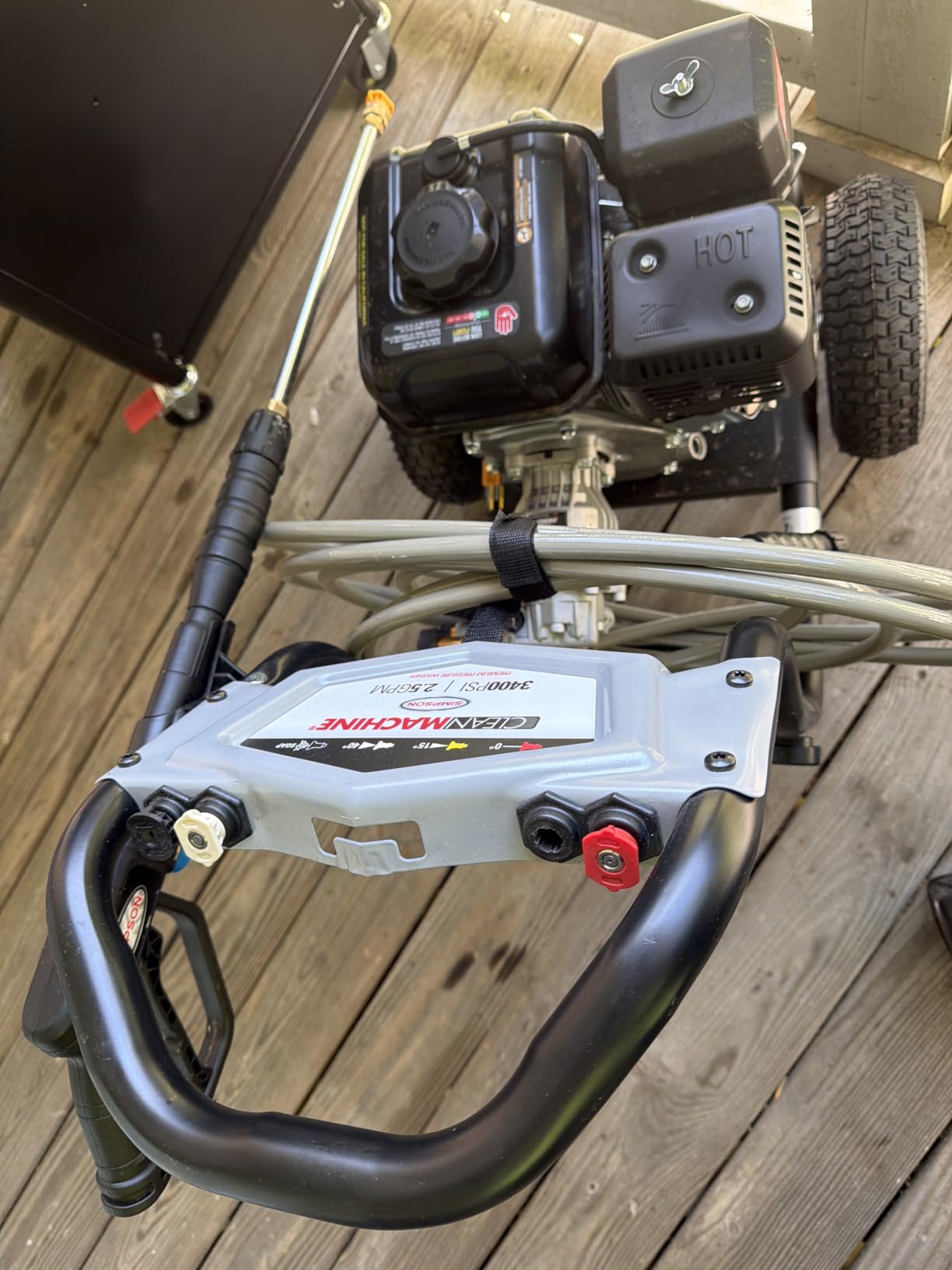
The engine details are the right ones for repeated starts. The 208cc CRX has low-oil shutdown and an easy-start design, and the axial cam pump is maintenance-free with a thermal relief valve that protects it from heat buildup during long runs.
Owners who need serious throughput praise the flow rate, the pump and the 25-foot Simpson MorFlex high-pressure hose, which is non-marring and resistant to kinking and abrasion. That hose specification matters for cars, because a marring hose dragged over a wet panel will scratch clear coat before the nozzle ever touches it.
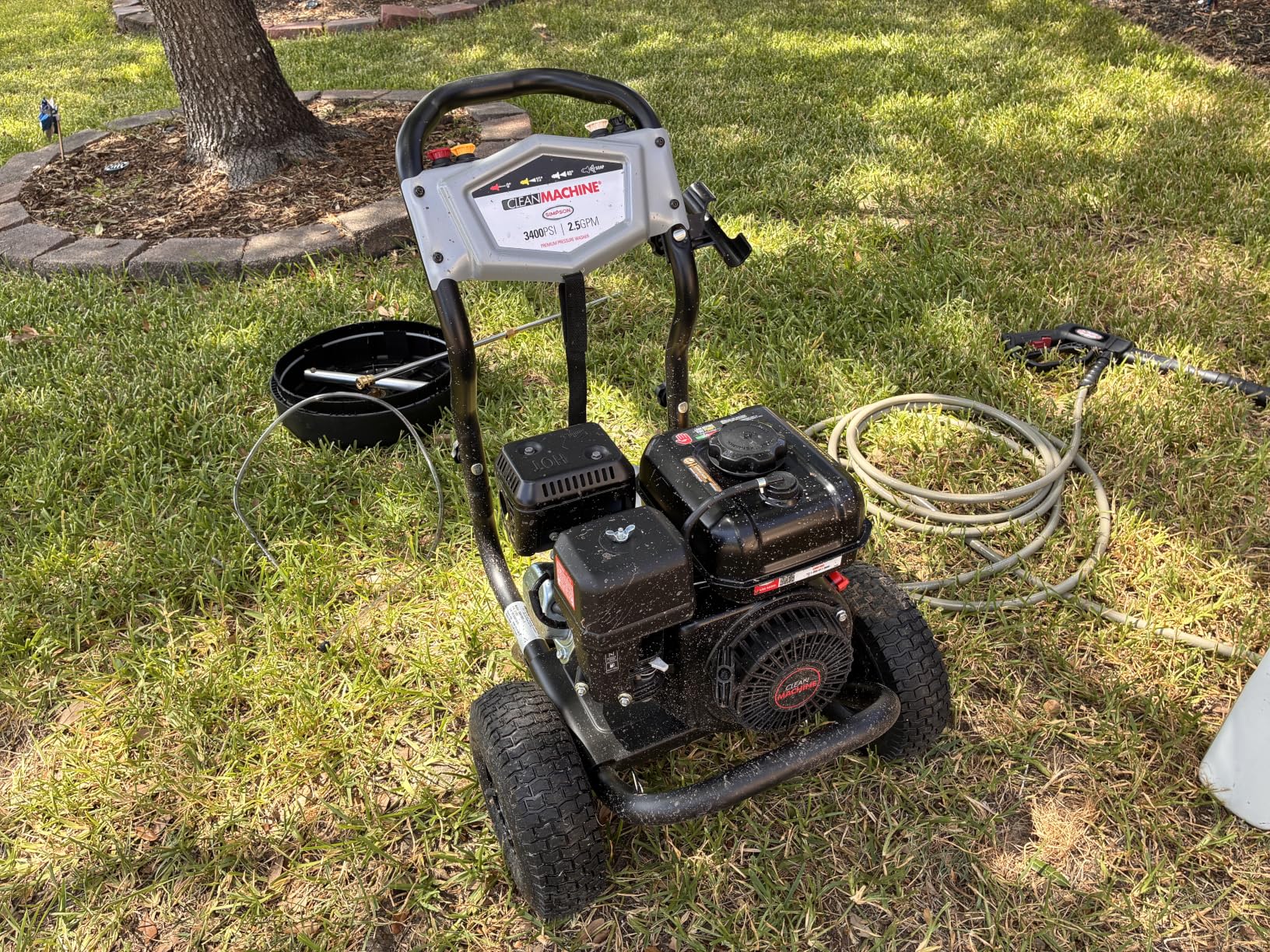
The kit includes four quick-connect tips at 0, 15 and 40 degrees plus a soap nozzle, a front-load ergonomic M22 gun, a 16-inch wand, 10-inch pneumatic tires and a welded powder-coated steel frame. There is no detergent tank, so detergent runs through the soap nozzle rather than a reservoir.
About 71 percent of ratings are five-star and 12 percent four-star. The recurring drawbacks are the usual gas-package complaints: noise, weight, fuel and oil upkeep, and a warranty of 2 years on the engine but only 1 year on the pump and frame.
Who this is genuinely for
Buy it if you clean hard surfaces more often than you wash cars. A gas unit is the right tool for a stained concrete driveway, a wooden deck with algae, or a boat hull, and forum consensus consistently treats gas as near-mandatory for those jobs.
It also suits someone with a large property who wants one machine to cover everything and accepts the maintenance that comes with an engine.
Why most people should skip it for cars
3400 PSI is far more pressure than automotive paint needs, and the difference between enough and too much happens fast at that level. A 0-degree tip at close range will etch clear coat, and soft plastic trim and window seals can be stripped or torn.
At 61 to 64 pounds it is also awkward to move and impossible to store on a shelf, and the exhaust means you are working outdoors whether you want to or not. For a car-only household, an electric machine in the 1.8-to-2.0 GPM class is the smarter purchase.
10. DeWalt DXPW3300-S – the longest warranty package
DeWalt 3300 PSI Gas Pressure Washer, 2.4 GPM, Residential Model DXPW3300-S
- Strong warranty package: 5-year frame
- 3-year pump
- 2-year engine
- Five quick-connect nozzles give the widest tip selection in the roundup
- Ergonomic spray gun and 16 inch steel wand for good reach
- 10 inch pneumatic tires roll smoothly over uneven ground
- Easy-start 208cc engine with a thermal relief valve
- Heaviest unit listed at 64 pounds
- Gas power means noise
- fuel and oil maintenance
- Factory-tested units may arrive with residual fuel odour
- Highest rated pressure here
- so it needs the most care on a car
The DeWalt DXPW3300-S is rated at 3300 PSI and 2.4 GPM from a 208cc engine and an OEM Technologies axial cam pump with a thermal relief valve, mounted on a welded powder-coated steel frame. It is the second gas machine here, included because its warranty is the best in the roundup by a wide margin.
Five years on the frame, three on the pump and two on the engine is a genuinely different commitment from the 1-year pump and frame cover on the Simpson. If you intend to own a machine for a decade, that coverage is the most concrete reason to pick this one over the other gas option.
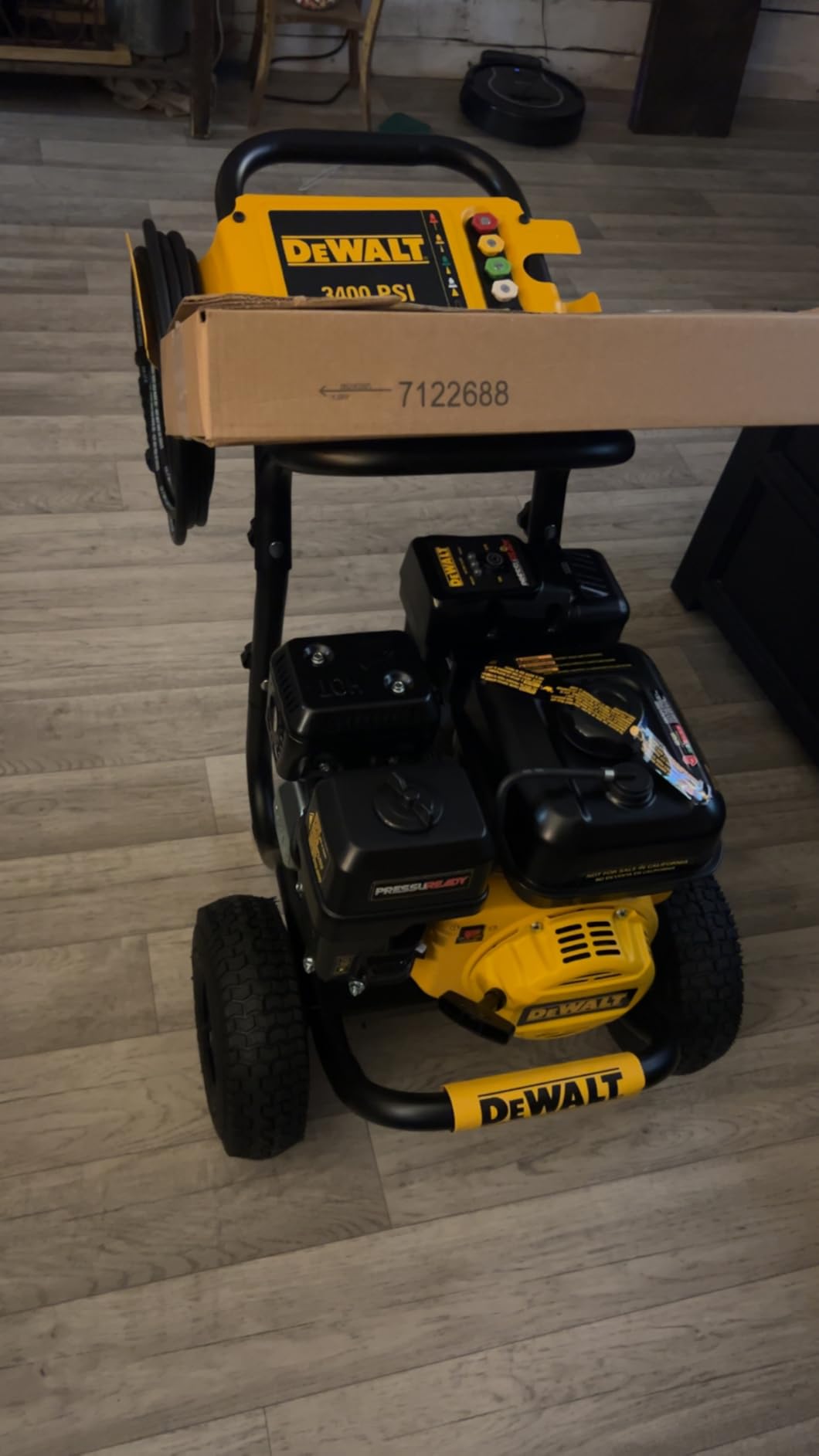
About 73 percent of ratings are five-star. Owners are satisfied with the combination of 3300 PSI, 2.4 GPM and the easy-start 208cc engine across decks, siding, driveways and vehicle washing, and the 10-inch pneumatic tires handle uneven ground well.
The nozzle set is the widest here: 0, 15, 25, 40 degrees plus soap, all quick-connect, supplied with a 25-foot abrasion-resistant hose, an ergonomic spray gun and a 16-inch steel wand. For a driveway, patio and car setup, nothing is missing.
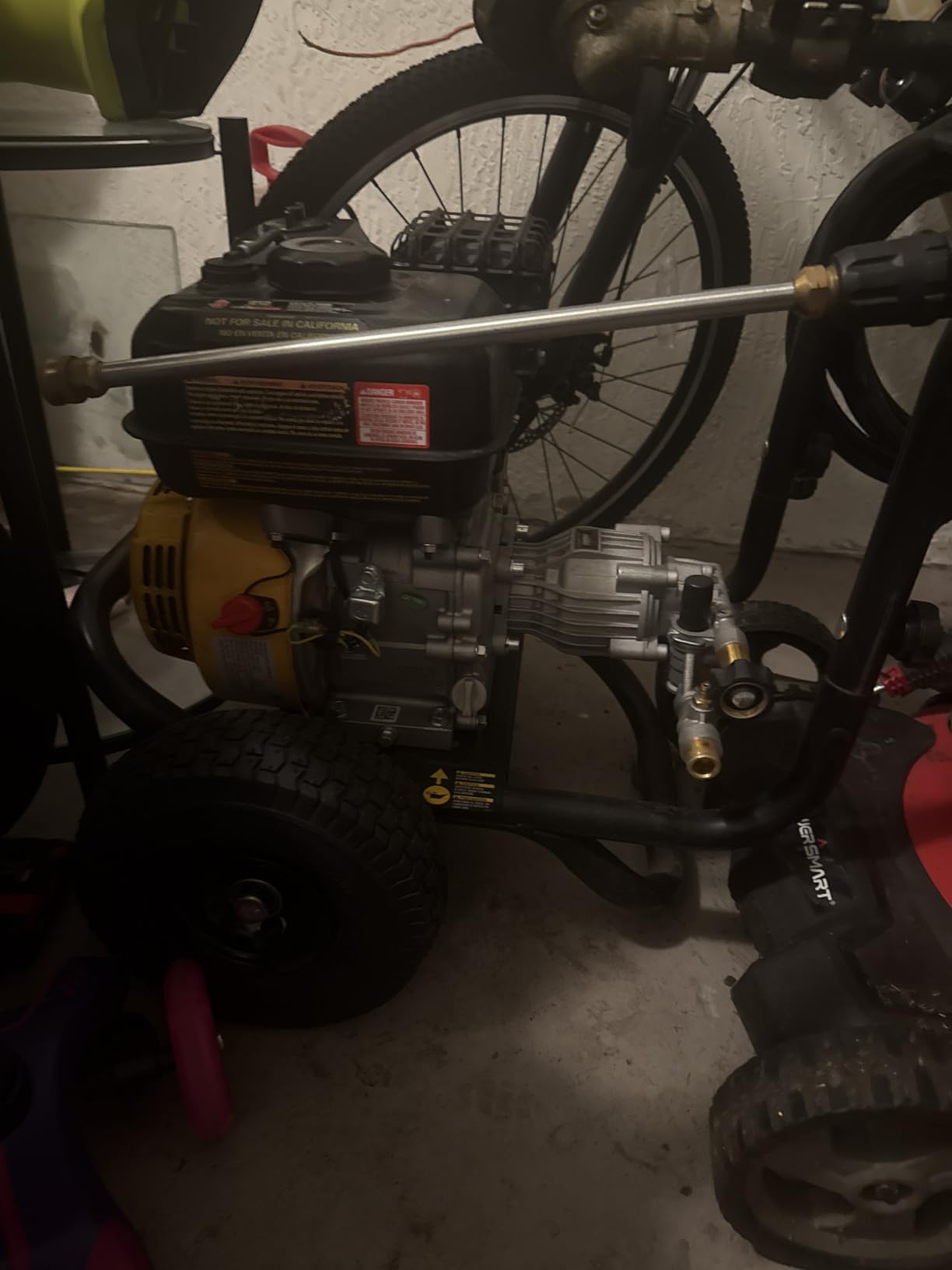
Now the less comfortable part. At 64 pounds this is the heaviest machine in the roundup, and gas power means noise, fuel and oil maintenance on top of that. A 12 percent one-star group reflects the familiar gas reliability complaints, and some owners report factory-tested units arriving with a residual fuel odour that takes several runs to clear.
For cars specifically, 3300 PSI is well beyond what paint needs. It is a driveway machine that can also wash a car, not a detailing machine that happens to clean a driveway.
When the warranty changes the decision
Choose it if you plan to keep the machine for many years and want the pump and frame covered. Over a long ownership horizon, better coverage on the expensive wear parts is worth more than a modest specification difference.
It is also a reasonable single-machine choice for someone who genuinely splits time between vehicles and hard surfaces, provided the machine lives outdoors or in a garage where noise does not matter.
When it is the wrong call
Skip it as a first washer and skip it if your washes are car-only. The weight, the storage footprint and the 3300 PSI ceiling all work against the way most people use a pressure washer.
Also skip it if you care about noise. A gas engine at close quarters in a residential neighbourhood is the single most common complaint in gas-unit reviews.
Why GPM Beats PSI for Car Detailing
Here is the argument nobody in this category will make plainly enough. PSI is how hard water hits the surface. GPM is how much water gets there. When you wash a car, most of the work is moving water and detergent across a large horizontal panel, and that is a flow problem, not a pressure problem.
A quick way to think about it: cleaning power scales with PSI multiplied by GPM. Take the Active 2.0 at 1500 rated PSI and 2.0 GPM for 3000 units of combined power. Take the CRAFTSMAN at 1700 PSI and 1.2 GPM for 2040. The machine with lower pressure on the box does more total work, and it is the one that rinses a foamy car down in a third fewer passes.
The forum consensus in r/AutoDetailing and r/Detailing lands on the same conclusion: flow beats pressure for detailing. A community summary of r/AutoDetailing discussions rated the Kranzle at 88 percent positive and the Karcher Cube at 85 percent, both reputationally chosen for build and flow rather than headline pressure. Forum members on autogeekonline and mustang7g specifically name the Kranzle K1322TS as a detailing-capable electric that does not need a dedicated 20-amp outlet.
That consensus also produced the other rule everyone repeats: car paint needs about 1,000 to 1,200 PSI. Higher is not better here. It is simply more energy pointed at a surface that does not need it.
Flow also decides foam. A foam cannon needs a steady incoming water supply to mix detergent and air. This is the most common disappointment among first-time buyers, who buy an excellent cannon, fit it to a 1.2 GPM machine and conclude the cannon was faulty. It was not. The water supply was.
The practical rule I use: aim for 1.8 GPM or more if foam is part of the plan, accept 1.2 to 1.6 GPM if you are rinsing driveway grime, and treat anything above 2,000 PSI on a car as a liability you are paying extra to carry. If you also want a broader view of the category, our general pressure washer roundup covers the machines that are not car-specific.
Buying Guide for Pressure Washers Used on Cars
Flow rate. Look at GPM first, and look at rated GPM rather than the maximum figure. The 1.2 versus 1.76 rated GPM split between the Westinghouse units in this roundup is the difference between a quick rinse and a long one. Above 1.8 GPM you are in genuine foam-cannon territory.
Pressure. For automotive paint, 1,000 to 1,800 PSI at the nozzle is the working range. Many manufacturers quote a maximum burst figure that is not the sustained output, so treat a 3000 PSI headline as a driveway number, not a detailing number. Our 10 picks here span 1700 to 3400 PSI, and the two 3000-plus machines are both gas.
Nozzles and angles. A 40-degree fan is your body-wash tip, a 15-degree is for crevices and wheel wells, and a 0-degree red tip is a concentrated blast you should treat carefully. A turbo or rotating nozzle spins a jet and is far more aggressive than a flat fan, which makes it a driveway tool. Every pick here except the three-tip ePX3100v includes multiple angles.
Foam cannon compatibility. Quick-connect fittings come in quarter-inch and M22 formats, and they are not interchangeable without an adapter. The Active 2.0, the Westinghouse WPX3000e and the CRAFTSMAN unit all use fittings that accept mainstream aftermarket foam cannons, which is a real advantage when you are building a kit over time.
Total Stop System. When you release the trigger, a total-stop motor shuts off instead of idling at pressure. It saves energy, reduces heat and extends pump life. It is present on the Sun Joe, on both smaller Westinghouse units and on the Greenworks in its start-stop form, and it is worth more than a spec-sheet line.
Hose length and cord length. This is the most common practical complaint in owner reviews. A 25-foot hose lets you circle most cars without moving the machine. Shorter hoses, especially around 20 feet, mean you are dragging a wet machine across a driveway mid-wash. A 35-foot power cord gives you reach from a single wall outlet.
Power source and circuits. Gas units deliver more power and unlimited runtime but bring noise, weight and maintenance. Electric units are quieter, lighter and safer near paint, but the higher-draw ones need a dedicated 20-amp circuit and an extension cord is not always a good idea. If you want more on gas specifically, we covered the trade-offs in the gas pressure washer guide.
Storage footprint and weight. Measure before you buy. The machines here run from 14.33 pounds to 64 pounds, and the tallest electric is 36.6 inches. A machine you cannot lift will not get used, and one that cannot be stored indoors will end up exposed to freezing temperatures.
Soap system. A small onboard bottle is fine for a quick detergent pass. A detachable foam cannon is what makes a proper pre-soak routine possible, and the ePX3100v is the only pick here that ships one.
Accessories That Decide Whether a Washer Feels Good
The most repeated complaint across detailing forums is not about motors or pressure. It is the supplied hose. Across owner reviews of several picks, the pattern is identical: the machine is good, the hose is stiff, it kinks, and within a few months the fitting starts weeping. Replacing the hose is the single highest-impact upgrade you can make.
The second is the gun. A stubby wand with a short wand and a full-size trigger grip gives you far better control in tight areas, around wheel spokes and in panel gaps, than a long 16-inch steel wand. It also halves the chance of wobbling the lance into a door mirror.
Third is quick-connect hardware. If your machine uses quarter-inch fittings and the accessory you want is M22, or the reverse, buy the adapter set before you buy the accessory. Searching for the right connector after the tool arrives is the most common wasted afternoon in this hobby.
Fourth, and this is the one people skip: a grit guard for the bucket if you are doing a contact wash. The pressure washer handles the rinse and the pre-soak, not the physical removal of grit. If you are not buying one yet, the professional washer setup guide covers the commercial side of the same tool list.
How to Wash a Car Safely With the Machine You Bought
Buying a machine is the easy part. The wash itself is where paint damage happens, and the rules are simple enough that most damage comes from ignoring them.
Work out of the sun if you can. Panel heat causes soap to dry on the surface, and dried soap is a spotting problem. Early morning or evening is best.
Pre-soak, then dwell, then contact wash. Rinse the car first, apply foam from a proper cannon, let it sit for a few minutes, then rinse before touching the paint. The jet loosens dirt. The foam lifts it. The mitt removes it. If you are scrubbing grit with a jet, you are grinding particles into clear coat.
Keep distance. Hold the nozzle 12 to 24 inches from the panel and start with the widest fan. Move closer only for tires, wheel wells and undercarriage work, and never use a 0-degree red tip on a body panel.
Never spray into people. High-pressure water will cut skin and can permanently damage eyes. A jet at close range is not a joke, which is one more argument against the 3000-plus PSI machines on a car.
Wash from top to bottom and rinse wheels last. The underside of a car throws brake dust upward, so cleaning it last stops you re-depositing grit onto a clean panel.
Dry properly. A clean microfibre towel and a drying towel after the final rinse prevent the water spots that cause most of the disappointed owner reviews. If spot-free rinsing is your priority, a deionizer filter is a reasonable later purchase, but it is not a substitute for a pressure washer or for a proper dry.
Frequently Asked Questions
What pressure washer do car detailers use?
Most car detailers use an electric machine with roughly 1.8 to 2.0 gallons per minute at a paint-safe working pressure of 1,000 to 1,800 PSI, fitted with quick-connect nozzles and a foam cannon. The high-flow Active 2.0 is the most commonly recommended platform in detailing communities, and the Westinghouse ePX3100v is a frequent value choice. Gas units are reserved for concrete, decks and driveways rather than paint.
What PSI pressure washer is best for car detailing?
Aim for 1,000 to 1,800 PSI at the nozzle for automotive paint. That range clears road film, dust and light grime without stripping clear coat or damaging plastic trim. Many manufacturers quote a higher maximum figure that they do not sustain, so read rated PSI where it is published. A 3000 PSI machine is a driveway tool that can also wash a car, not a detailing tool.
What is the best pressure washer gun for detailing cars?
A stubby wand with a full-size trigger grip and a short lance is the best gun for detailing, because it gives finer control around wheel spokes, panel gaps and badges. Pair it with quick-connect nozzles at 15 and 40 degrees and keep a dedicated foam cannon for the pre-soak. Check whether your machine uses quarter-inch or M22 fittings before buying, since the two formats need an adapter.
Is a 3000 PSI pressure washer too much for a car?
For most cars, yes, it is more pressure than the paint needs. At 0-degree or turbo settings, 3000 PSI can etch clear coat, damage soft plastic trim and strip window seals. It is not dangerous if you stay 12 to 24 inches back with a wide fan nozzle, but the risk-reward is poor for vehicle work. Choose a machine in the 1,000 to 1,800 PSI working range instead.
How many GPM do you need for a foam cannon?
You need 1.8 GPM or more for thick, clinging foam, and 2.0 GPM is better. Foam is a flow problem, because the cannon has to mix detergent and air with a steady water supply. A 1.2 GPM machine will produce watery film no matter which cannon you fit, and that is the most common reason buyers think their cannon is faulty. The Active 2.0 at 2.0 GPM is the best pairing in this roundup.
What pressure washer do most car detailers use?
Most detailers and the forums they use agree that an electric machine beats a gas one for vehicle work, and that flow matters more than pressure. A community summary of r/AutoDetailing discussions rated the Kranzle at 88 percent positive and the Karcher Cube at 85 percent, both chosen for build quality and flow. Forum members on autogeekonline and mustang7g name the Kranzle K1322TS as a detailing-capable electric that avoids a dedicated 20-amp outlet.
Final Verdict
The best pressure washers for car detailing in 2026 come down to flow, fittings and how much the machine weighs when you have to move it. The Sun Joe SPX100-GO takes the top slot: 1800 PSI, a Total Stop System, a 14.33-pound body and the largest owner base of anything I tested. It is the machine I recommend to a first-time buyer without hesitation.
Buy the Westinghouse ePX3500 if you want the highest owner satisfaction and the steadiest general-purpose machine. Buy the ePX3100v if you want a detachable foam cannon in the box and a three-year warranty. Buy the Active 2.0 GPM the moment foam becomes a weekly habit, because 2.0 GPM is the number that makes foam work.
Leave the two gas machines for concrete, decks and driveways, where their 2.4 and 2.5 GPM output is genuinely justified. If your washes are car-only, they are more machine than the job requires and more risk than the job deserves.
One last recommendation, and it is the same one that appears at the top of every detailing forum: upgrade the hose before anything else. A better machine with a cheap hose still feels cheap, and no amount of PSI will fix it.