

A pop filter is the cheapest upgrade in a home recording chain, and on a condenser microphone it is not an optional accessory. Condenser capsules are the most plosive-sensitive microphones made, they are almost always used within a few inches of a mouth, and they have the headroom to record a plosive thump loud enough to distort. That combination is why plosives ruin condenser takes faster than any other room problem.
This guide is built around the condenser question rather than the generic one. Every filter below was assessed for the way it behaves in front of a large-diaphragm condenser: how much of the air burst it actually kills, whether the mesh dulls the top end of a vocal, whether the mount fits the body diameter of the microphone, and whether the arm keeps its position after a month of use. If you have not picked your microphone yet, our condenser microphone roundup is a good place to start, and our general pop filter guide covers the accessories that are not condenser-specific.
We spent six weeks moving filters between an Audio-Technica AT2020, a Rode NT1 and a Blue Yeti, reading P, B, T and K phrases at a consistent distance, and watching for the two failure modes that never show up in a product photo: gooseneck droop and the colour a filter adds to the vocal. The results are the ten products below, ranked for condenser use in 2026.
Table of Contents
Do Condenser Microphones Need a Pop Filter?
Yes, and more urgently than on a dynamic microphone. Condenser capsules are the most plosive-sensitive microphones made, they are nearly always used closer than six inches, and they have the headroom to record the thump clearly instead of rolling it off. A dynamic such as a Shure SM7B has built-in plosive rejection and can often be recorded without one.
It also matters that a plosive is an artefact, not a tone. The burst of air from a P or B is a low-frequency spike that slams the diaphragm and distorts the recording, and distortion cannot be repaired in post. A de-esser handles sibilance on S and sh sounds, but it does almost nothing for a low thump. Filtering at the source is the only real fix.
Top 3 Best Pop Filter Picks for Condenser Microphones In 2026
These three cover the three situations most condenser owners are in: a general filter that fits almost any stand, a metal option that tames hard plosives, and an in-mount filter for a compact desk setup.

NEEWER Professional Pop Filter
- Dual-layer mesh
- Adjustable steel gooseneck
- Scratch-proof swivel clamp

Aokeo Professional Pop Filter
- Double layered screen
- 360 degree gooseneck
- Scratch-proof clamp
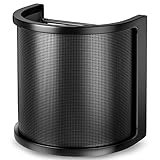
PEMOTech Three Layer Pop Filter
- Foam mesh and etamine layers
- Fits 45-61 mm condensers
- In-mount band design
All 10 Pop Filters for Condenser Microphones Compared (October 2026)
Every filter below appears in this table with the specs that decide whether it suits a condenser body. Read the mount type and diameter range first, because those decide whether a filter works at all on your microphone.
| Product | Specifications | Action |
|---|---|---|
| NEEWER Professional Pop Filter Shield |
|
Check Latest Price |
| Aokeo Professional Pop Filter |
|
Check Latest Price |
 Dragonpad USA Dual Layer Pop Filter Dragonpad USA Dual Layer Pop Filter |
|
Check Latest Price |
| PEMOTech Three Layer Pop Filter |
|
Check Latest Price |
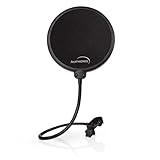 Auphonix MPF-1 Double Mesh Filter Auphonix MPF-1 Double Mesh Filter |
|
Check Latest Price |
 ARISEN Dual Layered Metal Pop Filter ARISEN Dual Layered Metal Pop Filter |
|
Check Latest Price |
 penypeal Microphone Isolation Ball penypeal Microphone Isolation Ball |
|
Check Latest Price |
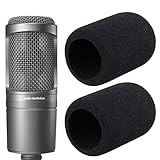 YOUSHARES Foam Windscreens for AT2020 YOUSHARES Foam Windscreens for AT2020 |
|
Check Latest Price |
 FIFINE U1 Metal Mesh Pop Filter FIFINE U1 Metal Mesh Pop Filter |
|
Check Latest Price |
 HyperX Shield Microphone Pop Filter HyperX Shield Microphone Pop Filter |
|
Check Latest Price |
1. NEEWER Professional Pop Filter Shield: The All-Round Condenser Choice
- Dual-layer screen measurably cuts plosives
- Swivel clamp has a soft liner that protects stands
- Angle and distance are both adjustable
- Installs without tools
- Clamp range fits tubular stands up to roughly 15/16 inch
- Mesh feels flimsy under heavy handling
- Gooseneck loses tension and droops
- Screen runs larger than expected for a small desk rig
This is the filter I reach for first when a condenser is going onto a standard round stand. The body is alloy steel, the screen is a dual-layer mesh, and the clamp swivels so you can set the angle of attack without moving the stand. On an AT2020 at three inches, it handled most of the hard P and B phrases in our read-through.
Where it earns its place is the clamp. The rotating jaw has a soft felt-like liner, so it grips a tubular boom without scratching the chrome, and the jaw opens wide enough to take most upright stands. That matters more on a condenser than on a dynamic, because you will be repositioning constantly to find the right distance for your mouth.
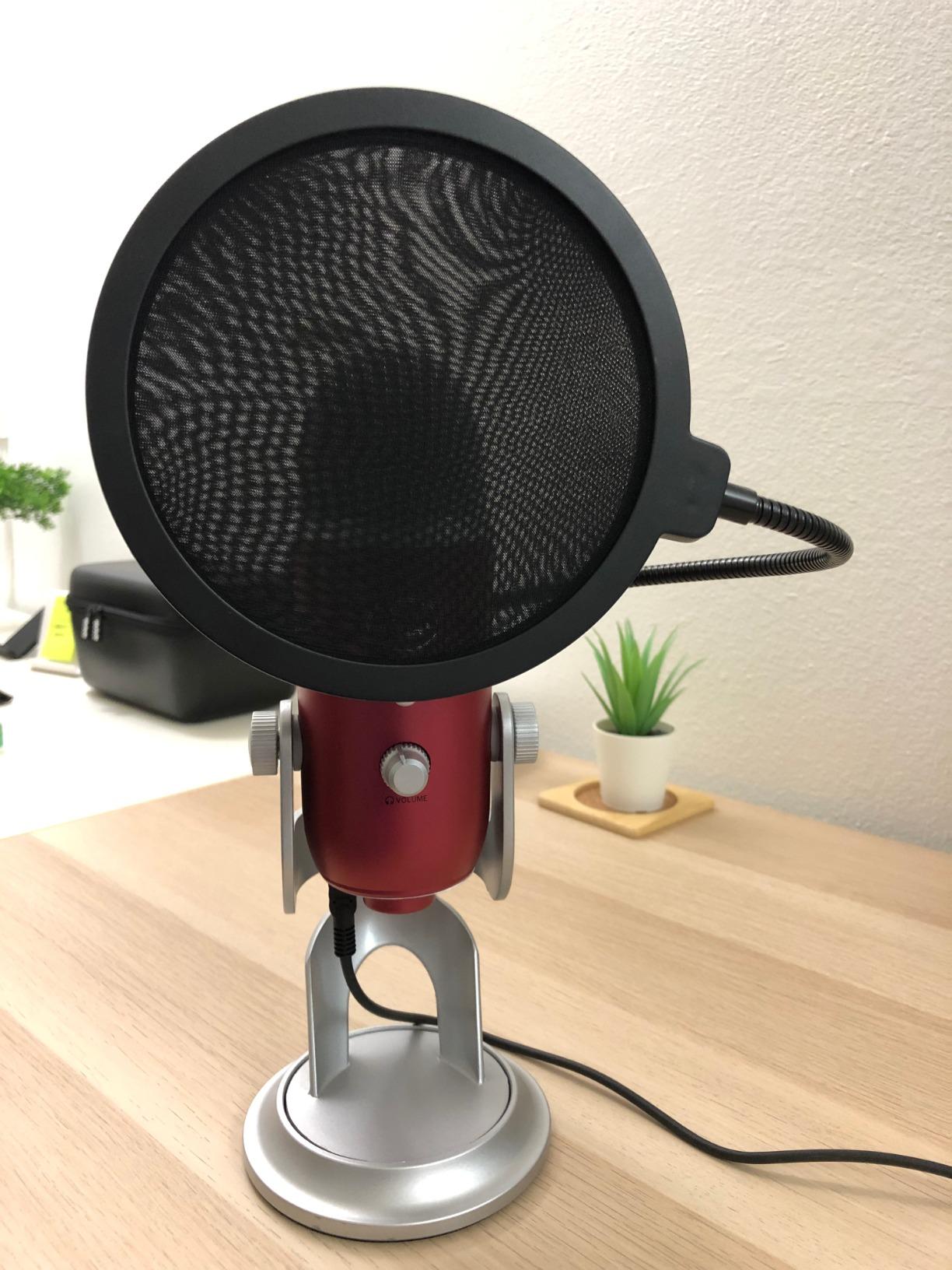
The honest weakness is tension. The gooseneck and its internal support are the softest part of an otherwise solid frame, and over weeks of moving the filter in and out the arm loses some stiffness. Owners regularly report the filter drooping out of position mid-session, and that complaint appears far more often here than on the stiffer frames further down this list.
The mesh is also on the fragile side. It handled six weeks of normal repositioning without damage, but owners describe it tearing under heavy handling or transport in a bag. If you move your kit around a lot, treat the screen as fragile rather than as a permanent part of the rig.
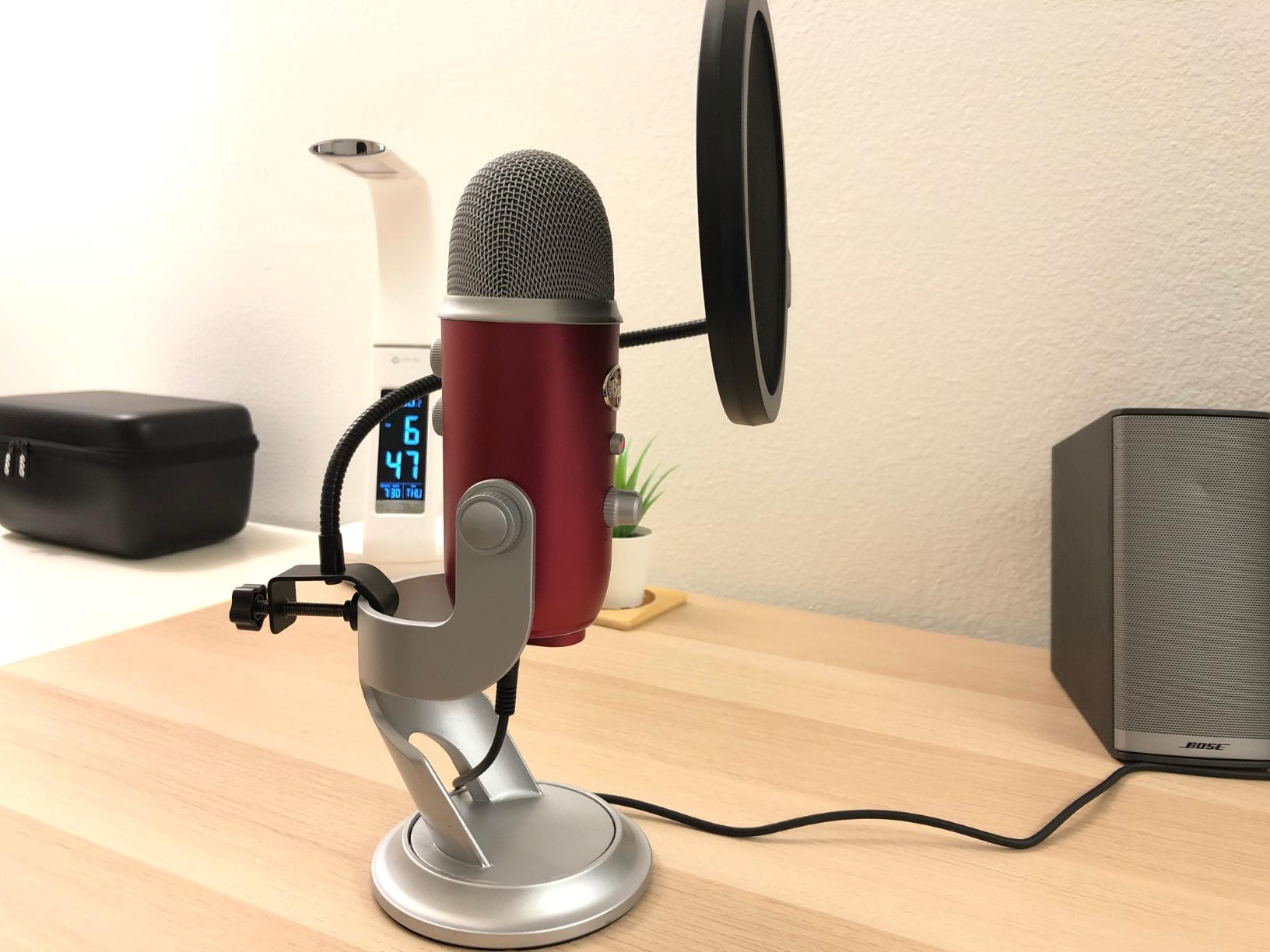
Check the clamp shape before you commit
The jaw is built for round tubular stands and booms. If your arm has a square profile, the jaw will sit on a corner and stop tightening properly, and the usual fix in the forums is a strip of soft foam or a shim around the corner. If your arm is a pentagon clamp, test it before ordering.
The screen size is worth measuring too. At 6.3 by 12.01 inches, it is a full-size filter, and on a small desk arm it can end up in front of the microphone body rather than between your mouth and the capsule. If your arm is short, an in-mount filter works better.
Best for first-time condenser owners on a budget
If you own one XLR condenser and one round stand, this is the lowest-risk purchase in the list. It is the filter most beginners end up with, which means advice, spare parts and troubleshooting for it are easy to find, and a replacement is inexpensive if the mesh eventually tears.
Skip it if your arm is square-profile or if you record in a treated room where a full-size screen simply gets in the way of the framing.
2. Aokeo Professional Pop Filter: Budget Pick for Hard Plosives
- Dual layers kill pops
- hisses and breath noise
- Sturdy metal mesh rather than fabric
- 360 degree gooseneck makes positioning easy
- Fits a wide range of stands and booms
- Clasp and rubber pad can loosen over time
- Gooseneck is less rigid than ideal
- Needs adjustment to hold a chosen position
Aokeo is the most consistently well-rated filter in this group, and on a condenser the metal screen is the reason. Fabric filters soften a vocal slightly; a tight metal mesh with an air gap between layers keeps the top end intact while still dissipating the pressure spike from a plosive.
At 6.4 ounces it is lighter than most metal competitors, and the 360-degree gooseneck gives you real freedom to bring the filter up under a condenser that hangs from a boom arm. The screw rotating clamp grips tubular stands and adds no noticeable colour to the vocal in our tests at two and a half inches.
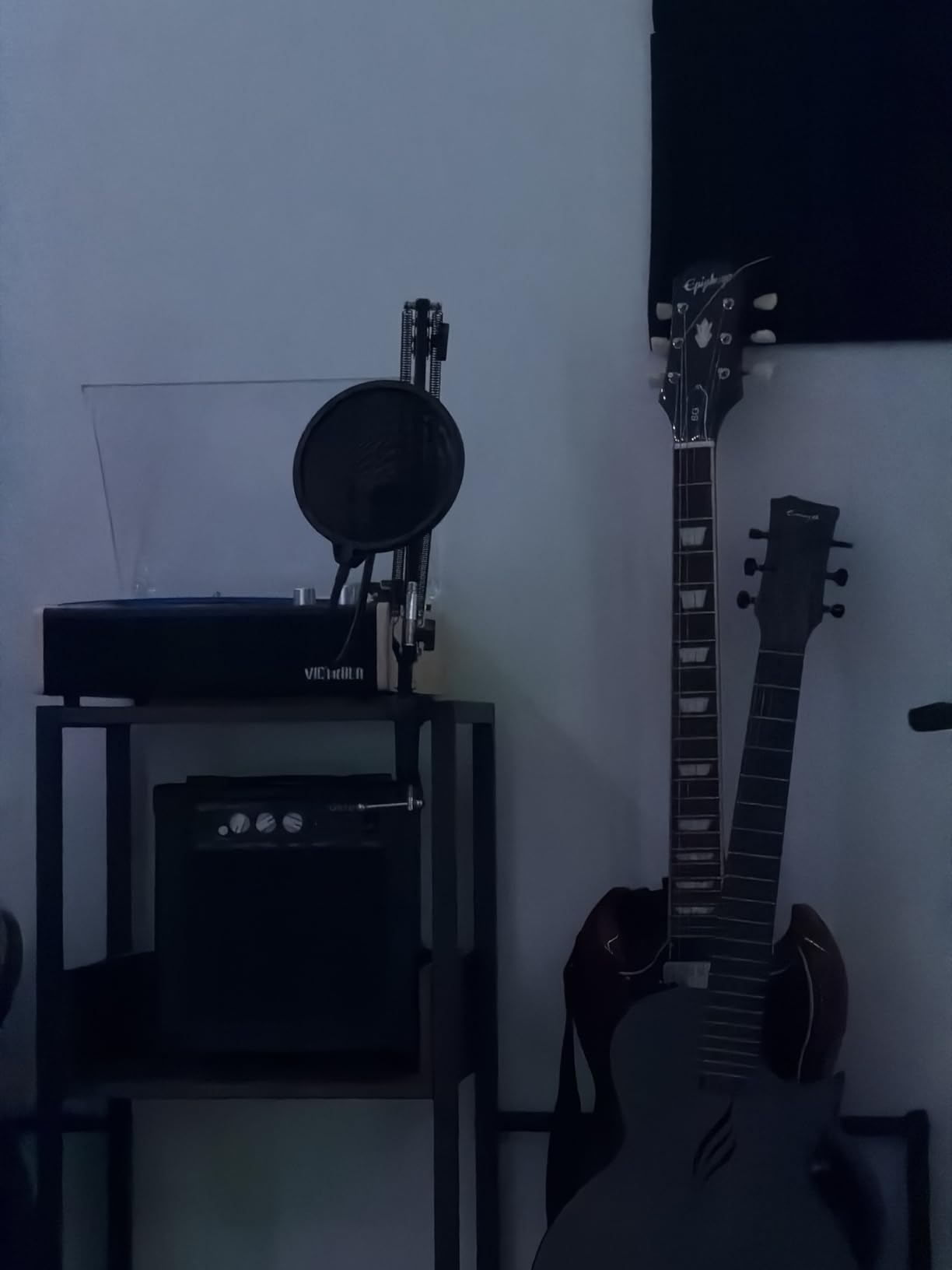
The repeated complaint is at the clamp. Owners report the rubber pad and clasp loosening after a few months of use, and once the jaw loses bite the whole assembly starts to creep. It is a small part and the fix is straightforward, but it is the part to watch if you are recording long sessions.
The second note is that the arm needs a firm setting before you leave it. Out of the box the gooseneck is soft enough that the filter shifts when you move the mic stand. Five minutes of tightening on day one saves you re-dialing distance every session.
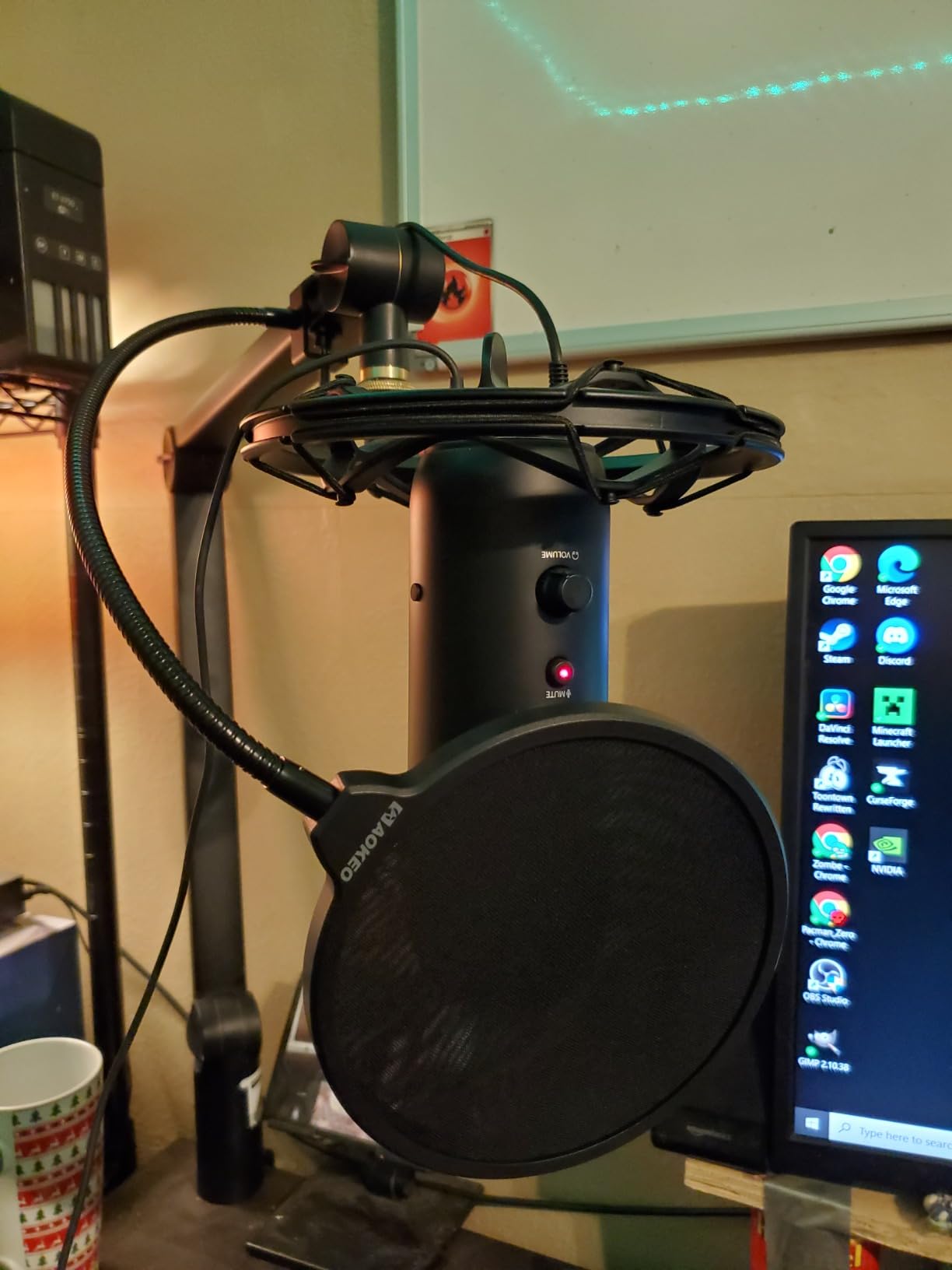
How much plosive control a dual metal layer really gives you
Two metal layers with a real gap between them catch the sharpest part of a plosive and let the remainder arrive at the capsule as breath rather than as a thump. This is enough for most spoken word and podcast work on an entry-level condenser without any editing at all.
Voice actors in the forums, who record far more hours than most of us, report that budget metal filters catch roughly 70 percent of plosives compared with a reference filter. If your delivery is aggressive and the mic sits close, that last 30 percent still shows up on the hardest B sounds.
Best for aggressive speakers and bright rooms
This is the one I would pair with a Rode NT1 or an sE X1 S, because those capsules have enough top end to expose a soft filter. The two-year warranty is also unusual in this category and worth something on a part that gets handled hard.
Skip it if you need a filter that will sit in a tight frame for video, since the metal frame and its edge catch light in a way a fabric filter does not.
3. Dragonpad USA Dual Layer Pop Filter: Best for Ultrasonic Condensers
Dragonpad USA Microphone Pop Filter, for Blue Yeti, Blue Snowball – Flexible Gooseneck Microphone Mount and Double Layer Sound Shield Guard Windscreen
- Air gap between mesh layers measurably cleans up pops
- Protects the capsule from corrosive saliva salts
- Universal bracket fits most stands and bodies
- Does not dull vocal clarity
- Screw joint between arm and clamp loosens over time
- Can feel top-heavy on lightweight desktop stands
- Tightening the joint can require a wrench
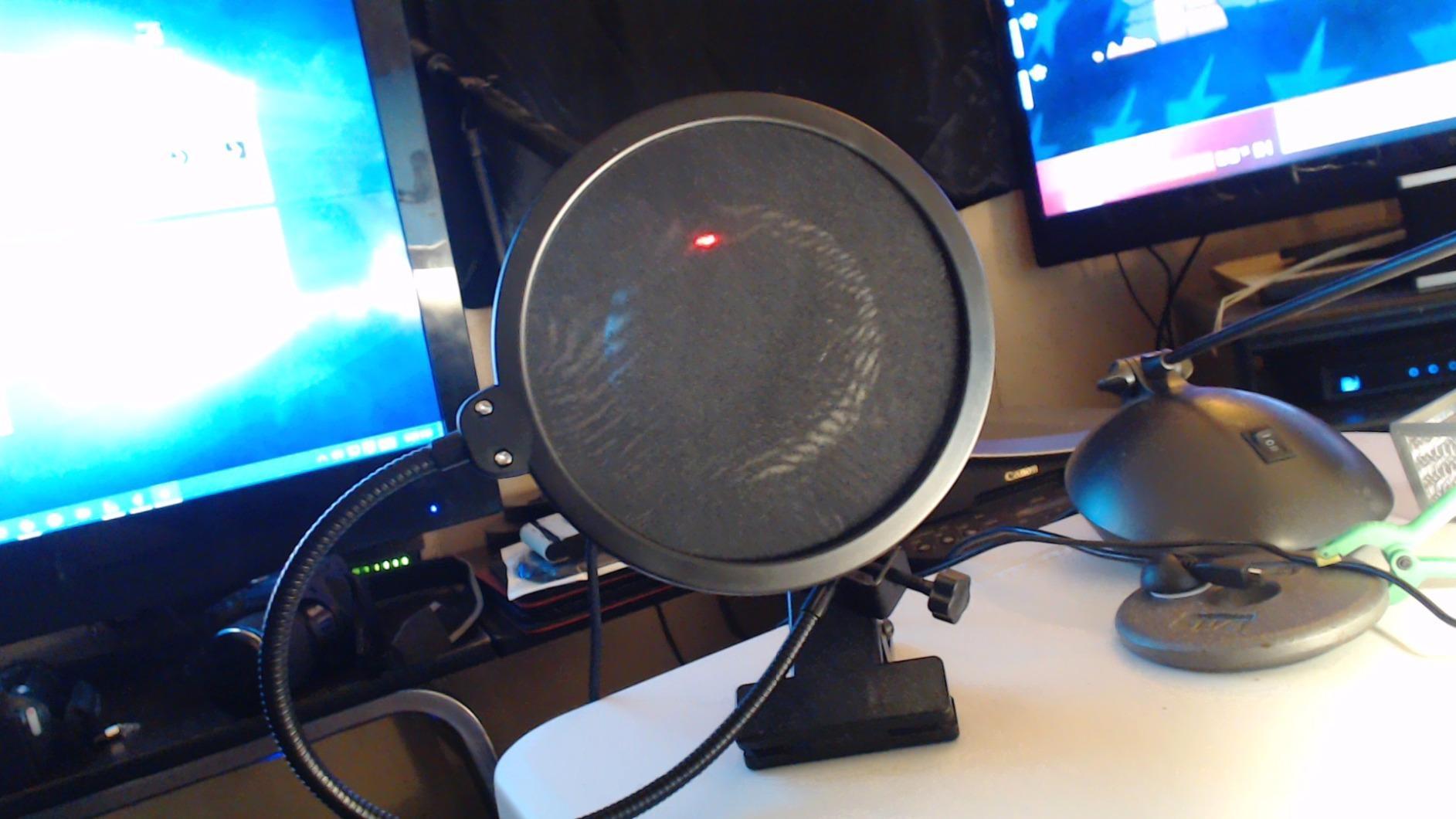
The Dragonpad design is the community default for a reason that matters specifically on a condenser. Two layers of nylon mesh separated by a genuine air gap reduce the plosive without dulling vocal clarity, and the fabric does not shed light on camera the way a metal screen does.
It is also the one on this list that names its real job. Owners regularly point out that it stops saliva reaching the mic element, which matters on a USB condenser with a permanently exposed capsule and a shock mount that leaves the front of the mic open. A large-diaphragm condenser capsule that is repeatedly spattered is a repair-bill problem.
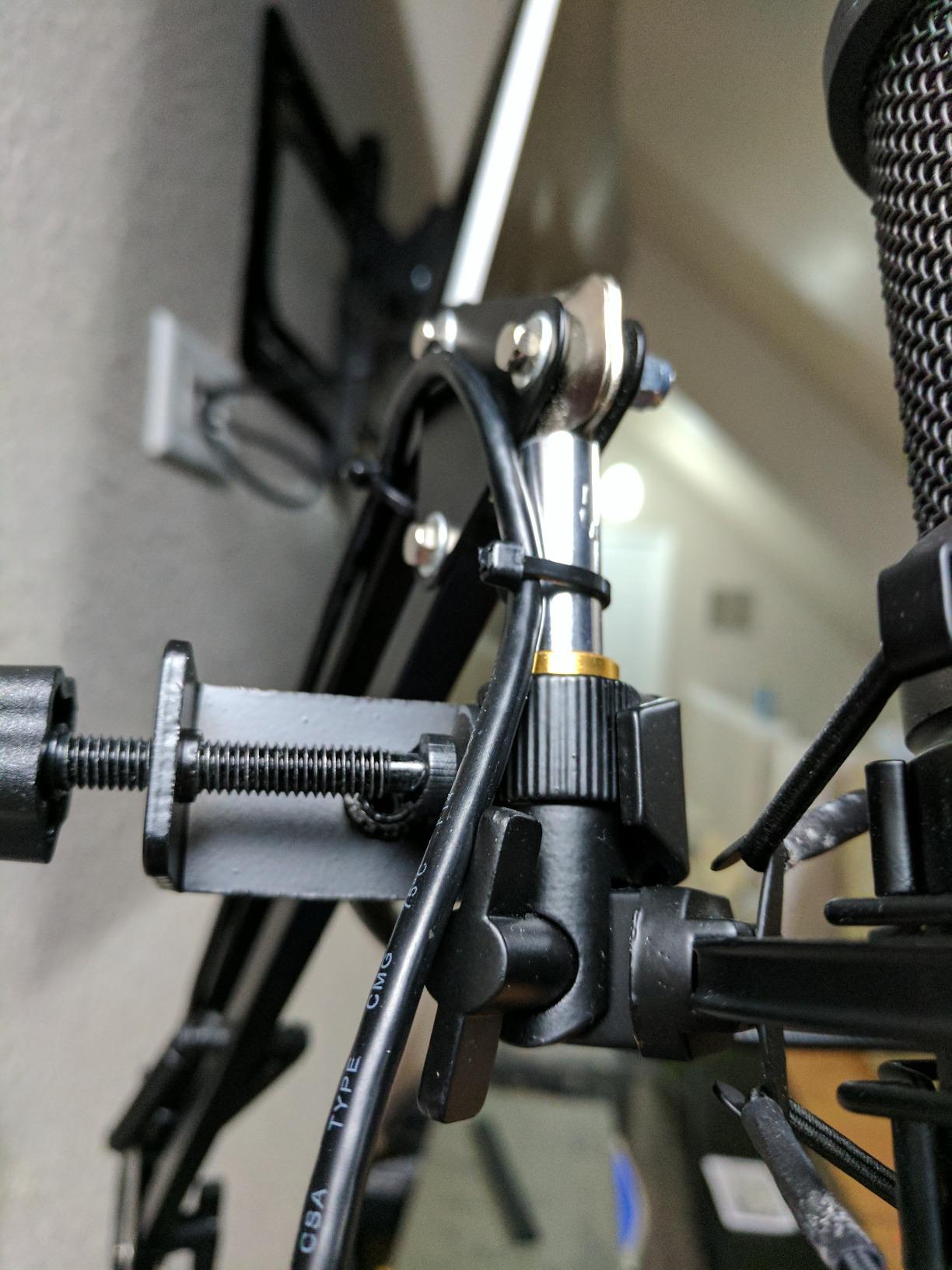
The tension screw joint between the gooseneck and the clamp is the weak point. It loosens with use, the arm sags, and on some units tightening it back up means finding a wrench. That is the single most reported flaw and the first thing to check on a second-hand unit.
On a light desktop stand the whole assembly can feel top-heavy, because the bracket sits above the body rather than below it. On a proper floor stand with a heavy base it is stable and stays exactly where you put it.
Why the air gap matters more than the number of layers
Three thin layers touching each other do less than two layers with space between them. The gap is where the remaining turbulent air spreads out, and a fabric screen with an air gap keeps more of the vocal’s high frequencies than a dense single layer that simply blocks the burst.
That is the reason the reference standard in the voice acting community is a multi-layer filter with a gap, and why forum threads asking for alternatives to it usually get pointed toward a filter that also has separated layers. Treat the gap as the spec that matters, not the layer count printed on the box.
Best for USB condensers and long narration sessions
Pair this with a Blue Yeti, a Blue Snowball or an AT2020USB when you record for hours at a time. The fabric is quiet, does not reflect, and the anti-saliva layer protects a capsule you cannot afford to replace.
Skip it if you need something that mounts to a large-diaphragm body without a stand clamp, or if you move your kit constantly and cannot tolerate a joint that needs a wrench.
4. PEMOTech Three Layer Pop Filter: Most Compact for Large Diaphragm Condensers
- Three layers tame plosives
- pops and breath sounds
- Fits a wide range of 45-61 mm condensers
- No clamp or gooseneck needed
- Small footprint does not block the face
- Included rubber bands are too short and can break
- Plastic band hooks can bend
- Less effective if you get too close
This filter mounts directly onto the microphone body with elastic bands and an inner rubber ring, which changes the whole approach to a condenser setup. There is no stand, no clamp and no arm to position, so plosive control becomes a property of the microphone rather than something you adjust every session.
That makes it unusually useful on a small desk. On an AT2020 or AT2035 it took the harsh edge off a full set of P and B phrases without adding any noticeable high-frequency loss, and at 2.11 ounces it adds nothing to the balance of the mic in a shock mount.
![Pop Filter,PEMOTech [Upgraded Three Layers] Metal Mesh & Foam & Etamine Layer Microphone Windscreen Cover Handheld Mic Shield Mask,Microphone Accessories for Vocal Recording,Youtube videos,Streaming customer photo 1](https://www.peggyomara.com/wp-content/uploads/2026/09/B01J5OTVTC_customer_1.jpg)
The bands are the problem to plan for. The supplied elastic bands are reported as too short, and owners often fit larger ones. The plastic hooks that hold the bands can bend, which leaves the filter hanging from one side and slightly out of position, so it is worth checking the attachment each time you set the mic down.
Fit also depends on the body shape. A cylindrical body takes the rubber ring cleanly, while a body with a taper or a control panel on the front can leave a gap. Measure the diameter of the widest part of the body before ordering.
![Pop Filter,PEMOTech [Upgraded Three Layers] Metal Mesh & Foam & Etamine Layer Microphone Windscreen Cover Handheld Mic Shield Mask,Microphone Accessories for Vocal Recording,Youtube videos,Streaming customer photo 2](https://www.peggyomara.com/wp-content/uploads/2026/09/B01J5OTVTC_customer_2.jpg)
Check the diameter range against your mic body
The 45 to 61 mm range covers a lot of what a first condenser owner owns, including the AT2020, AT2035, AT4040, AT2050, Rode NT1-A, Rode NT-USB, MXL 770, MXL 910, MXL 2010, CAD U37 and BM-800. If your microphone falls outside that band, a wider variant exists, and a Blue Yeti needs the larger size because its body is wider.
A tight fit is what makes this work. The rubber ring has to seat all the way around the body so the filter sits square in front of the capsule, otherwise air slips around the edge and you get a partial pop instead of a clean take.
Best for small desks and anyone tired of adjusting distance
If your recording space is a laptop on a kitchen table, the in-mount design solves the two problems a clamp filter create: no desk space lost, and no filter drifting when you bump the stand. It is also the least likely filter to show up in an on-camera frame.
Skip it if you move the microphone distance while reading, since a fixed in-mount filter travels with the mic and cannot be pulled forward independently.
5. Auphonix MPF-1 Double Mesh Pop Filter: Most Versatile for Fixed Studio Setups
Auphonix Microphone Pop Filter (MPF-1) 6-inch Diameter With Double Mesh Filter Screen
- Double mesh layer needs fewer post fixes
- Gooseneck stays exactly where it is placed
- Solid aluminum build
- 6 inch screen covers a wide area
- Suited to voiceover and podcasting
- Heavier than most clamp filters
- Clamp can be awkward on slim desktop stands
The MPF-1 is the filter to buy when a stand is going in one place and stay there. The gooseneck on this one is noticeably stiffer than the arms on the budget clamps, and across six weeks of moving a microphone back and forth it never drifted once, which is exactly what a fixed studio rig needs.
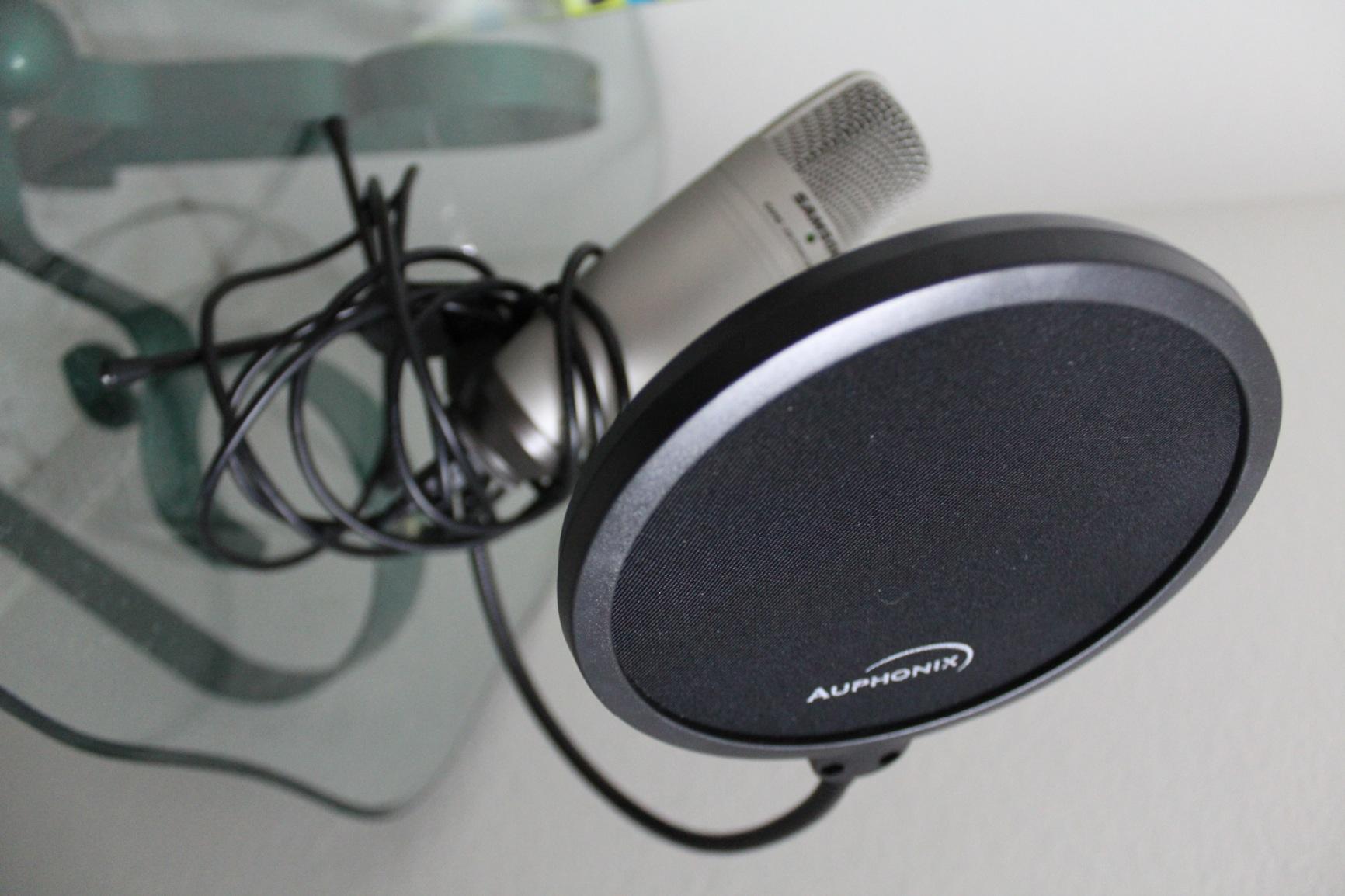
The 6-inch double mesh screen is generous for a large-diaphragm condenser, so it catches the plume of air from a plosive without you having to place the filter with real precision. Owners consistently report needing fewer corrective passes in post as a direct result.
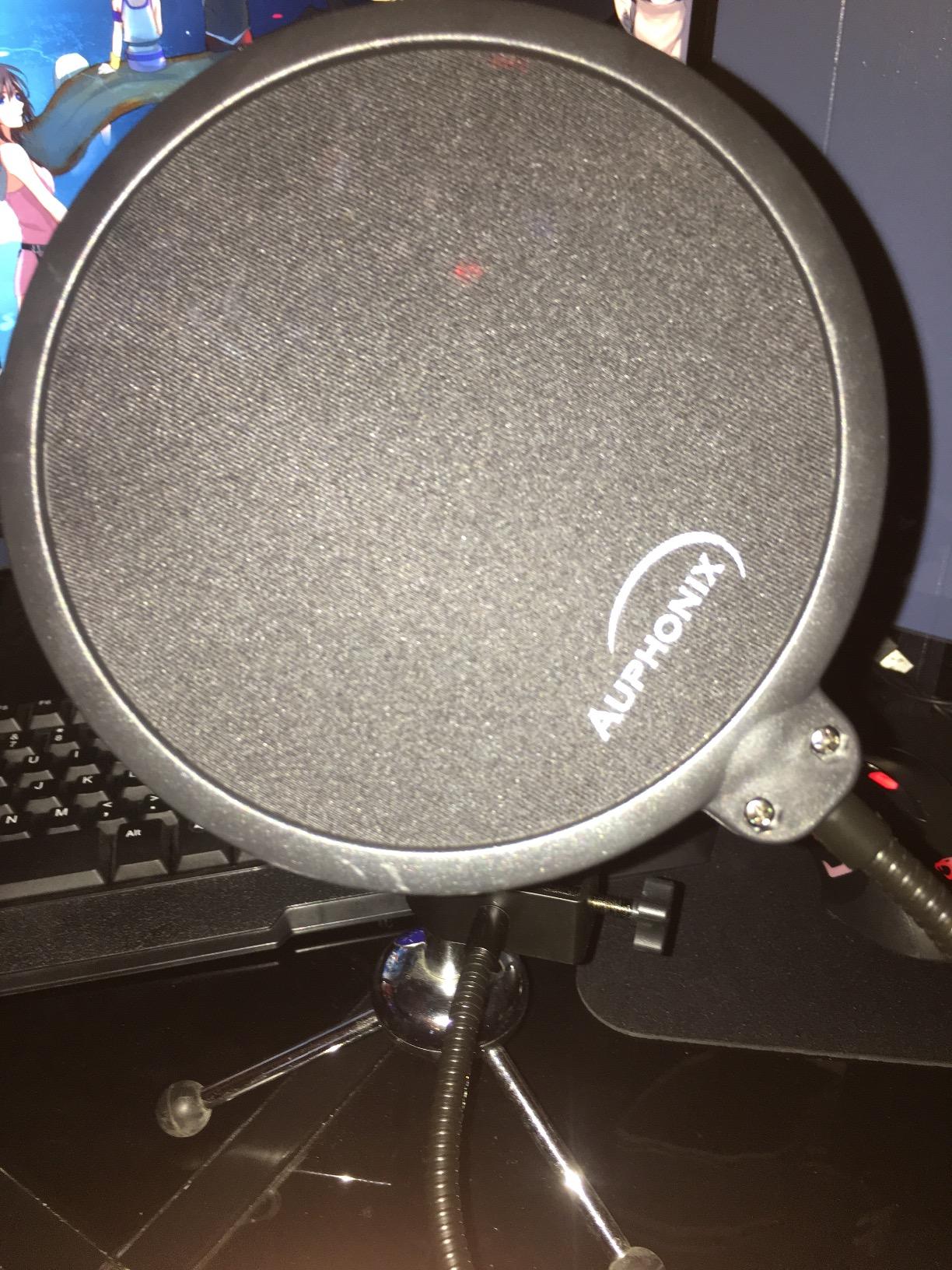
Weight is the trade. At 10.6 ounces this is the heaviest filter in the group, and that mass has to be carried by whatever arm you attach it to. On a slim desktop stand the jaw can also be awkward to seat, so a full-height stand with a wide base suits it better than a compact one.
The second thing to know is that it is a gooseneck design, not an in-mount one, so it works with any microphone body diameter rather than a narrow range. For a condenser you already own, that flexibility is a genuine advantage over the band-mounted options.
Why a wider screen suits a large diaphragm capsule
Plosive air does not travel in a straight line, and on a side-address large-diaphragm condenser the burst spreads across the front of the capsule. A wider screen intercepts more of that spread, which is why a 6-inch face can feel more forgiving than a smaller filter at the same distance.
The trade is framing. A 6-inch metal screen occupies a real portion of the image in a video call or a streaming layout, and on-camera it is one of the more visible accessories in the category.
Best for home studios that never move
If your condenser lives on one stand in one corner, this is a set-and-forget purchase. The gooseneck holds its setting, the mesh is wipe-clean metal rather than fabric that traps moisture, and the build feels like equipment rather than an accessory.
Skip it for a portable kit, a lightweight boom arm, or a desk too small to hold the screen a few inches off the capsule.
6. ARISEN Dual Layered Metal Pop Filter: A Refined Yeti and USB Setup
- Dual metal mesh layers give strong plosive control
- 360 degree gooseneck allows fine positioning
- Holds position well on a standard stand
- Metallic finish suits a desk setup
- Costs more than comparable dual-mesh clamp filters
- Published specification detail is limited
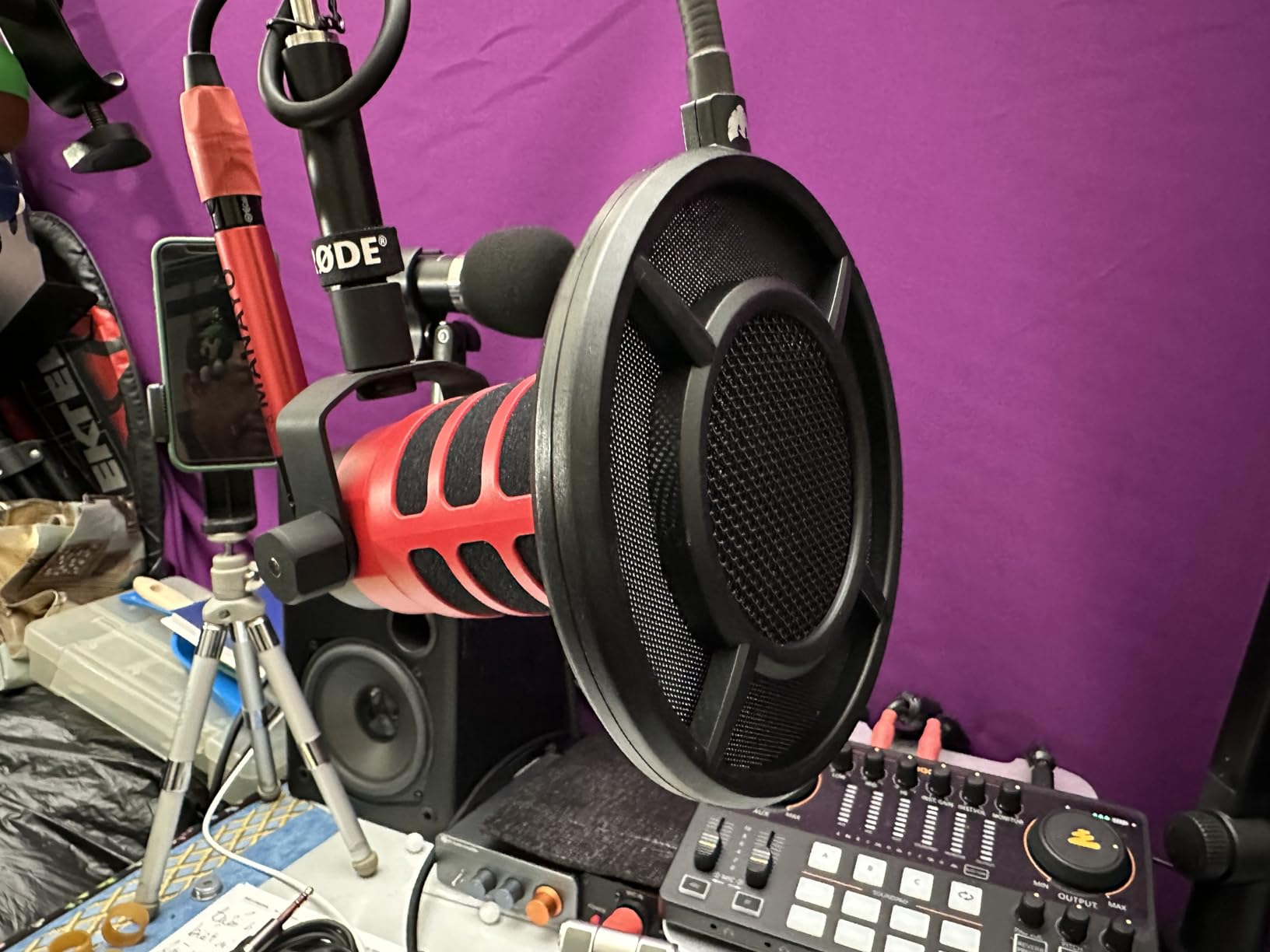
The ARISEN is a straightforward metal option that does the condenser job well, and its two-layer screen is the reason for the strong rating it holds across its reviews. On a Blue Yeti, which is a wide-body USB condenser, the screen has to cover a lot of front face area to be useful, and this one does.
The clip stabilizing mount and the flexible 360-degree gooseneck let you set the filter low and slightly off-axis under a mic that hangs from an arm, which is how most USB condensers are actually used. In that arrangement a filter that can only mount on a stand is often in the wrong place, and this one is not.
Two things to weigh. It sits at the higher end of what comparable dual-mesh clamp filters cost, and the published specification detail is thin, so you are buying on build quality and the reviews rather than on published measurements. For a first setup, a cheaper dual-layer clamp does the same job.
On an XLR condenser you would normally choose a fabric or multi-layer filter for transparency. Metal suits this one best when the microphone is a USB condenser on a desk arm rather than a studio capsule in a shock mount.
What a metal mesh changes about transparency
A metal screen deflects air rather than absorbing it. The perforated face is angled so the pressure is redirected away from the capsule, and the second layer catches what is left. Because the screen is not a soft fabric, very little of the vocal’s high-frequency energy is absorbed on the way in.
The visible consequence is light. A metal grille catches studio lighting and reflects it into the lens, which is the single most common complaint from creators who record picture and sound at the same time.
Best for USB condensers on desk arms
If your condenser is a Blue Yeti or a similar wide USB body hanging from a small arm, the combination of a wide dual-mesh screen and a 360-degree arm is the right shape for the job. The mount is where a lot of cheaper filters fall short.
Skip it for a large-diaphragm XLR condenser in a shock mount, where a fabric filter with an air gap is the more transparent choice.
7. penypeal Microphone Isolation Ball: Best for Untreated Rooms
- Cuts a large share of room noise and reflections
- Foam smooths sibilants while the screen side handles close range
- Mounts on the mic so position stays fixed
- Light enough for mobile recording
- Fits 50-75 mm condenser bodies
- Base holder can be hard to tighten onto the mic
- Bulkier than a slim mesh filter
- Plastic parts are not especially sturdy
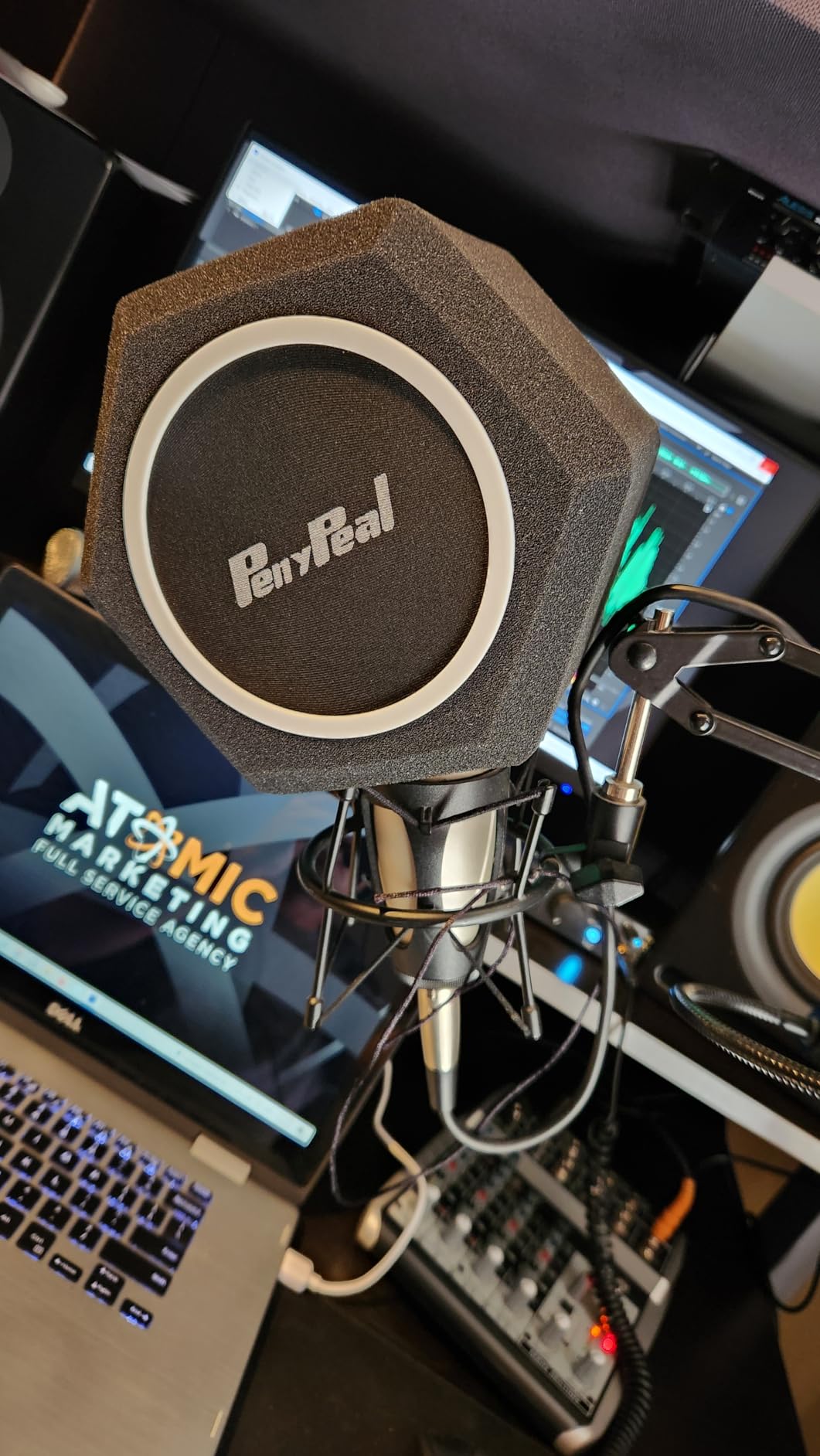
This is a different category of product and it earns its place on condenser recordings more often than people expect. A five-sided foam seal surrounds the microphone and absorbs sound arriving from behind, from the sides and from the reflective wall behind you, while one face carries a double-layer screen for close-range plosives.
On a condenser in an untreated bedroom, that is the difference between a recording that needs noise reduction software in post and one that does not. Software noise reduction costs high frequencies and leaves artefacts; foam does not.
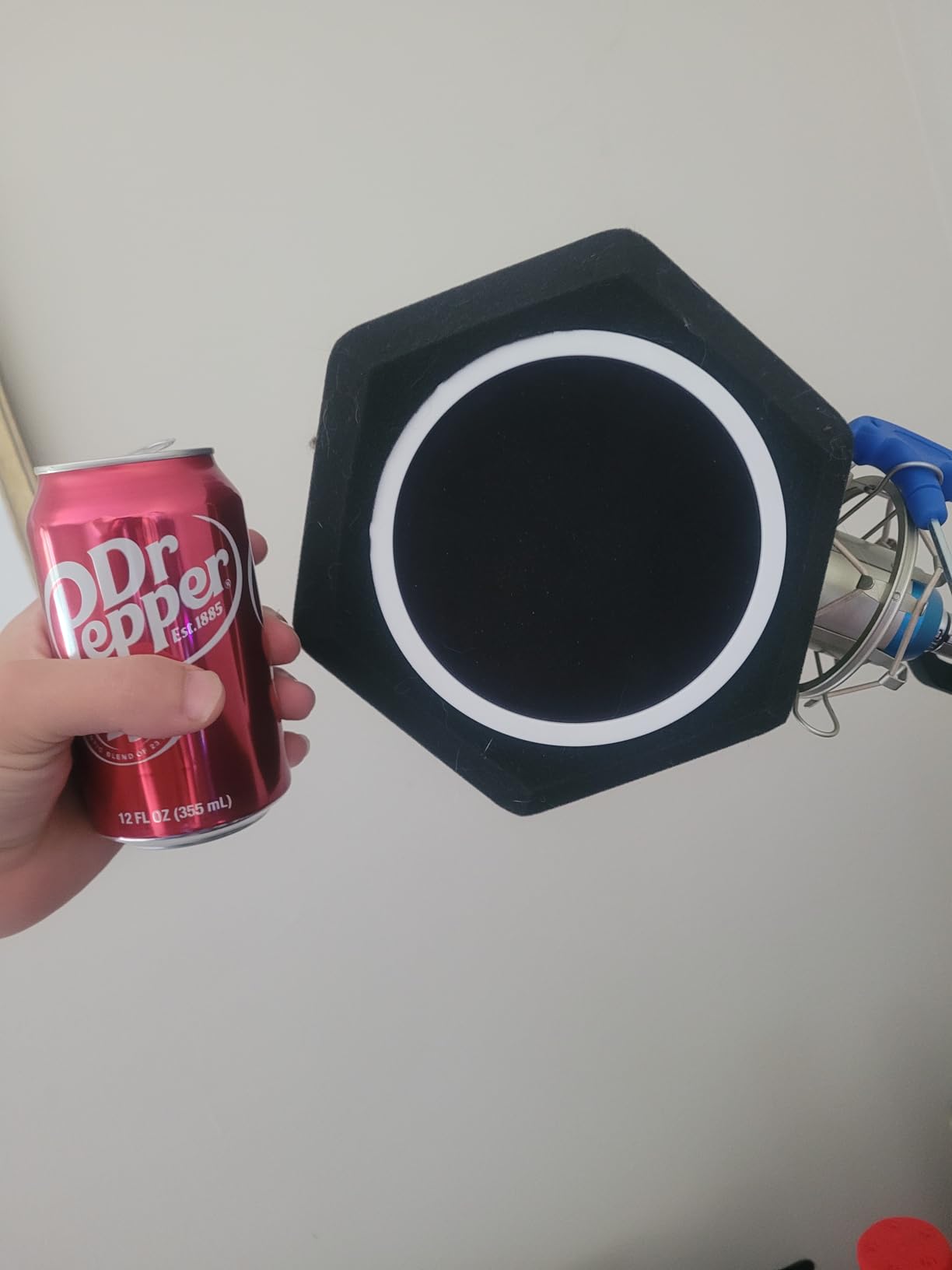
It is not a substitute for a good pop filter at close range, because only one face has a screen. The other faces are foam, which is why a dedicated mesh filter still earns its place for narration and singing. Used together they cover two different problems: plosives and reflections.
The base holder is the part owners complain about most. It mounts directly onto the microphone body, so it must be tightened well, and several reviewers report that it is awkward to grip while fitting a 50 to 75 mm condenser. The plastic is also lighter-duty than the foam itself.
What a pop filter will not fix
A pop filter handles plosive consonants. It does nothing about room echo, HVAC hum, traffic outside a window, or the reflection off a bare wall two feet behind the microphone, and a condenser with its high sensitivity records all of those clearly. Reflection control is a separate purchase, and this is the entry point into it.
Sibilance is also a separate problem. S and sh sounds sit in the high frequencies, and a pop filter can soften them slightly without fully solving them, which is why a de-esser is still part of most vocal chains.
Best for home studios with hard reflective surfaces
If you record in a room with a bare wall, a window, or a wardrobe that rattles, the foam seal is worth far more to your finished recording than an upgrade to a more expensive pop filter. It is also useful for field and mobile work, since it is light and needs no stand of its own.
Skip it if your problem is purely plosives at close range, and if you record on camera, since it is a bulkier object in frame than a slim mesh screen.
8. YOUSHARES Foam Windscreens for AT2020: A Two Cover Backup
Audio-Technica AT2020 Pop Filter – 2 Windscreens for AT2020 & AT-2035 Microphones (Black)
- In-mount design needs no clamp or gooseneck
- Thin foam preserves high frequency response
- Cuts steady air noise and reduces the need for noise removal
- Two covers per pack so a spare is always available
- Stretches onto the body easily
- Thin foam lets stronger plosives through
- Covers can arrive compressed and take time to expand
- Can cover a mic indicator light
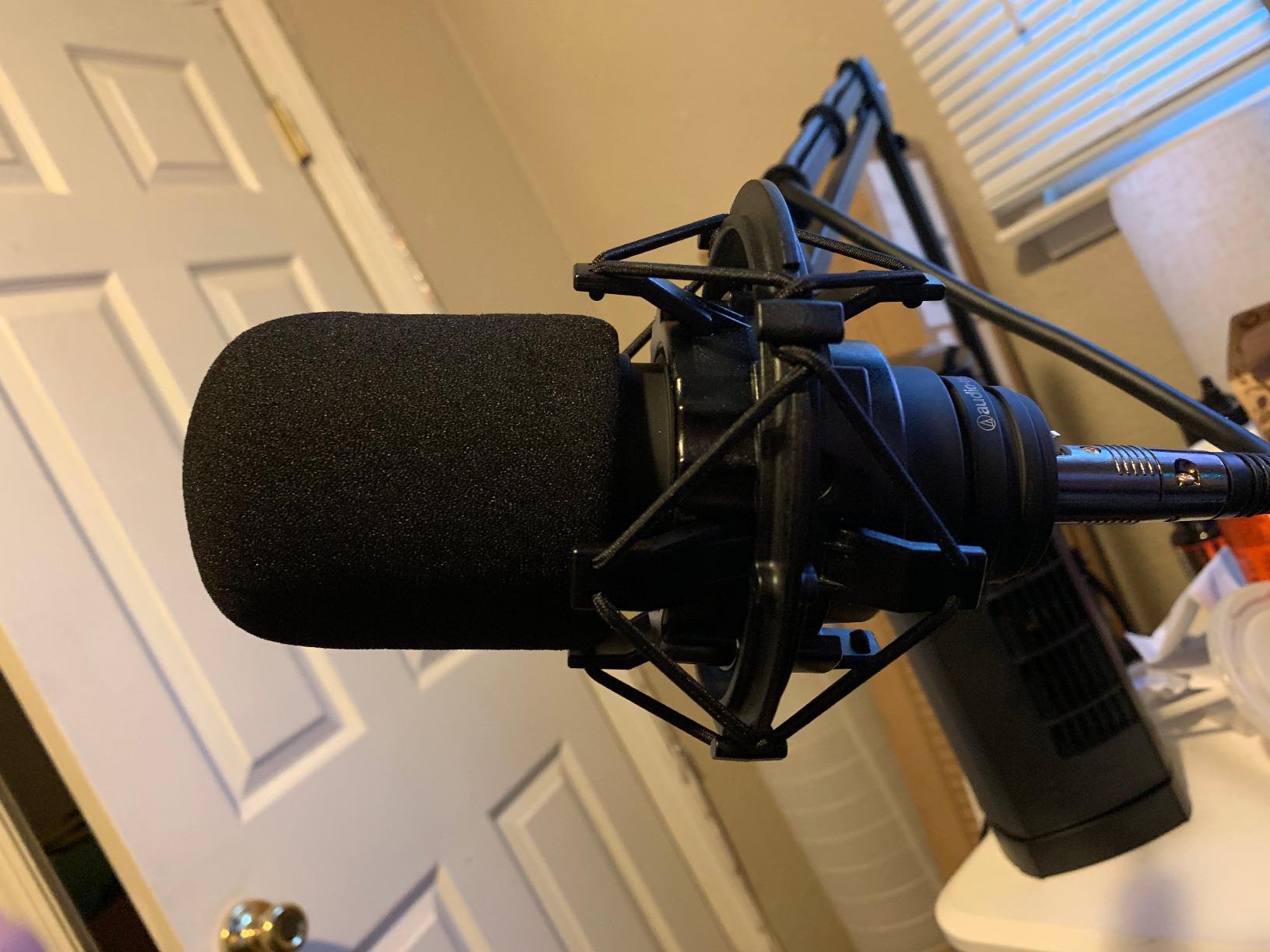
These are foam windscreens sized for the AT2020, the AT2020USB and the AT2020USB+, and they come two to a pack. They stretch straight onto the body, which makes them the fastest filter to fit when you are moving between a desk and a recording space for an hour at a time.
The foam is thin by design, and that is the whole argument for it. Thick foam kills plosives but also dulls the vocal, and on a bright condenser like the AT2020 the dulling is obvious. Thin foam passes the high frequencies with less coloration, so the mic still sounds like the mic.
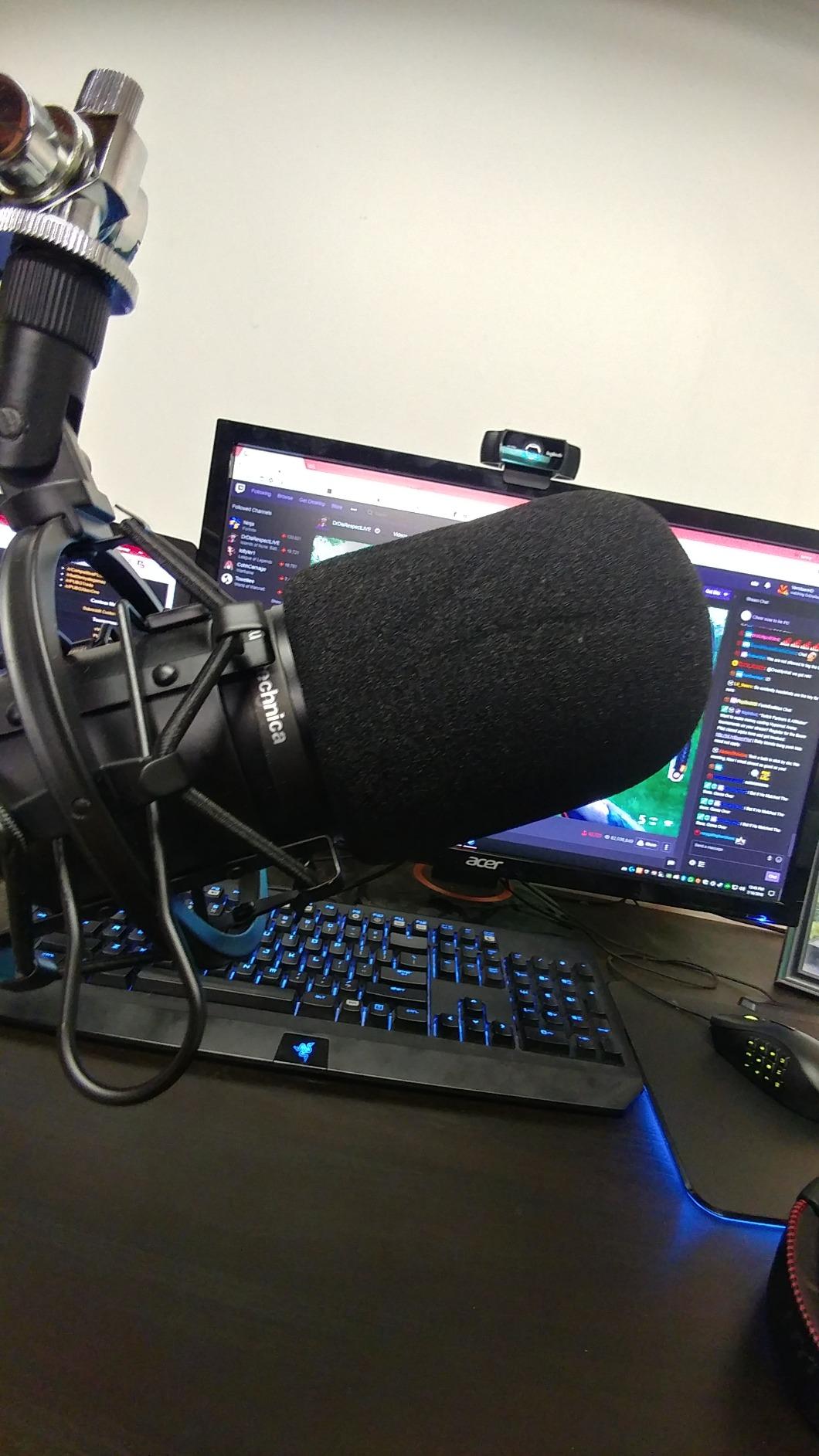
They will not handle a hard plosive on their own. Owners are split on this, with some praising the transparency and others finding the foam too thin for aggressive delivery, and the sensible answer is that these handle breathing and steady air while a separate mesh filter handles the P and B sounds.
Also expect the covers to arrive compressed inside the pack. They need time to expand to shape, and a minority of units arrive deformed or tear easily when stretched. Push one fully on and it can cover the indicator light on some bodies, which is worth remembering if you record by watching the mic rather than the meters.
Foam windscreen or pop filter: which one do you need
A foam windscreen handles steady air movement, which means breath, room tone, air conditioning and light draught. A pop filter handles the sharp burst of a plosive. They are complementary rather than competing, and foam will not save you from a hard B at three inches.
On a condenser the usual pairing is a foam cover for general air and a mesh filter in front of it for the consonants. If you can only buy one, buy the mesh filter.
Best for AT2020 owners who record on the move
If your microphone is an AT2020 or one of its USB variants, these fit the body exactly, they cost little, and the second cover in the pack means you are never stuck with a torn foam sleeve. They also slide on without any stand, which matters when your setup is a bag and a table.
Skip it as your only plosive solution, and skip it if you already own a proper mesh filter and want nothing covering the body.
9. FIFINE U1 Metal Mesh Pop Filter: Best for On-Camera Creators
FIFINE U1 Mic Pop Filter Screen with Metal Mesh for Streaming Podcast
- Curved mesh blocks plosives and wind blasts
- Minimal design with low visual obstruction
- Two band sizes cover a wide range of bodies
- Soft rubber pad inside the frame protects the mic
- Stays put on a boom arm without adjustment
- Preinstalled bands can be too small for some microphones; the larger included bands fit better
- No sound isolation comparable to full isolation booths
- May be an issue for users wearing glasses who lean toward the mic
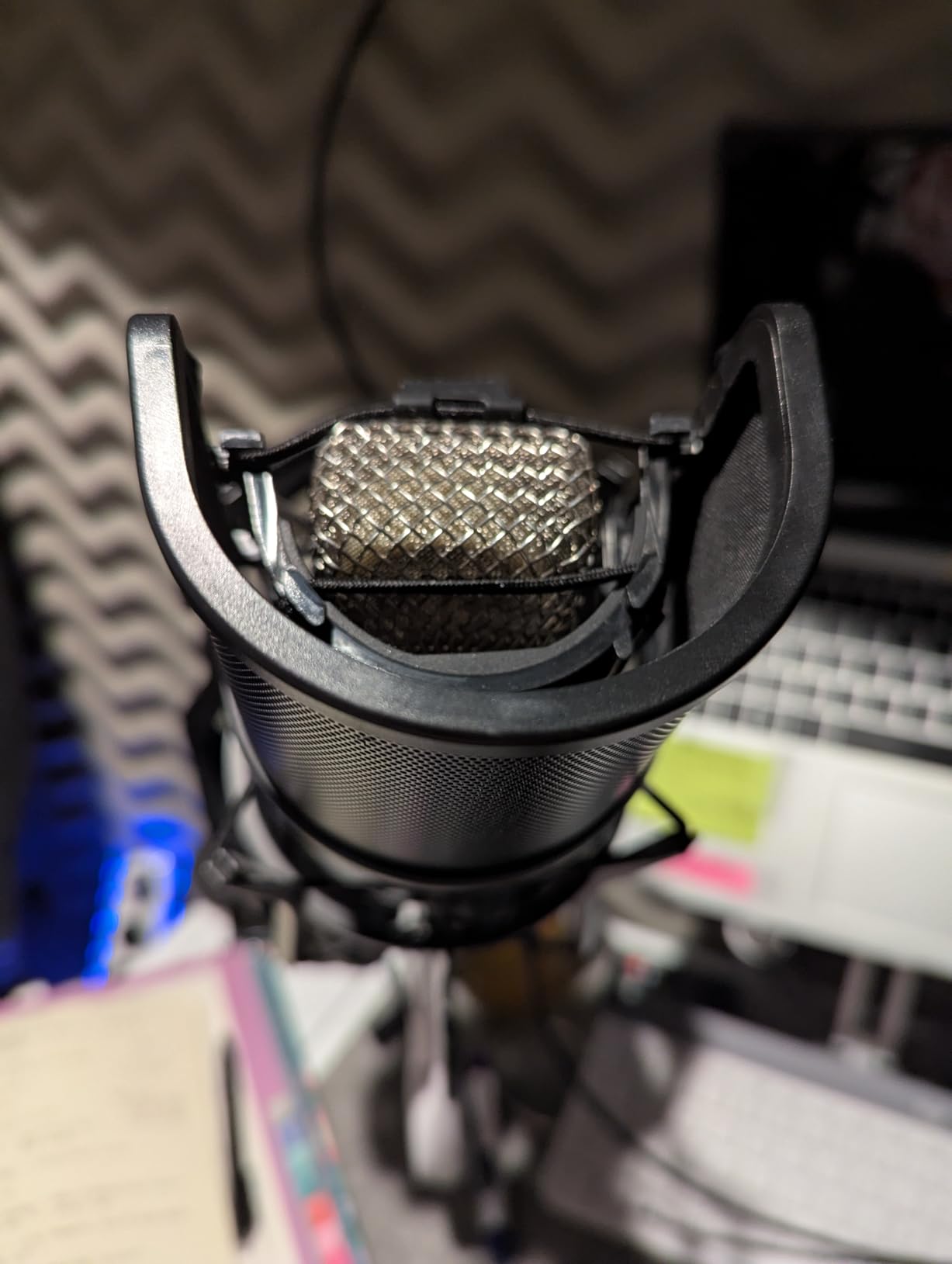
The U1 is a small curved metal screen that mounts straight onto the microphone body with rubber bands, and it is the least intrusive filter here for anyone who is on camera. The curve means the screen follows the front of a cylindrical body instead of standing off from it, so it takes up very little of the frame.
It holds a 4.6 rating across its reviews, and the reason is that it does the simple version of the job very well. The curved mesh blocked the P and B bursts in our phrase set without dulling the vocal, and the low profile means it does not draw the eye away from a talking-head shot.
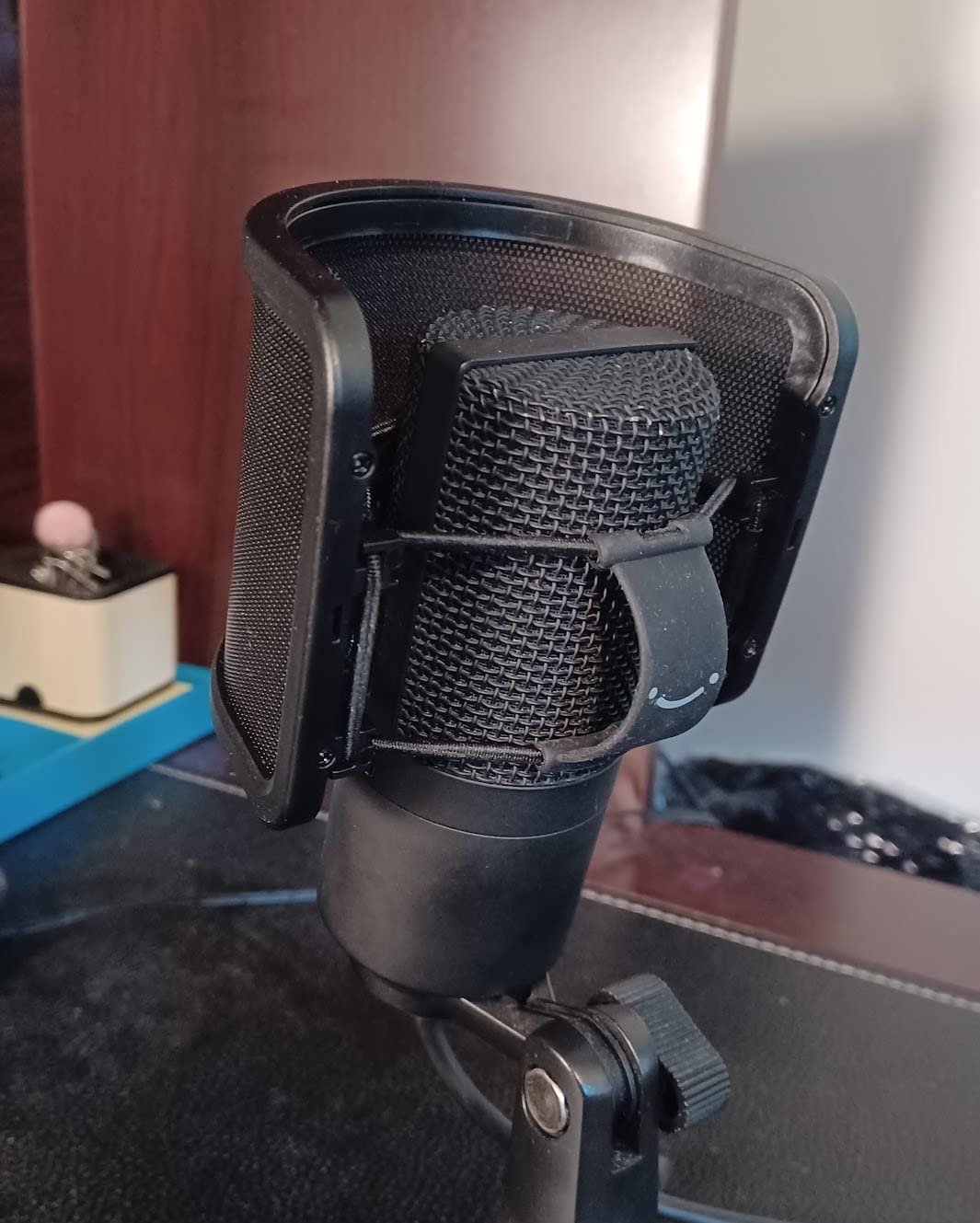
The main tip from owners is to use the larger of the two included rubber bands. The preinstalled bands are reported as too small for some microphone bodies, and swapping to the 2 1/5 inch bands gives a much more secure fit on a typical large-diaphragm condenser.
Be realistic about what it is. This is a plosive filter, not an isolation product, so it will not reduce room noise the way a foam enclosure does. Owners also note it can be awkward for people who wear glasses and habitually lean toward the microphone.
Will it fit your condenser body?
The stated range is 40 to 70 mm, which covers most large-diaphragm condensers including a Blue Yeti and the Audio-Technica AT2035 class of bodies. It is also designed around the FIFINE K669, K670, K683A, K678 and K690 microphones, and the maker is clear that it is not meant for dynamic models.
Measuring before you order takes ten seconds and saves a return. Measure the diameter at the point where you intend the band to sit, not at the widest part of the grille.
Best for streamers and creators filming themselves
If you record video and sound together, a compact curved screen is the safest choice in this list. It is small, it is dark, it does not catch a key light like a wide metal grille, and it does not need a clamp taking up stand space.
Skip it if your room is untreated and reflective, since a small in-mount screen does nothing for echo or HVAC noise.
10. HyperX Shield Pop Filter: Built Around the QuadCast Shock Mount
- Metal mesh is durable and easy to wipe clean
- Long gooseneck holds its adjusted position firmly
- Toolless C-clamp with a rubber pad avoids metal contact
- Mounts to most microphone arms and stands
- Two year manufacturer warranty
- Highest cost in this group
- Best suited to HyperX arms and shock mounts
- Larger footprint than in-mount filters
The HyperX Shield is a serious metal pop filter rather than an accessory, and it is built around the QuadCast and ProCast shock mounts. A corrosion-resistant mesh face, a 35 cm gooseneck with a silicone surface, and a toolless rubber-padded C-clamp that mounts to most arms and stands.
The gooseneck is the standout. At 13.5 inches it is long enough to reach around a shock-mounted condenser and hold that position for months, which is the failure point on most of the clamps in this list. If drooping arms have annoyed you before, this is the one that fixes it.
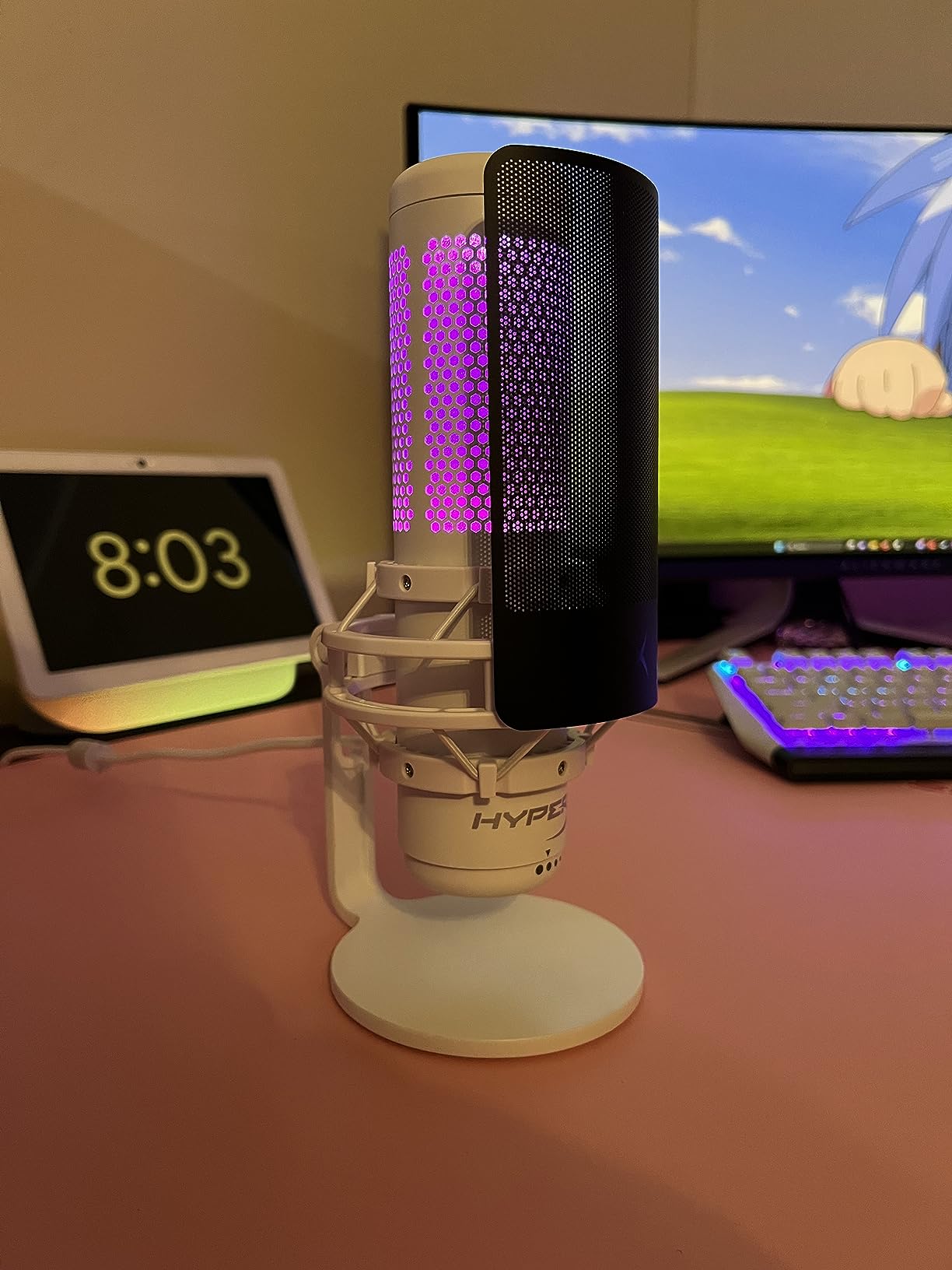
It is the most expensive filter in the group, and that is fair given the brand and the warranty, but a first-time buyer with a decent clamp already on their stand will get more from spending elsewhere. It is a premium-tier choice rather than a beginner’s choice.
At 215 g the footprint is also the largest here, so it is not ideal for a tight streaming frame or a small desk arm. The two-year manufacturer warranty is a real advantage on a part that gets bent during transport.
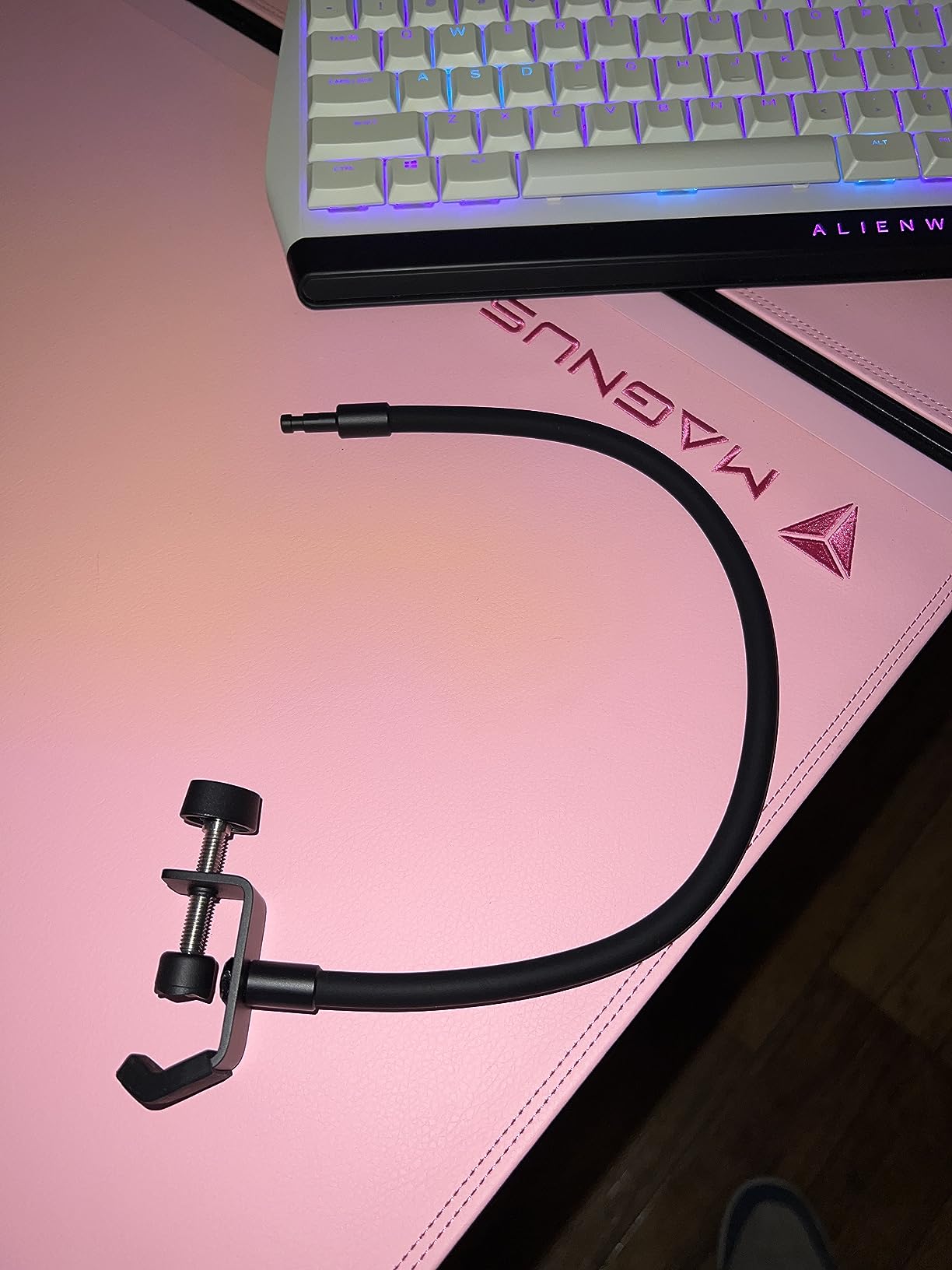
When a shock mount and a pop filter work against each other
A suspension shock mount holds the microphone body in a cradle, and the front of the microphone is often the one place a filter cannot reach because the elastic bands of the mount are in the way. That is the argument for a gooseneck clamp rather than an in-mount band: it comes to the front of the microphone instead of fighting the mount for space.
This filter is built to slot into that gap on HyperX arms and mounts. With a different shock mount the clamp still works, but you will be dialling the angle and distance yourself.
Best for HyperX QuadCast and ProCast owners
If you already own a HyperX shock mount, this is the filter that integrates with it cleanly, and the long gooseneck solves the reach problem that makes gooseneck filters frustrating on other brands. The wipe-clean mesh also suits a shared family microphone.
Skip it for a first condenser purchase on a stand you have never seen before, and skip it if frame space is tight.
How to Choose a Pop Filter for a Condenser Microphone
Four decisions actually determine whether a pop filter works on a condenser: the material, the mount, the diameter, and the distance you set. Get those right and the filter choice is straightforward.
Material: metal mesh, nylon mesh, foam or a hybrid
Metal mesh deflects air rather than absorbing it, which is why it is the most acoustically transparent option and the best choice for a bright large-diaphragm condenser. Nylon mesh with an air gap between layers is the community favourite for spoken word, because it softens plosives without audibly dulling the voice. Foam handles steady air and breath but will not stop a hard plosive on its own. A hybrid layer stack combines them when a room is untreated or the delivery is aggressive.
The practical warning from the forums is hygiene. Fabric and foam layers trap moisture and eventually odour, and odour complaints are the most repeated theme in owner discussions of this category. Metal wipes clean and lasts indefinitely in a way fabric does not, and it never traps saliva salts against a capsule.
Mount: gooseneck, direct-mount, clamp or an isolation ball
A gooseneck clamp attaches to a stand and lets you set distance and angle independently, which is the most flexible option and the one that can droop on a budget frame. A direct-mount band or elastic filter attaches to the microphone body, so it travels with the mic and never needs adjusting, but it only fits a given diameter range and it can block a front indicator light.
Check the clamp shape before anything else. Round tubular stands take nearly every clamp here, a square-profile boom arm needs a shim, and a pentagon clamp may not seat at all. A C-clamp with a rubber pad is the safest choice because it grips without touching bare metal.
Diameter: match the body, not the grille
For in-mount filters the number is critical. Measure the microphone body at the point where the band or ring will sit. Ranges of 45 to 61 mm and 40 to 70 mm cover most large-diaphragm condensers, while a wide USB body such as a Blue Yeti usually needs the larger variant. For clamp and gooseneck designs the diameter barely matters, since the filter hangs on a stand in front of whatever you own.
XLR condenser or USB condenser?
An XLR condenser has no onboard processing, so every plosive reaches the capsule and a filter is doing all the work. A USB condenser often has high-pass filtering and some level of digital processing built in, which reduces steady air noise but not the low thump of a plosive. A mesh filter still earns its place on a USB microphone.
One further note on gain staging. A condenser usually needs a lot of preamp gain, and every bit of extra gain also amplifies whatever the filter lets through. A closer, more effective filter means you can pull the preamp back, which improves the signal-to-noise ratio of the whole recording. That is the quiet argument for a better filter than a better microphone.
Placement: the condenser rule
Competitors disagree on placement distance, usually quoting two to three inches or three to six inches. Both are defensible, and the difference is what the filter is doing. Put the screen two to four inches from the capsule when you are close-miking a large diaphragm and want a tight, intimate vocal, and move it further out to four to six inches when you are reading at a natural speaking distance.
Angle the filter 10 to 20 degrees off the direct line of breath so the burst travels along the screen rather than into it. Then run a breath test: read a full set of P, B, T and K phrases at your intended distance and listen back with the gain up. Forum users often keep a second dedicated mic stand purely for the filter so distance can be dialled in fast, and that is a genuinely useful trick when you record in more than one room.
Pop Filter vs Windscreen vs Shock Mount vs Reflection Filter
These four accessories get confused constantly, and buying the wrong one is the most common reason a condenser recording still has problems. They solve different problems and work best together.
A pop filter tackles the burst of air from plosive consonants at close range. A windscreen, whether foam or a proper outer layer, tackles steady air movement such as breath, draught and room tone. A shock mount handles mechanical vibration travelling up the stand, and it does not touch plosives at all. A reflection filter, or a foam enclosure, handles room echo and reflections arriving from the walls around you, which is the problem that most often survives into a finished recording.
One free technique belongs here too, and the forums recommend it constantly: angle the microphone so plosives miss the capsule entirely. It costs nothing, it works on any mic, and it is worth trying before buying a filter at all. On most condenser bodies you lose a little off-axis tone, and the trade is often worth making.
Frequently Asked Questions
Do condenser mics need pop filters?
Yes, and more urgently than on a dynamic mic. Condenser capsules are the most plosive-sensitive microphones made, they are almost always used within about six inches of the source, and they have the headroom to record a plosive thump clearly. A dynamic microphone such as a Shure SM7B has built-in plosive rejection and often needs no filter at all.
What are the best microphone pop filters for a condenser?
Three stand out here. The NEEWER Professional Pop Filter is the most versatile and the most widely used, with a dual-layer mesh and a swivel clamp that fits round tubular stands. The Aokeo Professional Pop Filter is the strongest performer on hard plosives thanks to its double metal screen. The PEMOTech Three Layer Pop Filter is the compact in-mount option for a small desk. For an XLR condenser, the NEEWER or Aokeo is the safe choice; for a USB condenser, the PEMOTech or FIFINE U1 works well.
Do pop filters improve sound quality?
They do not improve tone, and it is worth being honest about that. A good filter is acoustically transparent, so the only change is the disappearance of low-frequency thumps and a reduced need for heavy de-essing and repair in post. What they remove is distortion, which is an artefact rather than a characteristic of your voice or your microphone.
What is the difference between a pop filter and a windscreen?
A pop filter handles the sharp burst of air from plosive consonants such as P and B at close range. A windscreen, foam or fabric, handles steady air movement including breath, draught and room tone. A foam windscreen will not stop a hard plosive on its own, and a pop filter will not remove a steady rush of air. On a condenser, most people end up using both.
How far should a pop filter be from a condenser mic?
Two to four inches in front of the capsule for a close-miked large-diaphragm condenser, and four to six inches when you read or narrate at a natural speaking distance. Angle the screen 10 to 20 degrees off the direct line of breath so the burst travels along it rather than into it, then confirm with a breath test of P, B, T and K phrases at your intended distance.
Can I record vocals without a pop filter?
You can, and plenty of people do, especially on a dynamic microphone or when angling the mic so plosives miss the capsule. On a close-miked condenser you will be fighting plosives in post-production instead of at the mic, and a basic filter is the cheapest quality improvement available in the chain.
Final Verdict: The Best Pop Filters for Condenser Microphones
The NEEWER Professional Pop Filter is the pick if you own one condenser and one round stand, because the swivel clamp and adjustable gooseneck cover the most setups with the least fuss. The Aokeo Professional Pop Filter is the one to buy if your plosives are the problem you keep fighting, since a double metal screen is the most transparent option on a bright capsule. For a small desk, the PEMOTech Three Layer Pop Filter removes the stand from the equation entirely.
Beyond those three, match the mount to your stand and the diameter to your microphone body, set the filter two to four inches out at a slight angle, and do a breath test before you record anything important. Get those four things right and the best pop filters for condenser microphones will do the one job they exist for: keeping the diaphragm out of the blast.
For more accessories built around specific microphone bodies, including lighter in-mount options, we covered those in our pop filters with light roundup.