
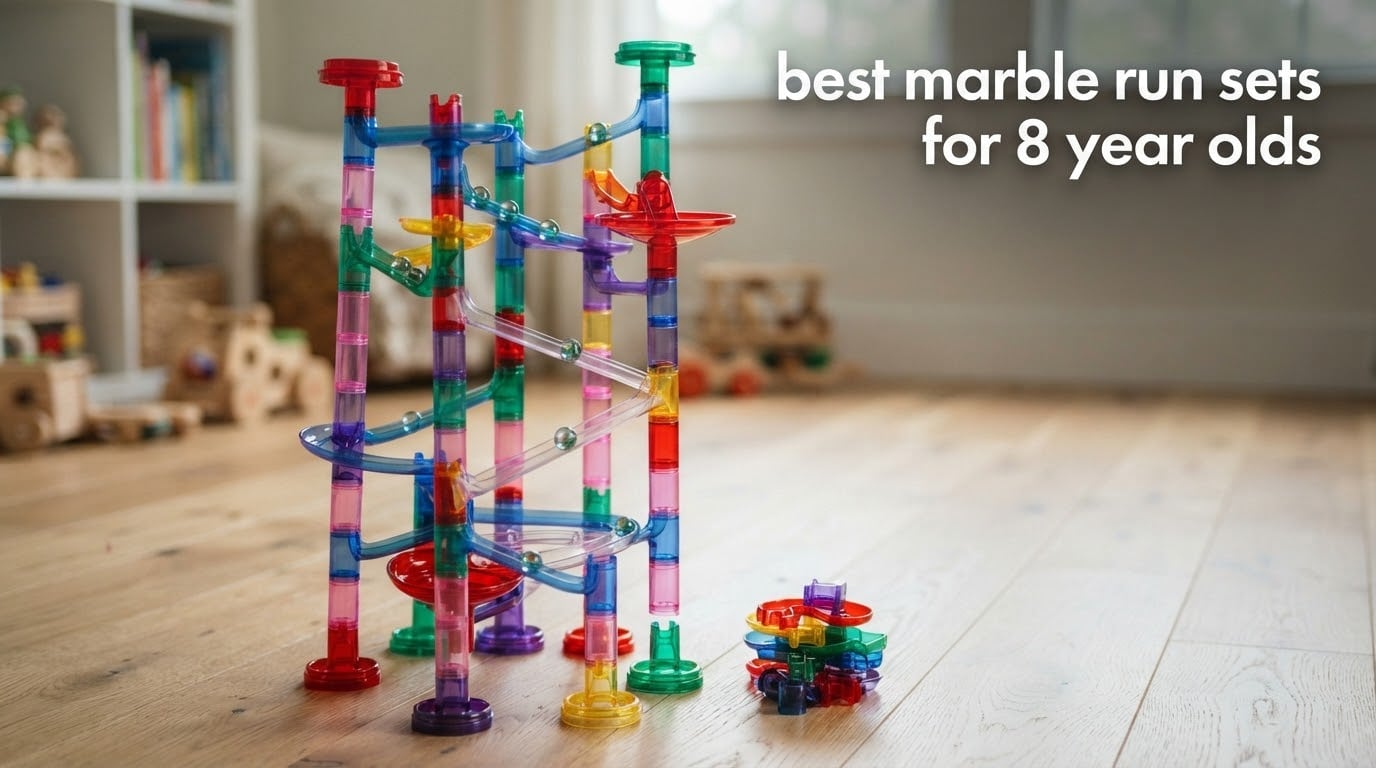
The best marble run sets for 8 year olds are the Marble Genius 150-Piece Super Set for sheer variety, the MAGBLOCK 176-Piece Magnetic Set for the strongest builds, the National Geographic Glow-in-the-Dark Marble Run for atmosphere, and the Ravensburger GraviTrax Starter Set for a system that grows with your child. All four handle the age-8 stage well, but they suit very different children.
That distinction matters more than it sounds. A marble run for a five-year-old is about snapping chunky tubes together. A marble run for an eight-year-old is about planning a structure, predicting where the marble will stall, and rebuilding it when it fails. One parent shopping on a forum thread for exactly this age wrote that GraviTrax looked “a bit too advanced” and was weighing it against PicassoTiles and VTech Marble Rush. That hesitation is the whole buying decision in miniature.
We compared ten sets currently on the market and sorted them by how they behave at age 8 rather than by piece count. Age-8 kids can usually work alone, plan a two-level build, and debug a route when the marble stops. That rules out some toddler sets and stretches a few others.
We also weighed the things parents actually complain about on forums: builds that topple, connectors that pop apart, marbles that disappear under the sofa, and sets that get abandoned after a fortnight. Our team built with each one over several weeks of after-school sessions. If you want the wider picture, our general marble run roundup for all ages covers the same systems from a five-year-old’s angle.
Table of Contents
Top 3 Best Marble Run Picks for 8 Year Olds In 2026
These three are the strongest starting points in 2026, and between them they cover the three ways families actually use a marble run: building flat and wide, building vertically and sturdily, and playing in the dark.

Marble Genius Super Set
- 150 translucent pieces
- 65 glass marbles
- Snug-fit connectors
- Works with Marble Genius booster packs

MAGBLOCK 176-Piece Magnetic Set
- 176 pieces including 12 glass marbles
- Permanent magnets in every tile
- Turntable and windmill pieces
- Works on a fridge or floor

National Geographic Glowing Marble Run
- 15 glow-in-the-dark glass marbles
- 45 clear track pieces plus 15 action pieces
- Storage bag included
- Learning guide on physics
Marble Run Sets for 8 Year Olds: Quick Comparison (October 2026)
All ten sets below clear the age-8 bar, though they differ sharply in build style, footprint and how much independent construction they ask of a child.
| Product | Specifications | Action |
|---|---|---|
| Marble Genius Super Set |
|
Check Latest Price |
| National Geographic Glowing Marble Run |
|
Check Latest Price |
| MAGBLOCK 176-Piece Magnetic Set |
|
Check Latest Price |
 PicassoTiles 100-Piece Marble Run PicassoTiles 100-Piece Marble Run |
|
Check Latest Price |
 Meland Marble Run 153 Pieces Meland Marble Run 153 Pieces |
|
Check Latest Price |
 Ravensburger GraviTrax Starter Set Ravensburger GraviTrax Starter Set |
|
Check Latest Price |
 VTech Marble Rush Ultimate Set VTech Marble Rush Ultimate Set |
|
Check Latest Price |
 National Geographic Magnetic Marble Run National Geographic Magnetic Marble Run |
|
Check Latest Price |
 National Geographic Motorized 150-Piece Set National Geographic Motorized 150-Piece Set |
|
Check Latest Price |
 Learning Resources Tumble Trax Learning Resources Tumble Trax |
|
Check Latest Price |
1. Marble Genius Marble Run Super Set – Best Overall for 8 Year Olds
- Huge piece count keeps rebuilds varied
- Translucent pieces show the marble's path
- Connectors hold but still come apart easily
- Survives repeated rebuilding
- Works for kids and adults together
- Instructions are visual only so younger builders need help
- Long horizontal runs need extra support legs
- Companion app is unreliable for some buyers
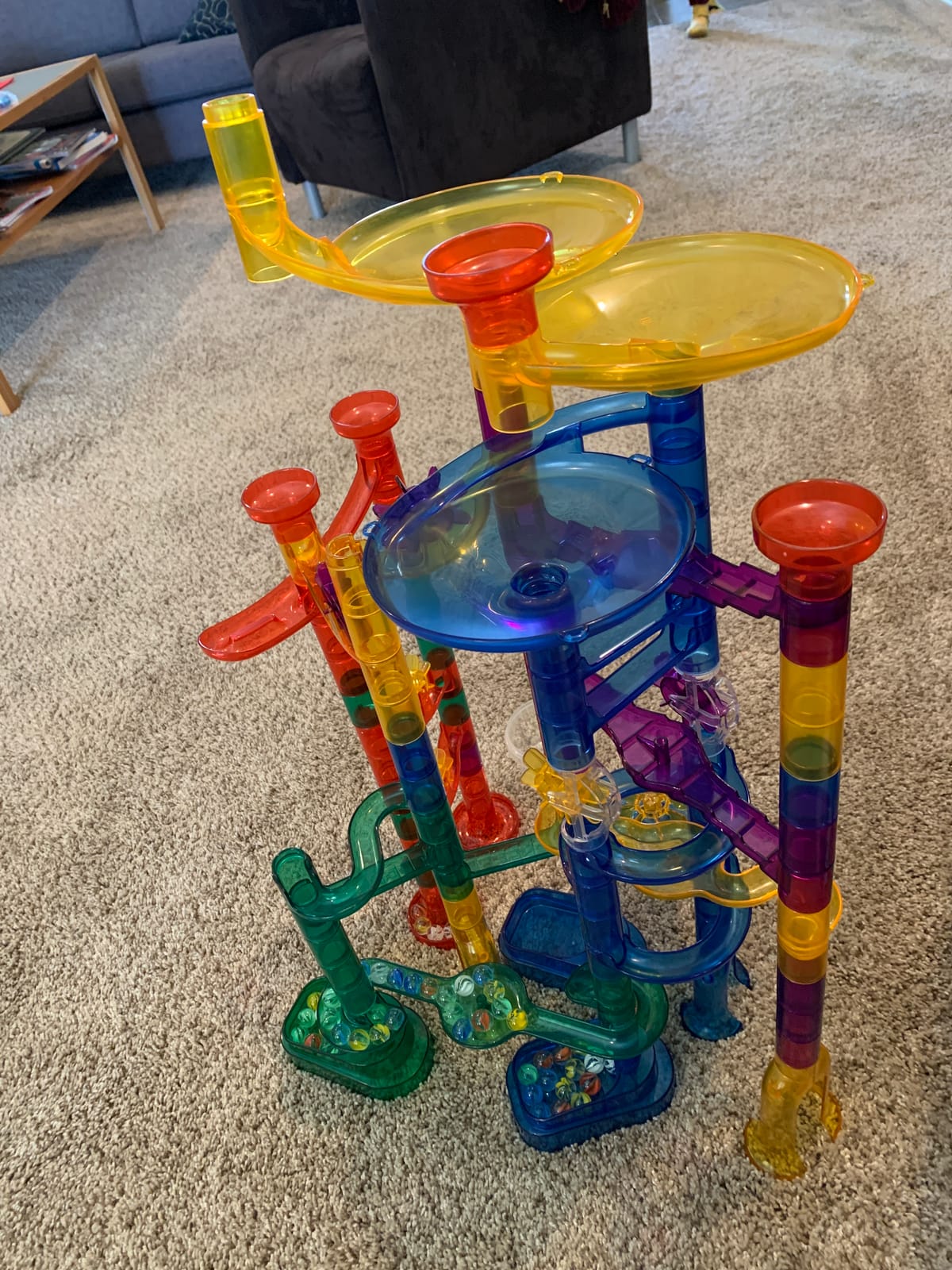
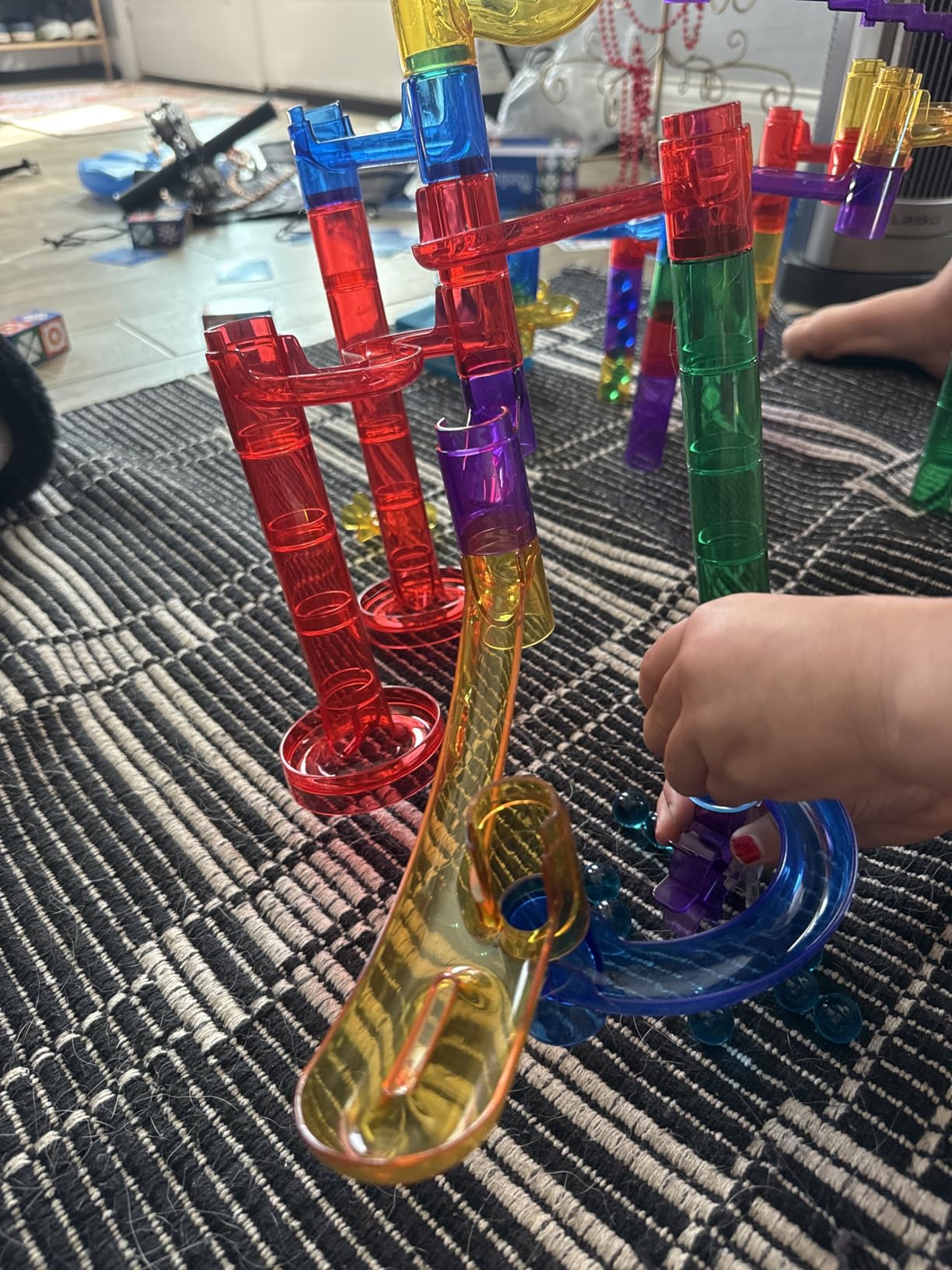
We built with the Marble Genius Super Set most often of anything on this list, and it is the one our team hands to an 8-year-old without a safety briefing. At 150 pieces including 65 glass marbles, there is simply not enough play inside it to exhaust quickly. Two kids can build competing runs at the same time, which is rarer than manufacturers suggest.
The translucent track pieces are the reason it stays interesting past the first week. Kids can see the marble inside the tube and diagnose a jam rather than guessing. That visibility turns a frustrating stall into a solvable problem, and it is why reviewers so often describe this set as holding attention longer than cheaper chute sets.
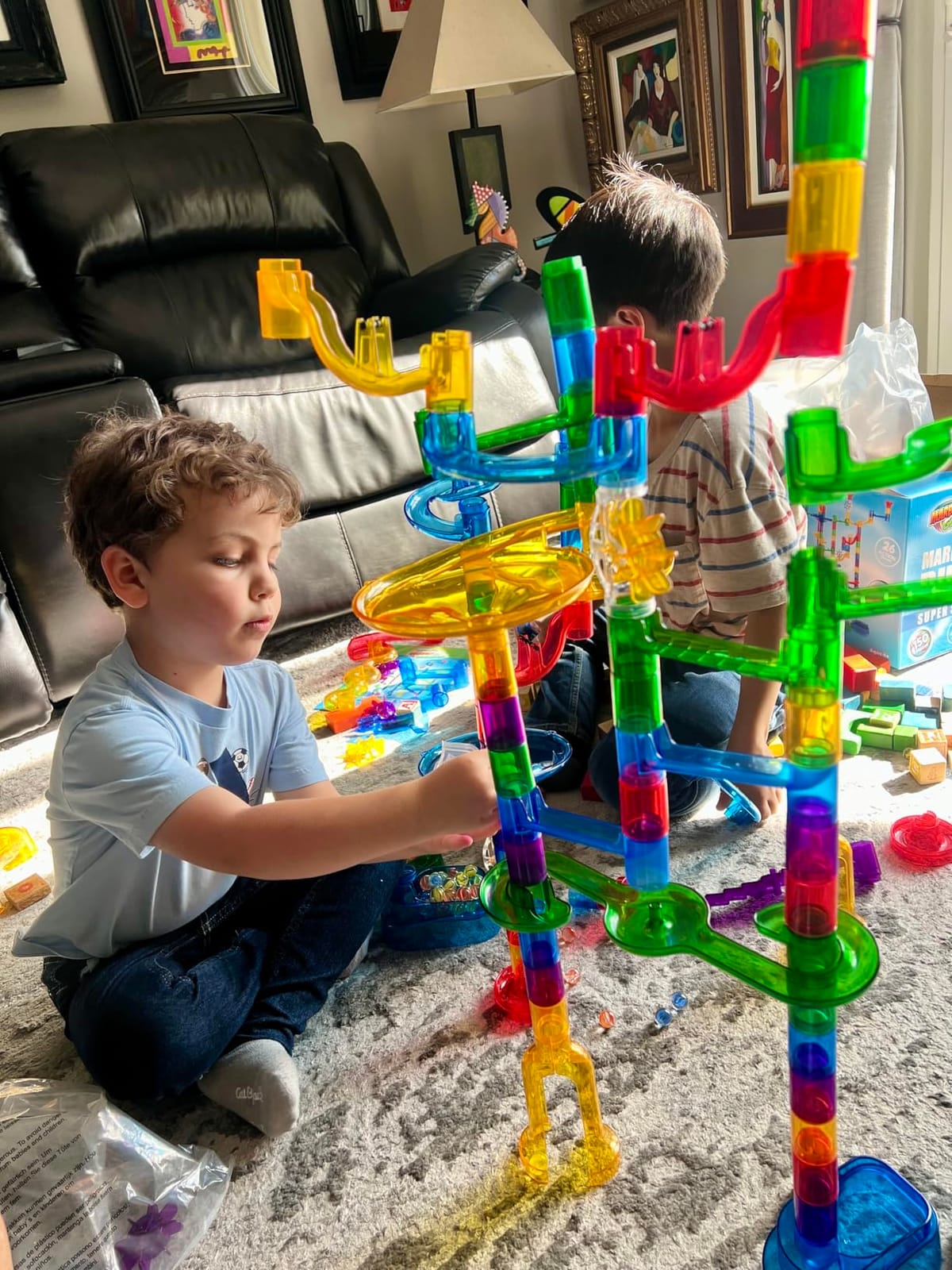
Specs are honest for what it is. The box measures 13.7 by 10.39 by 6.81 inches and weighs 4.5 pounds, which is light enough for an eight-year-old to carry from a shelf to the table without an argument. The listed material is glass and plastic, and the manufacturer recommends age four and up. Stunt pieces and catch-basin bases let an older child make a genuinely complicated route rather than a straight line with corners.
The weak spot is assembly guidance. Instructions are entirely visual, so a child who has never built one may need a parent for the first connection. Once the click is understood, independence comes fast. Our other complaint is structural: the number of base and leg pieces is limited relative to the track pieces, so long horizontal runs are harder to support than tall ones.
For whom it works well
This suits the child who has outgrown a five-piece starter chute set and wants a bigger machine, not a different toy. It also works well as a shared family set, since the race format naturally invites a parent or a sibling to join in. Parents on mumsnet mention it by name as a set they have actually kept playing with.
For STEM-leaning kids, the engineering and math framing lands well. One parent on the r/toys thread described buying a set for an 8-year-old and building it alongside the child, which is a good way to use this one. It pairs nicely with a broader STEM building set guide if you are planning a whole kit of activities.
For whom it falls short
Skip it if your child wants a pre-drawn layout to follow. There are no numbered challenge cards here, so a child who prefers step-by-step instructions may lose interest before the freeform appeal kicks in. The optional companion app is meant to fill that gap, though reviewers report mixed results getting it to work.
Also consider a magnetic option if your child knocks things over constantly. Marble runs that stand on the floor are more exposed than sets that stick to a fridge door. And if storage space is tight, 150 pieces is a lot to put away between sessions.
2. National Geographic Glow-in-the-Dark Marble Run – Best for Glow and Storage
NATIONAL GEOGRAPHIC Glowing Marble Run – Construction Set with 15 Glow in the Dark Glass Marbles & Storage Bag, STEM Gifts for Boys and Girls, Building Project Toy (Amazon Exclusive)
- Glowing marbles turn off lights play into the main event
- Clear pieces let kids follow the marble
- Five sturdy bases keep low runs stable
- Storage bag makes tidy-up quick
- Good value for the piece count
- Only five bases so large or tall runs wobble
- Glow coating leaves visible seams on the marbles
- Plastic can crack if pieces are stepped on
The National Geographic glowing set is the one our team recommends when the child is happiest in a dim room rather than a bright one. Fifteen glow-in-the-dark glass marbles in six colours charge from the included light pen, and the effect genuinely surprises kids the first time they turn the lights out.
Mechanically it is a straightforward tube set: 45 clear smooth-run track pieces, 15 action pieces and 5 sturdy bases, rated for ages 8 and up. The box is 14.02 by 4.02 by 10 inches and weighs 2.8 pounds, noticeably lighter than the Marble Genius set. That low weight makes it a good travel option for a sleepover or a rainy-weekend trip to a grandparent’s.
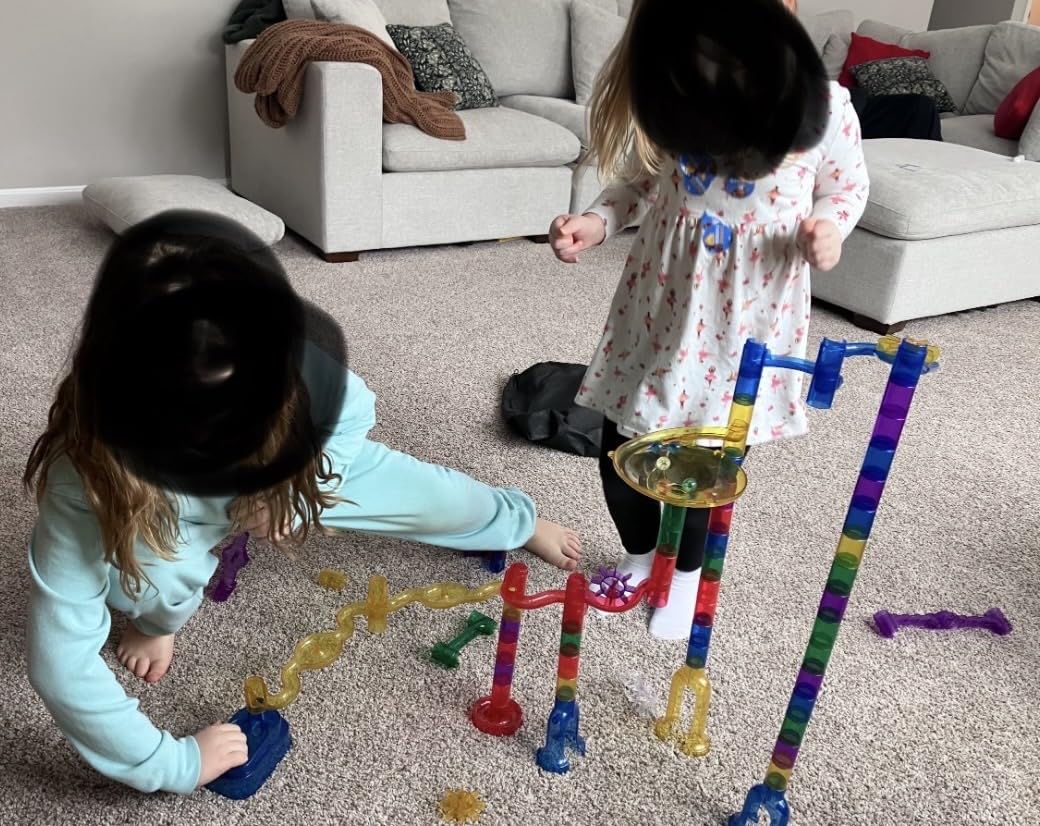
Two details earn their place. The storage bag is included and genuinely large enough for the pieces and the marbles together, which solves the tidying problem that plagues most sets of this size. The learning guide covers the physics of motion and aerodynamics, which gives an older child something to read rather than just repeat the same drop.
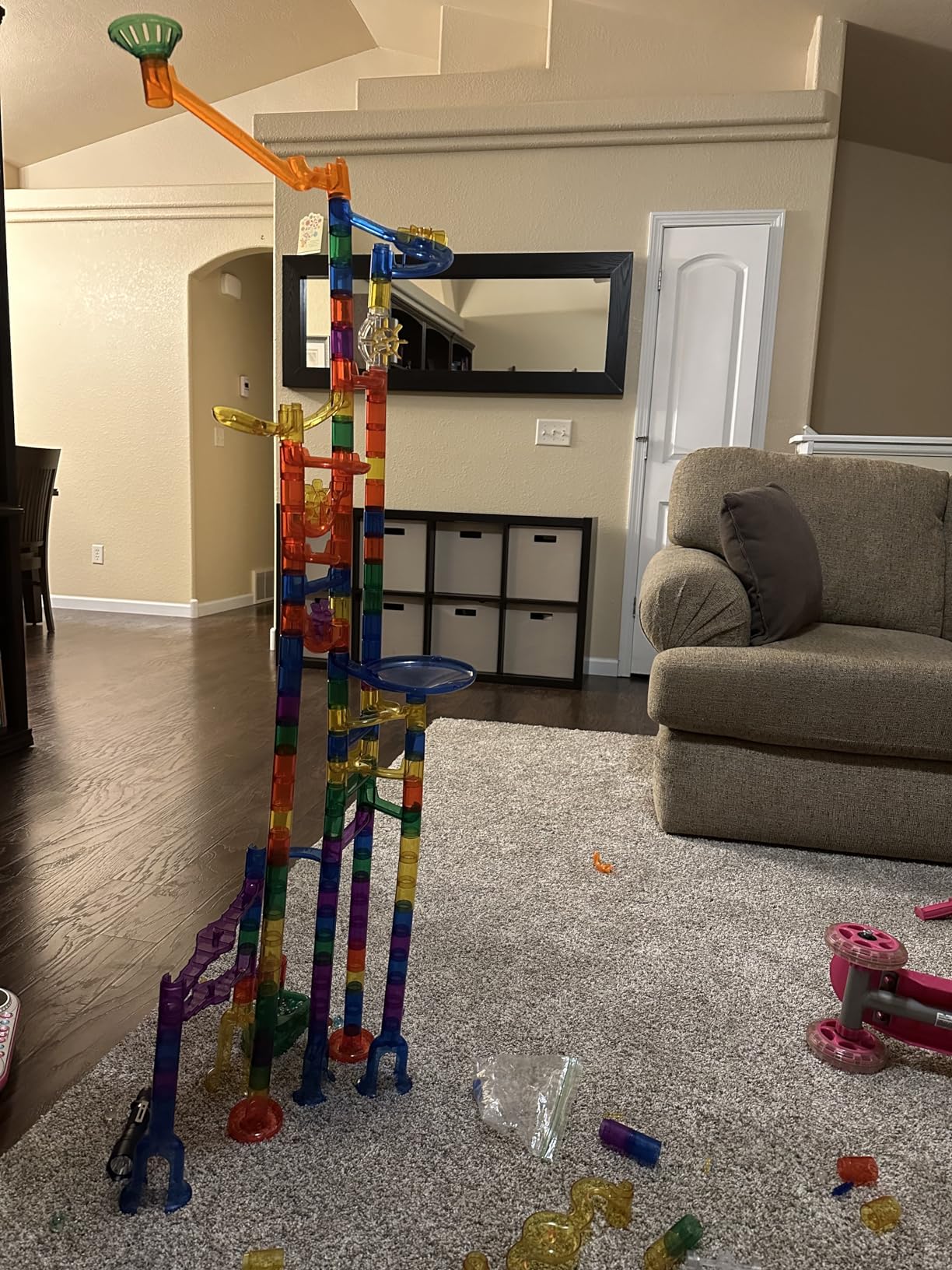
The honest limitation is base pieces. Five bases support a decent low run, and reviewers repeatedly note that taller structures wobble or pop apart unless they are braced. Two equal race tracks also stretch the piece count, so sibling races end with one side finished and the other improvised.
For whom it works well
This is the pick for a child who likes atmosphere and dark-room games, and it doubles as a screen-free activity for a bedroom at night. The stated age range of eight and up matches the buying decision exactly, so you are not stretching a toddler product upward. It suits a child who wants to experiment with routes more than build a permanent tower.
It is also a sensible first marble run. An eight-year-old who has never had one will finish a satisfying run within a few minutes and understand the core idea before you commit to anything larger. Later, the same base pieces can feed into a bigger system if you buy the matching expansion.
For whom it falls short
Choose something sturdier if your child builds tall towers as a habit. The glow feature also wears off for some kids once they understand the drop, and reviews mention interest fading after they master the basic drops. Parents who expect months of fresh content should look at the modular systems instead.
Finally, note that the marbles carry a luminescence coating with visible seams. Some buyers dislike the look close up. It does not affect rolling, but it is a fair thing to know before you promise a glowing marble as a birthday moment.
3. MAGBLOCK 176-Piece Magnetic Marble Run Set – Best Rated and Sturdiest
- Highest average rating in our group at 4.8 stars
- Strong magnets hold tall structures without collapsing
- Three ways to play in one box
- Works as an extension to existing magnetic tiles
- Smooth rounded edges in ABS plastic
- Curved tubes join on small pegs that are fiddly for small hands
- Booklet shows ideas but no step-by-step directions
- Some buyers received boxes with missing pieces
The MAGBLOCK set carries the highest average rating of any product we reviewed for this article, and after several weeks of building it is the one that held together best on our table. Permanent magnets in every tile meant we never had a tower collapse mid-run, which was the single most common failure with the tube-based sets.
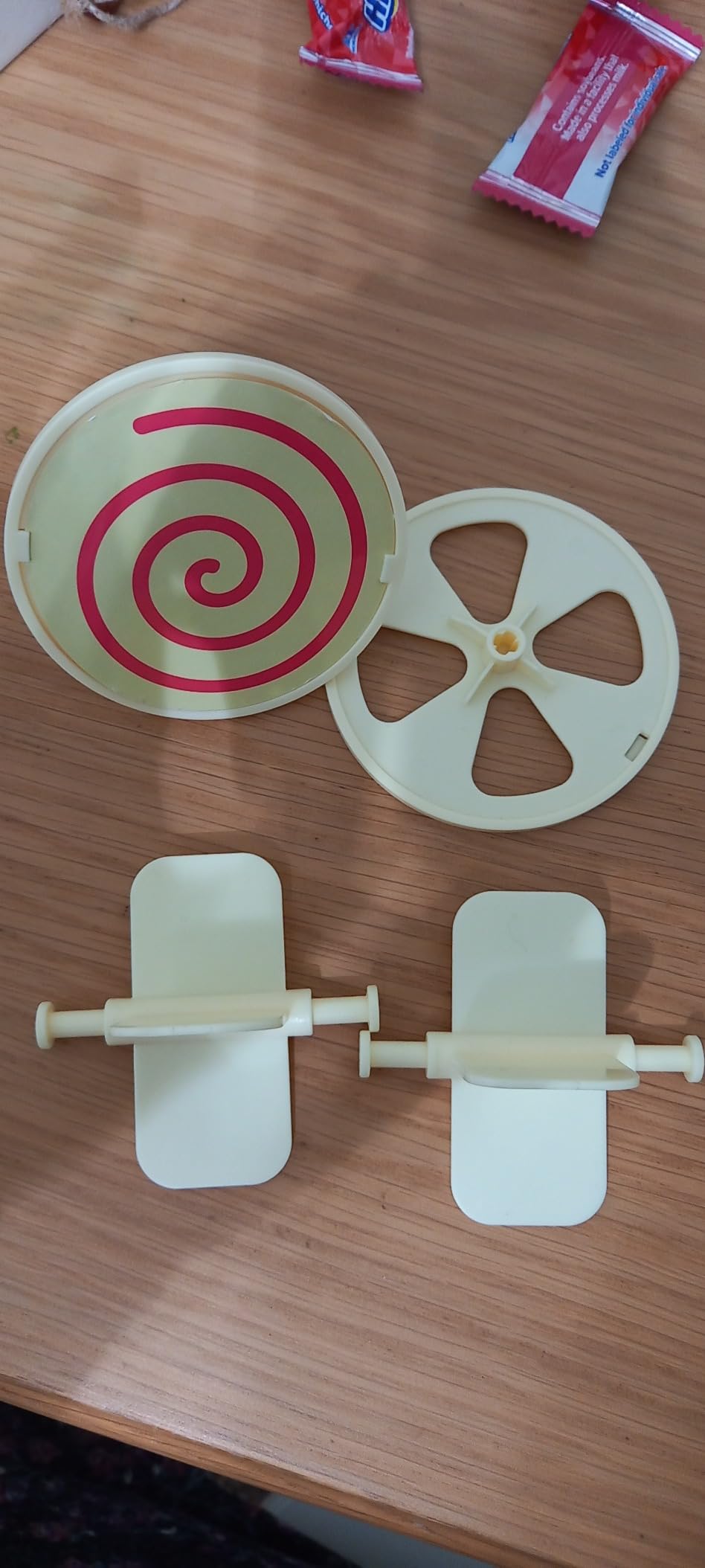
The contents are unusually generous for a magnetic set: 74 magnetic square pieces in three types, 56 pipeline and accessory pieces in six types, a three-piece turntable, a seven-piece windmill, 24 window cards, decorative stickers and 12 glass marbles. Rated for ages eight and up, and sized at 15.5 by 11 by 4 inches and 3 pounds.
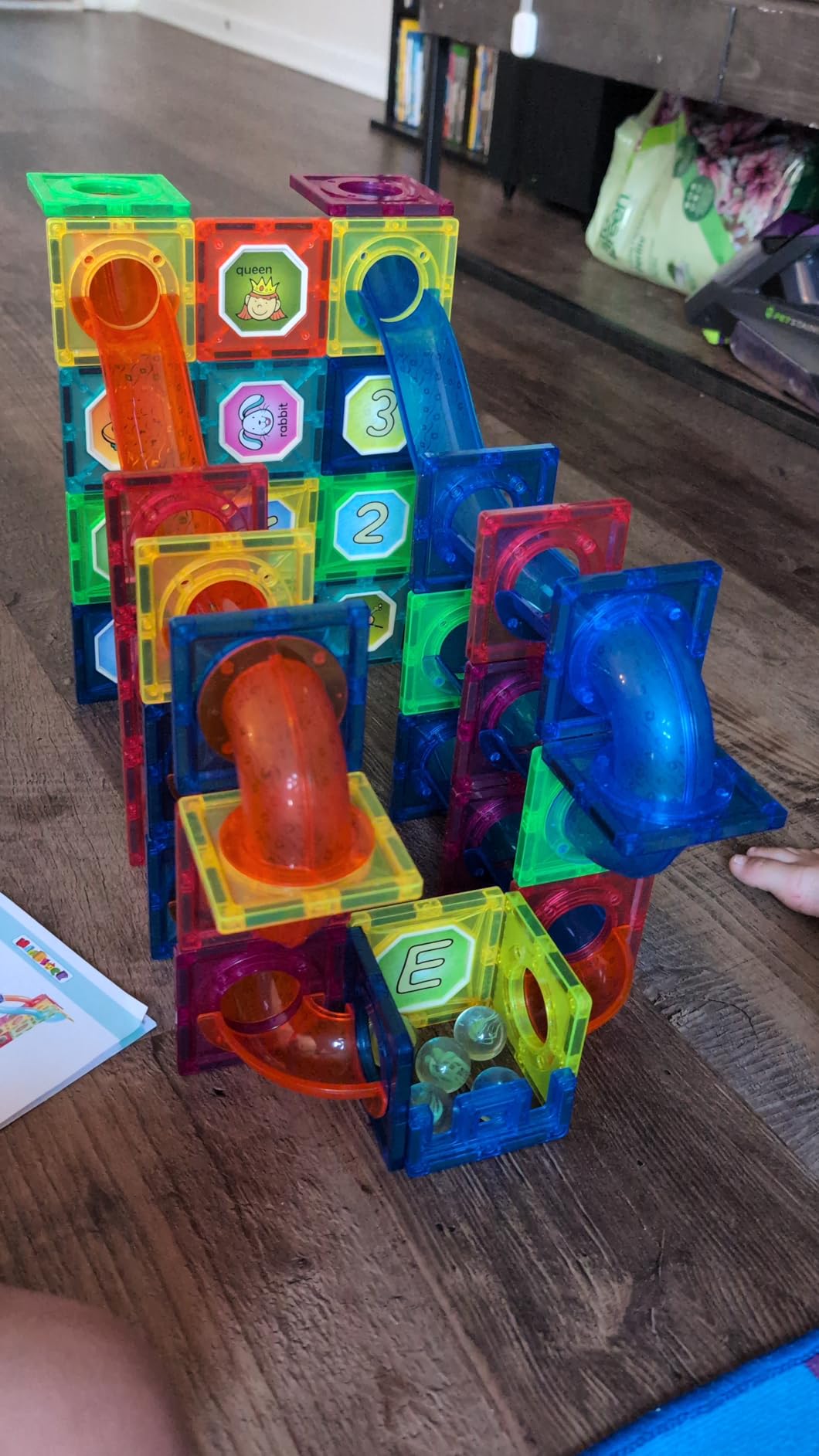
What makes it work at this age is that it offers three games in one box: magnetic building, marble maze and marble race. An eight-year-old can spend a whole session on tile structures without a marble ever appearing, then switch to runs the next day. Reviews describe it as a genuine upgrade on basic magnetic tiles rather than a novelty.
The friction is the connection method. Curved tube pieces clip together on small pegs that take real fingertip pressure to seat, and one reviewer note is that the booklet offers build ideas but no actual directions. If your child is impatient with fiddly joins, this is worth testing before you commit.
For whom it works well
It suits a child who already owns magnetic tiles and wants a marble run that plugs into that collection, since it is compatible with the Magblock series and other major magnetic tile sets. It also works for a child who builds vertically. The magnets make tall structures genuinely stable, so a tower does not need base pieces the way a floor set does.
Because it can be built on a vertical magnetic surface as well as the floor, it also serves families without floor space. That makes it a reasonable companion to our picks for larger and more extreme marble runs when you want something compact rather than sprawling.
For whom it falls short
It is not for younger children. The curved tube connections are described as too difficult below about age 8, and the glass marbles are larger than standard, which means you still want supervision if a younger sibling is around. It is also the least forgiving set for a child who wants guided builds.
Our practical advice is to count the pieces out on the floor before the first session. A few buyers reported incomplete boxes, and with 176 components a missing turntable piece is harder to notice than a missing tube. Setting aside ten minutes at the start prevents a mid-build disappointment.
4. PicassoTiles 100-Piece Marble Run – Best if You Already Own Magnetic Tiles
PicassoTiles 100 Piece Marble Run Magnetic Tiles Race Track STEM Ages 3+
- Excellent expansion for existing tile collections
- Marbles are larger than traditional marbles
- Photo booklet gives layouts to copy then extend
- Track pieces form a channel or a full tube
- Magnets hold once clicked together
- Track pieces are thinner and more fragile than standard PicassoTiles
- Clips are hard to detach without a card
- Loosening one clip can knock the tower down
The PicassoTiles marble run is the right purchase for one specific household: a family that already owns a big magnetic tile collection and wants a marble track that snaps onto it. Standard sizing means it integrates with other PicassoTiles and MagnaTiles pieces, so the run becomes part of an existing build rather than a separate toy competing for floor space.
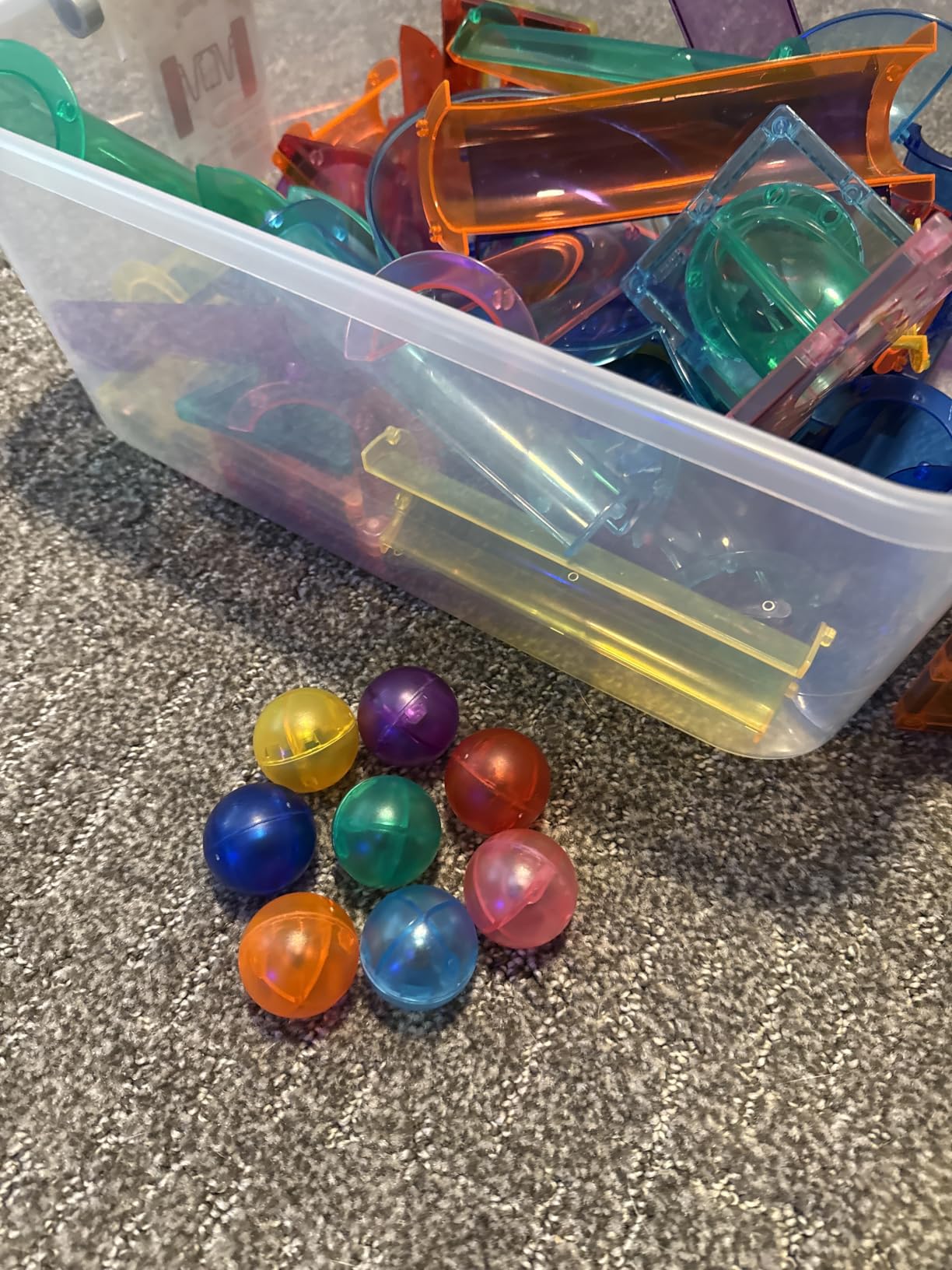
The set holds 100 pieces including magnetic square tiles, funnels, slopes, race track sections and 5 steel marbles. Materials are BPA-free, non-toxic, lead-free ABS plastic that is CPC certified and ASTM tested, and the manufacturer lists it for ages three and up.
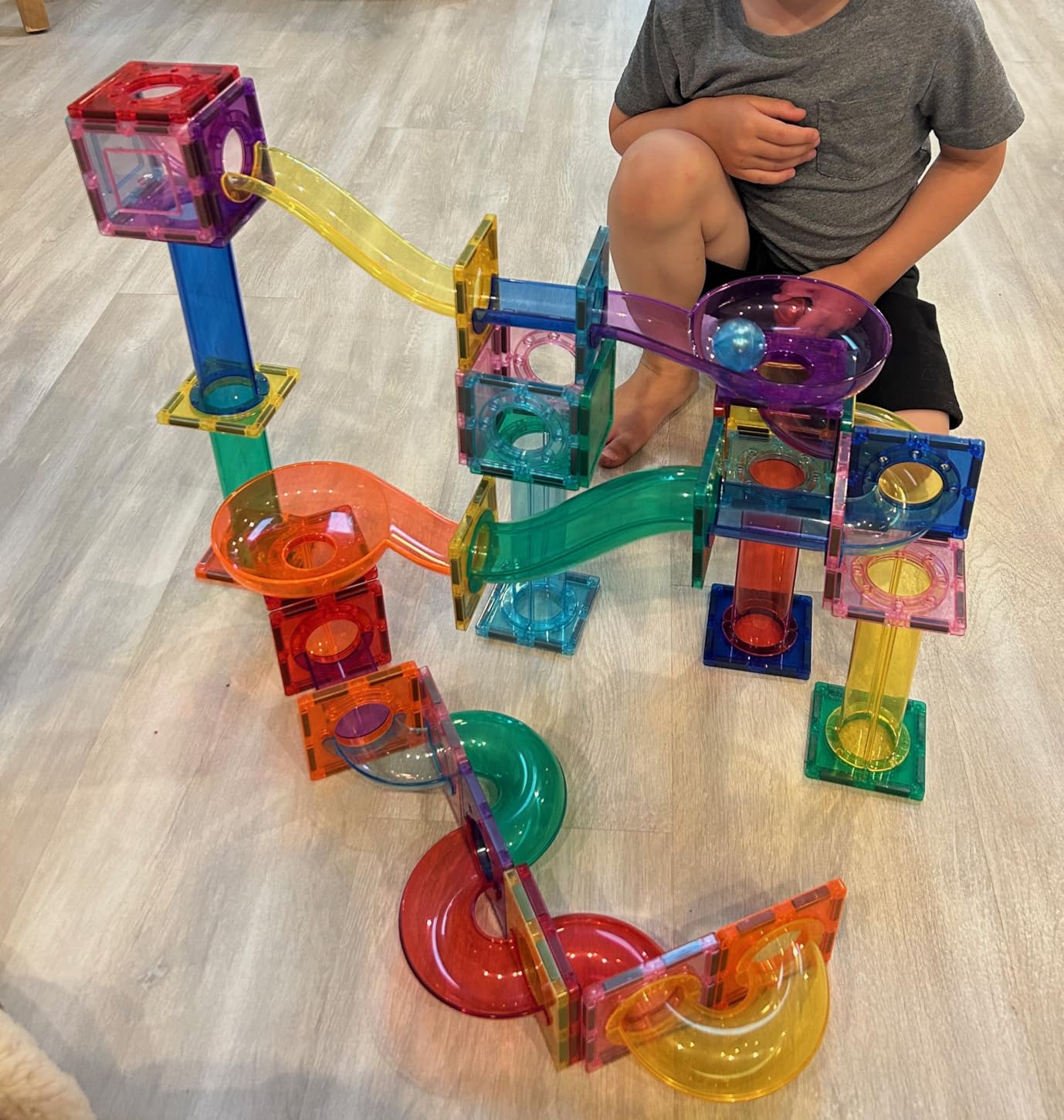
Two features reward an eight-year-old specifically. The steel marbles are larger than traditional glass marbles, which reduces one choking worry when little siblings are around. And the two identical track pieces can be configured as an open channel or a closed tube, which is a genuine design decision rather than a cosmetic option.
Durability is the weak point. Reviewers rate the track pieces as noticeably thinner and more fragile than standard PicassoTiles, and the clips that hold chutes to tiles are hard to detach without slipping a card underneath. Pulling one clip loose can also bring a neighbouring tower down, so treat the connections as permanent once built.
For whom it works well
This is the value pick for a child with an existing magnetic tile collection, and it doubles as a track for building mazes vertically. The photo idea booklet is useful at this age because it gives concrete layouts to copy first and then break apart, which solves the blank-canvas problem many eight-year-olds hit.
Families who lean toward wooden construction will find our wooden marble run guide a better fit. For magnetic builds the appeal is durability and surface flexibility rather than heirloom quality.
For whom it falls short
Do not start here. A first marble run should have forgiving connections, and these are the opposite. Only the square tiles are magnetic; the track pieces themselves are not, so a run depends on tile placement rather than track strength. Very young children get frustrated quickly with the clips.
Its 4.4-star average is the lowest in our group, and the reason is consistent: the concept works, the thin plastic does not last as long as the tiles it clips onto. For a child who treats construction toys roughly, expect to replace track pieces over time.
5. Meland Marble Run 153-Piece Set – Best Value for Big Builds
- Widest variety of action pieces in our group
- 30 glass marbles reduce the usual marble loss
- Pieces feel thick rather than cheap
- Builds around 70 cm tall with support
- Works across a wide age range
- LED marbles are too light and roll badly
- Some curved pieces arrive warped
- Large builds tip unless support legs are staggered
The Meland set is the one that most often gets described as sturdier and better made than it has any right to be at its tier. Reviewers consistently single out the thickness of the pieces, and after several weeks of building we agree that the connectors held far better than the price point suggests.
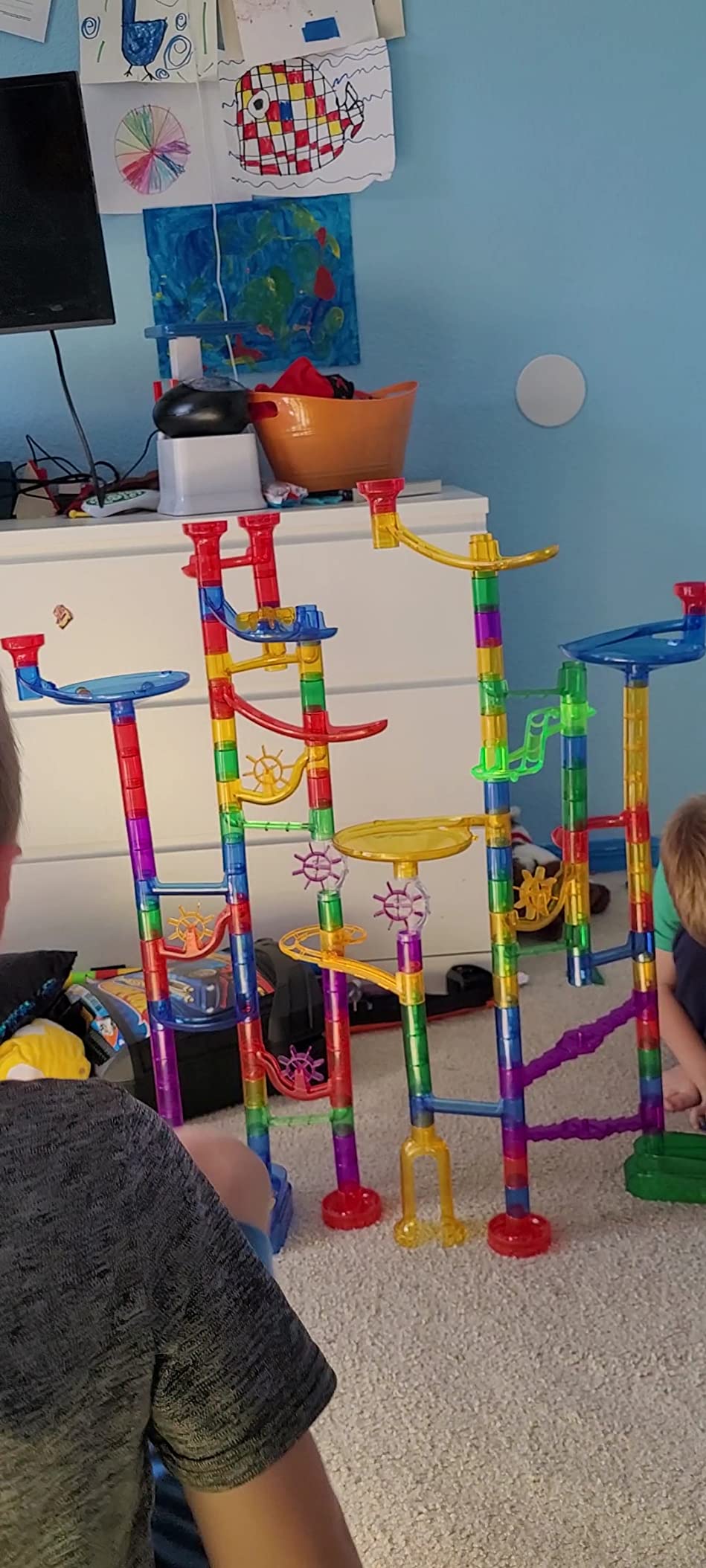
The count is 153 pieces: 113 building parts plus 30 glass marbles and 10 LED lighted marbles. Action pieces include wheels, a Y-splitter, an S-turn slide, centrifugal funnels, U-turn slides and windmills. Builds reach roughly 70 cm tall with proper bracing, and the manufacturer lists it for 36 months through 12 years, which is a wide window for the money.
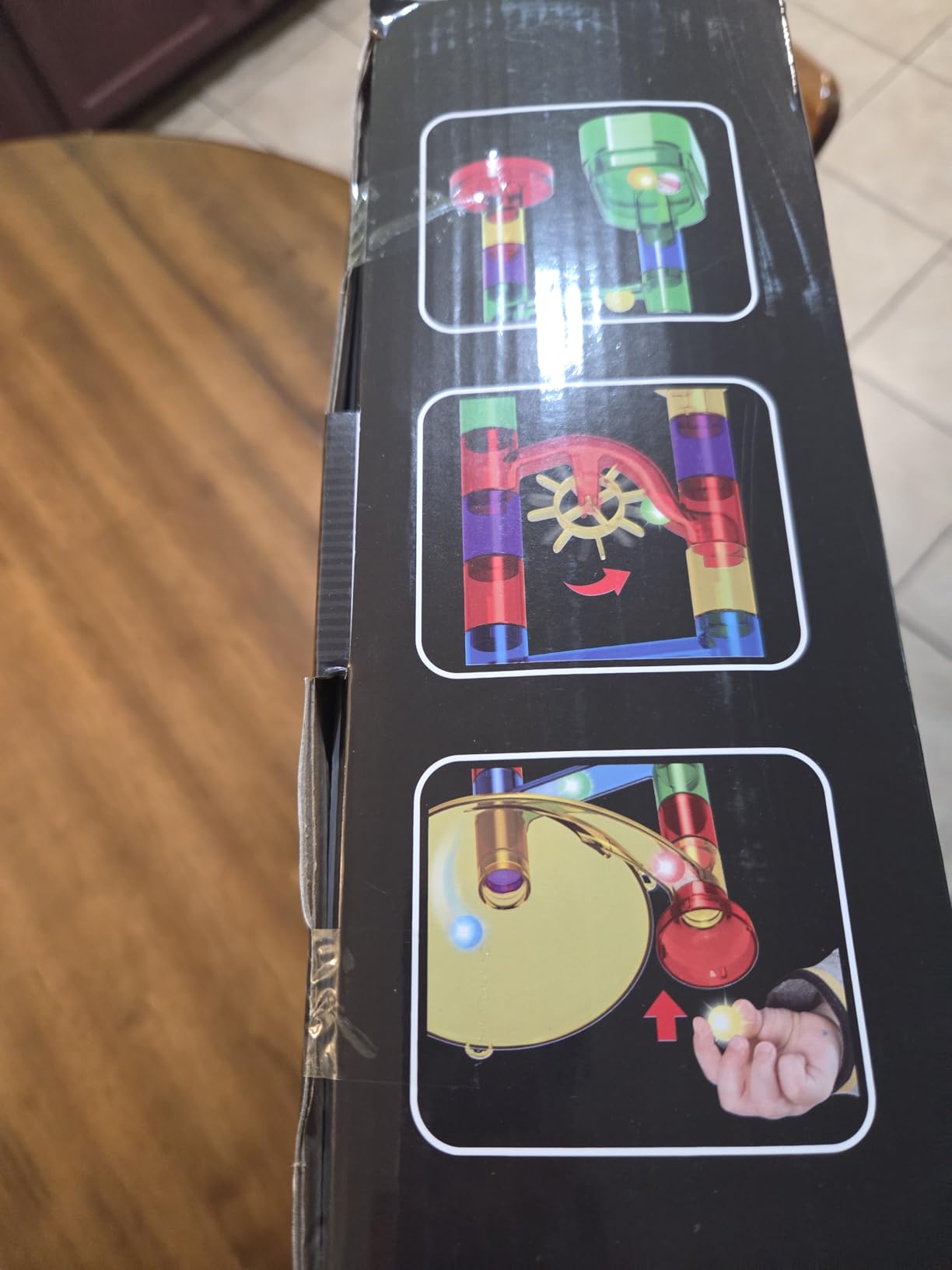
The action-piece variety is what makes it work for an eight-year-old rather than a five-year-old. A child who has run out of ideas on a basic chute set will keep going when there is a windmill to place or a splitter to route into. The build manual also offers easy, medium and hard modes, so the same box serves a beginner and an older sibling.
Two honest problems. The LED marbles are lighter than the glass ones and roll poorly, which causes traffic jams where two meet; reviewers suggest treating them as decorative. And two curved roller-coaster style pieces occasionally arrive slightly warped, stopping the marble dead until you straighten them by hand.
For whom it works well
This suits a family that wants a tall, dramatic build without moving into premium pricing, and it is our recommendation for a child who loves height. Roughly 70 cm is taller than most sets in this price band, and that vertical space is what makes the windmill and funnel pieces worth using.
The 30 included glass marbles matter more than they sound. Sets that ship with a handful of marbles lose most of them within a month, and then the toy is unusable. Reviewers praise the marble count here for exactly that reason.
For whom it falls short
It is a poor choice if your child treats toys roughly. Warped curved pieces and tip-over failures are both reported, and stability depends on staggering support legs, which takes planning. A child who builds first and braces later will lose tall runs repeatedly.
Check the box on arrival. Two curved pieces in our set had a visible bend, and the long manual does not always colour-match what is in front of you. Neither problem is fatal, but both need sorting before the first session.
6. Ravensburger GraviTrax Starter Set – Best Modular System to Grow Into
- Clean system that holds up to frequent use
- Booklet and instructions make the first build easy
- Design moves past copying into original tracks
- Works for kids 8 and up and keeps adults busy
- Expands with GraviTrax extension sets
- Track pieces are hard plastic rather than metal
- Price feels steep for a plastic set at this piece count
- Not suited to children much under 8
Let us settle the most common question on this topic straight away: GraviTrax is not too advanced for an eight-year-old. It is rated from age eight, and the manufacturer positions this line for children who want planning and statics thinking. A parent on mumsnet with boys aged 8 and 10 wrote that they still play with the large marble run, which matches our own sessions.
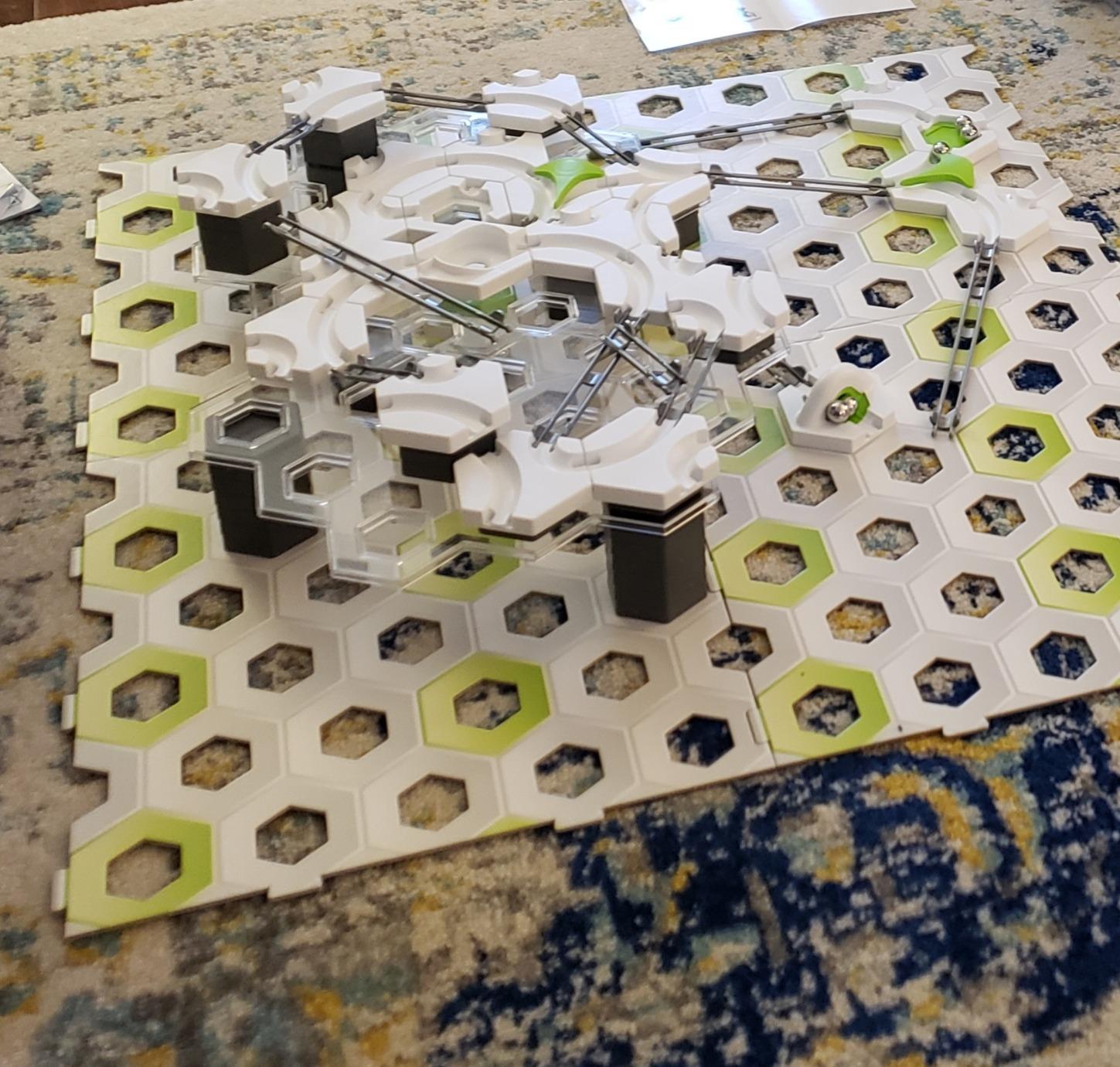
What GraviTrax is, in plain terms: a modular gravity track system. Pieces snap onto a square baseplate grid in layers, and a ball bearing released at the top rolls through a structure the child designs rather than one they assemble in a fixed order. The Starter Set carries 122 unique components, a construction plan booklet and instructions, and uses hard plastic with metal ball bearings plus magnets in select pieces.
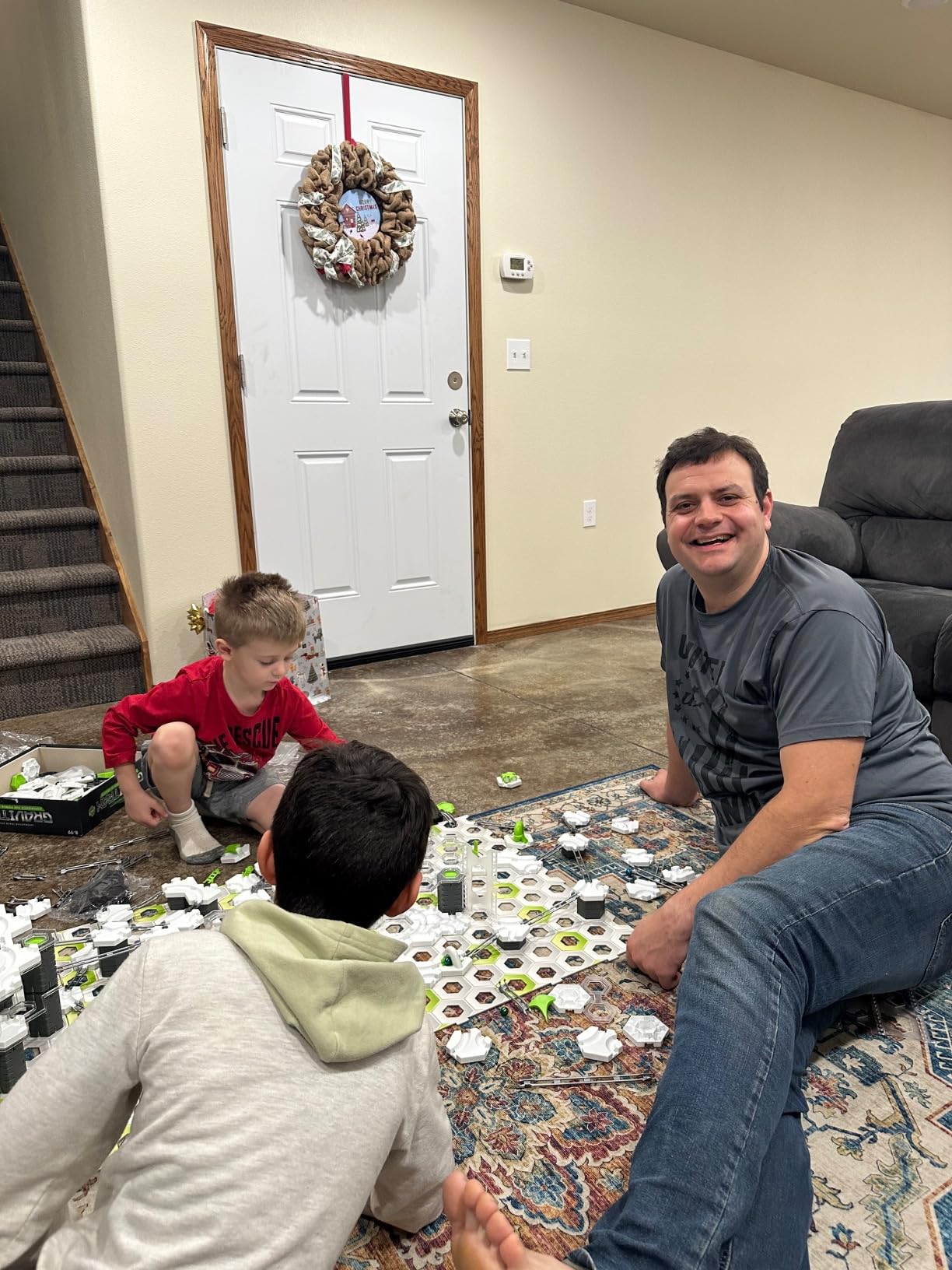
The grid is the point. Because everything anchors to a fixed baseplate, a tall build is structurally sounder than a free-standing tower of tubes, and an eight-year-old can add a second storey without the whole thing collapsing. Reviews describe it as holding up well under frequent use and working for adults and older children as readily as for the eight-year-old it is designed for.
The common criticism is materials versus expectations. Many buyers expect metal tracks because of the packaging photography and find hard plastic instead, and reviewers also call the price steep for a plastic-and-cardboard set. Pieces can feel fragile for younger hands, which is why it suits eight and up rather than younger children.
For whom it works well
This is our pick if you want a system that still works at eleven or twelve. Unlike a themed chute set, the open-ended grid invites bigger and more abstract structures as the child’s spatial reasoning develops, and expansion sets extend runs without a full replacement. One grandparent on the welltrainedmind forum described a similar set as the kind that grows with your children, and that is exactly the case here.
It also suits a child who wants to design rather than assemble. The construction plan booklet gives a starting point, but the system rewards original track layouts, which is a different kind of play from working through instructions.
For whom it falls short
Do not buy it for a child who wants guided builds and quick results. The first hour is spent learning how the grid works, and there is no motorized lift or light show to create instant drama. A child who abandons anything without an early success will need an adult to build the first structure with them.
It is also the wrong gift if you are unsure the child will stay interested. Because of the price and the complexity, we would suggest starting with a simpler set first and moving up later, unless you already know the child builds with this kind of system.
7. VTech Marble Rush Ultimate Set – Best Motorized Set for Sound and Motion
- Sound and motion hold attention longer than gravity-only runs
- 135 pieces support three guided builds
- Colour-coded blocks and a leveled guide
- Connections are easy for small hands
- Large footprint makes impressive structures
- Needs 2 AA and 3 AAA batteries for the powered parts
- Age guidance stops around 8
- Heavier and bulkier than tube-only sets
- Guide shows three fixed layouts
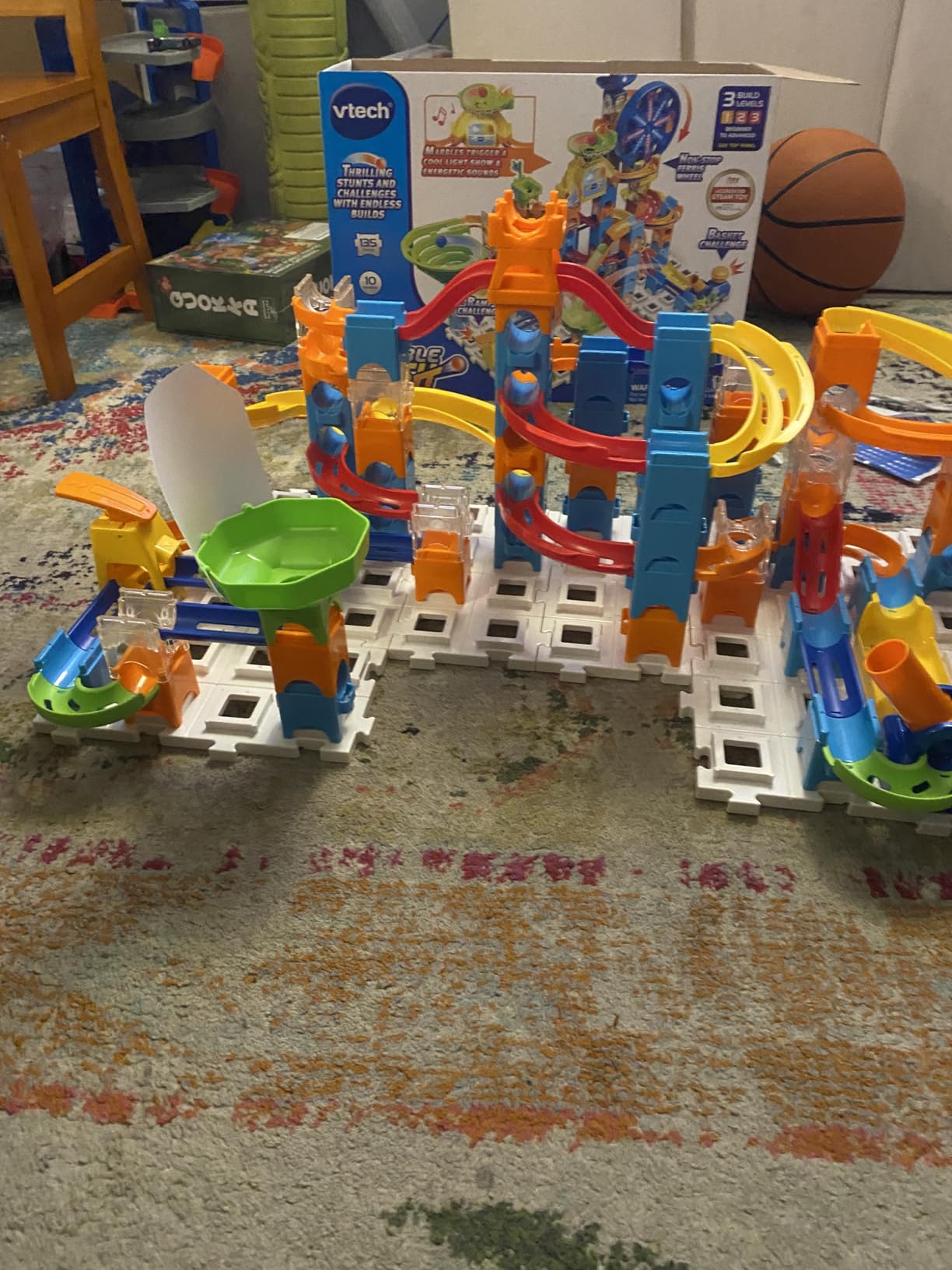
VTech Marble Rush is the pick when the appeal is event rather than engineering. The electronic elements add a Ferris wheel that spins and a musical light-show cone, and that motion is why children come back to it when a purely gravitational run has started to feel repetitive.
The Ultimate Set includes 135 building pieces plus 10 marbles, fast tracks, extreme launchers and color-coded blocks, with a sticker sheet, quick start guide and a leveled building guide showing three builds from beginner to advanced. It is Toy Association STEAM accredited and requires 2 AA and 3 AAA batteries, included for demonstration only.
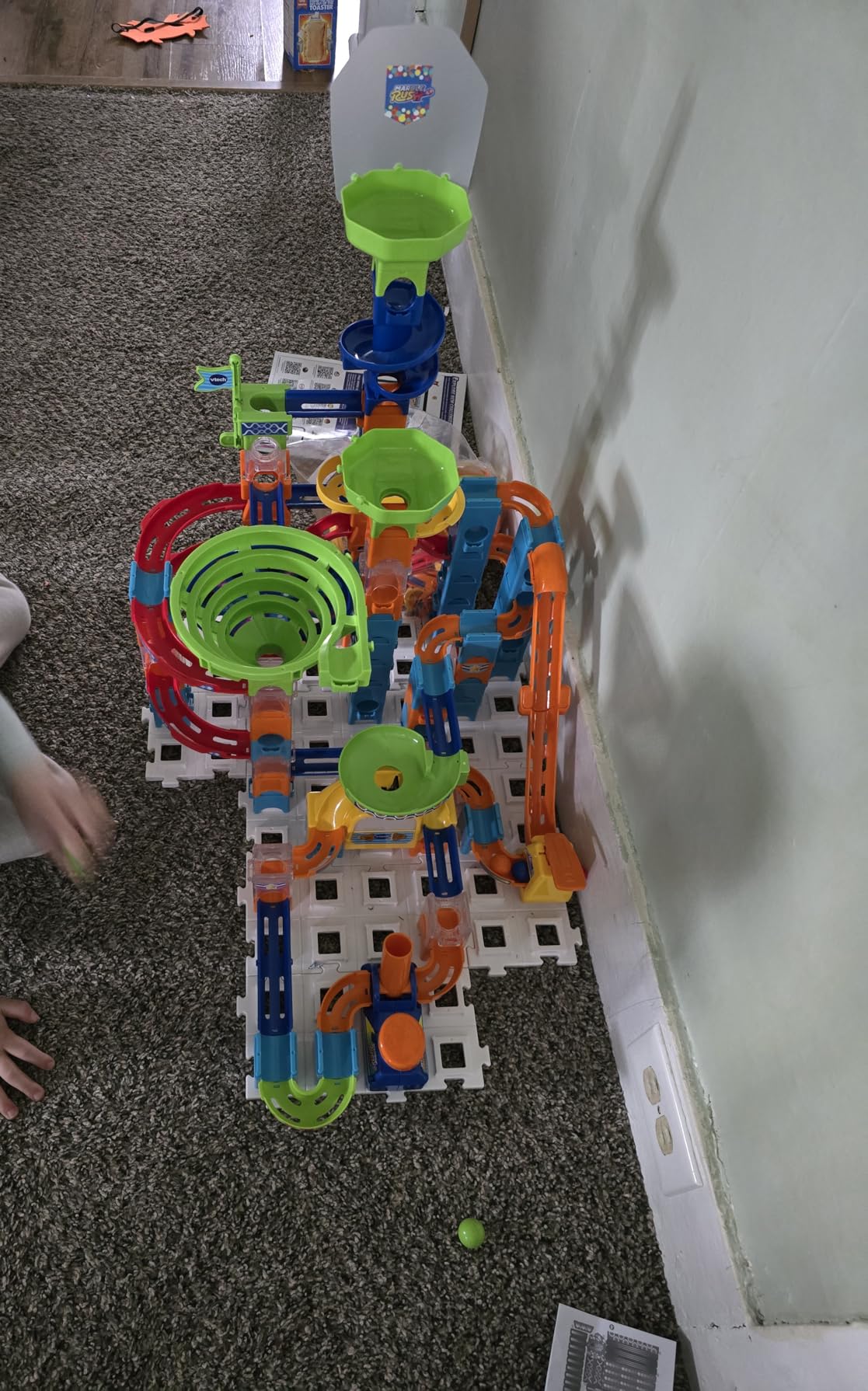
Two things stand out in use. The connections are easy for small hands to snap together, so an eight-year-old can build independently after one guided run. And the footprint is genuinely large at 16.3 by 28.7 by 25.2 inches, which produces structures that look impressive from across the room. Budget 7.3 pounds of weight and a clear table or floor area before you start.
The catch is the age ceiling. The manufacturer recommends four to eight years, which means an eight-year-old is at the top of the range and a nine-year-old may find it simple. Reviews also note the appeal fades sooner for children who prefer pure building play, since the powered pieces only work in fixed positions.
For whom it works well
This suits a child who lights up at lights, sound and motion rather than at plan sheets. It also works well as a co-building set, since the large footprint naturally invites a parent to help and the three guided layouts give a shared starting point. Parents naming this system on r/toys liked that it feels sturdier than typical plastic marble runs.
It is a good choice for a child with a younger sibling, because the same set covers a wider age spread than the modular systems. If you are planning a broader gift, our activity set guides for older children cover the next stage up.
For whom it falls short
Buy something else if the child is a pure builder who wants open-ended design. The guide offers three fixed layouts, so once those are built the appeal depends on the motorized parts rather than on new ideas. Battery dependence is also a downside: the Ferris wheel and light show do nothing without power.
Storage is the practical problem. At 7.3 pounds and 135 pieces, this is the bulkiest set in our group, and it will not go back into the box quickly after a session.
8. National Geographic Magnetic Marble Run – Best for Small Spaces
National Geographic Magnetic Marble Run STEM Building Set for Kids
- Magnetic mounting removes towers that collapse
- Takes no floor space at all
- Quick to attach and rearrange
- Trick pieces add real problem-solving depth
- Works on fridges
- lockers and whiteboards
- No magnetic board is included so you need your own surface
- Ambitious designs can pop loose when bumped
- Magnets weaker on some surfaces
- Listed for ages 10 and up
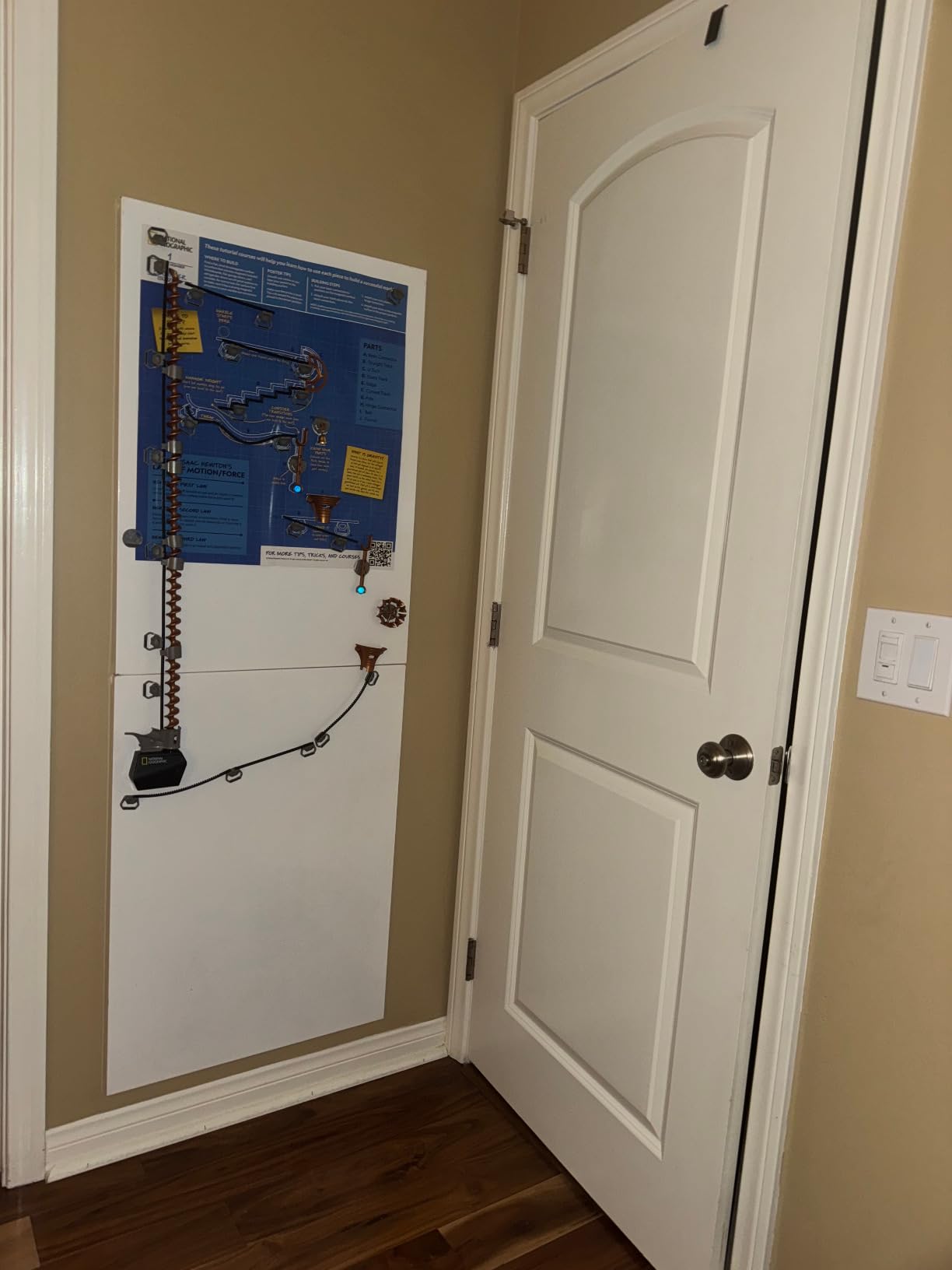
If floor space is the constraint, this magnetic set solves it completely. Everything attaches to a vertical ferrous surface, so a fridge door, a locker or a whiteboard becomes the whole play area. There is no tower to topple and nothing to clear off the table afterwards.
The kit holds 75 pieces: 42 track and connector pieces, 17 trick pieces and 15 marbles, held together by secure snap-fit connectors. It measures 12 by 2.37 by 11 inches and weighs 1.7 pounds, among the lighter sets we reviewed. A learning guide on physics and engineering and a travel and storage bag are included.
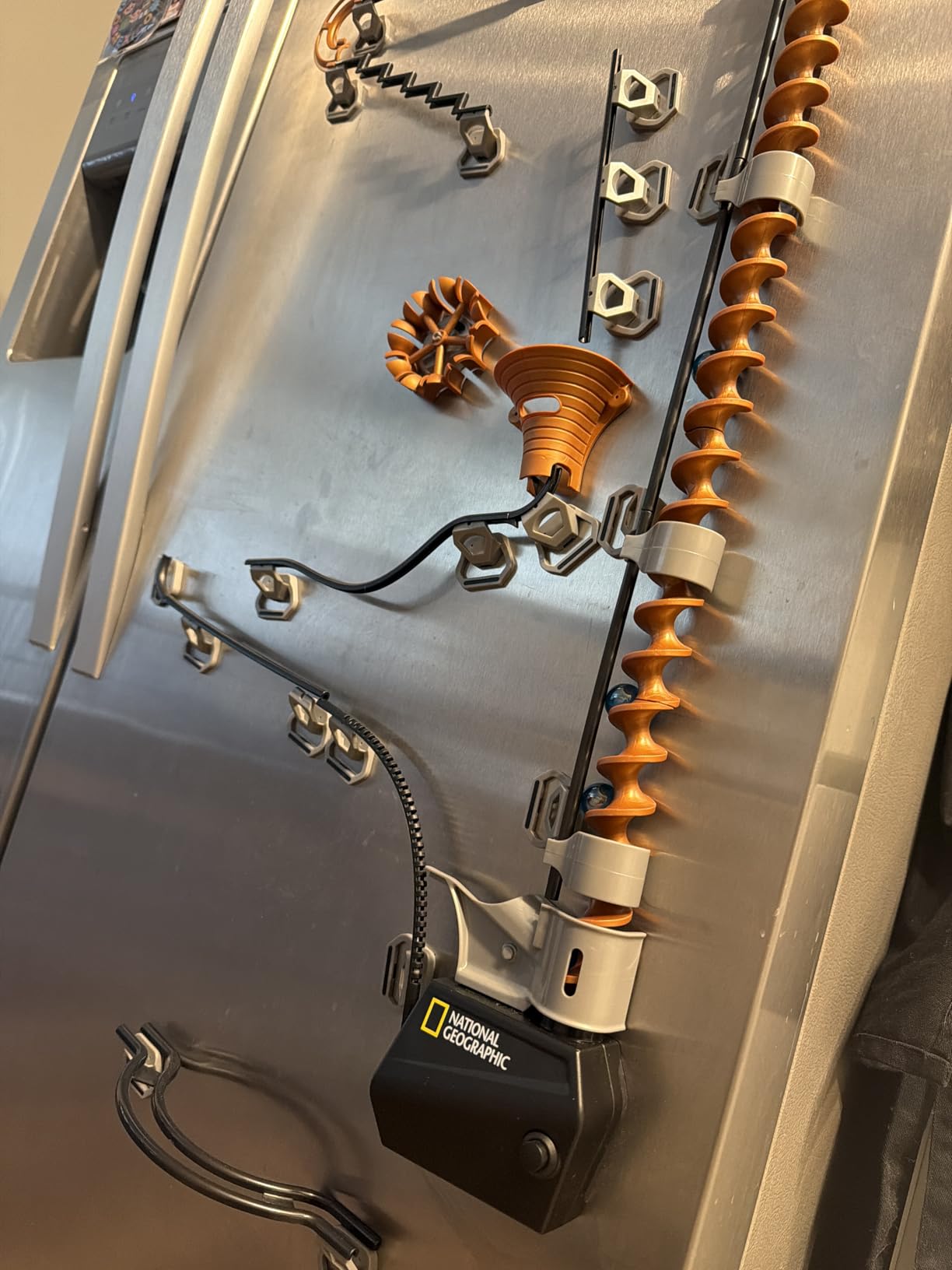
For an eight-year-old, the trick pieces are the reason this is worth a close look. Straight runs are easy; deciding where a marble goes when it hits a switch or a trap door is not. Because attaching and detaching takes seconds, a child can iterate on a design in a way that a screwed-together tower would not allow.
Two things to know before you commit. No magnetic board is included, so you need a suitable surface at home or the toy has nowhere to live. And the manufacturer lists it for ages 10 and up, which is higher than this roundup is aimed at; our sense from building with it is that a determined eight-year-old manages, but a younger sibling will not.
For whom it works well
This suits small bedrooms, flat-pack storage situations and homes with no dedicated play room. It also works for classroom and homeschool settings where a magnetic whiteboard is already available, which is why teachers and parents praise it in reviews.
Because it stores flat and weighs 1.7 pounds, it travels well. It is the easiest set in our group to move between a home, a grandparent’s house and a holiday, and the included bag keeps the pieces together in the process.
For whom it falls short
It fails completely in a home without a large steel surface. Some reviewers also found the magnets weaker than expected on certain finishes, and ambitious designs can pop loose when bumped, which defeats the main advantage of a magnetic build.
Given the stated age of ten and up, we would also consider whether a simpler set serves an eight-year-old better in the short term. It works well as a second marble run rather than a first.
9. National Geographic Motorized 150-Piece Marble Run – Best for Perpetual Motion
National Geographic Motorized Marble Run 150-Piece Building Set for Kids
- Motorized lift produces genuinely continuous runs
- Generous piece count for repeated redesigns
- Pieces connect cleanly without instructions
- Compatible with other National Geographic marble runs
- Works well on a flat table
- Lift can only be built so tall so runs stay short
- Not all 150 pieces fit one run
- Hard to build two independent race tracks
- Spiral lift assembly is tricky for younger children
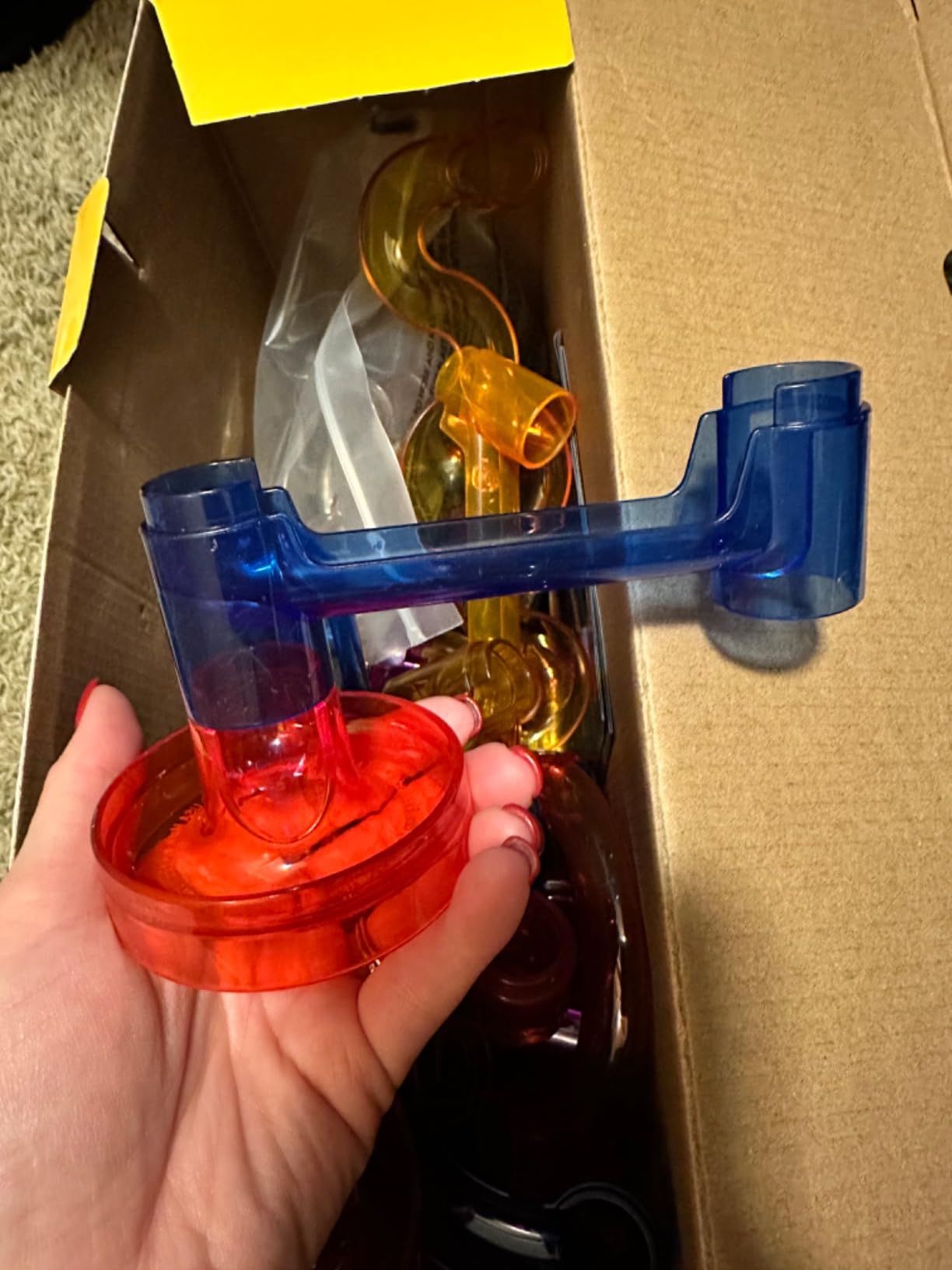
The defining feature here is the motorized spiral lift, which raises marbles close to 20 inches and drops them onto the track. That single component changes the feel of play more than any piece count: instead of releasing a marble and watching it fall, the child starts a run and the machine keeps feeding itself.
The kit totals 150 pieces: 106 construction pieces, 30 marbles and the 14-piece spiral lift. It measures 14.76 by 4.49 by 12.01 inches, weighs 4.1 pounds and is rated for ages 8 and up. A storage bag and a learning guide on physics and motion are included.
It pairs well with the glow-in-the-dark set at number two, since it is designed to expand any National Geographic marble run. If a child plays with one and wants more height, that is a clean upgrade path rather than a whole new system. Pieces also connect cleanly enough that reviewers report children building without referring to instructions.
The counter-intuitive limitation is piece count. Not all 150 pieces fit in a single run, because tracks have to descend progressively, and the lift can only be built so tall. Two fully independent race tracks are also difficult since the routes merge before the tower, which matters if there are two children.
For whom it works well
This suits a child who wants to watch something run rather than always be the one releasing the marble. It is also a good choice for a child who has already built a basic set and has run out of ideas, since the lift adds a new dimension rather than more of the same track.
It works nicely on a solid flat table, and the storage bag means a longer build can be dismantled in a few minutes at the end of a session.
For whom it falls short
Skip it if the child loses interest quickly when a run stops. Assembly of the spiral lift is the fiddliest part of the build, and younger children need help with it. The motorized part is also the part most likely to disappoint if it fails, and some buyers reported a non-working motor or a box with pieces missing.
Finally, if your child races a sibling regularly, note that two separate tracks are hard to achieve with this piece mix. Buy two lift add-ons instead of assuming the box contains two complete courses.
10. Learning Resources Tumble Trax – Best for Travel and Classrooms
- Assembling
- rearranging and packing away is hassle-free
- Activity cards give concrete challenges to follow
- Lightweight foam survives heavy use
- Compact enough for a travel bag or small room
- Good value for classroom or homeschool use
- Marble guards and edges peel off after a month or two
- Pieces shift when a marble lands on them
- Catch basin fails with all four marbles loaded
- Needs a magnetic surface which is not included
Tumble Trax is the set to buy when convenience beats scale. The track pieces are magnetic foam that sticks to a refrigerator, whiteboard or magnetic easel, and taking a run apart takes seconds. Nothing else in our group packs down this easily or tolerates being moved around mid-session.
Construction is foam and metal magnets, sized 12.75 by 10.25 by 2.75 inches and rated for ages five to 10. Activity cards with maze and track challenges are included, which matters at this age because they give a child something specific to attempt before free design takes over. Foam pieces are also forgiving, which is why teachers like them.
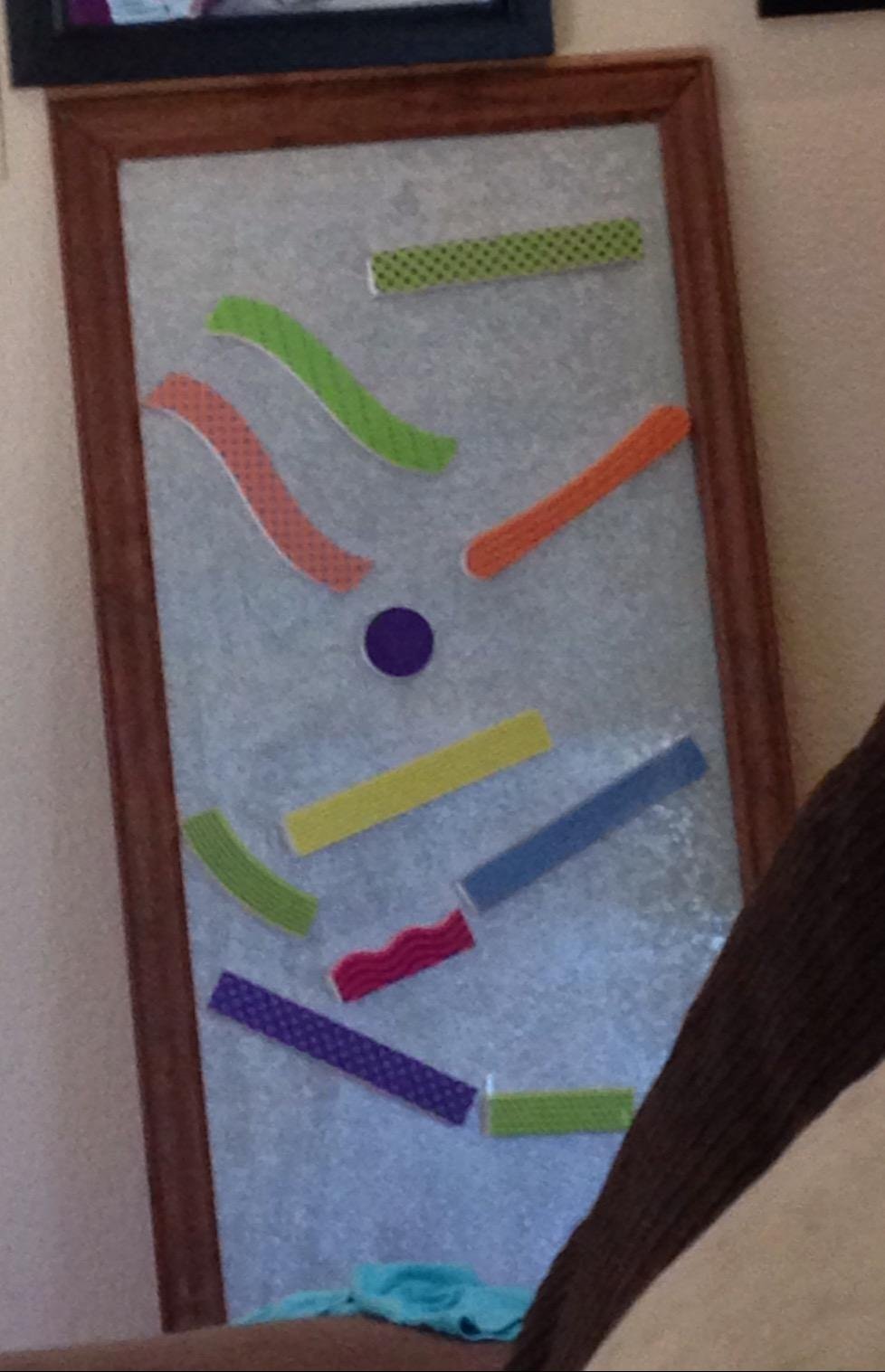
Our sessions showed the appeal clearly. Because rearrangement is instant, an eight-year-old can try a layout from a card, modify it after a failed run and try again without a rebuild from scratch. It is closer to experimenting than to assembling, and that suits a child who loses patience with long instructions.
The durability complaint is specific and worth taking seriously. Marble guards and edges on the foam pieces can peel or detach after a month or two of use, and pieces shift slightly when a marble lands hard. The catch basin also fails to stay attached when all four supplied marbles are loaded into it.

For whom it works well
It suits classrooms, homeschool spaces and homes where the fridge door is the only reliable magnetic surface. Teachers and homeschool families rate it highly for good reason: nothing breaks when dropped, and clean-up is a matter of pulling pieces off the board.
It is also the best travel option here. The whole footprint is the size of a folder, so it fits in a holdall for a long car journey or a stay with relatives. For an eight-year-old who gets bored on holiday, that portability is worth more than piece count.
For whom it falls short
Do not buy it for a child who wants to build big. Foam pieces cannot form a tall stable tower, so the ceiling on ambition is low. The included marbles are also small, which is a choking hazard for younger siblings in the house.
And like the other magnetic sets here, it needs a surface you already own. Without a fridge, whiteboard or easel, it has nothing to attach to.
How to Choose a Marble Run for an 8 Year Old
At age eight the deciding question is not piece count. It is how much planning the toy asks the child to do before anything moves. Work through these six factors and the right system becomes obvious.
What an 8 year old can build alone
Most eight-year-olds can snap two tube pieces together after one demonstration and build a working two-level run unaided. What they cannot reliably do is brace a tall tower so it survives a marble hit, which is why support pieces matter as much as connectors.
Independent building becomes reliable around age six or seven for a simple chute set, and an eight-year-old can usually manage a modular grid on their own after one adult-built first structure. Anything with a motorized lift or a snap-fit maze needs an adult on the first session.
Modular grid versus chute style
A chute set is a stack of curved tubes joined end to end. It is intuitive, cheap and quick, but a tall run topples easily because each piece carries the load of the ones below it.
A modular grid anchors everything to a baseplate, so height costs nothing structurally. That makes grid systems the better choice once a child is eight, because the builds are more ambitious and last longer. GraviTrax is the clearest example, and the National Geographic magnetic set works the same way on a vertical surface instead of the floor.
Magnets, wood or plastic
Plastic dominates this category and the quality gap is enormous. The Marble Genius and Meland sets feel thick and hold together; the PicassoTiles track pieces are noticeably thinner and rated lower for that reason. Treat piece thickness as the single best durability signal available without handling the set.
Magnetic pieces solve stability rather than strength. They hold tall structures without collapsing, and they let a child build on surfaces instead of the floor. Wooden sets are outside this roundup, and they trade volume for durability in a different way entirely.
Check the expansion path
An eight-year-old who enjoys a marble run in 2026 is very likely still playing with one at eleven. That makes expansion the most important long-term purchase criterion, and it is where sets diverge sharply.
Systems with published expansion lines are GraviTrax, PicassoTiles, MAGBLOCK and the National Geographic range, which is explicitly cross-compatible with the glow and motorized sets. Sets that only sell a larger version of themselves limit what you can add later. Before buying, check whether add-ons exist for the exact set and whether the marbles match.
Storage and footprint
Two hundred pieces are roughly the size of a shoebox and take about ten minutes to sort. Sets that include a storage bag save you most of that, and magnetic foam sets store flat rather than needing a whole shelf. Check the assembled footprint too, since a 28-inch wide motorized build will not fit a small table.
Label any bag or bin by track type. Once a set has 100-plus pieces, finding the spiral slide at bedtime stops being a five-minute job.
Safety and supervision
Marbles are a choking hazard and every set here carries small balls. The safest choices for a house with younger siblings are the sets with larger steel marbles, such as the PicassoTiles run, or magnetic foam with fewer loose pieces. Standard glass marbles in the Marble Genius and MAGBLOCK sets are fine with an eight-year-old but should stay out of reach of a toddler.
Second rule: build on the floor rather than a shelf edge. Most marble run injuries in our sessions came from towers being placed too high, not from pieces themselves.
Can You Mix and Match Marble Run Sets?
You can, but only within a brand, and only if the marbles are the same type. Mixing pieces across brands rarely works because connectors are not standardised, so a track from one system will not seat properly on another.
The exception worth knowing about is cube-based maze systems such as Q-BA-MAZE 2.0, which run on their own steel ball bearings rather than standard glass marbles. Their ball size does not match a standard set, so those balls will not run in another brand’s track. Check the marble type before buying a second system, because this is an easy and expensive mistake.
Within a brand the picture is better. National Geographic’s motorized 150-piece set is designed to expand the glow-in-the-dark set. MAGBLOCK works with other major magnetic tile collections, and PicassoTiles uses standard sizing that fits existing tile sets. GraviTrax expansion and extension sets are built for the Starter Set.
Frequently Asked Questions
What is the best marble run for an 8 year old?
The Marble Genius 150-Piece Super Set is our top pick for an 8 year old because it combines a large piece count with translucent track pieces that let kids see and debug a stalled marble. The MAGBLOCK magnetic set is the sturdiest option, and the National Geographic glow set is best for dark-room play.
Is GraviTrax suitable for 8 year olds?
Yes. GraviTrax is rated for ages eight and up, and the modular grid is designed to reward planning and statics thinking rather than quick assembly. A parent with boys aged 8 and 10 reported on mumsnet that they still play with it, which matches our own testing sessions.
Are marble run sets compatible with each other?
Only within the same brand, and only when the marbles match. Cube-based maze systems such as Q-BA-MAZE 2.0 use their own steel ball bearings that will not run in standard glass-marble tracks. National Geographic, MAGBLOCK, PicassoTiles and GraviTrax each publish add-ons for their own sets.
Why are some marble run sets so much more expensive?
Premium sets cost more because they use better materials, machined or tighter connectors and modular baseplate systems that make tall builds stable. A grid system anchors every piece to a fixed baseplate, so height does not cause toppling. Sets priced for younger children use thinner plastic with snap-fit parts that favour simple low runs.
How many pieces should a marble run set have for an 8 year old?
Around 100 to 150 pieces is the sweet spot at this age. Below 80 an eight-year-old runs out of new layouts quickly, and above 150 tidying becomes the main frustration. Sets in that range also allow two independent race tracks, which matters if there is a sibling.
How do you make a marble run go slower?
Shorten the drop height between sections, add a zigzag or switch piece to break the straight line, and use curve sections instead of long straights. Replacing a fast launcher with a plain ramp also helps. The slowest runs use several small descents rather than one tall drop.
Our Verdict on the Best Marble Run Sets for 8 Year Olds
No other set here matches that combination of piece variety and pieces an eight-year-old can connect independently, and the translucent track turns every stall into a puzzle rather than a dead end.
Buy the MAGBLOCK set if your child builds tall structures, the National Geographic glow set if evenings and dark rooms are your main play window, and GraviTrax if you want a system that still works at twelve. Whatever you choose, check that an expansion path exists before you buy, because the child who loves this at eight will still be adjusting the drop height at ten.