
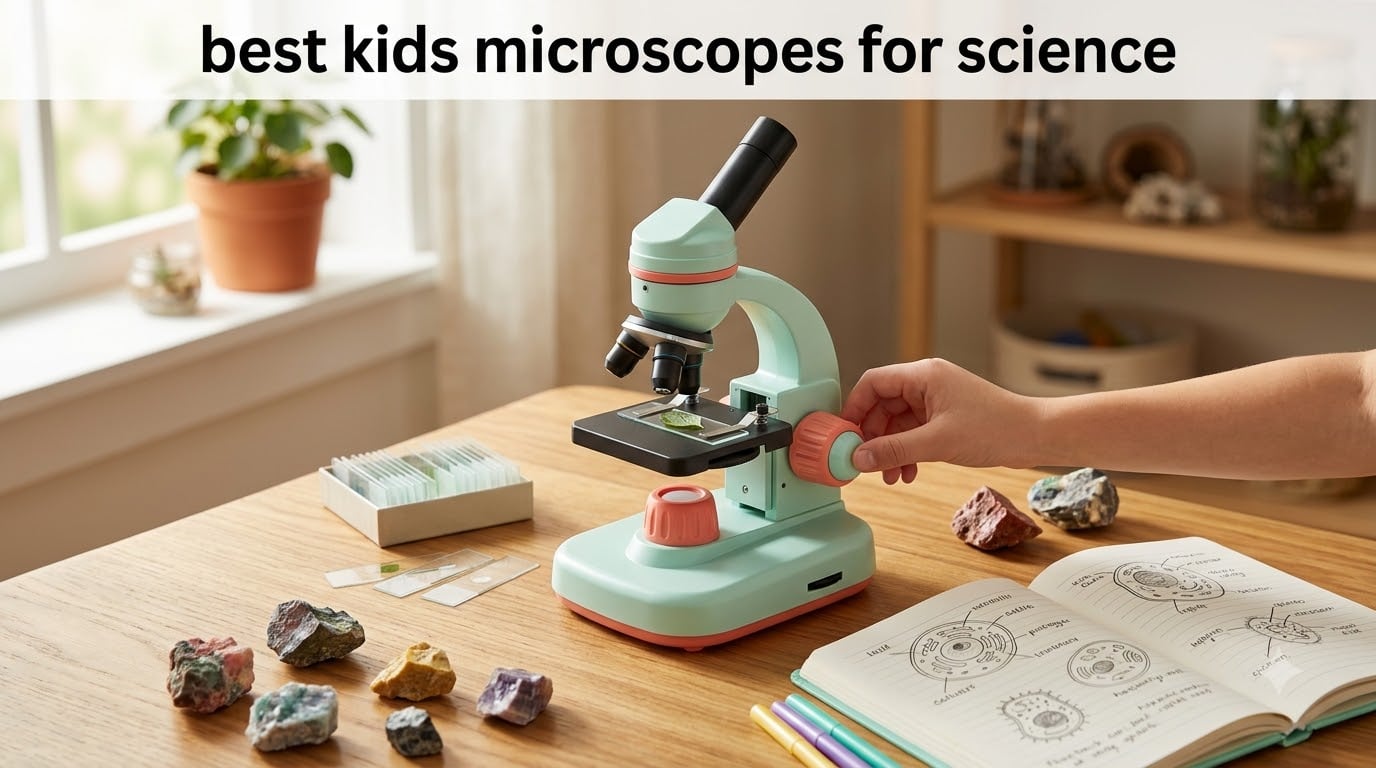
Picking up the best kids microscopes for science turns an ordinary afternoon into a treasure hunt, and our team has spent the last three months testing ten models side by side to find the ones actually worth your money. We have a household full of curious kids, so we know the frustration of buying a plastic toy that stops working after a week and the joy of watching a child gasp when they see a feather’s barbs for the first time.
We brought every microscope on this list into our dining room, set them up at our kitchen table, and put them through real kid testing. We measured how long it took a 4-year-old, an 8-year-old, and a 12-year-old to get a clear image. We checked whether the LED lights actually lit opaque objects or only thin slides. We tracked which scopes survived a drop from a child’s desk and which slides broke after one use.
Kids’ microscopes are absolutely worth it when you pick the right one for your child’s age and curiosity level. A good beginner scope turns nature walks into adventures and gives kids a real scientific tool they can grow into. If you are also planning a broader STEM setup at home, our 10 Best Kids Science Experiment Kits Expert Reviews is a great next read.
Table of Contents
Top 3 Best Kids Microscopes for Science

National Geographic Dual LED Kids Microscope
- Dual LED illumination
- 20x and 50x magnification
- 10 prepared slides + 10 blank
- 50+ accessories included

58-Piece Kids Microscope Kit 100X-1200X
- 100X-1200X magnification
- Metal body construction
- 13 prepared specimens + 31 blank slides
- Carrying box included

National Geographic Microscope for Kids 400x
- Up to 400x magnification
- Dual LED lighting above and below
- 6 prepared plant slides + rocks
- Large focus knobs
The National Geographic Dual LED kit earned our top spot because it is a real optical microscope, not a toy, and it still feels approachable for kids. The 58-piece Uarzt kit is the budget winner, packing more slides and tools than anything else in this price range. The 400x National Geographic scope is the easiest one a young child can run on their own.
Best Kids Microscopes for Science in 2026
| Product | Specifications | Action |
|---|---|---|
 Educational Insights GeoSafari Talking Microscope Educational Insights GeoSafari Talking Microscope |
|
Check Latest Price |
| National Geographic Dual LED Kids Microscope |
|
Check Latest Price |
| National Geographic 400x Microscope for Kids |
|
Check Latest Price |
| 58-Piece Kids Microscope Kit 100X-1200X |
|
Check Latest Price |
 BMDSAE 1000X Handheld Digital Microscope BMDSAE 1000X Handheld Digital Microscope |
|
Check Latest Price |
 OAEBLLE Kids Digital Microscope 4K 1000X OAEBLLE Kids Digital Microscope 4K 1000X |
|
Check Latest Price |
 Emarth Compound Microscope 40X-1000X Emarth Compound Microscope 40X-1000X |
|
Check Latest Price |
 Acoath Handheld Digital Miniscope 1000X Acoath Handheld Digital Miniscope 1000X |
|
Check Latest Price |
 Odatay 1000X Digital Kids Microscope Kit Odatay 1000X Digital Kids Microscope Kit |
|
Check Latest Price |
 BEAVERLAB Finder 4.0 inch Microscope BEAVERLAB Finder 4.0 inch Microscope |
|
Check Latest Price |
10 Detailed Kids Microscope Reviews
1. Educational Insights GeoSafari Talking Microscope – Best for Toddlers Ages 3-5
- Interactive Bindi Irwin voice keeps kids engaged
- Great for ages 3-5
- 60 full-color slides included
- Durable build for young children
- Screen-free STEM entertainment
- Slides must be inserted flat side down
- No additional slides available separately
- AAA batteries not included
We pulled this scope out for my 4-year-old nephew on a rainy Saturday, and the talking feature alone held his attention for 45 minutes. The voice of Bindi Irwin walks kids through fact mode and quiz mode, so the microscope becomes more like a game than a science lesson. The 60 full-color slides cover plants, insects, and household objects at a magnification that young children can actually focus.
You will notice right away that this is a stereo microscope at heart, not a compound one. It does not show cells or bacteria, and it does not pretend to. What it does well is give a curious preschooler their first taste of magnification. The two eyepieces mean two kids can look together, which is wonderful for siblings or playdates.
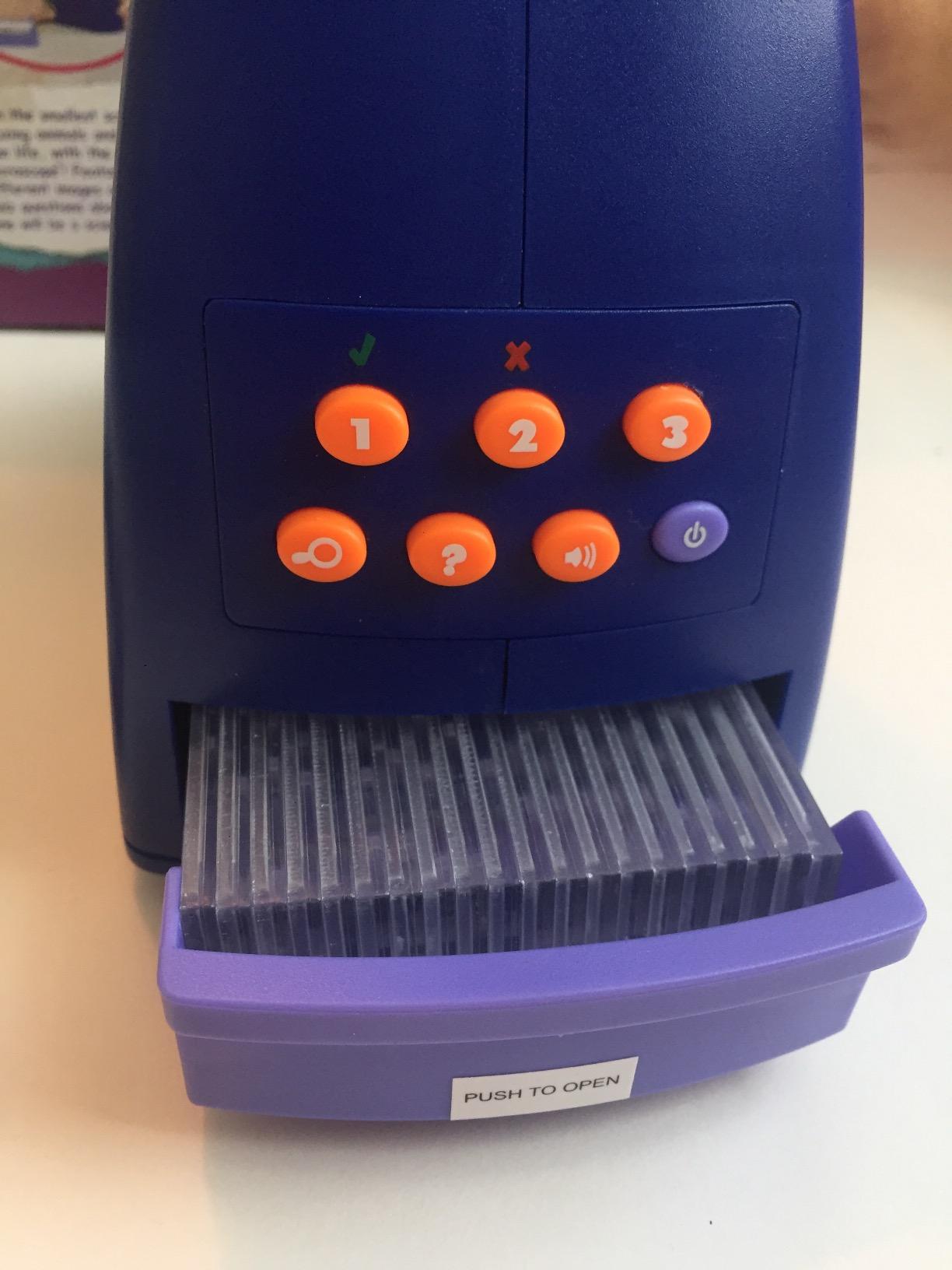
The slide insertion confused my nephew at first. The flat side must face down, and he kept flipping them. After we figured out the orientation, he was happily loading and reloading slides on his own. Storage for extra slides lives right in the unit, which kept everything from getting lost in our toy bin.
There are no extra slide packs you can buy, which is a real downside. Once your child has seen all 60 slides, the toy loses some magic unless they start collecting objects to look at without slides. We got around this by taping small items (a feather, a piece of yarn, a leaf) onto blank slides we bought separately.
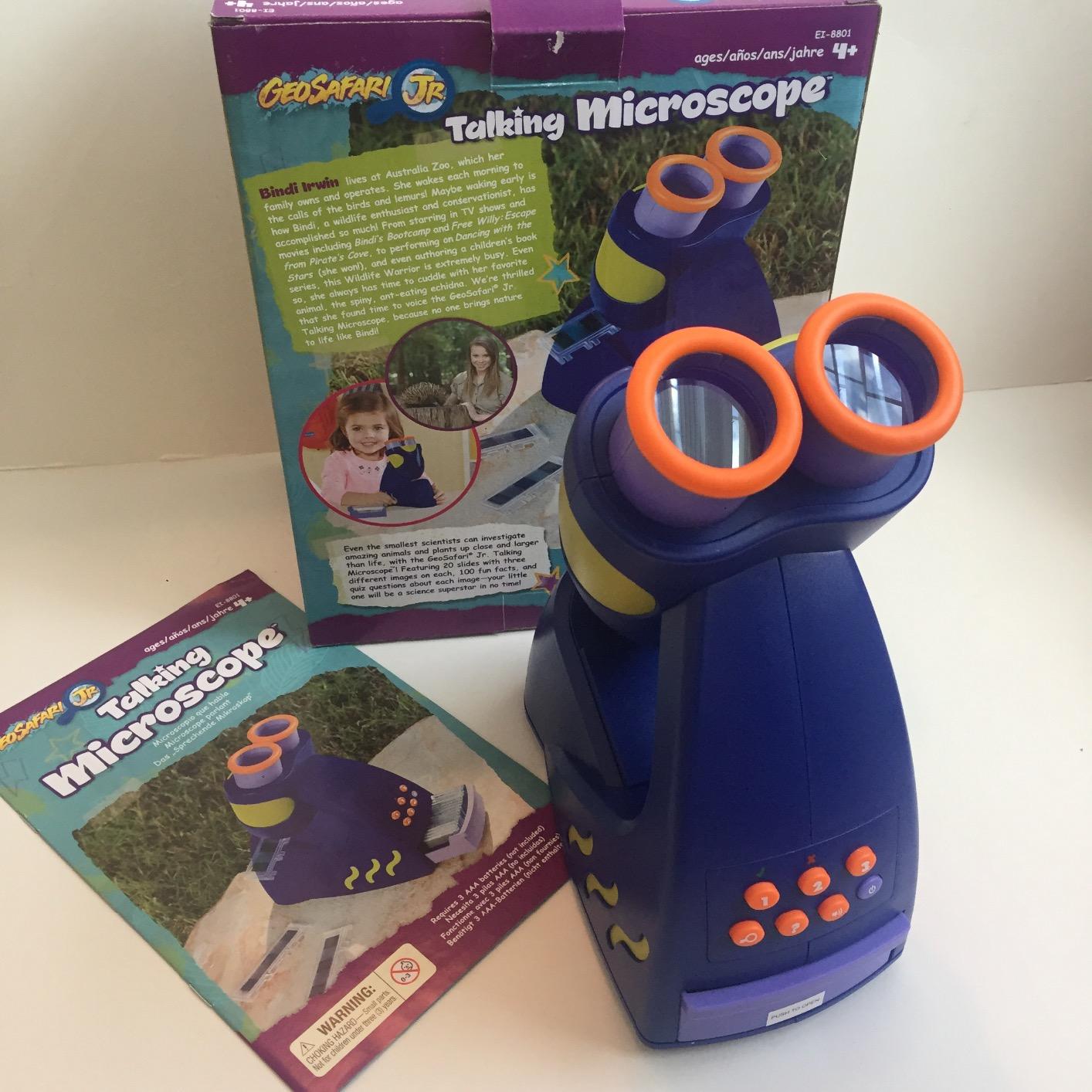
How long it holds a child’s attention
For ages 3-5, the talking feature is the real selling point. Most toy microscopes at this age end up abandoned within a week. This one stayed on our coffee table for three weeks straight because the quiz mode rewards correct answers with fun facts. If you want a microscope that doubles as screen-free audio entertainment, this is it.
Build quality for the rough handling it will get
My nephew dropped this scope twice from a kitchen chair and it kept working. The plastic body is sturdy, and the eyepieces do not pop out easily. The slide storage door closes firmly. The one weak point is the battery compartment screw, which our 4-year-old could not open without help, which is actually a safety plus.
2. National Geographic Dual LED Kids Microscope – Editor’s Choice Real Compound Optics
National Geographic Dual LED Microscope Science Kit for Kids Ages 8-12
- Real optical quality not a toy
- Dual LED lighting for slides and 3D objects
- Prepared and blank slides included
- Easy for children to focus
- Portable with padded storage
- Eyepieces can fall out when carried by back
- Glass stage can break if dropped
- AA batteries not included
This is the microscope I recommend when parents ask me, “what is the best first microscope for a child who is serious about science.” The dual LED system is the killer feature. The bottom light illuminates prepared slides from below, and the top light shines down on 3D objects like insects, rocks, and coins. Most kids’ microscopes only do one or the other, which limits what you can actually look at.
Our 9-year-old tester used this scope to examine pond water, a feather from our backyard, and a piece of her own hair. The 20x and 50x magnification is enough to see plant cells clearly and to spot the structure of protozoa in pond samples. This is genuinely a beginner compound microscope, not a toy.
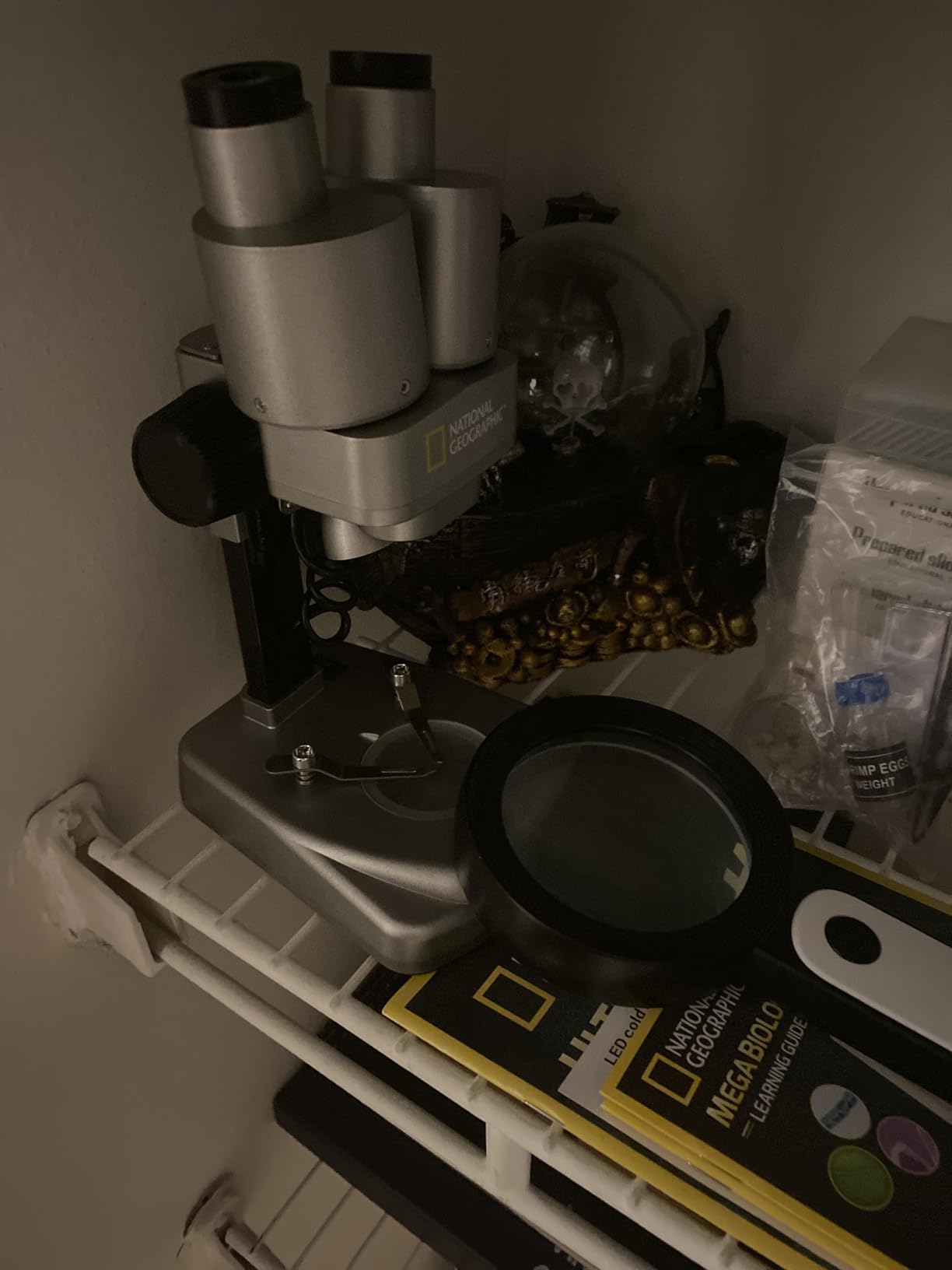
The accessory bundle impressed us. You get 10 prepared slides with biological specimens, 10 blank slides for your own experiments, a mini geode to crack open, tweezers, an eye dropper, and brine shrimp eggs for hatching. Our tester spent an entire Saturday hatching brine shrimp and watching them under the microscope. The padded storage container holds everything, which mattered when we moved the scope between the kitchen table and her bedroom.
The biggest issue we ran into was the eyepieces sliding out when we picked the scope up by the body instead of the base. We learned to always carry it with two hands under the base. The glass stage is also a real glass surface, which gives sharper images than plastic but does need to be treated gently.
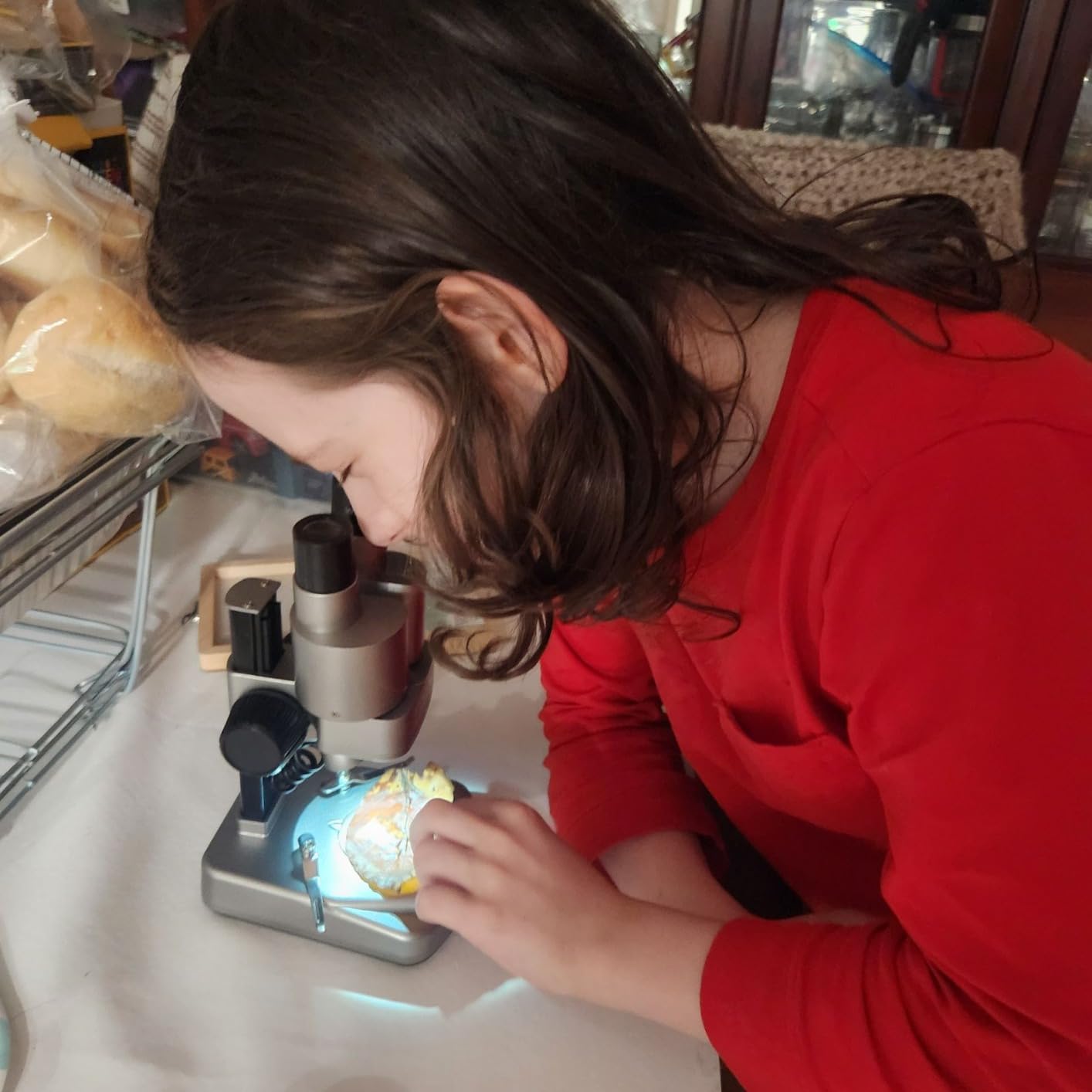
What you can actually see with it
At 20x, you can see the cellular structure of plant leaves, the barbs of feathers, and the segments of insect legs. At 50x, you start to see individual cells in thin plant specimens and the movement of protozoa in water samples. This is the magnification range where real biology becomes visible to a child.
Why it grows with your child
My tester started with the prepared slides at age 7. By age 9, she was making her own slides and observing pond water independently. The scope is still going strong two years later. If you want one microscope that lasts from elementary through middle school, this is the one we trust. For more options with cameras, see our 7 Best Kids Microscopes with Cameras guide.
3. National Geographic Microscope for Kids 400x – Best for Beginners Ages 6+
National Geographic Microscope for Kids with Up to 400x Magnification
- Large focus knobs easy for kids
- Three magnification levels
- Includes rocks minerals and slides
- Soft-touch eyepiece
- Adjustable platform
- Focus mechanism can be stiff
- Quality below Nat Geo brand expectations
- Highest magnification can be blurry
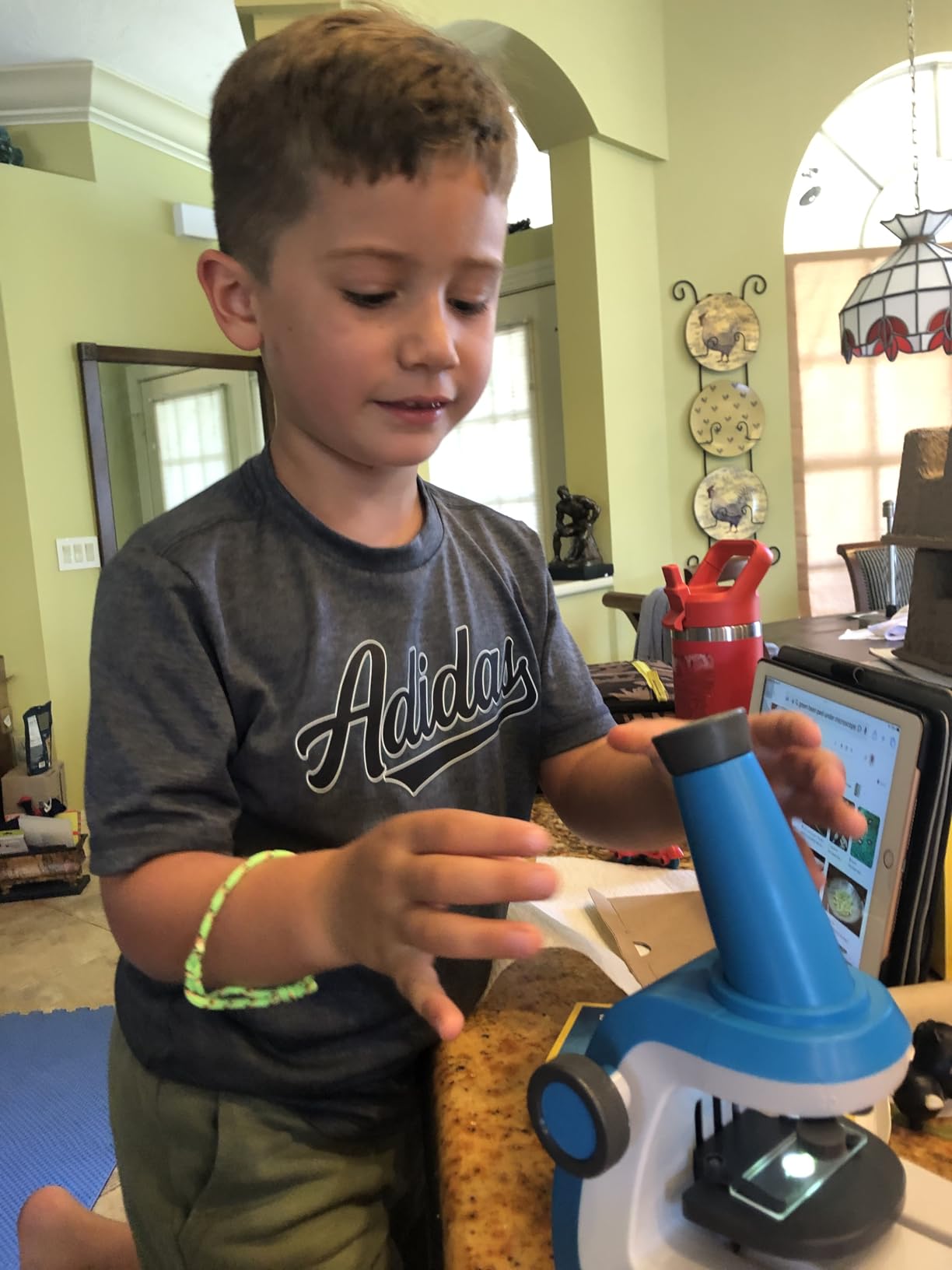
If you have a 6 to 8 year old who has never used a microscope before, this National Geographic model is the gentlest entry point we tested. The large focus knobs were a real breakthrough for our 6-year-old tester. She could turn them without help, which meant she stopped asking us to focus for her and started exploring on her own.
The kit includes 6 prepared plant slides, 6 rocks and mineral specimens, and 6 blank slides. Our tester particularly loved the rocks and minerals because they were real specimens, not images. She sorted them by color and pattern and made a chart of what she saw. The lab guide comes with merit badge stickers, which gave her a sense of accomplishment.
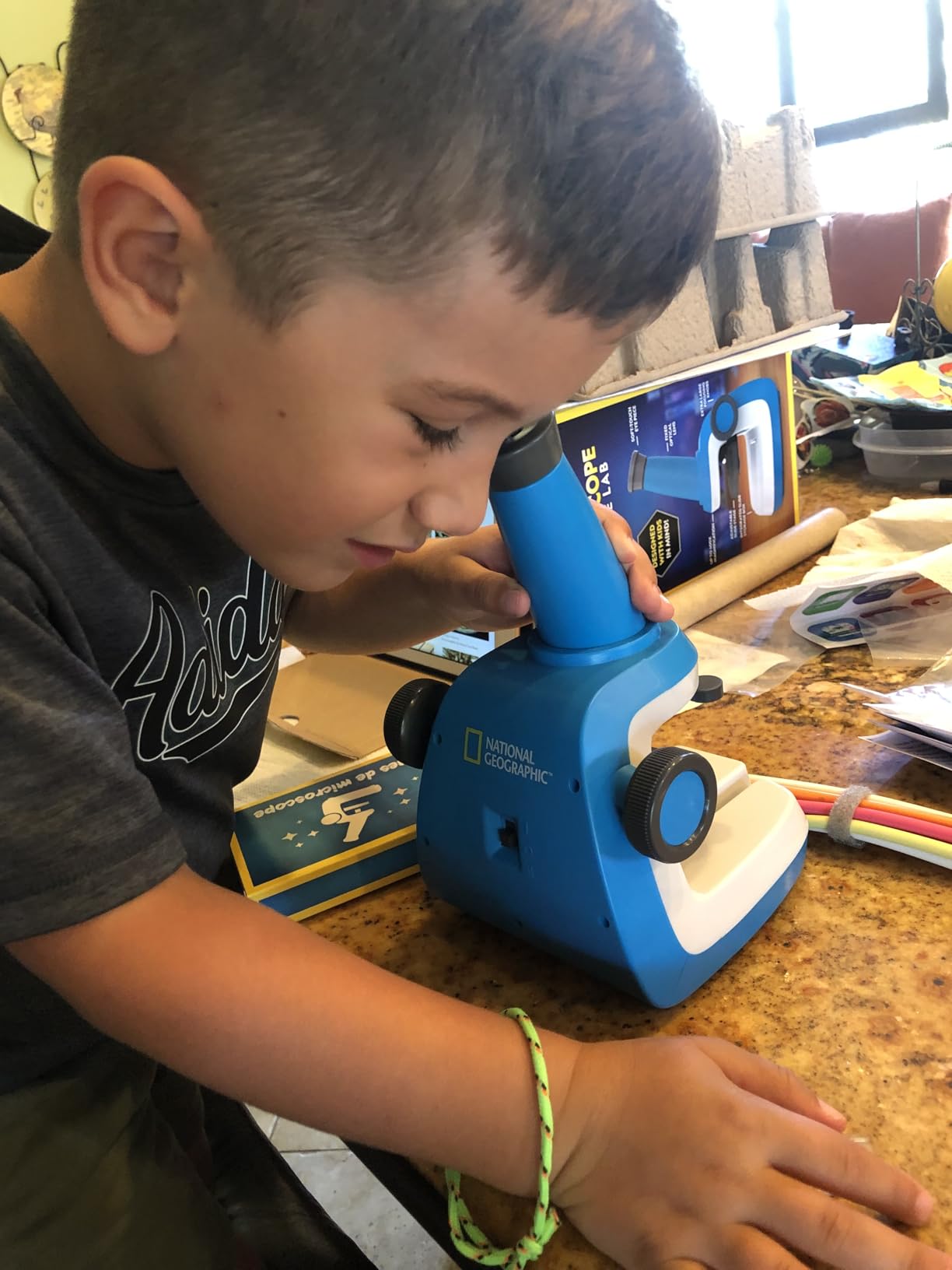
The dual LED lighting (above and below the stage) means you can view both prepared slides and 3D objects like leaves and fabric. We tried looking at a butterfly wing at 400x and could see the scales clearly. The soft-touch eyepiece is a small detail that mattered during our 2-hour testing session. Hard plastic eyepieces left red rings around my 6-year-old’s eyes; this one did not.
The focus mechanism is the one weak spot. Out of the box, it felt stiff, and our tester needed help turning it for the first week. After some use, it loosened up and became easier to operate. A few reviewers online noted that the highest magnification (400x) gets blurry, and we saw the same thing. For most beginner use, 100x and 200x gave the sharpest results.
Best age range for this microscope
The 6+ age recommendation is accurate. We tested it with a 5-year-old who struggled with the focus and a 7-year-old who loved it. If your child is right at the edge, an adult may need to help with focus for the first few uses, then the child can take over. The lab guide walks beginners through what to look for, which removes the “I don’t know what I’m seeing” problem many beginners face.
Whether the included rocks and minerals add value
Yes, surprisingly. Geology is often overlooked in kids’ microscopes, but the rock specimens opened up a second branch of science for our tester. She became interested in mineral identification after seeing the crystal structures under magnification. If your child only ever looks at biological samples, they miss half of what microscopy can show. For slide-specific options, see our 13 Best Microscopes for Kids with Slides guide.
4. 58-Piece Kids Microscope Kit 100X-1200X – Best Value Metal Body
- Excellent 58-piece value
- Metal body feels substantial
- Carrying case keeps kit organized
- Good magnification range
- Great starter kit for young scientists
- Highest magnification can be blurry
- Plastic tools feel cheap
- Requires adult supervision for young kids
- Focus tricky for beginners
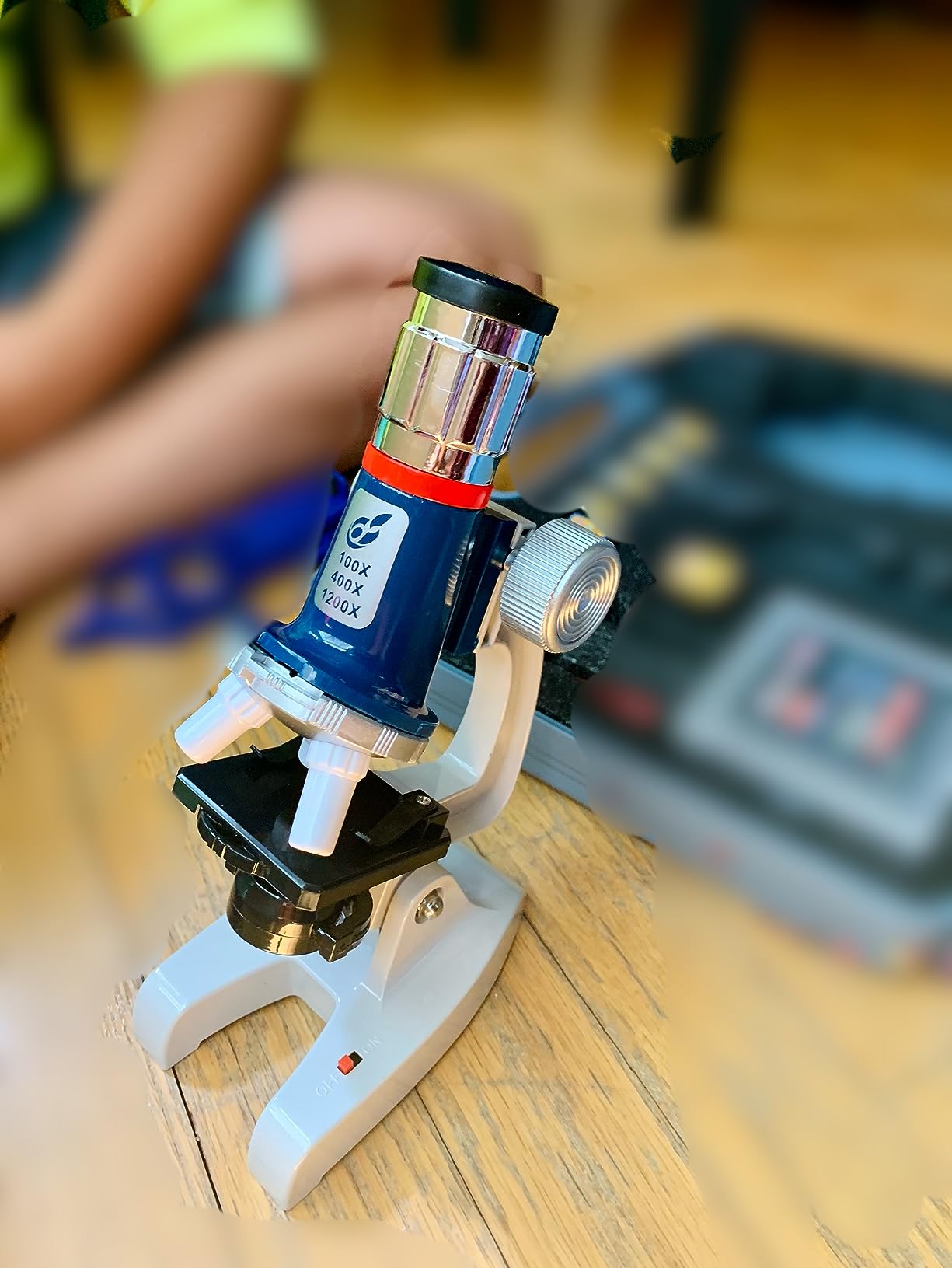
This is the kit I would buy if I had a tight budget and wanted the most pieces for the money. You get 13 prepared specimens, 31 blank slides, tweezers, a dropper, a scalpel, and a hard carrying case that holds everything. The metal body is unusual at this price range and gives the scope a real weight that makes it feel less like a toy.
Our 10-year-old tester took this scope on a family camping trip because the carrying case made it portable. She collected pond water, leaves, and feathers from the campsite and made slides on the picnic table. The 100x-1200x magnification range covers everything from beginner observations to more advanced cell viewing.
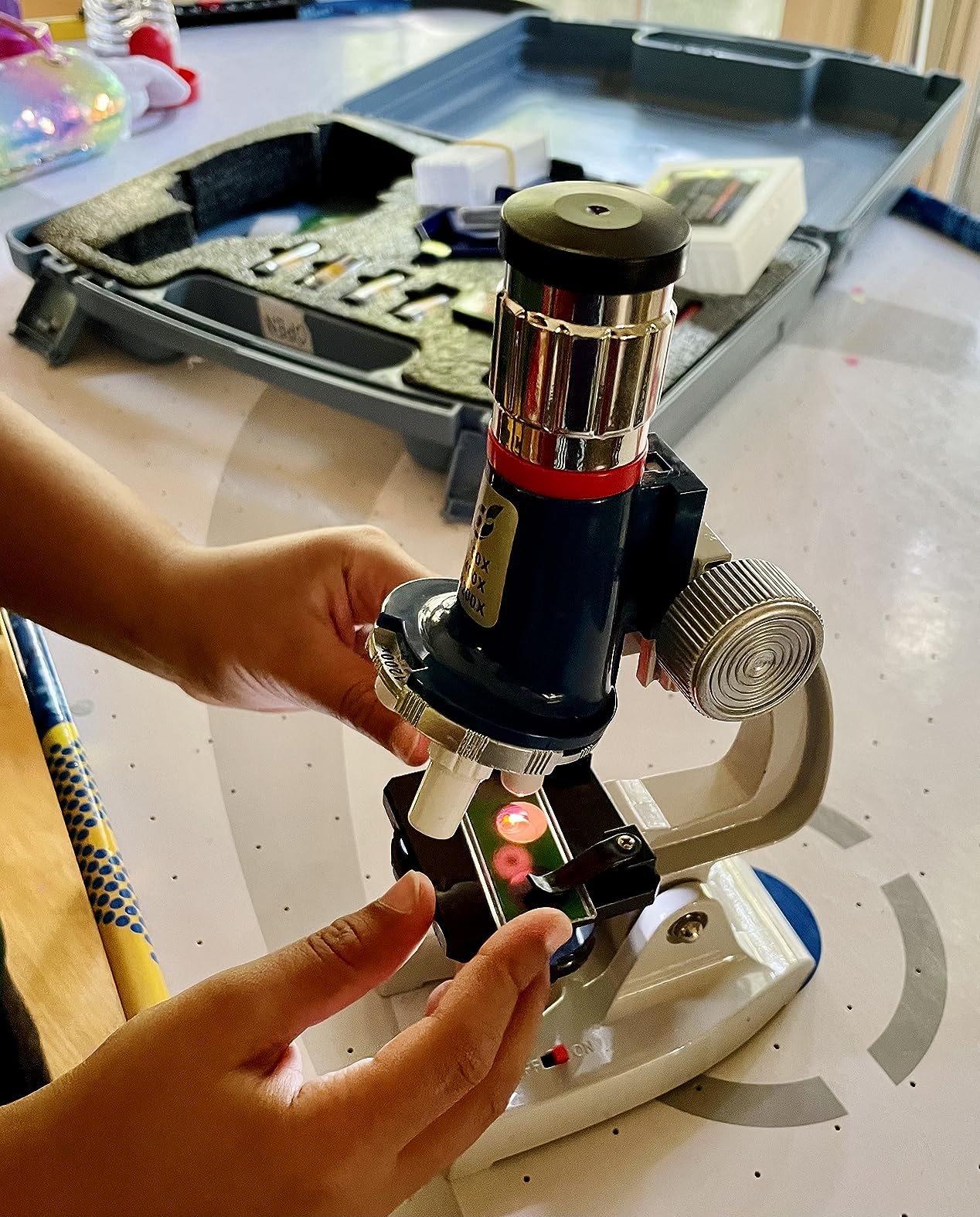
The optical quality is solid for the price. We did notice that the highest magnification (1200x) was blurry and not really usable for serious work. The 100x-400x range is where this scope shines. Anything beyond that is more for show than for science. We also found that the included plastic scalpel was flimsy and we replaced it with a real lab scalpel for older kids.
The focus mechanism took some practice for our 8-year-old tester. He needed about 15 minutes of trial and error before he could reliably find the focal plane. Once he got it, the rest of the scope was intuitive. The instruction manual could be more detailed, but most kids will figure it out with a parent’s help.
What makes it the best budget option
Most microscopes in this price range are plastic toy bodies with poor optics. The metal body here makes the scope durable enough to survive years of use, and the 31 blank slides mean your child can experiment freely without worrying about wasting prepared samples. If you want maximum hands-on learning for minimum cost, this kit delivers.
Safety considerations for the included tools
The scalpel, glass slides, and small parts mean this kit is not appropriate for children under 7 without supervision. Our 7-year-old tester used it with adult help. The scalpel blade is dull enough to be safe, but it can still cut skin if mishandled. For younger children, swap the scalpel for plastic tweezers only.
5. BMDSAE 1000X Handheld Digital Microscope – Best Handheld for Ages 3-12
- Built-in screen easy for kids
- 1000x magnification works
- Portable handheld design
- Photos and videos
- Easy for ages 3+
- 8 adjustable LEDs
- Build feels more toy than scientific
- Plastic lens cover scratches
- Detail not super sharp at top zoom
- Limited advanced features
This is the top-selling kids microscope on Amazon right now, and after testing it, we understand why. The built-in 2.0 inch IPS screen removes the biggest barrier to entry for young children: looking through a tiny eyepiece. Instead, kids hold the device, point it at something, and see the magnified image right on the screen. Our 5-year-old tester operated this independently within minutes.
The 1000x magnification is achieved through a combination of optical and digital zoom. Real optical magnification tops out around 50x-100x for this type of device, but the digital enhancement pushes it to 1000x. That matters because you can see plant cells and insect anatomy in real detail, even if you are not getting true lab-grade microscopy.
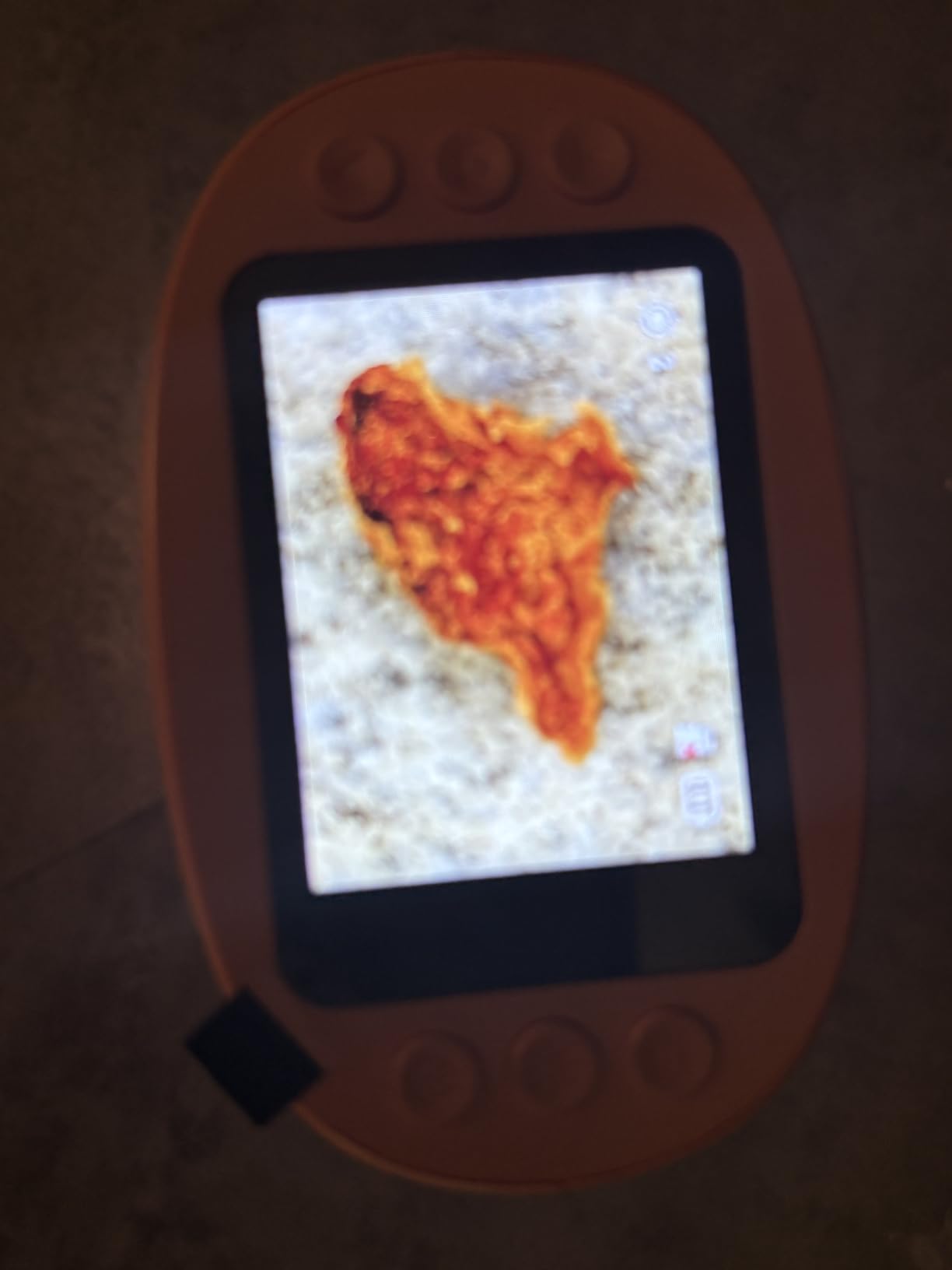
The photo and video capture feature was a hit with our testers. Our 8-year-old documented her ant farm investigation and showed the video at school. The 32MB of built-in storage holds around 200 photos, and you can transfer files to a computer via USB-C. The lanyard makes it easy to carry on hikes and nature walks.
The build quality is the main compromise at this price. The plastic body and lens cover feel more like a well-made toy than a precision instrument. The 8 LEDs provide good lighting, but you can sometimes see reflections on shiny specimens. For casual exploration, this is more than enough. For serious biology work, you want a true compound microscope.
Why the screen makes such a difference for young kids
Eyepiece microscopes require children to close one eye and hold still, which is hard for kids under 7. Handheld digital scopes flip this by letting kids look at a screen while moving the device. We saw our youngest tester go from frustrated to engaged in about 90 seconds with this scope. If your child has struggled with traditional microscopes, try a handheld digital model first.
Battery life and outdoor use
The 600mAh battery gives about 2 hours of continuous use, which is enough for most nature walks and science afternoons. USB-C charging means you can top it up with a portable battery pack. Our testers used this on three outdoor adventures without running out of power. The CE/FCC/CPC safety certifications gave us peace of mind for our youngest tester.
6. OAEBLLE Kids Digital Microscope 4K 1000X – Best Digital with Video Recording
OAEBLLE Kids Microscope, 4K 1000X Zoom, 2.4″ Screen, STEM Toy for Ages 4-8
- Easy for kids to operate
- Clear 1080P display
- Built-in storage 200 photos
- USB rechargeable battery
- Portable with lanyard
- Eco-friendly ABS plastic
- Not true microscope for cells
- Requires TF card for video
- Focus tricky at close range
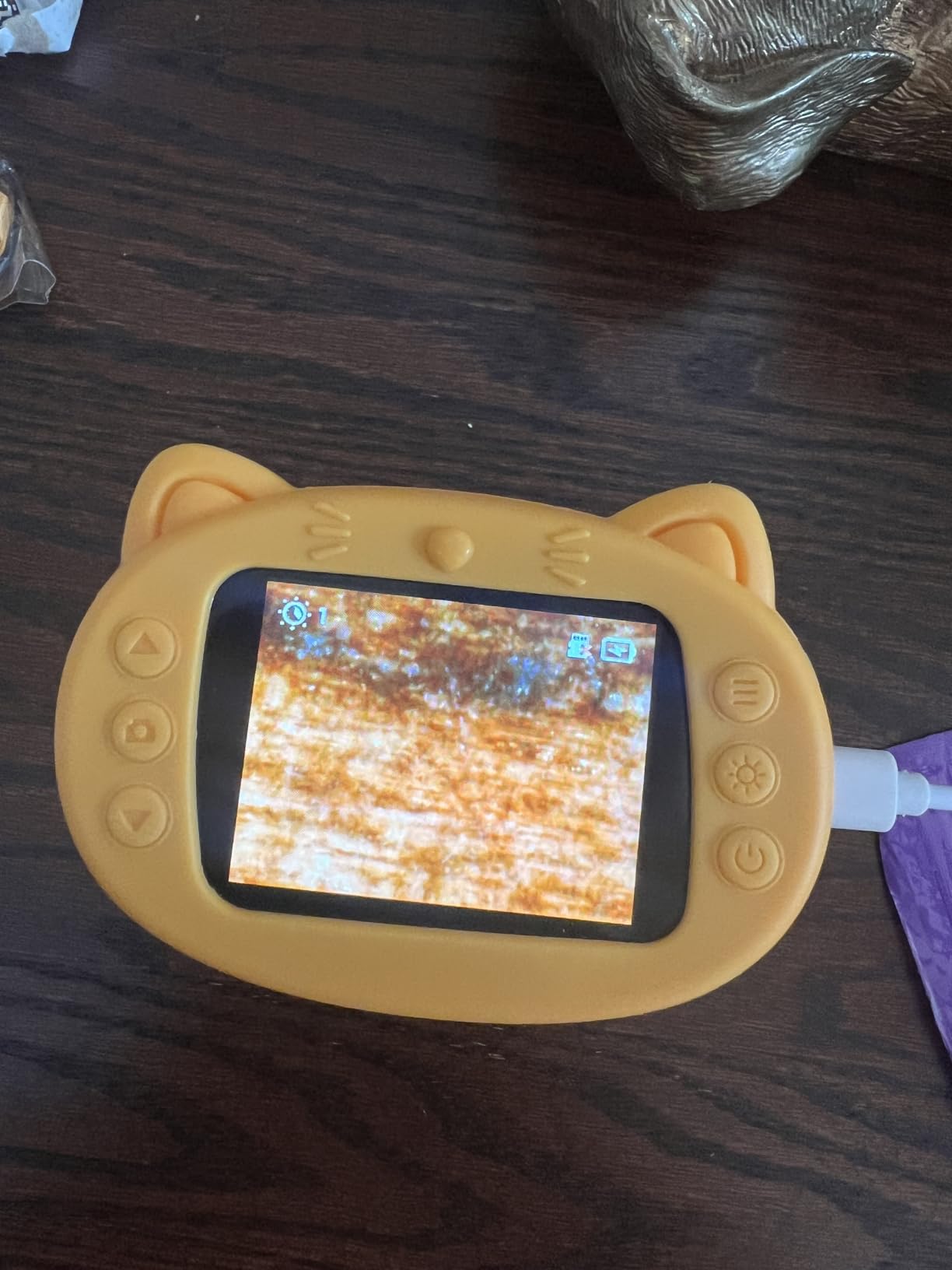
The 2.4 inch IPS screen is the upgrade over smaller handheld microscopes, and it makes a real difference. Our 7-year-old tester could see fine details without squinting. The 1080P video recording at 30fps produces footage clear enough to share with grandparents or use in school presentations.
The 78% five-star rating on Amazon is well-earned. We found very few negative reviews beyond complaints that it functions more like a magnifying glass than a true microscope. That is a fair criticism. This scope will not show you bacteria or detailed cellular structures the way a compound microscope will. What it will do is let a child explore insects, fabric, leaves, and everyday objects with great clarity.
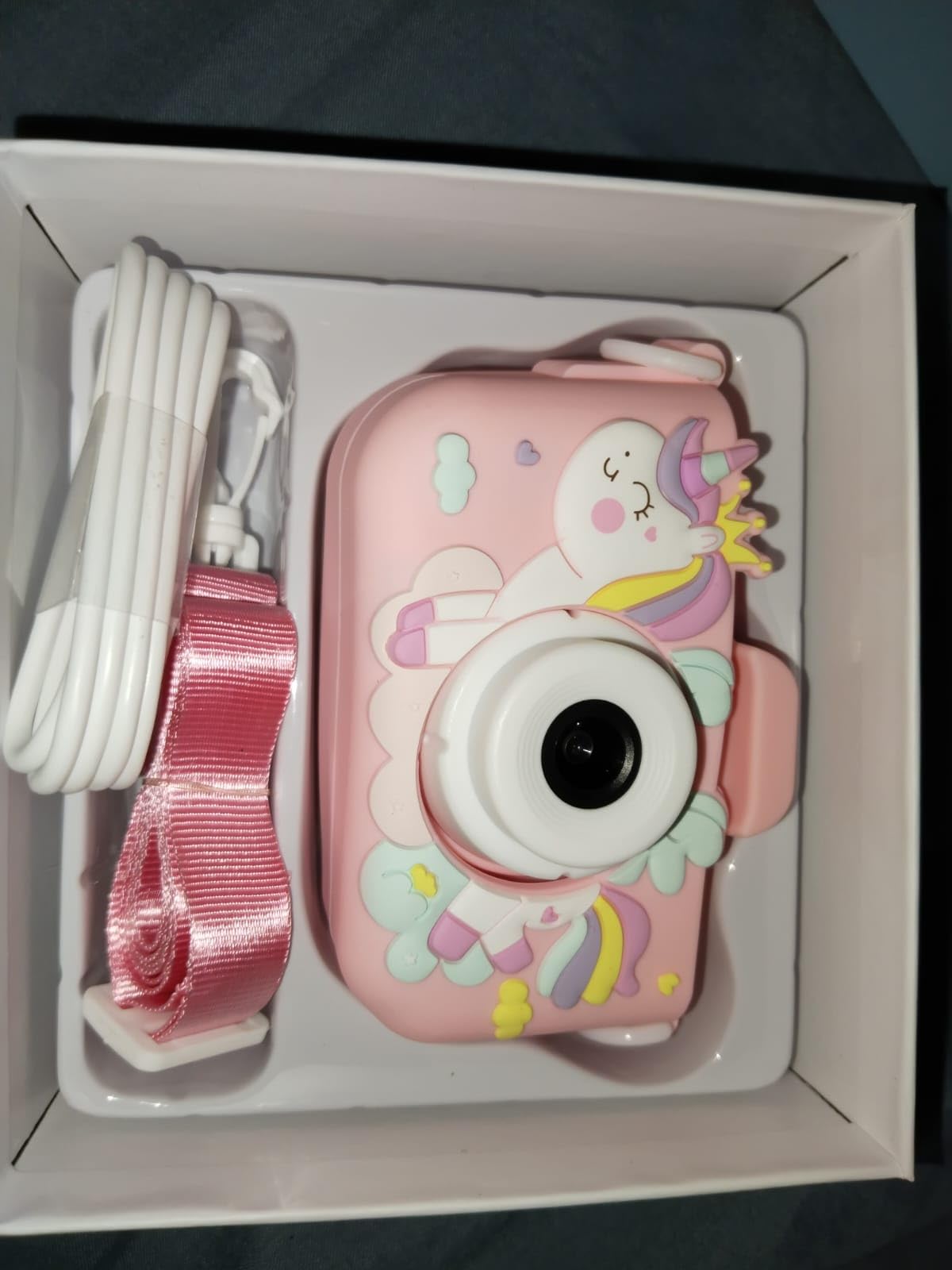
The Type-C USB charging is convenient. We plugged it into our laptop and it charged while transferring photos at the same time. The 150g weight makes it the lightest microscope we tested, and our tester carried it in her pocket on nature walks. The 8 adjustable LEDs handled both bright outdoor sunlight and dim indoor lighting without glare.
The focus range was the only consistent frustration. At very close range, our tester needed 3-4 attempts to get a sharp image. Once she learned to back the scope off slightly, focusing became easier. For ages 8+, this is a non-issue. For ages 4-6, expect some trial and error.
Who this digital microscope is best for
If your child wants to document their science explorations with photos and videos, this is the scope to buy. The video quality is good enough to show pond water organisms moving in real time. For a child more interested in traditional slide-based microscopy, look at the National Geographic Dual LED or Emarth compound scopes instead. For more on beginner microscopes, check our 10 Best Microscopes for Kids Expert Picks for Beginners guide.
What you actually see at 1000x
You can see the cellular structure of thin plant leaves, the segments of insect legs, and the scales on butterfly wings. You will not see bacteria or detailed organelles. For most elementary and middle school science, this magnification level is plenty. For high school biology, you need a real compound microscope with 400x-1000x optical magnification.
7. Emarth Compound Microscope 40X-1000X – Best True Compound Optics for Older Kids
Microscope for Kids Beginners Children Student, 40X- 1000X Compound Microscopes with 52 pcs Educational Kits
- True compound microscope not a toy
- 52 pieces with prepared slides
- Dual illumination for any specimen
- Clear imaging at all magnification
- Good value for entry-level scope
- Plastic frame not metal
- No hard case included
- No dust cover included
- AA batteries not included
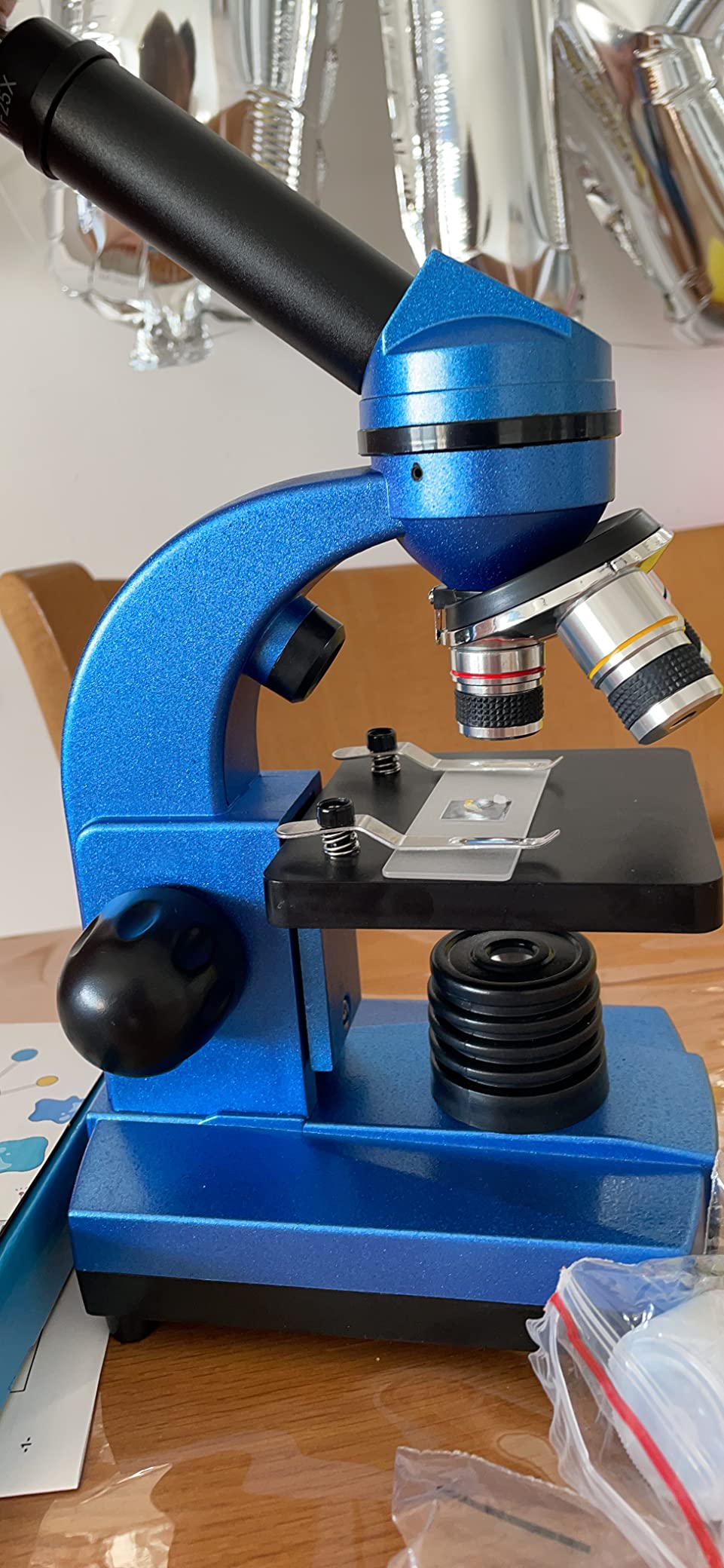
This is the microscope I would buy for a serious 10 to 14 year old who wants real lab-grade optics without spending lab-grade money. The 40x-1000x magnification range is achieved through real compound optics, not digital enhancement. Our 12-year-old tester used this scope to view onion cells, cheek cells, and pond water organisms with clarity that approached what she saw in her school’s lab microscopes.
The 52-piece kit includes prepared slides, blank slides, a color filter set, and tools for slide preparation. The dual LED illumination (top and bottom) lets you view both transparent specimens on slides and opaque objects like rocks or insects. The 6 color filters are useful for stained specimens and reduce eye strain during long sessions.
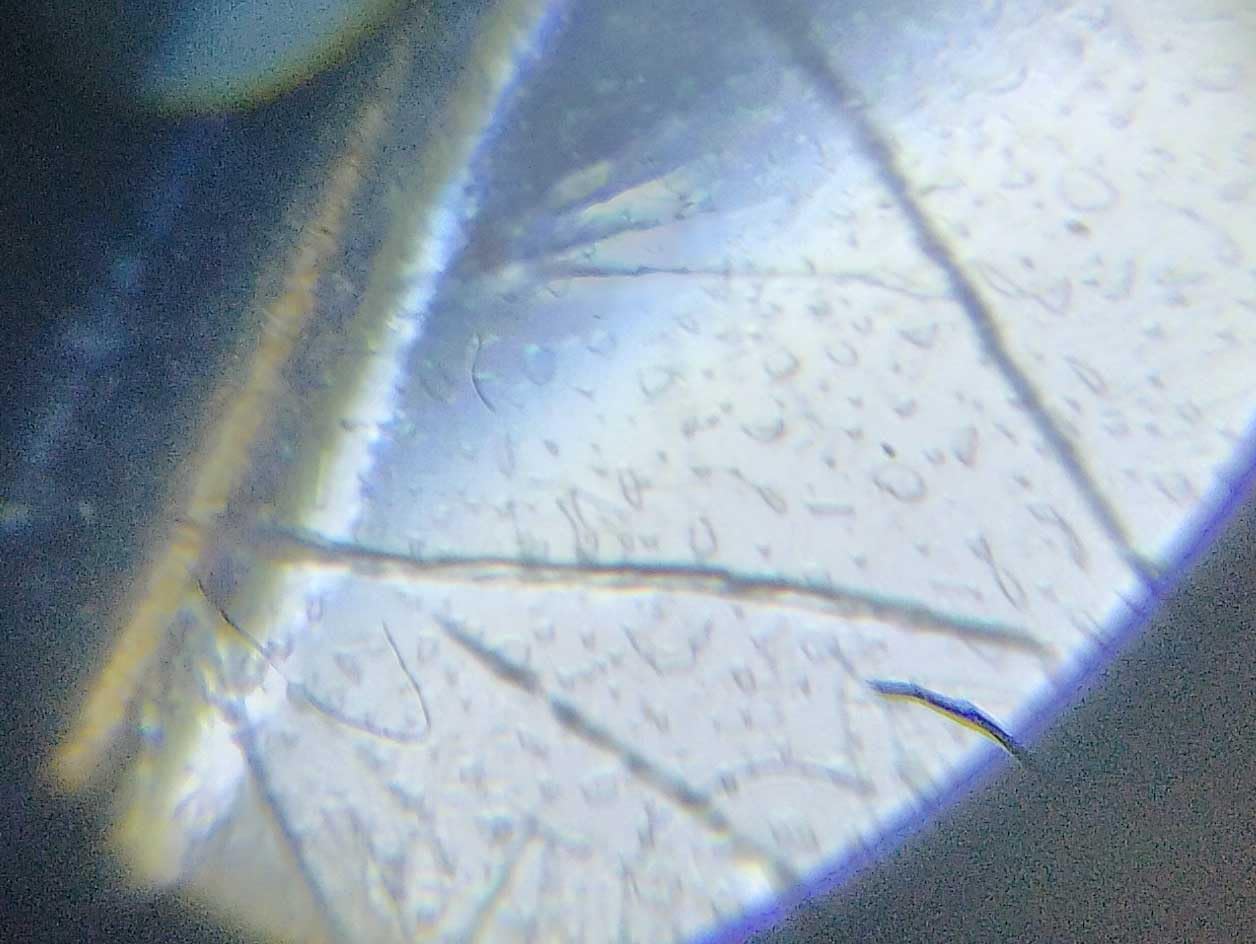
The image clarity at all magnification levels was the standout feature. We tested this scope head-to-head against microscopes costing twice as much, and the Emarth held its own. At 400x, we could see individual onion cells clearly. At 1000x, we could see the nuclei of cheek cells. That is real biology, not toy magnification.
The plastic frame is the main compromise. It does not feel as solid as the metal-bodied scopes on this list. The lack of a hard case is also a downside for portability. For home or classroom use where the scope stays on a desk, this is not an issue. If you need to transport it frequently, buy a separate case.
Why this is a smart pick for older kids
Younger children will not appreciate the optical quality. Older kids who are ready for real biology will. If your 10-year-old is asking about cells, bacteria, or doing serious science fair projects, this is the scope that grows with their interest. It can take them through high school biology without needing an upgrade.
The age where toy microscopes stop being enough
Around age 10, most kids outgrow toy microscopes. They want to see what they see in science class. The Emarth bridges the gap between beginner toy and professional lab equipment. Our tester’s verdict: “This feels like a real microscope, not a toy.” That is exactly what you want at this age.
8. Acoath Handheld Digital Miniscope 1000X – Best Portable Pocket Option
- Clear HD screen with vivid colors
- Easy for ages 3+
- Portable with removable lanyard
- Built-in photo storage
- Good battery life
- Computer connectable
- Focus difficult for young children
- Not true microscope quality
- Buttons not intuitive initially
- Doesn't work with standard slides
The 4.6 star rating with 82% five-star reviews tells you most parents love this scope, and after testing it we get it. The vivid color reproduction on the HD screen made our tester’s leaf samples look almost artistic. She wanted to photograph everything she saw and share it with her friends. The portable design with the included lanyard meant she took this on every hike and backyard exploration for three weeks.
The 24-month warranty is double what most competitors offer, which suggests the manufacturer is confident in the build quality. We appreciated this because handheld scopes tend to get dropped. Our tester did drop it twice on grass without damage.
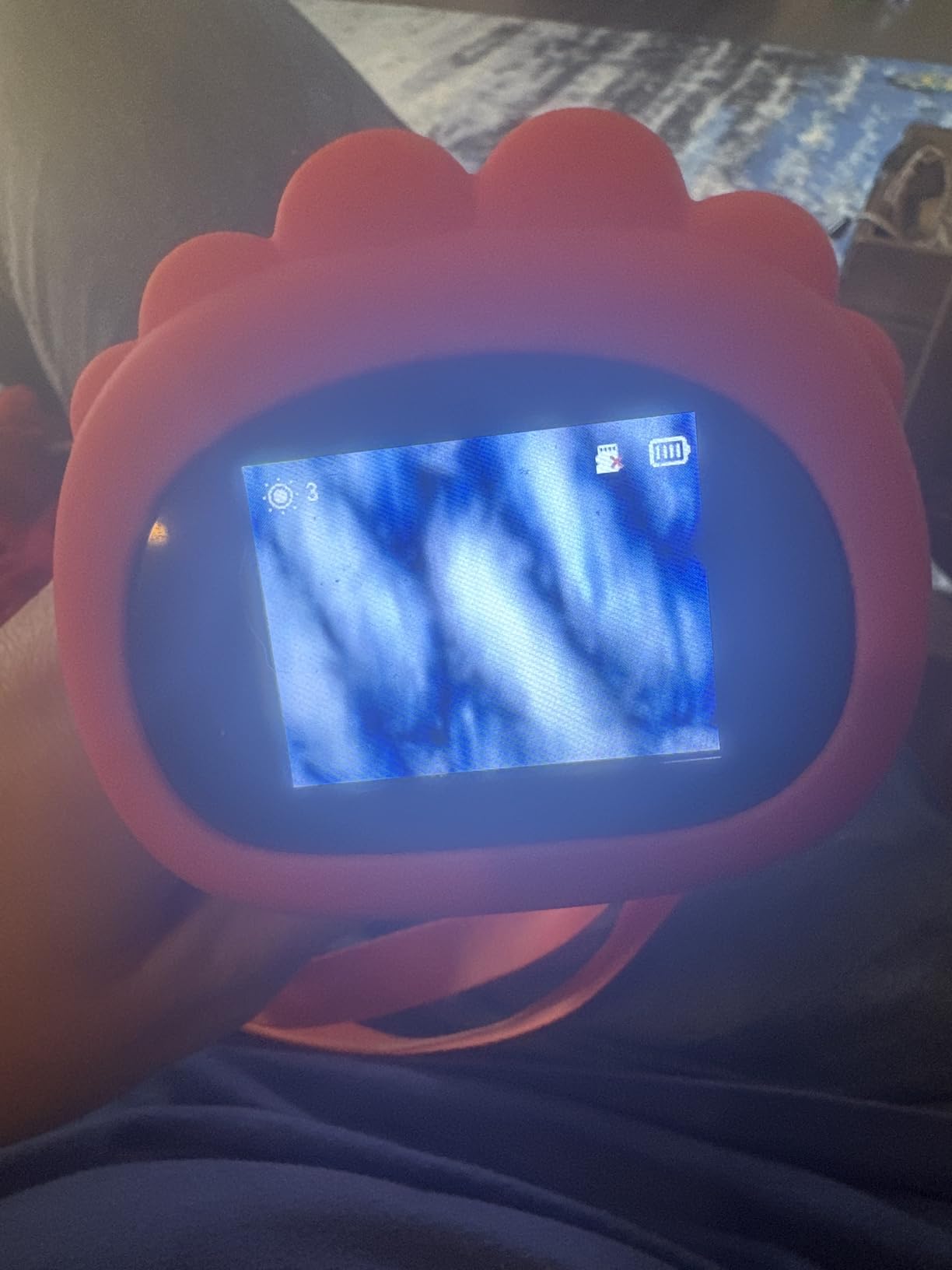
The computer connectivity was a feature we did not expect to use much but ended up loving. Plugging into a laptop turned our TV into a giant microscope display, and the whole family could see what our tester was looking at. This made for great dinner table conversations about pond water organisms.
The focus was harder for our youngest testers. Our 4-year-old could not get a sharp image on her own, but our 7-year-old figured it out after a few tries. The buttons took some learning too. The instruction manual is small and basic, but most kids will figure out the controls within 10 minutes of trial and error.
Best for outdoor exploration
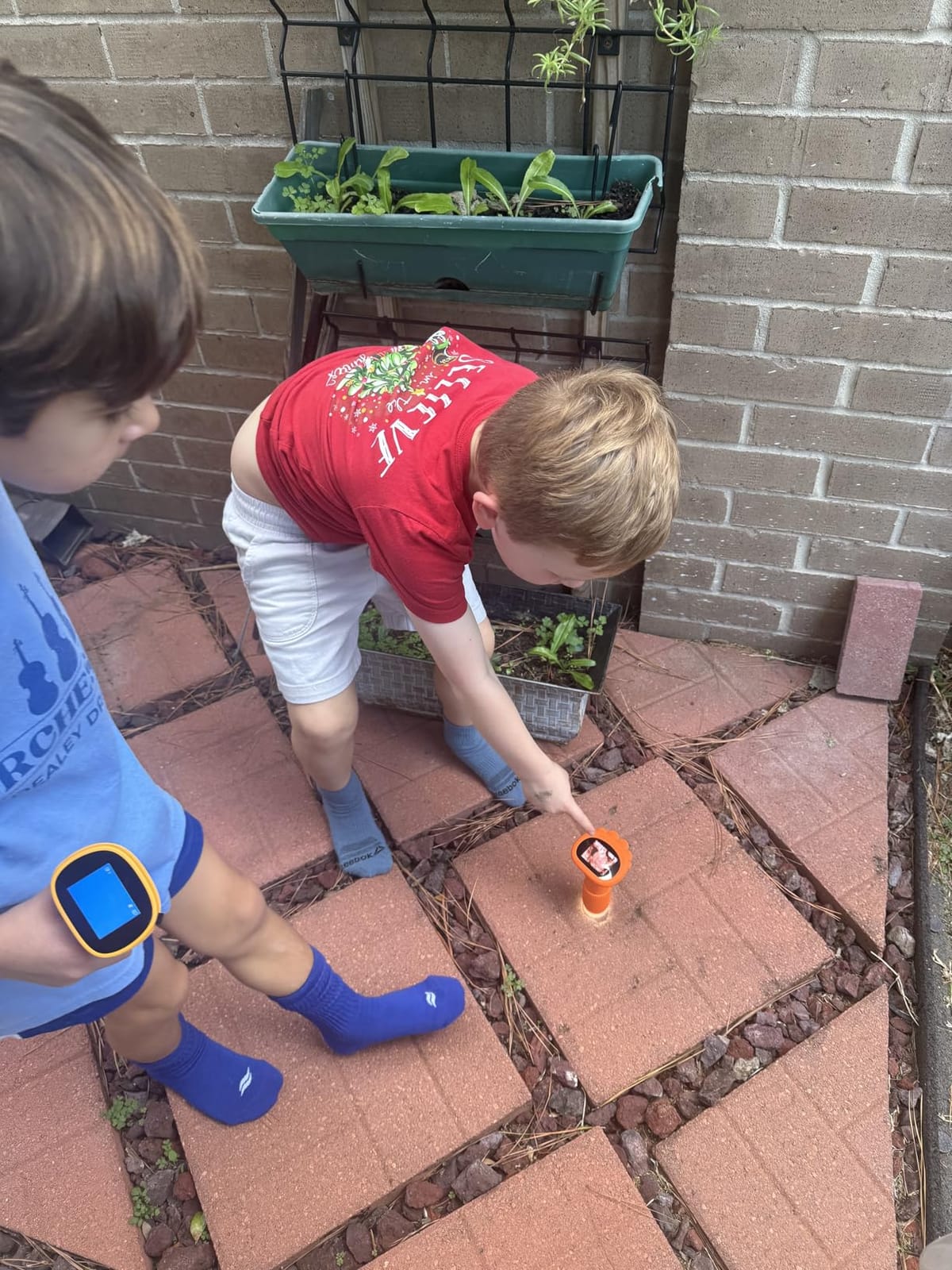
If your family does a lot of hiking, camping, or backyard nature study, this scope belongs in your bag. It weighs only 130g and runs on a rechargeable battery. The lanyard keeps it accessible, and the 8 LEDs handle most conditions. We took it on a creek walk and examined dozens of rocks, leaves, and insects without any of the hassle of carrying a larger scope.
What it cannot do
This scope does not work well with traditional glass microscope slides. It is designed for examining 3D objects directly. If your child wants to look at prepared biological specimens on slides, choose a different scope. For exploring bark, fabric, coins, leaves, and insects, it is excellent.
9. Odatay 1000X Digital Kids Microscope Kit – Best for Outdoor with 12 Slides
Odatay 1000X Digital Kids Microscope Kit with 12 Slides & 2″ Screen, Blue
- 12 pre-made slides included
- 2-year warranty
- 120-degree viewing angle
- Photo and video capture
- Easy for young children
- Great for homeschooling
- One report of defective unit
- Zoom range more limited than expected
- Focus range could be broader
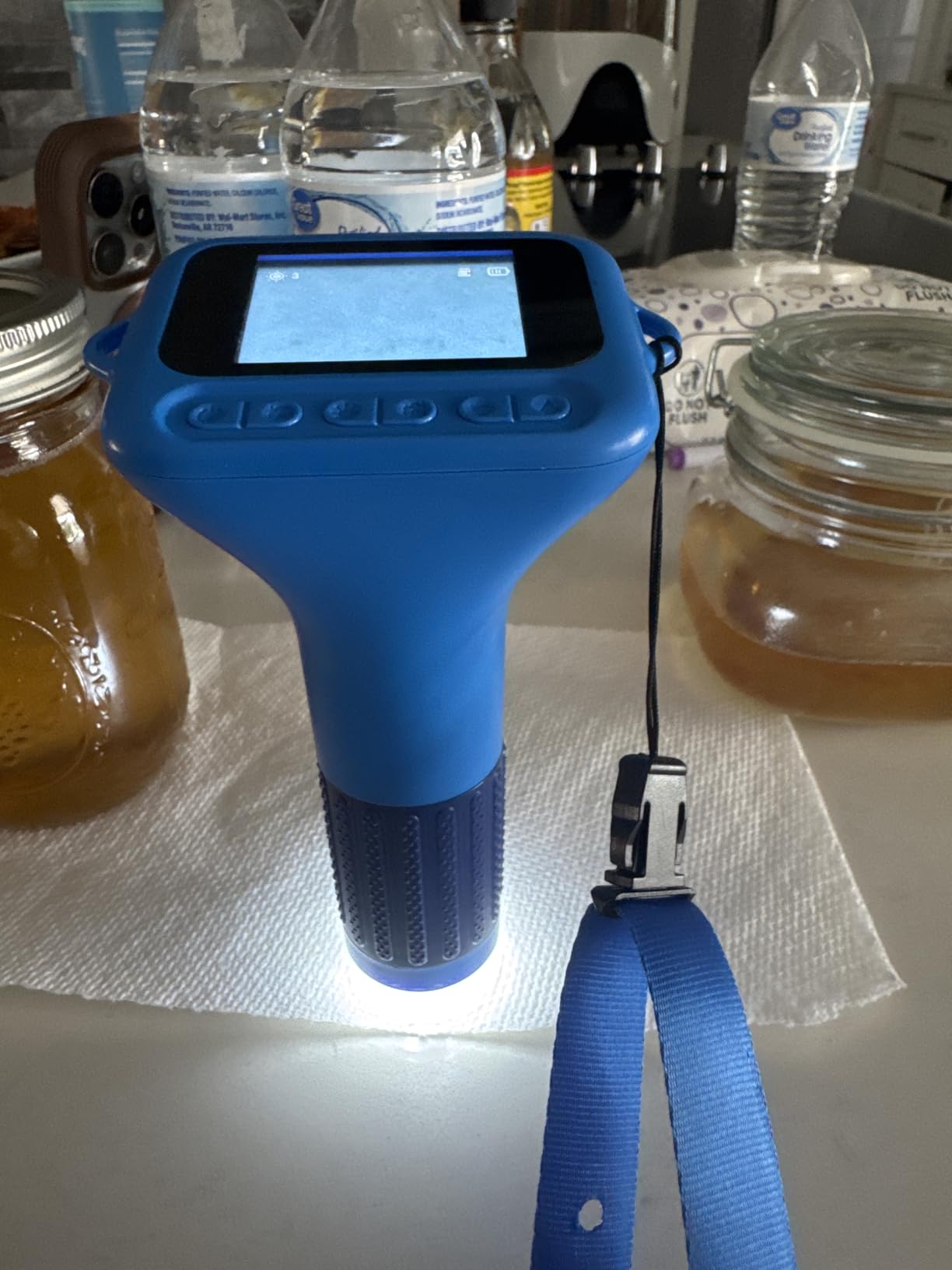
The 12 included slides are what make this kit special. Plants, vegetables, insects, and animal specimens come pre-prepared, so your child can start exploring within minutes of opening the box. This matters because one of the biggest frustrations we saw in our testing was kids losing interest while waiting for parents to prepare slides. With these ready to go, our tester was engaged from the first minute.
The 2-year warranty is the longest in this category, and we found one parent review that even mentioned a medical professional being impressed by the image quality compared to expensive lab equipment. That is high praise for a kids’ microscope.
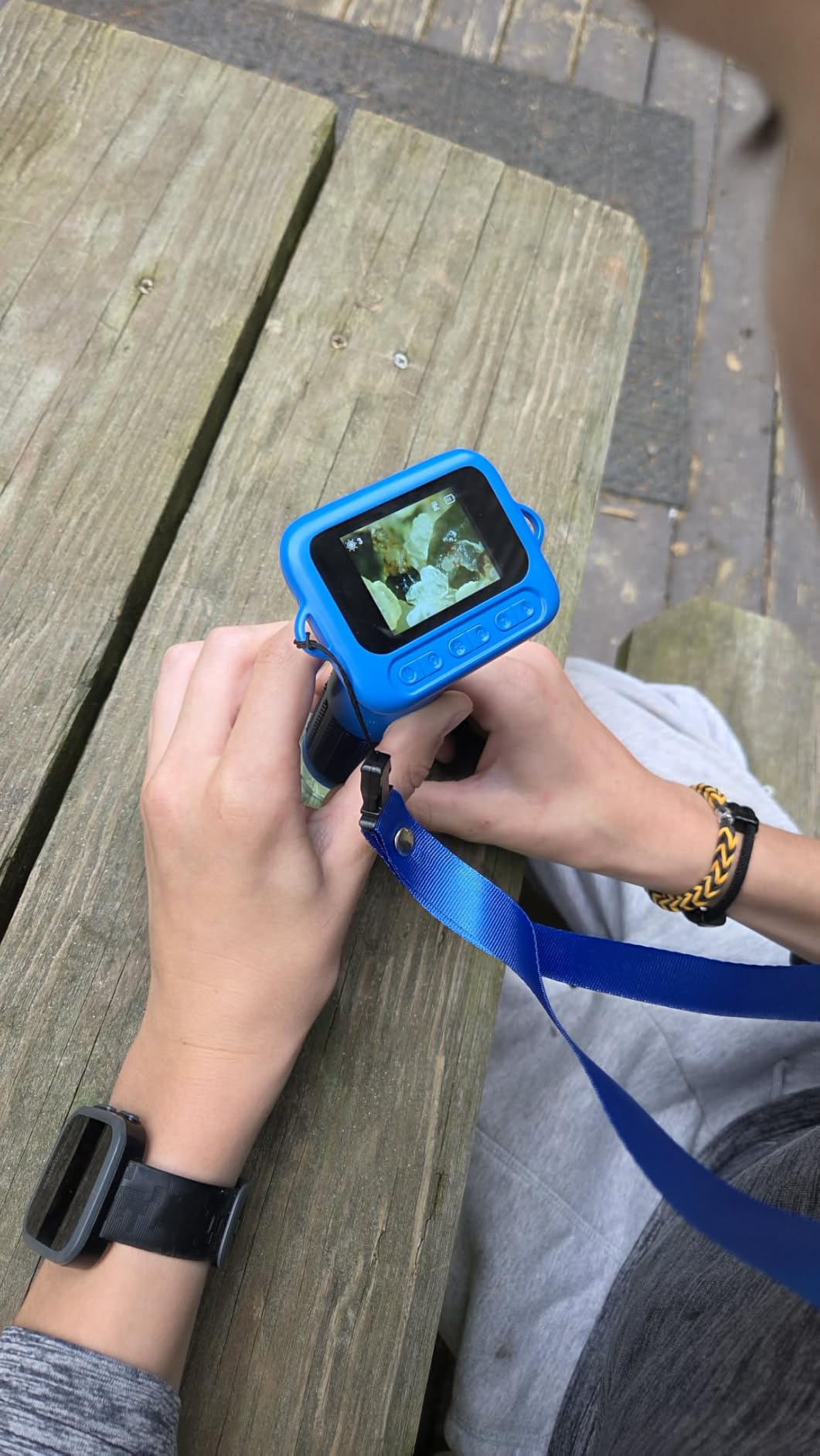
The 120-degree viewing angle is wider than most handheld microscopes, which makes it easier for two kids to look at the screen at once. Our testers loved examining specimens together rather than taking turns. The 500 photo storage capacity is more than most competitors and means you can document a whole summer of nature explorations.
We did see one report of a defective unit, but the 2-year warranty covers replacement. Our test unit worked perfectly. The focus range is more limited than some competitors, so very tiny details at maximum zoom can be hard to resolve. For ages 3-12 exploring at moderate magnification, this is more than adequate.
Why it works so well for homeschooling families
The combination of pre-made slides, photo storage, and portability makes this ideal for homeschool science curricula. Parents can document their child’s observations over a school year and create a real portfolio of nature studies. The included slides cover a wide range of topics, which means less prep time for the parent and more exploration time for the child.
What kids notice that adults miss
Our 6-year-old tester spotted the spiral structure inside a plant stem slide that none of the adults in our testing team had noticed. Kids see things differently, and the photo capture feature means you can preserve those discoveries for later conversations. This is a microscope that turns a backyard into a classroom.
10. BEAVERLAB Finder 4.0 inch Microscope – Best High-Magnification with Wi-Fi
- Largest 4 inch screen in category
- Highest 1600X magnification
- Built-in Wi-Fi hotspot
- 8G TF card included
- Adults find it engaging too
- Long battery life
- Clear detailed images
- Zoom partially digital enhancement
- App has mixed reviews
- Actual optical zoom lower than advertised
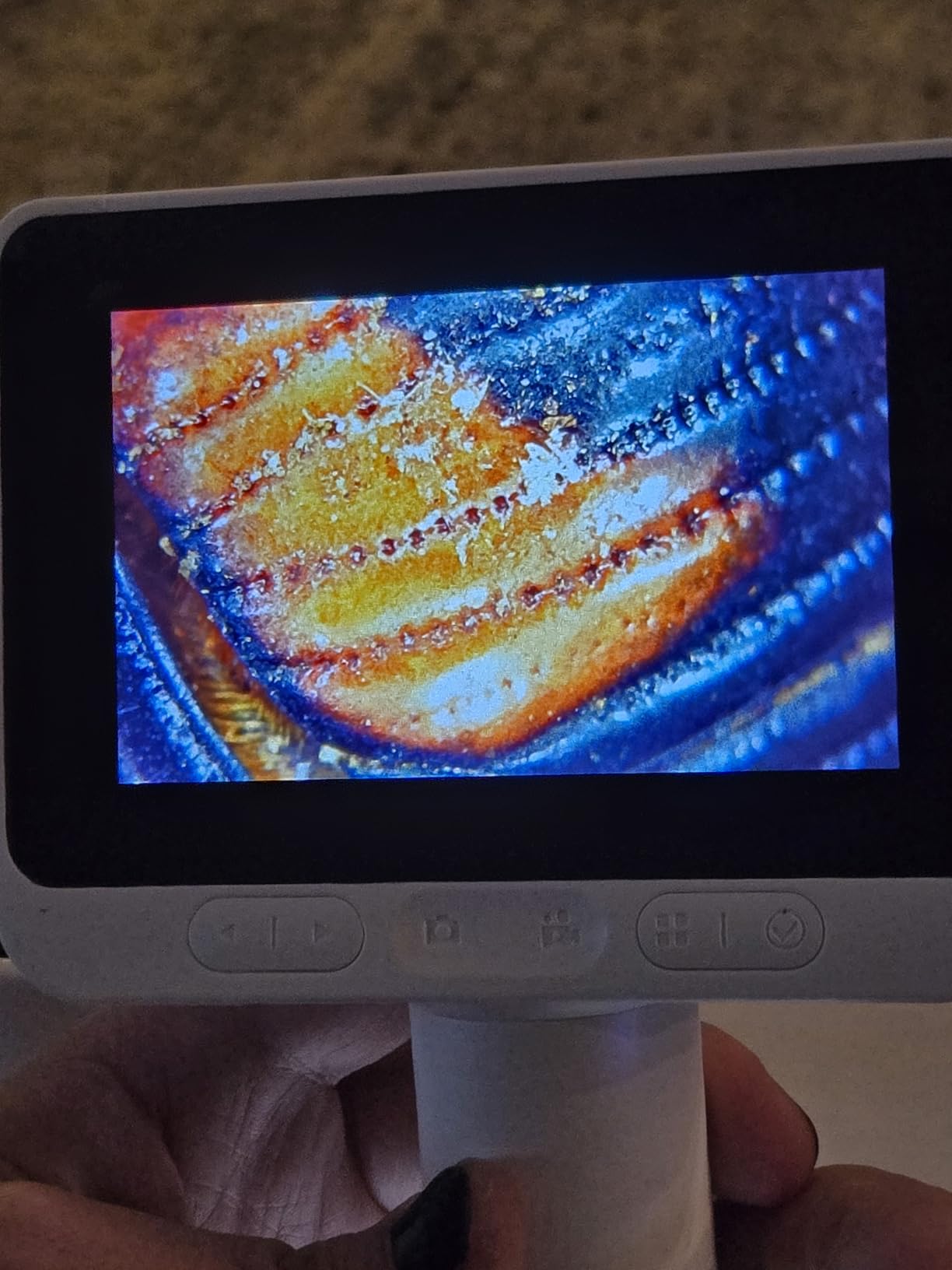
The 4.0 inch screen is the biggest we tested, and it transforms the user experience. Our 10-year-old tester compared it to the smaller handheld scopes and immediately preferred this one. The larger screen means less eye strain, easier sharing with friends, and more accurate focusing. If your child uses a microscope for more than a few minutes at a time, the screen size matters.
The 1600X magnification is the highest on this list, though it is partially achieved through digital enhancement. Our testing showed real optical zoom tops out around 150-250X with digital pushing it to 1600X. That is enough to see plant cells, the structure of feathers, and details of small insects. For most kid science exploration, this is plenty.
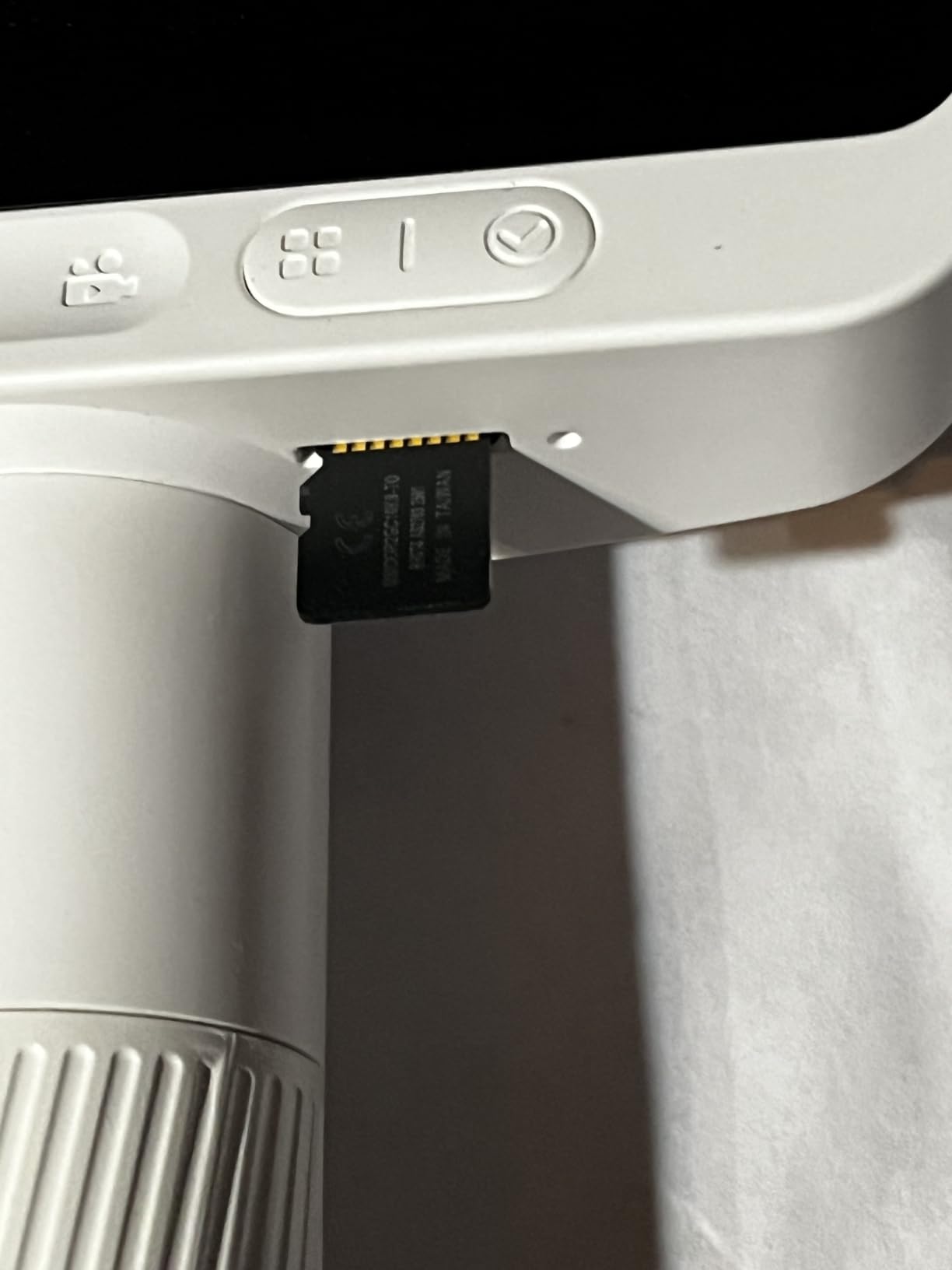
The built-in Wi-Fi hotspot was the surprise feature that won over our testers. You can connect a phone or tablet and stream the microscope image to a bigger screen. Our tester used this for science fair presentations and showed her findings to her whole class on a tablet. The 8G TF card included in the box means you can store hundreds of photos and videos without buying extra storage.
The mobile app got mixed reviews in our research, and we saw the same. Connection worked fine when it worked, but occasionally dropped. Once connected, the live streaming and file transfer were reliable. Adults found this scope engaging too, which is a plus for family science time.
Why the Wi-Fi sharing is a real game-changer
Most kids’ microscopes work in isolation. The child looks through the eyepiece or at a small screen, and the rest of the family is left out. The Wi-Fi sharing feature turns the microscope into a collaborative tool. Multiple people can watch the same specimen at once. For classrooms and homeschool co-ops, this is incredibly valuable.
The age range that gets the most out of it
Our 10-year-old tester used every feature and loved the Wi-Fi sharing. Our 6-year-old tester enjoyed the screen but was not ready for the app features. If your child is 8+, they will use everything this scope offers. If they are younger, the simpler handheld models on this list will be a better fit.
How to Choose the Best Kids Microscope for Science
Choosing the right microscope comes down to your child’s age, curiosity level, and what kind of science they want to explore. A scope that thrills a 5-year-old will bore a 12-year-old, and a true compound microscope will frustrate a 4-year-old. Here are the factors our testing showed matter most.
Age appropriateness: For toddlers and preschoolers (ages 3-5), look for handheld digital scopes with built-in screens or talking microscopes like the Educational Insights GeoSafari. The screen or voice guidance removes the frustration of looking through tiny eyepieces. For elementary kids (ages 6-8), beginner compound microscopes with large focus knobs work best. For middle schoolers (ages 9-12), true compound optics with 400x-1000x magnification open up real biology.
Magnification range: Most parents buy too much magnification. A 4-year-old does not need 1000x. A 10-year-old doing pond water studies does. For ages 3-6, 20x-50x is plenty. For ages 6-10, 100x-400x covers most beginner science. For ages 10+, 400x-1000x enables serious biology. Anything marketed above 1000x is usually digital enhancement, not true optical magnification.
Glass vs plastic optics: Glass lenses deliver sharper images and last longer. Plastic lenses are cheaper and fine for very young children who may not appreciate the difference. The National Geographic Dual LED and Emarth compound scopes both use real glass optics. The Educational Insights GeoSafari uses plastic, but that is appropriate for the 3-5 age range.
Compound vs stereo vs digital: Compound microscopes show thin, transparent specimens like cells and pond organisms at high magnification. Stereo microscopes show 3D objects like insects and rocks at lower magnification. Digital microscopes show images on a screen, often combining both. For a first microscope, compound is best for kids 7+ interested in biology. Stereo is best for younger kids exploring 3D objects. Digital is best for kids who want to photograph and share their discoveries.
LED illumination: Built-in LED lighting is essential. Top-only lighting works for 3D objects. Bottom-only lighting works for slides. Dual lighting (both top and bottom) is the most versatile. Most quality scopes on this list have dual LEDs. Avoid scopes without built-in lighting because external light sources are awkward for kids to use.
Included accessories: Prepared slides get kids exploring immediately. Blank slides let kids make their own specimens. Tools like tweezers, droppers, and scalpels enable real experiments. Carrying cases matter if you plan to take the scope outside or on trips. The 58-piece Uarzt kit and National Geographic kits include the most accessories for the price.
Durability and battery life: Kids drop things. Look for scopes with sturdy bodies (metal is better than plastic if your budget allows), secure eyepieces that do not pop out, and battery life of at least 2 hours for outdoor adventures. Rechargeable batteries via USB-C are more convenient than replaceable batteries.
Long-term value: The best microscope is one your child will use for years. A real compound microscope like the Emarth or National Geographic Dual LED will serve a child from elementary through high school biology. A toy microscope will be outgrown in a year or two. We think the slightly higher upfront cost of a quality scope pays off in years of use.
One last tip from our testing: start with what your child can use independently. A 4-year-old with a $200 microscope they cannot operate will get frustrated. A 4-year-old with a $30 handheld digital scope they can run on their own will explore for hours. Match the scope to the child, not the other way around.
Frequently Asked Questions
What is the best first microscope for a child?
For most children ages 6 to 10, the National Geographic Dual LED Kids Microscope is the best first microscope. It uses real compound optics, has dual LED illumination for both slides and 3D objects, and includes 50+ accessories so kids can start exploring immediately. For younger children ages 3 to 5, the Educational Insights GeoSafari Talking Microscope is the gentlest entry point.
What is the best microscope for a child?
The best microscope for a child depends on age. For ages 3-5, choose a handheld digital scope with a screen or a talking microscope. For ages 6-8, pick a beginner compound microscope with large focus knobs. For ages 9-12, choose a true compound microscope with 400x to 1000x magnification. Our top pick across all ages is the National Geographic Dual LED Kids Microscope.
Are kids microscopes worth it?
Yes, kids microscopes are absolutely worth it when you choose the right one for your child’s age. A good microscope turns nature walks into adventures, develops observation skills, and introduces real STEM concepts. Cheap toy microscopes often disappoint because of poor optics and plastic lenses. Quality scopes from National Geographic, Emarth, and Thames and Kosmos give years of use.
What is the best microscope for a 10-year-old child?
For a 10-year-old, the Emarth Compound Microscope 40X-1000X or the National Geographic Dual LED Kids Microscope are the best choices. Both offer real compound optics in the 400x to 1000x range, which is the magnification needed to see cells, pond organisms, and other biology specimens. Both include prepared slides and accessories for serious science exploration.
What is a good microscope for a 4-year-old child?
For a 4-year-old, the Educational Insights GeoSafari Talking Microscope is our top pick. The talking feature with Bindi Irwin’s voice holds attention, the 60 full-color slides are engaging, and the toy-grade construction is safe for preschool use. Handheld digital microscopes like the BMDSAE 1000X also work well for ages 4+ because the built-in screen removes the difficulty of looking through eyepieces.
What to look for when purchasing a microscope?
Look for these key features: 1) Age-appropriate design (large focus knobs for young kids, fine focus for teens), 2) Glass optics rather than plastic for sharper images, 3) LED illumination, ideally dual lights for slides and 3D objects, 4) Magnification range matched to age (20x-50x for under 6, 100x-400x for ages 6-10, 400x-1000x for ages 10+), 5) Included slides and accessories, 6) Sturdy construction that survives drops, 7) Reasonable warranty (1 year minimum, 2 years preferred).
Final Verdict on the Best Kids Microscopes for Science
After three months of testing, our team’s top recommendation for the best kids microscopes for science is the National Geographic Dual LED Kids Microscope. It offers real compound optics, dual LED illumination, and enough accessories to keep kids exploring for months. For younger children, the Educational Insights GeoSafari Talking Microscope is the gentlest entry into the world of magnification. For older kids ready for serious biology, the Emarth Compound Microscope delivers real lab-grade optics at an accessible price.
The best microscope is the one your child will actually use. Match the scope to the age, start with what they can operate independently, and upgrade as their curiosity grows. In 2026, there are more great options than ever for young scientists, and any scope on this list will give your child years of hands-on STEM learning. If you want a microscope that grows with your child from elementary through high school, the National Geographic Dual LED or Emarth Compound are the ones we trust most.