
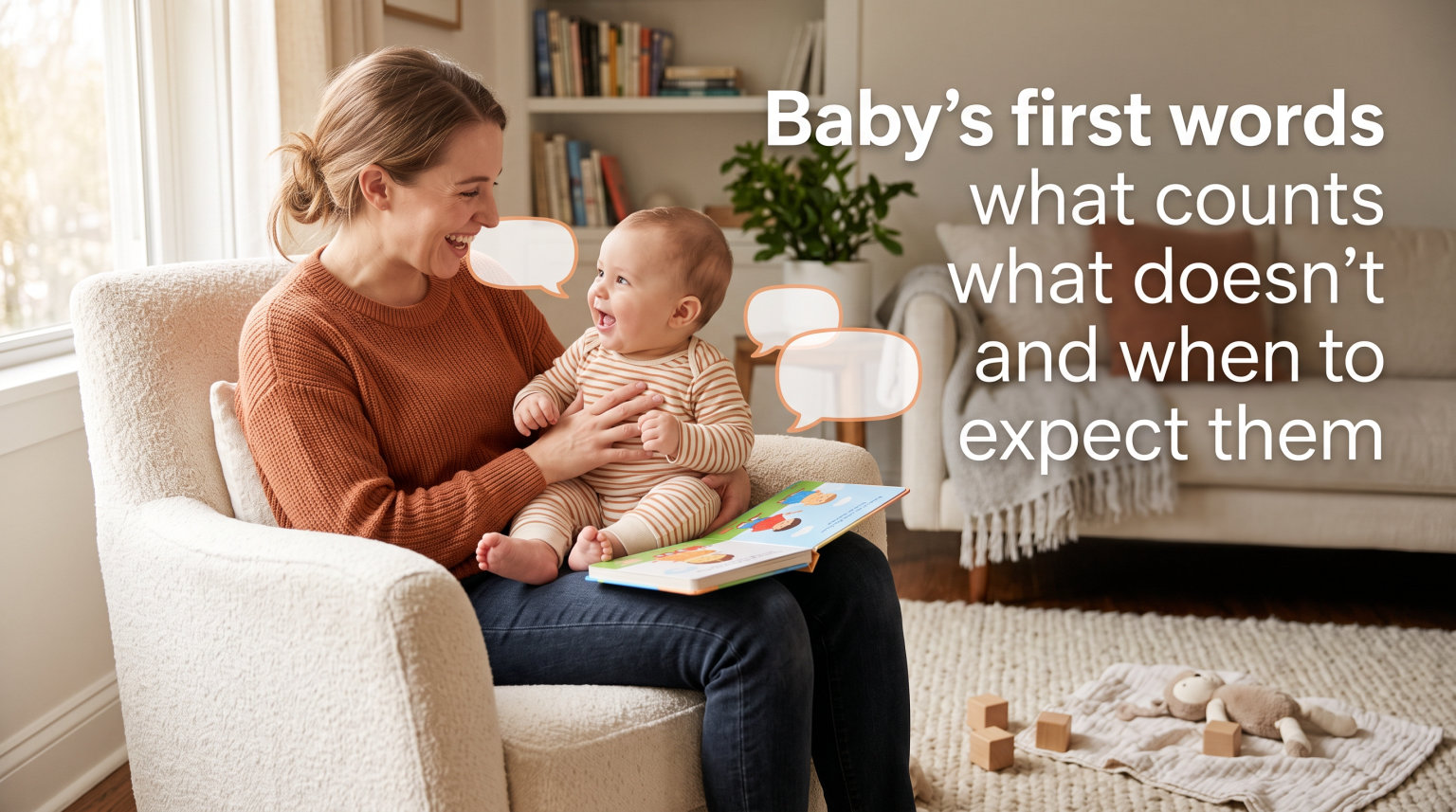
You are watching your baby closely. Every coo, every babble, every random sound makes you lean in and wonder: Was that it? Did my baby just say their first word?
I remember that exact feeling. When my daughter was 11 months old, she looked at our dog and let out a clear “duh!” while pointing. My heart skipped. But then I second-guessed myself. Does that even count as a real word?
As parents, we put enormous pressure on ourselves to catch these milestones. We compare our babies to others at playgroup. We worry when grandma mentions that cousin Ethan was speaking in full sentences by this age. The truth is, baby first words are both simpler and more complex than most of us realize.
In this guide, I will share exactly what speech-language pathologists consider a true first word, why timing varies so much between babies, and the pre-verbal milestones that matter just as much as actual speech. You will also learn what does not count (and why that matters), plus practical ways to encourage your baby’s communication starting today.
Most babies say their first word between 10 and 14 months. Some start as early as 8 months, while others wait until 16 months or later. All of these timeframes can be perfectly normal. What matters more than timing is the pattern of communication your baby is building.
Table of Contents
What Counts as a Baby’s First Word
A first word is not about perfection. It is about intention, consistency, and meaning. Speech-language pathologists use three key criteria to determine whether your baby has truly spoken their first word.
First, the sound must be intentional. Your baby uses it purposefully to communicate something, not just randomly while playing with sounds. When your little one looks at you, reaches for their cup, and says “baba,” that is intentional communication. The same sound made while chewing on a toy is probably not.
Second, it must be consistent. Your baby uses the same sound pattern to refer to the same thing, person, or concept repeatedly. It does not need to match adult pronunciation. If “da” always means dog, whether they see the actual pet or a picture in a book, that counts as a word.
Third, it needs appropriate context. Your baby uses the sound in relevant situations, not randomly. Saying “mama” while reaching for you indicates they understand who mama is. The same sound made while staring at a ceiling fan probably does not count yet.
Word Approximations Count
Here is the part that surprises many parents. Your baby does not need to pronounce words perfectly for them to count. Word approximations, sometimes called proto-words, are simplified versions that follow consistent patterns. “Ba” for ball, “duh” for dog, or “nana” for banana are all legitimate first words.
These simplifications follow predictable patterns. Babies naturally drop tricky consonants and simplify syllable structures. Consonant clusters (like the “tr” in truck) almost always get reduced. Ending sounds often disappear because they are harder to produce than beginning sounds. These patterns show your baby is actively working on speech development, not just randomly guessing.
Animal Sounds Are Words
One of the most common first “words” is not a word at all in the traditional sense. Animal sounds like “woof woof,” “moo,” or “baa” absolutely count as legitimate first words. They meet all three criteria: they are intentional, consistent, and used in context.
Animal sounds are actually easier for babies to produce than many real words. They often contain simple vowel sounds and early developing consonants. Plus, they are fun. Your baby hears you making these sounds during play, and they naturally want to imitate them. When your baby sees a dog and says “woof,” they are communicating just as effectively as if they said the word “dog.”
Exclamatory Words and Sound Effects
Words like “uh oh,” “yay,” “wow,” “bye bye,” and “peekaboo” frequently appear as early vocabulary. These exclamatory words pack a lot of communication punch with simple sounds. They express emotions, mark social routines, and connect your baby to the people around them.
Sound effects also count. “Vroom” for a car, “beep beep” for a truck, or “choo choo” for a train are all meaningful communication. Your baby is showing they understand what objects do and can reference them with consistent sounds. This is sophisticated communication, even if it does not sound like adult speech.
Sign Language as First Words
If your baby uses sign language, those signs absolutely count as first words. Signs for “more,” “milk,” “eat,” or “all done” meet the same three criteria as spoken words. They are intentional, consistent, and contextually appropriate.
Many babies actually sign before they speak. The motor control needed for hand gestures develops earlier than the complex coordination required for speech. Babies as young as 8 or 9 months can learn meaningful signs. If your baby signs “milk” when they want to nurse or have a bottle, that is just as much a first word as if they said the sound.
Partial Words and Simplifications
Your baby might only manage the first syllable of a word. “Ba” for bottle, “mo” for more, or “da” for daddy are all valid first words. These partial productions show your baby recognizes the word and is attempting to say it. They will add more sounds as their speech develops.
Some babies create their own consistent sound patterns that do not resemble adult words at all. One baby I know called his blanket “geh.” He used it every single time he wanted his blanket, from 10 months until he was almost 2 years old. That absolutely counted as his word for blanket, even though no adult would have guessed the meaning without context.
When Do Babies Say Their First Words
Most babies say their first word between 10 and 14 months of age. This is the typical window, but individual babies vary widely. Some early talkers produce clear words as young as 8 or 9 months. Late talkers might not have a recognizable word until 15 or 16 months. Both ends of this spectrum can fall within normal development.
By the time most babies reach their first birthday, about half will have at least one word. By 15 months, most babies have between 1 and 3 words. By 18 months, the average toddler has about 20 words, though anywhere from 10 to 50 is considered normal at that age.
Why Dada Often Comes Before Mama
Here is a fascinating detail that many parents notice but few understand. “Dada” frequently appears before “mama,” even though babies typically spend more time with their mothers. This is not favoritism or a commentary on parenting roles. It is about speech sound development.
The “d” sound is physically easier for babies to produce than the “m” sound. The “d” sound is a plosive made with the tongue tapping behind the front teeth. The “m” sound requires sustained airflow through the nose while the lips are pressed together. That nasal resonance and lip closure coordination is actually more complex for developing mouths.
Babies practice the “d” sound naturally during babbling. They produce strings of “dadadada” sounds while playing with their voice. When they finally connect that easy sound to the person who walks in the door every evening, “dada” emerges. The “m” sound takes more time to master, so “mama” often follows a few weeks or months later.
Factors That Influence Timing
Several factors affect when your baby will say their first word. Genetics plays a role. If you or your partner were early or late talkers, your baby might follow a similar pattern. Birth order matters too. Firstborns often speak earlier because they have more one-on-one adult interaction. Later children might talk later but often catch up quickly once they start.
How caregivers interact with baby matters significantly. Babies whose caregivers talk to them frequently, respond to their sounds, and read together daily tend to develop language skills earlier. This is not about flashcards or educational videos. Simple back-and-forth interaction, called serve and return communication, builds the neural pathways for language.
Bilingual babies sometimes appear to start talking later, but this is usually a misconception. They are processing two language systems simultaneously. Their total vocabulary across both languages is typically on par with monolingual peers. They may simply mix languages or take slightly longer to produce their very first words.
The Difference Between First Word and Meaningful Use
Many babies produce sounds that resemble words before they truly understand them. A 6-month-old might say “mama” while babbling, but this is not a true first word. They are not calling for their mother specifically. They are experimenting with sounds.
The real milestone happens when your baby uses a word with clear intention and understanding. This usually occurs closer to 10-14 months. When your baby says “mama” while reaching for you specifically, or says “dog” while pointing at the family pet, that is meaningful communication.
Baby Language Milestones Before First Words
First words do not emerge from nowhere. They build on months of pre-verbal communication development. Understanding these earlier milestones helps you see your baby’s progress and provides plenty of opportunities for encouragement along the way.
Birth to 3 Months: Crying and Cooing
Newborns communicate through crying. Different cries signal hunger, discomfort, or tiredness. Parents quickly learn to distinguish these sounds, though it takes practice. This is the foundation of communication: making sounds that produce responses from caregivers.
By 6 to 8 weeks, most babies start cooing. These are soft, vowel-like sounds such as “oooo” and “aaaa.” Your baby experiments with their voice, discovering what their mouth can do. They also start to recognize your voice and may become quiet when they hear you speak. This is the beginning of receptive language, understanding before expressing.
4 to 6 Months: Laughter and Early Babbling
Around 4 months, your baby’s laughter emerges. This is social communication at its finest. They are responding to your actions and connecting joyfully. They also begin making raspberries, blowing bubbles, and experimenting with consonant sounds.
By 6 months, early babbling starts. You will hear strings of sounds like “ba ba ba” or “da da da.” These are not words yet, but they are important practice. Your baby is learning to coordinate their mouth, tongue, and breathing to produce consistent sounds. They are also learning that sounds get reactions from you.
At this stage, babies often become more interactive during conversations. They make sounds, pause for your response, then make more sounds. This turn-taking pattern mimics adult conversation and teaches the rhythm of communication.
7 to 9 Months: Canonical Babbling and Gestures
Between 7 and 9 months, canonical babbling appears. This is when consonant-vowel combinations repeat in patterns: “bababa,” “dadada,” “nanana.” These patterns are the building blocks of real words. Your baby is practicing the mouth movements they will need for speech.
Receptive language explodes during this period. Your baby understands simple words like “no,” “bye bye,” and their own name. They respond to their name by turning or looking. They might stop briefly when you say “no,” even if they proceed anyway.
Gestures become important communication tools. Your baby waves bye bye, reaches to be picked up, and points at interesting things. Pointing is especially significant. It shows your baby wants to share attention and experiences with you. This joint attention is a critical foundation for language development.
10 to 12 Months: Jargon and First Words
Between 10 and 12 months, many babies enter the jargon stage. This is babbling that sounds like conversation but contains no real words. It has the rhythm, intonation, and pauses of adult speech. Your baby is practicing the melody of language.
First words often appear during this window. They are typically simple, starting with sounds your baby can easily produce. Common early words include “mama,” “dada,” “bye bye,” “hi,” “dog,” “ball,” and “more.” Your baby might also use consistent sound patterns that only you recognize as specific words.
At 12 months, most babies understand between 50 and 100 words, even if they cannot say them yet. They follow simple directions like “come here” or “give me the toy.” They recognize familiar people, objects, and body parts when named. This receptive vocabulary is the reservoir from which expressive language will flow.
Language Milestones Summary Table
| Age Range | Key Milestones | What Parents Can Do |
|---|---|---|
| Birth to 3 months | Crying, cooing, recognizes voice | Talk, sing, and respond to sounds |
| 4 to 6 months | Laughter, early babbling, turn-taking | Have “conversations,” mimic sounds |
| 7 to 9 months | Canonical babbling, gestures, understands name | Teach simple signs, name objects |
| 10 to 12 months | Jargon, first words, follows directions | Read daily, expand on their sounds |
| 12 to 15 months | 1 to 3 words, more gestures, understands 50+ words | Label everything, give choices |
| 15 to 18 months | 10 to 50 words, combines gestures with words | Simplify speech, sing songs |
| 18 to 24 months | Word explosion, two-word phrases | Expand their phrases, ask questions |
What Doesn’t Count as a First Word
This is where I want to give you some relief. Not every sound your baby makes is a word, and that is perfectly fine. Understanding what does not count helps you celebrate true communication milestones while keeping realistic expectations about your baby’s development.
Random babbling does not count. When your baby strings together “dadadada” sounds while playing alone, they are practicing speech motor skills. This is important development, but it is not a word. There is no specific meaning attached, no context, and no intention to communicate something specific.
Reflex vocalizations are not words. Crying, coughing, sneezing, and hiccup sounds are automatic responses, not communication. Even if your baby cries in a way that sounds like “ma,” this is not a true word. It is a physical response to discomfort or need.
Echolalia without understanding does not count. Sometimes babies repeat sounds they hear without grasping the meaning. A 10-month-old might say “thank you” after hearing you say it, but if they say it randomly or in wrong contexts, they are just imitating sounds. True words require understanding.
Sounds made only during play are usually not words. If your baby says “ba” repeatedly while banging blocks together, they are likely enjoying the sound itself. This is sound play, not word use. However, if they look at you, hold up a block, and say “ba,” that might be their word for block.
Isolated productions without consistency do not count. A single instance of something that sounds like “mama” is exciting, but it is not a true first word yet. Your baby needs to use the sound repeatedly in appropriate contexts before it qualifies as a word in their vocabulary.
How to Tell the Difference
So how do you know if a sound counts as a real word? Watch for the three criteria we discussed earlier. Does your baby use the sound intentionally to communicate? Is it consistent across different situations? Does the context match the meaning?
Also, look at your baby’s body language. True words usually come with eye contact, pointing, or reaching. Your baby is trying to get your attention and share something with you. Random babbling tends to happen without that social connection.
Finally, consider whether your baby seems to expect a response. After saying a true word, most babies pause and look at you, waiting for acknowledgment. This shows they understand the conversational nature of communication.
How to Encourage Your Baby’s First Words
You cannot force a first word, but you can create an environment where language flourishes. These strategies are backed by speech-language research and fit naturally into your daily routines.
Narrate Your Day
Talk about what you are doing constantly. “Now I am putting on your shirt. Here goes your arm through the sleeve.” This running commentary exposes your baby to language in context. They hear words connected to real actions and objects.
You might feel silly at first. Talking to someone who does not talk back seems odd. But your baby is absorbing every word. Studies show that babies whose caregivers talk to them frequently have larger vocabularies later. The quantity and quality of words matter.
Use Parentese Effectively
Parentese, sometimes called baby talk, is that sing-song way adults naturally speak to babies. Higher pitch, exaggerated vowels, slower pace, and plenty of pauses. This is not the same as using nonsense words or poor grammar. It is a modified form of speech that actually helps babies learn language.
The exaggerated sounds make it easier for babies to distinguish individual phonemes. The slower pace gives them time to process. The higher pitch captures attention. Research shows babies prefer parentese to regular speech and learn words faster when caregivers use it.
Respond to Baby’s Sounds (Serve and Return)
When your baby makes a sound, treat it like the opening line of a conversation. Respond with interest and wait for their next “turn.” This back-and-forth pattern, called serve and return, builds neural connections for communication.
Your baby coos. You coo back and add a comment. They look at you and make another sound. You respond again. Even without real words, you are having a dialogue. This teaches your baby that communication is rewarding and effective.
Read Together Daily
Reading exposes your baby to rich vocabulary, complex sentence structures, and the rhythm of stories. Board books with simple pictures work well for babies. You do not need to read every word. Point to pictures, name objects, and make sounds together.
Let your baby turn pages (even if they go backward). Ask questions, even though they cannot answer yet. “Where is the doggie? What does the doggie say?” This interactive style of reading, called dialogic reading, builds language skills more effectively than simply reading text aloud.
Sing Songs and Nursery Rhymes
Songs teach language patterns, rhythm, and new vocabulary. The repetitive nature of nursery rhymes helps babies predict what comes next. Simple songs with gestures, like “Itsy Bitsy Spider” or “Wheels on the Bus,” add movement and engagement.
Music activates multiple areas of the brain simultaneously. Singing together is also joyful bonding time. Do not worry about your voice. Your baby loves the sound of you singing more than any professional recording.
Limit Screen Time
The American Academy of Pediatrics recommends no screen time (except video chatting) for children under 18 months. This is not just about limiting exposure. It is about protecting the interactive, responsive communication that babies need for language development.
Video does not respond to your baby. The characters do not pause when your baby coos or look back when your baby points. Screens provide one-way communication, which does not build the same neural pathways as live interaction. Save screens for after language is well established.
When to Worry About Speech Delays
Most babies follow their own timeline, and late talking by itself is rarely cause for alarm. However, certain red flags warrant professional evaluation. Knowing these signs helps you advocate for your child without unnecessary anxiety.
Red Flags by Age
By 7 months: Your baby should be responding to sounds and voices. They should turn toward noises and show interest in new sounds. If your baby seems oblivious to sound, hearing may be an issue.
By 12 months: Most babies are babbling with consonant sounds and using gestures like pointing and waving. If your baby makes no sounds other than crying, or shows no interest in communication, mention it to your pediatrician.
By 15 months: Most babies have at least one word they use consistently and meaningfully. If your baby has no words at all by 15 months, consider requesting a hearing test and developmental screening.
By 18 months: The average toddler has 10 to 50 words and is adding new ones regularly. If your baby has fewer than 10 words or seems to have lost previously used words, seek evaluation.
By 24 months: Most children are combining two words into phrases like “more milk” or “mommy up.” If your 2-year-old has fewer than 50 words or no two-word combinations, speech therapy may be beneficial.
Speech Delay Versus Language Delay
Speech and language are different skills. Speech refers to the physical production of sounds. Language refers to the system of communication, including understanding words, using gestures, and eventually forming sentences.
A child can have a speech delay (trouble producing sounds) with normal language development (good understanding and communication through gestures). Conversely, a child might have clear speech but struggle with language concepts. Speech-language pathologists can evaluate both areas.
Hearing Concerns
Hearing problems are the most common cause of speech and language delays. Even mild hearing loss can significantly impact language development because babies learn speech by hearing it. Frequent ear infections can cause temporary hearing loss that affects learning.
If your baby does not startle at loud sounds, does not turn toward your voice, or seems to hear some sounds but not others, request a hearing evaluation. Newborn hearing screenings catch major issues, but progressive or fluctuating hearing loss can develop later.
When to Seek Evaluation
Trust your instincts. If you feel something is not right with your baby’s communication development, talk to your pediatrician. Early intervention services are available in every state for children with developmental delays, often at no cost to families.
Contact early intervention if your baby shows multiple red flags, has lost skills they previously had, or if you have ongoing concerns despite reassurances to “wait and see.” The earlier support begins, the more effective it is. There is no downside to early evaluation, and it can make a significant difference in outcomes.
Remember that many late talkers catch up completely with no intervention. Some children, especially boys and second-born children, simply start talking later. The goal is to identify the children who need support while avoiding unnecessary worry about normal variation.
Frequently Asked Questions
What counts as baby’s first words?
A first word is any intentional, consistent sound or gesture used to communicate meaning in the appropriate context. This includes word approximations like ‘ba’ for ball, animal sounds like ‘woof,’ exclamatory words like ‘uh oh,’ sign language signs, and partial words. The sound does not need to match adult pronunciation perfectly.
When should you expect your baby’s first word?
Most babies say their first word between 10 and 14 months of age. Some early talkers begin as early as 8 months, while late talkers may not produce a recognizable word until 15 or 16 months. By 12 months, about half of babies have at least one word. By 15 months, most have between 1 and 3 words.
What’s the earliest a baby can say mama or dada?
Babies may babble ‘mama’ or ‘dada’ sounds as early as 6 to 8 months, but these are usually not true words yet. True intentional use of these words typically emerges between 9 and 14 months. ‘Dada’ often appears before ‘mama’ because the ‘d’ sound is physically easier for babies to produce than the ‘m’ sound.
What is the rarest baby’s first word?
While most babies start with simple sounds like ‘mama,’ ‘dada,’ ‘hi,’ or ‘bye bye,’ some first words are quite unusual. Rare first words reported by parents include ‘octopus,’ ‘helicopter,’ ‘delicious,’ and ‘ actually.’ These typically occur when a baby becomes fascinated with a specific object or mimics a frequently heard expression.
At what age is speech delay a concern?
Speech delays become a concern if your baby has no meaningful words by 15 months, fewer than 10 words by 18 months, or no two-word phrases by 24 months. Other red flags include no babbling by 12 months, loss of previously used words, or lack of response to sounds and voices. Early evaluation is always recommended if you have concerns.
What is the red flag for speech delay?
Major red flags include: no babbling or consonant sounds by 12 months, no pointing or gestures by 12 months, no words by 15 months, fewer than 10 words by 18 months, no two-word combinations by 24 months, loss of previously acquired skills, and lack of response to sounds or voices. Hearing difficulties should also be ruled out.
How late is too late for first word?
While most babies have a first word by 14 months, many healthy, normal children do not speak until 15 to 18 months. Concern increases after 18 months with no words. However, late talking alone does not indicate a problem. The pattern of communication, including gestures, understanding, and social engagement, matters more than the exact timing of first words.
What is the 3 6 9 rule for babies?
The 3-6-9 rule refers to expected word counts at certain ages: approximately 3 words by 12 months, 6 words by 15 months, and 9 words by 18 months. However, this is a rough guideline. The normal range is wide, with some 18-month-olds having 10 words and others having 50 or more. Both can be developmentally normal.
Does dada count as a first word?
Yes, ‘dada’ absolutely counts as a first word when used intentionally and consistently to refer to father. The sound does not need to be perfectly pronounced. If your baby says ‘dada’ or even ‘da’ while reaching for or looking at their father, that qualifies as a meaningful first word, regardless of whether ‘mama’ has emerged yet.
Do animal sounds count as first words?
Yes, animal sounds like ‘woof,’ ‘moo,’ ‘baa,’ and ‘meow’ count as legitimate first words. They meet all the criteria for true words: they are intentional, used consistently, and applied in appropriate contexts. Animal sounds are often easier for babies to produce than full words and are frequently among the earliest forms of intentional communication.
Conclusion
Baby first words are a magical milestone, but they are not the whole story of your child’s communication journey. The months of cooing, babbling, gesturing, and understanding that come before that first word are equally important building blocks. Every sound your baby makes is practice for the conversations to come.
Remember the three criteria for a true first word: intention, consistency, and context. Word approximations, animal sounds, exclamations, and signs all count. Your baby’s “duh” for dog is just as valid as another child’s perfectly pronounced “doggy.” What matters is that they are communicating with you.
Most babies say their first word between 10 and 14 months, but healthy, normal development spans a wide range. If your baby is 15 months with no words yet, or 18 months with only a handful, that is still within the bounds of normal for many children. Trust your instincts about when to seek evaluation, but also trust that your baby is developing on their own timeline.
Keep talking, singing, reading, and responding to your baby’s communication attempts. The foundation you are building now supports a lifetime of language learning. That first word will come, and when it does, you will know exactly why it counts.