
When does imaginative play start? Most children begin engaging in simple pretend play between 18 months and 3 years of age, though the developmental timeline varies widely. Some toddlers show early signs as young as 12 months, while others may not fully embrace make-believe play until closer to age 5.
I remember watching my own daughter hold a wooden block to her ear and babble into it like a phone at 20 months. That simple act of object substitution marked the beginning of a magical developmental journey. Understanding when and how imaginative play emerges helps parents support their child’s cognitive, social, and emotional growth.
In this guide, I will explain the stages of pretend play, share practical ways to nurture it at home, and address common concerns parents have about their child’s development. Whether your toddler is already creating elaborate tea parties or your preschooler shows little interest in make-believe, you will find reassurance and actionable tips here.
Table of Contents
What Is Imaginative Play?
Imaginative play, also called pretend play or symbolic play, occurs when children use objects, actions, or ideas to represent something else. A child holding a banana like a telephone demonstrates classic object substitution. This type of play requires symbolic thinking, the ability to mentally represent one thing as another.
Unlike simple imitation, where a child copies adult actions like stirring a pot, imaginative play involves creating new meanings and scenarios. A toddler who stirs an empty pot while pretending to cook for a stuffed animal moves beyond copying into the realm of symbolic thought. This distinction matters because true pretend play reflects advanced cognitive development.
Child development experts recognize several overlapping forms of imaginative play. Dramatic play involves acting out real-life scenarios like going to the doctor. Fantasy play includes imaginary elements like dragons or superpowers. Role play happens when children take on specific characters or professions. Functional play, the earliest form, involves using objects in pretend ways before complex scenarios emerge.
The foundation for imaginative play begins at birth through observation and imitation. Newborns watch their parents’ faces and mirror expressions. By 6 months, infants engage in simple back-and-forth interactions that build the social skills needed for later pretend play. These early experiences create the neural pathways that support symbolic thinking.
When Does Imaginative Play Start?
Simple pretend play typically emerges between 18 months and 24 months, marking an exciting developmental milestone. At this stage, children begin using familiar objects in pretend ways. You might see your toddler feed a doll with a spoon or pretend to sleep by closing their eyes and snoring.
Between 2 and 3 years, pretend play becomes more complex and frequent. Children start combining multiple actions into sequences, such as stirring pretend food, serving it to a stuffed animal, and then washing the dishes. They also begin incorporating others into their play, though often directing them rather than collaborating.
Ages 3 to 5 represent the peak period for imaginative play, often called the high season of make-believe. Preschoolers create elaborate scenarios with detailed storylines, multiple roles, and extended play sessions. Imaginary friends may appear during this window, serving as companions and allowing children to practice social interactions safely.
Early Signs Before 18 Months
Some babies show glimmers of symbolic thinking before the typical 18-month mark. A 13-month-old might babble into a toy phone or try to brush a doll’s hair after watching a parent. These early behaviors represent the foundation of pretend play rather than fully developed imaginative scenarios.
Between 12 and 18 months, children engage heavily in functional play, exploring how objects work and imitating familiar routines. A toddler might push a toy car back and forth or try to put a key in a door lock. These activities build the understanding that objects have purposes, which later supports the leap to using objects symbolically.
The Wide Normal Range
Developmental timelines vary significantly from child to child. Some children burst into elaborate pretend scenarios at 18 months, while others remain focused on exploration and functional play until age 3 or 4. Both patterns fall within the normal range.
Forum discussions reveal that many parents worry when their 2-year-old shows minimal interest in pretend play. Yet experienced parents and child development specialists consistently report that children start imaginative play anywhere from 18 months to 5 years. The key factor is not the exact age but whether children meet their other developmental milestones.
The Stages of Imaginative Play
Children progress through distinct stages of pretend play, each building on the previous one. Understanding these stages helps parents recognize where their child currently stands and what to expect next.
Stage 1: Self-Pretend (12-18 Months)
The earliest form of pretend play involves the child as the actor. A toddler might pretend to drink from an empty cup or sleep on a pretend bed made of pillows. At this stage, the child focuses on familiar actions they have experienced directly, such as eating, sleeping, or waving goodbye.
Self-pretend requires the child to represent themselves in an imaginary scenario. They understand that they are not actually drinking but are pretending to drink. This represents the first breakthrough in symbolic thinking, where internal mental representations replace external reality.
Stage 2: Simple Object Substitution (18-24 Months)
True symbolic play emerges when children use one object to represent another. The classic example involves holding a block to the ear like a phone. At this stage, children recognize that an object’s function can change based on their imagination rather than its physical properties.
Object substitution demonstrates significant cognitive advancement. The child must inhibit their knowledge of what the object actually is and override it with a pretend identity. This capacity for flexible thinking underlies later problem-solving skills and creativity.
Stage 3: Pretend Play with Others (24-30 Months)
Between 2 and 2.5 years, children begin involving others in their pretend scenarios. They might offer a parent a pretend cookie or direct a stuffed animal to sit at a tea party. This stage shows growing awareness that other people can participate in shared imaginary worlds.
However, play at this stage remains largely self-centered. The toddler directs the action and expects others to follow their script. True collaboration, where both partners contribute ideas equally, develops later. Parents may notice their child becoming frustrated when playmates deviate from the imagined scenario.
Stage 4: Complex Pretend Scenarios (30-36 Months)
By age 2.5 to 3, children combine multiple pretend actions into coherent sequences. A child might set up a restaurant, take orders, cook pretend food, serve customers, and collect payment. These multi-step scenarios require planning, memory, and the ability to hold an imaginary framework over time.
Children also begin using more abstract substitutions during this stage. Instead of needing a phone-shaped object, they might use any rectangular block as a phone. This progression from concrete to abstract representation reflects maturing symbolic abilities.
Stage 5: Socio-Dramatic Play (3-5 Years)
The most advanced form of pretend play emerges between ages 3 and 5. Socio-dramatic play involves cooperation, role assignment, and extended storylines. Children negotiate roles (you be the doctor, I will be the patient), create props from available materials, and sustain play for 30 minutes or longer.
This stage demonstrates the development of theory of mind, the understanding that others have different thoughts and perspectives. Children begin incorporating social rules into their play, such as taking turns or following the imagined rules of a classroom or restaurant. The complexity of socio-dramatic play directly supports school readiness.
Stage 6: Fantasy and Imaginary Companions (3-6 Years)
Preschoolers often develop imaginary friends or immerse themselves in fantasy worlds. These creations serve important psychological functions, allowing children to process emotions, practice social skills, and feel companionship. Research indicates that children with imaginary friends often show advanced language development and emotional understanding.
Fantasy play may involve magical thinking, superpowers, or talking animals. While these elements seem disconnected from reality, they provide safe contexts for children to explore fears, wishes, and complex emotions. A child who fears the dark might create a superhero character who protects them at night.
Why Imaginative Play Matters: Key Benefits
Imaginative play supports development across multiple domains, making it one of the most valuable activities for young children. The benefits extend far beyond entertainment, building foundational skills for academic and social success.
Cognitive Development
Pretend play strengthens executive function, the mental processes that enable planning, focus, and self-control. When children engage in make-believe scenarios, they must hold an imaginary framework in mind while coordinating their actions with that framework. This practice builds working memory and inhibitory control.
Symbolic play also develops divergent thinking, the ability to generate multiple solutions to problems. A child playing restaurant must decide what foods to offer, how to prepare them, and how to handle customer requests. Each decision requires creative problem-solving rather than following predetermined rules.
Research consistently links pretend play to stronger language development. Children use more complex sentences and richer vocabulary during play than in other contexts. They practice describing imaginary scenarios, negotiating with playmates, and narrating their actions, all of which build communication skills.
Social-Emotional Growth
Imaginative play provides a safe space for emotional processing. Children act out scenarios that worry them, such as doctor visits or starting school, gaining mastery through repetition. They also explore emotions by assigning feelings to dolls or stuffed animals and responding with comfort or care.
Cooperative pretend play builds social skills through practice. Children learn to take turns, share materials, and consider others’ perspectives. They experience conflict when playmates disagree about scenarios and develop negotiation skills to resolve these disputes. These experiences directly transfer to real-world social situations.
Role play allows children to experience different perspectives. By pretending to be a teacher, parent, or doctor, they consider how others think and feel. This practice develops empathy and theory of mind, the understanding that others have different beliefs and desires than oneself.
Language and Literacy Foundations
Children use more advanced language during pretend play than in everyday conversation. They create narratives, describe imaginary objects, and engage in extended conversations with playmates. Research shows that the complexity of language used during socio-dramatic play predicts later reading comprehension.
Pretend play also introduces concepts that support early literacy. Children learn about story structure through creating their own narratives with beginnings, middles, and ends. They practice using symbols when substituting objects, a skill that directly relates to understanding that written letters represent sounds and words.
Problem-Solving and Creativity
Imaginative play requires constant problem-solving. Children must figure out how to create desired effects with available materials, resolve conflicts with playmates, and adapt when scenarios do not go as planned. These challenges build flexible thinking and resilience.
Creativity flourishes in pretend play because there are no wrong answers. A block can become a phone, a car, or a piece of cake depending on the child’s imagination. This open-ended quality encourages divergent thinking, the foundation of innovation and creative problem-solving throughout life.
How to Nurture Pretend Play at Home
Parents can create environments that encourage imaginative play without expensive toys or elaborate setups. The key lies in providing space, materials, and supportive presence that allows children’s natural creativity to emerge.
Create a Play-Friendly Space
Designate an area where children can leave play scenarios set up over time. A play kitchen, dress-up corner, or block area that remains available encourages children to return to and extend their imaginary worlds. Constant cleanup interrupts the deep engagement that supports the most beneficial play.
Reduce screen time to create space for imaginative play. Children engaged with tablets or television have fewer opportunities to generate their own entertainment. Setting clear boundaries around screen use opens hours for creative activities. Many parents report that their children naturally gravitate toward pretend play once screens are no longer the default option.
Provide Open-Ended Materials
The best toys for pretend play have no fixed purpose. Blocks, scarves, boxes, and fabric pieces become whatever the child imagines. A cardboard box transforms from a car to a house to a spaceship across a single afternoon. These materials support the flexibility that characterizes mature symbolic play.
Simple household items often outperform expensive toys. Wooden spoons become microphones, laundry baskets become boats, and old clothes become costumes. Parents can rotate these materials to spark new interest without constant shopping. A basket of safe kitchen items offered during cooking time often inspires rich pretend scenarios.
Include props that represent real-life scenarios children know. Play food, doctor kits, and dress-up clothes allow children to process familiar experiences. However, avoid overloading the play space. Too many options can overwhelm children and reduce the depth of their engagement.
Model Pretend Play
Children learn by watching adults. When parents engage in pretend play, they demonstrate how to create and sustain imaginary scenarios. Simple actions like pretending to drink from a toy cup or talking on a pretend phone show children that make-believe is valued and enjoyable.
Follow your child’s lead when joining play rather than directing it. If your child announces that a block is a phone, treat it as a phone. Imposing adult logic interrupts the symbolic thinking process. Instead, ask questions that extend the scenario: Who are you calling? What are you cooking in that pot?
Balance Participation and Independence
Children need both shared play with adults and independent play time. Adult participation can enrich scenarios and model complex language, but children also need space to generate their own ideas. Watch for cues that your child wants you involved or prefers to play alone.
When joining play, take supporting roles rather than directing the action. If your child is playing restaurant, be the customer who orders food rather than the chef who runs the kitchen. This positioning allows the child to maintain control while benefiting from your participation and language modeling.
Extend Play Through Conversation
Ask questions that deepen imaginary scenarios rather than ending them. Instead of asking whether a toy is a phone, ask who the child is calling and what they are discussing. These prompts encourage children to elaborate their narratives and use more complex language.
Narrate your child’s actions during play to reinforce language development. You might say, You are stirring the soup carefully so it does not spill. This commentary builds vocabulary and helps children reflect on their play. Avoid overdoing narration, which can interrupt the flow of independent play.
Encourage Outdoor Pretend Play
Nature provides rich materials for imaginative play that most homes cannot replicate. Sticks become magic wands, rocks become food, and fallen leaves become money or tickets. Outdoor spaces also offer the large-scale movement that supports physical development alongside imaginative play.
Create outdoor play opportunities by visiting parks, gardens, or natural areas without structured activities. Unstructured time in nature consistently sparks creative play. A fallen log becomes a pirate ship, a stream becomes a moat, and a clearing becomes a castle. These experiences combine the benefits of imaginative play with the mental health benefits of time in nature.
Activity Ideas by Age
Specific activities can spark pretend play at different developmental stages. These ideas use household items and require minimal preparation while offering maximum opportunity for imagination.
Activities for 18-24 Months
At this stage, focus on simple object substitution and familiar routines. Offer a toy phone or use a block as a phone and model talking into it. Encourage your child to feed a doll or stuffed animal with a spoon. These activities build the foundation of symbolic thinking.
Set up a simple tea party with plastic cups and pretend to pour and drink. Use a stuffed animal as a guest and talk to it. Create a bedtime routine for a doll, tucking it in with a blanket and patting it to sleep. These scenarios process daily experiences your child recognizes.
Activities for 2-3 Years
Children at this age enjoy multi-step pretend scenarios. Create a grocery store using empty food boxes and a reusable bag for shopping. Set up a doctor station with a toy medical kit and take turns being patient and doctor. Build a train from cardboard boxes and pretend to travel to different destinations.
Restaurant play works well at this age because children understand the routine. Set up a simple kitchen area with play food, paper plates, and a notepad for taking orders. Let your child be the chef while you play the customer. Reverse roles to model different perspectives.
Activities for 3-5 Years
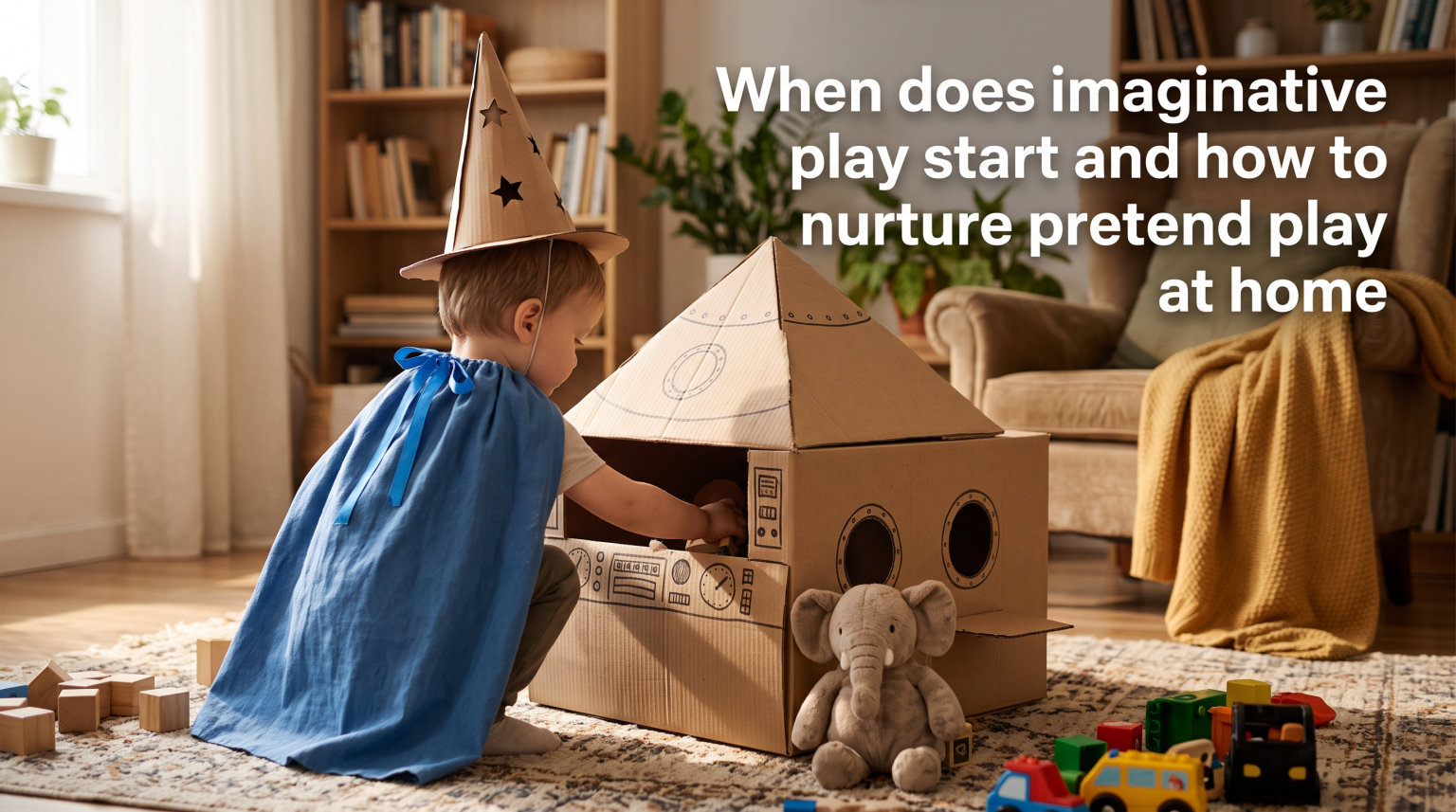
Preschoolers create elaborate scenarios that can last for hours. Build a spaceship from a large cardboard box, adding buttons and controls with markers. Create a post office using envelopes, stickers as stamps, and a bag for mail delivery. Set up a construction site with blocks, toy trucks, and hard hats made from paper bowls.
Dramatic play areas that combine multiple elements work particularly well. A veterinarian clinic with stuffed animals, doctor tools, and clipboards for records allows extended role play. A camping scene with a blanket tent, flashlight, and pretend campfire supports overnight adventure scenarios.
Outdoor Pretend Play Ideas
Nature invites imaginative scenarios that differ from indoor play. Collect sticks and create a fairy house against a tree trunk. Use rocks to build a dinosaur excavation site and pretend to be paleontologists. Create an obstacle course and pretend to be spies completing a mission.
Water play offers rich pretend opportunities. A washing station for toy cars becomes a full-service garage. A bucket of water with floating leaves becomes a boat race. Mud kitchens, where children mix dirt and water to create pretend food, combine sensory play with imagination.
Activities for Siblings of Different Ages
Mixed-age play requires activities that allow different participation levels. Simple scenarios like restaurant or doctor work well because younger children can imitate basic actions while older children manage complex roles. The older sibling often naturally takes a directing role that supports both children’s development.
Building projects allow parallel play with different complexity levels. A younger child might stack blocks randomly while an older child creates a specific structure. Both can then use the creation in pretend play, assigning it different meanings. The key involves finding the overlap in their interests.
When to Be Concerned About Pretend Play
Parents often worry when their child does not show interest in pretend play by expected ages. Forum discussions reveal this anxiety as one of the most common concerns among parents of toddlers and preschoolers. Understanding the wide normal range helps ease these fears.
The Normal Range Is Wide
Children start pretend play anywhere from 18 months to 5 years while remaining within typical development. Some children focus intensely on physical skills, language development, or exploration before engaging with symbolic play. This pattern does not indicate a problem.
Many parents report in online forums that their children showed minimal pretend play at 2 or 3 but suddenly burst into elaborate scenarios at 4 or 5. Others note that their neurodivergent children began pretend play later than siblings but developed rich imaginative worlds once they started. Individual timelines vary enormously.
Red Flags to Watch For
While the absence of pretend play alone rarely indicates a problem, certain patterns warrant attention. Consider consulting a pediatrician or child development specialist if your child shows no symbolic play by age 5 combined with other concerns.
Watch for limited social engagement overall, not just lack of pretend play. Children who avoid eye contact, do not respond to their names, or show no interest in interactive play may need evaluation. Significant delays in language development alongside absent pretend play also suggest consulting a professional.
Regression matters more than absence. If a child previously engaged in pretend play and suddenly stops, particularly after a stressful event or illness, discuss this change with a healthcare provider. Sudden loss of skills sometimes signals issues requiring support.
Neurodivergent Children and Pretend Play
Autistic children often develop pretend play on different timelines than neurotypical peers. Research shows they may engage in pretend play differently, often preferring repetitive scenarios or object exploration over social dramatic play. These patterns represent different ways of processing information rather than deficits.
Parents of autistic children report in forums that pretend play sometimes emerges closer to age 5 rather than 2 or 3. When it does appear, it often looks different from typical pretend play, with more focus on predictable patterns or specific interests. Supporting these preferences respects the child’s neurotype while still encouraging imaginative thinking.
Focus on Overall Development
The presence or absence of pretend play matters less than overall developmental progress. Children meeting milestones in language, social interaction, motor skills, and cognitive development generally show healthy growth even without elaborate pretend scenarios.
If you have concerns, document specific behaviors rather than general worry. Note what types of play your child does enjoy, how they interact with others, and what skills they have developed. This information helps professionals assess whether any evaluation would be helpful.
Frequently Asked Questions
At what age does imaginative play start?
Imaginative play typically begins between 18 months and 3 years of age. Simple pretend play with object substitution, like using a block as a phone, usually emerges around 18-24 months. Complex pretend scenarios become more common between ages 2 and 3. However, the normal range is wide, with some children starting as early as 12 months and others not fully engaging until age 4 or 5.
Why is Montessori against pretend play?
This is a common misconception. Montessori education actually supports pretend play, though it emphasizes using real objects before introducing fantasy. Montessori classrooms include practical life activities that form the foundation for later dramatic play. Dr. Montessori observed that children under 6 prefer real activities to fantasy, so her method prioritizes cooking with real tools over pretend kitchens. However, children in Montessori programs absolutely engage in imaginative play, particularly as they reach the preschool years.
What are the stages of imaginative play?
Children progress through six main stages: (1) Self-pretend (12-18 months) where children pretend familiar actions like sleeping or eating, (2) Simple object substitution (18-24 months) using items to represent other things, (3) Pretend play with others (24-30 months) involving others in scenarios, (4) Complex pretend scenarios (30-36 months) with multi-step sequences, (5) Socio-dramatic play (3-5 years) involving cooperation and role assignment, and (6) Fantasy and imaginary companions (3-6 years) with elaborate imaginary worlds.
Can a 2 year old do pretend play?
Yes, most 2-year-olds can and do engage in pretend play. By age 2, children typically demonstrate simple object substitution, such as pretending a banana is a phone or a block is a car. They also engage in self-pretend activities like pretending to sleep or eat. While 2-year-olds may not yet create complex multi-step scenarios, they absolutely participate in make-believe play and benefit greatly from opportunities to practice symbolic thinking.
Conclusion
When does imaginative play start? For most children, the journey begins between 18 months and 3 years, though the full range of normal development extends from 12 months to age 5. Understanding this timeline helps parents support their children without unnecessary worry.
The stages of pretend play build naturally from simple self-pretend to complex socio-dramatic scenarios. Each stage offers unique benefits for cognitive, social, emotional, and language development. By providing space, open-ended materials, and supportive presence, parents nurture this critical aspect of childhood.
If your child shows minimal interest in pretend play today, remember that development unfolds uniquely for every child. Focus on the play your child does enjoy and trust that imagination will emerge in its own time. When you are ready to encourage pretend play, start with something simple: offer a block and pretend it is a phone. Watch what happens next.