
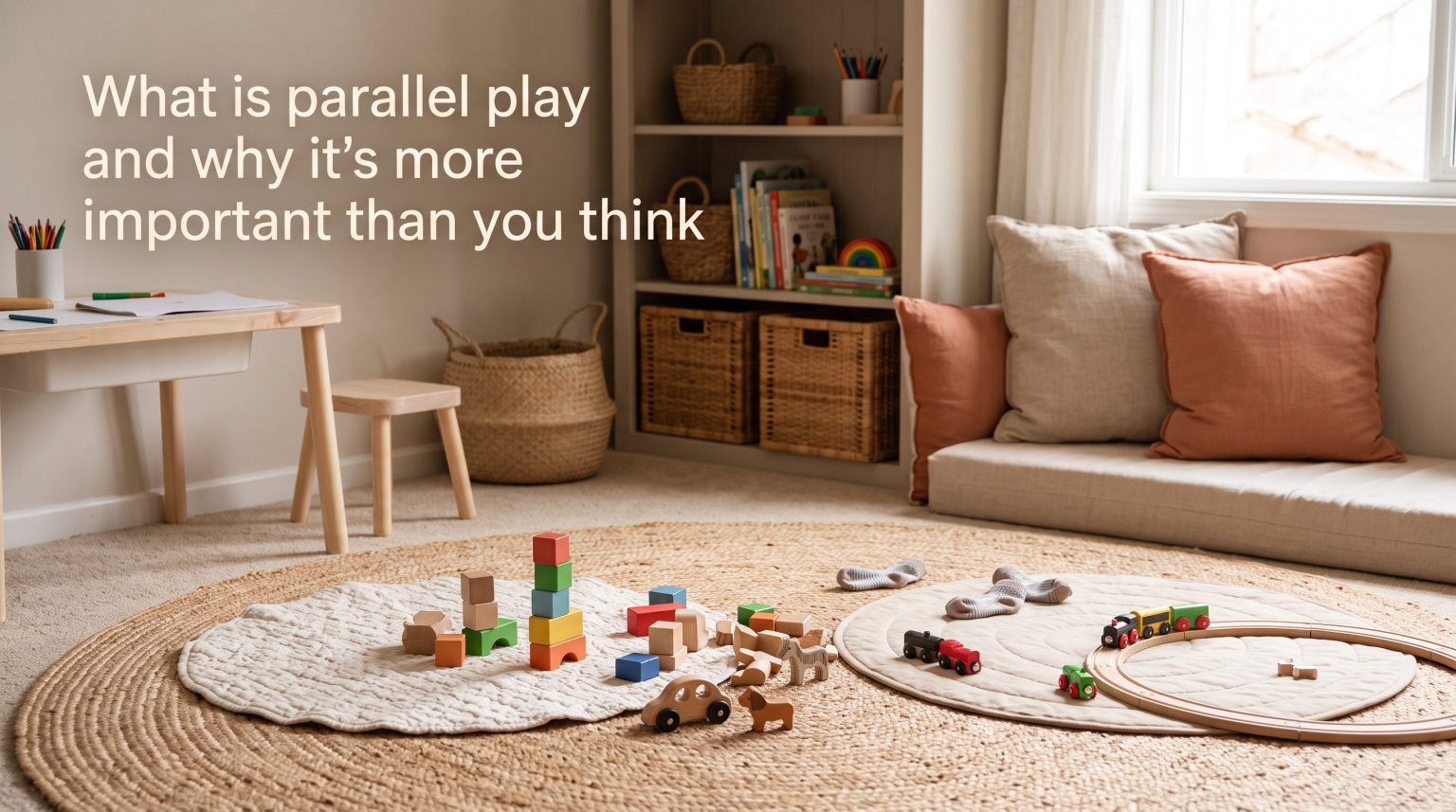
Your toddler sits next to another child at the playground, both playing with sand, but they never look at each other or share a single word. You watch other kids playing together, laughing, and taking turns, and you wonder: Is something wrong with my child? This scene plays out in parks and playrooms everywhere, and it causes more parent anxiety than almost any other developmental milestone. The truth is, what you’re witnessing is called parallel play, and it is not only completely normal, it is a critical foundation for your child’s social, emotional, and cognitive development.
Parallel play happens when children play independently in the same area, often with similar toys or materials, but without direct interaction or cooperation. Think of two toddlers building separate block towers side by side, or children coloring at the same table with no conversation. They are aware of each other. They observe and sometimes copy what the other child does. But they are not playing together in the way adults typically imagine.
Most parents underestimate this stage because it looks like isolation. It seems like their child is not “being social.” But development experts understand something powerful: parallel play is where children learn the fundamental skills that make genuine friendship possible later. In this guide, I will explain exactly what parallel play is, walk you through the six stages of play development discovered by researcher Mildred Parten, and show you why this seemingly quiet, independent play matters more than almost any other early childhood experience. You will also learn when to encourage it, when to be concerned, and how it even applies to healthy adult relationships.
Table of Contents
What Is Parallel Play?
Parallel play is a developmental stage where children engage in recreational activities adjacent to each other without trying to influence one another’s behavior. First identified by sociologist Mildred Parten in her groundbreaking 1929 study, this stage typically emerges around age 2 and can last through ages 3 and 4, sometimes longer.
The key distinction is awareness without interaction. During parallel play, children are fully conscious of the other children around them. They watch. They listen. They occasionally mimic what another child does. But they maintain separate play goals and do not attempt to coordinate their activities with anyone else.
Real Examples of Parallel Play
Here is what parallel play actually looks like in everyday life:
At the playground: Two toddlers swing on separate swings next to each other. They might glance over occasionally or copy how the other pumps their legs, but they do not talk or try to swing together.
With blocks: Children sit on the same rug with the same bucket of blocks. Each builds their own tower independently. One might copy the other’s design, but they do not collaborate on a single structure or discuss their plans.
During art time: Kids sit at a table with paper and crayons. Each colors their own picture. They might comment on each other’s work with phrases like “That’s blue” or “I made a sun,” but there is no shared creative goal.
With toy cars: Two children push cars around the same play mat. They drive near each other, sometimes mimicking sounds or movements, but they do not create a shared story or take on roles like “driver” and “passenger.”
Is My Kid Abnormal? Addressing the Biggest Parent Fear
Let me be direct about the question that keeps parents awake at night. If your 2, 3, or even 4-year-old prefers playing next to other children rather than with them, your child is not abnormal. In fact, according to discussions with preschool teachers across multiple forums and research studies, the majority of children in toddler groups and early preschool classrooms spend most of their time in parallel play. It is the statistical norm, not the exception.
Parents often panic because they see one child in a playgroup who seems more socially advanced, playing cooperative games while their own child plays separately. Development does not work that way. Children progress through these stages at different rates, and some will engage in brief moments of associative play while still spending most of their time in parallel play. Both are healthy. Both are normal. Your child’s social development is not a race.
The 6 Stages of Play Development
To understand where parallel play fits, you need to see the complete picture of how play skills develop. In 1929, American sociologist Mildred Parten published her landmark study at the University of Minnesota’s Institute of Child Development. She observed children ages 2 to 5 and identified six distinct stages of social participation. These stages form a developmental ladder, with each level building on the previous one.
Stage 1: Unoccupied Play (Birth to 3 Months)
Newborns engage in random movements with no clear purpose. They might wave their arms, kick their legs, or make faces. These movements seem meaningless, but they are actually early learning experiments. Babies discover that they can control their own bodies and explore how the world responds to their actions. This is the foundation of all future play.
Stage 2: Solitary Play (Birth to 2 Years)
During solitary play, children play alone and are completely unaware of others around them. A baby might examine a rattle intensely, completely ignoring a nearby sibling. A toddler might stack cups repeatedly, absorbed in their own activity even in a busy room. This type of play remains common throughout early childhood and into later years, especially for activities requiring deep concentration.
Stage 3: Onlooker Play (Around 2 Years)
Children in this stage watch other kids play without joining in. They might stand at the edge of a group, observing intently, asking questions about what is happening, but making no move to participate. This is not shyness or exclusion. It is active learning. Children are studying social dynamics, learning the rules of games, and mentally preparing for their own participation when they feel ready.
Stage 4: Parallel Play (2+ Years)
This is the main topic of our discussion. Children play next to others using similar toys or activities, but they do not interact or share goals. They are socially engaged through proximity and observation, even without direct cooperation. This stage bridges the gap between complete independence and true social play. Most children enter this stage around age 2, though it can begin as early as 24 months in some children.
Stage 5: Associative Play (3 to 4 Years)
Children begin to interact more during associative play. They might share toys, talk about what they are doing, or trade materials. However, they still do not have a unified goal. Each child pursues their own interests within a shared activity. For example, children might all play dress-up together, but one is a doctor, one is a teacher, and one is a parent with no coordinated storyline connecting them.
Stage 6: Cooperative Play (4+ Years)
This is the most complex stage. Children work together toward a shared goal. They plan, assign roles, and coordinate their efforts. They build a block tower together with a specific design in mind. They create a pretend restaurant where each child has a job. They play organized games with rules. This stage requires advanced social skills including communication, compromise, and rule-following.
Important Reality Check
Here is what most parenting blogs get wrong: these stages are not strictly linear. A typical 3-year-old might engage in solitary play during quiet time, parallel play during free choice, onlooker play when observing an older sibling’s complex game, and occasional associative play when the mood strikes. A 4-year-old might spend most of the day in cooperative play but revert to parallel play when tired or overwhelmed.
The ages listed are general guidelines, not deadlines. What matters is the progression over time, not the specific age at which your child enters each stage.
Why Parallel Play Is More Important Than You Think
Parallel play might look like children ignoring each other, but beneath the surface, profound development is happening. This stage builds the exact skills children need to form real friendships, succeed in school, and develop emotional intelligence. Here are the key benefits that make parallel play such a critical developmental milestone.
1. Building Social Awareness and Observation Skills
During parallel play, children are constantly watching their peers. They notice how other children handle materials, solve problems, and express emotions. This observational learning is incredibly efficient. A child might struggle for weeks to figure out how to connect certain blocks, then watch another child do it once and immediately copy the technique.
This peer modeling teaches children that they can learn from others. It builds the foundation for all future social learning. Children who develop strong observation skills during parallel play enter cooperative play stages with a huge advantage. They already understand social cues, problem-solving strategies, and creative possibilities because they have been quietly absorbing them for months.
2. Developing Trust and Early Friendship Foundations
Friendship requires trust. Before children can play cooperatively, they need to feel safe with other children. Parallel play creates this safety through low-pressure proximity. Children learn that other kids can be nearby without hurting them, taking their toys, or demanding things from them.
This trust-building happens gradually. A child who plays parallel to others dozens of times begins to understand the pattern: other children are generally safe, they respect my space, and I can predict their behavior. This sense of security is essential before any child will agree to share goals, take turns, or collaborate on projects.
3. Learning Empathy and Emotional Awareness
Even without talking, children in parallel play absorb emotional information. They notice when another child looks frustrated with a puzzle. They see when a peer celebrates completing a task. They witness how different children handle disappointment when a block tower falls.
Over time, this exposure helps children develop empathy. They begin to recognize that other people have feelings similar to their own. They learn that frustration, joy, and determination are universal experiences. This emotional awareness becomes the basis for comforting friends, celebrating with them, and navigating social conflicts later in childhood.
4. Practicing Boundaries and Personal Space
One of the most practical skills developed during parallel play is an understanding of personal space and boundaries. Children learn through experience that they have their own play zone and so does everyone else. They discover that reaching over and knocking down another child’s tower is not acceptable. They figure out how close they can sit without annoying someone else.
These boundary lessons are learned naturally through trial and error with minimal conflict. Because parallel play does not involve shared goals, disputes are rare and low-stakes. Children can experiment with spatial awareness and social boundaries in a safe environment before they need to apply these skills in more complex cooperative situations.
5. Early Concepts of Sharing and Turn-Taking
While parallel play does not involve active sharing, it introduces the concept that materials exist in limited quantities. When two children both want the red marker from the same cup, they begin to learn that resources must be distributed. They might not share the marker itself during parallel play, but they become aware that the other child also wants it.
This awareness is the first step toward genuine sharing. Children who have spent time in parallel play understand that other people have needs and desires. When they eventually enter cooperative play, this foundation makes the abstract concept of “sharing” much easier to grasp because they have already accepted the reality of other children’s interests.
6. Language Development Through Peer Exposure
Children in parallel play often talk to themselves or make comments about their own activities. When they do this near other children, they receive responses. A child might say “I made a big tower” and hear another child reply “Mine is bigger.” These exchanges are simple, but they are genuine communication practice.
Children also learn new vocabulary by hearing peers use words they do not know. One child might call a toy by a specific name. Another might describe their action using a verb the other child has not heard before. This peer-to-peer language exposure is sometimes more effective than adult instruction because children are motivated to understand and communicate with their equals.
7. Motor Skill Development Through Imitation
Physical development gets a boost during parallel play too. When children see peers engaging in new physical challenges, they often attempt to copy those movements. One child might start jumping between cushions. Another might watch, then try it themselves, improving their gross motor skills in the process.
Fine motor skills develop similarly. A child might observe a peer successfully threading beads or cutting with scissors. The desire to do what the other child is doing motivates them to practice these skills. This motivation-driven practice is often more effective than adult-led instruction because it comes from the child’s own curiosity and competitive instinct.
Parallel Play and Neurodivergent Children
One of the most common questions parents ask online is whether parallel play is connected to autism or ADHD. The simple answer is that parallel play is a normal stage for all children, but neurodivergent children may find this stage particularly comfortable and may engage in it longer or return to it throughout life.
Is Parallel Play a Sign of Autism?
No, parallel play by itself is not a sign of autism. All neurotypical children go through this stage between ages 2 and 4. However, children on the autism spectrum may prefer parallel play to more interactive forms of play for longer periods. They might also engage in parallel play in ways that look different, such as lining up toys in specific patterns while another child does the same nearby.
The concern for autism typically involves multiple factors, not just play style. Signs that warrant professional evaluation include: never making eye contact, not responding to their name by age 2, showing no interest in other children at all (not even parallel play), repetitive movements that interfere with activities, and significant regression in language or social skills. Parallel play alone, especially if your child is under age 4, is not a red flag.
Parallel Play and ADHD
Children with ADHD often engage enthusiastically in parallel play because it allows them to be near others without the complex demands of cooperation. They can switch activities frequently without disrupting a group plan. They can move their bodies without worrying about staying in role for a pretend game.
For children with ADHD, parallel play can be a healthy social outlet. It provides the stimulation of other children’s presence without the pressure of sustained attention to social rules. Many adults with ADHD report that they still prefer parallel play style activities, such as working on individual projects alongside friends or family members.
Why Neurodivergent Communities Value Parallel Play
In online neurodivergent communities, parallel play is often discussed as a preferred and healthy social strategy. Many autistic adults explain that parallel play allows them to enjoy companionship without the exhaustion of constant social interaction. They can be with someone they care about while still having the mental space to focus on their own interests.
This perspective is valuable for parents of neurodivergent children. Rather than pushing children toward more interactive play before they are ready, supporting comfortable parallel play builds social confidence. A child who feels safe in parallel play will eventually experiment with more interaction when they are developmentally ready and genuinely interested.
How to Encourage Parallel Play at Home
Creating an environment that supports parallel play does not require special equipment or elaborate planning. You simply need to set up situations where children can be near each other with engaging individual activities. Here are practical ways to encourage this important developmental stage.
Set Up Parallel Play Stations
Create activity areas where multiple children can engage in the same type of play simultaneously. Examples include:
Art stations: Cover a table with paper and provide multiple sets of crayons, markers, or paint. Each child creates their own artwork while sitting together.
Building zones: Place a large basket of blocks or Legos on a rug where two or three children can build separate structures near each other.
Reading nooks: Set out several picture books in a comfortable corner. Children can each look at their own book while sitting on the same cushions.
Sensory bins: Fill a large container with rice, beans, or sand and add multiple scoops and cups. Children can explore independently while sharing the same materials.
Playdate Strategies
When hosting playdates for toddlers and young preschoolers, keep expectations realistic. Do not push children to share toys or play together immediately. Instead, set out duplicate materials so each child can have their own. Two doll strollers. Two sets of play dough. Two magnifying glasses for bug exploration.
Stay nearby but resist the urge to facilitate constantly. Let the children navigate their proximity naturally. They will observe each other, occasionally comment, and learn to coexist peacefully. This low-pressure environment allows parallel play to flourish and occasionally evolve into associative play naturally.
Sibling-Specific Tips
Parallel play works beautifully for siblings of different ages. An older child might be doing a complex puzzle while a younger sibling plays with simple blocks nearby. The older child gets quiet concentration time while the younger child benefits from observing more advanced skills.
Encourage siblings to do parallel activities together rather than always requiring them to play the same games. One can draw while the other builds with magnetic tiles. Both are creating, both are in the same space, but neither is bored by an activity mismatched to their developmental level.
When Should You Be Concerned About Parallel Play?
While parallel play is typically healthy and normal, there are situations where it might indicate a need for professional evaluation. Here are the red flags that suggest your child’s play development warrants a conversation with your pediatrician or a developmental specialist.
Age-Related Concerns
By age 4, most children should show some ability to engage in associative play, even if they still spend considerable time in parallel play. If your child has reached age 5 and shows absolutely no interest in interacting with peers, even briefly, this might warrant evaluation.
Similarly, if your 18-month-old shows no signs of parallel play and seems completely oblivious to other children’s presence, mention this at your next well-child visit. While many children are still in solitary play at this age, complete disinterest in peers might indicate social awareness delays.
Behavioral Red Flags
Watch for these specific behaviors that go beyond typical parallel play:
Extreme distress at proximity: If your child becomes genuinely upset, not just disinterested, when another child sits near them, this suggests sensory or anxiety issues beyond normal parallel preferences.
No progress over time: If your child shows exactly the same play behaviors at age 4 that they showed at age 2 with no increase in social awareness or communication, discuss this with your doctor.
Regression: If a child who previously showed interest in other children suddenly stops and retreats completely into solitary play, this warrants attention.
Total absence of communication: Parallel play can include occasional comments, gestures, or looks. If your child never acknowledges other children in any way, even nonverbally, mention this to your pediatrician.
Trust Your Instincts
The most important advice I can offer is to trust yourself as a parent. If your gut tells you something is different about your child’s social development, seek evaluation. Early intervention services are available in every state for children showing developmental delays, and they are highly effective. A conversation with your pediatrician does not commit you to anything. It simply opens the door to support if your child needs it.
That said, remember that the vast majority of children who prefer parallel play are developing exactly as they should. If your child makes eye contact, responds to their name, communicates with you, and shows interest in other children even from a distance, parallel play is almost certainly a healthy stage, not a symptom of a problem.
Parallel Play in Adult Relationships
An emerging trend in relationship psychology is the recognition that parallel play does not end in childhood. Healthy adults regularly engage in parallel play style activities, and this behavior actually strengthens relationships when both partners understand and value it.
What Adult Parallel Play Looks Like
Adult parallel play occurs when partners or friends engage in separate activities while remaining physically near each other. Examples include couples reading different books in the same room, friends doing separate crafts at the same table, or partners working on individual laptops at a coffee shop together.
This type of togetherness provides the comfort of companionship without the demands of constant interaction. It allows introverts to recharge without leaving the relationship space. It lets partners pursue individual interests while maintaining connection.
The Connection to Secure Attachment
Relationship researchers note that couples who comfortably engage in parallel play often display secure attachment styles. They trust each other enough to focus on separate activities without anxiety. They do not require constant attention to feel valued. The ability to be together without performing together indicates relationship security.
For parents, understanding this adult application can ease anxiety about their parallel-playing children. A child who learns to be comfortable with parallel play is developing the exact skills that will allow them to have healthy, secure adult relationships decades later.
Frequently Asked Questions About Parallel Play
What is parallel play and why is it important?
Parallel play is when children play independently in the same area, with similar materials, but without direct interaction. It is important because it builds social awareness, develops trust between children, teaches empathy, helps children practice boundaries, develops early sharing concepts, supports language acquisition through peer modeling, and strengthens motor skills through imitation.
What age do kids stop parallel play?
Children typically transition from parallel play to associative play between ages 3 and 4, though parallel play can continue alongside other play types well beyond this age. Most children enter cooperative play around age 4 or older. However, parallel play remains normal even at older ages and many adults still enjoy parallel play style activities.
Is parallel play an ADHD thing?
Parallel play is not specifically an ADHD behavior; it is a normal developmental stage for all children. However, neurodivergent individuals including those with ADHD may find parallel play more comfortable than direct interaction. Many people with ADHD prefer parallel play throughout life because it allows social connection without the exhaustion of constant interaction.
What are examples of parallel play?
Examples of parallel play include: two toddlers playing with separate blocks side by side, children drawing on their own papers at the same table, kids playing in the same sandbox without interacting directly, siblings reading different books near each other, or children building separate structures with the same materials while sitting together.
Is parallel play normal for a 3-year-old?
Yes, parallel play is completely normal and very common for 3-year-olds. While some 3-year-olds begin showing occasional associative play, most still spend the majority of their playtime in parallel play. Teachers report that most children in toddler and early preschool groups primarily engage in parallel play, making it the statistical norm rather than something to worry about.
Conclusion
Parallel play is far more than a stage where children simply ignore each other. It is a sophisticated developmental milestone where children build the foundational skills they need for friendship, empathy, communication, and cooperation. When your toddler plays alongside another child without interacting, they are not being antisocial or delayed. They are actively learning how to be social.
The research is clear: children who develop strong parallel play skills enter cooperative play with advantages in trust, observation, language, and emotional awareness. Whether your child is 2, 3, or 4, if they are engaging in parallel play, they are developing exactly as they should. Support this stage with appropriate activities, resist the urge to push them toward interaction before they are ready, and trust that this quiet, observational play is building the social brain they will use for the rest of their life.