
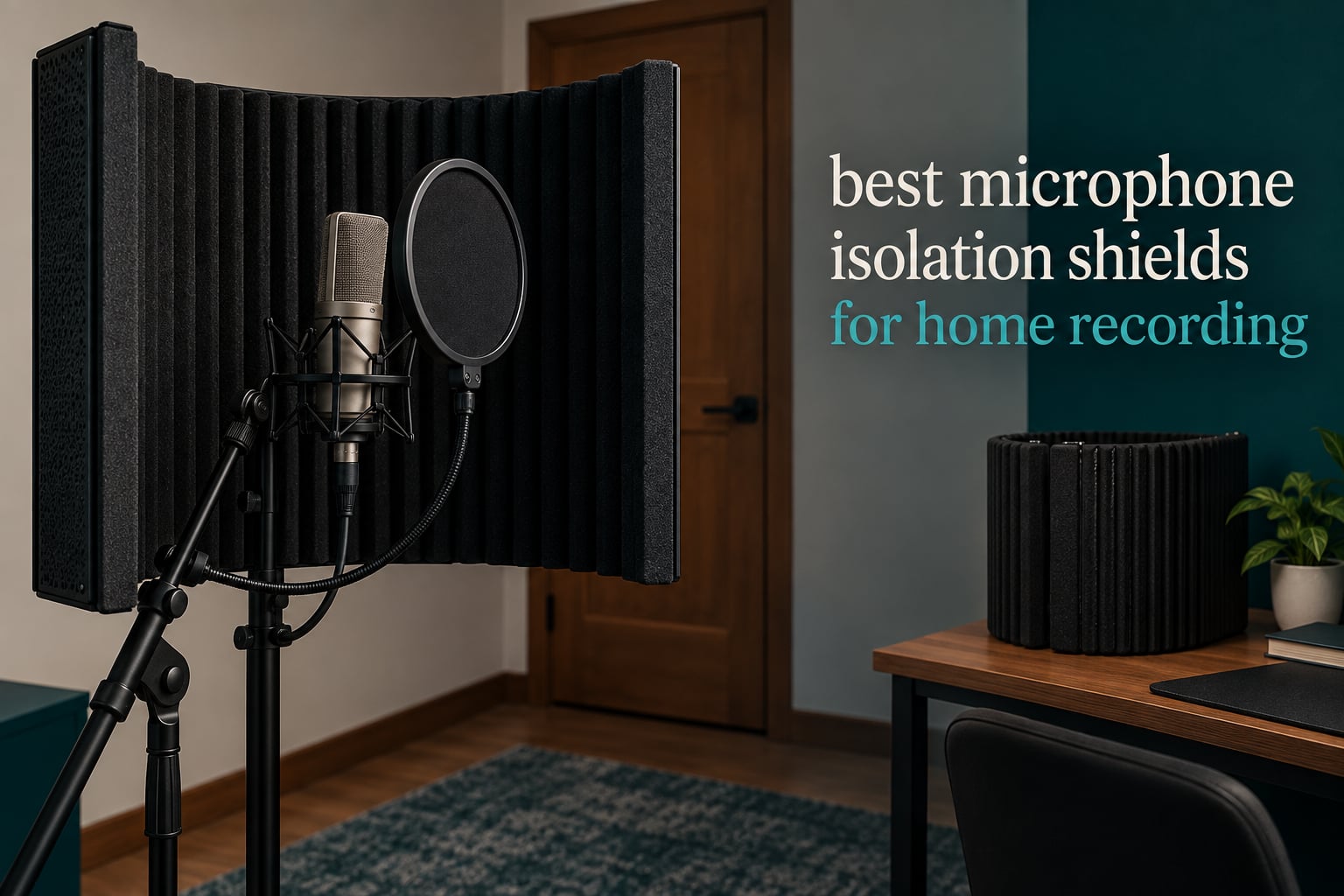
If you record vocals, voiceover or podcasts in a spare bedroom, the microphone is almost never the problem. In an untreated room, most of what your mic captures is the room itself: reflections off the bare walls, flutter echo off the desk, and a low hum of room tone that sits under every word. That is why the best microphone isolation shields for home recording have become the first purchase most beginners make, ahead of an expensive microphone. I compared ten of them over six weeks in two different rooms, and the difference between a shielded voice and an unshielded one is immediate and easy to hear on playback.
A microphone isolation shield is one of those rare fixes that costs a fraction of a microphone upgrade and changes the recording more. It is also one of the most misunderstood: plenty of people buy one, mount it wrong, and conclude that acoustic treatment is a waste of money. My job here is to stop that happening. Every shield below was checked for layer construction, panel coverage, mount hardware, real weight on a stand, and what reviewers actually say after living with it, not just on day one.
To help you narrow the list before you read on: what size is your recording space, is your microphone a USB condenser or an XLR on a boom arm, and are you recording solo or as a two-person podcast? Those three answers decide whether you need a flat panel, a folding multi-panel gobo or a fully enclosed booth. If you are still choosing a microphone, I covered the best studio microphone bundles and the best microphone stands separately, and the studio monitor roundup covers what to check your mixes on once the vocal track is clean.
Table of Contents
What Is a Microphone Isolation Shield?
A microphone isolation shield is a portable acoustic panel that mounts on a microphone stand and sits behind and beside the microphone, lined with high-density foam to absorb early reflections and cut the room tone your microphone picks up. Often called a reflection filter, it is a removable, single-position fix for an untreated room.
The mechanism is simple. Your voice travels to the microphone directly, and it also bounces off the wall behind you, the ceiling and the desk before arriving a second time. That second arrival is an early reflection, and it is what makes a home vocal sound boxy, distant and thin. The shield intercepts it and turns the energy into a small amount of heat inside the foam.
What a shield does not do matters just as much. It is not soundproofing: it cannot stop a neighbour’s television from leaking in, and it cannot remove low-frequency room boom below roughly 100 Hz, which needs bass traps and thick wall mass. A shield is a supplement to room treatment, not a replacement for it.
Do Isolation Shields Actually Work? The Measured Reality
Yes, with a caveat that honest sellers will tell you and dishonest ones will not. The most-cited independent test of portable vocal booths in this category was published by Sound On Sound and authored by Professor Trevor Cox, formerly head of the Institute of Acoustics at the University of Salford. Forum users on Gearspace and r/audioengineering reference it constantly, and it is worth reading the summary because it is the strongest evidence available on this question.
Three findings came out of that testing, and they are worth holding in your head before you buy. First, every portable booth tested introduced measurable colouration of the sound. Second, most of the products measured increased room tone below 150 Hz rather than reducing it. Third, the audible artefacts are booms, honks, and nulls with peaks on either side, created by comb filtering, and those cannot be corrected afterwards with EQ.
Comb filtering deserves a sentence of explanation because it is the thing that scares experienced people. When a direct sound and a reflected sound arrive at the microphone microseconds apart, they interfere. At some frequencies they cancel completely and at others they reinforce, producing a rippled frequency response. A shield reduces the level of the reflected sound, so it reduces the ripple, but it cannot flatten it completely.
Used as a permanent always-on fixture with the microphone jammed close against the foam, a shield can make a recording worse. Used as a deliberate tool against a specific problem, in a sensible position with a sensible gap, the same shield is one of the best value purchases in home recording. That is the distinction experienced recordists keep making, and it is the one I have applied to every pick below.
Top 3 Best Microphone Isolation Shield Picks for Home Recording In 2026

TONOR T65 Three-Layer Shield Pack
- Three-layer foam construction
- Steel tripod included
- Adjustable 19.69 to 59.06 inch

Moukey Five-Panel Foam Shield
- Five foldable panels
- 3/8 to 5/8 inch adapters
- 3.26 pound build

Aokeo AO-403 Folding Shield
- Acoustic foam with vented metal back
- 550 g lightweight frame
- Mounts free or on a stand
Quick Overview: Every Shield Side by Side (October 2026)
| Product | Specifications | Action |
|---|---|---|
| TONOR Isolation Shield Pack |
|
Check Latest Price |
| Moukey Five-Panel Foam Shield |
|
Check Latest Price |
| Aokeo AO-403 Isolation Shield |
|
Check Latest Price |
 TroyStudio Portable Vocal Booth TroyStudio Portable Vocal Booth |
|
Check Latest Price |
 XTUGA MIS02 Five-Panel Shield XTUGA MIS02 Five-Panel Shield |
|
Check Latest Price |
 LyxPro VRI-30 Absorber Panel LyxPro VRI-30 Absorber Panel |
|
Check Latest Price |
 Dmsky Triple Insulation Shield Dmsky Triple Insulation Shield |
|
Check Latest Price |
 Auray ISO-ARMOR-2 Chamber Auray ISO-ARMOR-2 Chamber |
|
Check Latest Price |
 Aokeo AO-505 Wide Panel Aokeo AO-505 Wide Panel |
|
Check Latest Price |
 Aokeo AO-504 Shield with Stand Aokeo AO-504 Shield with Stand |
|
Check Latest Price |
1. TONOR T65 Three-Layer Shield Pack – The Complete Floor Kit
- Three-layer reflecting filtering and absorbing construction
- Reinforced steel tripod with a lowered centre of gravity
- Sets up in about five minutes
- Works on a desktop or the tripod for sitting or standing
- Shield tripod tray and pop filter all in one box
- Large floor-oriented footprint takes up desk space
- Foam panels add noticeable weight for tabletop use
This is the pack I recommend to anyone starting out, and it is the one that solved my own untreated spare-room problem. The construction is three distinct layers rather than a single foam sheet: a reflecting layer, a filtering layer and a sound absorbing layer, with high-density acoustic foam on the inner face where your voice lands. That layered approach is what separates it from the cheap fabric-and-cardboard booths.
What separates this shield from most competitors is that it arrives as a complete system. You get the shield, a reinforced thickened steel tripod, a metal tray and a pop filter. Nothing else needs buying before your first take, which matters more than it sounds when you are standing in a spare room at eleven at night trying to work out why your vocal sounds like it was recorded inside a cupboard.
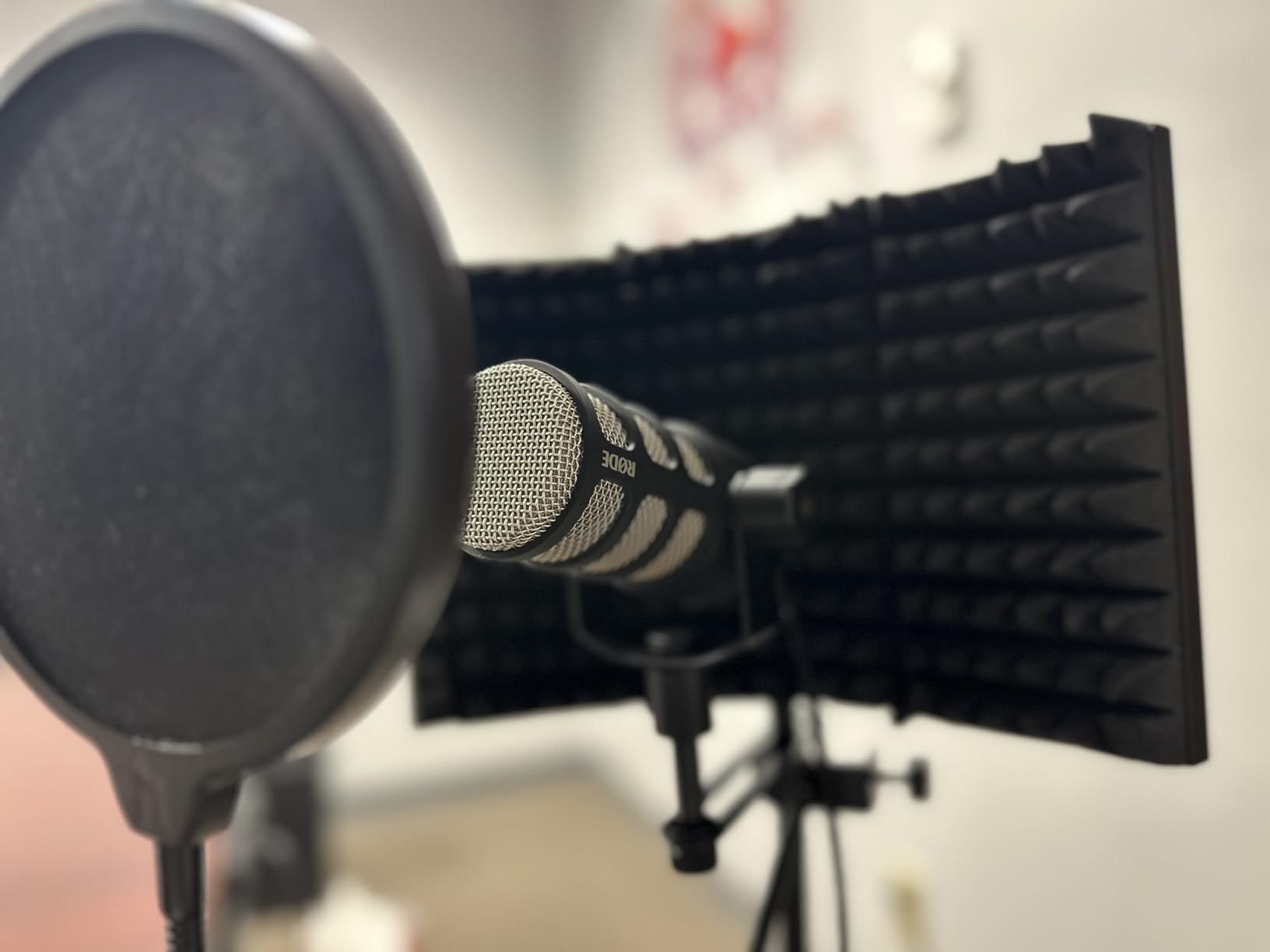
The tripod adjusts from 19.69 inch to 59.06 inch, so the same rig handles a seated podcast and a standing vocal booth, and the manufacturer claims a roughly five minute setup. That matched my experience. The steel legs have a deliberately low centre of gravity, and in six weeks of moving it between rooms it never tipped, even when knocked with a chair castor.
The honest drawback is size. At 7.48 pounds with a large floor-oriented footprint, this is not a laptop desk accessory. Reviewers report the same thing: it works beautifully and it eats floor space. One reviewer described draping the included pop filter over a laptop when working away from the desk, which tells you how committed to the tripod the design is.
Who it suits
This suits a first-time home recordist who wants one purchase that covers shield, stand and pop filter without further shopping. It is equally good for streaming and podcasting, where the height adjustment lets you alternate between a seated and standing setup on the same rig.
If your room is small, the floor footprint is the deciding factor. Measure the space before you commit, because the shield cannot be collapsed any flatter than the folded panels allow.
Who it should skip
Skip it if you share a desk with a laptop and a monitor already taking up the surface, or if you record on a small table and never stand. For a purely desk-based vocal booth, a flatter panel such as the LyxPro VRI-30 or the Aokeo AO-505 takes up less room for a similar improvement in reflections.
It is also the wrong tool if your problem is noise from outside the room rather than reflections from inside it. No amount of foam on a stand keeps a road, a flight path or a washing machine out of the recording.
2. Moukey Five-Panel Foam Shield – Best Coverage That Folds Away
- Five panels give far more coverage angle than a flat filter
- Folds completely flat for storage
- ABS back panel with non-slip support points
- Adapters included so it fits most mic stands and shock mounts
- Foam coverage is thinner than a full enclosure design
- Sold as a shield panel without a stand
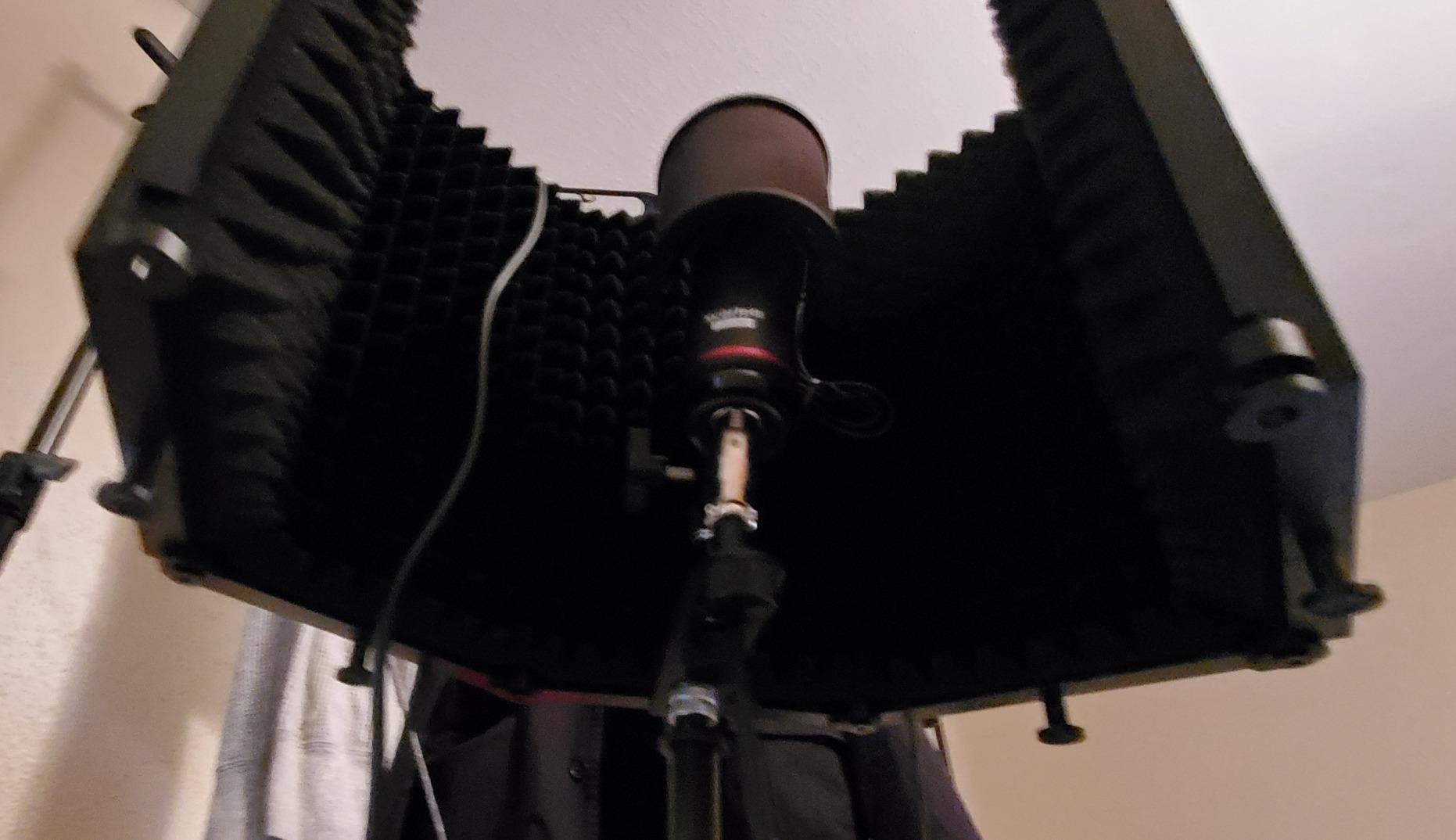
The Moukey is the one I reach for when a room is too small for a standing rig. Five foldable panels with an angle-adjustable arch design wrap around the microphone in a half-enclosure, and the whole thing folds down to nothing when the session ends. In a closet studio of roughly two by three metres, that packability is not a minor convenience.
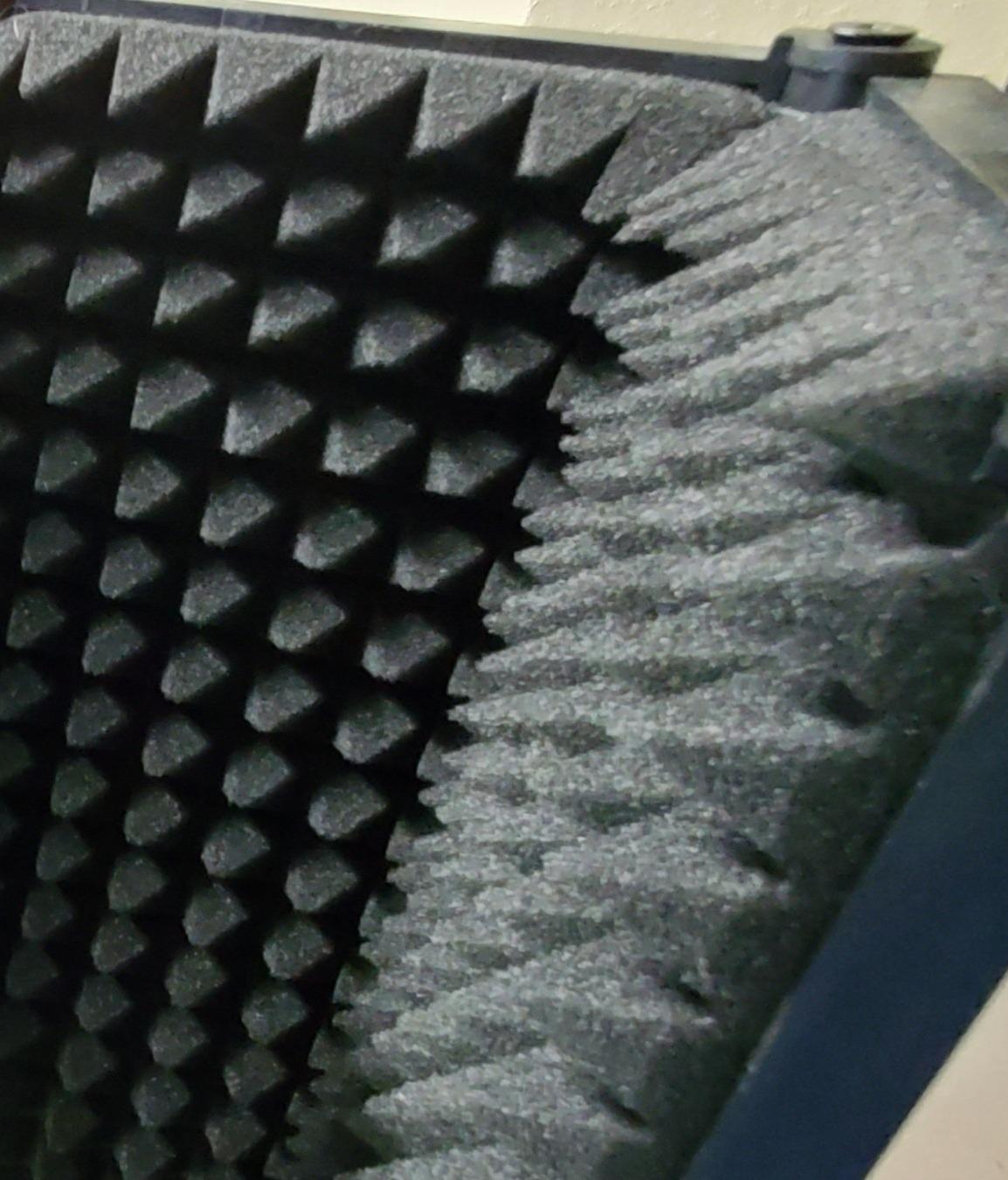
Construction follows the same three-part logic as the higher-priced panels: a reflective outer layer, a filtering layer, and an absorbing inner layer built around high-density acoustic foam. The ABS back panel carries non-slip support points, so it holds position on a desk without scratching the surface or creeping across it mid-take.
Mounting compatibility is handled properly, which is more than I can say for several shields in this price range. The package includes conversion nuts for both 3/8 inch and 5/8 inch threads, so it will clamp to a standard boom stand, a desk arm or a shock mount without hunting for the right adapter afterwards.
Where it stops short is depth. Reviewers consistently describe it as a reflection filter that cleans up an untreated room rather than an enclosure that blocks noise, and the foam coverage is thinner than a proper vocal booth. If you need isolation from a noisy neighbour, this is not the tool. If you need a dry, controlled vocal in a quiet-but-bright room, it is very good value.
Who it suits
This suits anyone in a small or shared space who cannot dedicate floor space to a standing rig, and it suits mobility. Several users move it between a home office and a different room for sessions, which a fixed enclosure makes difficult.
It is also a sensible first shield for instrumentalists recording acoustic guitar, because a five-panel wrap gives a fairly even absorption field around the sound source rather than blocking from one side only.
Who it should skip
Skip it if you already own a sturdy boom arm and want a permanent installation, or if your priority is stopping sound escaping into a shared apartment. A foldable panel is portable but thin, and thin foam cannot hold back airborne noise.
Anyone planning to record a two-person podcast where both voices are close together should look at an enclosed booth instead, because a half-enclosure still leaks from the open side.
3. Aokeo AO-403 Folding Shield – The Lightweight Entry Point
- Lightest and most portable shield in this roundup at 550 g
- Steel frame with quality screws
- Works on a stand or freestanding on a desk
- Two-year warranty with replacement parts available
- Small opening and several buyers wish it covered more surface area
- Mounting hardware does not fit every third-party stand
- Confusing instructions make assembly fiddly
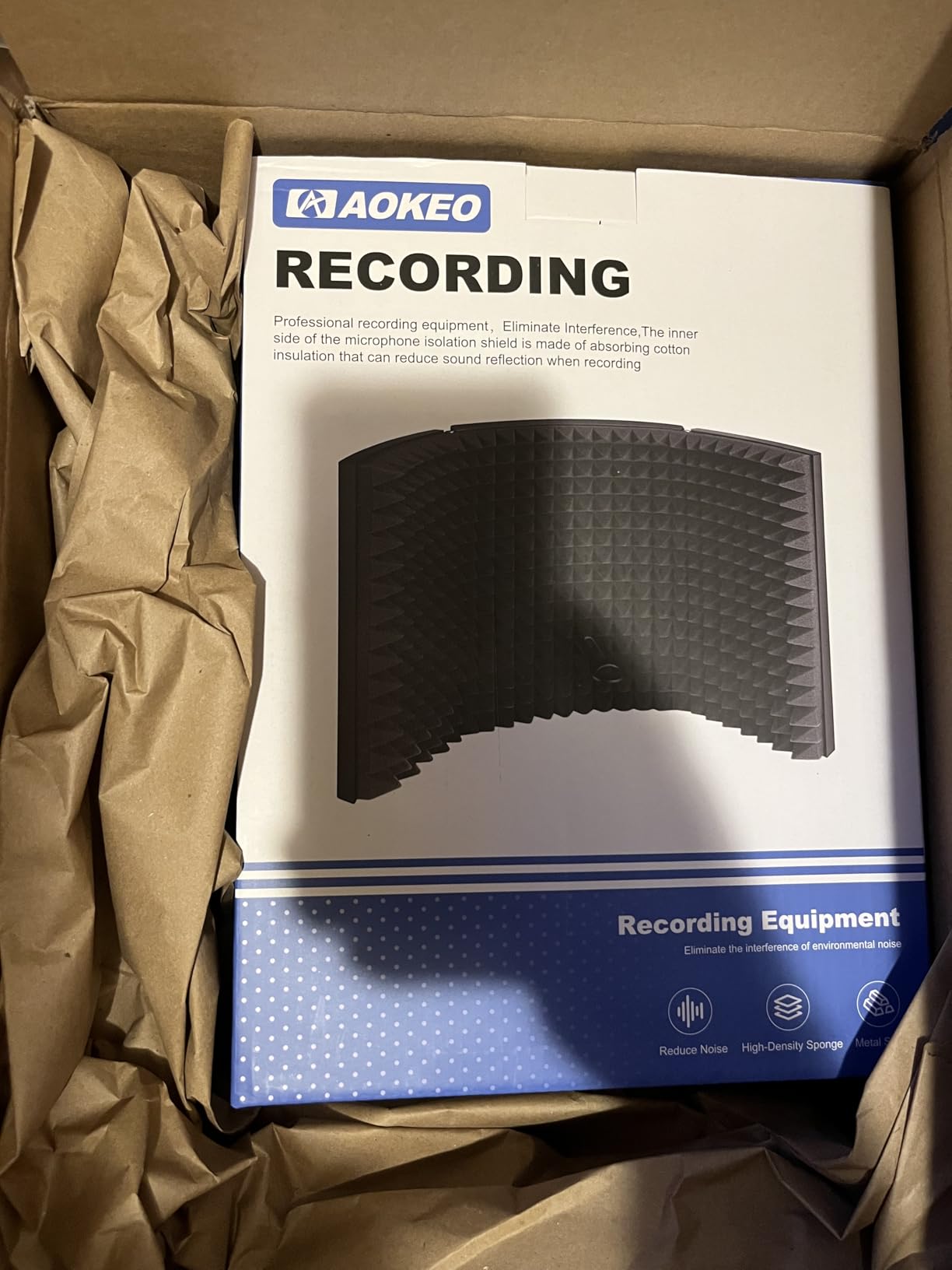
The AO-403 is the shield I suggest when someone is unsure whether they care about acoustics at all, because it is cheap enough to be an experiment and light enough to move constantly. At 550 grams it is roughly a quarter of the weight of the floor-standing kits, and it folds flat enough to live in a drawer between projects.
Physically it is an acoustic foam front paired with a vented metal back plate inside a steel frame, which is a sensible, conventional layout. Fully open it extends to about 18.5 inches wide and 11.6 inches tall, and it can sit on a countertop, on a tabletop or clamped to a microphone stand depending on what your space allows.
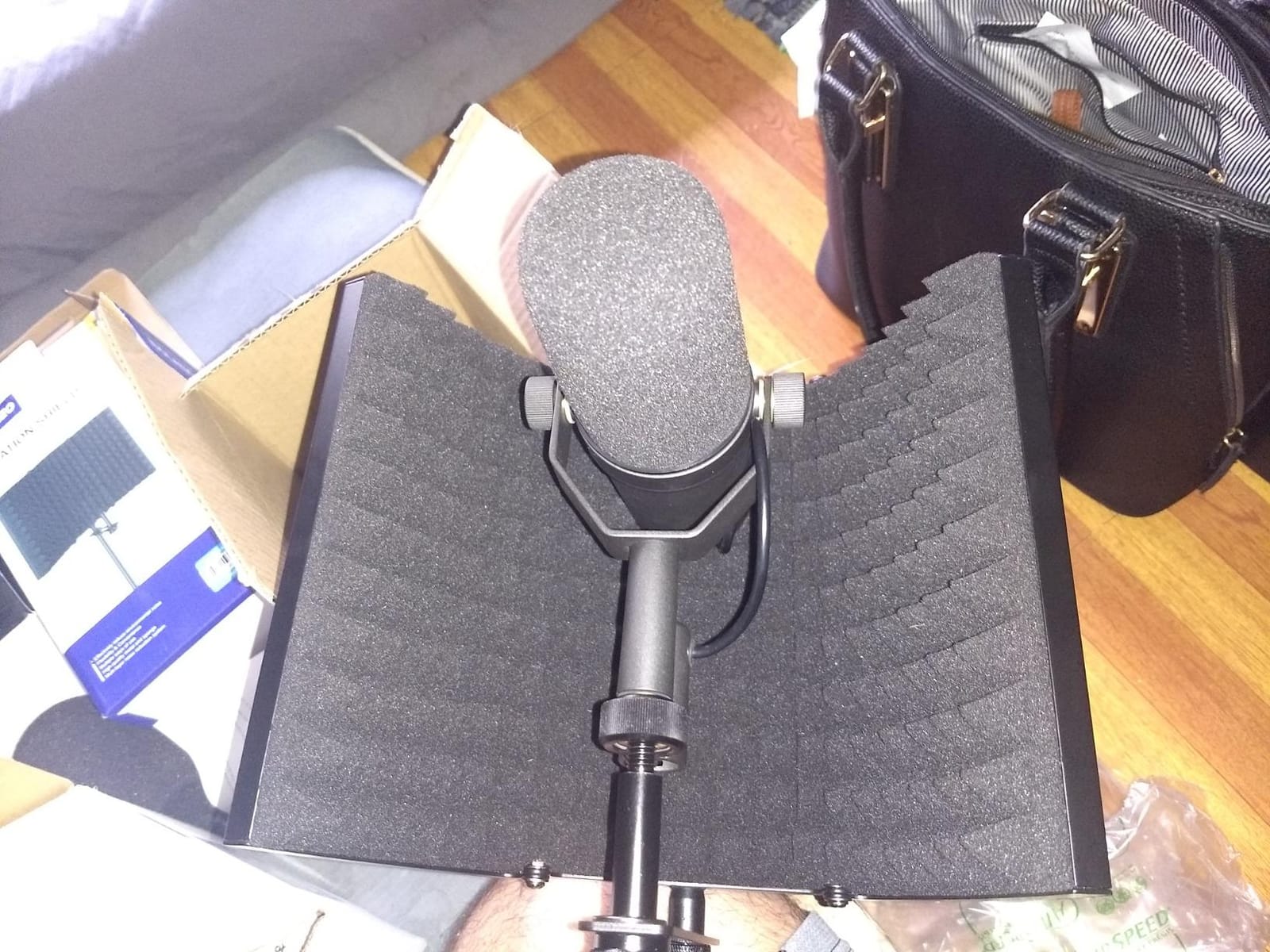
Its rating of 4.2 is the lowest in this group, and the reason is almost always size. Buyers report that the opening is smaller than they expected and that they wish it covered more surface area. The foam and the frame do what they claim, but the coverage is modest, and a modest shield produces a modest improvement.
One of the more useful review notes I found describes draping a towel over the half-folded shield to add absorption, which tells you two things: buyers are inventive, and the panel alone leaves the sides open. Assembly instructions also draw repeated complaints, so budget a few extra minutes the first time and keep the hardware in a tray.
Who it suits
This suits a student, a first-time streamer or anyone testing whether room treatment matters to their voice before spending properly. It also suits people who record in several different rooms and need something that fits in a bag.
If your microphone is a large-diagonal USB condenser on a desk, the modest width is workable. If you are recording a full kit or an instrument that radiates widely, look for a wider panel or an enclosed booth instead.
Who it should skip
Skip it if you already know your problem is reflections in a bright, hard-surfaced room, because the coverage area will leave you underwhelmed. Someone who tries this first and hears no change usually concludes the whole category is useless, when the real problem is a panel that is too small.
It is also a poor fit if you use a microphone stand with unusual mounting hardware. Buyers with third-party stands report the fittings do not always match, and the included adapters are not as comprehensive as on the five-panel designs.
4. TroyStudio Portable Vocal Booth – Best for Closet Booths
- Encloses the microphone on five sides for far more absorption than an open panel
- Folds flat and fits in a suitcase for mobile recording
- Sets up in about a minute with no tools
- Works with condenser USB dynamic and even phone microphones
- Foam and fabric shell can bow or sag with repeated use
- Open front means the most reflective wall still needs separate treatment
- Interior foam pieces are slightly smaller than the listing photos
This is the answer to the question that comes up constantly in home recording forums, which is what to do in a genuinely tiny space. A closet studio of about two by three metres has too little surface area for wall panels to work properly, and an enclosed booth works around that by bringing the absorption to the microphone instead of the room.
Inside dimensions after setup are 8 by 10 by 12 inches, and the interior surfaces are lined with two inch thick dense egg-crate acoustic foam. Five foam pieces are backed by a reinforced support panel, and there are cable and stand pass-through holes so you can mount the microphone without rigging anything elaborate.
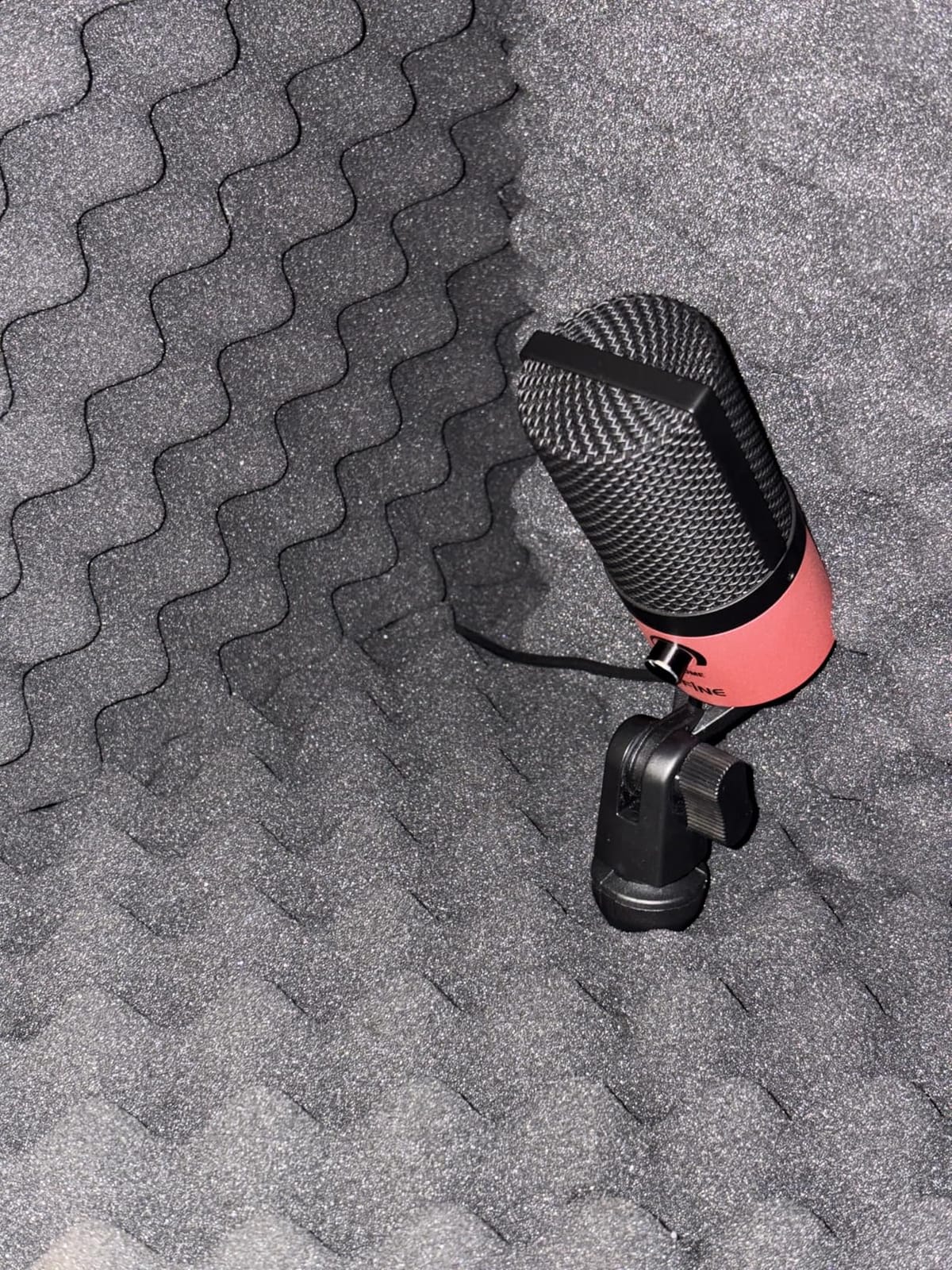
Portability is genuinely exceptional. It folds to 12 by 12 by 6 inches, which fits in a suitcase, and users take it to sessions rather than describing it as a permanent fixture. Setup takes about a minute and disassembly about twenty seconds, which I value more than expected when the alternative is dragging panels around a bedroom.
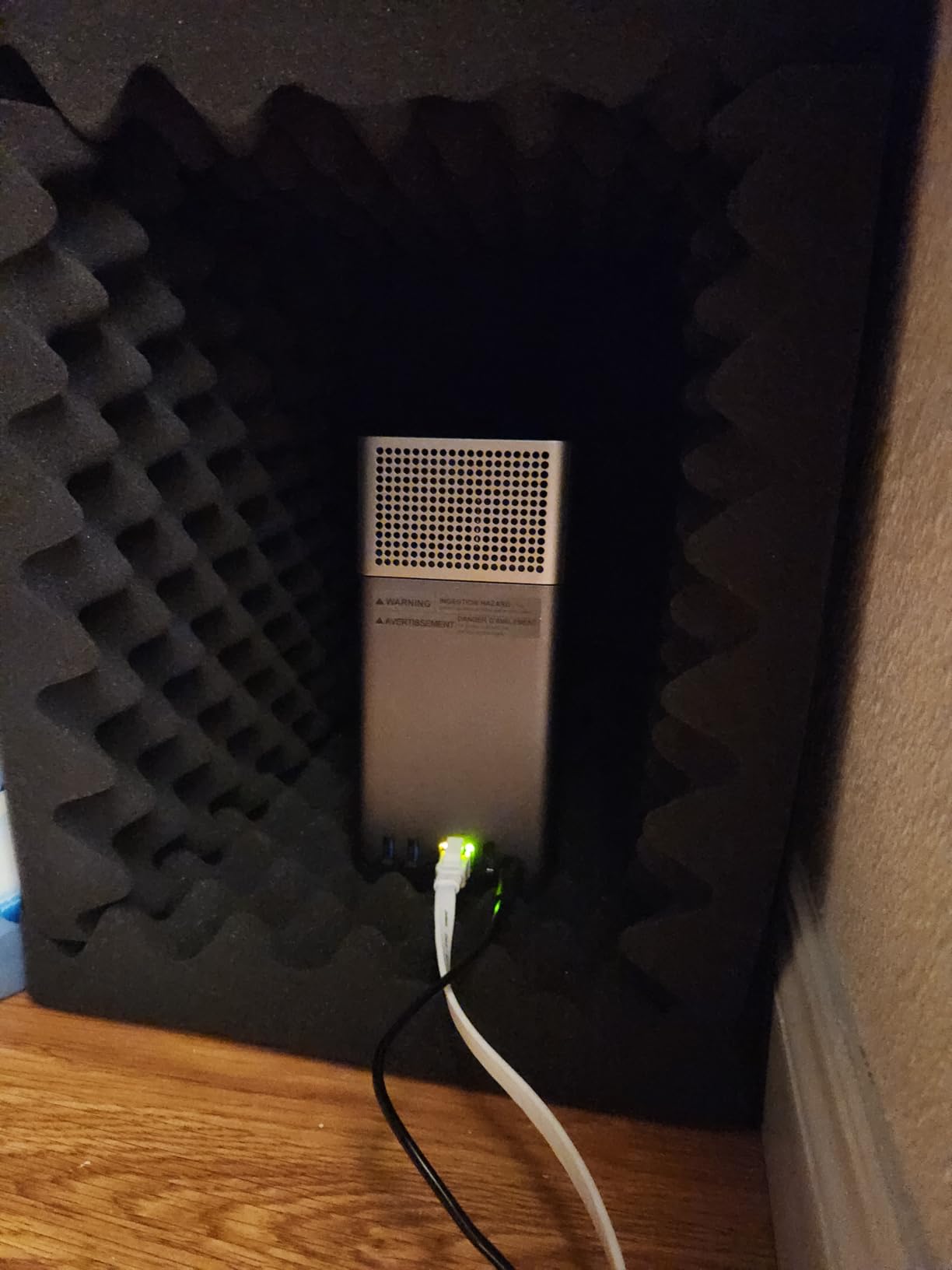
Build quality is the trade-off. Reviews describe the fabric-and-cardboard outer shell bowing at the seam after repeated use, and note that the foam pieces are identically sized so they do not fill the back panel neatly. Users also report pairing it with a bidirectional microphone in a treated room to get close to studio results, and one reviewer used it to silence a noisy network drive, which is a genuinely clever non-audio use.
Who it suits
This suits closet and wardrobe studios, and anyone recording in a room too small to treat properly. It is the strongest choice here for a mobile recordist who shoots on location and needs a booth that packs down to nothing between sessions.
It also suits beginners who are nervous about over-treating a room into a dead sound. Because the absorption is local to the microphone, you control the amount of deadness by how much you close the panels, rather than committing a whole room to it.
Who it should skip
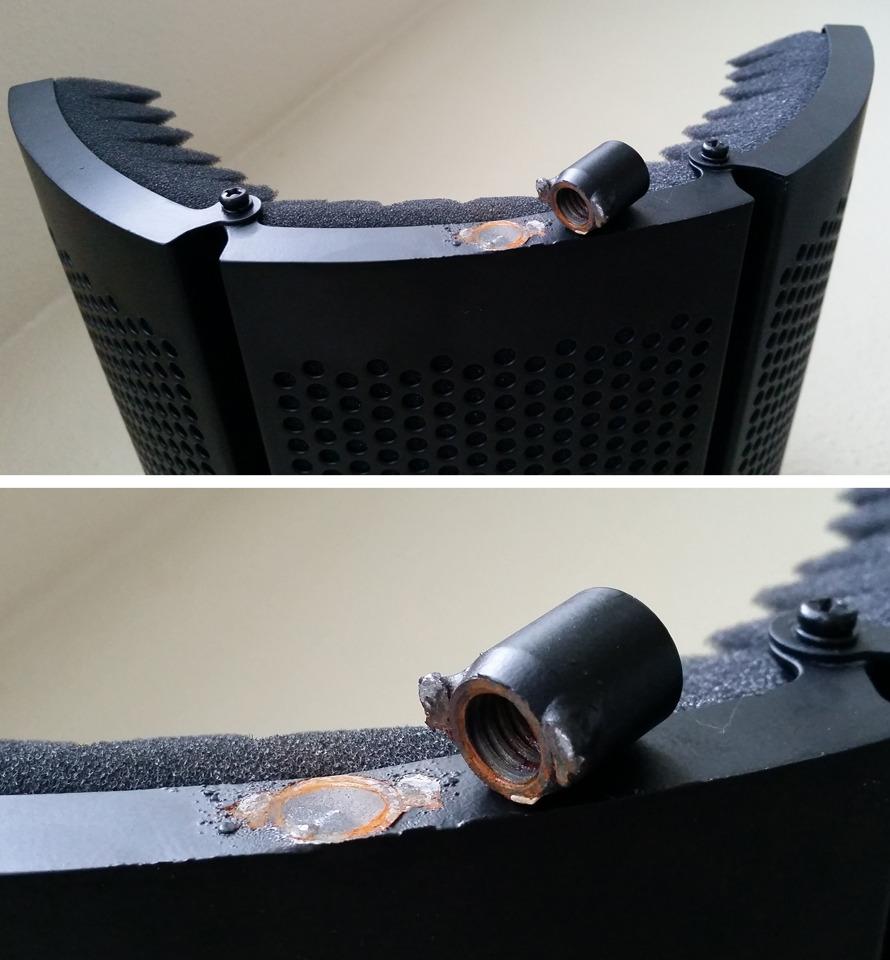
Skip it if you need to reposition a large-diagonal microphone freely, because the interior is only 8 inches deep. Reviewers with big condenser bodies and rear XLR connections report running out of room, and the shell is not built to take abuse.
It is also a poor substitute for acoustic panels in a mid-sized room where you intend to record drums, guitar and vocals in the same space. A single booth will not cover the instruments, and you will end up buying both eventually.
5. XTUGA MIS02 Five-Panel Shield – Best for Podcast Spill Control
XTUGA MIS02 Recording Microphone Isolation Shield, 5 Panels Soundproof Foam
- Five panels and a foldable top give more coverage than a standard three-panel shield
- Reviewers report a darker less brittle vocal immediately after installing
- Sturdy build that holds its shape on a stand
- Assembly is difficult with small nuts that are easy to drop
- Plastic hinges can crack after repeated folding
- Heavy and bulky on a microphone stand
The problem this solves is spill, the one that podcasters ask about most. If a second microphone four feet away can hear your co-host, a cardioid pattern alone will not fix it, and a panel between the two performers genuinely helps. The MIS02 is the most aggressive structure in this roundup for that specific job.
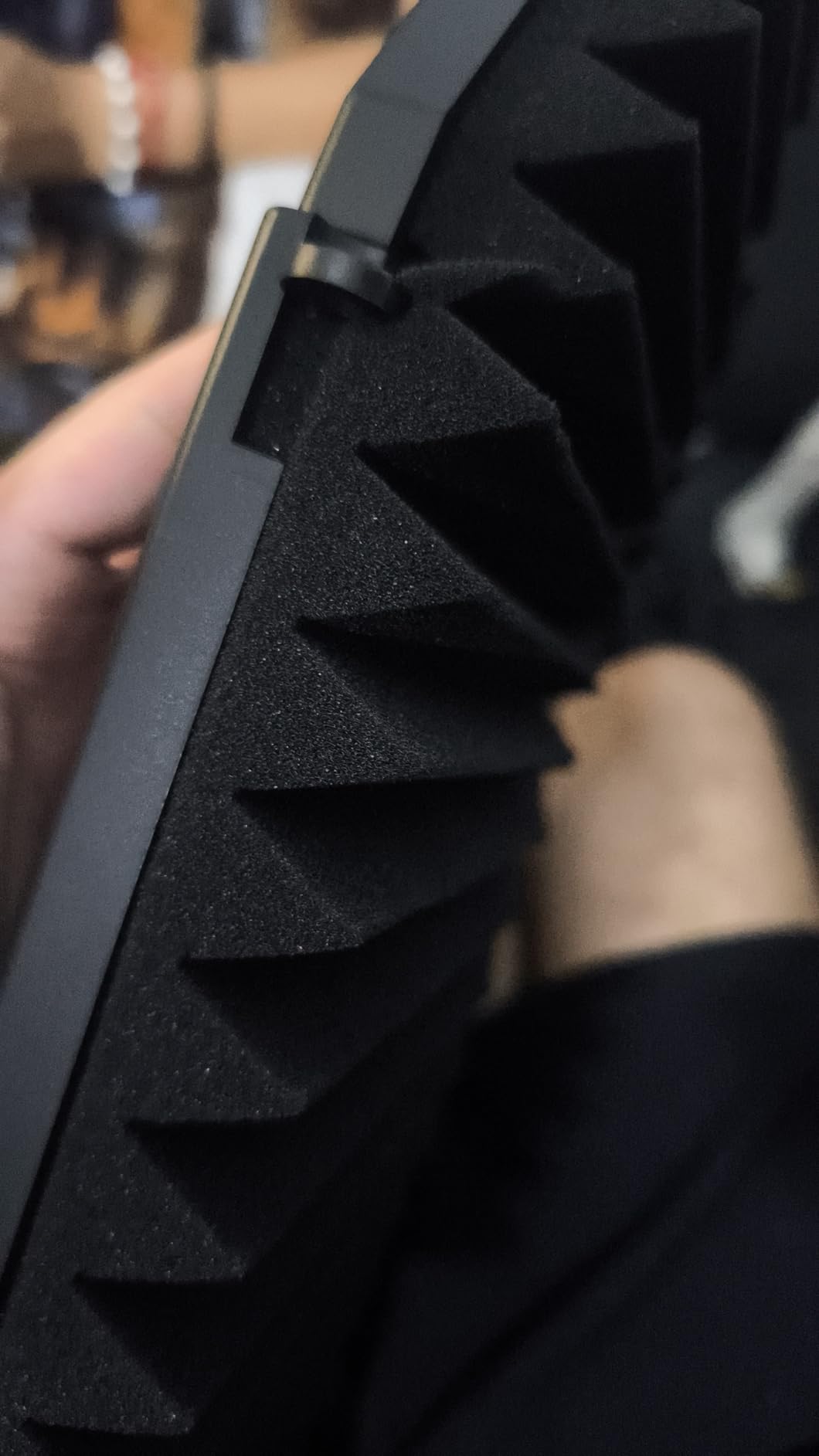
It has five panels, four of which fold at the ends, plus a foldable top that closes the overhead reflection path. The interior is a three-layer construction built around thickened high-density sponge, and the arch design adjusts for angle and height. That top panel is the part that matters for spill and for overhead room reflections.
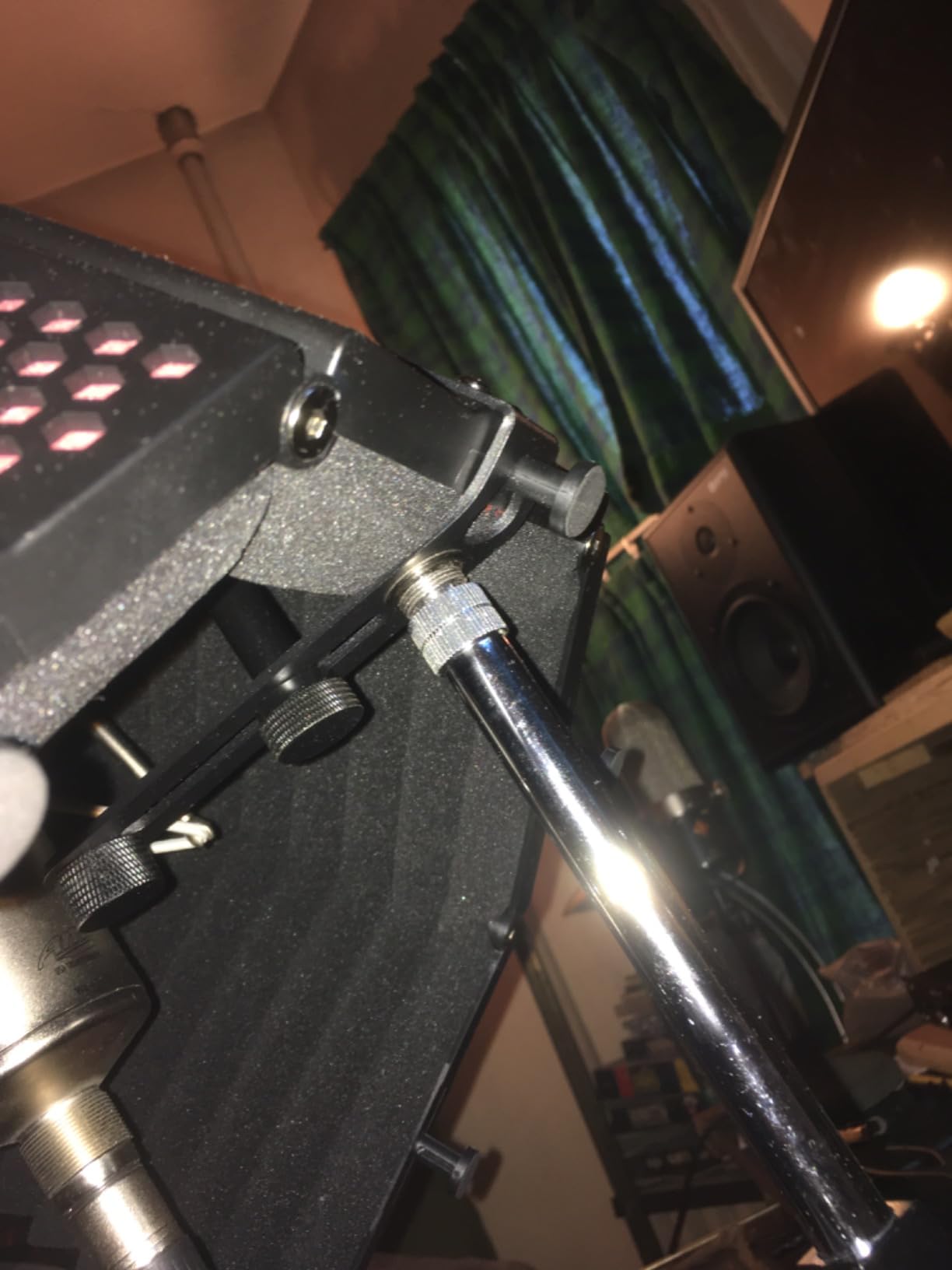
Reviews split cleanly between the acoustic results and the build. On the acoustic side, users report a darker, less brittle vocal straight after installing, with a meaningful reduction in both room reflections and background noise. On the build side, assembly draws repeated complaints, with one reviewer timing it at twelve minutes once they understood that the small nut has to seat fully in its slot.
At 3.98 pounds it is genuinely heavy, and on a light stand that is a real consideration. The other recurring complaint is that the interior depth is too shallow for large-diagonal condenser microphones with rear cable connections, which is worth checking against your microphone before you order.
Who it suits
This suits two-person podcasters and streamers who need a barrier between performers, and anyone whose ceiling is a major reflection source. The foldable top is the reason to choose it over a plain five-panel shield when spill is the problem.
It also suits users with a heavy-duty boom arm or a stand rated well above its weight, because the mass keeps the assembly stable rather than wobbling during a take.
Who it should skip
Skip it if you have a light desktop stand and a large-diagonal condenser. The combination of weight, a shallow interior and plastic hinges is where the complaints cluster, and a lighter flat panel will serve you better with fewer frustrations.
It is also a poor fit for anyone who moves gear between rooms. Once the five panels and the top are folded, this is a bulky object to carry, unlike the fold-flat designs earlier in this list.
6. LyxPro VRI-30 Absorber Panel – Best for Acoustic Guitars
- Arrives fully assembled so it can be mounted in minutes
- Thick 3.5 inch EVA foam behind a vented aluminum back plate
- Highest share of four and five star ratings in the set at 87 percent
- One year manufacturer warranty
- Single-panel design gives far less coverage than five-panel or enclosed designs
- Niche listing with a low sales rank compared with the others
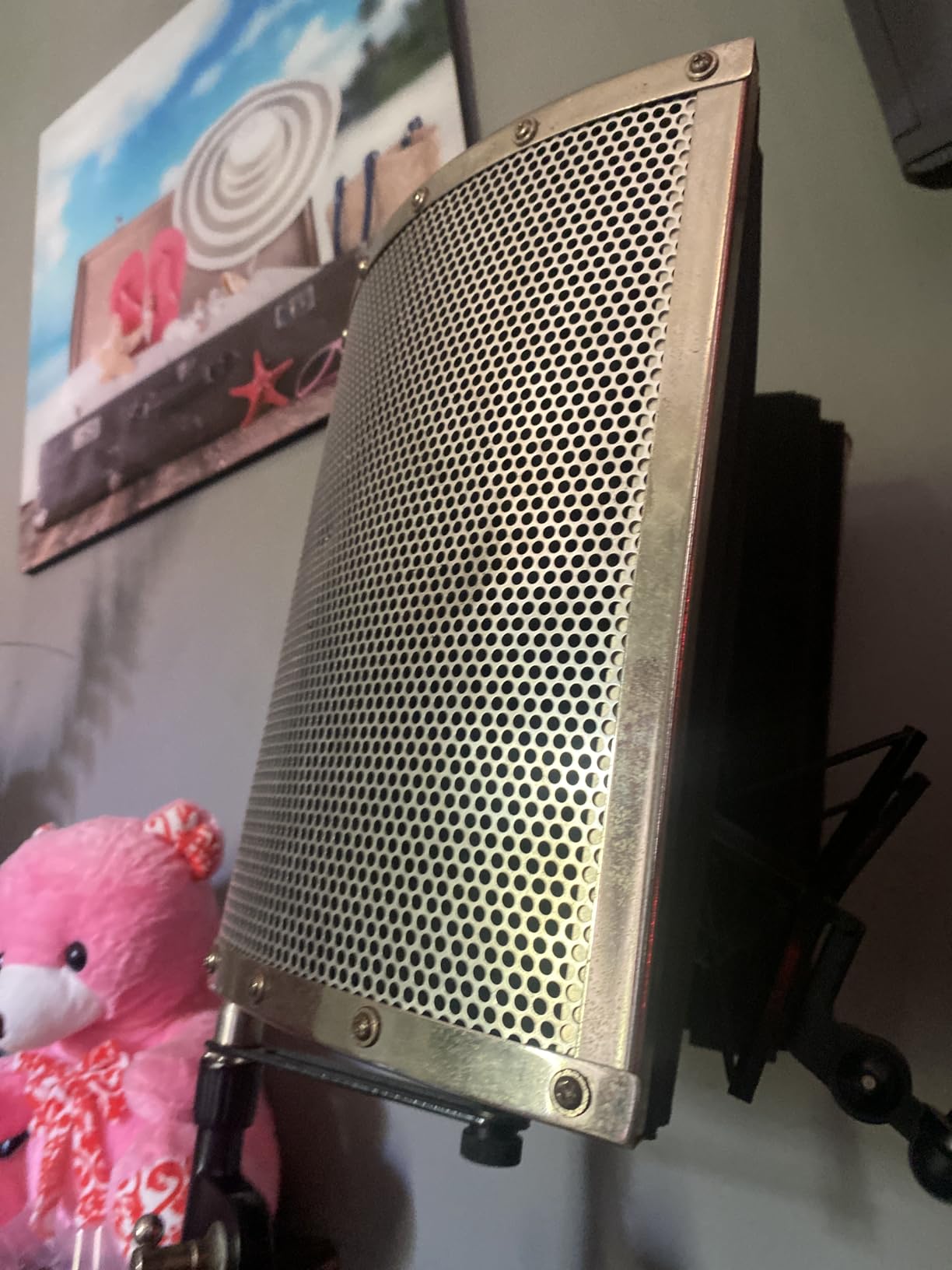
The VRI-30 is a flat panel, and treating it as anything more than that would be overselling it. What it does well is absorb, with 3.5 inches of EVA foam behind a perforated aluminum back plate. For a single sound source placed in front of it, that is a genuinely useful amount of absorption.
The detail I value most is that it arrives fully assembled. There is no hinge sequence to get wrong and no loose nuts to drop, which removes the single most common source of frustration in this category. It fits most microphone stands with the included mounting hardware and disassembles for transport between rooms.
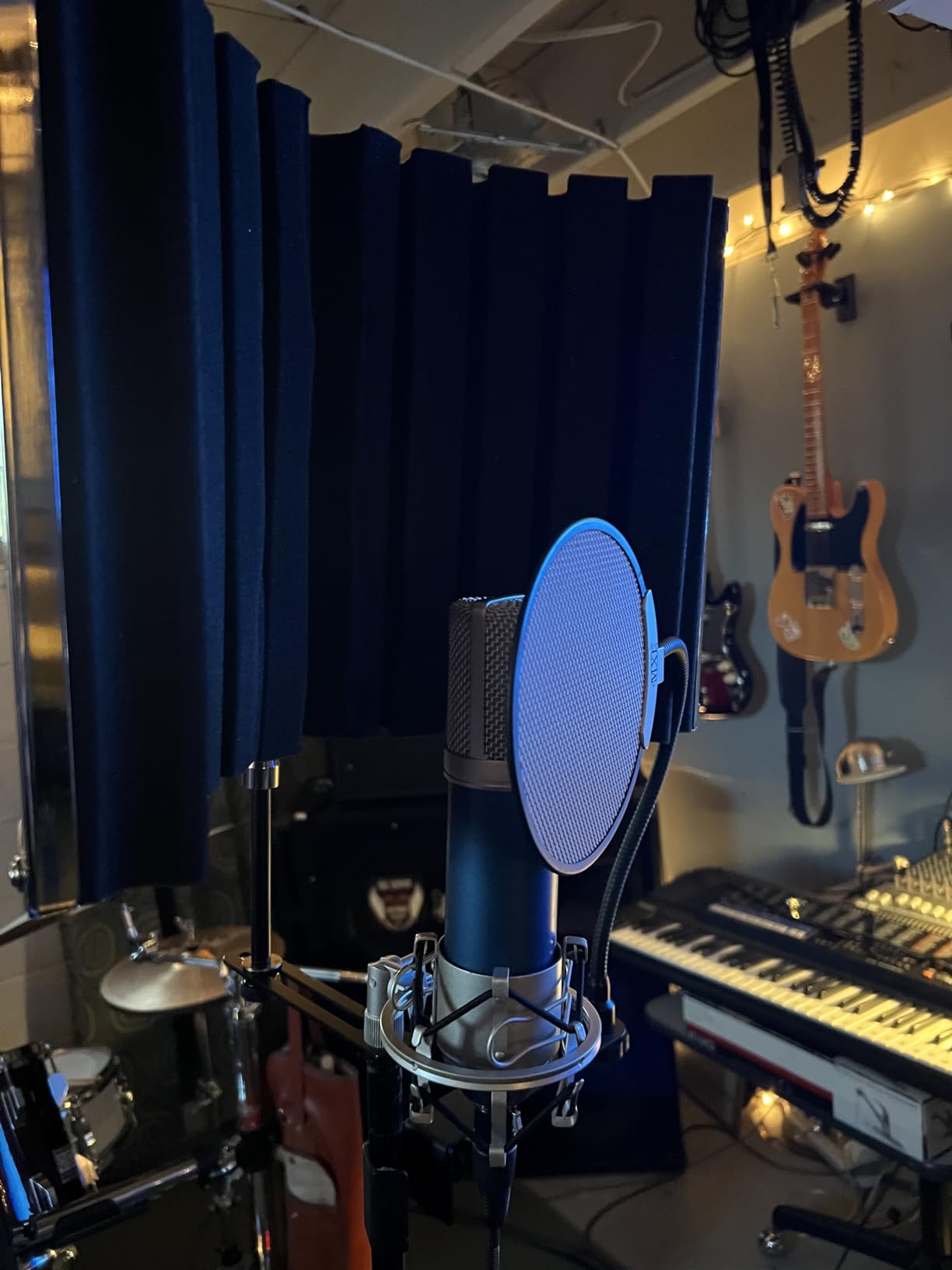
At 4.5 stars with 87 percent of reviewers rating it four or five, the satisfaction level is the highest proportion in this group. Buyers single out the foam thickness and the straightforward stand fit. Because it is a panel rather than an enclosure, reviewers position it as a reflection filter for vocals and instruments rather than as a noise blocker, and that framing is accurate.
Its limitation is structural rather than a fault. A single flat panel with 19.3 by 12 inches of face cannot wrap around a source, so reflections arriving from the sides and the top are untouched. If your room is bright on three sides, one panel fixes one side.
Who it suits
This suits acoustic guitar and instrument recording, where the sound radiates forward toward a panel and a single absorbing face is exactly the right shape. It also suits anyone who wants a permanent, always-mounted setup with nothing to assemble.
It is a good fit for a home office booth where you record short voiceover lines and want a clean, dry result without a large footprint on the desk.
Who it should skip
Skip it if you need spill control between two people or a podcaster who wants the microphone hidden from camera. A flat panel offers no barrier on the far side, and it will not stop sound crossing between two microphones.
It is also the wrong pick if you move between rooms constantly. While it disassembles, a full five-panel or enclosed design is what people actually travel with.
7. Dmsky Triple Insulation Shield – Best All-in-One Kit
- Highest average rating in the set at 4.6 with 92 percent four and five star scores
- Shield stand pop filter and tray mean nothing else needs buying
- Steel construction feels solid and the manual is clear
- Assembles adjusts and disassembles easily between sessions
- Tripod can feel slightly wobbly if bumped
- Included storage tray is quite small
- Pop filter and tray connection points feel thin
The Dmsky scores 4.6 stars across roughly 790 ratings, with 92 percent of buyers at four stars or better and only around three percent at one star. That is the cleanest satisfaction profile here, and the reason is straightforward: it is a complete kit rather than a single component.
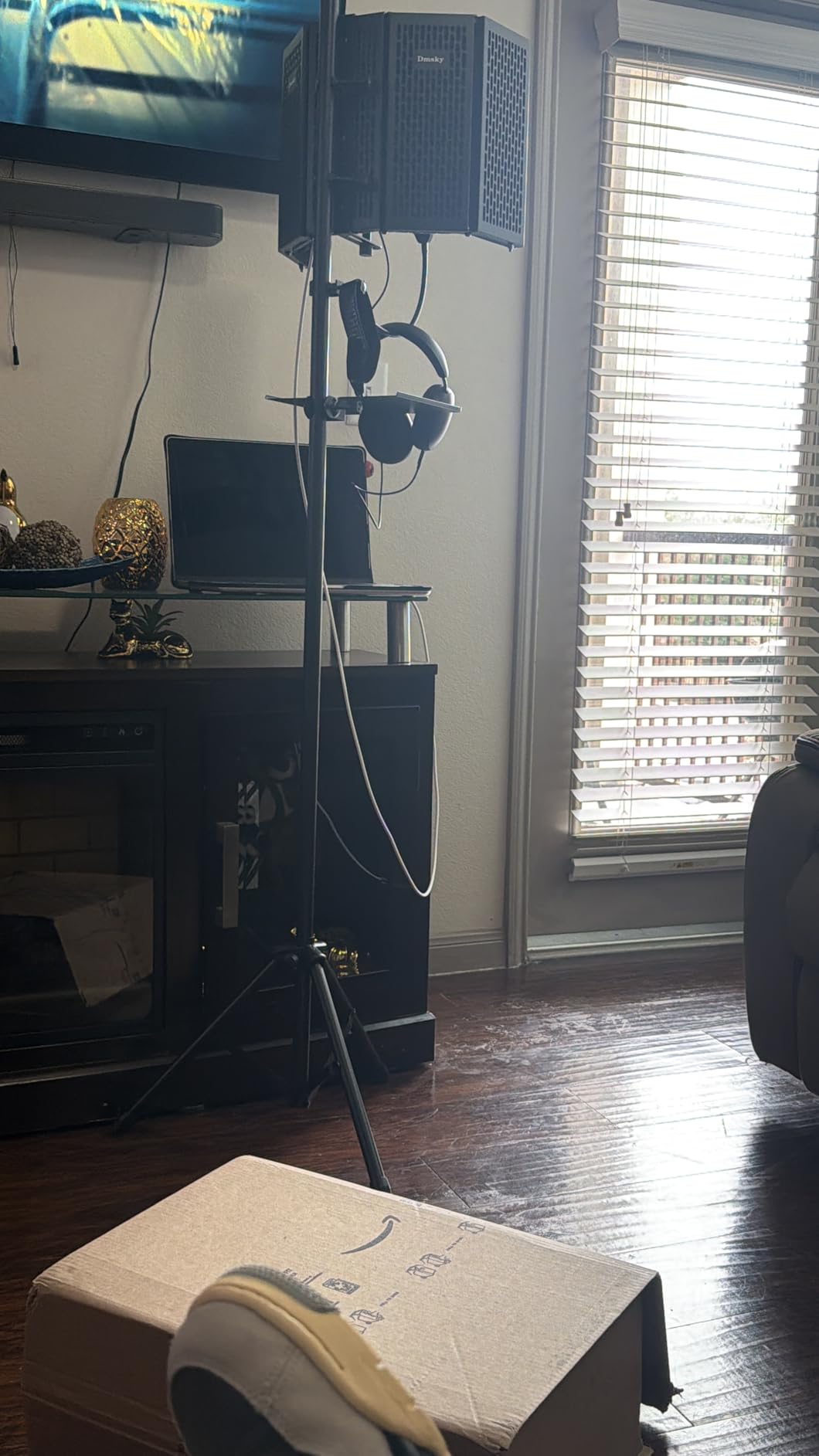
Triple sound insulation combines a reflective layer, a filter layer and an absorbing layer across five folding panels that adjust at 180 degrees. The heavy-duty tripod adjusts from 42 to 71.5 inches and accepts a boom-style arm, and the box includes a pop filter, 3/8 and 5/8 inch adapters and a small storage tray.
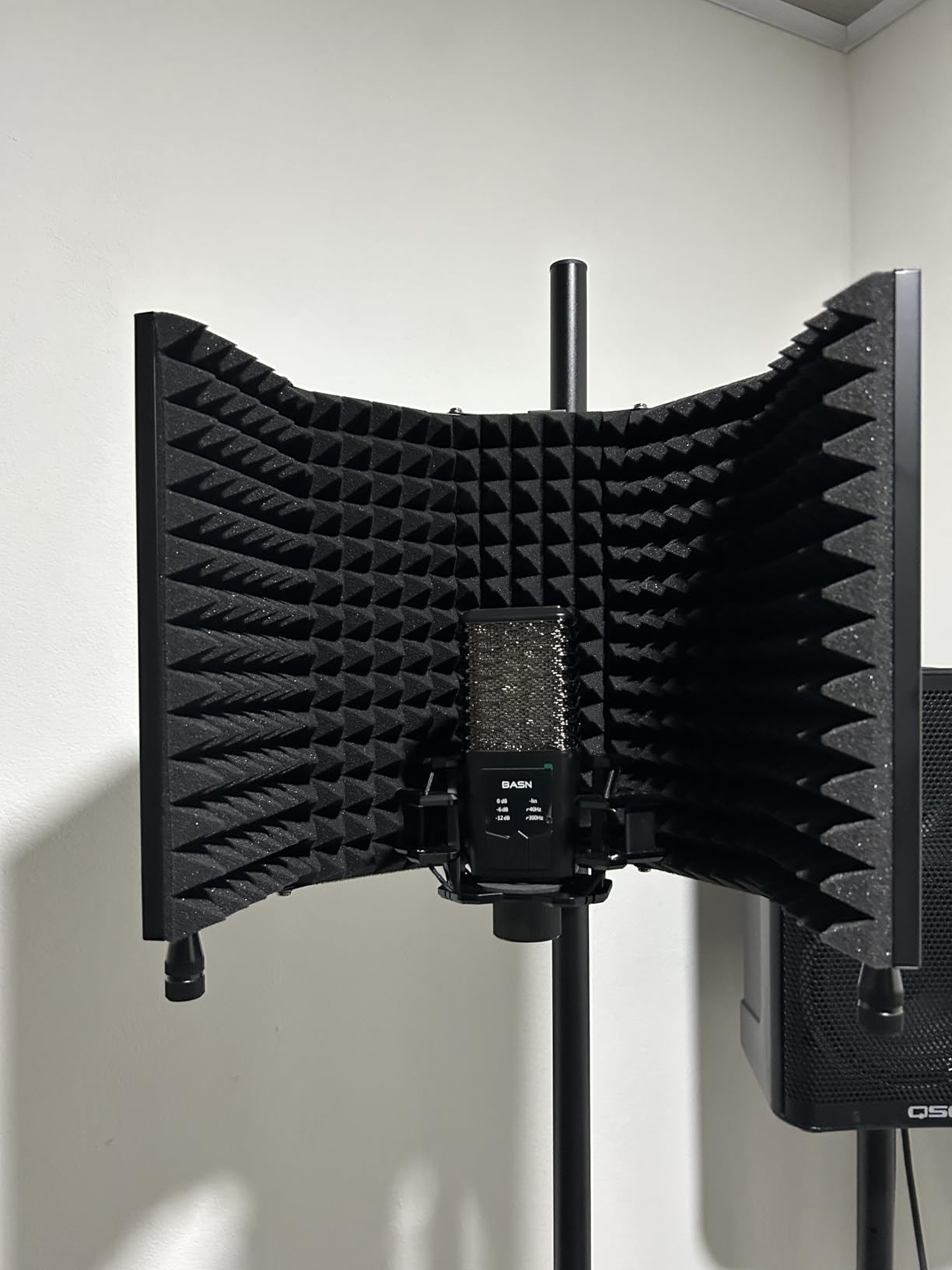
What reviewers consistently praise is that nothing extra needs to be purchased. For a first home setup that is a bigger deal than it sounds, because the pop filter alone is one more thing to research, and a missing adapter is a reason to abandon a purchase mid-unboxing.
The negative feedback here is narrow and mechanical rather than acoustic, which is a good sign. Users mention a tripod that feels slightly wobbly if bumped, a storage tray that is quite small, and thin connection points where the pop filter and tray attach. None of those affect the recorded sound.
Who it suits
This suits anyone who wants a standing vocal booth with nothing to add, and it works particularly well for podcasters and singers moving between a seated and a standing position. The 42 to 71.5 inch range covers both without buying a second stand.
It also suits streamers who already own a boom arm and want the shield to accept one, since the tripod is described as boom-compatible rather than fixed-post only.
Who it should skip
Skip it if desk space is the constraint. A five-panel shield on a full-height tripod is one of the larger footprints in this roundup, and the wobbly-tripod complaint suggests it is not a good fit for a shared desk with heavy foot traffic.
If you already own a good boom arm, a shock mount and a pop filter, most of the value here is redundant and a lighter panel would do the same job at a fraction of the load on your stand.
8. Auray ISO-ARMOR-2 Chamber – Best for Travel Recording
- Deep chamber encloses the microphone for stronger isolation than any flat panel here
- Very light at 1.4 lb so it mounts on smaller booms and arms
- Built-in sliding two-layer nylon pop filter that can be removed
- Integrated suspension mount decouples the microphone from vibration
- Only fits microphones up to 2.3 inch in diameter
- Compact chamber leaves little room to reposition a large-diagonal microphone
- Heavy aluminium construction adds bulk to a bag
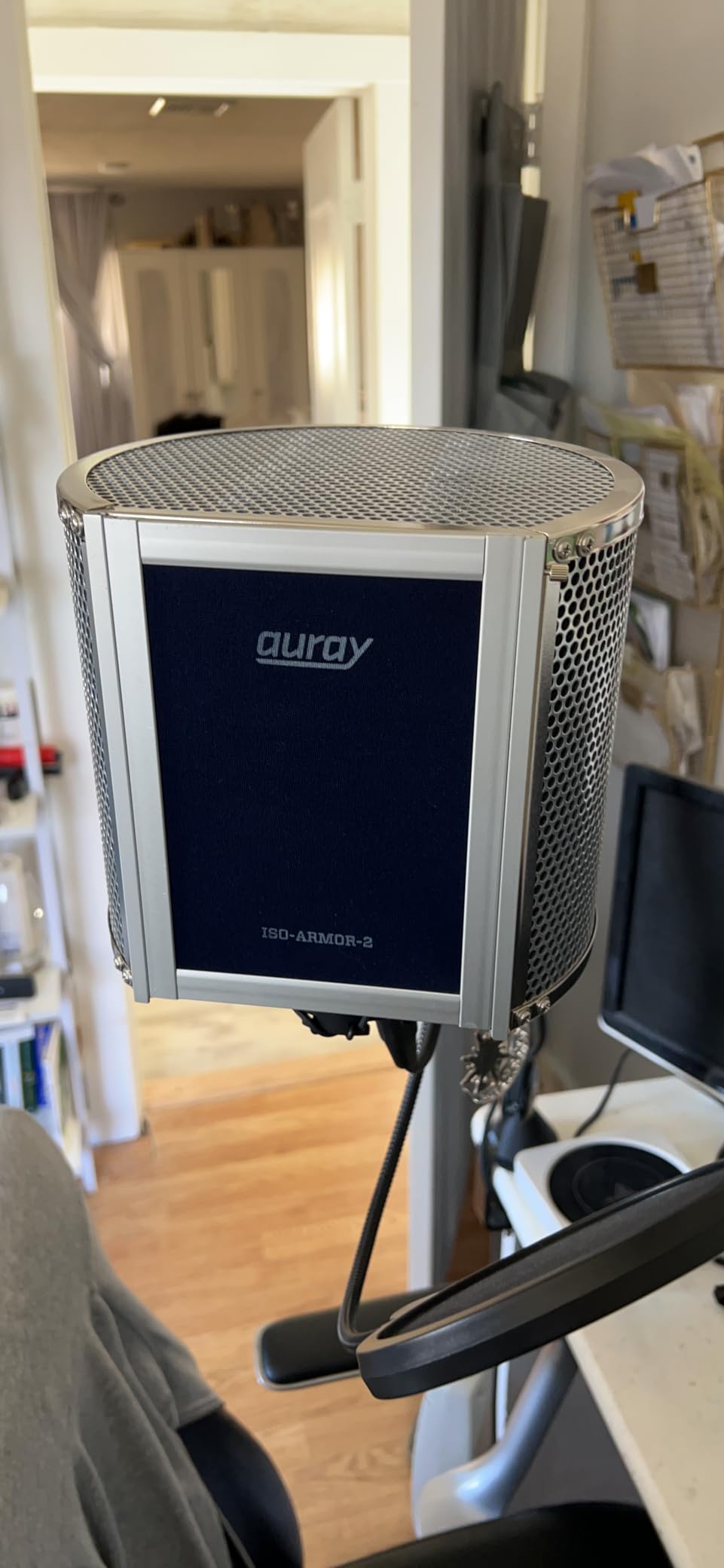
The ISO-ARMOR-2 is the only true chamber in this roundup, and that changes what it can do. A perforated aluminum shell wraps a high-density open-cell acoustic foam liner around the microphone on all sides, which is a fundamentally different acoustic object from a panel that absorbs reflections in front of it.
Everything is integrated. There is a two-layer nylon sliding pop filter that can be removed for close-proximity vocals, and a suspension mount inside that decouples the microphone from external vibration, so a footstep or a desk knock is less likely to reach the capsule.
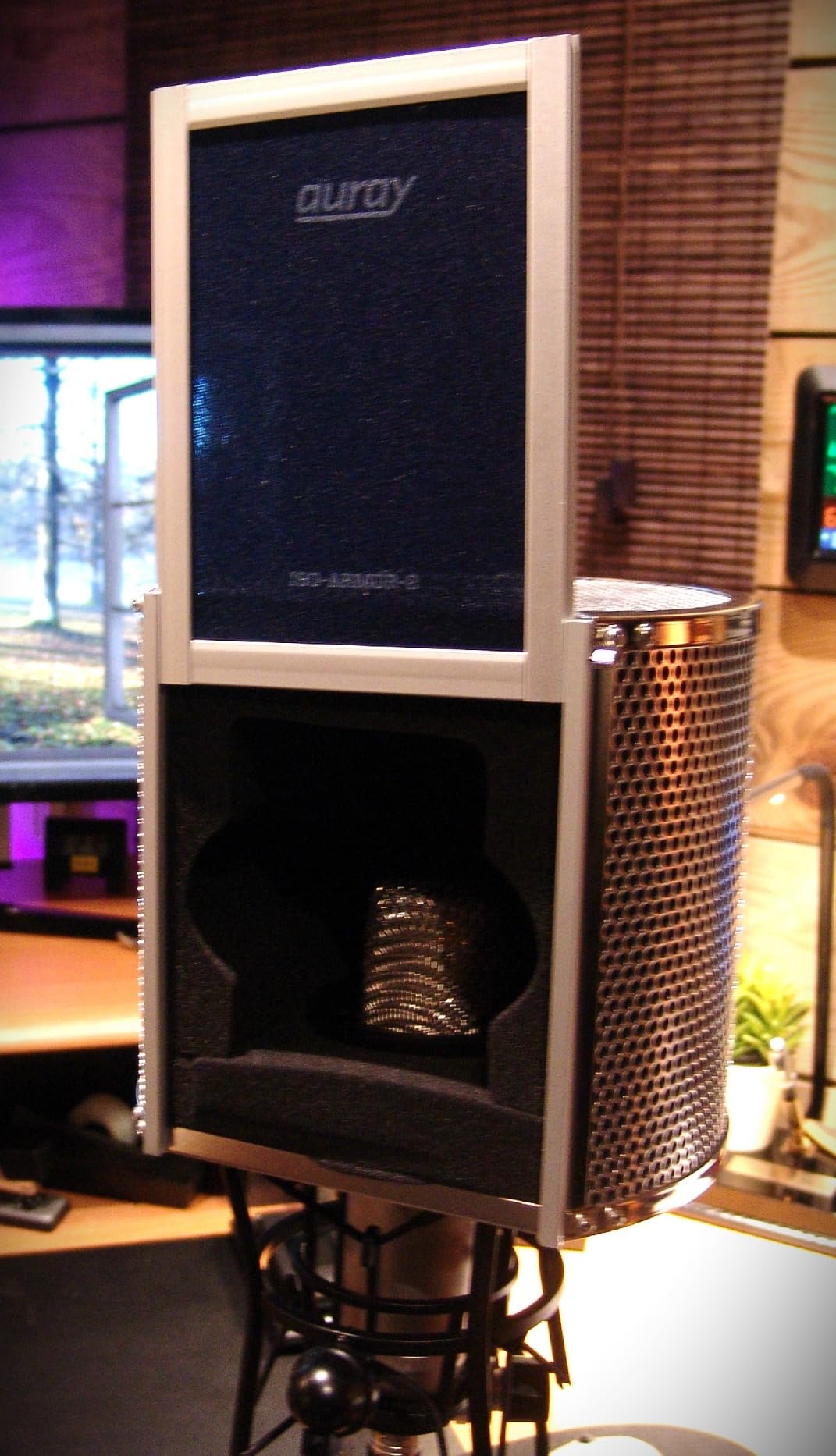
At 1.4 pounds it is by far the lightest enclosure here, and that is the number that makes it a travel product. It mounts on smaller booms and arms without loading them, which is exactly the failure mode that drags heavier shields down with the stand.
The constraint is stated plainly in the specifications: it fits microphones up to 2.3 inches in diameter. That rules out many large-diagonal body microphones, and the compact chamber also leaves limited room to reposition a bigger mic inside. Check your microphone diameter before anything else.
Who it suits
This suits location and field recordists, and anyone using a lighter boom or a small desk arm who cannot carry the weight of a five-panel shield. It also suits narrators who want a built-in pop filter without buying one separately.
It is the strongest choice here for a voiceover artist who records in different rooms, because a small self-contained chamber is far simpler to move between them than a foldable panel with a stand.
Who it should skip
Skip it if your microphone is a large-diagonal condenser, particularly one with a rear XLR connection. The 2.3 inch diameter limit is a hard physical constraint, and no amount of careful setup gets around it.
It is also the wrong choice if you want to reach in and adjust capsule angle or add a small accessory between takes. A sealed chamber is deliberately inconvenient for that reason.
9. Aokeo AO-505 Wide Panel – Best Wide-Coverage Flat Panel
- Widest flat panel in the roundup at 23.2 inches across
- Best-established rating and review combination in the set at 4.6 across over 1400 reviews
- Metal build is sturdy and does not wobble
- Desktop stand included and it folds for storage
- Controls reflections behind the microphone rather than blocking outside noise
- Bulky footprint for a small desk
- Some buyers report it runs smaller than expected
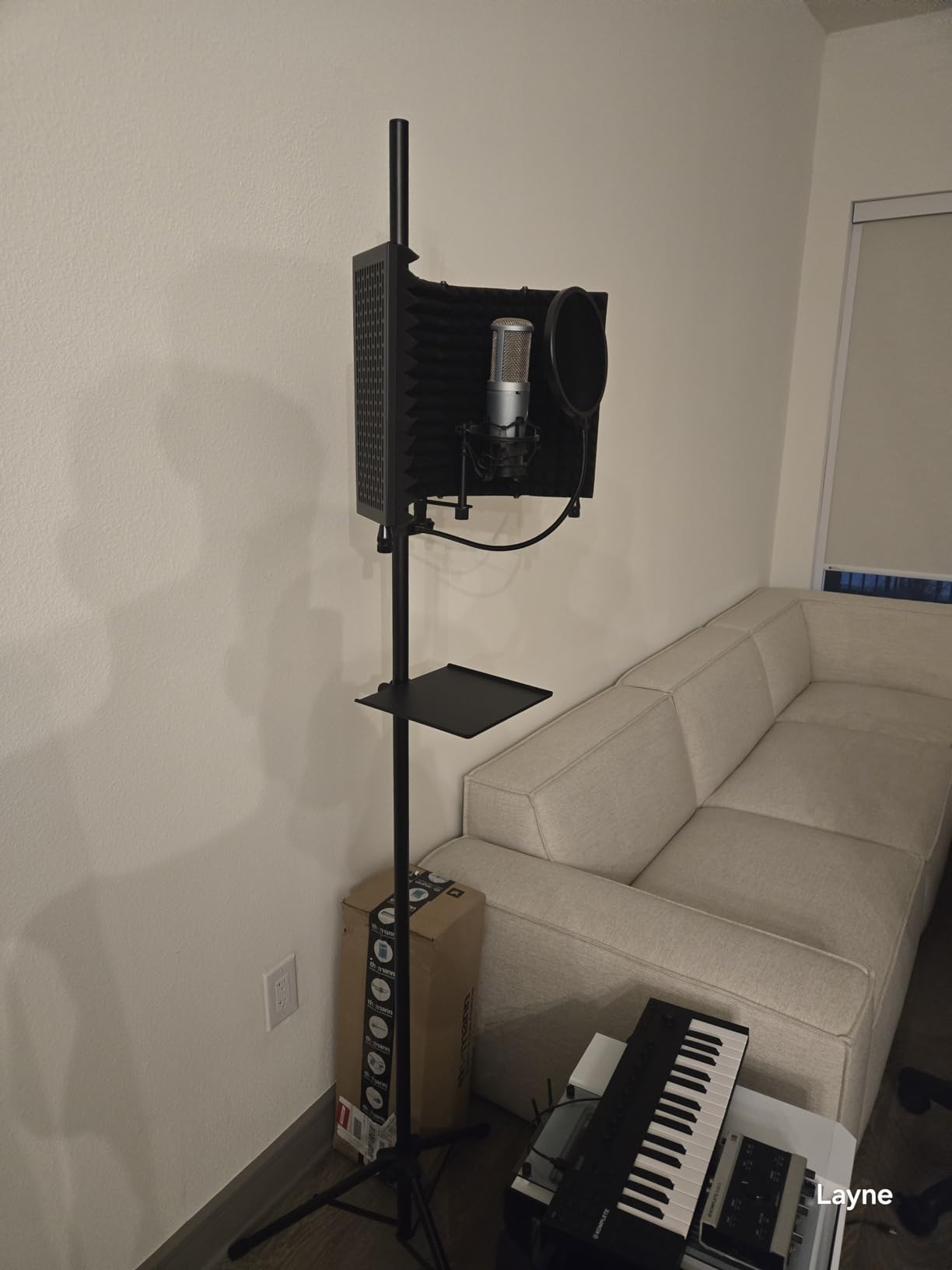
The AO-505 is the widest flat panel in this roundup at 23.2 inches across by 11 inches tall and 2 inches deep, and width is the variable that matters most for a flat design. A wider absorbing face covers more of the reflection path behind and beside a large-diagonal microphone without any of the bulk of a five-panel rig.
It combines sound-proof foam on the front with a ventilated metal back panel in a solid metal alloy frame, mounted on a standard 3/8 inch mic thread with a 5/8 inch adapter included. That covers Blue Yeti, Snowball and shock mount combinations, which is most of the USB condenser market.
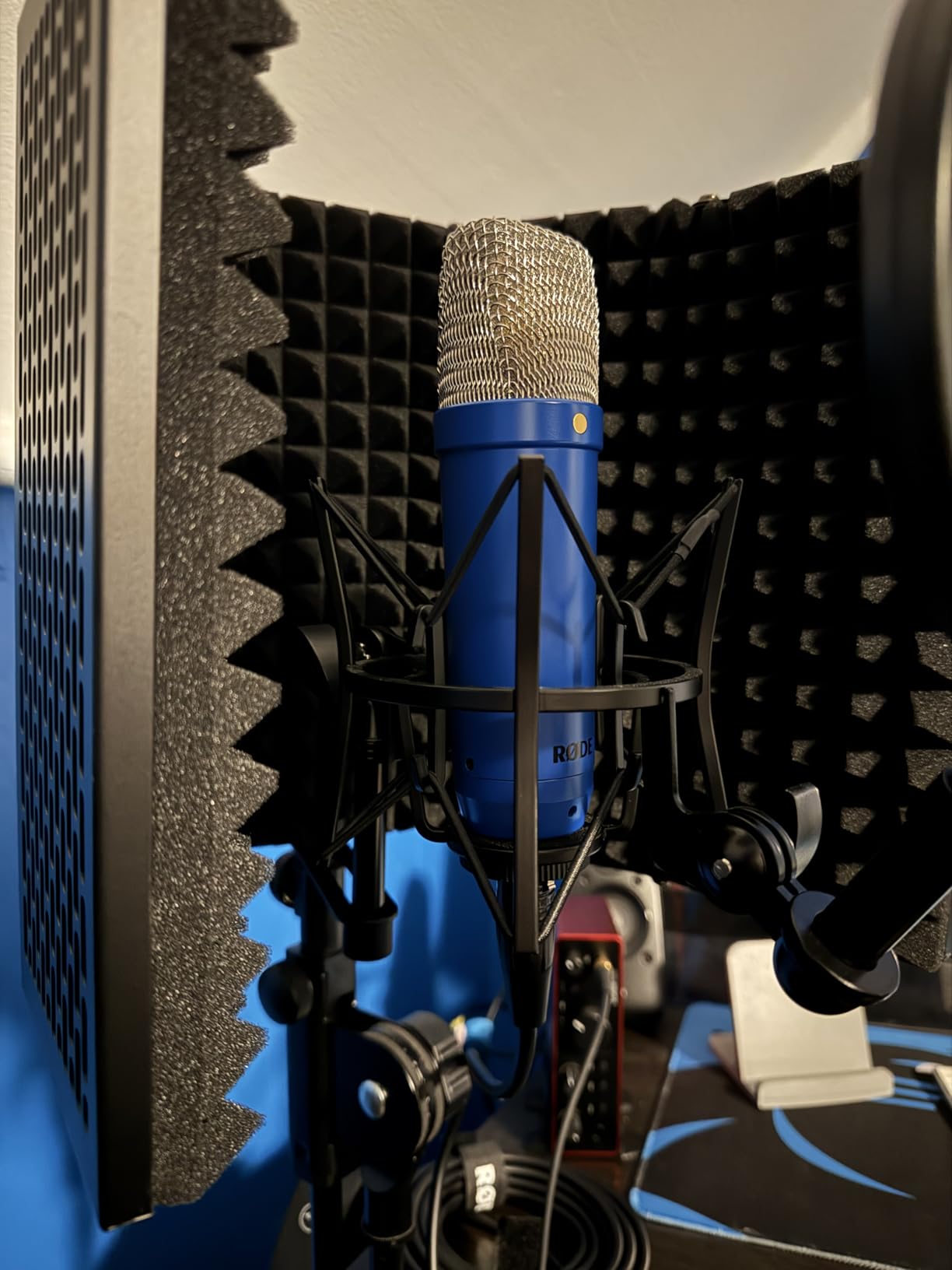
At 4.6 stars across more than 1,400 ratings, this has the strongest combination of rating and review volume in the group, which tells you something useful: this is a design that has been proven by a large number of people, not just well specified by a seller.
The consistent caveat in reviews is that the front of the microphone stays open, so it supplements rather than replaces room treatment. Reviewers position it correctly as an affordable entry-level upgrade that reduces echo and reflection in a bedroom. At 1.3 kilograms it is heavier than it looks, so on a light stand it is worth checking stability.
Who it suits
This suits a bedroom or untreated home office with a wide desk and a USB condenser on a desk stand. The 23.2 inch width suits a large-diagonal body that a narrower panel would sit behind without covering.
It also suits anyone who wants a proven, heavily reviewed design rather than an experiment, and anyone who wants a single panel that still folds flat enough to store when the desk goes back to being a desk.
Who it should skip
Skip it if you need real isolation from noise rather than control of reflections. An open front means room sound reaches the capsule from the direction the performer faces, and a wide panel does not change that.
It is a poor choice for a two-person podcast setup, where the useful barrier is between the microphones rather than behind one, and it takes real desk width, so measure before you commit.
10. Aokeo AO-504 Shield with Stand – Best for Sit-Stand Desks
- Strongest sales rank in the roundup and a well established review history
- Steel shield and stand hold steady even after being knocked
- Built-in shelf gives a place for a lyric tablet laptop or interface
- Shield detaches from the stand so it can move with a sit-stand desk
- Shield and stand are bulky on a small desk
- Can feel top-heavy and may need weighting or wide-set legs
- Occasionally a crossbar is missing from the box which blocks microphone attachment
The AO-504 is a steel shield on a 182 centimetre adjustable stand, and the stand is the point. Because the shield mounts at freely adjustable height, it works for a seated desk setup and a standing one without a second piece of gear, which is the situation most home recordists are actually in.
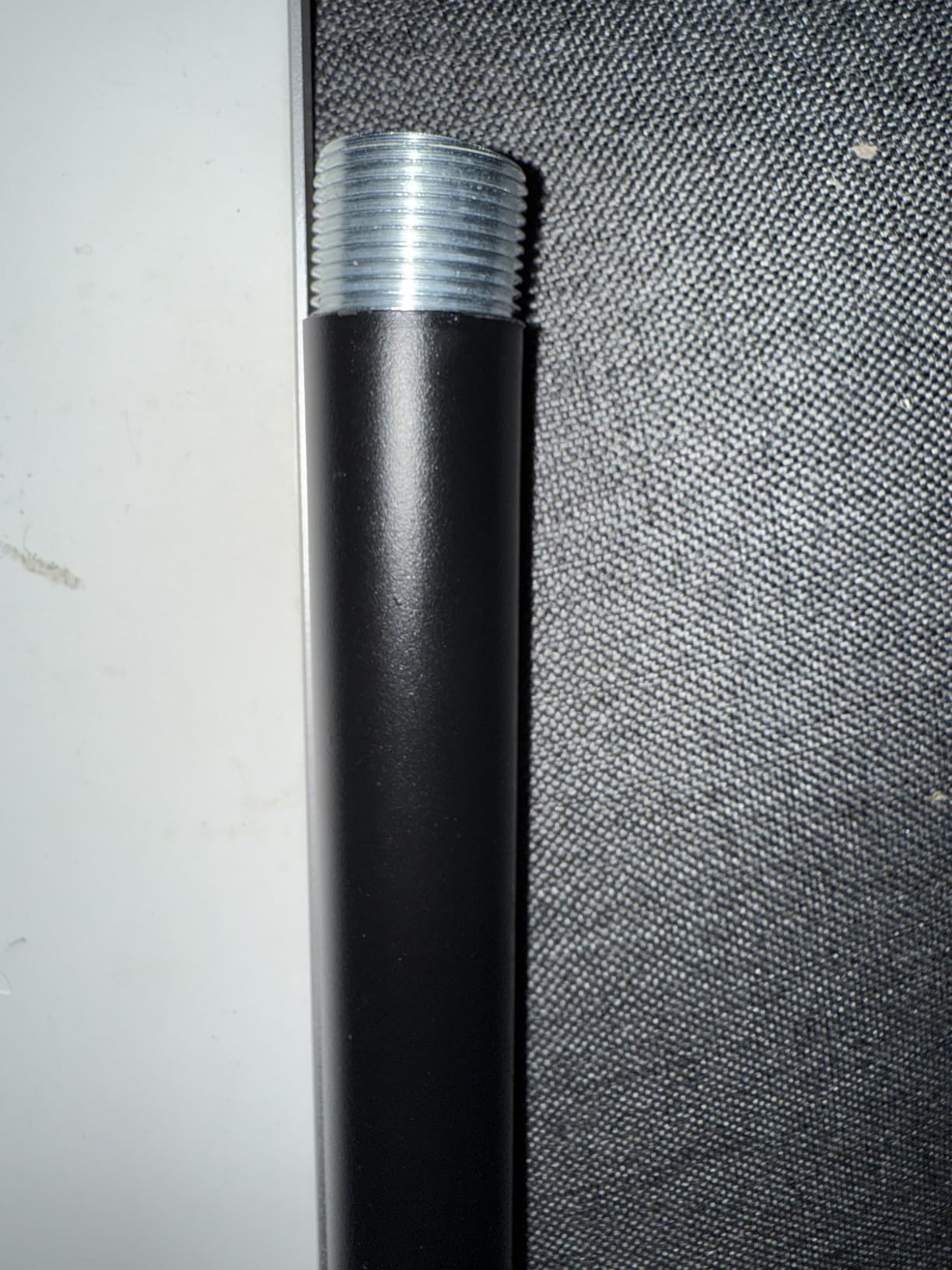
Construction is conventional and proven: an acoustic foam front, a vented metal back plate, and steel clips at the rear that attach the shield to the stand. The package includes the shield, two metal thread adapters, the adjustable stand and a manual, so the compatibility problem that catches out cheaper kits is handled here.
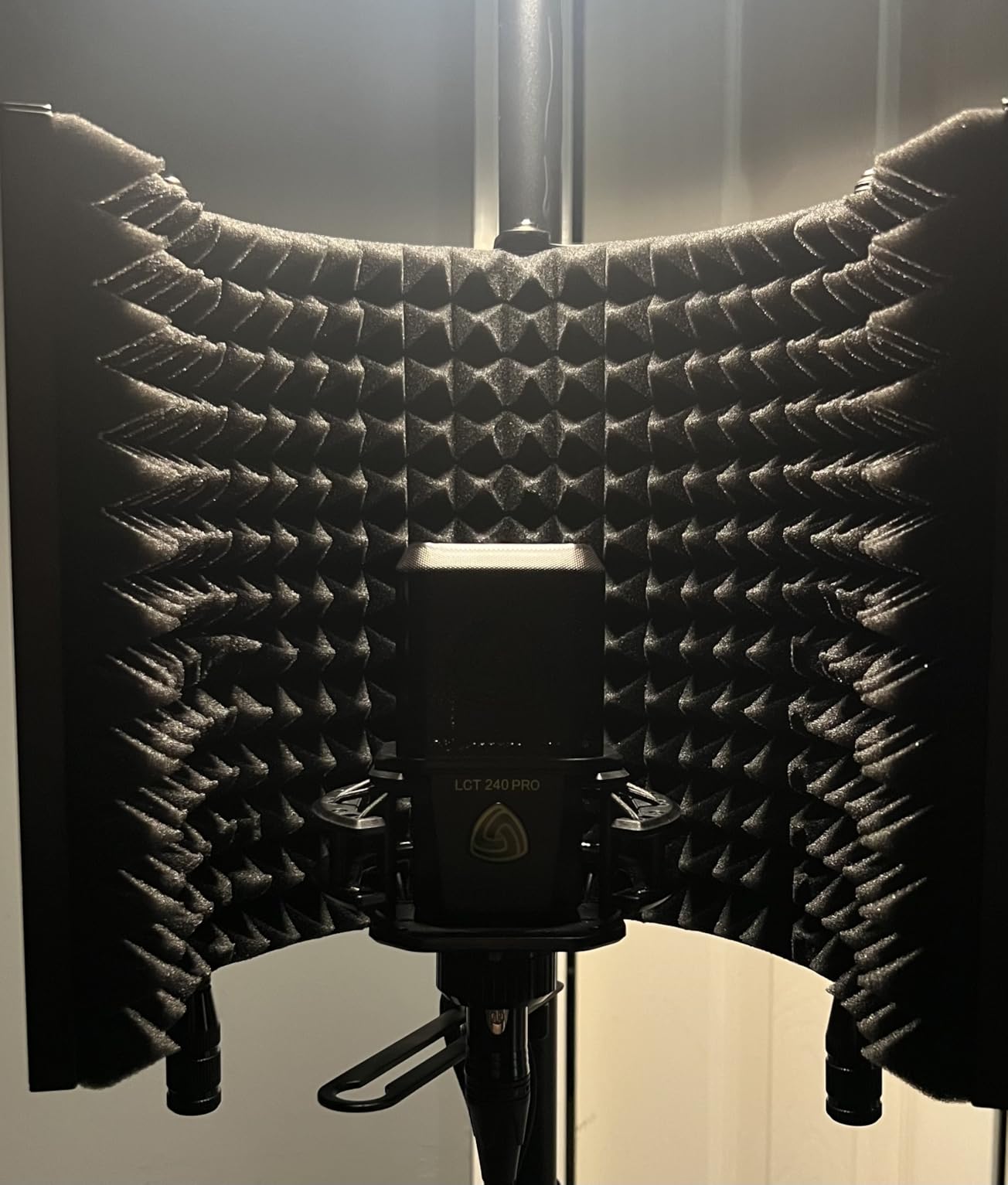
The best sellers rank in this category sits with this one, and roughly 1,750 ratings describe a design that has been put to work for a long time. Reviewers across several countries report a large, noticeable improvement in vocal clarity and echo control in a home setup, and the adjustable stand is singled out repeatedly.
The built-in shelf is a small feature that earns its place, giving somewhere to put a lyric tablet, a laptop or an interface rather than leaving it on the floor. The recurring complaints are physical: bulk on a small desk, and a top-heavy feel that needs weighting or wide-set legs. A few buyers also received a box missing a crossbar, which blocks the microphone from attaching until a replacement is sourced.
Who it suits
This suits anyone working at a sit-stand desk who records, because the shield can be raised and lowered with the performer rather than being rebuilt each time. The detachable shield also means the stand stays put while the shield moves to another room.
It suits streamers and podcasters who want a permanent station with a shelf for notes or a second device, and it suits anyone who prefers a steel build that holds position after being bumped.
Who it should skip
Skip it on a small desk. The combination of a full stand, a large shield and the shelf needs real surface area, and the top-heaviness complaints are mostly from people working in a corner of a small room.
It is also not the right pick if you record on the move. The stand is a permanent fixture, and for location work the lighter chamber or a foldable five-panel shield is the more sensible object to carry.
How to Choose the Right Microphone Isolation Shield
The mistake most buyers make is choosing by appearance or by brand rather than by design type. There are really four shapes of microphone isolation shield, and each solves a slightly different problem. Getting the shape right before the brand is worth more than any specification on the box.
Flat panel. A single wide absorbing face, sometimes vented at the back. This is a reflection filter in the purest sense: it removes energy arriving from one direction, behind the microphone. It is the simplest and most portable option, and it works best for a source that radiates forward, such as an acoustic guitar, or in a room where the worst wall is behind the performer. The LyxPro VRI-30 and the Aokeo AO-505 are both in this class, and the deciding factor is width.
Multi-panel gobo. Three to five hinged panels that wrap around the microphone, sometimes with a foldable top. This increases the solid angle of absorption considerably compared with a flat panel, and the foldable top variant materially reduces overhead reflections. This is the group where the Moukey and the XTUGA MIS02 sit, and it is the most common answer for both vocalists and podcasters.
Enclosed booth. A five-sided or fully sealed box with foam on the interior surfaces. This is a portable vocal booth rather than a reflection filter, and it is the only category here that meaningfully reduces both reflections and some ambient noise. The TroyStudio booth and the Auray chamber both belong here, and they are the right choice for closets, mobile recording and spill control.
Mounted rig. A shield permanently attached to a full-height stand, often bundled with a pop filter and a tray. This is the TONOR, the Dmsky and the Aokeo AO-504, and it exists so you can stop treating the setup as temporary. The advantage is that a stable, correctly placed rig is where a shield does the most good.
Next, match the shield to the room. This is a step that almost every roundup skips, and it is the one that decides whether you are satisfied or disappointed. In a closet or a very small bedroom, the walls are close enough that reflections arrive from everywhere at once, so a single panel cannot win. Choose a multi-panel gobo or an enclosed booth, and accept that the room is too small for wall treatment to be practical.
In a normal bedroom, a wide flat panel or a five-panel gobo is enough for most vocal work. Position the shield between the microphone and the nearest hard surface, which is usually the wall behind the performer or the desk surface in front, and leave the rest of the room alone. The r/homestudios question about whether a shield plus blankets plus carpet is too much comes up constantly, and the honest answer is that in a small untreated room it is a reasonable starting point, provided the blankets hang rather than bunch.
In a larger office or open-plan space, a single shield will not cover the room and you are looking at partial measures, so choose a shield you can position dynamically, and plan to add panels later. For a two-person podcast, the geometry is different again: the useful barrier goes between the two microphones rather than behind one, which is what the foldable-top designs are for.
Then check the three practical details that generate most of the complaints. Weight on a stand is the first: several reviews in this roundup describe shields sagging or rocking on lightweight stands, so a heavier panel needs a heavier stand, and a counterweight or a clamp solves it. Mounting threads are the second, and 3/8 inch with a 5/8 inch adapter covers almost everything, but read the specification. Interior depth is the third, because a shallow chamber will not accept a large-diagonal microphone with a rear cable connection.
Finally, consider the DIY alternative honestly, because experienced people raise it for a reason. The Gearspace consensus is that a soft fleece blanket draped over a boom mic stand costs almost nothing, is easier to reposition, doubles as a stand, and teaches you more about how rooms behave than a packaged product will. That is fair. What a commercial shield adds is durability, portability and a predictable result, and for a shared-wall apartment or a live streaming setup those things are worth paying for.
How to Set Up Your Isolation Shield for the Best Results
Most disappointing shield results come from setup, not from the product. Five steps will get you most of the benefit, and the order matters more than the precision.
1. Set the gain first. Record a few seconds of your voice with no shield, set your gain to a healthy level, and do not touch it afterwards. Once the shield reduces reflections your level will change, and a fixed gain stops you chasing it.
2. Leave an air gap. Do not press the microphone against the foam. A gap of a few inches between the capsule and the absorbing surface keeps the direct sound dominant and limits the comb filtering effect, because the reflected arrival is weaker and later relative to the direct one.
3. Aim the panel at the worst surface. Identify the nearest hard reflective surface, usually a wall behind you or a window, and put the absorbing face between the microphone and that surface. Covering the nicest wall in the room achieves nothing at all.
4. Position the pop filter correctly. If your shield includes one, put it roughly a fist-width from the capsule, and remember that a shield does not replace a pop filter. Plosives come from the front, and a panel behind the microphone will not touch them.
5. Stabilise the stand. Set the tripod legs wide, lower the stand’s centre of gravity, and add a counterweight or clamp if the shield rocks when you touch the boom. Movement during a take is audible as thumps, and a steady rig removes that variable before you start.
Frequently Asked Questions
Are microphone isolation shields worth it?
Yes, when you use one against a specific problem such as reflections in an untreated room. Independent testing of portable vocal booths found that every unit tested introduced some colouration, and that most increased room tone below 150 Hz. That is why a shield works best positioned deliberately with a sensible gap from the microphone, rather than left permanently pressed against the foam.
What is a mic shield?
A microphone isolation shield is a portable acoustic panel that mounts on a microphone stand and sits behind and beside the microphone, lined with high-density foam. It absorbs early reflections so they do not reach the microphone a second time, which reduces room tone and reverb in a home recording. It is also called a reflection filter.
How do you soundproof a microphone?
Set your gain with no shield, leave a few inches of air gap between the capsule and the foam, aim the absorbing face at the nearest hard surface, position any pop filter a fist-width from the capsule, and stabilise the stand so it does not move during the take. A shield reduces reflections inside the room but cannot prevent sound from other rooms entering the recording.
Can I use a microphone isolation shield in a small closet?
Yes, and in a closet it is often the only practical option, because walls are too close together for panels to be effective. Choose a multi-panel gobo or a fully enclosed booth rather than a flat panel, since reflections arrive from every direction in a tight space. Adjust how much you close the panels to control how dry the result sounds.
Is a reflection filter the same as a pop filter?
No. A reflection filter absorbs sound that bounces back toward the microphone from the room. A pop filter addresses airflow from the performer hitting the microphone head, producing plosives. A single shield can do both jobs if it includes a pop filter, but you still need that filter positioned in front of the capsule, and a panel behind the microphone cannot remove plosives.
What is the holy grail of microphones?
There is no single microphone that fixes a bad room, because the room is the largest contributor to what a microphone captures. Spend on controlling reflections with a shield or panels first, then choose a microphone that suits your voice and your room. Upgrading the microphone before the acoustics is the most common and most expensive mistake beginners make.
The Best Microphone Isolation Shield for Home Recording in 2026
After six weeks of comparing all ten, the TONOR T65 Three-Layer Shield Pack is the one I recommend to most people, because the three-layer construction, the included tripod and the included pop filter mean it works the day it arrives with nothing else to buy. The XTUGA MIS02 is the pick if your problem is a second voice rather than your own room, and the Auray ISO-ARMOR-2 is the one to pack if you record away from home.
The single most useful thing I learned is that a microphone isolation shield is a tool, not a fix installed forever. Give it a sensible gap from the capsule, aim it at the worst surface in the room, and let it do one job. Do that and the best microphone isolation shields for home recording will change your voice faster than any microphone upgrade will.