
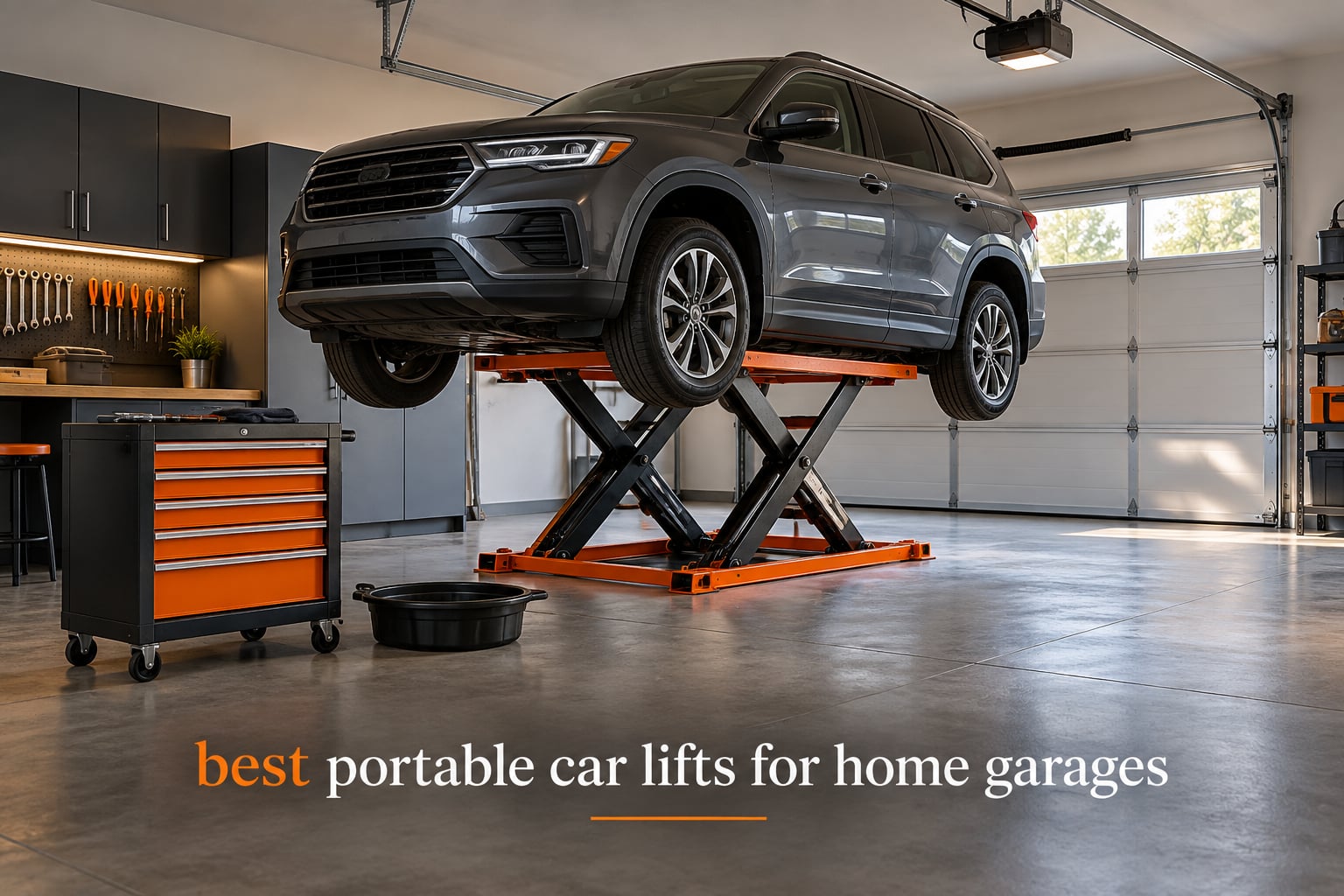
If you have ever counted ceiling height in your head while planning brake work, you already know why portable car lifts exist. A typical two-car garage has a 9 or 10 foot ceiling, and a fixed two-post lift needs all of it before the arms even clear the vehicle roofline. The best portable car lifts for home garages solve that by getting under a car fast and folding away afterwards, and we put ten of them side by side to find out which one actually fits your space.
Here is the honest summary: these lifts are for maintenance and storage, not full teardowns. They hold rated loads safely when you stay inside capacity and engage the locks, and they are the only practical way to get a car off the floor in a garage that physically cannot host a post lift.
What they do not give you is the undercarriage access of a two-post, and scissor designs in particular make transmission removal painful. For oil changes, brakes, tires, suspension work, and stacking a second vehicle, they are more than good enough.
One measurement decides half of these picks, and it is not your ceiling. It is the lowest point of your garage door track and opener hardware. An AskMechanics poster with a 12 foot ceiling and roughly 9 feet of effective clearance could not run a conventional two-post at full height, and that single number is what pushed the answer toward a scissor unit. We start every recommendation below with that clearance triage, then move to capacity, then to the power unit.
We leaned on manufacturer specifications, aggregated owner ratings, and multi-year ownership reports from Garage Journal and mechanic forums, because in this category a three-year ownership report tells you more than a five-star average ever will. If you want a broader look first, our guide to portable car lifts and general car lift picks cover the format in more general terms.
Table of Contents
Top 3 Picks for the Best Portable Car Lifts for Home Garages in 2026

Albott 7000 lb Folding Scissor Lift
- 7000 lb capacity
- 28 inch max rise
- Folds flat on casters
- Mechanical locking levers

APlusLift SL6600X Mid-Rise Scissor
- 6600 lb capacity
- 55 inch max rise
- Triple roller base
- 110V plug-in

BendPak MaxJax M7K Portable Two-Post
- 7000 lb capacity
- Open undercarriage access
- Stows in under 15 minutes
- Automatic arm restraints
All 10 Portable Car Lifts Compared Side by Side (October 2026)
Every lift below is listed with the four numbers that actually decide the purchase: capacity, maximum rise, collapsed or approach height, and power. Where a figure is missing from the manufacturer listing, we have left it out rather than guess.
| Product | Specifications | Action |
|---|---|---|
| Albott 7000 lb Folding Scissor Lift |
|
Check Latest Price |
| APlusLift SL6600X Mid-Rise Scissor Lift |
|
Check Latest Price |
 AUTOKATO KT-4H950 4-Post Lift AUTOKATO KT-4H950 4-Post Lift |
|
Check Latest Price |
 AUTOKATO X77 Mid-Rise Scissor Lift AUTOKATO X77 Mid-Rise Scissor Lift |
|
Check Latest Price |
 KATOOL 8500 lb 4-Post Lift KATOOL 8500 lb 4-Post Lift |
|
Check Latest Price |
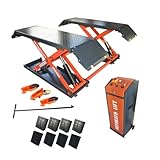 KATOOL AK-X85 8000 lb Scissor Lift KATOOL AK-X85 8000 lb Scissor Lift |
|
Check Latest Price |
| BendPak MaxJax M7K Portable Two-Post |
|
Check Latest Price |
 Motool AK-X66 Mid-Rise Scissor Lift Motool AK-X66 Mid-Rise Scissor Lift |
|
Check Latest Price |
 QuickJack 8000TLX Portable Lift QuickJack 8000TLX Portable Lift |
|
Check Latest Price |
 DigMaster 8000 lb Portable Two-Post DigMaster 8000 lb Portable Two-Post |
|
Check Latest Price |
Are Portable Car Lifts Any Good?
Yes, for maintenance and storage rather than full teardowns. They hold rated loads safely when you stay within capacity and the locks are engaged, and they are the only practical way to get a car off the floor in a garage too short for a two-post.
They do not match a two-post for undercarriage access, and scissor designs are a poor choice for transmission removals. For oil changes, brakes, tires, suspension work, and stacking a second vehicle, they are more than good enough.
That answer hides a second question people rarely ask out loud: are they safe? A portable lift is a hydraulic machine holding several thousand pounds over your head, and the ones with mechanical safety teeth and a positive lock are meaningfully safer than the ones without.
Reviewers consistently report the locking levers on the folding scissor designs engaging reliably once the vehicle is raised, which is the single most important mechanical behaviour in the whole category.
What varies enormously is build quality between units that look identical in a listing photo. Enthusiasts on Garage Journal and mechanic forums inspect scissor lifts before buying specifically for welded rather than bolted safety teeth, a separate hydraulic line feeding each cylinder instead of one line that tees off, and greasable fittings present rather than absent.
A buyer who chose Twin Busch over an almost identical rival on exactly those three points paid a few hundred dollars more and considered it money well spent.
What Portable Actually Means: Four Lift Types Explained
First, a terminology note that comes up constantly in searches for the best car hoists for home garages. A car hoist is a ceiling or gantry mounted engine hoist for pulling an engine, not a machine for raising a whole vehicle. If you want the car itself in the air, you are choosing between four architectures.
Low-rise rolling quick lifts are the simplest. Two wheeled frames roll under the vehicle, hydraulic rams raise them, and you do a brake job or oil change on factory-height arms. The QuickJack 8000TLX is the archetype: 8000 lb capacity, 296 lb total weight, and setup in under a minute with no bolting down.
They rise about 24 inches, so you work seated or kneeling rather than standing.
Scissor lifts use a scissor mechanism to raise two full-length platforms. They deliver far more rise than a quick lift, often 39 to 55 inches, and open up real undercarriage space when the platform is high. They also weigh a great deal, from around 400 lb for a folding model to more than 1100 lb for a fixed mid-rise unit, and most do not fold flat enough to park a car beside.
Portable two-post lifts give you the classic open layout with nothing between the front wheels. The BendPak MaxJax M7K is the best known of these, weighing 940 lb and rolling aside on casters in under 15 minutes. The catch is height: you need a 9 foot ceiling or lower to use one at full rise.
Four-post lifts are storage machines. Runways hold the vehicle and you can park underneath, but the runways themselves obstruct wheel-end work, which is why forum owners often run a four-post for storage and a scissor for the actual wrenching. They are the heaviest option, commonly 1200 to 1800 lb, and the least portable in practice.
One category that barely appears in editorial roundups is the manual and air quick-lift frame set in the entry tier of the shopping results. It is worth knowing that the shortlist below is weighted toward scissor and two-post designs, which is where the rise height and the owner feedback data both concentrate.
1. Abbott 7000 lb Folding Scissor Lift: Best Overall Portable Car Lift
Albott 7000 LBS Portable Car Lift with Extension Plates for Garage Use
- Q235B high-strength steel with no reported wobble at full height
- Locking levers engage reliably once raised
- Assembly is just wheels and handles plus one hydraulic coupling per side
- Folding design that slides under the vehicle
- Quiet pump with slow controlled lift
- Rubber pads are too tall for low-clearance cars costing about an inch of height
- Hydraulic oil is not included so you must add about 3/4 gallon of ISO 46 fluid
- Owners report slow lifting with a 5500 lb vehicle
This is the lift I keep coming back to for the widest range of home garages, and the reason is simple arithmetic rather than features. At 401 lb it is the second-lightest scissor in this group and by a wide margin lighter than any mid-rise or four-post unit here, and at 28 inches of rise it still clears enough of the pan to do real work.
The steel is the story. Owners report no wobble and no sway at full height, which is not something you can fake with a thin frame. The Q235B construction with anti-corrosion coating is a step above the tubular imports of the same nominal capacity, and the multiple locking levers with upgraded spring design are what actually hold the car up.
Two details catch people out. The hydraulic oil is not included, so you need to buy roughly three quarters of a gallon of ISO 46 grade fluid before first use, and the included rubber jack pads are taller than ideal, costing about an inch of height on a lowered car. If your vehicle sits low, plan on swapping or trimming those pads before the first job.
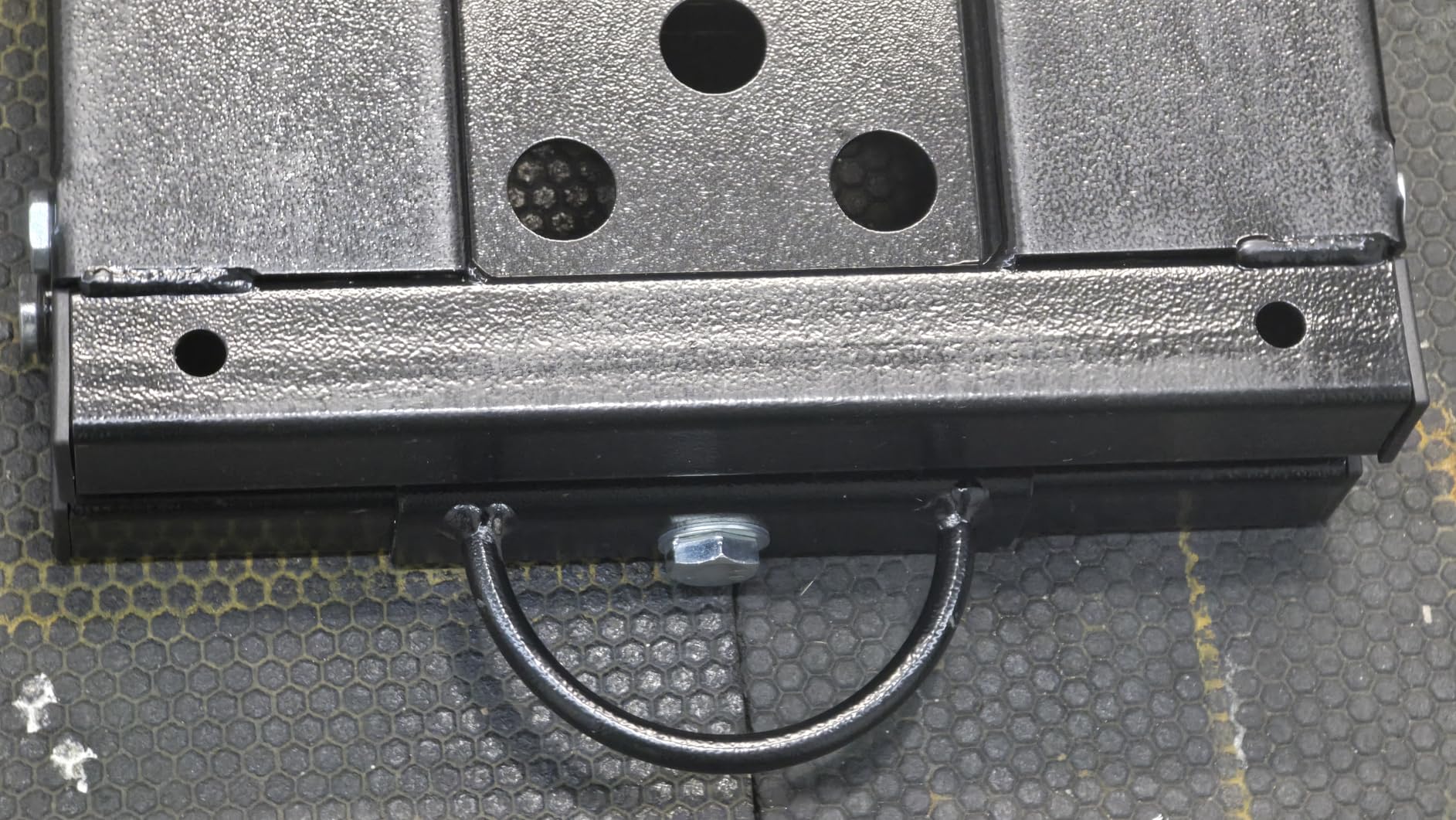
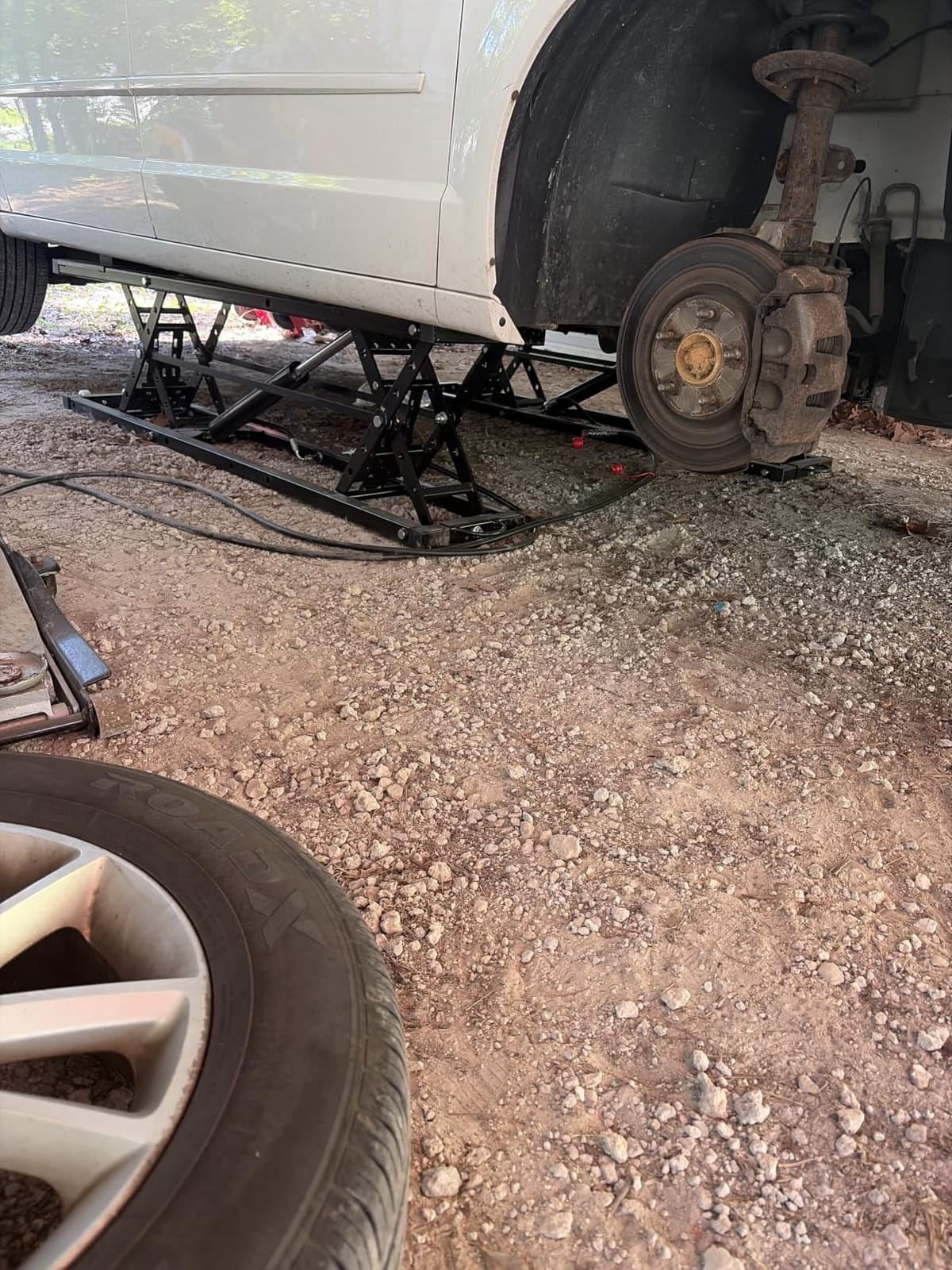
There is a capacity caveat worth stating plainly. Reviewers report slow lifting with a 5500 lb vehicle, which suggests the 7000 lb rating is more generous than the real-world headroom. If your heaviest daily vehicle is a full-size pickup or a large SUV near that weight, look at a heavier frame with a 110V power unit rather than a manual hydraulic pump.
The manual is a weak translation from Chinese and is unclear on wheel orientation and handle clearance, so budget an extra evening on setup. Loose hose fittings that weep oil on arrival, cosmetic shipping damage, and loose hardware are reported on some units, all of which are ten-minute fixes if you catch them early.
Who this lift is for
This suits a homeowner with a sedan, crossover, or mid-size SUV in a garage with tight door track clearance who wants to roll the lift under the car on a Tuesday and push it against the wall on Wednesday.
The folding frame is what makes that routine possible, and the low unit weight is what makes it a one-person job rather than a chore.
If your work is mostly oil changes, fluid drains, brake inspections, and tire rotations on vehicles under about 5000 lb, the 28 inch rise is genuinely enough. Undercarriage work on a lowered car needs the pad swap, and anything genuinely heavy needs a different frame.
Who should skip it
Skip it if you routinely lift 5500 lb or more and want the lift to feel quick, because owners report the pace drops noticeably with that kind of load. Also skip it if you need standing-height underbody access, or if you plan to pull a transmission, since a scissor platform is the wrong tool for that job.
The missing hydraulic fluid is not a dealbreaker but it is a genuine annoyance on day one, and anyone who wants zero setup surprises should budget for a first fill. Beyond that, the unit needs a flat floor: the manufacturer rates it for slopes under 4 degrees, so a sloped or uneven driveway-adjacent slab is disqualifying.
2. APlusLift SL6600X Mid-Rise Scissor Lift: Best Rise Height in a Light Package
APlusLift SL6600X 6600LB Portable Mid-Rise Scissor Lift 3 Year Warranty
- Build quality
- welds and cylinders exceed expectations for the tier
- Quiet 110V operation on a 15 amp cord
- 55 inch rise with adjustable screw pads and truck adapters
- Owners report it replaces shop visits for routine work
- Responsive support including replacement parts
- 5.81 inch approach height means low sports cars need drive-on ramps
- Exposed hydraulic lines and wiring run along the ground and can be run over
- 1200 lb weight makes solo repositioning difficult
Among the mid-rise scissor lifts, the SL6600X is the one whose owners describe the build quality in superlatives, and they mean the welds and the twin 3.25 inch hydraulic cylinders rather than the paint. For a unit that sits in a residential garage next to a family vehicle, that is the part that matters.
What makes it distinct is 55 inches of rise, the tallest in this group, combined with adjustable screw pads and a set of 2.75 inch truck adapters in the box.
That height is the difference between crawling under a car with a creeper and standing bent at the waist under the same car. It is the reason a Garage Journal owner with a 9 foot ceiling chose a scissor over a portable two-post.
It runs quietly on standard 110V current with a 15 amp rated cord, so no electrical work is required.
Owners also report it paying for itself quickly by replacing shop visits for oil changes, brakes, and tires, which is the most common justification we heard for this category as a whole.
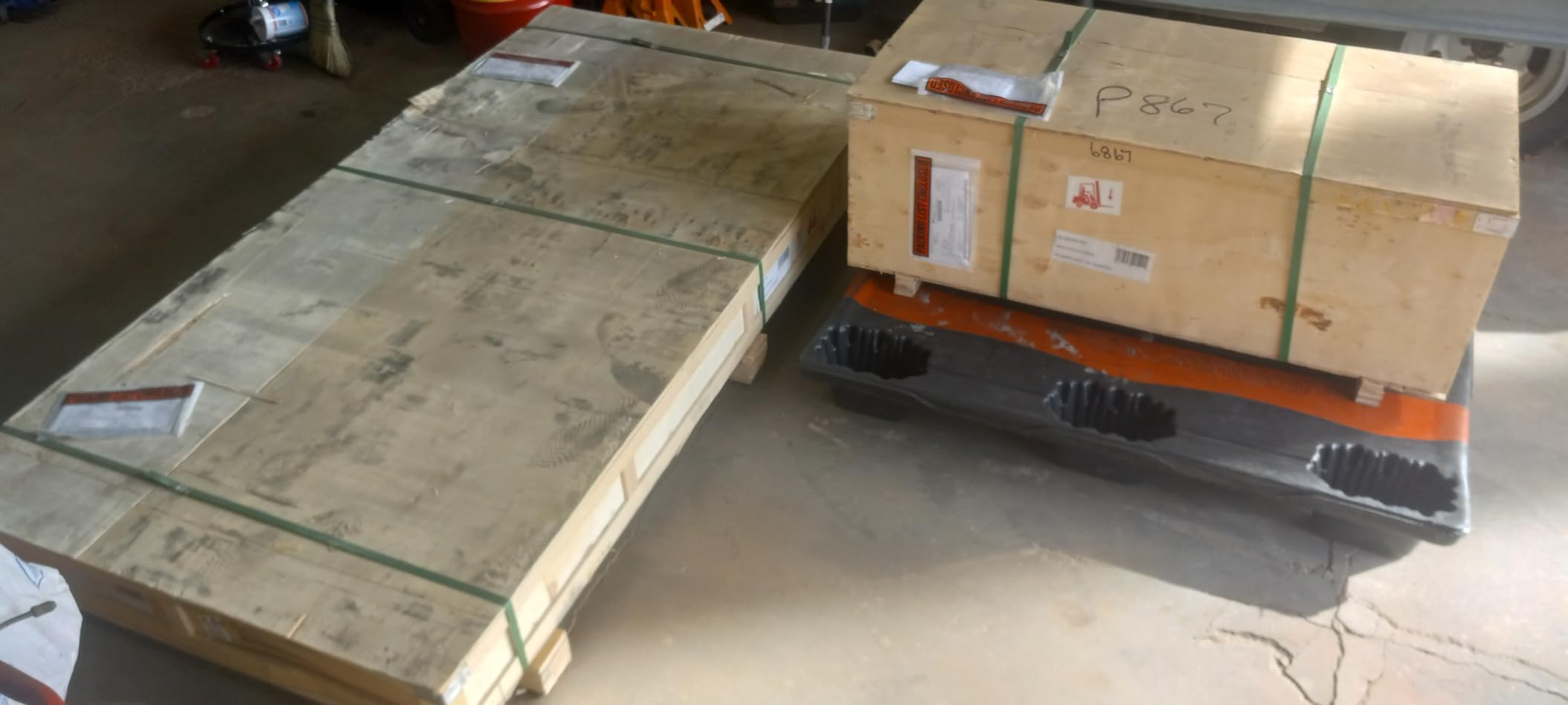
The approach height is the real trade. At 5.81 inches, a low sports car will not clear the platform, and you need drive-on ramps to make it work. That is a non-issue for an SUV or a truck and a dealbreaker for a lowered coupe, so check your vehicle before anything else.
Two build issues show up repeatedly. Some units shipped with wiring cut between the electric motor and the control box, and the exposed hydraulic lines and wiring that run along the floor can be run over by a wheel.
Owners also note the 1200 lb weight is difficult to reposition without a small floor jack or control dolly.
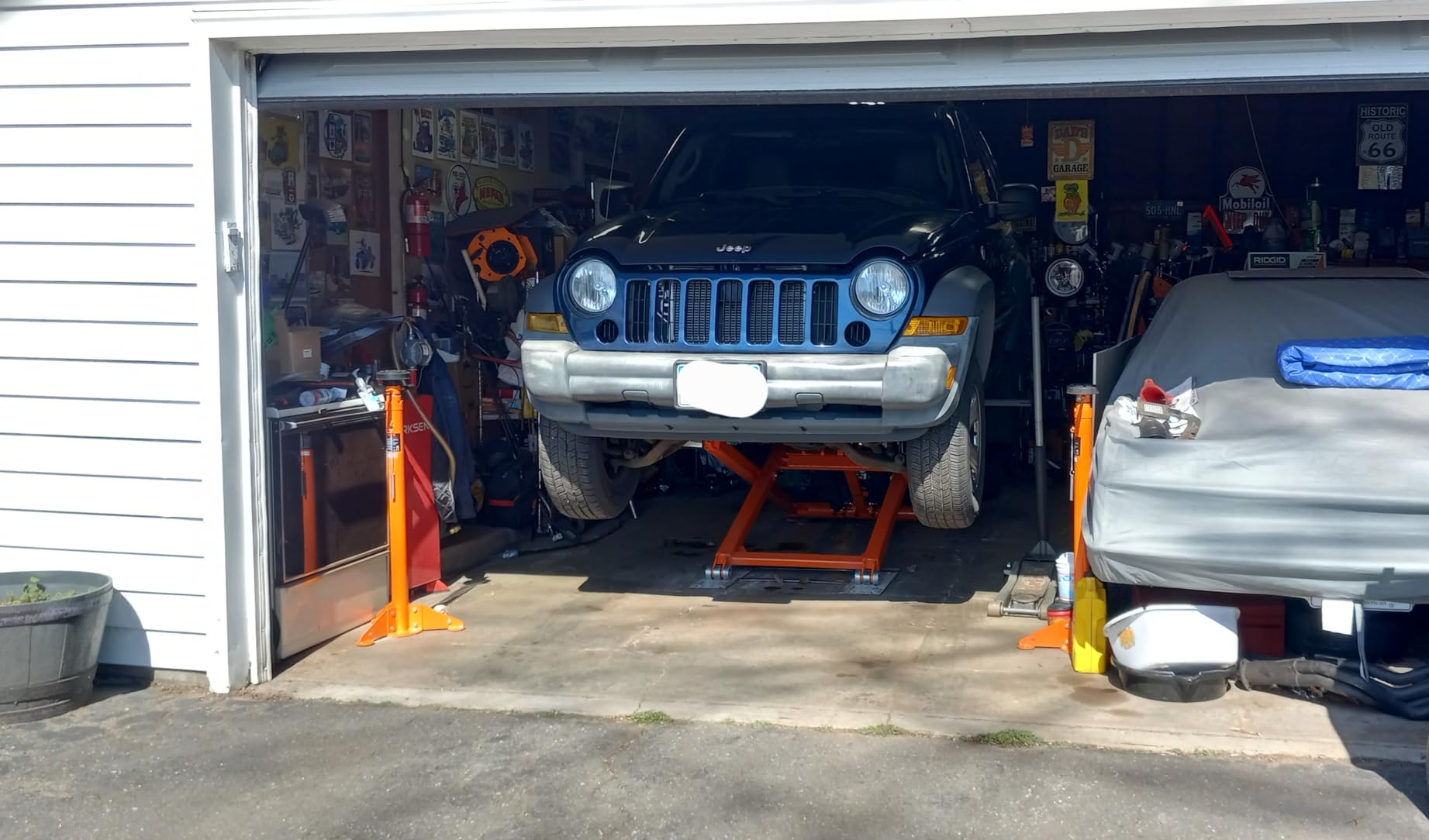
What 55 inches of rise actually buys you
Rise height is the number that decides whether a lift suits your posture and your job type. At 55 inches, a transaxle drain, an oil change, a fuel filter, and a brake bleed all happen standing or on a roller stool with your head clear of the car. At 28 inches you are lying on a creeper for the same tasks.
It also determines which vehicles you can service. The 6600 lb rating covers most crossovers and light trucks, and the included truck adapters raise the pads for a frame with a higher sill. Where it falls short is anything with genuinely low ground clearance, and the 5.81 inch approach is unforgiving there.
Where the value breaks down
The warranty split is unusual and worth reading carefully: 5 year structural, 2 years hydraulic and electrical. Since power units are the component most likely to fail, a 2 year electrical warranty is thinner than the 5 year headline suggests, and that is worth factoring into how long you expect to own the unit.
Support is genuinely responsive, including replacement parts sent out, which is a meaningful advantage over off-brand imports at this price. The counterweight is the 1200 lb shipping weight: plan the delivery and the repositioning route before you order, because this is not a solo move.
3. AUTOKATO KT-4H950 4-Post Lift: Best for Storing a Second Vehicle
AUTOKATO KT-4H950 110V 3.0HP Four Post Lift Car Truck Parking Hoist Aluminum Plate with Casters and 9500Lbs Lifting Capacity,Max Lifting Height 84.5 Inch Extra Wide 113 Inch
- 84.5 inch height lets you stand upright under the vehicle
- Heavy gauge metal with tight aligned bolt holes
- Crates complete with casters and ramps plus jack tray and drip trays
- Runs on standard 110V with no electrical upgrade
- Fast 50 second ascent
- Poor assembly instructions with owners relying on video walkthroughs
- Incorrect hydraulic fitting at the pump on some units
- Jack plate and drip trays only align at narrowest width
A four-post lift is a different purchase from everything else here. You are not buying a service tool, you are buying a parking space that floats, and the KT-4H950 raises a vehicle high enough that you can stand upright underneath it at 84.5 inches.
That height is unusually tall for a home unit and it is the reason this one shows up for stacking a second vehicle in an ordinary two-car garage. The extra-wide 113 inch span also means longer vehicles fit without a fight, and 9500 lb capacity covers essentially anything short of a heavy dually.
Everything you need arrives in the crate. Owners specifically call out that the casters, ramps, jack tray, and drip trays were all included, which removes the most common surprise with a lift in this class.
The 110V 3.0HP power unit reaches full height in 50 seconds and needs no garage electrical upgrade.
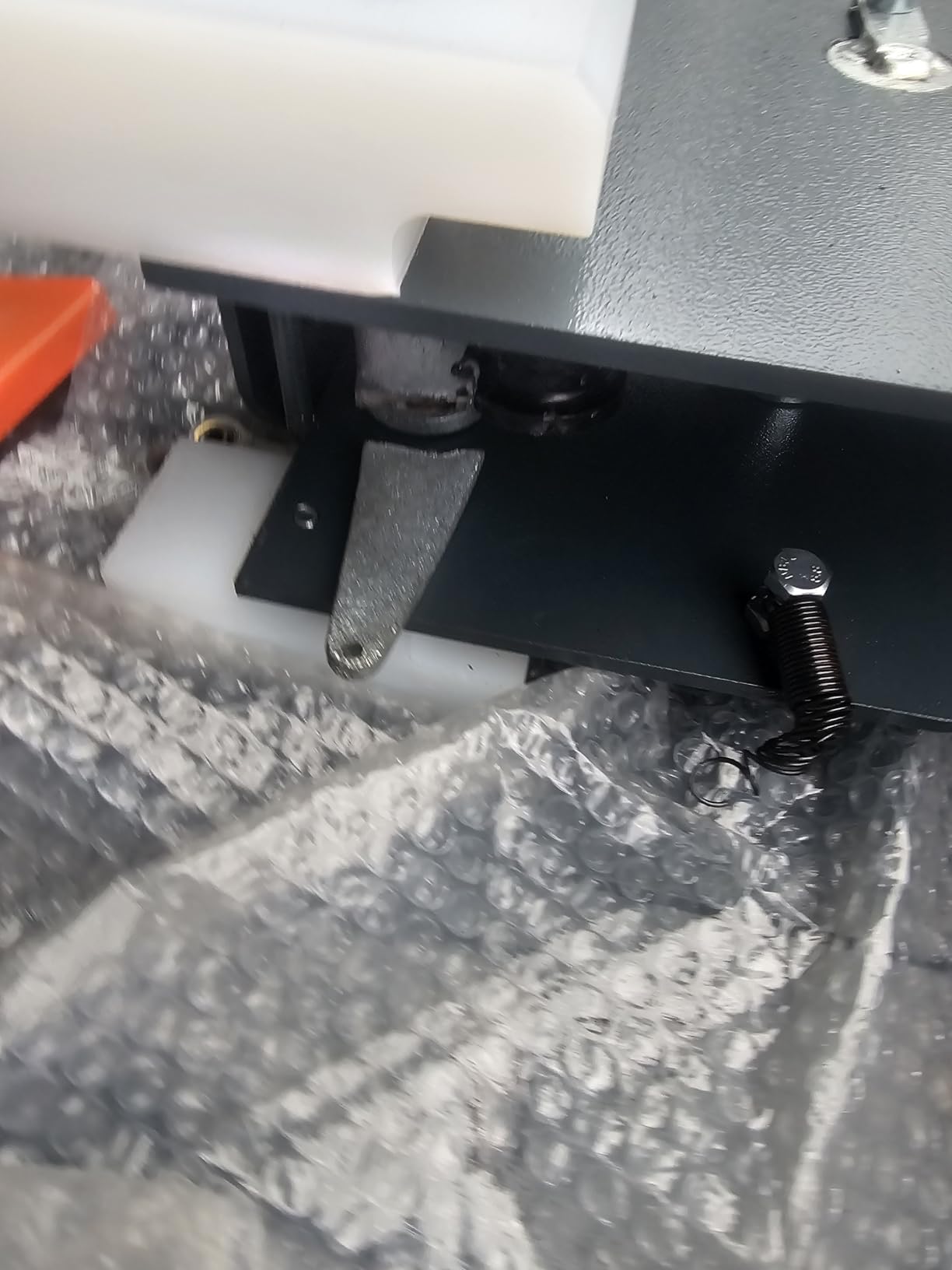
Build quality reads better than the documentation. Owners describe very heavy gauge metal with tight, aligned bolt holes, which is what you want in a structure whose job is holding a vehicle in the air for months at a time with nobody underneath it.
The weaknesses are all around assembly and accessories. Instructions are poor enough that owners look for video walkthroughs instead, and a wrong hydraulic fitting at the pump has shown up on some units, requiring a custom hose.
The jack plate and drip trays only line up correctly when the lift is set to its narrowest width, which is a design choice rather than a defect but catches people out.
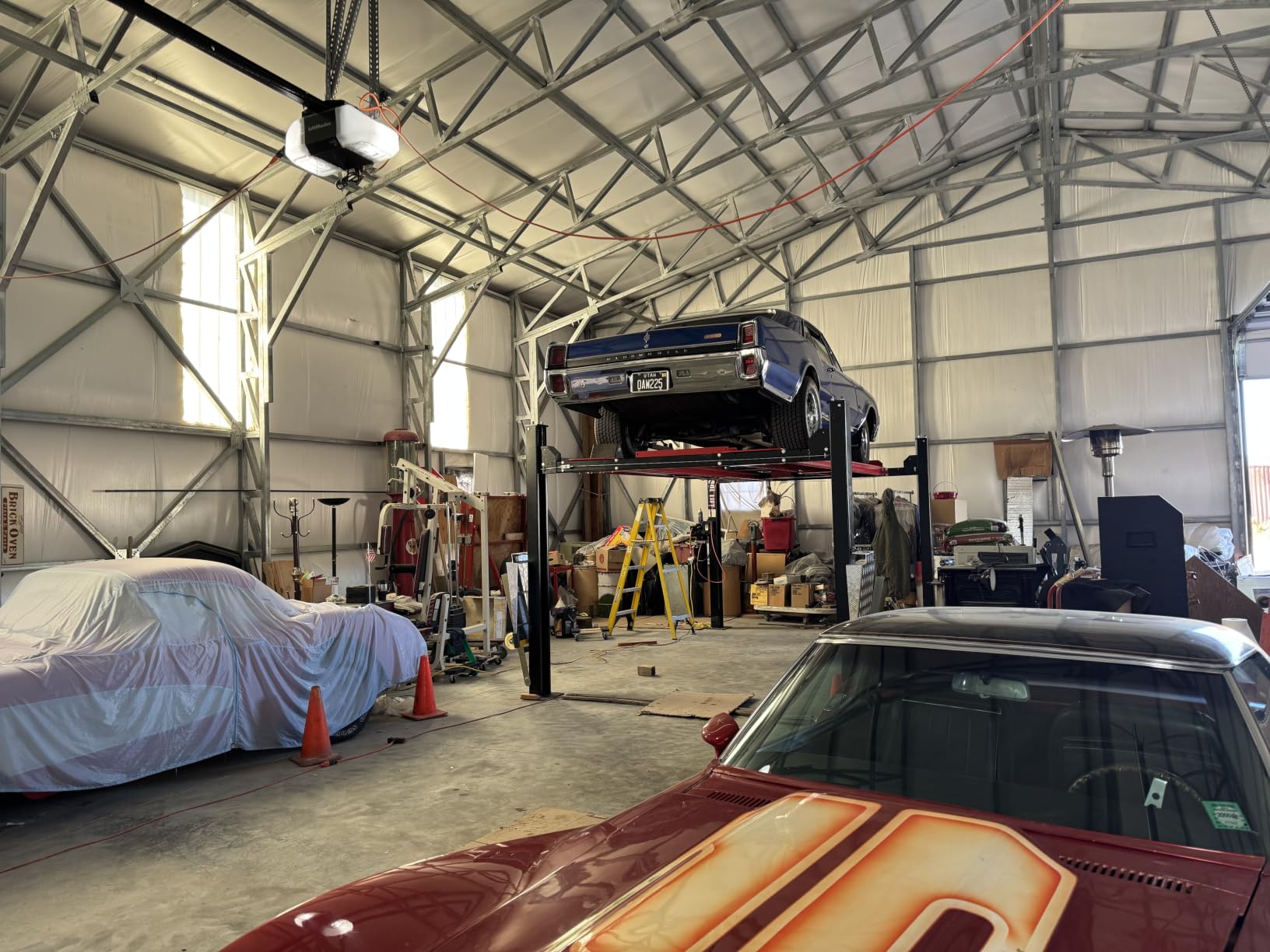
When a four-post is the right tool
A four-post earns its floor space when the job is storage, seasonal over-wintering, or long projects where the car needs to stay up for weeks. Lift a car, build a storage shelf underneath it, and the footprint cost is paid back. That is the honest use case, and no scissor lift in this roundup competes with it.
For active wrenching it is the wrong tool, because the runways sit exactly where you need to reach a wheel, and a four-post plus a scissor is a common pairing for owners who want both. The same four-post thread that praised this category noted a heavy truck creeping on the runways, which is the argument for anchoring a unit you plan to load often.
What to check before ordering
Budget a full day for assembly. Owners report roughly 8 hours of work, and that figure assumes you already know the sequence the instructions fail to explain. You will also need equipment for unloading, since the crate requires a forklift or a pickup at a local terminal.
Measure your garage before committing. At 113 inches of span, the footprint is generous, and a two-car bay with a door that has to open over it is the whole point of buying portable, so check that the lift can be rolled out to work on the second car. Parts availability from an off-brand manufacturer can be slow, so factor that into the long-term ownership picture.
4. AUTOKATO X77 Mid-Rise Scissor Lift: Best Fit for Low-Ceiling Garages
X77 7000Lbs 110V Car Lift Scissor Lift, Electric Release 39.37″ Auto Lift Adjustable Mid Rise Lift for Cars, SUVs, Light Trucks, Garage
- Works well in low-ceiling garages
- easy to use once set up
- Reliable safety latch design owners prefer over electronic switches
- Mobile kit makes repositioning straightforward
- Company support described as responsive
- Extremely heavy and difficult to move alone
- Some units will not lift until the pump flow screw and jam nut are adjusted
- Requires a 30 amp receptacle rather than a standard outlet
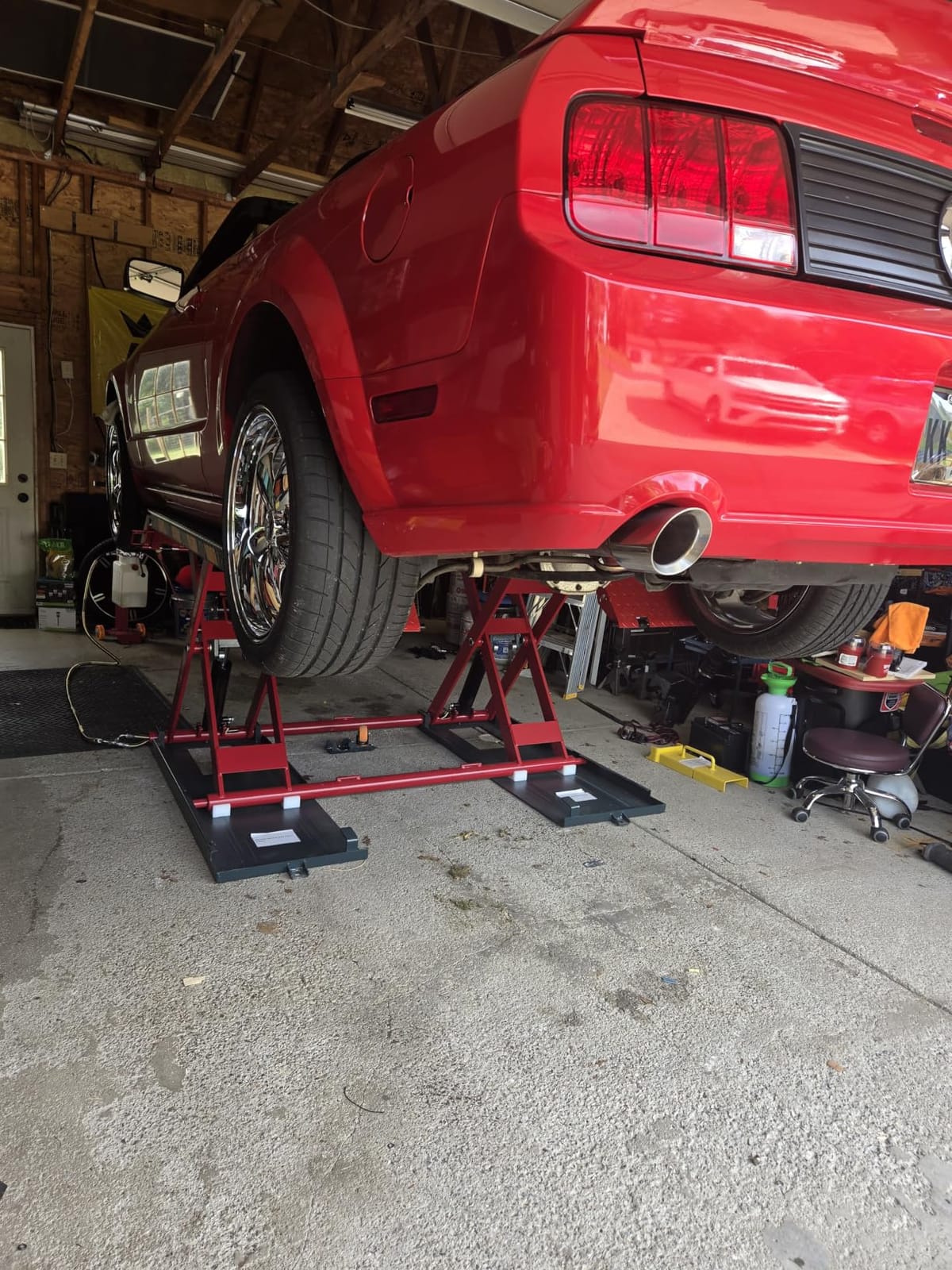
The X77 is the pick for the exact constraint the AskMechanics poster described, a garage with plenty of ceiling but a door track that eats the headroom. At 4.33 inches of approach height it is the lowest-profile scissor here, and at 39.37 inches of rise it still gives you meaningful undercarriage space.
Owners consistently describe it as straightforward to use, and the design decision we particularly like is the safety latch, which is mechanical rather than electronic. Several owners state directly that they prefer the latch over extra electronic safety switches, which is a reasonable position when the failure mode you care about is a car falling on you.
The mobile kit is included, which addresses the main objection to a scissor lift in a one-car bay. The drive-up ramp lock design extends the platform for longer vehicles, and an assist arm helps with low-chassis and hard-suspension vehicles that would otherwise refuse to come off the ground.
Two practical issues. The manufacturer recommends a 30 amp receptacle, which is a step above a standard household outlet and worth confirming with an electrician before delivery day.
And some units initially refused to lift a vehicle until the pump flow screw and jam nut were adjusted, which sounds trivial and is not if you have never done it.
The weight is the bigger issue in practice. Owners call it extremely heavy and say moving it alone is difficult, so this is a two-person job or a job for a floor jack.
Transit damage has also been reported with a resolution the owners did not consider satisfactory, which is worth factoring into how you document the unit on arrival.
Why approach height matters more than rise height
Rise height is what you get; approach height is what you need to get there. A lift that raises a car 55 inches is worthless if a 6 inch ground clearance vehicle cannot get onto the platform, which is why the 4.33 inch figure on this unit matters more to a lowered-car owner than the 39.37 inch rise does.
For a homeowner with a stock-height crossover or sedan in a tight bay, the low approach plus the included mobile kit is the combination that makes a scissor lift viable at all. For a car on a lowered suspension, verify your sill height against the approach figure before you order anything in this category.
Where it falls short
It is not a storage lift and it is not a transmission tool. With 7000 lb capacity and 39.37 inches of rise, it sits squarely in the routine maintenance band, which is exactly what most home buyers need and exactly what an enthusiast restoring a car does not.
The 30 amp receptacle requirement is the item most likely to derail an install, because a garage outlet on an existing circuit may not support it. Owners also flag that the first lift attempt may need the flow adjustment, so set aside an hour with the manual before you plan your first real job.
5. KATOOL 8500 lb 4-Post Lift: Best Movable Four-Post for Small Garages
KATOOL 8500 lbs 4-Post Portable Storage Service Car Lift with Casters Kits 70.8″ Lifting Height Tested 10000lbs 4-Post Portable Storage Service Lift Home Parking Lift Double Locks
- Well manufactured with good welds and paint
- Parts fit precisely
- Included casters let the heavy unit be pushed aside
- Single-point manual lock release for quick lowering
- Seller honored damage claims
- Instructions widely criticized with owners asking for an assembly video
- Lock return springs and lockout linkages reported as under-strength
- Crate is very heavy and awkward to move without equipment
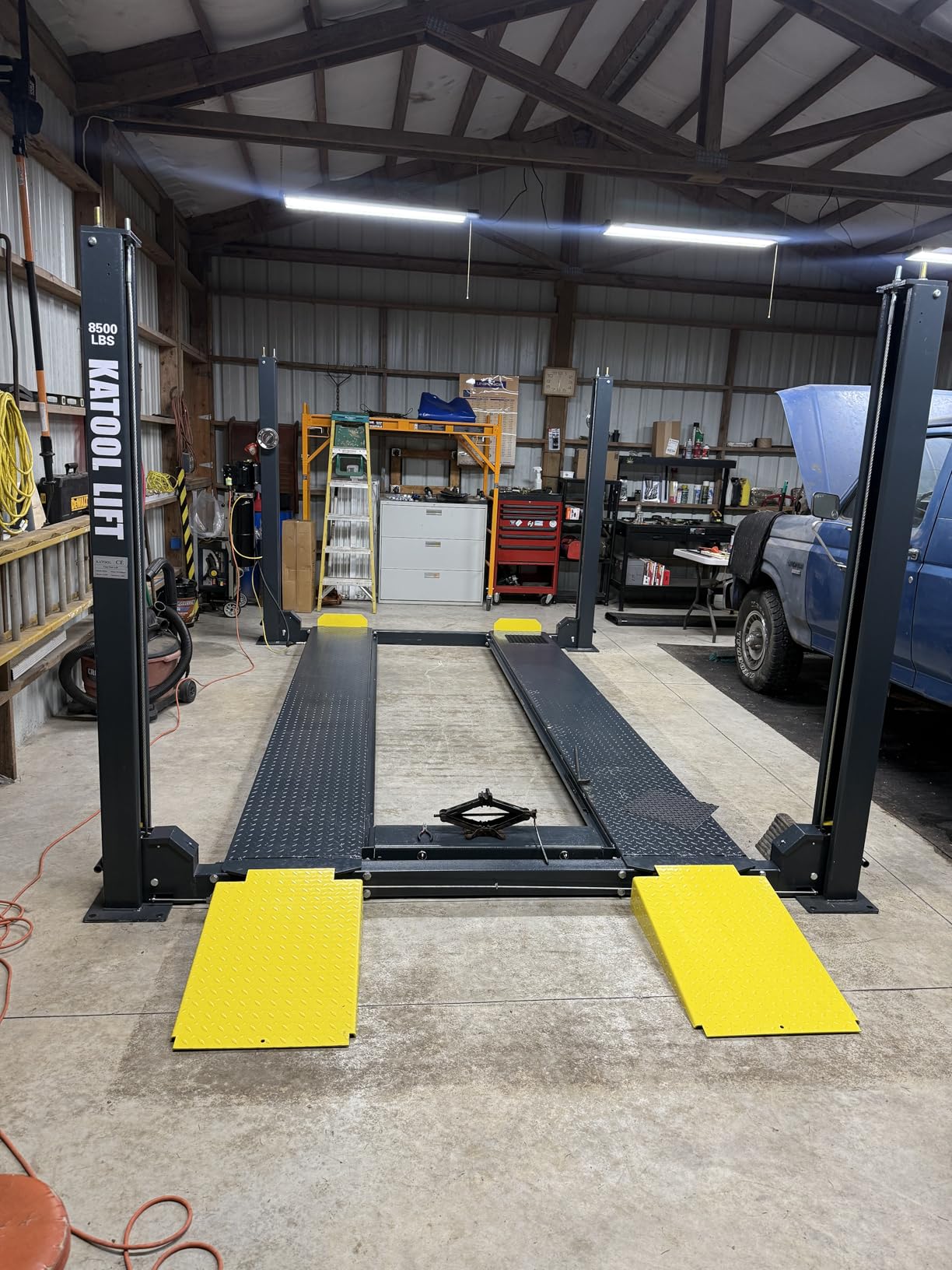
This is the four-post answer for someone who genuinely cannot give up the floor. At 1820 lb it is not portable in any casual sense, but the included caster kit means it can be pushed aside when you need the bay, and owners report that the posts sit out of the way enough to park a car over daily.
Manufacture quality is the strength. Owners report good welds, good paint, and parts that fit precisely, which is a better combination than most of the off-brand four-posts at this tier.
The locking arrangement is worth noting: four mechanical locking devices with primary and secondary locks on each post, released from a single point. That single-point release makes lowering fast and safe, which matters more than it sounds when a car has been sitting at 70 inches for three weeks.
Power is standard 110V at 60Hz single phase, with a 220V pump available as an extra order if you want faster cycles.
Dual locks per post are the safety feature that matters most
Dual locks per post is a genuine safety margin rather than a marketing line, and it is the specification we would weight most heavily in this whole category after clearance. A mechanical lock that does not depend on hydraulics holding pressure is the last line of defence between a heavy vehicle and the floor, and two independent locks per post is the right way to build that.
Self-assembly is achievable with furniture dollies and a come-along, and the seller honored damage claims in the reports we saw. That says a lot about how the company handles a 1820 lb freight shipment.
Under-strength lock springs are the reason to pause
The lock return springs and lockout linkages being reported as under-strength is a serious complaint, because that is the safety mechanism itself rather than a cosmetic part. If you buy this unit, we would inspect those springs carefully on arrival and know how to replace them before you put a vehicle on it.
Documentation is the other problem. Instructions are widely criticized and several owners specifically asked for an assembly video, which means budget the research time yourself. The crate needs equipment to move, and freight damage is reported on arrival, so inspect everything before you sign the delivery receipt.
6. KATOOL AK-X85 8000 lb Scissor Lift: Most Flexible Mounting Options
- All nine owner ratings are 5 stars
- Handles low-profile cars through SUVs and trucks
- Electric release with self-lubricating bushings and bearings
- Works as a mobile unit or bolted down as a fixed mount
- 110V fan-cooled hydraulic power unit
- Very small review base so long-term durability is not yet documented
- 1184 lb platform needs freight handling and forklift unloading
The AK-X85 is unusual in how the reviews read: all nine owner ratings are 5 stars, with no negative entries at all.
That is a real signal that the unit does what it claims, and it is also a very small sample, so we treat it as encouraging rather than proven.
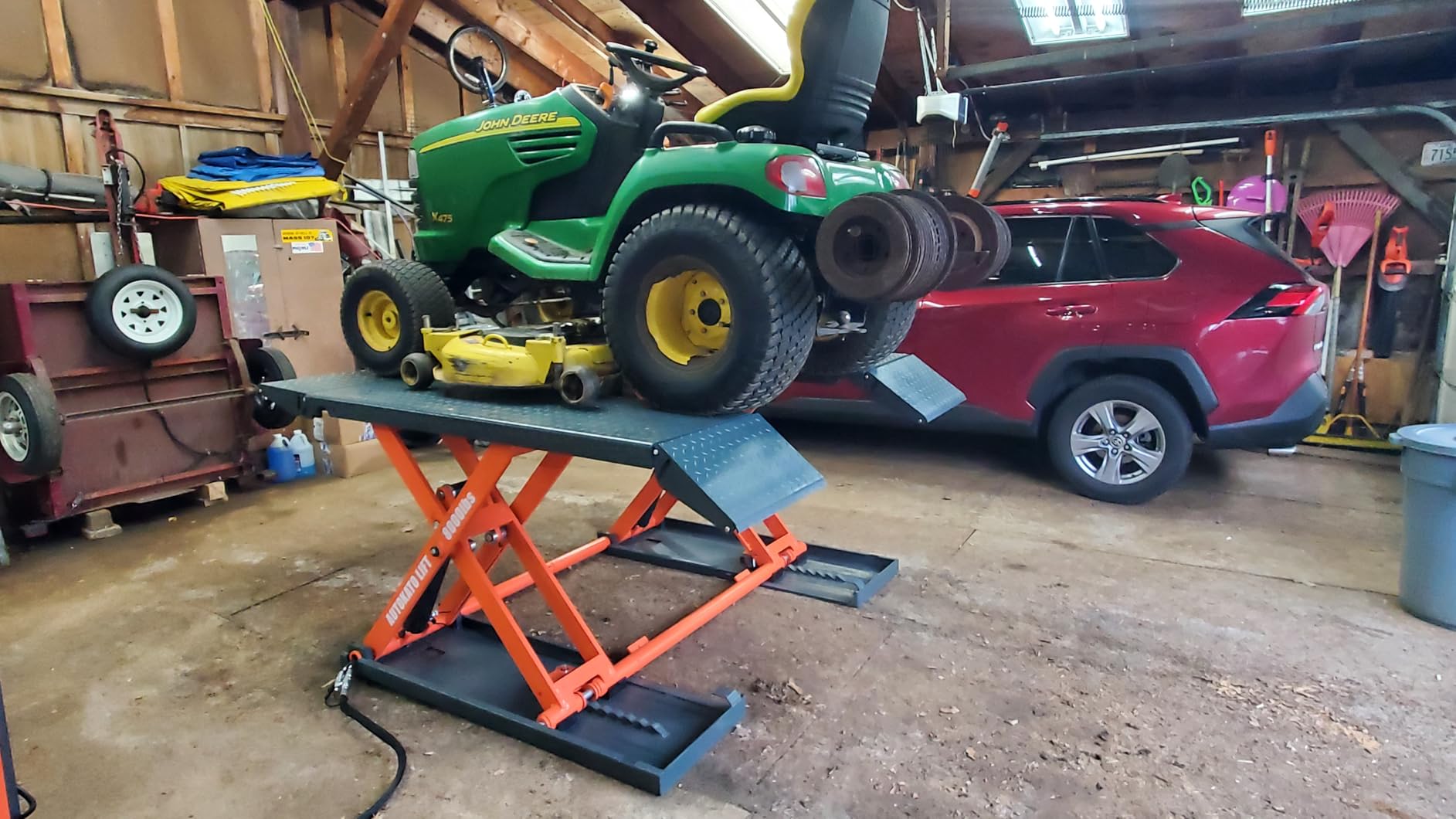
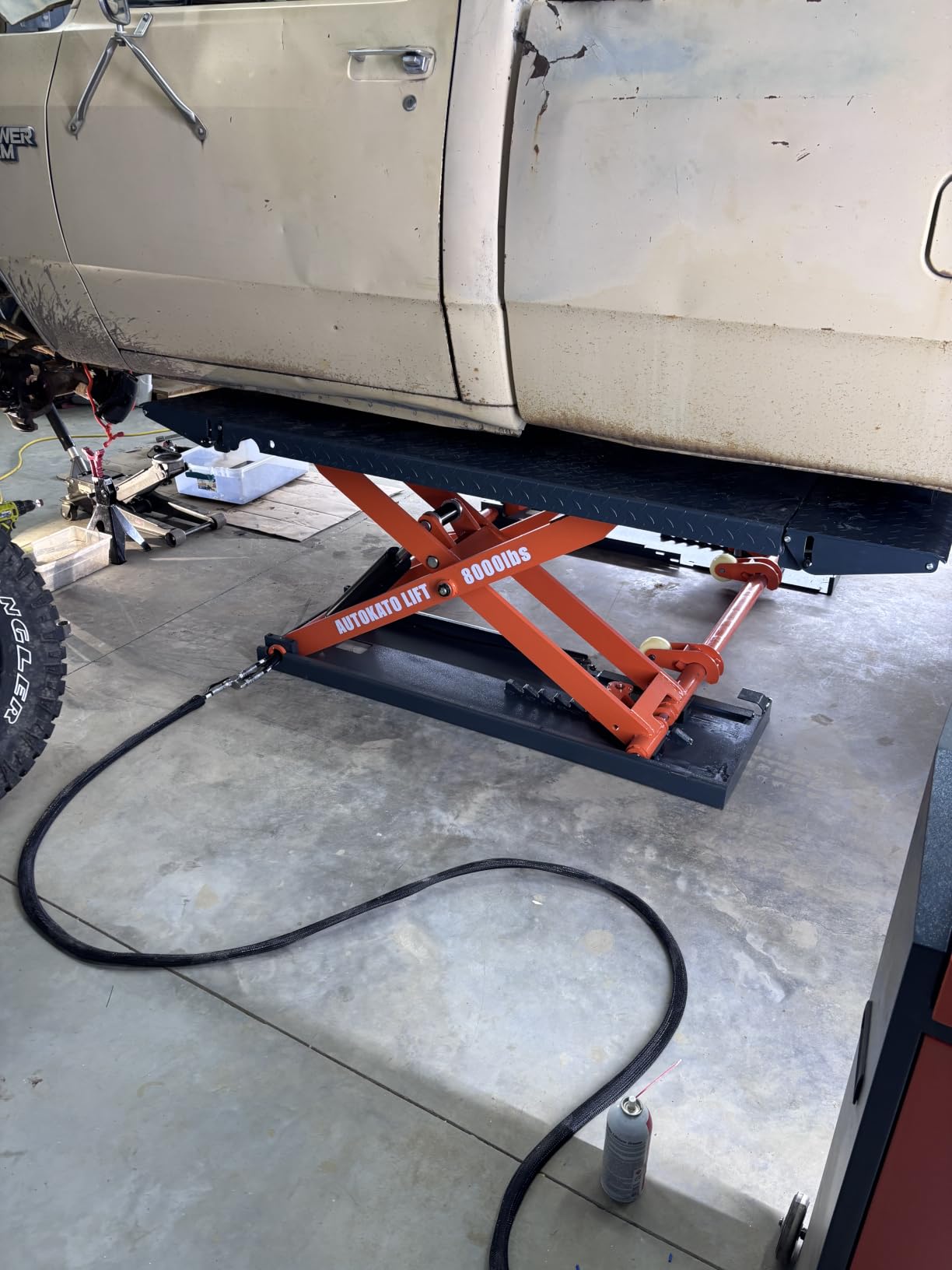
The mounting flexibility is the genuinely differentiating feature. It can run as a mobile unit or be bolted down as a fixed mount, which means it suits a renter today and an owner who later wants a permanent bay.
The electric release handles descent without a manual lever, and self-lubricating bushings and bearings reduce the maintenance burden.
At 8000 lb capacity and 40.15 inches of rise with a 4.25 inch approach height, it covers low-profile cars through SUVs and trucks. The drive-up ramps with lock design extend the platform for longer vehicles, and the fan-cooled aluminum motor and high-level hydraulic system are built for sustained 110V work rather than occasional use.
The honest caveat is the sample size. Nine ratings across a small review base tell you the first few owners were satisfied, not that the unit will still be raising cars in a decade. For a safety-critical machine, we would pair that enthusiasm with a plan for inspecting the locks and hoses on a fixed schedule regardless of brand.
Logistics are the other consideration. At 1184 lb, this needs freight handling and forklift unloading rather than a residential drop.
The owner who decides later to bolt it down should confirm the slab takes an anchor before the delivery is booked.
Why mounting flexibility matters more than it looks
Most buyers underestimate how much their situation changes. A tenant becomes an owner, a one-car bay becomes a two-car bay, a rental becomes permanent. A lift that can move today and be anchored later lets you commit without solving a concrete problem you do not have yet.
That is also why it is worth reading the anchoring rules later in this article before buying. Scissor lifts need no anchoring at all, which is the reason they remain the default recommendation for renters, and this unit simply does not take that freedom away from you on day one.
Who should look elsewhere
Skip it if your decision hinges on long-term owner reports, because nine reviews will not settle that question and the category has better-documented options for it.
Anyone who needs to move the unit solo should also look elsewhere, since 1184 lb is a two-person lift.
It is also the wrong shape of tool for a heavy front-biased truck. Scissor platforms raise all four corners evenly, which is stable, but they are not designed for the kind of loading a large pickup imposes when you drive onto them with a stack of materials in the bed.
7. BendPak MaxJax M7K Portable Two-Post: Best Undercarriage Access
BendPak Maxjax M7K Auto Lift – 7000lb Capacity Two Post Portable Garage Car/Vehicle/Automobile Lift – Home/Garage/Shop/Mechanic Use
- Clean unobstructed under-car access with the classic two-post layout
- Posts can stay fixed or be rolled aside
- Quick-disconnect hydraulic lines avoid bleeding the system
- Clear instructions and straightforward installation
- Handles full undercarriage work on a Panamera in a 10 ft garage
- Requires a 9 ft or lower garage ceiling to use at height
- First fill needs about 7.5 quarts of hydraulic fluid and several lift cycles
- Heaviest unit here at 940 lb so the casters matter
If your work is under the car rather than beside it, the MaxJax is the best answer in this roundup, full stop. Nothing between the front wheels means exhaust, transmission pan, front suspension, and driveline all become reachable in a way no scissor platform on this list can match.
It is also the most genuinely portable design here, despite the 940 lb weight. The stow time of under 15 minutes on the included casters is a real number from the manufacturer, and the quick-disconnect hydraulic lines mean you do not bleed the system every time you move it.
That last detail is the one most competing designs leave out.
Build details are what you would expect from this maker. Industrial grade hydraulic cylinders, single-piece columns, adjustable lifting arms with stackable adapters, a low-profile arm option, and automatic arm restraints that keep the vehicle contained as it rises.
Instructions are clear and installation is straightforward.
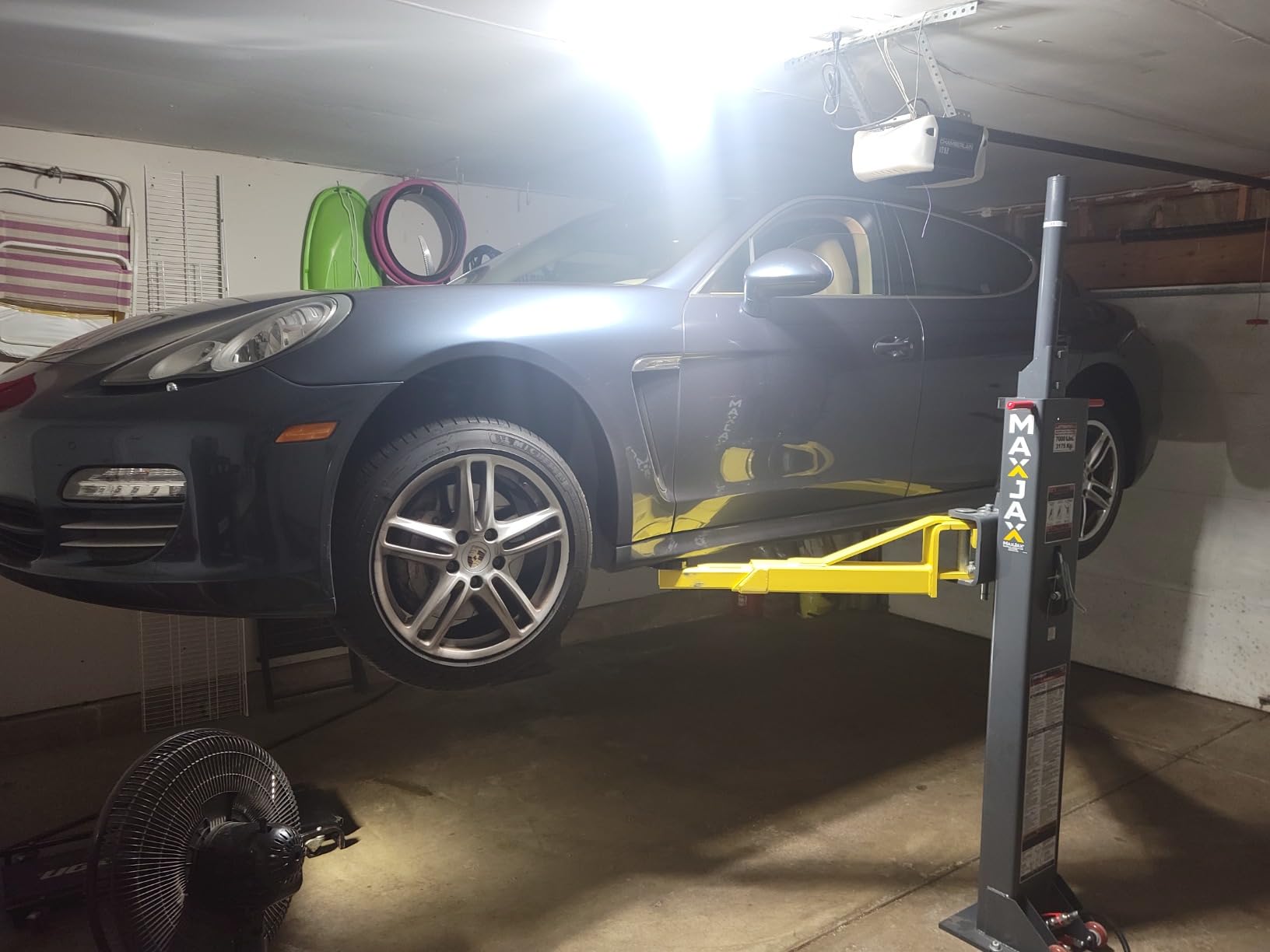
Owners report handles full undercarriage work on a Porsche Panamera in a 10 foot ceiling garage, which is a demanding test for a portable format.
A five-year Garage Journal owner lifted a 2001 Tahoe, an 08 Tahoe, a 03 Corvette, an 05 Expedition, an 87 Fiero, and a 07 Grand Prix over that period with consistent column spacing. He used wedge anchors with bolts and nuts so the anchors act as studs and avoid twisting in the concrete.
Set expectations on two points. The first fill needs about 7.5 quarts of hydraulic fluid and several lift cycles, so budget for that and for the time.
And you need roughly a 9 foot ceiling or lower to use the lift at height, which is exactly the constraint that puts most people into a scissor unit instead.
What a real two-post gives you that nothing else here can
Access, simply. With the arms out of the way and the vehicle supported at the frame, you can stand in the space the front wheels normally occupy and work on anything running fore to aft. Scissor platforms put a steel deck in roughly that area, which is why transmission removals are difficult or impossible on those designs.
The arms themselves are adjustable, and stackable adapters plus a low-profile arm option let you set the reach for a compact car one day and a full-size truck the next. Automatic arm restraints are the safety feature to check after every reposition, because they are what keeps the arms from swinging outward under load.
Where it falls short for home use
The 9 foot ceiling requirement is the disqualifier for a lot of residential garages, and it is not adjustable. If your door track sits below 9 feet, this is not a stretch goal, it simply will not reach full height, and no amount of careful measuring changes that.
At 940 lb with a 940 lb shipping weight, the casters are not a convenience, they are a requirement, and the stow process is a fifteen minute job with at least one other person. With only nine ratings behind a unit at this level, we would also look closely at the warranty terms before committing, because the long-term record here rests on forum reports rather than a large owner base.
8. Motool AK-X66 Mid-Rise Scissor Lift: Tallest Rise in a Small Footprint
AK-X66 6000LBS Car Lift Portable Mid Rise Scissor Lift Auto Lift 48″ Lifting Height
- 48 inch lift height is the tallest for underbody headroom at 6000 lb
- 91 percent of owner ratings are 5 stars
- Alloy steel construction at a mid-tier price point
- Smallest review base here with only seven ratings
- 6000 lb capacity is the lowest of the mid-rise scissor options and limits heavier trucks
The AK-X66 is the height specialist for its capacity class. Its 48 inch lift height is the tallest among the 6000 lb mid-rise scissor lifts here, and if your work is under the car rather than lifting heavy vehicles, that is the number that matters.
It suits cars, SUVs, and light trucks, and the 115V AC 60Hz power unit lifts in approximately 45 seconds, which is a perfectly usable cycle time for routine work. Alloy steel construction is the right material choice for a machine that carries a car.
With seven ratings, 91 percent of which are 5 stars, the sentiment is very strong. We would simply note that a sample of seven tells you about first impressions rather than longevity, and in this category that distinction has mattered before.
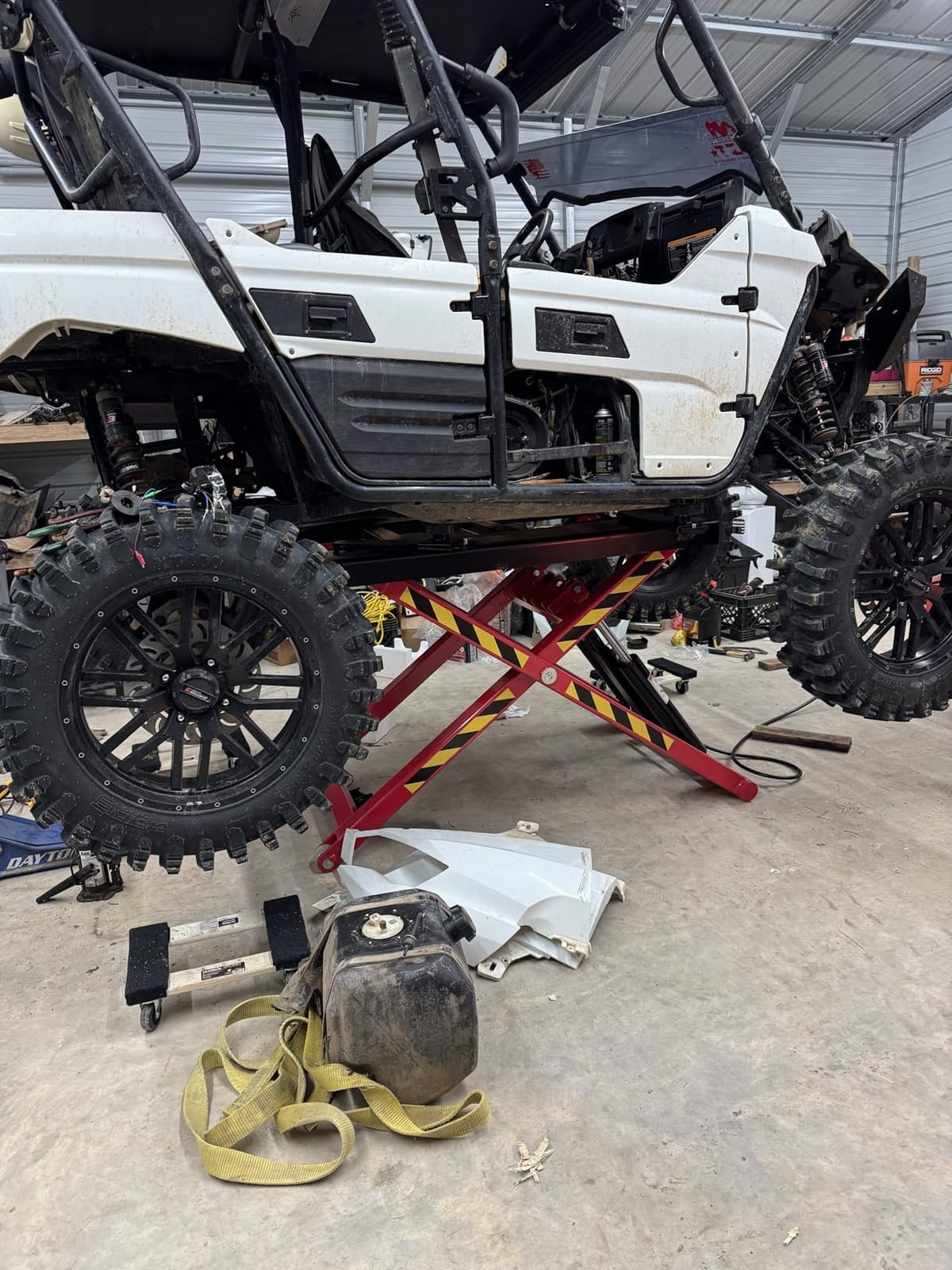
The capacity is the trade. At 6000 lb it is the lowest capacity of the mid-rise scissor units here, so a full-size pickup or a large SUV sits close to the ceiling of what it can do, and adding a passenger or a full tank leaves less margin than you would like.
That is a real consideration when sizing any lift. Our rule of thumb is to buy at least 30 percent above your heaviest vehicle, and at 6000 lb that rule points to a vehicle of roughly 4600 lb or less as a comfortable daily load. For anything heavier, look at an 8000 lb frame instead.
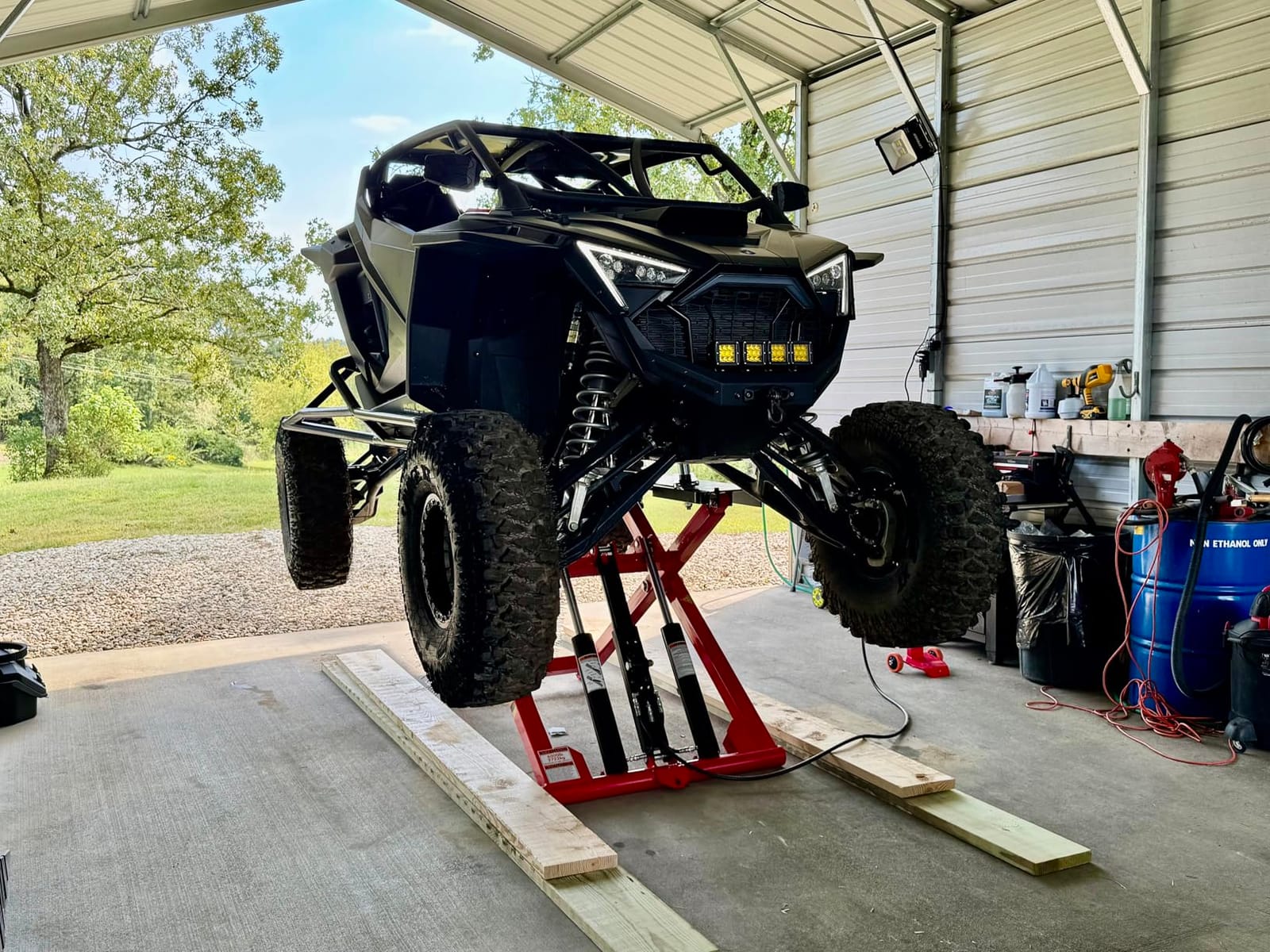
When height beats capacity
There is a clear set of jobs where rise height is the deciding factor and capacity is a checkbox. Exhaust and catalytic converter work, transmission pan access, differential service, fuel tank draining, and general underbody inspection all reward a taller platform far more than they reward extra pounds of rating.
At 48 inches you can work on a drain pan with a roller stool rather than lying flat, and that posture difference is what determines whether a job is comfortable or a daily complaint. For that work, this unit is well matched.
Where the trade-off bites
If your household includes a full-size truck or a heavy SUV, the 6000 lb ceiling is the wrong place to be. A marginal lift does not fail cleanly, it simply rises more slowly and, on a portable two-post with a front-biased load, produces visible arm droop and column flex that owners describe as alarming.
The seven-rating base is the other caution. Check the warranty split carefully and plan a maintenance schedule, because a thinly reviewed machine needs a closer eye than a well-documented one. We would not rule it out, but we would not build a workshop around it either.
9. QuickJack 8000TLX Portable Lift: Fastest Setup of Any Pick Here
- Quick setup and lift in under 60 seconds
- Automatic safety locks engage as the lift rises
- 296 lb is far easier to move than a scissor or 4-post
- Owners buy it as a second quick jack alongside a primary unit
- Very small review base with only five ratings
- 296 lb still needs two people to reposition comfortably
- Not suited to drive-line work since it lifts at the four corners
At 296 lb, this is the lightest lift in the roundup by a wide margin, and the only one that moves without a dolly or a second person planning ahead. Every scissor unit and both four-posts here weigh between 401 and 1820 lb, so the difference in daily convenience is enormous.
The purpose is simple and the design follows it. It sets up and lifts in under 60 seconds with no bolting required, the automatic locking system engages as the lift rises rather than as a separate step, and stackable adapters are included.
Owners describe buying it as a second quick jack alongside a primary unit, which tells you how the category is used in practice.
At 8000 lb capacity with extended-length frames for a wider stance and longer chassis compatibility, it covers SUVs and light trucks well.
Open-center access suits underbody repairs, detailing, and tire and brake service, which is where a lift of this format is at its best.
The published owner feedback here is thin, with five ratings, so the case for this unit rests on the specification and the format rather than on a large body of long-term reports. That is a fair way to buy a tool; it is just worth knowing which kind of evidence you are relying on.
Why weight is the most underrated spec in this category
Everything else in this article is about capability. Weight is about whether you will actually use the thing. A lift that takes twenty minutes and two people to move gets moved once a month, and a lift that takes two minutes to roll out gets used every week.
At 296 lb it is still an awkward solo lift, which is the honest framing, but it is a fundamentally different proposition from a 1200 lb mid-rise scissor. For a one-car garage where every parking space matters, that is often the difference between owning a lift and owning an expensive obstacle.
Where it does not reach
It lifts at the four corners on stock-height arms, so it is not the tool for drive-line work. That is a genuine con rather than a nitpick, since a transmission or exhaust component down the centreline is exactly what a scissor deck or a two-post layout exists to reach.
Rise height is also modest, so deep undercarriage jobs mean lying on a creeper. If your work is mostly brakes, tires, oil, and underbody inspection, that is fine. If it involves pulling a component, plan on a second lift or a different format.
10. DigMaster 8000 lb Portable Two-Post: Best for Workshops With 220V Power
Portable Two Post Car Lift 8000 LBS Capacity, 220V Electric Lock, Movable Garage Car Lift for Home Garage & Workshop, Adjustable Height up to 51.3”
- Dual safety lock system gives real confidence working underneath
- Lifts both SUVs and sedans to a comfortable working height
- Movable design suits home garages and workshops with limited space
- 51.3 inch height reduces back strain during underbody work
- Only two customer reviews so there is very little long-term owner feedback
- Requires a 220V outlet rather than standard 110V household power
- Heaviest unit here at 1223.6 lb
The DigMaster is included here because it represents a fast-growing corner of the category: affordable portable two-post lifts with electric locking, aimed at people who have 220V available and want a post lift without a permanent concrete pour.
At 8000 lb capacity with adjustable height up to 51.3 inches and 18.1 inch of arm reach, it covers a wide range of vehicles. The reinforced arms and high-strength chain drive are the structural story, and the electric-hydraulic power unit with lifting synchronization keeps both sides rising together.
The dual safety lock system with electric lock release is the feature owners single out for confidence. Being able to work under a car supported by two independent locks, released by a deliberate electrical action, is a reasonable answer to the main safety objection in the category.
Be clear-eyed about the evidence, though. Two customer reviews and a perfect 5.0 rating is a promising start and nothing more. We would want a longer record, a clear warranty split, and a plan for parts availability before building a working habit around it.
When a 220V lift is the right call
A 220V power unit is not a disadvantage, it is a specification. If you have a workshop with a proper 220V circuit, the faster cycle and greater power headroom are genuine advantages, and there is no reason to downgrade to 110V just for a standard outlet.
For a homeowner with only a standard 110V household circuit, the opposite applies. This unit is not usable without an electrician, and adding that cost and a wall of delay to a home maintenance project usually points you back to the scissor lifts in this roundup instead.
What to verify before buying
Ask about the warranty split, because power units are the component most likely to fail and a thin electrical warranty is where the risk sits. Also confirm replacement parts availability and lead times, because a 1223.6 lb two-post is not a machine you can easily service from a different brand’s cylinders.
Check the column spacing against your longest vehicle, since arm reach only helps if the columns can sit far enough apart. And with only two ratings behind it, plan to inspect the locks, chains, and hydraulic lines on a fixed monthly schedule rather than trusting the absence of complaints.
How to Choose a Portable Car Lift Without Regretting It
Start with three measurements, not one. Measure the ceiling, then measure the lowest point of your garage door track and opener hardware, then measure the lowest obstruction in the bay such as a light fixture or a duct. The smallest of the three is your effective clearance, and that is the number your lift has to fit inside.
A 12 foot ceiling with 9 feet of effective clearance is completely ordinary, and it is the single most common reason people end up with a scissor lift instead of the two-post they wanted. If your effective clearance is under about 9 feet, cross every two-post off the list immediately. Above that, a portable two-post becomes possible again.
Then size capacity at 30 percent above your heaviest vehicle, not at the number on the door jamb. Most household sedans sit around 3000 to 3500 lb, crossovers around 4000 to 4500 lb, and full-size pickups and large SUVs can run past 5500 lb. Add 30 percent, and a 7000 lb lift covers most of what a family owns, while a 6000 lb unit needs a lighter daily load to be comfortable.
Headroom matters more than most buyers expect, and it is not linear. One owner reported a 5700 lb Land Cruiser lifting and behaving no differently on a 7000 lb lift than a 3000 lb sedan, while an 08 Tahoe took visibly longer to rise. The failure mode of too little headroom is not dramatic, it is just slow and slightly alarming, which is the worst combination.
Next, check the power. A 110V plug-in unit is the default for home use and needs no electrical work. Anything specifying a 30 amp receptacle or a 220V outlet needs an electrician, and that changes the economics of the whole purchase for a residential garage.
Finally, settle the anchoring question honestly. Scissor lifts need no anchoring at all, which is why they remain the default for renters. Portable two-post lifts use removable wedge anchors so they can be unbolted and moved. Fixed two-post and four-post lifts should be anchored into 4,000 PSI concrete, and if you rent or cannot drill the slab, an anchored lift should not be on your shortlist.
When you do inspect a lift before buying, enthusiasts check four things: whether the safety teeth are welded or bolted on, whether each cylinder has its own hydraulic line instead of one line teeing off, whether greasable fittings are present, and what the anchor type actually is. Those four checks separate visually identical units better than any specification on a listing page.
If you want a narrower look, our scissor lift roundup and low rise picks cover the lower end of the format in more detail, and the mid-rise guide covers the heavy scissor units in this roundup.
Anchoring, Concrete, and the Electrical Circuit That Trips Your Breaker
The amp draw profile across a lift cycle is the least published and most useful fact in this category. Independent measurements shared in a Garage Journal thread put draw at roughly 20 amps at the instant of lift-off, around 15 amps mid-rise, and about 10 amps at full height. The spike is at the start, not the top, which is exactly when people are not expecting a problem.
That profile explains why lifts trip breakers on circuits that look adequate, including a dedicated 10 AWG stranded circuit an electrician had already run. The answer is a dedicated circuit for the power unit alone, kept as short a run as possible, with no welder, compressor, or other large load sharing the circuit. If a breaker trips repeatedly, the diagnosis is the circuit, not the lift.
For concrete, the standard is 4,000 PSI and enough thickness to take an anchor without drilling into anything you did not expect, such as rebar or a buried line. Residential slabs vary widely, and a project-car community commenter cautions that a residential lift installation can become a far larger project than expected once slab thickness, permits, and reinforcement are involved.
A seam running close to where a post would land is a hard disqualifier, and it is worth finding out before you buy. One owner whose slab had a seam near the post location chose a scissor unit instead and considered it good for what he needed. If you rent, the decision is made for you: a non-anchored design is the only one that belongs on your list.
There is one failure mode worth knowing that no retailer page mentions. A scissor lift may not engage a vehicle sitting fully lowered on flat ground, because it has to ramp up slightly to build hydraulic pressure. Owners have had to jack and block all four corners just to get the lift to pick the car up, so keep a low-profile jack and stands on hand.
Freight deserves its own line, because a 400 to 900 lb unit delivered to a residential address carries real cost. Unloading at a local terminal with a forklift or a pickup, or driving to the warehouse with a trailer, has saved one buyer a four-figure sum versus LTL freight.
For a lift in this weight class, that is money better spent on hydraulic fluid and a good creeper.
Safety Habits That Keep a Home Lift Under a Car All Day
Engage the mechanical locks every time, without exception, and treat the automatic locks as a backup rather than the primary mechanism. A scissor lift should be run to a locked height before you get under it, and on a two-post the arm restraints should be checked after every reposition because they are what stop the arms swinging outward under load.
Chock the wheels before raising, and keep the parking brake on. With the vehicle supported at the approved frame points, the tyres are off the ground, but a vehicle that creeps during the lift will find the lowest point of the platform first, and a scissor deck is not designed to stop that.
Stay disciplined about capacity. Working at roughly 80 percent of rated capacity is the practical rule, and it leaves margin for the fact that a lift is a tool that will be used when someone is tired, in a hurry, with a heavier vehicle than last time. The documented arm droop and column flex on a front-heavy truck happened well below the rated capacity.
Know your emergency lowering before you need it. Every scissor lift has a manual release, usually a valve or lever you open to let fluid back to the reservoir, and every two-post has a lowering handle or a chain release. Find yours on day one, with the vehicle still down, and practise it once.
Keep an eye on the ties. Scissor lifts have a tie bar connecting the two halves, and owners report it blocks transmission removal, which turns a two-hour job into an afternoon of improvisation. If you do transmission work regularly, that limitation alone should move you to a two-post format.
Long-Term Ownership: What Owners Report After Years of Service
For equipment in this price range, a three-year or five-year ownership report is worth more than a five-star average, and the forum record in this category is unusually good. A five-year owner ran a 2001 and 08 Tahoe, a 03 Corvette, a 05 Expedition, an 87 Fiero, and a 07 Grand Prix through a portable two-post with consistent column spacing, and reports that it is easy to unbolt and move when floor space is needed.
That owner’s anchoring method is worth copying. He uses wedge anchors with bolts and nuts, so the anchors act as studs and the female part never twists in the concrete. It is a small decision that makes a portable lift genuinely portable rather than a permanent fixture with casters.
Another long-term owner ran a Twin Busch open-center mid-rise scissor alongside a Wildfire four-post for over a year, using the scissor as the daily workhorse for full suspension rebuilds, brake work, and coolant and steering component replacement, while the four-post served purely as storage. He chose Twin Busch over an almost identical rival because it runs a separate hydraulic hose to each cylinder and welds the safety teeth rather than bolting them on.
That same owner paid a few hundred dollars more and considered it worth it, and he noted the rival lacked greasable fittings. It is the clearest illustration in this article of the argument for paying for build quality in a category where the outside of two units can be identical.
Vendor support is the thing buyers cannot research before buying and regret afterwards. In one documented case a representative took three and a half weeks to return a quote and later apologised, and in another a brand never responded at all. Buyers switched on the strength of pre-sale responsiveness alone, so test it: ask a detailed question by email before you buy and see how long the answer takes.
For maintenance, the minimum schedule is straightforward. Grease the pivots on the interval the manual states, inspect hoses, fittings, cables, and chains monthly, check the lock teeth for wear, and keep the hydraulic fluid clean and at level. Owners who treat it as shop equipment get years; owners who never look at it get a surprise repair, and a power unit failure just after a one-year warranty expires is a documented and expensive pattern.
Finally, warranty length is a real filter. A five-year structural warranty is meaningfully better than one year, and we would weight the structural and electrical split separately rather than reading the headline number. A lift with a 5 year structural and 2 year hydraulic and electrical warranty is a different risk profile from one with a 1 year blanket term, even when the structural figure is identical.
Frequently Asked Questions
How much clearance does a portable car lift need?
Measure three numbers, not one: the ceiling, the lowest point of the garage door track and opener hardware, and the lowest obstruction such as lights or ducts. The smallest of the three is your effective clearance. A 12 foot ceiling with a 9 foot door track gives you roughly 9 feet of usable height, which rules out most two-post lifts and permits scissor and low-rise portable units. Portable two-post lifts generally need 9 feet or lower to reach full rise.
Do portable car lifts need to be anchored to concrete?
Scissor lifts need no anchoring at all. Portable two-post lifts use removable wedge anchors so they can be unbolted and moved between locations. Fixed two-post and four-post lifts should be anchored into concrete rated around 4,000 PSI. If you rent your space or cannot drill the slab, restrict your shortlist to non-anchored scissor or quick-lift designs. A concrete seam running close to where a post would land is a hard disqualifier for an anchored lift.
Why does my portable car lift trip the breaker?
The power unit draws roughly 20 amps at the instant of lift-off, about 15 amps mid-rise, and around 10 amps at full height. The spike happens at the start of the cycle, not the top. Run the lift on a dedicated circuit, keep the run short, and do not share that circuit with a welder, compressor, or other large load. If a breaker trips on a circuit that looks adequate, the problem is the circuit rather than the lift.
What is a good compact car lift for a home garage?
A folding or low-rise scissor lift rated around 6,000 to 7,000 lb, with a 110V power unit and a cycle of roughly 30 to 50 seconds to full rise, is the standard answer. It needs no anchoring, stores against a wall, and fits a garage with tight door track clearance. For underbody headroom rather than speed, a mid-rise scissor with 39 to 55 inches of rise is the better choice.
Who makes the best portable car lift?
By build quality and warranty length, this category is led by BendPak and its QuickJack brand on scissor and portable two-post designs, while VEVOR, GIVIMO, BILT HARD, and LumiParty compete on price in the entry tier. Owners of premium imports repeatedly report paying more for welded rather than bolted safety teeth and separate hydraulic feeds per cylinder. Judge each lift on those inspection points rather than the badge on the box.
Is QuickJack owned by BendPak?
Yes. QuickJack is a BendPak-owned brand, which is why the two appear as separate labels with overlapping portable lift lineups and shared engineering. QuickJack concentrates on folding scissor and quick-jack formats, while BendPak sells the portable two-post and higher-capacity units. When comparing the two, treat them as one engineering organisation with two product families rather than two independent manufacturers.
What capacity portable car lift do I need for my vehicle?
Buy a lift rated at least 30 percent above the weight of your heaviest daily vehicle. Most sedans sit around 3,000 to 3,500 lb, crossovers around 4,000 to 4,500 lb, and full-size pickups and large SUVs can exceed 5,500 lb. A 7,000 lb lift therefore covers most family vehicles, while a 6,000 lb unit works best with lighter daily loads. Headroom also affects lift speed, so a marginal rating feels sluggish rather than unsafe.
Can you use a portable car lift every day?
Yes, provided you stay within roughly 80 percent of rated capacity, grease the pivots on the interval the manual specifies, inspect hoses, fittings, cables, and chains monthly, and keep the safety locks serviced. Multi-year daily owners exist for both scissor and portable two-post designs, and a five-year owner in the forums reports lifting six different vehicles through the same portable lift without incident.
Final Verdict: Which Portable Car Lift Should You Buy?
If you take one recommendation from this guide, make it the Abbott 7000 lb folding scissor lift. It is the only unit here that combines 7000 lb of capacity, a folding frame that stores flat, and a 401 lb weight, which is what makes a portable lift worth owning in the first place.
Buy the APlusLift SL6600X instead if you want to work standing rather than lying down, since 55 inches of rise changes how every job feels. Buy the BendPak MaxJax M7K if your garage has 9 feet of clearance or more and your work is genuinely under the car, and buy a four-post only if stacking a second vehicle is the actual goal.
Whichever you choose, measure your effective clearance before anything else, size capacity at 30 percent above your heaviest vehicle, and give the power unit a dedicated circuit. Those three decisions account for most of the disappointment we see in this category, and all three are free.
Measure first, then buy, and your best portable car lift for a home garage will be the one that fits the space you actually have rather than the space in the listing photo.