
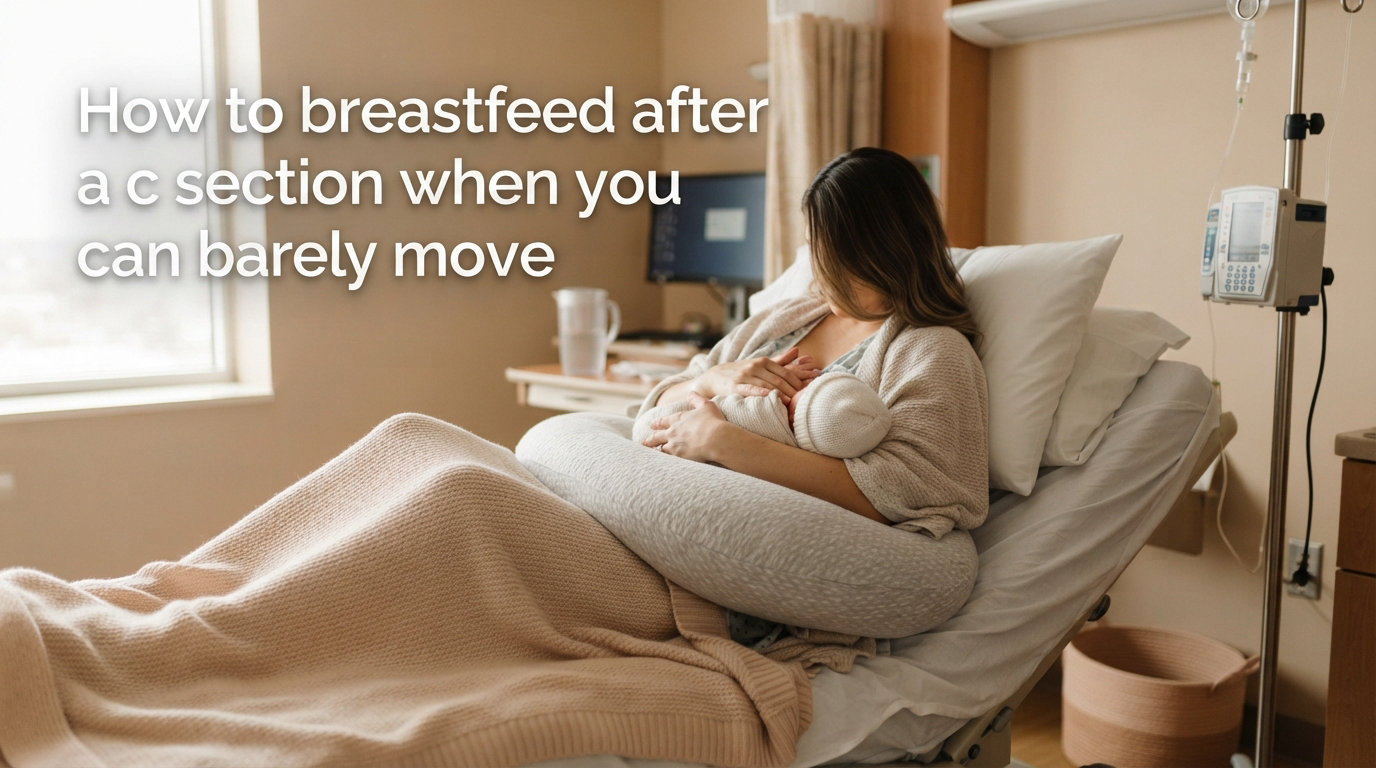
Learning how to breastfeed after a c section when you can barely move feels overwhelming. You’re recovering from major abdominal surgery while trying to nourish a newborn who needs to eat every few hours. Your body hurts, you’re exhausted from the anesthesia, and the last thing you want is another person touching your sensitive midsection.
I want you to know this: what you’re experiencing is real, it’s temporary, and you are not failing. This guide gives you practical strategies for breastfeeding when mobility is severely limited, based on the experiences of mothers who’ve been exactly where you are right now.
You will learn specific positions that protect your incision, how your partner can help without you having to explain everything, what pain medications are safe, and when to expect your body to start cooperating again. Let’s start with understanding why this is so challenging in the first place.
Table of Contents
Why Is It Hard to Breastfeed After a C-Section?
Breastfeeding after cesarean delivery presents unique challenges because your body is simultaneously healing from major surgery while trying to establish milk production. The anesthesia from surgery can make you groggy and slow to respond to your baby’s cues. Your incision site is tender and any abdominal engagement causes pain. Your uterus is contracting as it shrinks back to size, creating afterpains that intensify during nursing.
Milk production can be delayed after C-section, sometimes by 24-72 hours compared to vaginal delivery. The stress of surgery, potential separation from baby immediately after birth, and medication effects can all suppress the hormones that trigger milk coming in. This doesn’t mean you won’t produce milk—it just means your body needs more time and encouragement.
The physical positioning required for traditional breastfeeding holds puts direct pressure on your healing abdomen. The cradle hold, where baby lies across your stomach, can be agonizing. Sitting upright requires core engagement you can’t manage yet. These aren’t excuses to give up—they’re obstacles to work around while you heal.
The First 24 Hours: What to Expect When You’re Groggy and Sore
The first day after surgery is often the hardest for breastfeeding. You’re dealing with the residual effects of spinal anesthesia or an epidural, which can make your legs feel heavy and your coordination unreliable. The pain medication helps with incision discomfort but adds to the mental fog. You might feel like you need three extra hands—one to hold baby, one to support your breast, and one to adjust positioning.
One mother on Reddit described it perfectly: “You use two hands to hold the baby, one to hold your boob, one to hold the baby’s head.” That’s the reality when you can barely move. The good news is nurses in the maternity ward are trained to help with exactly this situation.
Skin-to-Skin in the Recovery Room
If your hospital allows it, request skin-to-skin contact with your baby immediately after surgery. This might happen in the operating room or shortly after in recovery. Even if you feel groggy, having baby on your chest triggers oxytocin release that helps with milk production and uterine contraction. Let the nurses position baby safely while you focus on breathing and staying calm.
If you’re too groggy to safely hold your baby, your partner can do skin-to-skin contact until you’re more alert. This keeps baby calm and warm while giving you time to recover from the anesthesia. The bonding and hormonal benefits still happen even if you need a few hours before holding your baby.
When Baby Is Separated from You
Some C-sections result in temporary separation if baby needs assessment or if you’re dealing with complications. If this happens, start hand-expressing colostrum within the first 1-2 hours after birth. Ask the nurses for help—they can collect what you express and give it to your baby. Hand-expressing is more effective than pumping in the first 48 hours for stimulating milk production.
How to Breastfeed After a C-Section When You Can Barely Move: Best Positions
Finding the right position makes the difference between painful, frustrating feeds and manageable ones. When you can’t sit up easily or engage your core, these positions protect your incision while allowing baby to latch effectively.
Side-Lying Position: The Recovery Room Essential
The side-lying position is the gold standard for breastfeeding after C-section when mobility is limited. You lie on your side with baby facing you, tummy-to-tummy. Your incision faces upward, completely protected from pressure. You don’t need to sit up or use your abdominal muscles at all.
To set up: Lie on your side with a pillow between your knees for hip alignment. Roll baby toward you so you’re belly-to-belly. Use one arm to support baby’s head at breast level. Place a rolled towel or small pillow behind baby’s back so they don’t roll away from you. You can rest while baby nurses—this position allows you to doze safely.
Getting out of this position is the tricky part. Call your partner or nurse to help you roll onto your back first, then push yourself up using your arms rather than your core. Never try to sit up directly from your side while your incision is fresh.
Football Hold with Partner Support
The football hold positions baby at your side with their legs pointing behind you, avoiding your incision completely. When you can barely move, your partner becomes essential for this position.
Here’s how it works with a helper: Sit semi-upright with pillows behind your back for support. Have your partner place baby at your side, tummy tucked against your side with their nose level with your nipple. Your partner holds baby’s weight while you guide your breast and help with latch. Once baby is securely nursing, your partner can place a pillow under baby to support their weight so your arms can rest.
This position keeps baby’s body completely away from your incision. The football hold is particularly good for mothers with large breasts or for babies who need extra head support to maintain latch.
Laid-Back Breastfeeding: Let Gravity Do the Work
Laid-back breastfeeding, also called biological nurturing, uses gravity to hold baby against your breast instead of arm strength. You recline at about 45 degrees with your whole body supported by pillows.
Position yourself with pillows behind your back, neck, and under your knees for comfort. Place baby tummy-down on your chest, letting their natural instincts guide them to your breast. Your body supports baby’s weight completely. You don’t have to hold or position baby actively—you just relax and let them find their way.
This position is ideal when you’re exhausted because it requires almost no effort from you. Your hands are free to stroke baby or simply rest. The semi-upright position also helps with let-down reflex for some mothers.
Cross-Cradle Hold with Strategic Pillow Support
If you prefer a more traditional position, the cross-cradle hold can work with enough pillow support to protect your incision. You’ll need multiple pillows—this is not a minimalist approach.
Place a firm pillow across your lap and up against your abdomen, creating a barrier between baby and your incision. Some mothers use a breastfeeding pillow designed for this purpose, or you can stack regular pillows. Position baby on the pillow so they nurse from the breast opposite your supporting arm. Your hand supports baby’s head while your arm rests on the pillow.
The key is keeping baby’s weight entirely on the pillows, not on your body. Your partner can help by positioning baby on the pillow initially so you don’t have to lift or twist.
Pain Management and Medication Safety While Breastfeeding
One of the most common questions new mothers ask is whether pain medication will harm their breastfed baby. The answer is reassuring: most standard post-surgical pain medications are compatible with breastfeeding. What matters more is managing your pain effectively so you can nurse comfortably.
Safe Pain Medications for Breastfeeding Mothers
The typical pain management protocol after C-section includes acetaminophen (Tylenol) and ibuprofen (Advil or Motrin), both considered safe during breastfeeding. These medications pass into breast milk in very small amounts that don’t affect your baby. Ibuprofen has the added benefit of being an anti-inflammatory, which helps with incision healing.
Narcotic pain medications like oxycodone or hydrocodone may be prescribed for breakthrough pain in the first few days. These are also generally considered compatible with breastfeeding when used as directed. The amount that passes into milk is minimal when you’re taking them short-term at prescribed doses. If you’re concerned, talk to your doctor about timing doses right after nursing so levels are lowest at the next feeding.
Why Staying Ahead of Pain Matters
There’s a practical reason to stay on top of pain control beyond comfort: pain inhibits oxytocin release, which you need for milk let-down. When you’re tensing against incision pain, your body struggles to release milk effectively. One mother shared her experience: “Successfully breastfed my C-section baby. What helped was staying on top of pain control (Tylenol/Advil) and staying hydrated.”
Don’t wait until pain becomes severe before taking medication. Take it on the schedule your doctor recommends, even if you feel okay at that moment. It’s easier to maintain comfort than to catch up once pain spikes.
Managing Afterpains During Nursing
Afterpains—uterine contractions that happen while breastfeeding—are particularly intense after a C-section. These are actually healthy signs that your uterus is shrinking back to pre-pregnancy size, but they hurt. As one mother described: “For the first 2 weeks or so after my c-section breastfeeding was uncomfortable because your uterus will contract.”
Taking ibuprofen 30 minutes before nursing can help reduce afterpain intensity. Deep breathing while baby latches also helps manage the discomfort. Remember that afterpains typically peak around day 3 and decrease significantly by the end of the first week.
Building Your Milk Supply After C-Section Surgery
C-section deliveries can delay milk production by 24-72 hours compared to vaginal births. This doesn’t mean you’ll have low supply long-term—it just means your body needs extra stimulation to get started. The stress of surgery, fluids you received, and any separation from baby can all contribute to this delay.
Frequency Over Duration
The key to establishing supply after C-section is feeding frequency rather than session length. Aim for 8-12 nursing sessions in 24 hours, even if each session is short. This frequent stimulation tells your body that milk is needed. Don’t wait for baby to cry—offer the breast whenever baby shows early hunger cues like rooting or hand-to-mouth movements.
If baby is sleepy or not nursing effectively, hand-expressing or pumping after feeds provides the extra stimulation your body needs. Hand-expressing is particularly effective in the first 48 hours before your milk fully comes in.
Hand-Expressing Technique
Hand-expressing is a skill every C-section mother should learn. It’s more effective than pumping for removing colostrum and doesn’t require sitting upright with equipment attached to you. You can do it while lying in bed with minimal movement.
Place your thumb above your nipple and fingers below, about an inch back from the areola. Press back toward your chest wall, then compress fingers together while maintaining pressure. Release and repeat in a rhythmic motion. Collect drops in a spoon or small cup. Nurses or lactation consultants can demonstrate this technique and help you practice.
Signs Your Supply Is Coming In
Milk typically comes in between days 3-5 after a C-section. Signs include breast fullness, warmth, and noticeable changes in baby’s swallowing pattern during feeds. Your baby will start having more wet diapers—at least 6 per day by day 5 is a good sign.
If your milk hasn’t come in by day 5, or if baby isn’t having enough wet diapers, contact a lactation consultant. There are usually simple interventions that can help, and early support prevents bigger problems from developing.
Timeline: When Will I Be Able to Move Comfortably Again?
Understanding the recovery timeline helps set realistic expectations. Most competitors don’t address this directly, leaving mothers wondering if their limited mobility is normal. Here’s what typically happens:
Days 1-3: Hospital Recovery Phase
During the first three days, you’ll need significant help with positioning. You’re dealing with catheter removal, IV medications, and learning to walk again. Breastfeeding sessions require assistance from nurses or your partner. This is completely normal—don’t push yourself to do more than your body allows.
Week 1: Home with Support Needs
The first week at home requires just as much support as the hospital. Getting in and out of bed for nursing is challenging. You’ll need someone to bring baby to you, help with positioning, and handle burping so you don’t have to sit up repeatedly. Continue using the side-lying position as much as possible to minimize movement.
Weeks 2-3: Gradual Mobility Improvement
By the end of week two, most mothers notice significant improvement in mobility. You’ll be able to sit up more easily and may start nursing in a chair with good support. Afterpains should be minimal. Your incision is healing well, though still tender to touch.
Week 4 and Beyond: Near-Normal Movement
By week four, you’ll likely feel mostly normal during breastfeeding. You can probably manage most positions without assistance, though you’ll still want to be careful about any direct pressure on your incision. Most mothers feel fully recovered by 6-8 weeks postpartum.
Everyone’s timeline is different. Factors like whether your C-section was planned or emergency, whether you labored before surgery, and your general fitness level all affect recovery speed. Follow your body’s signals rather than comparing yourself to others.
Managing Frustration and Your Emotional Wellbeing
The physical challenge of breastfeeding after C-section is only part of the story. The emotional toll is equally significant and deserves attention. You might feel frustrated, guilty, or like your body has failed you by needing surgery and then struggling with something “natural” like breastfeeding.
It’s Okay to Need Help
Needing assistance with breastfeeding doesn’t make you less of a mother. It makes you a mother recovering from major surgery. The expectation that you should be able to independently nurse your newborn while healing from abdominal surgery is unrealistic. Accept help gratefully and without apology.
Many mothers experience grief about their birth experience when a C-section wasn’t planned. Adding breastfeeding struggles on top of that disappointment can feel overwhelming. Acknowledge those feelings—they’re valid. Then remind yourself that this difficult phase is temporary and doesn’t define your entire breastfeeding journey.
Dealing with Guilt About Supplementing
If you need to supplement with formula while your milk supply establishes, you’re not failing. You’re ensuring your baby is fed while your body recovers from surgery. Supplementation doesn’t doom your breastfeeding relationship. Many mothers successfully transition to exclusive breastfeeding after a temporary supplementation period.
If supplementation becomes necessary, use a feeding method that supports breastfeeding—paced bottle feeding or supplemental nursing systems maintain breastfeeding behaviors better than standard bottle feeding. Ask a lactation consultant to show you these techniques.
When to Seek Lactation Support
Don’t wait until you’re in crisis to call a lactation consultant. Early support prevents small problems from becoming big ones. Call for help if: baby isn’t latching within the first 24 hours, you’re experiencing significant pain beyond incision discomfort, baby isn’t having enough wet diapers, or you simply feel overwhelmed and need guidance.
Many insurance plans cover lactation consultant visits, and hospitals often have support groups or follow-up services. Take advantage of every resource available to you.
Your Partner’s Role: How They Can Help
Your partner is your most important support person during C-section recovery breastfeeding. They can do things you physically cannot while you heal. Here’s exactly how they can help:
Handing Baby to You Safely
Your partner should learn the safe way to place baby in your arms without you having to reach or twist. They support baby’s head and neck, lift baby from the bassinet, and place baby directly against your chest. You shouldn’t be doing any lifting or twisting motions yourself.
Supporting Baby’s Weight During Feeds
In positions like the football hold, your partner can hold baby’s weight while you focus on latch and positioning. This is especially helpful in the first week when baby’s head control is minimal and they need frequent repositioning. Your arms get a break while baby keeps nursing.
Managing Pillows and Positioning
Pillows are essential for C-section breastfeeding comfort, but arranging them requires movement you can’t manage. Your partner can place and adjust pillows behind your back, under your arms, or under baby to create the support you need. Tell them what feels good and let them adjust accordingly.
Handling Burping and Diaper Changes
Every time baby needs to burp or have a diaper change, that’s movement you have to do if you’re alone. Your partner can handle these tasks so you can rest between feeds. This is particularly valuable at night when exhaustion is highest.
Advocating with Hospital Staff
Your partner can speak up for you when you’re too tired or in pain to advocate for yourself. They can request lactation consultant visits, ask for help with positioning, or clarify instructions you missed. They know your birth plan and can help ensure it’s followed as much as possible given the circumstances.
Frequently Asked Questions About Breastfeeding After C-Section
Why is it hard to breastfeed after a C-section?
Breastfeeding is hard after C-section because your body is recovering from major surgery while simultaneously trying to establish milk production. Anesthesia effects can make you groggy and slow to respond. Your incision pain makes positioning difficult. Milk production may be delayed 24-72 hours. Uterine contractions during nursing (afterpains) add discomfort. These factors combined make the early days more challenging than after vaginal delivery.
Is nursing harder after a C-section?
Nursing is typically harder in the first 1-2 weeks after C-section compared to vaginal delivery. The physical recovery from surgery limits your mobility and positioning options. Pain management becomes part of every feeding decision. However, by week 3-4, most mothers find breastfeeding comparable to what they’d experience after any delivery type. The difficulty is temporary, not permanent.
Can you breastfeed while taking pain medications after a C-section?
Yes, you can safely breastfeed while taking standard post-C-section pain medications. Acetaminophen (Tylenol) and ibuprofen (Advil) are compatible with breastfeeding. Short-term narcotic pain medications at prescribed doses are also generally considered safe. The small amounts that pass into breast milk do not harm your baby. Staying on top of pain control actually helps breastfeeding by allowing you to relax for let-down.
What is the 30 30 30 rule for breastfeeding?
The 30-30-30 rule is a guideline for breastfeeding session structure: 30 minutes of skin-to-skin contact before feeding, 30 minutes of active nursing, and 30 minutes of rest or sleep after feeding. This approach emphasizes relaxation and bonding over rigid scheduling. While helpful for some, it’s not a requirement—feed on demand and focus on what works for your recovery and baby’s needs.
How long until I can move comfortably after a C-section?
Most mothers can move comfortably within 2-3 weeks after a C-section. Days 1-3 require significant assistance for positioning. Week 1 still needs substantial support at home. By weeks 2-3, mobility improves noticeably and you can handle most breastfeeding positions independently. Full recovery, including normal core strength, typically takes 6-8 weeks. Everyone’s timeline varies based on surgery circumstances and individual healing.
Will my milk come in after a C-section?
Yes, your milk will almost certainly come in after a C-section, though it may be delayed 24-72 hours compared to vaginal delivery. Most mothers see their milk increase between days 3-5 postpartum. Frequent nursing or hand-expressing helps stimulate production. If milk hasn’t come in by day 5, or if baby isn’t having enough wet diapers, contact a lactation consultant for support.
What if my baby won’t latch after a C-section?
If baby won’t latch after C-section, start hand-expressing colostrum within 1-2 hours of birth and every 2-3 hours thereafter. Request a lactation consultant visit immediately—hospitals have them on staff. Try different positions, especially laid-back breastfeeding which uses baby’s natural instincts. Keep baby skin-to-skin as much as possible. Temporary supplementation is okay while you work on latch. Most latch issues resolve within the first week with support.
Final Thoughts: This Is Temporary
Learning how to breastfeed after a c section when you can barely move is one of the hardest things you’ll do as a new mother. The combination of surgical recovery, sleep deprivation, and the urgent needs of a newborn creates a perfect storm of difficulty. But here’s what I need you to remember: this phase is temporary.
The positions in this guide—the side-lying, the football hold with partner support, the laid-back nursing—they’re tools to get you through these first few weeks. By week three, you’ll likely be moving comfortably enough to nurse in whatever position you prefer. By week six, your incision will be well-healed and this will all feel like a distant memory.
Your baby doesn’t care that you needed help to get positioned. They don’t know that the football hold was more practical than the cradle. They only know your warmth, your heartbeat, and your milk. You’re giving them exactly what they need, even when it doesn’t feel picture-perfect.
Accept help without guilt. Take your pain medications on schedule. Call the lactation consultant before you’re desperate. And remember that countless mothers before you have successfully breastfed after C-sections, many with far less support than you have. You can do this, one feed at a time, until it gets easier.