
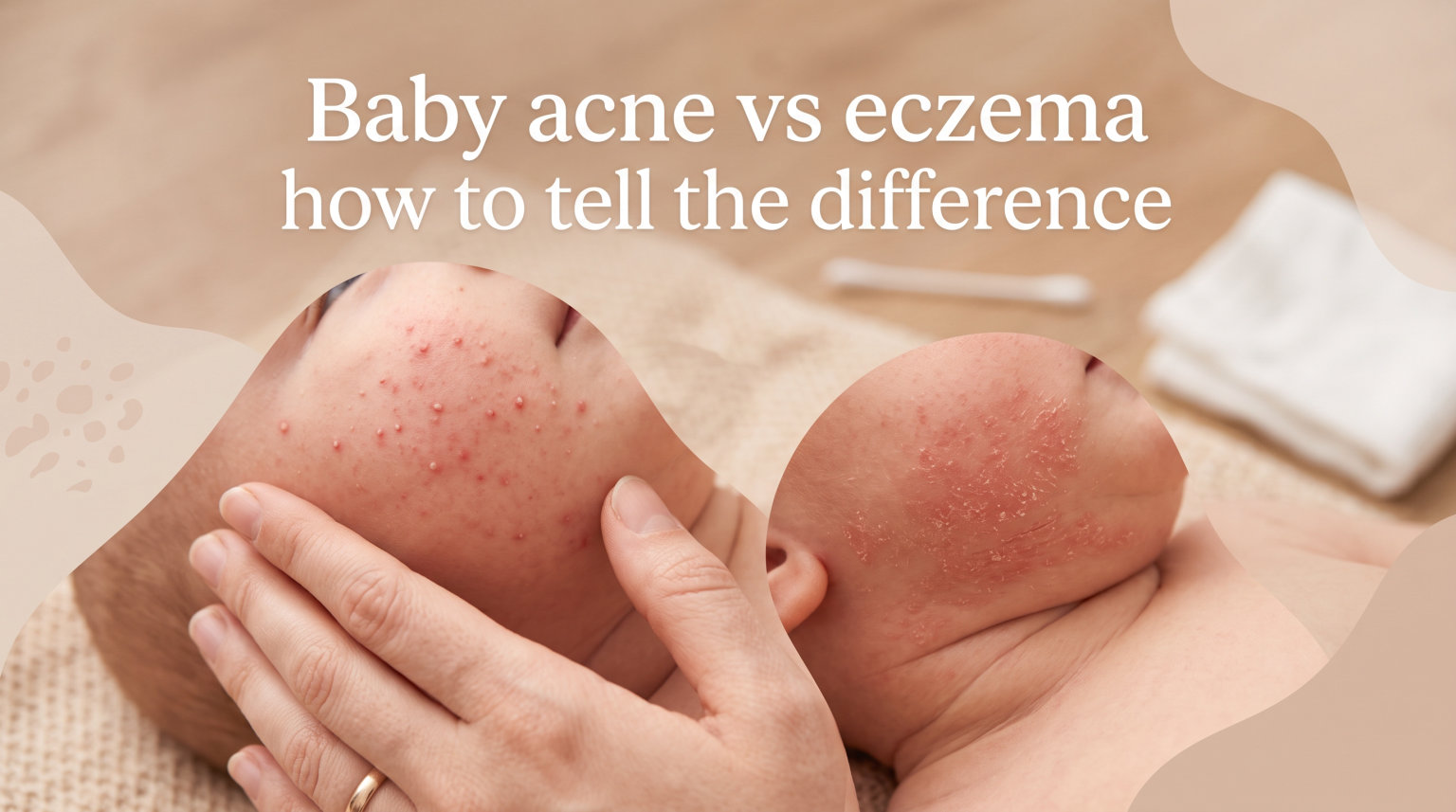
When you first notice red bumps on your newborn’s perfect little face, your heart sinks. Is it baby acne? Eczema? Or something more serious? I remember standing in front of the mirror with my firstborn, squinting at those tiny red spots and wondering if I should rush to the pediatrician or simply wait it out.
Baby acne vs eczema confuses nearly every new parent. These two conditions look remarkably similar at first glance. Both cause red, irritated-looking skin on your baby’s face. Both appear during those early months when you’re already overwhelmed with feedings and diaper changes. And both make you question whether you’re doing something wrong with your baby’s skincare routine.
The truth is, neither condition reflects poor parenting. Baby acne affects up to 20% of newborns, while eczema touches roughly 15-20% of babies before their first birthday. Learning to tell the difference matters because acne needs no treatment, while eczema requires active care to keep your baby comfortable. This guide will give you the practical tools to identify what you’re seeing and respond appropriately.
Table of Contents
Baby Acne vs Eczema: A Quick Overview
The fastest way to distinguish these conditions comes down to three factors: timing, texture, and itchiness.
Baby acne typically appears between 2-6 weeks of age, creates small pimple-like bumps on the cheeks and forehead, and does not cause itching or discomfort. It resolves on its own within a few months without any special treatment.
Baby eczema usually shows up later, between 3-6 months, creates dry rough patches rather than distinct bumps, and causes intense itching that makes babies fussy. It requires regular moisturizing and may persist or recur throughout childhood.
The Simple Touch Test Parents Swear By
Run your clean finger gently across your baby’s skin. Acne feels bumpy and pimple-like, with distinct raised spots you can trace with your fingertip. Eczema feels rough, dry, and scaly – like running your finger across fine sandpaper.
Parents on parenting forums consistently mention this touch test as their most reliable diagnostic tool. One mother shared that her pediatrician taught her this simple trick: “If it feels rough and dry, think eczema. If it feels like tiny bumps, think acne.”
What Is Baby Acne
Doctors call baby acne “neonatal cephalic pustulosis,” though you’ll also hear it called infantile acne or simply baby acne. It is a harmless, temporary skin condition that affects nearly one in five newborns.
What Causes Baby Acne
The primary trigger is your hormones. During pregnancy, your estrogen and progesterone cross the placenta and stimulate your baby’s oil glands. After birth, those hormone levels drop, but the oil glands remain overactive for several weeks. This excess oil clogs pores and creates those tiny red or white bumps.
Recent research also points to a yeast called Malassezia that naturally lives on skin. This yeast thrives in oily environments and may contribute to inflammation in some babies. Neither cause involves poor hygiene or anything you did wrong during pregnancy.
What Baby Acne Looks Like
Baby acne appears as small red bumps or white pustules on the cheeks, nose, forehead, and sometimes chin. The bumps look remarkably like teenage acne, with some showing whiteheads. The surrounding skin looks normal – not dry or scaly, just dotted with these small inflamed spots.
The condition stays strictly on the face. You will not find baby acne on the body, arms, legs, or diaper area. If you see similar bumps in those locations, you’re likely dealing with something else entirely.
Timeline and Duration
Baby acne typically emerges around 2-6 weeks of age. Some babies are born with a few spots, but the full breakout usually happens a few weeks after birth. The peak severity lasts about two weeks, then gradually fades.
Most cases completely clear by 3-4 months of age. In rare instances, infantile acne can persist longer or appear later (3-6 months), but this is uncommon. If bumps persist beyond 6 months, doctors may investigate other causes.
What Is Baby Eczema
Doctors call baby eczema “atopic dermatitis.” Unlike acne, eczema is a chronic inflammatory skin condition related to immune system sensitivity and skin barrier dysfunction. It affects roughly 15-20% of infants and often signals a tendency toward allergies or asthma later in childhood – a progression doctors call the “atopic march.”
What Causes Baby Eczema
Eczema stems from a damaged skin barrier. Healthy skin has a protective outer layer that locks moisture in and keeps irritants out. In babies with eczema, this barrier contains defects – often related to a protein called filaggrin that helps build strong skin cells.
When the barrier fails, moisture escapes and allergens penetrate. This triggers inflammation, redness, and intense itching. Common triggers include dry air, rough fabrics, harsh soaps, temperature changes, and certain foods in sensitive babies.
Genetics play a significant role. If you or your partner have eczema, allergies, or asthma, your baby has higher odds of developing eczema. The condition is not contagious and not caused by poor hygiene.
What Baby Eczema Looks Like
Eczema presents as dry, red, scaly patches that feel rough to the touch. Unlike acne’s distinct bumps, eczema creates larger inflamed areas with a dry, flaky texture. On darker skin tones, eczema may appear as darker brown, purple, or gray patches rather than bright red.
Severe eczema can weep clear fluid when scratched, then crust over as it dries. Chronic scratching leads to lichenification – a thickening and leathery texture of the skin. The condition can look quite dramatic, but it is manageable with proper care.
Where Eczema Appears
In infants, eczema typically starts on the cheeks and scalp. As babies grow, it often spreads to the outer arms and legs, particularly the elbows and knees. Unlike acne, eczema loves body creases – the neck folds, armpits, behind the knees, and wrist creases.
The location pattern helps with diagnosis. Acne stays on the face. Eczema wanders to body folds and joint areas. Heat rash appears where sweat accumulates. Understanding these patterns gives you diagnostic clues.
Timeline and Prognosis
Eczema typically appears between 3-6 months of age, though it can start earlier or later. The condition follows a relapsing-remitting pattern – flare-ups alternating with calm periods. About 60% of children outgrow eczema by puberty, though their skin may remain sensitive.
Early and consistent management prevents complications. Babies with untreated eczema scratch relentlessly, which damages skin further and can introduce infection. They also sleep poorly, which affects the entire family’s wellbeing.
How to Tell the Difference Between Baby Acne and Eczema
Baby acne vs eczema becomes clearer when you know exactly what to look for. Here is the side-by-side comparison that helps parents distinguish these conditions confidently.
Appearance Comparison
Baby acne looks like small pimples. You will see distinct red bumps, some with white centers, scattered across the cheeks and forehead. The skin between bumps looks completely normal – not dry, not rough, just clear skin with spots on top.
Eczema creates patches rather than spots. You will see larger areas of red, dry, rough skin that might look scaly or flaky. The entire affected area looks and feels different from surrounding skin. On babies with darker skin, look for darker patches or areas that look ashy compared to their normal skin tone.
The Itch Factor: The Most Reliable Clue
This is the single most important differentiator, and it comes straight from what parents report their doctors telling them. Baby acne does not itch. Your baby will not scratch at acne, will not seem bothered by it, and will not fuss when you touch the affected areas.
Eczema itches intensely. Babies with eczema rub their faces against crib sheets, scratch with their tiny nails, and fuss when the affected skin touches clothing. They may have trouble sleeping because the itch bothers them. If your baby seems distressed by their skin condition, suspect eczema rather than acne.
Timing Tells the Story
Baby acne arrives early, typically between 2-6 weeks after birth. If you are seeing red bumps in the first month or two of life, acne is the more likely suspect. The condition peaks around week 4 and fades by month 3 or 4.
Eczema tends to appear later, usually between 3-6 months. However, it can emerge earlier in some babies, particularly those with strong family histories of allergies or eczema. If red patches show up after the 3-month mark, pay closer attention to the texture and itch factor to distinguish from late-onset acne.
Location Patterns
Baby acne stays on the face. You will find it on the cheeks, nose, forehead, and possibly chin. It never spreads to the body, arms, legs, or diaper area. This facial-only pattern is a strong indicator of acne.
Eczema starts on the face but does not stay there. It commonly spreads to the scalp, the outer surfaces of arms and legs, and especially to body creases. Check behind the knees, inside the elbows, the neck folds, and wrist creases. Eczema loves these warm, folded areas.
Can Babies Have Both Conditions
Yes, babies can have baby acne and eczema simultaneously. This confuses many parents who expect a single diagnosis. A baby might have classic acne bumps on the forehead while developing dry eczema patches on the cheeks.
Forum discussions reveal this is more common than medical literature suggests. Parents report their babies having “horrendous baby acne” on the face while simultaneously showing dry, rough patches in body folds. If you suspect both conditions, treat each area appropriately – gentle cleansing for acne zones, moisturizing for eczema patches.
Other Rashes That Look Similar
Baby skin reacts to everything, and several other conditions mimic acne or eczema. Knowing these look-alikes prevents misdiagnosis and inappropriate treatment.
Cradle Cap (Seborrheic Dermatitis)
Cradle cap causes greasy, yellow, scaly patches on the scalp. Unlike eczema, it is not itchy and does not bother babies. It can extend to the eyebrows and behind the ears. The greasy quality distinguishes it from the dry roughness of eczema.
Heat Rash
Heat rash appears as tiny red bumps in areas that overheat – the neck, diaper area, and skin folds. It shows up suddenly after a hot day or overdressing and disappears quickly once the skin cools. Unlike acne, it is not limited to the face. Unlike eczema, it is not dry or scaly.
Milia
Milia are tiny white cysts that appear on the nose, cheeks, and chin of newborns. They look like whiteheads but are not inflamed or red. These are completely harmless, caused by trapped skin flakes, and disappear within a few weeks without treatment.
Contact Dermatitis
Contact dermatitis is a reaction to something touching the skin – harsh detergents, fragrances, new fabrics, or even saliva from drooling. It appears exactly where contact occurred and clears when the irritant is removed. This can look like either acne or eczema depending on the reaction.
Food Allergy Rash
Cow’s milk protein allergy (CMPA) and other food allergies can cause rashes that look like eczema. These often appear as hives – raised, red welts that move around the body. They may accompany vomiting, diarrhea, or blood in stool. If a rash appears suddenly after introducing a new food, consider allergy.
Treatment Guide for Baby Acne and Eczema
Treatment differs dramatically between these conditions. Using the wrong approach can worsen symptoms or waste your effort on ineffective care.
How to Treat Baby Acne
The best treatment for baby acne is patience. This condition resolves on its own without intervention. Your job is to avoid making it worse.
Wash your baby’s face once daily with lukewarm water and a soft washcloth. Pat dry gently – do not rub. Avoid all lotions, creams, and oils on the affected areas. These can clog pores further and extend the breakout.
Never use acne medications meant for teenagers or adults. Benzoyl peroxide, salicylic acid, and retinoids are far too harsh for newborn skin and can cause chemical burns. Skip the home remedies too – no toothpaste, no baking soda scrubs, no essential oils.
What About Breast Milk for Baby Acne?
You will find passionate opinions about this online. Some parents swear that dabbing breast milk on acne cleared it overnight. Others report no change. The medical consensus: breast milk is generally safe to try but not proven effective.
Breast milk contains antimicrobial compounds and anti-inflammatory factors that might help. However, leaving milk on skin can also create a sticky environment for yeast growth. If you want to try it, apply a few drops, let it sit briefly, then gently wipe clean. Do not let milk dry and crust on the skin.
How to Treat Baby Eczema
Eczema requires active management. The goal is repairing the skin barrier, locking in moisture, and reducing inflammation.
Moisturizing forms the foundation of eczema care. Apply a thick, fragrance-free cream or ointment multiple times daily. Look for products with ceramides that help rebuild the skin barrier. Petroleum jelly works well as a budget-friendly option. Avoid lotions (too thin) and anything with fragrance or essential oils.
Trigger management matters too. Dress your baby in soft cotton, avoid wool and synthetic fabrics, use fragrance-free laundry detergent, and keep the nursery at a comfortable temperature. Identify and avoid food triggers if your pediatrician suspects allergy connections.
The 3-Minute Rule for Eczema Care
This technique, recommended by pediatric dermatologists, makes moisturizing dramatically more effective. After bathing your baby, gently pat skin until just slightly damp. Then immediately apply moisturizer within three minutes.
This timing captures the window when skin is still hydrated from the bath and creates an occlusive layer that seals that moisture in. Waiting longer than three minutes allows water to evaporate, carrying away the hydration you want to keep. Parents who adopt this 3-minute rule often report significant improvement in eczema within days.
Bathe your baby in lukewarm (not hot) water for 5-10 minutes using a gentle, fragrance-free cleanser. Hot water strips natural oils and worsens eczema. Pat – never rub – the skin dry. Then moisturize from head to toe within that critical 3-minute window.
When to See a Doctor
Most baby skin conditions are harmless and resolve without medical intervention. However, certain signs warrant professional evaluation.
Seek medical care if your baby develops a fever alongside a rash. This combination can signal infection or viral illness requiring treatment. Rapidly spreading rashes, especially those turning dark purple or accompanied by bruising, need immediate attention.
Signs of skin infection include yellow crusting, pus, red streaks extending from affected areas, or warmth around the rash. Eczema that weeps fluid is vulnerable to bacterial infection and may need antibiotic treatment.
Trust your instincts. If your baby seems unusually fussy, is not feeding well, or you simply feel something is wrong, call your pediatrician. You know your baby better than any guide or forum. Medical professionals expect these calls from concerned parents and prefer early intervention to late complications.
FAQs
How do I know if my baby has eczema or just baby acne?
The key difference is itchiness and texture. Baby acne appears as small pimple-like bumps that are not itchy and do not bother your baby. Eczema appears as dry, rough, scaly patches that cause intense itching. Run the touch test: acne feels bumpy, eczema feels rough like sandpaper. Also consider timing – acne typically appears at 2-6 weeks while eczema shows up at 3-6 months.
What is the 3 minute rule for eczema?
The 3-minute rule states that you should apply moisturizer within 3 minutes of bathing your baby. After a lukewarm bath, gently pat skin until slightly damp, then immediately apply a thick fragrance-free cream or ointment. This timing locks in the hydration from the bath before water can evaporate. Following this rule consistently often improves eczema significantly within days.
How to differentiate eczema and acne?
Differentiate by appearance, texture, location, and symptoms. Acne shows as distinct red or white pimples on the face only. Eczema shows as larger dry, scaly patches that can spread to body creases. Acne is not itchy; eczema causes intense itching. Acne feels bumpy; eczema feels rough. Acne appears at 2-6 weeks and clears by 3-4 months. Eczema appears at 3-6 months and may persist or recur.
Can you put Aquaphor on baby acne?
You should not put Aquaphor or any ointments on baby acne. Baby acne results from overactive oil glands and clogged pores. Adding heavy ointments can worsen the clogging and extend the breakout. The best approach for baby acne is gentle cleansing with water only and letting it resolve naturally. Save the Aquaphor for eczema or dry skin patches.
Is baby acne itchy?
No, baby acne is not itchy. This is one of the key differences from eczema. Babies with acne do not scratch at the bumps, do not seem bothered by them, and are not fussy when the affected skin touches clothing. If your baby is scratching or seems distressed by their skin condition, it is likely eczema rather than acne.
Can babies have both acne and eczema at the same time?
Yes, babies can have both baby acne and eczema simultaneously. Some babies develop classic acne bumps on the forehead while having dry eczema patches on their cheeks or in body creases. This is more common than many parents expect. If you suspect both conditions, treat each area appropriately: gentle water cleansing for acne areas and moisturizing for eczema patches.
Conclusion
Baby acne vs eczema becomes much less mysterious once you know the key differentiators. Remember the simple touch test: run your finger across your baby’s skin. Bumpy means acne. Rough means eczema.
Consider your baby’s comfort too. Acne does not itch or bother babies. Eczema causes intense itching that disrupts sleep and creates fussiness. If your baby is scratching, suspect eczema.
Both conditions are common, manageable, and not your fault. Baby acne requires patience – it clears on its own with gentle care. Eczema requires active moisturizing and the 3-minute rule after bathing. Neither needs expensive treatments or miracle creams.
Trust your parental instincts. If something seems wrong beyond a simple rash, call your pediatrician. They have seen thousands of baby skin conditions and can provide reassurance or treatment when needed. Your baby will outgrow these skin challenges, and you will gain confidence with each passing week of parenthood.