
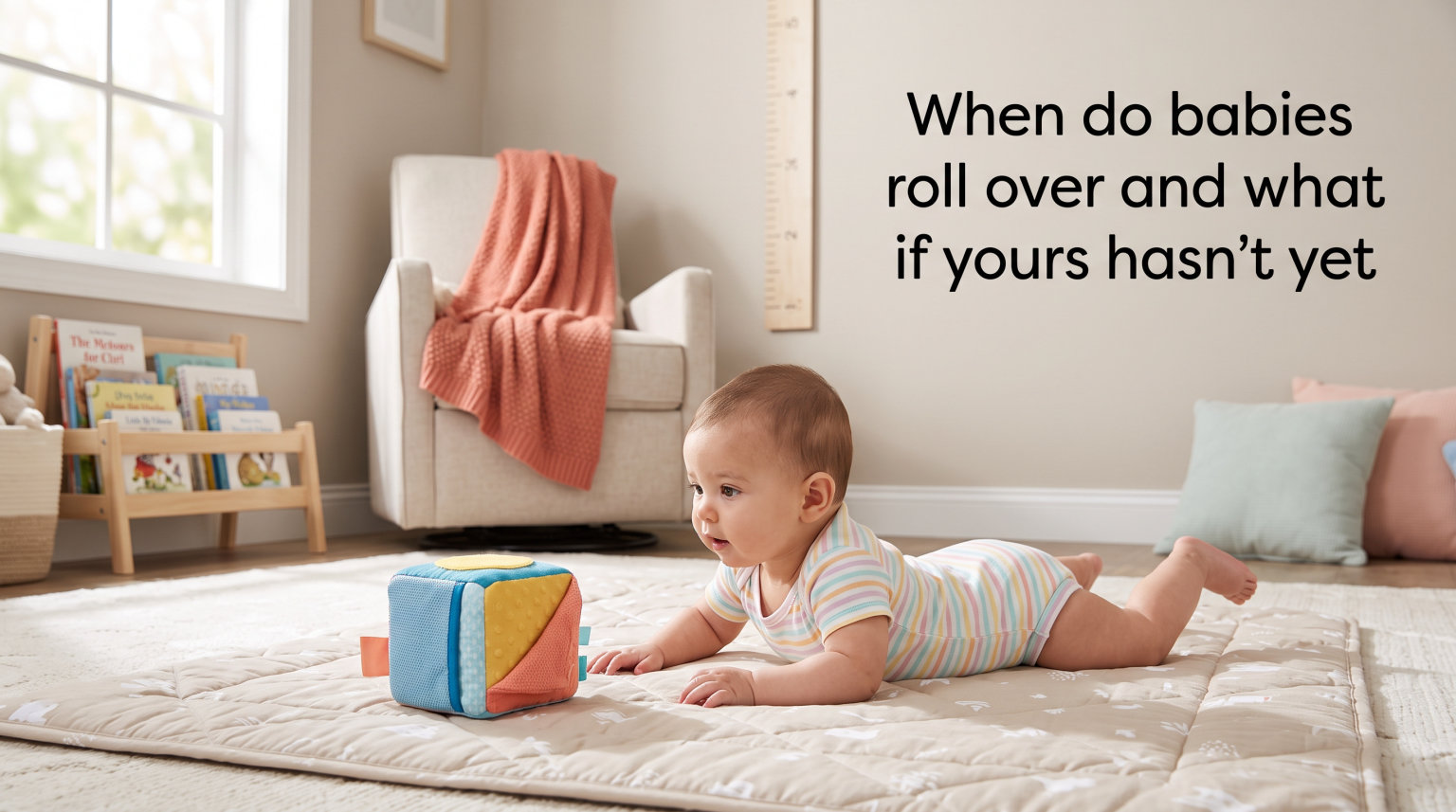
Most babies learn to roll from their belly to their back between 3 and 5.5 months of age, and from their back to their belly between 5.5 and 7 months. If your little one hasn’t started rolling yet, you’re probably watching other babies on social media and wondering if something is wrong. Take a deep breath. Every baby develops at their own pace, and the timeline for rolling over varies widely among healthy infants.
I remember pacing the living room at 5 months, watching my daughter lie perfectly still during tummy time while my friend’s baby was already doing somersaults. That anxiety is real, and it’s something nearly every parent experiences. The good news? By the end of this guide, you’ll understand exactly when babies typically roll over, how to support your baby’s development, and when you might want to check in with your pediatrician.
Here’s what we’ll cover: the complete rolling timeline from those first wobbly attempts to confident rolls, the three developmental stages your baby moves through, clear signs that show your baby is getting ready, practical techniques to encourage rolling safely, important safety changes you need to make once rolling starts, and honest guidance about when to stop worrying and when to seek help.
Table of Contents
When Do Babies Roll Over? The Complete Timeline
Babies typically begin rolling from their tummy to their back between 3 and 5.5 months of age. Rolling from back to tummy usually follows a bit later, generally between 5.5 and 7 months. These are averages, not deadlines. Some babies roll earlier, some later, and both can be perfectly normal.
Those first rolls are often accidental. Your baby might be doing tummy time, push up a little too far to one side, and suddenly find themselves on their back. The surprise on their face is usually priceless. These accidental rolls are an important step, even though your baby isn’t doing them on purpose yet. The intentional rolls come later as your baby develops better muscle control and starts understanding cause and effect.
Month-by-Month Breakdown
Months 1-2: During this period, your baby is building foundational strength. They can lift their head briefly during tummy time and turn it side to side. Rolling is not expected at this age, though some babies may rock or show early signs of wanting to move.
Months 3-4: This is when the magic typically starts. Many babies begin accidental tummy-to-back rolls during this window. You might notice your baby pushing up higher during tummy time, reaching for toys, and showing more interest in movement.
Months 5-6: By this stage, intentional tummy-to-back rolling is common. Babies are also working on the harder back-to-tummy direction. Some babies master both directions by 6 months, while others are still working on building the core strength needed.
Months 6-7: Most babies who haven’t rolled yet will achieve this milestone during this period. If your baby is approaching 7 months and hasn’t shown any signs of rolling, a conversation with your pediatrician is a good idea.
According to the American Academy of Pediatrics, rolling over is considered a normal developmental milestone that typically emerges between 4 and 7 months. The wide range accounts for the natural differences in muscle development, temperament, and opportunities for practice that each baby experiences.
Why Some Babies Roll Earlier or Later
Babies who spend lots of time on the floor often roll earlier than babies who are frequently in seats, swings, or carriers. Free movement on a flat, safe surface gives babies the chance to experiment with their bodies and build strength naturally.
Temperament plays a role too. Some babies are natural movers who squirm and wiggle constantly. Others are content observers who prefer to watch the world from a stationary position. Neither personality type is better, and both will reach milestones on their own timeline.
Birth factors can influence timing. Babies born prematurely may reach milestones based on their adjusted age rather than their actual age. Larger babies sometimes roll later simply because they have more weight to move. Babies with lots of hair might roll earlier because that extra weight on their head creates momentum when they lift up during tummy time.
The Three Stages of Learning to Roll Over
Rolling over doesn’t happen overnight. Your baby moves through distinct developmental stages as they build the strength, coordination, and confidence needed to flip themselves over. Understanding these stages helps you know what to look for and how to support your baby’s progress.
Stage 1: Building Foundation Strength
The first stage starts from birth and continues through the first few months. During this time, your baby is developing the neck, shoulder, arm, and core muscles that make rolling possible. Think of this as laying the groundwork for all future movement milestones.
Tummy time is the star of this stage. When your baby spends time on their stomach, they naturally work to lift their head and chest. These mini-pushups strengthen the exact muscle groups needed for rolling. You might see your baby lifting their head 45 degrees by 2 months and 90 degrees by 3-4 months.
Other signs of stage 1 progress include turning their head to track sounds or toys, pushing up on their forearms during tummy time, and showing interest in looking around while on their belly. These small victories are building the physical foundation for rolling.
Stage 2: Rocking and Building Momentum
This stage is where things start getting exciting. Your baby has the basic strength, and now they’re figuring out how to use it to move. You’ll see your baby rocking back and forth while on their tummy, almost like they’re trying to crawl but haven’t figured out the leg coordination yet.
During back time, you might notice your baby bringing their legs up and rocking side to side. This leg lifting and dropping helps them understand momentum and body positioning. Some babies get stuck on their side during this stage, frustrated that they can’t complete the roll in either direction.
The accidental rolls often happen during this stage. Your baby might push up too far to grab a toy and topple over, or they might arch their back and flip while stretching. Celebrate these moments, even though your baby isn’t doing them intentionally yet. Each accidental roll teaches their brain about body movement and spatial awareness.
Stage 3: The Intentional Roll
This is the payoff stage. Your baby has put together the strength from stage 1 and the coordination from stage 2. Now they’re rolling with purpose. You’ll see your baby look at a toy, position their body, and execute a roll to get closer to it.
The intentional roll requires more sophisticated skills than the accidental roll. Your baby needs to coordinate multiple muscle groups, understand their body in space, and plan the movement ahead of time. This is a big cognitive leap as well as a physical one.
Most babies master tummy-to-back rolling first because gravity helps them. Back-to-tummy rolling requires more core strength to fight gravity and lift that top hip up and over. Don’t worry if your baby seems stuck on one direction for a while. This is completely normal.
Log Roll vs. Fluid Roll
Not all rolling looks the same. Some babies do what therapists call a “log roll,” where their entire body moves as one stiff unit. They might use their head weight to initiate the movement and roll like a log tumbling down a hill.
Other babies develop a “fluid roll” where different body parts move independently. They might lift one arm, twist their torso, and bring a leg over in a more segmented motion. The fluid roll usually develops after the log roll as babies gain better control over individual muscle groups.
Both rolling styles are normal. The log roll is often easier for babies to learn first, while the fluid roll shows more refined motor control. By the time babies are crawling and sitting, most have transitioned to the fluid style of movement.
Connection to Future Milestones
Rolling over isn’t just about rolling. It’s a foundational skill that leads directly to sitting, crawling, and eventually walking. The core strength your baby builds while learning to roll is the same core strength they’ll need to sit upright without support.
The coordination and body awareness developed during rolling translate into crawling skills. Babies who roll well often crawl earlier because they’ve already figured out how to coordinate their limbs and move with intention. The weight shifting they practice during rolling is exactly what they’ll need for the hands-and-knees position of crawling.
Parents often ask if early rolling means early walking. While rolling is a positive sign of motor development, it doesn’t necessarily predict when your baby will walk. Some early rollers are late walkers, and some late rollers are early walkers. Each milestone has its own timeline.
5 Signs Your Baby Is Ready to Roll Over
Wondering if your baby is getting close to their first roll? Watch for these developmental signals that indicate your little one is building the skills needed for rolling over. Seeing these signs means you’re likely weeks, not months, away from that exciting milestone.
1. Strong Head and Neck Control
Your baby can hold their head steady when upright and lift it easily during tummy time. By 3-4 months, they should be able to lift their head 90 degrees while on their stomach and hold it there for several seconds. This neck strength is essential because the head is heavy, and controlling it is a major part of the rolling motion.
You might notice your baby turning their head to follow sounds, lights, or your voice. This side-to-side head control shows that the neck muscles are developing the flexibility and strength needed for rolling.
2. Pushing Up During Tummy Time
During tummy time, your baby can push up on their forearms and lift their chest off the floor. This position strengthens the shoulder, arm, and back muscles that power the rolling motion. Some babies even start pushing up on straight arms, which shows even greater strength development.
The ability to shift weight from one arm to the other while in this position is particularly important for rolling. Watch for your baby to favor one side, reaching more with one arm than the other. This asymmetry is actually a good sign that they’re preparing to initiate a roll.
3. Rocking Back and Forth
While on their tummy, you see your baby rocking their body forward and back. This movement is practice for the momentum needed to complete a roll. Your baby is essentially teaching themselves about weight distribution and body mechanics.
During back time, look for leg lifting and dropping. When your baby brings their knees up and rocks side to side, they’re building the core strength and understanding the body positioning needed for back-to-tummy rolling.
4. Reaching and Pivoting
Your baby reaches for toys while on their tummy and may pivot their body to get closer to interesting objects. This reaching motion naturally creates the twisting and weight shifting that leads to rolling. You might see your baby do a full 360-degree circle while reaching for toys around them.
The interest in toys and motivation to move is just as important as the physical strength. A baby who wants to reach that colorful toy is more likely to attempt the movements that lead to rolling than a baby who is content staying still.
5. Side-Lying Interest
Your baby seems comfortable and interested in lying on their side. They might roll partially to the side and stay there, or they might use the side-lying position to play with toys. This middle position is exactly where they need to be during a roll.
Some babies get stuck in the side-lying position for a week or two, unable to complete the roll in either direction. This is a normal part of the learning process. Your baby is building the final bit of strength and coordination needed to get past that middle point.
How to Help Your Baby Learn to Roll Over
You can’t force a baby to roll before they’re ready, but you can create an environment that encourages natural development. These techniques give your baby the opportunities and motivation they need to practice the skills that lead to rolling.
Prioritize Tummy Time
Tummy time is the single most important activity for developing rolling skills. The American Academy of Pediatrics recommends supervised tummy time starting from the first days of life, building up to at least 30 minutes total per day by 3 months of age.
Start with short sessions of 1-2 minutes and gradually increase as your baby builds tolerance. Some babies love tummy time from the start, while others resist it. If your baby fusses, try doing tummy time on your chest instead of the floor, or use a rolled towel under their chest for support.
Make tummy time interesting by placing mirrors, black-and-white cards, or colorful toys at eye level. The more engaged your baby is, the longer they’ll stay in the position and the more strength they’ll build.
Use Toys as Motivation
Place toys just out of reach during tummy time to encourage your baby to stretch and shift their weight. This natural reaching motion often triggers the rolling reflex. As your baby reaches for a toy, they may overbalance and roll accidentally, which is exactly what you want at this stage.
Change the toy positions frequently so your baby practices reaching in different directions. Place toys to the left, right, and slightly above eye level. This variety helps develop balanced strength on both sides of the body.
Choose toys that make noise or have interesting textures. The extra sensory input keeps your baby engaged longer and gives them more reason to move toward the toy.
Practice the Position
Help your baby experience the rolling motion by gently positioning them on their side. Place a small rolled blanket or towel behind their back to keep them in the side-lying position. This lets them experience the middle stage of rolling without the full effort of getting there themselves.
From the side-lying position, show your baby toys placed slightly above their head. This encourages the final twist and push needed to complete a back-to-tummy or tummy-to-back roll. Many babies need to feel what a completed roll is like before they can do it independently.
Never force your baby through a rolling motion. Gentle positioning is fine, but let your baby do the actual movement work themselves. Forced movement doesn’t build the neural connections that true independent rolling requires.
Give Plenty of Floor Time
Babies who spend lots of time on the floor typically reach motor milestones earlier than babies who are always in seats, swings, or carriers. The floor gives your baby freedom to move, experiment, and practice without restrictions.
Create a safe, clean floor space where your baby can spend supervised time throughout the day. A play mat or clean blanket works perfectly. The more time your baby spends on their tummy and back, the more opportunities they have to practice rolling movements.
Limit time in restrictive containers like car seats, bouncers, and swings to when they’re truly necessary. These devices can delay motor development because they don’t allow the natural movement and weight shifting that build rolling skills.
Know When to Step Back
There’s a fine line between encouraging and hovering. Once you’ve set up the environment, give your baby space to figure things out. The struggle is part of the learning process. When your baby works through the frustration of not quite reaching a toy, they’re building problem-solving skills along with physical strength.
Celebrate the small victories. When your baby lifts their head a little higher, reaches a bit further, or accidentally rolls, show your enthusiasm. Your positive reaction helps your baby understand that movement is fun and rewarding.
What If Your Baby Hates Tummy Time?
Some babies genuinely dislike tummy time, and that’s okay. Try these alternatives to build the same strength without the tears. Tummy time on your chest counts just as much as tummy time on the floor. Lie back and place your baby on your chest, making eye contact and talking to them.
Use a tummy time mirror or water mat to make the position more interesting. Some babies tolerate tummy time much better when there’s something novel to look at or interact with.
Try tummy time when your baby is well-rested and not hungry. A tired or hungry baby has less patience for challenging positions. Even 30-60 seconds of tummy time several times a day adds up and builds strength.
Safety Tips for When Your Baby Starts Rolling
The moment your baby starts rolling is exciting, but it also marks a transition point where safety practices need to change. Suddenly, your stationary newborn is a mobile infant who can get themselves into positions and places they couldn’t before.
Stop Swaddling Immediately
Once your baby shows any signs of rolling, even accidental rolls, it’s time to stop swaddling. A swaddled baby who rolls onto their stomach cannot use their arms to push up and reposition themselves. This creates a suffocation risk.
Transition to a sleep sack or wearable blanket that keeps your baby warm while leaving their arms free. Many babies have trouble adjusting to unswaddled sleep at first. Expect a few rough nights as your baby learns to sleep with their arms available.
If your baby startles awake without the swaddle, try a transitional swaddle with one arm out first, then both arms out before moving to a sleep sack completely. Give your baby a few days to adjust at each stage.
Always Use a Safe Sleep Surface
Continue following safe sleep guidelines even after your baby can roll. Place your baby on their back to sleep on a firm, flat surface with no loose bedding, pillows, or soft objects. Even babies who can roll should start sleep on their backs.
If your baby rolls onto their stomach during sleep, you don’t need to flip them back over as long as they got there themselves. Once babies can roll independently, they’re usually able to lift and turn their heads to breathe. However, always place them back-down to start sleep.
Room-sharing without bed-sharing remains the safest sleep arrangement for the first 6-12 months. Your baby should sleep in their own crib, bassinet, or play yard in your bedroom.
Never Leave Baby Unattended on Elevated Surfaces
Changing tables, beds, couches, and even infant bouncers on elevated surfaces become dangerous once your baby can roll. It takes only a second for a rolling baby to flip off a changing table or wiggle to the edge of a bed.
Always keep one hand on your baby during diaper changes. Never turn your back, even for a moment, when your baby is on an elevated surface. The first roll often surprises parents because it happens so quickly and quietly.
If you need to step away, place your baby in a safe location on the floor first. Floor play is always safer than elevated surface play once rolling begins.
Lower the Crib Mattress
Once your baby can push up on their hands and knees or roll consistently, lower the crib mattress to the middle position if you haven’t already. When your baby can pull to standing, move the mattress to the lowest setting.
Check that crib slats are no more than 2 3/8 inches apart so your baby can’t get their head stuck. Remove any hanging toys or bumpers that could become climbing aids or entanglement hazards.
SIDS Risk After Rolling Begins
The risk of SIDS decreases significantly once babies can roll independently and lift their heads well, which usually happens around 4-6 months. However, safe sleep practices remain important throughout the first year of life.
The peak risk period for SIDS is between 1 and 4 months of age, which is before most babies can roll well. By the time your baby is consistently rolling, the SIDS risk has already dropped considerably. The back-to-sleep recommendation is strongest in those early months when babies cannot reposition themselves.
Continue following safe sleep guidelines until your baby’s first birthday. Room-sharing, back-sleeping, firm surfaces, and no loose bedding protect against SIDS and other sleep-related infant deaths throughout the first year.
What If Your Baby Hasn’t Rolled Over Yet?
If you’re reading this with a 6-month-old who shows no interest in rolling, I want you to hear this clearly: your baby is probably fine. The normal range for rolling is wide, and plenty of healthy, developmentally typical babies don’t roll until 7 months or even later.
The Reassurance You Need
I’ve talked to dozens of parents whose babies rolled “late” by the books. One mom’s son rolled at 6.5 months and now, at age 2, never stops running. Another’s daughter didn’t roll until 7 months and crawled at 10 months, right on her own timeline. These stories aren’t exceptions, they’re the reality of normal child development.
Babies are individuals, not textbook diagrams. Your baby’s unique combination of genetics, temperament, body type, and experiences creates a personal developmental timeline. Some babies are cautious observers who prefer to watch before trying. Others are content being carried and held rather than moving independently. These personality traits are not deficits.
The pressure parents feel at pediatrician appointments is real. Those milestone checklists can make any parent anxious. Remember that pediatricians use broad ranges for a reason. Falling outside the average is not the same as falling outside the normal range.
When to Check With Your Pediatrician
Most pediatricians aren’t concerned about rolling until 6-7 months of age. However, there are some signs that warrant a conversation with your healthcare provider. If your baby shows no interest in movement by 6 months, cannot lift their head during tummy time, or seems to have significantly less strength than they did previously, schedule an appointment.
Asymmetry can be a red flag. If your baby only looks to one side, only uses one arm, or seems much stronger on one side of their body, mention this to your pediatrician. Normal rolling development is generally symmetrical.
Regression is another signal to seek help. If your baby was lifting their head well and has stopped, or was making rolling attempts and no longer does, talk to your doctor. Losing previously acquired skills is more concerning than simply being slow to develop them.
What Your Doctor Might Recommend
If your pediatrician has concerns about your baby’s motor development, they may refer you to early intervention services or a pediatric physical therapist. These services are often free or low-cost and can provide targeted exercises to help your baby build strength.
Early intervention is not a sign that something is seriously wrong. Many babies benefit from a few sessions of professional guidance to get over a developmental hump. The earlier any issues are addressed, the easier they are to resolve.
Your pediatrician might also ask about your baby’s overall environment. Are they getting enough tummy time? Are they spending excessive time in restrictive devices? Sometimes simple changes to daily routines are all that’s needed.
When Early Rolling Is Concerning
While most parents worry about late rolling, some babies roll unusually early, and this can occasionally signal an issue. If your baby is rolling consistently before 2 months of age, mention this to your pediatrician. Very early rolling can sometimes be a sign of low muscle tone or reflex issues.
The key word here is “consistently.” A single accidental roll at an early age is usually just that, an accident. But a baby who is regularly flipping themselves over at 1-2 months might be using abnormal muscle patterns to do so.
Your pediatrician can assess whether your baby’s early rolling is powered by normal developing strength or by reflexive movements that indicate a need for further evaluation. Most of the time, early rolling is simply a sign of a strong, active baby.
Frequently Asked Questions About Baby Rolling
Can a baby roll over at 2 months?
While most babies roll over between 4-7 months, some babies can roll as early as 2-3 months. Early rolling is often accidental rather than intentional. A single accidental roll at 2 months is usually not concerning, but consistent rolling at this age should be mentioned to your pediatrician to rule out any muscle tone or reflex issues.
What is the 3 6 9 rule for babies?
The 3 6 9 rule refers to typical developmental milestones at 3, 6, and 9 months. At 3 months, babies typically hold their head steady and push up on arms during tummy time. At 6 months, most can roll over in both directions and sit with support. At 9 months, many babies can sit without support and may start crawling. Remember these are averages, and healthy babies develop at their own pace.
At what age is SIDS no longer a risk?
The risk of SIDS is highest between 1 and 4 months of age and decreases significantly after 6 months. By the time most babies can roll over independently, typically around 4-6 months, the SIDS risk has already dropped considerably. However, safe sleep practices should continue until your baby’s first birthday. Room-sharing, back-sleeping, and avoiding loose bedding remain important throughout the first year.
What is the 5 3 3 rule for babies?
The 5 3 3 rule typically refers to sleep training or feeding schedules, not rolling milestones. In sleep contexts, it often means 5 hours of sleep, 3 hours awake, 3 hours of sleep. For feeding, it may refer to feeding every 3 hours with 5-6 feedings per day. This rule is not directly related to when babies roll over or motor development milestones.
Is it normal for my baby to skip rolling and go straight to sitting?
Some babies do skip rolling and move directly to sitting or even crawling. While rolling is considered a typical milestone, it is not a mandatory step that every baby must take. If your baby is developing other gross motor skills on schedule and shows good muscle strength, skipping rolling alone is usually not a concern. However, mention it to your pediatrician to ensure overall development is on track.
How much tummy time does my baby need to learn to roll?
The American Academy of Pediatrics recommends building up to at least 30 minutes of tummy time per day by 3 months of age. This can be broken into short sessions throughout the day. Start with 1-2 minute sessions and gradually increase as your baby builds tolerance. More tummy time generally means faster strength development, but even babies who tolerate only small amounts will eventually build the skills needed for rolling.
Embracing Your Baby’s Unique Timeline
When do babies roll over? Most start between 3 and 5.5 months for tummy-to-back, and 5.5 to 7 months for back-to-tummy. But the real answer is that your baby will roll when they’re ready.
The best thing you can do is provide plenty of tummy time, create a safe space for exploration, and let go of the comparison game. Your baby’s timeline is exactly that, theirs. The fact that you’re reading this article, researching, and caring about your baby’s development means you’re already doing a great job.
If your baby rolled yesterday, celebrate that milestone. If your baby is 7 months and still content to watch the world from their back, give them time and keep encouraging movement. Both babies are developing normally. Trust your instincts, check in with your pediatrician if you have concerns, and remember that these early months are just the beginning of a lifetime of watching your unique, wonderful child grow.