
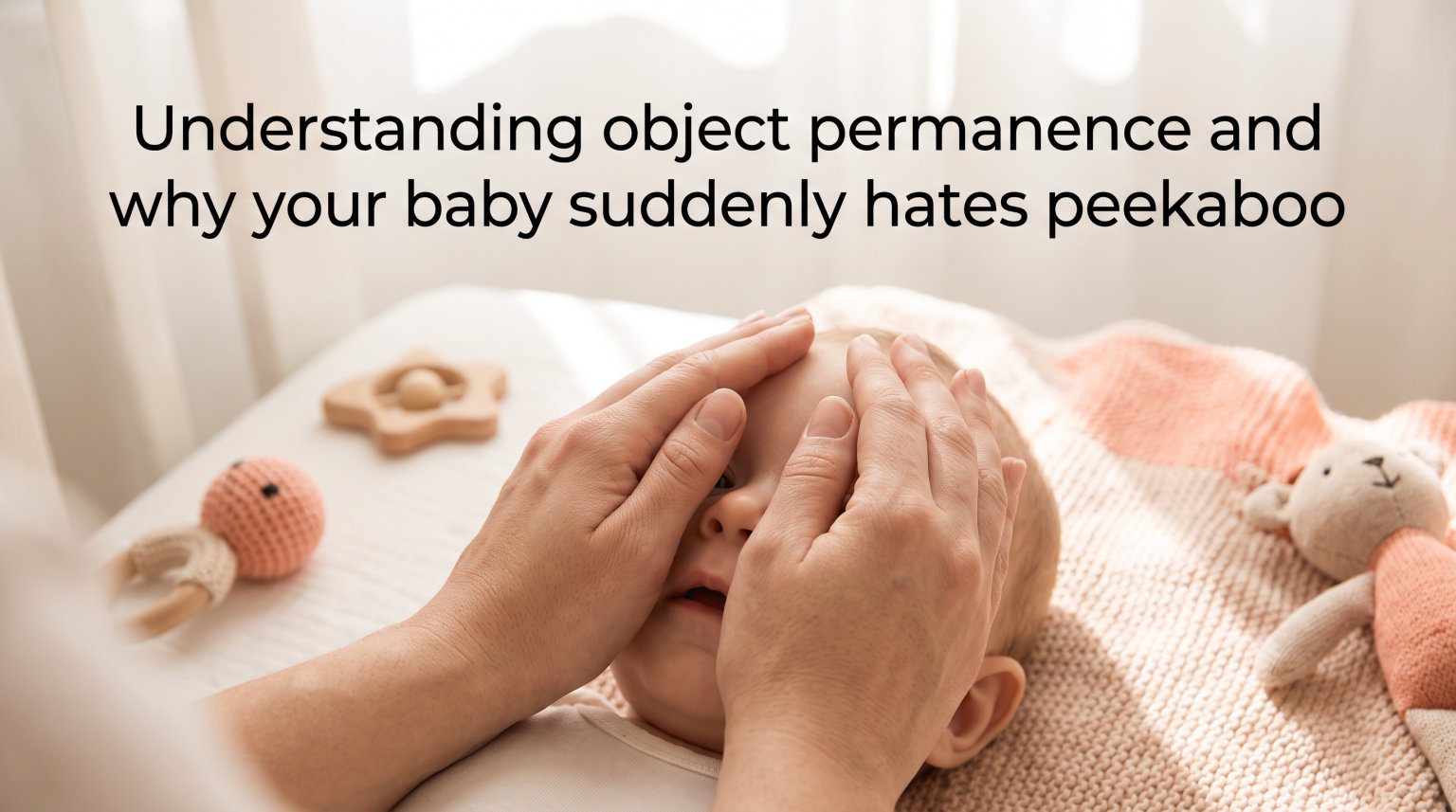
One day your baby is giggling hysterically at peekaboo. The next day, they burst into tears when you cover your face. This sudden shift confuses many parents. I remember when my daughter went from loving the game to crying every time I ducked behind my hands.
The explanation lies in a fascinating cognitive milestone called object permanence. Your baby’s brain has just made a major leap. They now understand that you still exist even when hidden. This knowledge changes everything about how they experience peekaboo. In this guide, I will explain what object permanence is, when it develops, and why this developmental breakthrough transforms a fun game into something that can feel scary for your little one.
Table of Contents
What Is Object Permanence?
Object permanence is the understanding that objects and people continue to exist even when they cannot be seen, heard, or touched. Before this concept develops, babies live entirely in the present moment. When something leaves their sight, it literally ceases to exist in their mind.
Swiss psychologist Jean Piaget first described object permanence in the 1950s. He identified it as a critical milestone during the sensorimotor stage of development, which spans from birth to approximately age two. Piaget believed that object permanence developed gradually between 4 and 12 months, with babies showing full mastery by around 8 to 9 months.
This cognitive skill represents more than just knowing things exist when hidden. It signals the development of working memory and mental representation. Your baby can now hold a picture of you in their mind even when you are not physically present. This is the foundation for language development, pretend play, and emotional attachment.
When Do Babies Develop Object Permanence?
Babies typically begin developing object permanence between 4 and 9 months of age. However, modern research suggests the process may start even earlier, with some studies showing signs of emerging object permanence in infants as young as 3 to 4 months old.
The development happens in stages rather than all at once. During the early phase, babies start tracking objects that move out of sight. They might look toward a toy that rolled under the couch. In the middle phase, they actively search for partially hidden objects. By the final phase, they understand that completely hidden objects still exist and will look for them deliberately.
Here are signs your baby is developing object permanence:
They look for toys that drop out of sight
They pull blankets off hidden objects
They search in multiple locations for a lost item
They protest when you leave the room
They reach for toys hidden under cups or cloths
Every baby develops at their own pace. Some may show clear signs by 5 months, while others may not fully demonstrate object permanence until closer to 10 months. This variation is completely normal and usually not a cause for concern.
Why Your Baby Suddenly Hates Peekaboo
Before developing object permanence, peekaboo is pure magic. You disappear. Then you reappear. The surprise delights your baby every single time. Their brain processes each peekaboo round as a brand new event because they literally do not know you exist behind your hands.
Once object permanence develops, the game changes completely. Your baby now knows you still exist behind your hands or under the blanket. The surprise element disappears. Instead of wondering where you went, they start wondering when you will come back.
This creates a specific type of anxiety. Your baby understands you are still there but cannot see you. They have no concept of time. Five seconds feels like an eternity when you are a baby who depends completely on your caregiver for survival. The uncertainty becomes uncomfortable, then distressing.
The cry you hear is not a cry of confusion. It is a cry of anticipation and worry. Your baby is essentially saying, “I know you are there. Why are you not showing yourself? When will you return?” The game has shifted from delightful surprise to mild torture.
This reaction is actually a positive sign. It means your baby’s brain is developing exactly as it should. They are forming the mental frameworks necessary for memory, language, and complex thought. The tears, while heartbreaking, signal healthy cognitive growth.
The Connection to Separation Anxiety
Object permanence and separation anxiety are deeply intertwined. They typically emerge around the same developmental window, usually between 6 and 9 months. This timing is not coincidental.
Before object permanence develops, your baby knows you as a sensory experience. You are warmth, milk, comfort, and voice. When you leave the room, those sensations stop. Your baby does not miss you because you do not exist in their mind once gone. There is no anxiety because there is no awareness of your absence.
After object permanence develops, your baby can hold a mental picture of you. They know you exist somewhere else. This knowledge creates a new emotion: missing someone. They want the comfort you provide, and they know you could provide it if you were there. The result is separation anxiety.
This anxiety affects many daily routines. Bedtime becomes harder because your baby knows you still exist when you leave the room. Drop-offs at daycare trigger tears because they understand you are going somewhere else. Even walking to another room can prompt crying.
The intensity of separation anxiety varies greatly between babies. Some experience mild fussiness when parents leave. Others have intense reactions that last for many months. Both extremes fall within the normal range. The anxiety typically peaks between 10 and 18 months and gradually improves by age two or three.
How to Help Your Baby Through This Phase
While you cannot stop object permanence from developing (nor would you want to), you can help your baby navigate this transition with less distress. Several strategies can make peekaboo enjoyable again and ease separation anxiety.
Modified Peekaboo Techniques
Try peekaboo with partially hidden faces instead of fully covering yourself. Peek out from behind a cushion or blanket edge so your baby can still see part of you. This maintains the playfulness while reducing the uncertainty.
Make the reveal faster. Instead of drawing out the hidden moment, reappear quickly. Your baby gets the joy of the reveal without the anxiety of the wait. As they become more comfortable, you can gradually extend the time.
Use mirrors during peekaboo. Your baby can see your reflection even when you are hidden from direct view. This helps them understand that hidden does not mean gone forever.
Games That Build Comfort
Hide-and-seek with toys builds object permanence skills with less emotional charge. Hide a favorite toy under a blanket and help your baby find it. Start with the toy partially visible and gradually make the hiding more complete.
Pop-up toys provide controlled object permanence practice. The predictability of these toys helps babies learn that hidden objects return reliably.
Play peekaboo from behind furniture where your baby can hear you. Call out to them so they know you are still present even when not visible.
Coping with Separation Anxiety
Practice brief separations during play. Tell your baby you are stepping to the kitchen and will return in one minute. Come back exactly when promised. This builds trust that separations are temporary.
Create a consistent goodbye routine. A special wave, phrase, or kiss helps signal that you are leaving but will return. Predictability reduces anxiety.
Allow your baby to have a comfort object. A familiar blanket or toy can provide security when you are not immediately available.
When to play peekaboo again? Most babies return to enjoying peekaboo once they fully understand that hidden always means temporarily hidden. This typically happens a few weeks or months after the initial distress appears. Watch for signs your baby is ready, such as initiating peekaboo themselves or laughing when you partially hide.
FAQs
Does peekaboo work because of object permanence?
Peekaboo works differently depending on your baby’s developmental stage. Before object permanence develops, babies find peekaboo funny because they believe you literally disappear and reappear by magic. Once object permanence develops, the game changes. Babies now understand you still exist behind your hands, so peekaboo becomes about anticipation and predictability rather than surprise.
How does understanding object permanence affect a baby’s behavior?
Understanding object permanence triggers several behavioral changes. Babies start searching for hidden toys, protesting when parents leave rooms, and showing distress at peekaboo. They may develop separation anxiety because they can now miss people who are absent. They also begin engaging in more complex play like finding hidden objects and eventually pretend play.
At what age do babies start liking peekaboo?
Most babies enjoy peekaboo from around 3 to 4 months of age and continue through toddlerhood. However, the nature of their enjoyment changes. Younger babies love the surprise element. Around 6 to 9 months, some babies temporarily dislike peekaboo as they develop object permanence. They typically return to enjoying the game by 10 to 12 months when they understand hidden things return predictably.
Why does my baby cry at peekaboo now?
Your baby cries at peekaboo now because they have developed object permanence. They understand you still exist behind your hands but cannot predict when you will reappear. This uncertainty creates anxiety. Unlike before when they thought you disappeared completely, now they know you are hiding and wonder why you are not returning immediately. This is normal development and usually temporary.
Is it normal for my baby to suddenly hate peekaboo?
Yes, it is completely normal. The sudden dislike typically appears between 6 and 9 months when object permanence develops. This reaction actually indicates healthy cognitive development. Your baby’s brain has advanced enough to understand that hidden objects continue to exist. With time and modified play techniques, most babies return to enjoying peekaboo within a few weeks or months.
Conclusion
Understanding object permanence and why your baby suddenly hates peekaboo helps transform a confusing parenting moment into a celebration of development. Your baby’s tears signal that their brain is growing exactly as it should. They have crossed a major cognitive threshold that will serve them for the rest of their life.
This phase, like all developmental phases, will pass. With patience, modified play techniques, and lots of reassurance, your baby will return to enjoying peekaboo. Until then, remember that those tears come from a place of love and attachment. Your baby misses you the moment you hide because you matter to them. That is something worth celebrating.