
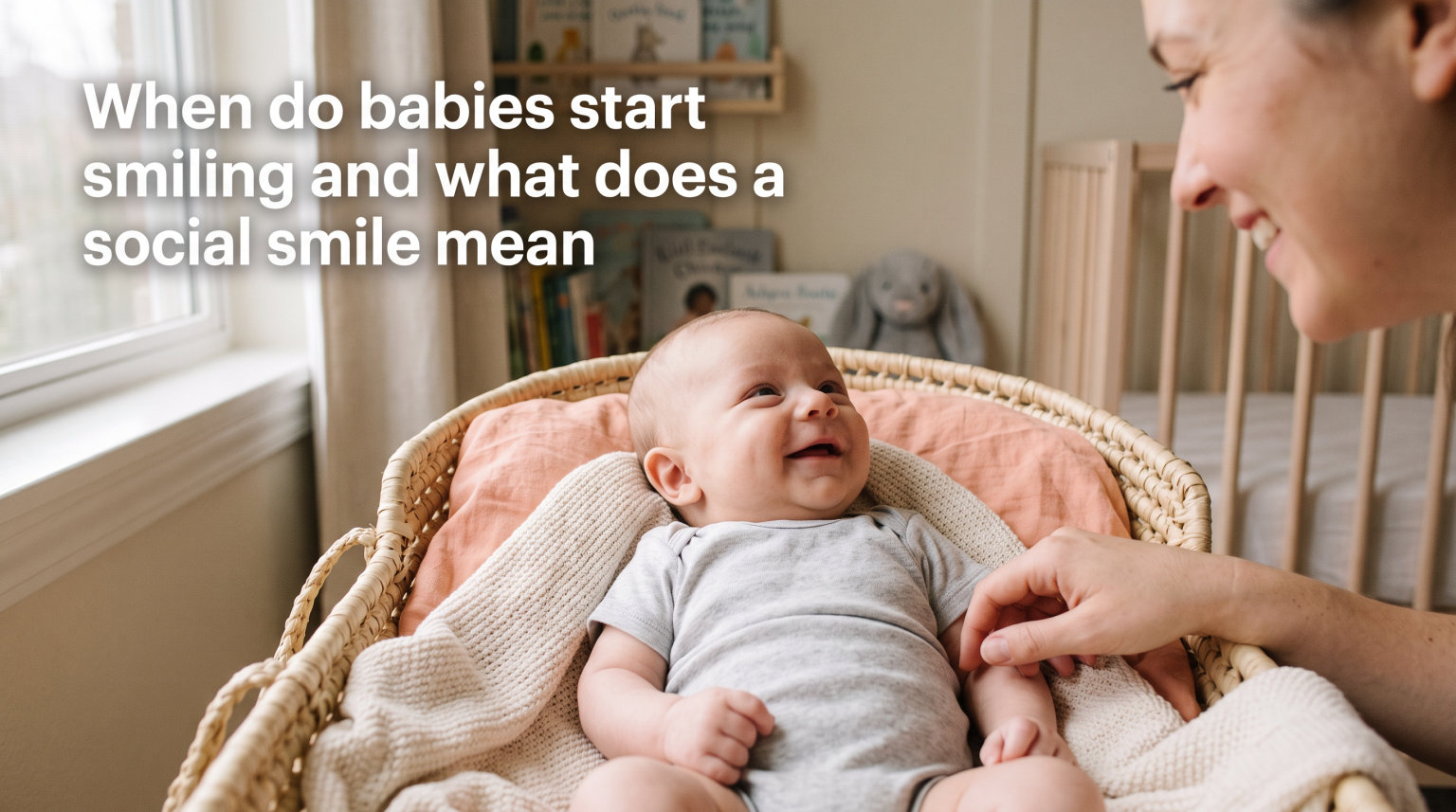
A social smile is your baby’s first intentional, responsive smile—where they smile back at you in recognition of your face, voice, or presence. Most babies develop this milestone somewhere between 6 to 8 weeks of age, though the normal range spans anywhere from 4 to 12 weeks. I remember waiting for my daughter’s first real smile, scrutinizing every twitch of her lips, wondering if that half-grin during a diaper change counted as the real thing.
If you’re in that waiting period right now, you’re not alone. Every parent I know has watched their newborn with hawk-like intensity, desperate for that first genuine social smile. The good news is that once it happens, you’ll know—it is completely different from those fleeting, mysterious expressions that flicker across your baby’s face during sleep or after a feeding.
Table of Contents
What Is a Social Smile and How Do You Recognize It?
A social smile represents one of your baby’s earliest forms of intentional communication. Unlike the random facial movements of early weeks, this smile happens specifically in response to you—or another familiar caregiver—when your baby sees your face, hears your voice, or feels your touch.
Our pediatrician described it perfectly at my son’s two-month checkup: a true social smile involves the whole face, not just the mouth. Your baby’s eyes will light up, their cheeks will rise, and you might notice tiny crinkles forming at the corners of their eyes. This full-face engagement is what psychologists call a Duchenne smile, and it signals genuine positive emotion rather than a reflexive muscle contraction.
The timing matters too. A reflex smile typically lasts only a second or two, appearing and disappearing like a passing shadow. A social smile hangs around longer—sometimes for several seconds—and it is responsive. You smile, pause, and your baby smiles back. That back-and-forth rhythm is your first real “conversation.”
Reflex Smile vs Social Smile: How to Tell the Difference
New parents often wonder how to tell if their baby’s smile is “real” or just gas. I have been there, staring at my daughter’s face at 3 AM, convinced that smirk meant she loved me, only to have her pediatrician gently explain the difference.
Reflex smiles are involuntary facial movements that can appear from birth. They tend to be brief, lasting only a second or two. The mouth often stays relatively closed, and the expression may look one-sided or lopsided. You will most commonly see these during REM sleep, after a good burp, or during digestion. They do not involve the eyes—your baby’s gaze may be unfocused or directed at nothing in particular.
Social smiles, by contrast, are intentional and responsive. They last longer, often several seconds. The mouth opens wider, and the whole face participates—cheeks lift, eyes crinkle at the corners, and your baby maintains eye contact with you. These smiles happen when your baby is alert and engaged, typically when you are talking to them, making faces, or offering close face-to-face interaction.
The most reliable test is responsiveness. Try this: get close to your baby’s face, about 8 to 12 inches away, make eye contact, and give a big, genuine smile. Pause. If your baby smiles back within a few seconds, you have witnessed a social smile.
When Do Babies Start Smiling Socially?
Most babies flash their first social smile between 6 and 8 weeks of age, right around the time of their two-month pediatric checkup. This timing is not coincidental—by this age, your baby’s vision has matured enough to focus on faces at close range, and their brain has developed the capacity for social recognition.
However, the normal range is surprisingly wide. Forum discussions reveal parents reporting first social smiles anywhere from 4 weeks to 12 weeks, and pediatricians confirm this variation is completely typical. My first baby smiled socially at exactly 6 weeks, almost to the day. My second waited until 10 weeks, and I spent those extra month worrying unnecessarily.
Premature babies often follow a corrected timeline based on their due date rather than birth date. If your baby arrived two weeks early, you might expect that first social smile two weeks later than the typical range. Every baby develops on their own schedule, and early smiling is not an indicator of future intelligence or developmental success.
How to Encourage Your Baby to Smile
You cannot force a social smile before your baby is developmentally ready, but you can create conditions that make smiling more likely. The key is face-to-face interaction during your baby’s alert, awake periods.
Get close—about 8 to 12 inches from your baby’s face. This is the distance your newborn can see most clearly. Make exaggerated expressions: big smiles, raised eyebrows, wide eyes. Your baby is learning to read faces, and high-contrast expressions are easier to interpret.
Talk or sing in a higher-pitched, sing-song voice. Research shows babies prefer this “parentese” and respond more readily to it. Pause after your expressions to give your baby time to process and respond. That pause-and-wait rhythm teaches them that communication is a two-way street.
Timing matters enormously. A tired, hungry, or overstimulated baby will not smile socially no matter how entertaining you are. Wait for those sweet spot moments—after a feeding, when your baby is calm and alert, or during quiet wakeful periods. Some babies are naturally more “smiley” than others, but every baby eventually develops this skill.
Why Social Smiles Matter for Development
That first real smile is more than just adorable—it represents a major milestone in your baby’s social-emotional development. When your baby smiles at you and you smile back, both of your brains release oxytocin, often called the “bonding hormone.” This biochemical exchange literally wires your baby for secure attachment.
Social smiling marks the beginning of intentional communication. Before this milestone, your baby’s expressions were involuntary. Now they are sending you a deliberate message: “I see you. I recognize you. You make me happy.” This two-way interaction forms the foundation for all future social learning.
Smiling also connects to other developmental milestones. Babies typically start cooing within weeks of their first social smile, and laughing usually follows a month or two later. These early forms of communication build on each other, creating the framework for language development and social competence.
When to Talk to Your Pediatrician About Smiling
Most forum discussions reveal a common thread among new parents: anxiety about developmental timelines. If you are worried because your baby has not smiled socially yet, please know this concern is completely normal. The waiting period can feel endless.
Pediatricians generally expect to see social smiling by the two-month checkup, but they also understand that healthy babies vary widely. Many doctors are not concerned unless a baby shows no social smiles by 3 months of age. Even then, there is usually a wide range of normal, and your doctor will look at the whole picture of your baby’s development.
Contact your pediatrician if your baby shows no social smiles by 3 months, rarely makes eye contact, seems not to recognize familiar faces, or shows no other forms of social engagement like cooing or responsive vocalization. These combined signs, not smiling alone, are what prompt further evaluation. The absence of smiling in isolation rarely indicates a serious problem.
If you are feeling anxious, call your pediatrician anyway. I did this with my second child, and the reassurance I received was worth any embarrassment about “overreacting.” Your doctor has heard these concerns thousands of times, and they would rather address your worry than have you stew in anxiety.
Frequently Asked Questions
How to tell if baby is social smiling?
A true social smile involves the whole face, not just the mouth. Look for eye crinkling, raised cheeks, and eye contact. The smile lasts several seconds and responds to your interaction. Try the smile-pause-test: smile at your baby, wait a few seconds, and see if they smile back. That responsive back-and-forth is the hallmark of a social smile.
Do autistic babies socially smile?
Yes, most babies with autism do smile socially, though patterns may differ. The absence of social smiling alone does not indicate autism. Autism spectrum diagnosis relies on multiple factors assessed over time, including eye contact, joint attention, and communication patterns across many months. If you have concerns about your baby’s development, discuss them with your pediatrician rather than drawing conclusions from any single milestone.
What is the 3-6-9 rule for babies?
The 3-6-9 rule refers to common developmental checkup schedules at 3 months, 6 months, and 9 months of age. At the 2-month visit, which typically falls near when social smiling emerges, pediatricians assess social-emotional development along with physical growth. This milestone-based monitoring helps track healthy development while accounting for individual variation.
What are early signs of giftedness in babies?
Early smiling is not a reliable indicator of giftedness or intelligence. While some studies have explored connections between early milestones and later development, individual variation in timing is enormous and perfectly normal. A baby who smiles at 4 weeks is not necessarily more advanced than one who smiles at 10 weeks. Focus on the quality of interaction and your baby’s overall developmental progress rather than comparing milestone timing.
Why does my baby smile in their sleep?
Sleep smiles are typically reflex smiles, not social smiles. During REM sleep, your baby’s facial muscles may twitch and move involuntarily, creating smile-like expressions. These sleep grins are adorable but neurologically different from the intentional, responsive social smiles that emerge during awake time around 6-8 weeks.
My baby is 9 weeks and hasn’t smiled socially yet—is this normal?
Yes, this is absolutely within the normal range. While many babies smile socially by 6-8 weeks, healthy babies may take anywhere from 4 to 12 weeks to develop this milestone. My own second child waited until 10 weeks, and my pediatrician assured me this was completely typical. If you are concerned, mention it at your next checkup, but try not to worry.
Every Baby Smiles on Their Own Timeline
When do babies start smiling and what does a social smile mean? Most babies develop their first intentional, responsive social smile between 6 and 8 weeks of age, though anywhere from 4 to 12 weeks falls within the completely normal range. This milestone represents your baby’s first true form of intentional communication and the beginning of genuine social connection.
If you are still waiting for that first real smile, I understand the anxiety. I have been there, scrutinizing every facial twitch, comparing my baby to friends’ babies, wondering if something was wrong. The reality is that babies develop on their own schedules, and a later smile says nothing about your baby’s future happiness, intelligence, or your quality as a parent.
When that first social smile finally arrives—and it will—you will know immediately. The whole face lights up, the eyes crinkle, and your baby is looking right at you, not through you. That moment of genuine connection makes the wait worthwhile. Until then, keep offering those big, goofy grins. Your baby is watching, learning, and getting ready to respond.