
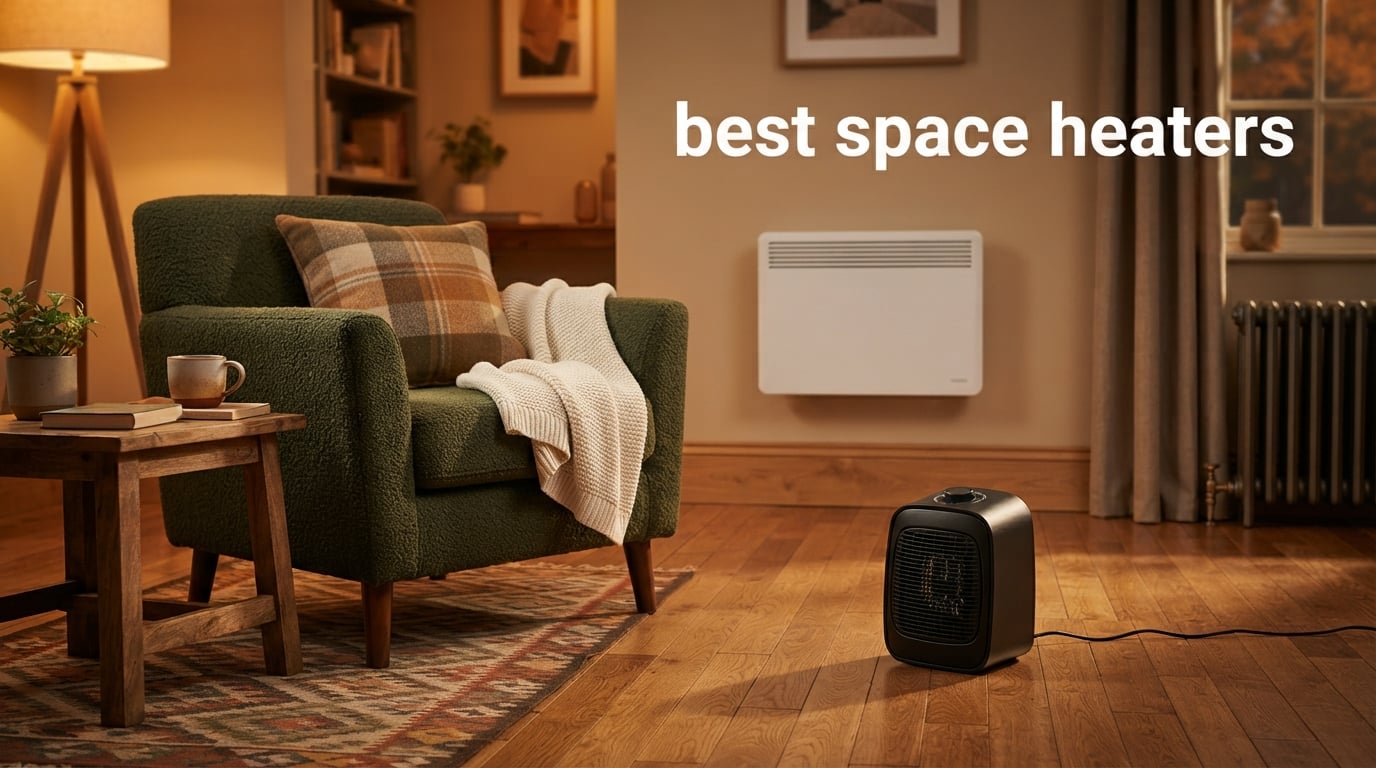
A good space heater should warm the occupied part of your home without turning safety, noise, or controls into an afterthought. The best space heaters for 2026 range from compact ceramic units for a desk or bedroom to a quiet oil-filled radiator and a mounted smart model for a fixed spot.
I approached this list by reading the supplied manufacturer specifications alongside product ratings and review volumes, not by pretending that I ran a lab test. That matters because a 1500-watt portable heater can have the same maximum electrical draw as another, while its airflow, thermostat, noise figure, safety hardware, and shape can make daily use feel very different.
Every pick below is an indoor electric heater with a stated thermostat or heat-control system and protective features documented in its listing. A portable space heater is a supplement for the room you are using, not a substitute for a central system or a reason to leave a heater running unattended.
The short version is simple: choose the DREO HSH006 for a compact, quiet ceramic option; choose the BREEZOME for wider oscillation in a modest room; and choose the DREO oil-filled radiator when silent, steady radiant warmth matters more than a fast blast of air. I also included choices for a wall installation, a tabletop office setup, and whole-room circulation.
Table of Contents
The top three picks for best space heaters are tailored to different rooms 2026
These three cover the most common needs without asking one design to do every job. I selected them for the clearest combination of documented controls, safety features, room-fit details, and practical daily convenience.
The DREO HSH006 is the all-around choice because it pairs a 41–95°F adjustable range with a remote, timer, child lock, and a listed 34 dB operating level. The BREEZOME is the better fit when 90-degree oscillation and a claimed 250-square-foot coverage figure match your room, while the tilting DREO can direct warmth toward a chair, bed, or desk.
These best space heaters in 2026 cover portable, wall-mounted, and radiant needs
The quick comparison below includes every model in this guide. Coverage claims are manufacturer figures rather than a promise that any heater will warm every drafty, open-plan, or poorly insulated room the same way.
| Product | Specifications | Action |
|---|---|---|
 DREO HSH006 DREO HSH006 |
|
View product details |
 DREO DR-HSH020 DREO DR-HSH020 |
|
View product details |
 BREEZOME MG26AQN BREEZOME MG26AQN |
|
View product details |
 Lasko Artisan CX16550 Lasko Artisan CX16550 |
|
View product details |
 DREO Smart Wall Heater DREO Smart Wall Heater |
|
View product details |
 DR. Infrared DR-123 DR. Infrared DR-123 |
|
View product details |
 Lasko Ellipse CD12950 Lasko Ellipse CD12950 |
|
View product details |
 DREO Oil Filled Radiator DREO Oil Filled Radiator |
|
View product details |
 Vornado MVH Vornado MVH |
|
View product details |
 Vornado AVH10 Vornado AVH10 |
|
View product details |
For context, ceramic forced-air models respond quickly and distribute heat with a fan, while an oil-filled radiator warms more gradually through radiant heat. The wall model saves floor area, and Vornado’s circulation approach aims to move warm air through a small or medium room instead of concentrating it right in front of the unit.
1. The DREO HSH006 is the best all-around compact heater for bedrooms and offices
DREO Space Heater, Portable Electric Heaters for Indoor Use with Thermostat
- 34 dB listed operation
- 41-95 F control
- Remote and timer
- Child lock
- Tip-over protection
- Indoor use only
- 200 sq ft stated coverage
I would start with the DREO HSH006 when the goal is a space heater for bedroom or home-office use without a bulky footprint. It is a 3.04-pound tower measuring about 11 inches tall, with 1500-watt PTC ceramic heat and a stated 200-square-foot coverage area.
The standout specification is the 34 dB listed operating level, which is useful for readers who have flagged fan noise as a sleep and concentration problem. Its controls cover 41–95°F in one-degree increments, and the supplied details list Power Heat, ECO, and Fan Only modes along with a remote and a 12-hour timer.
Its close-range warmth and precise thermostat suit a regularly occupied small room
The small tower form makes sense beside a desk or near a bed where floor space is limited, provided it has clear space around it. The heat-funnel design is described as extending the reach of warm air, but I would still treat the 200-square-foot figure as the appropriate starting point rather than expect it to overcome an open doorway or major drafts.
One-degree thermostat steps help when you want a steady target instead of repeatedly switching the heater from high to off. The memory function, mute option, remote, and child lock add day-to-day convenience that basic dial-controlled heaters do not offer.
Its safety package makes supervised indoor use the sensible way to run it
The listing documents a tilt-detection sensor, overheat protection, and V0 flame-retardant materials. Those are meaningful layers, but they do not change the basic routine: plug directly into a wall outlet, place the unit on a level hard surface, and keep textiles, bedding, and furniture clear.
The HSH006 is not the choice for a large, open living area or outdoor use. For a small room where quiet operation, compact size, and detailed temperature control matter, it is the clearest first pick in this group.
2. The DREO DR-HSH020 is the best portable heater for directing warmth upward or forward
- Adjustable tilt
- 34 dB listed operation
- Remote and touch controls
- ETL certified
- Tip-over protection
- Indoor use only
- No stated coverage figure
The DREO DR-HSH020 separates itself from an ordinary desk heater with a head that adjusts through 0, 20, 40, and 60 degrees. I see that as a practical answer for a recliner, bedside setup, or desk where straight-ahead airflow lands below or above the person who needs it.
It uses the same 1500-watt Hyperamics PTC approach, has a 41–95°F setting range in one-degree increments, and lists 34 dB operation. At 3.5 pounds and about 10 inches tall, it remains easy to shift within one room rather than acting like a fixed appliance.
Its tilt head is the direct answer for personal warmth that needs a different angle
Aiming the heated airflow is a more useful feature than it first sounds, especially when a heater sits low on the floor beside a seated person. The manufacturer lists 10.5 feet per second of airflow and 53.9% more heated air than traditional heaters, claims that describe its air-delivery design rather than a room-size guarantee.
Three heat settings and three fan settings give more combinations than a two-setting basic heater. The remote and touch controls mean that changing the direction or temperature plan does not require moving a chair or reaching across a desk.
Its eight listed protections support a supervised bedroom or work-area routine
The supplied product information calls out advanced tip-over protection, overheat protection, V0 flame-retardant materials, and ETL certification. These are the features I would want before considering a portable model for a room where people, pets, or an active household may brush past it.
There is no stated square-foot coverage number in the listing, so I would choose this DREO for directed personal heat instead of assuming it can condition a large room. It is indoor-only, and a tilt head should never be aimed at curtains, bedding, or other nearby fabrics.
3. The BREEZOME MG26AQN is the best oscillating ceramic heater for a modest shared room
- 90 degree oscillation
- 250 sq ft stated coverage
- 24-hour timer
- Remote control
- ETL certified
- 59 F minimum setting
- Indoor use only
The BREEZOME MG26AQN is the choice I would look at for a bedroom, home office, or compact living room where more than one person benefits from the heat. Its 90-degree oscillation and listed 250-square-foot coverage give it a broader brief than a heater meant only to warm one pair of feet.
This 16.2-inch tower uses 1500-watt PTC ceramic heat with a cross-flow fan platform. It has Power Heat, ECO, and Fan modes, three heat levels, a 24-hour automatic shutdown function, a remote, and an LED display.
Its 90-degree oscillation is the useful feature for spreading air across a compact room
Oscillation does not create more heat than another 1500-watt unit, but it can spread the warm airflow through a wider arc. That distinction matches the practical forum advice: maximum wattage alone is not the whole story when a room needs even distribution.
The stated quiet level is under 35 dB, so it belongs on a bedroom shortlist if a fan hum is a concern. Its carry handle also helps when the same heater will move between a workday office and an evening living area.
Its ECO range works best for users comfortable with a 59°F minimum setting
The ECO thermostat is listed from 59–95°F, unlike several DREO models that begin at 41°F. That limitation may not matter for typical comfort heating, yet it gives this model less low-end control for a cool utility room or a person who prefers a lower holding temperature.
The safety details include ETL certification, V0 flame-retardant materials, tip-over protection, and overheat protection. Use the 24-hour shutoff as a backstop, not as permission to operate an electric heater while no one is present.
4. The Lasko Artisan CX16550 is the best ceramic tower for a stated 300-square-foot area
- 300 sq ft stated coverage
- Wide oscillation
- Auto Eco thermostat
- Cool-touch housing
- Remote and timer
- Two heat settings only
- Limited review volume
The Lasko Artisan CX16550 stands out because its listing names a 300-square-foot heating coverage, the largest stated area among the ceramic tower-style units here. I would view that as a good candidate for a closed medium room, with insulation and ceiling height still deciding how it performs in practice.
It is a 15.56-inch, 5.1-pound floor tower with 1500-watt ceramic heat, widespread oscillation, two heat settings, a digital readout, and a 12-hour timer. The Artisan name also signals a styling choice for people who do not want an appliance that looks aggressively utilitarian in a living space.
Its stated 300-square-foot coverage is the reason to consider it for a medium enclosed room
When a room is larger than a personal office, wide oscillation can be more important than a tiny cabinet. The CX16550 pairs that air movement with an Auto Eco thermostat, so the product can adjust its output around the selected temperature instead of relying only on a fixed high setting.
There are just two heat settings, which is less granular than the DREO models with several heat and fan choices. Still, a remote and touch-sensing digital controls make the core functions simple to access from a couch or chair.
Its cool-touch housing and three protective features suit active household spaces
Lasko lists overheat protection, tip-over protection, and a cool-touch housing as its triple-safe package. That combination is reassuring in a living room, but a clear three-foot zone around the heater remains the safer habit for kids, pets, and passing traffic.
The available review count is smaller than that of several other choices, so I would not treat the matching rating alone as identical evidence of long-term use. Choose it when its stated coverage, oscillation, and decor-friendly tower format fit the room better than a compact personal heater.
5. The DREO Smart Wall Heater is the best fixed heater for saving floor space
DREO Smart Electric Wall Heater for Indoor Use, Works with Alexa,Large Room
- Wall-mounted design
- 28 dB listed noise
- Alexa and app control
- IP24 rating
- 24-hour timer
- Not portable
- 150 sq ft primary coverage
The DREO Smart Wall Heater makes the most sense when a heater needs a permanent home rather than another object on the floor. Its wall-mounted form leaves walking paths clear, and it brings a remote, app control, Alexa compatibility, a digital display, and a 24-hour timer to that fixed installation.
The manufacturer states 150 square feet as primary heating coverage and up to 750 square feet as supplementary heating. I would use the smaller number when deciding whether it can serve a room by itself, then treat the larger figure as help for an already heated space.
Its mounted design is the direct answer for a bedroom or office with limited floor area
At roughly 16 inches high and 6.13 pounds, this is not a portable unit you move from room to room. The included mounting template is a practical installation aid, but the wall location should follow the manual’s clearance and electrical directions rather than merely the nearest open patch of wall.
The 30-degree manual oscillation lets you alter the air direction after installation. That adjustment, together with 11.5-feet-per-second listed airflow, is helpful when the heater must avoid blowing straight at a desk or bed.
Its 28 dB figure and smart controls make scheduled comfort its strongest case
This model’s listed 28 dB noise level is the lowest supplied figure in the roundup, which puts it on the shortlist for a quiet bedroom or focused office. ECO mode with temperature calibration adds a way to tune the thermostat to the particular location rather than accepting a one-size setting.
The IP24 rating, overheat protection, and flame-retardant material are useful documented details, but this is still an indoor electric appliance that needs a sound installation and direct wall-outlet connection. It is the least appropriate choice if you need a heater to follow you from room to room.
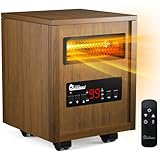
6. The DR. Infrared Heater DR-123 is the best mobile cabinet heater for a larger stated area
- 400 sq ft stated coverage
- Dual infrared and PTC heating
- Four caster wheels
- 30-99 F thermostat
- Lifetime filter
- 18-pound cabinet
- Remote batteries not included
The DR. Infrared Heater DR-123 is a different category from the little towers: it is an 18-pound cabinet with four caster wheels and a stated 400-square-foot coverage figure. For a larger bedroom, home office, garage, shop, or living room, I would rather roll this unit into place than repeatedly carry a smaller heater that is designed for personal warmth.
Its dual-heating design combines infrared quartz tubes with a PTC fan-forced system. The thermostat runs from 30–99°F, while Eco, High, and Low modes, a 12-hour timer, and the supplied remote offer more control than a simple on-off unit.
Its dual heating and stated 400-square-foot coverage fit a larger enclosed work or living area
Infrared and forced-air heat work in different ways: the radiant component is intended to provide comfortable direct warmth, while the fan helps move heat into the room. That combination is appealing for someone who wants both nearby warmth and broader circulation from one cabinet-form heater.
The listing describes the unit as under 45 dB, which is still a useful quiet claim but not as low as the 28–35 dB numbers published for several small models. The wheels matter here because 18 pounds is manageable to roll but not an effortless lift.
Its lifetime filter and long cord make recurring setup less demanding
The supplied details say the DR-123 has a lifetime filter that does not need replacement, plus a six-foot power cord. A cord should never be routed under rugs, pinched by furniture, or used to reach an overloaded outlet, regardless of its length.
Tip-over and overheat protection are listed, and the remote needs two AAA batteries that are not included. Pick this cabinet model for a larger stated room target and mobility on wheels, not for a tiny bedside footprint.
7. The Lasko Ellipse CD12950 is the best tabletop heater for wide close-room distribution
- 120 degree heat distribution
- Auto ECO mode
- Child lock
- Cool-touch housing
- 3-year warranty
- Tabletop placement needed
- 200 sq ft stated coverage
The Lasko Ellipse CD12950 gives a tabletop heater an unusually broad stated 120-degree heat-distribution design. It is a compact 3.1-pound ceramic unit for a bedroom, office, den, or desk-height surface, with listed 200-square-foot coverage and widespread oscillation.
Rather than relying on a tall narrow tower, the Ellipse uses a wide curved grille and a low tabletop shape. It has three heat settings, two fan settings, touch controls, a large display, remote control, and a timer that can run up to 12 hours.
Its 120-degree spread is the answer for a desk-side heater that should not feel narrowly aimed
The broader grille and oscillation can make a personal work area feel less like it is being heated from one fixed point. That is especially appealing if the heater sits on a stable side table facing a chair, rather than on a crowded desktop beside papers, cords, and electronics.
Lasko lists operation under 40 dB, which is a reasonable figure for an office or bedroom where phone calls and sleep matter. The shape does limit placement options compared with a floor tower, so measuring the intended surface is smart before choosing it.
Its Auto ECO mode and child lock make controlled personal heating its best role
The product listing says Auto ECO mode automatically adjusts output to maintain comfort while conserving energy, and it lists a claim of using 50% less energy in that mode. Actual use will vary with the selected temperature, room temperature, heat loss, and how long the heater cycles on.
A ceramic insert plug, tip-over sensor, child lock, and cool-touch housing round out the documented safety package. The three-year manufacturer warranty is also one of the more concrete coverage terms supplied for this list.
8. The DREO Oil Filled Radiator is the best quiet radiant heater for steady warmth
DREO Oil Filled Radiator Heater, Electric Heaters for indoor use Large Room
- Silent radiant heat
- 600W to 1500W modes
- Triple overheat protection
- Remote and child lock
- 24-hour timer
- 17.6 pounds
- Slower warm-up
The DREO Oil Filled Radiator is the natural pick for someone who dislikes fan noise and does not need instant warmth. Oil-filled radiator heaters work by warming internal oil and releasing heat from the fins, so their strength is gradual, stable radiant comfort rather than a quick stream of heated air.
This 17.6-pound model has 1500-watt maximum output, a 250-square-foot stated coverage figure, seven fins, and selectable 600W, 900W, and 1500W modes plus ECO mode. It also includes a display, touchscreen, remote, child lock, timer, wheels, and handles.
Its silent radiant operation is the right answer for bedrooms and noise-sensitive work
There is no fan-noise figure because the listing describes this radiator as silent. That difference can be more comfortable for sleep or quiet reading, even though it also means the heater cannot push warm air across the room as quickly as a forced-air ceramic model.
The manufacturer says its seven advanced fins improve heat dispersion, which speaks to how the radiator spreads warmth after it heats up. I would give it time to establish a temperature and choose it for a consistently occupied room instead of a space that needs a fast warm-up the moment you enter.
Its lower-wattage modes offer a direct way to limit maximum output when conditions allow
The 600W and 900W settings give more control over electrical draw than a heater that offers only full 1500-watt operation. ECO mode and a precise sensor can cycle heat around the target temperature, though no electric resistance heater can make more heat from each watt than another at the same output.
The listing documents triple overheat protection, fire-resistant material, ETL listing, tilt protection, and a burn-proof plug. Because the radiator is tall, heavy, and hot by design, wheels should be used on a level floor and the heater should stay clear of people, pets, and combustible materials.
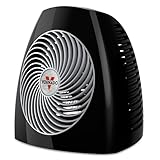
9. The Vornado MVH is the best simple whole-room circulator with a long warranty
- Vortex whole-room circulation
- Cool-touch exterior
- Three heat modes
- Tip-over shut-off
- 5-year replacement warranty
- Manual thermostat
- Small to medium rooms
The Vornado MVH is for shoppers who want a straightforward portable heater built around air circulation rather than a long list of digital extras. Its Vortex Heat Circulation is designed to gently move and evenly warm air in small to medium rooms, and the unit weighs 4.1 pounds.
It has Low, Medium, and High heat modes plus a seven-setting adjustable manual thermostat. There is no digital degree display, timer, remote, or published noise measurement in the supplied details, so this is a deliberately simpler choice.
Its Vortex circulation is the key feature for gently warming a small or medium room
The MVH’s approach is intended to circulate warm air through the room instead of functioning only as a close-range personal heater. Positioning still matters: give it an unobstructed path to move air and keep doors closed when possible if you want the room to retain warmth.
Three heat modes let you decide between a lower output and full output, but the manual thermostat needs a little more hands-on adjustment than a set-it-and-forget-it digital thermostat. That simplicity may be welcome for users who prefer physical controls over menus and apps.
Its five-year replacement warranty is the strongest long-term support detail in this roundup
Vornado says it will replace the product for up to five years if it does not meet the company’s standards. Warranty length is only one part of a buying decision, but it is a meaningful detail for readers who care about durability beyond the first heating season.
The cool-touch exterior, tip-over protection, and automatic shutoff system form the listed safety setup. It is suitable for supervised indoor heating in a small or medium room, not a fix for an oversized or poorly insulated space.
10. The Vornado AVH10 is the best whole-room heater with automatic climate control
- Automatic heat and airflow control
- Electronic thermostat
- Fan-only mode
- Cool-touch exterior
- 5-year replacement warranty
- Small to medium rooms
- No remote listed
The Vornado AVH10 adds automatic climate control to the brand’s whole-room circulation concept. I would pick it over the MVH when a digital electronic thermostat and automatic adjustment are more useful to you than the MVH’s simpler manual controls.
The AVH10 senses the heat and air circulation needed to maintain the preferred temperature, according to the supplied listing. It offers two quiet heat settings and a Fan Only mode, which gives it a use outside the heating months as an air circulator.
Its automatic climate control is the direct answer for hands-off temperature maintenance
Rather than selecting a fixed mode and revisiting it as the room changes, the AVH10 is designed to adjust heating and airflow around your chosen setting. That can make it easier to maintain comfort in a small bedroom, dorm, or living area with fairly consistent conditions.
It shares Vortex Heat Circulation with the MVH, aiming to distribute heat gently throughout a small to medium space. Neither a square-foot coverage figure nor a decibel figure is supplied here, so I would avoid assuming a specific large-room performance level.
Its fan-only mode gives it a year-round role beyond the heating season
The Fan Only option is a genuine functional distinction from many heaters that sit unused once temperatures rise. It does not cool air, but it can circulate it when you want airflow without heat.
The documented safety features are a cool-touch exterior, automatic tip-over protection, and a built-in safety shutoff system. Like the MVH, it carries a stated five-year replacement warranty, making it a strong choice for buyers who value climate automation and stated long-term support.
The right space heater depends on room, controls, noise, and safe placement
The most effective type of space heater is the one whose heating method and form factor match the room you actually occupy. A ceramic forced-air heater is usually the fastest route to warm airflow, an oil-filled radiator is the quiet steady-heat choice, and a vortex-style heater is for moving warmth through a small or medium enclosed room.
Start with the size and shape of the room, then think about how long you will be in it. A small desk setup may need directed airflow and low noise, while a closed medium living room may benefit more from oscillation or a heater with a larger stated coverage claim.
A closed room is the fairest setting for any stated coverage claim
Manufacturer coverage numbers are useful for comparing units, but they are not a guarantee. Ceiling height, drafts, insulation, open doors, windows, and the starting temperature all change the amount of heat a room loses.
Choose a 200-square-foot claim for a smaller closed room and look toward the Lasko Artisan’s 300-square-foot or DR-123’s 400-square-foot stated figures when the room is larger. For an open layout, use a heater as a supplement near the people using the space rather than expecting one plug-in appliance to heat the entire floor plan.
A digital thermostat gives more repeatable comfort than a simple manual dial
Digital controls help you pick a stated target and let an ECO or automatic mode cycle output around that point. The DREO HSH006, DREO DR-HSH020, DREO Smart Wall Heater, BREEZOME, DR-123, Lasko Ellipse, and Vornado AVH10 all provide a digital or electronic control approach in their supplied descriptions.
A manual thermostat is not wrong; it is simply less exact. The Vornado MVH is a good example of a simpler model with a seven-setting manual thermostat, three heat modes, and strong stated support, but it asks you to learn the setting that feels right in your room.
Low published decibel figures matter most for bedrooms, calls, and focused work
Noise is personal, but published figures offer a useful starting point when they are provided. The DREO Smart Wall Heater lists 28 dB, the DREO HSH006 and DR-HSH020 list 34 dB, the BREEZOME lists under 35 dB, the Lasko Ellipse lists under 40 dB, and the DR-123 lists under 45 dB.
The DREO oil-filled radiator is described as silent because it does not use a fan for its main heat delivery. Vornado does not supply decibel figures in the data used here, so choose those models for their circulation and controls rather than assuming a measured noise comparison.
A 1500-watt heater draws the same maximum power regardless of its badge or shape
At maximum output, a 1500-watt heater uses 1.5 kilowatts, which equals 1.5 kilowatt-hours for every full hour it actively runs. The useful energy-control question is not which 1500-watt resistance heater creates magically more heat per watt, but which thermostat, lower setting, or room-fit prevents unnecessary full-power runtime.
The DREO radiator’s 600W and 900W options are the clearest lower-output choices in this group. ECO modes, timers, and automatic climate control can also reduce on-time when the desired temperature is reached, but the room itself determines how often the heater needs to cycle back on.
Direct wall power and generous clearance are the non-negotiable safety basics
Use a heater on a stable, level, hard surface unless it is specifically made and installed for wall mounting. Plug it directly into a wall outlet, avoid extension cords and power strips, and keep a clear zone around it that is free of bedding, curtains, paper, furniture, clothing, and pet beds.
Tip-over protection, overheat protection, cool-touch housings, child locks, flame-retardant materials, ETL certification, and automatic shutoff are helpful documented features across these picks. They are layers of protection, not a reason to operate a heater while asleep, away from home, or in a wet location unless the product instructions specifically permit that use.
A warranty and a repair-friendly routine can matter after the first cold spell
The supplied warranties vary where terms are listed: the BREEZOME has one year, the DREO HSH006 lists 12 months that can extend to 30 months with registration, the Lasko Ellipse lists three years, and both Vornado models list up to five years of replacement coverage. Check the current documentation before purchase because terms and registration requirements can change.
Keep intake and outlet areas free of dust, follow the manual’s cleaning steps, and inspect the cord and plug before seasonal use. If the plug, cord, or outlet feels hot, stop using the heater and have the electrical issue assessed rather than treating it as normal operation.
These answers explain the space-heater questions shoppers ask most
A ceramic forced-air heater is often the most effective type for fast warmth—why?
A ceramic forced-air heater is often the most effective all-purpose type when you want fast, directed warmth in a small or medium room. Its fan moves heat quickly, while a thermostat can cycle output around the selected setting. An oil-filled radiator is usually better for silent, steady radiant warmth, and a vortex-style model is useful when whole-room air circulation is the priority.
The supplied picks answer which room heater is recommended—how should you choose?
Choose by room use rather than by a single overall label. The DREO HSH006 is a compact quiet choice for bedrooms and offices; the BREEZOME adds 90-degree oscillation for a modest shared room; the DREO Oil Filled Radiator favors silent steady heat; and the DR. Infrared DR-123 has the largest stated coverage at 400 square feet. Match stated coverage to a closed room and keep safety features central.
A quiet heater with controlled airflow is best for asthma-sensitive rooms—why?
For an asthma-sensitive room, prioritize a clean, dry, well-ventilated space and choose a heater that does not add combustion fumes because these are electric models. A quiet option with controlled airflow, such as the DREO HSH006 with a listed 34 dB level or the fanless DREO Oil Filled Radiator, may be more comfortable. A space heater does not filter air or treat asthma, so follow medical guidance and keep dust away from the heater.
The best heater for warming a room matches the room size and heater type—how?
For fast airflow in a smaller room, choose a ceramic forced-air heater such as the DREO HSH006 or BREEZOME. For a medium room, consider the Lasko Artisan’s stated 300-square-foot coverage or the DR-123’s stated 400-square-foot coverage when the room is enclosed. For quiet steady heat, choose an oil-filled radiator. Room insulation, drafts, and open doors can reduce real-world coverage.
The best space heater is the one that fits the room and safety routine
For most bedrooms and home offices, I would begin with the DREO HSH006 because its compact form, listed 34 dB operation, detailed thermostat range, and remote cover the everyday basics well. Choose the BREEZOME when wide oscillation is more useful, the DREO radiator when silent radiant warmth is the priority, and the DR-123 when you need the largest stated coverage in this guide.
The best space heaters in 2026 are not automatically the highest-output models, since most portable picks here top out at 1500 watts. Pick the heat-distribution method, controls, noise level, coverage claim, and form factor that fit your room, then follow the manual and safe-placement rules every time you use it.