
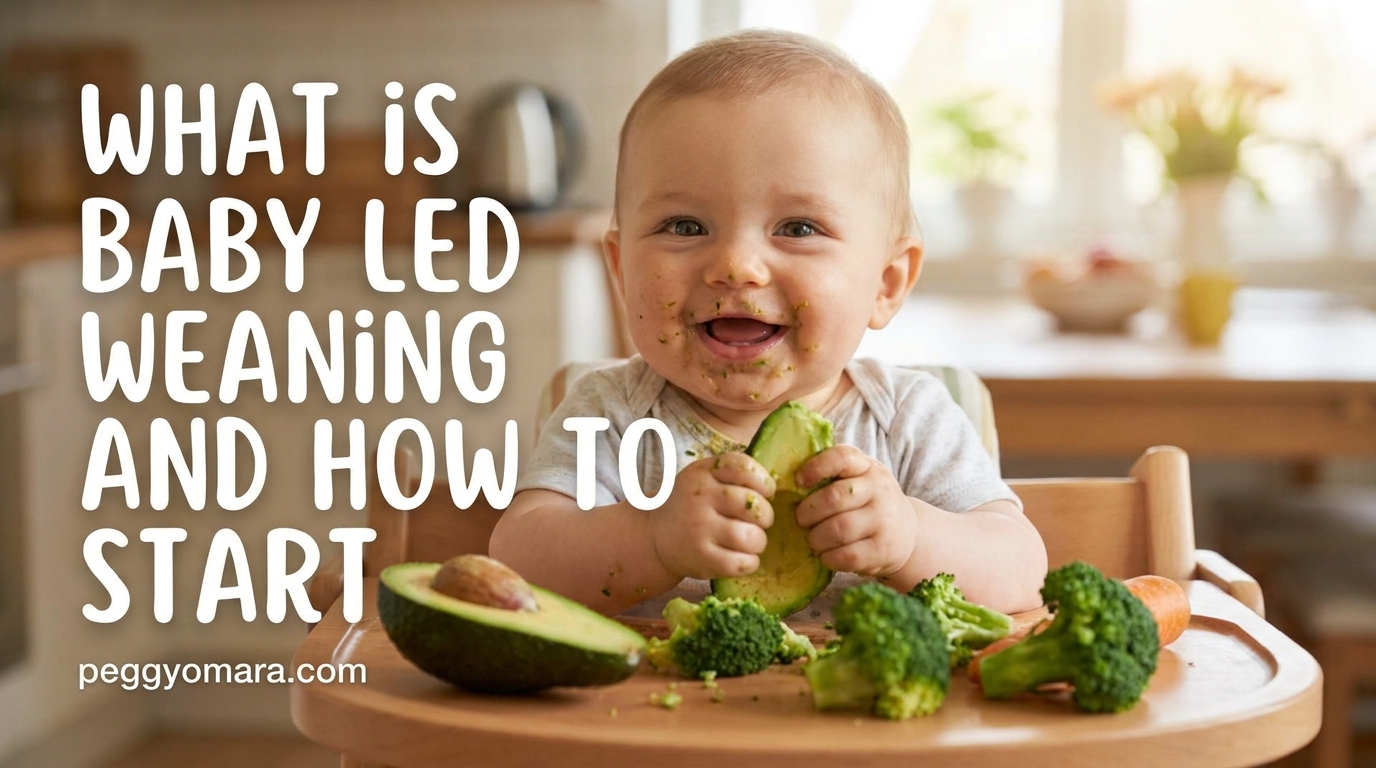
Baby-led weaning is a method of introducing solid food to babies where purées and spoon-feeding are skipped in favor of finger foods that a baby self-feeds. Starting around 6 months of age, babies join family mealtimes and explore age-appropriate foods at their own pace, developing independence and healthy eating habits from the very first bite.
If you have been researching how to start solids with your little one, you have probably seen photos of babies proudly munching on strips of avocado or spearing roasted sweet potato wedges. Maybe you felt inspired. Maybe you felt terrified. Both reactions are completely normal.
In this guide, we will walk through exactly what baby-led weaning is and how to start confidently. You will learn the signs your baby is ready, which first foods work best, how to tell the difference between gagging and choking, and practical tips from parents who have been exactly where you are now. We will also address the fears that keep parents up at night, because knowing what to expect makes all the difference.
Table of Contents
What Is Baby-Led Weaning?
Baby-led weaning (BLW) is an approach to introducing solid foods where infants feed themselves from the start. Instead of being spoon-fed smooth purées, babies are offered soft, graspable pieces of family foods that they pick up, explore, and eat independently.
The Core Philosophy Behind BLW
The fundamental principle of baby-led weaning is trust. Trust that your baby knows when they are hungry. Trust that they know when they are full. Trust that they can develop the skills to feed themselves when given appropriate opportunities.
This approach treats babies as active participants in feeding rather than passive recipients. When we spoon-feed, we control the pace, the amount, and the timing. With BLW, those decisions belong to the baby. They decide what to pick up, what to taste, how much to eat, and when to stop.
The baby sets the pace. This responsive feeding style helps babies maintain their natural ability to self-regulate food intake, a skill that research suggests may protect against obesity later in life.
BLW vs Traditional Weaning: Understanding Your Options
Traditional weaning typically begins with smooth purées spoon-fed by a caregiver, gradually progressing to mashed textures and then finger foods around 8-9 months. Baby-led weaning skips the purée stage entirely, starting with soft finger foods from day one.
Neither approach is inherently better. Both can result in well-nourished, healthy children when done thoughtfully. Some families choose to combine approaches, offering finger foods alongside spoon-fed purées. This flexibility is completely valid and works well for many households.
The key difference lies in who controls the feeding experience. Traditional weaning puts the adult in charge. BLW puts the baby in the driver’s seat. Your family circumstances, comfort level, and baby’s needs should guide your choice.
A Brief History of the Movement
Baby-led weaning as a named approach traces back to British midwife Gill Rapley, who coined the term in 2005. Her research into infant feeding revealed that babies developmentally capable of self-feeding were being prevented from doing so by cultural practices that emphasized early spoon-feeding.
However, the concept itself is not new. Before the commercial baby food industry emerged in the 1920s, most families worldwide practiced some form of baby-led feeding simply because pre-made purées did not exist. Babies ate what their families ate, modified as needed.
Today, major health organizations including the World Health Organization and the American Academy of Pediatrics recognize self-feeding approaches as valid options for starting solids, provided safety guidelines are followed.
Addressing the Skepticism: Is BLW Just a Trend?
You might wonder if baby-led weaning is simply another parenting fad without substance. The skepticism is understandable, especially when social media makes everything look picture-perfect.
Growing research supports BLW as a legitimate approach with measurable benefits. Studies have examined outcomes including food acceptance, obesity risk, motor development, and family quality of life. While more research is always needed, current evidence suggests BLW can be a safe and beneficial approach for most healthy infants.
That said, BLW is not the only right way to feed a baby. It works beautifully for many families but requires commitment, patience, and comfort with mess. If it does not fit your situation, traditional weaning or a combination approach is equally valid.
When to Start Baby-Led Weaning?
The timing of starting solids matters significantly for safety and success. Most babies are ready to begin baby-led weaning around 6 months of age, though individual readiness varies.
The 6-Month Milestone Explained
The 6-month recommendation exists for important developmental reasons. Before this age, most babies lack the physical skills to safely self-feed. Their digestive systems are not ready for solids. Their immune systems benefit from exclusive milk feeding during this critical window.
Starting too early increases choking risk because babies cannot yet sit upright safely or coordinate the complex oral movements needed for swallowing solid foods. Early introduction also displaces milk feeds before babies are nutritionally ready.
Some parents feel pressure to start earlier, especially if their baby shows interest in watching others eat or seems unsatisfied after milk feeds. These behaviors are normal developmental curiosity, not true readiness signs. Continuing to breastfeed alongside solids ensures your baby receives optimal nutrition for the first year.
Signs Your Baby Is Ready for BLW
Before beginning baby-led weaning, your baby should demonstrate all of these developmental readiness signs:
Sits independently with minimal support. Your baby should be able to sit upright in a high chair without slumping forward or sliding sideways. Good trunk control keeps the airway open during eating.
Shows good head and neck control. Your baby should hold their head steady and upright without wobbling, able to look around while seated.
Has lost the tongue-thrust reflex. When you touch a spoon or food to their lips, they should not automatically push it out with their tongue. This reflex protects against choking but must diminish before solids can be managed.
Demonstrates interest in food. Your baby watches you eat, reaches for your food, or opens their mouth when food approaches.
Can bring objects to their mouth. Your baby picks up toys and other items and successfully directs them toward their face.
Most babies reach these milestones right around 6 months, though some may be ready a few weeks earlier or later. Premature babies should be assessed based on their adjusted age.
Why Timing Matters for Safety and Success?
Starting at the right developmental window creates the best conditions for safe, enjoyable eating. A baby who cannot sit upright is at higher risk of food sliding backward in the mouth before they are ready to swallow. A baby with an active tongue-thrust reflex will struggle to manage anything beyond milk.
Beyond physical safety, timing affects the emotional experience of starting solids. Babies who are truly ready show curiosity and engagement. Babies pushed too early often become frustrated, developing negative associations with mealtimes that can persist.
If your baby reaches 6 months but has not yet developed all readiness signs, wait. There is no rush. A few weeks of additional development makes a significant difference in safety and enjoyment.
How to Start Baby-Led Weaning: A Step-by-Step Guide
Starting baby-led weaning feels overwhelming until you break it into manageable steps. This guide walks you through everything you need to know for your baby’s first meals and beyond.
Step 1: Gather Your Supplies
You do not need expensive equipment to begin BLW, but a few key items make the experience safer and cleaner.
A safe high chair is essential. Look for a high chair that allows your baby to sit with hips, knees, and ankles at 90-degree angles with feet supported. A footrest is not optional, it is a safety requirement. When babies have nowhere to rest their feet, they tend to push backward or slide forward, creating unstable posture.
Smock or bib with full coverage. Long-sleeved bibs or overall-style smocks protect clothing. Many experienced BLW parents strip babies to diapers for meals, especially in warm weather, because cleanup is easier.
Suction plates or bowls. These stay in place better than regular dishes when babies inevitably swipe at them. However, many parents find that placing food directly on the high chair tray works just as well in the beginning.
Easy-clean floor protection. A plastic mat, shower curtain, or large towel under the high chair catches falling food. Some parents use a handheld vacuum for quick cleanup after meals.
Soft-tipped spoons and open cups. Even with BLW, you will want spoons for yogurt or oatmeal. An open cup or small shot glass, with your help, teaches drinking skills alongside eating.
Step 2: Set Up a Safe Eating Space
Safety begins before food touches the tray. Always position your baby fully upright in the high chair, never reclined. The tray should be at a height where your baby can comfortably reach food without stretching or hunching.
Remove distractions during meals. Turn off television and put phones away. Mealtimes are social, but your attention should remain on your baby for safety monitoring.
Sit facing your baby or at a 90-degree angle so you can watch their face and breathing. Never leave a baby unattended while eating. Choking is silent, and you need to be present to respond immediately if needed.
Step 3: Choose First Foods Wisely
Select foods that are nutritionally valuable, easy to grasp, and safe for beginners. We will cover specific foods in detail in the next section, but generally, start with soft foods cut into finger-sized strips about the length and width of an adult finger.
Iron-rich foods should feature prominently from the start. Babies’ iron stores begin depleting around 6 months, and breast milk does not provide enough iron to meet growing needs. Soft strips of meat, iron-fortified cereals, beans, and egg yolks are excellent choices.
Offer one or two foods at a time in the beginning. Too many options can overwhelm babies. Place food on the tray and let your baby discover it naturally.
Step 4: Let Your Baby Lead
This is the heart of baby-led weaning. Your job is to provide appropriate foods. Your baby’s job is to decide whether and how much to eat.
Do not put food in your baby’s mouth. Do not guide their hands toward the food. Do not praise or pressure them to eat more. Simply sit with them, eating your own food, modeling enjoyment of meals.
Expect that your baby will play with food more than eat it for the first weeks or even months. This is normal and valuable. Through touching, smashing, dropping, and mouthing food, babies learn about textures, temperatures, and flavors. They are building comfort and familiarity before consumption begins in earnest.
Trust that your baby knows their own hunger and fullness cues. They may eat everything offered or barely touch a single piece. Both outcomes are acceptable. Milk remains their primary nutrition source until 12 months, so solid food intake varies widely without concern.
Step 5: Handle the Mess with Perspective
The mess is real. There is no sugar-coating this aspect of BLW. Food will be dropped, thrown, smeared, and ground into hair. Your floor will need daily attention. Your baby will need a bath after many meals.
Experienced parents offer these practical strategies. Strip baby to diaper or use full-coverage smocks. Place a washable mat under the high chair. Keep a damp cloth nearby for quick hand and face wiping. Accept that the floor is part of the process.
The mess phase does not last forever. As fine motor skills develop, dropping decreases. As eating skills improve, more food goes into mouths and less onto floors. Most parents find that after 2-3 months, the chaos becomes manageable.
What to Expect in the First Week of BLW
The first week of baby-led weaning often surprises parents. Many babies show intense interest in food, grabbing and mouthing everything offered. Others seem completely indifferent, ignoring food entirely. Both responses are normal.
Gagging is extremely common in the first week as babies learn to manage food in their mouths. This is protective and expected, not a sign that BLW is not working. We will cover gagging in detail in the safety section.
Actual swallowing may not happen for days or weeks. Your baby might explore textures, taste flavors, and spit everything out. This is learning. Swallowing will come naturally as skills develop.
Most families find that by the end of the first week, routine begins forming. Meals happen at predictable times. Babies understand that the high chair means food is coming. Parents feel slightly less anxious about the process.
Best First Foods for Baby-Led Weaning by Age
Choosing appropriate foods is one of the most important aspects of safe baby-led weaning. Food texture, size, and nutritional value all matter. Here is what to offer at each stage.
First Foods at 6 Months: Starting Simple
At 6 months, babies use a palmar grasp, scooping food into their fist. They need food pieces large enough to protrude from their grasp for easy biting. Think finger-sized strips about 3-4 inches long and roughly adult-finger width.
Vegetables: Steamed or roasted sweet potato strips, soft-cooked carrot sticks, steamed broccoli florets with large stems for handles, roasted zucchini spears, steamed green beans. Cook until easily squished between your fingers.
Fruits: Ripe avocado slices with skin left on as a grip handle, ripe banana split lengthwise, steamed apple slices, ripe pear spears, ripe mango strips. Soft fruits can be slippery, so leaving some peel or using crinkle-cut shapes helps with grip.
Proteins: Strip of tender slow-cooked meat, soft chicken thigh meat torn into strips, flaked cooked salmon, hard-boiled egg yolk cut into quarters, well-cooked lentil patties. Iron-rich options should appear daily.
Grains: Toast soldiers or strip of well-cooked pancake, large pieces of soft pasta, iron-fortified baby cereal mixed thick enough to scoop with hands. Some families prefer making their own baby food alongside BLW for additional options.
Expanding at 7-9 Months: New Textures
Between 7 and 9 months, babies develop the pincer grasp, using thumb and forefinger to pick up small items. Food can become smaller, though large pieces remain appropriate for practicing biting and tearing.
New additions: Small pieces of ripe banana, blueberries cut in half, cooked peas, soft beans like black beans or chickpeas (flatten slightly), small cubes of soft cheese, minced meat, rice balls, pasta shapes, soft-cooked quinoa.
Texture progression: Begin offering foods with more texture rather than completely smooth. Ground meat rather than slow-cooked strips, mashed beans with some whole ones mixed in, pasta with sauce for coating practice.
Family foods: More of what you eat can become baby-appropriate. Simply set aside a portion before adding salt or strong seasonings. Avoid processed foods high in sodium.
Advancing at 10-12 Months: Complex Meals
By 10-12 months, most BLW babies eat a wide variety of family foods. Their chewing skills have developed significantly, and they can handle more challenging textures.
Appropriate foods: Small pieces of tender meat, well-cooked vegetables cut into bite-sized pieces, whole grain breads, soft-cooked beans and legumes, scrambled eggs, soft casseroles and stews, pasta dishes, rice dishes, pieces of ripe fruit.
Self-feeding skills: Babies this age often want to use spoons themselves. Offer pre-loaded spoons with yogurt, oatmeal, or mashed foods. Let them practice dipping and scooping. Expect mess and resist the urge to take over.
Meal patterns: By 12 months, many babies eat three meals plus snacks, consuming significant nutrition from solids. Breast milk or formula remains important but decreases in proportion as food intake increases.
Safety and Choking: What Every Parent Must Know?
Fear of choking stops many parents from trying baby-led weaning. Understanding the difference between gagging and choking, knowing which foods to avoid, and learning safe preparation techniques transforms that fear into informed confidence.
Understanding the Gag Reflex in Babies
Babies have a much more sensitive gag reflex than adults. In infants, the gag reflex sits farther forward on the tongue, triggering protective responses earlier in the swallowing process. This is actually a safety feature, not a flaw.
When food touches that sensitive area, babies gag, pushing the food forward with their tongue. You will hear coughing, spluttering, and see the tongue thrust outward. The baby’s eyes may water. They might make noise. These are signs of gagging, which is protective and functional.
Gagging helps babies learn appropriate bite sizes and chewing patterns. It teaches them to slow down, to chew more thoroughly, and to respect their own limits. Frequent gagging in the first weeks of BLW is completely normal and decreases significantly as babies gain experience.
Gagging vs Choking: The Critical Difference
This distinction could save your baby’s life. Gagging is loud, active, and protective. Choking is silent and dangerous.
| Sign | Gagging (Normal) | Choking (Emergency) |
|---|---|---|
| Sound | Coughing, sputtering, gurgling noises | Silent or very quiet |
| Breathing | Breathing continues, though irregular | Cannot breathe, gasping |
| Color | May turn red in face | Turning blue or gray, especially lips |
| Eyes | Watery, may look surprised | Wide, panicked, or unfocused |
| Movement | Active tongue thrust, body movement | Still or limp, unable to move |
| Response | Continue watching, stay calm | Intervene immediately with first aid |
When your baby gags, stay calm and watch. Do not slap their back. Do not reach into their mouth. Do not show panic, which frightens your baby. Most gagging episodes resolve within seconds as the baby clears the food themselves.
If your baby is choking, you must act immediately. Call emergency services if you are alone. Begin infant back blows and chest thrusts. Every parent starting BLW should take an infant CPR and choking response course before beginning.
Foods to Avoid: The Choking Hazard List
Certain foods pose genuine choking risks for babies and should be avoided or carefully modified.
High-risk foods to avoid entirely under age 1:
Whole nuts and seeds, popcorn, hard raw vegetables like raw carrot rounds, whole grapes, whole cherry tomatoes, hot dogs or similar round foods, hard candies, gum, marshmallows, chunks of meat or cheese larger than a baby’s airway.
Foods requiring modification:
Apples and firm pears should be cooked or grated until chewing skills develop. Grapes and cherry tomatoes must be quartered lengthwise. Nut butters should be thinned or spread thinly rather than given by the spoonful. Stringy foods like celery or tough meat should be avoided initially.
Always cut cylindrical foods like sausages or bananas lengthwise rather than into rounds, which can block airways. Shape matters as much as texture.
Safe Food Preparation Techniques
How you prepare food matters as much as what you serve. The general rule is that food should be soft enough to mash between your thumb and forefinger with gentle pressure.
Cook vegetables until soft. Roasting often works better than steaming for achieving soft textures while maintaining shape. Meats should be slow-cooked until falling apart or offered as ground/minced preparations.
Cut food into appropriate shapes for your baby’s grasp. At 6 months, finger-sized strips. At 9 months, smaller pieces. Avoid perfectly round shapes. Cut round foods into thin strips or quarters.
When to Seek Medical Help
Most BLW experiences proceed without incident, but know when professional help is needed. Seek immediate medical attention if choking does not resolve quickly with first aid, if your baby turns blue, becomes unresponsive, or struggles to breathe after an episode.
Consult your pediatrician if gagging seems excessive or distressing to your baby beyond the first few weeks, if your baby consistently refuses all solids beyond 7-8 months, or if you have concerns about weight gain or growth. Trust your parental instincts when something feels wrong.
Benefits of Baby-Led Weaning: What the Research Shows?
Parents choose baby-led weaning for many reasons. Understanding the potential benefits, supported by emerging research, helps you make an informed decision for your family.
Benefits for Your Baby’s Development
Baby-led weaning supports fine motor skill development from the start. Grasping, bringing food to mouth, and manipulating different textures all strengthen hand-eye coordination and dexterity. Babies who self-feed typically develop the pincer grasp earlier than spoon-fed peers.
Oral motor development advances through BLW. Chewing from day one exercises jaw muscles and promotes proper oral development. This may have implications for speech development and dental alignment later.
Perhaps most importantly, BLW preserves a baby’s natural ability to self-regulate intake. Babies decide when they are satisfied rather than having a spoon urged toward them after signaling fullness. Early research suggests this may help prevent obesity by maintaining sensitivity to hunger and satiety cues.
Exposure to diverse textures early may reduce picky eating later. Babies who experience varied textures, temperatures, and flavors from the beginning seem more accepting of new foods in toddlerhood. The sensory exploration central to BLW builds food acceptance.
Benefits for the Whole Family
BLW simplifies meal preparation. You are not cooking separate baby meals, pureeing batches, or packing special containers. Your baby eats what you eat, modified for safety and salt content. Many families find this liberating.
Shared family meals strengthen bonds. When baby joins the table, mealtimes become social occasions rather than isolated feeding sessions. Babies observe family food culture, manners, and social interaction. Parents can enjoy hot meals while baby explores.
Parents often report that BLW feels more natural and enjoyable than spoon-feeding. Watching your baby discover food, make choices, and develop skills is genuinely delightful. Many parents find the process less stressful than anticipated once confidence develops.
What Current Research Says
Research on baby-led weaning continues to develop. Current studies suggest several positive outcomes, though more research is needed for definitive conclusions.
A 2019 study in the journal Pediatrics found that infants doing BLW had lower stress levels during feeding compared to spoon-fed infants. The self-directed nature of BLW appeared more relaxing for babies.
Research on picky eating shows promising results. Multiple studies indicate that BLW babies may be less selective eaters at age 2-3 years compared to traditionally weaned peers. Early texture exposure appears protective against neophobia, the fear of new foods common in toddlerhood.
Regarding weight outcomes, early studies suggested BLW might protect against overweight and obesity, though results are mixed. Some research shows no difference in weight outcomes between feeding methods when families practice responsive feeding regardless of approach.
Safety research has been reassuring. Studies comparing choking rates between BLW and traditional weaning have found no significant difference when parents follow safety guidelines. Proper food preparation and supervision matter more than method choice.
Introducing Allergens Safely
Food allergy introduction has changed dramatically in recent years. Current guidance encourages early introduction of common allergens rather than delay, which was previously recommended.
The Top Allergens to Introduce
The major food allergens are eggs, milk, peanuts, tree nuts, fish, shellfish, wheat, soy, and sesame. Early introduction, typically between 4-6 months once solids have started, is now recommended for most babies.
Start with well-cooked egg and yogurt or cheese for milk. Peanut can be introduced as thinned peanut butter or peanut powder mixed into other foods. Small amounts of wheat in well-cooked pasta or soft bread are appropriate.
Introduce one allergen at a time when your baby is healthy. Offer a small amount in the morning so you can monitor for several hours. Watch for hives, vomiting, facial swelling, difficulty breathing, or unusual lethargy.
Understanding the 3-Day Rule
The 3-day rule suggests waiting 3-5 days between introducing new foods to monitor for reactions. This was standard advice for generations and remains cautious practice.
However, current research supports introducing allergens more rapidly, especially for high-risk foods where early introduction appears protective against allergy development. Some families introduce a new food daily. Others prefer the traditional spacing.
If your baby has severe eczema, known food allergies, or a strong family history of allergies, consult an allergist before introducing high-risk allergens. They may recommend supervised introduction or testing first.
Tips for Successful Baby-Led Weaning
Learning from experienced parents and experts can smooth your BLW journey. Here are proven strategies for success.
Essential Tips from Experienced BLW Parents
Start when you are both ready. Your confidence matters as much as your baby’s readiness. If you feel anxious, consider taking an infant CPR course first. Starting from a place of calm makes the experience better for everyone.
Offer food at optimal times. Babies eat best when slightly hungry but not starving. Try mid-morning or early afternoon after a milk feed but before your baby becomes tired. Avoid introducing new foods when your baby is cranky or teething badly.
Keep early meals short. Ten to fifteen minutes is plenty for beginners. End the meal while everyone is still enjoying themselves. You can always offer food again later if your baby seems interested.
Model eating behaviors. Sit and eat with your baby whenever possible. They learn by watching you. Show enthusiasm for your food. Demonstrate chewing. Make mealtimes social and pleasant.
Respect rejection. Babies refuse foods for many reasons. They might be full, tired, not hungry, or simply not ready for that particular food. Never force or pressure. Offer again another day without comment.
Common BLW Mistakes to Avoid
Starting too early is the most significant mistake. Babies who cannot sit independently, who still have strong tongue-thrust reflexes, or who lack head control are not ready. Premature starting increases choking risk and creates negative associations with eating.
Wrong food sizes cause problems. Pieces too small frustrate babies who cannot yet pinch them. Pieces too small also pose choking hazards. Pieces too large intimidate beginners. Match food size to developmental stage.
Leaving baby unattended during meals is dangerous. Choking is silent. You must be present, watching, and ready to respond. Meals are not times to multitask on your phone.
Wiping your baby’s face mid-meal interrupts their concentration and signals that mess is problematic. Let the exploration happen. Clean up comes after the meal ends.
Forcing baby to eat more after they show fullness cues teaches them to ignore their body’s signals. Trust that your baby knows their own hunger. Milk provides complete nutrition until age 1, so solid food intake varies enormously without concern.
Making BLW Work for Working Parents
Working parents face unique challenges with BLW, but the approach remains entirely feasible. The key is maximizing weekend and evening family meals while ensuring caregivers understand the approach.
Discuss BLW thoroughly with daycare providers or family caregivers. Many are unfamiliar with the approach and may default to spoon-feeding out of habit or safety concerns. Share resources, demonstrate techniques, and provide clear written guidance about appropriate foods.
Batch cook on weekends when possible. Prepare soft-cooked vegetables, tender meats, and grains that caregivers can quickly assemble into meals. Frozen portions of appropriate foods make weekday meals easier.
Focus on family dinner as the primary BLW meal even if other meals follow different patterns. One self-directed meal daily still provides significant benefit. Do not pressure yourself to make every meal perfect.
Handling Unsupportive Family Members
Grandparents and older relatives often express concern about BLW. They may worry about choking, nutrition, or simply find the mess distressing. These concerns usually come from love and unfamiliarity rather than criticism.
Share reputable resources explaining the approach. The American Academy of Pediatrics and other respected organizations now recognize BLW as valid. Sometimes professional backing reassures concerned relatives.
Set boundaries firmly but kindly. You are the parent making decisions for your child. Thank relatives for their concern while maintaining confidence in your choices. If necessary, supervise mealtimes with skeptical caregivers to ensure guidelines are followed.
Remember that results speak louder than explanations. As your baby thrives, develops eating skills, and enjoys meals, concerns often fade naturally. Many grandparents become enthusiastic BLW supporters once they witness the benefits.
Frequently Asked Questions About Baby-Led Weaning
Is there any evidence that baby-led weaning is better?
What are common BLW mistakes to avoid?
What is the 3 day rule for weaning?
Is baby-led weaning nonsense?
Do babies need teeth for baby-led weaning?
Can you combine BLW with purees?
Conclusion: Trust the Process
Baby-led weaning offers a natural, developmentally aligned approach to starting solids that puts your baby in control of their eating journey. By understanding what baby-led weaning is and how to start safely, you give your baby the opportunity to develop independence, healthy eating habits, and a positive relationship with food from the very beginning.
The early weeks may feel messy and uncertain. Gagging episodes might spike your anxiety. Your baby might play with food for days before swallowing anything. These experiences are normal parts of the learning process.
Remember that there is no single right way to feed your baby. BLW works beautifully for many families but requires commitment and comfort with mess. If a combination approach or traditional weaning fits your circumstances better, those choices are equally valid.
Trust your baby. Trust yourself. Start when you are both ready, follow safety guidelines, and approach meals with calm confidence. The memories you create around your family table will last far longer than the mess on your floor.