
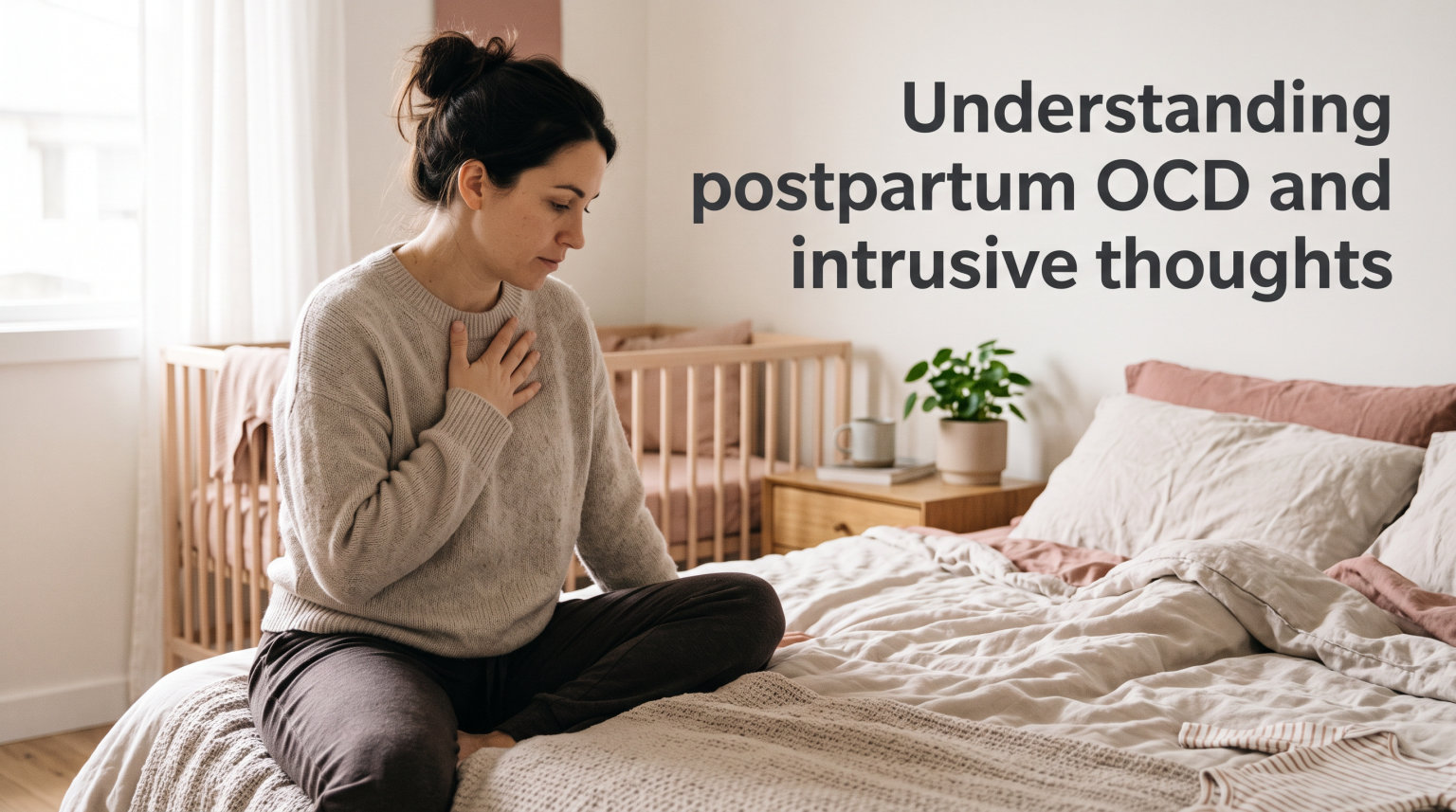
If you are having thoughts that scare you, thoughts you cannot control about harm coming to your baby, please know this first: you are not alone, you are not broken, and you will not act on these thoughts. Understanding postpartum OCD and intrusive thoughts begins with recognizing that up to 91% of new mothers experience unwanted, distressing thoughts about their baby’s safety. These thoughts do not make you a bad mother. In fact, they often mean the opposite.
Postpartum OCD is a treatable condition that affects 3-5% of new mothers. It belongs to a category called perinatal mood and anxiety disorders (PMADs), which also includes postpartum depression and postpartum anxiety. The difference with OCD is the specific pattern: unwanted thoughts that won’t leave your mind, followed by behaviors you feel compelled to perform to keep your baby safe.
I have spoken with many mothers who suffered in silence for months, convinced they were the only ones experiencing this. They feared judgment, feared having their baby taken away, and feared what the thoughts meant about them as mothers. Every single one of them found relief with proper support. This article will help you understand what is happening, why it is happening, and most importantly, how to feel better.
Table of Contents
Key Takeaways
- Postpartum OCD is a common, treatable condition affecting 3-5% of new mothers, characterized by unwanted intrusive thoughts and compulsive behaviors.
- Having intrusive thoughts does NOT mean you will act on them or that you are dangerous to your baby.
- 91% of new mothers experience intrusive thoughts; the difference is whether they become obsessive and disruptive.
- Effective treatments include cognitive behavioral therapy (CBT), exposure and response prevention (ERP), and medication when needed.
- Breastfeeding mothers have safe treatment options, including certain medications compatible with nursing.
- Postpartum OCD is fundamentally different from postpartum psychosis, a critical distinction for safety and reassurance.
What is Postpartum OCD?
Postpartum obsessive-compulsive disorder (OCD) is a perinatal mood and anxiety disorder that develops after giving birth. It involves a cycle of intrusive, unwanted thoughts about harm coming to your baby, followed by compulsive behaviors aimed at preventing that harm. The thoughts are ego-dystonic, meaning they go against your true values and desires. You do not want these thoughts, which is precisely why they cause such distress.
The condition typically emerges within the first few weeks after delivery, though it can develop anytime during the first year postpartum. Some mothers notice symptoms immediately; others find they intensify gradually as the demands of new motherhood increase. The onset often coincides with major hormonal shifts, sleep deprivation, and the overwhelming responsibility of caring for a newborn.
Unlike the normal worry all new parents experience, postpartum OCD involves thoughts that feel outside your control, repetitive, and deeply disturbing. The anxiety they produce can be paralyzing. Many mothers describe feeling trapped in their own minds, unable to share what they are experiencing for fear of judgment or consequences.
Postpartum OCD vs. Postpartum Depression vs. Normal Worry
Understanding the difference between these conditions can help you identify what you are experiencing and seek appropriate help. Here is how they compare:
| Feature | Normal New Mom Worry | Postpartum OCD | Postpartum Depression |
|---|---|---|---|
| Thought content | General concerns about baby’s wellbeing | Specific, graphic, intrusive thoughts about harm | Feelings of sadness, hopelessness, worthlessness |
| Control over thoughts | Can redirect attention | Cannot stop thoughts despite effort | Persistent negative mood |
| Response to thoughts | Reasonable precautions | Compulsive checking, cleaning, avoiding | Withdrawal, disinterest |
| Distress level | Moderate, manageable | Severe, overwhelming | Varies; often numbness |
| Impact on daily life | Minimal interference | Significant disruption to functioning | Difficulty caring for self/baby |
| Insight | Clear perspective | Knows thoughts are irrational but cannot stop them | May have distorted thinking |
Understanding Intrusive Thoughts
Intrusive thoughts are unwanted images, ideas, or impulses that enter your mind without invitation. They feel foreign and disturbing. For mothers with postpartum OCD, these thoughts almost always center on the baby: fears of accidentally or intentionally causing harm, contamination fears, or distressing sexual thoughts. The content can be shocking, which makes discussing it feel nearly impossible.
Here is what mothers commonly report experiencing:
- Vivid images of dropping the baby while walking down stairs
- Fears of accidentally smothering the baby while sleeping
- Thoughts about the baby getting sick from germs or contamination
- Distressing mental images of accidents (car crashes, drowning, falls)
- Intrusive sexual thoughts about the baby (a particularly shame-filled symptom)
- Fears of poisoning the baby through breast milk or food
- Thoughts about someone else harming the baby
These thoughts do not reflect your true desires or intentions. Research consistently shows that mothers with postpartum OCD are less likely to act on these thoughts than the general population because they are so distressed by them. The thoughts occur because your brain is hyper-alert to threats, and your baby is the most precious thing in your world. The very fact that these thoughts disturb you so deeply demonstrates that you are a protective, loving mother.
I want to emphasize this clearly: having a thought is not the same as having intent. The brain generates thousands of thoughts daily. Many are random, meaningless, or opposite to what we want. The problem with OCD is not the thought itself but the meaning you attach to it and the anxiety cycle that follows.
Understanding Postpartum OCD vs. Postpartum Psychosis
This distinction is so important that it deserves its own section. Many mothers with postpartum OCD fear they are developing psychosis, or they fear telling anyone about their thoughts because they worry their baby will be taken away. Let me provide reassurance on both counts.
| Postpartum OCD | Postpartum Psychosis |
|---|---|
| You are distressed by the thoughts and do not want them | You may believe the thoughts are true or rational |
| You have full insight that the thoughts are irrational | You may have lost touch with reality (delusions, hallucinations) |
| You actively resist the thoughts and try to prevent harm | You may believe you or the baby must die, or act on delusions |
| You are hypervigilant about baby’s safety | Behavior may be bizarre or disconnected from baby’s needs |
| Treatable with therapy and medication | Medical emergency requiring immediate hospitalization |
| Thoughts are ego-dystonic (against your values) | May lack awareness that thinking is distorted |
Postpartum psychosis is rare, affecting approximately 1-2 in every 1,000 births. It is a medical emergency characterized by delusions, hallucinations, severe confusion, and loss of touch with reality. If you are reading this article, seeking information, and distressed by your thoughts, you almost certainly have OCD, not psychosis. The fact that you recognize your thoughts as unwanted and disturbing demonstrates the insight that psychosis takes away.
Regarding Child Protective Services: mental health professionals who specialize in perinatal mood and anxiety disorders understand postpartum OCD. Their goal is to help you, not to separate you from your baby. When you seek help from qualified providers, you are taking the most protective action possible for your child and yourself.
Common Symptoms and Signs of Postpartum OCD
Postpartum OCD involves two main components: obsessions and compulsions. Understanding both helps you recognize the full picture of what you may be experiencing.
Obsessions in Postpartum OCD
Obsessions are persistent, intrusive thoughts, images, or urges that cause significant anxiety. They feel outside your control and occur repeatedly despite your efforts to suppress them. Common obsessions include:
- Fear of accidentally harming the baby (dropping, smothering, causing illness)
- Fear of intentionally harming the baby (stabbing, suffocating, shaking)
- Contamination fears (germs, chemicals, diseases)
- Sexual obsessions (unwanted sexual thoughts about the baby)
- Fear of making wrong decisions (feeding, sleeping, medical choices)
- Fear of losing control and acting on impulse
- Religious or moral obsessions (being a bad mother, sinful thoughts)
These thoughts often follow a pattern. They pop into your mind unbidden, trigger intense anxiety or shame, and then you feel compelled to do something to neutralize them or prevent the feared outcome. This leads to compulsions.
Compulsions in Postpartum OCD
Compulsions are repetitive behaviors or mental acts performed to reduce anxiety or prevent a feared event. While they provide temporary relief, they reinforce the OCD cycle and often increase over time. Common compulsions include:
- Excessive checking (breathing monitors, baby position, door locks, stove)
- Repetitive cleaning and sterilizing (bottles, pacifiers, hands, surfaces)
- Avoidance behaviors (not using knives, avoiding changing tables, not bathing baby alone)
- Reassurance seeking (asking partner repeatedly if baby is okay, Googling symptoms)
- Mental rituals (praying, counting, repeating phrases to “undo” thoughts)
- Excessive research (reading everything about SIDS, illnesses, safety)
- Constant monitoring (never leaving baby alone, watching breathing continuously)
These behaviors can consume hours each day. One mother I worked with spent three hours nightly sterilizing bottles, while another checked her sleeping baby every ten minutes throughout the night, leaving her exhausted. The compulsions steal time, energy, and joy from early motherhood.
Risk Factors and Causes
Postpartum OCD does not occur because you are weak, flawed, or unfit for motherhood. It develops from a combination of biological, psychological, and environmental factors. Understanding these risk factors can help reduce self-blame.
Biological factors: The dramatic hormonal shifts after delivery play a significant role. Estrogen and progesterone levels drop precipitously in the days following birth, affecting neurotransmitter systems including serotonin, which regulates mood and anxiety. Thyroid changes after pregnancy can also contribute to anxiety symptoms.
Personal history: Women with a personal or family history of OCD, anxiety disorders, or depression are at higher risk. If you experienced OCD symptoms before pregnancy, the postpartum period may trigger a recurrence or intensification. Previous postpartum mood disorders also increase risk in subsequent pregnancies.
Psychological factors: Perfectionism, high need for control, and difficulty tolerating uncertainty predispose some women to OCD. The unpredictable nature of infants can activate these underlying tendencies. Traumatic birth experiences or pregnancy complications may also contribute.
Environmental stressors: Sleep deprivation is perhaps the most significant environmental trigger. Lack of sleep impairs the prefrontal cortex, making it harder to dismiss intrusive thoughts. Lack of support, relationship stress, financial pressure, and isolation all increase vulnerability.
It is essential to understand that having risk factors does not mean you caused this condition. The combination of biological vulnerability and the unique stressors of new motherhood creates the perfect storm for postpartum OCD. You did not choose this, and you do not deserve to suffer with it.
Treatment Options for Postpartum OCD
Here is the hopeful news: postpartum OCD is highly treatable. With appropriate intervention, most mothers experience significant improvement within weeks to months. The evidence-based treatments for postpartum OCD include therapy, medication, and self-help strategies.
Cognitive Behavioral Therapy (CBT)
Cognitive behavioral therapy is the gold standard psychological treatment for OCD. CBT helps you identify the thought patterns that fuel anxiety and teaches skills to respond differently. A specialized form called Exposure and Response Prevention (ERP) is particularly effective.
ERP works by gradually exposing you to the thoughts, situations, or objects that trigger anxiety while preventing the compulsive response. Over time, your brain learns that anxiety naturally decreases without needing compulsions, and the feared outcomes do not occur. This retrains your threat detection system.
ERP sounds frightening, but it is done gradually and collaboratively with a trained therapist. You never do anything that would actually harm you or your baby. The goal is to build tolerance for uncertainty and anxiety, not to prove that bad things will not happen.
Medication Options
Selective serotonin reuptake inhibitors (SSRIs) are the most commonly prescribed medications for OCD. They work by increasing serotonin availability in the brain, which helps reduce obsessive thoughts and compulsive urges. Medication can be especially helpful when symptoms are severe or when therapy access is limited.
Common SSRIs prescribed for postpartum OCD include sertraline (Zoloft), fluoxetine (Prozac), and escitalopram (Lexapro). These medications typically take 4-6 weeks to reach full effectiveness. Dosage for OCD is often higher than for depression, so working with a psychiatrist familiar with perinatal OCD is important.
Breastfeeding-Safe Treatment Considerations
For breastfeeding mothers, medication decisions require careful consideration. Many SSRIs are compatible with breastfeeding, with sertraline (Zoloft) generally considered the first-line choice due to favorable transfer data. The amount that passes into breast milk is typically minimal, and studies have not shown adverse effects on infant development.
Working with a perinatal psychiatrist can help you weigh the risks and benefits. Untreated maternal OCD also carries risks for infant development through impaired bonding and maternal functioning. The decision should be individualized based on symptom severity, past treatment response, and personal values.
Non-pharmacological options like ERP therapy are fully compatible with breastfeeding and may be sufficient for some mothers. Online therapy options have expanded access significantly, making specialized treatment available even in areas with few local resources.
Support Groups and Additional Resources
Peer support can be invaluable for recovery. Connecting with other mothers who have experienced postpartum OCD reduces isolation and shame. Postpartum Support International (PSI) offers online support groups specifically for mothers with OCD and anxiety. The organization provides resources, provider directories, and a warmline for immediate support.
Self-help strategies that complement professional treatment include mindfulness meditation, which helps you observe thoughts without reacting to them; adequate sleep whenever possible; reducing caffeine and alcohol; and gentle exercise. These practices support overall mental health but are not substitutes for therapy when OCD is moderate to severe.
How Partners Can Help
Partners often feel helpless watching their loved one struggle with distressing thoughts. Understanding how to respond makes a significant difference in recovery. Here are evidence-based ways to support your partner through postpartum OCD.
What helps: Listen without judgment when she shares her experience. Reassure her that these thoughts are symptoms of a treatable condition, not reflections of her character. Validate her distress without validating the content of the fears (“I can see how scared you are” rather than “You’re right, that is dangerous”). Take over tasks that trigger compulsions when possible. Encourage professional help gently and consistently. Take care of your own mental health so you can be present for her.
What does not help: Dismissing her fears (“Just don’t think about it”), becoming frustrated with compulsions, providing constant reassurance that feeds the OCD cycle, monitoring her like a babysitter, or making her feel guilty for needing help. These responses, while understandable, often increase shame and isolation.
Partners can also benefit from education about OCD and may need their own support. Some fathers develop postpartum OCD themselves, experiencing similar intrusive thoughts about infant safety. Perinatal mental health affects the entire family system, and supporting the primary caregiver ultimately benefits everyone.
When and How to Get Help
Seeking professional help is a sign of strength and love for your baby. Consider reaching out if your thoughts are causing significant distress, interfering with your ability to care for your baby or yourself, consuming more than an hour daily, or if you are avoiding necessary activities due to fear.
Start with your obstetrician or midwife, who can screen for PMADs and provide referrals. Look for therapists who specialize in perinatal mental health and have training in ERP for OCD. Postpartum Support International maintains a directory of specialized providers. Many therapists now offer telehealth, expanding your options beyond local providers.
In your first therapy session, expect to discuss your symptoms, their impact on your life, your history, and your goals for treatment. The therapist should provide a safe, non-judgmental space. You do not need to share the most distressing details immediately; build trust at your own pace.
If you are in crisis, having thoughts of harming yourself or your baby, or feel you cannot keep yourself safe, seek immediate help through emergency services, your local crisis line, or the 988 Suicide and Crisis Lifeline. Postpartum psychosis requires immediate medical attention. For everyone else struggling with intrusive thoughts, know that effective treatment is available and recovery is possible.
Frequently Asked Questions
What are examples of intrusive thoughts postpartum?
Common intrusive thoughts include vivid images of dropping the baby down stairs, accidentally smothering them while sleeping, contamination fears about germs making the baby sick, thoughts about car accidents, and unwanted sexual thoughts. These thoughts are involuntary, distressing, and contrary to what the mother actually wants. Having these thoughts does not indicate risk to the baby.
How long do postpartum intrusive thoughts last?
Intrusive thoughts vary in duration. For 91% of mothers who experience them as normal new parent anxiety, they typically fade within the first few months as confidence grows. When postpartum OCD develops, thoughts persist for months without treatment. With proper therapy and/or medication, most mothers see significant improvement within 8-12 weeks, though recovery timelines vary individually.
How to stop postpartum intrusive thoughts?
You cannot force intrusive thoughts to stop, but you can reduce their impact through: 1) Cognitive Behavioral Therapy (CBT), particularly Exposure and Response Prevention (ERP), 2) Medication such as SSRIs if symptoms are severe, 3) Mindfulness practices to observe thoughts without reacting, 4) Reducing reassurance-seeking and checking behaviors that reinforce the cycle, 5) Prioritizing sleep and self-care, and 6) Connecting with specialized support groups.
What is the difference between postpartum OCD and anxiety?
While postpartum OCD involves anxiety, the key difference is the presence of obsessions and compulsions. General postpartum anxiety involves excessive worry about various aspects of motherhood without specific intrusive thoughts or ritualistic behaviors. Postpartum OCD features unwanted, repetitive thoughts that the mother tries to neutralize through compulsions. Both are treatable, but OCD typically requires specialized ERP therapy.
How long does postpartum OCD last?
Without treatment, postpartum OCD can persist for months or longer, sometimes worsening over time. With appropriate treatment (CBT/ERP therapy, medication, or both), most mothers experience significant symptom reduction within 8-12 weeks. Some may need longer treatment depending on severity. Early intervention leads to faster recovery and prevents the condition from becoming chronic.
What are postpartum OCD symptoms?
Postpartum OCD symptoms include obsessions (unwanted, intrusive thoughts about harm coming to the baby) and compulsions (repetitive behaviors to prevent that harm). Common obsessions involve fears of accidents, contamination, or intentional harm. Common compulsions include excessive checking, cleaning, avoidance behaviors, reassurance seeking, and mental rituals. These symptoms cause significant distress and interfere with daily functioning.
What is postpartum OCD treatment?
Postpartum OCD treatment typically involves Cognitive Behavioral Therapy with Exposure and Response Prevention (ERP), which is highly effective. Medication (SSRIs) is often recommended for moderate to severe cases and is generally compatible with breastfeeding. Support groups, online therapy, and self-help strategies like mindfulness complement professional treatment. Most mothers recover fully with appropriate care.
What are postpartum OCD sexually intrusive thoughts?
Sexual intrusive thoughts are a common but particularly shame-filled symptom of postpartum OCD. These involve unwanted, distressing sexual thoughts or images about the baby that are completely contrary to the mother’s values. These thoughts do not indicate any actual desire or risk. They occur because the OCD mind attacks what matters most to you. Treatment is the same as for other OCD symptoms: ERP therapy that helps you tolerate the thoughts without engaging with them.
Conclusion
Understanding postpartum OCD and intrusive thoughts is the first step toward healing. If you have read this far, you have already taken that step. You now know that these thoughts do not define you, that you are not alone, and that effective treatment is available.
Postpartum OCD is a medical condition, not a character flaw. It affects mothers who care deeply about their children, which is precisely why the thoughts are so disturbing. The same protective instinct that makes you a good mother has become overactive. With proper support from a therapist trained in ERP, medication if needed, and support from people who understand, you can reclaim your life and your joy in motherhood.
You do not need to suffer in silence. You do not need to wait and hope it goes away on its own. You deserve to feel at peace in your own mind. Reach out today. Whether that means calling your doctor, finding a therapist through Postpartum Support International, or simply telling your partner what you have been experiencing, take one small step. Recovery is not only possible, it is probable with the right help. You and your baby both deserve a mother who can be present, calm, and free from the prison of intrusive thoughts. That mother is still you, and she is waiting to come back.