
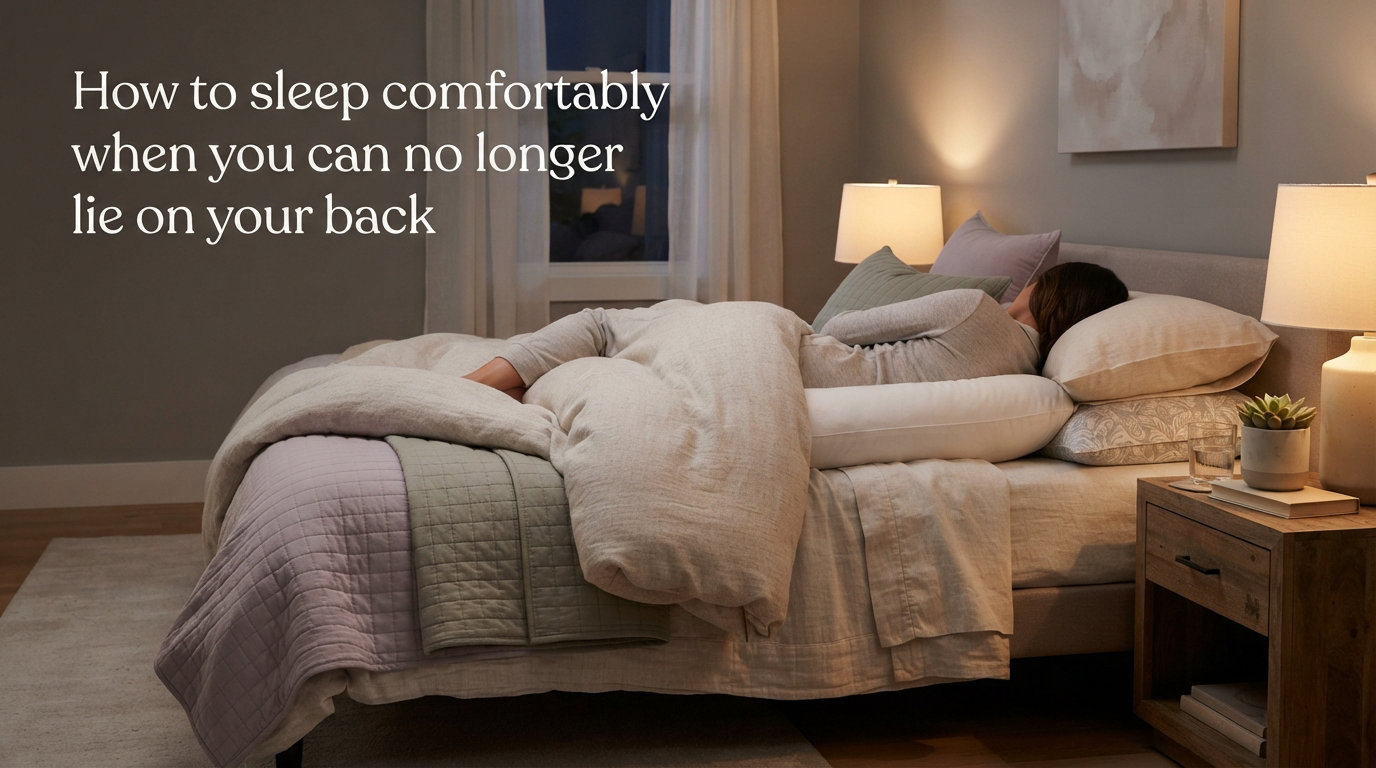
Waking up at 3 AM because you cannot get comfortable is frustrating. When your doctor tells you that you need to stop sleeping on your back, or your body simply refuses to tolerate that position anymore, it feels like someone is taking away your one safe place. I have been there, and I understand how disorienting it is to relearn something as basic as sleep.
The good news is that you can learn how to sleep comfortably when you can no longer lie on your back. It takes patience, the right setup, and a willingness to experiment. In this guide, I will walk you through exactly what worked for me and what I learned from talking to hundreds of people who faced the same challenge.
Table of Contents
Why You Might Need to Sleep on Your Back (Medical and Comfort Reasons)
There are several reasons why you might find yourself unable to sleep on your back anymore. Understanding why your body is rejecting this position helps you address the root cause rather than just masking symptoms.
Post-Surgery Recovery Requirements
After certain surgeries, particularly spinal procedures, hip replacements, or abdominal operations, doctors often recommend back sleeping to keep your spine aligned and reduce pressure on healing tissues. I spoke with several people recovering from lumbar fusion who were told they must sleep on their backs for at least six weeks. The adjustment period was brutal for them, but proper pillow support made it manageable.
Spinal Alignment Benefits
Sleeping on your back, when done correctly, keeps your spine in a neutral position. This means your head, neck, and spine stay aligned in a straight line, which reduces strain on your muscles and ligaments. Many physical therapists recommend back sleeping for people with chronic back pain because it distributes weight evenly across the body.
However, here is the catch. Back sleeping only helps if you have the right support. Without proper pillow placement under your knees and neck, back sleeping can actually worsen lower back pain. Your lumbar curve needs support, or your spine will flatten against the mattress and create tension.
Reducing Pressure Points
Side sleepers often wake up with numb shoulders or hip pain from pressure points. Stomach sleepers twist their necks unnaturally. Back sleeping eliminates these issues by distributing your body weight across the largest surface area. For people with arthritis or joint pain, this even distribution can mean the difference between waking up refreshed or in agony.
Pregnancy and Sleep Position Restrictions
During the second and third trimesters, doctors advise pregnant women to avoid back sleeping. The weight of the uterus can compress the vena cava, reducing blood flow. Some women find that even early in pregnancy, back sleeping becomes uncomfortable due to shortness of breath or dizziness. After delivery, many new mothers are eager to return to back sleeping but find their bodies have adapted to side sleeping and no longer tolerate flat positions.
Sleep Apnea and Snoring Considerations
Ironically, while some people need to start back sleeping for medical reasons, others are told to stop. Back sleeping can worsen snoring and sleep apnea because gravity pulls the tongue and soft tissues backward, obstructing the airway. If you have been diagnosed with obstructive sleep apnea, your doctor may have recommended side sleeping instead. This article is for those moving in the opposite direction, needing to learn back sleeping for recovery or pain relief.
How to Sleep Comfortably When You Can No Longer Lie on Your Back
Now we get to the heart of the matter. If you are transitioning to back sleeping because you can no longer tolerate your previous position, there is a specific approach that works better than just forcing yourself flat and hoping for the best.
The key is understanding that your body needs time to adapt. Muscle memory is real, and your preferred sleep position is often a decade-long habit. Expecting to change overnight will only lead to frustration. Instead, think of this as a three-week training program where each night builds on the last.
The Pillow-First Approach
Before you worry about your mattress or sleep environment, focus on pillows. They are the most immediate and affordable way to make back sleeping comfortable. The right pillow setup can transform a miserable night into restorative sleep, even on an average mattress.
Start with a pillow under your knees. This single adjustment maintains your lower back’s natural curve and prevents your hips from rotating forward. Next, ensure your neck pillow keeps your head aligned with your spine, not tilted up or down. Finally, consider a small pillow or rolled towel under your lower back for additional lumbar support.
Mattress Considerations
Your mattress plays a significant role in how comfortable back sleeping feels. If your mattress is too soft, your hips and butt will sink, creating an arch in your lower back that leads to morning pain. If it is too firm, you will feel pressure on your shoulder blades and tailbone.
Medium-firm mattresses generally work best for back sleepers. They provide enough support to keep your spine aligned while offering enough cushion for pressure relief. If you are not ready to buy a new mattress, a mattress topper can help adjust the firmness level. Memory foam toppers between two and three inches thick often provide the contouring back sleepers need.
Pillow Support Techniques That Actually Work
Let me break down the specific pillow strategies that have helped thousands of people transition to comfortable back sleeping. These are not theoretical suggestions. They come from real users who shared what worked in sleep forums and support groups.
The Knee Pillow Technique
Placing a pillow under your knees is the single most effective adjustment for back sleeping comfort. This simple change reduces pressure on your lower back by about 40 percent according to spinal health research. The pillow keeps your knees slightly bent, which flattens your lower back against the mattress and reduces the arch in your lumbar spine.
Use a standard bed pillow, folded in half lengthwise, or a dedicated knee pillow. The height should lift your knees just enough to feel your lower back relax into the mattress. Too high and your hips will tilt uncomfortably. Too low and you will not get the pressure relief you need.
Neck Support Essentials
Your neck pillow should keep your cervical spine in a neutral position. This means your head should not tilt forward toward your chest or backward toward the mattress. The pillow should fill the space between your neck and the mattress without lifting your head at an angle.
For back sleepers, a thinner pillow often works better than a thick one. Your head should rest flat, with just enough support to maintain the natural curve of your neck. Cervical pillows with a dip in the center can help cradle your head while supporting your neck. Experiment with pillow height by folding or removing fill until you find the sweet spot where your neck feels relaxed, not strained.
The Pillow Fortress Method
One technique I found repeatedly mentioned in Reddit forums is building a pillow fortress around your body. This approach helps if you tend to roll onto your side or stomach during the night. Place pillows on both sides of your body, tucked snugly against your hips and shoulders. Some people also place a pillow under each arm to prevent rolling.
This method serves two purposes. First, it creates a physical barrier that makes rolling uncomfortable, training your body to stay put. Second, it provides a sense of security and containment that many people find comforting. One Reddit user described it as creating a nest that signals to their brain that it is safe to relax in this position.
Lower Back Support Options
Not everyone needs additional lower back support, but for those with lumbar issues, it can be essential. A small pillow, rolled towel, or lumbar roll placed under the curve of your lower back provides targeted support. The key is placing it in the natural curve of your spine, not directly under your spine where it would create an unnatural arch.
Some people find that a full-body pillow works better than multiple smaller pillows. A U-shaped or C-shaped pregnancy pillow can provide support for your neck, knees, and sides all at once. These are particularly useful if you are recovering from surgery and need to avoid any pressure on specific body parts.
Training Yourself to Sleep on Your Back: A Step-by-Step Guide
Learning to sleep on your back is a skill you can develop with the right approach. I have broken this down into a seven-step process based on what actually works for real people, including insights from sleep forums and my own experience.
Step 1: Start With Short Daytime Sessions
Do not attempt to change your entire sleep position on your first night. Instead, start with 20-minute relaxation sessions during the day. Lie on your back on the floor or bed, using your full pillow setup, and simply practice relaxing. This helps your body get used to the position without the pressure of needing to fall asleep immediately.
Do this for three to five days before attempting a full night. Your nervous system needs time to accept this position as safe and comfortable. Many people report that after several days of practice sessions, falling asleep on their back feels much more natural.
Step 2: Create the Perfect Sleep Environment
Your bedroom setup matters more than you might think. Keep the room cool, between 60 and 67 degrees Fahrenheit, which promotes deeper sleep. Use blackout curtains to eliminate light, and consider a white noise machine if you are sensitive to sound.
Remove distractions from your bedroom. Your bed should be associated only with sleep, not with scrolling through your phone or watching television. This psychological conditioning helps your brain transition to sleep mode faster when you lie down, regardless of your position.
Step 3: Position Your Pillows Correctly
Before you lie down, arrange all your support pillows. Place the knee pillow where your knees will naturally rest. Position your neck pillow so your head will land in the right spot. If you are using side pillows, set them up on both sides.
Then, lower yourself carefully onto your back. Take a moment to adjust each pillow while you are still awake and aware. The pillow under your knees should feel supportive but not push your hips forward. Your neck should feel cradled, not propped up. Spend two to three minutes getting everything positioned perfectly.
Step 4: Use Physical Barriers to Prevent Rolling
If you are a former side or stomach sleeper, your body will try to return to that position subconsciously. This is where the pillow fortress mentioned earlier becomes essential. Place firm pillows on both sides of your body, tucked tightly against your hips and shoulders.
Some people take this further by sewing a tennis ball into a pocket on the back of a sleep shirt. When you try to roll onto your side or stomach, the tennis ball creates discomfort that wakes you just enough to adjust back to your back. I do not personally recommend this method because it disrupts sleep quality, but some forum users swear by it for the first week of training.
Step 5: Practice Relaxation Techniques
Once positioned, help your body relax with progressive muscle relaxation. Starting at your toes, tense each muscle group for five seconds, then release. Work your way up through your legs, abdomen, chest, arms, and face. This releases physical tension and distracts your mind from the unfamiliar position.
Deep breathing also helps. Try the 4-7-8 technique: inhale for four counts, hold for seven, exhale for eight. This activates your parasympathetic nervous system and makes falling asleep easier, regardless of your position.
Step 6: Be Patient With Setbacks
You will roll onto your side during the night. You will wake up uncomfortable and frustrated. This is normal and expected. When it happens, simply reposition yourself and your pillows, and try again. Do not judge yourself or decide that back sleeping is impossible for you.
Most people need two to three weeks to fully adapt to a new sleep position. Some take longer. Track your progress by noting how long you stay on your back each night. Celebrate small wins, like making it to 2 AM before rolling over, or waking up on your back after a full night.
Step 7: Consider a Weighted Blanket
A weighted blanket can help you stay in position by providing gentle pressure that discourages tossing and turning. Many forum users mentioned that switching to a weighted blanket was the turning point that made back sleeping possible for them. The weight signals your body to stay still and can reduce the subconscious urge to roll.
Start with a lighter weight, around 10 percent of your body weight, and increase if needed. Make sure you can still move freely if you need to adjust your position during the night.
When Back Sleeping Is Not Recommended
While this article focuses on learning to sleep on your back, it is important to acknowledge that back sleeping is not right for everyone. There are specific medical conditions where back sleeping can cause harm rather than help.
Sleep Apnea and Snoring
Back sleeping is generally the worst position for people with obstructive sleep apnea or chronic snoring. Gravity pulls the tongue and soft palate backward, which can block the airway and worsen breathing interruptions during sleep. If you have been diagnosed with sleep apnea, consult your doctor before attempting to sleep on your back.
Some people with mild snoring find that elevating the head of the bed by six inches reduces back-sleeping-related snoring. Adjustable beds or wedge pillows can achieve this angle while still allowing you to sleep on your back.
Pregnancy Restrictions
After the first trimester, most doctors advise against back sleeping during pregnancy. The weight of the growing uterus can compress the inferior vena cava, reducing blood flow to your heart and the baby. Left side sleeping is the recommended position for pregnant women, particularly in the third trimester.
If you are pregnant and reading this article in preparation for postpartum recovery, wait until your doctor clears you for back sleeping before trying these techniques. Your body needs time to recover from delivery, and your sleep position restrictions will change as you heal.
Acid Reflux and GERD
Back sleeping can worsen acid reflux and gastroesophageal reflux disease. When you lie flat on your back, stomach acid can flow more easily back into the esophagus. Side sleeping, particularly on the left side, is generally recommended for people with reflux.
If you must sleep on your back due to other medical reasons but have reflux, elevate the head of your bed or use a wedge pillow to keep your upper body at an angle. This reduces the likelihood of acid flowing backward while still allowing you to rest in a back position.
Certain Types of Back Pain
Not all back pain responds well to back sleeping. Some people with spinal stenosis or degenerative disc disease find that back sleeping increases their pain. If you try back sleeping and your pain worsens rather than improves, stop and consult your doctor or physical therapist.
Your specific spinal condition may require a different position. What works for someone with herniated discs may not work for someone with spondylolisthesis. Always prioritize pain relief and medical guidance over general sleep position recommendations.
Common Mistakes to Avoid When Learning to Sleep on Your Back
After analyzing hundreds of forum posts and my own failed attempts, I have identified the most common mistakes people make when trying to learn back sleeping. Avoiding these pitfalls will save you weeks of frustration.
Using the Wrong Pillow Height
The number one mistake is using a pillow that is too thick or too thin for back sleeping. Side sleepers often use thick pillows that prop their heads up, which tilts the neck forward uncomfortably when lying on the back. Stomach sleepers may use very thin pillows or none at all, which leaves the neck unsupported.
Test your pillow by lying down and having someone take a photo of you from the side. Your neck should form a straight line with your spine, not curve up or down. If you cannot get a photo, simply notice whether you feel any strain in your neck when lying flat. Any tension means your pillow needs adjustment.
Sleeping on a Too-Soft Mattress
As mentioned earlier, a mattress that is too soft causes your hips to sink, creating an arch in your lower back. This leads to morning back pain that many people mistakenly attribute to back sleeping itself rather than their mattress.
If you wake up with lower back pain after trying back sleeping, check your mattress. Lie on your back and slide your hand under your lower back. There should be a small gap, but if the gap is large enough to fit your entire forearm, your mattress is probably too soft.
Giving Up Too Soon
Most people try back sleeping for three or four nights, have a bad experience, and declare that they cannot do it. This is premature. Your body needs time to adapt to any new sleep position. I recommend committing to at least three weeks of consistent practice before deciding whether back sleeping works for you.
Keep a sleep journal during this period. Note what pillow setup you used, how long it took to fall asleep, whether you stayed on your back all night, and how you felt in the morning. Patterns will emerge that help you optimize your setup.
Ignoring Discomfort Signals
While persistence is important, you should not push through sharp pain or significant discomfort. Dull aches and muscle tension are normal during adaptation. Sharp pain, numbness, or tingling are signals that something is wrong with your setup.
If you experience sharp pain, stop immediately and reassess your pillow positions. Your knee pillow might be too high, or your neck support might be forcing your head into an awkward angle. Make adjustments and try again.
Not Using Enough Support
Many people try back sleeping with just a standard head pillow and wonder why they are uncomfortable. Back sleeping requires more support than side or stomach sleeping. You need support under your neck, under your knees, and possibly under your lower back.
Gather all the pillows in your house before starting your back sleeping experiment. You might need four or five pillows arranged strategically. Do not try to make do with minimal support. The investment in proper positioning pays off in better sleep quality.
FAQs
What is the Japanese trick to sleep?
The Japanese trick to sleep involves lying on your back with your arms and legs spread out in a starfish position. This position helps reduce body temperature and promotes relaxation. Some variations include placing a pillow under the knees and keeping the room cool to enhance the calming effect.
What is the 10 5 3 2 1 rule for sleep?
The 10 5 3 2 1 rule is a sleep hygiene framework: 10 hours before bed, no more caffeine; 5 hours before bed, no more large meals; 3 hours before bed, no more work or exercise; 2 hours before bed, no more fluids; 1 hour before bed, no more screens. This routine helps prepare your body for restful sleep in any position.
What is the forbidden sleeping position?
The forbidden sleeping position generally refers to sleeping on your stomach. This position forces your neck to twist to one side for hours, straining muscles and ligaments. It also arches your lower back unnaturally. Doctors and chiropractors typically advise against stomach sleeping due to the spinal strain it causes.
How to force body to sleep on back?
To train your body to sleep on your back, start by creating a supportive pillow setup with a pillow under your knees and proper neck support. Use side pillows as physical barriers to prevent rolling. Practice daytime relaxation sessions on your back to build comfort. Be patient, as most people need 2-3 weeks to adapt to a new sleep position.
How long does it take to learn to sleep on your back?
Most people need 2 to 3 weeks of consistent practice to fully adapt to sleeping on their back. Some may adapt faster within a week, while others need up to a month. The key is consistent nightly practice with proper pillow support and patience with setbacks during the training period.
Conclusion
Learning how to sleep comfortably when you can no longer lie on your back is absolutely possible. It requires the right combination of pillow support, patience, and a systematic approach to retraining your body. The key takeaways from this guide are simple but powerful.
Start with proper pillow placement, especially the pillow under your knees. Give yourself at least three weeks to adapt, tracking your progress along the way. Use barriers like side pillows to prevent rolling if needed. Most importantly, be kind to yourself during this transition. Sleep is essential to your health, and taking the time to get your position right is an investment in your wellbeing.
If you are struggling with the transition, remember that thousands of people have successfully made this change before you. The discomfort you feel now is temporary. With the techniques outlined in this guide, you will be sleeping comfortably on your back and waking up pain-free sooner than you think.