
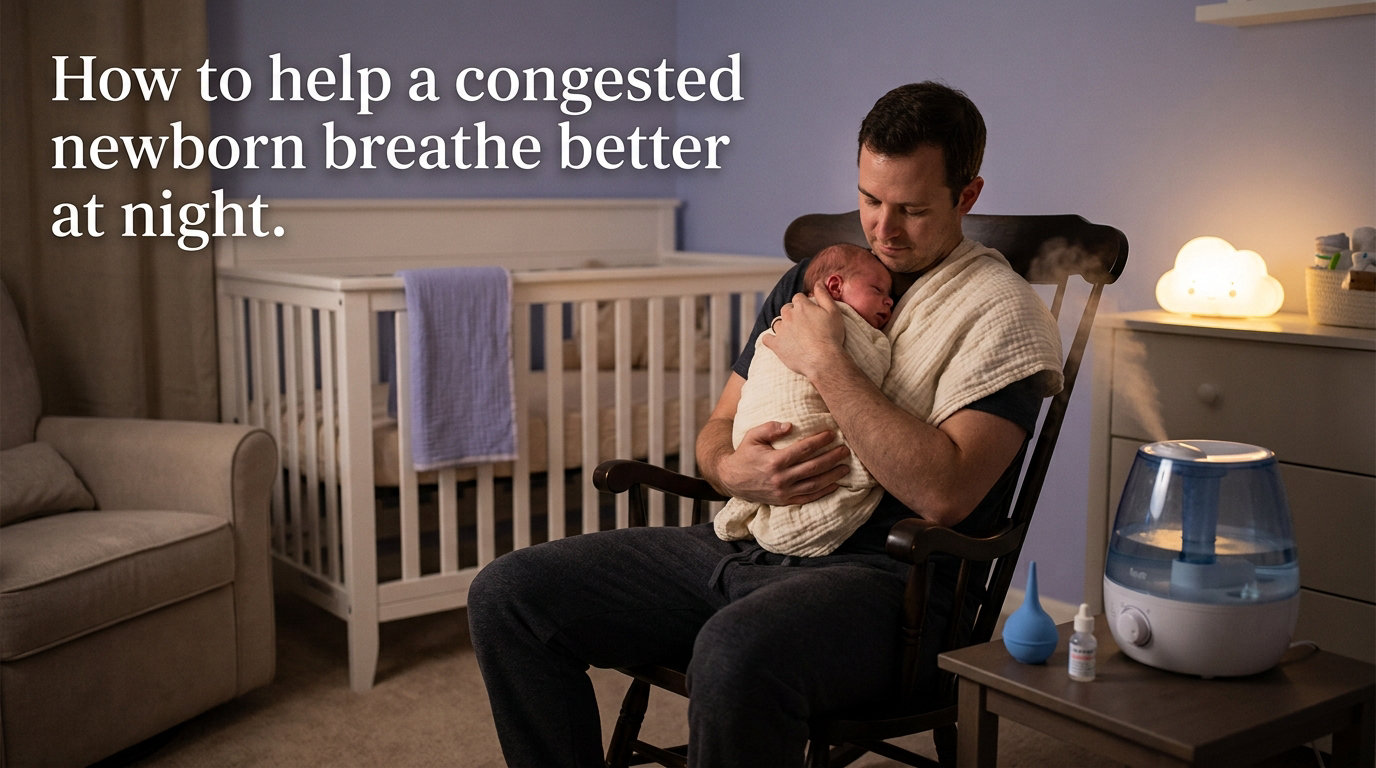
It is 2 AM. You are rocking your newborn who sounds like a tiny snorting piglet, and you are wondering if they are getting enough air. Their little nose is stuffed, their breathing sounds labored, and you have not slept more than twenty minutes all night. I have been there three times with my own babies, and I want you to know this: newborn congestion is incredibly common, and in most cases, it is completely normal.
Your baby’s nasal passages are tiny, and they breathe exclusively through their nose for the first several months of life. This combination means even a small amount of mucus creates big sounds. In this guide, I will walk you through exactly how to help a congested newborn breathe better at night, from immediate relief techniques to knowing when you should actually worry.
Table of Contents
Why Newborns Sound Congested at Night
Before we dive into solutions, let me explain why your baby sounds like a congested pug at 3 AM. Newborns have several physiological quirks that make nighttime congestion almost inevitable.
First, their nasal passages are incredibly narrow, about the diameter of a coffee stirrer. A tiny bit of mucus, dry air, or even normal secretions takes up significant space in those small channels. Second, babies are obligate nose breathers for the first 3-6 months. Unlike adults who switch to mouth breathing when stuffed up, babies have no backup option.
Then there is the gravity factor. When your baby lies flat in their crib, mucus pools in the back of their nasal passages instead of draining. This is why congestion almost always seems worse at night. Add in heating systems that dry out bedroom air during winter months, and you have the perfect recipe for a snuffly, restless baby.
Here is the reassuring part: most newborn congestion is not from colds or infections. It is often just normal newborn mucus, dry air irritation, or even regurgitated milk that irritates the nasal lining. Those snorting, snuffling sounds are usually far more distressing to parents than they are harmful to babies.
How to Help a Congested Newborn Breathe Better at Night
If you need immediate relief right now, here are the five most effective techniques to help your congested baby sleep more comfortably tonight:
1. Use saline drops before every sleep. Two to three drops in each nostril loosen mucus and make it easier to clear.
2. Gentle suction with a bulb syringe or nasal aspirator. Remove loosened mucus, but limit to 2-3 times daily to avoid irritating nasal tissues.
3. Run a cool-mist humidifier in the nursery. Aim for 40-50% humidity to keep nasal passages moist.
4. Try bathroom steam therapy before bedtime. Sit with your baby in a steamy bathroom for 10-15 minutes to loosen congestion.
5. Keep your baby well-hydrated. Frequent breastfeeding or formula feeding thins mucus naturally.
I will break down each technique in detail below so you can use them confidently and safely.
Safe Sleep During Congestion: The Most Important Rule
If you remember nothing else from this article, remember this: even when congested, your baby must sleep flat on their back on a firm surface. Never elevate their head. Never prop their mattress. Never let them sleep in a swing, car seat, or inclined sleeper to “help drainage.”
I understand the temptation. You think: if I am stuffed up, I sleep propped up on pillows. Should not my baby sleep elevated too? The answer is absolutely not, and here is why.
Think of your baby’s airway like a straw. When you suck through a straw that is straight, air flows freely. Bend that straw even slightly, and the flow is restricted. Your baby’s airway works the same way. When their head tilts forward or their neck bends even a little, that narrow airway gets squeezed. Their head is heavy relative to their body, and in an inclined position, it flops forward, compressing the airway.
This is why inclined sleepers have been linked to over 100 infant deaths and why the CPSC banned them. It is also why car seats and swings are not safe for unsupervised sleep, even for short periods. The risk of positional asphyxiation is real and documented.
Your baby is actually safer lying flat on their back, even with congestion, than they are at any angle. The flat position keeps their airway open and aligned. If mucus pools, their natural reflexes handle it. Trust their physiology, and trust the decades of safe sleep research.
Saline Drops and Gentle Suction: Your Go-To Nighttime Tools
This combination is your most effective weapon against nighttime congestion. I used this routine with all three of my children, and it became as automatic as changing a diaper.
Step 1: Saline Drops
Before every sleep period and before every feeding, place 2-3 drops of unmedicated saline solution in each nostril. You can buy pre-made drops or make your own with 1/4 teaspoon salt dissolved in 8 ounces of warm distilled water. The salt draws moisture into the mucus, thinning it so it can drain or be removed more easily.
Hold your baby semi-upright. Tilt their head back slightly. Drop the saline in, then wait 30-60 seconds. You will hear snuffling sounds as the saline works. Some babies sneeze, which is actually helpful for clearing mucus.
Step 2: Gentle Suction
After the saline has worked for a minute, use a bulb syringe or oral nasal aspirator to remove loosened mucus. Here is the technique that works best:
Squeeze the bulb before inserting it. Gently insert the tip just inside the nostril, no more than 1/4 inch. Release the bulb slowly to suction. Remove and squeeze the mucus onto a tissue. Repeat in the other nostril.
With an oral aspirator, you create suction with your mouth through a tube while the tip sits at the nostril opening. These often work better than bulb syringes and are easier to clean thoroughly.
Important limits: Do not suction more than 2-3 times per day, and do not insert the tip deeply. Over-suctioning irritates nasal tissues and can actually cause more swelling and congestion. Reserve your suction attempts for before important sleeps and feedings.
Humidifier and Steam Therapy for Nighttime Relief
Dry air is the enemy of congested babies. Running a cool-mist humidifier in your baby’s room can make a dramatic difference in their comfort level, especially during winter when heating systems strip moisture from the air.
Cool-Mist Humidifier Setup
Place the humidifier about 3-6 feet from the crib, close enough to add moisture to the air they breathe but not so close that mist settles on bedding. Aim for 40-50% humidity. You can buy an inexpensive hygrometer to measure this, or simply ensure the room feels comfortable, not damp.
Clean the humidifier daily according to manufacturer instructions. Standing water grows mold and bacteria quickly, which can make your baby sicker. Use distilled water if your tap water is hard, as minerals create white dust.
Bathroom Steam Therapy
Before bedtime, try this: close the bathroom door, turn the shower to hot, and let the room fill with steam. Sit with your baby in the steamy bathroom for 10-15 minutes, holding them upright on your shoulder. The warm, moist air loosens mucus beautifully.
I used to do this as part of our bedtime routine when my babies were congested. After the steam session, I would immediately use saline drops and gentle suction, then nurse or bottle-feed, then lay them down. The combination worked consistently to get us through the night with fewer wake-ups.
Warm Bath Option
A warm bath can provide similar benefits, especially if you keep the bathroom steamy. The warmth relaxes your baby and the humidity helps their breathing. Just keep bath time brief (5-10 minutes for newborns) to avoid chilling them afterward.
More Ways to Help Your Congested Newborn Sleep Better
Beyond the core techniques, these additional strategies can provide relief and improve sleep quality for everyone.
Keep Your Baby Well-Hydrated
Frequent feeding is one of the best ways to thin mucus naturally. Breast milk and formula are mostly water, and hydration keeps secretions flowing rather than thickening. Do not worry about overfeeding, congested babies often take smaller, more frequent feeds anyway. Let them nurse or bottle-feed on demand.
Upright Feeding Positions
How you position your baby during feeds matters. Try keeping them more upright rather than fully reclined. This reduces the chance of milk regurgitating up into the nasal passages, which can worsen congestion. For breastfed babies, a laid-back nursing position or football hold can help. For bottle-fed babies, keep the bottle tilted so milk fills the nipple, reducing air intake.
Address Silent Reflux
Here is something most articles miss: silent reflux is a common cause of persistent nighttime congestion. When stomach contents flow back up the esophagus, they can reach the nasal passages and cause irritation and swelling. Unlike typical spit-up, silent reflux happens without visible vomiting.
Signs include: congestion worse at night or after feeds, frequent hiccups, arching back during feeds, grimacing or swallowing after feeds, and poor sleep despite seeming tired. If this sounds like your baby, keep them upright for 20-30 minutes after each feed, burp frequently, and discuss with your pediatrician if symptoms persist.
Breastmilk Drops
Some parents swear by placing a drop or two of breastmilk in each nostril. Breastmilk has natural antibodies and anti-inflammatory properties. While research is limited, many pediatricians consider this safe. Use the same technique as saline drops.
Understanding Mucus Colors
Clear or white mucus is normal and usually indicates irritation or mild viral illness. Yellow or green mucus does not automatically mean a bacterial infection requiring antibiotics. It simply means white blood cells are present fighting a virus. Blood-tinged mucus is usually from dry, irritated nasal tissues. Only call the doctor about mucus color if it persists with other concerning symptoms.
How Long Congestion Lasts
If your baby has a cold, expect congestion to last 10-14 days. The first 3-5 days are usually worst. If congestion persists beyond 2 weeks without improvement, or keeps recurring, discuss with your pediatrician. There may be an underlying issue like allergies, structural concerns, or reflux.
When to Call the Doctor: Warning Signs Parents Should Know
Most newborn congestion is harmless and resolves with home care. But some signs require immediate medical attention. I want you to know the difference between “concerning but manageable” and “call now.”
Call 911 Immediately If You See:
Blue or gray lips, tongue, or skin. This means your baby is not getting enough oxygen. Retractions, when the skin pulls inward between or under the ribs with each breath, indicates serious breathing difficulty. Breathing faster than 60 breaths per minute while calm. Pauses in breathing longer than 10 seconds. Extreme lethargy or unresponsiveness.
Call Your Pediatrician the Same Day If:
Fever over 100.4F (38C) in a baby under 3 months, any fever is an emergency. Signs of dehydration: fewer than 6 wet diapers per day, dry mouth, no tears when crying. Refusing feeds or unable to nurse/bottle-feed because of congestion. Symptoms lasting more than 10 days without improvement. Wheezing or a harsh, barky cough. One nostril constantly blocked (possible foreign object in older babies).
Be Alert for RSV and Bronchiolitis
RSV (respiratory syncytial virus) is extremely common and usually mild in older children, but it can be serious in newborns. Watch for: rapid breathing, wheezing, grunting sounds with each breath, poor feeding, unusual sleepiness. If you suspect RSV, call your pediatrician. Many cases can be managed at home, but babies under 3 months sometimes need hospital support.
Trust your parental instincts. If something feels wrong, call. Pediatricians would rather hear from you ten times unnecessarily than miss one serious case. You know your baby best.
For Exhausted Parents: You’re Doing Great
I want to pause here and speak directly to you, the parent who has been awake for three nights listening to every breath your baby takes. You are exhausted. You are worried. You might be crying in the rocking chair at 4 AM, convinced you are failing because your baby is uncomfortable.
You are not failing. Congestion is one of the most frustrating aspects of newborn care because there is no instant fix. You cannot give a baby a decongestant. You cannot explain to them that it will pass. You can only offer comfort, do your best with the tools available, and wait for their little bodies to clear the mucus.
This phase will pass. Most babies outgrow the worst congestion by 3-4 months as their nasal passages grow and they develop the ability to mouth-breathe. You will sleep again. Your baby will breathe quietly again. Until then, you are exactly the parent your baby needs, even at 3 AM when you are running on fumes.
Frequently Asked Questions
How do I help my newborn with congestion at night?
Use saline drops in each nostril followed by gentle suction with a bulb syringe before bedtime. Run a cool-mist humidifier in the nursery to keep air moist. Try 10-15 minutes of steam therapy in the bathroom before sleep. Keep your baby hydrated with frequent feeds. Always place your baby flat on their back to sleep, even when congested.
Does congestion get worse at night for babies?
Yes, congestion typically worsens at night because lying flat causes mucus to pool in the back of the nasal passages. Gravity no longer helps drain the mucus as it does when upright. Additionally, bedroom air tends to be drier at night, especially with heating systems running, which can further irritate nasal passages.
Is it okay to let a baby sleep congested?
Yes, it is generally safe for a baby with mild congestion to sleep, provided they are placed flat on their back on a firm surface. Never elevate the head of the crib or let them sleep in an inclined position. If congestion is severe, causing breathing difficulty, or accompanied by fever or lethargy, contact your pediatrician before putting them down to sleep.
How do you treat a congested baby’s breathing?
Saline drops and gentle suction are the most effective treatments for clearing a congested baby’s breathing. Use 2-3 drops of saline in each nostril, wait 30-60 seconds, then suction with a bulb syringe or nasal aspirator. Limit suction to 2-3 times daily. Add a cool-mist humidifier to the room and ensure your baby stays well-hydrated. Seek medical care immediately for blue lips, retractions, or breathing over 60 breaths per minute.
Final Thoughts
Helping a congested newborn breathe better at night comes down to a few key techniques: saline drops, gentle suction, humidified air, and safe sleep positioning. Most congestion resolves within 10-14 days, and your baby will outgrow the worst of it as their airways develop.
Remember, you are doing a wonderful job even when it feels overwhelming. Trust your instincts, use these tools, and know that quieter nights are ahead.